Veda Skills Quantitative Aptitude Unit 9: Pipes and Cisterns
- 2 topics
- 118 MCQs
- 8 short answers
- 2 long answers
- 24 flashcards
- 2 games
- ~95 min read
- English
Checked before publishing: 23 automated checks, including a plagiarism check against the textbook's own words. How we check our content
Filling and Emptying
Treat each pipe as a worker: an inlet does positive work and an outlet negative work. Take the tank as the LCM of the times, add the hourly units with signs, and divide. Also handle tanks given in litres, tanks already part full and pipes of different speeds.
What you will be able to do
- I can find the time two or more filling pipes take together.
- I can combine filling and emptying pipes using signed rates.
- I can solve tank problems given in litres per minute.
- I can find the time to fill the rest of a partly full tank.

Key points
A pipe that fills a tank in n hours fills 1/n of it each hour.
An outlet that empties a full tank in m hours removes 1/m of it each hour: count it as negative.
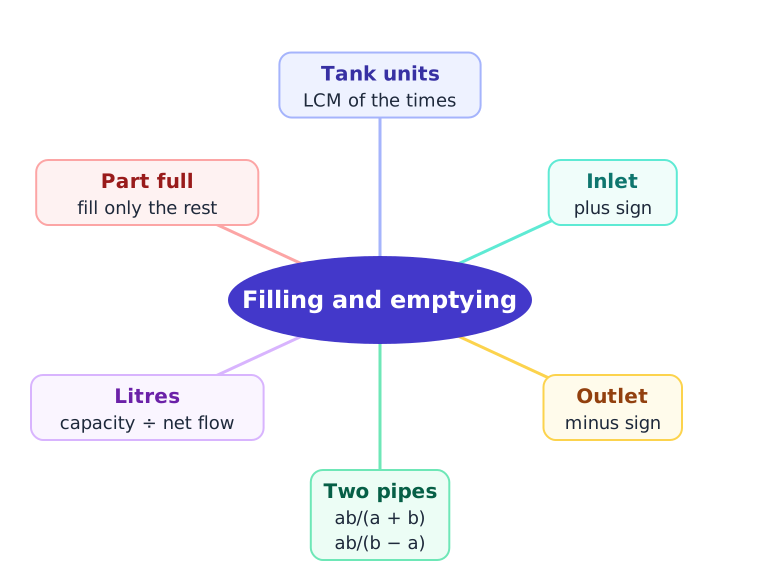
Take the tank as the LCM of all the times; then every hourly flow is a whole number of units.
Two inlets: time = ab/(a + b). Inlet a with outlet b (b > a): time = ab/(b − a).
If the outlet is faster than the inlet, a full tank empties in ab/(a − b) hours when both are open.
In litres: time = capacity ÷ (inflow − outflow) per unit time.
If a tank is already p/q full, only the remaining (1 − p/q) needs filling.
Flow through a round pipe is proportional to the square of its diameter.
Full explanation
The rooftop tank
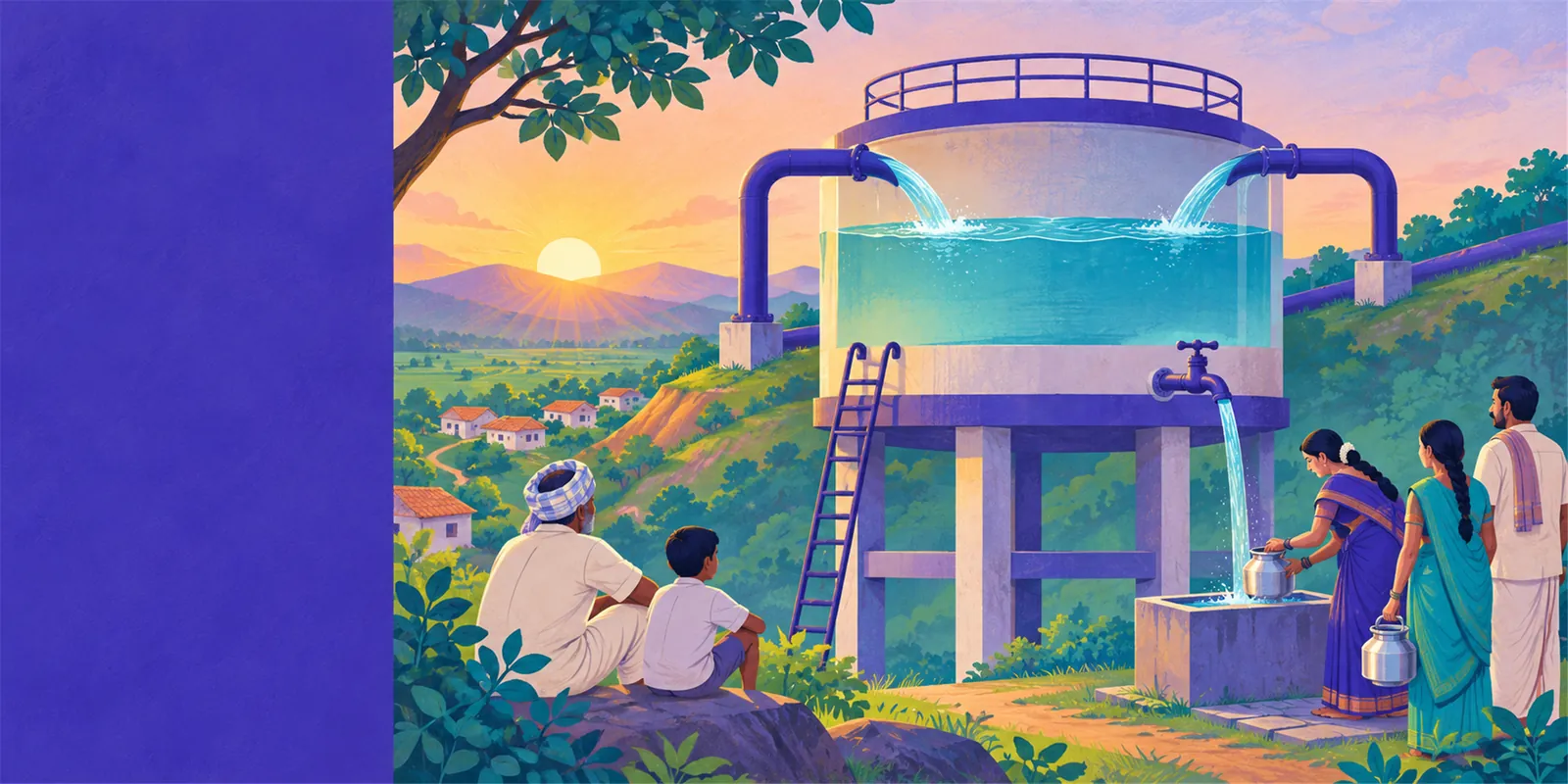
Priya's family has a rooftop tank. The motor pipe fills it in 12 hours, and the new municipal pipe fills it in 15 hours. The bathroom tap, left open by mistake, can empty a full tank in 20 hours. Her father asks: "If everything is running, when will the tank be full?"
You already know Time and Work. Pipes are the same idea with one twist: some pipes work backwards.
Pipes are workers
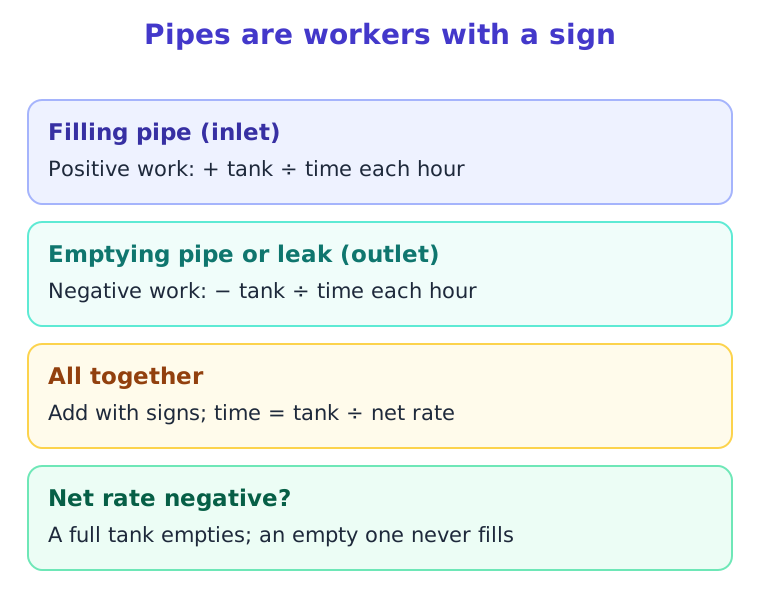
A pipe that fills a tank in $n$ hours fills $\frac{1}{n}$ of it each hour. An outlet that empties a full tank in $m$ hours removes $\frac{1}{m}$ each hour.
So inlets get a plus sign and outlets a minus sign. Everything else is Time and Work.
Two pipes filling
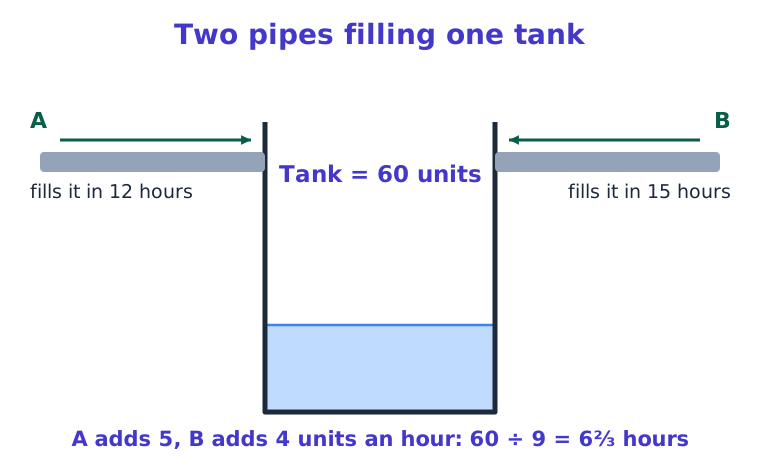
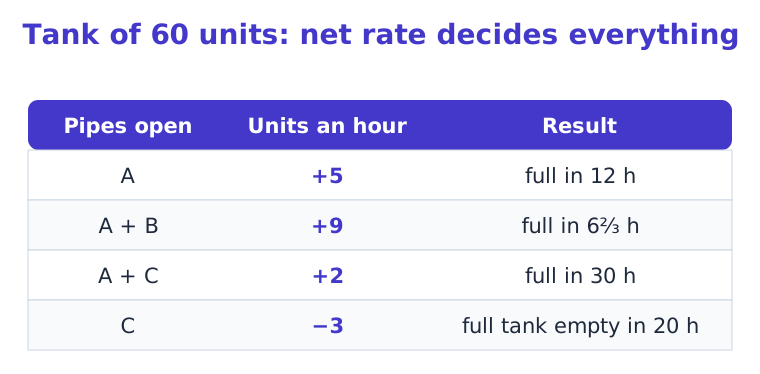
Take the tank as LCM(12, 15) = 60 units. A adds 5 units an hour and B adds 4. Together 9 units an hour: $60 \div 9 = 6\frac{2}{3}$ hours.
Shortcut: $\frac{ab}{a + b} = \frac{12 \times 15}{27} = 6\frac{2}{3}$ hours.
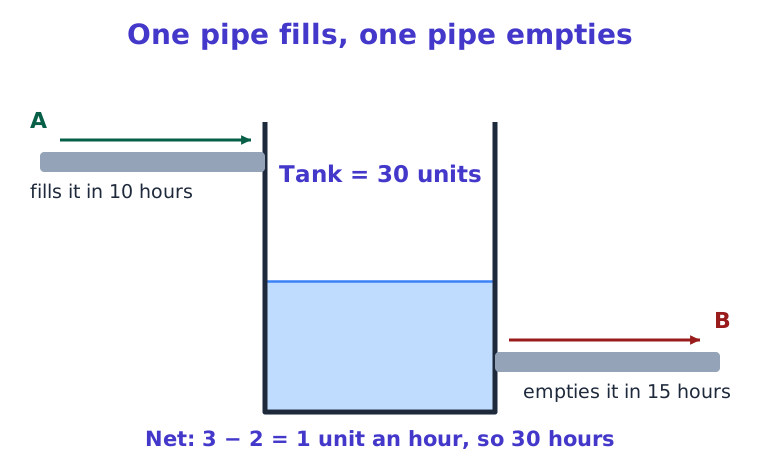
One fills, one empties
A fills in 10 hours and B empties in 15 hours. Tank = 30 units: A $+3$, B $-2$, net $+1$ unit an hour. Time = 30 hours.
Shortcut: $\frac{ab}{b - a} = \frac{10 \times 15}{5} = 30$ hours. If the outlet were faster, the level would fall instead.
Three pipes with the LCM
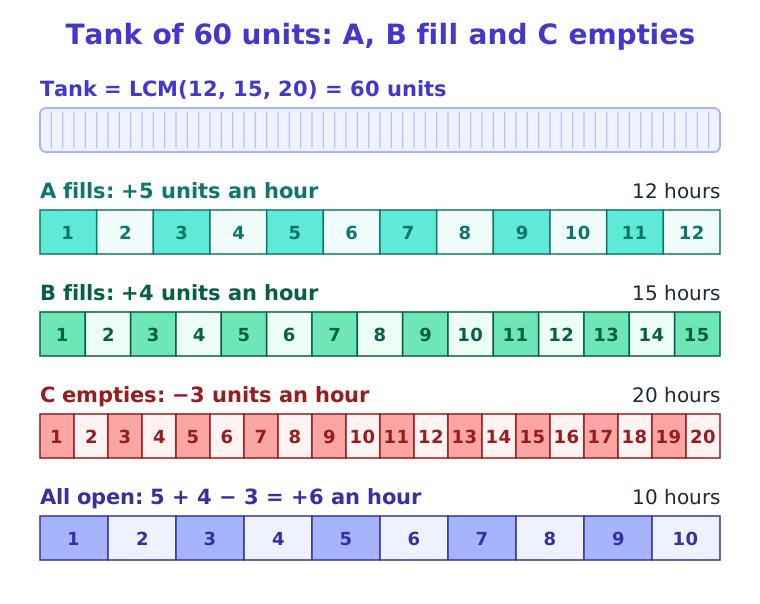
Priya's tank: A 12 hours, B 15 hours, tap C empties in 20 hours. Tank = LCM(12, 15, 20) = 60 units.
A $+5$, B $+4$, C $-3$: net $+6$ units an hour, so the tank is full in $60 \div 6 = 10$ hours.
The net rate tells the story
The same 60-unit tank behaves differently with different pipes open.
Tanks in litres
A tank holds 1,200 litres. The inlet brings 50 litres a minute and the outlet takes 20 litres a minute. Net flow $= 30$ litres a minute, so the empty tank fills in $1200 \div 30 = 40$ minutes. Keep every flow in the same time unit.
A tank that is already part full
If a tank is $\frac{1}{3}$ full, only $\frac{2}{3}$ is left. A pipe that fills the empty tank in 9 hours needs $\frac{2}{3} \times 9 = 6$ hours.
Pipe size and flow
Water flows through the circular cross-section of a pipe, whose area is proportional to the square of the diameter. One pipe of 6 cm carries as much as $(6 \div 2)^2 = 9$ pipes of 2 cm.
Back to the rooftop
With A, B and the leaking tap all running, the net is $+6$ of 60 units each hour, so Priya's tank is full in 10 hours. Closing the tap would make it $+9$ and the time $6\frac{2}{3}$ hours.
Concepts and terms
A pipe that fills in 12 hours adds 1/12 of the tank each hour, like a worker taking 12 days.
A pipe that empties a full tank in 20 hours removes 1/20 each hour, so its rate is −1/20.
The sum of all signed rates. Positive: the tank fills; negative: it empties; zero: the level stays.
When flows are in litres per minute, divide the capacity by the net flow to get the time.

Did you know
Bhaskara II's Lilavati (12th century) has a famous puzzle about four fountains filling a tank together.

Memory tricks
Signs — In is plus, out is minus — Every pipe or leak gets a sign before you add.
Fill and empty pair — Product over difference — Inlet a and outlet b: ab/(b − a), the same as the work rule with a minus sign.
Practice MCQs with answers (61)
- A 3 hours
- B $13\frac{1}{2}$ hours
- C 27 hours
- D $6\frac{2}{3}$ hours
Show answer
Why:
Tank = LCM(12, 15) = 60 units; the two pipes fill 5 and 4 units an hour. Together 9: 60 ÷ 9 = $6\frac{2}{3}$ hours.
- A 6 hours
- B $12\frac{1}{2}$ hours
- C 25 hours
- D 5 hours
Show answer
Why:
Bucket = LCM(10, 15) = 30 units; the taps fill 3 and 2 units an hour. Together 5: 30 ÷ 5 = 6 hours.
- A 25 minutes
- B 12 minutes
- C 50 minutes
- D 10 minutes
Show answer
Why:
Tank = LCM(20, 30) = 60 units; the two pipes fill 3 and 2 units a minute. Together 5: 60 ÷ 5 = 12 minutes.
- A 9 hours
- B 18 hours
- C 4 hours
- D 6 hours
Show answer
Why:
Tank = LCM(6, 12) = 12 units; the two pipes fill 2 and 1 units an hour. Together 3: 12 ÷ 3 = 4 hours.
- A 6 minutes
- B 21 minutes
- C 42 minutes
- D $10\frac{2}{7}$ minutes
Show answer
Why:
Bucket = LCM(18, 24) = 72 units; the taps fill 4 and 3 units a minute. Together 7: 72 ÷ 7 = $10\frac{2}{7}$ minutes.
- A $15\frac{5}{13}$ minutes
- B 15 minutes
- C $32\frac{1}{2}$ minutes
- D 65 minutes
Show answer
Why:
Tank = LCM(25, 40) = 200 units; the two pipes fill 8 and 5 units a minute. Together 13: 200 ÷ 13 = $15\frac{5}{13}$ minutes.
- A 21 hours
- B 10 hours
- C $24\frac{1}{2}$ hours
- D 49 hours
Show answer
Why:
Tank = LCM(14, 35) = 70 units; the two pipes fill 5 and 2 units an hour. Together 7: 70 ÷ 7 = 10 hours.
- A 64 minutes
- B 24 minutes
- C 12 minutes
- D 32 minutes
Show answer
Why:
Bucket = LCM(16, 48) = 48 units; the taps fill 3 and 1 units a minute. Together 4: 48 ÷ 4 = 12 minutes.
- A $12\frac{1}{2}$ hours
- B 6 hours
- C 5 hours
- D 30 hours
Show answer
Why:
Tank = 30 units; inlet +3, outlet −2 an hour: net +1. 30 ÷ 1 = 30 hours. (Shortcut ab/(b − a).)
- A 18 hours
- B $7\frac{1}{2}$ hours
- C $3\frac{3}{5}$ hours
- D 3 hours
Show answer
Why:
Tank = 18 units; inlet +3, outlet −2 an hour: net +1. 18 ÷ 1 = 18 hours. (Shortcut ab/(b − a).)
- A 8 minutes
- B 30 minutes
- C 16 minutes
- D $7\frac{1}{2}$ minutes
Show answer
Why:
Tank = 60 units; inlet +5, outlet −3 a minute: net +2. 60 ÷ 2 = 30 minutes. (Shortcut ab/(b − a).)
- A $22\frac{1}{2}$ minutes
- B $11\frac{1}{9}$ minutes
- C 100 minutes
- D 5 minutes
Show answer
Why:
Tank = 100 units; inlet +5, outlet −4 a minute: net +1. 100 ÷ 1 = 100 minutes. (Shortcut ab/(b − a).)
- A 16 hours
- B 32 hours
- C 6 hours
- D 12 hours
Show answer
Why:
Tank = 24 units; inlet +3, outlet −1 an hour: net +2. 24 ÷ 2 = 12 hours. (Shortcut ab/(b − a).)
- A 12 hours
- B 18 hours
- C 4 hours
- D 6 hours
Show answer
Why:
Tank = 12 units; +1 in and −2 out an hour: net −1, so it empties in 12 ÷ 1 = 12 hours.
- A 15 minutes
- B 60 minutes
- C $8\frac{4}{7}$ minutes
- D 5 minutes
Show answer
Why:
Tank = 60 units; +3 in and −4 out a minute: net −1, so it empties in 60 ÷ 1 = 60 minutes.
- A 12 minutes
- B 18 minutes
- C 45 minutes
- D $11\frac{1}{4}$ minutes
Show answer
Why:
Tank = 90 units; +3 in and −5 out a minute: net −2, so it empties in 90 ÷ 2 = 45 minutes.
- A $6\frac{2}{3}$ hours
- B $15\frac{2}{3}$ hours
- C 5 hours
- D 10 hours
Show answer
Why:
Tank = LCM = 60 units. A +5, B +4, C −3 an hour: net 6. 60 ÷ 6 = 10 hours.
- A $8\frac{4}{7}$ hours
- B 4 hours
- C $5\frac{5}{11}$ hours
- D $12\frac{1}{3}$ hours
Show answer
Why:
Tank = LCM = 60 units. A +6, B +5, C −4 an hour: net 7. 60 ÷ 7 = $8\frac{4}{7}$ hours.
- A $21\frac{2}{3}$ minutes
- B 60 minutes
- C $6\frac{2}{3}$ minutes
- D 12 minutes
Show answer
Why:
Tank = LCM = 60 units. A +3, B +2, C −4 a minute: net 1. 60 ÷ 1 = 60 minutes.
- A $3\frac{3}{7}$ hours
- B $8\frac{2}{3}$ hours
- C $4\frac{4}{5}$ hours
- D $2\frac{2}{3}$ hours
Show answer
Why:
Tank = LCM = 24 units. A +4, B +3, C −2 an hour: net 5. 24 ÷ 5 = $4\frac{4}{5}$ hours.
- A 26 minutes
- B 8 minutes
- C $10\frac{2}{7}$ minutes
- D $14\frac{2}{5}$ minutes
Show answer
Why:
Tank = LCM = 72 units. A +4, B +3, C −2 a minute: net 5. 72 ÷ 5 = $14\frac{2}{5}$ minutes.
- A 30 hours
- B 25 hours
- C 6 hours
- D 5 hours
Show answer
Why:
Tank = 30 units; together 3 an hour, first pipe 2, so the other 1: 30 ÷ 1 = 30 hours.
- A 18 minutes
- B 20 minutes
- C 42 minutes
- D $8\frac{4}{7}$ minutes
Show answer
Why:
Tank = 60 units; together 5 a minute, first pipe 2, so the other 3: 60 ÷ 3 = 20 minutes.
- A 56 minutes
- B $12\frac{6}{7}$ minutes
- C 45 minutes
- D 16 minutes
Show answer
Why:
Tank = 180 units; together 9 a minute, first pipe 5, so the other 4: 180 ÷ 4 = 45 minutes.
- A 9 hours
- B 39 hours
- C $9\frac{3}{13}$ hours
- D 40 hours
Show answer
Why:
Tank = 120 units; together 8 an hour, first pipe 5, so the other 3: 120 ÷ 3 = 40 hours.
- A 6 hours
- B 3 hours
- C 8 hours
- D 9 hours
Show answer
Why:
Only 2/3 is left; the pipe fills the whole tank in 9 hours, so 2/3 × 9 = 6 hours.
- A 11 hours
- B 9 hours
- C 12 hours
- D 3 hours
Show answer
Why:
Only 3/4 is left; the pipe fills the whole tank in 12 hours, so 3/4 × 12 = 9 hours.
- A 6 hours
- B $2\frac{2}{5}$ hours
- C $3\frac{3}{5}$ hours
- D 4 hours
Show answer
Why:
Only 3/5 is left; together they fill the whole tank in 6 hours, so 3/5 × 6 = $3\frac{3}{5}$ hours.
- A 7 minutes
- B 8 minutes
- C $2\frac{2}{3}$ minutes
- D $5\frac{1}{3}$ minutes
Show answer
Why:
Only 2/3 is left; together they fill the whole tank in 8 minutes, so 2/3 × 8 = $5\frac{1}{3}$ minutes.
- A $7\frac{1}{2}$ minutes
- B $4\frac{1}{2}$ minutes
- C 9 minutes
- D 12 minutes
Show answer
Why:
Only 5/8 is left; together they fill the whole tank in 12 minutes, so 5/8 × 12 = $7\frac{1}{2}$ minutes.
- A 60 minutes
- B 40 minutes
- C $17\frac{1}{7}$ minutes
- D 24 minutes
Show answer
Why:
Net flow = 50 − 20 = 30 litres a minute. 1,200 ÷ 30 = 40 minutes.
- A $22\frac{1}{2}$ minutes
- B 36 minutes
- C 60 minutes
- D $13\frac{11}{13}$ minutes
Show answer
Why:
Net flow = 40 − 25 = 15 litres a minute. 900 ÷ 15 = 60 minutes.
- A 120 minutes
- B 24 minutes
- C 30 minutes
- D 40 minutes
Show answer
Why:
Net flow = 45 + 35 − 20 = 60 litres a minute. 2,400 ÷ 60 = 40 minutes.
- A 48 minutes
- B $28\frac{4}{5}$ minutes
- C 36 minutes
- D 144 minutes
Show answer
Why:
Net flow = 60 + 40 − 25 = 75 litres a minute. 3,600 ÷ 75 = 48 minutes.
- A 36 minutes
- B 30 minutes
- C 44 minutes
- D $53\frac{1}{3}$ minutes
Show answer
Why:
Capacity = 12 × 40 = 480 litres. 480 ÷ 16 = 30 minutes.
- A 41 minutes
- B $43\frac{1}{5}$ minutes
- C 30 minutes
- D 31 minutes
Show answer
Why:
Capacity = 25 × 36 = 900 litres. 900 ÷ 30 = 30 minutes.
- A 18 hours
- B 24 hours
- C 48 hours
- D 36 hours
Show answer
Why:
Slow pipe 1 unit, fast pipe 2 units an hour: tank = (2 + 1) × 12 = 36 units. The slower pipe: 36 ÷ 1 = 36 hours.
- A 20 minutes
- B 30 minutes
- C 60 minutes
- D 45 minutes
Show answer
Why:
Slow pipe 1 unit, fast pipe 3 units a minute: tank = (3 + 1) × 15 = 60 units. The faster pipe: 60 ÷ 3 = 20 minutes.
- A 25 minutes
- B 100 minutes
- C 80 minutes
- D 40 minutes
Show answer
Why:
Slow pipe 1 unit, fast pipe 4 units a minute: tank = (4 + 1) × 20 = 100 units. The slower pipe: 100 ÷ 1 = 100 minutes.
- A 25 hours
- B $12\frac{1}{2}$ hours
- C 6 hours
- D 30 hours
Show answer
Why:
Both remove water: 3 + 2 = 5 of 30 units an hour, so 30 ÷ 5 = 6 hours.
- A 60 minutes
- B 64 minutes
- C 32 minutes
- D 15 minutes
Show answer
Why:
Both remove water: 5 + 3 = 8 of 120 units a minute, so 120 ÷ 8 = 15 minutes.
- A 40 minutes
- B 25 minutes
- C 120 minutes
- D $5\frac{5}{8}$ minutes
Show answer
Why:
Whole tank = 15 ÷ 3/8 = 40 minutes.
- A 12 hours
- B 4 hours
- C 24 hours
- D $5\frac{1}{3}$ hours
Show answer
Why:
Whole tank = 8 ÷ 2/3 = 12 hours; 12 − 8 = 4 hours more.
- A $17\frac{6}{7}$ minutes
- B 35 minutes
- C 10 minutes
- D 175 minutes
Show answer
Why:
Whole tank = 25 ÷ 5/7 = 35 minutes; 35 − 25 = 10 minutes more.
- A 3
- B 6
- C 12
- D 9
Show answer
Why:
Flow ∝ area ∝ diameter². (6 ÷ 2)² = 9 pipes.
- A 16
- B 4
- C 8
- D 20
Show answer
Why:
Flow ∝ area ∝ diameter². (8 ÷ 2)² = 16 pipes.
- A 8
- B 4
- C 2
- D 6
Show answer
Why:
Flow ∝ area ∝ diameter². (10 ÷ 5)² = 4 pipes.
- A −8
- B 8
- C −1/8
- D 1/8
Show answer
Why:
It removes 1/8 of the tank each hour, so its work is −1/8.
- A It fills in 2.4 hours
- B It fills in 10 hours
- C It fills in 12 hours
- D The tank never fills
Show answer
Why:
Net rate 1/6 − 1/4 is negative, so water leaves faster than it comes.
- A ab/(b − a)
- B ab/(a + b)
- C (a + b)/2
- D b − a
Show answer
Why:
Net rate 1/a − 1/b = (b − a)/ab; invert it.
- A the same
- B one quarter
- C half
- D double
Show answer
Why:
Flow becomes 2² = 4 times, so time is 1/4.
- A Because tanks are measured in LCM litres
- B To make outlets positive
- C So that every hourly flow is a whole number of units
- D Because the HCF is too large
Show answer
Why:
Any size works; the LCM just avoids fractions.
- A doubles
- B rises slowly
- C falls slowly
- D stays the same
Show answer
Why:
What comes in each hour equals what goes out.
- A Both A and R are true, and R is the correct explanation of A
- B Both A and R are true, but R is not the correct explanation of A
- C A is true but R is false
- D A is false but R is true
Show answer
Why:
Both true; R is the working for A.
- A Both A and R are true, and R is the correct explanation of A
- B Both A and R are true, but R is not the correct explanation of A
- C A is true but R is false
- D A is false but R is true
Show answer
Why:
By R, a 4 cm pipe equals (4/2)² = 4 pipes of 2 cm, so A is false; R is true.
- A 1 only
- B 2 only
- C Both 1 and 2
- D Neither 1 nor 2
Show answer
Why:
1/12 + 1/6 = 1/4, so 4 hours; B's 1/6 is twice A's 1/12. Both true.
- A 1 only
- B 2 only
- C Both 1 and 2
- D Neither 1 nor 2
Show answer
Why:
1 is true. 2 is false: an outlet slows filling, so time increases.
- A 6 hours
- B 8 hours
- C 12 hours
- D $12\frac{1}{2}$ hours
Show answer
Why:
Tank = 30 units. A +3, B +2: net +5 an hour, so 30 ÷ 5 = 6 hours.
- A 26 hours
- B 24 hours
- C $4\frac{4}{5}$ hours
- D 10 hours
Show answer
Why:
Tank = 24 units. A +3, B −2: net +1 an hour, so 24 ÷ 1 = 24 hours.
- A $12\frac{1}{3}$ hours
- B 14 hours
- C 12 hours
- D 4 hours
Show answer
Why:
Tank = 60 units. A +6, B +4, C −5: net +5 an hour, so 60 ÷ 5 = 12 hours.
- A 4 hours
- B 8 hours
- C 2 hours
- D 6 hours
Show answer
Why:
Three quarters are left: 3/4 × 8 = 6 hours.
Important short questions (4)
Tank 60 units; 3 + 2 = 5 a minute: 12 minutes.
Tank 36 units: +4 − 3 = +1 an hour, so 36 hours.
Net 25 L/min: 1500 ÷ 25 = 60 minutes.
It undoes the filling: every hour it removes part of the water, so its work is negative.
Long answer questions (1)
Tank = LCM(12, 18, 9) = 36 units; A +3, B +2, C −4 an hour.
(a) Net = 3 + 2 − 4 = +1 unit an hour.
(b) 36 ÷ 1 = 36 hours.
(c) +5 an hour: 36 ÷ 5 = 7.2 hours.
Flashcards (12)
Play this topic
- Tank check
Leaks and Taps Opened in Turns
Find a hidden leak from how much it slows the filling, find a tank's capacity from a leak in litres, and solve taps opened in turns, pipes closed early and pipes opened later, always splitting the time into stages.
What you will be able to do
- I can find how long a leak alone takes to empty a full tank.
- I can find the capacity of a tank from a leak or tap given in litres.
- I can solve problems where pipes are opened in turns.
- I can split the time into stages when a pipe is closed or opened midway.
Key points
A leak is an outlet you did not plan for: give it a minus sign.
Leak rate = (rate with the leak) − (rate without it). If a pipe takes a hours alone and b hours with a leak, the leak empties the full tank in ab/(b − a) hours.
When a leak or tap is given in litres, write the capacity as C and make one equation in C.
For taps opened in turns, add one full round as a block, count whole blocks, then finish the last part hour by hour.
With a fill-and-empty turn, stop as soon as the filling pipe reaches the top; do not subtract an outlet hour after the tank is full.
If pipe B is closed x minutes before the tank is full, A runs t minutes and B runs t − x minutes: t/a + (t − x)/b = 1.
If a pipe is closed or opened after k minutes, first find the part done in those k minutes, then divide the rest by the new rate.
Full explanation
The slow motor
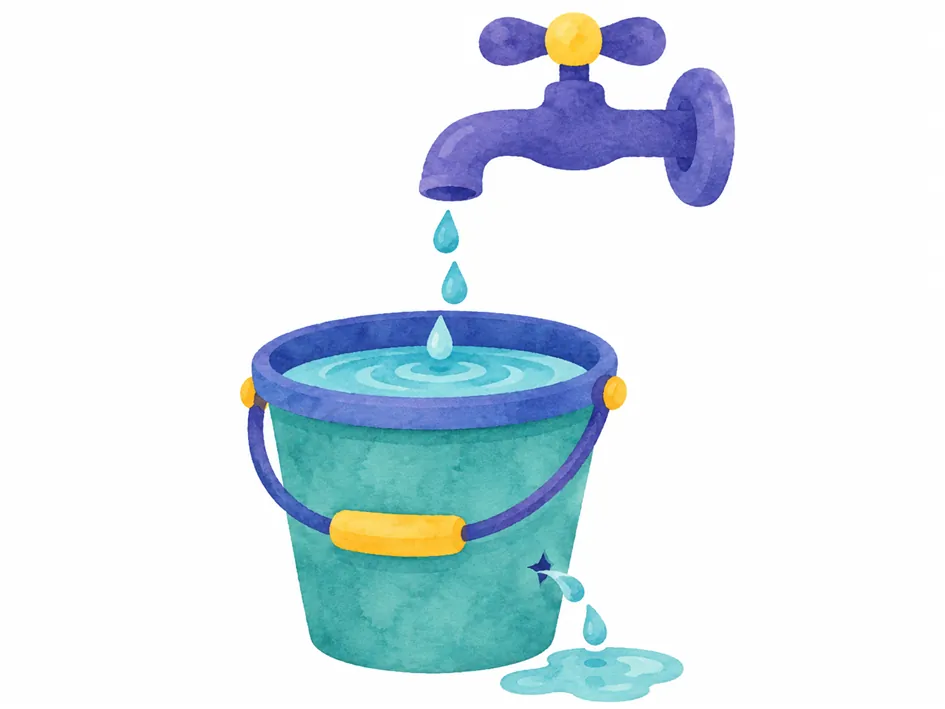
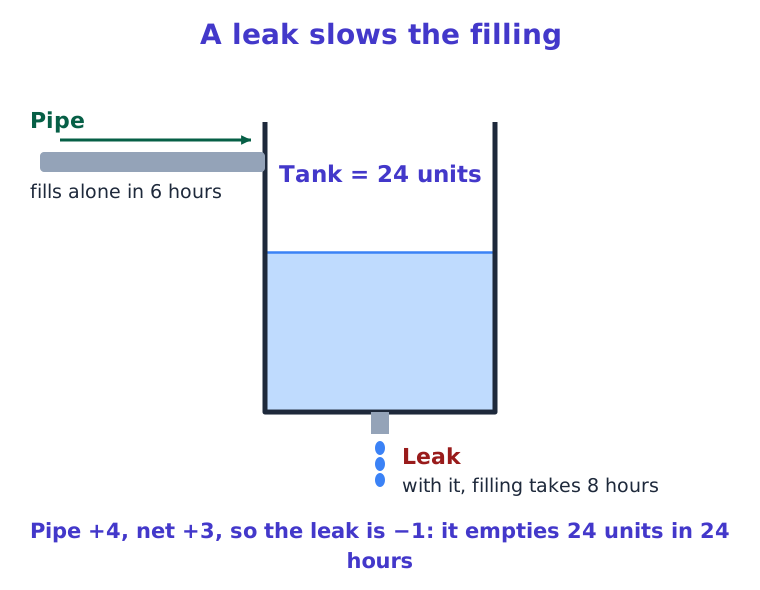
Every morning Imran's motor filled the rooftop tank in 6 hours. This week it takes 8 hours. Nothing is wrong with the motor. There must be a crack at the bottom of the tank. How bad is the leak? If the motor stopped, how long would the leak take to empty a full tank?
This topic is about such hidden leaks, and about taps that are opened one after another.
A leak is an outlet
Treat the leak as a pipe with a minus sign. Compare the rate with the leak and without it; the difference is the leak.
Working it out
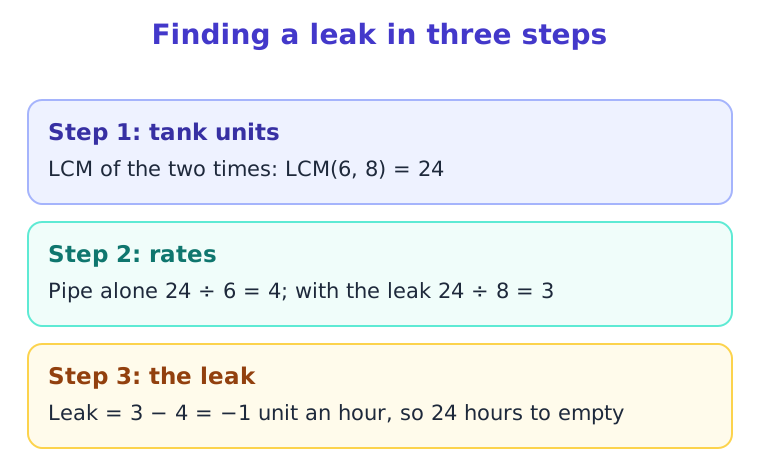
Tank = LCM(6, 8) = 24 units. Motor alone: $+4$ an hour. With the leak: $+3$ an hour. So the leak is $-1$ unit an hour, and alone it empties the full tank in 24 hours.
Shortcut: $\frac{ab}{b - a} = \frac{6 \times 8}{2} = 24$ hours.
Leaks in litres: finding the capacity
A leak can empty a full tank in 6 hours. A tap bringing 4 litres a minute (240 litres an hour) is opened, and now the tank empties in 8 hours. Let the capacity be $C$ litres.
$$\frac{C}{6} - 240 = \frac{C}{8} \Rightarrow \frac{C}{24} = 240 \Rightarrow C = 5760 \text{ litres}$$
Taps opened in turns
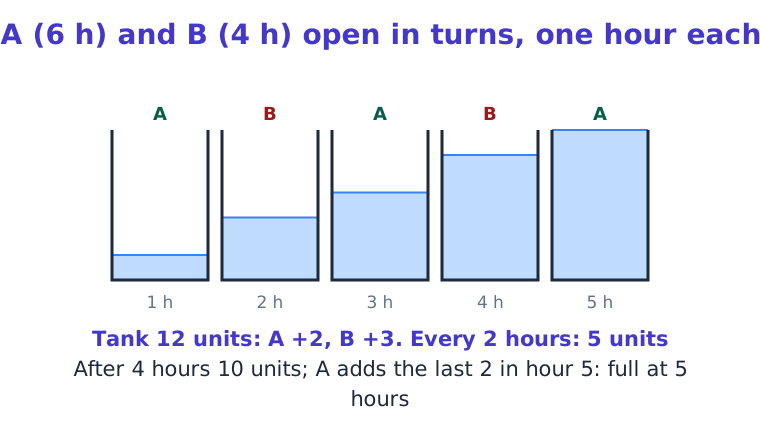
A fills in 6 hours and B in 4 hours. They are opened for one hour each, A first. Tank = 12 units: A $+2$, B $+3$. Each pair of hours adds 5 units. After 4 hours: 10 units. In hour 5, A adds the last 2 units: full in 5 hours.
Fill and empty in turns: stop at the top
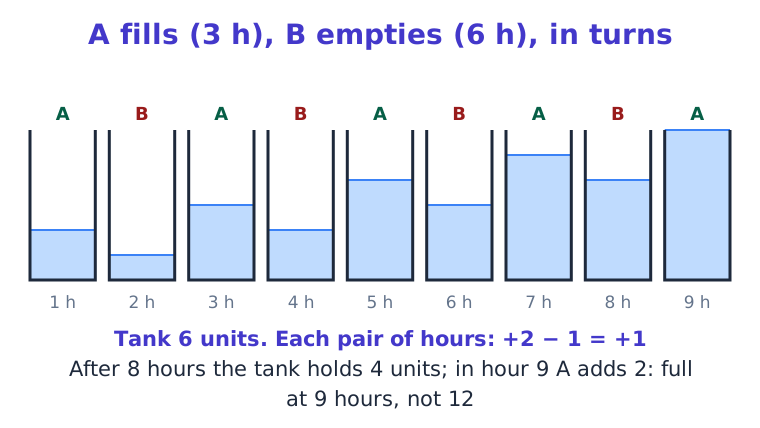
A fills in 3 hours, B empties in 6 hours; they open in turns, A first. Tank = 6 units: A $+2$, B $-1$, each pair $+1$.
The trap: "6 units at 1 a pair = 12 hours" is wrong. After 6 hours the tank holds 3 units, after 8 hours 4, and in hour 9 A lifts it from 4 to 6: full in 9 hours. The tank fills during a filling hour, before the last outlet hour.
A pipe closed early
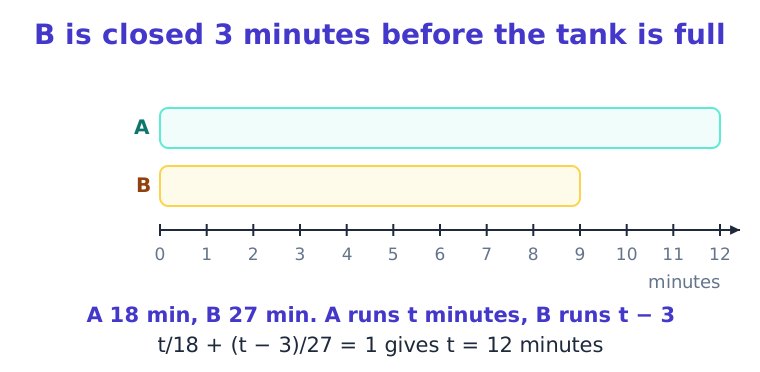
A fills in 18 minutes and B in 27 minutes. Both start together, but B is closed 3 minutes before the tank is full. If the total time is $t$, A runs $t$ minutes and B runs $t - 3$:
$$\frac{t}{18} + \frac{t - 3}{27} = 1 \Rightarrow 3t + 2(t - 3) = 54 \Rightarrow t = 12 \text{ minutes}$$
Opened later or closed after k minutes
Split the time into stages. Example: A (12 min) and B (16 min) are open for 4 minutes, then B is closed. Tank = 48 units: first stage $4 \times 7 = 28$ units, rest 20 units by A at 4 a minute = 5 minutes. Total 9 minutes.
Back to Imran's tank
The crack drains 1 of 24 units every hour, so alone it would empty the tank in 24 hours. Imran now knows the leak is small but real: fixing it gives back two hours of motor time every day.
Concepts and terms
Compare filling with and without the leak; the difference in rates is the leak's rate.
When taps open one after another, one complete round behaves like a single block of work.
A change in the set of open pipes starts a new stage. Work out each stage separately and add the times.
With litres, the tank size is unknown: C ÷ (time) − leak litres per hour = C ÷ (new time).
Did you know
City water boards find hidden leaks in exactly this way: they compare how fast a reservoir fills with the supply they send.
Memory tricks
Leak time — Product over the delay — Pipe 6 h, with leak 8 h: leak = 6 × 8 ÷ (8 − 6) = 24 h.
Turns — Block, count, finish — Make a block of one round, count full blocks, then finish carefully at the top.
Practice MCQs with answers (57)
- A 2 hours
- B 24 hours
- C 14 hours
- D $3\frac{3}{7}$ hours
Show answer
Why:
Tank = LCM(6, 8) = 24 units. Alone +4, with the leak +3 an hour: the leak is −1. It empties 24 units in 24 ÷ 1 = 24 hours.
- A 2 hours
- B 22 hours
- C 60 hours
- D $5\frac{5}{11}$ hours
Show answer
Why:
Tank = LCM(10, 12) = 60 units. Alone +6, with the leak +5 an hour: the leak is −1. It empties 60 units in 60 ÷ 1 = 60 hours.
- A $6\frac{2}{3}$ minutes
- B 3 minutes
- C 27 minutes
- D 60 minutes
Show answer
Why:
Tank = LCM(12, 15) = 60 units. Alone +5, with the leak +4 a minute: the leak is −1. It empties 60 units in 60 ÷ 1 = 60 minutes.
- A 40 hours
- B 18 hours
- C $4\frac{4}{9}$ hours
- D 2 hours
Show answer
Why:
Tank = LCM(8, 10) = 40 units. Alone +5, with the leak +4 an hour: the leak is −1. It empties 40 units in 40 ÷ 1 = 40 hours.
- A 44 minutes
- B 120 minutes
- C $10\frac{10}{11}$ minutes
- D 4 minutes
Show answer
Why:
Tank = LCM(20, 24) = 120 units. Alone +6, with the leak +5 a minute: the leak is −1. It empties 120 units in 120 ÷ 1 = 120 minutes.
- A 3 hours
- B 21 hours
- C 36 hours
- D $5\frac{1}{7}$ hours
Show answer
Why:
Tank = LCM(9, 12) = 36 units. Alone +4, with the leak +3 an hour: the leak is −1. It empties 36 units in 36 ÷ 1 = 36 hours.
- A $7\frac{7}{15}$ hours
- B 2 hours
- C 30 hours
- D 112 hours
Show answer
Why:
Tank = LCM(14, 16) = 112 units. Alone +8, with the leak +7 an hour: the leak is −1. It empties 112 units in 112 ÷ 1 = 112 hours.
- A 90 minutes
- B 33 minutes
- C $8\frac{2}{11}$ minutes
- D 3 minutes
Show answer
Why:
Tank = LCM(15, 18) = 90 units. Alone +6, with the leak +5 a minute: the leak is −1. It empties 90 units in 90 ÷ 1 = 90 minutes.
- A $3\frac{1}{3}$ hours
- B 20 hours
- C 4 hours
- D $6\frac{2}{3}$ hours
Show answer
Why:
Tank = 60 units; pipes +5 + 4 = 9, actual +6, so the leak is −3 an hour: 60 ÷ 3 = 20 hours.
- A 6 minutes
- B 2 minutes
- C 24 minutes
- D $3\frac{3}{7}$ minutes
Show answer
Why:
Tank = 120 units; pipes +12 + 8 = 20, actual +15, so the leak is −5 a minute: 120 ÷ 5 = 24 minutes.
- A 12 minutes
- B 3 minutes
- C $6\frac{2}{3}$ minutes
- D 60 minutes
Show answer
Why:
Tank = 60 units; pipes +3 + 2 = 5, actual +4, so the leak is −1 a minute: 60 ÷ 1 = 60 minutes.
- A 12 hours
- B 4 hours
- C 2 hours
- D $2\frac{2}{5}$ hours
Show answer
Why:
Tank = 12 units; pipes +2 + 1 = 3, actual +2, so the leak is −1 an hour: 12 ÷ 1 = 12 hours.
- A 96 litres
- B 5,760 litres
- C 2,880 litres
- D 11,520 litres
Show answer
Why:
Tap = 4 × 60 = 240 litres an hour. C/6 − 240 = C/8, so C(1/6 − 1/8) = 240 and C = 5,760 litres.
- A 17,280 litres
- B 144 litres
- C 8,640 litres
- D 4,320 litres
Show answer
Why:
Tap = 6 × 60 = 360 litres an hour. C/8 − 360 = C/12, so C(1/8 − 1/12) = 360 and C = 8,640 litres.
- A 7,200 litres
- B 60 litres
- C 1,800 litres
- D 3,600 litres
Show answer
Why:
Tap = 2 × 60 = 120 litres an hour. C/10 − 120 = C/15, so C(1/10 − 1/15) = 120 and C = 3,600 litres.
- A 200 litres
- B 50 litres
- C 40 litres
- D 100 litres
Show answer
Why:
C/4 − 10 = C/5, so C × (5 − 4)/20 = 10 and C = 10 × 20 ÷ 1 = 200 litres.
- A 120 litres
- B 360 litres
- C 90 litres
- D 180 litres
Show answer
Why:
C/6 − 15 = C/8, so C × (8 − 6)/48 = 15 and C = 15 × 48 ÷ 2 = 360 litres.
- A 96 litres
- B 60 litres
- C 160 litres
- D 80 litres
Show answer
Why:
C/5 − 12 = C/8, so C × (8 − 5)/40 = 12 and C = 12 × 40 ÷ 3 = 160 litres.
- A 6 hours
- B $4\frac{4}{5}$ hours
- C $2\frac{2}{5}$ hours
- D 5 hours
Show answer
Why:
Tank = 12 units; A +2, B +3. Level after each hour: 2, 5, 7, 10, 12, reaching 12 at 5 hours.
- A 12 hours
- B $11\frac{1}{2}$ hours
- C 6 hours
- D 13 hours
Show answer
Why:
Tank = 30 units; A +3, B +2. Level after each hour: 3, 5, 8, 10, 13, 15, 18, 20, 23, 25, 28, 30, reaching 30 at 12 hours.
- A $13\frac{5}{7}$ minutes
- B $13\frac{2}{3}$ minutes
- C $6\frac{6}{7}$ minutes
- D $14\frac{2}{3}$ minutes
Show answer
Why:
Tank = 48 units; A +4, B +3. Level after each minute: 4, 7, 11, 14, 18, 21, 25, 28, 32, 35, 39, 42, 46; the last part takes $\frac{2}{3}$ more, so $13\frac{2}{3}$ minutes.
- A $2\frac{2}{5}$ hours
- B 6 hours
- C 5 hours
- D $4\frac{4}{5}$ hours
Show answer
Why:
Tank = 12 units; A +3, B +2. Level after each hour: 2, 5, 7, 10, 12, reaching 12 at 5 hours.
- A $11\frac{1}{4}$ minutes
- B $10\frac{2}{7}$ minutes
- C $5\frac{1}{7}$ minutes
- D $10\frac{1}{4}$ minutes
Show answer
Why:
Tank = 36 units; A +4, B +3. Level after each minute: 4, 7, 11, 14, 18, 21, 25, 28, 32, 35; the last part takes $\frac{1}{4}$ more, so $10\frac{1}{4}$ minutes.
- A 8 hours
- B $7\frac{1}{2}$ hours
- C 4 hours
- D 9 hours
Show answer
Why:
Tank = 8 units; A +1, B +1. Level after each hour: 1, 2, 3, 4, 5, 6, 7, 8, reaching 8 at 8 hours.
- A 11 hours
- B 9 hours
- C 6 hours
- D 12 hours
Show answer
Why:
Tank = 6 units; A +2, B −1, so each pair adds 1. After 8 hours the level is 4; in the next hour A brings it up to 6 in 1 hour. Total 9 hours (not 12: the tank fills during A's hour).
- A $7\frac{1}{2}$ hours
- B 15 hours
- C 13 hours
- D 14 hours
Show answer
Why:
Tank = 15 units; A +3, B −1, so each pair adds 2. After 12 hours the level is 12; in the next hour A brings it up to 15 in 1 hour. Total 13 hours (not 15: the tank fills during A's hour).
- A 12 hours
- B 11 hours
- C 9 hours
- D 7 hours
Show answer
Why:
Tank = 6 units; A +3, B −2, so each pair adds 1. After 6 hours the level is 3; in the next hour A brings it up to 6 in 1 hour. Total 7 hours (not 12: the tank fills during A's hour).
- A $26\frac{4}{5}$ hours
- B $28\frac{4}{5}$ hours
- C 30 hours
- D 29 hours
Show answer
Why:
Tank = 30 units; A +5, B −3, so each pair adds 2. After 26 hours the level is 26; in the next hour A brings it up to 30 in $\frac{4}{5}$ hour. Total $26\frac{4}{5}$ hours (not 30: the tank fills during A's hour).
- A 14 hours
- B 13 hours
- C $14\frac{2}{5}$ hours
- D 16 hours
Show answer
Why:
Tank = 24 units; one round of 3 hours adds 4 + 3 − 2 = 5. Count full rounds, then finish within a filling hour: 13 hours.
- A 11 hours
- B 9 hours
- C 8 hours
- D $10\frac{2}{7}$ hours
Show answer
Why:
Tank = 24 units; one round of 3 hours adds 6 + 4 − 3 = 7. Count full rounds, then finish within a filling hour: 8 hours.
- A $10\frac{4}{5}$ minutes
- B $13\frac{4}{5}$ minutes
- C 15 minutes
- D 12 minutes
Show answer
Why:
A runs t minutes, B runs t − 3: t/18 + (t − 3)/27 = 1, so t = 18(27 + 3) ÷ (18 + 27) = 12 minutes.
- A $8\frac{4}{7}$ minutes
- B $12\frac{4}{7}$ minutes
- C $6\frac{6}{7}$ minutes
- D $10\frac{6}{7}$ minutes
Show answer
Why:
A runs t minutes, B runs t − 4: t/12 + (t − 4)/16 = 1, so t = 12(16 + 4) ÷ (12 + 16) = $8\frac{4}{7}$ minutes.
- A 12 minutes
- B 16 minutes
- C 22 minutes
- D 26 minutes
Show answer
Why:
A runs t minutes, B runs t − 10: t/20 + (t − 10)/30 = 1, so t = 20(30 + 10) ÷ (20 + 30) = 16 minutes.
- A $22\frac{4}{5}$ minutes
- B $14\frac{2}{5}$ minutes
- C $16\frac{4}{5}$ minutes
- D $20\frac{2}{5}$ minutes
Show answer
Why:
A runs t minutes, B runs t − 6: t/24 + (t − 6)/36 = 1, so t = 24(36 + 6) ÷ (24 + 36) = $16\frac{4}{5}$ minutes.
- A $10\frac{6}{7}$ minutes
- B 5 minutes
- C 12 minutes
- D 9 minutes
Show answer
Why:
Tank = 48 units; together 7 a minute. In 4 minutes: 28. Left 20 for A at 4: 5 minutes. Total 4 + 5 = 9.
- A $10\frac{1}{2}$ minutes
- B $14\frac{4}{7}$ minutes
- C $4\frac{1}{2}$ minutes
- D 15 minutes
Show answer
Why:
Tank = 60 units; together 7 a minute. In 6 minutes: 42. Left 18 for A at 4: $4\frac{1}{2}$ minutes. Total 6 + $4\frac{1}{2}$ = $10\frac{1}{2}$.
- A 6 minutes
- B 9 minutes
- C 10 minutes
- D $10\frac{1}{2}$ minutes
Show answer
Why:
Tank = 30 units; together 4 a minute. In 3 minutes: 12. Left 18 for A at 3: 6 minutes. Total 3 + 6 = 9.
- A 10 minutes
- B 24 minutes
- C 18 minutes
- D $21\frac{5}{7}$ minutes
Show answer
Why:
Tank = 96 units; together 7 a minute. In 8 minutes: 56. Left 40 for A at 4: 10 minutes. Total 8 + 10 = 18.
- A 20 minutes
- B 24 minutes
- C 12 minutes
- D 16 minutes
Show answer
Why:
Tank = 20 units. A alone 4 minutes: 8. Then net 2 − 1 = 1 a minute for the other 12: 12 minutes. Total 16.
- A 30 minutes
- B 39 minutes
- C 27 minutes
- D 36 minutes
Show answer
Why:
Tank = 36 units. A alone 3 minutes: 9. Then net 3 − 2 = 1 a minute for the other 27: 27 minutes. Total 30.
- A 25 minutes
- B 30 minutes
- C $37\frac{1}{2}$ minutes
- D $42\frac{1}{2}$ minutes
Show answer
Why:
Tank = 75 units. A alone 5 minutes: 25. Then net 5 − 3 = 2 a minute for the other 50: 25 minutes. Total 30.
- A 6 hours
- B 10 hours
- C 9 hours
- D 12 hours
Show answer
Why:
First half: 3 hours. Then net 1/6 − 1/12 = 1/12 an hour, so the second half takes (1/2) ÷ 1/12 = 6 hours. Total 9.
- A 6 hours
- B 11 hours
- C 12 hours
- D 10 hours
Show answer
Why:
First half: 4 hours. Then net 1/8 − 1/24 = 1/12 an hour, so the second half takes (1/2) ÷ 1/12 = 6 hours. Total 10.
- A 5 hours
- B 4 hours
- C 6 hours
- D 3 hours
Show answer
Why:
First half: 2 hours. Then net 1/4 − 1/12 = 1/6 an hour, so the second half takes (1/2) ÷ 1/6 = 3 hours. Total 5.
- A −1/11
- B −1/30
- C −1/6
- D −1/5
Show answer
Why:
1/6 − 1/5 = −1/30 of the tank each hour.
- A He should have used 4 + 5 = 9 hours
- B There is no mistake
- C He used the extra time instead of the difference in rates
- D He forgot to add the times
Show answer
Why:
Leak = 1/4 − 1/5 = 1/20, so it takes 20 hours, not 1.
- A We can; it always gives the answer
- B Because outlets work faster in turns
- C Because the LCM changes each hour
- D The tank can fill during a filling hour before the pair ends
Show answer
Why:
Once the level reaches the top, filling stops; the next outlet hour never happens.
- A t − x minutes
- B t + x minutes
- C x minutes
- D t minutes
Show answer
Why:
B stops x minutes before the end.
- A shorter
- B longer
- C unchanged
- D zero
Show answer
Why:
The leak lowers the net rate, so filling takes longer.
- A Both A and R are true, and R is the correct explanation of A
- B Both A and R are true, but R is not the correct explanation of A
- C A is true but R is false
- D A is false but R is true
Show answer
Why:
1/6 − 1/8 = 1/24: both true and R explains A.
- A Both A and R are true, and R is the correct explanation of A
- B Both A and R are true, but R is not the correct explanation of A
- C A is true but R is false
- D A is false but R is true
Show answer
Why:
R is true, but the tank is full in the 9th hour, during A's turn, so A is false.
- A 1 only
- B 2 only
- C Both 1 and 2
- D Neither 1 nor 2
Show answer
Why:
4(1/12 + 1/16) = 7/12. Rest 5/12 by A takes 5 minutes, total 9. Both true.
- A 1 only
- B 2 only
- C Both 1 and 2
- D Neither 1 nor 2
Show answer
Why:
1 is true. 2 is false: use the difference in rates, not the delay.
- A 25 hours
- B 6 hours
- C 30 hours
- D 5 hours
Show answer
Why:
Tank 30 units: pipe +3, with leak +2, so the leak is −1: 30 hours.
- A $12\frac{1}{2}$ hours
- B 11 hours
- C 6 hours
- D 12 hours
Show answer
Why:
Tank 30 units: A +3, B +2, each pair +5. 6 pairs = 12 hours give 30: full at 12 hours.
- A $10\frac{2}{3}$ hours
- B 12 hours
- C 11 hours
- D 8 hours
Show answer
Why:
Tank 12 units: A +3, B −1. Level after each hour: 3, 2, 5, 4, 7, 6, 9, 8; in hour 9 A lifts 8 to 11, hour 10 B makes 10, hour 11 A reaches 12 after 2/3 of an hour: $10\frac{2}{3}$ hours.
- A 17 minutes
- B 14 minutes
- C 9 minutes
- D 12 minutes
Show answer
Why:
t/20 + (t − 5)/30 = 1: 3t + 2t − 10 = 60, t = 14 minutes.
Important short questions (4)
1/3 − 2/7 = 1/21, so 21 hours.
Tank 20 units: A 2, B 1, each pair 3. After 12 minutes 18; minute 13, A adds 2: 13 minutes.
Once full, the tank is full; the outlet's next turn does not matter for the question "when is it first full".
C/6 − 15 = C/8, so C/24 = 15 and C = 360 litres.
Long answer questions (1)
(a) A runs 25 minutes, B runs x: 25/30 + x/45 = 1.
(b) x/45 = 1/6, so x = 7.5 minutes.
(c) B filled 7.5/45 = 1/6 of the tank.
Flashcards (12)
Play this topic
- Leak or not?
Veda Skills Quantitative Aptitude Unit 9 — frequently asked questions
Tank 60 units; 3 + 2 = 5 a minute: 12 minutes.
Tank 36 units: +4 − 3 = +1 an hour, so 36 hours.
Net 25 L/min: 1500 ÷ 25 = 60 minutes.
1/3 − 2/7 = 1/21, so 21 hours.
Tank 20 units: A 2, B 1, each pair 3. After 12 minutes 18; minute 13, A adds 2: 13 minutes.
Once full, the tank is full; the outlet's next turn does not matter for the question "when is it first full".

All Veda Skills Quantitative Aptitude units
All Quantitative Aptitude units · All Skills & Exams courses
Study this chapter properly, free
Everything above is on this page to read. In the Veda app the same chapter becomes spaced-repetition flashcards, timed tests that mark themselves, Veda Bites you can swipe, and games — with your progress tracked topic by topic.
Get Veda free