Veda Skills Quantitative Aptitude Unit 14: Geometry
- 3 topics
- 201 MCQs
- 11 short answers
- 3 long answers
- 46 flashcards
- 3 games
- ~160 min read
- English
Checked before publishing: 23 automated checks, including a plagiarism check against the textbook's own words. How we check our content
Lines, Angles and Triangles
Use angle pairs, parallel-line rules, the angle sum and exterior angle of a triangle, Pythagoras, the triangle inequality, the centres of a triangle and similar triangles to find any missing angle or side.
What you will be able to do
- I can find complements, supplements and angles made by a transversal on parallel lines.
- I can use the angle sum and the exterior angle property of a triangle.
- I can apply Pythagoras and the triangle inequality to sides.
- I can use the incentre, centroid and orthocentre angle results.
- I can find sides of similar triangles and the ratio of their areas.

Key points
Complementary angles add to 90°; supplementary angles add to 180°.
Vertically opposite angles are equal; a linear pair adds to 180°.
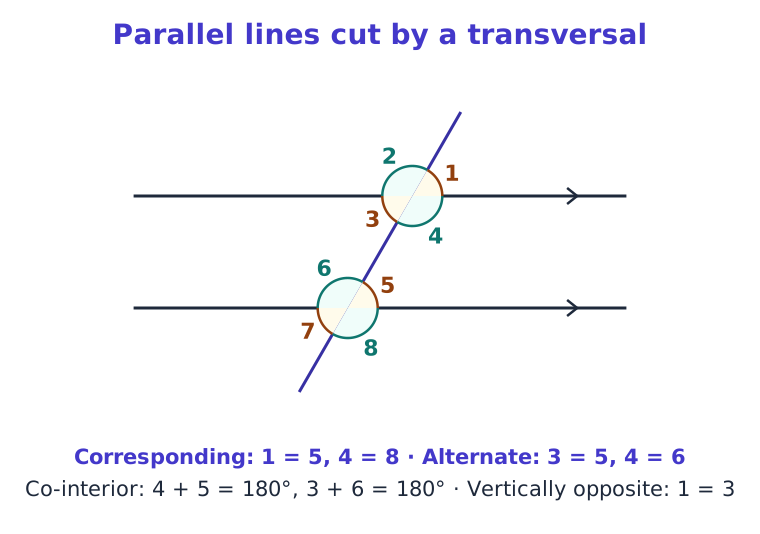
With parallel lines, corresponding and alternate angles are equal, and co-interior angles add to 180°.
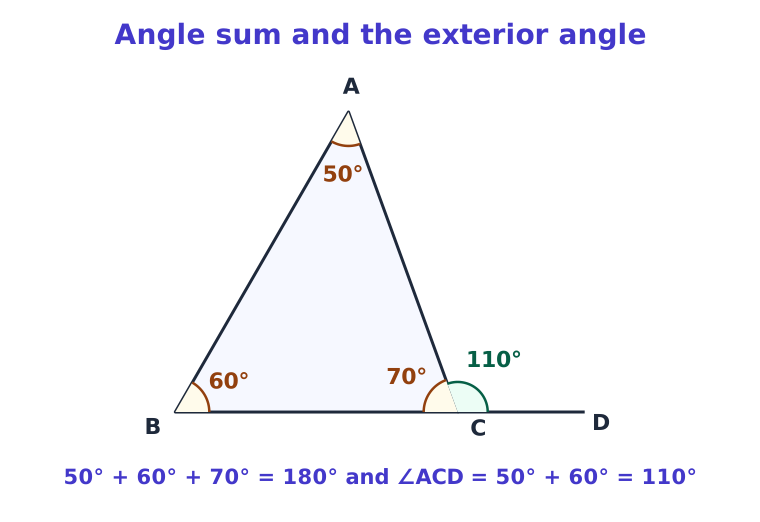
The angles of a triangle add to 180°; an exterior angle equals the sum of the two interior opposite angles.
In a right triangle, (hypotenuse)² = (base)² + (height)².
Any two sides of a triangle together are longer than the third side.
If I is the incentre, ∠BIC = 90° + A/2; with the excentre opposite A the angle is 90° − A/2; with the orthocentre H, ∠BHC = 180° − A.
The centroid divides each median in the ratio 2 : 1 from the vertex.
In similar triangles, sides are in one ratio k and areas are in the ratio k².
Full explanation
The mason's rope

Ramesh is building a room in his village. He has no set square, only a rope with knots at 3, 4 and 5 metres. He pegs the rope into a triangle, and the corner between the 3 m and 4 m parts comes out at exactly 90°.
Why does that work, and how do exam questions use the same idea? Angles, parallel lines and triangles answer both.
Angle pairs
- Complementary: add to 90°. The complement of 35° is 55°.
- Supplementary: add to 180°. The supplement of 35° is 145°.
- Linear pair: two angles on a straight line, total 180°.
- Vertically opposite: made by two crossing lines, always equal.
Exam form: "An angle is 4 times its complement." Then $x = 4(90 - x)$, so $x = 72°$.
Parallel lines and a transversal
When a line cuts two parallel lines it makes eight angles, but only two different sizes: an acute one and its supplement.
Angle sum and exterior angle
The three angles of any triangle add to 180°. If one side is extended, the outside angle equals the sum of the two interior angles opposite to it.
$$\angle ACD = \angle A + \angle B$$
Kinds of triangles
- By sides: equilateral (all equal, each angle 60°), isosceles (two equal sides, equal base angles), scalene.
- By angles: acute, right (one 90°), obtuse (one angle above 90°; a triangle can have only one).
The largest side is always opposite the largest angle.
Pythagoras: back to the rope
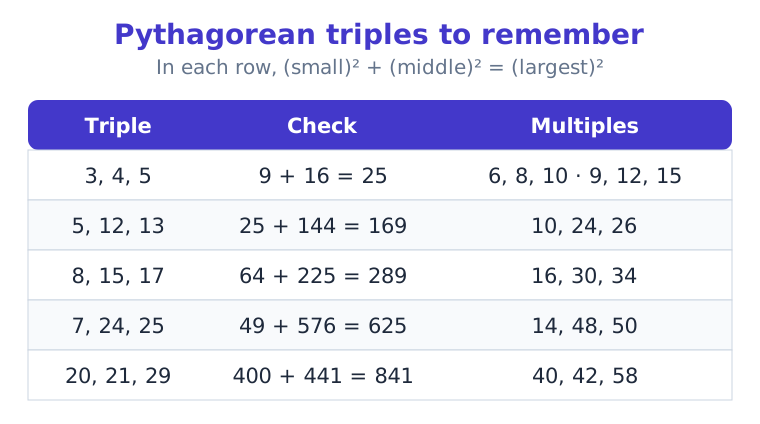
Ramesh's rope works because $3^2 + 4^2 = 9 + 16 = 25 = 5^2$. Whenever the sides fit $a^2 + b^2 = c^2$, the angle opposite $c$ is a right angle.
Learn the common triples; most exam numbers are built on them or on their multiples.
Can these sides make a triangle?
The sum of any two sides must be greater than the third. 4, 5, 10 fails because $4 + 5 < 10$.
If two sides are $a$ and $b$, the third side lies strictly between $|a - b|$ and $a + b$. With sides 6 and 11, the third side is between 5 and 17, so it can take 11 whole-number values (6 to 16).
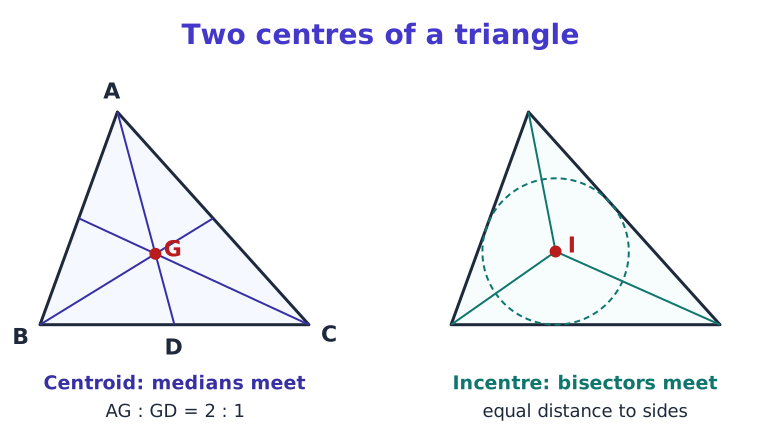
The centres of a triangle
| Centre | Where lines meet | Angle result |
|---|---|---|
| Centroid G | medians | divides median 2 : 1 |
| Incentre I | angle bisectors | ∠BIC = 90° + A/2 |
| Circumcentre O | perpendicular bisectors | ∠BOC = 2A |
| Orthocentre H | altitudes | ∠BHC = 180° − A |
For a right triangle the circumcentre is the midpoint of the hypotenuse and the orthocentre is the right-angle corner.
Similar triangles
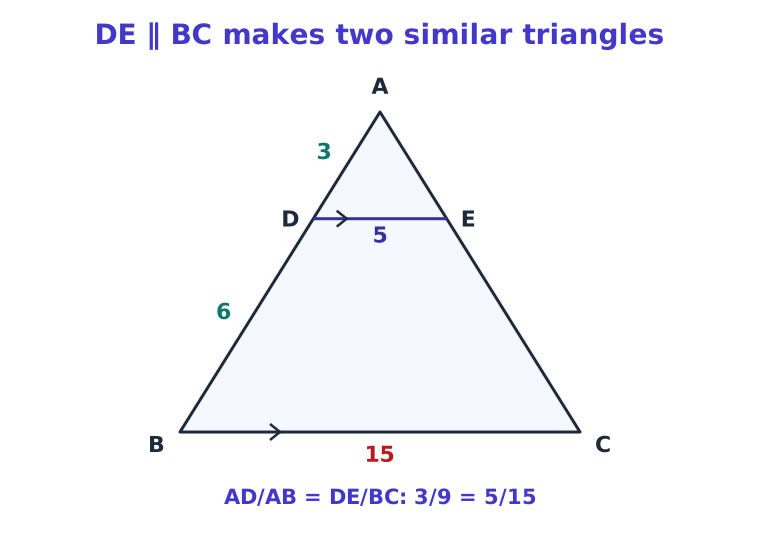
If $DE \parallel BC$ in triangle $ABC$, then triangle $ADE$ is similar to triangle $ABC$ and
$$\frac{AD}{AB} = \frac{AE}{AC} = \frac{DE}{BC}$$
If the side ratio is $k$, the area ratio is $k^2$: sides 2 : 3 give areas 4 : 9.
Two more side rules
- Angle bisector theorem: if AD bisects ∠A, then $\frac{BD}{DC} = \frac{AB}{AC}$.
- Median length (Apollonius): $AB^2 + AC^2 = 2(AD^2 + BD^2)$ when D is the midpoint of BC.
- Right triangle: altitude to the hypotenuse $= \frac{ab}{c}$ and the median to the hypotenuse $= \frac{c}{2}$.
Exam shortcut summary
- Two angles known: third $= 180° - (A + B)$.
- Exterior angle = sum of the two far interior angles.
- Parallel lines: every angle is either $x$ or $180° - x$.
- Right triangle: look for a triple before squaring.
- Bisectors of B and C meet at $90° + \frac{A}{2}$.
- Similar figures: lengths $k$, areas $k^2$.
Ramesh's room is square
With one rope, Ramesh checked all four corners of his room: 3, 4 and 5 make 90° every time. You now have the same toolkit for any angle or side question, from SSC to placement tests.
Concepts and terms
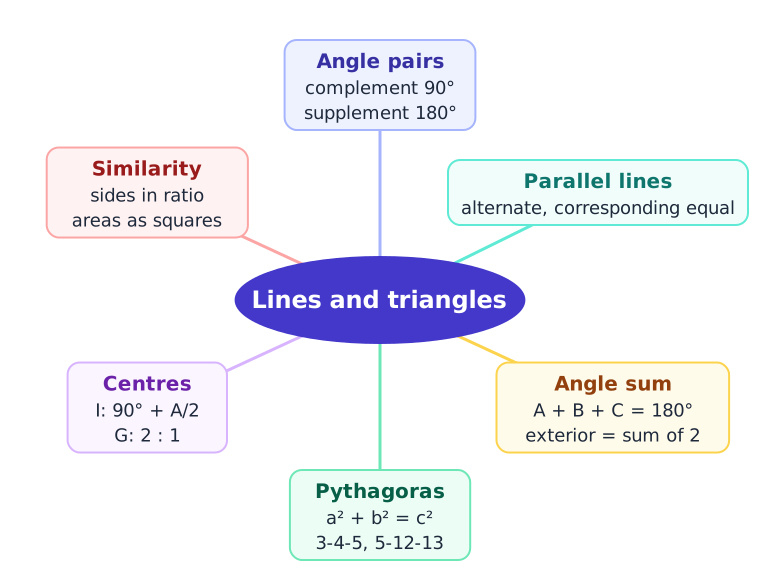
Two angles adding to 90° are complementary, adding to 180° supplementary. Crossing lines make equal vertically opposite angles.
Extend one side of a triangle. The outside angle equals the sum of the two inside angles not next to it.
In a right triangle with legs a, b and hypotenuse c, a² + b² = c². Whole-number sets like 3, 4, 5 are called triples.
Medians meet at the centroid, angle bisectors at the incentre, perpendicular bisectors at the circumcentre, and altitudes at the orthocentre.
Triangles with the same angles. Their sides are proportional, so a line parallel to one side cuts the other two in the same ratio.

Did you know
Indian builders used ropes with 3-4-5 knots to make right angles for altars; the Baudhayana Sulba Sutra states the Pythagoras idea centuries before Pythagoras.
In every triangle the centroid, circumcentre and orthocentre lie on one straight line, called the Euler line.

Memory tricks
Complement or supplement — C comes before S, 90 comes before 180 — Complement pairs with the smaller total 90°, supplement with the larger total 180°.
Bisector angles — In plus, Ex minus, Ortho one-eighty — Incentre: 90° + A/2. Excentre: 90° − A/2. Orthocentre: 180° − A.
Practice MCQs with answers (87)
- A 326°
- B 66°
- C 146°
- D 56°
Show answer
Why:
Complementary angles add to 90°: 90° − 34° = 56°.
- A 23°
- B 33°
- C 113°
- D 293°
Show answer
Why:
Complementary angles add to 90°: 90° − 67° = 23°.
- A 313°
- B 133°
- C 143°
- D 43°
Show answer
Why:
Supplementary angles add to 180°: 180° − 47° = 133°.
- A 58°
- B 248°
- C 68°
- D 78°
Show answer
Why:
Supplementary angles add to 180°: 180° − 112° = 68°.
- A 60°
- B 130°
- C 105°
- D 120°
Show answer
Why:
$x = 2(180° - x)$, so $3x = 360°$ and $x = 120°$.
- A 150°
- B 30°
- C 160°
- D 75°
Show answer
Why:
$x = 5(180° - x)$, so $6x = 900°$ and $x = 150°$.
- A 75°
- B 60°
- C 30°
- D 120°
Show answer
Why:
$180 - x = 4(90 - x)$ gives $3x = 180$, so $x = 60°$.
- A 105°
- B 90°
- C 75°
- D 15°
Show answer
Why:
$180 - x = 7(90 - x)$ gives $6x = 450$, so $x = 75°$.
- A 64°
- B 36°
- C 108°
- D 54°
Show answer
Why:
One part = 90° ÷ 5 = 18°, so the larger angle = 3 × 18° = 54°.
- A 100°
- B 110°
- C 80°
- D 50°
Show answer
Why:
One part = 180° ÷ 9 = 20°, so the larger angle = 5 × 20° = 100°.
- A 66°
- B 57°
- C 102°
- D 33°
Show answer
Why:
$x + (x - 24) = 90$, so $2x = 114$ and $x = 57°$.
- A 245°
- B 75°
- C 65°
- D 115°
Show answer
Why:
∠R = 180° − (48° + 67°) = 65°.
- A 217°
- B 47°
- C 143°
- D 37°
Show answer
Why:
∠Z = 180° − (105° + 38°) = 37°.
- A 70°
- B 130°
- C 20°
- D 110°
Show answer
Why:
x = 180° − (50° + 60°) = 70°.
- A 115°
- B 65°
- C 142°
- D 25°
Show answer
Why:
x = 180° − (38° + 77°) = 65°.
- A 50°
- B 140°
- C 40°
- D 75°
Show answer
Why:
x = 180° − (105° + 35°) = 40°.
- A 116°
- B 118°
- C 26°
- D 64°
Show answer
Why:
x = 180° − (62° + 54°) = 64°.
- A 80°
- B 90°
- C 70°
- D 20°
Show answer
Why:
2x + 3x + 4x = 9x = 180°, so x = 20° and the largest angle is 80°.
- A 20°
- B 30°
- C 150°
- D 40°
Show answer
Why:
x + 2x + 3x = 6x = 180°, so x = 30° and the smallest angle is 30°.
- A 90°
- B 150°
- C 75°
- D 60°
Show answer
Why:
One part = 180° ÷ 12 = 15°, so the angle = 75°.
- A 65°
- B 140°
- C 60°
- D 50°
Show answer
Why:
One part = 180° ÷ 18 = 10°, so the angle = 50°.
- A 110°
- B 115°
- C 70°
- D 135°
Show answer
Why:
The exterior angle equals the sum of the two interior opposite angles: x = 45° + 65° = 110°.
- A 128°
- B 126°
- C 106°
- D 54°
Show answer
Why:
The exterior angle equals the sum of the two interior opposite angles: x = 52° + 74° = 126°.
- A 65°
- B 85°
- C 75°
- D 105°
Show answer
Why:
Exterior angle = ∠A + ∠B, so 115° = 40° + x and x = 75°.
- A 98°
- B 82°
- C 50°
- D 72°
Show answer
Why:
Exterior angle = ∠A + ∠B, so 130° = 58° + x and x = 72°.
- A 75°
- B 60°
- C 15°
- D 135°
Show answer
Why:
120° = 45° + x, so x = 75°.
- A 115°
- B 65°
- C 25°
- D 230°
Show answer
Why:
The marked angles are corresponding angles, so x = the given angle = 65°.
- A 244°
- B 122°
- C 58°
- D 32°
Show answer
Why:
The marked angles are alternate interior angles, so x = the given angle = 58°.
- A 110°
- B 20°
- C 180°
- D 70°
Show answer
Why:
The marked angles are co-interior angles, so x = 180° minus the given angle = 70°.
- A 48°
- B 132°
- C 42°
- D 180°
Show answer
Why:
The marked angles are exterior angles on the same side, so x = 180° minus the given angle = 48°.
- A 15°
- B 105°
- C 180°
- D 75°
Show answer
Why:
The marked angles are exterior angles on the same side, so x = 180° minus the given angle = 105°.
- A 20
- B 10
- C 15
- D 30
Show answer
Why:
Vertically opposite angles are equal: 3x + 5 = 2x + 20, so x = 15.
- A 25
- B 15
- C 40
- D 20
Show answer
Why:
Vertically opposite angles are equal: 4x − 10 = 2x + 30, so x = 20.
- A 30
- B 35
- C 25
- D 60
Show answer
Why:
A linear pair adds to 180°: 2x + 10 + 3x + 20 = 180, so x = 30.
- A 16
- B 15
- C 14
- D 21
Show answer
Why:
√(9² + 12²) = √225 = 15.
- A 30
- B 28
- C 29
- D 41
Show answer
Why:
√(20² + 21²) = √841 = 29.
- A 16
- B 14
- C 9
- D 15
Show answer
Why:
x² = 17² − 8² = 289 − 64 = 225, so x = 15.
- A 40
- B 41
- C 39
- D 32
Show answer
Why:
x² = 41² − 9² = 1681 − 81 = 1600, so x = 40.
- A 8
- B 10
- C 14
- D 11
Show answer
Why:
x² = 6² + 8² = 36 + 64 = 100, so x = 10.
- A 11
- B 17
- C 13
- D 14
Show answer
Why:
x² = 5² + 12² = 25 + 144 = 169, so x = 13.
- A 23
- B 18
- C 15
- D 17
Show answer
Why:
x² = 15² + 8² = 225 + 64 = 289, so x = 17.
- A 24
- B 23
- C 18
- D 25
Show answer
Why:
x² = 25² − 7² = 625 − 49 = 576, so x = 24.
- A 23
- B 24
- C 16
- D 25
Show answer
Why:
x² = 26² − 10² = 676 − 100 = 576, so x = 24.
- A 18
- B 26
- C 24
- D 32
Show answer
Why:
√(25² − 7²) = √(625 − 49) = √576 = 24.
- A 15
- B 17
- C 12
- D 13
Show answer
Why:
Height difference 5 m, gap 12 m: √(5² + 12²) = 13.
- A 10
- B 2
- C 12
- D 14
Show answer
Why:
East and north are at 90°: √(8² + 6²) = 10.
- A 3, 4, 8
- B 5, 7, 10
- C 2, 6, 9
- D 4, 5, 9
Show answer
Why:
5, 7, 10 works: 5 + 7 = 12 > 10. In the others the two smaller sides add to no more than the largest.
- A 3, 7, 10
- B 4, 4, 9
- C 6, 9, 14
- D 5, 6, 12
Show answer
Why:
6, 9, 14 works: 6 + 9 = 15 > 14. In the others the two smaller sides add to no more than the largest.
- A 10
- B 17
- C 13
- D 11
Show answer
Why:
The third side is between 5 and 17, so it can be 6 to 16: 11 values.
- A 7
- B 6
- C 13
- D 9
Show answer
Why:
The third side is between 5 and 13, so it can be 6 to 12: 7 values.
- A 80°
- B 70°
- C 140°
- D 40°
Show answer
Why:
Equal sides give equal base angles: x = (180° − 40°) ÷ 2 = 70°.
- A 47°
- B 74°
- C 37°
- D 106°
Show answer
Why:
Equal sides give equal base angles: x = (180° − 106°) ÷ 2 = 37°.
- A 115°
- B 25°
- C 65°
- D 50°
Show answer
Why:
180° − 2 × 65° = 50°.
- A 125°
- B 110°
- C 140°
- D 55°
Show answer
Why:
O is the incentre, so ∠BOC = 90° + A/2 = 90° + 35° = 125°.
- A 96°
- B 114°
- C 66°
- D 132°
Show answer
Why:
O is the incentre, so ∠BOC = 90° + A/2 = 90° + 24° = 114°.
- A 140°
- B 125°
- C 55°
- D 110°
Show answer
Why:
O is the excentre opposite A, so ∠BOC = 90° − A/2 = 90° − 35° = 55°.
- A 58°
- B 128°
- C 122°
- D 116°
Show answer
Why:
O is the orthocentre, so ∠BOC = 180° − A = 180° − 64° = 116°.
- A 130°
- B 50°
- C 100°
- D 140°
Show answer
Why:
∠BIC = 90° + 80°/2 = 130°.
- A 13.5
- B 12
- C 9
- D 6
Show answer
Why:
G divides AD in 2 : 1 from A, so AG = 2/3 × 18 = 12.
- A 13.5
- B 18
- C 9
- D 20.25
Show answer
Why:
G divides AD in 2 : 1 from A, so GD = 1/3 × 27 = 9.
- A 7
- B 6
- C 4
- D 5
Show answer
Why:
Apollonius: 6² + 8² = 2(x² + 5²), so 100 = 2x² + 50 and x = 5.
- A 7
- B 6
- C 9
- D 8
Show answer
Why:
Apollonius: 7² + 11² = 2(x² + 6²), so 170 = 2x² + 72 and x = 7.
- A 14
- B 20
- C 22
- D 12
Show answer
Why:
AD/AB = DE/BC: 4/10 = 8/x, so x = 8 × 10 ÷ 4 = 20.
- A 14
- B 26
- C 24
- D 15
Show answer
Why:
AD/AB = DE/BC: 3/8 = 9/x, so x = 9 × 8 ÷ 3 = 24.
- A 13
- B 17
- C 5
- D 15
Show answer
Why:
AD/AB = DE/BC: 6/9 = 10/x, so x = 10 × 9 ÷ 6 = 15.
- A 8
- B 4.5
- C 7
- D 9
Show answer
Why:
AD/DB = AE/EC: 3/4 = 6/x, so x = 8.
- A 45
- B 75
- C 102
- D 125
Show answer
Why:
Areas go as the square of sides: 27 × (5/3)² = 75.
- A 195
- B 257.25
- C 147
- D 84
Show answer
Why:
Areas go as the square of sides: 48 × (7/4)² = 147.
- A 7 : 9
- B 81 : 49
- C 3 : 7
- D 9 : 7
Show answer
Why:
Side ratio = √(81/49) = 9/7.
- A 6
- B 8/3
- C 7
- D 8
Show answer
Why:
BD/DC = AB/AC: 4/x = 6/9, so x = 4 × 9 ÷ 6 = 6.
- A 4
- B 9
- C 10
- D 11
Show answer
Why:
BD/DC = AB/AC: 6/x = 8/12, so x = 6 × 12 ÷ 8 = 9.
- A 10
- B 17.5
- C 12
- D 25
Show answer
Why:
Hypotenuse = 25. Altitude = (15 × 20) ÷ 25 = 12.
- A 25
- B 12
- C 15.5
- D 12.5
Show answer
Why:
The hypotenuse 25 is a diameter of the circumcircle, so R = 12.5.
- A 6
- B 9
- C 3√3
- D 3
Show answer
Why:
R = a/√3 = 6√3/√3 = 6. (The inradius is half of it, 3.)
- A 10√3 cm
- B 5√3 cm
- C 5 cm
- D 5√2 cm
Show answer
Why:
h = (√3/2) × 10 = 5√3 cm.
- A orthocentre
- B circumcentre
- C centroid
- D incentre
Show answer
Why:
Medians meet at the centroid.
- A centroid
- B circumcentre
- C orthocentre
- D incentre
Show answer
Why:
The incentre is the centre of the circle touching all three sides.
- A at the right-angle vertex
- B at the centroid
- C at the midpoint of the hypotenuse
- D outside the triangle
Show answer
Why:
The two legs are themselves altitudes, and they meet at the right angle.
- A 540°
- B 360°
- C 180°
- D 270°
Show answer
Why:
Each exterior + interior = 180°, so the three exteriors = 540° − 180° = 360°.
- A 0
- B 2
- C 1
- D 3
Show answer
Why:
Two obtuse angles would already add to more than 180°.
- A ∠B
- B ∠C
- C All are equal
- D ∠A
Show answer
Why:
The largest side BC = 9 is opposite ∠A.
- A 9, 40, 41
- B 12, 15, 20
- C 8, 14, 17
- D 6, 9, 11
Show answer
Why:
9, 40, 41 works: 81 + 1600 = 1681 = 41². The others fail the check.
- A Not a triangle
- B Obtuse-angled
- C Right-angled
- D Acute-angled
Show answer
Why:
7² + 8² = 113 < 12² = 144, so the angle opposite 12 is obtuse.
- A Both A and R are true, and R is the correct explanation of A
- B Both A and R are true, but R is not the correct explanation of A
- C A is true but R is false
- D A is false but R is true
Show answer
Why:
Both are true, and since each interior angle is positive, the sum is bigger than either part. R explains A.
- A Both A and R are true, and R is the correct explanation of A
- B Both A and R are true, but R is not the correct explanation of A
- C A is true but R is false
- D A is false but R is true
Show answer
Why:
A is true since 25 + 144 = 169. R is also true, but the inequality does not show the right angle; Pythagoras does.
- A 1 only
- B 2 only
- C Both 1 and 2
- D Neither 1 nor 2
Show answer
Why:
Medians stay inside, so 1 is true. For an obtuse triangle the orthocentre is outside, so 2 is false.
- A 1 only
- B 2 only
- C Both 1 and 2
- D Neither 1 nor 2
Show answer
Why:
Co-interior angles add to 180°; alternate interior angles are equal.
Important short questions (4)
x = 4(90 − x) gives 5x = 360, x = 72°. Its supplement is 108°.
2B + B + 3B = 180°, so B = 30°, A = 60°, C = 90°.
81 + 144 = 225 = 15², so yes; the right angle is opposite the 15 side.
∠B + ∠C = 116°, half is 58°, so ∠BIC = 180° − 58° = 122° (= 90° + 32°).
Long answer questions (1)
(a) AD/AB = DE/BC gives 4/10 = 6/BC, so BC = 15 cm.
(b) Side ratio 2 : 5, so areas 4 : 25.
(c) The trapezium is 25 − 4 = 21 parts, so the ratio is 4 : 21.
Flashcards (16)
Play this topic
- Angle facts
Circles
Chord and radius rules, angles at the centre and on the circle, cyclic quadrilaterals, tangents, the alternate segment theorem, crossing chords and common tangents of two circles.
What you will be able to do
- I can find a chord, a radius or the distance from the centre using the right triangle inside a circle.
- I can use the angle at the centre, the angle in a semicircle and angles in the same segment.
- I can solve cyclic quadrilateral angle questions.
- I can find tangent lengths and angles between tangents.
- I can find the length of a common tangent of two circles.
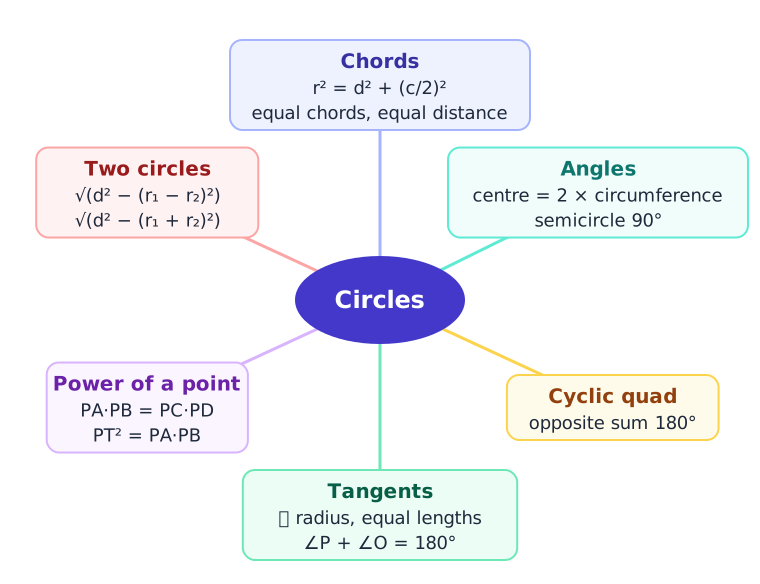
Key points
The perpendicular from the centre to a chord bisects it, so r² = d² + (half chord)².
Equal chords are equally far from the centre; the diameter is the longest chord.
The angle an arc makes at the centre is twice the angle it makes anywhere on the remaining circle.
The angle in a semicircle is 90°, and angles in the same segment are equal.
Opposite angles of a cyclic quadrilateral add to 180°; its exterior angle equals the interior opposite angle.
A tangent is perpendicular to the radius at the point of contact; the two tangents from an outside point are equal.
If tangents PA and PB touch at A and B, then ∠APB + ∠AOB = 180°.
Chords crossing at P: PA × PB = PC × PD. Tangent and secant from P: PT² = PA × PB.
Direct common tangent = √(d² − (r₁ − r₂)²); transverse common tangent = √(d² − (r₁ + r₂)²).
Full explanation
Asha's round pond
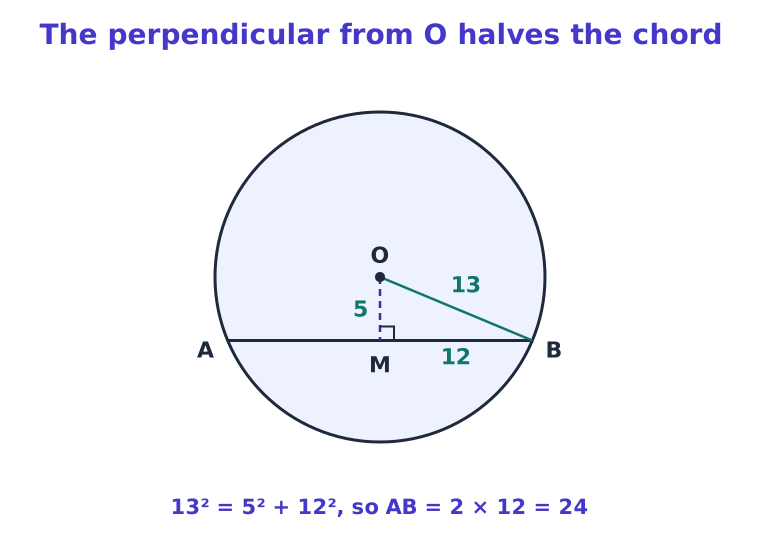
Asha's village has a round pond with a straight footbridge across it. The bridge is 24 m long and its middle is 5 m from the centre post. The panchayat wants to fence the pond and asks Asha for its radius.
She needs only one idea about chords. This topic gives you that idea and the rest of the circle rules.
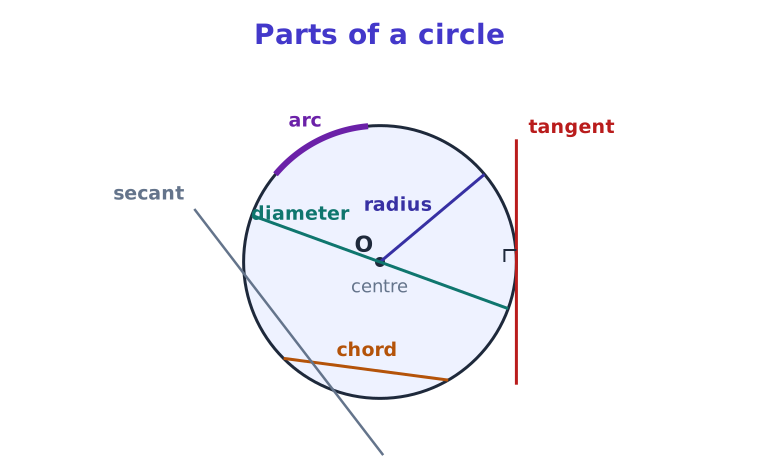
Parts of a circle
- Radius: centre to the circle. Diameter = 2 × radius, the longest chord.
- Chord: a segment joining two points of the circle.
- Arc: a piece of the circle. Tangent: touches at one point. Secant: cuts at two points.
Chords and the centre
The perpendicular from the centre O to a chord AB meets it at its midpoint M. So triangle OMB is right-angled:
$$r^2 = d^2 + \left(\frac{AB}{2}\right)^2$$
Equal chords are at equal distances from the centre, and a chord nearer the centre is longer.
Angles on the same arc
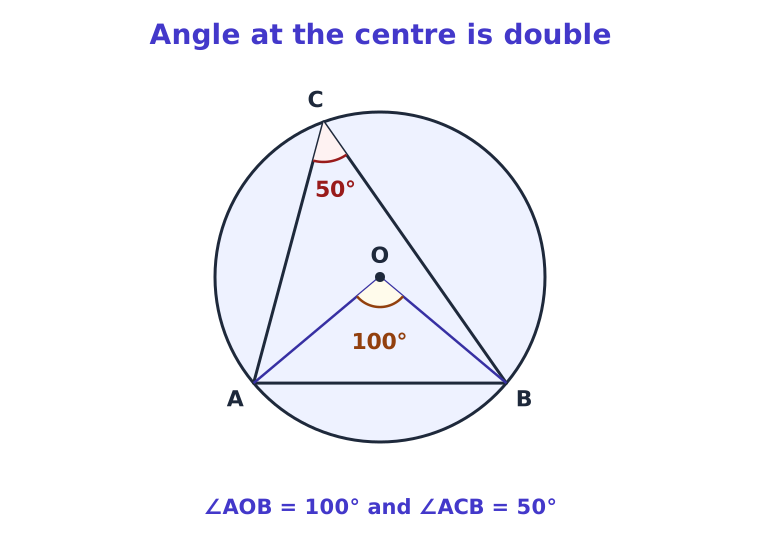
An arc AB makes $\angle AOB$ at the centre and $\angle ACB$ at a point C on the rest of the circle. Always
$$\angle AOB = 2,\angle ACB$$
All points C on the same side see AB at the same angle (angles in the same segment are equal).
The angle in a semicircle
If AB is a diameter, $\angle AOB = 180°$, so the angle at any point C on the circle is $90°$.
Example: AB is a diameter and $\angle CAB = 35°$. Then $\angle ACB = 90°$ and $\angle CBA = 55°$.
Cyclic quadrilaterals
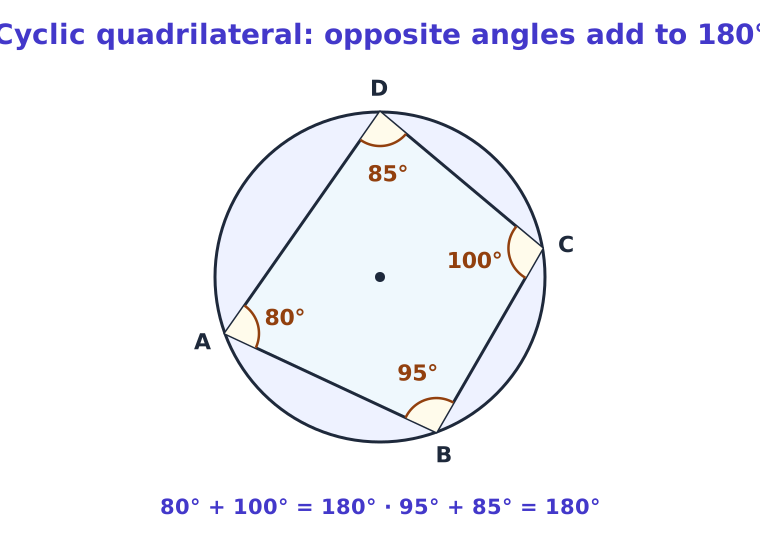
When all four corners of ABCD lie on a circle, $\angle A + \angle C = 180°$ and $\angle B + \angle D = 180°$. If side DC is extended to E, the exterior angle $\angle BCE = \angle A$.
Tangents
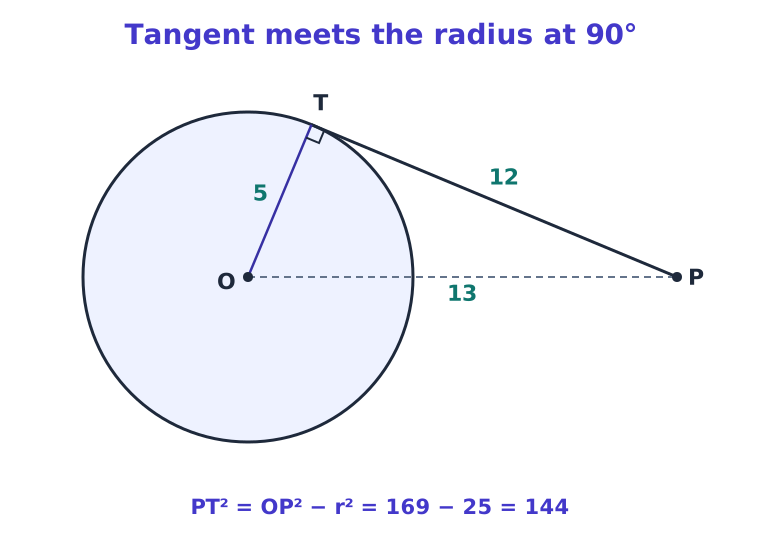
- A tangent is perpendicular to the radius at the point of contact.
- From an outside point P there are exactly two tangents, and they are equal.
- Tangent length: $PT = \sqrt{OP^2 - r^2}$.
- For tangents PA and PB: $\angle APB + \angle AOB = 180°$.
The alternate segment theorem
At the point A where a tangent touches, draw a chord AB. The angle between the tangent and AB equals the angle ACB made by AB at any point C in the other segment.
Power of a point
- Two chords AB and CD crossing at P: $PA \times PB = PC \times PD$.
- Tangent PT and secant PAB from an outside point: $PT^2 = PA \times PB$.
Example: PA = 6, PB = 4, PC = 3 gives $PD = 24 \div 3 = 8$.
Two circles
Centres $d$ apart, radii $r_1$ and $r_2$:
- Direct common tangent $= \sqrt{d^2 - (r_1 - r_2)^2}$
- Transverse common tangent $= \sqrt{d^2 - (r_1 + r_2)^2}$
| Position | Common tangents |
|---|---|
| far apart, $d > r_1 + r_2$ | 4 |
| touching outside | 3 |
| cutting | 2 |
| touching inside | 1 |
| one inside the other | 0 |
Exam shortcut summary
- Chord questions: draw the radius to one end and use a triple.
- Centre angle = 2 × circle angle; semicircle = 90°.
- Cyclic quadrilateral: opposite angles total 180°.
- Two tangents: angle at P = 180° − angle at O.
- Power of a point: products of the two pieces are equal.
Asha answers the panchayat
Half the bridge is 12 m and the distance is 5 m, so $r^2 = 5^2 + 12^2 = 169$ and $r = 13$ m. The fence will run all around a circle of radius 13 m. One right triangle inside the circle solved the whole problem.
Concepts and terms
The radius, the distance to the chord and half the chord form a right triangle with the radius as hypotenuse.
An angle with its vertex on the circle. It is half the central angle on the same arc.
A quadrilateral with all four corners on one circle. Its opposite angles are supplementary.
A line that touches the circle at exactly one point and is perpendicular to the radius there.
The angle between a tangent and a chord equals the angle the chord makes in the other segment.
Did you know
Bicycle chains around two gears follow the direct common tangents of two circles.
A carpenter finds the centre of a round table top by drawing two chords and their perpendicular bisectors; they cross at the centre.
Memory tricks
Centre angle — Centre is the boss, it gets double — Same arc: centre angle = 2 × angle on the circle.
Common tangents — Direct uses Difference — Direct tangent: r₁ − r₂. Transverse (crossing between) tangent: r₁ + r₂.
Practice MCQs with answers (58)
- A 110°
- B 125°
- C 35°
- D 55°
Show answer
Why:
The angle on the circle is half the centre angle: x = 110° ÷ 2 = 55°.
- A 70°
- B 20°
- C 140°
- D 110°
Show answer
Why:
The angle on the circle is half the centre angle: x = 140° ÷ 2 = 70°.
- A 40°
- B 80°
- C 100°
- D 10°
Show answer
Why:
The centre angle is double the angle on the circle: x = 2 × 40° = 80°.
- A 98°
- B 64°
- C 128°
- D 52°
Show answer
Why:
The centre angle is double the angle on the circle: x = 2 × 64° = 128°.
- A 140°
- B 40°
- C 70°
- D 110°
Show answer
Why:
On the major arc the angle is 70°; a point on the minor arc sees the supplement, 180° − 70° = 110°.
- A 65°
- B 50°
- C 115°
- D 130°
Show answer
Why:
OA = OB, so ∠OBA = 25° and ∠AOB = 180° − 50° = 130°. Then ∠ACB = 130° ÷ 2 = 65°.
- A 124°
- B 56°
- C 112°
- D 68°
Show answer
Why:
OA = OB, so ∠OBA = 34° and ∠AOB = 180° − 68° = 112°. Then ∠ACB = 112° ÷ 2 = 56°.
- A 35°
- B 145°
- C 55°
- D 70°
Show answer
Why:
∠ACB = 90° (angle in a semicircle), so x = 90° − 35° = 55°.
- A 152°
- B 56°
- C 28°
- D 62°
Show answer
Why:
∠ACB = 90° (angle in a semicircle), so x = 90° − 28° = 62°.
- A 90°
- B 52°
- C 128°
- D 104°
Show answer
Why:
AB is a diameter, so the angle at C is the angle in a semicircle: 90°.
- A 132°
- B 48°
- C 24°
- D 96°
Show answer
Why:
Angles in the same segment are equal, so ∠ADB = 48°.
- A 75°
- B 85°
- C 95°
- D 265°
Show answer
Why:
Opposite angles of a cyclic quadrilateral add to 180°: x = 180° − 85° = 95°.
- A 72°
- B 252°
- C 88°
- D 108°
Show answer
Why:
Opposite angles of a cyclic quadrilateral add to 180°: x = 180° − 72° = 108°.
- A 76°
- B 104°
- C 206°
- D 152°
Show answer
Why:
∠D is opposite ∠B, so x = 180° − 104° = 76°. (∠A is not needed.)
- A 168°
- B 96°
- C 76°
- D 84°
Show answer
Why:
The exterior angle of a cyclic quadrilateral equals the interior opposite angle: x = ∠A = 96°.
- A 136°
- B 112°
- C 68°
- D 224°
Show answer
Why:
The exterior angle of a cyclic quadrilateral equals the interior opposite angle: x = ∠A = 68°.
- A 66
- B 36
- C 26
- D 30
Show answer
Why:
∠A + ∠C = 180°: 5x + 30 = 180, so x = 30.
- A 26
- B 32
- C 22
- D 10
Show answer
Why:
∠A + ∠C = 180°: 7x − 2 = 180, so x = 26.
- A 12
- B 24
- C 26
- D 16
Show answer
Why:
Half chord = √(13² − 5²) = √144 = 12, so the chord = 24.
- A 14
- B 8
- C 16
- D 18
Show answer
Why:
Half chord = √(10² − 6²) = √64 = 8, so the chord = 16.
- A 50
- B 36
- C 24
- D 48
Show answer
Why:
Half chord = √(25² − 7²) = √576 = 24, so the chord = 48.
- A 30
- B 15
- C 32
- D 18
Show answer
Why:
Half chord = √(17² − 8²) = √225 = 15, so the chord = 30.
- A 8
- B 6
- C 2
- D 9
Show answer
Why:
x = √(10² − 8²) = √36 = 6. Use half the chord, 8.
- A 10
- B 2
- C 8
- D 11
Show answer
Why:
x = √(17² − 15²) = √64 = 8. Use half the chord, 15.
- A 23
- B 15
- C 31
- D 17
Show answer
Why:
r = √(15² + 8²) = √289 = 17.
- A 17
- B 12
- C 14
- D 7
Show answer
Why:
Distances from O: √(169 − 25) = 12 and √(169 − 144) = 5. Opposite sides, so 12 + 5 = 17.
- A 13
- B 12
- C 8
- D 18
Show answer
Why:
∠OTP = 90°, so x = √(13² − 5²) = √144 = 12.
- A 9
- B 25
- C 15
- D 16
Show answer
Why:
∠OTP = 90°, so x = √(17² − 8²) = √225 = 15.
- A 26
- B 18
- C 32
- D 24
Show answer
Why:
√(25² − 7²) = √576 = 24.
- A 10
- B 50
- C 2
- D 12
Show answer
Why:
r = √(26² − 24²) = √100 = 10.
- A 210°
- B 60°
- C 70°
- D 120°
Show answer
Why:
OA ⟂ PA and OB ⟂ PB, so in $OAPB$ ∠P + ∠O = 360° − 180° = 180°. x = 60°.
- A 110°
- B 55°
- C 70°
- D 200°
Show answer
Why:
OA ⟂ PA and OB ⟂ PB, so in $OAPB$ ∠P + ∠O = 360° − 180° = 180°. x = 70°.
- A 50°
- B 25°
- C 140°
- D 130°
Show answer
Why:
OA ⟂ PA and OB ⟂ PB, so in $OAPB$ ∠P + ∠O = 360° − 180° = 180°. x = 130°.
- A 65°
- B 130°
- C 25°
- D 50°
Show answer
Why:
PA = PB, so triangle PAB is isosceles: ∠PAB = (180° − 50°) ÷ 2 = 65°.
- A 125°
- B 55°
- C 110°
- D 35°
Show answer
Why:
Alternate segment theorem: the tangent-chord angle equals the angle in the other segment, so x = 55°.
- A 132°
- B 96°
- C 48°
- D 42°
Show answer
Why:
Alternate segment theorem: the tangent-chord angle equals the angle in the other segment, so x = 48°.
- A 8
- B 13
- C 14
- D 12
Show answer
Why:
Direct tangent = √(d² − (r₁ − r₂)²) = √(169 − 25) = 12.
- A 15
- B 18
- C 17
- D 9
Show answer
Why:
Transverse tangent = √(d² − (r₁ + r₂)²) = √(289 − 64) = 15.
- A 25
- B 24
- C 26
- D 18
Show answer
Why:
Direct tangent = √(d² − (r₁ − r₂)²) = √(625 − 49) = 24.
- A 10
- B 8
- C 6
- D 2
Show answer
Why:
Transverse tangent = √(d² − (r₁ + r₂)²) = √(100 − 64) = 6.
- A 2
- B 1
- C 3
- D 4
Show answer
Why:
d > r₁ + r₂, the circles are apart, so 4.
- A 3
- B 2
- C 1
- D 4
Show answer
Why:
d = r₁ + r₂, they touch outside, so 3.
- A 3
- B 2
- C 1
- D 4
Show answer
Why:
|r₁ − r₂| < d < r₁ + r₂, they cut, so 2.
- A 4
- B 3
- C 1
- D 2
Show answer
Why:
d = r₁ − r₂, they touch inside, so 1.
- A 4.5
- B 7
- C 9
- D 8
Show answer
Why:
PA × PB = PC × PD: 6 × 4 = 3 × x, so x = 8.
- A 4
- B 16
- C 5
- D 2.25
Show answer
Why:
PA × PB = PC × PD: 8 × 3 = 6 × x, so x = 4.
- A 2.5
- B 10
- C 11
- D 14.4
Show answer
Why:
PA × PB = PC × PD: 5 × 12 = 6 × x, so x = 10.
- A 6.5
- B 5
- C 6
- D 8
Show answer
Why:
PT² = PA × PB = 4 × 9 = 36, so x = 6.
- A 6.93
- B 10
- C 12
- D 8
Show answer
Why:
PT² = PA × PB = 4 × 16 = 64, so x = 8.
- A bisects the chord
- B is equal to the radius
- C is a tangent
- D trisects the chord
Show answer
Why:
OA = OB, so the foot of the perpendicular is the midpoint.
- A 2
- B 1
- C Infinitely many
- D 0
Show answer
Why:
Exactly 1: the line perpendicular to the radius at that point.
- A trapezium that is not a parallelogram
- B kite
- C rectangle
- D rhombus that is not a square
Show answer
Why:
Opposite angles are equal (parallelogram) and add to 180° (cyclic), so each is 90°.
- A They cross at the centre
- B They are diameters
- C They are parallel
- D They are equally far from the centre
Show answer
Why:
Same radius and same half-chord give the same distance.
- A 90°
- B 45°
- C 180°
- D 60°
Show answer
Why:
A tangent is always perpendicular to the radius there, so the angle is 90°.
- A Both A and R are true, and R is the correct explanation of A
- B Both A and R are true, but R is not the correct explanation of A
- C A is true but R is false
- D A is false but R is true
Show answer
Why:
Both true; half of 180° is 90°, so R explains A.
- A Both A and R are true, and R is the correct explanation of A
- B Both A and R are true, but R is not the correct explanation of A
- C A is true but R is false
- D A is false but R is true
Show answer
Why:
A is false: a rhombus with angles 60° and 120° has opposite angles adding to 120° or 240°, not 180°. R is true.
- A 1 only
- B 2 only
- C Both 1 and 2
- D Neither 1 nor 2
Show answer
Why:
1 is true. In 2, the transverse tangent subtracts the larger (r₁ + r₂)², so it is shorter.
- A 1 only
- B 2 only
- C Both 1 and 2
- D Neither 1 nor 2
Show answer
Why:
A chord nearer the centre is longer, so 1 is false. 2 is true.
Important short questions (4)
r = √(8² + 6²) = 10 cm, so the diameter is 20 cm.
A + C = 180° and A = 3C, so 4C = 180°, C = 45°, A = 135°.
∠AOB = 180° − 70° = 110°. OA = OB, so ∠OAB = (180° − 110°) ÷ 2 = 35°.
d = 9 + 4 = 13, so the tangent = √(169 − 25) = 12 cm. (Shortcut: 2√(r₁r₂) = 2 × 6 = 12.)
Long answer questions (1)
(a) AB: √(100 − 64) = 6 cm. CD: √(100 − 36) = 8 cm.
(b) Same side: 8 − 6 = 2 cm.
(c) Opposite sides: 8 + 6 = 14 cm.
Flashcards (15)
Play this topic
- Circle facts
Quadrilaterals and Polygons
Angle sums of polygons, interior and exterior angles of regular polygons, diagonals, and the properties of parallelograms, rectangles, rhombuses, squares and trapeziums.
What you will be able to do
- I can find the angle sum of any polygon and a missing angle in it.
- I can find each interior and exterior angle of a regular polygon, and the number of sides from an angle.
- I can count the diagonals of a polygon.
- I can use the angle and diagonal properties of special quadrilaterals.
Key points
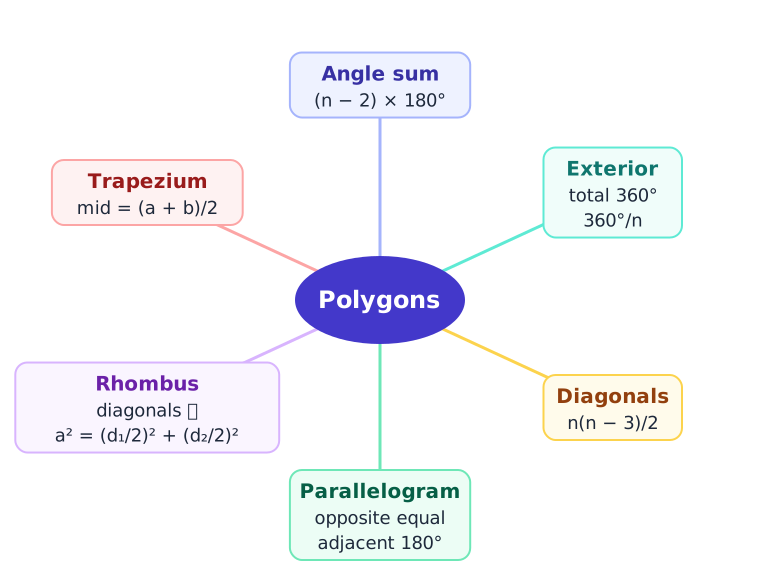
The interior angles of an n-sided polygon add to (n − 2) × 180°.
The exterior angles of any convex polygon add to 360°.
A regular polygon has each exterior angle 360°/n and each interior angle 180° − 360°/n.
A polygon with n sides has n(n − 3)/2 diagonals.
In a parallelogram, opposite angles are equal, adjacent angles add to 180°, and the diagonals bisect each other.
A rectangle has equal diagonals; a rhombus has perpendicular diagonals; a square has both.
Rhombus side = √((d₁/2)² + (d₂/2)²); rectangle diagonal = √(l² + b²); square diagonal = a√2.
In a trapezium the two angles on each slanting side add to 180°, and the mid-segment is half the sum of the parallel sides.
Full explanation
The hexagon puzzle

Meera designs floor tiles. Her client wants a regular polygon tile with each angle 150°. How many sides must the tile have, and will it cover a floor on its own?
Two formulas answer this in seconds: the angle sum and the exterior angle of a polygon.
Angle sum of a polygon
From one corner, draw all diagonals. An n-sided polygon splits into $n - 2$ triangles, so
$$\text{Sum of interior angles} = (n - 2) \times 180°$$
Quadrilateral: 360°. Pentagon: 540°. Hexagon: 720°.
Exterior angles
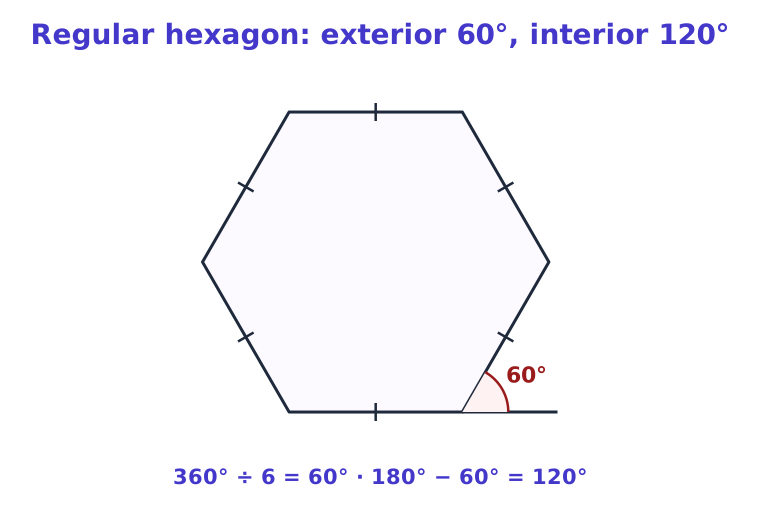
The exterior angles of any convex polygon add to 360°. In a regular polygon they are equal, so
$$\text{each exterior} = \frac{360°}{n}, \quad \text{each interior} = 180° - \frac{360°}{n}$$
Working backwards
Given each interior angle, first find the exterior angle, then $n = \frac{360°}{\text{exterior}}$.
Example: interior 156° gives exterior 24°, so $n = 360 \div 24 = 15$ sides.
Counting diagonals
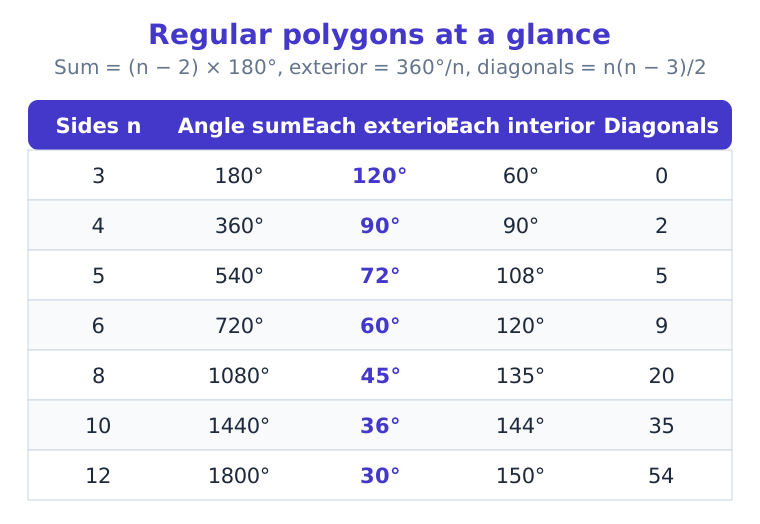
Each of the $n$ corners joins to $n - 3$ others (not itself and not its two neighbours). Each diagonal is counted twice:
$$\text{Diagonals} = \frac{n(n - 3)}{2}$$
A decagon has $10 \times 7 \div 2 = 35$ diagonals.
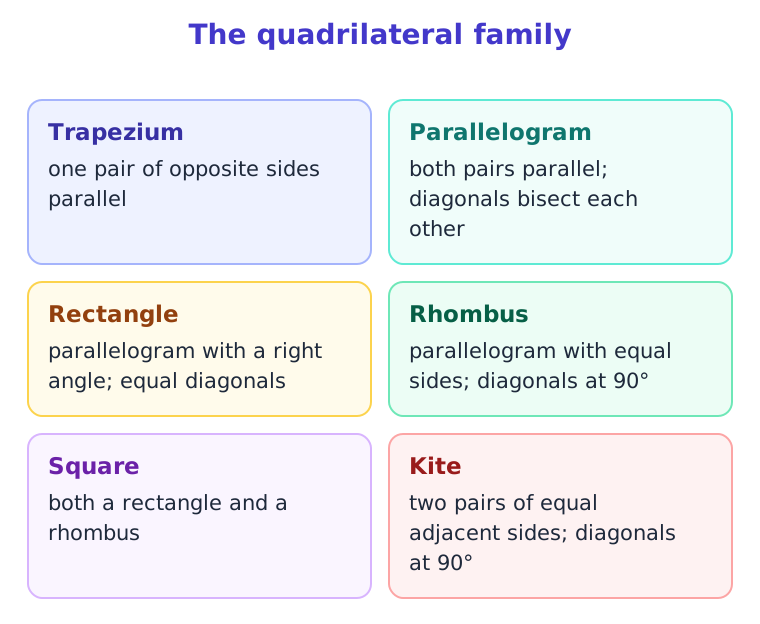
The quadrilateral family
Every special quadrilateral keeps the properties of the one above it and adds one more.
Parallelograms and rectangles
- Opposite sides equal and parallel; opposite angles equal.
- Adjacent angles add to 180°: if $\angle A = 70°$ then $\angle B = 110°$.
- Diagonals bisect each other. In a rectangle they are also equal: $d = \sqrt{l^2 + b^2}$.
Rhombus and square
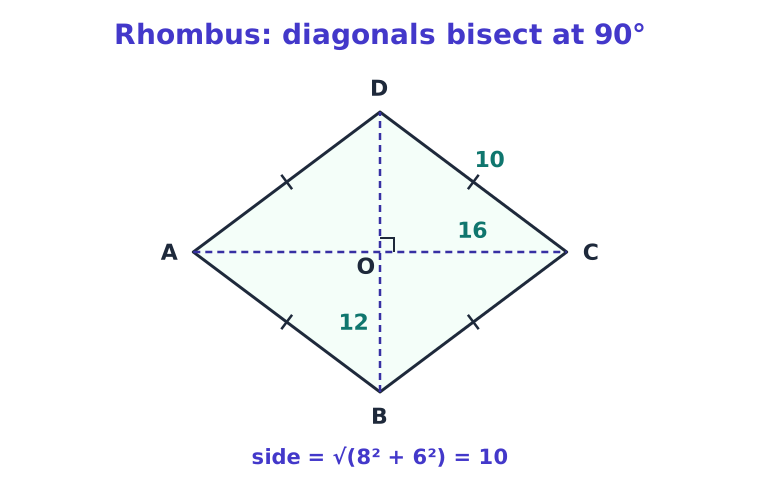
The diagonals of a rhombus cut each other in half at 90°, so each side is the hypotenuse of a small right triangle:
$$a = \sqrt{\left(\frac{d_1}{2}\right)^2 + \left(\frac{d_2}{2}\right)^2}$$
A square of side $a$ has diagonal $a\sqrt{2}$.
Trapeziums
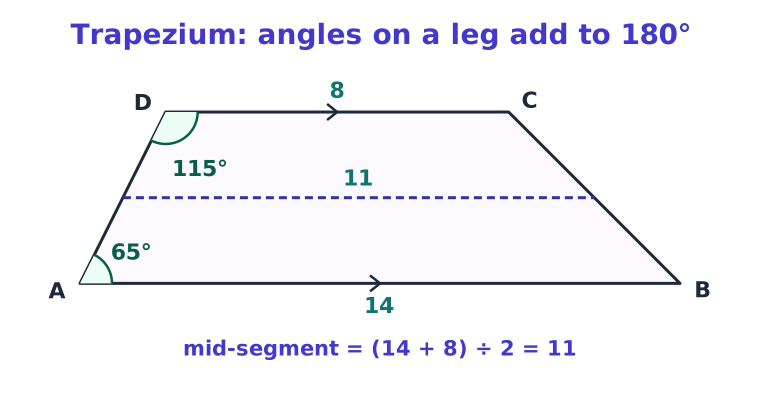
One pair of sides is parallel. The two angles on each slanting side are co-interior, so they add to 180°. The segment joining the midpoints of the slanting sides is parallel to the bases and equals $\frac{a + b}{2}$.
Meera's tile
Each angle 150° means each exterior angle is 30°, so the tile has $360 \div 30 = 12$ sides. But 150° does not divide 360°, so 12-gons alone leave gaps. Meera fills them with small equilateral triangles: two 12-gons and one triangle meet at each corner, as 150° + 150° + 60° = 360°.
Concepts and terms
From one vertex, diagonals cut an n-gon into n − 2 triangles, each worth 180°.
Walking once round any polygon turns you through 360°, shared equally: 360°/n.
Each vertex joins to n − 3 others by diagonals; every diagonal is counted twice, so n(n − 3)/2.
Every square is both a rectangle and a rhombus, and every rectangle or rhombus is a parallelogram. Each step down adds a property.
Did you know
Honeybees build regular hexagons because three of them (3 × 120° = 360°) fit round a point with no gap, using the least wax.
Memory tricks
Exterior first — 360 shared, then 180 minus — Find each exterior angle as 360/n, then interior = 180 − exterior. Faster than the angle sum.
Diagonals — n times n-minus-3, halved — Octagon: 8 × 5 ÷ 2 = 20 diagonals.
Practice MCQs with answers (56)
- A 1080°
- B 720°
- C 1260°
- D 900°
Show answer
Why:
(7 − 2) × 180° = 900°.
- A 1260°
- B 1620°
- C 1440°
- D 1080°
Show answer
Why:
(9 − 2) × 180° = 1260°.
- A 2160°
- B 1800°
- C 1980°
- D 1620°
Show answer
Why:
(12 − 2) × 180° = 1800°.
- A 144°
- B 45°
- C 135°
- D 145°
Show answer
Why:
Each exterior angle = 360° ÷ 8 = 45°, so each interior angle = 180° − 45° = 135°.
- A 141°
- B 24°
- C 166°
- D 156°
Show answer
Why:
Each exterior angle = 360° ÷ 15 = 24°, so each interior angle = 180° − 24° = 156°.
- A 120°
- B 135°
- C 60°
- D 130°
Show answer
Why:
Each exterior angle = 360° ÷ 6 = 60°, so each interior angle = 180° − 60° = 120°.
- A 154°
- B 144°
- C 150°
- D 36°
Show answer
Why:
Each exterior angle = 360° ÷ 10 = 36°, so each interior angle = 180° − 36° = 144°.
- A 140°
- B 20°
- C 40°
- D 60°
Show answer
Why:
Exterior angles total 360°, so each = 360° ÷ 9 = 40°.
- A 162°
- B 9°
- C 27°
- D 18°
Show answer
Why:
Exterior angles total 360°, so each = 360° ÷ 20 = 18°.
- A 45°
- B 67.5°
- C 135°
- D 22.5°
Show answer
Why:
Exterior angles total 360°, so each = 360° ÷ 8 = 45°.
- A 82°
- B 72°
- C 108°
- D 36°
Show answer
Why:
Exterior angles total 360°, so each = 360° ÷ 5 = 72°.
- A 14
- B 17
- C 15
- D 16
Show answer
Why:
n = 360° ÷ 24° = 15.
- A 12
- B 11
- C 9
- D 10
Show answer
Why:
n = 360° ÷ 36° = 10.
- A 9
- B 10
- C 8
- D 11
Show answer
Why:
Exterior = 180° − 140° = 40°, so n = 360 ÷ 40 = 9.
- A 25
- B 24
- C 23
- D 26
Show answer
Why:
Exterior = 180° − 165° = 15°, so n = 360 ÷ 15 = 24.
- A 10
- B 6
- C 8
- D 12
Show answer
Why:
Interior + exterior = 180° and interior = 3 × exterior, so exterior = 180° ÷ 4 = 45° and n = 360 ÷ 45 = 8.
- A 16
- B 14
- C 10
- D 12
Show answer
Why:
Interior + exterior = 180° and interior = 5 × exterior, so exterior = 180° ÷ 6 = 30° and n = 360 ÷ 30 = 12.
- A 20
- B 40
- C 18
- D 28
Show answer
Why:
8(8 − 3) ÷ 2 = 8 × 5 ÷ 2 = 20.
- A 66
- B 54
- C 108
- D 52
Show answer
Why:
12(12 − 3) ÷ 2 = 12 × 9 ÷ 2 = 54.
- A 180
- B 88
- C 90
- D 105
Show answer
Why:
15(15 − 3) ÷ 2 = 15 × 12 ÷ 2 = 90.
- A 9
- B 12
- C 11
- D 10
Show answer
Why:
n(n − 3)/2 = 35 gives n(n − 3) = 70 = 10 × 7, so n = 10.
- A 11
- B 13
- C 12
- D 10
Show answer
Why:
n(n − 3)/2 = 44 gives n(n − 3) = 88 = 11 × 8, so n = 11.
- A 95°
- B 105°
- C 75°
- D 115°
Show answer
Why:
The angles of a quadrilateral add to 360°: x = 360° − (80° + 100° + 75°) = 105°.
- A 60°
- B 130°
- C 120°
- D 110°
Show answer
Why:
The angles of a quadrilateral add to 360°: x = 360° − (95° + 70° + 75°) = 120°.
- A 52°
- B 118°
- C 72°
- D 62°
Show answer
Why:
The angles of a quadrilateral add to 360°: x = 360° − (118° + 96° + 84°) = 62°.
- A 115°
- B 65°
- C 125°
- D 105°
Show answer
Why:
The angles of a pentagon add to 540°: x = 540° − (100° + 120° + 110° + 95°) = 115°.
- A 88°
- B 98°
- C 82°
- D 108°
Show answer
Why:
The angles of a pentagon add to 540°: x = 540° − (125° + 112° + 90° + 115°) = 98°.
- A 24°
- B 120°
- C 144°
- D 72°
Show answer
Why:
2x + 3x + 4x + 6x = 15x = 360°, so x = 24° and the largest angle = 6 × 24° = 144°.
- A 30°
- B 18°
- C 72°
- D 36°
Show answer
Why:
10 parts = 360°, so one part = 36°.
- A 65°
- B 25°
- C 230°
- D 115°
Show answer
Why:
In a parallelogram opposite angles are equal, so x = 65°.
- A 244°
- B 122°
- C 58°
- D 32°
Show answer
Why:
In a parallelogram adjacent angles add to 180°, so x = 122°.
- A 216°
- B 72°
- C 108°
- D 18°
Show answer
Why:
In a parallelogram adjacent angles add to 180°, so x = 108°.
- A 144°
- B 216°
- C 72°
- D 108°
Show answer
Why:
Adjacent angles add to 180°: 3/5 × 180° = 108°.
- A 100°
- B 110°
- C 30°
- D 80°
Show answer
Why:
A + B = 180°: 5x + 30 = 180, x = 30. ∠C = ∠A = 100°.
- A 12
- B 10
- C 20
- D 14
Show answer
Why:
Half diagonals 8 and 6 meet at 90°: side = √(8² + 6²) = 10.
- A 17
- B 15
- C 13
- D 26
Show answer
Why:
Half diagonals 12 and 5 meet at 90°: side = √(12² + 5²) = 13.
- A 17
- B 92
- C 72
- D 68
Show answer
Why:
Side = √(15² + 8²) = 17, so the perimeter = 4 × 17 = 68.
- A 10
- B 11
- C 26
- D 5
Show answer
Why:
Half of the other diagonal = √(13² − 12²) = 5, so it is 10.
- A 14
- B 13
- C 11
- D 17
Show answer
Why:
x = √(12² + 5²) = √169 = 13.
- A 18
- B 15
- C 17
- D 23
Show answer
Why:
x = √(15² + 8²) = √289 = 17.
- A 1
- B 49
- C 12
- D 7
Show answer
Why:
√(25² − 24²) = √49 = 7.
- A 7√2 cm
- B 7√3 cm
- C 49 cm
- D 14 cm
Show answer
Why:
d = a√2 = 7√2 cm.
- A 10
- B 40
- C 20
- D 56.4
Show answer
Why:
Side = 10√2 ÷ √2 = 10, perimeter = 40.
- A 70°
- B 160°
- C 110°
- D 220°
Show answer
Why:
∠A and ∠D are co-interior angles on the slanting side AD, so x = 180° − 70° = 110°.
- A 148°
- B 244°
- C 58°
- D 122°
Show answer
Why:
∠A and ∠D are co-interior angles on the slanting side AD, so x = 180° − 58° = 122°.
- A 13
- B 26
- C 6
- D 3
Show answer
Why:
Mid-segment = (16 + 10) ÷ 2 = 13.
- A Rectangle
- B Square
- C Rhombus
- D Kite
Show answer
Why:
Equal diagonals need a rectangle, perpendicular ones a rhombus; both together make a square.
- A bisect the angles
- B are equal
- C bisect each other
- D are perpendicular
Show answer
Why:
Only bisecting each other holds for all parallelograms; the others need a rectangle or a rhombus.
- A Pentagon
- B Hexagon
- C Triangle
- D Quadrilateral
Show answer
Why:
(n − 2) × 180° = 360° gives n = 4.
- A Regular pentagon
- B Regular hexagon
- C Equilateral triangle
- D Square
Show answer
Why:
108° does not divide 360°; 60°, 90° and 120° do.
- A Yes, with 8 sides
- B No, 360 is not a multiple of 50
- C Yes, with 5 sides
- D Yes, with 7 sides
Show answer
Why:
n = 360 ÷ 50 = 7.2 is not a whole number.
- A 18 cm
- B 6√3 cm
- C 12 cm
- D 6 cm
Show answer
Why:
A regular hexagon is six equilateral triangles; the longest diagonal is two sides, 12 cm.
- A Both A and R are true, and R is the correct explanation of A
- B Both A and R are true, but R is not the correct explanation of A
- C A is true but R is false
- D A is false but R is true
Show answer
Why:
Both true and R gives A: 180° − 60° = 120°.
- A Both A and R are true, and R is the correct explanation of A
- B Both A and R are true, but R is not the correct explanation of A
- C A is true but R is false
- D A is false but R is true
Show answer
Why:
A is true: a square has four equal sides. R is false: a rhombus need not have right angles.
- A 1 only
- B 2 only
- C Both 1 and 2
- D Neither 1 nor 2
Show answer
Why:
8 × 5 ÷ 2 = 20, so 1 is true. A heptagon gives 5 × 180° = 900°, so 2 is false.
- A 1 only
- B 2 only
- C Both 1 and 2
- D Neither 1 nor 2
Show answer
Why:
Rhombus diagonals are perpendicular, not equal (unless it is a square). Statement 2 is true.
Important short questions (3)
Exterior 30°, so n = 12. Diagonals = 12 × 9 ÷ 2 = 54.
360° − 280° = 80°.
Side = √(9² + 12²) = 15 cm; perimeter = 60 cm.
Long answer questions (1)
(a) Sum = 540°: 5x + 100 = 540, so x = 88.
(b) Largest = 88 + 40 = 128°.
(c) No. A regular pentagon has every angle 108°, but these angles are all different.
Flashcards (15)
Play this topic
- Polygon check
Veda Skills Quantitative Aptitude Unit 14 — frequently asked questions
x = 4(90 − x) gives 5x = 360, x = 72°. Its supplement is 108°.
2B + B + 3B = 180°, so B = 30°, A = 60°, C = 90°.
81 + 144 = 225 = 15², so yes; the right angle is opposite the 15 side.
r = √(8² + 6²) = 10 cm, so the diameter is 20 cm.
A + C = 180° and A = 3C, so 4C = 180°, C = 45°, A = 135°.
∠AOB = 180° − 70° = 110°. OA = OB, so ∠OAB = (180° − 110°) ÷ 2 = 35°.
Exterior 30°, so n = 12. Diagonals = 12 × 9 ÷ 2 = 54.
360° − 280° = 80°.
Side = √(9² + 12²) = 15 cm; perimeter = 60 cm.

All Veda Skills Quantitative Aptitude units
All Quantitative Aptitude units · All Skills & Exams courses
Study this chapter properly, free
Everything above is on this page to read. In the Veda app the same chapter becomes spaced-repetition flashcards, timed tests that mark themselves, Veda Bites you can swipe, and games — with your progress tracked topic by topic.
Get Veda free