Veda Skills Quantitative Aptitude Unit 18: Permutation and Combination
- 2 topics
- 111 MCQs
- 10 short answers
- 4 long answers
- 28 flashcards
- 2 games
- ~110 min read
- English
Checked before publishing: 23 automated checks, including a plagiarism check against the textbook's own words. How we check our content
Counting and Arrangements
Count without listing: use the multiplication and addition principles, factorials and ⁿPᵣ for ordered arrangements, handle repeated letters, “together” and “never together” conditions, digits with restrictions, and round tables.
What you will be able to do
- I can decide when to multiply (AND) and when to add (OR).
- I can use n! and ⁿPᵣ to count ordered arrangements.
- I can arrange letters with repeats and with “together” conditions.
- I can count numbers formed from digits under conditions such as even, no zero first or greater than a value.
- I can count circular arrangements and necklaces.

Key points
Multiplication principle: if one job can be done in m ways and the next in n ways, both together can be done in m × n ways.
Addition principle: if a choice is from one group OR another (not both), add the counts.
n! = n × (n − 1) × … × 1, and 0! = 1.
ⁿPᵣ = n! ÷ (n − r)! counts ordered arrangements of r things chosen from n.
With repeats: n! ÷ (p! q! …), where p, q, … are the counts of each repeated letter.
“Together”: glue the group into one block, arrange the blocks, then arrange inside the block.
“Never together” = total − together.
n people round a table: (n − 1)!. A necklace or garland that can be flipped: (n − 1)! ÷ 2.
With digits, fill the restricted place first, and remember that 0 cannot start a number.
Full explanation
Meena’s tiffin

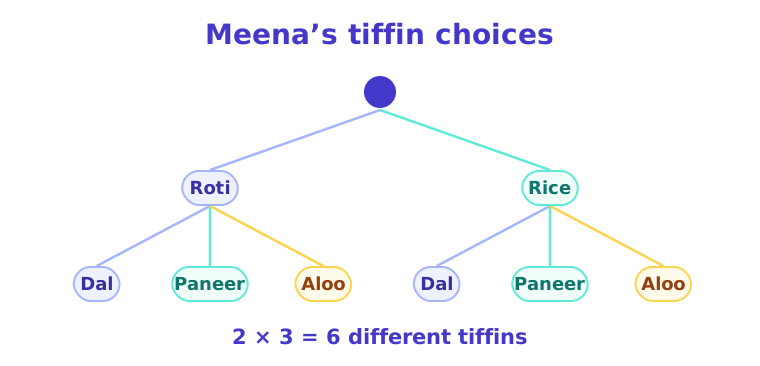
Every morning Meena packs a tiffin: roti or rice, and one of dal, paneer or aloo. Her little brother asks: “How many different tiffins can you make before one repeats?”
She could list them all. Or she could count in one step. This topic is about counting in one step.
AND means multiply
First choose the base (2 ways), then the side (3 ways). Each base goes with each side, so the count is 2 × 3 = 6.
This is the multiplication principle: jobs done one after another multiply.
OR means add
If Meena may take either one of 4 fruits or one of 3 biscuits (only one item), she has 4 + 3 = 7 choices. That is the addition principle.
Factorials and ⁿPᵣ
$n! = n \times (n-1) \times \cdots \times 1$, so $5! = 120$ and $0! = 1$.
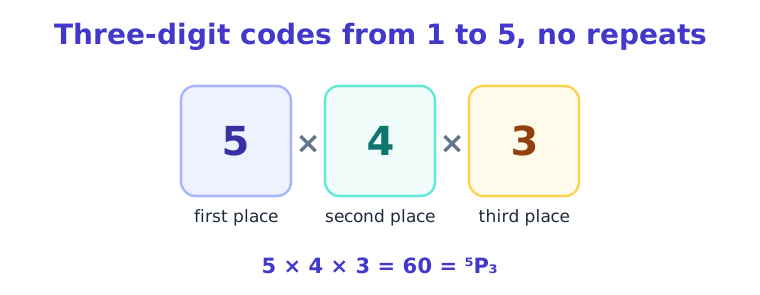
Arranging r of n different things in order: $^nP_r = \frac{n!}{(n-r)!}$. For example $^5P_3 = 5 \times 4 \times 3 = 60$.
Digits with conditions
How many 3-digit even numbers can be made from 1 to 6 without repeats? Fill the fussy place first: the units digit must be 2, 4 or 6 (3 ways). Then the hundreds (5 left) and tens (4 left): 3 × 5 × 4 = 60.
If 0 is among the digits, keep it out of the first place.
Repeated letters
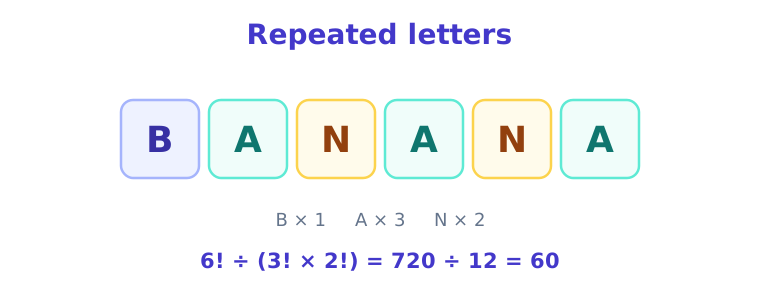
BANANA has 6 letters, but A appears 3 times and N twice. Swapping the A’s changes nothing, so divide: $\frac{6!}{3! \times 2!} = 60$.
“Together” and “never together”
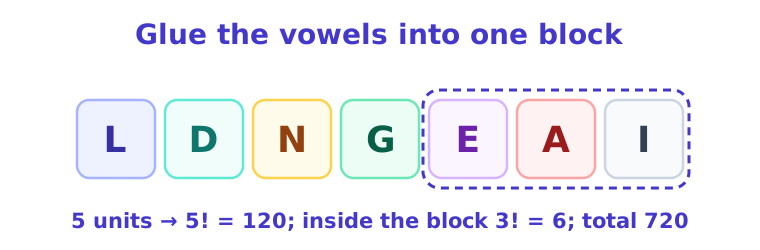
In how many arrangements of LEADING do the vowels E, A, I stay together? Glue them into one block: L, D, N, G and the block are 5 units, giving 5! = 120. Inside the block the vowels can be arranged in 3! = 6 ways. Answer: 120 × 6 = 720.
Never together = all 7! = 5,040 minus 720 = 4,320.
Round tables
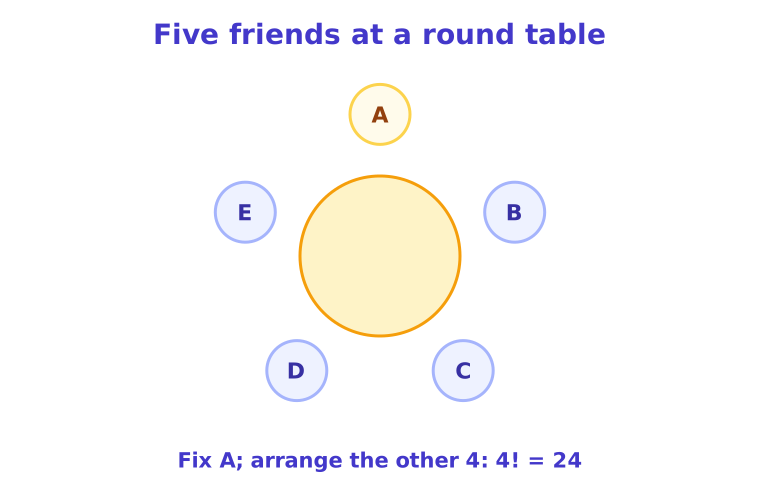
Five friends at a round table: if everyone moves one seat to the right, nobody’s neighbours change, so it is the same seating. Fix A’s seat and arrange the other four: 4! = 24.
A necklace can also be flipped over, so it has half as many: (n − 1)! ÷ 2.
Back to Meena
2 bases AND 3 sides: 6 tiffins, so a new one each day for almost a week. Add 4 fruits OR 3 biscuits as a treat and she has 6 × 7 = 42 combinations.
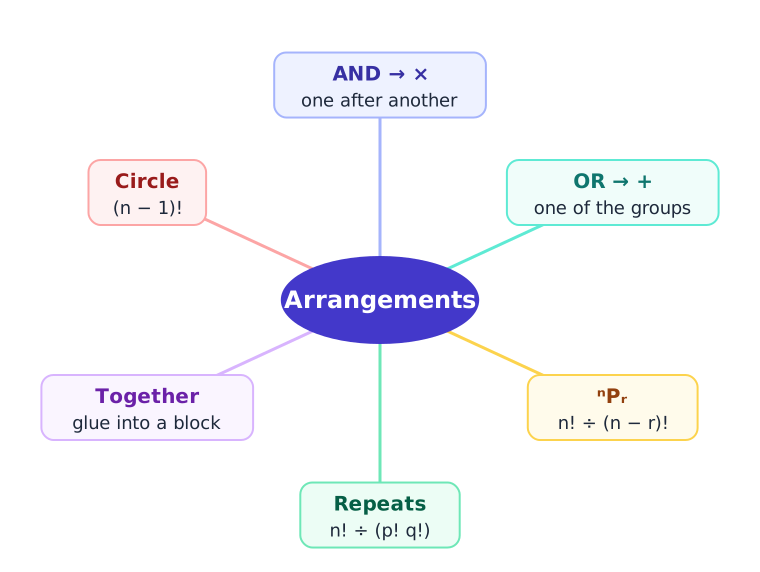
Multiply for AND, add for OR, divide for repeats, glue for together, and fix one seat for circles.
Concepts and terms
Jobs done one after another multiply; alternatives (either this or that) add.
An ordered arrangement. AB and BA are different permutations. ⁿPᵣ = n! ÷ (n − r)!.
Swapping two identical letters gives the same word, so divide by the factorial of each repeat count.
Turning everyone one seat round gives the same seating, so fix one person: (n − 1)!.

Did you know
Indian mathematicians, from Pingala’s poetry metres to Bhaskara II in 1150 CE, gave rules for counting arrangements centuries before Europe.
52! (the orders of a deck of cards) is so large that every well-shuffled deck has almost surely never existed before.

Memory tricks
AND or OR — AND multiplies, OR adds — Shirt AND trousers: multiply. Bus OR train: add.
Slots — Fussy first — Fill the place with a condition (no 0, must be even) before the free places.
Practice MCQs with answers (58)
- A 12
- B 14
- C 9
- D 24
Show answer
Why:
One choice after another, so multiply: 4 × 3 × 2 = 24.
- A 60
- B 20
- C 23
- D 12
Show answer
Why:
One choice after another, so multiply: 5 × 4 × 3 = 60.
- A 17
- B 60
- C 64
- D 12
Show answer
Why:
4 × 3 × 5 = 60.
- A 7
- B 24
- C 12
- D 64
Show answer
Why:
Choose the first road (4 ways), then the second (3 ways): 4 × 3 = 12.
- A 400
- B 40
- C 380
- D 240
Show answer
Why:
Going: 5 × 4. Returning on new roads: 3 × 4. Total = 5 × 4 × 3 × 4 = 240.
- A 4096
- B 16384
- C 1296
- D 24
Show answer
Why:
Each question has 4 choices independently: 4 multiplied 6 times = 4^6 = 4096.
- A 20
- B 1024
- C 2048
- D 100
Show answer
Why:
Each question has 2 choices independently: 2 multiplied 10 times = 2^10 = 1024.
- A 8
- B 48
- C 14
- D 47
Show answer
Why:
Only one item is chosen, from either group: “or” means add. 6 + 8 = 14.
- A 14
- B 5
- C 15
- D 8
Show answer
Why:
Only one item is chosen, from either group: “or” means add. 5 + 3 = 8.
- A 72
- B 36
- C 18
- D 2
Show answer
Why:
Cancel 7!: what is left is 9 × 8 = 72.
- A 30
- B 720
- C 6
- D 120
Show answer
Why:
Cancel 7!: what is left is 10 × 9 × 8 = 720.
- A 56
- B 24
- C 336
- D 512
Show answer
Why:
Order matters: $^{8}P_{3}$ = 8 × 7 × 6 = 336.
- A 40
- B 10000
- C 210
- D 5040
Show answer
Why:
Order matters: $^{10}P_{4}$ = 10 × 9 × 8 × 7 = 5040.
- A 9
- B 8
- C 10
- D 36
Show answer
Why:
$^nP_2 = n(n − 1) = 72 = 9 × 8$, so n = 9.
- A 15
- B 64
- C 63
- D 24
Show answer
Why:
Signals with r flags: $^nP_r$. Add over r = 1 to 4: 4 + 12 + 24 + 24 = 64.
- A 120
- B 1440
- C 720
- D 360
Show answer
Why:
6 different letters: 6! = 720.
- A 24
- B 240
- C 60
- D 120
Show answer
Why:
5 different letters: 5! = 120.
- A 180
- B 120
- C 360
- D 720
Show answer
Why:
6 letters with E repeated 2 times, T repeated 2 times: 6! ÷ (2! × 2!) = 180.
- A 840
- B 420
- C 5040
- D 720
Show answer
Why:
7 letters with S repeated 3 times, C repeated 2 times: 7! ÷ (3! × 2!) = 420.
- A 40320
- B 15120
- C 7560
- D 362880
Show answer
Why:
9 letters with A repeated 4 times, L repeated 2 times: 9! ÷ (4! × 2!) = 7560.
- A 39916800
- B 3628800
- C 69300
- D 34650
Show answer
Why:
11 letters with I repeated 4 times, S repeated 4 times, P repeated 2 times: 11! ÷ (4! × 4! × 2!) = 34650.
- A 4320
- B 40320
- C 36000
- D 720
Show answer
Why:
Glue the 3 vowels into one block: 6 objects give 720 orders, and the vowels inside the block give 6. Together: 720 × 6 = 4320.
- A 3276000
- B 50400
- C 2520
- D 3326400
Show answer
Why:
Glue the 5 vowels into one block: 7 objects give 2520 orders, and the vowels inside the block give 20. Together: 2520 × 20 = 50400.
- A 720
- B 40320
- C 36000
- D 4320
Show answer
Why:
Glue the 3 vowels into one block: 6 objects give 720 orders, and the vowels inside the block give 6. Together: 720 × 6 = 4320. Never together = all 40320 − 4320 = 36000.
- A 40320
- B 36000
- C 720
- D 4320
Show answer
Why:
Glue the 3 vowels into one block: 6 objects give 720 orders, and the vowels inside the block give 6. Together: 720 × 6 = 4320.
- A 120
- B 720
- C 240
- D 24
Show answer
Why:
Fix M in the first place; arrange the other 5: 5! = 120.
- A 48
- B 24
- C 6
- D 720
Show answer
Why:
Fix S first and Y last; arrange the other 4: 4! = 24.
- A 240
- B 60
- C 120
- D 140
Show answer
Why:
6 × 5 × 4 = 120.
- A 250
- B 62
- C 137
- D 125
Show answer
Why:
Each place has 5 choices: 5^3 = 125.
- A 90
- B 120
- C 210
- D 105
Show answer
Why:
Fill the last place first: 2, 4, 6 (3 ways). The other places take 6 × 5. Total = 3 × 6 × 5 = 90.
- A 60
- B 96
- C 192
- D 120
Show answer
Why:
The first place cannot be 0: 4 choices; then 4 × 3 × 2 for the other places. Total = 4 × 4 × 3 × 2 = 96.
- A 56
- B 120
- C 60
- D 80
Show answer
Why:
Fill the first place first: it must be one of 4, 5, 6 (3 choices), and every such number is greater than 400. The other places take 5 × 4 = 20. Total = 3 × 20 = 60.
- A 168
- B 360
- C 180
- D 108
Show answer
Why:
Fill the last place first and split on 0. Last digit 0: the other places take 5 × 4 × 3 = 60. Last digit 5 (1 way), first digit not 0 and not that one (4 ways), then 4 × 3 for the middle: 1 × 4 × 4 × 3 = 48. Total = 60 + 48 = 108.
- A 18
- B 36
- C 60
- D 30
Show answer
Why:
Fill the last place first; 0 cannot go first. Last digit 5, 7 (2 ways), first digit not 0 and not that one (3 ways), then 3 for the middle: 2 × 3 × 3 = 18.
- A 240
- B 720
- C 120
- D 36
Show answer
Why:
6! = 720.
- A 480
- B 120
- C 240
- D 720
Show answer
Why:
Tie Asha and Bela together: 5 units give 5! orders, and the pair can swap: 2 × 5! = 240.
- A 4320
- B 1440
- C 5040
- D 3600
Show answer
Why:
All orders 5040 minus the together orders 1440 = 3600.
- A 1152
- B 40320
- C 48
- D 576
Show answer
Why:
Pattern BGBG… or GBGB… (2 ways); boys in 4! ways and girls in 4! ways: 2 × 4! × 4! = 1152.
- A 120
- B 720
- C 5040
- D 360
Show answer
Why:
Fix one person to remove the turning copies; arrange the rest: (7 − 1)! = 720.
- A 20160
- B 5040
- C 2520
- D 40320
Show answer
Why:
Round arrangements: (8 − 1)!; a necklace can be flipped, so halve it: 5040 ÷ 2 = 2520.
- A 120
- B 24
- C 240
- D 48
Show answer
Why:
Treat the pair as one: 5 units round a table give (5 − 1)! = 24; the pair swaps: × 2 = 48.
- A 601
- B 602
- C 120
- D 600
Show answer
Why:
Letters in order: A, C, H, I, N, S. For each place, count the words that start with a smaller unused letter (each such letter adds (letters left)!), add them up, then add 1 for the word itself: rank = 601.
- A 412
- B 309
- C 308
- D 310
Show answer
Why:
Letters in order: E, H, M, O, R, T. For each place, count the words that start with a smaller unused letter (each such letter adds (letters left)!), add them up, then add 1 for the word itself: rank = 309.
- A 9000
- B 10000
- C 4536
- D 5040
Show answer
Why:
First slot: 9 (1 to 9). Then 9 (0 is back, one used), 8, 7: 9 × 9 × 8 × 7 = 4,536.
- A 20
- B 400
- C 16900
- D 625
Show answer
Why:
Vowels A, E, I, O, U: 5 each; odd digits 1, 3, 5, 7, 9: 5 each. 5 × 5 × 5 × 5 = 625.
- A 60
- B 24
- C 30
- D 120
Show answer
Why:
5 letters with P repeated 2 times: 5! ÷ (2!) = 60.
- A 120
- B 240
- C 720
- D 480
Show answer
Why:
Glue the 2 vowels into one block: 5 objects give 120 orders, and the vowels inside the block give 2. Together: 120 × 2 = 240.
- A 60
- B 24
- C 120
- D 720
Show answer
Why:
With H fixed, the other 5 fill 5 seats in order: 5! = 120 = (6 − 1)!.
- A 720
- B 1440
- C 120
- D 240
Show answer
Why:
Glue P and Q: 6 units round a table = 5! = 120; P and Q can swap: 2 × 120 = 240.
- A 24
- B 9
- C 6
- D 10
Show answer
Why:
The tree has 2 × 3 = 6 end points; each goes with 4 shorts: 6 × 4 = 24.
- A 0
- B 0!
- C 1! − 1
- D 2! ÷ 1
Show answer
Why:
0! = 1 by definition; 1! − 1 = 0 and 2! ÷ 1 = 2.
- A Selecting 2 books to borrow
- B Picking 3 fruits from a basket
- C Electing a president and a secretary from a club
- D Choosing a team of 5 players
Show answer
Why:
President–secretary are different posts, so AB ≠ BA: a permutation. The others are selections.
- A The host is never counted
- B A circle has no first and second person, so we subtract 1
- C One chair is always left empty
- D Rotating everyone gives the same seating, so n rotations count as one
Show answer
Why:
n! counts each seating n times (once per rotation): n! ÷ n = (n − 1)!.
- A n!
- B 1
- C n
- D (n − 1)!
Show answer
Why:
$^nP_n = n! ÷ 0! = n!$.
- A Both A and R are true, and R is the correct explanation of A
- B Both A and R are true, but R is not the correct explanation of A
- C A is true but R is false
- D A is false but R is true
Show answer
Why:
4! ÷ 2! = 12, and R is the exact reason.
- A Both A and R are true, and R is the correct explanation of A
- B Both A and R are true, but R is not the correct explanation of A
- C A is true but R is false
- D A is false but R is true
Show answer
Why:
A is false: (5 − 1)! = 24. R is true.
- A 1 only
- B 2 only
- C Both 1 and 2
- D Neither 1 nor 2
Show answer
Why:
4! = 24 includes those starting with 0 (3! = 6), so 24 − 6 = 18.
- A 1 only
- B 2 only
- C Both 1 and 2
- D Neither 1 nor 2
Show answer
Why:
⁵P₂ = 5 × 4 = 20, but ⁵P₃ = 60, so statement 2 is false.
Important short questions (5)
5 letters with L twice and E twice: 5! ÷ (2! × 2!) = 120 ÷ 4 = 30.
Last digit 2 or 4: 2 ways. Then 4 and 3 for the other places: 2 × 4 × 3 = 24.
After gluing them into one unit, the two can still sit as AB or BA, so each block arrangement counts twice.
⁷P₃ = 7 × 6 × 5 = 210.
All: 5! = 120. Together: 2 × 4! = 48. Not together: 120 − 48 = 72.
Long answer questions (2)
(a) 8 different letters: 8! = 40320.
(b) Vowels E, U, A, I, O form one block; with Q, T, N that is 4 units: 4! × 5! = 24 × 120 = 2880.
(c) Choose consonants for the two ends in order: ³P₂ = 6; the other 6 letters fill the middle: 6! = 720. Total 6 × 720 = 4320.
(a) First place 4 ways (not 0), then 4 and 3: 4 × 4 × 3 = 48.
(b) Ending in 0: 4 × 3 = 12. Ending in 2 or 4: 2 × 3 × 3 = 18 (first place not 0 and not the last digit). Even = 12 + 18 = 30.
Flashcards (14)
Play this topic
- Multiply or add?
Selections and Committees
Choose without caring about order: ⁿCᵣ, committees with fixed numbers from groups, “at least” and “at most” cases, people who must or must not be chosen, handshakes and matches, diagonals, triangles and lines from points, grid routes and rectangles, and sharing identical things.
What you will be able to do
- I can tell a selection from an arrangement and compute ⁿCᵣ.
- I can form committees from groups, including “at least” and “at most” conditions.
- I can count handshakes, matches, diagonals, lines and triangles.
- I can count grid routes and rectangles by choosing lines or steps.
- I can combine selection and arrangement in one problem.
Key points
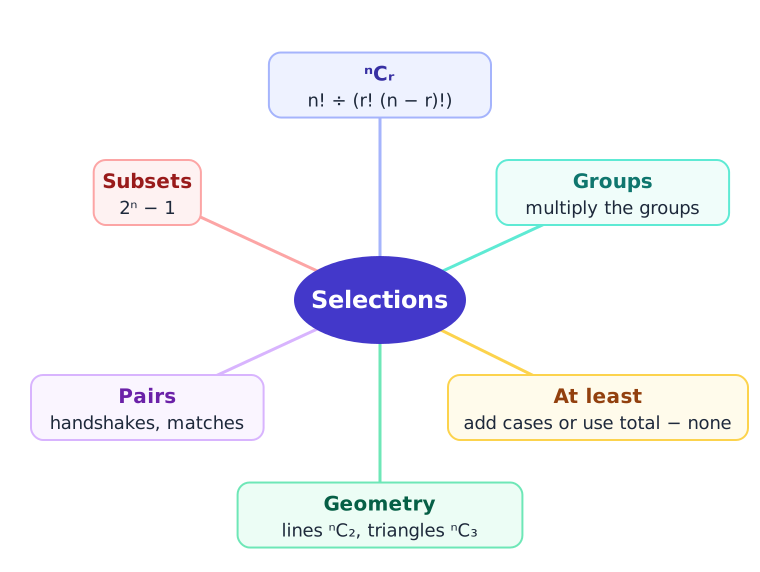
ⁿCᵣ = n! ÷ (r! × (n − r)!) counts selections where order does not matter.
ⁿPᵣ = ⁿCᵣ × r!: arrange after you select.
ⁿCᵣ = ⁿCₙ₋ᵣ. Choosing who goes is the same as choosing who stays.
ⁿC₀ = ⁿCₙ = 1 and ⁿC₁ = n.
From two groups, multiply the selections from each group.
“At least” and “at most”: add the separate cases, or subtract the unwanted cases from the total.
Handshakes among n people = ⁿC₂; diagonals of an n-sided polygon = n(n − 3) ÷ 2.
Triangles from n points with k in a line = ⁿC₃ − ᵏC₃.
Selecting one or more from n different things: 2ⁿ − 1.
Shortest grid routes m right and n up: ⁽ᵐ⁺ⁿ⁾Cₘ.
Full explanation
Selecting the class team

The sports teacher must send 3 of her 5 best runners, Amit, Bina, Chetan, Dev and Esha, to a relay camp. Amit asks: “Is it 5 × 4 × 3 = 60 ways?”
Not quite. In a camp team nobody has a position, so Amit–Bina–Chetan is the same team as Chetan–Amit–Bina.
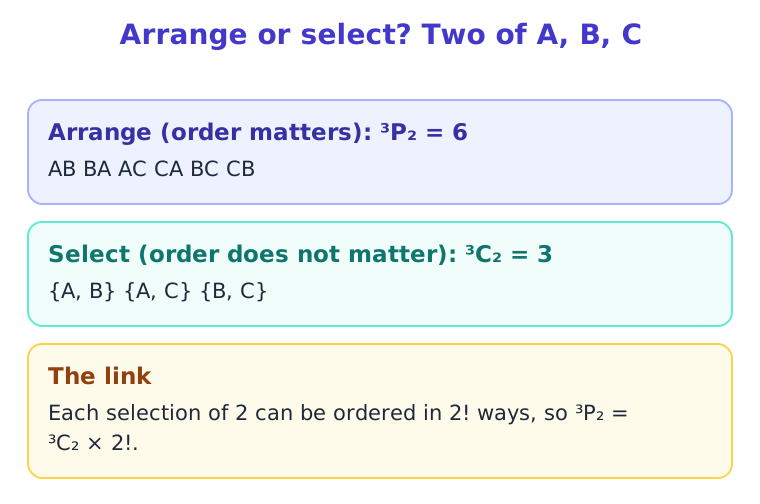
Arrange or select?
60 counts ordered lists. Every team of 3 appears in 3! = 6 orders, so the number of teams is 60 ÷ 6 = 10.
That is the combination formula: $^nC_r = \frac{n!}{r!,(n-r)!} = \frac{^nP_r}{r!}$.
Handy facts
- $^nC_0 = {}^nC_n = 1$ and $^nC_1 = n$.
- $^nC_r = {}^nC_{n-r}$: picking 3 to go is picking 2 to stay, so $^5C_3 = {}^5C_2 = 10$.
- If $^nC_a = {}^nC_b$ and a ≠ b, then a + b = n.
Committees from groups
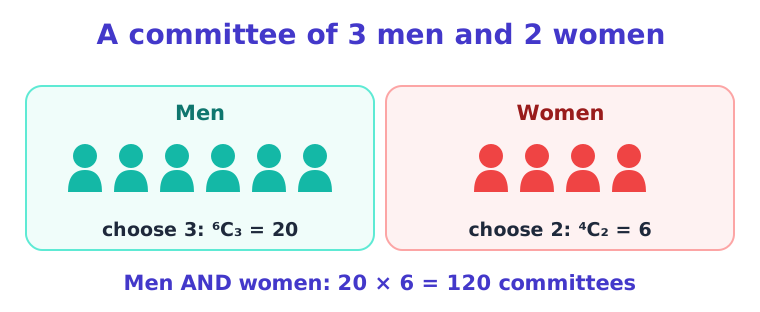
From 6 men and 4 women, a committee needs 3 men and 2 women. Choose the men ($^6C_3 = 20$) AND the women ($^4C_2 = 6$): 20 × 6 = 120.
At least and at most
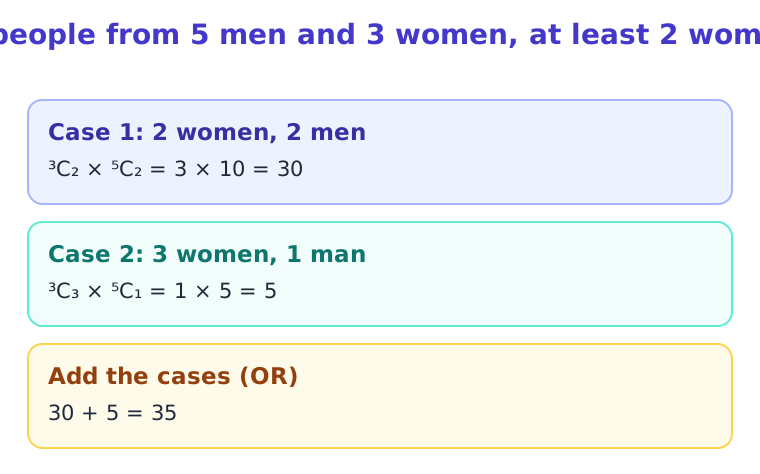
A team of 4 from 5 men and 3 women must have at least 2 women. Split into cases: exactly 2 women or exactly 3 women, then add.
For at least one, the complement is faster: all teams minus the teams with none.
Must go, must not go
If Kavya must be chosen, she takes one seat: choose the rest from the others, $^{n-1}C_{r-1}$. If she must be left out, choose all r from the other n − 1: $^{n-1}C_r$.
If two people refuse to go together, count all groups and remove those that contain both: $^nC_r - {}^{n-2}C_{r-2}$.
Handshakes, matches and diagonals
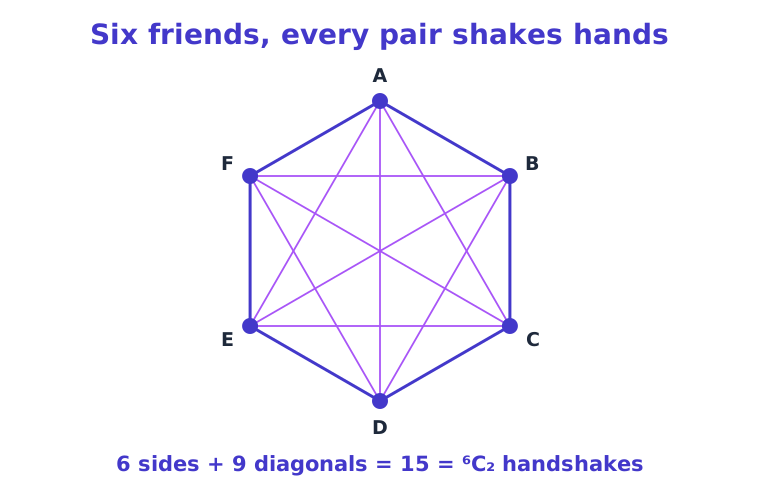
A handshake is just a pair of people, so 6 friends make $^6C_2 = 15$ handshakes. A league where each team meets each other once is the same count.
Joining any 2 corners of a polygon gives a side or a diagonal, so diagonals = $^nC_2 - n = \frac{n(n-3)}{2}$.
Points, lines and triangles
A line needs 2 points and a triangle needs 3. With 10 points, no three in a line, there are $^{10}C_3 = 120$ triangles. If 4 of them lie on one line, those 4 give $^4C_3 = 4$ flat “triangles”, so the answer is 120 − 4 = 116.
Routes on a grid
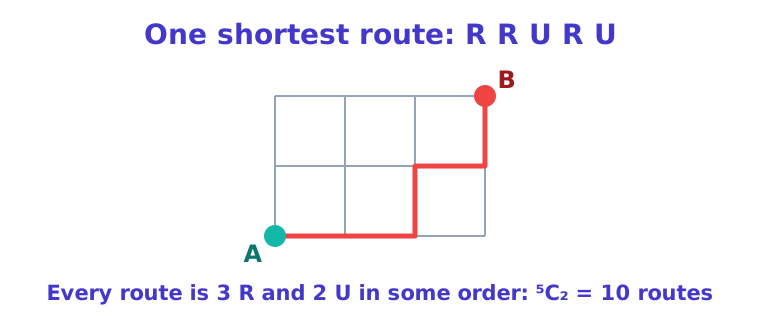
To walk from A to B on a grid 3 blocks right and 2 blocks up, every shortest route is some order of R, R, R, U, U. Choose the 2 places for U: $^5C_2 = 10$ routes.
A rectangle on a grid needs 2 vertical and 2 horizontal lines, so an m × n grid has $^{m+1}C_2 \times {}^{n+1}C_2$ rectangles.
Identical things
From 3 identical mangoes you can take 0, 1, 2 or 3: 4 choices, not $2^3$. With 3 mangoes and 2 apples, at least one fruit can be picked in 4 × 3 − 1 = 11 ways.
Sharing n identical sweets among r children, each getting at least one, is $^{n-1}C_{r-1}$: place r − 1 dividers in the n − 1 gaps.
Select, then arrange
How many 4-letter words with 2 vowels and 2 consonants can be made from 5 vowels and 6 consonants? Select: $^5C_2 \times {}^6C_2 = 10 \times 15 = 150$. Arrange the 4 letters: 4! = 24. Total 150 × 24 = 3,600.
Back to the relay camp
The teacher has $^5C_3 = 10$ possible teams. If Esha must go, it is $^4C_2 = 6$. If she later picks a captain too, multiply by 3.
Select with C, arrange with P, multiply groups, add cases, and subtract what you do not want.
Concepts and terms
A selection where order does not matter: {A, B} is the same as {B, A}. ⁿCᵣ = ⁿPᵣ ÷ r!.
Choose from each group separately and multiply, because the choices happen together (AND).
Split “at least” into cases and add them, or count all and remove the cases you do not want.
A line needs 2 points, a triangle 3 points, a rectangle 2 vertical and 2 horizontal lines.
Did you know
Sushruta, the ancient Indian physician, listed all 63 ways of combining the six tastes, which is 2⁶ − 1.
A lottery that picks 6 numbers from 49 has ⁴⁹C₆ = 1,39,83,816 possible tickets.
Memory tricks
P or C — Posts are P, Committees are C — Different posts (president, secretary) make order matter; a plain committee does not.
At least one — All minus none — At least one woman = all committees − committees with no woman.
Practice MCQs with answers (53)
- A 35
- B 70
- C 210
- D 21
Show answer
Why:
$^{7}C_{3} = \frac{7!}{3! \times 4!}$ = (7 × 6 × 5) ÷ 3! = 210 ÷ 6 = 35.
- A 5040
- B 210
- C 120
- D 252
Show answer
Why:
$^{10}C_{4} = \frac{10!}{4! \times 6!}$ = (10 × 9 × 8 × 7) ÷ 4! = 5040 ÷ 24 = 210.
- A 1320
- B 66
- C 220
- D 495
Show answer
Why:
$^{12}C_{3} = \frac{12!}{3! \times 9!}$ = (12 × 11 × 10) ÷ 3! = 1320 ÷ 6 = 220.
- A 55
- B 10
- C 36
- D 45
Show answer
Why:
$^nC_a = {}^nC_b$ with a ≠ b means a + b = n, so n = 4 + 6 = 10. Then $^{10}C_2 = \frac{10 \times 9}{2} = 45$.
- A 91
- B 105
- C 14
- D 78
Show answer
Why:
$^nC_a = {}^nC_b$ with a ≠ b means a + b = n, so n = 5 + 9 = 14. Then $^{14}C_2 = \frac{14 \times 13}{2} = 91$.
- A 40
- B 56
- C 6720
- D 70
Show answer
Why:
Order does not matter in a team: $^{8}C_{5}$ = 56.
- A 165
- B 54486432000
- C 1365
- D 3003
Show answer
Why:
Order does not matter in a team: $^{15}C_{11}$ = 1365.
- A 70
- B 74
- C 1680
- D 280
Show answer
Why:
Choose the team: $^{8}C_{4}$ = 70; then the captain from those 4: 70 × 4 = 280.
- A 200
- B 2400
- C 462
- D 30
Show answer
Why:
Men AND women, so multiply: $^{6}C_{3} \times {}^{5}C_{2}$ = 20 × 10 = 200.
- A 50400
- B 350
- C 792
- D 45
Show answer
Why:
Men AND women, so multiply: $^{7}C_{4} \times {}^{5}C_{3}$ = 35 × 10 = 350.
- A 120
- B 144
- C 100
- D 40
Show answer
Why:
Add the cases by the number of women: $^{4}C_{1} \cdot {}^{6}C_{2}$ + $^{4}C_{2} \cdot {}^{6}C_{1}$ + $^{4}C_{3} \cdot {}^{6}C_{0}$ = 60 + 36 + 4 = 100. Faster: all $^{10}C_{3}$ = 120 minus all-men $^{6}C_{3}$ = 20, so 120 − 20 = 100.
- A 504
- B 91
- C 462
- D 301
Show answer
Why:
Add the cases by the number of women: $^{4}C_{2} \cdot {}^{7}C_{3}$ + $^{4}C_{3} \cdot {}^{7}C_{2}$ + $^{4}C_{4} \cdot {}^{7}C_{1}$ = 210 + 84 + 7 = 301.
- A 115
- B 100
- C 330
- D 600
Show answer
Why:
Add the cases by the number of women: $^{5}C_{0} \cdot {}^{6}C_{4}$ + $^{5}C_{1} \cdot {}^{6}C_{3}$ = 15 + 100 = 115.
- A 210
- B 84
- C 126
- D 120
Show answer
Why:
Kavya is already in; choose the other 3 from the remaining 9: $^{9}C_{3}$ = 84.
- A 495
- B 792
- C 462
- D 330
Show answer
Why:
Remove Kavya; choose all 5 from the other 11: $^{11}C_{5}$ = 462.
- A 35
- B 126
- C 21
- D 105
Show answer
Why:
All groups $^{9}C_{4}$ = 126 minus groups with both, $^{7}C_{2}$ = 21: 105.
- A 66
- B 132
- C 144
- D 220
Show answer
Why:
A handshake is a pair of people: $^{12}C_2 = \frac{12 \times 11}{2} = 66$.
- A 400
- B 190
- C 1140
- D 380
Show answer
Why:
A handshake is a pair of people: $^{20}C_2 = \frac{20 \times 19}{2} = 190$.
- A 64
- B 36
- C 28
- D 56
Show answer
Why:
One game per pair: $^{8}C_2$ = 28.
- A 55
- B 45
- C 100
- D 90
Show answer
Why:
Each pair plays twice: 2 × $^{10}C_2$ = 2 × 45 = 90 (the same as $^{10}P_2$).
- A 11
- B 10
- C 12
- D 27
Show answer
Why:
$\frac{n(n − 1)}{2} = 55$ gives n(n − 1) = 110 = 11 × 10, so n = 11.
- A 70
- B 35
- C 55
- D 45
Show answer
Why:
Any 2 corners make a line: $^{10}C_2$ = 45. Take away the 10 sides: 45 − 10 = 35 = $\frac{10(10 − 3)}{2}$.
- A 66
- B 108
- C 54
- D 78
Show answer
Why:
Any 2 corners make a line: $^{12}C_2$ = 66. Take away the 12 sides: 66 − 12 = 54 = $\frac{12(12 − 3)}{2}$.
- A 11
- B 8
- C 10
- D 9
Show answer
Why:
$\frac{n(n − 3)}{2} = 27$ gives n(n − 3) = 54 = 9 × 6, so n = 9.
- A 210
- B 35
- C 215
- D 220
Show answer
Why:
Any 3 points: $^{12}C_3$ = 220. Three points on the same line make no triangle: subtract $^{5}C_3$ = 10. Answer 210.
- A 16
- B 40
- C 45
- D 39
Show answer
Why:
All pairs $^{10}C_2$ = 45; the $^{4}C_2$ = 6 pairs on the line are all the same one line, so subtract them and add 1: 40.
- A 36
- B 126
- C 84
- D 504
Show answer
Why:
No three points on a circle are in a line, so every 3 points work: $^{9}C_{3}$ = 84.
- A 56
- B 62
- C 1680
- D 70
Show answer
Why:
No three points on a circle are in a line, so every 4 points work: $^{8}C_{4}$ = 70.
- A 126
- B 792
- C 495
- D 9
Show answer
Why:
The 3 compulsory ones are fixed; choose 5 more from the other 9: $^{9}C_{5}$ = 126.
- A 100
- B 150
- C 330
- D 25
Show answer
Why:
A AND B: $^{6}C_{4} \times {}^{5}C_{3}$ = 15 × 10 = 150.
- A 720
- B 36
- C 63
- D 64
Show answer
Why:
Each friend is either invited or not: 2^6 = 64 ways. Remove the one way with nobody invited: 63.
- A 24
- B 60
- C 511
- D 59
Show answer
Why:
Mangoes: take 0 to 3, so 4 choices; apples 5; bananas 3. 4 × 5 × 3 = 60, minus the empty pick: 59.
- A 42000
- B 350
- C 95040
- D 4200
Show answer
Why:
Select: $^{5}C_{2} \times {}^{7}C_{3}$ = 350. Then arrange the 5 letters: 5! = 120. Total 42000.
- A 18
- B 15
- C 90
- D 30
Show answer
Why:
6! ÷ (2!)^3 = 90 orders the groups; the groups have no names, so divide by 3! = 6: 15.
- A 280
- B 60480
- C 1680
- D 252
Show answer
Why:
Student 1 picks $^{9}C_{3}$, the next from what is left, and so on: 9! ÷ (3!)^3 = 1680. The students are different, so do not divide by 3!.
- A 64
- B 1296
- C 203
- D 204
Show answer
Why:
Squares of side k fit in (8 − k + 1)² places. Add: 8² + 7² + 6² + 5² + 4² + 3² + 2² + 1² = 204.
- A 150
- B 30
- C 20
- D 330
Show answer
Why:
Pick 2 lines from each set: $^{5}C_2 \times {}^{6}C_2$ = 10 × 15 = 150.
- A 45
- B 21
- C 6561
- D 56
Show answer
Why:
Line up the 8 toffees; there are 7 gaps. Put 2 dividers in different gaps: $^{7}C_{2}$ = 21.
- A 216
- B 10
- C 28
- D 729
Show answer
Why:
Stars and bars: 6 stars and 2 bars in a row, choose the bar places: $^{8}C_{2}$ = 28.
- A 6
- B 126
- C 63
- D 51
Show answer
Why:
Add the cases by the number of women: $^{3}C_{2} \cdot {}^{6}C_{2}$ + $^{3}C_{3} \cdot {}^{6}C_{1}$ = 45 + 6 = 51.
- A 20
- B 40
- C 36
- D 28
Show answer
Why:
Any 2 corners make a line: $^{8}C_2$ = 28. Take away the 8 sides: 28 − 8 = 20 = $\frac{8(8 − 3)}{2}$.
- A 84
- B 80
- C 10
- D 81
Show answer
Why:
Any 3 points: $^{9}C_3$ = 84. Three points on the same line make no triangle: subtract $^{4}C_3$ = 4. Answer 80.
- A 15
- B 256
- C 56
- D 6720
Show answer
Why:
Every shortest path is 5 steps right and 3 steps up in some order. Choose which 5 of the 8 steps go right: $^{8}C_{5}$ = 56.
- A 126
- B 12
- C 18
- D 60
Show answer
Why:
A rectangle needs 2 of the 5 vertical lines and 2 of the 4 horizontal lines: $^{5}C_2 \times {}^{4}C_2$ = 10 × 6 = 60.
- A 20
- B 120
- C 15
- D 18
Show answer
Why:
No three corners of a hexagon are in a line: $^6C_3 = 20$.
- A Making 4-digit PIN codes
- B Choosing 4 books to pack in a bag
- C Giving gold, silver and bronze medals
- D Seating guests in a row
Show answer
Why:
Books in a bag have no order; the others all depend on order.
- A ⁿCᵣ = r!
- B ⁿC₁ = 1
- C ⁿCᵣ = ⁿCₙ₋ᵣ
- D ⁿCᵣ = ⁿPᵣ
Show answer
Why:
Choosing r to take is choosing n − r to leave.
- A It counts too few teams
- B It misses the teams with only men
- C It should use permutations
- D A team with two women is counted twice, once for each woman picked first
Show answer
Why:
The “first” woman is not special in a team, so teams with 2 or 3 women are overcounted.
- A 8
- B 14
- C 56
- D 7
Show answer
Why:
n(n − 1) ÷ 2 = 28 gives n(n − 1) = 56 = 8 × 7.
- A Both A and R are true, and R is the correct explanation of A
- B Both A and R are true, but R is not the correct explanation of A
- C A is true but R is false
- D A is false but R is true
Show answer
Why:
⁷C₃ = ⁷C₄ = 35, and R explains it.
- A Both A and R are true, and R is the correct explanation of A
- B Both A and R are true, but R is not the correct explanation of A
- C A is true but R is false
- D A is false but R is true
Show answer
Why:
Both are true: ¹⁰C₃ = 120 and 10 × 7 ÷ 2 = 35, but the diagonal count does not explain the triangle count.
- A 1 only
- B 2 only
- C Both 1 and 2
- D Neither 1 nor 2
Show answer
Why:
⁷C₃ = 35. All-men committees: ⁴C₃ = 4, so at least one woman: 35 − 4 = 31. Both are true.
- A 1 only
- B 2 only
- C Both 1 and 2
- D Neither 1 nor 2
Show answer
Why:
5 × 2 ÷ 2 = 5, true. ⁸C₂ = 28, not 56, so statement 2 is false.
Important short questions (5)
¹⁰C₇ = ¹⁰C₃ = 10 × 9 × 8 ÷ 6 = 120.
15 × 12 ÷ 2 = 90.
⁴C₂ × ⁶C₃ = 6 × 20 = 120.
Each route has 6 steps: 4 right and 2 up. A route is fixed once you choose which 2 of the 6 steps go up, so ⁶C₂ = 15.
⁸C₃ − ³C₃ = 56 − 1 = 55.
Long answer questions (2)
(a) ¹⁰C₅ = 252.
(b) ⁴C₂ × ⁶C₃ = 6 × 20 = 120.
(c) All minus all-men: 252 − ⁶C₅ = 252 − 6 = 246.
(d) He takes one place; choose 4 from the other 9: ⁹C₄ = 126.
(a) ¹²C₂ − ⁵C₂ + 1 = 66 − 10 + 1 = 57.
(b) ¹²C₃ − ⁵C₃ = 220 − 10 = 210.
Flashcards (14)
Play this topic
- Select or arrange?
Veda Skills Quantitative Aptitude Unit 18 — frequently asked questions
5 letters with L twice and E twice: 5! ÷ (2! × 2!) = 120 ÷ 4 = 30.
Last digit 2 or 4: 2 ways. Then 4 and 3 for the other places: 2 × 4 × 3 = 24.
After gluing them into one unit, the two can still sit as AB or BA, so each block arrangement counts twice.
¹⁰C₇ = ¹⁰C₃ = 10 × 9 × 8 ÷ 6 = 120.
15 × 12 ÷ 2 = 90.
⁴C₂ × ⁶C₃ = 6 × 20 = 120.

All Veda Skills Quantitative Aptitude units
All Quantitative Aptitude units · All Skills & Exams courses
Study this chapter properly, free
Everything above is on this page to read. In the Veda app the same chapter becomes spaced-repetition flashcards, timed tests that mark themselves, Veda Bites you can swipe, and games — with your progress tracked topic by topic.
Get Veda free