Veda Skills Quantitative Aptitude Unit 8: Time and Work
- 2 topics
- 127 MCQs
- 8 short answers
- 2 long answers
- 27 flashcards
- 2 games
- ~100 min read
- English
Checked before publishing: 23 automated checks, including a plagiarism check against the textbook's own words. How we check our content
Work and Efficiency
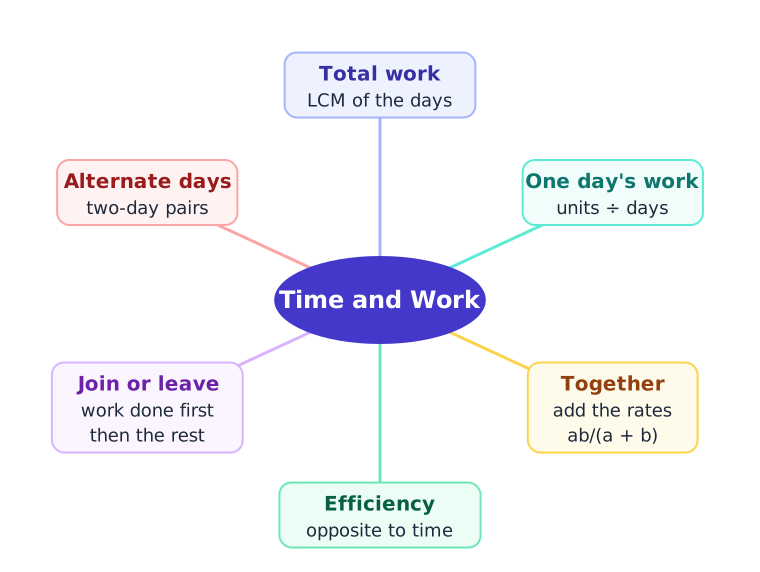
Treat a job as a fixed number of units (the LCM of the days), find each worker's one-day work, add rates when people work together, turn efficiency into time, and handle workers who join, leave or work on alternate days.
What you will be able to do
- I can find the time two or three workers take together using the LCM method.
- I can find one worker's time when the joint time and the other worker's time are known.
- I can convert efficiency ratios into time ratios and back.
- I can solve problems where a worker joins late, leaves early or works on alternate days.

Key points
If A finishes a job in n days, A does 1/n of it in one day.
Take the total work as the LCM of the given days; then every one-day work is a whole number of units.
When people work together, add their one-day works, never their days.
For two workers, together time = ab/(a + b), where a and b are their separate times.
Efficiency and time are inversely proportional: twice as efficient means half the time.
If A + B, B + C and C + A times are given, adding the three one-day works gives twice the work of A + B + C.
When someone joins or leaves, first find the work already done, then divide the rest by the new rate.
On alternate days, treat each pair of days as one block and finish the last part day by day.
Full explanation
Two painters and one wall

Ravi can paint the school wall in 12 days. His friend Arjun can paint it in 20 days. The principal asks: "If both work together, when will the wall be ready?"
Many students say 16 days, the average. That cannot be right: with help, Ravi must finish sooner than 12 days. This topic gives you a method that answers such questions in a few seconds.
Work as a rate

If a worker finishes a job in $n$ days, the worker does $\frac{1}{n}$ of the job each day.
- Ravi: $\frac{1}{12}$ of the wall per day.
- Arjun: $\frac{1}{20}$ of the wall per day.
Working together, the parts add: $\frac{1}{12} + \frac{1}{20} = \frac{5 + 3}{60} = \frac{8}{60}$ per day.
The LCM method: no fractions at all
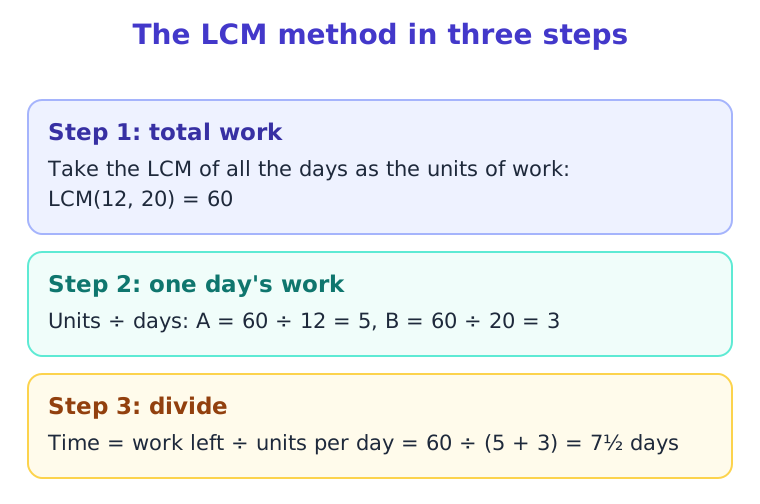
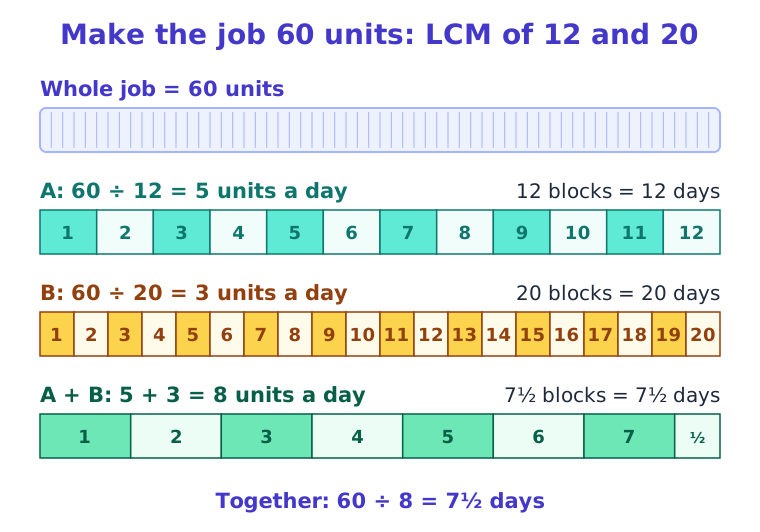
Examiners love this method because it avoids fractions. Pretend the wall has LCM(12, 20) = 60 units of work.
Seeing the units
The picture lays each worker's day-blocks along the job. Ravi's 5-unit blocks fill the 60 units in 12 days, Arjun's 3-unit blocks in 20 days, and the joint 8-unit blocks in $60 \div 8 = 7\frac{1}{2}$ days.
The two-worker shortcut
For two workers taking $a$ and $b$ days:
$$\text{Together} = \frac{ab}{a + b}$$
Ravi and Arjun: $\frac{12 \times 20}{12 + 20} = \frac{240}{32} = 7\frac{1}{2}$ days. Use this for two people only; for three, use LCM units.
Efficiency is the other side of time
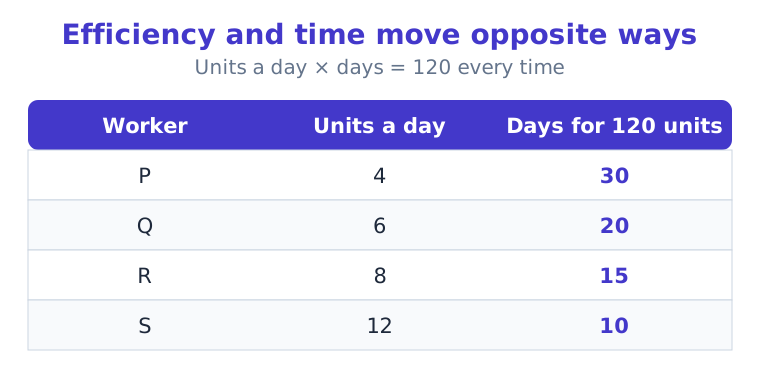
Efficiency means work per day. For a fixed job, efficiency × days = total work, so the two move in opposite directions.
Worked example: efficiency ratio
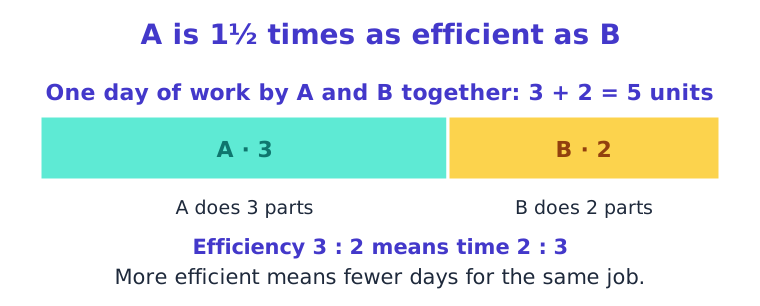
A is 50% more efficient than B. Together they finish a job in 18 days. How long does A take alone?
Efficiency A : B = 150 : 100 = 3 : 2. Total work = $(3 + 2) \times 18 = 90$ units. A alone: $90 \div 3 = 30$ days, B alone: $90 \div 2 = 45$ days.
Someone joins later
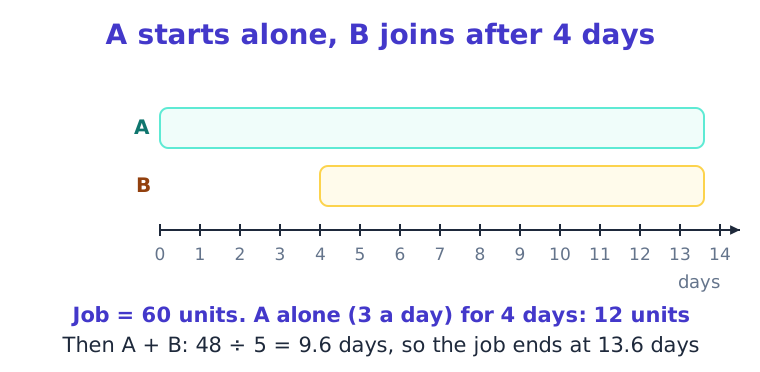
A can do a job in 20 days and B in 30 days. A starts alone; B joins after 4 days. When is the job finished?
Job = LCM(20, 30) = 60 units; A does 3, B does 2 units a day. In 4 days A does 12 units. The other 48 units at $3 + 2 = 5$ a day take $48 \div 5 = 9\frac{3}{5}$ days. Total $= 4 + 9\frac{3}{5} = 13\frac{3}{5}$ days.
Alternate days
A (10 days) and B (15 days) work on alternate days, A first. Job = 30 units; A does 3, B does 2. Every two days: 5 units. After 12 days (6 pairs): 30 units, done. If the last pair is not needed in full, finish day by day.
Back to the wall
Ravi and Arjun together do 8 of the 60 units each day, so the wall is ready in 7½ days, well before Ravi's 12. The average, 16 days, was wrong because days never add or average; rates do.
Concepts and terms
The part of the job done in one day. A worker who needs 15 days does 1/15 of the job each day.
Choose the job size as the LCM of the days, for example 60 units for 12 and 20 days. Fractions disappear.
Work done per day. If A does 3 units a day and B 2 units, A is 1.5 times as efficient and takes 2/3 of B's time.
Work = rate × time. Keep the job fixed and the rest follows: more rate, less time.

Did you know
Project managers plan big works such as metro lines with "man-days" and work rates, the same idea as this topic.
The formula ab/(a + b) also gives the joint resistance of two resistors in parallel in physics.

Memory tricks
Together — Add rates, not days — Days never add for people working side by side; their one-day works do.
Two-worker shortcut — Product over sum — Together time = (a × b) ÷ (a + b). For 12 and 24: 288 ÷ 36 = 8 days.
Practice MCQs with answers (69)
- A 8 days
- B 12 days
- C 18 days
- D 36 days
Show answer
Why:
Take the work as LCM(12, 24) = 24 units. One does 2 and the other 1 units a day, so together 3: 24 ÷ 3 = 8.
- A 5 days
- B 6 days
- C $12\frac{1}{2}$ days
- D 25 days
Show answer
Why:
Take the work as LCM(10, 15) = 30 units. One does 3 and the other 2 units a day, so together 5: 30 ÷ 5 = 6.
- A 50 days
- B 10 days
- C 12 days
- D 25 days
Show answer
Why:
Take the work as LCM(20, 30) = 60 units. One does 3 and the other 2 units a day, so together 5: 60 ÷ 5 = 12.
- A 9 hours
- B 18 hours
- C 6 hours
- D 4 hours
Show answer
Why:
Take the work as LCM(6, 12) = 12 units. One does 2 and the other 1 units an hour, so together 3: 12 ÷ 3 = 4.
- A 15 days
- B 32 days
- C 64 days
- D 16 days
Show answer
Why:
Take the work as LCM(24, 40) = 120 units. One does 5 and the other 3 units a day, so together 8: 120 ÷ 8 = 15.
- A 7 days
- B 12 days
- C $24\frac{1}{2}$ days
- D 49 days
Show answer
Why:
Take the work as LCM(21, 28) = 84 units. One does 4 and the other 3 units a day, so together 7: 84 ÷ 7 = 12.
- A $31\frac{1}{2}$ days
- B 63 days
- C $12\frac{6}{7}$ days
- D 27 days
Show answer
Why:
Take the work as LCM(18, 45) = 90 units. One does 5 and the other 2 units a day, so together 7: 90 ÷ 7 = $12\frac{6}{7}$.
- A 24 hours
- B 32 hours
- C 64 hours
- D 12 hours
Show answer
Why:
Take the work as LCM(16, 48) = 48 units. One does 3 and the other 1 units an hour, so together 4: 48 ÷ 4 = 12.
- A 6 days
- B $13\frac{1}{2}$ days
- C 27 days
- D 9 days
Show answer
Why:
Take the work as LCM(9, 18) = 18 units. One does 2 and the other 1 units a day, so together 3: 18 ÷ 3 = 6.
- A 9 days
- B 20 days
- C $40\frac{1}{2}$ days
- D 81 days
Show answer
Why:
Take the work as LCM(36, 45) = 180 units. One does 5 and the other 4 units a day, so together 9: 180 ÷ 9 = 20.
- A 5 days
- B 25 days
- C 30 days
- D 6 days
Show answer
Why:
Work = LCM(10, 15) = 30 units. A + B do 3 a day and A does 2, so B does 1: 30 ÷ 1 = 30 days.
- A $8\frac{4}{7}$ days
- B 18 days
- C 42 days
- D 20 days
Show answer
Why:
Work = LCM(12, 30) = 60 units. A + B do 5 a day and A does 2, so B does 3: 60 ÷ 3 = 20 days.
- A 30 days
- B 32 days
- C $7\frac{1}{2}$ days
- D 8 days
Show answer
Why:
Work = LCM(12, 20) = 60 units. A + B do 5 a day and A does 3, so B does 2: 60 ÷ 2 = 30 days.
- A 56 days
- B 45 days
- C $12\frac{6}{7}$ days
- D 16 days
Show answer
Why:
Work = LCM(20, 36) = 180 units. A + B do 9 a day and A does 5, so B does 4: 180 ÷ 4 = 45 days.
- A 63 days
- B $12\frac{6}{7}$ days
- C 30 days
- D 27 days
Show answer
Why:
Work = LCM(18, 45) = 90 units. A + B do 5 a day and A does 2, so B does 3: 90 ÷ 3 = 30 days.
- A $12\frac{1}{3}$ days
- B 5 days
- C $5\frac{5}{11}$ days
- D 4 days
Show answer
Why:
Work = LCM = 60 units; one-day works 6 + 5 + 4 = 15 units: 60 ÷ 15 = 4 days.
- A 5 days
- B $15\frac{2}{3}$ days
- C 6 days
- D $6\frac{2}{3}$ days
Show answer
Why:
Work = LCM = 60 units; one-day works 5 + 4 + 3 = 12 units: 60 ÷ 12 = 5 days.
- A $10\frac{1}{3}$ days
- B 3 days
- C 4 days
- D $3\frac{3}{4}$ days
Show answer
Why:
Work = LCM = 30 units; one-day works 5 + 3 + 2 = 10 units: 30 ÷ 10 = 3 days.
- A 12 days
- B $36\frac{2}{3}$ days
- C 10 days
- D 11 days
Show answer
Why:
Work = LCM = 60 units; one-day works 3 + 2 + 1 = 6 units: 60 ÷ 6 = 10 days.
- A $4\frac{4}{5}$ days
- B $14\frac{2}{3}$ days
- C 5 days
- D 4 days
Show answer
Why:
Work = LCM = 24 units; one-day works 3 + 2 + 1 = 6 units: 24 ÷ 6 = 4 days.
- A 8 days
- B 9 days
- C $10\frac{2}{7}$ days
- D 26 days
Show answer
Why:
Work = LCM = 72 units; one-day works 4 + 3 + 2 = 9 units: 72 ÷ 9 = 8 days.
- A 5 days
- B 10 days
- C $15\frac{2}{3}$ days
- D 20 days
Show answer
Why:
Work = 60 units. Pair rates 5 + 4 + 3 = 12 = 2 × (A + B + C), so A + B + C = 6 a day. Time = 60 ÷ 6 = 10 days.
- A 5 days
- B $15\frac{2}{3}$ days
- C 30 days
- D $7\frac{1}{2}$ days
Show answer
Why:
Work = 60 units. Pair rates 5 + 4 + 3 = 12 = 2 × (A + B + C), so A + B + C = 6 a day. Then A alone does 2 a day. Time = 60 ÷ 2 = 30 days.
- A 4 days
- B $12\frac{1}{3}$ days
- C 16 days
- D 8 days
Show answer
Why:
Work = 60 units. Pair rates 6 + 5 + 4 = 15 = 2 × (A + B + C), so A + B + C = $7\frac{1}{2}$ a day. Time = 60 ÷ $7\frac{1}{2}$ = 8 days.
- A 24 days
- B 6 days
- C 4 days
- D $14\frac{2}{3}$ days
Show answer
Why:
Work = 24 units. Pair rates 3 + 2 + 1 = 6 = 2 × (A + B + C), so A + B + C = 3 a day. Then A alone does 1 a day. Time = 24 ÷ 1 = 24 days.
- A 28 days
- B 21 days
- C 35 days
- D 42 days
Show answer
Why:
Efficiency A : B = 2 : 1. Work = (2 + 1) × 14 = 42 units (B = 1 unit a day). A alone: 42 ÷ 2 = 21 days.
- A 60 days
- B 16 days
- C 48 days
- D 36 days
Show answer
Why:
Efficiency A : B = 3 : 1. Work = (3 + 1) × 12 = 48 units (B = 1 unit a day). B alone: 48 ÷ 1 = 48 days.
- A 48 days
- B 45 days
- C 27 days
- D 30 days
Show answer
Why:
Efficiency A : B = 3 : 2. Work = ($1\frac{1}{2}$ + 1) × 18 = 45 units (B = 1 unit a day). A alone: 45 ÷ $1\frac{1}{2}$ = 30 days.
- A 45 days
- B 65 days
- C 36 days
- D 25 days
Show answer
Why:
Efficiency A : B = 5 : 4. Work = ($1\frac{1}{4}$ + 1) × 20 = 45 units (B = 1 unit a day). B alone: 45 ÷ 1 = 45 days.
- A 40 days
- B 60 days
- C 80 days
- D 30 days
Show answer
Why:
Efficiency A : B = 2 : 1. Work = (2 + 1) × 20 = 60 units (B = 1 unit a day). B alone: 60 ÷ 1 = 60 days.
- A 6 days
- B 12 days
- C $10\frac{1}{2}$ days
- D $7\frac{1}{2}$ days
Show answer
Why:
Work = 30 units; A 3, B 2 a day. In 3 days together: 3 × 5 = 15. Left 15 for B: 15 ÷ 2 = $7\frac{1}{2}$ days, so 3 + $7\frac{1}{2}$ = $10\frac{1}{2}$ days in all.
- A 14 days
- B 12 days
- C $7\frac{1}{5}$ days
- D 8 days
Show answer
Why:
Work = 36 units; A 3, B 2 a day. In 4 days together: 4 × 5 = 20. Left 16 for B: 16 ÷ 2 = 8 days.
- A 21 days
- B 12 days
- C 24 days
- D 15 days
Show answer
Why:
Work = 60 units; A 3, B 2 a day. In 6 days together: 6 × 5 = 30. Left 30 for B: 30 ÷ 2 = 15 days, so 6 + 15 = 21 days in all.
- A $13\frac{1}{3}$ days
- B $8\frac{1}{3}$ days
- C $8\frac{4}{7}$ days
- D 15 days
Show answer
Why:
Work = 60 units; A 4, B 3 a day. In 5 days together: 5 × 7 = 35. Left 25 for B: 25 ÷ 3 = $8\frac{1}{3}$ days.
- A 12 days
- B 9 days
- C 14 days
- D 17 days
Show answer
Why:
Work = 60 units; A 3, B 2 a day. A alone in 5 days: 15. Left 45 at 5 a day: 9 days. Total 5 + 9 = 14.
- A 12 days
- B 9 days
- C $6\frac{3}{4}$ days
- D $9\frac{3}{4}$ days
Show answer
Why:
Work = 36 units; A 3, B 1 a day. A alone in 3 days: 9. Left 27 at 4 a day: $6\frac{3}{4}$ days. Total 3 + $6\frac{3}{4}$ = $9\frac{3}{4}$.
- A 13 days
- B 9 days
- C 16 days
- D 12 days
Show answer
Why:
Work = 48 units; A 3, B 1 a day. A alone in 4 days: 12. Left 36 at 4 a day: 9 days. Total 4 + 9 = 13.
- A 12 days
- B 14 days
- C 8 days
- D 18 days
Show answer
Why:
Work = 36 units; A 2, B 1 a day. A alone in 6 days: 12. Left 24 at 3 a day: 8 days. Total 6 + 8 = 14.
- A 1/15
- B 3/5
- C 3/4
- D 1/4
Show answer
Why:
In 5 days A does 5/20 of the job, so 1 − 5/20 = 3/4 is left.
- A 3/8
- B 1/15
- C 5/11
- D 5/8
Show answer
Why:
In 9 days A does 9/24 of the job, so 1 − 9/24 = 5/8 is left.
- A 3/5
- B 3/7
- C 2/5
- D 1/18
Show answer
Why:
In 12 days A does 12/30 of the job, so 1 − 12/30 = 3/5 is left.
- A 12 days
- B 20 days
- C 40 days
- D $3\frac{1}{5}$ days
Show answer
Why:
Whole job = 8 ÷ 2/5 = 20 days.
- A 36 days
- B $6\frac{3}{4}$ days
- C 3 days
- D 12 days
Show answer
Why:
Whole job = 9 ÷ 3/4 = 12 days; 12 − 9 = 3 more days.
- A 84 days
- B $5\frac{1}{7}$ days
- C 16 days
- D 28 days
Show answer
Why:
Whole job = 12 ÷ 3/7 = 28 days.
- A 12 days
- B 6 days
- C 13 days
- D 11 days
Show answer
Why:
Work = 30 units; A 3, B 2 a day, so every 2 days give 5 units. 6 pairs = 12 days give 30 units; nothing is left, so the job ends on day 12. Total 12 days.
- A $13\frac{5}{7}$ days
- B $13\frac{2}{3}$ days
- C $6\frac{6}{7}$ days
- D $14\frac{2}{3}$ days
Show answer
Why:
Work = 48 units; A 4, B 3 a day, so every 2 days give 7 units. 6 pairs = 12 days give 42 units; 6 units are left: A does 4 on the next day and B the last 2 in $\frac{2}{3}$ of a day. Total $13\frac{2}{3}$ days.
- A 8 days
- B $7\frac{1}{5}$ days
- C 7 days
- D $3\frac{3}{5}$ days
Show answer
Why:
Work = 18 units; A 3, B 2 a day, so every 2 days give 5 units. 3 pairs = 6 days give 15 units; 3 units are left and A does them in 1 of the next day. Total 7 days.
- A $10\frac{1}{2}$ days
- B $9\frac{3}{5}$ days
- C $4\frac{4}{5}$ days
- D $9\frac{1}{2}$ days
Show answer
Why:
Work = 24 units; A 3, B 2 a day, so every 2 days give 5 units. 4 pairs = 8 days give 20 units; 4 units are left: A does 3 on the next day and B the last 1 in $\frac{1}{2}$ of a day. Total $9\frac{1}{2}$ days.
- A 16 days
- B 17 days
- C 15 days
- D 25 days
Show answer
Why:
Efficiency A : B = 125 : 100, so time A : B = 100 : 125. A = 20 × 100 ÷ 125 = 16 days.
- A 15 days
- B 20 days
- C 45 days
- D 21 days
Show answer
Why:
Efficiency A : B = 150 : 100, so time A : B = 100 : 150. A = 30 × 100 ÷ 150 = 20 days.
- A $43\frac{1}{5}$ days
- B 16 days
- C 30 days
- D $28\frac{4}{5}$ days
Show answer
Why:
Efficiency A : B = 120 : 100, so time A : B = 100 : 120. A = 36 × 100 ÷ 120 = 30 days.
- A 8 days
- B 10 days
- C 12 days
- D 6 days
Show answer
Why:
Try A = 6, B = 12: together 6 × 12 ÷ 18 = 4 days. It fits, so A takes 6 days.
- A 10 days
- B 11 days
- C 15 days
- D 12 days
Show answer
Why:
Try A = 10, B = 15: together 10 × 15 ÷ 25 = 6 days. It fits, so A takes 10 days.
- A 1 − 1/n
- B 1/n
- C n
- D n − 1
Show answer
Why:
In n days A does the whole, so in one day 1/n of it.
- A directly proportional
- B always equal
- C inversely proportional
- D unrelated
Show answer
Why:
Efficiency × time = work, which is fixed, so one goes up as the other goes down.
- A 1 : 9
- B 3 : 1
- C 1 : 1
- D 1 : 3
Show answer
Why:
Time is the inverse of efficiency: 3 : 1 becomes 1 : 3.
- A So that each one-day work is a whole number of units
- B Because the job really has that many parts
- C To make the answer larger
- D Because the HCF never works
Show answer
Why:
Any job size works; the LCM just keeps every number whole.
- A between the two separate times
- B less than the time of the faster person
- C the average of the two times
- D the sum of the two times
Show answer
Why:
The faster person alone takes t days; any help makes it shorter than t.
- A Work = rate + time
- B Work = rate ÷ time
- C Work = rate of work × time
- D Work = time ÷ rate
Show answer
Why:
Like distance = speed × time, work = rate × time.
- A 6 days
- B 5 days
- C 3 days
- D 10 days
Show answer
Why:
Alone, each must take more than the joint 6 days; only 10 is more than 6.
- A Both A and R are true, and R is the correct explanation of A
- B Both A and R are true, but R is not the correct explanation of A
- C A is true but R is false
- D A is false but R is true
Show answer
Why:
Both are true and R is exactly the reason for A.
- A Both A and R are true, and R is the correct explanation of A
- B Both A and R are true, but R is not the correct explanation of A
- C A is true but R is false
- D A is false but R is true
Show answer
Why:
A is false: 10 and 15 give 6 days, not 12.5. R is true.
- A 1 only
- B 2 only
- C Both 1 and 2
- D Neither 1 nor 2
Show answer
Why:
1 is true. 2 is false: efficiency is inversely proportional to time.
- A 1 only
- B 2 only
- C Both 1 and 2
- D Neither 1 nor 2
Show answer
Why:
1/12 + 1/24 = 1/8, so 8 days. In 4 days they do 4/8 = 1/2. Both true.
- A 6 days
- B $12\frac{1}{2}$ days
- C 25 days
- D 15 days
Show answer
Why:
Together 2 + 3 = 5 units a day: 30 ÷ 5 = 6 days.
- A 15 days
- B $7\frac{1}{5}$ days
- C 30 days
- D 18 days
Show answer
Why:
Together 2 + 3 = 5 units a day: 36 ÷ 5 = $7\frac{1}{5}$ days.
- A 10 days
- B 6 days
- C 9 days
- D 8 days
Show answer
Why:
Job = 24 units; A 2, B 1 a day. A alone 3 days: 6 units. Left 18 at 3 a day: 6 days. Total 3 + 6 = 9.
- A 24 days
- B 20 days
- C 18 days
- D 30 days
Show answer
Why:
Work = (3 + 2) × 12 = 60 units. B alone: 60 ÷ 2 = 30 days (A would take 20).
- A 20 units
- B 35 units
- C 40 units
- D 25 units
Show answer
Why:
5 days × 8 units = 40 units done, so 60 − 40 = 20 units are left.
Important short questions (4)
Work = LCM(18, 27) = 54 units; A 3, B 2 a day. Together 5 a day: 54 ÷ 5 = 10.8 days.
B does 1 unit a day, so work = 30 units. A does 2. Together 3 a day: 10 days.
Work = 48 units; pair rates 4 + 3 + 2 = 9 = 2 × (A + B + C). All three do 4.5 a day: 48 ÷ 4.5 = 10⅔ days.
The faster worker alone already finishes in that time; the second worker adds more work each day, so the job ends earlier.
Long answer questions (1)
Work = LCM(20, 30, 60) = 60 units; A 3, B 2, C 1 a day.
(a) A in 4 days: 12 units, so 48 units (4/5 of the job) are left.
(b) Together 3 + 2 + 1 = 6 units a day: 48 ÷ 6 = 8 days.
(c) 4 + 8 = 12 days.
Flashcards (14)
Play this topic
- Work facts
Groups of Workers and Wages
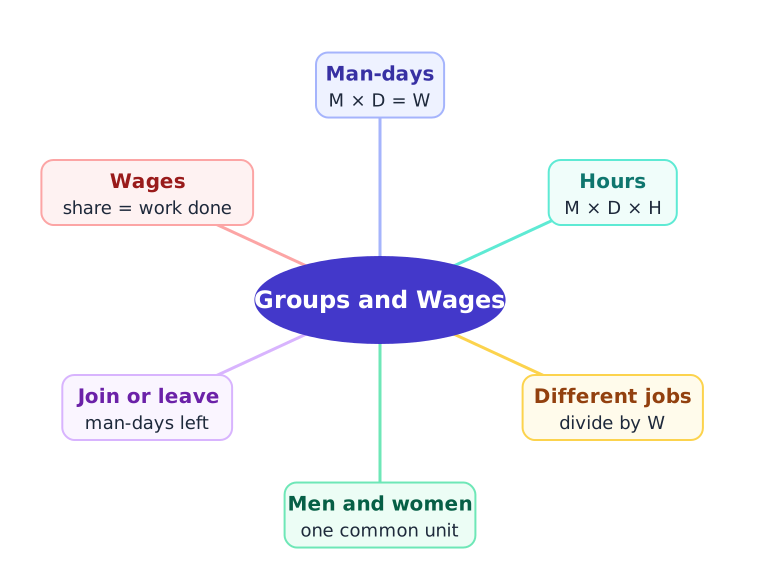
Measure a job in man-days (and man-hours), use M₁D₁H₁/W₁ = M₂D₂H₂/W₂, compare men, women and boys in one unit, handle workers who join or leave, and share wages in the ratio of the work each person did.
What you will be able to do
- I can use man-days and the chain rule M₁D₁H₁/W₁ = M₂D₂H₂/W₂.
- I can convert men, women and boys into one common work unit.
- I can find the time when workers join or leave a group midway.
- I can divide wages in the ratio of work done.
Key points
A job needs a fixed number of man-days: men × days stays the same for the same job.
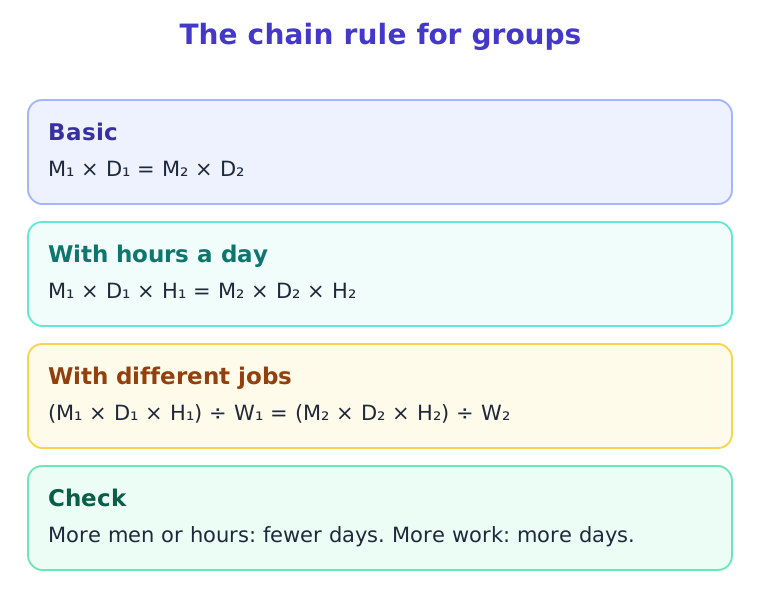
With hours per day: M₁ × D₁ × H₁ = M₂ × D₂ × H₂.
When the jobs differ: M₁D₁H₁ ÷ W₁ = M₂D₂H₂ ÷ W₂.
If 12 men or 18 women do a job, 1 man = 18/12 = 1.5 women in work.
When workers join or leave, find the man-days already done, then divide the rest by the new number of workers.
Wages are shared in the ratio of work done, which for the same days is the ratio of efficiencies.
If A takes a days and B takes b days, wages for working together split as b : a.
A helper's share = total wage × (part of the work the helper did).
Full explanation
The village well

The panchayat of Rampur hires 12 workers to dig a well, and they say it will take 10 days. The monsoon is coming early, so the sarpanch asks: "If I hire 3 more workers, how many days do we save? And how should I pay a helper who joins for a few days?"
Groups of workers and fair wages are what this topic is about.
Man-days: the size of a job
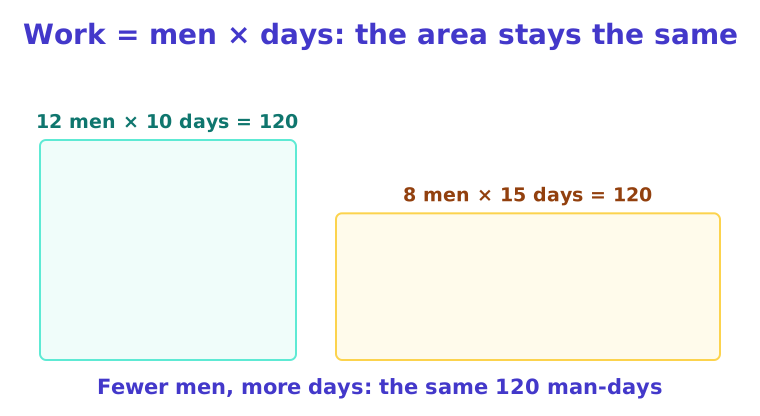
12 workers for 10 days give $12 \times 10 = 120$ man-days. The well needs 120 man-days whoever digs it.
With 15 workers: $120 \div 15 = 8$ days. The sarpanch saves 2 days.
Adding hours and different jobs
If the hours per day change, multiply them in. If the job itself changes size, divide by it.
Worked example: the chain rule
15 men working 8 hours a day dig a 120 m trench in 10 days. How many days will 20 men working 6 hours a day take for a 144 m trench?
$$\frac{15 \times 10 \times 8}{120} = \frac{20 \times D \times 6}{144}$$
$D = \frac{15 \times 10 \times 8 \times 144}{120 \times 20 \times 6} = 12$ days.
Men, women and boys
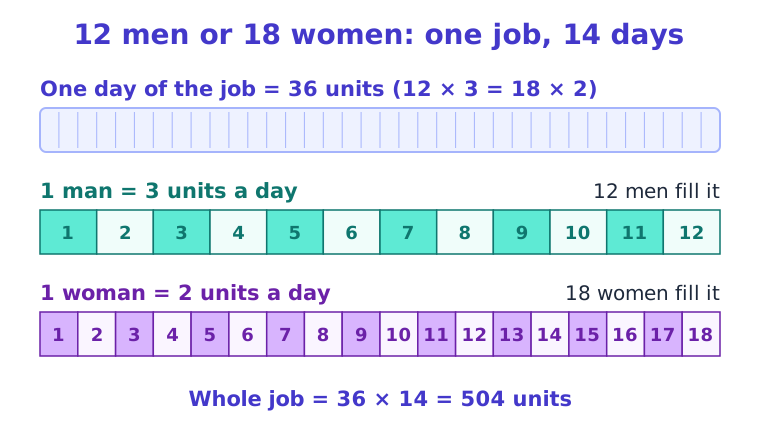
"12 men or 18 women can do a job in 14 days." Then 12 men do what 18 women do, so 1 man = 3 units and 1 woman = 2 units of daily work.
Job $= 12 \times 3 \times 14 = 504$ units. 8 men and 16 women do $24 + 32 = 56$ units a day: $504 \div 56 = 9$ days.
Workers who join midway
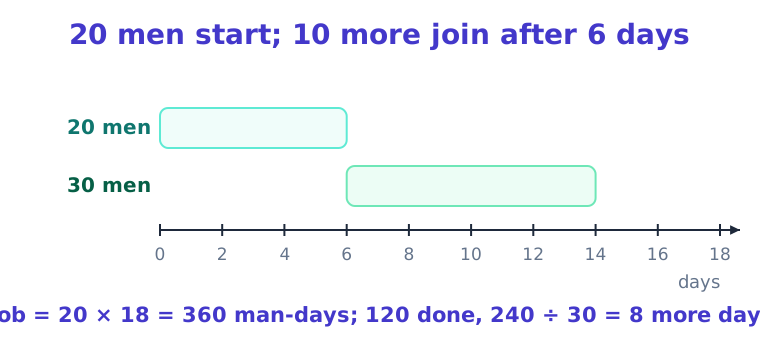
20 men can finish a job in 18 days (360 man-days). After 6 days, 10 more men join. Done so far: $20 \times 6 = 120$. Left: 240 man-days for 30 men, so 8 more days. Total 14 days.
Fair wages
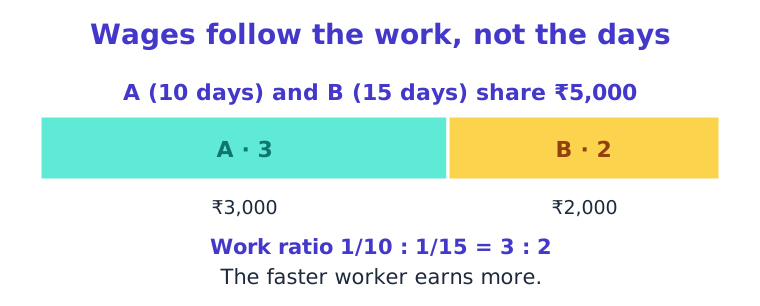
Pay follows the work. A takes 10 days and B 15 days; together they get ₹5,000. Their one-day works are $\frac{1}{10} : \frac{1}{15} = 3 : 2$, so A gets ₹3,000 and B ₹2,000.
Trap: sharing in the ratio of days, 10 : 15, gives the slower worker more money. That is backwards.
A helper's share
A (12 days) and B (24 days) finish a job with C's help in 6 days and get ₹1,600. A did $\frac{6}{12} = \frac{1}{2}$ and B $\frac{6}{24} = \frac{1}{4}$, so C did $\frac{1}{4}$ and gets ₹400.
Back to the well
120 man-days with 15 workers is 8 days, so Rampur saves 2 days before the rain. A helper who works 3 of those days with the team is paid for exactly the part of the well that is his.
Concepts and terms
Men × days. 12 men for 10 days is 120 man-days; any group giving 120 man-days does the same job.
M₁D₁H₁/W₁ = M₂D₂H₂/W₂. Men, days and hours are on top; the amount of work is below.
Turn men, women and boys into one unit using an equality such as 2 men = 3 women.
Each person is paid for the part of the job done, not for the days spent.
Did you know
Under MGNREGA, rural works are measured and paid by the amount of work done, the same idea as sharing wages by work.
Memory tricks
Chain rule — MDH over W — Men, Days, Hours on top, Work below, equal on both sides.
Wages — Pay follows the work — Find each person's share of the work; the money splits the same way.
Practice MCQs with answers (58)
- A 10 days
- B $12\frac{1}{2}$ days
- C 8 days
- D 7 days
Show answer
Why:
Work = 12 × 10 = 120 man-days. 120 ÷ 15 = 8 days.
- A 8 days
- B $37\frac{1}{2}$ days
- C 3 days
- D 6 days
Show answer
Why:
Work = 8 × 15 = 120 man-days. 120 ÷ 20 = 6 days.
- A 12 days
- B 14 days
- C 27 days
- D 6 days
Show answer
Why:
Work = 24 × 18 = 432 man-days. 432 ÷ 36 = 12 days.
- A 13 days
- B 12 days
- C 14 days
- D $6\frac{3}{4}$ days
Show answer
Why:
Work = 16 × 9 = 144 man-days. 144 ÷ 12 = 12 days.
- A 20 workers
- B 40 workers
- C 10 workers
- D 12 workers
Show answer
Why:
Work = 600 man-days. In 15 days: 600 ÷ 15 = 40 workers, so 40 − 30 = 10 more.
- A 11 workers
- B 27 workers
- C 12 workers
- D 9 workers
Show answer
Why:
Work = 432 man-days. In 16 days: 432 ÷ 16 = 27 workers, so 27 − 18 = 9 more.
- A 5 workers
- B 30 workers
- C 7 workers
- D 10 workers
Show answer
Why:
Work = 300 man-days. In 10 days: 300 ÷ 10 = 30 workers, so 30 − 25 = 5 more.
- A 14 days
- B 12 days
- C 9 days
- D $6\frac{3}{4}$ days
Show answer
Why:
M₁D₁H₁ = M₂D₂H₂: 15 × 12 × 8 = 20 × D × 6, so D = 1440 ÷ 120 = 12 days.
- A $32\frac{2}{5}$ days
- B $22\frac{1}{2}$ days
- C 10 days
- D 15 days
Show answer
Why:
M₁D₁H₁ = M₂D₂H₂: 10 × 18 × 6 = 12 × D × 9, so D = 1080 ÷ 108 = 10 days.
- A $19\frac{1}{5}$ days
- B 12 days
- C $13\frac{1}{3}$ days
- D $7\frac{1}{2}$ days
Show answer
Why:
M₁D₁H₁ = M₂D₂H₂: 24 × 10 × 5 = 20 × D × 8, so D = 1200 ÷ 160 = $7\frac{1}{2}$ days.
- A 12 days
- B $10\frac{2}{7}$ days
- C $21\frac{1}{3}$ days
- D $8\frac{40}{49}$ days
Show answer
Why:
M₁D₁H₁ = M₂D₂H₂: 9 × 16 × 7 = 14 × D × 6, so D = 1008 ÷ 84 = 12 days.
- A $22\frac{1}{2}$ days
- B 10 days
- C $2\frac{38}{45}$ days
- D $5\frac{1}{3}$ days
Show answer
Why:
(M₁D₁H₁) ÷ W₁ = (M₂D₂H₂) ÷ W₂: D = 6 × 8 × 1 × 45 ÷ (24 × 9 × 1) = 10 days.
- A 4 days
- B 8 days
- C 16 days
- D 36 days
Show answer
Why:
(M₁D₁H₁) ÷ W₁ = (M₂D₂H₂) ÷ W₂: D = 10 × 12 × 1 × 600 ÷ (300 × 15 × 1) = 16 days.
- A 10 days
- B 16 days
- C $6\frac{1}{4}$ days
- D 12 days
Show answer
Why:
(M₁D₁H₁) ÷ W₁ = (M₂D₂H₂) ÷ W₂: D = 15 × 10 × 8 × 144 ÷ (120 × 20 × 6) = 12 days.
- A 9 days
- B 27 days
- C 3 days
- D $4\frac{1}{2}$ days
Show answer
Why:
(M₁D₁H₁) ÷ W₁ = (M₂D₂H₂) ÷ W₂: D = 8 × 9 × 6 × 72 ÷ (36 × 12 × 8) = 9 days.
- A $8\frac{3}{4}$ days
- B 9 days
- C 7 days
- D $10\frac{1}{2}$ days
Show answer
Why:
12 men = 18 women, so take 1 man = 3 units and 1 woman = 2 units a day. Work = 12 × 3 × 14 = 504. New rate 8 × 3 + 16 × 2 = 56: 504 ÷ 56 = 9 days.
- A 12 days
- B 18 days
- C 15 days
- D 17 days
Show answer
Why:
6 men = 9 women, so take 1 man = 3 units and 1 woman = 2 units a day. Work = 6 × 3 × 20 = 360. New rate 4 × 3 + 6 × 2 = 24: 360 ÷ 24 = 15 days.
- A $13\frac{7}{11}$ days
- B $10\frac{10}{11}$ days
- C $16\frac{4}{11}$ days
- D $13\frac{1}{3}$ days
Show answer
Why:
10 men = 15 women, so take 1 man = 3 units and 1 woman = 2 units a day. Work = 10 × 3 × 12 = 360. New rate 5 × 3 + 6 × 2 = 27: 360 ÷ 27 = $13\frac{1}{3}$ days.
- A 15 days
- B $16\frac{2}{3}$ days
- C $13\frac{1}{3}$ days
- D 20 days
Show answer
Why:
8 men = 12 women, so take 1 man = 3 units and 1 woman = 2 units a day. Work = 8 × 3 × 15 = 360. New rate 6 × 3 + 3 × 2 = 24: 360 ÷ 24 = 15 days.
- A $10\frac{4}{5}$ days
- B 9 days
- C 11 days
- D $7\frac{1}{5}$ days
Show answer
Why:
4 men = 6 women, so take 1 man = 3 units and 1 woman = 2 units a day. Work = 4 × 3 × 9 = 108. New rate 2 × 3 + 3 × 2 = 12: 108 ÷ 12 = 9 days.
- A 9 days
- B $18\frac{2}{11}$ days
- C $12\frac{1}{2}$ days
- D $14\frac{1}{2}$ days
Show answer
Why:
10(2M + 3B) = 8(3M + 2B) gives M : B = 7 : 2. Work = 10 × (2 × 7 + 3 × 2) = 200 units; new rate 2 × 7 + 1 × 2 = 16: $12\frac{1}{2}$ days.
- A 8 days
- B 6 days
- C $3\frac{7}{11}$ days
- D 4 days
Show answer
Why:
10(6M + 8B) = 2(26M + 48B) gives M : B = 2 : 1. Work = 10 × (6 × 2 + 8 × 1) = 200 units; new rate 15 × 2 + 20 × 1 = 50: 4 days.
- A $8\frac{4}{7}$ days
- B $17\frac{1}{7}$ days
- C $17\frac{1}{2}$ days
- D $10\frac{4}{7}$ days
Show answer
Why:
20(1M + 2B) = 15(2M + 1B) gives M : B = 5 : 2. Work = 20 × (1 × 5 + 2 × 2) = 180 units; new rate 3 × 5 + 3 × 2 = 21: $8\frac{4}{7}$ days.
- A 12 days
- B 14 days
- C 16 days
- D 8 days
Show answer
Why:
Work = 20 × 18 = 360 man-days. Done: 20 × 6 = 120. Left 240 for 30 men: 8 days. Total 6 + 8 = 14.
- A 12 days
- B 18 days
- C 20 days
- D 16 days
Show answer
Why:
Work = 30 × 24 = 720 man-days. Done: 30 × 8 = 240. Left 480 for 40 men: 12 days. Total 8 + 12 = 20.
- A 20 days
- B 10 days
- C $13\frac{1}{3}$ days
- D $18\frac{1}{3}$ days
Show answer
Why:
Work = 40 × 15 = 600 man-days. Done: 40 × 5 = 200. Left 400 for 30 men: $13\frac{1}{3}$ days. Total 5 + $13\frac{1}{3}$ = $18\frac{1}{3}$.
- A 25 days
- B 15 days
- C 20 days
- D $26\frac{2}{3}$ days
Show answer
Why:
Work = 24 × 20 = 480 man-days. Done: 24 × 5 = 120. Left 360 for 18 men: 20 days. Total 5 + 20 = 25.
- A 18 days
- B 22 days
- C 20 days
- D 12 days
Show answer
Why:
Work = 12 × 30 = 360 man-days. Done: 12 × 10 = 120. Left 240 for 20 men: 12 days. Total 10 + 12 = 22.
- A 30 men
- B 24 men
- C 20 men
- D 40 men
Show answer
Why:
1/3 of the job = 200 man-days, so the rest (2/3) = 400 man-days. In 10 days: 40 men, so 20 more.
- A 22 men
- B 5 men
- C 30 men
- D 15 men
Show answer
Why:
2/5 of the job = 180 man-days, so the rest (3/5) = 270 man-days. In 9 days: 30 men, so 15 more.
- A 12 men
- B 10 men
- C 24 men
- D 18 men
Show answer
Why:
1/4 of the job = 96 man-days, so the rest (3/4) = 288 man-days. In 12 days: 24 men, so 12 more.
- A ₹2,000
- B ₹3,000
- C ₹2,500
- D ₹3,100
Show answer
Why:
Work ratio = 1/10 : 1/15 = 15 : 10. A's share = 5,000 × 15/25 = ₹3,000.
- A ₹1,900
- B ₹2,700
- C ₹1,800
- D ₹2,250
Show answer
Why:
Work ratio = 1/12 : 1/18 = 18 : 12. B's share = 4,500 × 12/30 = ₹1,800.
- A ₹3,750
- B ₹4,600
- C ₹3,000
- D ₹4,500
Show answer
Why:
Work ratio = 1/20 : 1/30 = 30 : 20. A's share = 7,500 × 30/50 = ₹4,500.
- A ₹800
- B ₹2,400
- C ₹1,600
- D ₹900
Show answer
Why:
Work ratio = 1/8 : 1/24 = 24 : 8. B's share = 3,200 × 8/32 = ₹800.
- A ₹2,400
- B ₹4,000
- C ₹3,200
- D ₹4,100
Show answer
Why:
Work ratio = 1/15 : 1/25 = 25 : 15. A's share = 6,400 × 25/40 = ₹4,000.
- A ₹450
- B ₹500
- C ₹400
- D ₹800
Show answer
Why:
In 6 days A does 1/2 and B does 1/4 of the job, so C does 1/4. C gets 1,600 × 1/4 = ₹400.
- A ₹1,200
- B ₹3,000
- C ₹1,800
- D ₹1,500
Show answer
Why:
In 4 days A does 2/5 and B does 4/15 of the job, so C does 1/3. C gets 4,500 × 1/3 = ₹1,500.
- A ₹600
- B ₹650
- C ₹800
- D ₹1,200
Show answer
Why:
In 9 days A does 1/2 and B does 1/4 of the job, so C does 1/4. C gets 2,400 × 1/4 = ₹600.
- A ₹6,750
- B ₹12,000
- C ₹6,000
- D ₹18,000
Show answer
Why:
One man-day earns 9,000 ÷ (15 × 6) = ₹100. 10 × 12 = 120 man-days earn ₹12,000.
- A ₹4,800
- B ₹5,000
- C ₹7,200
- D ₹9,000
Show answer
Why:
One man-day earns 6,000 ÷ (8 × 5) = ₹150. 12 × 4 = 48 man-days earn ₹7,200.
- A ₹76,800
- B ₹36,000
- C ₹40,000
- D ₹30,000
Show answer
Why:
One man-day earns 48,000 ÷ (20 × 12) = ₹200. 15 × 10 = 150 man-days earn ₹30,000.
- A ₹720
- B ₹820
- C ₹620
- D ₹920
Show answer
Why:
Shares ∝ days × rate: 18 : 16 : 36. C = 1,400 × 36/70 = ₹720.
- A ₹2,450
- B ₹2,550
- C ₹2,750
- D ₹2,650
Show answer
Why:
Shares ∝ days × rate: 20 : 24 : 20. B = 6,800 × 24/64 = ₹2,550.
- A 22 man-days
- B 1.2 man-days
- C 120 man-days
- D 2 man-days
Show answer
Why:
Men × days = 10 × 12 = 120.
- A not related
- B directly proportional
- C always equal
- D inversely proportional
Show answer
Why:
Men × days is fixed, so more men need fewer days.
- A 3 : 2
- B 1 : 1
- C 10 : 15
- D 2 : 3
Show answer
Why:
Share follows work: 1/10 : 1/15 = 3 : 2.
- A The number of men
- B The amount of work
- C The number of days
- D Hours per day
Show answer
Why:
Men, days and hours do the work; the work itself is what they produce, so it goes below.
- A 10 women
- B 15 women
- C 12 women
- D 9 women
Show answer
Why:
6 men = 9 women; with 3 more women that is 12 women.
- A double
- B increase
- C stay the same
- D decrease
Show answer
Why:
Man-hours are fixed, so more hours a day means fewer days.
- A Both A and R are true, and R is the correct explanation of A
- B Both A and R are true, but R is not the correct explanation of A
- C A is true but R is false
- D A is false but R is true
Show answer
Why:
150 man-days either way; R explains A.
- A Both A and R are true, and R is the correct explanation of A
- B Both A and R are true, but R is not the correct explanation of A
- C A is true but R is false
- D A is false but R is true
Show answer
Why:
Work ratio 3 : 2 gives A 60%, so A is false; R is true.
- A 1 only
- B 2 only
- C Both 1 and 2
- D Neither 1 nor 2
Show answer
Why:
240 man-days: 240 ÷ 30 = 8, true. Two walls need 480 man-days: 10 men need 48 days, so 2 is false.
- A 1 only
- B 2 only
- C Both 1 and 2
- D Neither 1 nor 2
Show answer
Why:
1 is true. 2 is false: the faster worker does more and gets more.
- A 9 days
- B 10 days
- C 16 days
- D 6 days
Show answer
Why:
18 × 12 = 216 man-days; 216 ÷ 24 = 9 days.
- A ₹2,250
- B ₹2,000
- C ₹1,800
- D ₹2,500
Show answer
Why:
Shares in the work ratio 5 : 4: B = 4500 × 4/9 = ₹2,000.
- A 12 days
- B 9 days
- C 13 days
- D 14 days
Show answer
Why:
Work = 15 × 16 = 240 man-days. Done 60; left 180 ÷ 20 = 9 days. Total 4 + 9 = 13.
- A 12 days
- B 18 days
- C 36 days
- D 15 days
Show answer
Why:
4 × 3 + 6 × 2 = 24 units a day: 360 ÷ 24 = 15 days.
Important short questions (4)
400 man-days ÷ 10 = 40 men.
Work ratio 1/16 : 1/24 = 3 : 2. A gets ₹1,200 and B ₹800.
Man 5, woman 3 units a day; work = 3 × 5 × 30 = 450. Rate 30 + 15 = 45: 10 days.
More days means slower work. Pay should follow work done, which is the inverse of days.
Long answer questions (1)
(a) 40 × 30 × 8 = 9,600 man-hours.
(b) Done: 40 × 10 × 8 = 3,200, so 6,400 are left.
(c) 30 workers × 10 hours = 300 man-hours a day: 6,400 ÷ 300 = 21⅓ days.
Flashcards (13)
Play this topic
- Groups check
Veda Skills Quantitative Aptitude Unit 8 — frequently asked questions
Work = LCM(18, 27) = 54 units; A 3, B 2 a day. Together 5 a day: 54 ÷ 5 = 10.8 days.
B does 1 unit a day, so work = 30 units. A does 2. Together 3 a day: 10 days.
Work = 48 units; pair rates 4 + 3 + 2 = 9 = 2 × (A + B + C). All three do 4.5 a day: 48 ÷ 4.5 = 10⅔ days.
400 man-days ÷ 10 = 40 men.
Work ratio 1/16 : 1/24 = 3 : 2. A gets ₹1,200 and B ₹800.
Man 5, woman 3 units a day; work = 3 × 5 × 30 = 450. Rate 30 + 15 = 45: 10 days.

All Veda Skills Quantitative Aptitude units
All Quantitative Aptitude units · All Skills & Exams courses
Study this chapter properly, free
Everything above is on this page to read. In the Veda app the same chapter becomes spaced-repetition flashcards, timed tests that mark themselves, Veda Bites you can swipe, and games — with your progress tracked topic by topic.
Get Veda free