Veda Skills Quantitative Aptitude Unit 15:
Mensuration
Mensuration is Unit 15 of
Veda Skills Quantitative Aptitude.
This page has the complete chapter notes across 2 topics, 139 practice MCQs with answers and explanations, 10 important short and long questions and 31 flashcards, written for SSC, Bank, Railway and placement exams and free to read.
2 topics
139 MCQs
8 short answers
2 long answers
31 flashcards
2 games
~130 min read
English
Checked before publishing: 23 automated checks, including a
plagiarism check against the textbook's own words.
How we check our content
Area and Perimeter of Plane Figures
Areas and perimeters of rectangles, squares, triangles (including Heron), parallelograms, rhombuses, trapeziums, circles, sectors and rings, with paths, roads, costs and shaded-region questions.
What you will be able to do
I can find the area and perimeter of rectangles, squares and triangles, including by Heron's formula.
I can find areas of parallelograms, rhombuses and trapeziums.
I can work with circles, semicircles, sectors and rings.
I can find shaded areas, path areas and costs of fencing or flooring.
I can find the percentage change in area when the sides change.
Key points
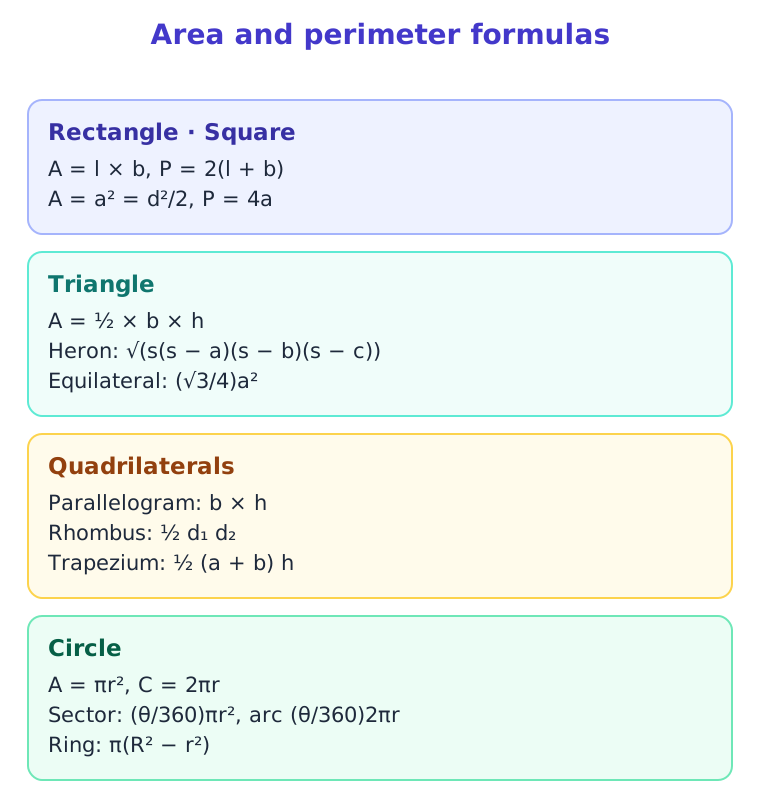
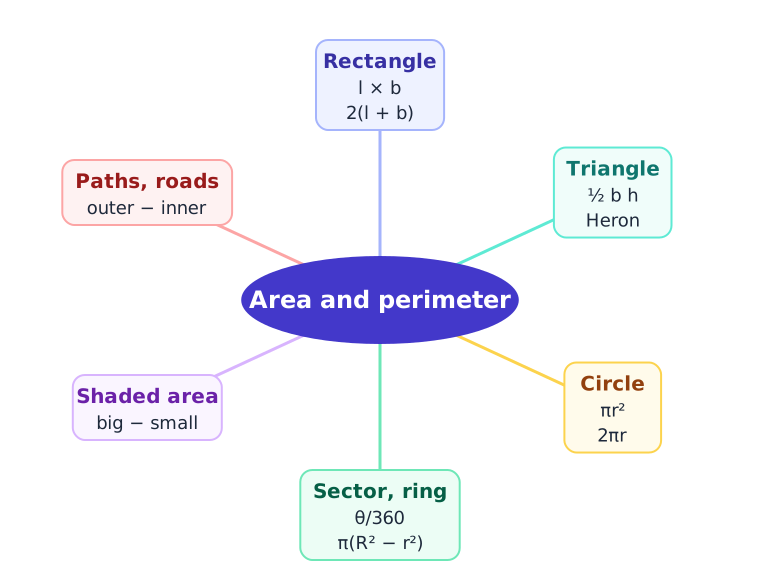
Rectangle: area l × b, perimeter 2(l + b). Square: area a² or d²/2, perimeter 4a.
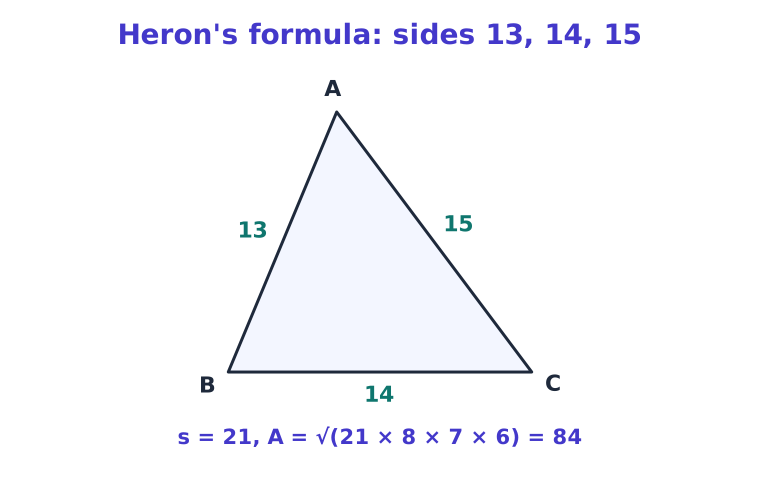
Triangle: ½ × base × height. With three sides use Heron: s = (a + b + c)/2, area = √(s(s − a)(s − b)(s − c)).
Equilateral triangle of side a: area (√3/4)a², height (√3/2)a.
Parallelogram: base × height. Rhombus: ½ × d₁ × d₂. Trapezium: ½ × (sum of parallel sides) × height.
Circle: area πr², circumference 2πr. Semicircle perimeter: πr + 2r.
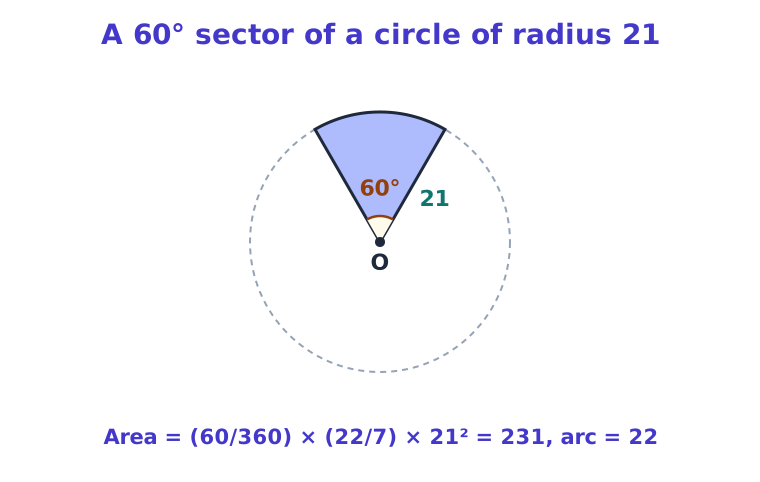
Sector of angle θ: area (θ/360) × πr², arc length (θ/360) × 2πr.
Ring between radii R and r: π(R² − r²) = π(R + r)(R − r).
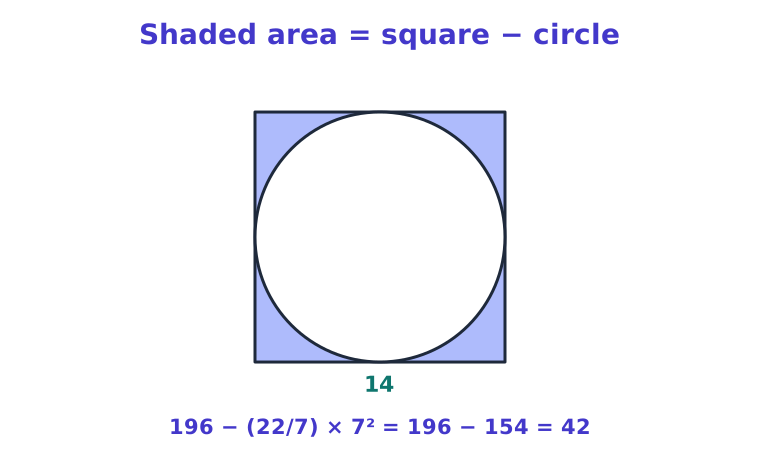
Shaded or path area = outer area − inner area.
If two sides change by a% and b%, the area changes by a + b + ab/100 percent.
Full explanation
Sunita's school garden
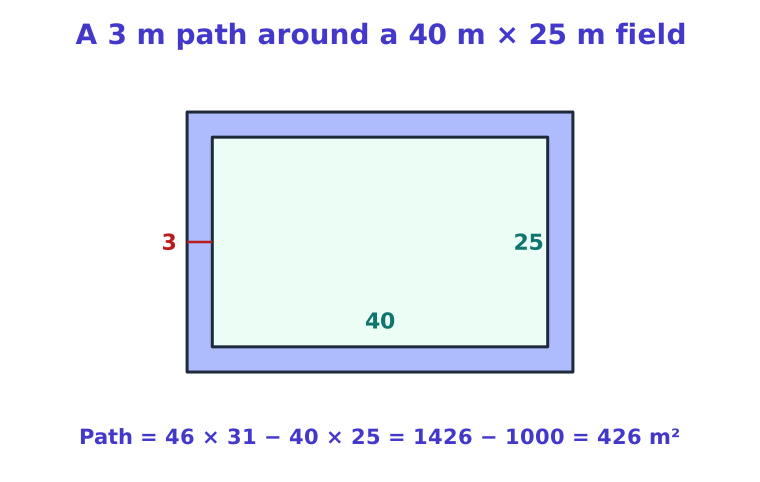
Sunita's school has a rectangular garden 40 m by 25 m. The principal wants a 3 m wide brick path all around it, a round fountain of radius 7 m in the middle, and a fence on the outside. How many square metres of bricks, and how many metres of fence?
Every part of that plan is a mensuration question. Let us build the toolkit one shape at a time.
Perimeter and area
Perimeter is the distance around a shape, measured in m or cm. Area is the surface inside, measured in m² or cm².
Rectangle: $A = l \times b$, $P = 2(l + b)$
Square: $A = a^2 = \frac{d^2}{2}$, $P = 4a$
Cost questions: fencing cost = perimeter × rate per metre; flooring cost = area × rate per m².
Paths and roads
A path of width $w$ outside an $l \times b$ field makes an outer rectangle $(l + 2w) \times (b + 2w)$. The path area is outer minus inner. For a path inside, the inner rectangle is $(l - 2w) \times (b - 2w)$.
Two roads of width $w$ crossing through the middle cover $w(l + b) - w^2$, because the crossing square is counted twice.
Triangles
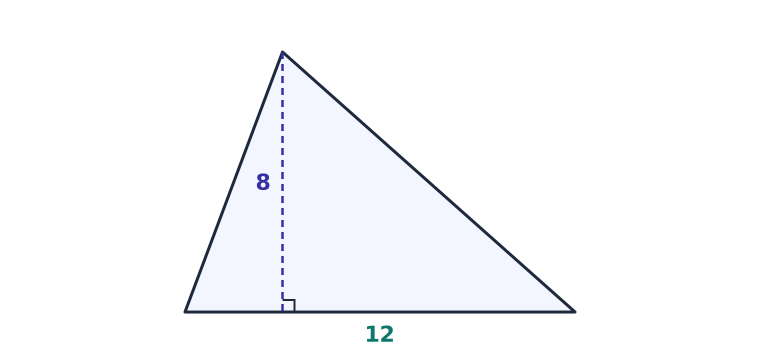
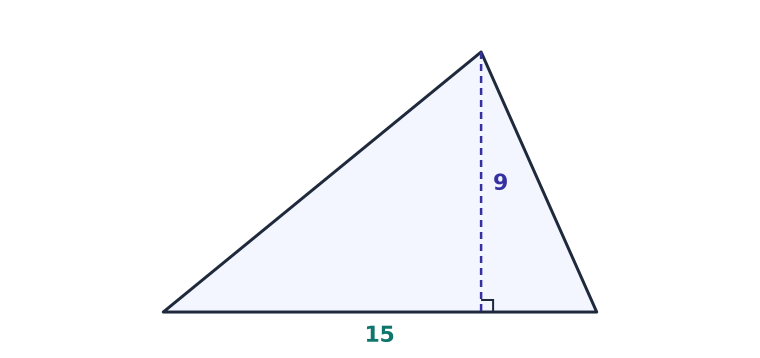
Base and height known: $A = \frac{1}{2} b h$.
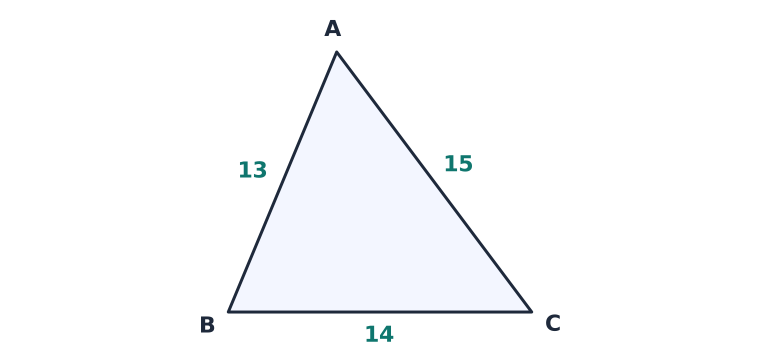
Three sides known: Heron's formula with $s = \frac{a + b + c}{2}$:
$$A = \sqrt{s(s - a)(s - b)(s - c)}$$
Equilateral of side $a$: $A = \frac{\sqrt{3}}{4} a^2$.
Four-sided figures
Parallelogram: base × perpendicular height.
Rhombus: $\frac{1}{2} d_1 d_2$.
Trapezium: $\frac{1}{2}(a + b) h$, where $a$, $b$ are the parallel sides.
Circles, semicircles and rings
$A = \pi r^2$ and $C = 2\pi r$. With $\pi = \frac{22}{7}$, choose $r$ as a multiple of 7: $r = 7$ gives $A = 154$ and $C = 44$.
Semicircle perimeter $= \pi r + 2r$.
Ring: $\pi(R^2 - r^2)$.
A wheel turns once for every $2\pi r$ of road.
Sectors and arcs
A sector of angle $\theta$ is $\frac{\theta}{360}$ of the circle:
Shaded area = whole shape − the white parts. A square of side 14 with a circle of radius 7 inside has corner pieces of $196 - 154 = 42$. Four quarter circles of radius 7 at the corners of the same square also cover one full circle, so the middle piece is also 42.
Percentage change in area
If length rises $a%$ and breadth $b%$, area changes by $a + b + \frac{ab}{100}$ percent. A square's side up 10%: $10 + 10 + 1 = 21%$. Length +20%, breadth −20%: $0 - 4 = -4%$.
Sunita's answers
Path: $46 \times 31 - 40 \times 25 = 426$ m² of bricks. Fence: $2(46 + 31) = 154$ m. A fountain of radius 7 m needs $154$ m² of the lawn. Three questions, three formulas, and the subtraction idea tying them together.
Concepts and terms
Area vs perimeter
Perimeter is the length around a shape (m); area is the surface it covers (m²). Fencing uses perimeter; flooring uses area.
Heron's formula
Gives a triangle's area from its three sides, no height needed.
Sector
A slice of a circle between two radii. It is θ/360 of the whole circle.
Subtraction method
For any shaded region, find the area of the full shape and subtract the unshaded parts.
Did you know
Of all shapes with the same perimeter, the circle encloses the largest area; that is why many storage tanks are round.
Aryabhata (499 CE) gave π ≈ 3.1416, correct to four decimal places.
Memory tricks
Circle formulas — Area is squared, circumference is doubled — Area πr² has r squared; circumference 2πr has a 2 in front.
Area change — a + b + ab/100 — +20% and −10% give 20 − 10 − 2 = +8%.
Practice MCQs with answers (60)
Q1
A rectangular plot is 18 m long and 12 m wide. Find its area (in m²).
beginner
A60
B234
C216
D232
Show answer
Answer: 216
Why:
18 × 12 = 216 m².
Q2
The area of a rectangle is 400 m² and its length is 25 m. Find its perimeter (in m).
beginner
A66
B16
C41
D82
Show answer
Answer: 82
Why:
Breadth = 400 ÷ 25 = 16, so perimeter = 2(25 + 16) = 82 m.
Q3
A field is 60 m by 40 m. Fencing costs ₹15 per metre. What is the cost of fencing it (in ₹)?
beginner
Q12
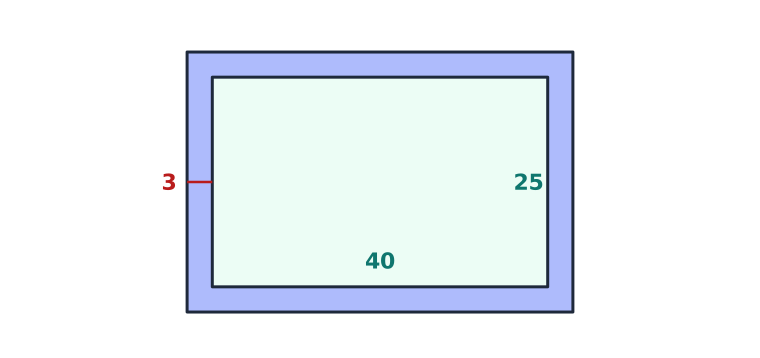
A 40 m × 25 m garden has a path 3 m wide running outside along its edges (shaded). Find the area of the path (in m²).
intermediate
A204
B426
C390
D462
Show answer
Answer: 426
Why:
Outer = 46 × 31 = 1426; path = that − 40 × 25 = 426 m².
Q13
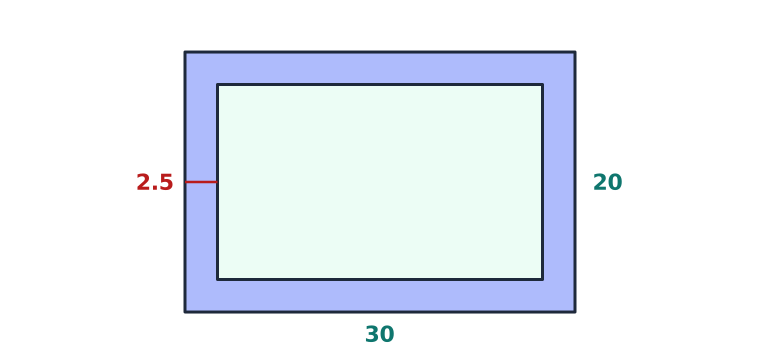
A 30 m × 20 m garden has a path 2.5 m wide running inside along its edges (shaded). Find the area of the path (in m²).
intermediate
A250
B220
C225
D118.75
Show answer
Answer: 225
Why:
Inner = 25 × 15 = 375; path = 600 − that = 225 m².
Q14
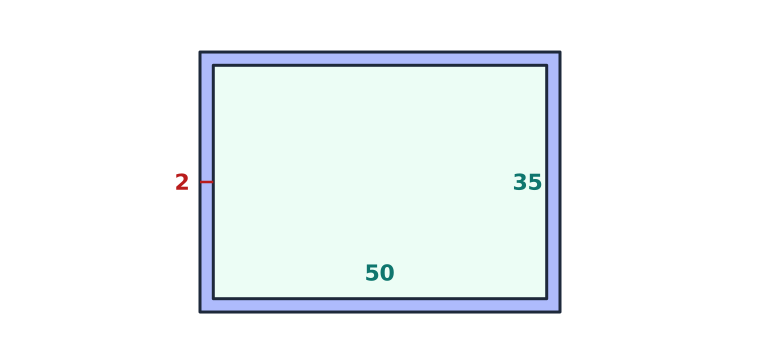
A 50 m × 35 m garden has a path 2 m wide running outside along its edges (shaded). Find the area of the path (in m²).
beginner
A174
B340
C372
D356
Show answer
Answer: 356
Why:
Outer = 54 × 39 = 2106; path = that − 50 × 35 = 356 m².
Q15
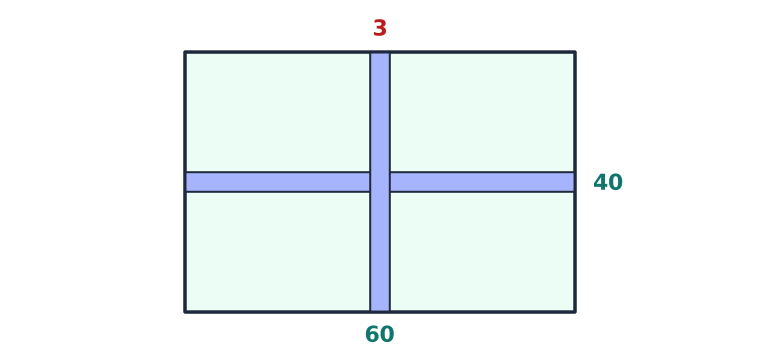
A 60 m × 40 m park has two roads, each 3 m wide, crossing at the centre parallel to its sides (shaded). Find the area of the roads (in m²).
intermediate
A291
B309
C180
D300
Show answer
Answer: 291
Why:
Roads = 3 × 60 + 3 × 40 − 3 × 3 = 291 m².
Q16
A 80 m × 50 m park has two roads, each 4 m wide, crossing at the centre (shaded). Gravelling costs ₹12 per m². Find the cost (in ₹).
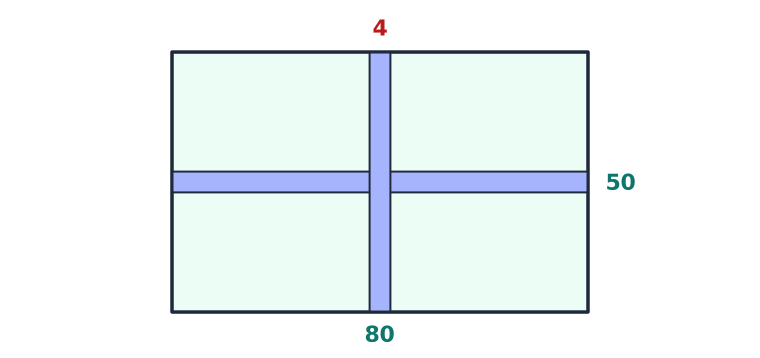
advanced
Q17
Find the area of the triangle (in cm²). All lengths are in cm.
beginner
A20
B60
C48
D96
Show answer
Answer: 48
Why:
½ × 12 × 8 = 48 cm².
Q18
Find the area of the triangle (in cm²). All lengths are in cm.
beginner
A135
B24
C82.5
D67.5
Show answer
Answer: 67.5
Why:
½ × 15 × 9 = 67.5 cm².
Q19
Find the area of the triangle (in cm²). All lengths are in cm.
intermediate
Q20
Find the area of the triangle (in cm²). All lengths are in cm.
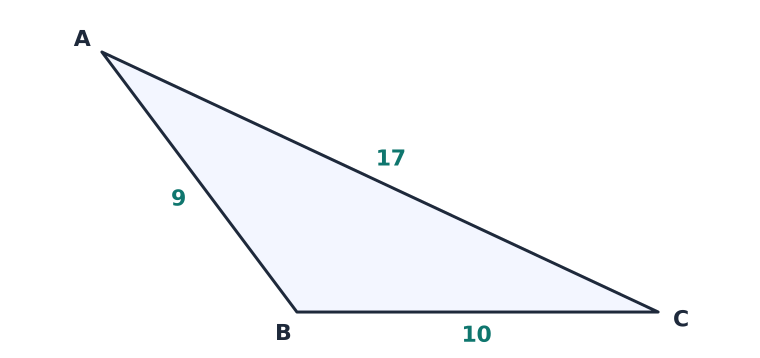
intermediate
Q21
Find the area of the triangle (in cm²). All lengths are in cm.
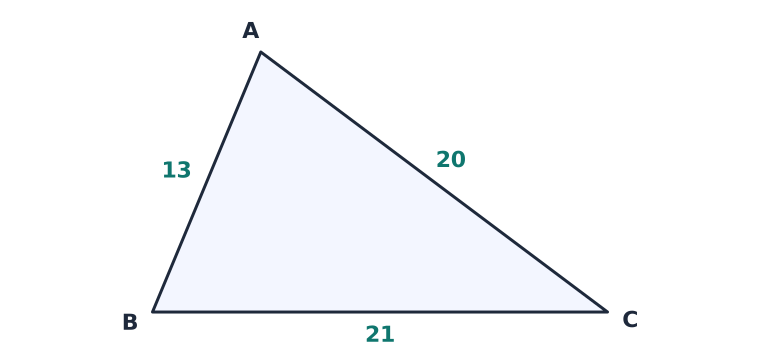
advanced
Q25
The diagonals of rhombus ABCD are AC = 16 cm and BD = 12 cm. Find its area (in cm²).
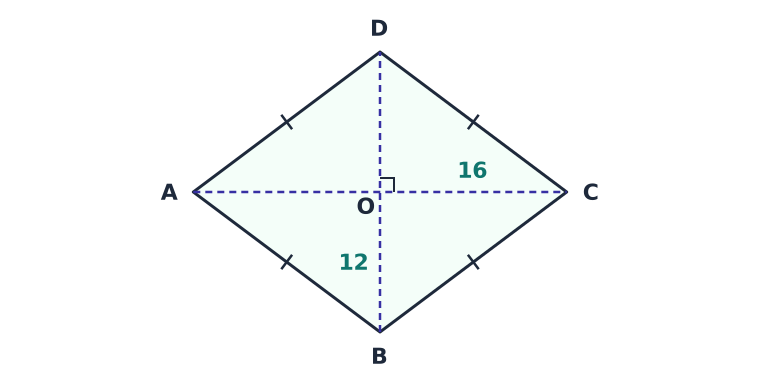
beginner
A112
B192
C96
D56
Show answer
Answer: 96
Why:
½ × 16 × 12 = 96.
Q26
The diagonals of rhombus ABCD are AC = 24 cm and BD = 10 cm. Find its area (in cm²).
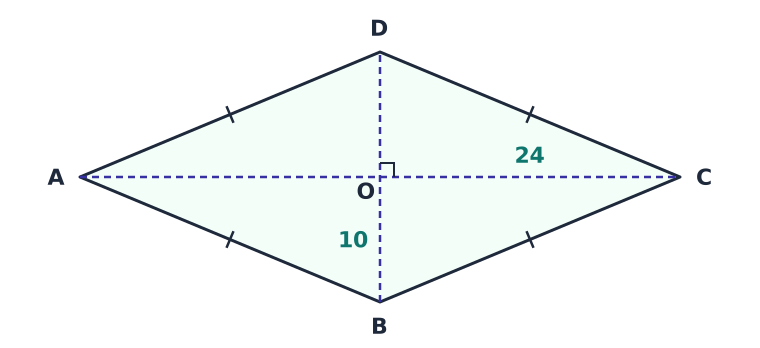
beginner
A240
B68
C144
D120
Show answer
Answer: 120
Why:
½ × 24 × 10 = 120.
Q27
AB ∥ DC. Find the area of the trapezium (in cm²). All lengths are in cm.
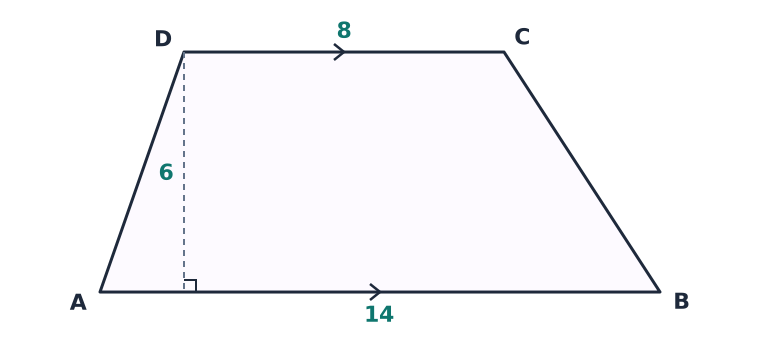
intermediate
A66
B132
C84
D72
Show answer
Answer: 66
Why:
½ × (14 + 8) × 6 = 66.
Q28
AB ∥ DC. Find the area of the trapezium (in cm²). All lengths are in cm.
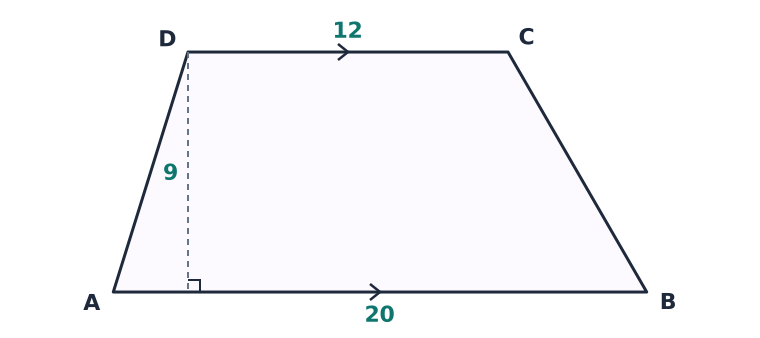
intermediate
A180
B144
C153
D288
Show answer
Answer: 144
Why:
½ × (20 + 12) × 9 = 144.
Q29
Find the area of the parallelogram (in cm²). All lengths are in cm.
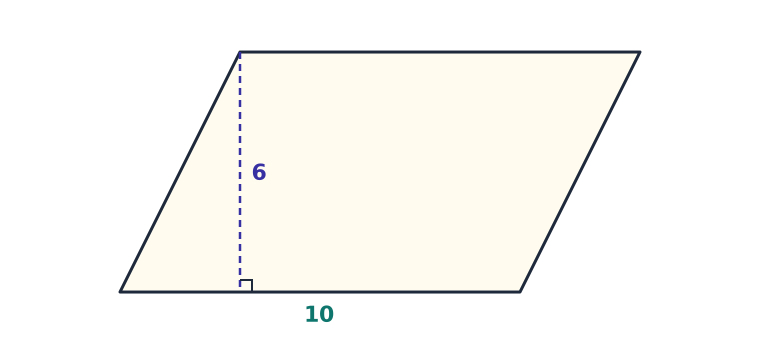
beginner
A66
B30
C60
D32
Show answer
Answer: 60
Why:
Base × height = 10 × 6 = 60.
Q30
Find the area of a circle of radius 7 cm (in cm²). Take π = 22/7.
beginner
A44
B616
C168
D154
Show answer
Answer: 154
Why:
(22/7) × 7² = 154 cm².
Q31
Find the circumference of a circle of radius 14 cm (in cm). Take π = 22/7.
beginner
A88
B616
C44
D95
Show answer
Answer: 88
Why:
2 × (22/7) × 14 = 88 cm.
Q32
A circular plot has diameter 42 m. Find its area (in m²). Take π = 22/7.
intermediate
A1407
B1386
C5544
D132
Show answer
Answer: 1386
Why:
r = 21; area = (22/7) × 21² = 1386 m².
Q33
The circumference of a circle is 220 cm. Find its area (in cm²). Take π = 22/7.
intermediate
A7700
B4070
C3850
D15,400
Show answer
Answer: 3850
Why:
2πr = 220 gives r = 35; area = (22/7) × 35² = 3850.
Q34
A wheel has diameter 70 cm. How many complete turns does it make in covering 1.1 km? Take π = 22/7.
intermediate
A5000
B1000
C250
D500
Show answer
Answer: 500
Why:
One turn = π × 70 = 220 cm; 110000 ÷ 220 = 500.
Q35
A wheel has diameter 56 cm. How many complete turns does it make in covering 2.2 km? Take π = 22/7.
advanced
A1250
B625
C12,500
D2500
Show answer
Answer: 1250
Why:
One turn = π × 56 = 176 cm; 220000 ÷ 176 = 1250.
Q36
A wire bent into a square of side 22 cm is reshaped into a circle. Find the area of the circle (in cm²). Take π = 22/7.
intermediate
A88
B616
C484
D154
Show answer
Answer: 616
Why:
Wire = 4 × 22 = 88 = 2πr, so r = 14 and area = 616.
Q37
The figure is a semicircle with the diameter shown. Find its perimeter (in cm). All lengths are in cm. Take π = 22/7.
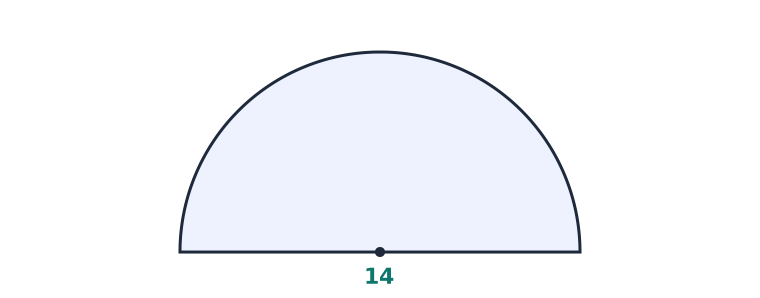
intermediate
A44
B29
C36
D22
Show answer
Answer: 36
Why:
πr + 2r = (22/7) × 7 + 14 = 22 + 14 = 36.
Q38
The figure is a semicircle with the diameter shown. Find its perimeter (in cm). All lengths are in cm. Take π = 22/7.
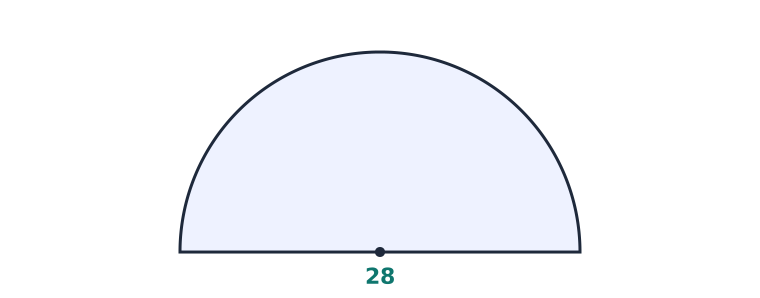
beginner
A58
B44
C88
D72
Show answer
Answer: 72
Why:
πr + 2r = (22/7) × 14 + 28 = 44 + 28 = 72.
Q39
Find the area of the shaded sector (in cm²). All lengths are in cm. Take π = 22/7.
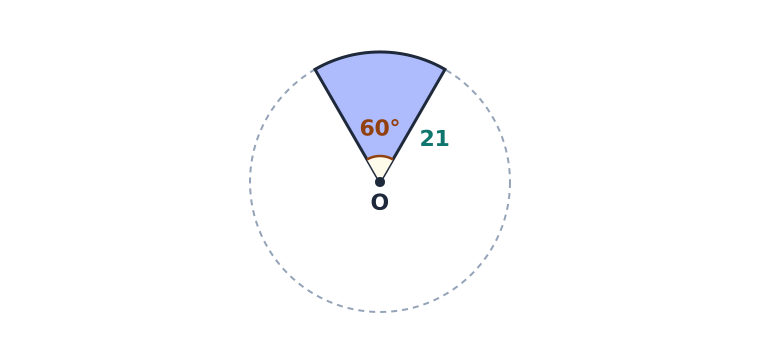
intermediate
A231
B462
C22
D1386
Show answer
Answer: 231
Why:
(60/360) × (22/7) × 21² = 231.
Q40
Find the area of the shaded sector (in cm²). All lengths are in cm. Take π = 22/7.
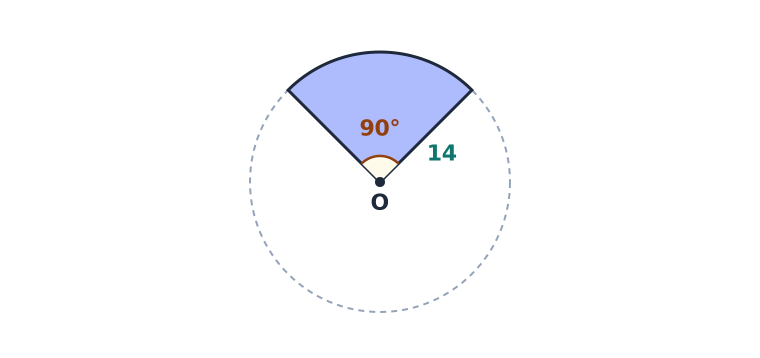
beginner
A308
B154
C22
D616
Show answer
Answer: 154
Why:
(90/360) × (22/7) × 14² = 154.
Q41
Find the length of the arc of the shaded sector (in cm). All lengths are in cm. Take π = 22/7.
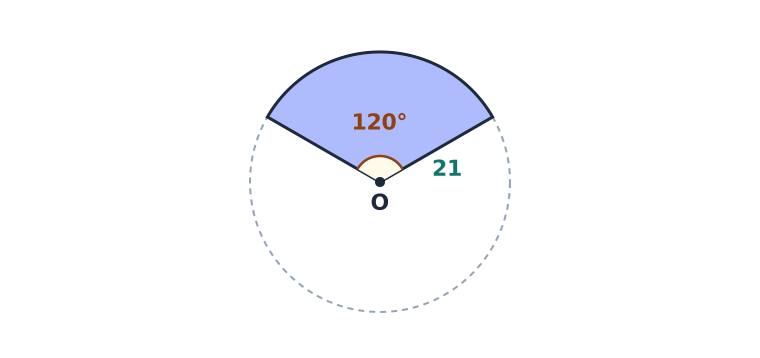
intermediate
A462
B132
C44
D88
Show answer
Answer: 44
Why:
Arc = (120/360) × 2 × (22/7) × 21 = 44.
Q42
Find the length of the arc of the shaded sector (in cm). All lengths are in cm. Take π = 22/7.
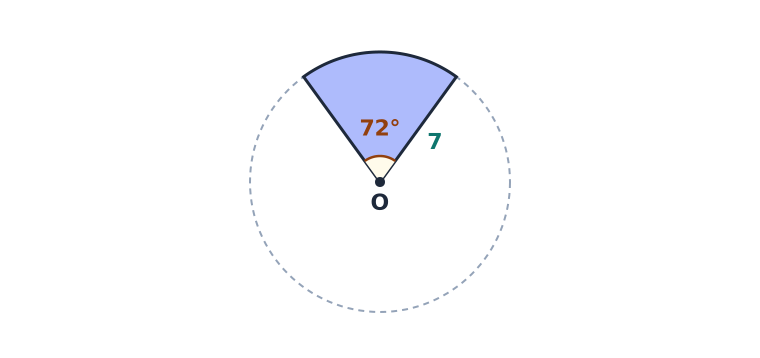
advanced
A17.6
B30.8
C44
D8.8
Show answer
Answer: 8.8
Why:
Arc = (72/360) × 2 × (22/7) × 7 = 8.8.
Q43
The minute hand of a clock is 14 cm long. What area does it sweep in 15 minutes (in cm²)? Take π = 22/7.
intermediate
Q44
Find the area of the shaded ring (in cm²). All lengths are in cm. Take π = 22/7.
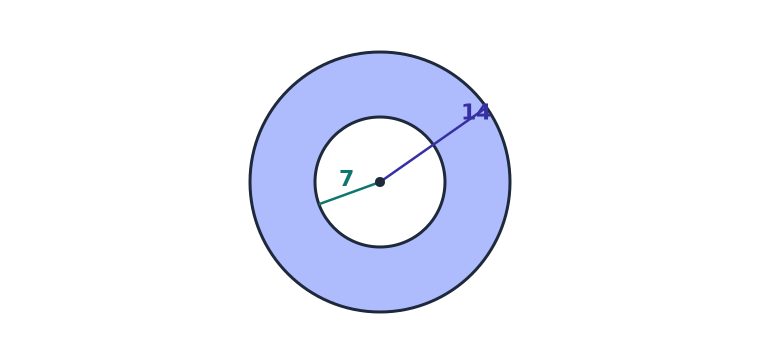
intermediate
A44
B462
C154
D616
Show answer
Answer: 462
Why:
π(R² − r²) = (22/7) × (196 − 49) = 462.
Q45
A circular park of radius 14 m has a track 7 m wide all around it, outside. Find the area of the track (in m²). Take π = 22/7.
intermediate
Q46
A circle is drawn inside a square of side 28 cm, touching all four sides. Find the shaded area (in cm²). Take π = 22/7.
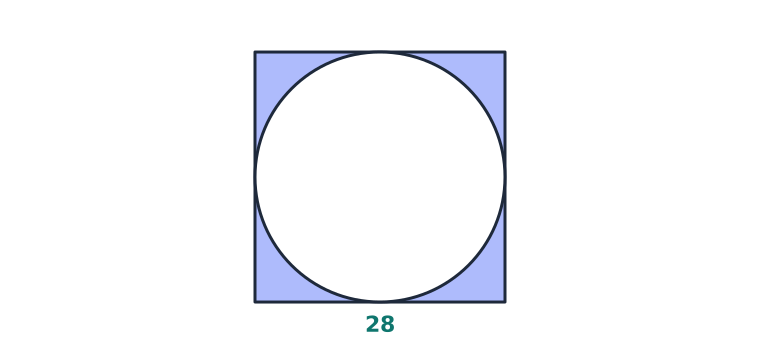
intermediate
A696
B616
C42
D168
Show answer
Answer: 168
Why:
784 − (22/7) × (14)² = 784 − 616 = 168.
Q47
A circle is drawn inside a square of side 21 cm, touching all four sides. Find the shaded area (in cm²). Take π = 22/7.
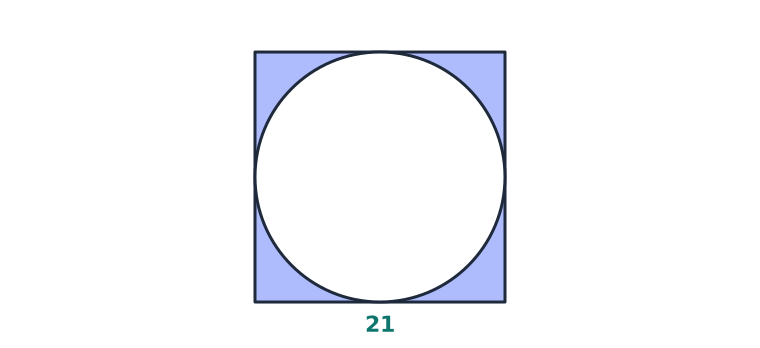
advanced
A94.5
B24
C375
D346.5
Show answer
Answer: 94.5
Why:
441 − (22/7) × (10.5)² = 441 − 346.5 = 94.5.
Q48
Four quarter circles of radius 7 cm are drawn at the corners of a square of side 14 cm. Find the shaded area (in cm²). Take π = 22/7.
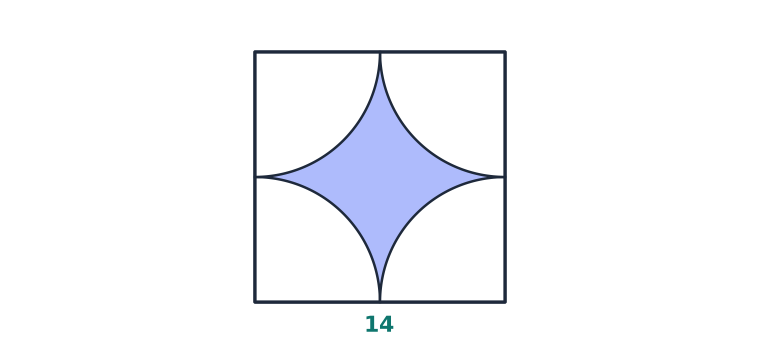
intermediate
A154
B42
C157.5
D168
Show answer
Answer: 42
Why:
The four quarters make one full circle: 196 − (22/7) × (7)² = 42.
Q49
Four quarter circles of radius 14 cm are drawn at the corners of a square of side 28 cm. Find the shaded area (in cm²). Take π = 22/7.
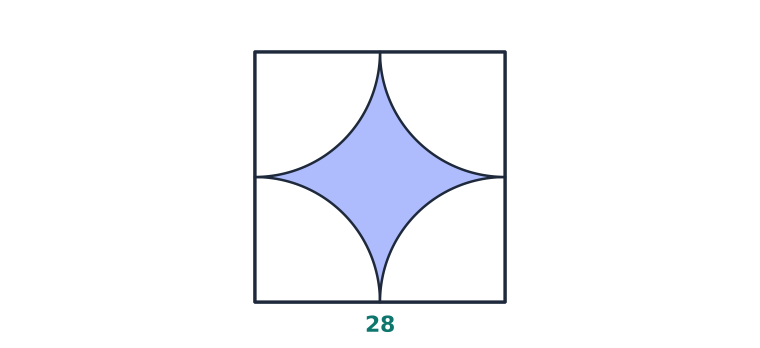
advanced
A630
B672
C168
D616
Show answer
Answer: 168
Why:
The four quarters make one full circle: 784 − (22/7) × (14)² = 168.
Q50
A square is drawn inside a circle of radius 7 cm with its corners on the circle. Find the shaded area (in cm²). Take π = 22/7.
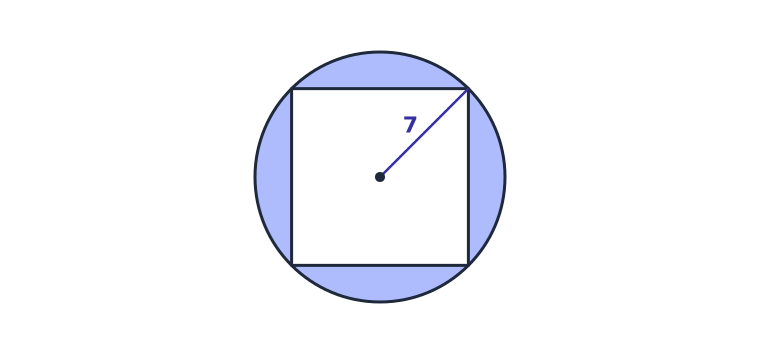
intermediate
Q51
A square is drawn inside a circle of radius 14 cm with its corners on the circle. Find the shaded area (in cm²). Take π = 22/7.
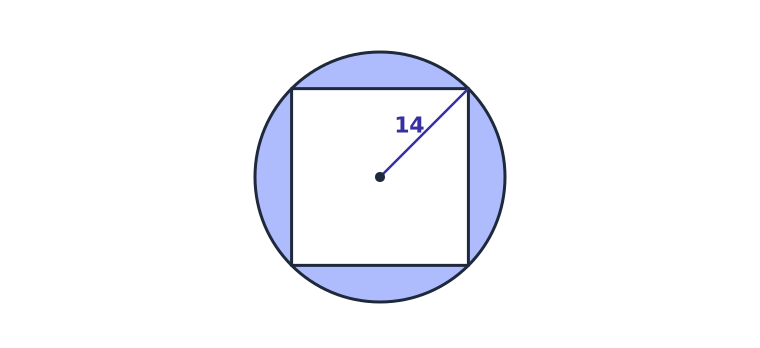
advanced
Q52
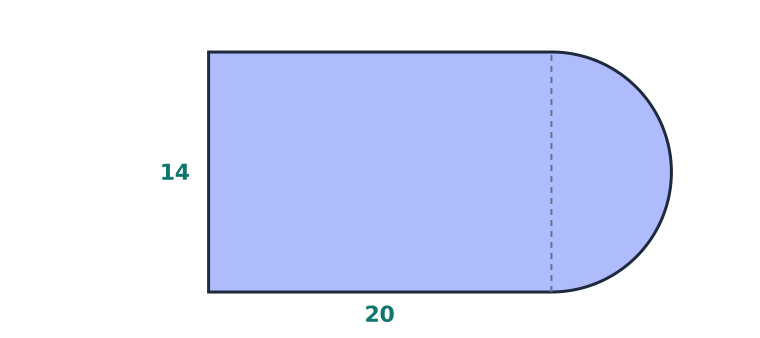
A semicircle with diameter 14 cm is added to the end of a 20 cm × 14 cm rectangle, as shown. Find the total shaded area (in cm²). Take π = 22/7.
intermediate
A280
B357
C203
D434
Show answer
Answer: 357
Why:
20 × 14 + ½ × (22/7) × (7)² = 280 + 77 = 357.
Q53
If the radius of a circle is doubled, its area becomes
beginner
A8 times
Bunchanged
C4 times
D2 times
Show answer
Answer: 4 times
Why:
Area goes as r², and 2² = 4.
Q54
A square and a circle have the same perimeter. Which has the larger area?
intermediate
AIt depends on the size
BThe square
CBoth equal
DThe circle
Show answer
Answer: The circle
Why:
For perimeter 88: circle 616, square 484. The circle always wins.
Q55
What is the ratio of the areas of the circle inscribed in a square to the circle drawn around it?
advanced
A1 : 2
B1 : 4
C1 : √2
D2 : 3
Show answer
Answer: 1 : 2
Why:
Radii are a/2 and a/√2; squares give a²/4 : a²/2 = 1 : 2.
Q56
The ratio of the areas of two circles is 16 : 25. What is the ratio of their circumferences?
intermediate
A16 : 25
B4 : 5
C2 : 5
D8 : 5
Show answer
Answer: 4 : 5
Why:
Radii ratio = √(16/25) = 4/5, and circumference goes as r.
Q57
Assertion (A): A 10% increase in each side of a square increases its area by 21%.
Reason (R): Area of a square depends on the square of its side.
intermediate
ABoth A and R are true, and R is the correct explanation of A
BBoth A and R are true, but R is not the correct explanation of A
CA is true but R is false
DA is false but R is true
Show answer
Answer: Both A and R are true, and R is the correct explanation of A
Why:
1.1² = 1.21, so A is true and follows from R.
Q58
Assertion (A): The perimeter of a semicircle of radius 7 cm is 22 cm.
Reason (R): The curved part of a semicircle of radius 7 cm is 22 cm long.
intermediate
ABoth A and R are true, and R is the correct explanation of A
BBoth A and R are true, but R is not the correct explanation of A
CA is true but R is false
DA is false but R is true
Show answer
Answer: A is false but R is true
Why:
R is true (π × 7 = 22), but the perimeter also includes the diameter: 22 + 14 = 36. So A is false.
Q59
Consider the statements:
1. A rhombus with diagonals 10 cm and 24 cm has area 120 cm².
2. A triangle with sides 5, 12 and 13 cm has area 60 cm².
intermediate
A1 only
B2 only
CBoth 1 and 2
DNeither 1 nor 2
Show answer
Answer: 1 only
Why:
½ × 10 × 24 = 120, true. The 5-12-13 triangle is right-angled: ½ × 5 × 12 = 30, so 2 is false.
Q60
Which of these statements is/are true?
1. Doubling the length and breadth of a rectangle doubles its area.
2. A 90° sector is one quarter of the circle.
beginner
A1 only
B2 only
CBoth 1 and 2
DNeither 1 nor 2
Show answer
Answer: 2 only
Why:
Doubling both makes the area 4 times, so 1 is false. 90/360 = ¼, so 2 is true.
Important short questions (4)
Find the area of a triangle with sides 9 cm, 10 cm and 17 cm.
s = 18; area = √(18 × 9 × 8 × 1) = √1296 = 36 cm².
A circular field has circumference 132 m. Find its area (π = 22/7).
2πr = 132 gives r = 21; area = (22/7) × 441 = 1386 m².
Two roads 5 m wide cross at the centre of a 100 m × 80 m field, parallel to the sides. Find their area.
5 × 100 + 5 × 80 − 5 × 5 = 875 m².
Find the area of a sector of angle 45° in a circle of radius 28 cm.
(45/360) × (22/7) × 784 = ⅛ × 2464 = 308 cm².
Long answer questions (1)
A rectangular lawn is 50 m by 35 m. A path 2.5 m wide runs all round it outside, and a circular flower bed of radius 7 m is made in the middle of the lawn. (a) Find the area of the path. (b) Find the cost of laying the path at ₹40 per m². (c) Find the area of the lawn left for grass.
(c) Bed = (22/7) × 49 = 154; grass = 1750 − 154 = 1596 m².
Flashcards (15)
Area of a rectangle 12 × 7?
84
Perimeter of a rectangle 12 × 7?
38
Area of a square with diagonal 10?
50
Area of a circle of radius 7 (π = 22/7)?
154
Circumference for radius 14?
88
Perimeter of a semicircle of radius 7?
36
Heron's s for sides 5, 12, 13?
15
Area of an equilateral triangle of side 4?
4√3
Rhombus with diagonals 10 and 8: area?
40
Trapezium sides 10 and 6, height 4: area?
32
Sector of 90° in a circle of radius 14: area?
154
Ring with R = 14, r = 7: area?
462
Square side +20%: area change?
+44%
Radius doubled: area becomes?
4 times
Distance in one turn of a wheel of radius r?
2πr
Play this topic
Area check
Volume and Surface Area of Solids
Volume, curved and total surface area of cuboids, cubes, cylinders, cones, spheres and hemispheres; melting and recasting, water-level rise, percentage change in volume, composite solids, and the painted-cube and frustum questions of harder exams.
What you will be able to do
I can find the volume, surface area and diagonal of a cuboid and a cube.
I can work with cylinders, cones, spheres and hemispheres, including slant height.
I can solve melting, recasting and water-level questions by equating volumes.
I can find surface areas and volumes of composite solids such as tents and capsules.
I can find the percentage change and ratio of volumes when dimensions change.
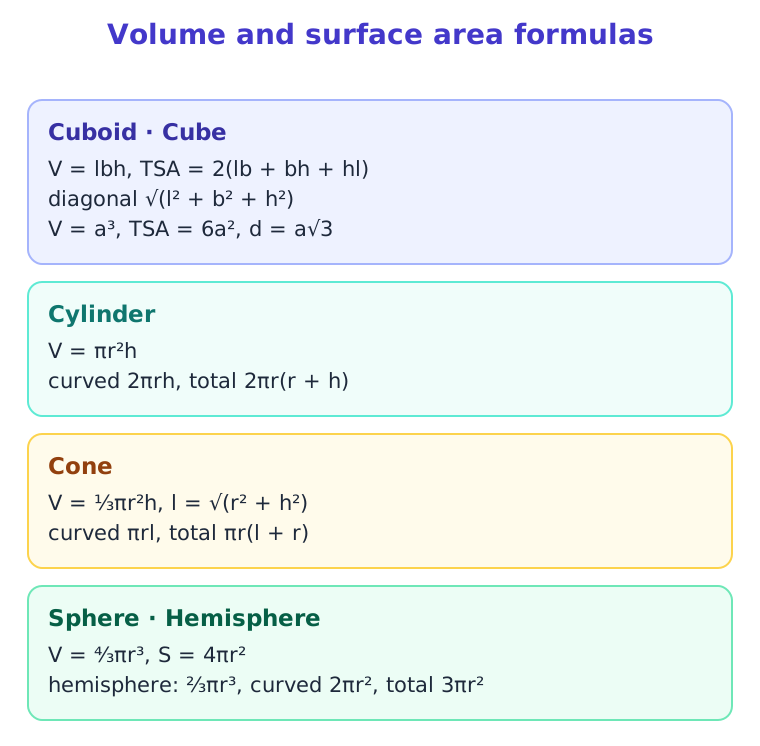
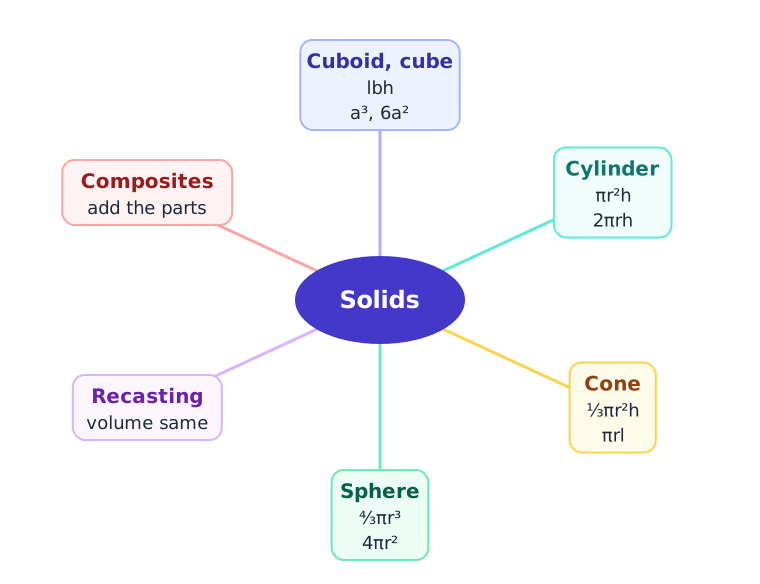
Cube of side a: V = a³, TSA = 6a², diagonal = a√3.
Cylinder: V = πr²h, curved surface 2πrh, total 2πr(r + h).
Cone: V = ⅓πr²h, slant l = √(r² + h²), curved πrl, total πr(l + r).
Sphere: V = ⁴⁄₃πr³, S = 4πr². Hemisphere: V = ⅔πr³, curved 2πr², total 3πr².
Melting and recasting keeps the volume the same; the surface area changes.
Rise in water level = volume put in ÷ base area of the vessel.
1 m³ = 1000 litres and 1 litre = 1000 cm³.
If every length is multiplied by k, area becomes k² times and volume k³ times.
Cone, hemisphere and cylinder of the same radius r and height r have volumes in the ratio 1 : 2 : 3.
Full explanation
Raju's ice-cream cart
Raju sells kulfi in cones and ice cream from a cylindrical tub. He wants to know how many cones one tub fills, how much paper wraps each cone, and what happens to his cost if he makes the tub 10% wider.
Each question is about a solid: how much it holds (volume) and how much covers it (surface area).
Cuboid and cube
A cuboid of length $l$, breadth $b$, height $h$:
Volume $= lbh$
Total surface $= 2(lb + bh + hl)$
Four walls $= 2h(l + b)$
Longest diagonal $= \sqrt{l^2 + b^2 + h^2}$
A cube of side $a$: volume $a^3$, surface $6a^2$, diagonal $a\sqrt{3}$.
Cylinder
A cylinder is a stack of circles: volume $= \pi r^2 h$. Unroll its side and you get a rectangle $2\pi r$ by $h$, so the curved surface is $2\pi r h$. Add two circular ends for the total: $2\pi r(r + h)$.
Cone
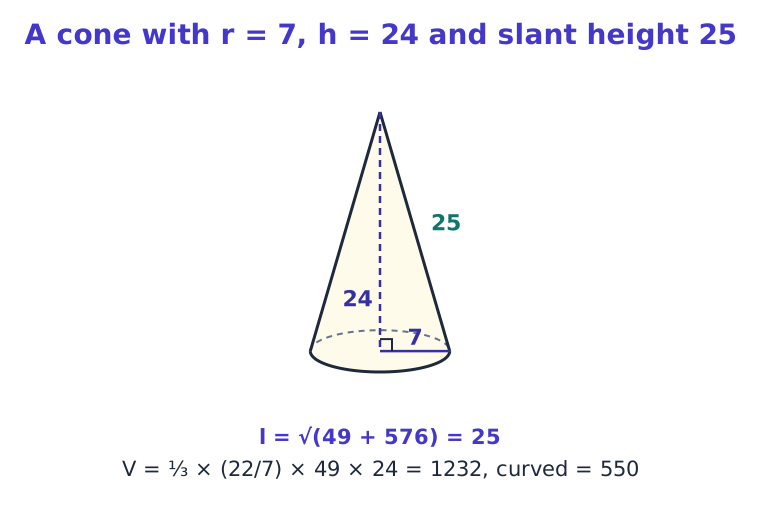
A cone holds one-third of the cylinder with the same base and height: $V = \frac{1}{3}\pi r^2 h$. Its slant height comes from the right triangle inside it: $l = \sqrt{r^2 + h^2}$. Curved surface $= \pi r l$; total $= \pi r(l + r)$.
Sphere and hemisphere
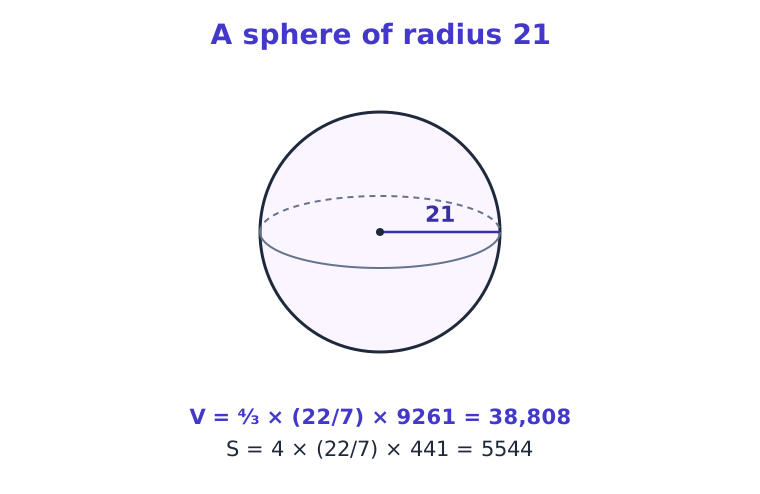
Sphere: $V = \frac{4}{3}\pi r^3$, $S = 4\pi r^2$.
Hemisphere: $V = \frac{2}{3}\pi r^3$, curved $2\pi r^2$, total $3\pi r^2$ (curved plus the flat circle).
Melting and recasting
Metal melted into a new shape keeps its volume. A sphere of radius 6 recast into a cylinder of radius 4:
$$\tfrac{4}{3}\pi \cdot 6^3 = \pi \cdot 4^2 \cdot h \Rightarrow h = 18$$
A ball of radius 12 makes $(12/3)^3 = 64$ balls of radius 3. Volume ratio always goes as the cube of the length ratio.
Water level rise
Drop a solid into a vessel and the water rises by (volume of the solid) ÷ (base area of the vessel). A cube of side 20 cm in a 50 cm × 40 cm tank raises the water by $8000 \div 2000 = 4$ cm.
Composite solids
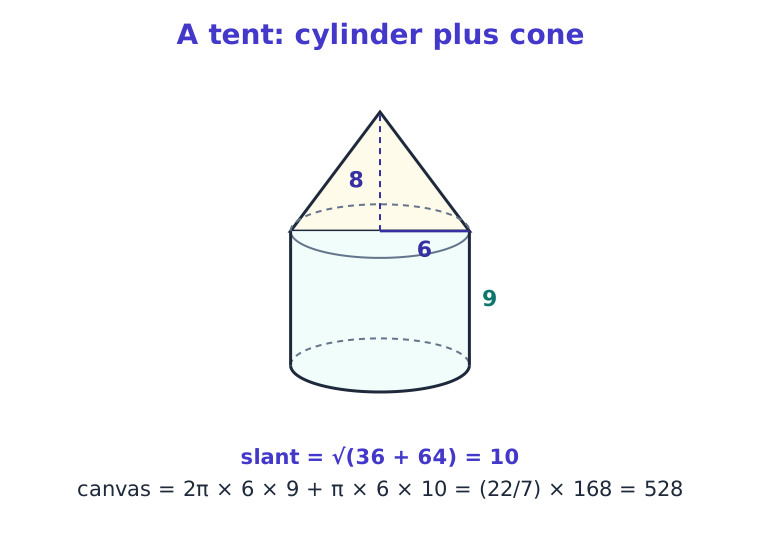
Add the volumes of the parts. For the surface, add only the faces you can touch from outside. A tent (cylinder plus cone) uses $2\pi r h + \pi r l$ of canvas: no base and no joining circle.
Percentage change in volume
Scale every length by $k$ and volume scales by $k^3$. Cube side up 10%: $1.1^3 = 1.331$, so volume up 33.1%. Cylinder radius up 10% with the same height: $1.1^2 = 1.21$, volume up 21%.
Two harder ideas
Painted cube. A cube painted outside and cut into $n^3$ small cubes has 8 cubes with three painted faces, $12(n - 2)$ with two, $6(n - 2)^2$ with one and $(n - 2)^3$ with none.
Frustum. A cone with its top cut off: $V = \frac{\pi h}{3}(R^2 + r^2 + Rr)$, curved surface $\pi(R + r)l$ with $l = \sqrt{h^2 + (R - r)^2}$.
Raju's answers
A tub of radius 14 cm and height 21 cm holds $\frac{22}{7} \cdot 196 \cdot 21 = 12{,}936$ cm³; each cone of radius 3.5 cm and height 12 cm holds 154 cm³, so one tub fills 84 cones. Each cone has slant height $\sqrt{3.5^2 + 12^2} = 12.5$ cm, so its paper wrap is $\pi r l = \frac{22}{7} \times 3.5 \times 12.5 = 137.5$ cm². A tub with a 10% larger radius holds 21% more. Volume questions are about one idea: find the space, then compare.
Concepts and terms
Volume
The space a solid fills, in cubic units. For any prism or cylinder it is base area × height.
Curved vs total surface
Curved surface leaves out the flat ends; total surface adds them. A pipe or a tent uses only the curved part.
Slant height
In a cone, the radius, height and slant height form a right triangle: l² = r² + h².
Conservation of volume
When a solid is melted and recast, or water is displaced, the volume before equals the volume after.
Scaling
Lengths scale by k, areas by k², volumes by k³.
Did you know
Archimedes proved that a sphere has exactly two-thirds the volume of the cylinder that just encloses it, and asked for this to be carved on his tomb.
A 1-litre carton holds exactly 1000 cm³, a cube 10 cm on each side.
Memory tricks
Cone vs cylinder — A cone is one-third of its cylinder — Same base and height: three cones of water fill one cylinder.
Sphere — Four-thirds pi r cubed, four pi r squared — Volume has the cube, surface has the square, both carry a 4.
Cone, hemisphere, cylinder — 1 : 2 : 3 — With radius r and height r, the volumes are ⅓, ⅔ and 1 times πr³.
Practice MCQs with answers (79)
Q1
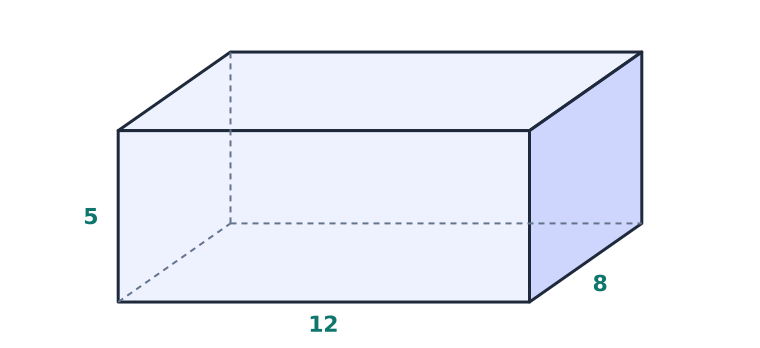
The cuboid shown is 12 cm long, 8 cm wide and 5 cm high. Find its volume (in cm³).
beginner
A480
B392
C576
D960
Show answer
Answer: 480
Why:
V = 12 × 8 × 5 = 480 cm³.
Q2
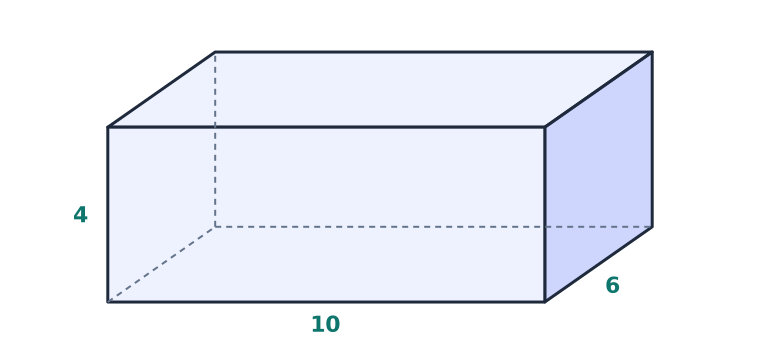
The cuboid shown is 10 cm long, 6 cm wide and 4 cm high. Find its total surface area (in cm²).
beginner
A240
B248
C128
D124
Show answer
Answer: 248
Why:
2(60 + 24 + 40) = 2 × 124 = 248 cm².
Q3
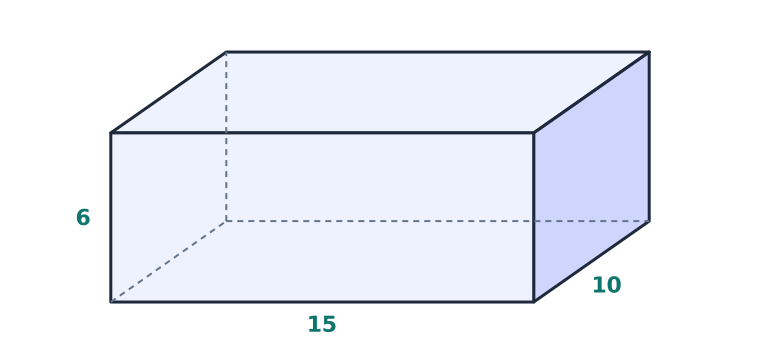
The cuboid shown is 15 cm long, 10 cm wide and 6 cm high. Find the area of its four side faces, leaving out the top and bottom (in cm²).
intermediate
A450
B600
C300
D150
Show answer
Answer: 300
Why:
Four walls = 2h(l + b) = 2 × 6 × 25 = 300 cm².
Q4
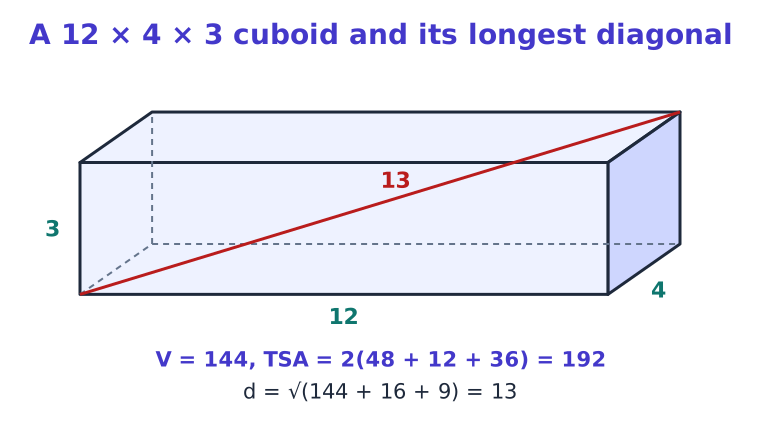
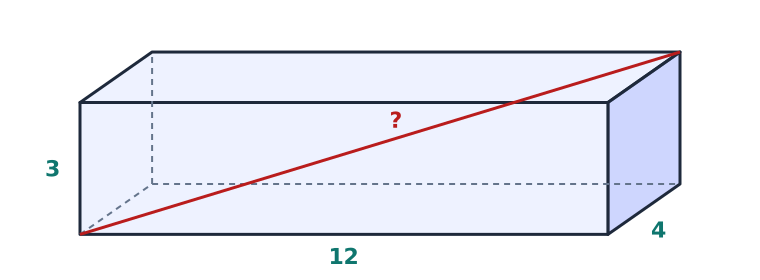
The cuboid shown is 12 cm long, 4 cm wide and 3 cm high. Find the length of the diagonal shown in red (in cm).
beginner
A19
B15
C12
D13
Show answer
Answer: 13
Why:
d = √(12² + 4² + 3²) = √169 = 13 cm.
Q5
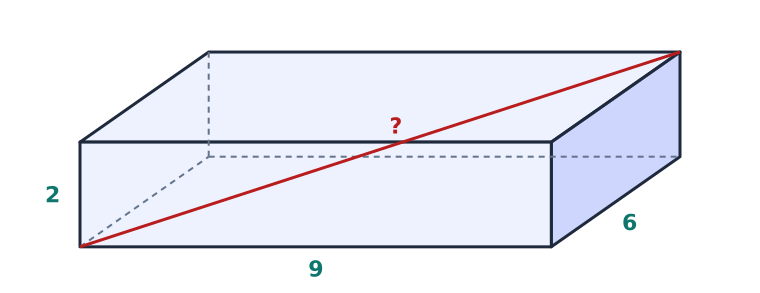
The cuboid shown is 9 cm long, 6 cm wide and 2 cm high. Find the length of the diagonal shown in red (in cm).
intermediate
A11
B13
C10
D17
Show answer
Answer: 11
Why:
d = √(9² + 6² + 2²) = √121 = 11 cm.
Q6
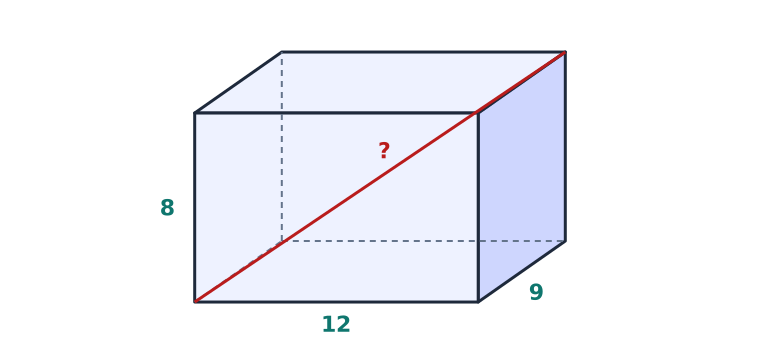
The cuboid shown is 12 cm long, 9 cm wide and 8 cm high. Find the length of the diagonal shown in red (in cm).
intermediate
A16
B17
C29
D19
Show answer
Answer: 17
Why:
d = √(12² + 9² + 8²) = √289 = 17 cm.
Q7
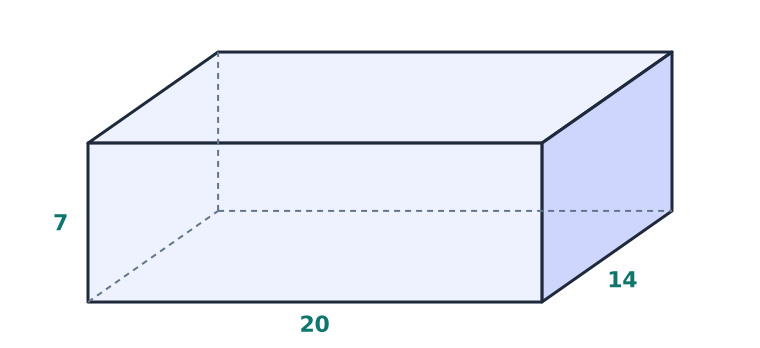
The cuboid shown is 20 cm long, 14 cm wide and 7 cm high. Find its total surface area (in cm²).
intermediate
A1960
B476
C1036
D518
Show answer
Answer: 1036
Why:
2(280 + 98 + 140) = 2 × 518 = 1036 cm².
Q8
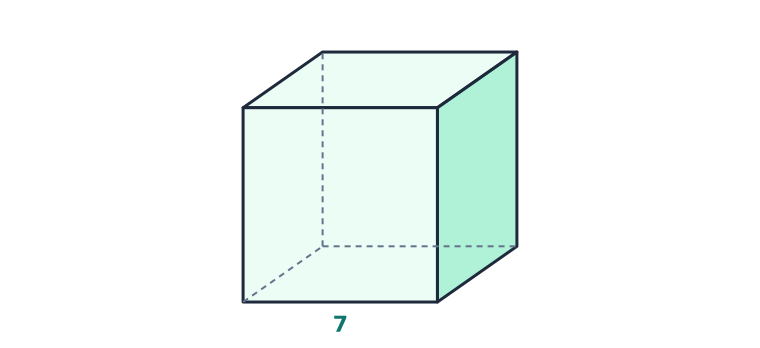
Find the volume of the cube shown, of side 7 cm (in cm³).
beginner
A294
B147
C49
D343
Show answer
Answer: 343
Why:
a³ = 7³ = 343 cm³.
Q9
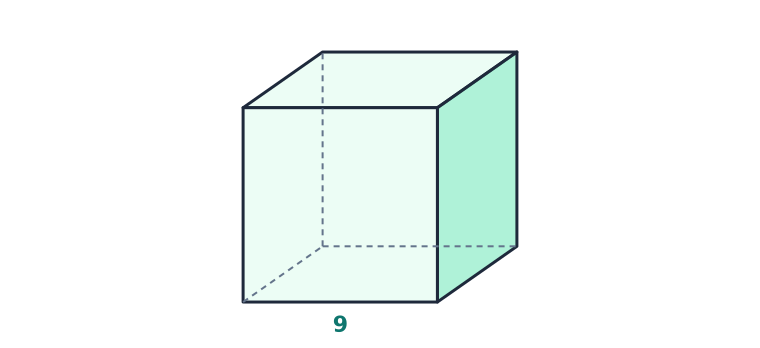
Find the total surface area of the cube shown, of side 9 cm (in cm²).
beginner
A486
B81
C324
D729
Show answer
Answer: 486
Why:
6a² = 6 × 81 = 486 cm².
Q10
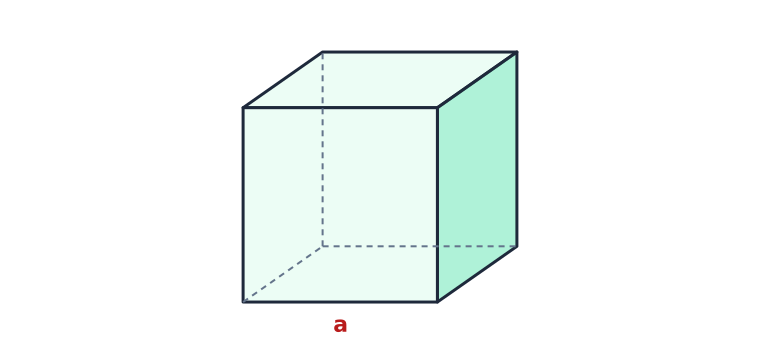
The total surface area of the cube shown is 216 cm². Find its volume (in cm³).
intermediate
A343
B216
C36
D252
Show answer
Answer: 216
Why:
6a² = 216 gives a² = 36, a = 6; volume = 216 cm³.
Q11
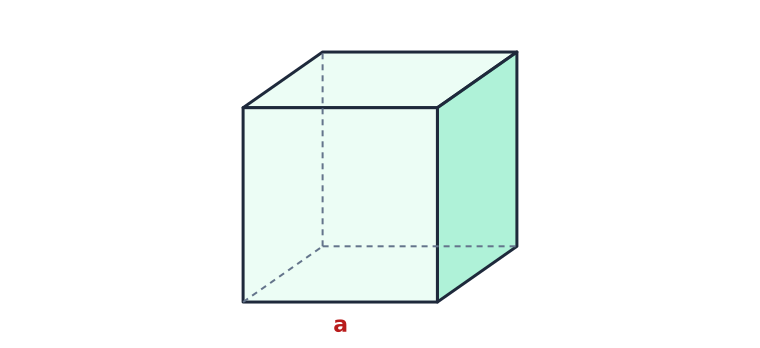
The total surface area of the cube shown is 726 cm². Find its volume (in cm³).
intermediate
Q12
Find the length of the longest diagonal of a cube of side 4 cm.
beginner
A4√2 cm
B12 cm
C4√6 cm
D4√3 cm
Show answer
Answer: 4√3 cm
Why:
d = a√3 = 4√3 cm.
Q13
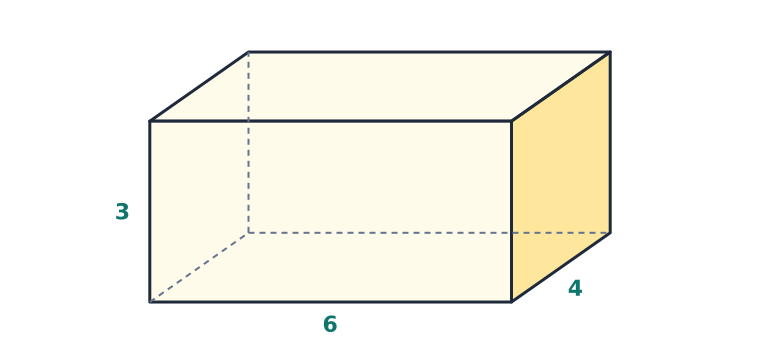
A room is 6 m long, 4 m wide and 3 m high. Find the cost of painting its four walls at ₹25 per m² (in ₹).
intermediate
Q14
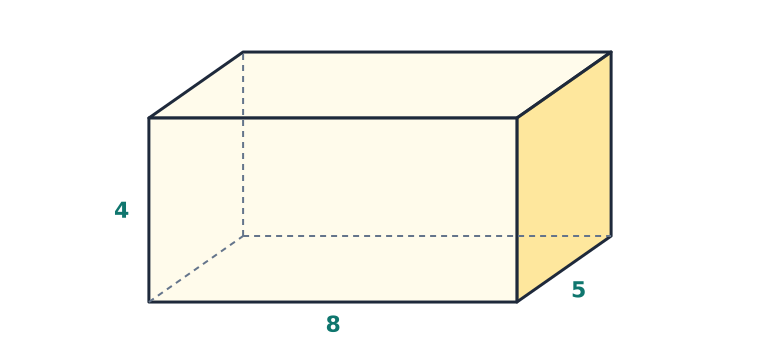
A room is 8 m long, 5 m wide and 4 m high. Find the cost of painting its four walls at ₹30 per m² (in ₹).
intermediate
Q19
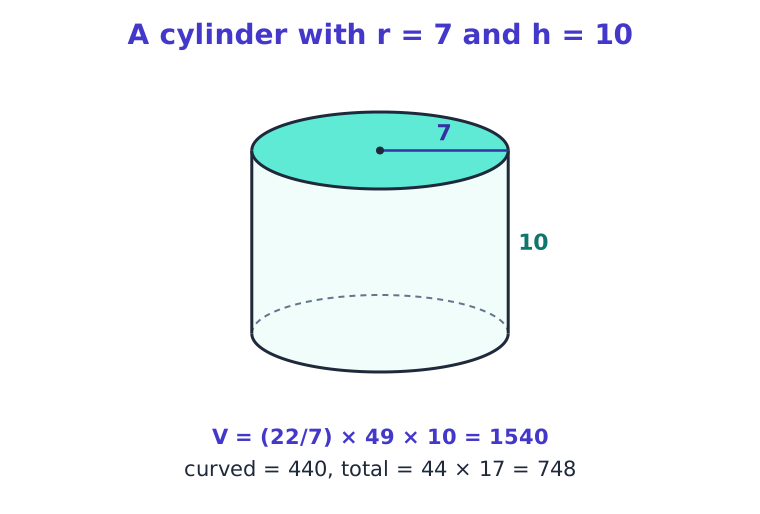
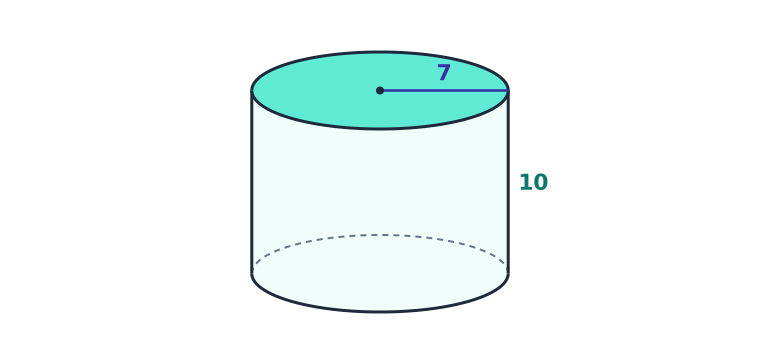
A cylinder has radius 7 cm and height 10 cm, as shown. Find its volume (in cm³). Take π = 22/7.
beginner
A770
B440
C1540
D3080
Show answer
Answer: 1540
Why:
πr²h = (22/7) × 49 × 10 = 1540 cm³.
Q20
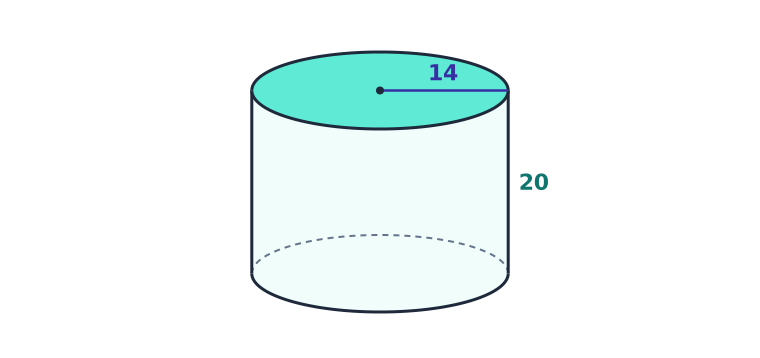
A cylinder has radius 14 cm and height 20 cm, as shown. Find its curved surface area (in cm²). Take π = 22/7.
beginner
A2992
B880
C12,320
D1760
Show answer
Answer: 1760
Why:
2πrh = 2 × (22/7) × 14 × 20 = 1760 cm².
Q21
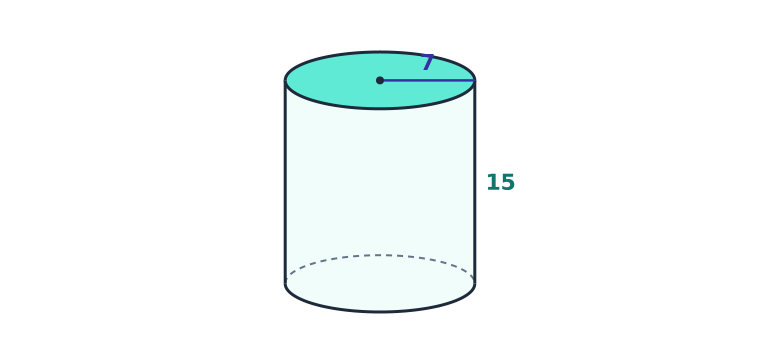
A cylinder has radius 7 cm and height 15 cm, as shown. Find its total surface area (in cm²). Take π = 22/7.
intermediate
A968
B814
C1276
D660
Show answer
Answer: 968
Why:
2πr(r + h) = 2 × (22/7) × 7 × 22 = 968 cm².
Q22
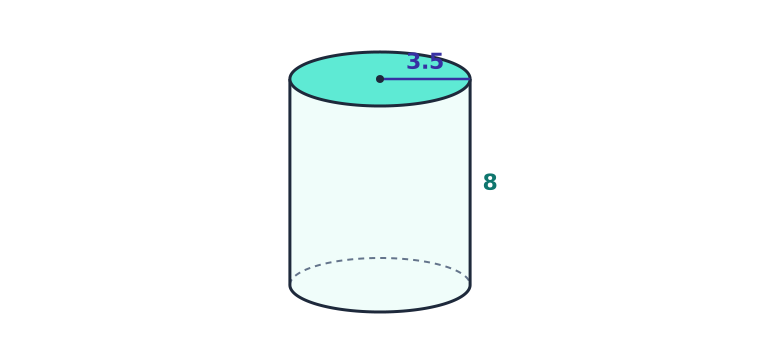
A cylinder has radius 3.5 cm and height 8 cm, as shown. Find its volume (in cm³). Take π = 22/7.
intermediate
A616
B308
C154
D176
Show answer
Answer: 308
Why:
πr²h = (22/7) × 12.25 × 8 = 308 cm³.
Q23
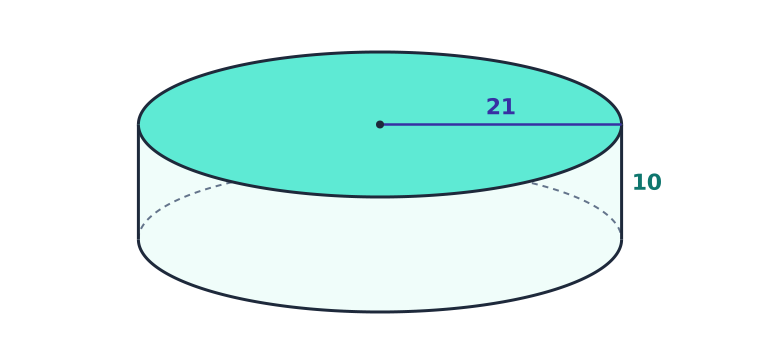
A cylinder has radius 21 cm and height 10 cm, as shown. Find its curved surface area (in cm²). Take π = 22/7.
beginner
A13,860
B4092
C1320
D660
Show answer
Answer: 1320
Why:
2πrh = 2 × (22/7) × 21 × 10 = 1320 cm².
Q24
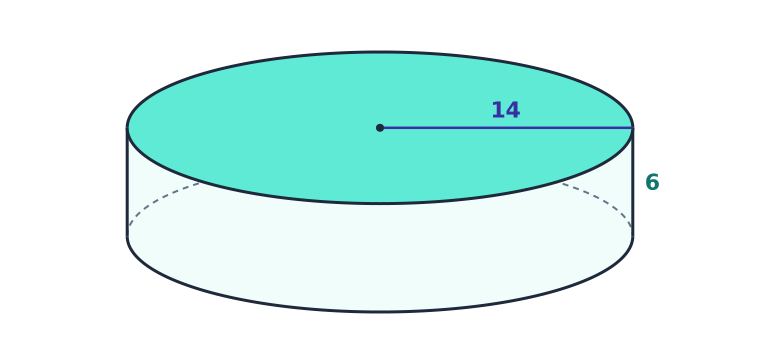
A cylinder has radius 14 cm and height 6 cm, as shown. Find its total surface area (in cm²). Take π = 22/7.
advanced
A2992
B528
C1144
D1760
Show answer
Answer: 1760
Why:
2πr(r + h) = 2 × (22/7) × 14 × 20 = 1760 cm².
Q25
A cylinder of height 9 cm has volume 1386 cm³. Find its radius (in cm). Take π = 22/7.
intermediate
A7
B49
C9
D14
Show answer
Answer: 7
Why:
r² = 1386 ÷ ((22/7) × 9) = 49, so r = 7 cm.
Q26
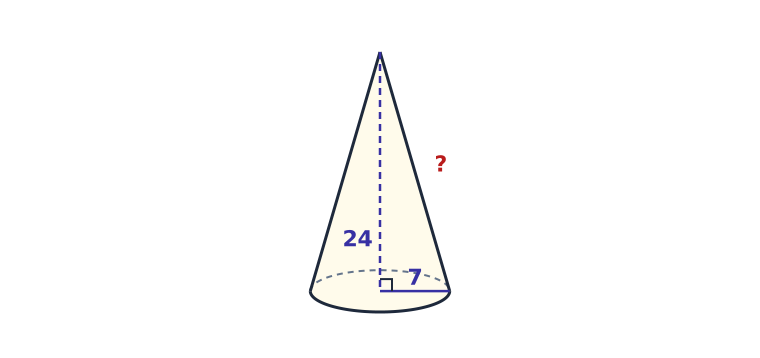
A cone has radius 7 cm and height 24 cm, as shown. Find its slant height (in cm).
beginner
A26
B25
C23
D31
Show answer
Answer: 25
Why:
l = √(7² + 24²) = √625 = 25 cm.
Q27
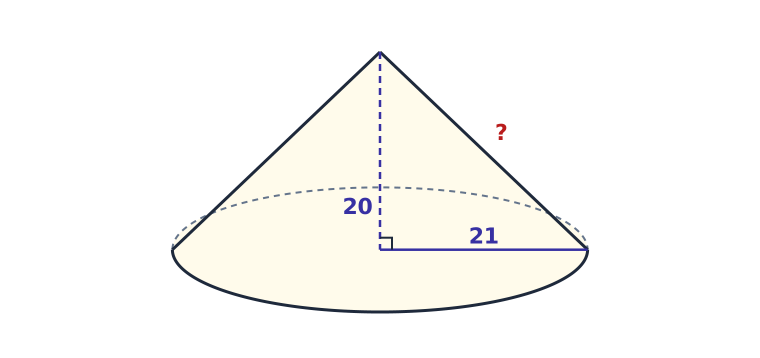
A cone has radius 21 cm and height 20 cm, as shown. Find its slant height (in cm).
beginner
A30
B21
C29
D41
Show answer
Answer: 29
Why:
l = √(21² + 20²) = √841 = 29 cm.
Q28
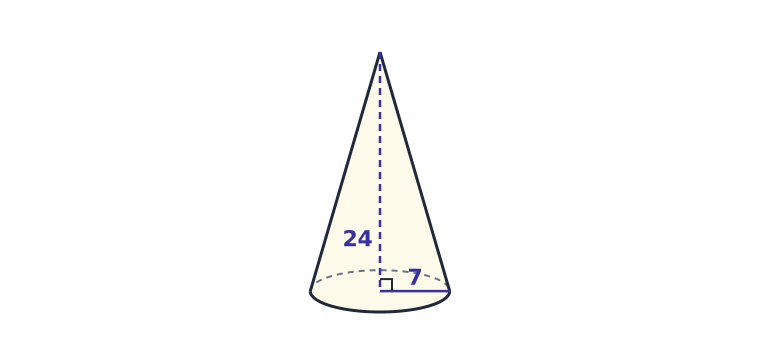
A cone has radius 7 cm and height 24 cm, as shown. Find its volume (in cm³). Take π = 22/7.
intermediate
A1283
B550
C3696
D1232
Show answer
Answer: 1232
Why:
⅓πr²h = ⅓ × (22/7) × 49 × 24 = 1232 cm³.
Q29
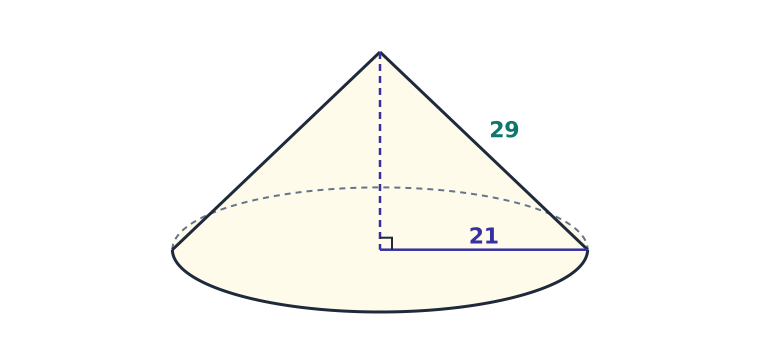
A cone has radius 21 cm and slant height 29 cm, as shown. Find its curved surface area (in cm²). Take π = 22/7.
intermediate
A1914
B3828
C3300
D1320
Show answer
Answer: 1914
Why:
πrl = (22/7) × 21 × 29 = 1914 cm².
Q30
A cone has radius 14 cm and height 48 cm, as shown. Find its volume (in cm³). Take π = 22/7.
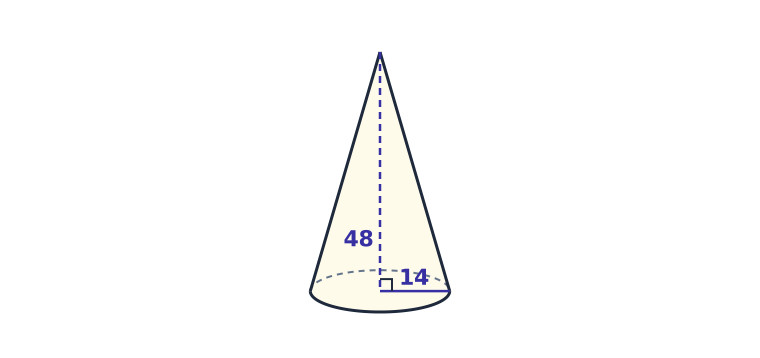
advanced
A29,568
B9856
C10,267
D2200
Show answer
Answer: 9856
Why:
⅓πr²h = ⅓ × (22/7) × 196 × 48 = 9856 cm³.
Q31
A cone has radius 7 cm and height 24 cm, as shown. Find its total surface area (in cm²). Take π = 22/7.
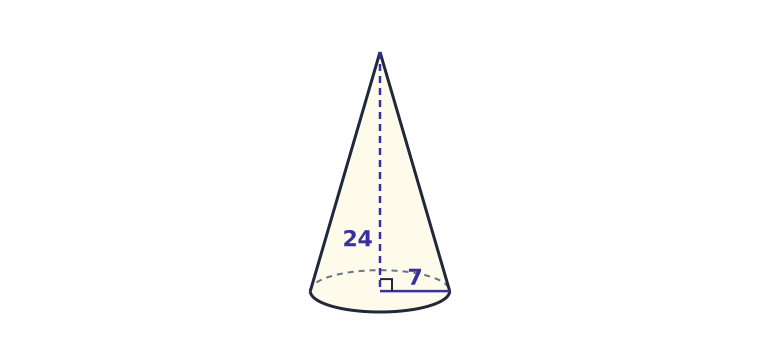
advanced
Q32
A cone has radius 28 cm and slant height 35 cm, as shown. Find its curved surface area (in cm²). Take π = 22/7.
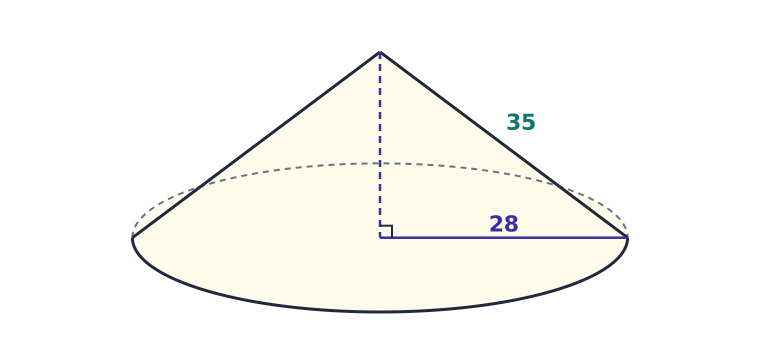
intermediate
A5544
B1848
C6160
D3080
Show answer
Answer: 3080
Why:
πrl = (22/7) × 28 × 35 = 3080 cm².
Q33
A sphere has radius 21 cm, as shown. Find its volume (in cm³). Take π = 22/7.
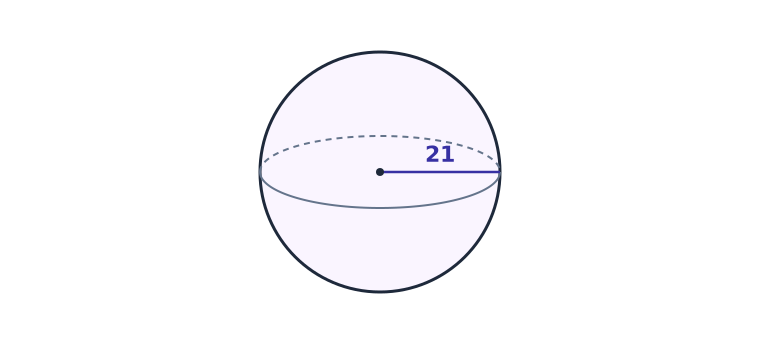
intermediate
A38,808
B5544
C19,404
D29,106
Show answer
Answer: 38,808
Why:
⁴⁄₃πr³ = ⁴⁄₃ × (22/7) × 9261 = 38,808 cm³.
Q34
A sphere has radius 7 cm, as shown. Find its surface area (in cm²). Take π = 22/7.
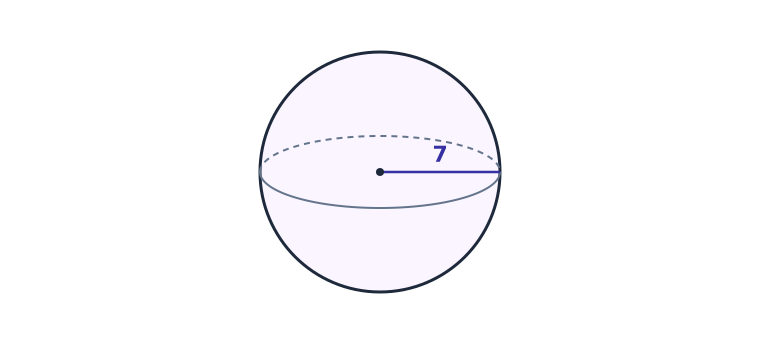
beginner
A462
B616
C308
D154
Show answer
Answer: 616
Why:
4πr² = 4 × (22/7) × 49 = 616 cm².
Q35
A sphere has radius 3.5 cm, as shown. Find its surface area (in cm²). Take π = 22/7.
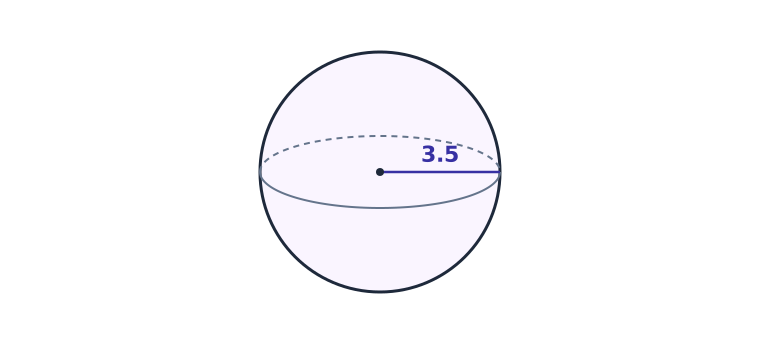
intermediate
A77
B38.5
C154
D115.5
Show answer
Answer: 154
Why:
4πr² = 4 × (22/7) × 12.25 = 154 cm².
Q36
A solid hemisphere has radius 21 cm, as shown. Find its volume (in cm³). Take π = 22/7.
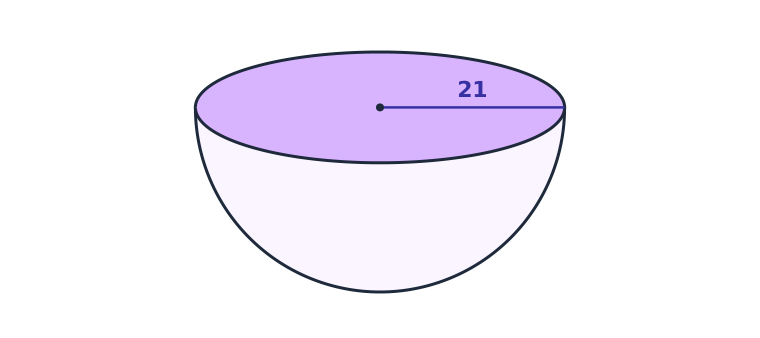
intermediate
A29,106
B38,808
C4158
D19,404
Show answer
Answer: 19,404
Why:
⅔πr³ = ⅔ × (22/7) × 9261 = 19,404 cm³.
Q37
A solid hemisphere has radius 7 cm, as shown. Find its total surface area (in cm²). Take π = 22/7.
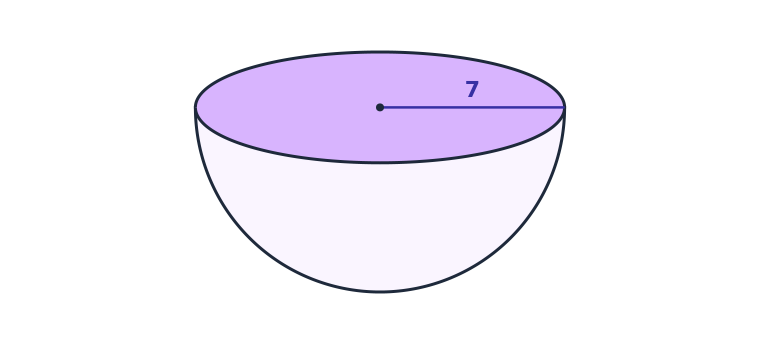
intermediate
Q38
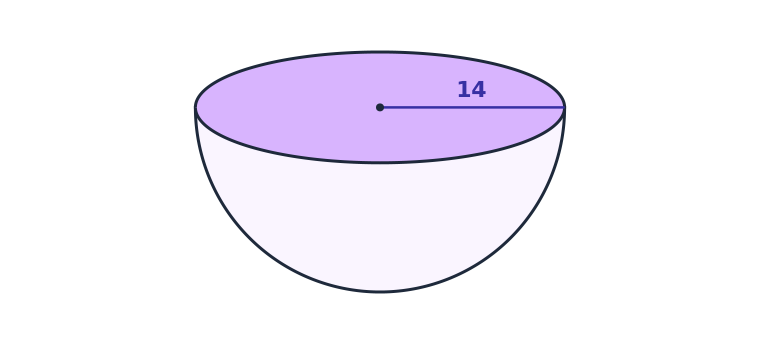
A solid hemisphere has radius 14 cm, as shown. Find its curved surface area (in cm²). Take π = 22/7.
beginner
A616
B1232
C1848
D2464
Show answer
Answer: 1232
Why:
2πr² = 2 × (22/7) × 196 = 1232 cm².
Q39
A metal ball of radius 12 cm is melted and made into small balls of radius 3 cm. How many small balls are made?
intermediate
A16
B4
C64
D12
Show answer
Answer: 64
Why:
Number = (R/r)³ = (12/3)³ = 64.
Q40
A metal ball of radius 10 cm is melted and made into small balls of radius 2 cm. How many small balls are made?
beginner
A15
B25
C5
D125
Show answer
Answer: 125
Why:
Number = (R/r)³ = (10/2)³ = 125.
Q41
A solid sphere of radius 6 cm is melted and recast into a cylinder of radius 4 cm. Find the height of the cylinder (in cm).
intermediate
A18
B27
C12
D13.5
Show answer
Answer: 18
Why:
⁴⁄₃π × 6³ = π × 4² × h, so h = 4 × 216 ÷ (3 × 16) = 18 cm.
Q42
Three metal cubes of sides 3 cm, 4 cm and 5 cm are melted into one cube. Find the side of the new cube (in cm).
intermediate
A7
B6
C5
D12
Show answer
Answer: 6
Why:
3³ + 4³ + 5³ = 27 + 64 + 125 = 216 = 6³, so the side is 6 cm.
Q43
Three metal cubes of sides 6 cm, 8 cm and 10 cm are melted into one cube. Find the side of the new cube (in cm).
advanced
A13
B11
C12
D24
Show answer
Answer: 12
Why:
6³ + 8³ + 10³ = 216 + 512 + 1000 = 1728 = 12³, so the side is 12 cm.
Q44
A copper sphere of radius 3 cm is drawn into a wire of radius 1 mm. Find the length of the wire (in m).
advanced
A27
B360
C3.6
D36
Show answer
Answer: 36
Why:
r = 0.1 cm. Length = ⁴⁄₃ × 27 ÷ 0.01 = 3600 cm = 36 m.
Q45
A solid cone of radius 6 cm and height 24 cm is melted and recast into a sphere. Find the radius of the sphere (in cm).
advanced
A6
B8
C12
D7
Show answer
Answer: 6
Why:
⅓πr²h = ⁴⁄₃πR³ gives R³ = r²h/4 = 864/4 = 216, so R = 6 cm.
Q46
How many cones of radius 3 cm and height 5 cm can be made by melting a cylinder of radius 6 cm and height 15 cm?
intermediate
Q47
2 iron balls, each of radius 3 cm, are dropped into a cylindrical jar of radius 6 cm partly filled with water. By how many cm does the water level rise?
intermediate
A1.5
B6
C2
D1
Show answer
Answer: 2
Why:
Rise = 2 × ⁴⁄₃π3³ ÷ (π × 6²) = 72 ÷ 36 = 2 cm.
Q48
16 iron balls, each of radius 3 cm, are dropped into a cylindrical jar of radius 12 cm partly filled with water. By how many cm does the water level rise?
advanced
Q49
A cuboidal tank with base 50 cm × 40 cm contains water. A solid cube of side 20 cm is put in and is fully covered. By how many cm does the water rise?
intermediate
A4
B16
C2
D8
Show answer
Answer: 4
Why:
Rise = 8000 ÷ (50 × 40) = 4 cm.
Q50
Each edge of a cube is increased by 10%. By what percent does its volume change?
intermediate
A+30%
B+33.1%
C+10%
D+21%
Show answer
Answer: +33.1%
Why:
Volume factor = (1.1)³ = 1331/1000, a change of +33.1%.
Q51
The radius of a sphere is increased by 20%. By what percent does its volume change?
advanced
A+44%
B+60%
C+72.8%
D+20%
Show answer
Answer: +72.8%
Why:
Volume factor = (1.2)³ = 216/125, a change of +72.8%.
Q52
The radius of a cylinder is increased by 10% and its height is unchanged. By what percent does its volume change?
intermediate
A+10%
B+33.1%
C+20%
D+21%
Show answer
Answer: +21%
Why:
Volume factor = (1.1)² = 1.21, a change of +21%.
Q53
Each edge of a cube is decreased by 10%. By what percent does its volume change?
advanced
A-27.1%
B-30%
C-10%
D-19%
Show answer
Answer: -27.1%
Why:
Volume factor = (0.9)³ = 729/1000, a change of -27.1%.
Q54
The radii of two cylinders are in the ratio 2 : 3 and their heights in the ratio 5 : 4. Find the ratio of their volumes.
intermediate
A4 : 9
B5 : 9
C16 : 45
D5 : 6
Show answer
Answer: 5 : 9
Why:
V ∝ r²h: 4 × 5 : 9 × 4 = 5 : 9.
Q55
The radii of two cones are in the ratio 3 : 4 and their heights in the ratio 4 : 3. Find the ratio of their volumes.
advanced
A9 : 16
B27 : 64
C3 : 4
D1 : 1
Show answer
Answer: 3 : 4
Why:
V ∝ r²h: 9 × 4 : 16 × 3 = 3 : 4.
Q56
A wooden cube is painted on all faces and then cut into 64 equal small cubes. How many small cubes have exactly three painted faces?
advanced
A56
B14
C24
D8
Show answer
Answer: 8
Why:
n = 4: 8 corner cubes.
Q57
A wooden cube is painted on all faces and then cut into 125 equal small cubes. How many small cubes have exactly one painted face?
advanced
A54
B27
C8
D36
Show answer
Answer: 54
Why:
n = 5: 6 faces × (n − 2)² = 6 × 9 = 54.
Q58
A wooden cube is painted on all faces and then cut into 216 equal small cubes. How many small cubes have no painted faces?
advanced
A96
B64
C8
D48
Show answer
Answer: 64
Why:
n = 6: (n − 2)³ = 4³ = 64.
Q59
A wooden cube is painted on all faces and then cut into 125 equal small cubes. How many small cubes have exactly two painted faces?
advanced
A27
B8
C36
D54
Show answer
Answer: 36
Why:
n = 5: 12 edges × (n − 2) = 12 × 3 = 36.
Q60
A bucket is a frustum of a cone with end radii 14 cm and 7 cm and depth 6 cm. Find its capacity (in cm³). Take π = 22/7.
advanced
Q62
A metal pipe is 21 cm long. Its outer radius is 4 cm and inner radius 3 cm. Find the volume of metal in it (in cm³). Take π = 22/7.
intermediate
A1056
B462
C1650
D66
Show answer
Answer: 462
Why:
π × 21 × (4² − 3²) = (22/7) × 21 × 7 = 462 cm³.
Q63
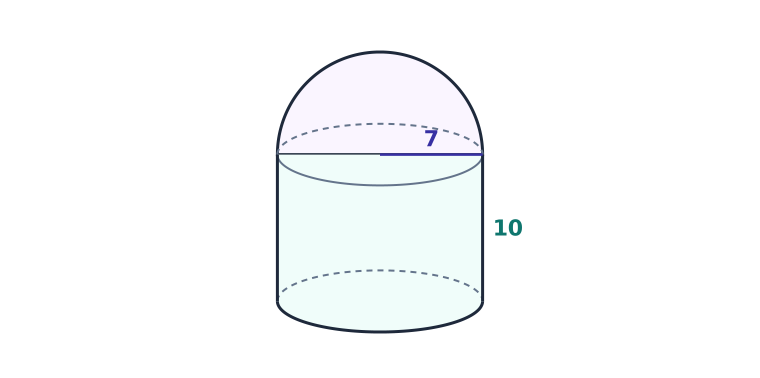
A solid is a cylinder of radius 7 cm and height 10 cm with a hemisphere of the same radius on top, as shown. Find its outer surface area, leaving out the flat base (in cm²). Take π = 22/7.
advanced
A902
B1056
C748
D440
Show answer
Answer: 748
Why:
Cylinder side 2πrh = 440 + hemisphere 2πr² = 308; total 748 cm².
Q64
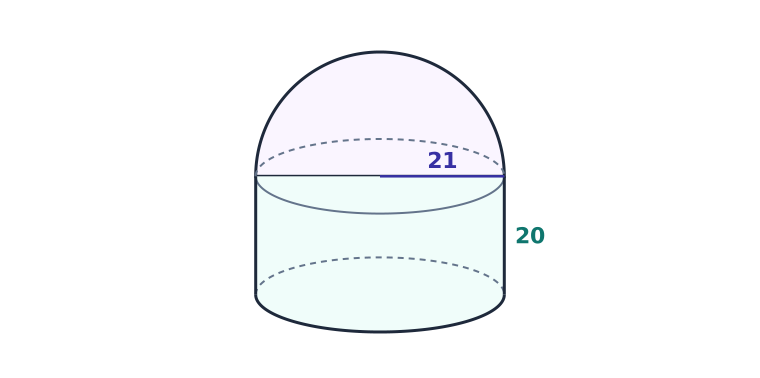
A solid is a cylinder of radius 21 cm and height 20 cm with a hemisphere of the same radius on top, as shown. Find its volume (in cm³). Take π = 22/7.
advanced
Q65
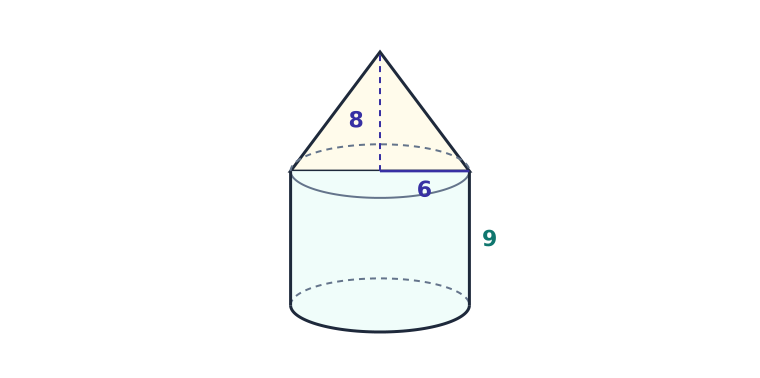
A tent is a cylinder of radius 6 m and height 9 m with a cone of height 8 m on top, as shown. How much canvas is needed, leaving out the floor (in m²)? Take π = 22/7.
advanced
Q66
A tent is a cylinder of radius 21 m and height 5 m with a cone of height 20 m on top, as shown. Find the volume of air inside it (in m³). Take π = 22/7.
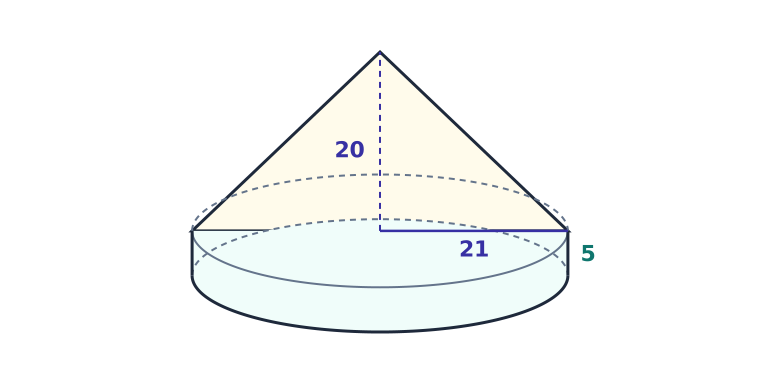
advanced
A6930
B16,170
C34,650
D20,328
Show answer
Answer: 16,170
Why:
πr²h + ⅓πr²hc = 6930 + 9240 = 16,170 m³.
Q67
A tent is a cylinder of radius 21 m and height 5 m with a cone of height 20 m on top, as shown. How much canvas is needed, leaving out the floor (in m²)? Take π = 22/7.
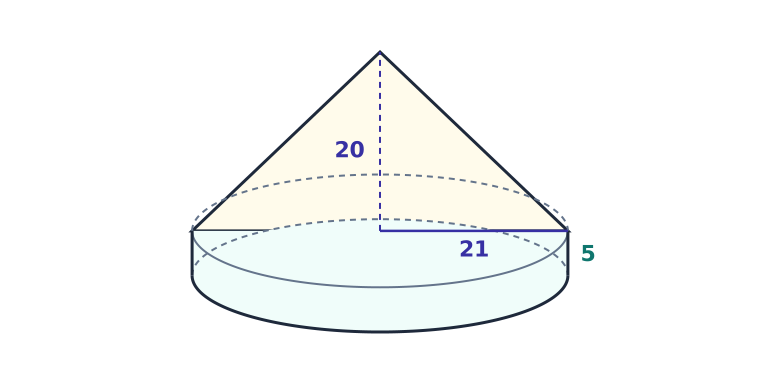
advanced
Q68
A well of diameter 7 m is dug 20 m deep. How much earth is taken out (in m³)? Take π = 22/7.
intermediate
A385
B3080
C440
D770
Show answer
Answer: 770
Why:
r = 3.5; πr²h = (22/7) × 12.25 × 20 = 770 m³.
Q69
2 cm of rain falls on a flat roof 22 m × 20 m. How many litres of water fall on the roof?
intermediate
A8800
B880
C8.8
D88,000
Show answer
Answer: 8800
Why:
22 × 20 × 0.02 = 8.8 m³ = 8800 litres.
Q70
A cone, a hemisphere and a cylinder have the same radius, and the cone and cylinder have height equal to that radius. Their volumes are in the ratio
intermediate
A3 : 2 : 1
B1 : 2 : 3
C1 : 1 : 1
D1 : 3 : 2
Show answer
Answer: 1 : 2 : 3
Why:
⅓πr³ : ⅔πr³ : πr³ = 1 : 2 : 3.
Q71
If the radius of a sphere is doubled, its volume becomes
beginner
A4 times
B6 times
C8 times
D2 times
Show answer
Answer: 8 times
Why:
Volume goes as r³ and 2³ = 8.
Q72
A cone and a cylinder have the same base and the same height. The volume of the cylinder is how many times that of the cone?
beginner
A4 times
B2 times
C1.5 times
D3 times
Show answer
Answer: 3 times
Why:
V(cone) = ⅓πr²h.
Q73
Two cubes of side 5 cm are joined end to end. What is the total surface area of the cuboid formed (in cm²)?
intermediate
A250
B200
C300
D275
Show answer
Answer: 250
Why:
Cuboid 10 × 5 × 5: 2(50 + 25 + 50) = 250. Two faces got hidden at the join.
Q74
When a solid is melted and recast into a different shape, which of these stays the same?
beginner
AIts surface area
BIts volume
CIts height
DIts perimeter
Show answer
Answer: Its volume
Why:
The amount of metal does not change, so the volume is conserved.
Q75
The surface areas of two spheres are in the ratio 4 : 9. What is the ratio of their volumes?
advanced
A16 : 81
B4 : 9
C8 : 27
D2 : 3
Show answer
Answer: 8 : 27
Why:
Radii 2 : 3, so volumes 2³ : 3³ = 8 : 27.
Q76
Assertion (A): The curved surface area of a cone of radius 7 cm and height 24 cm is 528 cm².
Reason (R): The curved surface area of a cone is πrl, where l is the slant height.
intermediate
ABoth A and R are true, and R is the correct explanation of A
BBoth A and R are true, but R is not the correct explanation of A
CA is true but R is false
DA is false but R is true
Show answer
Answer: A is false but R is true
Why:
R is true. l = 25, so πrl = 550; 528 comes from wrongly using h = 24. So A is false.
Q77
Assertion (A): When the radius of a cylinder is doubled and its height halved, its volume doubles.
Reason (R): The volume of a cylinder is proportional to r²h.
intermediate
ABoth A and R are true, and R is the correct explanation of A
BBoth A and R are true, but R is not the correct explanation of A
CA is true but R is false
DA is false but R is true
Show answer
Answer: Both A and R are true, and R is the correct explanation of A
Why:
2² × ½ = 2, so A is true and R explains it.
Q78
Consider the statements:
1. The total surface area of a solid hemisphere of radius r is 3πr².
2. A cube of side 3 cm has a longer diagonal than a cuboid 2 cm × 3 cm × 6 cm.
intermediate
A1 only
B2 only
CBoth 1 and 2
DNeither 1 nor 2
Show answer
Answer: 1 only
Why:
2πr² + πr² = 3πr², true. Cube diagonal 3√3 ≈ 5.2; cuboid diagonal 7. So 2 is false.
Q79
Which of these statements is/are true?
1. 1 m³ equals 100 litres.
2. A sphere of radius 3 cm can be recast into 27 spheres of radius 1 cm.
beginner
A1 only
B2 only
CBoth 1 and 2
DNeither 1 nor 2
Show answer
Answer: 2 only
Why:
1 m³ = 1000 L, so 1 is false. (3/1)³ = 27, so 2 is true.
Important short questions (4)
Find the volume and total surface area of a cuboid 10 cm × 8 cm × 5 cm.
V = 400 cm³; TSA = 2(80 + 40 + 50) = 340 cm².
A cone has radius 21 cm and height 20 cm. Find its slant height and curved surface area.
How many balls of radius 1 cm can be made from a solid sphere of radius 4 cm?
(4/1)³ = 64.
A cube is painted on all faces and cut into 125 equal cubes. How many have no face painted?
n = 5; (5 − 2)³ = 27.
Long answer questions (1)
A toy is a cone of radius 3.5 cm standing on a hemisphere of the same radius. The total height of the toy is 15.5 cm. (a) Find the height of the cone. (b) Find the volume of the toy. (c) Find its total surface area.
Everything above is on this page to read. In the Veda app the same chapter
becomes spaced-repetition flashcards, timed tests that mark themselves,
Veda Bites you can swipe, and games — with your progress tracked topic by
topic.