Veda Skills Quantitative Aptitude Unit 20: Practice Papers and Mock Tests
- 2 topics
- 125 MCQs
- 6 short answers
- 2 long answers
- 27 flashcards
- 2 games
- ~100 min read
- English
Checked before publishing: 23 automated checks, including a plagiarism check against the textbook's own words. How we check our content
Exam Strategy, Speed and Accuracy
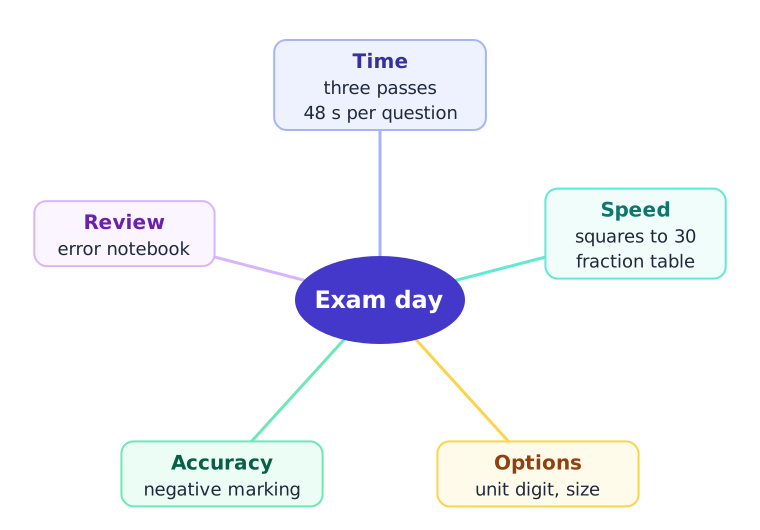
Plan a Quant paper in three passes, budget about 48 seconds a question, use approximation and option elimination, learn the fraction-percent table and squares for speed, and handle negative marking.
What you will be able to do
- I can plan a timed paper in three passes.
- I can approximate calculations to pick the closest option.
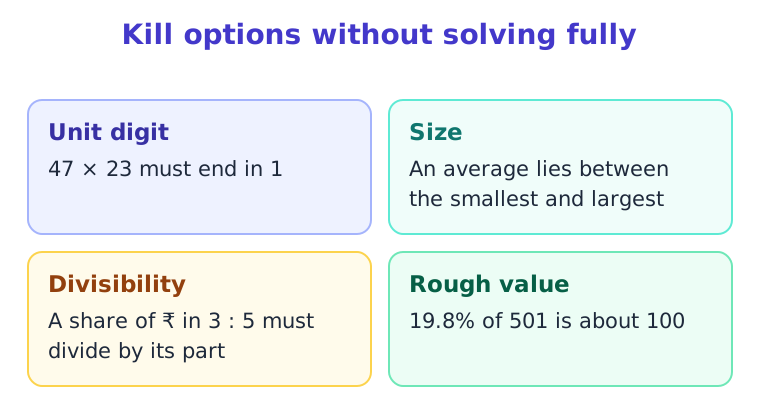
- I can rule out options using unit digits, size and divisibility.
- I can decide when to skip a question under negative marking.

Key points
If a Quant section gives you 25 questions in 20 minutes, your budget is 48 seconds a question; check the current pattern of your own exam.
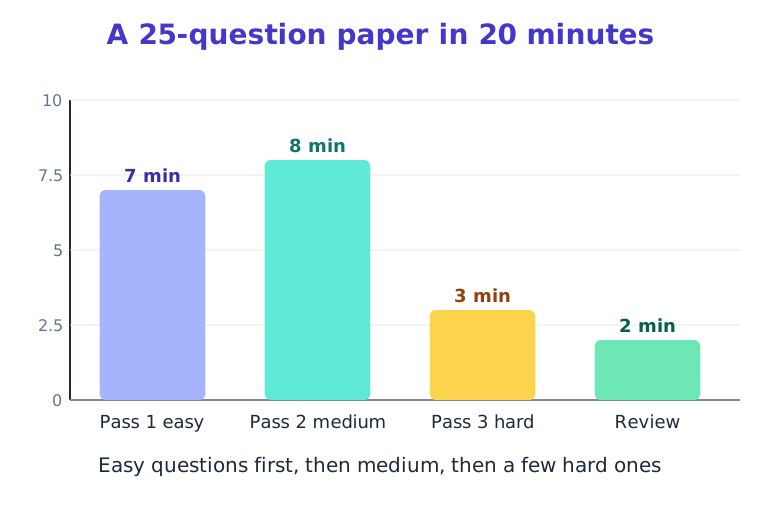
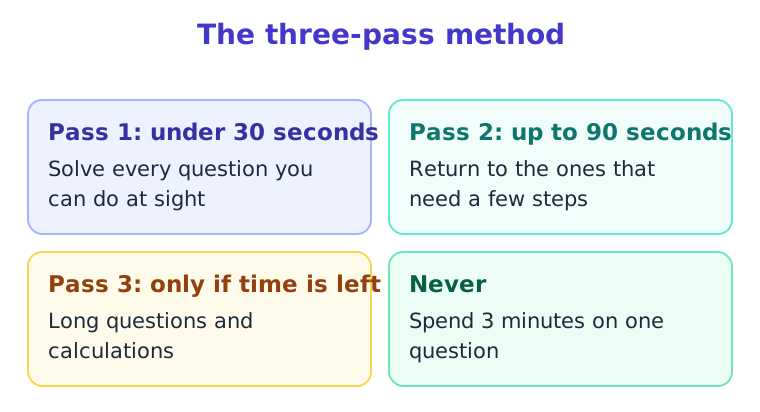
Pass 1 takes every question you can do at sight; pass 2 takes the few-step ones; pass 3 only if time is left.
With 0.5 negative marks for a wrong answer, guess only if you can rule out at least two options.
Approximation: round to easy numbers when the options are far apart.
The unit digit of a product depends only on the unit digits being multiplied.
An average always lies between the smallest and the largest value.
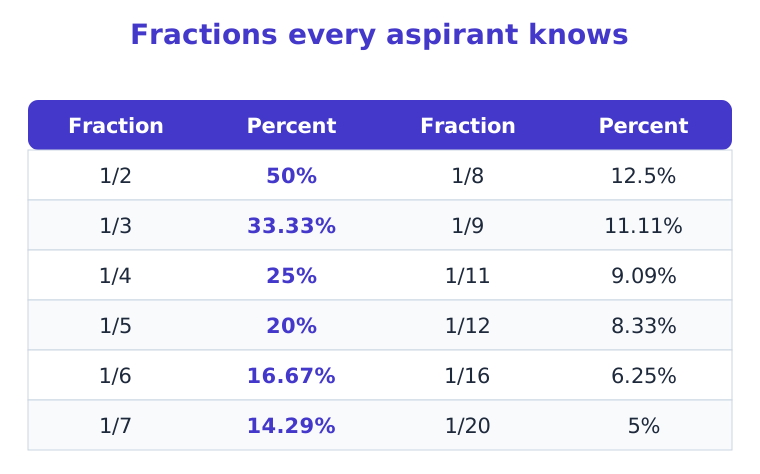
Knowing 1/7 = 14.29% or 1/8 = 12.5% turns many percent questions into fractions.
After every mock, write each mistake and its cause in an error notebook.
Full explanation
Twenty minutes, twenty-five questions

Pooja knew every chapter, yet scored 30 out of 50 in her first mock. She spent four minutes on one geometry question and never reached the last six easy ones.
Knowing the maths is half the job. The other half is managing the clock. This topic is about that half.
Your time budget
$$\frac{20 \text{ min}}{25} = 48 \text{ s per question}$$
Some questions take 20 seconds, some take 90. The budget is an average, not a rule for each question.
The three-pass method
Read each question once. If you can solve it at sight, do it. If not, mark it and move on. Come back in pass 2 and pass 3.
Approximation
$19.8%$ of $501$ is close to $20%$ of $500 = 100$. When the options are 100, 140, 180 and 220, you are done in five seconds.
Approximate only when the options are far apart.
Kill the wrong options
You rarely need the full answer. You need to know which option is right.
Worked example: elimination
$47 \times 23 = ?$ Options: 1071, 1081, 1084, 1101.
$7 \times 3 = 21$, so the answer ends in 1: 1084 is out. $47 \times 23 \approx 50 \times 23 = 1150$ minus $3 \times 23 = 69$ gives about 1081. Answer 1081.
Fractions are faster than percents
Learn this table once and use it in every chapter: percent, profit, interest and DI.
Negative marking
In SSC CGL a right answer gives +2 and a wrong one −0.5.
- Rule out 2 options and guess between 2: expected gain $\frac{1}{2} \times 2 - \frac{1}{2} \times 0.5 = 0.75$.
- Blind guess among 4: only $0.125$. Usually not worth the time.
After the mock
Pooja started an error notebook: question, her answer, the right answer, and why she missed it. In six weeks her score rose from 30 to 44. The notebook, not more mocks, made the difference.
Concepts and terms
Total time ÷ number of questions. 20 minutes for 25 questions is 48 seconds each.
Use a quick property (unit digit, size, divisibility) to strike out wrong options before solving fully.
With +2 for right and −0.5 for wrong, a blind guess among 4 options gains on average 2/4 − 0.5 × 3/4 = 0.125 marks.

Did you know
With +2 for right and −0.5 for wrong, every wrong answer wipes out a quarter of a right one. That is why many strong scorers leave a few questions untouched on purpose.

Memory tricks
Three passes — Pick, Push, Polish — Pick the easy ones, push through the medium ones, polish with hard ones and review.
Practice MCQs with answers (53)
- A 300
- B 225
- C 235
- D 125
Show answer
Why:
15² = 225. Quick check: the unit digit of 5² is 5.
- A 2,035
- B 1,925
- C 2,025
- D 900
Show answer
Why:
45² = 2,025. Quick check: the unit digit of 5² is 5.
- A 5,635
- B 5,525
- C 1,500
- D 5,625
Show answer
Why:
75² = 5,625. Quick check: the unit digit of 5² is 5.
- A 9,025
- B 1,900
- C 9,035
- D 8,925
Show answer
Why:
95² = 9,025. Quick check: the unit digit of 5² is 5.
- A 10,925
- B 11,025
- C 2,100
- D 11,035
Show answer
Why:
105² = 11,025. Quick check: the unit digit of 5² is 5.
- A 13,125
- B 2,300
- C 13,225
- D 13,235
Show answer
Why:
115² = 13,225. Quick check: the unit digit of 5² is 5.
- A 261
- B 380
- C 371
- D 361
Show answer
Why:
19² = 361. Quick check: the unit digit of 9² is 1.
- A 729
- B 540
- C 739
- D 629
Show answer
Why:
27² = 729. Quick check: the unit digit of 7² is 9.
- A 851
- B 841
- C 741
- D 580
Show answer
Why:
29² = 841. Quick check: the unit digit of 9² is 1.
- A 620
- B 971
- C 961
- D 861
Show answer
Why:
31² = 961. Quick check: the unit digit of 1² is 1.
- A 2,204
- B 960
- C 2,314
- D 2,304
Show answer
Why:
48² = 2,304. Quick check: the unit digit of 8² is 4.
- A 2,704
- B 2,604
- C 1,040
- D 2,714
Show answer
Why:
52² = 2,704. Quick check: the unit digit of 2² is 4.
- A 35%
- B 37.5%
- C 42.5%
- D 266 2/3%
Show answer
Why:
3/8 × 100 = 37.5%.
- A 160%
- B 60%
- C 62.5%
- D 67.5%
Show answer
Why:
5/8 × 100 = 62.5%.
- A 114 2/7%
- B 85%
- C 92.5%
- D 87.5%
Show answer
Why:
7/8 × 100 = 87.5%.
- A 16 2/3%
- B 600%
- C 14 1/6%
- D 21 2/3%
Show answer
Why:
1/6 × 100 = 16 2/3%.
- A 88 1/3%
- B 83 1/3%
- C 120%
- D 80 5/6%
Show answer
Why:
5/6 × 100 = 83 1/3%.
- A 350%
- B 26 1/14%
- C 28 4/7%
- D 33 4/7%
Show answer
Why:
2/7 × 100 = 28 4/7%.
- A 40 5/14%
- B 47 6/7%
- C 233 1/3%
- D 42 6/7%
Show answer
Why:
3/7 × 100 = 42 6/7%.
- A 44 4/9%
- B 225%
- C 41 17/18%
- D 49 4/9%
Show answer
Why:
4/9 × 100 = 44 4/9%.
- A 240%
- B 41 2/3%
- C 39 1/6%
- D 46 2/3%
Show answer
Why:
5/12 × 100 = 41 2/3%.
- A 48.75%
- B 228 4/7%
- C 43.75%
- D 41.25%
Show answer
Why:
7/16 × 100 = 43.75%.
- A 188
- B 113
- C 238
- D 148
Show answer
Why:
19.8% of 501 ≈ 99.2; adding 49 gives about 148. Round first, then choose the nearest option.
- A 300
- B 340
- C 265
- D 390
Show answer
Why:
24.9% of 801 ≈ 199.4; adding 101 gives about 300. Round first, then choose the nearest option.
- A 463
- B 498
- C 588
- D 538
Show answer
Why:
33.2% of 899 ≈ 298.5; adding 200 gives about 498. Round first, then choose the nearest option.
- A 189
- B 314
- C 224
- D 264
Show answer
Why:
11.9% of 1250 ≈ 148.8; adding 75 gives about 224. Round first, then choose the nearest option.
- A 488
- B 413
- C 538
- D 448
Show answer
Why:
49.7% of 640 ≈ 318.1; adding 130 gives about 448. Round first, then choose the nearest option.
- A 604
- B 569
- C 694
- D 644
Show answer
Why:
15.1% of 1999 ≈ 301.8; adding 302 gives about 604. Round first, then choose the nearest option.
- A 367
- B 402
- C 492
- D 442
Show answer
Why:
8.1% of 3001 ≈ 243.1; adding 159 gives about 402. Round first, then choose the nearest option.
- A 365
- B 490
- C 400
- D 440
Show answer
Why:
74.8% of 404 ≈ 302.2; adding 98 gives about 400. Round first, then choose the nearest option.
- A 1,391
- B 1,164
- C 1,157
- D 1,161
Show answer
Why:
The unit digit must be that of 3 × 7, which is 1, so 1,164 and 1,157 are out. A rough size check, 40 × 27 = 1,080, rules out 1,391 and leaves 1,161.
- A 2,312
- B 2,315
- C 2,308
- D 2,772
Show answer
Why:
The unit digit must be that of 8 × 4, which is 2, so 2,315 and 2,308 are out. A rough size check, 70 × 34 = 2,380, rules out 2,772 and leaves 2,312.
- A 10,704
- B 10,701
- C 10,697
- D 12,841
Show answer
Why:
The unit digit must be that of 3 × 7, which is 1, so 10,704 and 10,697 are out. A rough size check, 120 × 87 = 10,440, rules out 12,841 and leaves 10,701.
- A 3,595
- B 4,319
- C 3,599
- D 3,602
Show answer
Why:
The unit digit must be that of 9 × 1, which is 9, so 3,602 and 3,595 are out. A rough size check, 60 × 61 = 3,660, rules out 4,319 and leaves 3,599.
- A 11,088
- B 13,312
- C 11,095
- D 11,092
Show answer
Why:
The unit digit must be that of 6 × 7, which is 2, so 11,095 and 11,088 are out. A rough size check, 240 × 47 = 11,280, rules out 13,312 and leaves 11,092.
- A 7,448
- B 7,444
- C 8,938
- D 7,451
Show answer
Why:
The unit digit must be that of 8 × 6, which is 8, so 7,451 and 7,444 are out. A rough size check, 100 × 76 = 7,600, rules out 8,938 and leaves 7,448.
- A 35
- B 20
- C 9
- D 42
Show answer
Why:
An average lies between 12 and 30; only 20 does.
- A 75
- B 42
- C 57
- D 82
Show answer
Why:
An average lies between 45 and 70; only 57 does.
- A 5
- B 48
- C 41
- D 22
Show answer
Why:
An average lies between 8 and 36; only 22 does.
- A 100
- B 109
- C 93
- D 116
Show answer
Why:
An average lies between 96 and 104; only 100 does.
- A 50 seconds
- B 48 seconds
- C 1 minute
- D 40 seconds
Show answer
Why:
1200 s ÷ 25 = 48 s.
- A 0.125
- B 0.5
- C 0.75
- D 1
Show answer
Why:
½ × 2 − ½ × 0.5 = 1 − 0.25 = 0.75.
- A 44
- B 38
- C 40
- D 39
Show answer
Why:
20 × 2 − 2 × 0.5 = 40 − 1 = 39.
- A When the options are far apart
- B Always
- C Never
- D When the options differ by 1
Show answer
Why:
Rounding errors are small; they matter only when options are close.
- A solve every question in order
- B solve questions you can do at sight
- C start with the hardest
- D guess all answers
Show answer
Why:
Pass 1 collects quick marks; harder ones come later.
- A 100
- B 135
- C 120
- D 125
Show answer
Why:
62.5% = 5/8, so the number is 75 × 8/5 = 120.
- A 150
- B 98
- C 130
- D 140
Show answer
Why:
14.29% ≈ 1/7, and 980 ÷ 7 = 140.
- A Both A and R are true, and R is the correct explanation of A
- B Both A and R are true, but R is not the correct explanation of A
- C A is true but R is false
- D A is false but R is true
Show answer
Why:
¼ × 2 − ¾ × 0.5 = 0.125, so R explains A.
- A 1 only
- B 2 only
- C Both 1 and 2
- D Neither 1 nor 2
Show answer
Why:
1 saves time; 2 is how students run out of time.
- A 11
- B 10
- C 15
- D 13
Show answer
Why:
8 + 3 = 11 minutes.
- A 1/11
- B 1/12
- C 1/8
- D 1/9
Show answer
Why:
1/12 = 8.33%.
- A 118
- B 96
- C 99
- D 108
Show answer
Why:
16.67% = 1/6, and 594 ÷ 6 = 99.
- A 30%
- B 7%
- C 40%
- D 35%
Show answer
Why:
7 ÷ 20 × 100 = 35%.
Important short questions (3)
First solve everything you can do at sight, marking the rest. Then return to few-step questions, and attempt long ones only if time is left.
37.5% = 3/8. 648 ÷ 8 = 81, and 81 × 3 = 243.
Expected gain = ⅓ × 2 − ⅔ × 0.5 = 0.67 − 0.33 = 0.33 marks. Yes, if it takes little time.
Long answer questions (1)
Pass 1 (7 min): every sight question, about 12. Pass 2 (8 min): few-step questions, about 8. Pass 3 (3 min): two long ones. Review (2 min).
After each mock, list every error with its cause (concept, calculation, reading, time). Revise the concept errors first.
Flashcards (15)
Play this topic
- Strategy check
Mixed Practice Across the Syllabus
Practise questions from every chapter in mixed order, the way the real paper sets them: read the question, name its chapter from the key words, recall the one formula it needs, and solve.
What you will be able to do
- I can tell which chapter a question belongs to from its key words.
- I can recall the key formula of each arithmetic chapter in seconds.
- I can answer 4 or 5 questions on one chart in a row.
Key points
Percent: part = percent × whole ÷ 100; change is always on the original value.
Profit and loss percent are on the cost price.
SI = PRT/100; CI for 2 years = P(1 + R/100)² − P.
Together, A and B finish in ab/(a + b) days.
Change km/h to m/s by multiplying by 5/18.
Average speed = total distance ÷ total time, not the average of the speeds.
A share in the ratio a : b gets a/(a + b) of the total.
Two dice have 36 equally likely outcomes.
Full explanation
The real paper mixes everything
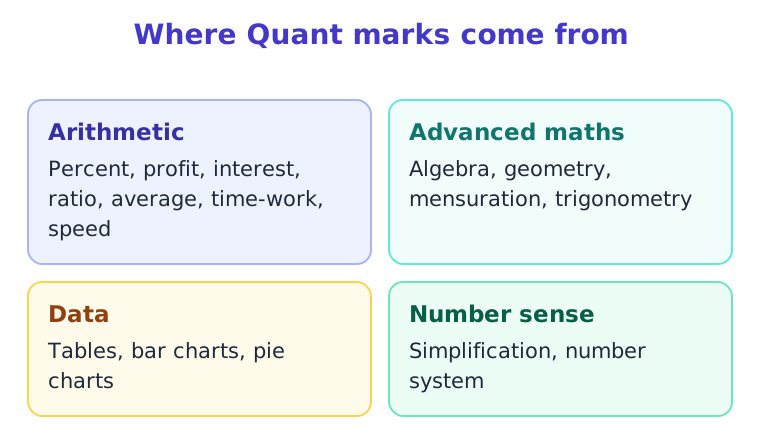
In the exam, a train question follows a pie chart, and a profit question follows an algebra one. Practice in chapter order hides this. This topic trains the switch.
Step 1: spot the chapter
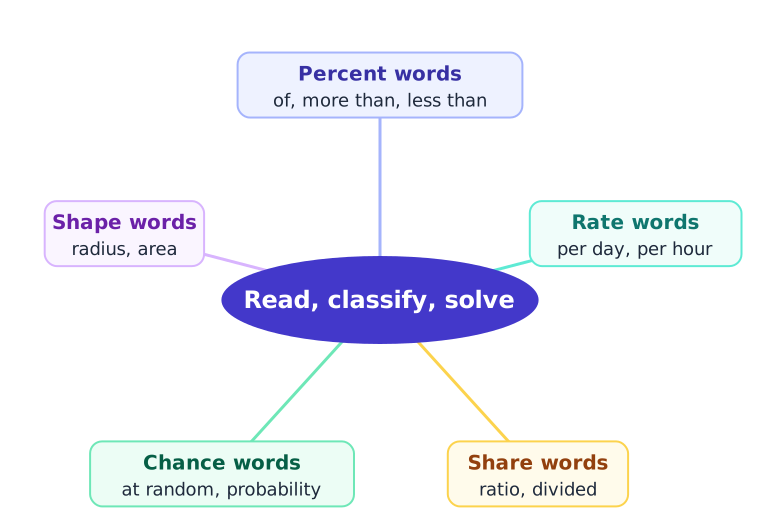
Read for key words. “Per day” is time and work. “km/h” is speed. “Ratio” is sharing. “At random” is probability. Naming the chapter brings its formula to mind.
Percent and profit in one breath
Both measure change on the starting value:
$$\text{change %} = \frac{\text{new} - \text{old}}{\text{old}} \times 100$$
Profit percent is the same formula with old = cost price.
Interest
$\text{SI} = \frac{PRT}{100}$. For 2 years of compound interest, $\text{CI} = P\left(1 + \frac{R}{100}\right)^2 - P$.
On ₹10,000 at 10%: SI for 2 years is ₹2,000, CI is ₹2,100.
Work and speed
Together, A (a days) and B (b days) take $\frac{ab}{a + b}$ days.
A train crossing a platform covers its own length plus the platform. Convert km/h to m/s with $\times \frac{5}{18}$.
Reading a chart
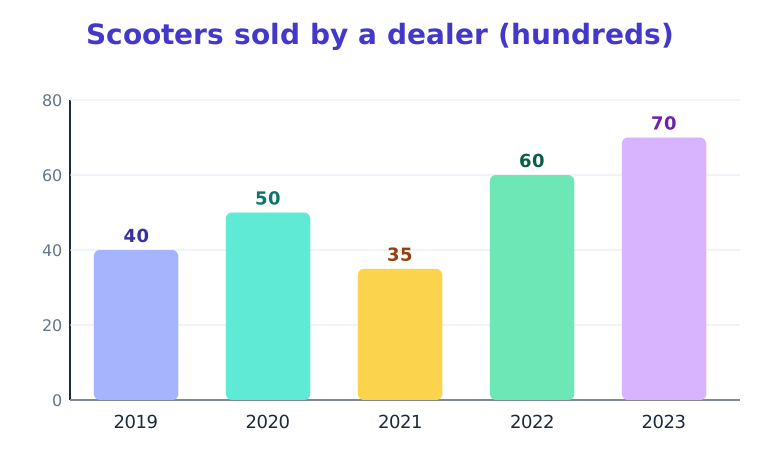
Read the chart once. Write the values in a row and add them. Most questions ask for a total, an average, a percent change or a ratio from those same numbers.
Worked example: one chart, four questions
From the scooter chart: total = 255 hundred; average = 51 hundred; rise from 2021 to 2023 = $\frac{70 - 35}{35} \times 100 = 100%$; ratio of 2019 to 2023 = 40 : 70 = 4 : 7.
Chance and shape
Two dice: 36 outcomes. A sum of 7 comes 6 ways, so $P = \frac{6}{36} = \frac{1}{6}$.
Circle: area $\pi r^2$, circumference $2\pi r$, with $\pi = \frac{22}{7}$ when r is a multiple of 7.
Algebra, geometry and trigonometry
A few identities do most of the work. If $x + \frac{1}{x} = k$, squaring gives $x^2 + \frac{1}{x^2} = k^2 - 2$. Similarly $x^2 + y^2 = (x + y)^2 - 2xy$.
Right triangles: $c^2 = a^2 + b^2$; learn the triples 3-4-5, 5-12-13, 8-15-17 and 7-24-25. A cuboid holds $l \times b \times h$. And keep the table of $\sin$, $\cos$ and $\tan$ for $30^\circ$, $45^\circ$ and $60^\circ$ at your fingertips.
Then take the mocks
The four mock papers in this chapter follow the real pattern: 25 questions in 20 minutes, mixed chapters, easy and hard together. Use the three-pass method.
Concepts and terms
“Per day” points to time and work, “km/h” to speed, “ratio” to sharing, “at random” to probability.
In DI sets, read the chart once and note the totals; four or five questions use the same numbers.
Percent change, profit and growth are all measured on the starting value.
Did you know
In most bank and SSC papers, percent, ratio and average ideas appear inside more than half of all Quant questions.
Memory tricks
Speed conversion — Five-eighteen to go small — km/h to m/s: × 5/18. m/s to km/h: × 18/5.
Practice MCQs with answers (72)
- A 96
- B 960
- C 9.6
- D 102
Show answer
Why:
15% of 640 = 640 × 15/100 = 96.
- A 63
- B 630
- C 648
- D 6,300
Show answer
Why:
35% of 1,800 = 1,800 × 35/100 = 630.
- A 12
- B 129
- C 120
- D 1,200
Show answer
Why:
12.5% of 960 = 960 × 12.5/100 = 120.
- A 2,200
- B 22
- C 247
- D 220
Show answer
Why:
8% of 2,750 = 2,750 × 8/100 = 220.
- A 1,620
- B 16,200
- C 162
- D 1,656
Show answer
Why:
45% of 3,600 = 3,600 × 45/100 = 1,620.
- A 30%
- B 25%
- C 50%
- D 20%
Show answer
Why:
Change ÷ original × 100 = 100 ÷ 400 × 100 = 25%. Divide by the old value, not the new one.
- A 22%
- B 25%
- C 20%
- D 40%
Show answer
Why:
Change ÷ original × 100 = 250 ÷ 1,250 × 100 = 20%. Divide by the old value, not the new one.
- A 80%
- B 28 4/7%
- C 45%
- D 40%
Show answer
Why:
Change ÷ original × 100 = 320 ÷ 800 × 100 = 40%. Divide by the old value, not the new one.
- A 25%
- B 50%
- C 33 1/3%
- D 30%
Show answer
Why:
Change ÷ original × 100 = 600 ÷ 2,400 × 100 = 25%. Divide by the old value, not the new one.
- A 11 1/9%
- B 12.5%
- C 17.5%
- D 25%
Show answer
Why:
Change ÷ original × 100 = 80 ÷ 640 × 100 = 12.5%. Divide by the old value, not the new one.
- A 16 2/3%
- B 25%
- C 20%
- D 10%
Show answer
Why:
Profit = 100; percent on the cost price = 100 ÷ 500 × 100 = 20%.
- A 20%
- B 30%
- C 12.5%
- D 25%
Show answer
Why:
Profit = 300; percent on the cost price = 300 ÷ 1,200 × 100 = 25%.
- A 20%
- B 30%
- C 25%
- D 10%
Show answer
Why:
Loss = 170; percent on the cost price = 170 ÷ 850 × 100 = 20%.
- A 11 1/9%
- B 12.5%
- C 17.5%
- D 6.25%
Show answer
Why:
Profit = 300; percent on the cost price = 300 ÷ 2,400 × 100 = 12.5%.
- A 7.5%
- B 17 11/17%
- C 15%
- D 20%
Show answer
Why:
Loss = 240; percent on the cost price = 240 ÷ 1,600 × 100 = 15%.
- A ₹6,200
- B ₹400
- C ₹2,400
- D ₹1,200
Show answer
Why:
SI = P × R × T ÷ 100 = 5,000 × 8 × 3 ÷ 100 = ₹1,200.
- A ₹3,600
- B ₹7,200
- C ₹15,600
- D ₹720
Show answer
Why:
SI = P × R × T ÷ 100 = 12,000 × 6 × 5 ÷ 100 = ₹3,600.
- A ₹900
- B ₹1,800
- C ₹3,600
- D ₹9,300
Show answer
Why:
SI = P × R × T ÷ 100 = 7,500 × 12 × 2 ÷ 100 = ₹1,800.
- A ₹18,000
- B ₹34,000
- C ₹9,000
- D ₹2,250
Show answer
Why:
SI = P × R × T ÷ 100 = 25,000 × 9 × 4 ÷ 100 = ₹9,000.
- A ₹12,100
- B ₹2,200
- C ₹2,000
- D ₹2,100
Show answer
Why:
Amount = 10,000 × (110/100)² = ₹12,100, so CI = ₹2,100. The simple interest would be ₹2,000.
- A ₹820
- B ₹800
- C ₹8,820
- D ₹920
Show answer
Why:
Amount = 8,000 × (105/100)² = ₹8,820, so CI = ₹820. The simple interest would be ₹800.
- A ₹26,450
- B ₹6,450
- C ₹6,550
- D ₹6,000
Show answer
Why:
Amount = 20,000 × (115/100)² = ₹26,450, so CI = ₹6,450. The simple interest would be ₹6,000.
- A ₹2,000
- B ₹14,580
- C ₹2,080
- D ₹2,180
Show answer
Why:
Amount = 12,500 × (108/100)² = ₹14,580, so CI = ₹2,080. The simple interest would be ₹2,000.
- A 9
- B 18
- C 12
- D 8
Show answer
Why:
Together they do 1/12 + 1/24 = 1/8 of the job a day, so they need 8 days.
- A 6
- B 5
- C 7
- D 12.5
Show answer
Why:
Together they do 1/10 + 1/15 = 1/6 of the job a day, so they need 6 days.
- A 25
- B 12
- C 10
- D 13
Show answer
Why:
Together they do 1/20 + 1/30 = 1/12 of the job a day, so they need 12 days.
- A 13.5
- B 9
- C 6
- D 7
Show answer
Why:
Together they do 1/18 + 1/9 = 1/6 of the job a day, so they need 6 days.
- A 11
- B 24.5
- C 21
- D 10
Show answer
Why:
Together they do 1/14 + 1/35 = 1/10 of the job a day, so they need 10 days.
- A 10
- B 20
- C 12
- D 2 7/9
Show answer
Why:
54 km/h = 54 × 5/18 = 15 m/s. Distance = 150 m, so time = 150 ÷ 15 = 10 s.
- A 3 1/3
- B 12
- C 24
- D 14
Show answer
Why:
72 km/h = 72 × 5/18 = 20 m/s. Distance = 240 m, so time = 240 ÷ 20 = 12 s.
- A 27
- B 6 17/18
- C 25
- D 15
Show answer
Why:
72 km/h = 72 × 5/18 = 20 m/s. Distance = 500 m, so time = 500 ÷ 20 = 25 s.
- A 5 5/9
- B 7.2
- C 22
- D 20
Show answer
Why:
90 km/h = 90 × 5/18 = 25 m/s. Distance = 500 m, so time = 500 ÷ 25 = 20 s.
- A 40
- B 11 1/9
- C 24
- D 42
Show answer
Why:
63 km/h = 63 × 5/18 = 17.5 m/s. Distance = 700 m, so time = 700 ÷ 17.5 = 40 s.
- A 37 km/h
- B 40 km/h
- C 45 km/h
- D 44 km/h
Show answer
Why:
Time = 60/30 + 60/60 = 3 h. Average = total distance ÷ total time = 120 ÷ 3 = 40 km/h.
- A 52 km/h
- B 45 km/h
- C 48 km/h
- D 50 km/h
Show answer
Why:
Time = 120/40 + 120/60 = 5 h. Average = total distance ÷ total time = 240 ÷ 5 = 48 km/h.
- A 59.5 km/h
- B 67.5 km/h
- C 66.5 km/h
- D 62.5 km/h
Show answer
Why:
Time = 100/50 + 150/75 = 4 h. Average = total distance ÷ total time = 250 ÷ 4 = 62.5 km/h.
- A 31
- B 32
- C 30
- D 38.75
Show answer
Why:
Sum = 155, count = 5, average = 31.
- A 60.5
- B 59.5
- C 58.5
- D 79 1/3
Show answer
Why:
Sum = 238, count = 4, average = 59.5.
- A 126
- B 124
- C 125
- D 156.25
Show answer
Why:
Sum = 625, count = 5, average = 125.
- A ₹2,500
- B ₹500
- C ₹3,600
- D ₹2,000
Show answer
Why:
Meena gets 4/9 of ₹4,500 = ₹2,000.
- A ₹2,700
- B ₹900
- C ₹4,320
- D ₹4,500
Show answer
Why:
Arjun gets 3/8 of ₹7,200 = ₹2,700.
- A ₹4,300
- B ₹4,200
- C ₹5,400
- D ₹600
Show answer
Why:
Fatima gets 7/16 of ₹9,600 = ₹4,200.
- A ₹9,100
- B ₹700
- C ₹3,500
- D ₹3,600
Show answer
Why:
Kabir gets 5/18 of ₹12,600 = ₹3,500.
- A 44 cm²
- B 308 cm²
- C 77 cm²
- D 154 cm²
Show answer
Why:
Area = πr² = 22/7 × 7 × 7 = 154 cm².
- A 88 cm
- B 44 cm
- C 616 cm
- D 176 cm
Show answer
Why:
Circumference = 2πr = 22/7 × 2 × 14 = 88 cm.
- A 132 cm²
- B 1,386 cm²
- C 2,772 cm²
- D 693 cm²
Show answer
Why:
Area = πr² = 22/7 × 21 × 21 = 1,386 cm².
- A 3,850 cm
- B 440 cm
- C 220 cm
- D 110 cm
Show answer
Why:
Circumference = 2πr = 22/7 × 2 × 35 = 220 cm.
- A 1/7
- B 7/36
- C 1/2
- D 1/6
Show answer
Why:
6 of the 36 equally likely outcomes give 7, so the probability is 1/6.
- A 5/36
- B 1/8
- C 1/6
- D 5/12
Show answer
Why:
5 of the 36 equally likely outcomes give 8, so the probability is 5/36.
- A 1/6
- B 1/18
- C 1/11
- D 1/12
Show answer
Why:
2 of the 36 equally likely outcomes give 11, so the probability is 1/18.
- A 1/18
- B 1/4
- C 1/12
- D 1/9
Show answer
Why:
3 of the 36 equally likely outcomes give 4, so the probability is 1/12.
- A 6
- B 9
- C 11
- D 7
Show answer
Why:
Square both sides: $x^2 + 2 + \frac{1}{x^2} = 9$, so $x^2 + \frac{1}{x^2} = 9 - 2 = 7$.
- A 62
- B 64
- C 66
- D 16
Show answer
Why:
Square both sides: $x^2 + 2 + \frac{1}{x^2} = 64$, so $x^2 + \frac{1}{x^2} = 64 - 2 = 62$.
- A 94
- B 34
- C 49
- D 64
Show answer
Why:
$x^2 + y^2 = (x + y)^2 - 2xy = 64 - 30 = 34$.
- A 249
- B 129
- C 89
- D 169
Show answer
Why:
$x^2 + y^2 = (x + y)^2 - 2xy = 169 - 80 = 89$.
- A 27 cm
- B 23 cm
- C 31 cm
- D 25 cm
Show answer
Why:
Hypotenuse² = 7² + 24² = 49 + 576 = 625, so the hypotenuse is √625 = 25 cm.
- A 34 cm
- B 32 cm
- C 46 cm
- D 36 cm
Show answer
Why:
Hypotenuse² = 16² + 30² = 256 + 900 = 1156, so the hypotenuse is √1156 = 34 cm.
- A 74 cm³
- B 120 cm³
- C 148 cm³
- D 150 cm³
Show answer
Why:
Volume = l × b × h = 6 × 5 × 4 = 120 cm³. (148 would be the surface area in cm², a different quantity.)
- A 1,056 cm³
- B 2,400 cm³
- C 2,160 cm³
- D 528 cm³
Show answer
Why:
Volume = l × b × h = 20 × 12 × 9 = 2,160 cm³. (1,056 would be the surface area in cm², a different quantity.)
- A 1
- B 5/3
- C 2/3
- D 4/3
Show answer
Why:
$\tan^2 30^\circ + \tan^2 45^\circ = \frac{1}{3} + 1 = \frac{4}{3}$.
- A 3/4
- B 1
- C 1/2
- D √3/2
Show answer
Why:
$\sin 60^\circ \times \cos 30^\circ = \frac{\sqrt{3}}{2} \times \frac{\sqrt{3}}{2} = \frac{3}{4}$.
- A 2
- B 4
- C 3
- D 1
Show answer
Why:
$\sec 60^\circ + \csc 30^\circ = 2 + 2 = 4$.
- A 265
- B 235
- C 255
- D 295
Show answer
Why:
Add the bars: 40 + 50 + 35 + 60 + 70 = 255.
- A 63.75
- B 56
- C 47
- D 51
Show answer
Why:
Total 255 ÷ 5 = 51.
- A 100%
- B 35%
- C 50%
- D 110%
Show answer
Why:
(70 − 35) ÷ 35 × 100 = 100%.
- A 5 : 7
- B 4 : 7
- C 7 : 4
- D 41 : 70
Show answer
Why:
40 : 70 in lowest terms is 4 : 7.
- A 970
- B 860
- C 850
- D 830
Show answer
Why:
Add the bars: 120 + 150 + 180 + 160 + 240 = 850.
- A 175
- B 166
- C 212.5
- D 170
Show answer
Why:
Total 850 ÷ 5 = 170.
- A 100%
- B 110%
- C 120%
- D 50%
Show answer
Why:
(240 − 120) ÷ 120 × 100 = 100%.
- A 2 : 1
- B 1 : 2
- C 121 : 240
- D 13 : 24
Show answer
Why:
120 : 240 in lowest terms is 1 : 2.
- A Both A and R are true, and R is the correct explanation of A
- B Both A and R are true, but R is not the correct explanation of A
- C A is true but R is false
- D A is false but R is true
Show answer
Why:
20 ÷ 80 = 25% and 20 ÷ 100 = 20%: the base changes. R explains A.
- A 1 only
- B 2 only
- C Both 1 and 2
- D Neither 1 nor 2
Show answer
Why:
2 h + 1 h = 3 h; average = 120 ÷ 3 = 40 km/h, so 2 is false.
Important short questions (3)
72 km/h = 20 m/s; distance 500 m; time 25 s.
P(R/100)² = 15,000 × 0.01 = ₹150.
15 × 10 ÷ 25 = 6 days.
Long answer questions (1)
(a) Marked price ₹2,600; after 10% off, ₹2,340.
(b) Profit ₹340 on ₹2,000 = 17%.
(c) SI = 2,000 × 10 × 2 ÷ 100 = ₹400, which is more than ₹340, but it takes 2 years.
Flashcards (12)
Play this topic
- Formula check
Veda Skills Quantitative Aptitude Unit 20 — frequently asked questions
First solve everything you can do at sight, marking the rest. Then return to few-step questions, and attempt long ones only if time is left.
37.5% = 3/8. 648 ÷ 8 = 81, and 81 × 3 = 243.
Expected gain = ⅓ × 2 − ⅔ × 0.5 = 0.67 − 0.33 = 0.33 marks. Yes, if it takes little time.
72 km/h = 20 m/s; distance 500 m; time 25 s.
P(R/100)² = 15,000 × 0.01 = ₹150.
15 × 10 ÷ 25 = 6 days.

All Veda Skills Quantitative Aptitude units
All Quantitative Aptitude units · All Skills & Exams courses
Study this chapter properly, free
Everything above is on this page to read. In the Veda app the same chapter becomes spaced-repetition flashcards, timed tests that mark themselves, Veda Bites you can swipe, and games — with your progress tracked topic by topic.
Get Veda free