Veda Skills Quantitative Aptitude Unit 2: Simplification and Approximation
- 3 topics
- 211 MCQs
- 12 short answers
- 3 long answers
- 41 flashcards
- 3 games
- ~140 min read
- English
Checked before publishing: 23 automated checks, including a plagiarism check against the textbook's own words. How we check our content
BODMAS and Fractions
Simplify any expression in the exam order (brackets, of, division and multiplication, addition and subtraction), handle fractions and mixed numbers, compare fractions fast, and turn recurring decimals into fractions.
What you will be able to do
- I can simplify an expression with +, −, ×, ÷, "of" and brackets in the correct order.
- I can add, subtract, multiply and divide fractions and mixed numbers.
- I can find the largest or smallest of several fractions without long working.
- I can convert terminating and recurring decimals into fractions.

Key points
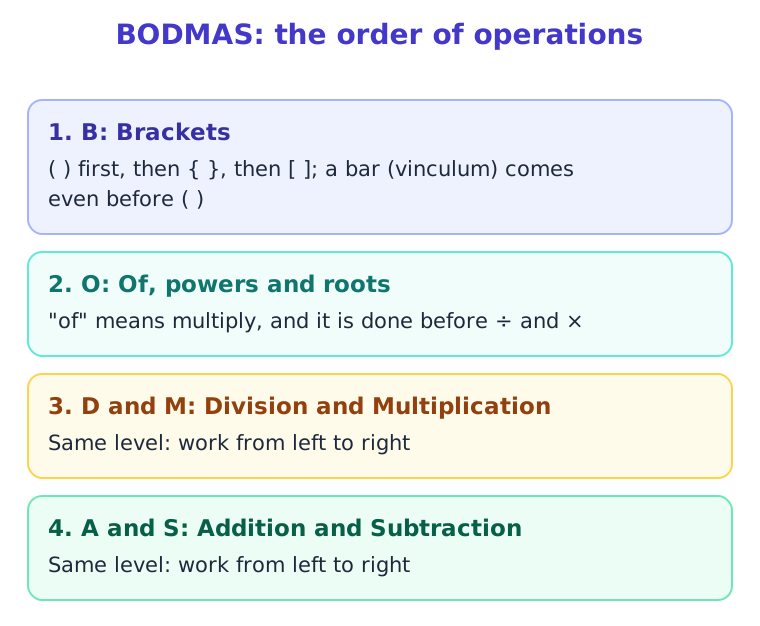
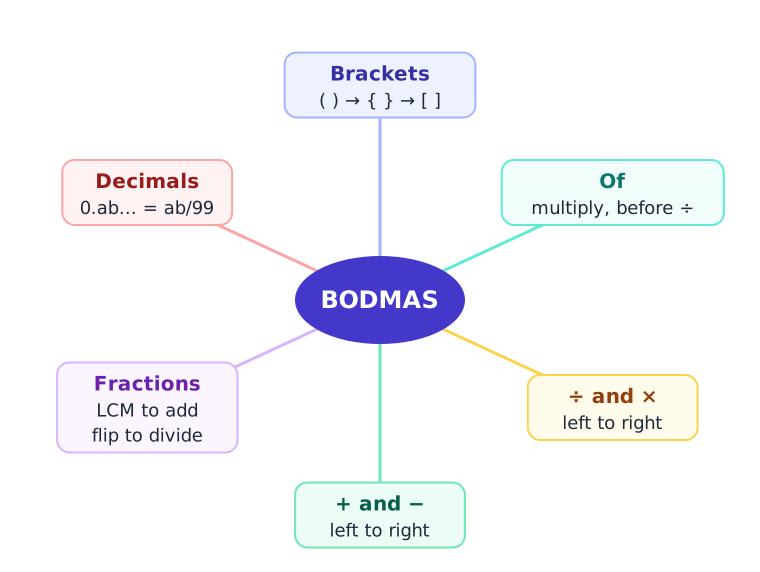
BODMAS: Brackets, Of, Division, Multiplication, Addition, Subtraction.
Division and multiplication have the same rank: do them from left to right. The same holds for addition and subtraction.
"Of" means multiplication, but it is done before division: 48 ÷ 4 of 3 = 48 ÷ 12 = 4.
Remove brackets from the inside out: ( ), then { }, then [ ]. A minus sign before a bracket flips every sign inside.
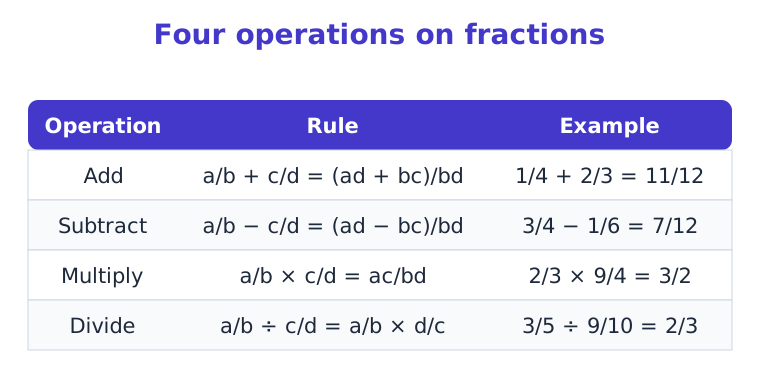
To add or subtract fractions, bring them to a common denominator (the LCM of the denominators).
To divide by a fraction, multiply by its reciprocal: a/b ÷ c/d = a/b × d/c.
To compare a/b and c/d, cross-multiply: a/b > c/d exactly when ad > bc.
A recurring decimal $0.\overline{ab} = \frac{ab}{99}$, and $0.a\overline{b} = \frac{ab - a}{90}$.
Full explanation
Meena's exam screen

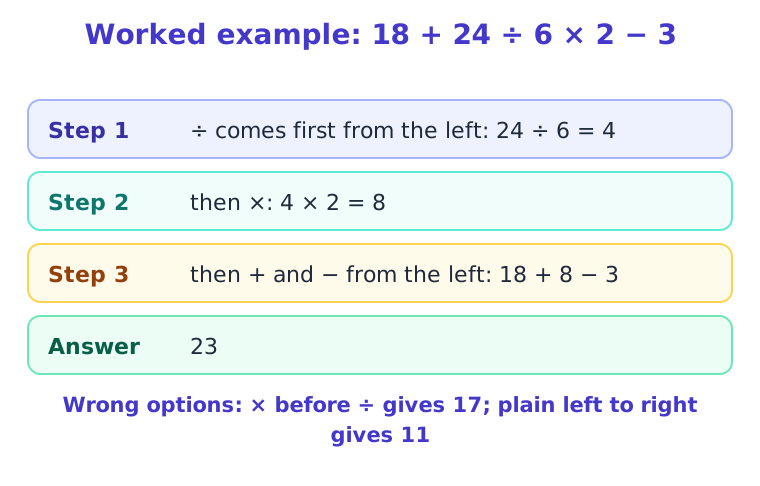
Meena is in an SSC exam. The first question reads $18 + 24 \div 6 \times 2 - 3$. The options are 23, 17, 11 and 14, and every one of them is what some student gets.
Simplification questions are the easiest marks in the paper, but only if you follow one fixed order every time. Let us learn that order, then the fraction rules that sit inside almost every question.
The fixed order: BODMAS

Brackets, Of, Division, Multiplication, Addition, Subtraction.
- D and M are on one level: do whichever comes first from the left.
- A and S are on one level too.
- Powers and roots are done with "of", before × and ÷.
Back to Meena's question
In $18 + 24 \div 6 \times 2 - 3$ there are no brackets and no "of". From the left, ÷ comes before ×, so $24 \div 6 = 4$, then $4 \times 2 = 8$. Now $18 + 8 - 3 = 23$.
"Of" and brackets
"Of" means multiply, but it is stronger than ÷: $60 \div 5 \text{ of } 3 = 60 \div 15 = 4$.
Open brackets from the inside: ( ), then { }, then [ ]. A minus in front flips every sign inside:
$40 - [18 - {12 - (9 - 4)}] = 40 - [18 - {12 - 5}] = 40 - [18 - 7] = 29$.
Fractions: the same length, different names
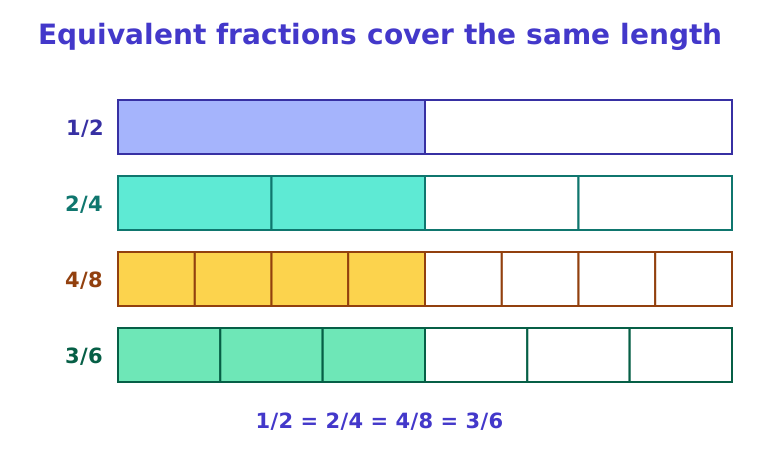
Multiplying top and bottom by the same number does not change a fraction. That is why we can bring fractions to a common denominator before adding.
The four operations on fractions
- Add / subtract: common denominator, then work on the tops. $\frac{1}{4} + \frac{2}{3} = \frac{3 + 8}{12} = \frac{11}{12}$
- Multiply: tops times tops, bottoms times bottoms; cancel first.
- Divide: keep, change, flip. $\frac{3}{5} \div \frac{9}{10} = \frac{3}{5} \times \frac{10}{9} = \frac{2}{3}$
- Mixed numbers: $2\frac{1}{3} = \frac{7}{3}$ before multiplying or dividing.
Which fraction is bigger?
Cross-multiply. For $\frac{5}{8}$ and $\frac{7}{11}$: $5 \times 11 = 55$ and $7 \times 8 = 56$. 56 is bigger, so $\frac{7}{11} > \frac{5}{8}$.
Quick rule: if the tops are equal, the smaller bottom wins; if the bottoms are equal, the bigger top wins.
Recurring decimals into fractions
- $0.\overline{7} = \frac{7}{9}$, $0.\overline{36} = \frac{36}{99} = \frac{4}{11}$
- $0.1\overline{6} = \frac{16 - 1}{90} = \frac{15}{90} = \frac{1}{6}$
Rule: write all the digits minus the non-repeating part on top; below, one 9 for each repeating digit and one 0 for each non-repeating digit.
Meena finishes in 20 seconds
Meena wrote 23 and moved on. Her checklist for every simplification question:
- Brackets from the inside.
- "Of", powers, roots.
- ÷ and × from the left.
-
- and − from the left.
- Fractions: LCM to add, flip to divide.
Concepts and terms
The agreed order for simplifying: Brackets, Of, Division and Multiplication (left to right), Addition and Subtraction (left to right).
3/5 is proper (top smaller), 7/4 is improper, and 7/4 = 1¾ as a mixed number.
The reciprocal of a/b is b/a; a number times its reciprocal is 1. 0 has no reciprocal.
A decimal in which a block of digits repeats for ever, like 0.272727… = 27/99 = 3/11.

Did you know
The bar over a recurring decimal and the bar used as a bracket (vinculum) are the same old sign; the word vinculum is Latin for "bond".
Indian mathematicians such as Brahmagupta (7th century) already wrote rules for adding and dividing fractions.

Memory tricks
Order of operations — B-O-DM-AS: "DM and AS are twins" — D and M are equal twins, so are A and S. Twins are done left to right, never one twin before the other by rule.
Dividing fractions — Keep, change, flip — Keep the first fraction, change ÷ to ×, flip the second fraction.
Practice MCQs with answers (72)
- A 1944
- B 1305
- C 1307
- D 13
Show answer
Why:
÷ and × first, from the left: $144 \div 2 = 72$, $72 \times 18 = 1296$. Then $1296 + 9 = 1305$.
- A 406
- B 514
- C 512
- D 976
Show answer
Why:
÷ and × first, from the left: $29 \times 17 = 493$. Then $29 + 493 - 10 = 512$.
- A 25
- B 3
- C 15
- D 1
Show answer
Why:
÷ and × first, from the left: $18 \div 2 = 9$, $9 \times 3 = 27$. Then $28 - 27 = 1$.
- A 67
- B 69
- C 64
- D 225
Show answer
Why:
÷ and × first, from the left: $15 \times 60 = 900$, $900 \div 12 = 75$. Then $75 + 7 - 15 = 67$.
- A 363
- B 159
- C 174
- D 161
Show answer
Why:
÷ and × first, from the left: $12 \div 2 = 6$, $6 \times 26 = 156$. Then $17 + 156 - 14 = 159$.
- A 2
- B 320
- C 398
- D 400
Show answer
Why:
÷ and × first, from the left: $120 \div 3 = 40$, $40 \times 10 = 400$. Then $400 - 2 = 398$.
- A 60
- B 82
- C 6
- D 10
Show answer
Why:
÷ and × first, from the left: $4 \times 24 = 96$, $96 \div 6 = 16$. Then $24 - 16 + 2 = 10$.
- A 28
- B 68
- C 84
- D 30
Show answer
Why:
÷ and × first, from the left: $4 \times 60 = 240$, $240 \div 12 = 20$. Then $10 + 20 - 2 = 28$.
- A 1
- B 4
- C 6
- D 14
Show answer
Why:
÷ and × first, from the left: $72 \div 18 = 4$, $4 \div 2 = 2$. Then $2 + 2 = 4$.
- A 96
- B 131
- C 129
- D 69
Show answer
Why:
÷ and × first, from the left: $4 \times 30 = 120$, $18 \div 2 = 9$. Then $120 + 9 = 129$.
- A 5
- B 432
- C 1302
- D 1300
Show answer
Why:
÷ and × first, from the left: $144 \div 2 = 72$, $72 \times 36 = 2592$, $2592 \div 2 = 1296$. Then $1296 + 4 = 1300$.
- A 18
- B 498
- C 660
- D 20
Show answer
Why:
÷ and × first, from the left: $18 \div 3 = 6$, $6 \times 28 = 168$, $27 \times 6 = 162$. Then $24 - 168 + 162 = 18$.
- A 20
- B 18
- C 272
- D 888
Show answer
Why:
÷ and × first, from the left: $48 \div 3 = 16$, $2 \times 12 = 24$. Then $26 + 16 - 24 = 18$.
- A 1440
- B 6475
- C 6473
- D 6470
Show answer
Why:
÷ and × first, from the left: $144 \div 6 = 24$, $24 \times 30 = 720$, $720 \times 9 = 6480$. Then $6480 - 7 = 6473$.
- A 0
- B 48
- C 18
- D 38
Show answer
Why:
Inside out: $(9 - 4) = 5$, then ${15 - 5} = 10$, then $[22 - 10] = 12$, and $50 - 12 = 38$.
- A 63
- B 77
- C 25
- D -1
Show answer
Why:
Inside out: $(13 - 6) = 7$, then ${26 - 7} = 19$, then $[40 - 19] = 21$, and $84 - 21 = 63$.
- A 58
- B 50
- C 18
- D -4
Show answer
Why:
Inside out: $(11 - 7) = 4$, then ${20 - 4} = 16$, then $[31 - 16] = 15$, and $65 - 15 = 50$.
- A 94
- B 34
- C 70
- D 0
Show answer
Why:
Inside out: $(17 - 5) = 12$, then ${30 - 12} = 18$, then $[48 - 18] = 30$, and $100 - 30 = 70$.
- A 34
- B 56
- C 79
- D 15
Show answer
Why:
"Of" comes before ÷: $4 \text{ of } 3 = 12$, so $96 \div 12 + 7 = 15$. Treating "of" as a plain × gives 79.
- A 17
- B 53
- C 31
- D 60
Show answer
Why:
"Of" comes before ÷: $6 \text{ of } 2 = 12$, so $144 \div 12 + 5 = 17$. Treating "of" as a plain × gives 53.
- A 74
- B 21
- C 108
- D 309
Show answer
Why:
"Of" comes before ÷: $3 \text{ of } 5 = 15$, so $180 \div 15 + 9 = 21$. Treating "of" as a plain × gives 309.
- A 371
- B 77
- C 21
- D 110
Show answer
Why:
"Of" comes before ÷: $2 \text{ of } 6 = 12$, so $120 \div 12 + 11 = 21$. Treating "of" as a plain × gives 371.
- A 10
- B 8
- C 11
- D 9
Show answer
Why:
Right side $6 \times 13 = 78$. So $? \times 7 = 78 - 15 = 63$ and $? = 63 \div 7 = 9$.
- A 14
- B 16
- C 15
- D 13
Show answer
Why:
Right side $7 \times 28 = 196$. So $? \times 12 = 196 - 28 = 168$ and $? = 168 \div 12 = 14$.
- A 29
- B 21
- C 22
- D 20
Show answer
Why:
Right side $15 \times 15 = 225$. So $? \times 9 = 225 - 36 = 189$ and $? = 189 \div 9 = 21$.
- A 18
- B 16
- C 17
- D 19
Show answer
Why:
Right side $13 \times 20 = 260$. So $? \times 14 = 260 - 22 = 238$ and $? = 238 \div 14 = 17$.
- A $\frac{7}{15}$
- B $\frac{2}{15}$
- C $\frac{3}{8}$
- D $\frac{11}{15}$
Show answer
Why:
LCM of the denominators is 15; adding gives $\frac{11}{15}$.
- A $\frac{19}{12}$
- B $\frac{23}{24}$
- C $\frac{5}{8}$
- D $\frac{4}{5}$
Show answer
Why:
LCM of the denominators is 12; adding gives $\frac{19}{12}$.
- A $\frac{35}{48}$
- B $\frac{17}{24}$
- C $3$
- D $\frac{25}{24}$
Show answer
Why:
LCM of the denominators is 24; subtracting gives $\frac{17}{24}$.
- A $\frac{11}{20}$
- B $\frac{23}{15}$
- C $\frac{8}{15}$
- D $\frac{17}{15}$
Show answer
Why:
LCM of the denominators is 30; subtracting gives $\frac{8}{15}$.
- A $\frac{32}{27}$
- B $\frac{12}{17}$
- C $\frac{59}{72}$
- D $\frac{1}{6}$
Show answer
Why:
Multiply tops and bottoms: $\frac{4 \times 3}{9 \times 8} = \frac{1}{6}$.
- A $\frac{2}{9}$
- B $\frac{33}{35}$
- C $\frac{50}{49}$
- D $\frac{35}{18}$
Show answer
Why:
Multiply tops and bottoms: $\frac{10 \times 7}{21 \times 15} = \frac{2}{9}$.
- A $\frac{25}{54}$
- B $\frac{3}{8}$
- C $\frac{8}{3}$
- D $\frac{25}{27}$
Show answer
Why:
Keep, change, flip: $\frac{5}{12} \times \frac{9}{10} = \frac{3}{8}$.
- A $\frac{32}{75}$
- B $\frac{3}{2}$
- C $\frac{2}{3}$
- D $\frac{64}{75}$
Show answer
Why:
Keep, change, flip: $\frac{8}{15} \times \frac{5}{4} = \frac{2}{3}$.
- A $4\frac{8}{13}$
- B $5\frac{1}{12}$
- C $3\frac{1}{12}$
- D $4\frac{1}{12}$
Show answer
Why:
Wholes: 4. Fractions: $\frac{1}{12}$. Total $4 + \frac{1}{12} = 4\frac{1}{12}$.
- A $4\frac{1}{12}$
- B $3\frac{1}{12}$
- C $4\frac{5}{9}$
- D $5\frac{1}{12}$
Show answer
Why:
Wholes: 4. Fractions: $\frac{1}{12}$. Total $4 + \frac{1}{12} = 4\frac{1}{12}$.
- A $5\frac{10}{17}$
- B $5\frac{1}{5}$
- C $6\frac{1}{5}$
- D $4\frac{1}{5}$
Show answer
Why:
Wholes: 5. Fractions: $\frac{1}{5}$. Total $5 + \frac{1}{5} = 5\frac{1}{5}$.
- A $\frac{3}{5}$
- B $\frac{5}{8}$
- C $\frac{7}{11}$
- D $\frac{4}{7}$
Show answer
Why:
Cross-multiply in pairs (or use decimals): $\frac{4}{7} < \frac{3}{5} < \frac{5}{8} < \frac{7}{11}$.
- A $\frac{2}{3}$
- B $\frac{7}{10}$
- C $\frac{9}{13}$
- D $\frac{5}{7}$
Show answer
Why:
Cross-multiply in pairs (or use decimals): $\frac{2}{3} < \frac{9}{13} < \frac{7}{10} < \frac{5}{7}$.
- A $\frac{2}{5}$
- B $\frac{4}{9}$
- C $\frac{3}{7}$
- D $\frac{5}{11}$
Show answer
Why:
Cross-multiply in pairs (or use decimals): $\frac{2}{5} < \frac{3}{7} < \frac{4}{9} < \frac{5}{11}$.
- A $\frac{5}{6}$
- B $\frac{7}{9}$
- C $\frac{11}{13}$
- D $\frac{13}{15}$
Show answer
Why:
Cross-multiply in pairs (or use decimals): $\frac{7}{9} < \frac{5}{6} < \frac{11}{13} < \frac{13}{15}$.
- A ₹20,000
- B ₹34,000
- C ₹24,000
- D ₹30,000
Show answer
Why:
Spent $= \frac{1}{4} + \frac{1}{3} = \frac{7}{12}$, so $\frac{5}{12}$ is saved. Salary = ₹10,000 ÷ $\frac{5}{12}$ = ₹24,000.
- A ₹12,000
- B ₹16,000
- C ₹28,800
- D ₹24,000
Show answer
Why:
Left = $(1 - \frac{1}{3})(1 - \frac{1}{4}) = \frac{1}{2}$ of the salary. Salary = ₹12,000 ÷ $\frac{1}{2}$ = ₹24,000.
- A ₹30,000
- B ₹43,000
- C ₹36,000
- D ₹26,000
Show answer
Why:
Spent $= \frac{2}{5} + \frac{1}{6} = \frac{17}{30}$, so $\frac{13}{30}$ is saved. Salary = ₹13,000 ÷ $\frac{13}{30}$ = ₹30,000.
- A ₹15,000
- B ₹30,000
- C ₹24,000
- D ₹36,000
Show answer
Why:
Left = $(1 - \frac{1}{5})(1 - \frac{3}{8}) = \frac{1}{2}$ of the salary. Salary = ₹15,000 ÷ $\frac{1}{2}$ = ₹30,000.
- A $\frac{8}{5}$
- B $\frac{7}{4}$
- C $\frac{5}{3}$
- D $2$
Show answer
Why:
Work up from the bottom: $1 + \frac{1}{2} = \frac{3}{2}$, then $1 + \frac{2}{3} = \frac{5}{3}$.
- A $\frac{43}{18}$
- B $\frac{23}{9}$
- C $\frac{5}{2}$
- D $\frac{18}{7}$
Show answer
Why:
Work up from the bottom: $1 + \frac{1}{3} = \frac{4}{3}$, then $1 + \frac{3}{4} = \frac{7}{4}$, then $2 + \frac{4}{7} = \frac{18}{7}$.
- A $\frac{10}{7}$
- B $\frac{3}{2}$
- C $\frac{17}{10}$
- D $\frac{13}{9}$
Show answer
Why:
Work up from the bottom: $2 + \frac{1}{3} = \frac{7}{3}$, then $1 + \frac{3}{7} = \frac{10}{7}$.
- A $\frac{9}{25}$
- B $\frac{4}{11}$
- C $\frac{2}{55}$
- D $\frac{37}{99}$
Show answer
Why:
Top: 36; bottom: 99. So $\frac{36}{99} = \frac{4}{11}$.
- A $\frac{5}{33}$
- B $\frac{8}{45}$
- C $\frac{1}{6}$
- D $\frac{4}{25}$
Show answer
Why:
Top: 16 − 1 = 15; bottom: 90. So $\frac{15}{90} = \frac{1}{6}$.
- A $\frac{27}{200}$
- B $\frac{1}{74}$
- C $\frac{136}{999}$
- D $\frac{5}{37}$
Show answer
Why:
Top: 135; bottom: 999. So $\frac{135}{999} = \frac{5}{37}$.
- A $\frac{27}{110}$
- B $\frac{49}{198}$
- C $\frac{49}{200}$
- D $\frac{9}{37}$
Show answer
Why:
Top: 245 − 2 = 243; bottom: 990. So $\frac{243}{990} = \frac{27}{110}$.
- A $\frac{19}{20}$
- B $\frac{1}{20}$
- C $\frac{1}{19}$
- D $\frac{1}{10}$
Show answer
Why:
Each bracket is $\frac{k-1}{k}$: $\frac{1}{2} \times \frac{2}{3} \times \cdots \times \frac{19}{20}$; everything cancels except $\frac{1}{20}$.
- A $\frac{17}{2}$
- B $\frac{15}{2}$
- C $8$
- D $\frac{16}{15}$
Show answer
Why:
$\frac{3}{2} \times \frac{4}{3} \times \cdots \times \frac{16}{15}$: only $\frac{16}{2} = 8$ survives.
- A $\frac{8}{9}$
- B $\frac{10}{11}$
- C $\frac{1}{10}$
- D $\frac{9}{10}$
Show answer
Why:
$\frac{1}{k(k+1)} = \frac{1}{k} - \frac{1}{k+1}$, so the sum is $1 - \frac{1}{10} = \frac{9}{10}$.
- A $\frac{24}{25}$
- B $\frac{1}{25}$
- C $\frac{23}{24}$
- D $\frac{25}{26}$
Show answer
Why:
$\frac{1}{k(k+1)} = \frac{1}{k} - \frac{1}{k+1}$, so the sum is $1 - \frac{1}{25} = \frac{24}{25}$.
- A Multiplication and addition
- B Division and multiplication
- C Of and subtraction
- D Brackets and of
Show answer
Why:
D and M share one level (left to right), as do A and S.
- A ÷
- B Whichever is on the left
- C "of"
- D Both together
Show answer
Why:
"Of" ranks above ÷: 40 ÷ 10 = 4.
- A $\frac{3}{8}$
- B $-\frac{5}{8}$
- C $\frac{5}{8}$
- D $\frac{8}{5}$
Show answer
Why:
Swap top and bottom: 8/5. Their product is 1.
- A 0
- B -1
- C $\frac{1}{2}$
- D 1
Show answer
Why:
1/0 is not defined, so 0 has no reciprocal.
- A $\frac{9}{16}$
- B $\frac{18}{24}$
- C $\frac{4}{5}$
- D $\frac{6}{12}$
Show answer
Why:
Multiply top and bottom of 3/4 by 6: 18/24.
- A only the last sign changes
- B only the first sign changes
- C every sign inside changes
- D no sign changes
Show answer
Why:
−(a − b + c) = −a + b − c: each term flips.
- A 0.454545…
- B 0.125
- C 0.2333…
- D 0.1010010001…
Show answer
Why:
Its pattern grows but never repeats as a fixed block, so it is irrational. The rest end or repeat.
- A increases
- B becomes 1
- C decreases
- D stays the same
Show answer
Why:
For a/b < 1, (a+1)/(b+1) − a/b = (b − a)/(b(b+1)) > 0. Example: 2/3 to 3/4.
- A Both A and R are true, and R is the correct explanation of A
- B Both A and R are true, but R is not the correct explanation of A
- C A is true but R is false
- D A is false but R is true
Show answer
Why:
Left to right: 24 ÷ 4 = 6, then 6 × 2 = 12. R is exactly why A holds.
- A Both A and R are true, and R is the correct explanation of A
- B Both A and R are true, but R is not the correct explanation of A
- C A is true but R is false
- D A is false but R is true
Show answer
Why:
1/2 + 1/3 = 3/6 + 2/6 = 5/6, so A is false. R is the correct rule.
- A 1 only
- B 2 only
- C Both 1 and 2
- D Neither 1 nor 2
Show answer
Why:
0.999… = 9/9 = 1, and any repeating block gives a fraction with 9s below, so both are true.
- A 1 only
- B 2 only
- C Both 1 and 2
- D Neither 1 nor 2
Show answer
Why:
Left to right: 100 ÷ 10 × 10 = 10 × 10 = 100, so 1 is false. 100 − 10 + 10 = 100 is true.
- A A
- B B
- C C
- D D
Show answer
Why:
3/5 = 0.6, 5/8 = 0.625, 4/7 ≈ 0.571, 7/12 ≈ 0.583. B (5/8) is the largest.
- A $\frac{1}{2}$
- B $1\frac{1}{2}$
- C $1\frac{5}{12}$
- D $\frac{5}{7}$
Show answer
Why:
2/3 + 3/4 = 8/12 + 9/12 = 17/12 = 1 5/12.
- A ₹14,400
- B ₹15,000
- C ₹72,000
- D ₹24,000
Show answer
Why:
3 parts = ₹9,000, so 1 part = ₹3,000 and 8 parts = ₹24,000.
- A Step 2
- B Step 4
- C No mistake
- D Step 3
Show answer
Why:
In Step 2 he did 4 × 2 before ÷. Correct: 48 ÷ 4 = 12, 12 × 2 = 24, 24 + 6 = 30.
Important short questions (4)
"Of" first: 4 × 5 = 20. Then 120 ÷ 20 = 6 and 3 × 6 = 18. Finally 6 + 18 − 10 = 14.
(245 − 2)/990 = 243/990 = 27/110.
Decimals: 0.667, 0.6, 0.625. So 3/5 < 5/8 < 2/3.
7/2 ÷ 7/4 = 2, then 2 × 8/3 = 16/3 = 5⅓.
Long answer questions (1)
(c) Added fraction = 5/6 − 1/3 = 1/2.
(a) 1/2 of the tank = 30 L, so capacity = 60 L.
(b) Still empty: 1/6 of 60 = 10 L.
Flashcards (14)
Play this topic
- Right order or not?
Surds, Indices and Square Roots
Use the laws of indices (including zero, negative and fractional powers), solve equations in powers, find square and cube roots of perfect powers in seconds, simplify and compare surds, and rationalise denominators.
What you will be able to do
- I can simplify expressions with the laws of indices, including zero, negative and fractional powers.
- I can solve equations such as $2^{x+1} = 32$ by matching bases.
- I can find the square root and cube root of a perfect power without long division.
- I can simplify, add, compare and rationalise surds.
Key points
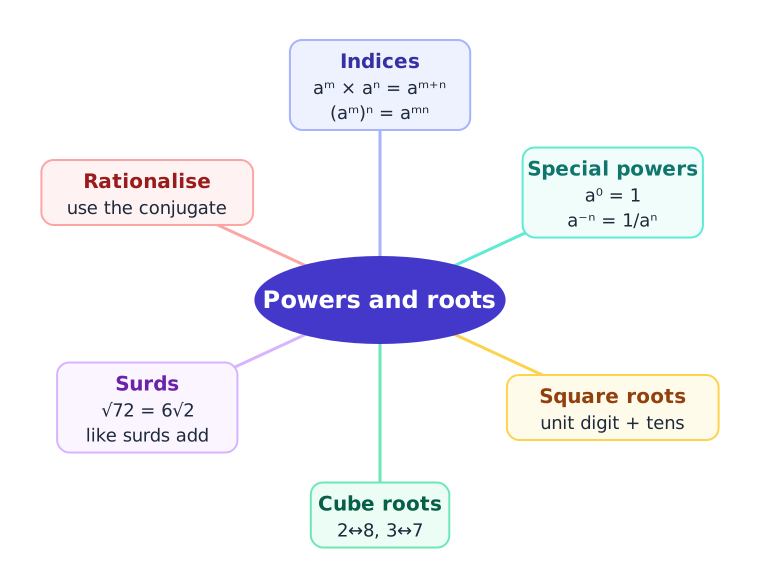
Same base: multiply means add the powers, divide means subtract them, power of a power means multiply them.
a⁰ = 1 for any a ≠ 0, and a⁻ⁿ = 1/aⁿ.
A fractional power p/q means: take the q-th root, then raise to the power p. 27^(2/3) = 3² = 9.
To solve an equation in powers, write both sides with the same base and equate the powers.
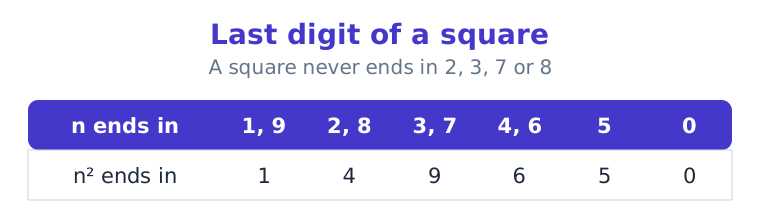
A perfect square ends in 0, 1, 4, 5, 6 or 9, never in 2, 3, 7 or 8.
For a cube root, the last digit maps 2↔8 and 3↔7; all other digits stay the same.
Only like surds can be added: 3√2 + 5√2 = 8√2, but √2 + √3 does not simplify.
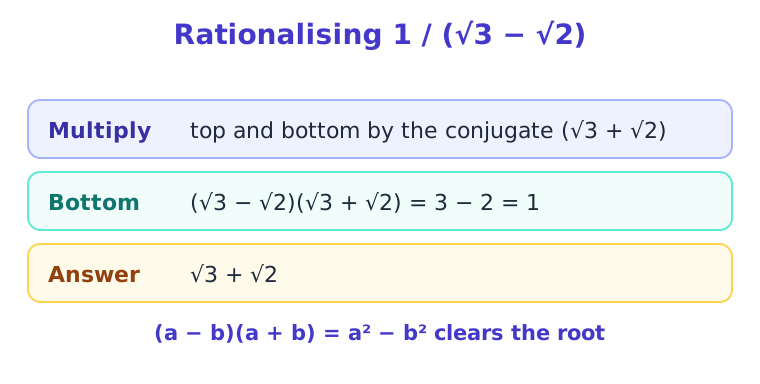
To rationalise 1/(√a − √b), multiply top and bottom by √a + √b: the bottom becomes a − b.
Full explanation
Aman's square plot

Aman's father bought a square plot of 1764 square metres and asked him how long one side is. Aman reached for a calculator; his sister said "42" in five seconds.
Her trick uses the last digit of squares. This topic gives you that trick and the rules for powers, roots and surds that exams test every year.
The laws of indices
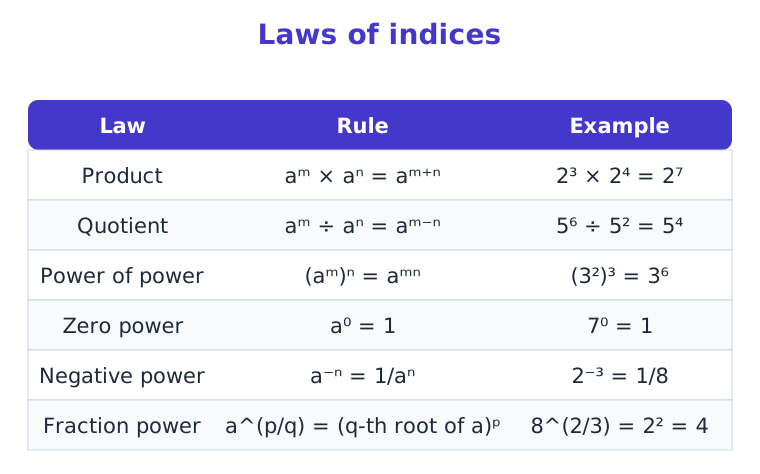
In $a^n$, $a$ is the base and $n$ the index. With the same base:
- $a^m \times a^n = a^{m+n}$
- $a^m \div a^n = a^{m-n}$
- $(a^m)^n = a^{mn}$
- $(ab)^n = a^n b^n$
Zero, negative and fractional powers
- $a^0 = 1$ (because $a^n \div a^n = a^0$ and also $= 1$)
- $a^{-n} = \frac{1}{a^n}$: $5^{-2} = \frac{1}{25}$
- $a^{p/q} = (\sqrt[q]{a})^p$: $16^{3/4} = 2^3 = 8$
Tip: take the root first; the numbers stay small.
Equations in powers
Write both sides with the same base, then equate the indices.
$4^x = 8^{x-1}$ becomes $2^{2x} = 2^{3x-3}$, so $2x = 3x - 3$ and $x = 3$.
Square roots in five seconds
For a perfect square up to 4 digits:
- The last digit of the number gives two choices for the last digit of the root.
- Drop the last two digits; the largest square not above what is left gives the tens digit.
- Pick between the two choices by comparing with the square of (tens digit)5.
Back to the plot: √1764
- Last digit 4: the root ends in 2 or 8.
- Drop "64": 17 is left; $4^2 = 16 \le 17$, so the tens digit is 4.
- $45^2 = 2025 > 1764$, so take the smaller choice: 42.
Check: $42^2 = 1764$.
Cube roots of perfect cubes
The last digit of a cube fixes the last digit of the root: 2↔8 and 3↔7 swap, every other digit stays. Drop the last three digits and find the largest cube not above what is left.
$\sqrt[3]{12167}$: ends in 7, so the root ends in 3; 12 is left and $2^3 = 8 \le 12 < 27$, so the root is 23.
Surds: roots that do not come out
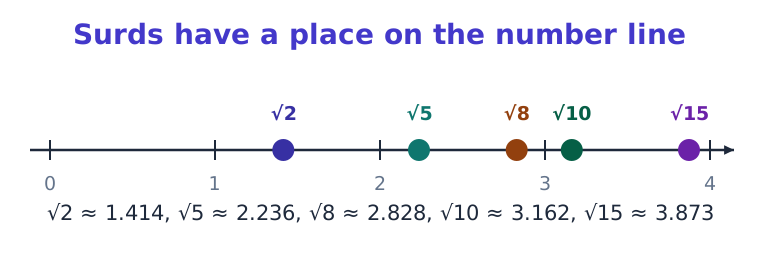
$\sqrt{2}$, $\sqrt{5}$ and $\sqrt[3]{4}$ are surds. Simplify by taking out square factors: $\sqrt{72} = \sqrt{36 \times 2} = 6\sqrt{2}$.
Like surds add like ordinary terms: $\sqrt{50} + \sqrt{18} = 5\sqrt{2} + 3\sqrt{2} = 8\sqrt{2}$.
Rationalising the denominator
To remove a root from the bottom, multiply top and bottom by the conjugate, because $(\sqrt{a} - \sqrt{b})(\sqrt{a} + \sqrt{b}) = a - b$.
If $x = 2 + \sqrt{3}$, then $\frac{1}{x} = 2 - \sqrt{3}$, so $x + \frac{1}{x} = 4$ and $x^2 + \frac{1}{x^2} = 4^2 - 2 = 14$.
Comparing surds
Which is bigger, $\sqrt{3}$ or $\sqrt[3]{5}$? Raise both to the LCM of the root orders, 6: $(\sqrt{3})^6 = 27$ and $(\sqrt[3]{5})^6 = 25$. So $\sqrt{3}$ is bigger.
Aman's sister, explained
She saw the last digit 4 (root ends in 2 or 8), saw that 17 sits between 16 and 25 (tens digit 4), and knew 1764 is below 45² = 2025. Three looks, one answer: 42 m.
Concepts and terms
In aⁿ, a is the base and n the index: a multiplied by itself n times.
A root that cannot be written as a fraction, such as √2, √5 or ∛4.
√a + √b and √a − √b are conjugates; their product a − b has no root.
A number that is an exact square or cube of a whole number, such as 1764 = 42² or 2197 = 13³.
Did you know
The Baudhayana Sulba Sutra (around 800 BCE) gives √2 ≈ 1 + 1/3 + 1/(3×4) − 1/(3×4×34), correct to five decimal places.
Memory tricks
Index laws — Times: add. Divide: subtract. Bracket: multiply. — The operation on the powers is one step simpler than the operation on the numbers.
Cube-root last digits — 2-8 and 3-7 swap, the rest stay — Cubes ending in 8 come from numbers ending in 2, cubes ending in 7 from numbers ending in 3, and the reverse.
Practice MCQs with answers (77)
- A $2^{11}$
- B $2^{4}$
- C $2^{12}$
- D $2^{6}$
Show answer
Why:
Add then subtract the powers: 5 + 3 − 4 = 4.
- A $3^{10}$
- B $3^{9}$
- C $3^{4}$
- D $3^{14}$
Show answer
Why:
Add then subtract the powers: 7 + 2 − 5 = 4.
- A $5^{13}$
- B $5^{1}$
- C $5^{21}$
- D $5^{7}$
Show answer
Why:
Add then subtract the powers: 4 + 6 − 3 = 7.
- A $7^{5}$
- B $7^{13}$
- C $7^{28}$
- D $7^{21}$
Show answer
Why:
Add then subtract the powers: 9 + 4 − 8 = 5.
- A $2^{76}$
- B $2^{7}$
- C $2^{2}$
- D $2^{17}$
Show answer
Why:
Power of a power multiplies: 3 × 4 = 12; then 12 − 5 = 7.
- A $3^{3}$
- B $3^{14}$
- C $3^{6}$
- D $3^{28}$
Show answer
Why:
Power of a power multiplies: 2 × 5 = 10; then 10 − 4 = 6.
- A $4$
- B $64$
- C $\frac{1}{16}$
- D $16$
Show answer
Why:
The cube root of 64 is 4; $4^{2} = 16$.
- A $\frac{1}{9}$
- B $3$
- C $\frac{1}{3}$
- D $9$
Show answer
Why:
The cube root of 27 is 3; $3^{2} = 9$, and the minus sign gives the reciprocal $\frac{1}{9}$.
- A $2$
- B $8$
- C $16$
- D $\frac{1}{8}$
Show answer
Why:
The fourth root of 16 is 2; $2^{3} = 8$.
- A $5$
- B $625$
- C $125$
- D $\frac{1}{125}$
Show answer
Why:
The square root of 25 is 5; $5^{3} = 125$.
- A $2$
- B $\frac{1}{2}$
- C $8$
- D $\frac{1}{8}$
Show answer
Why:
The fifth root of 32 is 2; $2^{3} = 8$, and the minus sign gives the reciprocal $\frac{1}{8}$.
- A $\frac{1}{27}$
- B $27$
- C $3$
- D $\frac{1}{3}$
Show answer
Why:
The fourth root of 81 is 3; $3^{3} = 27$, and the minus sign gives the reciprocal $\frac{1}{27}$.
- A 6
- B 4
- C 5
- D 3
Show answer
Why:
$32 = 2^{5}$, so $x + 1 = 5$ and $x = 4$.
- A 5
- B 4
- C 3
- D 2
Show answer
Why:
$243 = 3^{5}$, so $2x - 1 = 5$ and $x = 3$.
- A 2
- B 3
- C 4
- D 1
Show answer
Why:
$625 = 5^{4}$, so $3x + 1 = 4$ and $x = 1$.
- A 3
- B 2
- C 1
- D 4
Show answer
Why:
Write both in base 2: $2^{2x} = 2^{3(x - 1)}$. So $2x = 3x - 3$ and $x = 3$.
- A 8
- B 6
- C 5
- D 2
Show answer
Why:
Write both in base 3: $3^{2x} = 3^{3(x - 2)}$. So $2x = 3x - 6$ and $x = 6$.
- A 10
- B 7
- C 8
- D 2
Show answer
Why:
Write both in base 2: $2^{3x} = 2^{4(x - 2)}$. So $3x = 4x - 8$ and $x = 8$.
- A 54
- B 34
- C 46
- D 44
Show answer
Why:
1936 ends in 6, so the root ends in 4 or 6; 19 lies between 4² and 5², so the tens digit is 4; 45² = 2025 is more than 1936, so the root is 44.
- A 57
- B 47
- C 53
- D 67
Show answer
Why:
3249 ends in 9, so the root ends in 7 or 3; 32 lies between 5² and 6², so the tens digit is 5; 55² = 3025 is less than 3249, so the root is 57.
- A 66
- B 76
- C 74
- D 86
Show answer
Why:
5776 ends in 6, so the root ends in 6 or 4; 57 lies between 7² and 8², so the tens digit is 7; 75² = 5625 is less than 5776, so the root is 76.
- A 93
- B 73
- C 83
- D 87
Show answer
Why:
6889 ends in 9, so the root ends in 3 or 7; 68 lies between 8² and 9², so the tens digit is 8; 85² = 7225 is more than 6889, so the root is 83.
- A 102
- B 82
- C 98
- D 92
Show answer
Why:
8464 ends in 4, so the root ends in 2 or 8; 84 lies between 9² and 10², so the tens digit is 9; 95² = 9025 is more than 8464, so the root is 92.
- A 68
- B 78
- C 58
- D 62
Show answer
Why:
4624 ends in 4, so the root ends in 8 or 2; 46 lies between 6² and 7², so the tens digit is 6; 65² = 4225 is less than 4624, so the root is 68.
- A 0.013
- B 0.13
- C 1.3
- D 0.14
Show answer
Why:
0.0169 has 4 decimal places, so the root has 2: $\sqrt{169} = 13$, giving 0.13.
- A 0.21
- B 0.022
- C 0.021
- D 0.0021
Show answer
Why:
0.000441 has 6 decimal places, so the root has 3: $\sqrt{441} = 21$, giving 0.021.
- A 15
- B 1.6
- C 0.15
- D 1.5
Show answer
Why:
2.25 has 2 decimal places, so the root has 1: $\sqrt{225} = 15$, giving 1.5.
- A 0.18
- B 1.8
- C 0.19
- D 0.018
Show answer
Why:
0.0324 has 4 decimal places, so the root has 2: $\sqrt{324} = 18$, giving 0.18.
- A 7
- B 17
- C 13
- D 27
Show answer
Why:
4913 ends in 3, so the root ends in 7. Dropping the last three digits leaves 4, which lies between 1³ and 2³, so the root is 17.
- A 27
- B 33
- C 23
- D 13
Show answer
Why:
12167 ends in 7, so the root ends in 3. Dropping the last three digits leaves 12, which lies between 2³ and 3³, so the root is 23.
- A 48
- B 28
- C 32
- D 38
Show answer
Why:
54872 ends in 2, so the root ends in 8. Dropping the last three digits leaves 54, which lies between 3³ and 4³, so the root is 38.
- A 12
- B 18
- C 22
- D 2
Show answer
Why:
1728 ends in 8, so the root ends in 2. Dropping the last three digits leaves 1, which lies between 1³ and 2³, so the root is 12.
- A $15\sqrt{2}$
- B $8\sqrt{2}$
- C $8\sqrt{4}$
- D $\sqrt{68}$
Show answer
Why:
$\sqrt{50} = 5\sqrt{2}$ and $\sqrt{18} = 3\sqrt{2}$; like surds give $8\sqrt{2}$.
- A $\sqrt{6}$
- B $\sqrt{21}$
- C $\sqrt{3}$
- D $12\sqrt{3}$
Show answer
Why:
$\sqrt{48} = 4\sqrt{3}$ and $\sqrt{27} = 3\sqrt{3}$; like surds give $\sqrt{3}$.
- A $\sqrt{200}$
- B $12\sqrt{5}$
- C $8\sqrt{10}$
- D $8\sqrt{5}$
Show answer
Why:
$\sqrt{180} = 6\sqrt{5}$ and $\sqrt{20} = 2\sqrt{5}$; like surds give $8\sqrt{5}$.
- A $3\sqrt{2}$
- B $3\sqrt{4}$
- C $\sqrt{66}$
- D $28\sqrt{2}$
Show answer
Why:
$\sqrt{98} = 7\sqrt{2}$ and $\sqrt{32} = 4\sqrt{2}$; like surds give $3\sqrt{2}$.
- A $5\sqrt{14}$
- B $5\sqrt{7}$
- C $\sqrt{91}$
- D $6\sqrt{7}$
Show answer
Why:
$\sqrt{63} = 3\sqrt{7}$ and $\sqrt{28} = 2\sqrt{7}$; like surds give $5\sqrt{7}$.
- A $45\sqrt{3}$
- B $4\sqrt{6}$
- C $4\sqrt{3}$
- D $\sqrt{168}$
Show answer
Why:
$\sqrt{243} = 9\sqrt{3}$ and $\sqrt{75} = 5\sqrt{3}$; like surds give $4\sqrt{3}$.
- A $6\sqrt{3}$
- B $2\sqrt{6}$
- C $7\sqrt{2}$
- D $6\sqrt{2}$
Show answer
Why:
$72 = 36 \times 2$ and 36 is a perfect square, so $\sqrt{72} = 6\sqrt{2}$.
- A $5\sqrt{3}$
- B $6\sqrt{3}$
- C $5\sqrt{4}$
- D $3\sqrt{5}$
Show answer
Why:
$75 = 25 \times 3$ and 25 is a perfect square, so $\sqrt{75} = 5\sqrt{3}$.
- A $4\sqrt{8}$
- B $4\sqrt{7}$
- C $7\sqrt{4}$
- D $5\sqrt{7}$
Show answer
Why:
$112 = 16 \times 7$ and 16 is a perfect square, so $\sqrt{112} = 4\sqrt{7}$.
- A $9\sqrt{3}$
- B $2\sqrt{9}$
- C $9\sqrt{2}$
- D $10\sqrt{2}$
Show answer
Why:
$162 = 81 \times 2$ and 81 is a perfect square, so $\sqrt{162} = 9\sqrt{2}$.
- A $2\sqrt{2}$
- B $\sqrt{3} - \sqrt{2}$
- C $\frac{\sqrt{3} + \sqrt{2}}{5}$
- D $\sqrt{3} + \sqrt{2}$
Show answer
Why:
Multiply by $\sqrt{3} + \sqrt{2}$: the bottom becomes $3 - 2 = 1$.
- A $\sqrt{6} - \sqrt{5}$
- B $\sqrt{5} - \sqrt{6}$
- C $\frac{\sqrt{6} - \sqrt{5}}{11}$
- D $\sqrt{6} + \sqrt{5}$
Show answer
Why:
Multiply by $\sqrt{6} - \sqrt{5}$: the bottom becomes $6 - 5 = 1$.
- A $\sqrt{8} - \sqrt{7}$
- B $\sqrt{8} + \sqrt{7}$
- C $\frac{\sqrt{8} + \sqrt{7}}{15}$
- D $2\sqrt{7}$
Show answer
Why:
Multiply by $\sqrt{8} + \sqrt{7}$: the bottom becomes $8 - 7 = 1$.
- A $\sqrt{11} + \sqrt{10}$
- B $\sqrt{10} - \sqrt{11}$
- C $\sqrt{11} - \sqrt{10}$
- D $\frac{\sqrt{11} - \sqrt{10}}{21}$
Show answer
Why:
Multiply by $\sqrt{11} - \sqrt{10}$: the bottom becomes $11 - 10 = 1$.
- A 2
- B 5
- C $2\sqrt{3}$
- D 4
Show answer
Why:
$2^2 - 3 = 1$, so $\frac{1}{x} = 2 - \sqrt{3}$ and the roots cancel: $x + \frac{1}{x} = 4$.
- A 34
- B 36
- C 6
- D 38
Show answer
Why:
$\frac{1}{x} = 3 - \sqrt{8}$ (since $3^2 - 8 = 1$), so $x + \frac{1}{x} = 6$ and $x^2 + \frac{1}{x^2} = 6^2 - 2 = 34$.
- A 9
- B 8
- C $2\sqrt{15}$
- D 4
Show answer
Why:
$4^2 - 15 = 1$, so $\frac{1}{x} = 4 - \sqrt{15}$ and the roots cancel: $x + \frac{1}{x} = 8$.
- A 10
- B 102
- C 98
- D 100
Show answer
Why:
$\frac{1}{x} = 5 - \sqrt{24}$ (since $5^2 - 24 = 1$), so $x + \frac{1}{x} = 10$ and $x^2 + \frac{1}{x^2} = 10^2 - 2 = 98$.
- A 5
- B $\sqrt{12}$
- C 3
- D 4
Show answer
Why:
Let the value be y. Then $y^2 = 12 + y$. Since $12 = 4 \times 3$, $y = 4$.
- A 6
- B 5
- C 7
- D $\sqrt{30}$
Show answer
Why:
Let the value be y. Then $y^2 = 30 + y$. Since $30 = 6 \times 5$, $y = 6$.
- A 9
- B 8
- C $\sqrt{72}$
- D 7
Show answer
Why:
Let the value be y. Then $y^2 = 72 - y$. Since $72 = 8 \times 9$, $y = 8$.
- A $\sqrt[6]{20}$
- B $\sqrt{3}$
- C $\sqrt[4]{10}$
- D $\sqrt[3]{5}$
Show answer
Why:
Raise each to the power 12: $\sqrt{3}$ → 729, $\sqrt[3]{5}$ → 625, $\sqrt[4]{10}$ → 1000, $\sqrt[6]{20}$ → 400. The largest result is $\sqrt[4]{10}$.
- A $\sqrt{2}$
- B $\sqrt[3]{3}$
- C $\sqrt[4]{5}$
- D $\sqrt[6]{6}$
Show answer
Why:
Raise each to the power 12: $\sqrt{2}$ → 64, $\sqrt[3]{3}$ → 81, $\sqrt[4]{5}$ → 125, $\sqrt[6]{6}$ → 36. The smallest result is $\sqrt[6]{6}$.
- A $\sqrt[6]{12}$
- B $\sqrt[3]{3}$
- C $\sqrt[4]{5}$
- D $\sqrt{2}$
Show answer
Why:
Raise each to the power 12: $\sqrt{2}$ → 64, $\sqrt[3]{3}$ → 81, $\sqrt[4]{5}$ → 125, $\sqrt[6]{12}$ → 144. The largest result is $\sqrt[6]{12}$.
- A 9709
- B 9409
- C 9410
- D 9391
Show answer
Why:
$97^2 = (100 - 3)^2 = 10000 - 600 + 9 = 9409$.
- A 10416
- B 10817
- C 10816
- D 10784
Show answer
Why:
$104^2 = (100 + 4)^2 = 10000 + 800 + 16 = 10816$.
- A 99216
- B 991984
- C 996016
- D 992016
Show answer
Why:
$996^2 = (1000 - 4)^2 = 1000000 - 8000 + 16 = 992016$.
- A 18
- B $\sqrt{39}$
- C 20
- D 324
Show answer
Why:
$\sqrt{12} \times \sqrt{27} = \sqrt{324} = 18$.
- A $\sqrt{58}$
- B 20
- C 22
- D 400
Show answer
Why:
$\sqrt{8} \times \sqrt{50} = \sqrt{400} = 20$.
- A 32
- B 900
- C 30
- D $\sqrt{65}$
Show answer
Why:
$\sqrt{20} \times \sqrt{45} = \sqrt{900} = 30$.
- A not defined
- B 0
- C a
- D 1
Show answer
Why:
$a^n \div a^n = a^0$, and any number divided by itself is 1.
- A $\sqrt{12}$
- B $\sqrt{49}$
- C $\sqrt[3]{27}$
- D $\sqrt{0.25}$
Show answer
Why:
√49 = 7, ∛27 = 3, √0.25 = 0.5 all come out exactly. √12 = 2√3 does not.
- A 5,329
- B 4,358
- C 7,056
- D 2,601
Show answer
Why:
A square never ends in 8. (5329 = 73², 7056 = 84², 2601 = 51².)
- A when both are perfect squares
- B always
- C only when a = 0 or b = 0
- D when a = b
Show answer
Why:
Squaring both sides gives a + b = a + b + 2√(ab), so √(ab) = 0.
- A $2\sqrt{3} - 5$
- B $5 - 3\sqrt{2}$
- C $-5 + 2\sqrt{3}$
- D $5 + 2\sqrt{3}$
Show answer
Why:
Change only the sign of the surd part.
- A $\frac{1}{8}$
- B $-\frac{1}{8}$
- C -8
- D -6
Show answer
Why:
A negative power means the reciprocal: 1/2³ = 1/8.
- A 9
- B 8
- C 7
- D 10
Show answer
Why:
4, 9, 16, 25, 36, 49, 64, 81: eight.
- A Both A and R are true, and R is the correct explanation of A
- B Both A and R are true, but R is not the correct explanation of A
- C A is true but R is false
- D A is false but R is true
Show answer
Why:
5 − 3 = 2, by exactly the identity in R.
- A Both A and R are true, and R is the correct explanation of A
- B Both A and R are true, but R is not the correct explanation of A
- C A is true but R is false
- D A is false but R is true
Show answer
Why:
√2 + 2√2 = 3√2 ≈ 4.24, while √10 ≈ 3.16. A is false; R is true.
- A 1 only
- B 2 only
- C Both 1 and 2
- D Neither 1 nor 2
Show answer
Why:
(2³)² = 2⁶ = 64 but 2^(3²) = 2⁹ = 512, so 1 is false. 8 × 9 = 72, so 2 is true.
- A 1 only
- B 2 only
- C Both 1 and 2
- D Neither 1 nor 2
Show answer
Why:
3³ = 27 ends in 7 and 3² = 9 ends in 9; both true.
- A 216 m
- B 46 m
- C 184 m
- D 176 m
Show answer
Why:
Side = √2116 = 46 m (ends in 6, so 4 or 6; 21 is between 16 and 25; 45² = 2025 < 2116). Perimeter = 4 × 46 = 184 m.
- A 16 cm
- B 12 cm
- C 24 cm
- D 14 cm
Show answer
Why:
2744 ends in 4, so the edge ends in 4; 2 is left after dropping 744, and 1³ ≤ 2 < 2³, so 14 cm.
- A $\sqrt{7}$
- B $\sqrt{12}$
- C $\sqrt{5}$
- D $\sqrt{10}$
Show answer
Why:
P is between 2.5 and 3. √5 ≈ 2.24, √7 ≈ 2.65, √10 ≈ 3.16, √12 ≈ 3.46, so P = √7.
- A 1,936
- B 6,237
- C 3,481
- D 5,776
Show answer
Why:
No square ends in 7. The others are 59², 76² and 44².
Important short questions (4)
Ends in 1, so 1 or 9. 79 is between 64 and 81, so tens digit 8. 85² = 7225 < 7921, so 89.
3^(2x) = 3^(3x − 3), so 2x = 3x − 3 and x = 3.
7√2 − 4√2 + 3√2 = 6√2.
Multiply by (√5 + 1): 4(√5 + 1)/(5 − 1) = √5 + 1.
Long answer questions (1)
(a) (3 + 2√2)(3 − 2√2) = 9 − 8 = 1, so 1/x = 3 − 2√2.
(b) x + 1/x = 6.
(c) 6² − 2 = 34.
(d) (x + 1/x)³ − 3(x + 1/x) = 216 − 18 = 198.
Flashcards (14)
Play this topic
- Powers and roots: true or false?
Approximation
Round numbers correctly, replace awkward decimals, percents and roots with friendly values, and pick the nearest option in approximation questions, checking that the rounding error is smaller than the gap between options.
What you will be able to do
- I can round a number to given decimal places, to the nearest 10, 100 or 1000, and to significant figures.
- I can replace decimals, percents and roots by nearby friendly numbers.
- I can estimate the value of a long expression and choose the nearest option.
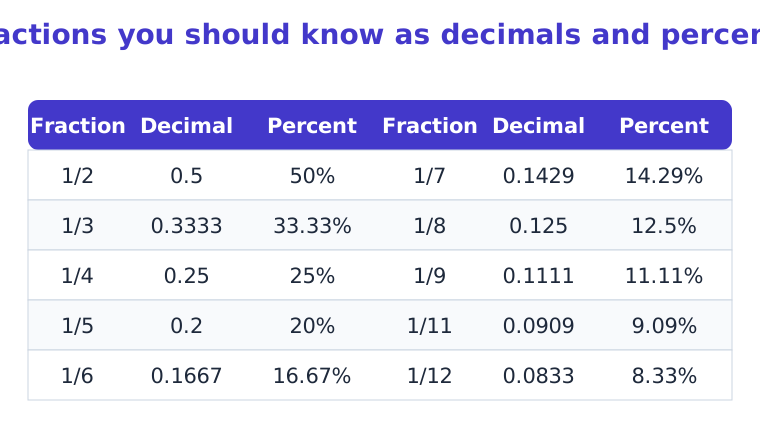
- I know the decimal values of 1/2 to 1/12 by heart.
Key points
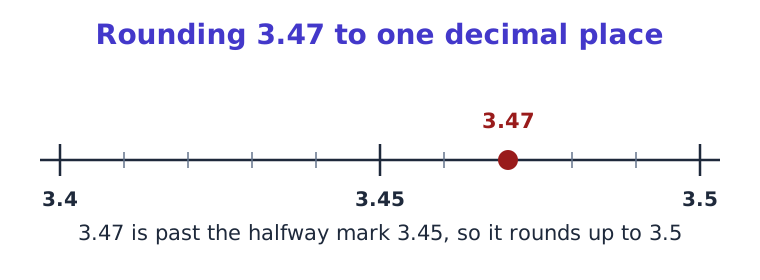
To round, look at the next digit: 5 or more rounds up, 4 or less rounds down.
Round only once, from the original number. 12.3449 to two decimal places is 12.34; rounding first to 12.345 and then to 12.35 is wrong.
In approximation questions, round each number to the nearest friendly value, then compute.
Friendly percents: 33.33% ≈ 1/3, 12.5% = 1/8, 16.67% ≈ 1/6, 14.29% ≈ 1/7, 11.11% ≈ 1/9.
For a root, move to the nearest perfect square or cube: √1297 ≈ 36, ∛3380 ≈ 15.
Round up some numbers and down others when you can, so the errors partly cancel.
If two options are close together, approximate less or compute exactly.
Full explanation
The 15-second rule
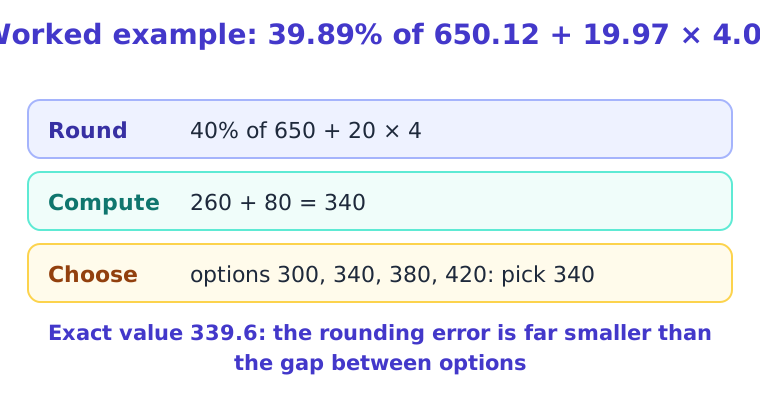
In an IBPS prelims paper, Karan sees: "What is the approximate value of $39.89%$ of $650.12 + 19.97 \times 4.02$?" He has about 15 seconds per question. Working out 39.89% of 650.12 exactly would take a minute.
Approximation questions reward a different skill: rounding smartly, then picking the nearest option.
Rounding: the basic rule
Look at the digit just after the place you keep:
- 5 or more: add one to the kept digit.
- 4 or less: leave it.
$7.486 \to 7.49$ (two places), $45{,}678 \to 45{,}700$ (nearest hundred), $0.004672 \to 0.0047$ (two significant figures).
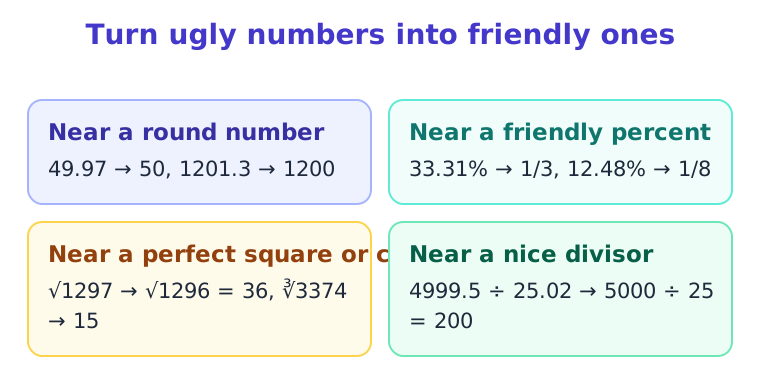
Friendly numbers
Replace each awkward number by a nearby one that is easy to use.
Percents as fractions
Many exam percents are fractions in disguise. Learn this table and you can do "33.31% of 899.7" as $\frac{1}{3} \times 900 = 300$.
Roots near perfect powers
$\sqrt{1297} \approx \sqrt{1296} = 36$, $\sqrt{624.7} \approx \sqrt{625} = 25$, $\sqrt[3]{3374.6} \approx \sqrt[3]{3375} = 15$.
Know the squares up to 30 and cubes up to 15 by heart; approximation questions are built on them.
Karan's question, solved
Round, compute, choose.
How rough can you be?
Compare your rounding error with the gap between options. If options are 40 apart, an error of 5 is harmless. If two options are 2 apart, round less or calculate exactly.
Balance trick: in $49.6 \times 20.4$, one number is rounded up and one down ($50 \times 20 = 1000$; exact 1011.84), so the errors partly cancel.
Karan's habit
Karan now spends 10 seconds on each approximation question: friendly numbers, one line of working, nearest option. He saves the extra time for data interpretation, where exact answers are needed.
Concepts and terms
Replacing a number by the nearest value with fewer digits, for example 7.486 → 7.49.
Digits counted from the first non-zero digit: 0.004672 to 2 significant figures is 0.0047.
A nearby value that is easy to work with: a round number, a perfect square, or a percent with a simple fraction.
In an approximation MCQ the answer is the option closest to the exact value, not one equal to it.
Did you know
Aryabhata (499 CE) gave π ≈ 62832/20000 = 3.1416, correct to four decimal places.
In bank and SSC approximation questions the options are usually kept well apart, which is why rounding to friendly numbers is safe.
Memory tricks
Rounding rule — Five and above, give it a shove — If the next digit is 5, 6, 7, 8 or 9, the kept digit goes up by one.
Friendly percents — Eight is twelve-and-a-half — 1/8 = 12.5%, so 3/8 = 37.5%, 5/8 = 62.5%, 7/8 = 87.5%.
Practice MCQs with answers (62)
- A 110
- B 90
- C 100
- D 120
Show answer
Why:
Round to friendly numbers: $50 \times 20 \div 10$ = 100. (Exact value: 100.24.)
- A 280
- B 340
- C 320
- D 300
Show answer
Why:
Round to friendly numbers: $150 \times 12 \div 6$ = 300. (Exact value: 300.85.)
- A 450
- B 480
- C 420
- D 510
Show answer
Why:
Round to friendly numbers: $720 \div 24 \times 15$ = 450. (Exact value: 449.79.)
- A 1650
- B 1700
- C 1800
- D 1750
Show answer
Why:
Round to friendly numbers: $35 \times 40 + 300$ = 1700. (Exact value: 1697.85.)
- A 1450
- B 1600
- C 1500
- D 1550
Show answer
Why:
Round to friendly numbers: $1250 + 750 - 500$ = 1500. (Exact value: 1500.50.)
- A 220
- B 180
- C 240
- D 200
Show answer
Why:
Round to friendly numbers: $5000 \div 25$ = 200. (Exact value: 199.82.)
- A 600
- B 550
- C 700
- D 650
Show answer
Why:
Round to friendly numbers: $20 \times 30$ = 600. (Exact value: 600.00.)
- A 220
- B 200
- C 180
- D 240
Show answer
Why:
Round to friendly numbers: $64 \times 25 \div 8$ = 200. (Exact value: 199.89.)
- A 280
- B 240
- C 260
- D 300
Show answer
Why:
Round to friendly numbers: $40%$ of $650$ = 260. (Exact value: 259.33.)
- A 350
- B 325
- C 275
- D 300
Show answer
Why:
Round to friendly numbers: $25%$ of $1200$ = 300. (Exact value: 300.01.)
- A 100
- B 120
- C 110
- D 90
Show answer
Why:
Round to friendly numbers: $12.5%$ of $800$ (12.5% = 1/8) = 100. (Exact value: 99.79.)
- A 380
- B 360
- C 340
- D 400
Show answer
Why:
Round to friendly numbers: $75%$ of $480$ (75% = 3/4) = 360. (Exact value: 360.02.)
- A 350
- B 325
- C 300
- D 275
Show answer
Why:
Round to friendly numbers: $33.33%$ of $900$ (33.33% ≈ 1/3) = 300. (Exact value: 299.69.)
- A 165
- B 155
- C 135
- D 145
Show answer
Why:
Round to friendly numbers: $20%$ of $350$ + $30%$ of $250$ = 145. (Exact value: 145.01.)
- A 60
- B 55
- C 70
- D 65
Show answer
Why:
Round to friendly numbers: $\sqrt{1296} + 24$ = 60. (Exact value: 60.04.)
- A 383
- B 343
- C 363
- D 323
Show answer
Why:
Round to friendly numbers: $\sqrt{2401} \times 7$ = 343. (Exact value: 343.84.)
- A 40
- B 34
- C 37
- D 43
Show answer
Why:
Round to friendly numbers: $\sqrt{625} + \sqrt{144}$ = 37. (Exact value: 36.99.)
- A 12
- B 8
- C 14
- D 10
Show answer
Why:
Round to friendly numbers: $\sqrt{3600} \div 6$ = 10. (Exact value: 10.03.)
- A 195
- B 205
- C 185
- D 215
Show answer
Why:
Round to friendly numbers: $15^2 - \sqrt{900}$ = 195. (Exact value: 194.41.)
- A 14
- B 15
- C 17
- D 16
Show answer
Why:
Round to friendly numbers: $\sqrt[3]{3375}$ = 15. (Exact value: 15.00.)
- A 110
- B 140
- C 120
- D 130
Show answer
Why:
Round to friendly numbers: $\sqrt[3]{1728} \times 10$ = 120. (Exact value: 119.75.)
- A 65
- B 55
- C 70
- D 60
Show answer
Why:
Round to friendly numbers: $\sqrt[3]{6859} + 41$ = 60. (Exact value: 60.02.)
- A 420
- B 390
- C 480
- D 450
Show answer
Why:
Round to friendly numbers: $\frac{7}{9} \times 540$ = 420. (Exact value: 420.47.)
- A 680
- B 600
- C 640
- D 560
Show answer
Why:
Round to friendly numbers: $\frac{3}{8} \times 1600$ = 600. (Exact value: 599.89.)
- A 1050
- B 950
- C 1000
- D 1100
Show answer
Why:
Round to friendly numbers: $\frac{5}{13} \times 2600$ = 1000. (Exact value: 1000.46.)
- A 550
- B 525
- C 475
- D 500
Show answer
Why:
Round to friendly numbers: $\frac{2}{3} \times 450 + \frac{1}{4} \times 800$ = 500. (Exact value: 499.77.)
- A 110
- B 120
- C 100
- D 130
Show answer
Why:
Round to friendly numbers: $\sqrt{625}$ + $25%$ of $400$ $- 15$ = 110. (Exact value: 109.87.)
- A 180
- B 200
- C 240
- D 220
Show answer
Why:
Round to friendly numbers: $(20 + 30) \times 12 \div 3$ = 200. (Exact value: 198.38.)
- A 550
- B 700
- C 600
- D 650
Show answer
Why:
Round to friendly numbers: $45 \times 20 - 25 \times 12$ = 600. (Exact value: 599.56.)
- A 195
- B 165
- C 210
- D 180
Show answer
Why:
Round to friendly numbers: $\frac{900}{30} \times 6$ = 180. (Exact value: 180.96.)
- A 625
- B 600
- C 675
- D 650
Show answer
Why:
Round to friendly numbers: $20^2 + 15^2$ = 625. (Exact value: 624.40.)
- A 7.48
- B 7.49
- C 7.486
- D 7.5
Show answer
Why:
Look at the digit after place 2: 6. It is 5 or more, so round up: 7.49.
- A 12.35
- B 12
- C 12.4
- D 12.3
Show answer
Why:
Look at the digit after place 1: 5. It is 5 or more, so round up: 12.4.
- A 45,680
- B 46,000
- C 45,600
- D 45,700
Show answer
Why:
45,678 lies between 45,600 and 45,700 and is nearer 45,700.
- A 2,35,000
- B 2,34,600
- C 2,30,000
- D 2,34,000
Show answer
Why:
2,34,567 lies between 2,34,000 and 2,35,000 and is nearer 2,35,000.
- A 0.005
- B 0.0047
- C 0.0046
- D 0.00467
Show answer
Why:
Count from the first non-zero digit and round there: 0.0047.
- A 3.14
- B 3.141
- C 3.142
- D 3.1416
Show answer
Why:
Look at the digit after place 3: 5. It is 5 or more, so round up: 3.142.
- A 0.1111
- B 0.1667
- C 0.1250
- D 0.1429
Show answer
Why:
$1 \div 7 = 0.142857…$, so about 0.1429, that is 14.29%.
- A 0.1111
- B 0.0909
- C 0.1250
- D 0.1000
Show answer
Why:
$1 \div 9 = 0.111111…$, so about 0.1111, that is 11.11%.
- A 0.0833
- B 0.0909
- C 0.0769
- D 0.1000
Show answer
Why:
$1 \div 11 = 0.090909…$, so about 0.0909, that is 9.09%.
- A 0.1429
- B 0.1250
- C 0.1667
- D 0.2000
Show answer
Why:
$1 \div 6 = 0.166667…$, so about 0.1667, that is 16.67%.
- A 0.59
- B 0.52
- C 0.63
- D 0.56
Show answer
Why:
$5 \div 9 = 0.5556…$; the nearest option is 0.56.
- A 0.54
- B 0.57
- C 0.50
- D 0.61
Show answer
Why:
$7 \div 13 = 0.5385…$; the nearest option is 0.54.
- A 0.72
- B 0.65
- C 0.68
- D 0.61
Show answer
Why:
$11 \div 17 = 0.6471…$; the nearest option is 0.65.
- A ₹950
- B ₹850
- C ₹900
- D ₹1,000
Show answer
Why:
5 × 60 + 2 × 150 + 3 × 100 = ₹900 (exact ₹894.45).
- A ₹720
- B ₹640
- C ₹760
- D ₹680
Show answer
Why:
12 × 40 + 8 × 25 = ₹680 (exact ₹676.80).
- A 180 km
- B 220 km
- C 200 km
- D 160 km
Show answer
Why:
Distance = speed × time ≈ 60 × 3 = 180 km (exact 180.6 km).
- A 365 km
- B 315 km
- C 340 km
- D 290 km
Show answer
Why:
Distance = speed × time ≈ 45 × 7 = 315 km (exact 313.4 km).
- A 210
- B 180
- C 150
- D 120
Show answer
Why:
157 is 7 from 150 and 23 from 180: mark the nearest, 150.
- A 4.56
- B 4.39
- C 4.44
- D 4.46
Show answer
Why:
4.46 → 4.5 (next digit 6). 4.44 → 4.4, 4.56 → 4.6, 4.39 → 4.4.
- A 4
- B 2
- C 3
- D 5
Show answer
Why:
Leading zeros do not count; 3, 0, 4 and the final 0 do: four.
- A When the numbers have decimals
- B When the options are very close together
- C When there is a square root
- D When the question says "approximately"
Show answer
Why:
The rounding error must stay smaller than the gap between options.
- A $\frac{1}{7}$
- B $\frac{1}{5}$
- C $\frac{1}{6}$
- D $\frac{1}{8}$
Show answer
Why:
1/6 = 16.666…%.
- A $40 \times 20$
- B $50 \times 21$
- C $49 \times 20$
- D $50 \times 20$
Show answer
Why:
One number up and one down: 50 × 20 = 1000, close to the exact 1011.84.
- A Both A and R are true, and R is the correct explanation of A
- B Both A and R are true, but R is not the correct explanation of A
- C A is true but R is false
- D A is false but R is true
Show answer
Why:
1297 is just above the perfect square 1296, so its root is just above 36. R explains A.
- A Both A and R are true, and R is the correct explanation of A
- B Both A and R are true, but R is not the correct explanation of A
- C A is true but R is false
- D A is false but R is true
Show answer
Why:
The next digit is 6, so the answer is 7.49: A is false. R is the true rule.
- A 1 only
- B 2 only
- C Both 1 and 2
- D Neither 1 nor 2
Show answer
Why:
1/8 of 800 = 100, so 1 is true. ∛1000 = 10, not 100, so 2 is false.
- A 1 only
- B 2 only
- C Both 1 and 2
- D Neither 1 nor 2
Show answer
Why:
2.449 → 2.4 (next digit 4), so 1 is false. 9,950 is halfway, which rounds up to 10,000, so 2 is true.
- A 220
- B 260
- C 200
- D 240
Show answer
Why:
50 + 60 + 70 + 40 = 220 (exact 220.1).
- A ₹24,000
- B ₹26,700
- C ₹20,000
- D ₹30,000
Show answer
Why:
33.4% ≈ 1/3 and 79,950 ≈ 80,000, so about ₹26,700 (exact ₹26,703). 1/3 of 80,000 is 26,667, nearest option ₹26,700.
- A 6.35
- B 6.0
- C 6.4
- D 6.3
Show answer
Why:
P = 6.38. The next digit 8 is 5 or more, so 6.4.
- A 640
- B 560
- C 480
- D 600
Show answer
Why:
37.5% = 3 × 12.5% = 3/8. 3/8 of 1600 = 600.
Important short questions (4)
25% of 800 = 200 and √1444 = 38, so about 238.
Significant digits start at 5: 5, 0, 7, then 8 rounds up: 0.0508.
Rounding one factor up and the other down keeps the errors balanced: 1000 against the exact 1011.84; 50 × 21 = 1050 is further away.
4,499.7 ≈ 4,500; 4,500 ÷ 9 = 500; 7 × 500 = 3,500.
Long answer questions (1)
(a) 1/3 of 1,200 = 400. (b) √2,704 = 52, 52 × 4 = 208. (c) 400 + 208 = 608. (d) Exact: 606.15, so 610 is nearer.
Flashcards (13)
Play this topic
- Good estimate or not?
Veda Skills Quantitative Aptitude Unit 2 — frequently asked questions
"Of" first: 4 × 5 = 20. Then 120 ÷ 20 = 6 and 3 × 6 = 18. Finally 6 + 18 − 10 = 14.
(245 − 2)/990 = 243/990 = 27/110.
Decimals: 0.667, 0.6, 0.625. So 3/5 < 5/8 < 2/3.
Ends in 1, so 1 or 9. 79 is between 64 and 81, so tens digit 8. 85² = 7225 < 7921, so 89.
3^(2x) = 3^(3x − 3), so 2x = 3x − 3 and x = 3.
7√2 − 4√2 + 3√2 = 6√2.
25% of 800 = 200 and √1444 = 38, so about 238.
Significant digits start at 5: 5, 0, 7, then 8 rounds up: 0.0508.
Rounding one factor up and the other down keeps the errors balanced: 1000 against the exact 1011.84; 50 × 21 = 1050 is further away.

All Veda Skills Quantitative Aptitude units
All Quantitative Aptitude units · All Skills & Exams courses
Study this chapter properly, free
Everything above is on this page to read. In the Veda app the same chapter becomes spaced-repetition flashcards, timed tests that mark themselves, Veda Bites you can swipe, and games — with your progress tracked topic by topic.
Get Veda free