Veda Skills Quantitative Aptitude Unit 13: Algebra
- 3 topics
- 231 MCQs
- 12 short answers
- 3 long answers
- 42 flashcards
- 3 games
- ~175 min read
- English
Checked before publishing: 23 automated checks, including a plagiarism check against the textbook's own words. How we check our content
Linear Equations
Solve equations in one variable, including ones with fractions, solve a pair of equations in two variables, decide whether a pair has one, no or infinitely many solutions, read lines on a graph with their intercepts, and turn age, digit, coin and price stories into equations.
What you will be able to do
- I can solve linear equations in one variable, with or without fractions.
- I can solve a pair of linear equations by elimination or by the cross-multiplication formula.
- I can tell from the ratios whether a pair has one, no or infinitely many solutions.
- I can find intercepts and the area a line cuts off with the axes.
- I can write equations for age, digit, coin and price problems.

Key points
A linear equation has no power of the variable above 1; ax + b = 0 (a ≠ 0) has exactly one root, x = −b/a.
Whatever you do to one side, do to the other: add, subtract, multiply or divide by the same non-zero number.
With fractions, multiply every term by the LCM of the denominators first.
The graph of ax + by = c is a straight line; it meets the x-axis at (c/a, 0) and the y-axis at (0, c/b).
The triangle a line makes with the axes has area c²/(2|ab|).
For a₁x + b₁y = c₁ and a₂x + b₂y = c₂: x = (c₁b₂ − c₂b₁)/(a₁b₂ − a₂b₁) and y = (a₁c₂ − a₂c₁)/(a₁b₂ − a₂b₁).
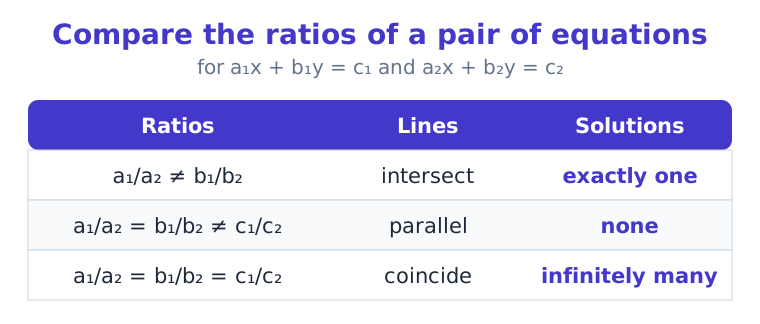
a₁/a₂ ≠ b₁/b₂: one solution. a₁/a₂ = b₁/b₂ ≠ c₁/c₂: none. All three equal: infinitely many.
In word problems, name the unknown, write one equation for each fact, and check the answer in the story.
Full explanation
Riya's number puzzle

Riya thinks of a number, multiplies it by 3 and adds 7. She gets 25. What was her number?
You could guess and check, but SSC questions hide the number behind many steps. An equation undoes the steps one by one.
What makes an equation linear

In a linear equation the variable appears only to the power 1: $3x + 7 = 25$ is linear, $x^2 = 9$ is not.
The equation $ax + b = 0$ with $a \neq 0$ has exactly one root:
$$x = -\frac{b}{a}$$
Solving: keep the balance
Solve $5x - 7 = 2x + 8$.
Take $2x$ from both sides: $3x - 7 = 8$. Add 7: $3x = 15$. Divide by 3: $x = 5$.
Check: $5(5) - 7 = 18$ and $2(5) + 8 = 18$.
Clearing fractions
Solve $\frac{x}{3} + \frac{x}{4} = 7$. The LCM of 3 and 4 is 12. Multiply every term by 12:
$4x + 3x = 84$, so $7x = 84$ and $x = 12$.
Two variables draw a line
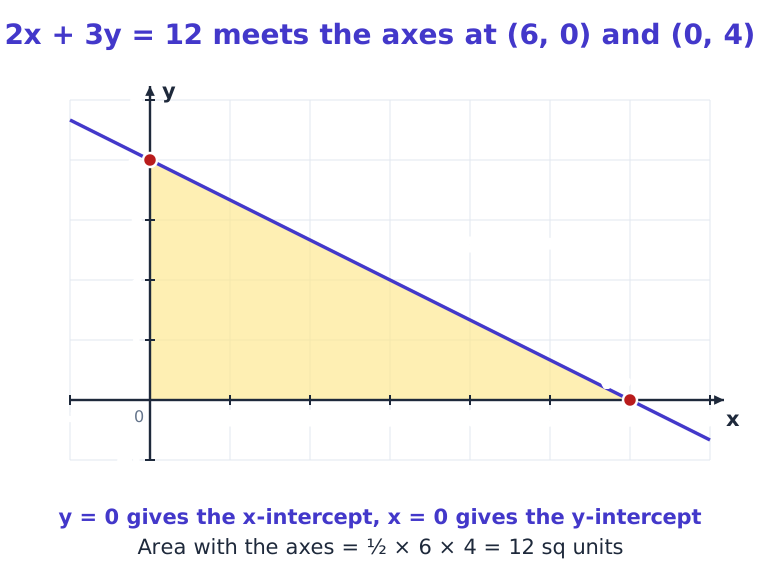
An equation like $2x + 3y = 12$ has many solutions: $(6, 0)$, $(3, 2)$, $(0, 4)$ and more. Plotted, they form a straight line.
Put $y = 0$ to get the x-intercept $6$ and $x = 0$ to get the y-intercept $4$.
Area with the axes
The line $ax + by = c$ cuts off a right triangle with legs $\frac{c}{a}$ and $\frac{c}{b}$, so
$$\text{Area} = \frac{1}{2} \cdot \left|\frac{c}{a}\right| \cdot \left|\frac{c}{b}\right| = \frac{c^2}{2|ab|}$$
For $2x + 3y = 12$: $\frac{144}{12} = 12$ square units.
Solving a pair by elimination
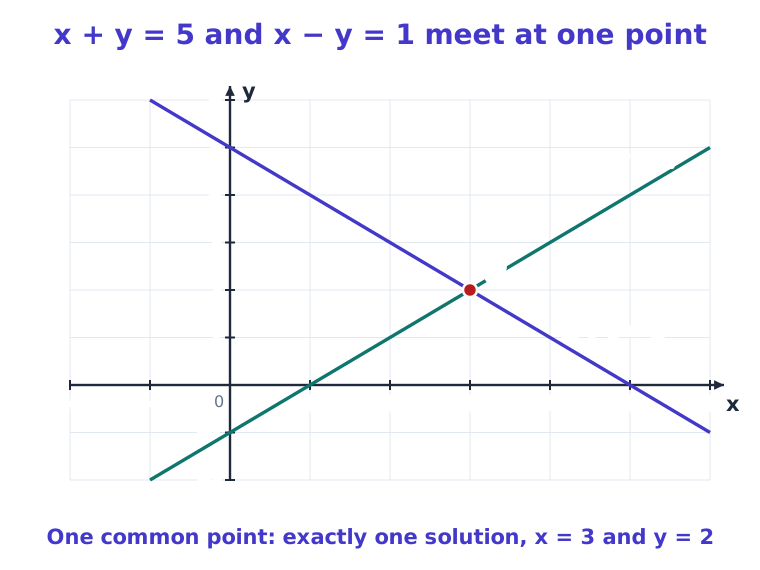
$x + y = 5$ and $x - y = 1$. Add them: $2x = 6$, so $x = 3$. Put it back: $y = 2$.
On a graph the answer is the point where the two lines cross.
The cross-multiplication formula
For $a_1x + b_1y = c_1$ and $a_2x + b_2y = c_2$:
$$x = \frac{c_1b_2 - c_2b_1}{a_1b_2 - a_2b_1}, \quad y = \frac{a_1c_2 - a_2c_1}{a_1b_2 - a_2b_1}$$
Example: $3x + 2y = 12$, $x - y = -1$. Bottom $= 3(-1) - 1(2) = -5$. $x = \frac{12(-1) - (-1)(2)}{-5} = 2$ and $y = \frac{3(-1) - 1(12)}{-5} = 3$.
One, none or infinitely many
Compare $\frac{a_1}{a_2}$, $\frac{b_1}{b_2}$ and $\frac{c_1}{c_2}$. If the first two differ, the lines cross once.
Finding k for no solution
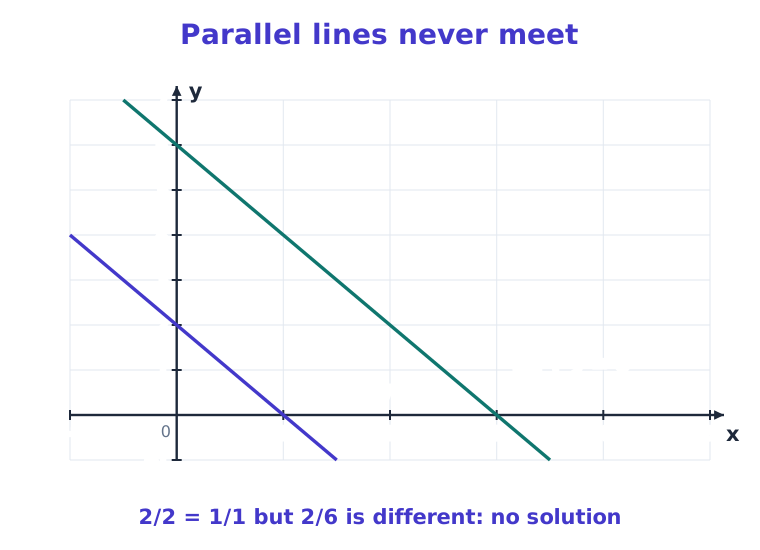
For what $k$ do $kx + 3y = 5$ and $4x + 6y = 7$ have no solution? Need $\frac{k}{4} = \frac{3}{6} \neq \frac{5}{7}$, so $k = 2$.
With $k = 2$ the lines $2x + 3y = 5$ and $4x + 6y = 7$ have the same slope but different intercepts. The graph shows another such pair.
Word problems: ages
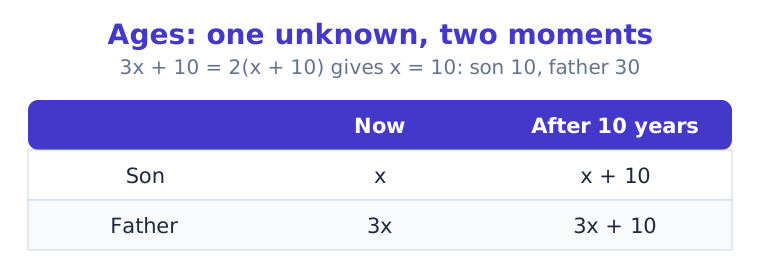
A father is 3 times as old as his son. In 10 years he will be twice as old. Let the son be $x$: $3x + 10 = 2(x + 10)$, so $x = 10$.
Add the years to both people.
Digits and coins
A two-digit number with tens digit $t$ and units digit $u$ is $10t + u$; reversed it is $10u + t$, and the change is $9(u - t)$.
Coins: 30 coins of ₹2 and ₹5 make ₹99. If all were ₹2 they would make ₹60; each ₹5 coin adds ₹3 more, so there are $39 \div 3 = 13$ coins of ₹5.
Back to Riya
$3x + 7 = 25$ gives $3x = 18$, so her number was $x = 6$. Check: $3 \times 6 + 7 = 25$.
Concepts and terms
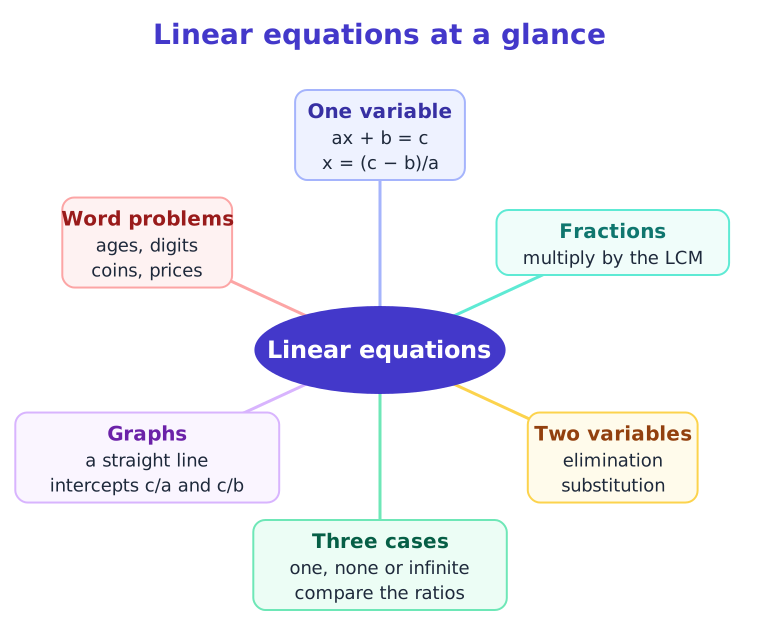
An equation is a balance. 5x − 7 = 18: add 7 to both sides to get 5x = 25, then divide both by 5 to get x = 5.
Each equation in x and y is a line. A solution of the pair is a point on both lines, so it is where they meet.
Lines that cross give one solution, parallel lines give none, and the same line written twice gives infinitely many.
Put y = 0 to find where a line crosses the x-axis and x = 0 for the y-axis. 3x + 4y = 24 crosses at (8, 0) and (0, 6).

Did you know
The word algebra comes from the Arabic al-jabr, "restoring", from a book by al-Khwarizmi written around 820 CE.
Brahmagupta, in 628 CE, gave rules for solving equations and used a name for the unknown, the "yavat-tavat".

Memory tricks
Cross-multiplication — Down minus up, same bottom — x and y both have the bottom a₁b₂ − a₂b₁; the tops swap the c column in for the a or b column.
Three cases — Cross, parallel, same — Different slopes cross (one), equal slopes stay apart (none), equal everything is one line (infinite).
Practice MCQs with answers (82)
- A 4/3
- B 6
- C 32/3
- D −6
Show answer
Why:
3x = 25 − 7 = 18, so x = 18 ÷ 3 = 6.
- A −5
- B 10.6
- C 5
- D 2.2
Show answer
Why:
5x = 18 + 7 = 25, so x = 25 ÷ 5 = 5.
- A −11.75
- B −0.5
- C 5
- D −5
Show answer
Why:
4x = −11 − 9 = −20, so x = −20 ÷ 4 = −5.
- A −6
- B −13.5
- C −11
- D 6
Show answer
Why:
−2x = 17 − 5 = 12, so x = 12 ÷ (−2) = −6.
- A 4
- B −4
- C −10/7
- D −34/7
Show answer
Why:
7x = −31 + 3 = −28, so x = −28 ÷ 7 = −4.
- A −32/3
- B 13/6
- C −1.5
- D 1.5
Show answer
Why:
6x = 2 − 11 = −9, so x = −9 ÷ 6 = −1.5.
- A 1/3
- B 15/7
- C −5
- D 5
Show answer
Why:
x terms to the left, numbers to the right: (5 − 2)x = 8 + 7, so 3x = 15 and x = 5.
- A 5
- B 7
- C 15/11
- D −5
Show answer
Why:
x terms to the left, numbers to the right: (7 − 4)x = 18 − 3, so 3x = 15 and x = 5.
- A 5
- B −5
- C −1
- D 1.25
Show answer
Why:
x terms to the left, numbers to the right: (3 − 5)x = 6 + 4, so −2x = 10 and x = −5.
- A −2.2
- B −15/13
- C −3
- D 3
Show answer
Why:
x terms to the left, numbers to the right: (9 − 4)x = −13 − 2, so 5x = −15 and x = −3.
- A 0.5
- B −1.5
- C −3
- D 3
Show answer
Why:
x terms to the left, numbers to the right: (2 − 6)x = −7 − 5, so −4x = −12 and x = 3.
- A 12
- B 84
- C 6
- D 49
Show answer
Why:
Multiply every term by the LCM 12: 4x + 3x = 84, so 7x = 84 and x = 12.
- A 70/3
- B 10
- C 70
- D 49
Show answer
Why:
Multiply every term by the LCM 10: 5x + 2x = 70, so 7x = 70 and x = 10.
- A 30
- B 50
- C 60
- D 12
Show answer
Why:
Multiply every term by the LCM 12: 3x − 2x = 60, so x = 60.
- A 60
- B 32
- C 7.5
- D 30
Show answer
Why:
Multiply every term by the LCM 15: 5x − 3x = 60, so 2x = 60 and x = 30.
- A 18
- B 75
- C 90
- D 9
Show answer
Why:
Multiply every term by the LCM 18: 3x + 2x = 90, so 5x = 90 and x = 18.
- A −11
- B 11
- C 67/3
- D 12
Show answer
Why:
Multiply by 10: 5(x + 3) − 2(x − 1) = 50, so 3x + 17 = 50, 3x = 33 and x = 11.
- A 2.8
- B 3
- C 2
- D −2
Show answer
Why:
Multiply by 12: 4(2x − 1) − 3(x − 2) = 12, so 5x + 2 = 12, 5x = 10 and x = 2.
- A −15
- B 6
- C −5
- D 5
Show answer
Why:
Multiply by 12: 3(3x − 2) − 4(2x + 1) = −5, so x − 10 = −5 and x = 5.
- A 2
- B 3
- C −2
- D 5
Show answer
Why:
Bottom = 2 × (−1) − 1 × 3 = −5. x = (13 × (−1) − (−1) × 3) ÷ (−5) = 2, y = (2 × (−1) − 1 × 13) ÷ (−5) = 3.
- A −1
- B 1
- C 5
- D 4
Show answer
Why:
Bottom = 1 × (−1) − 1 × 1 = −2. x = (5 × (−1) − 3 × 1) ÷ (−2) = 4, y = (1 × 3 − 1 × 5) ÷ (−2) = 1.
- A 6
- B −5
- C 5
- D −1
Show answer
Why:
Bottom = 3 × (−1) − 1 × 2 = −5. x = (12 × (−1) − (−1) × 2) ÷ (−5) = 2, y = (3 × (−1) − 1 × 12) ÷ (−5) = 3. So x + y = 5.
- A 12
- B 1
- C 7
- D −1
Show answer
Why:
Bottom = 5 × 1 − 2 × (−3) = 11. x = (3 × 1 − 10 × (−3)) ÷ 11 = 3, y = (5 × 10 − 2 × 3) ÷ 11 = 4. So x − y = −1.
- A −6
- B 6
- C −3
- D 1
Show answer
Why:
Bottom = 4 × (−2) − 3 × 3 = −17. x = (6 × (−2) − 13 × 3) ÷ (−17) = 3, y = (4 × 13 − 3 × 6) ÷ (−17) = −2. So xy = −6.
- A −1
- B 2
- C −2
- D 1
Show answer
Why:
Bottom = 7 × 5 − 3 × (−2) = 41. x = (16 × 5 − 1 × (−2)) ÷ 41 = 2, y = (7 × 1 − 3 × 16) ÷ 41 = −1.
- A −5
- B −6
- C −1
- D 1
Show answer
Why:
Bottom = 2 × (−4) − 3 × 5 = −23. x = (4 × (−4) − (−17) × 5) ÷ (−23) = −3, y = (2 × (−17) − 3 × 4) ÷ (−23) = 2. So x + y = −1.
- A 18
- B 27
- C −3
- D 3
Show answer
Why:
No solution needs k/9 = 5/15 ≠ 2/1. So k = 9 × 1/3 = 3, and 1/3 ≠ 2.
- A 3
- B 12
- C −3
- D 14/3
Show answer
Why:
No solution needs k/6 = 2/4 ≠ 7/9. So k = 6 × 1/2 = 3, and 1/2 ≠ 7/9.
- A 16
- B 4
- C −4
- D 6.4
Show answer
Why:
No solution needs k/8 = −3/−6 ≠ 4/5. So k = 8 × 1/2 = 4, and 1/2 ≠ 4/5.
- A −2
- B 6.6
- C 2
- D 4.5
Show answer
Why:
No solution needs k/3 = 4/6 ≠ 11/5. So k = 3 × 2/3 = 2, and 2/3 ≠ 11/5.
- A 3.5
- B 6
- C 7
- D 14
Show answer
Why:
4/2 = 6/3 = 2, so the second line is the first times 2. Infinitely many solutions need k = 2 × 7 = 14.
- A 20
- B −4
- C 5
- D 1.25
Show answer
Why:
12/3 = −4/−1 = 4, so the second line is the first times 4. Infinitely many solutions need k = 4 × 5 = 20.
- A 8/3
- B 24
- C 6
- D 8
Show answer
Why:
15/5 = 6/2 = 3, so the second line is the first times 3. Infinitely many solutions need k = 3 × 8 = 24.
- A −7
- B 8
- C 7
- D 5
Show answer
Why:
Need (k − 1)/2 = (k + 2)/3: 3k − 3 = 2k + 4, so k = 7. Check: each ratio is 3 and 3k/7 = 3.
- A 4
- B 2
- C −3
- D 3
Show answer
Why:
Need (k − 1)/1 = (k + 1)/2: 2k − 2 = k + 1, so k = 3. Check: each ratio is 2 and 2k/3 = 2.
- A (0, 6)
- B (8, 0)
- C (6, 0)
- D (0, 8)
Show answer
Why:
On the y-axis x = 0, so 4y = 24 and y = 6. The point is (0, 6).
- A (0, −10)
- B (4, 0)
- C (0, 4)
- D (−10, 0)
Show answer
Why:
On the x-axis y = 0, so 5x = 20 and x = 4. The point is (4, 0).
- A 40
- B 6
- C 14
- D 20
Show answer
Why:
x-intercept = 20/2 = 10, y-intercept = 20/5 = 4; sum = 14.
- A (−8, 0)
- B (0, 6)
- C (6, 0)
- D (0, −8)
Show answer
Why:
On the y-axis x = 0, so −3y = 24 and y = −8. The point is (0, −8).
- A 24 sq units
- B 14 sq units
- C 288/7 sq units
- D 48 sq units
Show answer
Why:
Intercepts 8 and 6. Area = ½ × 8 × 6 = 24 sq units (or c²/(2|ab|) = 576/24).
- A 14 sq units
- B 20 sq units
- C 200/7 sq units
- D 40 sq units
Show answer
Why:
Intercepts 4 and 10. Area = ½ × 4 × 10 = 20 sq units (or c²/(2|ab|) = 400/20).
- A 800/9 sq units
- B 80 sq units
- C 40 sq units
- D 18 sq units
Show answer
Why:
Intercepts 10 and −8. Area = ½ × 10 × 8 = 40 sq units (or c²/(2|ab|) = 1600/40).
- A 18 sq units
- B 2.5 sq units
- C 6 sq units
- D 9 sq units
Show answer
Why:
The lines cut the y-axis at (0, 5) and (0, −1), a base of 6. They meet at (3, 2), so the height is 3. Area = ½ × 6 × 3 = 9 sq units.
- A 13.5 sq units
- B 27 sq units
- C 4 sq units
- D 9 sq units
Show answer
Why:
The lines cut the y-axis at (0, 8) and (0, −1), a base of 9. They meet at (3, 2), so the height is 3. Area = ½ × 9 × 3 = 13.5 sq units.
- A 36 years
- B 12 years
- C 13 years
- D 48 years
Show answer
Why:
Let the son be x. Then 4x + 24 = 2(x + 24), so 2x = 24 and x = 12. The son is 12 and the father 48.
- A 20 years
- B 10 years
- C 15 years
- D 45 years
Show answer
Why:
Let the daughter be x. Then 3x − 5 = 4(x − 5), so x = 15. The daughter is 15 and the mother 45.
- A 12 years
- B 4 years
- C 32 years
- D 8 years
Show answer
Why:
Let the grandson be x. Then 4x + 4 = 3(x + 4), so x = 8. The grandson is 8 and the grandfather 32.
- A 40 years
- B 20 years
- C 50 years
- D 30 years
Show answer
Why:
Let the son be x. Then 2x − 10 = 3(x − 10), so x = 20. The son is 20 and the father 40.
- A 9 years
- B 15 years
- C 21 years
- D 3 years
Show answer
Why:
Ages 5t and 3t. (5t + 6) : (3t + 6) = 7 : 5 gives 5(5t + 6) = 7(3t + 6), so t = 3. Anil is 5 × 3 = 15 years.
- A 20 years
- B 35 years
- C 30 years
- D 10 years
Show answer
Why:
Ages 3t and 2t. (3t − 5) : (2t − 5) = 5 : 3 gives 3(3t − 5) = 5(2t − 5), so t = 10. Ravi is 3 × 10 = 30 years.
- A 32 years
- B 4 years
- C 36 years
- D 28 years
Show answer
Why:
Ages 7t and 9t. (7t + 4) : (9t + 4) = 4 : 5 gives 5(7t + 4) = 4(9t + 4), so t = 4. Meera is 7 × 4 = 28 years.
- A 35
- B 26
- C 53
- D 44
Show answer
Why:
Let the number be 10t + u. t + u = 8; reversing changes it by 9(u − t) = 18, so u − t = 2. Then t = 3, u = 5 and the number is 35.
- A 18
- B 27
- C 72
- D 36
Show answer
Why:
Let the number be 10t + u. t + u = 9; reversing changes it by 9(u − t) = 45, so u − t = 5. Then t = 2, u = 7 and the number is 27.
- A 38
- B 92
- C 83
- D 74
Show answer
Why:
Let the number be 10t + u. t + u = 11; reversing changes it by 9(u − t) = −45, so u − t = −5. Then t = 8, u = 3 and the number is 83.
- A 25
- B 16
- C 14
- D 15
Show answer
Why:
If all 40 were ₹1: ₹40. The extra ₹15 comes from the dearer ones, ₹1 each, so 15 ÷ 1 = 15.
- A 18
- B 32
- C 19
- D 17
Show answer
Why:
If all 50 were ₹2: ₹100. The extra ₹54 comes from the dearer ones, ₹3 each, so 54 ÷ 3 = 18.
- A 180
- B 100
- C 101
- D 200
Show answer
Why:
If all 300 were ₹20: ₹6000. The extra ₹3000 comes from the dearer ones, ₹30 each, so 3000 ÷ 30 = 100.
- A 75
- B 90
- C 45
- D 46
Show answer
Why:
If all 120 were ₹30: ₹3600. The extra ₹900 comes from the dearer ones, ₹20 each, so 900 ÷ 20 = 45.
- A ₹35
- B ₹16
- C ₹10
- D ₹25
Show answer
Why:
Let the prices be x and y: 3x + 2y = 80 and 2x + 5y = 145. Eliminating gives x = ₹10 and y = ₹25.
- A ₹500
- B ₹1300
- C ₹680
- D ₹800
Show answer
Why:
Let the prices be x and y: 2x + 3y = 3400 and 4x + y = 2800. Eliminating gives x = ₹500 and y = ₹800.
- A ₹100
- B ₹90
- C ₹40
- D ₹130
Show answer
Why:
Let the prices be x and y: 5x + 2y = 380 and 3x + 4y = 480. Eliminating gives x = ₹40 and y = ₹90.
- A 15
- B 13
- C 17
- D 19
Show answer
Why:
Let the smallest be x: 3x + 6 = 45, so x = 13. The numbers are 13, 15, 17; the largest is 17.
- A 18
- B 14
- C 10
- D 16
Show answer
Why:
Let the smallest be x: 4x + 12 = 52, so x = 10. The numbers are 10, 12, 14, 16; the largest is 16.
- A 25
- B 24
- C 21
- D 26
Show answer
Why:
Let the smallest be x: 5x + 10 = 115, so x = 21. The numbers are 21, 22, 23, 24, 25; the largest is 25.
- A 5/3
- B 3/5
- C 4/5
- D 3/4
Show answer
Why:
Let it be x/y. (x + 1)/y = 4/5 and x/(y − 1) = 3/4. Solving the pair gives x = 3, y = 5. Check: 4/5 = 4/5 and 3/4 = 3/4.
- A 5/4
- B 8/5
- C 5/8
- D 5/12
Show answer
Why:
Let it be x/y. (x + 3)/y = 1 and x/(y − 4) = 5/4. Solving the pair gives x = 5, y = 8. Check: 8/8 = 1 and 5/4 = 5/4.
- A 9/4
- B 6/9
- C 4/8
- D 4/9
Show answer
Why:
Let it be x/y. (x + 2)/y = 2/3 and x/(y − 1) = 1/2. Solving the pair gives x = 4, y = 9. Check: 6/9 = 2/3 and 4/8 = 1/2.
- A Exactly one
- B Two
- C None
- D Infinitely many
Show answer
Why:
ax + b = 0 with a ≠ 0 has the single root x = −b/a.
- A a circle
- B a straight line
- C a single point
- D a parabola
Show answer
Why:
All solutions of ax + by = c lie on one straight line.
- A parallel to the x-axis
- B through the origin
- C parallel to the y-axis
- D along the x-axis
Show answer
Why:
x stays 4 while y takes every value, so the line is vertical.
- A (0, 6)
- B (2, 3)
- C (4, 2)
- D (3, 2)
Show answer
Why:
2(3) + 3(2) = 12. The others give 13, 14 and 18.
- A parallel, with no solution
- B coincident, with infinitely many solutions
- C perpendicular, with one solution
- D intersecting, with one solution
Show answer
Why:
Same slope but different intercepts: the lines never meet.
- A increases by 7
- B stays the same
- C increases by 14
- D doubles
Show answer
Why:
Both ages grow by 7, so (A + 7) − (B + 7) = A − B.
- A k = 1
- B k ≠ 3
- C k ≠ 1
- D k = 3
Show answer
Why:
A unique solution needs k/3 ≠ 2/6, that is k ≠ 1. (At k = 1 the lines are the same, since 3/9 = 1/3 too.)
- A Both A and R are true, and R is the correct explanation of A
- B Both A and R are true, but R is not the correct explanation of A
- C A is true but R is false
- D A is false but R is true
Show answer
Why:
Both describe the same line, so every point on it is a solution. R is exactly why A holds.
- A Both A and R are true, and R is the correct explanation of A
- B Both A and R are true, but R is not the correct explanation of A
- C A is true but R is false
- D A is false but R is true
Show answer
Why:
Intercepts are 4 and 3, so the area is ½ × 4 × 3 = 6, not 12. A is false; R is true.
- A 1 only
- B 2 only
- C Both 1 and 2
- D Neither 1 nor 2
Show answer
Why:
All three ratios are 1/2, so the lines are the same: 1 is true and there are infinitely many solutions, so 2 is false.
- A 3x + 4y = 7
- B 4x + 3y = 12
- C 3x − 4y = 12
- D 3x + 4y = 12
Show answer
Why:
Intercept form x/4 + y/3 = 1. Multiply by 12: 3x + 4y = 12.
- A 13/3
- B 5
- C 8/3
- D 3
Show answer
Why:
Add the equations: 3x = 8, so x = 8/3 and y = x − 1 = 5/3. So x + y = 13/3.
- A 24 sq units
- B 12 sq units
- C 10 sq units
- D 6 sq units
Show answer
Why:
½ × 4 × 6 = 12 square units.
- A Exactly two
- B Infinitely many
- C None
- D Exactly one
Show answer
Why:
1/1 = (−2)/(−2) but −2/4 is different, so the lines are parallel and never meet.
- A 8 sq units
- B 32 sq units
- C 12 sq units
- D 16 sq units
Show answer
Why:
y-intercepts 6 and −2 give a base of 8. The lines meet at (4, 2), a height of 4. Area = ½ × 8 × 4 = 16.
Important short questions (4)
Multiply by 10: 5x − 2x = 90, so 3x = 90 and x = 30.
From the second, y = 3x − 3. Then 2x + 9x − 9 = 13, so x = 2 and y = 3.
3/6 = k/10 ≠ 7/11 gives k = 5.
(10u + t) − (10t + u) = 9u − 9t = 9(u − t).
Long answer questions (1)
(a) Let apples cost ₹x and grapes ₹y per kg: 3x + 2y = 540 and 2x + 3y = 560.
(b) Add: 5(x + y) = 1100, so x + y = 220. Subtract: y − x = 20. So y = 120 and x = 100.
(c) 3(100) + 2(120) = 540 and 2(100) + 3(120) = 560. Both match.
Flashcards (14)
Play this topic
- Line check
Quadratic Equations
Solve quadratic equations by splitting the middle term and by the formula, judge the nature of the roots from the discriminant, find k for equal roots, use the sum and product of roots to evaluate α² + β², 1/α + 1/β and similar expressions, form equations from given roots, and find maximum and minimum values.
What you will be able to do
- I can solve a quadratic equation by splitting the middle term or by the formula.
- I can use the discriminant to tell the nature of the roots and to find k for equal roots.
- I can find the sum and product of roots and use them in expressions such as α² + β².
- I can form an equation from its roots.
- I can find the maximum or minimum value of a quadratic expression.
Key points
A quadratic equation is ax² + bx + c = 0 with a ≠ 0; it has at most two roots.
Split the middle term: find two numbers whose product is ac and whose sum is b.
The roots are x = (−b ± √D)/2a, where D = b² − 4ac is the discriminant.
D > 0: two distinct real roots; D = 0: two equal roots; D < 0: no real roots.
Sum of the roots α + β = −b/a; product αβ = c/a.
α² + β² = (α + β)² − 2αβ, and (α − β)² = (α + β)² − 4αβ.
The equation with roots α and β is x² − (α + β)x + αβ = 0.
ax² + bx + c has its lowest (a > 0) or highest (a < 0) value at x = −b/2a; the value is c − b²/4a.
Full explanation
The garden puzzle

A rectangular garden is 2 m longer than it is wide, and its area is 24 m². How wide is it?
Let the width be $x$. Then $x(x + 2) = 24$, or $x^2 + 2x - 24 = 0$. The $x^2$ makes it a quadratic equation.
What a quadratic is
$$ax^2 + bx + c = 0, \quad a \neq 0$$
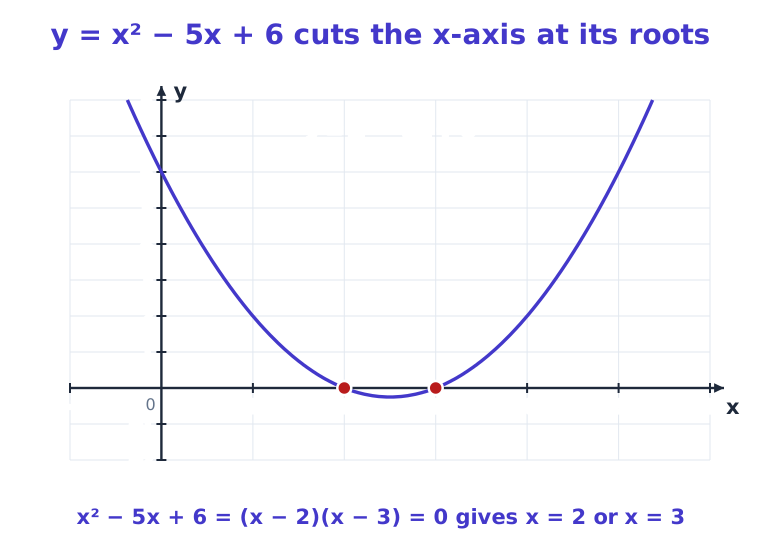
A quadratic has at most two roots. They are the $x$-values where the graph $y = ax^2 + bx + c$ meets the x-axis.
Roots by factorising
For $x^2 - 5x + 6 = 0$ find two numbers with product 6 and sum −5: −2 and −3.
$$x^2 - 5x + 6 = (x - 2)(x - 3) = 0$$
So $x = 2$ or $x = 3$.
When a is not 1
$2x^2 - 7x + 3 = 0$: $ac = 6$. Numbers with product 6 and sum −7: −6 and −1.
$2x^2 - 6x - x + 3 = 2x(x - 3) - 1(x - 3) = (2x - 1)(x - 3)$, so $x = \frac{1}{2}$ or $x = 3$.
The quadratic formula
When factors are hard to spot:
$$x = \frac{-b \pm \sqrt{b^2 - 4ac}}{2a}$$
For $x^2 - 4x + 1 = 0$: $x = \frac{4 \pm \sqrt{12}}{2} = 2 \pm \sqrt{3}$.
The discriminant
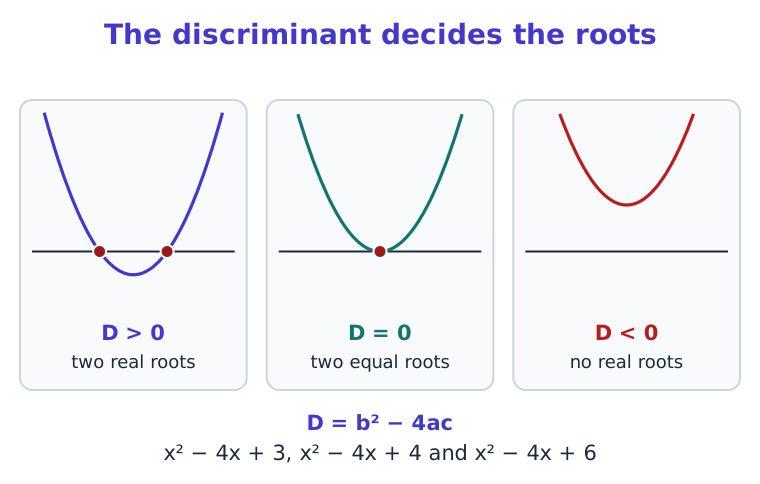
$D = b^2 - 4ac$ tells the story before you solve. If $D$ is a perfect square, the roots are rational too.
Equal roots: find k
$x^2 - 6x + k = 0$ has equal roots when $D = 0$: $36 - 4k = 0$, so $k = 9$, and the equation is $(x - 3)^2 = 0$.
For $x^2 + kx + 16 = 0$: $k^2 = 64$, so $k = \pm 8$.
Sum and product of roots
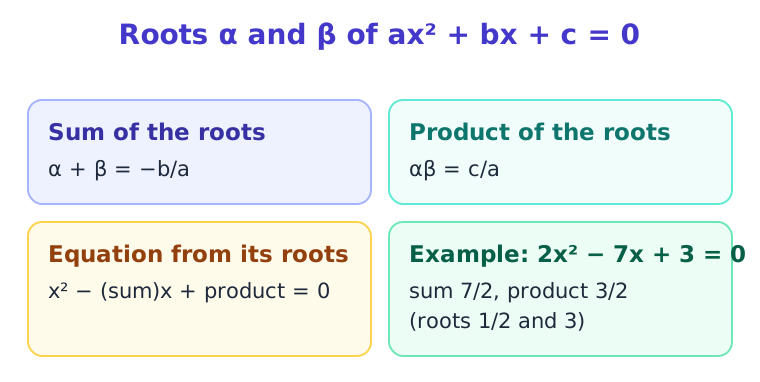
If $\alpha$ and $\beta$ are the roots of $ax^2 + bx + c = 0$:
$$\alpha + \beta = -\frac{b}{a}, \qquad \alpha\beta = \frac{c}{a}$$
Expressions in α and β
With $S = \alpha + \beta$ and $P = \alpha\beta$:
- $\alpha^2 + \beta^2 = S^2 - 2P$
- $\frac{1}{\alpha} + \frac{1}{\beta} = \frac{S}{P}$
- $\frac{\alpha}{\beta} + \frac{\beta}{\alpha} = \frac{S^2 - 2P}{P}$
- $(\alpha - \beta)^2 = S^2 - 4P$
- $\alpha^3 + \beta^3 = S^3 - 3SP$
For $x^2 - 5x + 6 = 0$: $S = 5$, $P = 6$, so $\alpha^2 + \beta^2 = 25 - 12 = 13$ (check: $4 + 9$).
Forming an equation
Roots 3 and −5: sum −2, product −15, so $x^2 + 2x - 15 = 0$.
Roots that are the reciprocals of those of $ax^2 + bx + c = 0$: swap $a$ and $c$ to get $cx^2 + bx + a = 0$.
Maximum and minimum
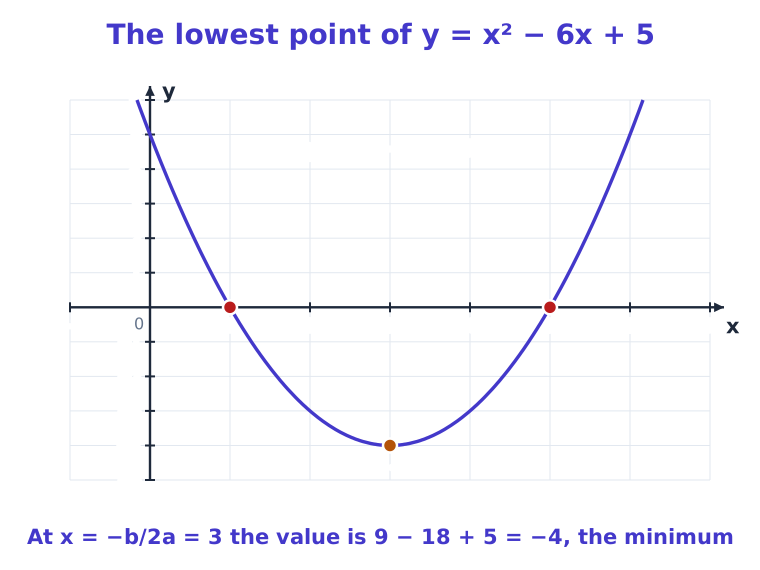
$ax^2 + bx + c$ turns at $x = -\frac{b}{2a}$. With $a > 0$ that is the lowest value, $c - \frac{b^2}{4a}$.
For $x^2 - 6x + 5$: at $x = 3$ the value is $-4$.
An SSC favourite: endless roots
$x = \sqrt{6 + \sqrt{6 + \sqrt{6 + \cdots}}}$. The part under the first root is $x$ again, so $x^2 = 6 + x$.
$x^2 - x - 6 = 0$ gives $(x - 3)(x + 2) = 0$, and since $x > 0$, $x = 3$.
Back to the garden
$x^2 + 2x - 24 = (x + 6)(x - 4) = 0$. A width cannot be −6, so the garden is 4 m wide and 6 m long. Check: $4 \times 6 = 24$.
Concepts and terms
If (x − 2)(x − 3) = 0, one of the brackets must be 0, so x = 2 or x = 3. That is why we factorise.
D = b² − 4ac sits under the square root in the formula. A negative D has no real square root, so no real roots.
Expressions like α² + β² do not change when α and β swap, so they can be written using only α + β and αβ.
y = ax² + bx + c is a U-shaped curve. Its x-axis crossings are the roots and its turning point is the vertex.
Did you know
Sridharacharya, more than a thousand years ago, gave a rule for solving quadratic equations that is the same as today's formula.
A ball thrown in the air follows a parabola; the vertex is its highest point.
Memory tricks
Sum and product — Sum flips b, product keeps c — α + β = −b/a has a minus sign; αβ = c/a does not.
Discriminant cases — Plus two, zero one, minus none — D positive: two crossing points; D zero: one touching point; D negative: no crossing.
Practice MCQs with answers (76)
- A −3 and −2
- B 2 and 3
- C −2 and 3
- D −3 and 2
Show answer
Why:
Two numbers with product 6 and sum −5: −2 and −3. So (x − 2)(x − 3) = 0 and x = 2 or 3.
- A −5 and −2
- B −5 and 2
- C −2 and 5
- D 2 and 5
Show answer
Why:
Two numbers with product −10 and sum −3: 2 and −5. So (x + 2)(x − 5) = 0 and x = −2 or 5.
- A −3 and 4
- B −4 and 3
- C 3 and 4
- D −4 and −3
Show answer
Why:
Two numbers with product 12 and sum 7: 4 and 3. So (x + 4)(x + 3) = 0 and x = −4 or −3.
- A −1 and 6
- B 1 and 6
- C −6 and 1
- D −6 and −1
Show answer
Why:
Two numbers with product −6 and sum −5: −6 and 1. So (x − 6)(x + 1) = 0 and x = 6 or −1.
- A −7 and 8
- B 7 and 8
- C −8 and 7
- D −8 and −7
Show answer
Why:
Two numbers with product 56 and sum −15: −7 and −8. So (x − 7)(x − 8) = 0 and x = 7 or 8.
- A −9 and −4
- B −4 and 9
- C −9 and 4
- D 4 and 9
Show answer
Why:
Two numbers with product −36 and sum 5: 9 and −4. So (x + 9)(x − 4) = 0 and x = −9 or 4.
- A 1 and 3
- B −3 and −1/2
- C 1/3 and 2
- D 1/2 and 3
Show answer
Why:
ac = 6; split −7x so that it factorises: (2x − 1)(x − 3) = 0, so x = 1/2 or x = 3.
- A −1 and 2/3
- B −1 and 2
- C −2/3 and 1
- D −1 and 3/2
Show answer
Why:
ac = −6; split x so that it factorises: (3x − 2)(x + 1) = 0, so x = 2/3 or x = −1.
- A −3 and 2/3
- B −1/3 and 3/2
- C −1 and 3
- D −3/2 and 1/3
Show answer
Why:
ac = −18; split −7x so that it factorises: (2x − 3)(3x + 1) = 0, so x = 3/2 or x = −1/3.
- A −4 and 1/2
- B −1 and 2
- C −1/4 and 2
- D −2 and 1/4
Show answer
Why:
ac = −8; split −7x so that it factorises: (4x + 1)(x − 2) = 0, so x = −1/4 or x = 2.
- A −3/2
- B −7/2
- C 3/2
- D 7/2
Show answer
Why:
Sum = −b/a = 7/2.
- A −2/3
- B 2/3
- C −5/3
- D 5/3
Show answer
Why:
Product = c/a = −2/3.
- A −9/4
- B 9/4
- C 3
- D −3
Show answer
Why:
Product = c/a = 9/4.
- A −3
- B −5/2
- C 3
- D 5/2
Show answer
Why:
Sum = −b/a = −6/(−2) = 3.
- A x² − 2x − 15 = 0
- B x² + 2x + 15 = 0
- C x² − 2x + 15 = 0
- D x² + 2x − 15 = 0
Show answer
Why:
Sum = −2, product = −15. The equation is x² − (sum)x + product = 0, that is x² + 2x − 15 = 0.
- A x² − 9x + 14 = 0
- B x² + 9x + 14 = 0
- C x² − 9x − 14 = 0
- D x² + 9x − 14 = 0
Show answer
Why:
Sum = 9, product = 14. The equation is x² − (sum)x + product = 0, that is x² − 9x + 14 = 0.
- A x² − 10x − 24 = 0
- B x² + 10x + 24 = 0
- C x² − 10x + 24 = 0
- D x² + 10x − 24 = 0
Show answer
Why:
Sum = −10, product = 24. The equation is x² − (sum)x + product = 0, that is x² + 10x + 24 = 0.
- A x² + 5x − 24 = 0
- B x² − 5x + 24 = 0
- C x² − 5x − 24 = 0
- D x² + 5x + 24 = 0
Show answer
Why:
Sum = 5, product = −24. The equation is x² − (sum)x + product = 0, that is x² − 5x − 24 = 0.
- A 6x² − x + 2 = 0
- B 6x² + x + 2 = 0
- C 6x² + x − 2 = 0
- D 6x² − x − 2 = 0
Show answer
Why:
x = 2/3 gives the factor (3x − 2) and x = −1/2 gives (2x + 1). Multiply: 6x² − x − 2 = 0.
- A 4x² − 13x + 3 = 0
- B 4x² + 13x + 3 = 0
- C 4x² − 13x − 3 = 0
- D 4x² + 13x − 3 = 0
Show answer
Why:
x = 1/4 gives the factor (4x − 1) and x = 3 gives (x − 3). Multiply: 4x² − 13x + 3 = 0.
- A 6x² + x + 15 = 0
- B 6x² − x − 15 = 0
- C 6x² + x − 15 = 0
- D 6x² − x + 15 = 0
Show answer
Why:
x = −3/2 gives the factor (2x + 3) and x = 5/3 gives (3x − 5). Multiply: 6x² − x − 15 = 0.
- A 49
- B −1
- C 1
- D 13
Show answer
Why:
D = b² − 4ac = (−5)² − 4 × 1 × 6 = 25 − 24 = 1.
- A −41
- B 25
- C −23
- D 41
Show answer
Why:
D = b² − 4ac = 3² − 4 × 2 × (−4) = 9 − (−32) = 41.
- A −56
- B 56
- C −26
- D 64
Show answer
Why:
D = b² − 4ac = (−2)² − 4 × 3 × 5 = 4 − 60 = −56.
- A One real root and one non-real root
- B Two equal real roots
- C Two distinct real roots
- D No real roots
Show answer
Why:
D = 16 − 16 = 0, which is zero.
- A Two distinct real roots
- B Two equal real roots
- C No real roots
- D One real root and one non-real root
Show answer
Why:
D = 9 − 40 = −31, which is negative.
- A Two equal real roots
- B No real roots
- C One real root and one non-real root
- D Two distinct real roots
Show answer
Why:
D = 25 − (−24) = 49, which is positive.
- A Two equal real roots
- B One real root and one non-real root
- C Two distinct real roots
- D No real roots
Show answer
Why:
D = 144 − 144 = 0, which is zero.
- A 64
- B 8
- C 32
- D 4
Show answer
Why:
Equal roots need D = 0: k² − 4 × 1 × 16 = 0, so k² = 64 and k = 8.
- A −9
- B 18
- C 9
- D 3
Show answer
Why:
D = 0: 36 − 4k = 0, so k = 9.
- A 8
- B 1/4
- C 36
- D 4
Show answer
Why:
D = 0: 144 − 36k = 0, so k = 4.
- A 20
- B 10
- C 400
- D 200
Show answer
Why:
Equal roots need D = 0: k² − 4 × 4 × 25 = 0, so k² = 400 and k = 20.
- A 36
- B 12
- C 24
- D 6
Show answer
Why:
D = 0: 144 − 12k = 0, so k = 12.
- A 25
- B 19
- C 13
- D 37
Show answer
Why:
S = α + β = 5, P = αβ = 6. α² + β² = S² − 2P = 13.
- A −7/12
- B 1/7
- C 12/7
- D 7/12
Show answer
Why:
S = α + β = 7, P = αβ = 12. 1/α + 1/β = S/P = 7/12.
- A 13/6
- B 37/6
- C 13/4
- D 25/6
Show answer
Why:
S = α + β = 5/2, P = αβ = 3/2. α/β + β/α = (S² − 2P)/P = 13/6.
- A 5
- B 2
- C 4
- D 8
Show answer
Why:
S = α + β = 8, P = αβ = 15. α − β = √(S² − 4P) = 2.
- A 56
- B 64
- C 40
- D 88
Show answer
Why:
S = α + β = 4, P = αβ = 2. α³ + β³ = S³ − 3SP = 40.
- A 10/3
- B 16/3
- C 4
- D 8/3
Show answer
Why:
S = α + β = 2, P = αβ = 2/3. α² + β² = S² − 2P = 8/3.
- A 29/100
- B −29/10
- C 9/100
- D −11/100
Show answer
Why:
S = α + β = −3, P = αβ = −10. 1/α² + 1/β² = (S² − 2P)/P² = 29/100.
- A 11
- B 7
- C 28
- D 9
Show answer
Why:
S = α + β = 6, P = αβ = 4. α/β + β/α = (S² − 2P)/P = 7.
- A 23
- B 14
- C 5
- D 3
Show answer
Why:
The lowest value is at x = −b/2a = 3: (3)² − 6(3) + 14 = 5. (Or c − b²/4a = 14 − 9.)
- A −4
- B 26
- C 10
- D −6
Show answer
Why:
The lowest value is at x = −b/2a = −4: (−4)² + 8(−4) + 10 = −6. (Or c − b²/4a = 10 − 16.)
- A 9
- B 1
- C 5
- D 2
Show answer
Why:
The highest value is at x = −b/2a = 2: −(2)² + 4(2) + 5 = 9. (Or c − b²/4a = 5 − (−4).)
- A 11
- B −5
- C 3
- D 2
Show answer
Why:
The lowest value is at x = −b/2a = 2: 2(2)² − 8(2) + 3 = −5. (Or c − b²/4a = 3 − 8.)
- A −19
- B −7
- C 5
- D 2
Show answer
Why:
The highest value is at x = −b/2a = 2: −3(2)² + 12(2) − 7 = 5. (Or c − b²/4a = −7 − (−12).)
- A −2
- B 5
- C 2
- D −5
Show answer
Why:
Product of the roots = −10, so the other root = −10 ÷ 2 = −5. (Then k = −(2 + (−5)) = 3.)
- A 1
- B −4
- C −7
- D −1
Show answer
Why:
Put x = 3: 9 + 3k − 12 = 0, so 3k = 3 and k = 1.
- A −2
- B 6
- C 2
- D −6
Show answer
Why:
Put x = −4: 16 − 4k + 8 = 0, so −4k = −24 and k = 6.
- A −3
- B 5
- C 3
- D −5
Show answer
Why:
Product of the roots = 15, so the other root = 15 ÷ 5 = 3. (Then k = −(5 + 3) = −8.)
- A 11
- B 12
- C 14
- D 13
Show answer
Why:
x(x + 1) = 156 gives x² + x − 156 = 0 = (x − 12)(x + 13), so x = 12 and the larger is 13.
- A 4 m
- B 6 m
- C 3 m
- D 5 m
Show answer
Why:
x(x + 2) = 24 gives x² + 2x − 24 = 0 = (x − 4)(x + 6). Breadth = 4 m, length = 6 m.
- A 10 m
- B 9 m
- C 14 m
- D 8 m
Show answer
Why:
x(x + 5) = 126 gives x² + 5x − 126 = 0 = (x − 9)(x + 14). Breadth = 9 m, length = 14 m.
- A 7
- B 11
- C 9
- D 8
Show answer
Why:
x² + (x + 2)² = 130 gives 2x² + 4x + 4 = 130, x² + 2x − 63 = 0 = (x − 7)(x + 9). So x = 7 and the larger is 9.
- A 9
- B 1/3
- C 4
- D 3
Show answer
Why:
x + 1/x = 10/3 gives 3x² − 10x + 3 = 0 = (3x − 1)(x − 3), so x = 3 or 1/3. The one greater than 1 is 3.
- A 21
- B 20
- C 22
- D 19
Show answer
Why:
x(x + 1) = 420 gives x² + x − 420 = 0 = (x − 20)(x + 21), so x = 20 and the larger is 21.
- A 6
- B 3
- C 4
- D 2
Show answer
Why:
Let x = √(6 + √(6 + √(6 + …))). Then x² = 6 + x, so x² − x − 6 = 0 = (x − 3)(x + 2). As x > 0, x = 3.
- A 6
- B 4
- C 5
- D 20
Show answer
Why:
Let x = √(20 + √(20 + √(20 + …))). Then x² = 20 + x, so x² − x − 20 = 0 = (x − 5)(x + 4). As x > 0, x = 5.
- A 4
- B 12
- C 2
- D 3
Show answer
Why:
Let x = √(12 − √(12 − √(12 − …))). Then x² = 12 − x, so x² + x − 12 = 0 = (x − 3)(x + 4). As x > 0, x = 3.
- A 6x² − 5x + 1 = 0
- B x² + 5x + 6 = 0
- C 6x² + 5x + 1 = 0
- D x² − 10x + 24 = 0
Show answer
Why:
Put 1/x for x and clear fractions: a and c swap. The answer is 6x² − 5x + 1 = 0.
- A 5x² + 3x − 2 = 0
- B 2x² + 6x − 20 = 0
- C 5x² − 3x − 2 = 0
- D 2x² − 3x − 5 = 0
Show answer
Why:
Put x/2 for x and multiply by 4: b doubles and c becomes 4c. The answer is 2x² + 6x − 20 = 0.
- A 10x² + 7x + 1 = 0
- B 10x² − 7x + 1 = 0
- C x² + 7x + 10 = 0
- D x² − 14x + 40 = 0
Show answer
Why:
Put −x for x: the sign of b flips. The answer is x² + 7x + 10 = 0.
- A Infinitely many
- B One
- C Three
- D Two
Show answer
Why:
A polynomial of degree 2 has at most 2 roots.
- A real and equal
- B not real
- C both zero
- D real and unequal
Show answer
Why:
With D = 0 both roots are −b/2a.
- A −c/a
- B −b/a
- C b/a
- D c/a
Show answer
Why:
α + β = −b/a and αβ = c/a.
- A equal
- B not real
- C real, one positive and one negative
- D both positive
Show answer
Why:
ac < 0 makes D = b² − 4ac > 0, and the product c/a is negative.
- A never meets the y-axis
- B opens upwards and has a lowest point
- C is a straight line
- D opens downwards and has a highest point
Show answer
Why:
A negative a turns the U upside down.
- A q = 0
- B q = 1
- C p = 0
- D p = q
Show answer
Why:
Put x = 0: 0 + 0 + q = 0, so q = 0.
- A Both A and R are true, and R is the correct explanation of A
- B Both A and R are true, but R is not the correct explanation of A
- C A is true but R is false
- D A is false but R is true
Show answer
Why:
D = −4 < 0, which is exactly why there are no real roots.
- A Both A and R are true, and R is the correct explanation of A
- B Both A and R are true, but R is not the correct explanation of A
- C A is true but R is false
- D A is false but R is true
Show answer
Why:
(x − 3)(x − 4) = 0, so A is true. The sum is −b/a, not b/a, so R is false.
- A 1 only
- B 2 only
- C Both 1 and 2
- D Neither 1 nor 2
Show answer
Why:
Sum = 8/2 = 4, true. Product = 6/2 = 3, not −3, so 2 is false.
- A 1 only
- B 2 only
- C Both 1 and 2
- D Neither 1 nor 2
Show answer
Why:
D = 36 − 36 = 0, and x² − 6x + 9 = (x − 3)², so both are true.
- A x² + 3x − 4 = 0
- B x² − 3x − 4 = 0
- C x² − 3x + 4 = 0
- D x² + 3x + 4 = 0
Show answer
Why:
Roots −1 and 4: sum 3, product −4, so x² − 3x − 4 = 0.
- A 7.25
- B 5
- C 2.75
- D 1.5
Show answer
Why:
At x = 1.5: 2.25 − 4.5 + 5 = 2.75. (Or c − b²/4a = 5 − 2.25 = 2.75.)
- A D = 0
- B D > 0
- C D is a perfect square
- D D < 0
Show answer
Why:
The curve never meets the x-axis, so there are no real roots: D = 4 − 12 = −8 < 0.
- A 9
- B 36
- C 6
- D 3
Show answer
Why:
Touching means equal roots: D = 36 − 4k = 0, so k = 9. Indeed x² − 6x + 9 = (x − 3)².
Important short questions (4)
(x − 4)(x + 3) = 0, so x = 4 or x = −3.
k² − 64 = 0, so k = 8 or k = −8.
S = 6, P = 7; α² + β² = 36 − 14 = 22.
−4ac is then positive, so D = b² − 4ac is at least b² and greater than 0.
Long answer questions (1)
(a) α + β = 5/2, αβ = 1.
(b) α² + β² = 25/4 − 2 = 17/4; 1/α + 1/β = (5/2) ÷ 1 = 5/2.
(c) Sum 5/2, product 1: x² − (5/2)x + 1 = 0, or 2x² − 5x + 2 = 0. It is the same equation, because the roots 2 and 1/2 are reciprocals of each other.
Flashcards (14)
Play this topic
- Root check
Algebraic Identities
Use the square and cube identities to evaluate expressions without finding the variables: x + 1/x and x − 1/x chains, a + b and ab given, three-variable sums, a + b + c = 0, surds like 2 + √3, sums of squares that equal zero, and quick numerical work such as 987² − 13².
What you will be able to do
- I can expand (a ± b)², (a ± b)³ and factorise a² − b², a³ ± b³.
- I can go from x + 1/x or x − 1/x to higher powers.
- I can find a² + b² or a³ + b³ from a + b and ab.
- I can use a + b + c = 0 and the three-variable identities.
- I can simplify numerical expressions with identities.
Key points
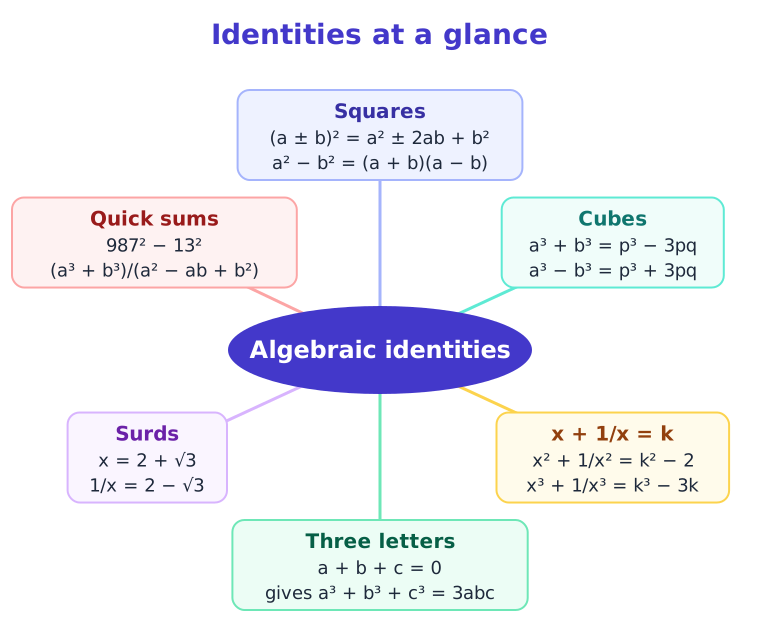
(a + b)² = a² + 2ab + b² and (a − b)² = a² − 2ab + b².
a² − b² = (a + b)(a − b): 987² − 13² = 1000 × 974.
a³ + b³ = (a + b)³ − 3ab(a + b) and a³ − b³ = (a − b)³ + 3ab(a − b).
If x + 1/x = k: x² + 1/x² = k² − 2 and x³ + 1/x³ = k³ − 3k.
If x − 1/x = k: x² + 1/x² = k² + 2 and x³ − 1/x³ = k³ + 3k.
x² − kx + 1 = 0 means x + 1/x = k (divide by x).
(a + b + c)² = a² + b² + c² + 2(ab + bc + ca).
If a + b + c = 0, then a³ + b³ + c³ = 3abc.
If a sum of squares is 0, each square is 0.
Full explanation
A square in your head
What is $103^2$? Multiplying 103 by 103 takes time. But $103 = 100 + 3$, and squares of sums follow a fixed pattern.
Identities are such patterns. They are true for every value, so they turn long sums into short ones.
(a + b)² as a picture
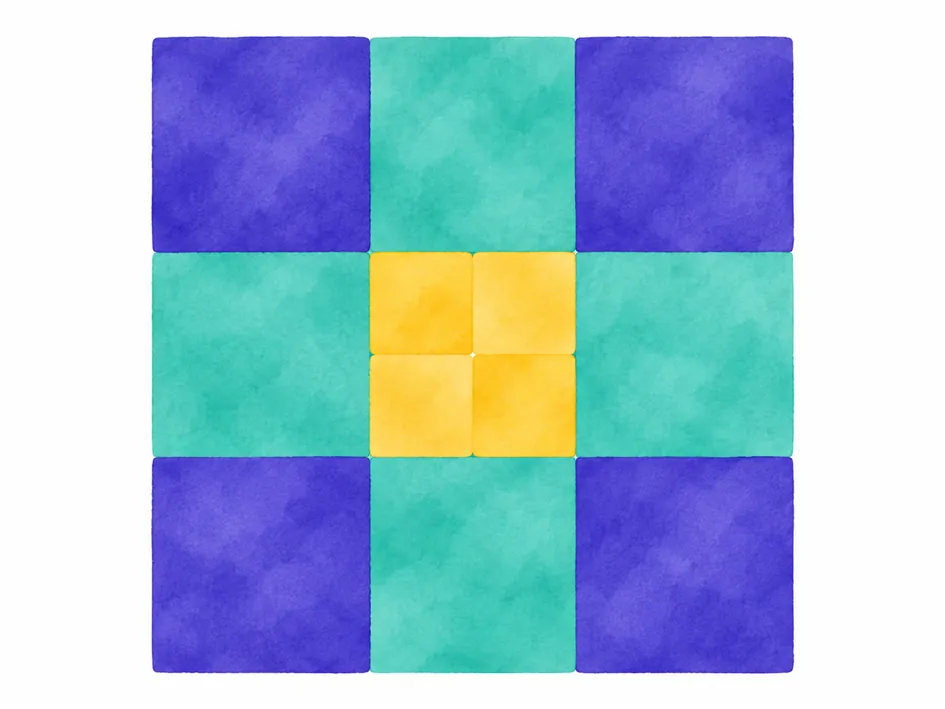
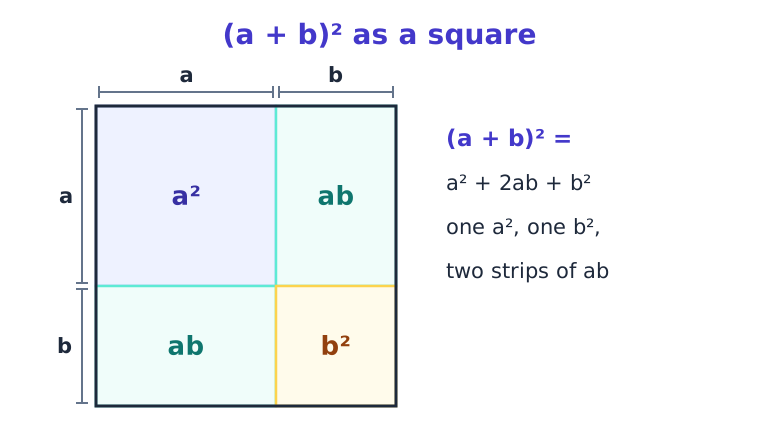
A square of side $a + b$ splits into a square $a^2$, a square $b^2$ and two strips of area $ab$:
$$(a + b)^2 = a^2 + 2ab + b^2$$
(a − b)² and the difference of squares
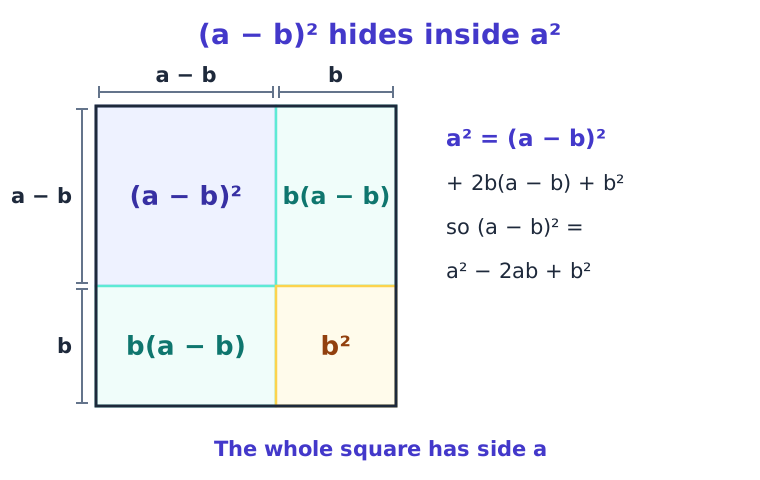
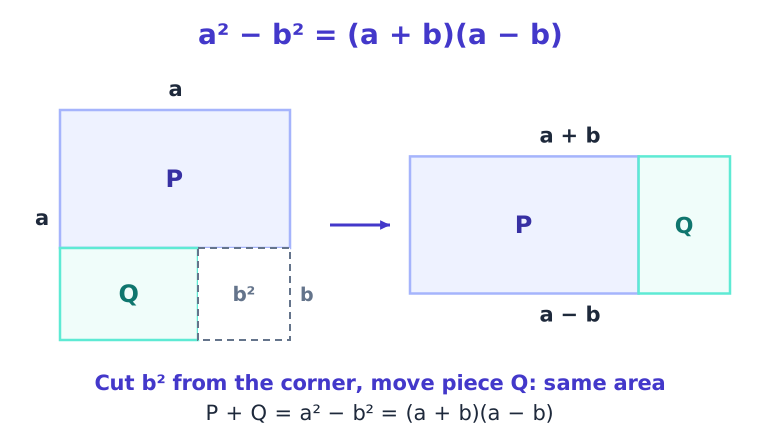
Inside a square of side $a$ sits a square of side $a - b$. Taking the two strips away and adding back the corner gives
$$(a - b)^2 = a^2 - 2ab + b^2$$
Quick numbers
$987^2 - 13^2 = (987 + 13)(987 - 13) = 1000 \times 974 = 974000$.
$48 \times 52 = (50 - 2)(50 + 2) = 2500 - 4 = 2496$.
Cubes
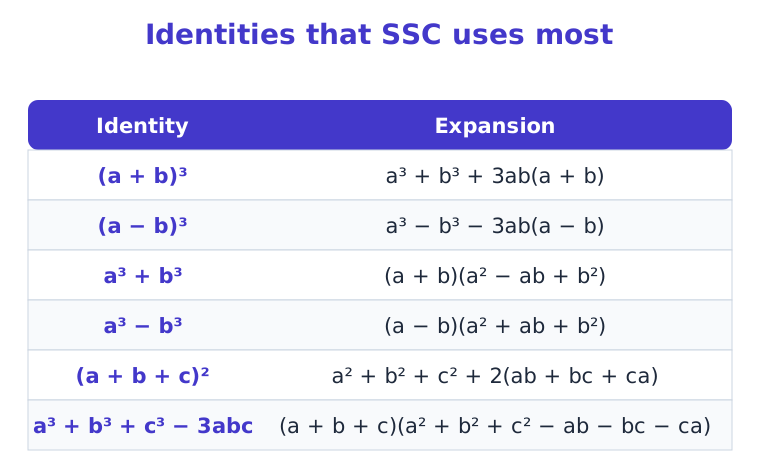
$(a + b)^3 = a^3 + b^3 + 3ab(a + b)$, so
$$a^3 + b^3 = (a + b)^3 - 3ab(a + b)$$
If $a + b = 7$ and $ab = 12$: $a^2 + b^2 = 49 - 24 = 25$ and $a^3 + b^3 = 343 - 252 = 91$. (Check: $a = 3$, $b = 4$.)
The x + 1/x family
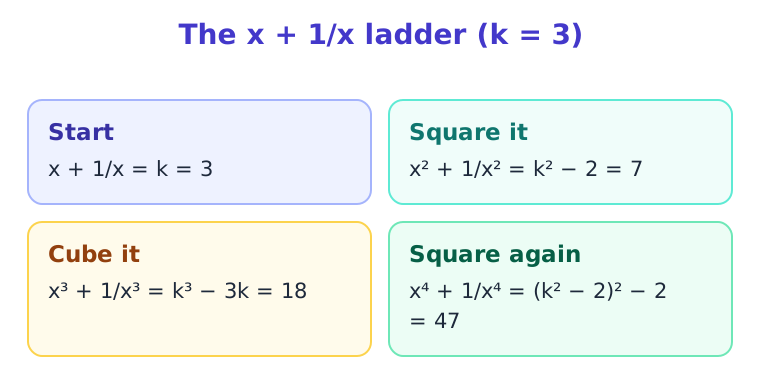
If $x + \frac{1}{x} = k$, squaring gives $x^2 + 2 + \frac{1}{x^2} = k^2$, so
$$x^2 + \frac{1}{x^2} = k^2 - 2, \qquad x^3 + \frac{1}{x^3} = k^3 - 3k$$
x − 1/x and hidden forms
If $x - \frac{1}{x} = k$: $x^2 + \frac{1}{x^2} = k^2 + 2$ and $x^3 - \frac{1}{x^3} = k^3 + 3k$.
A question may hide $x + \frac{1}{x}$: from $x^2 - 5x + 1 = 0$, divide by $x$ to get $x + \frac{1}{x} = 5$.
Surds that pair up
$x = 2 + \sqrt{3}$. Since $(2 + \sqrt{3})(2 - \sqrt{3}) = 1$, we get $\frac{1}{x} = 2 - \sqrt{3}$, so $x + \frac{1}{x} = 4$ and $x^2 + \frac{1}{x^2} = 16 - 2 = 14$.
Three letters
$(a + b + c)^2 = a^2 + b^2 + c^2 + 2(ab + bc + ca)$, and
$$a^3 + b^3 + c^3 - 3abc = (a + b + c)(a^2 + b^2 + c^2 - ab - bc - ca)$$
So if $a + b + c = 0$, then $a^3 + b^3 + c^3 = 3abc$. Example: $13^3 - 7^3 - 6^3 = 3 \times 13 \times (-7) \times (-6) = 1638$.
Squares that add to zero
$a^2 + b^2 - 2a + 4b + 5 = 0$ regroups as $(a - 1)^2 + (b + 2)^2 = 0$. A square is never negative, so both are 0: $a = 1$, $b = -2$.
Back to 103²
$(100 + 3)^2 = 10000 + 600 + 9 = 10609$. With identities, the answer takes one line.
Concepts and terms
An equation like 2x + 1 = 7 holds for one x. An identity like (x + 1)² = x² + 2x + 1 holds for every x.
(x + 1/x)² = x² + 2·x·(1/x) + 1/x² and x·(1/x) = 1, so the middle term is just 2.
(2 + √3)(2 − √3) = 4 − 3 = 1, so 1/(2 + √3) = 2 − √3 and x + 1/x = 4.
a³ + b³ + c³ − 3abc has the factor a + b + c, so when a + b + c = 0 the cubes add up to 3abc.
Did you know
Euclid proved (a + b)² = a² + 2ab + b² around 300 BCE using a drawing of a square, with no algebra symbols at all.
Vedic maths uses (a − b)(a + b) for products like 48 × 52 = 50² − 2² = 2496.
Memory tricks
x + 1/x powers — Square minus 2, cube minus 3k — k² − 2 for squares, k³ − 3k for cubes; with x − 1/x the minus signs turn to plus.
a³ + b³ factors — Same, opposite, always plus — a³ + b³ = (a + b)(a² − ab + b²): the first sign is the same, the middle sign is opposite, the last is always plus.
Practice MCQs with answers (73)
- A 8
- B 7
- C 11
- D 9
Show answer
Why:
Square: x² + 2 + 1/x² = 9, so x² + 1/x² = 9 − 2 = 7.
- A 15
- B 18
- C 14
- D 16
Show answer
Why:
Square: x² + 2 + 1/x² = 16, so x² + 1/x² = 16 − 2 = 14.
- A 120
- B 140
- C 125
- D 110
Show answer
Why:
x³ + 1/x³ = (x + 1/x)³ − 3(x + 1/x) = 125 − 15 = 110.
- A 18
- B 27
- C 24
- D 36
Show answer
Why:
x³ + 1/x³ = (x + 1/x)³ − 3(x + 1/x) = 27 − 9 = 18.
- A 14
- B 2
- C 4
- D 6
Show answer
Why:
x² + 1/x² = 4 − 2 = 2; square again: x⁴ + 1/x⁴ = 2² − 2 = 2.
- A 254
- B 196
- C 194
- D 198
Show answer
Why:
x² + 1/x² = 16 − 2 = 14; square again: x⁴ + 1/x⁴ = 14² − 2 = 194.
- A 216
- B 210
- C 234
- D 198
Show answer
Why:
x³ + 1/x³ = (x + 1/x)³ − 3(x + 1/x) = 216 − 18 = 198.
- A 3
- B 3√5
- C 7
- D 5
Show answer
Why:
Square: x² + 1/x² = (√5)² − 2 = 5 − 2 = 3.
- A 7√7
- B 4√7
- C 10√7
- D 4
Show answer
Why:
x³ + 1/x³ = k³ − 3k with k = √7: 7√7 − 3√7 = 4√7.
- A 18
- B 16
- C 14
- D 34
Show answer
Why:
x² + 1/x² = 6 − 2 = 4; x⁴ + 1/x⁴ = 4² − 2 = 14.
- A 5
- B 2
- C 4
- D 6
Show answer
Why:
Square: x² − 2 + 1/x² = 4, so x² + 1/x² = 4 + 2 = 6.
- A 36
- B 27
- C 30
- D 18
Show answer
Why:
x³ − 1/x³ = (x − 1/x)³ + 3(x − 1/x) = 27 + 9 = 36.
- A 16
- B 18
- C 17
- D 14
Show answer
Why:
Square: x² − 2 + 1/x² = 16, so x² + 1/x² = 16 + 2 = 18.
- A −1
- B 9
- C 7
- D 11
Show answer
Why:
x² + 1/x² = 1 + 2 = 3; x⁴ + 1/x⁴ = 3² − 2 = 7.
- A 110
- B 125
- C 130
- D 140
Show answer
Why:
x³ − 1/x³ = (x − 1/x)³ + 3(x − 1/x) = 125 + 15 = 140.
- A 4
- B 16
- C 5
- D 12
Show answer
Why:
(x + 1/x)² = x² + 1/x² + 2 = 16, so x + 1/x = 4.
- A 4
- B 3
- C 5
- D 9
Show answer
Why:
(x + 1/x)² = x² + 1/x² + 2 = 9, so x + 1/x = 3.
- A 9
- B 13
- C 3
- D 4
Show answer
Why:
(x − 1/x)² = x² + 1/x² − 2 = 9, so x − 1/x = 3 (positive since x > 1).
- A 9
- B 7
- C 4
- D 3
Show answer
Why:
(x² + 1/x²)² = 47 + 2 = 49, so x² + 1/x² = 7. Then (x + 1/x)² = 7 + 2 = 9, so x + 1/x = 3.
- A 4
- B 16
- C 14
- D 5
Show answer
Why:
(x² + 1/x²)² = 194 + 2 = 196, so x² + 1/x² = 14. Then (x + 1/x)² = 14 + 2 = 16, so x + 1/x = 4.
- A 15
- B 14
- C 18
- D 16
Show answer
Why:
Divide by x: x + 1/x = 4. Then x² + 1/x² = 16 − 2 = 14.
- A 120
- B 140
- C 110
- D 125
Show answer
Why:
Divide by x: x + 1/x = 5. Then x³ + 1/x³ = 125 − 15 = 110.
- A 36
- B 27
- C 24
- D 18
Show answer
Why:
Divide by x: x + 1/x = 3. Then x³ + 1/x³ = 27 − 9 = 18.
- A 34
- B 35
- C 38
- D 36
Show answer
Why:
Divide by x: x + 1/x = 6. Then x² + 1/x² = 36 − 2 = 34.
- A 18
- B 14
- C 12
- D 16
Show answer
Why:
(2 + √3)(2 − √3) = 4 − 3 = 1, so 1/x = 2 − √3 and x + 1/x = 4, so x² + 1/x² = 16 − 2 = 14.
- A 2√8
- B 3
- C 6
- D 16
Show answer
Why:
(3 + √8)(3 − √8) = 9 − 8 = 1, so 1/x = 3 − √8 and x + 1/x = 6.
- A 60
- B 64
- C 76
- D 52
Show answer
Why:
(2 + √3)(2 − √3) = 4 − 3 = 1, so 1/x = 2 − √3 and x + 1/x = 4, so x³ + 1/x³ = 64 − 12 = 52.
- A 62
- B 64
- C 66
- D 60
Show answer
Why:
(4 + √15)(4 − √15) = 16 − 15 = 1, so 1/x = 4 − √15 and x + 1/x = 8, so x² + 1/x² = 64 − 2 = 62.
- A 990
- B 970
- C 1000
- D 1030
Show answer
Why:
(5 + √24)(5 − √24) = 25 − 24 = 1, so 1/x = 5 − √24 and x + 1/x = 10, so x³ + 1/x³ = 1000 − 30 = 970.
- A 5
- B 8
- C 10
- D 12
Show answer
Why:
(√3 + √2)(√3 − √2) = 3 − 2 = 1, so 1/x = √3 − √2. x + 1/x = 2√3, so x² + 1/x² = 4 × 3 − 2 = 10.
- A 24
- B 11
- C 20
- D 22
Show answer
Why:
(√6 + √5)(√6 − √5) = 6 − 5 = 1, so 1/x = √6 − √5. x + 1/x = 2√6, so x² + 1/x² = 4 × 6 − 2 = 22.
- A 25
- B 37
- C 49
- D 73
Show answer
Why:
a² + b² = (a + b)² − 2ab = 49 − 24 = 25.
- A 273
- B 133
- C 313
- D 553
Show answer
Why:
a³ + b³ = (a + b)³ − 3ab(a + b) = 343 − 210 = 133.
- A 16
- B 58
- C 4
- D 6
Show answer
Why:
(a − b)² = (a + b)² − 4ab = 100 − 84 = 16, so a − b = 4.
- A 19
- B 9
- C −11
- D 29
Show answer
Why:
a² + b² = (a − b)² + 2ab = 9 + 20 = 29.
- A 63
- B −9
- C 39
- D 64
Show answer
Why:
a³ − b³ = (a − b)³ + 3ab(a − b) = 27 + 36 = 63.
- A 40
- B 8
- C 10
- D 64
Show answer
Why:
(a + b)² = (a − b)² + 4ab = 16 + 48 = 64, so a + b = 8.
- A 928
- B 1720
- C 280
- D 760
Show answer
Why:
a³ + b³ = (a + b)³ − 3ab(a + b) = 1000 − 720 = 280.
- A 49
- B 61
- C 43
- D 37
Show answer
Why:
a² + b² = (a + b)² − 2ab = 49 − 12 = 37.
- A 14
- B 25
- C 36
- D 58
Show answer
Why:
a² + b² + c² = (a + b + c)² − 2(ab + bc + ca) = 36 − 22 = 14.
- A 10
- B 26
- C 52
- D 55
Show answer
Why:
2(ab + bc + ca) = (a + b + c)² − (a² + b² + c²) = 81 − 29 = 52, so ab + bc + ca = 26.
- A 147
- B 245
- C 49
- D 7
Show answer
Why:
a² + b² + c² = 49 − 28 = 21. Then a³ + b³ + c³ − 3abc = (a + b + c)(a² + b² + c² − ab − bc − ca) = 7 × (21 − 14) = 49.
- A 144
- B 3
- C 14
- D 12
Show answer
Why:
(a + b + c)² = 50 + 2 × 47 = 144, so a + b + c = 12.
- A 65
- B 273
- C 117
- D 169
Show answer
Why:
a² + b² + c² = (a + b + c)² − 2(ab + bc + ca) = 169 − 104 = 65.
- A 0
- B 12
- C −12
- D 4
Show answer
Why:
With a + b + c = 0, a³ + b³ + c³ = 3abc = 3 × 4 = 12.
- A 546
- B 0
- C 1638
- D −1638
Show answer
Why:
13 + (−7) + (−6) = 0, so the sum of cubes is 3 × 13 × (−7) × (−6) = 1638.
- A 360
- B −120
- C 0
- D −360
Show answer
Why:
5 + 3 + (−8) = 0, so the sum of cubes is 3 × 5 × 3 × (−8) = −360.
- A −48
- B 48
- C −16
- D 0
Show answer
Why:
The three brackets 2, 2 and −4 add to 0, so the sum is 3 × 2 × 2 × (−4) = −48.
- A 15
- B −15
- C −5
- D 0
Show answer
Why:
With a + b + c = 0, a³ + b³ + c³ = 3abc = 3 × (−5) = −15.
- A 948676
- B 975000
- C 974000
- D 973000
Show answer
Why:
a² − b² = (a + b)(a − b) = 1000 × 974 = 974000.
- A 64
- B 900
- C 700
- D 800
Show answer
Why:
a² − b² = (a + b)(a − b) = 100 × 8 = 800.
- A 50
- B 60
- C 40
- D 25
Show answer
Why:
a² − b² = (a + b)(a − b) = 10 × 5 = 50.
- A 24.51
- B 10
- C 5
- D 1.4
Show answer
Why:
a³ + b³ = (a + b)(a² − ab + b²), so the value is a + b = 5.7 + 4.3 = 10.
- A 0.24
- B 1
- C 0.5
- D 1.1
Show answer
Why:
a³ − b³ = (a − b)(a² + ab + b²), so the value is a − b = 0.8 − 0.3 = 0.5.
- A 5
- B 2
- C 1
- D 4
Show answer
Why:
(a + b)² − (a − b)² = 4ab, so the value is 4ab ÷ ab = 4.
- A 1
- B 0.5476
- C 0.7738
- D 0.74
Show answer
Why:
This is (a + b)² = (0.87 + 0.13)² = 1² = 1.
- A 1
- B 2
- C 3
- D 4
Show answer
Why:
(a + b)² + (a − b)² = 2(a² + b²), so the value is 2.
- A −2
- B −6
- C 2
- D 6
Show answer
Why:
Regroup: (a − 1)² + (b + 2)² + (c − 3)² = 0. Squares are never negative, so each is 0: a = 1, b = −2, c = 3. So a + b + c = 2.
- A 4
- B −5
- C 6
- D 5
Show answer
Why:
Regroup: (a − 2)² + (b − 3)² = 0. Squares are never negative, so each is 0: a = 2, b = 3. So a + b = 5.
- A 1
- B −1
- C 8
- D 7
Show answer
Why:
Regroup: (a + 1)² + (b − 4)² + (c + 2)² = 0. Squares are never negative, so each is 0: a = −1, b = 4, c = −2. So a + b + c = 1.
- A 2ab
- B 4ab
- C 2(a² + b²)
- D 0
Show answer
Why:
(a² + 2ab + b²) − (a² − 2ab + b²) = 4ab.
- A x + 1 = 2x
- B x² + 1 = 2x
- C (x + 1)² = x² + 2x + 1
- D (x + 1)² = x² + 1
Show answer
Why:
Only (x + 1)² = x² + 2x + 1 holds for all x; each of the others holds for just one value (x = 1, x = 1 and x = 0).
- A (a + b)(a² + ab + b²)
- B (a − b)(a² + ab + b²)
- C (a + b)³
- D (a + b)(a² − ab + b²)
Show answer
Why:
Multiply out: (a + b)(a² − ab + b²) = a³ + b³.
- A 3
- B 0
- C 1
- D −3
Show answer
Why:
a³ + b³ + c³ = 3abc, so the ratio is 3.
- A 1
- B 2
- C 4
- D 0
Show answer
Why:
x + 1/x − 2 = (√x − 1/√x)² ≥ 0, with equality at x = 1.
- A 0
- B √2
- C 1
- D 2
Show answer
Why:
(x − 1/x)² = 2 − 2 = 0, so x = 1/x and x = 1.
- A Both A and R are true, and R is the correct explanation of A
- B Both A and R are true, but R is not the correct explanation of A
- C A is true but R is false
- D A is false but R is true
Show answer
Why:
(100 + 3)² = 10000 + 600 + 9 = 10609; the identity is what gives A.
- A Both A and R are true, and R is the correct explanation of A
- B Both A and R are true, but R is not the correct explanation of A
- C A is true but R is false
- D A is false but R is true
Show answer
Why:
By R, x² + 1/x² = 9 − 2 = 7, not 9. A is false; R is true.
- A 1 only
- B 2 only
- C Both 1 and 2
- D Neither 1 nor 2
Show answer
Why:
25 − 12 = 13 and 125 − 90 = 35, so both are true (a = 2, b = 3).
- A 10
- B 58
- C 21
- D 42
Show answer
Why:
Each strip is 7 × 3 = 21, so 2ab = 42. Check: 49 + 42 + 9 = 100 = 10².
- A 64
- B 80
- C 55
- D 49
Show answer
Why:
a² = 25 gives a = 5; ab = 15 gives b = 3, so b² = 9. Total = 25 + 30 + 9 = 64 = (5 + 3)².
- A 81
- B 65
- C 77
- D 25
Show answer
Why:
The rectangle is (9 + 4) × (9 − 4) = 13 × 5 = 65, which is 81 − 16.
- A 25
- B 27
- C 23
- D 24
Show answer
Why:
Whole square 25 = x² + 1 + 1 + 1/x², so x² + 1/x² = 25 − 2 = 23.
Important short questions (4)
(998 + 2)(998 − 2) = 1000 × 996 = 996000.
36 − 2 = 34 and 216 − 18 = 198.
512 − 3 × 15 × 8 = 512 − 360 = 152.
a³ + b³ + c³ − 3abc = (a + b + c)(a² + b² + c² − ab − bc − ca); the first factor is 0.
Long answer questions (1)
(a) (3 + √8)(3 − √8) = 9 − 8 = 1, so 1/x = 3 − √8.
(b) x + 1/x = 6.
(c) x² + 1/x² = 36 − 2 = 34; x³ + 1/x³ = 216 − 18 = 198.
Flashcards (14)
Play this topic
- Identity check
Veda Skills Quantitative Aptitude Unit 13 — frequently asked questions
Multiply by 10: 5x − 2x = 90, so 3x = 90 and x = 30.
From the second, y = 3x − 3. Then 2x + 9x − 9 = 13, so x = 2 and y = 3.
3/6 = k/10 ≠ 7/11 gives k = 5.
(x − 4)(x + 3) = 0, so x = 4 or x = −3.
k² − 64 = 0, so k = 8 or k = −8.
S = 6, P = 7; α² + β² = 36 − 14 = 22.
(998 + 2)(998 − 2) = 1000 × 996 = 996000.
36 − 2 = 34 and 216 − 18 = 198.
512 − 3 × 15 × 8 = 512 − 360 = 152.

All Veda Skills Quantitative Aptitude units
All Quantitative Aptitude units · All Skills & Exams courses
Study this chapter properly, free
Everything above is on this page to read. In the Veda app the same chapter becomes spaced-repetition flashcards, timed tests that mark themselves, Veda Bites you can swipe, and games — with your progress tracked topic by topic.
Get Veda free