Veda Skills Quantitative Aptitude Unit 10: Speed, Time and Distance
- ★ Free chapter
- 3 topics
- 174 MCQs
- 12 short answers
- 3 long answers
- 37 flashcards
- 3 games
- ~155 min read
- English
Checked before publishing: 23 automated checks, including a plagiarism check against the textbook's own words. How we check our content
Speed, Distance and Average Speed
Use D = S × T in all three forms, convert between km/h and m/s with 5/18, find the average speed of a journey from total distance and total time, read distance-time graphs, and solve late-and-early, changed-speed and stoppage problems.
What you will be able to do
- I can find speed, distance or time when the other two are given.
- I can convert km/h to m/s and back.
- I can find the average speed of a journey with parts at different speeds.
- I can read speed from a distance-time graph.
- I can solve late-and-early and changed-speed problems.

Key points
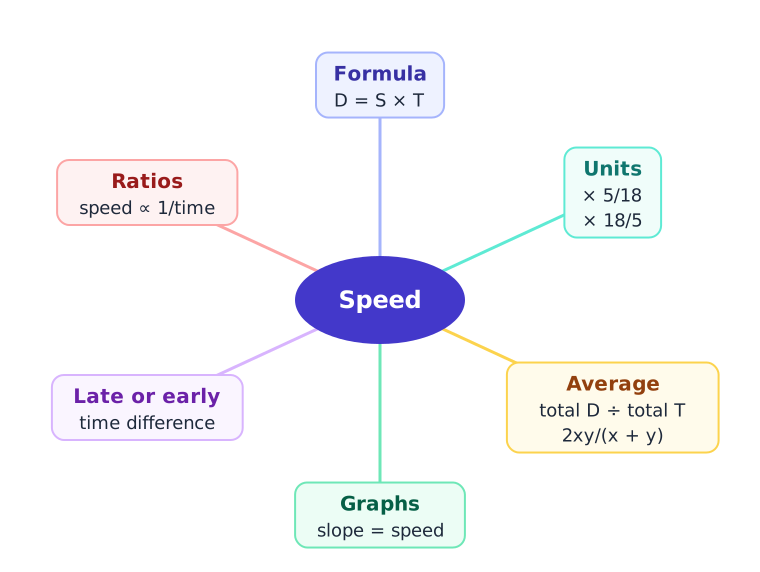
Distance = speed × time; speed = distance ÷ time; time = distance ÷ speed.
1 km/h = 5/18 m/s and 1 m/s = 18/5 km/h = 3.6 km/h.
Always change minutes to hours (÷ 60) before using a speed in km/h.
Average speed = total distance ÷ total time, never the plain average of the speeds.
For two equal distances at x and y, average speed = 2xy/(x + y).
For two equal times at x and y, average speed = (x + y)/2.
For the same distance, time is inversely proportional to speed: speed ratio a : b means time ratio b : a.
On a distance-time graph the slope is the speed; a flat part means rest.
Late at one speed and early at another: the difference in times equals (late + early) minutes.
Full explanation
A trip to Agra

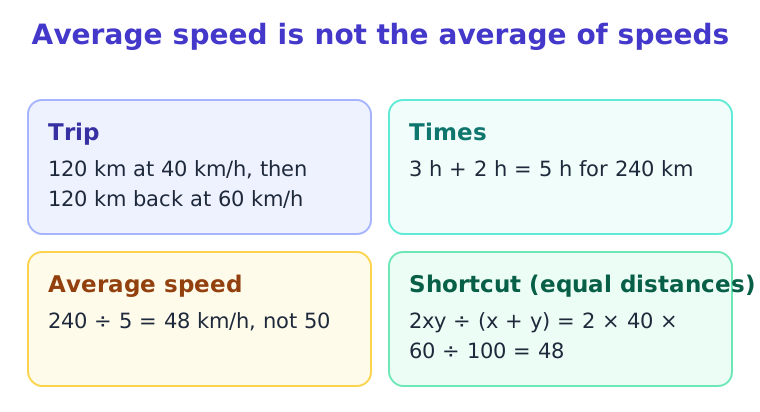
Meena's family drives from Delhi to Agra, 120 km, at 40 km/h, and comes back at 60 km/h. Her brother says, "Average speed 50 km/h." Meena checks the clock: the trip took 3 hours there and 2 hours back.
Who is right? By the end of this topic you will answer in one line.
One formula, three forms

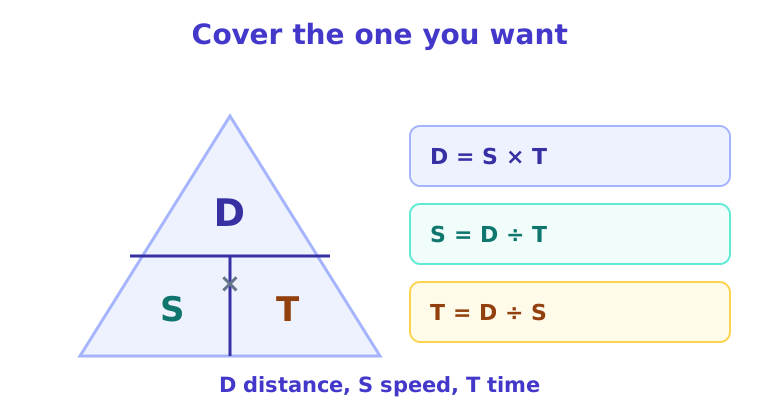
$$\text{Distance} = \text{Speed} \times \text{Time}$$
Cover what you want in the triangle: $S = \frac{D}{T}$ and $T = \frac{D}{S}$.
km/h and m/s
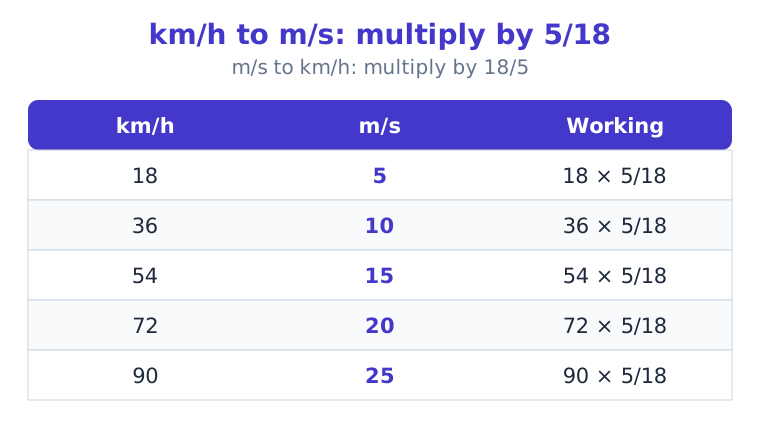
1 km = 1000 m and 1 hour = 3600 s, so $1 \text{ km/h} = \frac{1000}{3600} = \frac{5}{18}$ m/s.
- km/h to m/s: multiply by $\frac{5}{18}$. $72 \times \frac{5}{18} = 20$ m/s.
- m/s to km/h: multiply by $\frac{18}{5}$. $15 \times \frac{18}{5} = 54$ km/h.
Minutes with km/h
A scooter at 48 km/h runs for 25 minutes. Distance $= 48 \times \frac{25}{60} = 20$ km. Divide minutes by 60 first.
Time can also come out in hours: 150 km at 60 km/h is 2.5 hours, which is 2 hours 30 minutes, not 2 hours 50 minutes.
Reading a distance-time graph
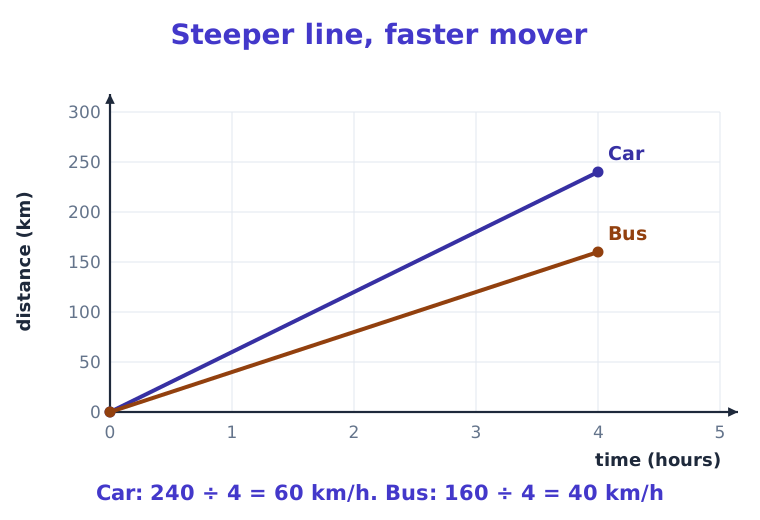
The slope of the line is the speed. The car covers 240 km in 4 hours (60 km/h) and the bus 160 km (40 km/h); the car's line is steeper.
Average speed: total over total
$$\text{Average speed} = \frac{\text{total distance}}{\text{total time}}$$
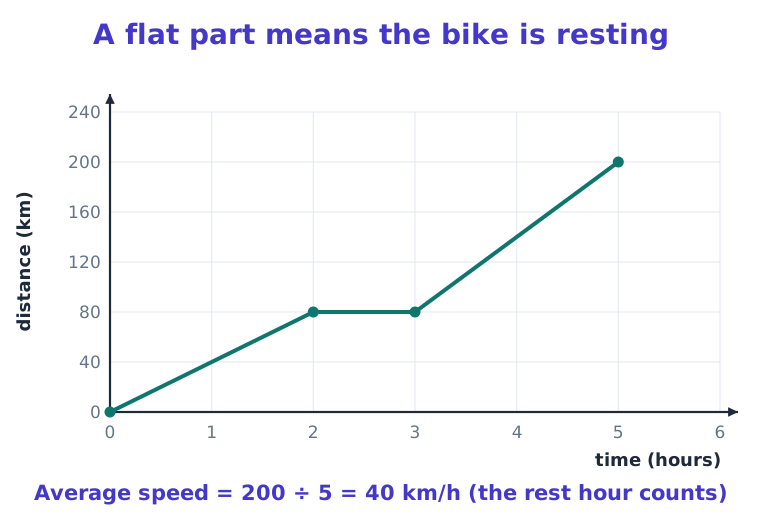
A bike goes 80 km in 2 hours, rests 1 hour, then goes 120 km in 2 hours. Average $= 200 \div 5 = 40$ km/h. The rest hour is part of the total time.
Equal distances: the 2xy rule
When the two parts are equal distances at speeds $x$ and $y$:
$$\text{Average} = \frac{2xy}{x + y}$$
When the two parts take equal times, the average really is $\frac{x + y}{2}$.
Late and early
At 40 km/h a boy is 10 minutes late; at 50 km/h he is 5 minutes early. The two times differ by 15 minutes = $\frac{1}{4}$ hour.
$$\frac{D}{40} - \frac{D}{50} = \frac{1}{4} \Rightarrow \frac{D}{200} = \frac{1}{4} \Rightarrow D = 50 \text{ km}$$
Speed ratio, time ratio
For the same distance, if speeds are in the ratio $3 : 4$, times are $4 : 3$. Walking at $\frac{3}{4}$ of the usual speed makes the time $\frac{4}{3}$ of usual: if that is 20 minutes late, $\frac{1}{3}$ of the usual time is 20 minutes, so the usual time is 60 minutes.
Back to Agra
Meena is right to check the clock. 240 km in $3 + 2 = 5$ hours gives 48 km/h. Her brother averaged the speeds, but the car spent more time at the slower speed, so the true average is below 50.
Concepts and terms
Distance covered in one unit of time. 60 km/h means 60 km every hour.
1 km = 1000 m and 1 hour = 3600 s, so 1 km/h = 1000/3600 = 5/18 m/s.
Total distance divided by total time, including any rest. It is closer to the speed at which more time was spent.
Time on the x-axis and distance on the y-axis. A steeper line is a faster motion; a flat line is rest.

Did you know
The Vande Bharat Express can touch 180 km/h, which is 50 m/s: half a football field every second.
The speedometer of a car shows instant speed; the trip computer shows average speed, total distance ÷ total time.

Memory tricks
D, S, T — Cover the triangle — Write D on top and S × T below; cover the one you want and read the rest.
Conversion — Going small? 5 over 18 — km/h to m/s gives a smaller number, so multiply by the smaller fraction 5/18.
Practice MCQs with answers (62)
- A 10 m/s
- B 7.2 m/s
- C 129.6 m/s
- D 600 m/s
Show answer
Why:
36 × 5/18 = 10 m/s.
- A 324 m/s
- B 25 m/s
- C 1500 m/s
- D 18 m/s
Show answer
Why:
90 × 5/18 = 25 m/s.
- A 10.8 m/s
- B 194.4 m/s
- C 15 m/s
- D 900 m/s
Show answer
Why:
54 × 5/18 = 15 m/s.
- A 1800 m/s
- B 21.6 m/s
- C 388.8 m/s
- D 30 m/s
Show answer
Why:
108 × 5/18 = 30 m/s.
- A 35 m/s
- B 2100 m/s
- C 25.2 m/s
- D 453.6 m/s
Show answer
Why:
126 × 5/18 = 35 m/s.
- A 5.4 km/h
- B 54 km/h
- C 45 km/h
- D $4\frac{1}{6}$ km/h
Show answer
Why:
15 × 18/5 = 54 km/h.
- A $6\frac{17}{18}$ km/h
- B 9 km/h
- C 90 km/h
- D 75 km/h
Show answer
Why:
25 × 18/5 = 90 km/h.
- A 36 km/h
- B $3\frac{1}{3}$ km/h
- C 4.32 km/h
- D 43.2 km/h
Show answer
Why:
12 × 18/5 = 43.2 km/h.
- A 126 km/h
- B 105 km/h
- C $9\frac{13}{18}$ km/h
- D 12.6 km/h
Show answer
Why:
35 × 18/5 = 126 km/h.
- A 115.2 km
- B 20 km
- C 1200 km
- D 12 km
Show answer
Why:
25 minutes = 25/60 hour. Distance = 48 × 25/60 = 20 km.
- A 14.4 km
- B 54 km
- C 24 km
- D 1440 km
Show answer
Why:
40 minutes = 40/60 hour. Distance = 36 × 40/60 = 24 km.
- A 2700 km
- B 27 km
- C 80 km
- D 45 km
Show answer
Why:
45 minutes = 45/60 hour. Distance = 60 × 45/60 = 45 km.
- A 45 km
- B 2700 km
- C 27 km
- D 64.8 km
Show answer
Why:
50 minutes = 50/60 hour. Distance = 54 × 50/60 = 45 km.
- A 2520 km
- B 42 km
- C 25.2 km
- D $123\frac{3}{7}$ km
Show answer
Why:
35 minutes = 35/60 hour. Distance = 72 × 35/60 = 42 km.
- A 2 h 50 min
- B 3 h
- C 2 h 30 min
- D 2 h 15 min
Show answer
Why:
Time = 150 ÷ 60 = 2.5 hours = 2 h 30 min.
- A 5 h 45 min
- B 5 h
- C 5 h 25 min
- D 5 h 15 min
Show answer
Why:
Time = 210 ÷ 40 = 5.25 hours = 5 h 15 min.
- A 6 h 30 min
- B 6 h 15 min
- C 6 h 50 min
- D 7 h
Show answer
Why:
Time = 325 ÷ 50 = 6.5 hours = 6 h 30 min.
- A 2 h
- B 1 h 45 min
- C 2 h 15 min
- D 1 h 30 min
Show answer
Why:
Time = 91 ÷ 52 = 1.75 hours = 1 h 45 min.
- A $2\frac{7}{9}$ km/h
- B 360 km/h
- C 36 km/h
- D 10 km/h
Show answer
Why:
Speed = 100 ÷ 10 = 10 m/s = 10 × 18/5 = 36 km/h.
- A $2\frac{2}{9}$ km/h
- B 288 km/h
- C 8 km/h
- D 28.8 km/h
Show answer
Why:
Speed = 400 ÷ 50 = 8 m/s = 8 × 18/5 = 28.8 km/h.
- A 21.6 km/h
- B 216 km/h
- C 6 km/h
- D $1\frac{2}{3}$ km/h
Show answer
Why:
Speed = 1500 ÷ 250 = 6 m/s = 6 × 18/5 = 21.6 km/h.
- A 52 km/h
- B 48 km/h
- C 20 km/h
- D 50 km/h
Show answer
Why:
Equal distances: average = 2 × 40 × 60 ÷ (40 + 60) = 48 km/h, not the plain average 50.
- A 45 km/h
- B 47 km/h
- C 40 km/h
- D 30 km/h
Show answer
Why:
Equal distances: average = 2 × 30 × 60 ÷ (30 + 60) = 40 km/h, not the plain average 45.
- A 50 km/h
- B 52 km/h
- C 10 km/h
- D 49.5 km/h
Show answer
Why:
Equal distances: average = 2 × 45 × 55 ÷ (45 + 55) = 49.5 km/h, not the plain average 50.
- A 24 km/h
- B 27 km/h
- C 10 km/h
- D 25 km/h
Show answer
Why:
Equal distances: average = 2 × 20 × 30 ÷ (20 + 30) = 24 km/h, not the plain average 25.
- A 77 km/h
- B 72 km/h
- C 30 km/h
- D 75 km/h
Show answer
Why:
Equal distances: average = 2 × 60 × 90 ÷ (60 + 90) = 72 km/h, not the plain average 75.
- A $39\frac{6}{7}$ km/h
- B $43\frac{1}{3}$ km/h
- C $42\frac{6}{7}$ km/h
- D $45\frac{6}{7}$ km/h
Show answer
Why:
Total distance 300 km; total time 3 + 2 + 2 = 7 h. Average = 300 ÷ 7 = $42\frac{6}{7}$ km/h.
- A 65.5 km/h
- B 59.5 km/h
- C 125 km/h
- D 62.5 km/h
Show answer
Why:
Total distance 250 km; total time 2 + 2 = 4 h. Average = 250 ÷ 4 = 62.5 km/h.
- A $33\frac{1}{3}$ km/h
- B $66\frac{2}{3}$ km/h
- C $36\frac{1}{3}$ km/h
- D $30\frac{1}{3}$ km/h
Show answer
Why:
Total distance 200 km; total time 2 + 2 + 2 = 6 h. Average = 200 ÷ 6 = $33\frac{1}{3}$ km/h.
- A 48 km/h
- B 52 km/h
- C 56 km/h
- D 50 km/h
Show answer
Why:
Distance = 80 + 180 = 260 km in 5 hours: 260 ÷ 5 = 52 km/h.
- A 37.5 km/h
- B 50 km/h
- C 46 km/h
- D 40 km/h
Show answer
Why:
Distance = 30 + 200 = 230 km in 5 hours: 230 ÷ 5 = 46 km/h.
- A 100 km
- B $5\frac{5}{9}$ km
- C $16\frac{2}{3}$ km
- D 50 km
Show answer
Why:
The times differ by 10 + 5 = 15 min = 15/60 h. D/40 − D/50 = 15/60, so D = 40 × 50 × 15 ÷ (60 × 10) = 50 km.
- A 5 km
- B $\frac{5}{9}$ km
- C $1\frac{2}{3}$ km
- D 10 km
Show answer
Why:
The times differ by 10 + 5 = 15 min = 15/60 h. D/4 − D/5 = 15/60, so D = 4 × 5 × 15 ÷ (60 × 1) = 5 km.
- A $\frac{3}{7}$ km
- B 3 km
- C 0.2 km
- D 6 km
Show answer
Why:
The times differ by 8 + 7 = 15 min = 15/60 h. D/3 − D/4 = 15/60, so D = 3 × 4 × 15 ÷ (60 × 1) = 3 km.
- A $5\frac{5}{11}$ km
- B 12 km
- C 60 km
- D 120 km
Show answer
Why:
The times differ by 12 + 8 = 20 min = 20/60 h. D/30 − D/36 = 20/60, so D = 30 × 36 × 20 ÷ (60 × 6) = 60 km.
- A 120 minutes
- B 80 minutes
- C 40 minutes
- D 60 minutes
Show answer
Why:
Time becomes 4/3 of usual, so the extra 1/3 of the usual time = 20 min. Usual = 20 × 3/1 = 60 minutes.
- A 60 minutes
- B 120 minutes
- C 75 minutes
- D 45 minutes
Show answer
Why:
Time becomes 5/4 of usual, so the extra 1/4 of the usual time = 15 min. Usual = 15 × 4/1 = 60 minutes.
- A 70 minutes
- B 60 minutes
- C 120 minutes
- D 50 minutes
Show answer
Why:
Time becomes 5/6 of usual, saving 1/6 of it = 10 min. Usual = 10 × 6/1 = 60 minutes.
- A 75 minutes
- B 25 minutes
- C 50 minutes
- D 100 minutes
Show answer
Why:
Time becomes 3/2 of usual, so the extra 1/2 of the usual time = 25 min. Usual = 25 × 2/1 = 50 minutes.
- A 80 minutes
- B 120 minutes
- C 90 minutes
- D 60 minutes
Show answer
Why:
Times are in the ratio 4 : 3; the difference 1 part = 20 min, so B = 3 × 20 = 60 minutes.
- A 60 minutes
- B 30 minutes
- C 90 minutes
- D 120 minutes
Show answer
Why:
Times are in the ratio 3 : 2; the difference 1 part = 30 min, so B = 2 × 30 = 60 minutes.
- A 12 minutes
- B 10 minutes
- C 5 minutes
- D 9 minutes
Show answer
Why:
Each hour it loses 9 km, which takes 9/54 hour at 54 km/h = 10 minutes.
- A 12 minutes
- B 5 minutes
- C 10 minutes
- D 20 minutes
Show answer
Why:
Each hour it loses 10 km, which takes 10/60 hour at 60 km/h = 10 minutes.
- A 17 minutes
- B 7.5 minutes
- C 20 minutes
- D 15 minutes
Show answer
Why:
Each hour it loses 20 km, which takes 20/80 hour at 80 km/h = 15 minutes.
- A 80 km/h
- B 75 km/h
- C 100 km/h
- D 90 km/h
Show answer
Why:
Check 80: 360/80 − 360/90 = 4.5 − 4 = 0.5 h = 30 min. So 80 km/h.
- A 30 km/h
- B 25 km/h
- C 23 km/h
- D 35 km/h
Show answer
Why:
Check 25: 300/25 − 300/30 = 12 − 10 = 2 h = 120 min. So 25 km/h.
- A 65 km/h
- B 56 km/h
- C 60 km/h
- D 44 km/h
Show answer
Why:
2 × 40 × y ÷ (40 + y) = 48 gives y = 48 × 40 ÷ (2 × 40 − 48) = 60 km/h.
- A 7.5 km
- B 30 km
- C 40 km
- D 15 km
Show answer
Why:
D/15 + D/5 = 4, so D = 4 × 15 × 5 ÷ (15 + 5) = 15 km.
- A 5/18
- B 3600
- C 18/5
- D 1000
Show answer
Why:
1 km/h = 1000 m ÷ 3600 s = 5/18 m/s.
- A speeding up
- B at rest
- C moving backwards
- D moving fastest
Show answer
Why:
The distance does not change with time, so the speed is zero.
- A the average of all the speeds
- B the highest speed reached
- C total distance ÷ total time
- D total time ÷ total distance
Show answer
Why:
This is the definition; it includes rests.
- A stays the same
- B becomes one quarter
- C doubles
- D becomes half
Show answer
Why:
Time ∝ 1/speed for a fixed distance.
- A (x + y)/2
- B xy/(x + y)
- C √(xy)
- D 2xy/(x + y)
Show answer
Why:
Equal times: total distance x + y in 2 hours.
- A 80 km/h
- B 25 m/s
- C 72 km/h
- D 1.2 km per minute
Show answer
Why:
25 m/s = 90 km/h; 1.2 km/min = 72 km/h. 90 is the largest.
- A Both A and R are true, and R is the correct explanation of A
- B Both A and R are true, but R is not the correct explanation of A
- C A is true but R is false
- D A is false but R is true
Show answer
Why:
2 × 40 × 60 ÷ 100 = 48, and R is why it is below 50.
- A Both A and R are true, and R is the correct explanation of A
- B Both A and R are true, but R is not the correct explanation of A
- C A is true but R is false
- D A is false but R is true
Show answer
Why:
36 × 5/18 = 10 m/s, so A is false; R is true.
- A 1 only
- B 2 only
- C Both 1 and 2
- D Neither 1 nor 2
Show answer
Why:
1 m/s = 3.6 km/h > 3 km/h. 90 ÷ 60 = 1.5 km a minute. Both true.
- A 1 only
- B 2 only
- C Both 1 and 2
- D Neither 1 nor 2
Show answer
Why:
1 is true. 2 is false: equal distances give 2xy/(x + y).
- A 22.5 km/h
- B 135 km/h
- C 45 km/h
- D 40 km/h
Show answer
Why:
Slope = 135 ÷ 3 = 45 km/h.
- A 6 km
- B 45 km
- C 24 km
- D 15 km
Show answer
Why:
P: 18 km/h, Q: 12 km/h. The gap grows 6 km each hour: 6 × 2.5 = 15 km.
- A 30 km/h
- B 40 km/h
- C 36 km/h
- D 45 km/h
Show answer
Why:
180 km in 6 hours, rests included: 30 km/h. (45 km/h is moving time only.)
- A 75 km/h
- B 50 km/h
- C 37.5 km/h
- D 100 km/h
Show answer
Why:
The line rises from 50 km to 150 km between hour 2 and hour 4: 100 km in 2 hours = 50 km/h.
Important short questions (4)
63 × 5/18 = 17.5 m/s; 22 × 18/5 = 79.2 km/h.
Times 2 h + 1 h = 3 h for 120 km: 40 km/h.
D/5 − D/6 = 10/60, so D/30 = 1/6 and D = 5 km.
The speed: distance gained per unit time. Steeper means faster.
Long answer questions (1)
(a) Going 30 ÷ 15 = 2 h, shopping 1 h, return 30 ÷ 10 = 3 h.
(b) 60 km in 6 h: 10 km/h.
(c) 12.5 is the plain average of the two speeds; it ignores that more time is spent at 10 km/h and ignores the hour of rest.
Flashcards (13)
Play this topic
- Speed check
Problems on Trains
A train has length, so crossing anything means covering the right distance: its own length for a pole or a man, train plus platform for a platform or bridge, and both lengths for another train, at the sum of speeds when they move towards each other and the difference when they move the same way.
What you will be able to do
- I can find the time a train takes to pass a pole, a man, a platform or a bridge.
- I can find a train's length or speed from crossing times.
- I can solve two trains crossing in opposite or the same directions.
- I can use the after-meeting rule for two trains.
Key points
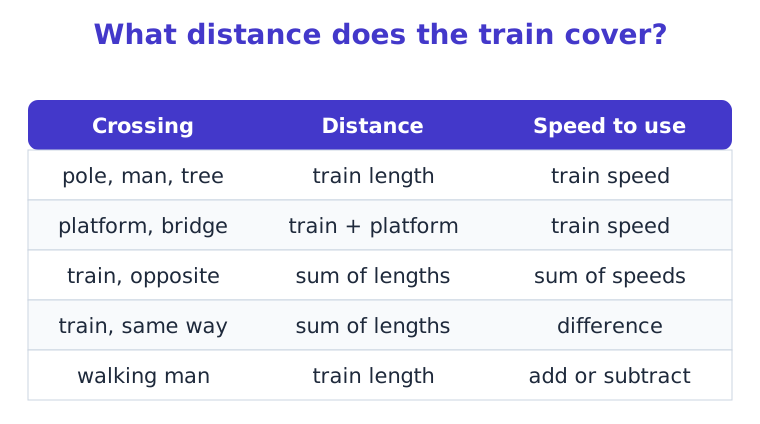
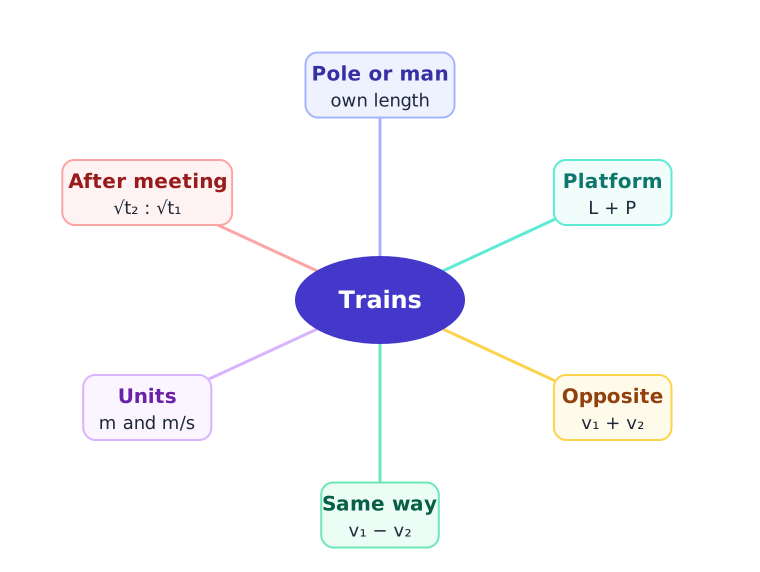
To pass a pole, a man standing still or a tree, a train covers its own length.
To pass a platform, bridge or tunnel, it covers its length plus the platform's length.
Work in metres and m/s: change km/h with 5/18 first.
Two trains in opposite directions cross in (L₁ + L₂) ÷ (v₁ + v₂).
Two trains in the same direction cross in (L₁ + L₂) ÷ (v₁ − v₂).
A man walking towards the train: add his speed; walking the same way: subtract it.
If a train passes a pole in t₁ s and a platform of P m in t₂ s, its length is P × t₁ ÷ (t₂ − t₁).
Two trains start towards each other and after meeting take t₁ and t₂ to finish: speeds are in the ratio √t₂ : √t₁.
Full explanation
At the railway crossing

Arjun waits at a level crossing on his cycle. A 150 m train passes the signal post in 10 seconds, but the gate stays closed much longer while it crosses the 250 m platform beyond the road. Why does the same train take different times?
Because a train is long. This topic is about the distance a long object must cover.
Passing a pole
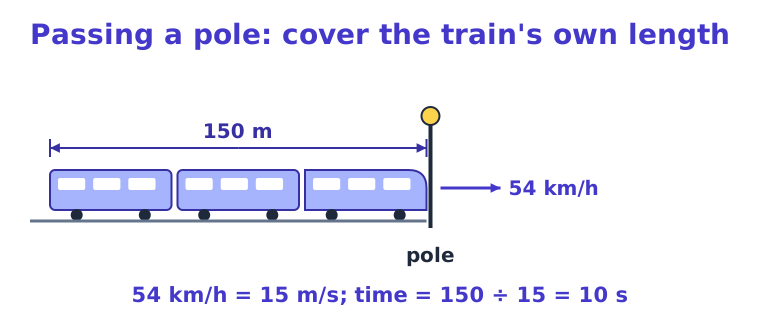
The crossing starts when the engine reaches the pole and ends when the last coach leaves it. So the train covers its own length.
$54 \text{ km/h} = 54 \times \frac{5}{18} = 15$ m/s, so a 150 m train needs $150 \div 15 = 10$ s.
Passing a platform or a bridge
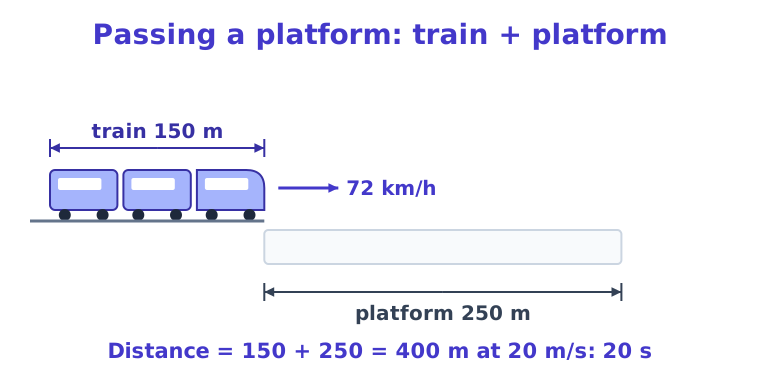
Now the engine must travel the platform and then pull the whole train off it: distance = train + platform.
At 72 km/h = 20 m/s, a 150 m train passes a 250 m platform in $(150 + 250) \div 20 = 20$ s.
Finding the length
A train passes a pole in 12 s and a 300 m platform in 27 s. The extra 15 s are spent on the platform's 300 m, so the speed is $300 \div 15 = 20$ m/s and the length is $20 \times 12 = 240$ m.
Two trains, opposite directions
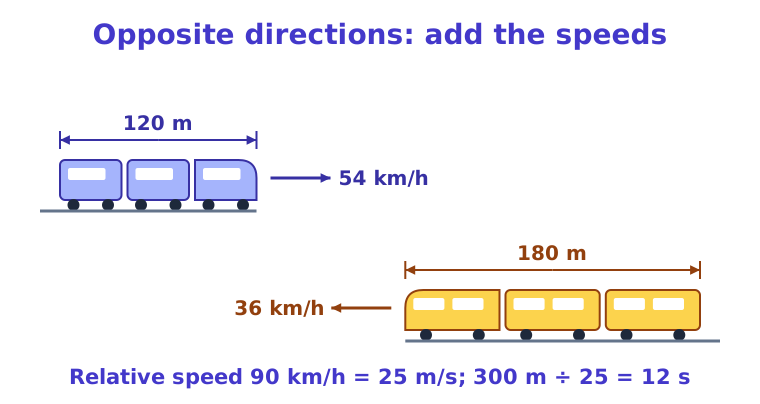
When trains move towards each other, the gap closes at the sum of the speeds, and they must cover both lengths.
120 m at 54 km/h and 180 m at 36 km/h: relative 90 km/h = 25 m/s, time $= 300 \div 25 = 12$ s.
Two trains, same direction
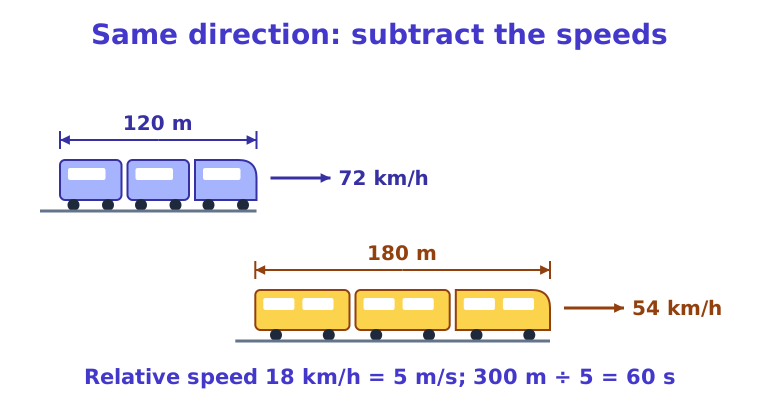
When one overtakes the other, it gains only the difference of the speeds. 120 m at 72 km/h passing 180 m at 54 km/h: relative 18 km/h = 5 m/s, time $= 300 \div 5 = 60$ s. Overtaking is slow.
The full checklist
Every train question is one row of this table.
After they meet
Two trains start at the same time from A and B towards each other. After meeting, the train from A takes $t_1 = 9$ hours to reach B and the train from B takes $t_2 = 16$ hours to reach A. Then $\frac{v_1}{v_2} = \sqrt{\frac{t_2}{t_1}} = \sqrt{\frac{16}{9}} = \frac{4}{3}$. The train that needs less time after the meeting is the faster one.
Back at the crossing
The train passed the post in 10 s because it covered only its 150 m. Along the platform it covered 150 + 250 = 400 m, and at the same speed that takes $400 \div 15 \approx 27$ s. Arjun now knows why the gate stays closed: the whole train must clear it.
Concepts and terms
Crossing ends when the last coach clears the object, so the train's own length is always part of the distance.
How fast one moves as seen from the other: add speeds for opposite directions, subtract for the same direction.
Lengths are in metres and times in seconds, so speeds must be in m/s.
After meeting, each train covers what the other already covered, which gives v₁ : v₂ = √t₂ : √t₁.
Did you know
A typical 24-coach Indian express train is about 600 m long, so passing a pole at 72 km/h still takes half a minute.
Memory tricks
What to add — Thin thing: own length. Long thing: add its length. — A pole or man has no length; a platform, bridge or train does.
Relative speed — Face to face: add. Back to back: subtract. — Trains meeting head-on close the gap fast; a train overtaking closes it slowly.
Practice MCQs with answers (54)
- A 20 seconds
- B 10 seconds
- C $2\frac{7}{9}$ seconds
- D $\frac{125}{162}$ seconds
Show answer
Why:
54 km/h = 15 m/s. The train covers its own 150 m: 150 ÷ 15 = 10 s.
- A 20 seconds
- B $2\frac{7}{9}$ seconds
- C 10 seconds
- D $\frac{125}{162}$ seconds
Show answer
Why:
72 km/h = 20 m/s. The train covers its own 200 m: 200 ÷ 20 = 10 s.
- A 48 seconds
- B $6\frac{2}{3}$ seconds
- C $1\frac{23}{27}$ seconds
- D 24 seconds
Show answer
Why:
36 km/h = 10 m/s. The train covers its own 240 m: 240 ÷ 10 = 24 s.
- A 12 seconds
- B $3\frac{1}{3}$ seconds
- C $\frac{25}{27}$ seconds
- D 24 seconds
Show answer
Why:
108 km/h = 30 m/s. The train covers its own 360 m: 360 ÷ 30 = 12 s.
- A $2\frac{7}{9}$ seconds
- B 10 seconds
- C $\frac{125}{162}$ seconds
- D 20 seconds
Show answer
Why:
63 km/h = 17.5 m/s. The train covers its own 175 m: 175 ÷ 17.5 = 10 s.
- A $1\frac{2}{3}$ seconds
- B $\frac{25}{54}$ seconds
- C 6 seconds
- D 12 seconds
Show answer
Why:
66 km/h = $18\frac{1}{3}$ m/s. The train covers its own 110 m: 110 ÷ $18\frac{1}{3}$ = 6 s.
- A 12.5 seconds
- B 7.5 seconds
- C $5\frac{5}{9}$ seconds
- D 20 seconds
Show answer
Why:
Distance = 150 + 250 = 400 m; speed 20 m/s; time = 400 ÷ 20 = 20 s.
- A 30 seconds
- B $8\frac{1}{3}$ seconds
- C 18 seconds
- D 12 seconds
Show answer
Why:
Distance = 180 + 270 = 450 m; speed 15 m/s; time = 450 ÷ 15 = 30 s.
- A 9.6 seconds
- B 24 seconds
- C $6\frac{2}{3}$ seconds
- D 14.4 seconds
Show answer
Why:
Distance = 240 + 360 = 600 m; speed 25 m/s; time = 600 ÷ 25 = 24 s.
- A $14\frac{2}{3}$ seconds
- B $5\frac{1}{3}$ seconds
- C 20 seconds
- D $5\frac{5}{9}$ seconds
Show answer
Why:
Distance = 120 + 330 = 450 m; speed 22.5 m/s; time = 450 ÷ 22.5 = 20 s.
- A 12.5 seconds
- B $28\frac{1}{8}$ seconds
- C $16\frac{7}{8}$ seconds
- D 45 seconds
Show answer
Why:
Distance = 300 + 500 = 800 m; speed $17\frac{7}{9}$ m/s; time = 800 ÷ $17\frac{7}{9}$ = 45 s.
- A 180 m
- B 90 m
- C 648 m
- D 2332.8 m
Show answer
Why:
54 km/h = 15 m/s; length = 15 × 12 = 180 m.
- A 150 m
- B 300 m
- C 1080 m
- D 3888 m
Show answer
Why:
72 km/h = 20 m/s; length = 20 × 15 = 300 m.
- A 225 m
- B 1620 m
- C 450 m
- D 5832 m
Show answer
Why:
90 km/h = 25 m/s; length = 25 × 18 = 450 m.
- A 720 m
- B 2592 m
- C 100 m
- D 200 m
Show answer
Why:
45 km/h = 12.5 m/s; length = 12.5 × 16 = 200 m.
- A 72 km/h
- B 20 km/h
- C 28.8 km/h
- D 43.2 km/h
Show answer
Why:
Speed = (160 + 240) ÷ 20 = 20 m/s = 20 × 18/5 = 72 km/h.
- A 36 km/h
- B 54 km/h
- C 15 km/h
- D 18 km/h
Show answer
Why:
Speed = (150 + 300) ÷ 30 = 15 m/s = 15 × 18/5 = 54 km/h.
- A 40.32 km/h
- B 20 km/h
- C 72 km/h
- D 31.68 km/h
Show answer
Why:
Speed = (220 + 280) ÷ 25 = 20 m/s = 20 × 18/5 = 72 km/h.
- A 60 m
- B 540 m
- C $133\frac{1}{3}$ m
- D 240 m
Show answer
Why:
The platform's 300 m take 27 − 12 = 15 s, so speed = 20 m/s and length = 20 × 12 = 240 m.
- A 200 m
- B 210 m
- C 400 m
- D 100 m
Show answer
Why:
The platform's 200 m take 20 − 10 = 10 s, so speed = 20 m/s and length = 20 × 10 = 200 m.
- A 72 km/h
- B 54 km/h
- C 15 km/h
- D 27 km/h
Show answer
Why:
The extra 15 s are for the 225 m platform: 15 m/s = 54 km/h.
- A 16 km/h
- B 32 km/h
- C 57.6 km/h
- D 72 km/h
Show answer
Why:
The extra 10 s are for the 160 m platform: 16 m/s = 57.6 km/h.
- A $3\frac{1}{3}$ seconds
- B 60 seconds
- C 7.2 seconds
- D 12 seconds
Show answer
Why:
Relative speed = 54 + 36 = 90 km/h = 25 m/s. Distance 120 + 180 = 300 m: 12 s.
- A 10 seconds
- B 20 seconds
- C 6 seconds
- D $2\frac{7}{9}$ seconds
Show answer
Why:
Relative speed = 40 + 50 = 90 km/h = 25 m/s. Distance 100 + 150 = 250 m: 10 s.
- A 108 seconds
- B 12 seconds
- C $6\frac{2}{3}$ seconds
- D $3\frac{1}{3}$ seconds
Show answer
Why:
Relative speed = 60 + 48 = 108 km/h = 30 m/s. Distance 200 + 160 = 360 m: 12 s.
- A 36 seconds
- B $16\frac{2}{3}$ seconds
- C 60 seconds
- D $8\frac{4}{7}$ seconds
Show answer
Why:
Relative speed = 72 − 54 = 18 km/h = 5 m/s. Distance 120 + 180 = 300 m: 60 s.
- A $13\frac{8}{9}$ seconds
- B $7\frac{37}{59}$ seconds
- C 30 seconds
- D 50 seconds
Show answer
Why:
Relative speed = 68 − 50 = 18 km/h = 5 m/s. Distance 150 + 100 = 250 m: 50 s.
- A 90 seconds
- B 50 seconds
- C 25 seconds
- D 10 seconds
Show answer
Why:
Relative speed = 90 − 72 = 18 km/h = 5 m/s. Distance 250 + 200 = 450 m: 90 s.
- A $4\frac{2}{27}$ seconds
- B $14\frac{2}{3}$ seconds
- C 12 seconds
- D 13.2 seconds
Show answer
Why:
Relative speed = 60 − 6 = 54 km/h = 15 m/s. Time = 220 ÷ 15 = $14\frac{2}{3}$ s.
- A 11.25 seconds
- B $10\frac{10}{17}$ seconds
- C 10 seconds
- D $2\frac{7}{9}$ seconds
Show answer
Why:
Relative speed = 51 + 3 = 54 km/h = 15 m/s. Time = 150 ÷ 15 = 10 s.
- A $4\frac{1}{6}$ seconds
- B 16.5 seconds
- C $15\frac{5}{7}$ seconds
- D 15 seconds
Show answer
Why:
Relative speed = 63 + 3 = 66 km/h = $18\frac{1}{3}$ m/s. Time = 275 ÷ $18\frac{1}{3}$ = 15 s.
- A $5\frac{1}{13}$ seconds
- B 4.4 seconds
- C $4\frac{5}{7}$ seconds
- D $1\frac{16}{39}$ seconds
Show answer
Why:
Relative speed = 84 − 6 = 78 km/h = $21\frac{2}{3}$ m/s. Time = 110 ÷ $21\frac{2}{3}$ = $5\frac{1}{13}$ s.
- A 240 m
- B 180 m
- C 360 m
- D 300 m
Show answer
Why:
The extra 180 m take 9 s, so speed = 20 m/s. Then L + 120 = 20 × 15 = 300, so L = 180 m.
- A 400 m
- B 100 m
- C 250 m
- D 325 m
Show answer
Why:
The extra 100 m take 5 s, so speed = 20 m/s. Then L + 150 = 20 × 20 = 400, so L = 250 m.
- A 3 : 4
- B 16 : 9
- C 9 : 16
- D 4 : 3
Show answer
Why:
Speed ratio = √16 : √9 = 4 : 3.
- A 3 : 2
- B 2 : 3
- C 9 : 4
- D 4 : 9
Show answer
Why:
Speed ratio = √9 : √4 = 3 : 2.
- A 25 : 16
- B 5 : 4
- C 16 : 25
- D 4 : 5
Show answer
Why:
Speed ratio = √25 : √16 = 5 : 4.
- A 90 km/h
- B 140 km/h
- C 40 km/h
- D 58 km/h
Show answer
Why:
Relative speed = 300 ÷ 12 = 25 m/s = 90 km/h. Other = 90 − 50 = 40 km/h.
- A 90 km/h
- B 130 km/h
- C 68 km/h
- D 50 km/h
Show answer
Why:
Relative speed = 250 ÷ 10 = 25 m/s = 90 km/h. Other = 90 − 40 = 50 km/h.
- A 180 km
- B 150 km
- C 120 km
- D $146\frac{2}{3}$ km
Show answer
Why:
In 1 h the first covers 60 km; 270 km remain at 135 km/h: 2 h. Distance from A = 60 + 60 × 2 = 180 km.
- A $191\frac{2}{3}$ km
- B $273\frac{1}{3}$ km
- C $153\frac{1}{3}$ km
- D $206\frac{2}{3}$ km
Show answer
Why:
In 2 h the first covers 120 km; 345 km remain at 135 km/h: $2\frac{5}{9}$ h. Distance from A = 120 + 60 × $2\frac{5}{9}$ = $273\frac{1}{3}$ km.
- A twice its length
- B the distance to the next station
- C its own length
- D zero
Show answer
Why:
The pole has no length; the whole train must pass it.
- A the average of their speeds
- B the product of their speeds
- C the sum of their speeds
- D the difference of their speeds
Show answer
Why:
One gains on the other only by the difference.
- A The length of the engine alone
- B The length of the platform
- C The speed of the train
- D The length of the train
Show answer
Why:
Distance = whole train + platform; the engine is already inside the train's length.
- A 18 m/s
- B 30 m/s
- C 36 m/s
- D 388.8 m/s
Show answer
Why:
108 × 5/18 = 30.
- A never
- B later
- C sooner
- D in the same time
Show answer
Why:
Opposite directions: speeds add, so the time is shorter.
- A Both A and R are true, and R is the correct explanation of A
- B Both A and R are true, but R is not the correct explanation of A
- C A is true but R is false
- D A is false but R is true
Show answer
Why:
400 m at 20 m/s = 20 s; R gives the 400 m.
- A Both A and R are true, and R is the correct explanation of A
- B Both A and R are true, but R is not the correct explanation of A
- C A is true but R is false
- D A is false but R is true
Show answer
Why:
10 km/h = 25/9 m/s; 200 ÷ 25/9 = 72 s, so A is false; R is true.
- A 1 only
- B 2 only
- C Both 1 and 2
- D Neither 1 nor 2
Show answer
Why:
15 m/s: pole 150 ÷ 15 = 10 s. Platform 300 ÷ 15 = 20 s, so 2 is false.
- A 1 only
- B 2 only
- C Both 1 and 2
- D Neither 1 nor 2
Show answer
Why:
1 is true. 2 is false: the same way uses the difference of speeds, which is slower.
- A $6\frac{2}{3}$ seconds
- B 16.8 seconds
- C 7.2 seconds
- D 24 seconds
Show answer
Why:
90 km/h = 25 m/s; (180 + 420) ÷ 25 = 24 s.
- A 245 m
- B 3087 m
- C 882 m
- D 250 m
Show answer
Why:
63 km/h = 17.5 m/s; length = 17.5 × 14 = 245 m.
- A $2\frac{7}{9}$ seconds
- B 10 seconds
- C 90 seconds
- D $5\frac{1}{3}$ seconds
Show answer
Why:
Relative speed 108 km/h = 30 m/s; 300 ÷ 30 = 10 s.
- A 10 seconds
- B 25 seconds
- C 40 seconds
- D $11\frac{1}{9}$ seconds
Show answer
Why:
Relative speed 36 km/h = 10 m/s; 400 ÷ 10 = 40 s.
Important short questions (4)
280 ÷ 14 = 20 m/s = 72 km/h.
For a platform it covers its own length plus the platform's length.
Relative 10 km/h = 25/9 m/s; 200 ÷ 25/9 = 72 s.
100 m in 10 s: 10 m/s; length 10 × 15 = 150 m.
Long answer questions (1)
(a) Relative 54 − 6 = 48 km/h = 40/3 m/s; 240 ÷ 40/3 = 18 s.
(b) Relative 54 + 36 = 90 km/h = 25 m/s; (240 + 160) ÷ 25 = 16 s.
Flashcards (12)
Play this topic
- Train check
Relative Speed and Races
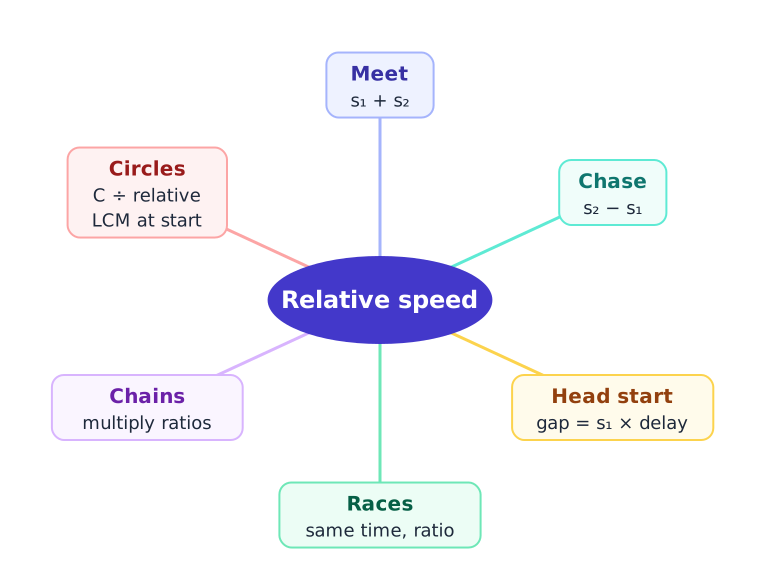
Use relative speed for two movers: add speeds when they move towards each other and subtract when one chases the other. Apply the same idea to head starts, straight races where one runner beats another, chains of races and runners on circular tracks.
What you will be able to do
- I can find when and where two people moving towards each other meet.
- I can solve chase problems, including a head start in time.
- I can turn "A beats B by x metres" into a speed ratio and use it.
- I can find meeting times on a circular track.
Key points
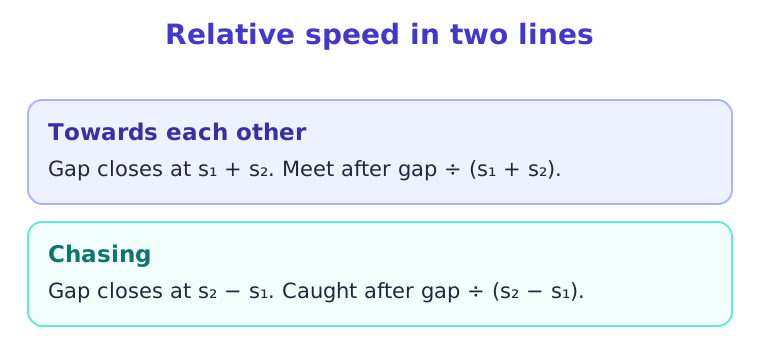
Towards each other: relative speed = s₁ + s₂; time to meet = distance ÷ (s₁ + s₂).
Chasing in the same direction: relative speed = s₂ − s₁; time to catch = gap ÷ (s₂ − s₁).
A head start in time becomes a head start in distance: gap = speed of the leader × the delay.
"A beats B by x m in an L m race" means when A runs L, B runs L − x: speed ratio L : (L − x).
"A beats B by t seconds" means B needs t seconds more than A for the full race.
For chains, multiply the fractions: if A beats B by x and B beats C by y in L m, C runs L × (L − x)/L × (L − y)/L when A finishes.
On a circular track of length C: opposite directions meet every C ÷ (v₁ + v₂); the same direction every C ÷ (v₁ − v₂).
Runners meet again at the starting point after the LCM of their lap times.
Full explanation
Two friends, one road

Sunil and Imran live 30 km apart. On Sunday they cycle towards each other, Sunil at 12 km/h and Imran at 8 km/h. When do they meet?
Later that day Imran races his younger brother on the school ground. Both questions use one idea: relative speed.
Moving towards each other
Each hour Sunil covers 12 km and Imran 8 km, so the gap shrinks by $12 + 8 = 20$ km every hour. They meet after $30 \div 20 = 1.5$ hours, $12 \times 1.5 = 18$ km from Sunil's home.
Chasing
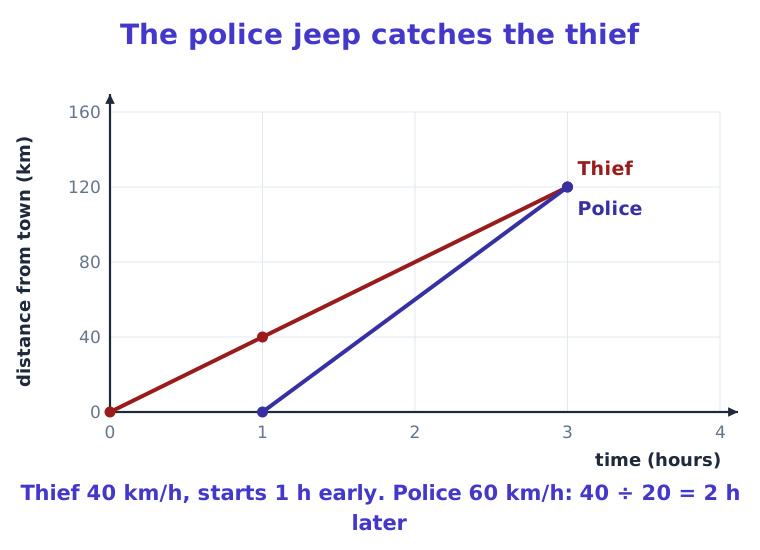
A thief runs at 40 km/h. The police start 1 hour later at 60 km/h. In that hour the thief gets 40 km ahead. The jeep gains $60 - 40 = 20$ km each hour, so it catches him after $40 \div 20 = 2$ hours, 120 km from the town.
Races: "beats by x metres"
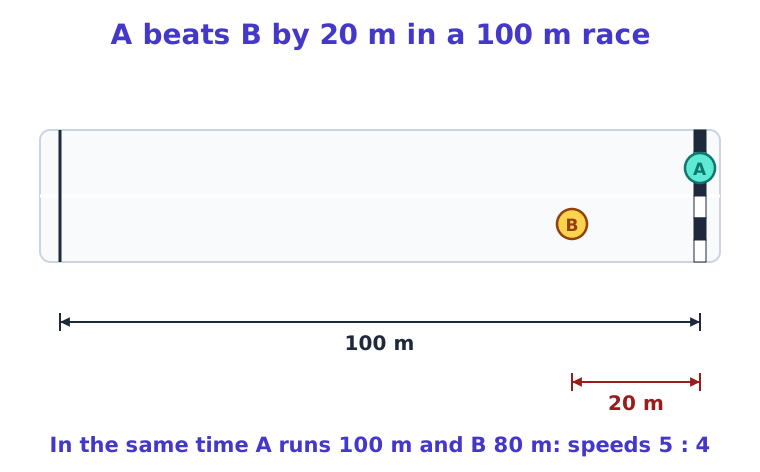
In a 100 m race A beats B by 20 m. When A crosses the line, B has run only 80 m. In the same time, distances are in the ratio of speeds, so $v_A : v_B = 100 : 80 = 5 : 4$.
"Beats by t seconds"
If A runs 100 m in 16 s and beats B by 20 m, B runs 80 m in 16 s, so B's speed is 5 m/s and B needs 20 s for 100 m. A beats B by 4 seconds.
Chains of races
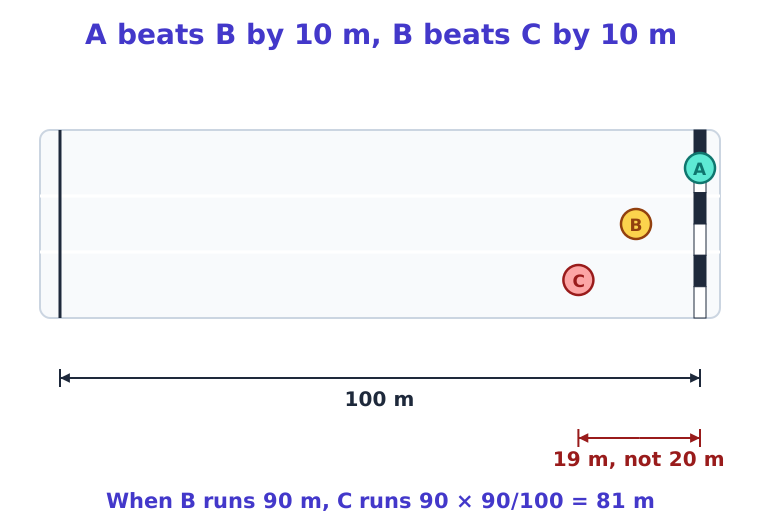
A beats B by 10 m and B beats C by 10 m in 100 m races. By how much does A beat C? Not 20 m. When B runs 90 m, C runs $90 \times \frac{90}{100} = 81$ m, so A beats C by 19 m.
Circular tracks
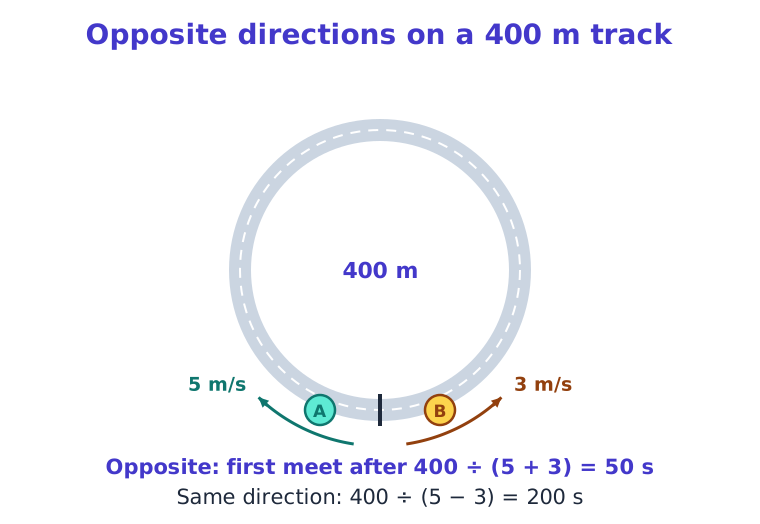
On a 400 m track, A runs at 5 m/s and B at 3 m/s.
- Opposite directions: together they cover a lap, so they meet every $400 \div 8 = 50$ s.
- Same direction: A must gain a full lap: every $400 \div 2 = 200$ s.
- At the start again: lap times 80 s and $133\frac{1}{3}$ s; the LCM of these is 400 s.
Back to Sunil and Imran
They met after 1.5 hours because the gap closed at 20 km/h. In Imran's race, the same reasoning with equal times turned a 20 m margin into a 5 : 4 speed ratio. Whenever two things move, ask first: is the gap closing at the sum or the difference?
Concepts and terms
The rate at which the gap between two movers changes: sum when approaching, difference when chasing.
In the same time, distances are in the ratio of speeds. A race result tells you the distances when the winner finishes.
A start of x m means the other runner begins x m ahead, so runs only L − x.
On a loop, the faster runner meets the slower one each time it gains one full lap (same direction) or when together they cover one lap (opposite).
Did you know
Air traffic controllers use relative speed every minute: two planes approaching at 800 km/h each close the gap at 1,600 km/h.
Memory tricks
Add or subtract — Face to face: add. Nose to tail: subtract. — Approaching closes the gap with both speeds; chasing only with the difference.
Race chains — Chain the fractions — Beats of 10 m and 10 m in 100 m give 19 m, not 20 m: 0.9 × 0.9 = 0.81.
Practice MCQs with answers (58)
- A 2 h
- B 7 h 30 min
- C 3 h
- D 1 h 30 min
Show answer
Why:
Gap closes at 12 + 8 = 20 km/h: 30 ÷ 20 = 1.5 h = 1 h 30 min.
- A 2 h
- B 2 h 30 min
- C 18 h
- D 4 h
Show answer
Why:
Gap closes at 10 + 8 = 18 km/h: 36 ÷ 18 = 2 h.
- A 50 km
- B 60 km
- C 62 km
- D 40 km
Show answer
Why:
They meet after 100 ÷ 50 = 2 h; Sunil covers 30 × 2 = 60 km.
- A 22.5 km
- B 29 km
- C 27 km
- D 18 km
Show answer
Why:
They meet after 45 ÷ 15 = 3 h; Priya covers 9 × 3 = 27 km.
- A 3 h 30 min
- B 15 h
- C 6 h
- D 3 h
Show answer
Why:
Gap closes at 15 + 10 = 25 km/h: 75 ÷ 25 = 3 h.
- A 48 km
- B 36 km
- C 42 km
- D 50 km
Show answer
Why:
They meet after 84 ÷ 28 = 3 h; Priya covers 16 × 3 = 48 km.
- A $\frac{1}{3}$ minutes
- B 3 minutes
- C 50 minutes
- D 0.6 minutes
Show answer
Why:
Gap closes at 10 − 8 = 2 km/h. 100 m = 0.1 km, so time = 0.1 ÷ 2 = 0.05 h = 3 minutes.
- A 1 minute
- B $\frac{6}{11}$ minutes
- C 6 minutes
- D 100 minutes
Show answer
Why:
Gap closes at 12 − 10 = 2 km/h. 200 m = 0.2 km, so time = 0.2 ÷ 2 = 0.1 h = 6 minutes.
- A 0.75 minutes
- B $\frac{3}{7}$ minutes
- C 50 minutes
- D 3 minutes
Show answer
Why:
Gap closes at 12 − 9 = 3 km/h. 150 m = 0.15 km, so time = 0.15 ÷ 3 = 0.05 h = 3 minutes.
- A 4.5 minutes
- B $1\frac{1}{8}$ minutes
- C 75 minutes
- D 1.8 minutes
Show answer
Why:
Gap closes at 10 − 6 = 4 km/h. 300 m = 0.3 km, so time = 0.3 ÷ 4 = $\frac{3}{40}$ h = 4.5 minutes.
- A 4 h
- B 2 h
- C 3 h
- D 24 min
Show answer
Why:
Head start 40 × 1 = 40 km; the car gains 20 km/h: 40 ÷ 20 = 2 h.
- A 6 h
- B 5 h
- C 3 h
- D 45 min
Show answer
Why:
Head start 30 × 2 = 60 km; the car gains 20 km/h: 60 ÷ 20 = 3 h.
- A 18 km
- B 42 km
- C 12 km
- D 30 km
Show answer
Why:
Head start 12 km; caught after 12 ÷ 8 = 1.5 h; distance 20 × 1.5 = 30 km.
- A 48 km
- B 64 km
- C 16 km
- D 32 km
Show answer
Why:
Head start 16 km; caught after 16 ÷ 8 = 2 h; distance 24 × 2 = 48 km.
- A 9 h
- B 6 h
- C 1 h 12 min
- D 12 h
Show answer
Why:
Head start 10 × 3 = 30 km; the car gains 5 km/h: 30 ÷ 5 = 6 h.
- A 2 km
- B 9 km
- C 18 km
- D 20 km
Show answer
Why:
Relative speed 4 + 5 = 9 km/h; × 2 = 18 km.
- A 15 km
- B 9 km
- C 30 km
- D 6 km
Show answer
Why:
Relative speed 6 − 4 = 2 km/h; × 3 = 6 km.
- A 20 km
- B 22.5 km
- C 5 km
- D 10 km
Show answer
Why:
Relative speed 3 + 5 = 8 km/h; × 2.5 = 20 km.
- A 42 km
- B 12 km
- C 16 km
- D 84 km
Show answer
Why:
Relative speed 12 − 9 = 3 km/h; × 4 = 12 km.
- A 6 : 5
- B 4 : 5
- C 5 : 4
- D 5 : 1
Show answer
Why:
When A runs 100 m, B runs 80 m in the same time: 100 : 80 = 5 : 4.
- A 4 : 5
- B 5 : 1
- C 6 : 5
- D 5 : 4
Show answer
Why:
When A runs 200 m, B runs 160 m in the same time: 200 : 160 = 5 : 4.
- A 10 : 9
- B 11 : 10
- C 9 : 10
- D 10 : 1
Show answer
Why:
When A runs 500 m, B runs 450 m in the same time: 500 : 450 = 10 : 9.
- A 16 : 1
- B 16 : 15
- C 17 : 16
- D 15 : 16
Show answer
Why:
When A runs 400 m, B runs 375 m in the same time: 400 : 375 = 16 : 15.
- A $9\frac{1}{11}$ m/s
- B 1 m/s
- C 9 m/s
- D 10 m/s
Show answer
Why:
v_B = 10 × 90/100 = 9 m/s.
- A 6.4 m/s
- B 2 m/s
- C 3 m/s
- D 6 m/s
Show answer
Why:
v_B = 8 × 150/200 = 6 m/s.
- A 4.5 m/s
- B 1 m/s
- C $4\frac{6}{11}$ m/s
- D 0.5 m/s
Show answer
Why:
v_B = 5 × 360/400 = 4.5 m/s.
- A 2 seconds
- B 4 seconds
- C 3.2 seconds
- D 20 seconds
Show answer
Why:
B runs 80 m in 16 s, so B needs 100 × 16 ÷ 80 = 20 s for 100 m. Margin 20 − 16 = 4 s.
- A 5 seconds
- B 31.25 seconds
- C 6.25 seconds
- D 4 seconds
Show answer
Why:
B runs 160 m in 25 s, so B needs 200 × 25 ÷ 160 = 31.25 s for 200 m. Margin 31.25 − 25 = 6.25 s.
- A 10 seconds
- B 18 seconds
- C 200 seconds
- D 20 seconds
Show answer
Why:
B runs 900 m in 180 s, so B needs 1000 × 180 ÷ 900 = 200 s for 1000 m. Margin 200 − 180 = 20 s.
- A 4 seconds
- B 3.75 seconds
- C 64 seconds
- D 2.5 seconds
Show answer
Why:
B runs 375 m in 60 s, so B needs 400 × 60 ÷ 375 = 64 s for 400 m. Margin 64 − 60 = 4 s.
- A 22 m
- B 19 m
- C 100 m
- D 20 m
Show answer
Why:
When A runs 100, B runs 90; when B runs 90, C runs 90 × 90/100 = 81. A beats C by 100 − 81 = 19 m.
- A 10 m
- B 29 m
- C 28 m
- D 30 m
Show answer
Why:
When A runs 100, B runs 80; when B runs 80, C runs 80 × 90/100 = 72. A beats C by 100 − 72 = 28 m.
- A 20 m
- B 57 m
- C 60 m
- D 56 m
Show answer
Why:
When A runs 200, B runs 180; when B runs 180, C runs 180 × 160/200 = 144. A beats C by 200 − 144 = 56 m.
- A 145 m
- B 146 m
- C 150 m
- D 50 m
Show answer
Why:
When A runs 1000, B runs 900; when B runs 900, C runs 900 × 950/1000 = 855. A beats C by 1000 − 855 = 145 m.
- A 60 m
- B 50 m
- C 10 m
- D 250 m
Show answer
Why:
A takes 300 ÷ 6 = 50 s; in that time B runs 5 × 50 = 250 m. Start = 300 − 250 = 50 m.
- A 10 m
- B 350 m
- C 50 m
- D $57\frac{1}{7}$ m
Show answer
Why:
A takes 400 ÷ 8 = 50 s; in that time B runs 7 × 50 = 350 m. Start = 400 − 350 = 50 m.
- A 50 m
- B 20 m
- C 160 m
- D 40 m
Show answer
Why:
A takes 200 ÷ 10 = 20 s; in that time B runs 8 × 20 = 160 m. Start = 200 − 160 = 40 m.
- A 50 seconds
- B 200 seconds
- C 80 seconds
- D $133\frac{1}{3}$ seconds
Show answer
Why:
Together they cover one lap: 400 ÷ (5 + 3) = 50 s.
- A 120 seconds
- B 300 seconds
- C 50 seconds
- D $85\frac{5}{7}$ seconds
Show answer
Why:
The faster must gain one lap: 600 ÷ (7 − 5) = 300 s.
- A 250 seconds
- B $83\frac{1}{3}$ seconds
- C 50 seconds
- D 125 seconds
Show answer
Why:
Together they cover one lap: 500 ÷ (6 + 4) = 50 s.
- A 60 seconds
- B 24 seconds
- C 40 seconds
- D 120 seconds
Show answer
Why:
The faster must gain one lap: 360 ÷ (9 − 6) = 120 s.
- A 80 seconds
- B 1200 seconds
- C 150 seconds
- D $171\frac{3}{7}$ seconds
Show answer
Why:
Together they cover one lap: 1200 ÷ (8 + 7) = 80 s.
- A 144 seconds
- B 72 seconds
- C 60 seconds
- D 12 seconds
Show answer
Why:
Each is at the start after a multiple of its lap time, so they meet there after LCM(24, 36) = 72 s.
- A 360 seconds
- B 135 seconds
- C 180 seconds
- D 15 seconds
Show answer
Why:
Each is at the start after a multiple of its lap time, so they meet there after LCM(30, 45, 60) = 180 s.
- A 88 seconds
- B 8 seconds
- C 480 seconds
- D 240 seconds
Show answer
Why:
Each is at the start after a multiple of its lap time, so they meet there after LCM(40, 48) = 240 s.
- A the sum of their speeds
- B the average of their speeds
- C the difference of their speeds
- D the faster car's speed
Show answer
Why:
Each closes part of the gap, so the speeds add.
- A caught after twice the gap
- B never caught
- C caught halfway
- D caught immediately
Show answer
Why:
Relative speed is zero, so the gap never changes.
- A 300 m
- B 330 m
- C 270 m
- D 30 m
Show answer
Why:
300 − 30 = 270 m.
- A 10 m
- B 21 m
- C 20 m
- D 19 m
Show answer
Why:
C runs 90 × 0.9 = 81 when A runs 100.
- A in opposite directions
- B it does not depend on direction
- C in the same direction
- D at the same speed in the same direction
Show answer
Why:
Opposite uses the sum of speeds, which is larger.
- A Both A and R are true, and R is the correct explanation of A
- B Both A and R are true, but R is not the correct explanation of A
- C A is true but R is false
- D A is false but R is true
Show answer
Why:
Gap 40 km at 20 km/h = 2 h; R gives the 20 km/h.
- A Both A and R are true, and R is the correct explanation of A
- B Both A and R are true, but R is not the correct explanation of A
- C A is true but R is false
- D A is false but R is true
Show answer
Why:
By R, C runs 0.81 of the race, so the margin is 19 m: A is false, R is true.
- A 1 only
- B 2 only
- C Both 1 and 2
- D Neither 1 nor 2
Show answer
Why:
1: 25 × 2 = 50, true. 2: 5 × 2 = 10 km, false.
- A 1 only
- B 2 only
- C Both 1 and 2
- D Neither 1 nor 2
Show answer
Why:
Both describe the standard rules.
- A $4\frac{6}{11}$ m/s
- B 4.5 m/s
- C 5 m/s
- D 0.5 m/s
Show answer
Why:
B ran 450 m in A's 100 s: 4.5 m/s.
- A 120 seconds
- B $85\frac{5}{7}$ seconds
- C 50 seconds
- D 300 seconds
Show answer
Why:
Together they cover a lap: 600 ÷ (5 + 7) = 50 s.
- A 40 seconds
- B 100 seconds
- C $66\frac{2}{3}$ seconds
- D 200 seconds
Show answer
Why:
A must gain one lap: 400 ÷ (6 − 4) = 200 s.
- A 47 m
- B 48 m
- C 50 m
- D 10 m
Show answer
Why:
When B runs 180 m, C runs 180 × 170/200 = 153 m. A beats C by 200 − 153 = 47 m.
Important short questions (4)
120 ÷ 80 = 1.5 h, so at 10:30 a.m.
1000 : 950 = 20 : 19.
B's 10 m lead over C is for a full 100 m; when B has run only 90 m, C is behind by 9 m, so C is at 81 m: margin 19 m.
LCM(30, 45) = 90 s.
Long answer questions (1)
(a) 45 × 0.5 = 22.5 km.
(b) Gap closes at 15 km/h: 22.5 ÷ 15 = 1.5 h after 10:30, so at 12 noon.
(c) The car runs 60 × 1.5 = 90 km.
Flashcards (12)
Play this topic
- Relative speed check
Veda Skills Quantitative Aptitude Unit 10 — frequently asked questions
63 × 5/18 = 17.5 m/s; 22 × 18/5 = 79.2 km/h.
Times 2 h + 1 h = 3 h for 120 km: 40 km/h.
D/5 − D/6 = 10/60, so D/30 = 1/6 and D = 5 km.
280 ÷ 14 = 20 m/s = 72 km/h.
For a platform it covers its own length plus the platform's length.
Relative 10 km/h = 25/9 m/s; 200 ÷ 25/9 = 72 s.
120 ÷ 80 = 1.5 h, so at 10:30 a.m.
1000 : 950 = 20 : 19.
B's 10 m lead over C is for a full 100 m; when B has run only 90 m, C is behind by 9 m, so C is at 81 m: margin 19 m.

All Veda Skills Quantitative Aptitude units
All Quantitative Aptitude units · All Skills & Exams courses
Study this chapter properly, free
Everything above is on this page to read. In the Veda app the same chapter becomes spaced-repetition flashcards, timed tests that mark themselves, Veda Bites you can swipe, and games — with your progress tracked topic by topic.
Get Veda free