Veda Skills Quantitative Aptitude Unit 1: Number System
- ★ Free chapter
- 3 topics
- 209 MCQs
- 12 short answers
- 3 long answers
- 44 flashcards
- 4 games
- ~150 min read
- English
Checked before publishing: 23 automated checks, including a plagiarism check against the textbook's own words. How we check our content
Types of Numbers and Divisibility
Know every family of numbers, spot primes fast, test divisibility by 2 to 12 without dividing, and count the factors of any number from its prime factorisation.
What you will be able to do
- I can place any number in its family: natural, whole, integer, rational or irrational.
- I can decide quickly whether a number up to 400 is prime.
- I can test divisibility by 2, 3, 4, 5, 6, 8, 9, 11 and 12 using digit rules.
- I can count the factors of a number from its prime factorisation.

Key points
Natural numbers start at 1; whole numbers add 0; integers add the negatives.
A rational number can be written as p/q with integers p, q and q ≠ 0; its decimal ends or repeats.
An irrational number such as √2 or π has a decimal that never ends and never repeats.
A prime has exactly two factors, 1 and itself. 1 is neither prime nor composite, and 2 is the only even prime.
To test whether n is prime, divide only by the primes up to √n.
There are 25 primes below 100: 15 up to 50 and 10 more from 51 to 100.
A number is divisible by 3 (or 9) when the sum of its digits is divisible by 3 (or 9).
If n = a^p × b^q × c^r in primes, n has (p + 1)(q + 1)(r + 1) factors.
Full explanation
A shopkeeper's question

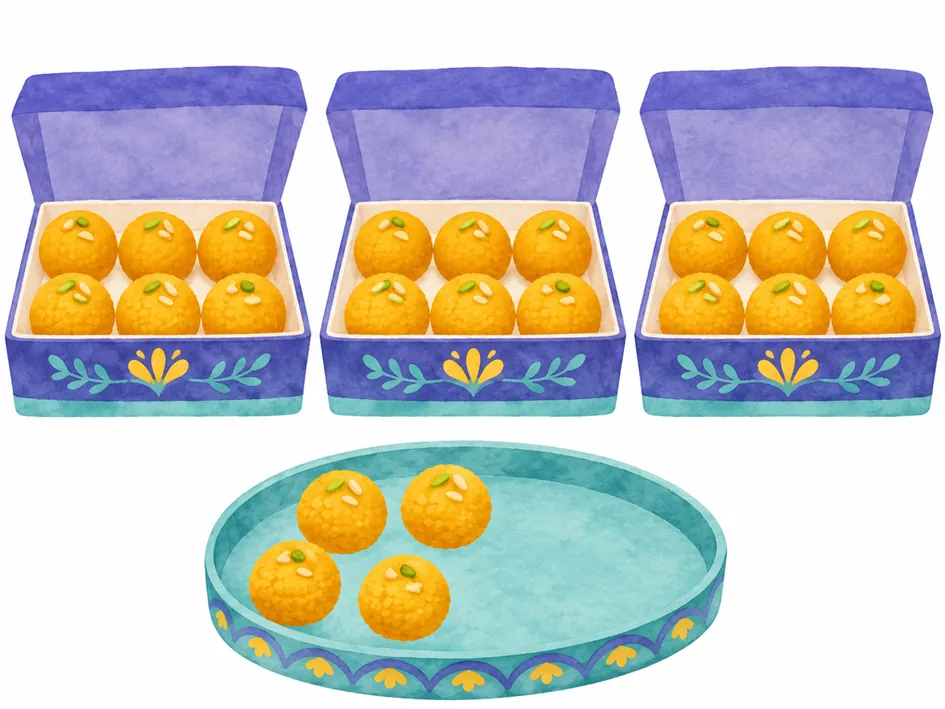
Ravi runs a sweet shop and has 360 laddoos. He wants to pack them in equal boxes with none left over. How many different box sizes can he choose?
To answer that in ten seconds, you need to know how numbers are built. That is what this unit is about, and almost every aptitude exam starts its maths section here.
The number family

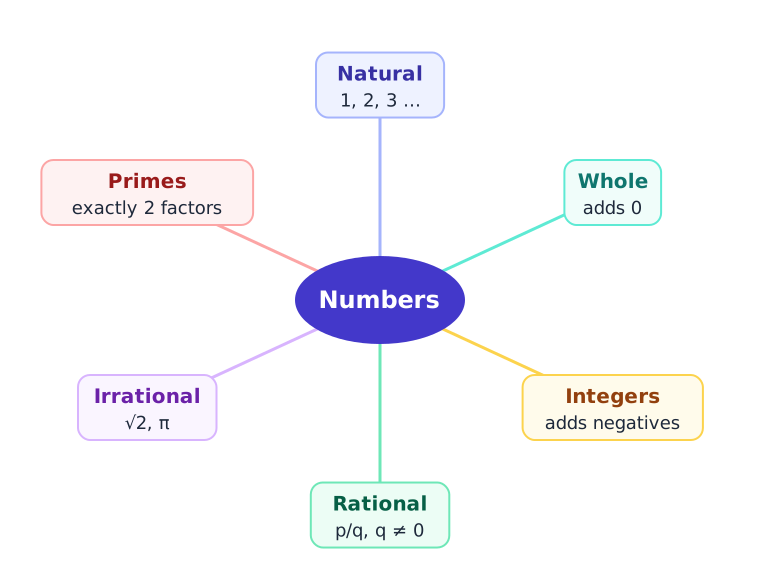
Numbers live inside one another, like boxes inside boxes.
- Natural numbers: 1, 2, 3, … (counting numbers)
- Whole numbers: 0, 1, 2, 3, …
- Integers: … −2, −1, 0, 1, 2, …
- Rational numbers: anything that can be written as $\frac{p}{q}$, with $q \neq 0$
- Real numbers: all of the above plus the irrationals
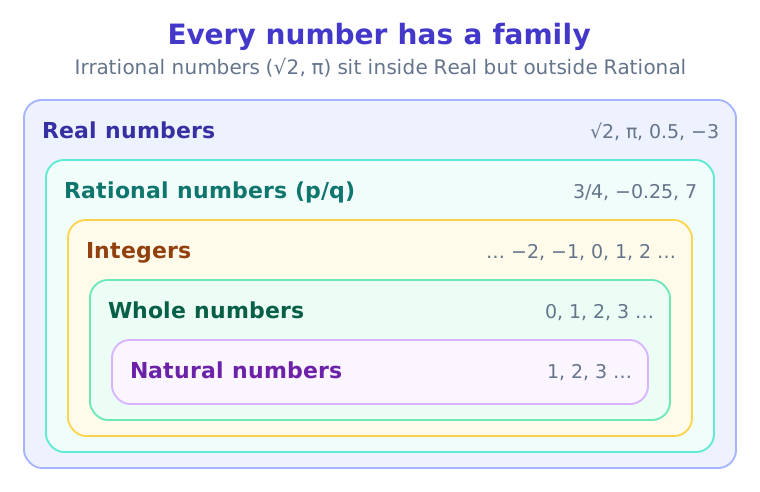
Rational or irrational?
A rational number has a decimal that either stops ($\frac{3}{4} = 0.75$) or repeats ($\frac{1}{3} = 0.333\ldots$). An irrational number never stops and never repeats: $\sqrt{2} = 1.41421\ldots$, $\pi = 3.14159\ldots$
Exam trap: $\frac{22}{7}$ is rational. It is only an approximation of $\pi$, which is irrational.
Primes and composites
A prime has exactly two factors: 1 and itself. A composite has more than two.
- 1 is neither prime nor composite.
- 2 is the only even prime.
- Two numbers are co-prime when their only common factor is 1, like 8 and 15.
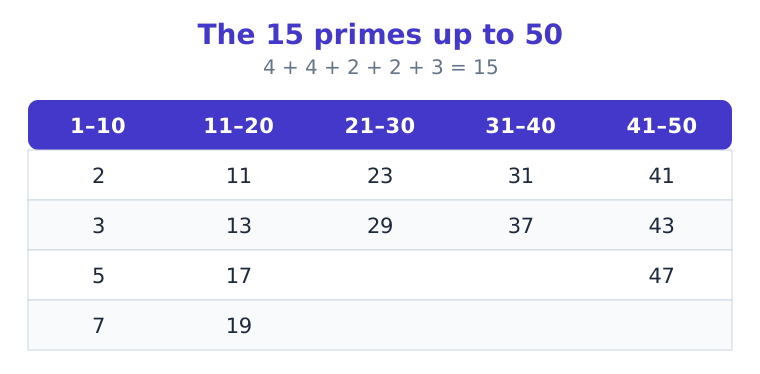
Is it prime? The square-root test
To check a number $n$, divide it only by the primes up to $\sqrt{n}$.
Example: Is 221 prime? $\sqrt{221}$ is a little under 15, so try 2, 3, 5, 7, 11, 13. It fails for 2 to 11, but $221 = 13 \times 17$. So 221 is composite.
Numbers that look prime but are not: 91, 119, 133, 143, 161, 187, 209, 221.
Divisibility without dividing
Each rule looks at the digits instead of doing the long division.
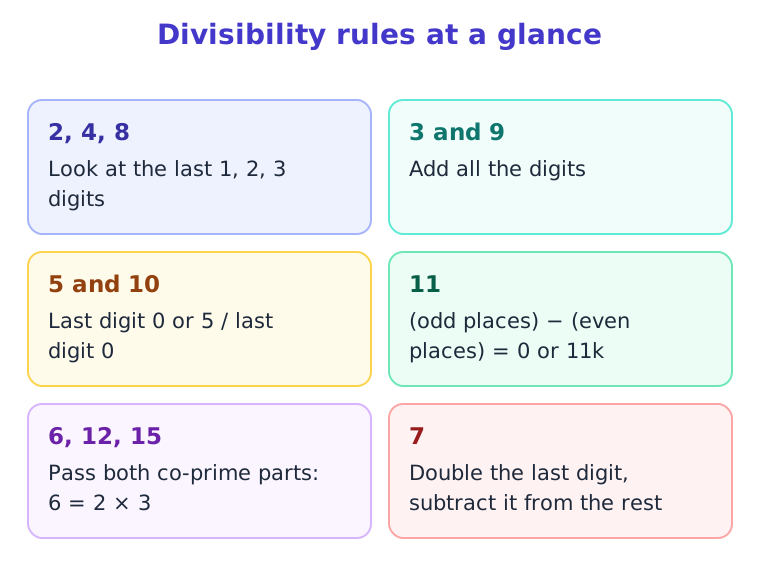
Worked example: the rule for 11
Is 9,08,071 divisible by 11?
Digits from the right: 1, 7, 0, 8, 0, 9.
Odd places: $1 + 0 + 0 = 1$. Even places: $7 + 8 + 9 = 24$. Difference: $24 - 1 = 23$.
23 is not 0 or a multiple of 11, so the number is not divisible by 11.
Breaking a number into primes
Keep splitting off the smallest prime until only primes remain. This is the prime factorisation.
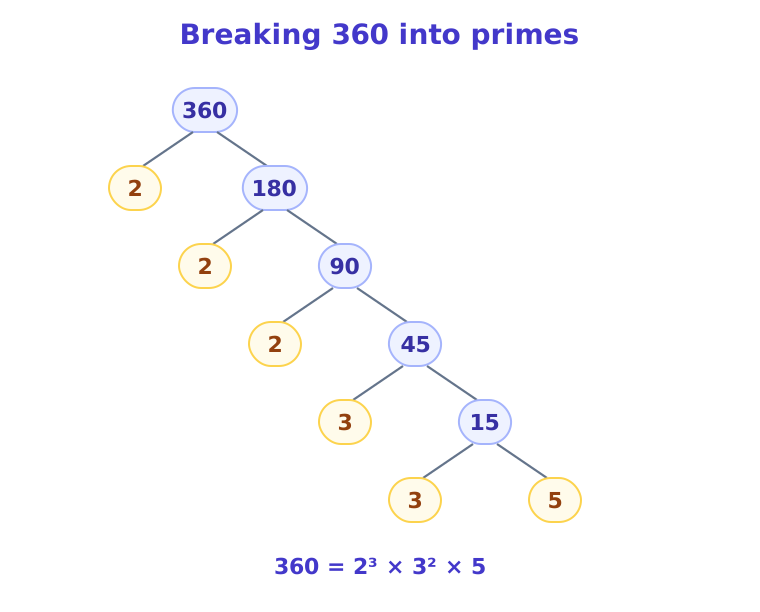
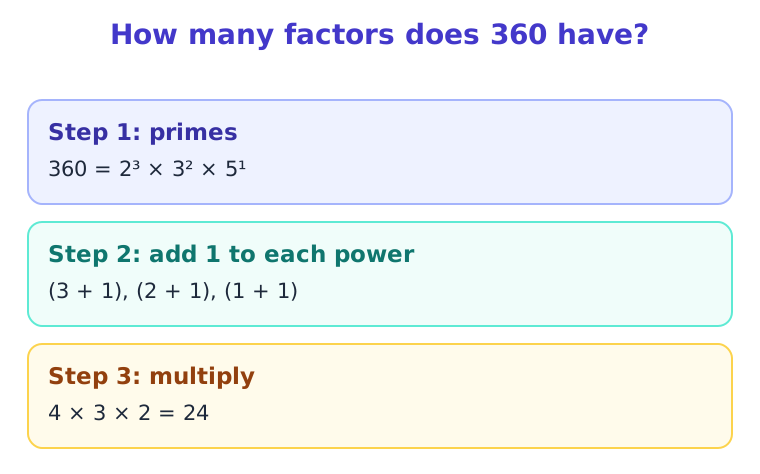
Counting factors: back to Ravi
If $n = a^p \times b^q \times c^r$, the number of factors is $(p+1)(q+1)(r+1)$.
For $360 = 2^3 \times 3^2 \times 5^1$: $(3+1)(2+1)(1+1) = 4 \times 3 \times 2 = 24$.
So Ravi has 24 box sizes to choose from, from boxes of 1 to one box of 360.
Exam shortcut summary
- Prime check: primes up to $\sqrt{n}$ only.
- 3 and 9: digit sum.
- 4 and 8: last two and last three digits.
- 11: odd places minus even places.
- Combined (6, 12, 15, 18): split into co-prime parts and test each.
- Factors: add one to every power and multiply.
Concepts and terms
A number greater than 1 whose only factors are 1 and itself, such as 2, 3, 5, 7, 11.
A number greater than 1 with more than two factors, such as 4, 9, 91 = 7 × 13.
Two numbers whose only common factor is 1, such as 8 and 15. Neither has to be prime.
Writing a number as a product of primes, for example 360 = 2³ × 3² × 5. Every number greater than 1 has exactly one, apart from the order of the factors.

Did you know
Every even number greater than 2 seems to be a sum of two primes (Goldbach, 1742). No one has proved it yet.
Online payments and passwords are protected by the fact that multiplying two huge primes is easy but undoing it is very hard.

Memory tricks
Primes up to 50 — 4-4-2-2-3 — Count the primes in each block of ten up to 50: 4, 4, 2, 2, 3, which makes 15.
Rule for 11 — Odd minus even — Add the digits in odd places, add the digits in even places, subtract. 0 or a multiple of 11 means divisible.
Practice MCQs with answers (73)
- A 91
- B 221
- C 247
- D 283
Show answer
Why:
283 has no prime factor up to √283, so it is prime. The others break up: 91 = 7×13, 221 = 13×17, 247 = 13×19.
- A 137
- B 203
- C 161
- D 119
Show answer
Why:
137 has no prime factor up to √137, so it is prime. The others break up: 161 = 7×23, 119 = 7×17, 203 = 7×29.
- A 187
- B 181
- C 221
- D 119
Show answer
Why:
181 has no prime factor up to √181, so it is prime. The others break up: 187 = 11×17, 221 = 13×17, 119 = 7×17.
- A 161
- B 299
- C 257
- D 253
Show answer
Why:
257 has no prime factor up to √257, so it is prime. The others break up: 161 = 7×23, 299 = 13×23, 253 = 11×23.
- A 133
- B 289
- C 377
- D 331
Show answer
Why:
331 has no prime factor up to √331, so it is prime. The others break up: 289 = 17², 377 = 13×29, 133 = 7×19.
- A 311
- B 247
- C 323
- D 377
Show answer
Why:
311 has no prime factor up to √311, so it is prime. The others break up: 377 = 13×29, 247 = 13×19, 323 = 17×19.
- A 71
- B 391
- C 149
- D 271
Show answer
Why:
391 = 17 × 23, so it is composite. The other three are prime.
- A 347
- B 191
- C 377
- D 223
Show answer
Why:
377 = 13 × 29. The other three have no factor except 1 and themselves.
- A 337
- B 59
- C 103
- D 341
Show answer
Why:
341 = 11 × 31. The other three have no factor except 1 and themselves.
- A 15
- B 13
- C 14
- D 16
Show answer
Why:
They are 2, 3, 5, 7, 11, 13, 17, 19, 23, 29, 31, 37, 41, 43, 47: 15 in all.
- A 12
- B 10
- C 9
- D 11
Show answer
Why:
They are 53, 59, 61, 67, 71, 73, 79, 83, 89, 97: 10 in all.
- A 24
- B 26
- C 25
- D 23
Show answer
Why:
They are 2, 3, 5, 7, 11, 13, 17, 19, 23, 29, 31, 37, 41, 43, 47, 53, 59, 61, 67, 71, 73, 79, 83, 89, 97: 25 in all.
- A 11
- B 12
- C 9
- D 10
Show answer
Why:
They are 101, 103, 107, 109, 113, 127, 131, 137, 139, 149: 10 in all.
- A 10
- B 9
- C 11
- D 8
Show answer
Why:
They are 2, 3, 5, 7, 11, 13, 17, 19, 23, 29: 10 in all.
- A 2
- B 0
- C 9
- D 3
Show answer
Why:
Known digits add to 18. The total must be a multiple of 9, and the smallest digit that does it is 0 (18 + 0 = 18).
- A 1
- B 7
- C 0
- D 9
Show answer
Why:
Known digits add to 18. The total must be a multiple of 9, and the smallest digit that does it is 0 (18 + 0 = 18).
- A 9
- B 2
- C 7
- D 0
Show answer
Why:
Known digits add to 12. The total must be a multiple of 3, and the smallest digit that does it is 0 (12 + 0 = 12).
- A 1
- B 9
- C 2
- D 8
Show answer
Why:
Known digits add to 17. The total must be a multiple of 9, and the smallest digit that does it is 1 (17 + 1 = 18).
- A 7
- B 2
- C 6
- D 1
Show answer
Why:
Known digits add to 22. The total must be a multiple of 3, and the smallest digit that does it is 2 (22 + 2 = 24).
- A 1
- B 6
- C 2
- D 8
Show answer
Why:
Known digits add to 16. The total must be a multiple of 9, and the smallest digit that does it is 2 (16 + 2 = 18).
- A It cannot be decided without long division
- B No, the place-sum difference is not a multiple of 11
- C No, because the number is even
- D Yes, the place-sum difference is a multiple of 11
Show answer
Why:
From the right, odd places add to 14 and even places to 14; the difference is 0, which is 0 or a multiple of 11.
- A No, the place-sum difference is not a multiple of 11
- B It cannot be decided without long division
- C Yes, the place-sum difference is a multiple of 11
- D Yes, because its digit sum is odd
Show answer
Why:
From the right, odd places add to 14 and even places to 7; the difference is 7, which is not 0 or a multiple of 11.
- A It cannot be decided without long division
- B Yes, the place-sum difference is a multiple of 11
- C No, the place-sum difference is not a multiple of 11
- D No, because the number is odd
Show answer
Why:
From the right, odd places add to 11 and even places to 11; the difference is 0, which is 0 or a multiple of 11.
- A Yes, the place-sum difference is a multiple of 11
- B Yes, because its digit sum is odd
- C No, the place-sum difference is not a multiple of 11
- D It cannot be decided without long division
Show answer
Why:
From the right, odd places add to 17 and even places to 12; the difference is 5, which is not 0 or a multiple of 11.
- A No, the place-sum difference is not a multiple of 11
- B No, because the number is odd
- C It cannot be decided without long division
- D Yes, the place-sum difference is a multiple of 11
Show answer
Why:
From the right, odd places add to 10 and even places to 10; the difference is 0, which is 0 or a multiple of 11.
- A 1
- B 6
- C 0
- D 3
Show answer
Why:
With ★ = 1, the number 8217 = 11 × 747.
- A 0
- B 1
- C 4
- D 6
Show answer
Why:
With ★ = 1, the number 96129 = 11 × 8739.
- A 4
- B 3
- C 9
- D 5
Show answer
Why:
With ★ = 9, the number 28919 = 11 × 2629.
- A 3
- B 1
- C 9
- D 4
Show answer
Why:
With ★ = 4, the number 86416 = 11 × 7856.
- A 580656
- B 672356
- C 683122
- D 433813
Show answer
Why:
Only the last 3 digits matter: 656 is a multiple of 8; the others are not.
- A 358030
- B 152024
- C 706254
- D 459259
Show answer
Why:
Only the last 2 digits matter: 24 is a multiple of 4; the others are not.
- A 560074
- B 559819
- C 799048
- D 875874
Show answer
Why:
Only the last 3 digits matter: 048 is a multiple of 8; the others are not.
- A 531821
- B 799702
- C 387450
- D 574032
Show answer
Why:
Only the last 2 digits matter: 32 is a multiple of 4; the others are not.
- A 91716
- B 9071
- C 5666
- D 84334
Show answer
Why:
6 = 2 × 3, two co-prime parts. Only 91716 passes both tests.
- A 55676
- B 94536
- C 20241
- D 62546
Show answer
Why:
12 = 3 × 4, two co-prime parts. Only 94536 passes both tests.
- A 76613
- B 87477
- C 17895
- D 64047
Show answer
Why:
15 = 3 × 5, two co-prime parts. Only 17895 passes both tests.
- A 2403
- B 99589
- C 94454
- D 93798
Show answer
Why:
18 = 2 × 9, two co-prime parts. Only 93798 passes both tests.
- A 12
- B 6
- C 14
- D 10
Show answer
Why:
$72 = 2^{3} × 3^{2}$, so the count is $(3+1) \times (2+1) = 12$.
- A 16
- B 18
- C 6
- D 20
Show answer
Why:
$180 = 2^{2} × 3^{2} × 5$, so the count is $(2+1) \times (2+1) \times (1+1) = 18$.
- A 7
- B 18
- C 16
- D 14
Show answer
Why:
$1000 = 2^{3} × 5^{3}$, so the count is $(3+1) \times (3+1) = 16$.
- A 18
- B 11
- C 7
- D 9
Show answer
Why:
$256 = 2^{8}$, so the count is $(8+1) = 9$.
- A 24
- B 22
- C 6
- D 26
Show answer
Why:
$420 = 2^{2} × 3 × 5 × 7$, so the count is $(2+1) \times (1+1) \times (1+1) \times (1+1) = 24$.
- A 30
- B 32
- C 6
- D 34
Show answer
Why:
$2310 = 2 × 3 × 5 × 7 × 11$, so the count is $(1+1) \times (1+1) \times (1+1) \times (1+1) \times (1+1) = 32$.
- A 14
- B 10
- C 12
- D 7
Show answer
Why:
$96 = 2^{5} × 3$, so the count is $(5+1) \times (1+1) = 12$.
- A -1
- B 1/2
- C 1
- D 0
Show answer
Why:
Whole numbers are 0, 1, 2, … and natural numbers start at 1, so 0 is the only one.
- A √5
- B 0.125
- C √16
- D 22/7
Show answer
Why:
√16 = 4, 22/7 is a fraction and 0.125 = 1/8. √5 never ends or repeats.
- A the smallest composite
- B neither prime nor composite
- C both prime and composite
- D the smallest prime
Show answer
Why:
A prime needs two factors and a composite more than two; 1 has only one.
- A 14 and 21
- B 12 and 18
- C 16 and 27
- D 15 and 25
Show answer
Why:
16 = 2⁴ and 27 = 3³ share no prime. 14 and 21 share 7, 12 and 18 share 6, 15 and 25 share 5.
- A 6
- B 1
- C 2
- D 4
Show answer
Why:
2 and 3 are prime and 1 is neither. 4 = 2 × 2 is the first composite.
- A 0.474747…
- B 3.1415926535…
- C 1.4142135…
- D 0.101001000100001…
Show answer
Why:
0.474747… repeats "47", so it equals 47/99. The others never repeat.
- A 49 and 51
- B 59 and 61
- C 87 and 89
- D 91 and 93
Show answer
Why:
59 and 61 are both prime. 49 = 7², 87 = 3 × 29, 91 = 7 × 13.
- A 127
- B 131
- C 129
- D 158
Show answer
Why:
2 + 3 + 5 + 7 + 11 + 13 + 17 + 19 + 23 + 29 = 129.
- A Exactly two
- B Infinitely many
- C None
- D Exactly one
Show answer
Why:
2 is the only one; every larger even number has 2 as a factor.
- A 12
- B 10
- C 8
- D 24
Show answer
Why:
It must be divisible by LCM(4, 6) = 12, not by 24: 12 itself is divisible by 4 and 6 but not 24.
- A 9
- B 6
- C 5
- D 4
Show answer
Why:
Among three consecutive numbers one is a multiple of 3 and at least one is even, so 6 always divides the product.
- A It is a natural number
- B It is irrational
- C It is an integer and a rational number
- D It is a whole number
Show answer
Why:
Negative numbers are integers but not whole or natural; −8 = −8/1, so it is rational.
- A Both A and R are true, and R is the correct explanation of A
- B Both A and R are true, but R is not the correct explanation of A
- C A is true but R is false
- D A is false but R is true
Show answer
Why:
Both true, and R is the reason: only 6k ± 1 remain as candidates. (Not every 6k ± 1 is prime, e.g. 25.)
- A Both A and R are true, and R is the correct explanation of A
- B Both A and R are true, but R is not the correct explanation of A
- C A is true but R is false
- D A is false but R is true
Show answer
Why:
0 = 0/1, so A is true; R is also true, but having no reciprocal does not explain why 0 is rational.
- A 1 only
- B 2 only
- C Both 1 and 2
- D Neither 1 nor 2
Show answer
Why:
Statement 1 is true. Statement 2 fails for 0, which is whole but not natural.
- A 1 only
- B 2 only
- C Both 1 and 2
- D Neither 1 nor 2
Show answer
Why:
(2 + √3) + (2 − √3) = 4 breaks statement 1. Statement 2 always holds.
- A 30
- B 7
- C 18
- D 24
Show answer
Why:
The leaves give 504 = 2^3 × 3^2 × 7, so the count is 4 × 3 × 2 = 24.
- A 36
- B 42
- C 7
- D 30
Show answer
Why:
The leaves give 1260 = 2^2 × 3^2 × 5 × 7, so the count is 3 × 3 × 2 × 2 = 36.
- A Whole numbers
- B Integers
- C Natural numbers
- D Only real numbers
Show answer
Why:
−7 is negative, so it is not whole or natural; the first box it fits is Integers.
- A 12
- B 3
- C 6
- D 4
Show answer
Why:
Each rectangle is a factor pair of 12: 1×12, 2×6, 3×4, 4×3, 6×2, 12×1, which is 6, the number of factors of 12.
- A D
- B A
- C B
- D C
Show answer
Why:
111 = 3 × 37, 117 = 3² × 13, 133 = 7 × 19. 127 has no prime factor up to 11, so it is prime.
- A 16
- B 8
- C 14
- D 18
Show answer
Why:
Each row size is a factor of 120, and 120 has 16 factors.
- A 10
- B 12
- C 14
- D 6
Show answer
Why:
Each row size is a factor of 84, and 84 has 12 factors.
- A 18
- B 22
- C 20
- D 10
Show answer
Why:
Each row size is a factor of 240, and 240 has 20 factors.
- A 2500
- B 1325
- C 1225
- D 1275
Show answer
Why:
$\frac{n(n+1)}{2} = \frac{50 \times 51}{2} = 1275$.
- A 5050
- B 4950
- C 10000
- D 5150
Show answer
Why:
$\frac{n(n+1)}{2} = \frac{100 \times 101}{2} = 5050$.
- A 900
- B 465
- C 495
- D 435
Show answer
Why:
$\frac{n(n+1)}{2} = \frac{30 \times 31}{2} = 465$.
- A 420
- B 399
- C 400
- D 800
Show answer
Why:
The sum of the first n odd numbers is $n^2 = 400$.
- A 2450
- B 1260
- C 1224
- D 1225
Show answer
Why:
The sum of the first n odd numbers is $n^2 = 1225$.
Important short questions (4)
√437 is a little under 21, so test primes up to 19. 437 ÷ 19 = 23, so 437 = 19 × 23 is composite.
Known digits: 6 + 5 + 3 + 1 + 2 = 17. The next multiple of 9 is 18, so ★ = 1.
2,000 = 2⁴ × 5³, so (4 + 1)(3 + 1) = 20 factors.
Let x = 0.3636…. Then 100x = 36.3636…, so 99x = 36 and x = 36/99 = 4/11.
Long answer questions (1)
We need (a + 1)(b + 1) = 12 with a, b ≥ 1: (a, b) = (1, 5), (5, 1), (2, 3), (3, 2).
2 × 3⁵ = 486, 2⁵ × 3 = 96, 2² × 3³ = 108, 2³ × 3² = 72.
Only 96 and 72 are below 100, so N = 72 or 96.
Flashcards (15)
Play this topic
- Prime or not?
- Match the number to its family
HCF and LCM
Find the HCF and LCM by prime factors and by division, use HCF × LCM = product, handle fractions, and read word problems: cutting into the largest pieces needs HCF, meeting again needs LCM.
What you will be able to do
- I can find the HCF and LCM of two or three numbers by prime factorisation.
- I can use HCF × LCM = product of two numbers to find a missing number.
- I can find the HCF and LCM of fractions.
- I can tell whether a word problem needs HCF or LCM.
Key points
HCF (Highest Common Factor) is the largest number that divides all the given numbers.
LCM (Lowest Common Multiple) is the smallest number that all the given numbers divide.
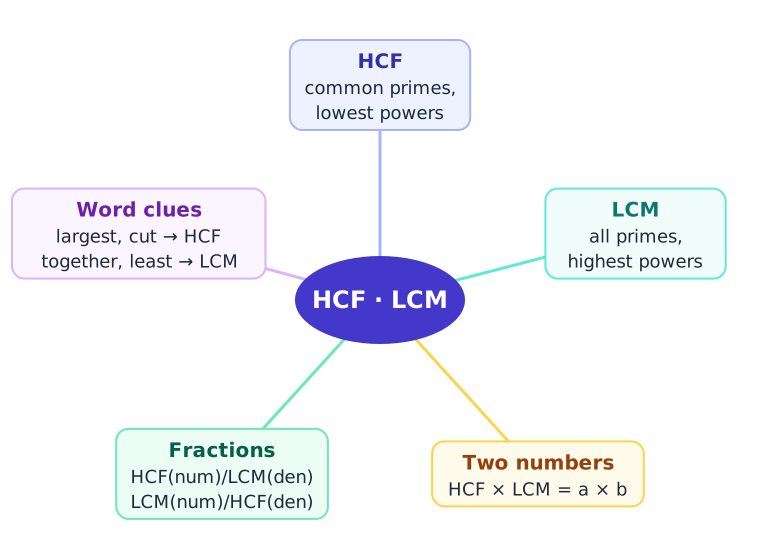
HCF: take the primes common to all numbers, each with its lowest power.
LCM: take every prime that appears, each with its highest power.
For two numbers only, HCF × LCM = product of the numbers.
The HCF always divides the LCM, and the HCF of co-prime numbers is 1.
HCF of fractions = HCF of numerators ÷ LCM of denominators; LCM of fractions = LCM of numerators ÷ HCF of denominators.
“Largest size, cut, fill exactly” points to HCF; “together again, least number, every” points to LCM.
Full explanation
Two bells, one question

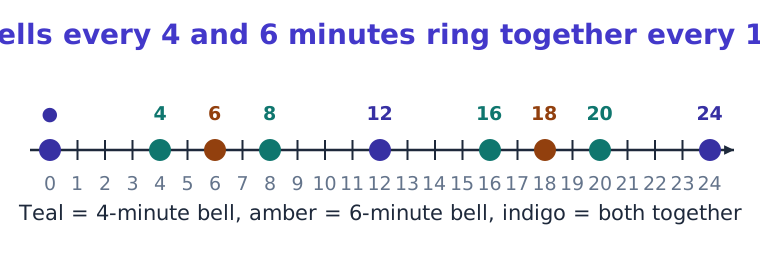
A temple bell rings every 4 minutes and a school bell every 6 minutes. They ring together at 8:00. When will they ring together again?
A tailor has cloth pieces of 36 m and 60 m and wants the longest equal pieces with nothing wasted. How long is each piece?
The first question is an LCM question and the second an HCF question. By the end of this topic you will tell them apart in one reading.
What HCF and LCM mean
- HCF of 36 and 60 is the biggest number that divides both: 12.
- LCM of 36 and 60 is the smallest number both divide: 180.
The HCF is never bigger than the smaller number, and the LCM is never smaller than the bigger number.
The prime-factor method
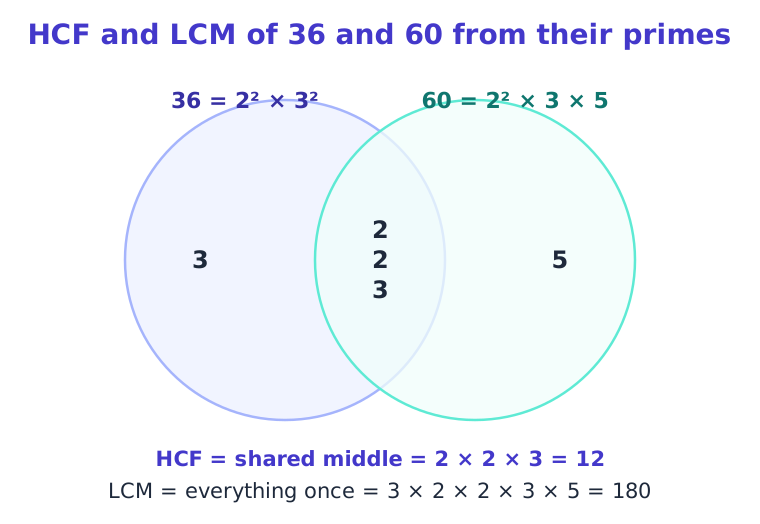
Write both numbers in primes: $36 = 2^2 \times 3^2$ and $60 = 2^2 \times 3 \times 5$.
- HCF: shared primes, lowest powers: $2^2 \times 3 = 12$.
- LCM: all primes, highest powers: $2^2 \times 3^2 \times 5 = 180$.
The division method for HCF
For large numbers, divide again and again.
$391 = 1 \times 323 + 68$, $323 = 4 \times 68 + 51$, $68 = 1 \times 51 + 17$, $51 = 3 \times 17 + 0$.
The last divisor is 17, so HCF(391, 323) = 17.
The product rule
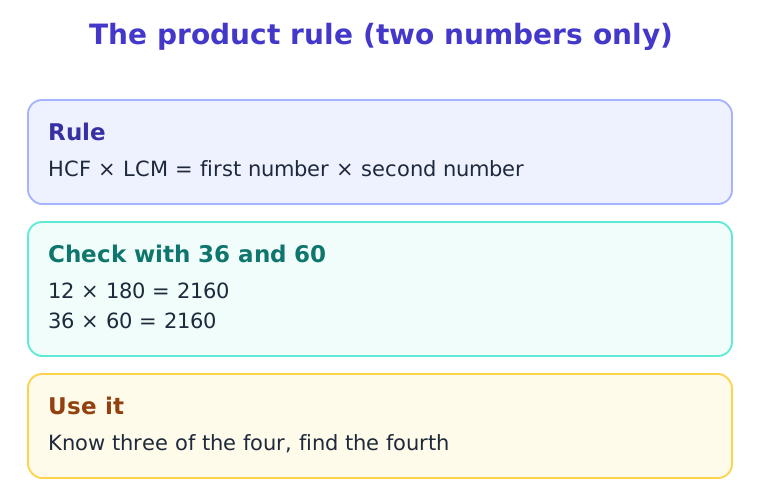
For two numbers, HCF × LCM = the product of the numbers.
Worked example: the missing number
The HCF of two numbers is 16 and their LCM is 192. One number is 48. Find the other.
$\text{Other} = \frac{16 \times 192}{48} = 64$.
Check: HCF(48, 64) = 16 and LCM(48, 64) = 192. Correct.
HCF and LCM of fractions
$\text{HCF} = \frac{\text{HCF of numerators}}{\text{LCM of denominators}}$, $\text{LCM} = \frac{\text{LCM of numerators}}{\text{HCF of denominators}}$.
For $\frac{2}{3}$ and $\frac{4}{9}$: HCF $= \frac{2}{9}$ and LCM $= \frac{4}{3}$.
Word problems: cut or meet?
Back to the bells: 4 and 6 minutes meet at LCM = 12 minutes, so they ring together again at 8:12.
The tailor and the tiles
The tailor needs the biggest length that divides both 36 and 60: HCF = 12 m, giving 3 + 5 = 8 pieces.
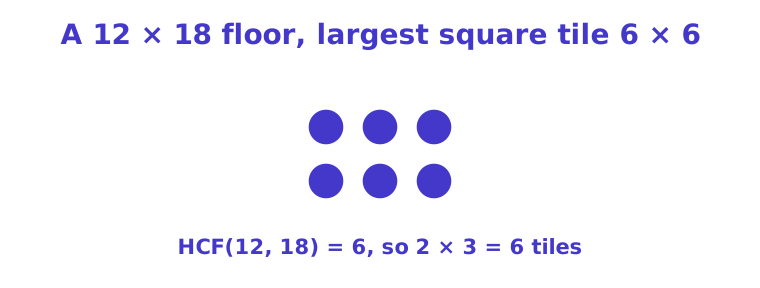
The same idea fills a floor with the biggest square tiles: a 12 × 18 floor takes tiles of side HCF(12, 18) = 6.
Remainder questions
- Smallest number that leaves remainder $r$ when divided by $a$, $b$, $c$: $\text{LCM}(a, b, c) + r$.
- Greatest number that divides $x$, $y$, $z$ leaving remainder $r$ each time: $\text{HCF}(x - r, y - r, z - r)$.
Concepts and terms
The biggest number that divides each given number exactly. HCF(36, 60) = 12.
The smallest number that each given number divides exactly. LCM(36, 60) = 180.
For two numbers a and b, HCF × LCM = a × b. It does not hold for three numbers.
Divide the larger by the smaller, then the divisor by the remainder, until the remainder is 0. The last divisor is the HCF.
Did you know
Euclid described the division method for the HCF about 2,300 years ago, and computers still use it today.
Memory tricks
Which powers? — HCF is humble, LCM is large — HCF takes the lowest power of each shared prime; LCM takes the highest power of every prime.
Word problems — Cut = HCF, Meet = LCM — Cutting things into the biggest equal parts is HCF; events repeating and meeting again is LCM.
Practice MCQs with answers (69)
- A 42
- B 84
- C 21
- D 252
Show answer
Why:
84 = 2² × 3 × 7 and 126 = 2 × 3² × 7; the shared primes with lowest powers give 42.
- A 96
- B 48
- C 24
- D 288
Show answer
Why:
96 = 2⁵ × 3 and 144 = 2⁴ × 3²; the shared primes with lowest powers give 48.
- A 675
- B 90
- C 45
- D 48
Show answer
Why:
135 = 3³ × 5 and 225 = 3² × 5²; the shared primes with lowest powers give 45.
- A 26
- B 624
- C 104
- D 52
Show answer
Why:
156 = 2² × 3 × 13 and 208 = 2⁴ × 13; the shared primes with lowest powers give 52.
- A 17
- B 20
- C 7429
- D 34
Show answer
Why:
391 = 17 × 23 and 323 = 17 × 19; the shared primes with lowest powers give 17.
- A 154
- B 77
- C 80
- D 5005
Show answer
Why:
1001 = 7 × 11 × 13 and 385 = 5 × 7 × 11; the shared primes with lowest powers give 77.
- A 34
- B 1360
- C 68
- D 136
Show answer
Why:
272 = 2⁴ × 17 and 340 = 2² × 5 × 17; the shared primes with lowest powers give 68.
- A 72
- B 18
- C 1260
- D 36
Show answer
Why:
180 = 2² × 3² × 5 and 252 = 2² × 3² × 7; the shared primes with lowest powers give 36.
- A 36
- B 72
- C 216
- D 18
Show answer
Why:
12 = 2² × 3 and 18 = 2 × 3²; every prime at its highest power gives 36.
- A 70
- B 140
- C 280
- D 700
Show answer
Why:
20 = 2² × 5 and 35 = 5 × 7; every prime at its highest power gives 140.
- A 60
- B 240
- C 120
- D 960
Show answer
Why:
24 = 2³ × 3 and 40 = 2³ × 5; every prime at its highest power gives 120.
- A 3024
- B 126
- C 504
- D 252
Show answer
Why:
36 = 2² × 3² and 84 = 2² × 3 × 7; every prime at its highest power gives 252.
- A 180
- B 360
- C 2700
- D 90
Show answer
Why:
45 = 3² × 5 and 60 = 2² × 3 × 5; every prime at its highest power gives 180.
- A 168
- B 84
- C 1176
- D 42
Show answer
Why:
28 = 2² × 7 and 42 = 2 × 3 × 7; every prime at its highest power gives 84.
- A 60
- B 480
- C 120
- D 240
Show answer
Why:
Highest powers of every prime among 2³, 2² × 3, 2² × 5 give 120.
- A 105
- B 630
- C 420
- D 210
Show answer
Why:
Highest powers of every prime among 2 × 3, 3 × 5, 3 × 7 give 210.
- A 144
- B 72
- C 3456
- D 288
Show answer
Why:
Highest powers of every prime among 2⁴, 2³ × 3, 2² × 3² give 144.
- A 360
- B 180
- C 90
- D 540
Show answer
Why:
Highest powers of every prime among 3², 2² × 3, 3 × 5 give 180.
- A 36
- B 24
- C 12
- D 6
Show answer
Why:
2⁴ × 3, 2³ × 3², 2² × 3³: the primes in all three at their lowest powers give 12.
- A 6
- B 36
- C 24
- D 12
Show answer
Why:
2³ × 3 × 5, 2⁴ × 3², 2² × 3 × 17: the primes in all three at their lowest powers give 12.
- A 18
- B 36
- C 9
- D 54
Show answer
Why:
2² × 3², 2 × 3³, 2 × 3² × 5: the primes in all three at their lowest powers give 18.
- A 12
- B 64
- C 80
- D 96
Show answer
Why:
Other = HCF × LCM ÷ given = 16 × 192 ÷ 48 = 64.
- A 96
- B 21
- C 84
- D 48
Show answer
Why:
Other = HCF × LCM ÷ given = 12 × 252 ÷ 36 = 84.
- A 15
- B 28
- C 42
- D 35
Show answer
Why:
Other = HCF × LCM ÷ given = 7 × 10⁵ ÷ 21 = 35.
- A 77
- B 88
- C 21
- D 44
Show answer
Why:
Other = HCF × LCM ÷ given = 11 × 231 ÷ 33 = 77.
- A 90
- B 75
- C 15
- D 60
Show answer
Why:
Other = HCF × LCM ÷ given = 15 × 225 ÷ 45 = 75.
- A 4860
- B 30
- C 2430
- D 279
Show answer
Why:
Product = HCF × LCM = 9 × 270 = 2430.
- A 2160
- B 30
- C 186
- D 1080
Show answer
Why:
Product = HCF × LCM = 6 × 180 = 1080.
- A 60
- B 12
- C 300
- D 120
Show answer
Why:
The numbers are 3 × 5 = 15 and 4 × 5 = 20; since 3 and 4 are co-prime, LCM = 3 × 4 × 5 = 60.
- A 1440
- B 120
- C 240
- D 10
Show answer
Why:
The numbers are 2 × 12 = 24 and 5 × 12 = 60; since 2 and 5 are co-prime, LCM = 2 × 5 × 12 = 120.
- A 28
- B 1008
- C 168
- D 336
Show answer
Why:
The numbers are 4 × 6 = 24 and 7 × 6 = 42; since 4 and 7 are co-prime, LCM = 4 × 7 × 6 = 168.
- A 30
- B 1920
- C 480
- D 240
Show answer
Why:
The numbers are 5 × 8 = 40 and 6 × 8 = 48; since 5 and 6 are co-prime, LCM = 5 × 6 × 8 = 240.
- A 2/9
- B 4/9
- C 4/3
- D 2/3
Show answer
Why:
HCF = HCF(2, 4) ÷ LCM(3, 9) = 2/9.
- A 2/9
- B 4/3
- C 4/9
- D 2/3
Show answer
Why:
LCM = LCM(2, 4) ÷ HCF(3, 9) = 4/3.
- A 9/16
- B 9/4
- C 3/16
- D 3/4
Show answer
Why:
HCF = HCF(3, 9) ÷ LCM(4, 16) = 3/16.
- A 3/4
- B 3/16
- C 9/16
- D 9/4
Show answer
Why:
LCM = LCM(3, 9) ÷ HCF(4, 16) = 9/4.
- A 5/18
- B 10/3
- C 5/3
- D 5/9
Show answer
Why:
HCF = HCF(5, 10) ÷ LCM(6, 9) = 5/18.
- A 5/9
- B 10/3
- C 5/3
- D 5/18
Show answer
Why:
LCM = LCM(5, 10) ÷ HCF(6, 9) = 10/3.
- A 2/5
- B 12/25
- C 2/25
- D 12/5
Show answer
Why:
HCF = HCF(4, 6) ÷ LCM(5, 25) = 2/25.
- A 2/5
- B 2/25
- C 12/25
- D 12/5
Show answer
Why:
LCM = LCM(4, 6) ÷ HCF(5, 25) = 12/5.
- A 24
- B 48
- C 192
- D 2
Show answer
Why:
Repeating events meet at the LCM: LCM(4, 6, 8) = 24.
- A 120
- B 60
- C 3600
- D 1
Show answer
Why:
Repeating events meet at the LCM: LCM(12, 15, 20) = 60.
- A 720
- B 12960
- C 360
- D 6
Show answer
Why:
Repeating events meet at the LCM: LCM(18, 24, 30) = 360.
- A 3
- B 180
- C 810
- D 90
Show answer
Why:
Repeating events meet at the LCM: LCM(6, 9, 15) = 90.
- A 12
- B 6
- C 24
- D 840
Show answer
Why:
The largest size that fits every amount exactly is the HCF: HCF(84, 120) = 12.
- A 5460
- B 10
- C 5
- D 20
Show answer
Why:
The largest size that fits every amount exactly is the HCF: HCF(420, 130) = 10.
- A 24
- B 96
- C 48
- D 3360
Show answer
Why:
The largest size that fits every amount exactly is the HCF: HCF(96, 240, 336) = 48.
- A 540
- B 5400
- C 135
- D 270
Show answer
Why:
The largest size that fits every amount exactly is the HCF: HCF(1350, 1080) = 270.
- A 27
- B 24
- C 51
- D 21
Show answer
Why:
LCM(4, 6, 8) = 24; add the remainder: 24 + 3 = 27.
- A 182
- B 92
- C 88
- D 90
Show answer
Why:
LCM(5, 6, 9) = 90; add the remainder: 90 + 2 = 92.
- A 180
- B 367
- C 187
- D 173
Show answer
Why:
LCM(12, 15, 18) = 180; add the remainder: 180 + 7 = 187.
- A 1
- B 12
- C 6
- D 4
Show answer
Why:
Use the differences: HCF(48, 92) = 4.
- A 1120
- B 1122
- C 5
- D 3360
Show answer
Why:
Use the differences: HCF(3360, 2240) = 1120.
- A 45
- B 15
- C 17
- D 1
Show answer
Why:
Use the differences: HCF(60, 135) = 15.
- A 12
- B 1
- C 6
- D 11
Show answer
Why:
Subtract the remainders: HCF(60, 132, 234) = 6.
- A 143
- B 276
- C 1
- D 138
Show answer
Why:
Subtract the remainders: HCF(276, 1242) = 138.
- A 1
- B 0
- C their product
- D the smaller number
Show answer
Why:
Co-prime means the only common factor is 1.
- A HCF 5, LCM 100
- B HCF 12, LCM 100
- C HCF 8, LCM 96
- D HCF 12, LCM 72
Show answer
Why:
The HCF must divide the LCM; 12 does not divide 100.
- A 2n + 1
- B n + 1
- C n(n + 1)
- D 1
Show answer
Why:
Consecutive numbers are co-prime, so the LCM is the product.
- A 1 and ab
- B a and ab
- C b and a
- D a and b
Show answer
Why:
a is the biggest common divisor and b is already a multiple of a.
- A “together again”
- B “cut equally”
- C “largest piece”
- D “greatest length”
Show answer
Why:
Events repeating and meeting again need the LCM; the others are HCF clues.
- A Both A and R are true, and R is the correct explanation of A
- B Both A and R are true, but R is not the correct explanation of A
- C A is true but R is false
- D A is false but R is true
Show answer
Why:
Lowest power + highest power = the two powers together, so the product of HCF and LCM rebuilds a × b. R explains A.
- A Both A and R are true, and R is the correct explanation of A
- B Both A and R are true, but R is not the correct explanation of A
- C A is true but R is false
- D A is false but R is true
Show answer
Why:
2 × 24 = 48, but 4 × 6 × 8 = 192, so A is false; R is true.
- A 1 only
- B 2 only
- C Both 1 and 2
- D Neither 1 nor 2
Show answer
Why:
1 always holds. 2 fails when one number divides the other: LCM(4, 8) = 8, not greater than 8.
- A 24
- B 12
- C 6
- D 720
Show answer
Why:
Multiply the shared middle: 2 × 2 × 3 = 12.
- A 12
- B 1440
- C 720
- D 8640
Show answer
Why:
Multiply every number in the picture once: 2 × 2 × 2 × 2 × 3 × 3 × 5 = 720.
- A 15
- B 450
- C 60
- D 30
Show answer
Why:
Multiply the shared middle: 2 × 3 × 5 = 30.
- A 450
- B 13500
- C 30
- D 900
Show answer
Why:
Multiply every number in the picture once: 3 × 2 × 3 × 5 × 5 = 450.
- A 48
- B 24
- C 32
- D 12
Show answer
Why:
LCM(12, 8) = 24, so all three ring together at 24 minutes.
Important short questions (4)
391 = 1 × 323 + 68; 323 = 4 × 68 + 51; 68 = 1 × 51 + 17; 51 = 3 × 17. HCF = 17.
Other = 6 × 180 ÷ 36 = 30. Check: HCF(36, 30) = 6, LCM = 180.
LCM(6, 9, 12) = 36, so the number is 36 + 5 = 41.
The HCF always divides the LCM, and 15 does not divide 100.
Long answer questions (1)
(a) LCM(36, 48, 60): 36 = 2² × 3², 48 = 2⁴ × 3, 60 = 2² × 3 × 5, so LCM = 2⁴ × 3² × 5 = 720 s = 12 minutes.
(b) 720 ÷ 36 = 20, 720 ÷ 48 = 15, 720 ÷ 60 = 12 rounds.
Flashcards (15)
Play this topic
- HCF or LCM?
Remainders, Unit Digits and Trailing Zeros
Find the unit digit of big powers with cycles, find remainders of products and powers, rebuild a number from its division, handle a divisor inside a divisor, and count the zeros at the end of n!.
What you will be able to do
- I can find the unit digit of a large power using its cycle.
- I can find the remainder of a product or a power without full multiplication.
- I can use dividend = divisor × quotient + remainder in both directions.
- I can count the trailing zeros of n!.
Key points
The unit digit of a product or power depends only on the unit digits involved.
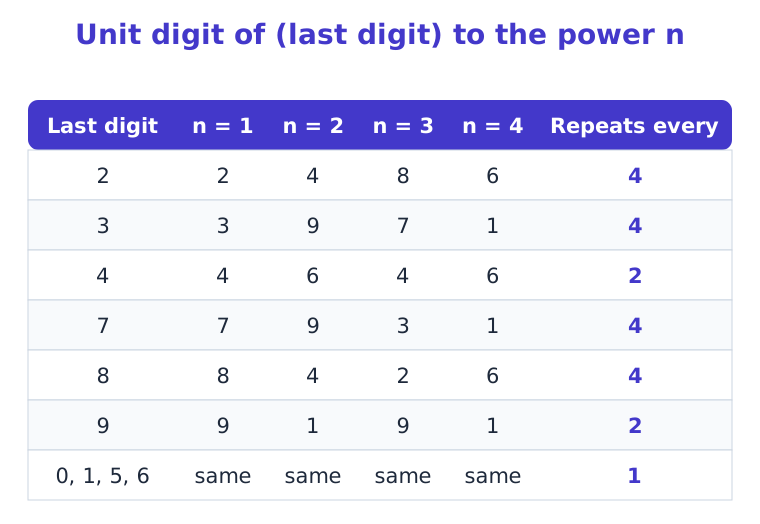
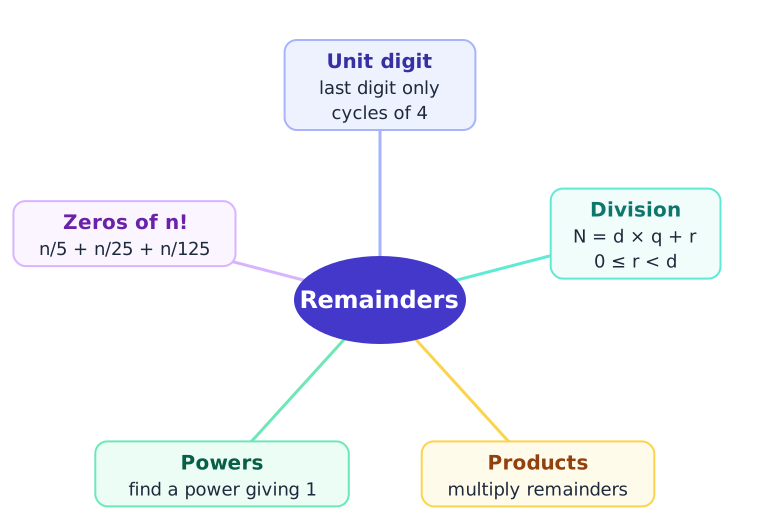
Unit digits 2, 3, 7 and 8 repeat every 4 powers; 4 and 9 repeat every 2; 0, 1, 5 and 6 never change.
To use a cycle of 4, divide the power by 4. Remainder 0 means the 4th place of the cycle.
Dividend = divisor × quotient + remainder, and the remainder is always less than the divisor.
The remainder of a product equals the remainder of the product of the remainders.
For powers, look for a small power that leaves remainder 1; then the big power breaks into copies of it.
If a number leaves remainder r on division by d, and k divides d, then on division by k it leaves the remainder of r by k.
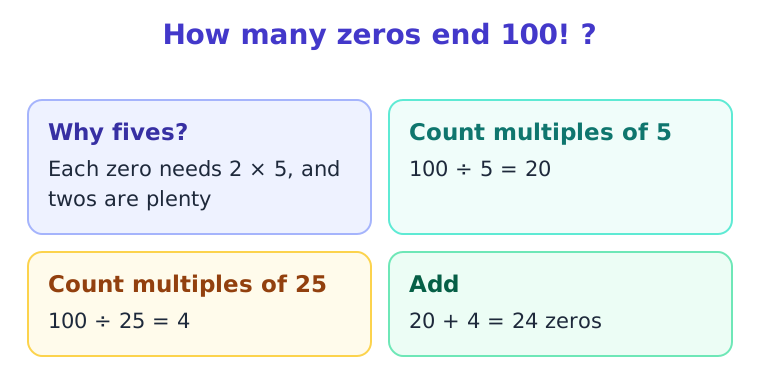
Trailing zeros of n! = n/5 + n/25 + n/125 + …, keeping only whole parts.
Full explanation
A Monday puzzle
Today is Monday. What day will it be after 100 days?
You do not count 100 days. You divide: 100 = 7 × 14 + 2. Fourteen full weeks bring you back to Monday, and the 2 extra days make it Wednesday. The remainder did all the work. This topic is about such remainders.
Dividend, divisor, quotient, remainder
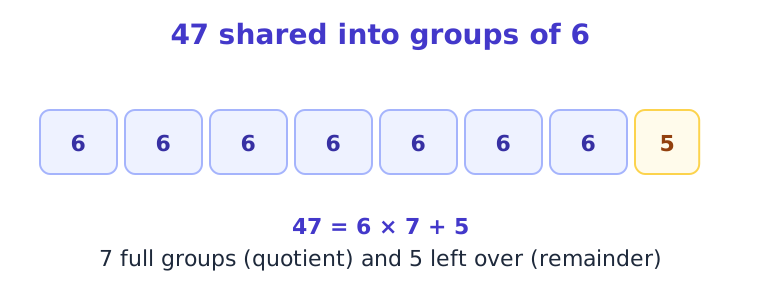
When 47 is divided by 6, we get 7 full groups and 5 left over:
$$47 = 6 \times 7 + 5$$
In general $N = d \times q + r$ with $0 \le r < d$.
Only the last digit matters
The unit digit of $347 \times 268$ is the unit digit of $7 \times 8 = 56$, which is 6. The other digits never reach the units place.
So for the unit digit of $347^{95}$ we only need the powers of 7.
Powers move in a circle
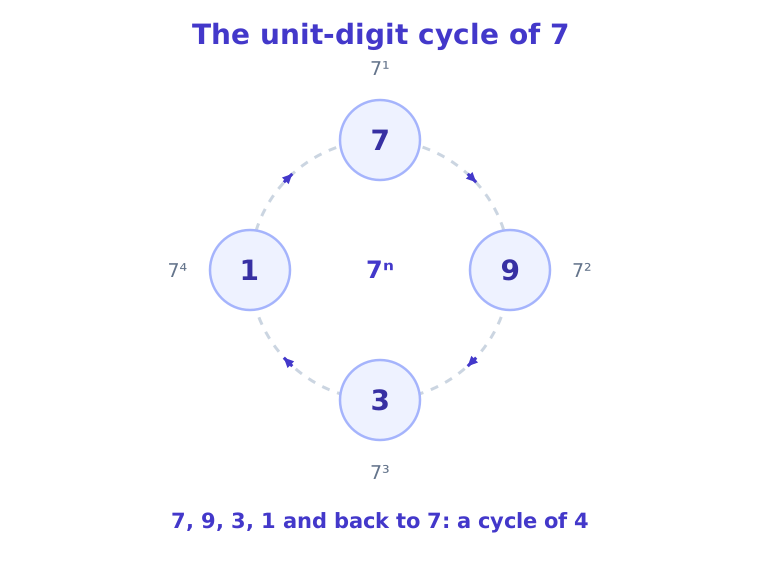
$7^1 = 7$, $7^2 = 49$, $7^3 = 343$, $7^4 = 2401$, $7^5 = 16807$.
The unit digits go 7, 9, 3, 1 and then 7 again. They move in a circle of 4.
Every digit has a cycle
The table shows the cycle of each last digit. Learn the last column: it tells you how often the digit repeats.
Worked example: the unit digit of a big power
Find the unit digit of $347^{95}$.
- Last digit 7, cycle 7, 9, 3, 1.
- Divide the power by 4: $95 = 4 \times 23 + 3$.
- Remainder 3 means the 3rd place: 3.
If the remainder is 0, take the 4th place. So $7^{96}$ ends in 1.
Unit digit of products and sums
Find each unit digit first, then combine.
$2^{43} \times 3^{22}$: $2^{43}$ ends in 8 and $3^{22}$ ends in 9, so the product ends in the last digit of 72: 2.
$3^{45} + 7^{45}$: they end in 3 and 7, so the sum ends in 0.
Remainder of a product
Find the remainder when $1235 \times 1237 \times 1239$ is divided by 12.
The remainders are 11, 1 and 3. Multiply them: $11 \times 1 \times 3 = 33$, and $33 = 12 \times 2 + 9$. The remainder is 9.
Remainder of a power
Find the remainder when $2^{100}$ is divided by 7.
$2^3 = 8$ leaves remainder 1. Since $100 = 3 \times 33 + 1$, $2^{100} = (2^3)^{33} \times 2$ leaves $1 \times 2 = 2$, so the remainder is 2.
A divisor inside a divisor
A number leaves remainder 29 when divided by 56. What is the remainder when it is divided by 8?
The number is $56k + 29$. Since 8 divides 56, only 29 matters: $29 = 8 \times 3 + 5$. The remainder is 5.
This works only because 8 divides 56.
Zeros at the end of n!
Every zero at the end needs one 2 and one 5. Twos are plentiful, so count the fives.
Back to Monday
The day puzzle was a remainder by 7. Unit digits are remainders by 10. Zeros of n! count factors of 10. One idea, many questions.
Concepts and terms
Any number N can be written as N = d × q + r with 0 ≤ r < d. For 47 and 6: 47 = 6 × 7 + 5.
The unit digits of powers repeat in a fixed loop. For 7 the loop is 7, 9, 3, 1.
Replace each number by its remainder, multiply, and take the remainder again.
n! = 1 × 2 × 3 × … × n. Its zeros at the end come from pairs of 2 and 5.
Did you know
Your bank card number ends in a check digit chosen from a remainder rule, so a single wrong digit is caught at once.
Memory tricks
Which digits cycle in 4? — 2-3-7-8 go round the gate — 2, 3, 7 and 8 have cycles of 4; 4 and 9 of 2; 0, 1, 5, 6 stay put.
Zeros of n! — Keep dividing by 5 — Divide n by 5, the answer by 5 again, and so on; add all the quotients.
Practice MCQs with answers (67)
- A 3
- B 9
- C 1
- D 7
Show answer
Why:
Last digit 3 cycles 3, 9, 7, 1 (length 4). Power 7 is place 3 of the cycle, so the unit digit is 7.
- A 4
- B 2
- C 8
- D 6
Show answer
Why:
Last digit 2 cycles 2, 4, 8, 6 (length 4). Power 10 is place 2 of the cycle, so the unit digit is 4.
- A 1
- B 9
- C 4
- D 0
Show answer
Why:
Last digit 9 cycles 9, 1 (length 2). Power 5 is place 1 of the cycle, so the unit digit is 9.
- A 1
- B 4
- C 6
- D 8
Show answer
Why:
Last digit 4 cycles 4, 6 (length 2). Power 6 is place 2 of the cycle, so the unit digit is 6.
- A 9
- B 1
- C 7
- D 3
Show answer
Why:
Last digit 7 cycles 7, 9, 3, 1 (length 4). Power 95 is place 3 of the cycle, so the unit digit is 3.
- A 7
- B 1
- C 3
- D 9
Show answer
Why:
Last digit 3 cycles 3, 9, 7, 1 (length 4). Power 47 is place 3 of the cycle, so the unit digit is 7.
- A 6
- B 4
- C 8
- D 2
Show answer
Why:
Last digit 8 cycles 8, 4, 2, 6 (length 4). Power 74 is place 2 of the cycle, so the unit digit is 4.
- A 2
- B 4
- C 8
- D 6
Show answer
Why:
Last digit 2 cycles 2, 4, 8, 6 (length 4). Power 43 is place 3 of the cycle, so the unit digit is 8.
- A 6
- B 9
- C 3
- D 1
Show answer
Why:
Last digit 9 cycles 9, 1 (length 2). Power 88 is place 2 of the cycle, so the unit digit is 1.
- A 1
- B 9
- C 3
- D 7
Show answer
Why:
Last digit 7 cycles 7, 9, 3, 1 (length 4). Power 256 is place 4 of the cycle, so the unit digit is 1.
- A 4
- B 8
- C 6
- D 2
Show answer
Why:
Last digit 2 cycles 2, 4, 8, 6 (length 4). Power 23 is place 3 of the cycle, so the unit digit is 8.
- A 1
- B 9
- C 3
- D 7
Show answer
Why:
Last digit 3 cycles 3, 9, 7, 1 (length 4). Power 53 is place 1 of the cycle, so the unit digit is 3.
- A 7
- B 8
- C 1
- D 6
Show answer
Why:
Last digit 6 cycles 6 (length 1). Power 71 is place 1 of the cycle, so the unit digit is 6.
- A 5
- B 6
- C 7
- D 0
Show answer
Why:
Last digit 5 cycles 5 (length 1). Power 39 is place 1 of the cycle, so the unit digit is 5.
- A 4
- B 6
- C 8
- D 1
Show answer
Why:
Last digit 4 cycles 4, 6 (length 2). Power 102 is place 2 of the cycle, so the unit digit is 6.
- A 6
- B 4
- C 8
- D 2
Show answer
Why:
Last digit 8 cycles 8, 4, 2, 6 (length 4). Power 1001 is place 1 of the cycle, so the unit digit is 8.
- A 2
- B 5
- C 3
- D 1
Show answer
Why:
Unit digits of the parts are 3, 7; combining them with × gives last digit 1.
- A 2
- B 8
- C 3
- D 6
Show answer
Why:
Unit digits of the parts are 8, 9; combining them with × gives last digit 2.
- A 7
- B 6
- C 0
- D 2
Show answer
Why:
Unit digits of the parts are 2, 7, 9; combining them with × gives last digit 6.
- A 3
- B 1
- C 0
- D 4
Show answer
Why:
Unit digits of the parts are 3, 7; combining them with + gives last digit 0.
- A 0
- B 8
- C 5
- D 4
Show answer
Why:
Unit digits of the parts are 8, 6; combining them with + gives last digit 4.
- A 8
- B 9
- C 4
- D 2
Show answer
Why:
Unit digits of the parts are 9, 6, 3; combining them with + gives last digit 8.
- A 4
- B 3
- C 2
- D 0
Show answer
Why:
$2^{4}$ leaves 1 on division by 5. Since 31 = 4 × 7 + 3, the remainder is that of $2^{3}$, which is 3.
- A 1
- B 4
- C 2
- D 3
Show answer
Why:
$2^{3}$ leaves 1 on division by 7. Since 100 = 3 × 33 + 1, the remainder is that of $2^{1}$, which is 2.
- A 2
- B 0
- C 3
- D 1
Show answer
Why:
$3^{2}$ leaves 1 on division by 8. Since 50 = 2 × 25, $3^{50} = (3^{2})^{25}$ leaves $1^{25} = 1$.
- A 1
- B 3
- C 2
- D 0
Show answer
Why:
$5^{2}$ leaves 1 on division by 6. Since 40 = 2 × 20, $5^{40} = (5^{2})^{20}$ leaves $1^{20} = 1$.
- A 3
- B 4
- C 6
- D 5
Show answer
Why:
$4^{3}$ leaves 1 on division by 9. Since 61 = 3 × 20 + 1, the remainder is that of $4^{1}$, which is 4.
- A 3
- B 2
- C 1
- D 0
Show answer
Why:
7 leaves 1 on division by 6, so every power of 7 leaves $1^{103} = 1$.
- A 0
- B 3
- C 2
- D 1
Show answer
Why:
10 leaves 1 on division by 9, so every power of 10 leaves $1^{25} = 1$.
- A 9
- B 10
- C 8
- D 3
Show answer
Why:
Remainders are 11, 1, 3; their product 33 leaves 9 on division by 12.
- A 5
- B 3
- C 2
- D 4
Show answer
Why:
Remainders are 2, 3, 4; their product 24 leaves 3 on division by 7.
- A 1
- B 7
- C 2
- D 3
Show answer
Why:
Remainders are 8, 9; their product 72 leaves 2 on division by 10.
- A 2
- B 5
- C 3
- D 4
Show answer
Why:
Remainders are 1, 2, 5; their product 10 leaves 4 on division by 6.
- A 58
- B 64
- C 54
- D 50
Show answer
Why:
Number = divisor × quotient + remainder = 6 × 9 + 4 = 58.
- A 219
- B 206
- C 195
- D 184
Show answer
Why:
Number = divisor × quotient + remainder = 13 × 15 + 11 = 206.
- A 751
- B 809
- C 785
- D 768
Show answer
Why:
Number = divisor × quotient + remainder = 24 × 32 + 17 = 785.
- A 2187
- B 2438
- C 2250
- D 2313
Show answer
Why:
Number = divisor × quotient + remainder = 125 × 18 + 63 = 2313.
- A 5
- B 3
- C 6
- D 7
Show answer
Why:
8 divides 56, so only 29 matters: 29 = 8 × 3 + 5.
- A 1
- B 11
- C 4
- D 0
Show answer
Why:
12 divides 84, so only 59 matters: 59 = 12 × 4 + 11.
- A 2
- B 10
- C 9
- D 11
Show answer
Why:
19 divides 342, so only 47 matters: 47 = 19 × 2 + 9.
- A 3
- B 4
- C 2
- D 1
Show answer
Why:
9 divides 45, so only 37 matters: 37 = 9 × 4 + 1.
- A 4
- B 3
- C 1
- D 0
Show answer
Why:
Replace n by its remainder: $3^{2} = 9$, which leaves 4 on division by 5.
- A 4
- B 1
- C 5
- D 2
Show answer
Why:
Replace n by its remainder: $4^{3} = 64$, which leaves 1 on division by 7.
- A 8
- B 5
- C 7
- D 1
Show answer
Why:
Replace n by its remainder: $5^{2} = 25$, which leaves 7 on division by 9.
- A 7
- B 5
- C 2
- D 6
Show answer
Why:
Count the fives: 5 + 1 = 6.
- A 12
- B 10
- C 5
- D 13
Show answer
Why:
Count the fives: 10 + 2 = 12.
- A 25
- B 24
- C 20
- D 10
Show answer
Why:
Count the fives: 20 + 4 = 24.
- A 25
- B 12
- C 31
- D 32
Show answer
Why:
Count the fives: 25 + 5 + 1 = 31.
- A 50
- B 40
- C 20
- D 49
Show answer
Why:
Count the fives: 40 + 8 + 1 = 49.
- A 249
- B 200
- C 100
- D 250
Show answer
Why:
Count the fives: 200 + 40 + 8 + 1 = 249.
- A 8
- B 9
- C 4
- D 0
Show answer
Why:
The remainder is always less than the divisor, so it cannot be 9.
- A 1 and 9 only
- B 2, 3, 7, 8
- C 0, 1, 5, 6
- D 4 and 9 only
Show answer
Why:
0, 1, 5 and 6 multiplied by themselves end in the same digit.
- A 1
- B 8
- C 2
- D 4
Show answer
Why:
8, 4, 2, 6, then 8 again: length 4.
- A 5
- B 10
- C 3
- D 2
Show answer
Why:
Each zero needs a 2 and a 5; fives are fewer, so they decide.
- A 1
- B 3
- C 9
- D 0
Show answer
Why:
From 5! on, every term ends in 0. 1 + 2 + 6 + 24 = 33, so the unit digit is 3.
- A Monday
- B Saturday
- C Sunday
- D Friday
Show answer
Why:
75 = 7 × 10 + 5. Ten full weeks bring you back to Tuesday; 5 more days give Sunday.
- A Both A and R are true, and R is the correct explanation of A
- B Both A and R are true, but R is not the correct explanation of A
- C A is true but R is false
- D A is false but R is true
Show answer
Why:
96 leaves 0 by 4, which is the 4th place of 7, 9, 3, 1, that is 1. R explains A.
- A Both A and R are true, and R is the correct explanation of A
- B Both A and R are true, but R is not the correct explanation of A
- C A is true but R is false
- D A is false but R is true
Show answer
Why:
125/5 + 125/25 + 125/125 = 25 + 5 + 1 = 31. Counting the extra fives from 25 and 125 is what R says.
- A Both A and R are true, and R is the correct explanation of A
- B Both A and R are true, but R is not the correct explanation of A
- C A is true but R is false
- D A is false but R is true
Show answer
Why:
17 itself leaves 1 by 4, and 47 (= 30 + 17) leaves 3, so A is false: there is no single answer. R is true and is why the shortcut fails.
- A 1 only
- B 2 only
- C Both 1 and 2
- D Neither 1 nor 2
Show answer
Why:
4 cycles 4, 6: odd powers end in 4. 9 cycles 9, 1: even powers end in 1, so 2 is false.
- A 1 only
- B 2 only
- C Both 1 and 2
- D Neither 1 nor 2
Show answer
Why:
Both follow from N = d × q + r with 0 ≤ r < d.
- A 8
- B 6
- C 2
- D 4
Show answer
Why:
38 = 4 × 9 + 2, so the 2nd place of 2, 4, 8, 6: 4.
- A 1
- B 7
- C 3
- D 9
Show answer
Why:
100 leaves 0 by 4, so take the 4th place: 1.
- A $3^{44}$
- B $3^{43}$
- C $3^{41}$
- D $3^{42}$
Show answer
Why:
7 is the 3rd place, so the power must leave 3 by 4. 43 = 4 × 10 + 3.
- A 56
- B 63
- C 59
- D 52
Show answer
Why:
8 groups of 7 and 3 left: 7 × 8 + 3 = 59.
- A Quotient 8, remainder 2
- B Quotient 7, remainder 5
- C Quotient 5, remainder 3
- D Quotient 7, remainder 3
Show answer
Why:
Seven full groups of 5 and 3 left over: 38 = 5 × 7 + 3.
- A 2
- B 4
- C 6
- D 8
Show answer
Why:
$8^{25}$: 25 leaves 1, so 8. $4^{13}$: odd, so 4. 8 × 4 = 32, unit digit 2.
Important short questions (4)
100 leaves 0 by 4. 2¹⁰⁰ ends in 6 and 3¹⁰⁰ ends in 1, so the sum ends in 7.
899 = 29 × 31, so 29 divides 899. 63 = 29 × 2 + 5, so the remainder is 5.
60/5 = 12 and 60/25 = 2, so 14 zeros.
3⁴ = 81 leaves 1. 19 = 4 × 4 + 3, so the remainder is that of 3³ = 27, which is 2.
Long answer questions (1)
(a) 95 leaves 3 by 4, so 7⁹⁵ ends in 3. 58 leaves 2, so 3⁵⁸ ends in 9. 7⁹⁵ is larger, so the difference ends in 13 − 9 = 4.
(b) 7⁹⁵ ends in 3, and a number ending in 3 leaves 3 on division by 5.
(c) A unit digit is a remainder by 10, and remainders of powers always repeat.
Flashcards (14)
Play this topic
- Remainder check
Veda Skills Quantitative Aptitude Unit 1 — frequently asked questions
√437 is a little under 21, so test primes up to 19. 437 ÷ 19 = 23, so 437 = 19 × 23 is composite.
Known digits: 6 + 5 + 3 + 1 + 2 = 17. The next multiple of 9 is 18, so ★ = 1.
2,000 = 2⁴ × 5³, so (4 + 1)(3 + 1) = 20 factors.
391 = 1 × 323 + 68; 323 = 4 × 68 + 51; 68 = 1 × 51 + 17; 51 = 3 × 17. HCF = 17.
Other = 6 × 180 ÷ 36 = 30. Check: HCF(36, 30) = 6, LCM = 180.
LCM(6, 9, 12) = 36, so the number is 36 + 5 = 41.
100 leaves 0 by 4. 2¹⁰⁰ ends in 6 and 3¹⁰⁰ ends in 1, so the sum ends in 7.
899 = 29 × 31, so 29 divides 899. 63 = 29 × 2 + 5, so the remainder is 5.
60/5 = 12 and 60/25 = 2, so 14 zeros.

All Veda Skills Quantitative Aptitude units
All Quantitative Aptitude units · All Skills & Exams courses
Study this chapter properly, free
Everything above is on this page to read. In the Veda app the same chapter becomes spaced-repetition flashcards, timed tests that mark themselves, Veda Bites you can swipe, and games — with your progress tracked topic by topic.
Get Veda free