Veda Skills Quantitative Aptitude Unit 7: Simple and Compound Interest
- 3 topics
- 205 MCQs
- 12 short answers
- 3 long answers
- 41 flashcards
- 3 games
- ~165 min read
- English
Checked before publishing: 23 automated checks, including a plagiarism check against the textbook's own words. How we check our content
Simple Interest
Find simple interest and amount with SI = P × R × T ÷ 100, work back to the principal, rate or time, and solve the exam patterns: two amounts at two times, a sum becoming k times itself, money split at two rates, months instead of years and rates that change.
What you will be able to do
- I can find the simple interest and the amount for any principal, rate and time.
- I can find the principal, rate or time when the other values are given.
- I can use two amounts at two different times to find the yearly interest, the principal and the rate.
- I can solve "k times in T years", split-sum and changing-rate questions.

Key points
Principal (P) is the money lent or borrowed; rate (R) is the percent charged per year; time (T) is in years.
Simple interest: SI = P × R × T ÷ 100.
Amount = principal + interest: A = P + SI = P(1 + RT/100).
Under SI the interest is the same every year, because it is always charged on the original principal.
Time given in months is divided by 12 to get years.
If a sum amounts to A₁ after T₁ years and A₂ after T₂ years, one year's SI = (A₂ − A₁) ÷ (T₂ − T₁).
A sum becomes k times itself in T years when R × T = (k − 1) × 100.
From an amount, P = A × 100 ÷ (100 + RT); never subtract RT% of the amount.
Full explanation
Meena's first loan

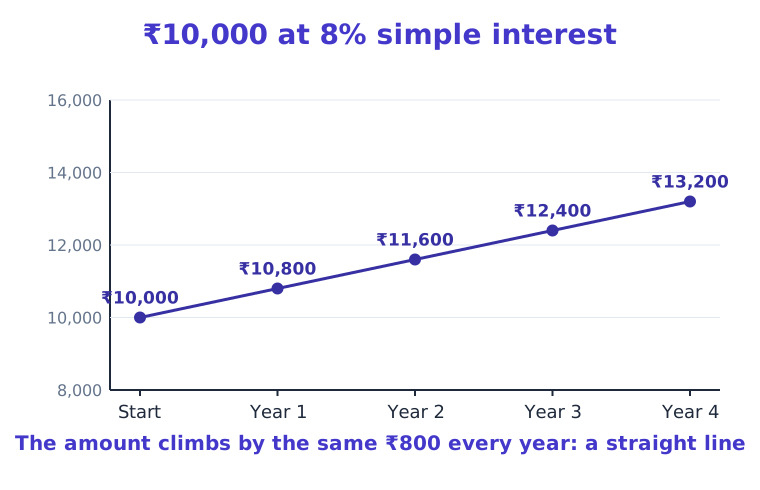
Meena wants a sewing machine for her tailoring shop. She borrows ₹10,000 from a self-help group at 8% simple interest a year. How much will she owe after 3 years? After 5? And how long until the debt doubles?
One short formula answers all of these.
The words
- Principal (P): the money borrowed, ₹10,000.
- Rate (R): percent charged per year, 8%.
- Time (T): in years.
- Interest (SI): the charge for using the money.
- Amount (A): what is paid back, $A = P + SI$.
The formula
$$SI = \frac{P \times R \times T}{100}$$
For Meena after 3 years: $SI = \frac{10000 \times 8 \times 3}{100} = ₹2{,}400$, so she owes $A = ₹12{,}400$.
Why the bars are equal
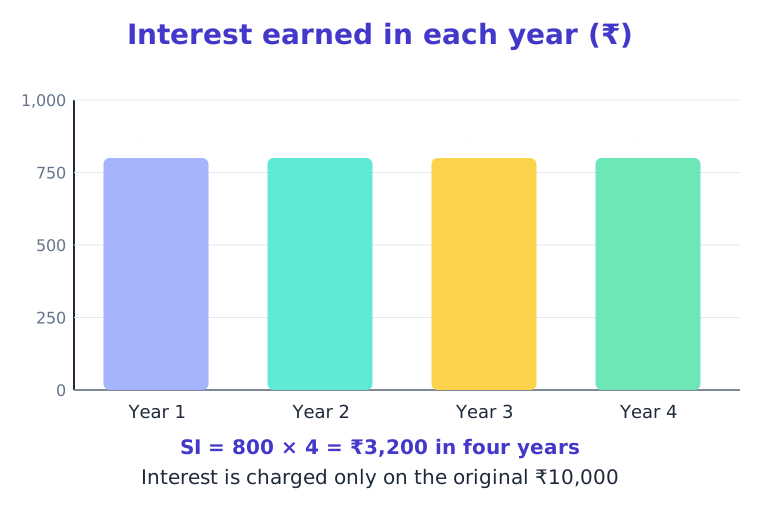
Simple interest is always worked out on the original ₹10,000. The ₹800 earned in year 1 does not earn anything in year 2. So the amount grows by the same step each year and its graph is a straight line.
Working backwards
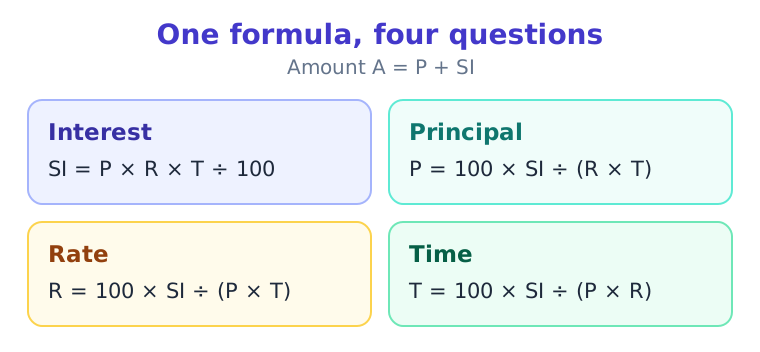
The same formula, rearranged, finds any missing value:
$$P = \frac{100 \cdot SI}{R \cdot T}, \quad R = \frac{100 \cdot SI}{P \cdot T}, \quad T = \frac{100 \cdot SI}{P \cdot R}$$
Example: ₹1,800 interest in 5 years at 6%: $P = \frac{100 \times 1800}{6 \times 5} = ₹6{,}000$.
From an amount back to the principal
If ₹7,440 is the amount after 3 years at 8%, the amount is $100% + 24% = 124%$ of P:
$$P = \frac{7440 \times 100}{124} = ₹6{,}000$$
Trap: $7440 - 24%$ of $7440$ is wrong, because the 24% was on P.
Two amounts, two times
A sum amounts to ₹5,800 in 2 years and ₹7,000 in 5 years. In 3 extra years it gained ₹1,200, so one year's SI = ₹400.
Go back 2 years from ₹5,800: $P = 5800 - 800 = ₹5{,}000$, and $R = \frac{400}{5000} \times 100 = 8%$.
Doubling and k times
A sum becomes k times itself when the interest is $(k - 1)P$:
$$R \times T = (k - 1) \times 100$$
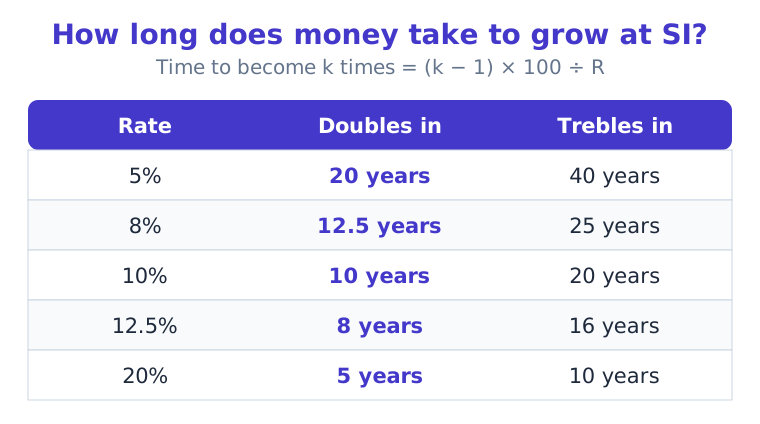
At 8%, Meena's debt doubles when $8T = 100$, after 12.5 years. It trebles after 25 years (interest 2P), not 3 × 12.5 = 37.5 years.
Months, splits and changing rates
- Months: 9 months is $T = \frac{9}{12}$ year.
- Split sums: ₹10,000 lent partly at 8% and partly at 10% earning ₹920: if all were at 10% it would earn ₹1,000, and each rupee moved to 8% loses 2 paise, so $\frac{80}{0.02} = ₹4{,}000$ is at 8%.
- Changing rates: add the rate × years of each period: 6% for 2 years then 8% for 3 years is $12 + 24 = 36%$ of P.
Back to Meena
Meena now knows: after 3 years she owes ₹12,400, after 5 years ₹14,000, and the debt would double in 12.5 years. She plans to repay within 2 years and pay only ₹1,600 as interest.
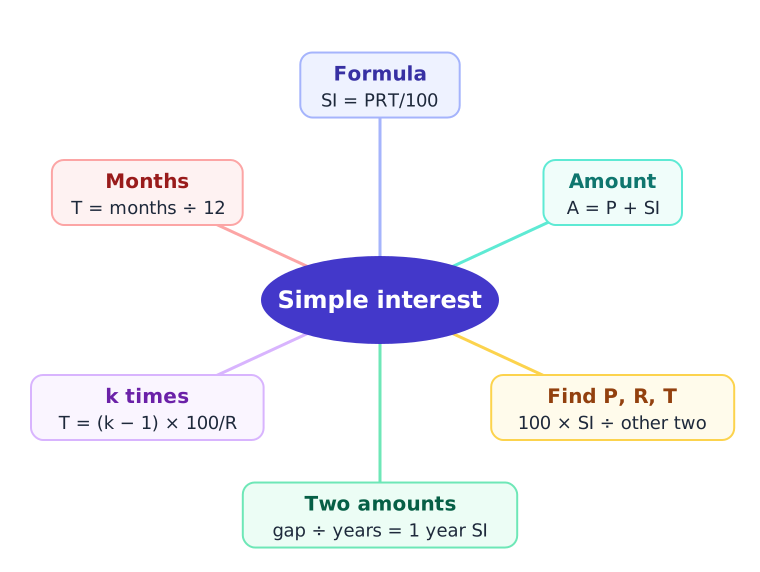
Exam summary: PRT over 100, the interest is equal each year, divide to go back, and use the yearly interest for two-amount questions.
Concepts and terms
Interest charged only on the original principal, the same amount every year. ₹10,000 at 8% earns ₹800 each year.
What is paid back at the end: principal plus interest. ₹10,000 at 8% for 3 years amounts to ₹12,400.
Only the product R × T matters under SI: 8% for 5 years earns the same as 10% for 4 years, 40% of P.
The amount rises by one year's SI each year, so the gap between two amounts divided by the years between them is one year's SI.

Did you know
Post office schemes such as the National Savings Certificate publish their rates every quarter, and many small savings accounts still pay simple interest.
Gold loans and many short farm loans in India are priced as simple interest per month.

Memory tricks
The SI formula — PRT over 100 — Multiply principal, rate and time, then divide by 100.
Finding any one value — 100 SI over the other two — P, R or T = 100 × SI ÷ (product of the other two).
Practice MCQs with answers (72)
- A ₹6,200
- B ₹400
- C ₹1,200
- D ₹1,298.56
Show answer
Why:
SI = P × R × T ÷ 100 = 5,000 × 8 × 3 ÷ 100 = ₹1,200.
- A ₹720
- B ₹1,483.20
- C ₹13,440
- D ₹1,440
Show answer
Why:
SI = P × R × T ÷ 100 = 12,000 × 6 × 2 ÷ 100 = ₹1,440.
- A ₹2,700
- B ₹5,400
- C ₹10,200
- D ₹675
Show answer
Why:
SI = P × R × T ÷ 100 = 7,500 × 9 × 4 ÷ 100 = ₹2,700.
- A ₹1,875
- B ₹3,750
- C ₹5,625
- D ₹28,750
Show answer
Why:
SI = P × R × T ÷ 100 = 25,000 × 7.5 × 2 ÷ 100 = ₹3,750.
- A ₹420
- B ₹2,100
- C ₹1,050
- D ₹9,450
Show answer
Why:
SI = P × R × T ÷ 100 = 8,400 × 5 × 2.5 ÷ 100 = ₹1,050.
- A ₹2,000
- B ₹6,781.25
- C ₹22,000
- D ₹6,000
Show answer
Why:
SI = P × R × T ÷ 100 = 16,000 × 12.5 × 3 ÷ 100 = ₹6,000.
- A ₹2,700
- B ₹7,200
- C ₹540
- D ₹5,400
Show answer
Why:
SI = P × R × T ÷ 100 = 4,500 × 12 × 5 ÷ 100 = ₹2,700.
- A ₹7,560
- B ₹3,780
- C ₹39,780
- D ₹2,520
Show answer
Why:
SI = P × R × T ÷ 100 = 36,000 × 7 × 1.5 ÷ 100 = ₹3,780.
- A ₹21,600
- B ₹1,650
- C ₹6,600
- D ₹13,200
Show answer
Why:
SI = P × R × T ÷ 100 = 15,000 × 11 × 4 ÷ 100 = ₹6,600.
- A ₹1,237.50
- B ₹10,800
- C ₹600
- D ₹1,200
Show answer
Why:
SI = P × R × T ÷ 100 = 9,600 × 6.25 × 2 ÷ 100 = ₹1,200.
- A ₹450
- B ₹5,400
- C ₹600
- D ₹6,450
Show answer
Why:
T = 9 ÷ 12 = 0.75 year. SI = 6,000 × 10 × 0.75 ÷ 100 = ₹450. (Using 9 as years is the trap.)
- A ₹960
- B ₹560
- C ₹12,560
- D ₹6,720
Show answer
Why:
T = 7 ÷ 12 = 7/12 year. SI = 12,000 × 8 × 7/12 ÷ 100 = ₹560. (Using 7 as years is the trap.)
- A ₹8,640
- B ₹2,160
- C ₹720
- D ₹24,720
Show answer
Why:
T = 4 ÷ 12 = 1/3 year. SI = 24,000 × 9 × 1/3 ÷ 100 = ₹720. (Using 4 as years is the trap.)
- A ₹1,080
- B ₹18,900
- C ₹10,800
- D ₹900
Show answer
Why:
T = 10 ÷ 12 = 5/6 year. SI = 18,000 × 6 × 5/6 ÷ 100 = ₹900. (Using 10 as years is the trap.)
- A ₹7,620
- B ₹8,160
- C ₹1,620
- D ₹6,540
Show answer
Why:
SI = 6,000 × 9 × 3 ÷ 100 = ₹1,620; amount = 6,000 + 1,620 = ₹7,620.
- A ₹6,000
- B ₹21,000
- C ₹16,200
- D ₹22,200
Show answer
Why:
SI = 15,000 × 8 × 5 ÷ 100 = ₹6,000; amount = 15,000 + 6,000 = ₹21,000.
- A ₹3,900
- B ₹1,200
- C ₹3,600
- D ₹2,700
Show answer
Why:
SI = 2,400 × 12.5 × 4 ÷ 100 = ₹1,200; amount = 2,400 + 1,200 = ₹3,600.
- A ₹9,960
- B ₹1,400
- C ₹8,560
- D ₹9,400
Show answer
Why:
SI = 8,000 × 7 × 2.5 ÷ 100 = ₹1,400; amount = 8,000 + 1,400 = ₹9,400.
- A ₹50,400
- B ₹5,400
- C ₹50,562
- D ₹47,700
Show answer
Why:
SI = 45,000 × 6 × 2 ÷ 100 = ₹5,400; amount = 45,000 + 5,400 = ₹50,400.
- A ₹3,680
- B ₹4,640
- C ₹1,440
- D ₹4,866.80
Show answer
Why:
SI = 3,200 × 15 × 3 ÷ 100 = ₹1,440; amount = 3,200 + 1,440 = ₹4,640.
- A ₹540
- B ₹30,000
- C ₹6,000
- D ₹7,800
Show answer
Why:
P = 100 × SI ÷ (R × T) = 100 × 1,800 ÷ (6 × 5) = ₹6,000.
- A ₹617.40
- B ₹29,400
- C ₹42,000
- D ₹14,000
Show answer
Why:
P = 100 × SI ÷ (R × T) = 100 × 2,940 ÷ (7 × 3) = ₹14,000.
- A ₹7,000
- B ₹21,000
- C ₹7,945
- D ₹12,600
Show answer
Why:
P = 100 × SI ÷ (R × T) = 100 × 945 ÷ (4.5 × 3) = ₹7,000.
- A ₹1,785.60
- B ₹6,000
- C ₹31,000
- D ₹5,654.40
Show answer
Why:
The amount is 124% of P, so P = 7,440 × 100 ÷ 124 = ₹6,000. (Taking 24% off the amount gives the wrong base.)
- A ₹27,000
- B ₹8,900
- C ₹9,000
- D ₹6,750
Show answer
Why:
The amount is 150% of P, so P = 13,500 × 100 ÷ 150 = ₹9,000. (Taking 50% off the amount gives the wrong base.)
- A ₹3,078.40
- B ₹2,841.60
- C ₹3,900
- D ₹4,000
Show answer
Why:
The amount is 148% of P, so P = 5,920 × 100 ÷ 148 = ₹4,000. (Taking 48% off the amount gives the wrong base.)
- A 6%
- B 15%
- C 8%
- D 30%
Show answer
Why:
R = 100 × SI ÷ (P × T) = 100 × 2,400 ÷ (8,000 × 5) = 6%.
- A 11%
- B 9%
- C 36%
- D 18%
Show answer
Why:
R = 100 × SI ÷ (P × T) = 100 × 4,500 ÷ (12,500 × 4) = 9%.
- A 9 3/8%
- B 8.25%
- C 6.25%
- D 18.75%
Show answer
Why:
R = 100 × SI ÷ (P × T) = 100 × 1,200 ÷ (6,400 × 3) = 6.25%.
- A 9.5%
- B 45%
- C 22.5%
- D 7.5%
Show answer
Why:
R = 100 × SI ÷ (P × T) = 100 × 9,000 ÷ (20,000 × 6) = 7.5%.
- A 10%
- B 30%
- C 15%
- D 12%
Show answer
Why:
R = 100 × SI ÷ (P × T) = 100 × 1,080 ÷ (3,600 × 3) = 10%.
- A 6 years
- B 5 years
- C 4 years
- D 10 years
Show answer
Why:
SI = 6,500 − 5,000 = ₹1,500. T = 100 × 1,500 ÷ (5,000 × 6) = 5 years.
- A 2 years
- B 13 years
- C 3 years
- D 4 years
Show answer
Why:
SI = 10,400 − 8,000 = ₹2,400. T = 100 × 2,400 ÷ (8,000 × 10) = 3 years.
- A 2 years
- B 6 years
- C 4 years
- D 3 years
Show answer
Why:
SI = 15,240 − 12,000 = ₹3,240. T = 100 × 3,240 ÷ (12,000 × 9) = 3 years.
- A 5 years
- B 10 years
- C 6 years
- D 4 years
Show answer
Why:
SI = 5,800 − 4,000 = ₹1,800. T = 100 × 1,800 ÷ (4,000 × 9) = 5 years.
- A 3.5 years
- B 2.5 years
- C 1.5 years
- D 15 years
Show answer
Why:
SI = 7,200 − 6,000 = ₹1,200. T = 100 × 1,200 ÷ (6,000 × 8) = 2.5 years.
- A ₹5,100
- B ₹4,600
- C ₹5,000
- D ₹5,400
Show answer
Why:
In 3 years the amount grew by ₹1,200, so one year's SI = ₹400. P = 5,800 − 2 × 400 = ₹5,000; R = 400 ÷ 5,000 × 100 = 8%.
- A 7%
- B 5.5%
- C 4.5%
- D 5%
Show answer
Why:
In 3 years the amount grew by ₹1,800, so one year's SI = ₹600. P = 13,800 − 3 × 600 = ₹12,000; R = 600 ÷ 12,000 × 100 = 5%.
- A ₹8,000
- B ₹7,900
- C ₹9,000
- D ₹8,100
Show answer
Why:
In 2 years the amount grew by ₹2,000, so one year's SI = ₹1,000. P = 10,000 − 2 × 1,000 = ₹8,000; R = 1,000 ÷ 8,000 × 100 = 12.5%.
- A 9.5%
- B 9%
- C 8.5%
- D 11%
Show answer
Why:
In 3 years the amount grew by ₹1,620, so one year's SI = ₹540. P = 8,160 − 4 × 540 = ₹6,000; R = 540 ÷ 6,000 × 100 = 9%.
- A 25%
- B 6.25%
- C 12.5%
- D 17.5%
Show answer
Why:
Becoming double means SI = P, so R × 8 = 100, R = 12.5%.
- A 10%
- B 25%
- C 30%
- D 20%
Show answer
Why:
Becoming three times means SI = 2P, so R × 10 = 200, R = 20%.
- A 25%
- B 12.5%
- C 33 1/3%
- D 8 1/3%
Show answer
Why:
Becoming four times means SI = 3P, so R × 12 = 300, R = 25%.
- A 24 years
- B 18 years
- C 19 years
- D 12 years
Show answer
Why:
Double: interest = P in 6 years. Four times: interest = 3P, which takes 3 ÷ 1 × 6 = 18 years.
- A 20 years
- B 30 years
- C 15 years
- D 35 years
Show answer
Why:
Three times: interest = 2P in 5 years. Seven times: interest = 6P, which takes 6 ÷ 2 × 5 = 15 years.
- A 50 years
- B 41 years
- C 25 years
- D 40 years
Show answer
Why:
Double: interest = P in 10 years. Five times: interest = 4P, which takes 4 ÷ 1 × 10 = 40 years.
- A ₹4,000
- B ₹9,200
- C ₹6,000
- D ₹5,000
Show answer
Why:
All at 10% would earn ₹1,000; the actual ₹920 is ₹80 less. Each rupee at 8% earns 2 paise less, so 80 ÷ 0.02 = ₹4,000.
- A ₹10,000
- B ₹15,000
- C ₹12,500
- D ₹20,000
Show answer
Why:
All at 9% would earn ₹2,250; the actual ₹1,800 is ₹450 less. Each rupee at 6% earns 3 paise less, so 450 ÷ 0.03 = ₹15,000.
- A ₹6,500
- B ₹6,000
- C ₹5,500
- D ₹9,937.50
Show answer
Why:
All at 8% would earn ₹960; the actual ₹795 is ₹165 less. Each rupee at 5% earns 3 paise less, so 165 ÷ 0.03 = ₹5,500.
- A ₹2,160
- B ₹18,000
- C ₹12,000
- D ₹6,000
Show answer
Why:
The extra interest is 2% for 3 years, which is 6% of P = ₹360. So P = 360 × 100 ÷ 6 = ₹6,000.
- A ₹7,500
- B ₹10,800
- C ₹30,000
- D ₹22,500
Show answer
Why:
The extra interest is 3% for 4 years, which is 12% of P = ₹900. So P = 900 × 100 ÷ 12 = ₹7,500.
- A ₹25,000
- B ₹5,000
- C ₹1,250
- D ₹10,000
Show answer
Why:
The extra interest is 1% for 5 years, which is 5% of P = ₹250. So P = 250 × 100 ÷ 5 = ₹5,000.
- A 56.25%
- B 15%
- C 7.5%
- D 28 1/8%
Show answer
Why:
SI = P × R × R ÷ 100 = 9/16 × P, so R² = 56.25 and R = 7.5%.
- A 64%
- B 16%
- C 32%
- D 8%
Show answer
Why:
SI = P × R × R ÷ 100 = 16/25 × P, so R² = 64 and R = 8%.
- A 7%
- B 49%
- C 14%
- D 24.5%
Show answer
Why:
SI = P × R × R ÷ 100 = 49/100 × P, so R² = 49 and R = 7%.
- A ₹3,200
- B ₹2,880
- C ₹10,880
- D ₹2,800
Show answer
Why:
Add rate × years: 6 × 2 + 8 × 3 = 36% of P. SI = 8,000 × 36 ÷ 100 = ₹2,880.
- A ₹6,450
- B ₹1,500
- C ₹1,450
- D ₹1,750
Show answer
Why:
Add rate × years: 5 × 3 + 7 × 2 = 29% of P. SI = 5,000 × 29 ÷ 100 = ₹1,450.
- A ₹11,100
- B ₹22,200
- C ₹4,440
- D ₹9,250
Show answer
Why:
Rate × years adds to 36% of P = ₹3,330, so P = 3,330 × 100 ÷ 36 = ₹9,250.
- A 12%
- B 8%
- C 48%
- D 10.71%
Show answer
Why:
The amount rises ₹600 a year on ₹5,000: 600 ÷ 5000 × 100 = 12%. (2,400 ÷ 5,000 = 48% is four years together.)
- A Arun
- B Sita
- C Ravi
- D Neha
Show answer
Why:
Ravi 1,440; Sita 1,920; Arun 1,750; Neha 1,440. The biggest principal does not win; P × R × T does.
- A 30%
- B 7.69%
- C 10%
- D 12%
Show answer
Why:
SI = 15,600 − 12,000 = ₹3,600 over 3 years. R = 100 × 3600 ÷ (12000 × 3) = 10%.
- A ₹5,400
- B ₹3,750
- C ₹60,000
- D ₹15,000
Show answer
Why:
One year's interest ₹900 = 6% of P, so P = 900 × 100 ÷ 6 = ₹15,000. (Using all four years with T = 1 gives ₹60,000.)
- A stays the same
- B grows every year
- C falls every year
- D doubles every year
Show answer
Why:
SI is always on the original principal, so every year earns P × R ÷ 100.
- A 2 times
- B 4 times
- C unchanged
- D 8 times
Show answer
Why:
SI = PRT ÷ 100; doubling P and T multiplies it by 2 × 2 = 4.
- A halves
- B becomes 4 times
- C stays the same
- D doubles
Show answer
Why:
R × T is unchanged: ½ × 2 = 1.
- A T²
- B 3T
- C 1.5T
- D 2T
Show answer
Why:
Doubling means interest P in T years; three times needs interest 2P, so 2T years.
- A ₹R
- B ₹(100 + R)
- C ₹100R
- D ₹R/100
Show answer
Why:
100 × R × 1 ÷ 100 = R. This is what "R percent" means.
- A the principal
- B the interest
- C the rate
- D the time
Show answer
Why:
A = P + SI, so A − P = SI.
- A Both A and R are true, and R is the correct explanation of A
- B Both A and R are true, but R is not the correct explanation of A
- C A is true but R is false
- D A is false but R is true
Show answer
Why:
Both true: P interest every 5 years, so 2P in 10 years. R is why the interest adds up evenly.
- A Both A and R are true, and R is the correct explanation of A
- B Both A and R are true, but R is not the correct explanation of A
- C A is true but R is false
- D A is false but R is true
Show answer
Why:
A is false: SI = ₹200 (₹210 is compound interest). R is true.
- A 1 only
- B 2 only
- C Both 1 and 2
- D Neither 1 nor 2
Show answer
Why:
1: 5000 × 8 × 3 ÷ 100 = 1,200. 2: SI = 2,000, so A = 7,000. Both true.
- A 1 only
- B 2 only
- C Both 1 and 2
- D Neither 1 nor 2
Show answer
Why:
1: 100 ÷ 8 = 12.5%, true. 2: 100 ÷ 5 = 20 years, so false.
Important short questions (4)
7500 × 8 × 3 ÷ 100 = ₹1,800.
R = 100 × 1200 ÷ (4000 × 5) = 6%.
Yearly SI = 1400 ÷ 2 = ₹700. P = 9800 − 3 × 700 = ₹7,700.
T = 100 ÷ 6.25 = 16 years.
Long answer questions (1)
Yearly interest = ₹2,400. All at 10% would give ₹3,000, which is ₹600 more. Each rupee at 6% earns 4 paise less, so 600 ÷ 0.04 = ₹15,000 at 6% and ₹15,000 at 10%. Check: 900 + 1,500 = 2,400 a year.
Flashcards (14)
Play this topic
- Interest or trap?
Compound Interest
Grow money year by year with A = P(1 + R/100)ⁿ, find the compound interest, compound half-yearly and quarterly, work back to the principal or rate, and apply the same multiplier to population growth, depreciation, different rates each year and part years.
What you will be able to do
- I can find the amount and compound interest for whole years, compounded annually.
- I can handle half-yearly and quarterly compounding by changing the rate and the number of periods.
- I can find the principal or the rate from a given amount.
- I can solve population growth, depreciation, changing-rate and part-year questions.
Key points
Compound interest charges interest on the interest already earned: each year's amount becomes the next year's principal.
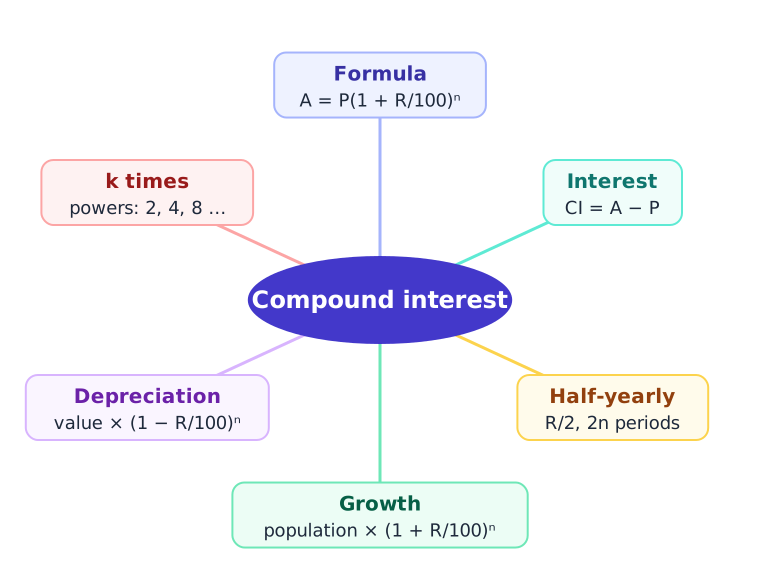
Amount A = P(1 + R/100)ⁿ for n years compounded annually; CI = A − P.
For the first year, CI and SI are equal; after that, CI is larger.
Half-yearly: use R/2 per period and 2n periods. Quarterly: R/4 per period and 4n periods.
Different rates in different years multiply: P(1 + R₁/100)(1 + R₂/100).
Growth: future = present × (1 + R/100)ⁿ. Depreciation: future = present × (1 − R/100)ⁿ.
If a sum doubles in t years at CI, it becomes 4 times in 2t and 8 times in 3t years.
For 2½ years at R%, the usual rule is P(1 + R/100)² × (1 + R/200).
Full explanation
Farhan's fixed deposit

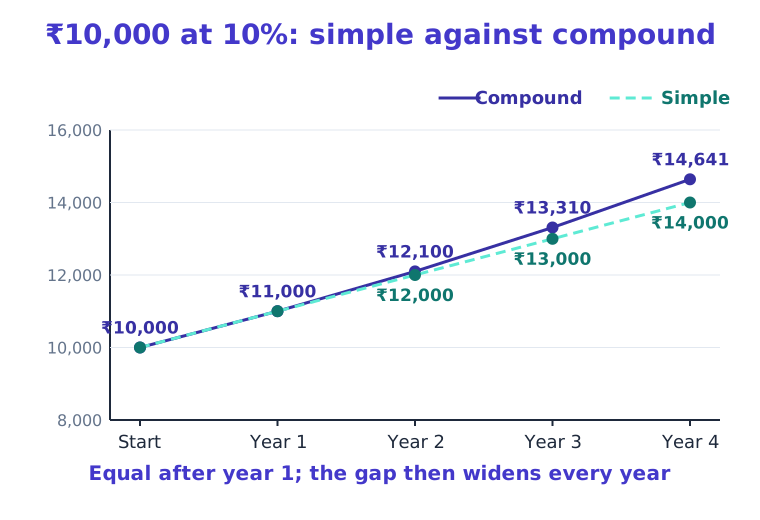
Farhan puts ₹10,000 in a bank deposit at 10% a year. The bank tells him the interest is compounded annually. His cousin earns simple interest at the same rate. After 3 years, Farhan has more. Where did the extra come from?
Interest on interest
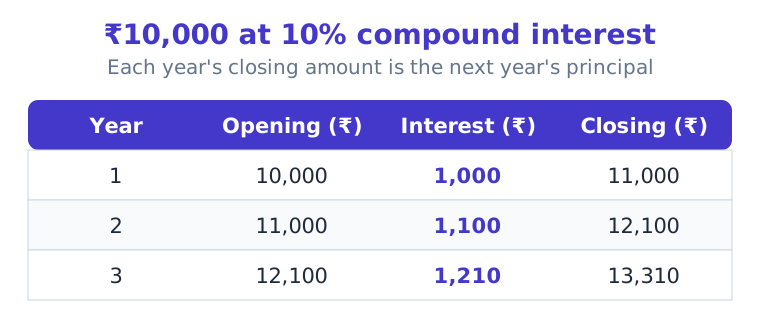
At the end of each year the bank adds the interest to the deposit. Next year the 10% is worked out on the bigger sum.
- Year 1: 10% of 10,000 = ₹1,000, total ₹11,000.
- Year 2: 10% of 11,000 = ₹1,100, total ₹12,100.
- Year 3: 10% of 12,100 = ₹1,210, total ₹13,310.
The formula
Each year multiplies the money by $1 + \frac{R}{100}$. After n years:
$$A = P\left(1 + \frac{R}{100}\right)^n, \qquad CI = A - P$$
Farhan: $10000 \times 1.1^3 = 10000 \times 1.331 = ₹13{,}310$, so CI $= ₹3{,}310$. His cousin's SI is only ₹3,000.
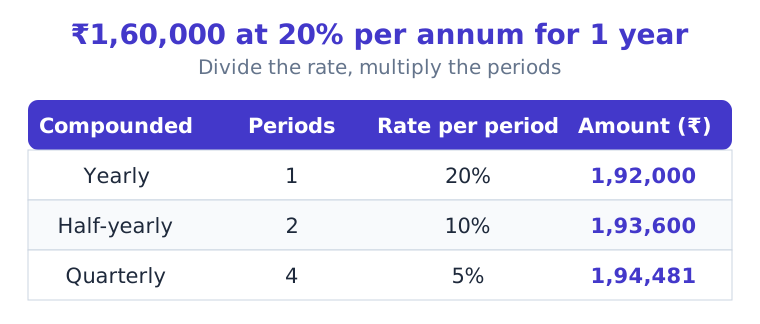
Half-yearly and quarterly
If interest is added more often, split the rate and multiply the periods:
- Half-yearly: rate $\frac{R}{2}$, periods $2n$.
- Quarterly: rate $\frac{R}{4}$, periods $4n$.
Example: ₹8,000 at 10% per annum, half-yearly, for 1 year: $8000 \times 1.05^2 = ₹8{,}820$.
Working backwards
Principal: divide by the multiplier. If ₹8,820 is the amount after 2 years at 5%, $P = 8820 \div 1.05^2 = ₹8{,}000$.
Rate: ₹6,400 grows to ₹7,744 in 2 years. $\frac{7744}{6400} = 1.21 = 1.1^2$, so $R = 10%$.
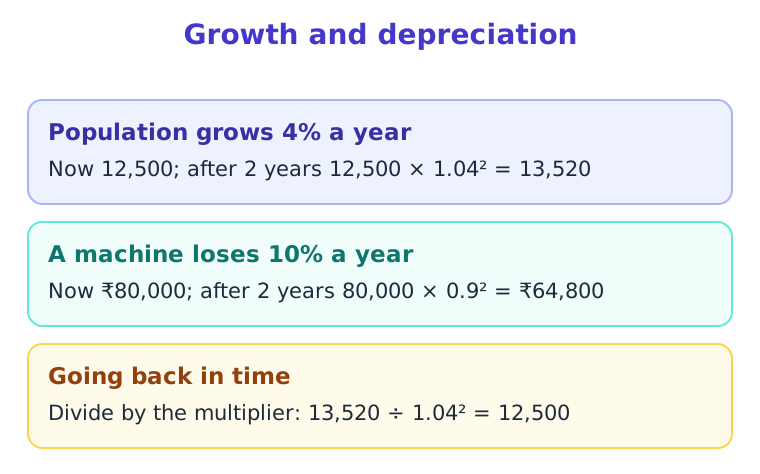
Growth and depreciation
The same multiplier runs a town's population forward, and a machine's value backward:
$$\text{growth: } V(1 + \tfrac{R}{100})^n, \qquad \text{depreciation: } V(1 - \tfrac{R}{100})^n$$
Changing rates and part years
- Different rates: 10% in year 1, 20% in year 2: $P \times 1.1 \times 1.2$.
- 2½ years at 10%: two full years, then half a year at 5%: $8000 \times 1.1^2 \times 1.05 = ₹10{,}164$.
Doubling under CI
If a sum doubles in 4 years, every 4 years multiplies it by 2. So it becomes $2^2 = 4$ times in 8 years and $2^3 = 8$ times in 12 years.
Under SI, a sum that doubles in 4 years would need 28 years to become 8 times, because SI only adds.
Back to Farhan
The extra ₹310 is interest on interest: ₹100 in year 2 and ₹210 in year 3. If his bank compounded half-yearly, he would get a little more still.
Exam summary: multiply by $1 + \frac{R}{100}$ each period, split the rate for shorter periods, divide to go back, and use $1 - \frac{R}{100}$ for depreciation.
Concepts and terms
Adding the interest to the principal at the end of each period, so the next period's interest is on a bigger sum.
1 + R/100 for one period. 10% for 3 years is 1.1³ = 1.331, so ₹10,000 becomes ₹13,310.
How often interest is added: yearly, half-yearly or quarterly. Shorter periods give a slightly bigger amount.
A fall in value by a fixed percent of the current value each year: compound interest running backwards.
Did you know
Most bank fixed deposits in India compound interest every quarter, so a 7% FD earns a little more than 7% in a year.
The "rule of 72" says money at R% compound interest doubles in about 72 ÷ R years: about 9 years at 8%.
Memory tricks
The CI formula — Multiply, do not add — Each year multiplies by 1 + R/100. Three years at 10% is 1.1 × 1.1 × 1.1, not 1 + 0.3.
Half-yearly — Half the rate, twice the time — 10% per annum half-yearly for 1 year = 5% for 2 periods.
Practice MCQs with answers (75)
- A ₹13,310
- B ₹12,000
- C ₹12,100
- D ₹2,100
Show answer
Why:
2 years: A = 10,000 × 1.1² = 10,000 × 1.21 = ₹12,100.
- A ₹800
- B ₹8,820
- C ₹1,261
- D ₹820
Show answer
Why:
2 years: A = 8,000 × 1.05² = 8,000 × 1.1025 = ₹8,820; CI = 8,820 − 8,000 = ₹820.
- A ₹16,900
- B ₹16,875
- C ₹1,275
- D ₹17,576
Show answer
Why:
2 years: A = 15,625 × 1.04² = 15,625 × 1.0816 = ₹16,900.
- A ₹14,580
- B ₹2,080
- C ₹3,246.40
- D ₹2,000
Show answer
Why:
2 years: A = 12,500 × 1.08² = 12,500 × 1.1664 = ₹14,580; CI = 14,580 − 12,500 = ₹2,080.
- A ₹8,000
- B ₹3,640
- C ₹8,640
- D ₹10,368
Show answer
Why:
3 years: A = 5,000 × 1.2³ = 5,000 × 1.728 = ₹8,640.
- A ₹928.20
- B ₹600
- C ₹2,662
- D ₹662
Show answer
Why:
3 years: A = 2,000 × 1.1³ = 2,000 × 1.331 = ₹2,662; CI = 2,662 − 2,000 = ₹662.
- A ₹8,100
- B ₹8,000
- C ₹1,700
- D ₹9,112.50
Show answer
Why:
2 years: A = 6,400 × 1.125² = 6,400 × 1.265625 = ₹8,100.
- A ₹52,900
- B ₹12,900
- C ₹20,835
- D ₹12,000
Show answer
Why:
2 years: A = 40,000 × 1.15² = 40,000 × 1.3225 = ₹52,900; CI = 52,900 − 40,000 = ₹12,900.
- A ₹2,400
- B ₹900
- C ₹2,500
- D ₹3,125
Show answer
Why:
2 years: A = 1,600 × 1.25² = 1,600 × 1.5625 = ₹2,500.
- A ₹13,923
- B ₹9,000
- C ₹39,930
- D ₹9,930
Show answer
Why:
3 years: A = 30,000 × 1.1³ = 30,000 × 1.331 = ₹39,930; CI = 39,930 − 30,000 = ₹9,930.
- A ₹204
- B ₹200
- C ₹2,704
- D ₹312.16
Show answer
Why:
2 years: A = 2,500 × 1.04² = 2,500 × 1.0816 = ₹2,704; CI = 2,704 − 2,500 = ₹204.
- A ₹8,800
- B ₹8,820
- C ₹820
- D ₹9,261
Show answer
Why:
2 periods at 5%: A = 8,000 × 1.05² = 8,000 × 1.1025 = ₹8,820.
- A ₹5,296
- B ₹23,425.60
- C ₹21,296
- D ₹20,800
Show answer
Why:
3 periods at 10%: A = 16,000 × 1.1³ = 16,000 × 1.331 = ₹21,296.
- A ₹800
- B ₹10,816
- C ₹1,248.64
- D ₹816
Show answer
Why:
2 periods at 4%: A = 10,000 × 1.04² = 10,000 × 1.0816 = ₹10,816; CI = 10,816 − 10,000 = ₹816.
- A ₹4,100
- B ₹6,305
- C ₹4,000
- D ₹44,100
Show answer
Why:
2 periods at 5%: A = 40,000 × 1.05² = 40,000 × 1.1025 = ₹44,100; CI = 44,100 − 40,000 = ₹4,100.
- A ₹3,972
- B ₹2,520
- C ₹2,400
- D ₹14,520
Show answer
Why:
2 periods at 10%: A = 12,000 × 1.1² = 12,000 × 1.21 = ₹14,520; CI = 14,520 − 12,000 = ₹2,520.
- A ₹18,400
- B ₹2,522
- C ₹18,522
- D ₹19,448.10
Show answer
Why:
3 periods at 5%: A = 16,000 × 1.05³ = 16,000 × 1.157625 = ₹18,522.
- A ₹1,94,481
- B ₹44,205.05
- C ₹32,000
- D ₹34,481
Show answer
Why:
4 periods at 5%: A = 1,60,000 × 1.05⁴ = 1,60,000 × 1.21550625 = ₹1,94,481; CI = 1,94,481 − 1,60,000 = ₹34,481.
- A ₹41,616
- B ₹42,448.32
- C ₹41,600
- D ₹1,616
Show answer
Why:
2 periods at 2%: A = 40,000 × 1.02² = 40,000 × 1.0404 = ₹41,616.
- A ₹10,500
- B ₹10,000
- C ₹9,317
- D ₹9,702.99
Show answer
Why:
P = A ÷ 1.1³ = 13,310 ÷ 1.331 = ₹10,000.
- A ₹8,500
- B ₹7,938
- C ₹8,000
- D ₹7,960.05
Show answer
Why:
P = A ÷ 1.05² = 8,820 ÷ 1.1025 = ₹8,000.
- A ₹20,500
- B ₹21,000
- C ₹19,901.44
- D ₹20,000
Show answer
Why:
P = A ÷ 1.04² = 21,632 ÷ 1.0816 = ₹20,000.
- A ₹5,000
- B ₹5,100
- C ₹4,898.88
- D ₹5,500
Show answer
Why:
P = A ÷ 1.08² = 5,832 ÷ 1.1664 = ₹5,000.
- A ₹5,000
- B ₹4,000
- C ₹4,300
- D ₹8,600
Show answer
Why:
CI = P × (1.3225 − 1) = P × 0.3225. So P = 1,290 ÷ 0.3225 = ₹4,000.
- A ₹16,550
- B ₹6,000
- C ₹5,000
- D ₹5,100
Show answer
Why:
CI = P × (1.331 − 1) = P × 0.331. So P = 1,655 ÷ 0.331 = ₹5,000.
- A 10.5%
- B 21%
- C 12%
- D 10%
Show answer
Why:
A ÷ P = 7,744 ÷ 6,400 = 1.21 = 1.1², so 1 + R/100 = 1.1 and R = 10%. (Dividing the interest by 2 years treats it as SI.)
- A 8%
- B 16.64%
- C 10%
- D 8.32%
Show answer
Why:
A ÷ P = 11,664 ÷ 10,000 = 1.1664 = 1.08², so 1 + R/100 = 1.08 and R = 8%. (Dividing the interest by 2 years treats it as SI.)
- A 40%
- B 20%
- C 22%
- D 44%
Show answer
Why:
A ÷ P = 7,200 ÷ 5,000 = 1.44 = 1.2², so 1 + R/100 = 1.2 and R = 20%. (Dividing the interest by 2 years treats it as SI.)
- A 10%
- B 5.5%
- C 5%
- D 7%
Show answer
Why:
A ÷ P = 9,261 ÷ 8,000 = 1.157625 = 1.05³, so 1 + R/100 = 1.05 and R = 5%. (Dividing the interest by 3 years treats it as SI.)
- A 6%
- B 8%
- C 4.5%
- D 4%
Show answer
Why:
A ÷ P = 17,576 ÷ 15,625 = 1.124864 = 1.04³, so 1 + R/100 = 1.04 and R = 4%. (Dividing the interest by 3 years treats it as SI.)
- A 12 years
- B 28 years
- C 16 years
- D 13 years
Show answer
Why:
Every 4 years multiplies the sum by 2. 8 = 2³, so it takes 3 × 4 = 12 years. (The SI answer would be 28 years.)
- A 45 years
- B 15 years
- C 20 years
- D 65 years
Show answer
Why:
Every 5 years multiplies the sum by 3. 27 = 3³, so it takes 3 × 5 = 15 years. (The SI answer would be 65 years.)
- A 90 years
- B 48 years
- C 24 years
- D 30 years
Show answer
Why:
Every 6 years multiplies the sum by 2. 16 = 2⁴, so it takes 4 × 6 = 24 years. (The SI answer would be 90 years.)
- A 15 years
- B 10 years
- C 5.5 years
- D 5 years
Show answer
Why:
4 = 2², so double takes half the time: 10 ÷ 2 = 5 years.
- A 13,520
- B 11,520
- C 13,620
- D 13,500
Show answer
Why:
12,500 × 1.04² = 12,500 × 1.0816 = 13,520.
- A 72,200
- B 88,200
- C 88,000
- D 92,610
Show answer
Why:
80,000 × 1.05² = 80,000 × 1.1025 = 88,200.
- A 91,125
- B 49,000
- C 81,000
- D 80,000
Show answer
Why:
64,000 × 1.125² = 64,000 × 1.265625 = 81,000.
- A 15,900
- B 17,000
- C 15,876
- D 16,000
Show answer
Why:
Divide by the growth: 17,640 ÷ 1.1025 = 16,000. (Multiplying by 0.95² is the trap.)
- A 25,000
- B 24,000
- C 24,900
- D 26,000
Show answer
Why:
Divide by the growth: 26,010 ÷ 1.0404 = 25,000. (Multiplying by 0.98² is the trap.)
- A ₹15,200
- B ₹64,800
- C ₹72,000
- D ₹64,000
Show answer
Why:
80,000 × 0.9² = 80,000 × 0.81 = ₹64,800. Each year's fall is on the value left, not on the original.
- A ₹61,000
- B ₹80,000
- C ₹64,000
- D ₹50,000
Show answer
Why:
1,25,000 × 0.8³ = 1,25,000 × 0.512 = ₹64,000. Each year's fall is on the value left, not on the original.
- A ₹1,38,750
- B ₹4,25,000
- C ₹3,50,000
- D ₹3,61,250
Show answer
Why:
5,00,000 × 0.85² = 5,00,000 × 0.7225 = ₹3,61,250. Each year's fall is on the value left, not on the original.
- A ₹1,00,000
- B ₹97,029.90
- C ₹94,770
- D ₹1,01,000
Show answer
Why:
New price × 0.729 = 72,900, so the new price = 72,900 ÷ 0.729 = ₹1,00,000.
- A ₹13,225
- B ₹13,200
- C ₹3,200
- D ₹13,000
Show answer
Why:
Multiply the yearly factors: 10,000 × 1.1 × 1.2 = ₹13,200.
- A ₹7,030
- B ₹6,750
- C ₹6,930
- D ₹1,930
Show answer
Why:
Multiply the yearly factors: 5,000 × 1.05 × 1.1 × 1.2 = ₹6,930.
- A ₹10,000
- B ₹10,125
- C ₹2,120
- D ₹10,120
Show answer
Why:
Multiply the yearly factors: 8,000 × 1.1 × 1.15 = ₹10,120.
- A ₹2,680
- B ₹2,684.50
- C ₹22,680
- D ₹2,600
Show answer
Why:
Multiply the yearly factors: 20,000 × 1.05 × 1.08 = ₹22,680; CI = ₹2,680.
- A ₹10,648
- B ₹10,164
- C ₹9,680
- D ₹10,000
Show answer
Why:
2 full years, then 0.5 year at 5%: 8,000 × 1.21 × 1.05 = ₹10,164.
- A ₹19,500
- B ₹21,600
- C ₹19,800
- D ₹18,000
Show answer
Why:
1 full years, then 0.5 year at 10%: 15,000 × 1.2 × 1.1 = ₹19,800.
- A ₹7,873.20
- B ₹7,290
- C ₹7,500
- D ₹7,581.60
Show answer
Why:
2 full years, then 0.5 year at 4%: 6,250 × 1.1664 × 1.04 = ₹7,581.60.
- A 10%
- B 9 1/11%
- C 5%
- D 20%
Show answer
Why:
Year 3 interest = 13,310 − 12,100 = ₹1,210, which is 10% of ₹12,100. P = 12,100 ÷ 1.21 = ₹10,000.
- A ₹4,320
- B ₹5,000
- C ₹6,000
- D ₹5,760
Show answer
Why:
Year 3 interest = 8,640 − 7,200 = ₹1,440, which is 20% of ₹7,200. P = 7,200 ÷ 1.44 = ₹5,000.
- A 10%
- B 7%
- C 5%
- D 2.5%
Show answer
Why:
Year 3 interest = 4,630.50 − 4,410 = ₹220.50, which is 5% of ₹4,410. P = 4,410 ÷ 1.1025 = ₹4,000.
- A ₹1,000
- B ₹500
- C ₹1,050
- D ₹550
Show answer
Why:
Year 1 interest = ₹500. Year 2 is on ₹5,500: 5,500 × 10 ÷ 100 = ₹550.
- A ₹1,380
- B ₹2,580
- C ₹2,400
- D ₹1,200
Show answer
Why:
Year 1 interest = ₹1,200. Year 2 is on ₹9,200: 9,200 × 15 ÷ 100 = ₹1,380.
- A ₹600
- B ₹630
- C ₹1,230
- D ₹1,200
Show answer
Why:
Year 1 interest = ₹600. Year 2 is on ₹12,600: 12,600 × 5 ÷ 100 = ₹630.
- A 50%
- B 20%
- C 10%
- D 9 1/11%
Show answer
Why:
Year 2 interest is year 1 interest plus interest on it: 50 ÷ 500 × 100 = 10%. The sum is 500 × 100 ÷ 10 = ₹5,000.
- A 320%
- B 40%
- C 16 2/3%
- D 20%
Show answer
Why:
Year 2 interest is year 1 interest plus interest on it: 320 ÷ 1,600 × 100 = 20%. The sum is 1,600 × 100 ÷ 20 = ₹8,000.
- A ₹100
- B ₹400
- C ₹1,000
- D ₹200
Show answer
Why:
Annual: 10,000 × 1.2 = ₹12,000. Half-yearly: 10,000 × 1.1² = ₹12,100. Extra = ₹100, the interest on the first half-year's interest.
- A ₹800
- B ₹200
- C ₹4,000
- D ₹400
Show answer
Why:
Annual: 80,000 × 1.1 = ₹88,000. Half-yearly: 80,000 × 1.05² = ₹88,200. Extra = ₹200, the interest on the first half-year's interest.
- A ₹1,000
- B ₹80
- C ₹40
- D ₹160
Show answer
Why:
Annual: 25,000 × 1.08 = ₹27,000. Half-yearly: 25,000 × 1.04² = ₹27,040. Extra = ₹40, the interest on the first half-year's interest.
- A ₹10,560
- B ₹10,480
- C ₹10,400
- D ₹10,648
Show answer
Why:
8000 → 8800 is a 10% rise; 9680 × 1.1 = ₹10,648. (Adding ₹880 again gives ₹10,560, the SI habit.)
- A ₹2,662
- B ₹2,620
- C ₹2,640
- D ₹2,600
Show answer
Why:
Year 3 interest = 10% of 2,420 = ₹242, so the closing amount = ₹2,662.
- A 46,000
- B 46,305
- C 48,620
- D 46,200
Show answer
Why:
42000 ÷ 40000 = 1.05, a 5% rise each year. 44100 × 1.05 = 46,305. (Adding 2,100 again gives 46,200.)
- A ₹22,000
- B ₹26,000
- C ₹25,600
- D ₹24,000
Show answer
Why:
Each year keeps 40000 ÷ 50000 = 0.8 of the value, a 20% fall. 32000 × 0.8 = ₹25,600. (Taking ₹8,000 off again gives ₹24,000.)
- A equal to the first year's
- B less than the first year's
- C always double the first year's
- D more than the first year's
Show answer
Why:
Year 2 interest is on the principal plus year 1 interest.
- A equal
- B CI is larger
- C SI is larger
- D CI is double
Show answer
Why:
There is no interest yet to earn interest in year 1.
- A R % for 2n periods
- B R/2 % for 2n periods
- C R/2 % for n periods
- D 2R % for n/2 periods
Show answer
Why:
Half the rate, twice the periods.
- A 15 years
- B 20 years
- C 10 years
- D 8 years
Show answer
Why:
4 = 2², so two doubling periods: 10 years. (15 years is the SI answer.)
- A 1.21
- B 1.3
- C 1.33
- D 1.331
Show answer
Why:
1.1 × 1.1 × 1.1 = 1.331.
- A 19%
- B 18%
- C 20%
- D 21%
Show answer
Why:
0.9² = 0.81 of the value is left, so 19% is lost.
- A Both A and R are true, and R is the correct explanation of A
- B Both A and R are true, but R is not the correct explanation of A
- C A is true but R is false
- D A is false but R is true
Show answer
Why:
Both true: 1,000 + 1,100 = 2,100, and the extra ₹100 is interest on the first ₹1,000.
- A Both A and R are true, and R is the correct explanation of A
- B Both A and R are true, but R is not the correct explanation of A
- C A is true but R is false
- D A is false but R is true
Show answer
Why:
A is true (2 × 2 = 4). R is false: equal rupee growth is SI; CI grows by the same percent.
- A 1 only
- B 2 only
- C Both 1 and 2
- D Neither 1 nor 2
Show answer
Why:
1: 8000 × 1.1025 = 8,820, true. 2: CI = ₹820; ₹800 is the SI, so false.
- A 1 only
- B 2 only
- C Both 1 and 2
- D Neither 1 nor 2
Show answer
Why:
1: the first half-year's interest earns interest, so true. 2: 0.9² = 0.81, true.
Important short questions (4)
A = 12000 × 1.21 = ₹14,520; CI = ₹2,520.
6% for 2 periods: 20000 × 1.1236 = ₹22,472.
60000 × 0.8² = 60000 × 0.64 = ₹38,400.
3025 ÷ 2500 = 1.21 = 1.1², so R = 10%.
Long answer questions (1)
Multiply the yearly factors: 125000 × 1.04 = 1,30,000; × 1.08 = 1,40,400; × 0.95 = 1,33,380.
Flashcards (14)
Play this topic
- Compound or not?
Instalments and SI versus CI
Compare simple and compound interest on the same sum: the gap for 2 and 3 years, finding the sum or rate from that gap, the rate from SI and CI together, equal annual instalments under SI and under CI, and the effective yearly rate of half-yearly compounding.
What you will be able to do
- I can find the difference between CI and SI for 2 and 3 years with the shortcuts.
- I can find the principal or the rate when the difference is given.
- I can find the equal annual instalment that repays a loan under CI and under SI.
- I can convert half-yearly compounding into an effective annual rate.
Key points
For 1 year (annual compounding) CI = SI; the difference starts in year 2.
CI − SI for 2 years = P(R/100)², the interest on the first year's interest.
CI − SI for 3 years = P(R/100)²(3 + R/100).
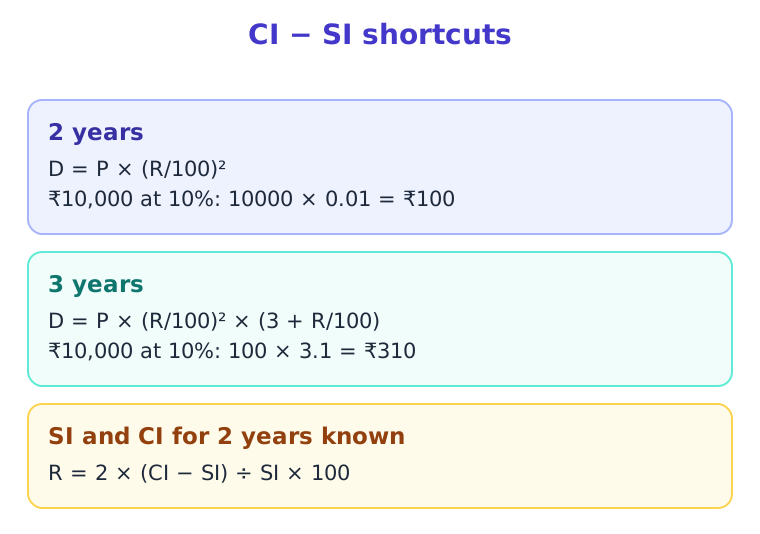
If SI and CI for 2 years are S and C, then R = 2(C − S) ÷ S × 100.
CI for 2 years = SI for 2 years × (1 + R/200).
Equal CI instalments: the loan equals the sum of each instalment divided by (1 + R/100) raised to its year.
Equal SI instalments on a debt due at the end: each instalment earns SI from its payment to the due date.
R% compounded half-yearly is the same as (1 + R/200)² − 1 per year, a little more than R%.
Full explanation
Joseph compares two loans

Joseph needs ₹10,000 for his cycle-repair shop. A moneylender offers 10% simple interest; a finance company offers 10% compound interest. Both say "same rate". Joseph also wonders whether he could pay in equal yearly instalments instead of one big payment.
Where the gap comes from
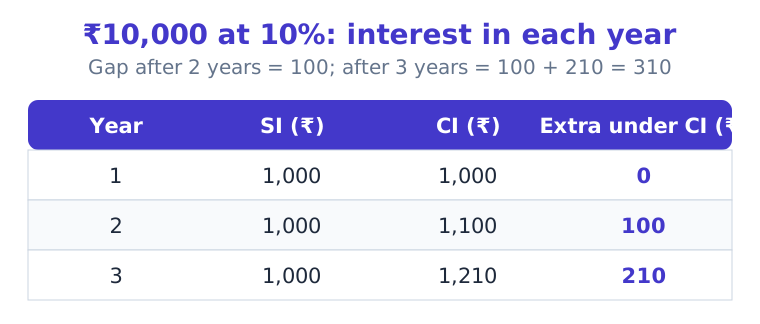
In year 1 both charge ₹1,000. In year 2 the compound loan also charges 10% on that ₹1,000, which is ₹100 more. In year 3 it charges interest on ₹2,100 of past interest, ₹210 more.
The 2-year shortcut
$$CI - SI = P\left(\frac{R}{100}\right)^2$$
₹10,000 at 10%: $10000 \times 0.1^2 = ₹100$. ₹25,000 at 4%: $25000 \times 0.0016 = ₹40$.
The 3-year shortcut
$$CI - SI = P\left(\frac{R}{100}\right)^2\left(3 + \frac{R}{100}\right)$$
₹10,000 at 10%: $100 \times 3.1 = ₹310$, which matches the table. It is not three times the 2-year gap.
Working back from the gap
- Sum: the gap for 2 years at 6% is ₹180, so $P = 180 \div 0.0036 = ₹50{,}000$.
- Rate: the gap on ₹5,000 for 2 years is ₹200, so $(R/100)^2 = 0.04$ and $R = 20%$.
- From SI and CI: SI = ₹2,000 and CI = ₹2,100 for 2 years. One year's SI is ₹1,000 and the extra ₹100 is 10% of it, so $R = 10%$.
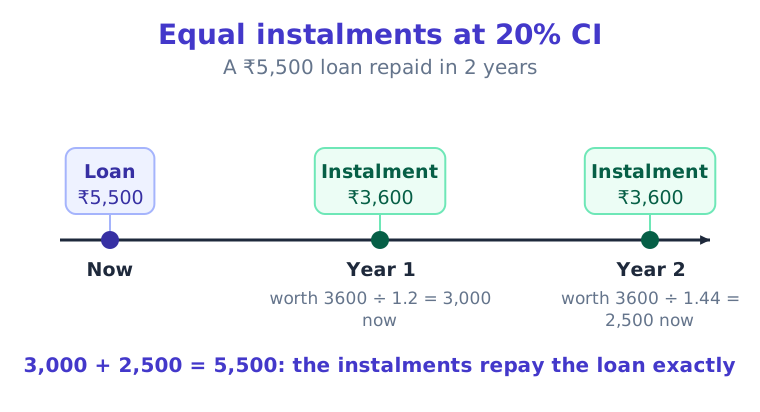
Equal instalments under CI
Each instalment is worth less today, because it is paid later. Divide it by $(1 + \frac{R}{100})^k$ for year k. The loan is the sum:
$$P = \frac{x}{1.2} + \frac{x}{1.2^2}$$
For ₹5,500 at 20%: $5500 = x \times \frac{55}{36}$, which gives $x = ₹3{,}600$.
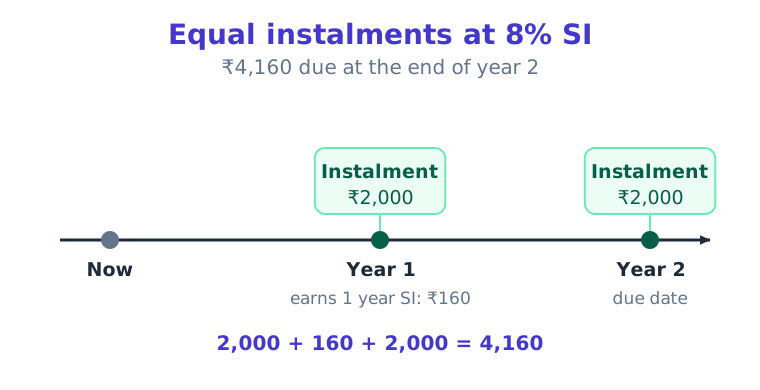
Equal instalments under SI
A debt of ₹4,160 is due at the end of 2 years at 8% SI. Pay x after year 1 and x after year 2. The first payment is early, so it earns 1 year's SI:
$$x + \frac{8x}{100} + x = 4160 \Rightarrow 2.08x = 4160 \Rightarrow x = ₹2{,}000$$
Effective yearly rate
If a bank pays 10% a year compounded half-yearly, ₹100 becomes $100 \times 1.05^2 = ₹110.25$ in a year. So the effective rate is 10.25%. In general it is $\left(1 + \frac{R}{200}\right)^2 - 1$.
Back to Joseph
Over 2 years the compound loan costs him only ₹100 more; over 3 years ₹310 more. With the compound loan, he could clear ₹10,000 in two equal yearly payments of ₹5,761.90.
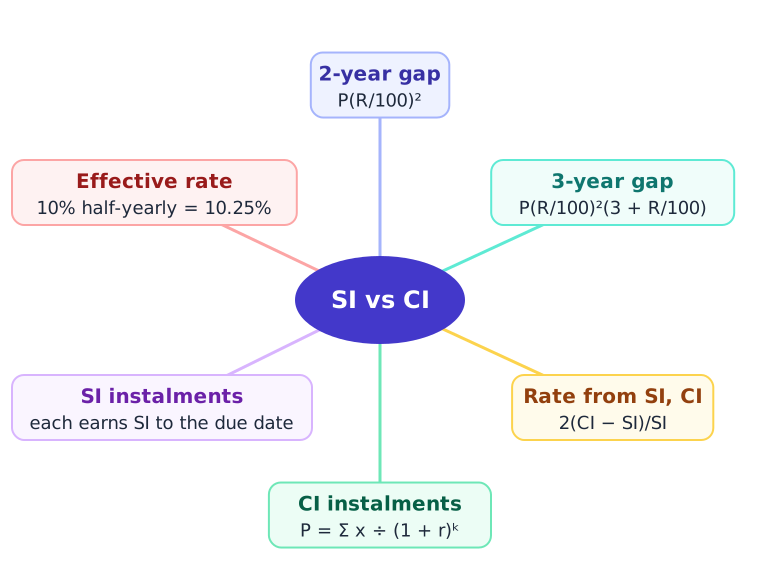
Exam summary: P r² for 2 years, P r²(3 + r) for 3, discount CI instalments to today, and let early SI instalments earn interest to the due date.
Concepts and terms
The whole CI − SI gap. For 2 years it is the interest on year 1's interest: P × r × r.
What a future payment is worth today: ₹3,600 due in 1 year at 20% is worth 3600 ÷ 1.2 = ₹3,000 now.
Equal payments whose present values add up to the loan.
The single yearly rate that gives the same amount as more frequent compounding: 10% half-yearly = 10.25% a year.
Did you know
The EMI on a home or car loan is an equal instalment under compound interest, worked out monthly instead of yearly.
Banks must show the annual percentage rate of a loan so that offers compounded differently can be compared.
Memory tricks
2-year gap — P r squared — CI − SI = P × (R/100)².
3-year gap — P r squared, times three-plus-r — CI − SI = P r²(3 + r) with r = R/100.
Practice MCQs with answers (58)
- A ₹500
- B ₹75
- C ₹50
- D ₹25
Show answer
Why:
CI − SI = P(R/100)² = 10,000 × (0.05)² = 10,000 × 0.0025 = ₹25.
- A ₹80
- B ₹160
- C ₹800
- D ₹240
Show answer
Why:
CI − SI = P(R/100)² = 8,000 × (0.1)² = 8,000 × 0.01 = ₹80.
- A ₹120
- B ₹40
- C ₹80
- D ₹1,000
Show answer
Why:
CI − SI = P(R/100)² = 25,000 × (0.04)² = 25,000 × 0.0016 = ₹40.
- A ₹216
- B ₹144
- C ₹72
- D ₹600
Show answer
Why:
CI − SI = P(R/100)² = 5,000 × (0.12)² = 5,000 × 0.0144 = ₹72.
- A ₹1,800
- B ₹1,200
- C ₹3,000
- D ₹600
Show answer
Why:
CI − SI = P(R/100)² = 15,000 × (0.2)² = 15,000 × 0.04 = ₹600.
- A ₹100
- B ₹200
- C ₹800
- D ₹300
Show answer
Why:
CI − SI = P(R/100)² = 6,400 × (0.125)² = 6,400 × 0.015625 = ₹100.
- A ₹100
- B ₹310
- C ₹200
- D ₹300
Show answer
Why:
CI − SI = P r²(3 + r) = 10,000 × 0.01 × 3.1 = ₹310. (Tripling the 2-year gap, ₹300, misses the extra r.)
- A ₹20
- B ₹40
- C ₹61
- D ₹60
Show answer
Why:
CI − SI = P r²(3 + r) = 8,000 × 0.0025 × 3.05 = ₹61. (Tripling the 2-year gap, ₹60, misses the extra r.)
- A ₹750
- B ₹250
- C ₹500
- D ₹781.25
Show answer
Why:
CI − SI = P r²(3 + r) = 16,000 × 0.015625 × 3.125 = ₹781.25. (Tripling the 2-year gap, ₹750, misses the extra r.)
- A ₹121.60
- B ₹40
- C ₹80
- D ₹120
Show answer
Why:
CI − SI = P r²(3 + r) = 25,000 × 0.0016 × 3.04 = ₹121.60. (Tripling the 2-year gap, ₹120, misses the extra r.)
- A ₹1,500
- B ₹50,000
- C ₹1,00,000
- D ₹3,000
Show answer
Why:
D = P × (R/100)² = P × 0.0036, so P = 180 ÷ 0.0036 = ₹50,000.
- A ₹600
- B ₹2,500
- C ₹7,500
- D ₹300
Show answer
Why:
D = P × (R/100)² = P × 0.0064, so P = 48 ÷ 0.0064 = ₹7,500.
- A ₹1,500
- B ₹3,000
- C ₹20,000
- D ₹60,000
Show answer
Why:
D = P × (R/100)² = P × 0.0025, so P = 150 ÷ 0.0025 = ₹60,000.
- A ₹3,000
- B ₹310
- C ₹930
- D ₹9,300
Show answer
Why:
D = P × (R/100)²(3 + R/100) = P × 0.031, so P = 93 ÷ 0.031 = ₹3,000.
- A ₹1,220
- B ₹8,000
- C ₹24,400
- D ₹16,000
Show answer
Why:
D = P × (R/100)²(3 + R/100) = P × 0.007625, so P = 61 ÷ 0.007625 = ₹8,000.
- A 0.36%
- B 3.6%
- C 6%
- D 3%
Show answer
Why:
(R/100)² = 36 ÷ 10,000 = 0.0036, so R/100 = 0.06 and R = 6%.
- A 20%
- B 5%
- C 1%
- D 10%
Show answer
Why:
(R/100)² = 40 ÷ 4,000 = 0.01, so R/100 = 0.1 and R = 10%.
- A 8%
- B 4%
- C 0.64%
- D 6.4%
Show answer
Why:
(R/100)² = 40 ÷ 6,250 = 0.0064, so R/100 = 0.08 and R = 8%.
- A 4%
- B 20%
- C 40%
- D 10%
Show answer
Why:
(R/100)² = 200 ÷ 5,000 = 0.04, so R/100 = 0.2 and R = 20%.
- A 30%
- B 12%
- C 10%
- D 5%
Show answer
Why:
One year's SI = ₹1,000. The 2-year extra ₹100 is interest on it: R = 100 ÷ 1,000 × 100 = 10%. P = 1,000 ÷ 0.1 = ₹10,000.
- A 8%
- B 3%
- C 18%
- D 6%
Show answer
Why:
One year's SI = ₹600. The 2-year extra ₹36 is interest on it: R = 36 ÷ 600 × 100 = 6%. P = 600 ÷ 0.06 = ₹10,000.
- A ₹20,000
- B ₹40,000
- C ₹40,800
- D ₹10,000
Show answer
Why:
One year's SI = ₹800. The 2-year extra ₹32 is interest on it: R = 32 ÷ 800 × 100 = 4%. P = 800 ÷ 0.04 = ₹20,000.
- A ₹24,000
- B ₹12,000
- C ₹25,200
- D ₹6,000
Show answer
Why:
One year's SI = ₹1,200. The 2-year extra ₹120 is interest on it: R = 120 ÷ 1,200 × 100 = 10%. P = 1,200 ÷ 0.1 = ₹12,000.
- A 10%
- B 9 1/11%
- C 20%
- D 60%
Show answer
Why:
One year's SI = ₹2,000. The 2-year extra ₹400 is interest on it: R = 400 ÷ 2,000 × 100 = 20%. P = 2,000 ÷ 0.2 = ₹10,000.
- A ₹1,100
- B ₹1,200
- C ₹210
- D ₹1,050
Show answer
Why:
P = 1,000 × 100 ÷ (2 × 10) = ₹5,000. Gap = P(R/100)² = ₹50, so CI = 1,000 + 50 = ₹1,050. Shortcut: SI × (1 + R/200).
- A ₹2,496
- B ₹399.36
- C ₹2,592
- D ₹2,784
Show answer
Why:
P = 2,400 × 100 ÷ (2 × 8) = ₹15,000. Gap = P(R/100)² = ₹96, so CI = 2,400 + 96 = ₹2,496. Shortcut: SI × (1 + R/200).
- A ₹4,680
- B ₹3,870
- C ₹1,161
- D ₹4,140
Show answer
Why:
P = 3,600 × 100 ÷ (2 × 15) = ₹12,000. Gap = P(R/100)² = ₹270, so CI = 3,600 + 270 = ₹3,870. Shortcut: SI × (1 + R/200).
- A ₹2,100
- B ₹1,900
- C ₹2,000
- D ₹2,080
Show answer
Why:
Instalment j earns SI for the years left to the due date: x(1 + 0.08) + x = 2.08x = 4,160, so x = ₹2,000.
- A ₹3,225
- B ₹3,100
- C ₹2,900
- D ₹3,000
Show answer
Why:
Instalment j earns SI for the years left to the due date: x(1 + 0.15) + x(1 + 0.1) + x(1 + 0.05) + x = 4.3x = 12,900, so x = ₹3,000.
- A ₹2,500
- B ₹2,650
- C ₹2,600
- D ₹2,400
Show answer
Why:
Instalment j earns SI for the years left to the due date: x(1 + 0.12) + x = 2.12x = 5,300, so x = ₹2,500.
- A ₹1,050
- B ₹1,000
- C ₹1,100
- D ₹900
Show answer
Why:
Instalment j earns SI for the years left to the due date: x(1 + 0.1) + x = 2.1x = 2,100, so x = ₹1,000.
- A ₹4,100
- B ₹4,520.25
- C ₹4,410
- D ₹4,305
Show answer
Why:
Present values add to the loan: x ÷ 1.05 + x ÷ 1.1025 = 8,200. That gives x = ₹4,410.
- A ₹14,641
- B ₹12,100
- C ₹14,310
- D ₹13,310
Show answer
Why:
Present values add to the loan: x ÷ 1.1 + x ÷ 1.21 + x ÷ 1.331 = 33,100. That gives x = ₹13,310.
- A ₹5,408
- B ₹5,100
- C ₹5,516.16
- D ₹5,304
Show answer
Why:
Present values add to the loan: x ÷ 1.04 + x ÷ 1.0816 = 10,200. That gives x = ₹5,408.
- A ₹10,500
- B ₹12,100
- C ₹12,705
- D ₹11,550
Show answer
Why:
Present values add to the loan: x ÷ 1.1 + x ÷ 1.21 = 21,000. That gives x = ₹12,100.
- A ₹4,410
- B ₹840.50
- C ₹620
- D ₹820
Show answer
Why:
Present values add to the loan: x ÷ 1.05 + x ÷ 1.1025 = 8,200. That gives x = ₹4,410; interest = 2 × 4,410 − 8,200 = ₹620.
- A 12.5%
- B 10%
- C 21%
- D 10.25%
Show answer
Why:
₹100 grows to 100 × 1.05² = ₹110.25 in a year, so the effective rate is 10.25%.
- A 21%
- B 25%
- C 20%
- D 44%
Show answer
Why:
₹100 grows to 100 × 1.1² = ₹121 in a year, so the effective rate is 21%.
- A 8%
- B 8.16%
- C 16.64%
- D 10%
Show answer
Why:
₹100 grows to 100 × 1.04² = ₹108.16 in a year, so the effective rate is 8.16%.
- A 15%
- B 12%
- C 12.36%
- D 25.44%
Show answer
Why:
₹100 grows to 100 × 1.06² = ₹112.36 in a year, so the effective rate is 12.36%.
- A 1 : 1
- B 20 : 21
- C 11 : 10
- D 21 : 20
Show answer
Why:
CI = SI × (1 + R/200) = SI × 1.05, so CI : SI = 210 : 200 = 21 : 20.
- A 26 : 25
- B 27 : 25
- C 1 : 1
- D 25 : 26
Show answer
Why:
CI = SI × (1 + R/200) = SI × 1.04, so CI : SI = 208 : 200 = 26 : 25.
- A 1 : 1
- B 41 : 40
- C 40 : 41
- D 21 : 20
Show answer
Why:
CI = SI × (1 + R/200) = SI × 1.025, so CI : SI = 205 : 200 = 41 : 40.
- A 50 : 51
- B 26 : 25
- C 51 : 50
- D 1 : 1
Show answer
Why:
CI = SI × (1 + R/200) = SI × 1.02, so CI : SI = 204 : 200 = 51 : 50.
- A ₹600
- B ₹200
- C ₹6,620
- D ₹620
Show answer
Why:
26,620 − 26,000 = ₹620. Check: 20000 × 0.01 × 3.1 = 620. (Three times the 2-year gap of ₹200 would be ₹600.)
- A ₹2,420
- B ₹2,541
- C ₹2,100
- D ₹2,310
Show answer
Why:
x/1.1 + x/1.21 = 4200 gives x × 210/121 = 4200, so x = ₹2,420. (Half the loan plus a year's interest, ₹2,310, is the trap.)
- A ₹200
- B ₹640
- C ₹440
- D ₹600
Show answer
Why:
0 + 200 + 440 = ₹640. Check: 5000 × 0.04 × 3.2 = 640. (₹440 is year 3 alone.)
- A ₹1,800
- B ₹2,100
- C ₹2,000
- D ₹1,900
Show answer
Why:
x(1.10) + x(1.05) + x = 3.15x = 6300, so x = ₹2,000. (6300 ÷ 3 = ₹2,100 ignores the interest.)
- A zero
- B the first year's interest
- C twice the first year's interest
- D the interest on the first year's interest
Show answer
Why:
Year 2 CI charges R% on year 1's interest; that is the whole gap: P × r × r.
- A more than simple interest
- B less than simple interest
- C equal to simple interest
- D sometimes less, sometimes more
Show answer
Why:
From year 2 onwards CI also earns on past interest.
- A 2D
- B D(3 + R/100)
- C 3D
- D D(1 + R/100)
Show answer
Why:
3-year gap = P r²(3 + r) = D(3 + r).
- A the last instalment
- B the sum of the instalments
- C the sum of the present values of the instalments
- D one instalment times the years
Show answer
Why:
Each instalment is divided by (1 + R/100) to the power of its year before adding.
- A no years
- B n years
- C 1 year
- D n − 1 years
Show answer
Why:
It is paid at the end of year 1, so n − 1 years remain until the due date.
- A slightly more than R%
- B exactly R%
- C slightly less than R%
- D exactly 2R%
Show answer
Why:
(1 + R/200)² − 1 = R/100 + (R/200)², a little above R%.
- A Both A and R are true, and R is the correct explanation of A
- B Both A and R are true, but R is not the correct explanation of A
- C A is true but R is false
- D A is false but R is true
Show answer
Why:
Both true: 10% of ₹1,000 = ₹100, and that is exactly why the gap appears.
- A Both A and R are true, and R is the correct explanation of A
- B Both A and R are true, but R is not the correct explanation of A
- C A is true but R is false
- D A is false but R is true
Show answer
Why:
A is false: the factor is 3 + R/100, slightly more than 3. R is true.
- A 1 only
- B 2 only
- C Both 1 and 2
- D Neither 1 nor 2
Show answer
Why:
1: 5000 × 20 × 2 ÷ 100 = 2,000. 2: 5000 × 0.2² = 200. Both true.
- A 1 only
- B 2 only
- C Both 1 and 2
- D Neither 1 nor 2
Show answer
Why:
1: 1.05² = 1.1025, true. 2: x × 210/121 = 2100 gives x = ₹1,210, so false.
Important short questions (4)
12000 × 0.05² = 12000 × 0.0025 = ₹30.
P × 0.01 × 3.1 = 155, so P = 155 ÷ 0.031 = ₹5,000.
x/1.2 + x/1.44 = 11000 gives x × 55/36 = 11000, so x = ₹7,200.
1.08² − 1 = 0.1664, so 16.64%.
Long answer questions (1)
One year's SI = ₹1,500. The extra ₹150 is 10% of it, so R = 10%. P = 1500 ÷ 0.1 = ₹15,000. 3-year gap = 15000 × 0.01 × 3.1 = ₹465.
Flashcards (13)
Play this topic
- Gap or trap?
Veda Skills Quantitative Aptitude Unit 7 — frequently asked questions
7500 × 8 × 3 ÷ 100 = ₹1,800.
R = 100 × 1200 ÷ (4000 × 5) = 6%.
Yearly SI = 1400 ÷ 2 = ₹700. P = 9800 − 3 × 700 = ₹7,700.
A = 12000 × 1.21 = ₹14,520; CI = ₹2,520.
6% for 2 periods: 20000 × 1.1236 = ₹22,472.
60000 × 0.8² = 60000 × 0.64 = ₹38,400.
12000 × 0.05² = 12000 × 0.0025 = ₹30.
P × 0.01 × 3.1 = 155, so P = 155 ÷ 0.031 = ₹5,000.
x/1.2 + x/1.44 = 11000 gives x × 55/36 = 11000, so x = ₹7,200.

All Veda Skills Quantitative Aptitude units
All Quantitative Aptitude units · All Skills & Exams courses
Study this chapter properly, free
Everything above is on this page to read. In the Veda app the same chapter becomes spaced-repetition flashcards, timed tests that mark themselves, Veda Bites you can swipe, and games — with your progress tracked topic by topic.
Get Veda free