Veda Skills Quantitative Aptitude Unit 11: Boats and Streams

Boats and Streams is Unit 11 of Veda Skills Quantitative Aptitude. This page has the complete chapter notes across 2 topics, 135 practice MCQs with answers and explanations, 10 important short and long questions and 27 flashcards, written for SSC, Bank, Railway and placement exams and free to read.
  • 2 topics
  • 135 MCQs
  • 8 short answers
  • 2 long answers
  • 27 flashcards
  • 2 games
  • ~100 min read
  • English

Checked before publishing: 23 automated checks, including a plagiarism check against the textbook's own words. How we check our content

Upstream and Downstream

Turn the boat speed b and the stream speed s into the downstream speed b + s and the upstream speed b − s, go back from D and U to b and s, and use them for times, distances, round trips and time ratios.

What you will be able to do

  • I can find the downstream and upstream speeds from b and s.
  • I can find the speed in still water and the stream speed from D and U.
  • I can find the time for each leg and for a round trip.
  • I can use the time-ratio shortcut b : s = (k + 1) : (k − 1).

Key points

  • Still water means no current; b is the speed of the boat (or swimmer) there.

  • Downstream means with the current: D = b + s.

  • Upstream means against the current: U = b − s.

  • b is the average of D and U: b = (D + U) ÷ 2.

  • s is half the difference: s = (D − U) ÷ 2.

  • Time = distance ÷ the speed for that leg. Never use one speed for both legs.

  • If upstream takes k times as long as downstream over the same distance, b : s = (k + 1) : (k − 1).

  • The average speed of a round trip is (b² − s²) ÷ b, always less than b.

Full explanation

Raju's ferry at Varanasi
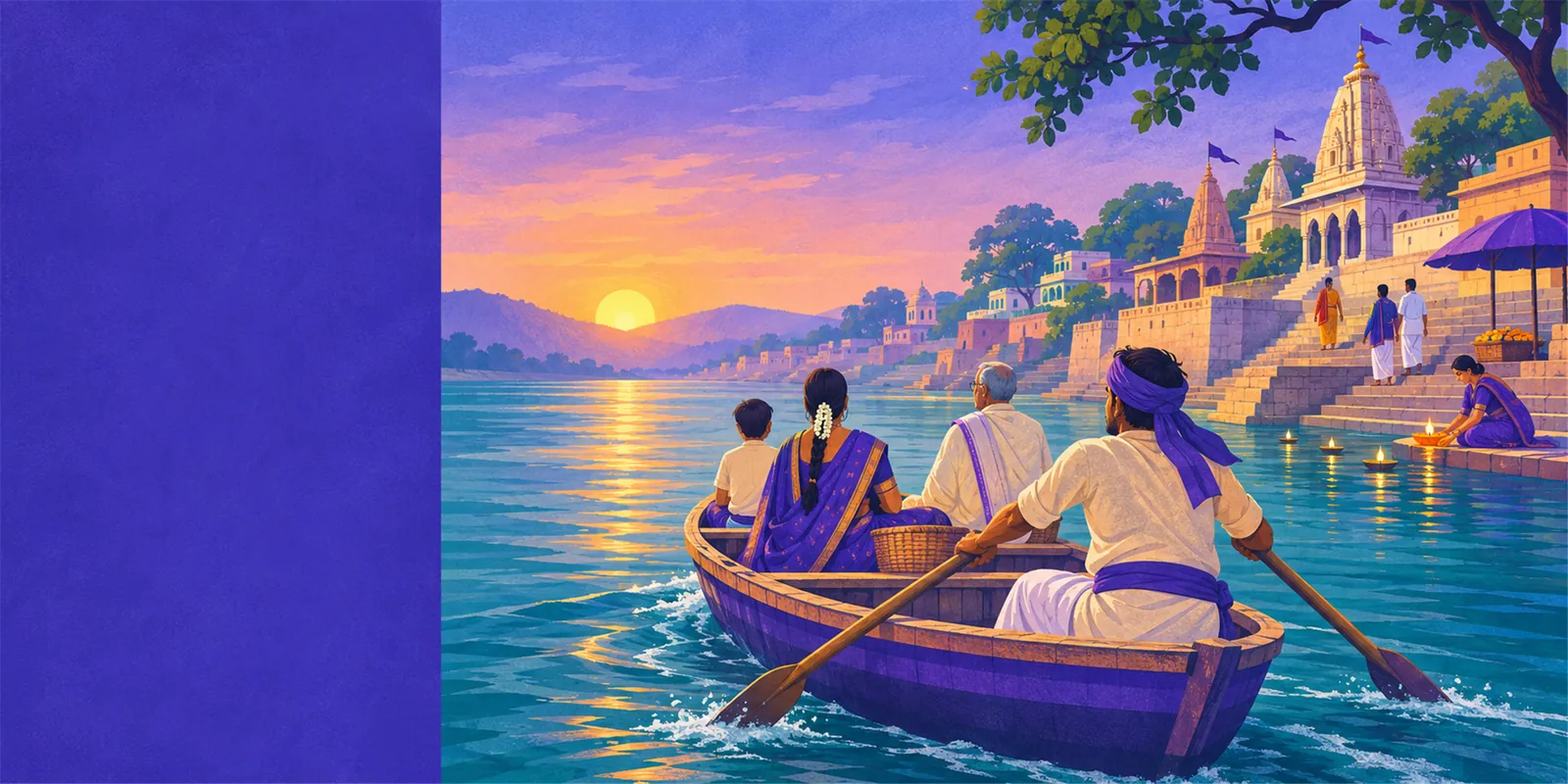
A rowing boat moving upstream on a wide river at dawn, ghats and temples on the bank.

Raju rows tourists 2 km along the Ganga from Assi Ghat to Dashashwamedh Ghat. Going down the river takes him 20 minutes. Coming back up the same 2 km takes 30 minutes.

His arms work just as hard both ways. So how fast does Raju row, and how fast is the Ganga flowing? By the end of this topic you will answer that in one line.

The words used in exams

Two boats on a river, one going with the current and one against it.

  • Still water: water that does not flow, like a lake. The boat's speed there is $b$.
  • Stream or current: the flowing river, with speed $s$.
  • Downstream: moving with the current.
  • Upstream: moving against the current.

Two speeds from one boat

With the current, the river carries the boat forward, so the speeds add. Against it, the river pulls back, so they subtract.

$$D = b + s \qquad U = b - s$$
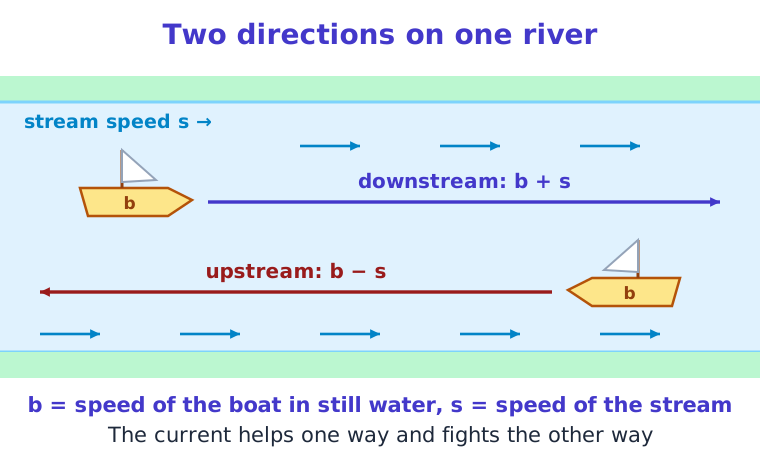
A river flowing left to right. One boat moves right with the current, labelled downstream b + s. Another moves left against it, labelled upstream b − s.

Going back: b and s from D and U

Add the two equations: $D + U = 2b$. Subtract them: $D - U = 2s$. So

$$b = \frac{D + U}{2} \qquad s = \frac{D - U}{2}$$

Example: downstream 14 km/h, upstream 8 km/h. Then $b = 22 \div 2 = 11$ km/h and $s = 6 \div 2 = 3$ km/h.
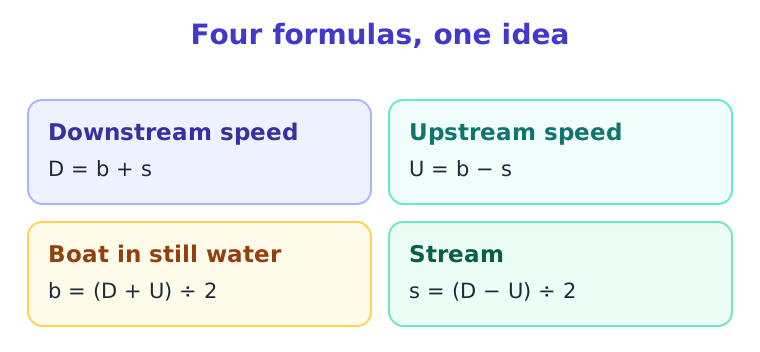
Four cards: D = b + s, U = b − s, b = (D + U) ÷ 2, s = (D − U) ÷ 2.

Worked example: from distances and times

A boat goes 36 km downstream in 3 hours and 24 km upstream in 4 hours.

  • $D = 36 \div 3 = 12$ km/h, $U = 24 \div 4 = 6$ km/h.
  • $b = (12 + 6) \div 2 = 9$ km/h, $s = (12 - 6) \div 2 = 3$ km/h.

Trap: $(36 + 24) \div (3 + 4)$ is an average speed of the whole trip, not $b$.

Time for each leg

Each leg has its own speed, so find each time separately and then add.
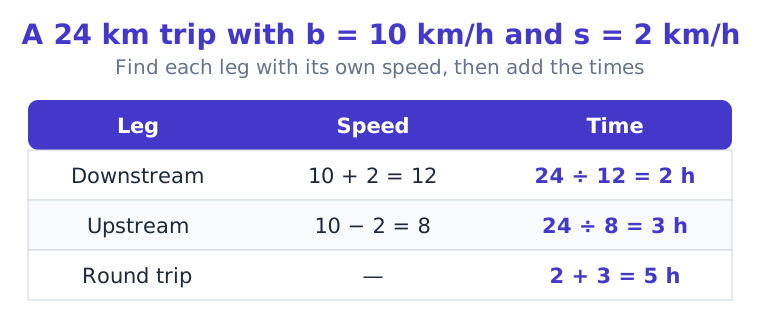
Table for a 24 km trip with b = 10 and s = 2: downstream 12 km/h takes 2 h, upstream 8 km/h takes 3 h, round trip 5 h.

Round trip: find the distance

A boat with $b = 10$ km/h goes to a village and back in 5 hours. The stream is 2 km/h. How far is the village?

Let the distance be $d$: $\frac{d}{12} + \frac{d}{8} = 5$, so $\frac{5d}{24} = 5$ and $d = 24$ km.

Shortcut: $d = \frac{T(b^2 - s^2)}{2b} = \frac{5 \times 96}{20} = 24$ km.

The time-ratio shortcut

If a man takes twice as long to row upstream as downstream over the same distance, his speeds are in the ratio $D : U = 2 : 1$. Then $b : s = (2 + 1) : (2 - 1) = 3 : 1$.
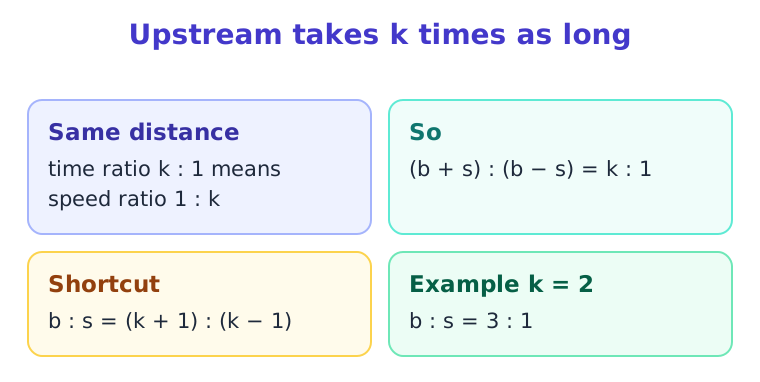
Cards: a time ratio k : 1 gives speed ratio 1 : k, so (b + s) : (b − s) = k : 1 and b : s = (k + 1) : (k − 1); for k = 2 it is 3 : 1.

Average speed of a round trip

Going and coming back the same distance, the average speed is total distance ÷ total time:

$$\text{average} = \frac{2d}{\frac{d}{b+s} + \frac{d}{b-s}} = \frac{b^2 - s^2}{b}$$

With $b = 10$, $s = 2$: $96 \div 10 = 9.6$ km/h. It is less than $b$, because the slow leg lasts longer.

Units: minutes and metres

"1 km in 5 minutes" is $60 \div 5 = 12$ km/h. A speed in m/s becomes km/h on multiplying by $\frac{18}{5}$. Change everything to km and hours before you use the formulas.

Back to Raju

Downstream: 2 km in 20 min = 6 km/h. Upstream: 2 km in 30 min = 4 km/h.

So Raju rows at $b = (6 + 4) \div 2 = 5$ km/h and the Ganga flows at $s = (6 - 4) \div 2 = 1$ km/h. One line, as promised.
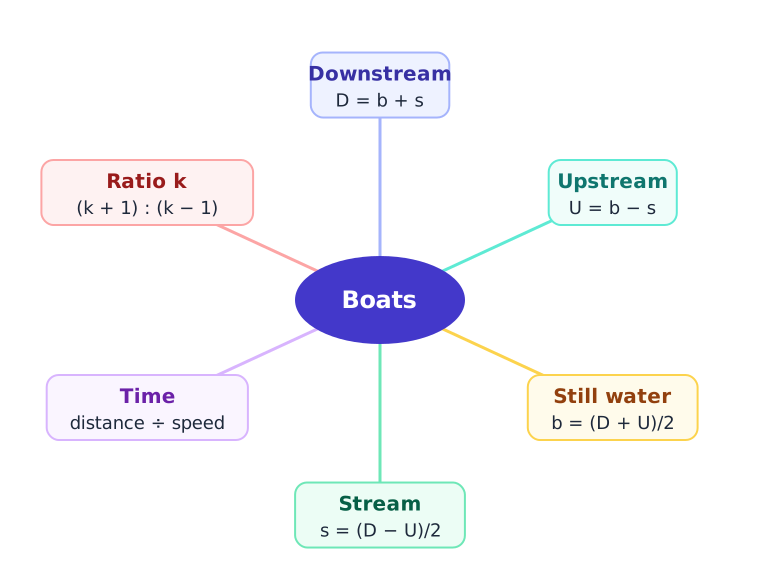
Mind map of boats and streams: downstream b + s, upstream b − s, still water (D + U)/2, stream (D − U)/2, time = distance ÷ speed, and the ratio rule.

Concepts and terms

Speed in still water

How fast the boat moves when the water is not flowing, written b. It is the boat's own effort.

Downstream speed

Moving with the flow, the current adds its speed: D = b + s.

Upstream speed

Moving against the flow, the current takes its speed away: U = b − s.

Getting b and s back

Add D and U and halve for b; subtract and halve for s. With D = 14 and U = 8: b = 11, s = 3.

Did you know

Fishermen on the Brahmaputra plan trips so that they go downstream when loaded and come back up empty, saving fuel and effort.

A log or a raft with no engine moves at exactly the speed of the stream, so it is a free speedometer for the river.

Memory tricks

Which sign? — Down adds, Up fights — Downstream the river pushes you (+ s); upstream it pushes back (− s).

b and s from D and U — Sum-half, difference-half — Half the sum is the boat, half the difference is the stream.

Practice MCQs with answers (76)

Q1 The speed of a boat in still water is 12 km/h and the stream flows at 3 km/h. What is its downstream speed? beginner
  • A 9 km/h
  • B 18 km/h
  • C 15 km/h
  • D 12 km/h
Show answer
Answer: 15 km/h
Why:

Downstream the speeds add: 12 + 3 = 15 km/h.

Q2 On the Yamuna, flowing at 5 km/h, Ravi's boat that does 15 km/h in still water goes with the current. Find its speed. beginner
  • A 15 km/h
  • B 10 km/h
  • C 25 km/h
  • D 20 km/h
Show answer
Answer: 20 km/h
Why:

Downstream the speeds add: 15 + 5 = 20 km/h.

Q3 The speed of a motorboat in still water is 8 km/h and the stream flows at 2 km/h. What is its downstream speed? beginner
  • A 10 km/h
  • B 6 km/h
  • C 12 km/h
  • D 8 km/h
Show answer
Answer: 10 km/h
Why:

Downstream the speeds add: 8 + 2 = 10 km/h.

Q4 On the Godavari, flowing at 4 km/h, Meena's boat that does 20 km/h in still water goes with the current. Find its speed. beginner
  • A 16 km/h
  • B 24 km/h
  • C 28 km/h
  • D 20 km/h
Show answer
Answer: 24 km/h
Why:

Downstream the speeds add: 20 + 4 = 24 km/h.

Q5 The speed of a fisherman's boat in still water is 13.5 km/h and the stream flows at 1.5 km/h. What is its downstream speed? beginner
  • A 13.5 km/h
  • B 12 km/h
  • C 15 km/h
  • D 16.5 km/h
Show answer
Answer: 15 km/h
Why:

Downstream the speeds add: 13.5 + 1.5 = 15 km/h.

Q6 The speed of a motorboat in still water is 14 km/h and the stream flows at 4 km/h. What is its upstream speed? beginner
  • A 14 km/h
  • B 18 km/h
  • C 6 km/h
  • D 10 km/h
Show answer
Answer: 10 km/h
Why:

Upstream the current takes its speed away: 14 − 4 = 10 km/h.

Q7 Meena's boat moves at 18 km/h in still water and heads against a 6 km/h current on the Godavari. How fast does it move? beginner
  • A 12 km/h
  • B 18 km/h
  • C 24 km/h
  • D 6 km/h
Show answer
Answer: 12 km/h
Why:

Upstream the current takes its speed away: 18 − 6 = 12 km/h.

Q8 The speed of a fisherman's boat in still water is 9 km/h and the stream flows at 3 km/h. What is its upstream speed? beginner
  • A 9 km/h
  • B 6 km/h
  • C 12 km/h
  • D 3 km/h
Show answer
Answer: 6 km/h
Why:

Upstream the current takes its speed away: 9 − 3 = 6 km/h.

Q9 A ferry moves at 25 km/h in still water and heads against a 7 km/h current on the Kaveri. How fast does it move? intermediate
  • A 11 km/h
  • B 25 km/h
  • C 18 km/h
  • D 32 km/h
Show answer
Answer: 18 km/h
Why:

Upstream the current takes its speed away: 25 − 7 = 18 km/h.

Q10 The speed of a steamer in still water is 10.5 km/h and the stream flows at 2.5 km/h. What is its upstream speed? intermediate
  • A 5.5 km/h
  • B 10.5 km/h
  • C 13 km/h
  • D 8 km/h
Show answer
Answer: 8 km/h
Why:

Upstream the current takes its speed away: 10.5 − 2.5 = 8 km/h.

Q11 The downstream speed of a boat is 14 km/h and its upstream speed is 8 km/h. What is its speed in still water? beginner
  • A 11 km/h
  • B 6 km/h
  • C 22 km/h
  • D 3 km/h
Show answer
Answer: 11 km/h
Why:

b = (D + U) ÷ 2 = (14 + 8) ÷ 2 = 11 km/h.

Q12 A man rows with the current at 20 km/h and against it at 12 km/h. How fast can he row in still water? beginner
  • A 4 km/h
  • B 16 km/h
  • C 8 km/h
  • D 32 km/h
Show answer
Answer: 16 km/h
Why:

b = (D + U) ÷ 2 = (20 + 12) ÷ 2 = 16 km/h.

Q13 The downstream speed of a motorboat is 18 km/h and its upstream speed is 10 km/h. What is its speed in still water? beginner
  • A 8 km/h
  • B 28 km/h
  • C 14 km/h
  • D 4 km/h
Show answer
Answer: 14 km/h
Why:

b = (D + U) ÷ 2 = (18 + 10) ÷ 2 = 14 km/h.

Q14 A man rows with the current at 25 km/h and against it at 15 km/h. How fast can he row in still water? intermediate
  • A 10 km/h
  • B 40 km/h
  • C 5 km/h
  • D 20 km/h
Show answer
Answer: 20 km/h
Why:

b = (D + U) ÷ 2 = (25 + 15) ÷ 2 = 20 km/h.

Q15 The downstream speed of a fisherman's boat is 11 km/h and its upstream speed is 5 km/h. What is its speed in still water? intermediate
  • A 8 km/h
  • B 3 km/h
  • C 6 km/h
  • D 16 km/h
Show answer
Answer: 8 km/h
Why:

b = (D + U) ÷ 2 = (11 + 5) ÷ 2 = 8 km/h.

Q16 A man rows with the current at 9 km/h and against it at 4 km/h. How fast can he row in still water? intermediate
  • A 2.5 km/h
  • B 6.5 km/h
  • C 5 km/h
  • D 13 km/h
Show answer
Answer: 6.5 km/h
Why:

b = (D + U) ÷ 2 = (9 + 4) ÷ 2 = 6.5 km/h.

Q17 A boat goes downstream at 16 km/h and upstream at 10 km/h. What is the speed of the stream? beginner
  • A 13 km/h
  • B 4 km/h
  • C 3 km/h
  • D 6 km/h
Show answer
Answer: 3 km/h
Why:

s = (D − U) ÷ 2 = (16 − 10) ÷ 2 = 3 km/h.

Q18 With the current a swimmer covers 22 km/h; against it only 14 km/h. How fast is the current? beginner
  • A 8 km/h
  • B 18 km/h
  • C 5 km/h
  • D 4 km/h
Show answer
Answer: 4 km/h
Why:

s = (D − U) ÷ 2 = (22 − 14) ÷ 2 = 4 km/h.

Q19 A boat goes downstream at 13 km/h and upstream at 7 km/h. What is the speed of the stream? intermediate
  • A 3 km/h
  • B 6 km/h
  • C 10 km/h
  • D 4 km/h
Show answer
Answer: 3 km/h
Why:

s = (D − U) ÷ 2 = (13 − 7) ÷ 2 = 3 km/h.

Q20 With the current a swimmer covers 30 km/h; against it only 21 km/h. How fast is the current? intermediate
  • A 5.5 km/h
  • B 4.5 km/h
  • C 9 km/h
  • D 25.5 km/h
Show answer
Answer: 4.5 km/h
Why:

s = (D − U) ÷ 2 = (30 − 21) ÷ 2 = 4.5 km/h.

Q21 A boat goes downstream at 17.5 km/h and upstream at 12.5 km/h. What is the speed of the stream? intermediate
  • A 5 km/h
  • B 15 km/h
  • C 2.5 km/h
  • D 3.5 km/h
Show answer
Answer: 2.5 km/h
Why:

s = (D − U) ÷ 2 = (17.5 − 12.5) ÷ 2 = 2.5 km/h.

Q22 A boat goes 36 km downstream in 3 hours and 24 km upstream in 4 hours. What is its speed in still water? intermediate
  • A 3 km/h
  • B 12 km/h
  • C 60/7 km/h
  • D 9 km/h
Show answer
Answer: 9 km/h
Why:

D = 36 ÷ 3 = 12, U = 24 ÷ 4 = 6; b = (12 + 6) ÷ 2 = 9 km/h.

Q23 Ravi's boat goes 24 km downstream in 2 hours and 24 km upstream in 3 hours. Find the speed of the stream. intermediate
  • A 2 km/h
  • B 10 km/h
  • C 3 km/h
  • D 4 km/h
Show answer
Answer: 2 km/h
Why:

D = 12, U = 8; s = (12 − 8) ÷ 2 = 2 km/h.

Q24 A motorboat goes 28 km downstream in 2 hours and 32 km upstream in 4 hours. What is its speed in still water? intermediate
  • A 14 km/h
  • B 11 km/h
  • C 10 km/h
  • D 3 km/h
Show answer
Answer: 11 km/h
Why:

D = 28 ÷ 2 = 14, U = 32 ÷ 4 = 8; b = (14 + 8) ÷ 2 = 11 km/h.

Q25 Meena's boat goes 36 km downstream in 2 hours and 30 km upstream in 3 hours. Find the speed of the stream. intermediate
  • A 8 km/h
  • B 14 km/h
  • C 4 km/h
  • D 5 km/h
Show answer
Answer: 4 km/h
Why:

D = 18, U = 10; s = (18 − 10) ÷ 2 = 4 km/h.

Q26 A fisherman's boat goes 36 km downstream in 4 hours and 30 km upstream in 6 hours. What is its speed in still water? intermediate
  • A 9 km/h
  • B 6.6 km/h
  • C 2 km/h
  • D 7 km/h
Show answer
Answer: 7 km/h
Why:

D = 36 ÷ 4 = 9, U = 30 ÷ 6 = 5; b = (9 + 5) ÷ 2 = 7 km/h.

Q27 A ferry goes 60 km downstream in 3 hours and 60 km upstream in 5 hours. Find the speed of the stream. advanced
  • A 4 km/h
  • B 8 km/h
  • C 16 km/h
  • D 5 km/h
Show answer
Answer: 4 km/h
Why:

D = 20, U = 12; s = (20 − 12) ÷ 2 = 4 km/h.

Q28 A steamer goes 40 km downstream in 4 hours and 30 km upstream in 6 hours. What is its speed in still water? advanced
  • A 2.5 km/h
  • B 7.5 km/h
  • C 10 km/h
  • D 7 km/h
Show answer
Answer: 7.5 km/h
Why:

D = 40 ÷ 4 = 10, U = 30 ÷ 6 = 5; b = (10 + 5) ÷ 2 = 7.5 km/h.

Q29 Arjun's canoe goes 36 km downstream in 2 hours and 40 km upstream in 5 hours. Find the speed of the stream. advanced
  • A 13 km/h
  • B 6 km/h
  • C 5 km/h
  • D 10 km/h
Show answer
Answer: 5 km/h
Why:

D = 18, U = 8; s = (18 − 8) ÷ 2 = 5 km/h.

Q30 The speed of a boat in still water is 10 km/h and the stream flows at 2 km/h. How long will it take to go 36 km downstream? beginner
  • A 4 hours
  • B 4 h 30 min
  • C 3 h 36 min
  • D 3 hours
Show answer
Answer: 3 hours
Why:

Downstream speed 12 km/h, so time = 36 ÷ 12 = 3 hours.

Q31 The speed of Ravi's boat in still water is 15 km/h and the stream flows at 3 km/h. How long will it take to cover 48 km upstream? beginner
  • A 4 hours
  • B 3 h 12 min
  • C 5 hours
  • D 2 h 40 min
Show answer
Answer: 4 hours
Why:

Upstream speed 12 km/h, so time = 48 ÷ 12 = 4 hours.

Q32 The speed of a motorboat in still water is 8 km/h and the stream flows at 2 km/h. How long does it take to go 30 km downstream and come back? intermediate
  • A 6 hours
  • B 8 hours
  • C 10 hours
  • D 7 h 30 min
Show answer
Answer: 8 hours
Why:

30 ÷ 10 + 30 ÷ 6 = 3 + 5 = 8 hours.

Q33 The speed of Meena's boat in still water is 12 km/h and the stream flows at 4 km/h. How long will it take to go 40 km downstream? intermediate
  • A 5 hours
  • B 3 h 20 min
  • C 2 h 30 min
  • D 3 h 30 min
Show answer
Answer: 2 h 30 min
Why:

Downstream speed 16 km/h, so time = 40 ÷ 16 = 2 h 30 min.

Q34 The speed of a fisherman's boat in still water is 9 km/h and the stream flows at 1 km/h. How long will it take to cover 32 km upstream? intermediate
  • A 3 h 12 min
  • B 5 hours
  • C 4 h 30 min
  • D 4 hours
Show answer
Answer: 4 hours
Why:

Upstream speed 8 km/h, so time = 32 ÷ 8 = 4 hours.

Q35 The speed of a ferry in still water is 14 km/h and the stream flows at 2 km/h. How long does it take to go 48 km downstream and come back? advanced
  • A 7 hours
  • B 6 hours
  • C 8 hours
  • D 4 hours
Show answer
Answer: 7 hours
Why:

48 ÷ 16 + 48 ÷ 12 = 3 + 4 = 7 hours.

Q36 The speed of a steamer in still water is 11 km/h and the stream flows at 1 km/h. How long does it take to go 30 km downstream and come back? advanced
  • A 6 hours
  • B 5 h 30 min
  • C 3 hours
  • D 5 hours
Show answer
Answer: 5 h 30 min
Why:

30 ÷ 12 + 30 ÷ 10 = 2.5 + 3 = 5 h 30 min.

Q37 A boat with a still-water speed of 10 km/h goes to a place and comes back in 5 hours. The stream flows at 2 km/h. How far is the place? intermediate
  • A 30 km
  • B 20 km
  • C 24 km
  • D 25 km
Show answer
Answer: 24 km
Why:

d = T(b² − s²) ÷ 2b = 5 × 96 ÷ 20 = 24 km.

Q38 Ravi's boat with a still-water speed of 9 km/h goes to a place and comes back in 9 hours. The stream flows at 3 km/h. How far is the place? intermediate
  • A 40.5 km
  • B 54 km
  • C 27 km
  • D 36 km
Show answer
Answer: 36 km
Why:

d = T(b² − s²) ÷ 2b = 9 × 72 ÷ 18 = 36 km.

Q39 A motorboat with a still-water speed of 8 km/h goes to a place and comes back in 8 hours. The stream flows at 2 km/h. How far is the place? advanced
  • A 30 km
  • B 32 km
  • C 40 km
  • D 24 km
Show answer
Answer: 30 km
Why:

d = T(b² − s²) ÷ 2b = 8 × 60 ÷ 16 = 30 km.

Q40 Meena's boat with a still-water speed of 15 km/h goes to a place and comes back in 6 hours. The stream flows at 5 km/h. How far is the place? advanced
  • A 30 km
  • B 40 km
  • C 45 km
  • D 60 km
Show answer
Answer: 40 km
Why:

d = T(b² − s²) ÷ 2b = 6 × 200 ÷ 30 = 40 km.

Q41 A fisherman's boat with a still-water speed of 7 km/h goes to a place and comes back in 7 hours. The stream flows at 3 km/h. How far is the place? advanced
  • A 35 km
  • B 14 km
  • C 20 km
  • D 24.5 km
Show answer
Answer: 20 km
Why:

d = T(b² − s²) ÷ 2b = 7 × 40 ÷ 14 = 20 km.

Q42 A man takes 2 times as long to row a distance upstream as to row the same distance downstream. The stream flows at 3 km/h. What is his speed in still water? intermediate
  • A 1 km/h
  • B 12 km/h
  • C 6 km/h
  • D 9 km/h
Show answer
Answer: 9 km/h
Why:

b : s = (2 + 1) : (2 − 1) = 3 : 1, so b = 3 × 3 ÷ 1 = 9 km/h.

Q43 A man takes 3 times as long to row a distance upstream as to row the same distance downstream. The stream flows at 4 km/h. What is his speed in still water? intermediate
  • A 8 km/h
  • B 16 km/h
  • C 2 km/h
  • D 12 km/h
Show answer
Answer: 8 km/h
Why:

b : s = (3 + 1) : (3 − 1) = 4 : 2, so b = 4 × 4 ÷ 2 = 8 km/h.

Q44 A man takes 2 times as long to row a distance upstream as to row the same distance downstream. The stream flows at 5 km/h. What is his speed in still water? intermediate
  • A 20 km/h
  • B 15 km/h
  • C 10 km/h
  • D 5/3 km/h
Show answer
Answer: 15 km/h
Why:

b : s = (2 + 1) : (2 − 1) = 3 : 1, so b = 5 × 3 ÷ 1 = 15 km/h.

Q45 Rowing upstream takes 3 times as long as rowing downstream over the same stretch. What is the ratio of the boat speed in still water to the stream speed? intermediate
  • A 4 : 1
  • B 3 : 1
  • C 2 : 1
  • D 1 : 2
Show answer
Answer: 2 : 1
Why:

(b + s) : (b − s) = 3 : 1, so b : s = (3 + 1) : (3 − 1) = 2 : 1.

Q46 Rowing upstream takes 4 times as long as rowing downstream over the same stretch. What is the ratio of the boat speed in still water to the stream speed? advanced
  • A 3 : 5
  • B 5 : 1
  • C 4 : 1
  • D 5 : 3
Show answer
Answer: 5 : 3
Why:

(b + s) : (b − s) = 4 : 1, so b : s = (4 + 1) : (4 − 1) = 5 : 3.

Q47 A man takes 5 times as long to row a distance upstream as to row the same distance downstream. The stream flows at 2 km/h. What is his speed in still water? advanced
  • A 3 km/h
  • B 10 km/h
  • C 12 km/h
  • D 4/3 km/h
Show answer
Answer: 3 km/h
Why:

b : s = (5 + 1) : (5 − 1) = 6 : 4, so b = 2 × 6 ÷ 4 = 3 km/h.

Q48 A boat goes from town A to town B downstream in 4 hours and comes back in 6 hours. The stream flows at 2 km/h. Find the speed of the boat in still water. advanced
  • A 4 km/h
  • B 10 km/h
  • C 3 km/h
  • D 12 km/h
Show answer
Answer: 10 km/h
Why:

(b + 2) × 4 = (b − 2) × 6 gives b = 2 × (6 + 4) ÷ (6 − 4) = 10 km/h.

Q49 A boat goes from town A to town B downstream in 3 hours and comes back in 5 hours. The stream flows at 3 km/h. Find the speed of the boat in still water. advanced
  • A 15 km/h
  • B 6 km/h
  • C 12 km/h
  • D 5 km/h
Show answer
Answer: 12 km/h
Why:

(b + 3) × 3 = (b − 3) × 5 gives b = 3 × (5 + 3) ÷ (5 − 3) = 12 km/h.

Q50 A launch takes 2 hours to go from A to B with the current and 3 hours to return. If the current is 2 km/h, how far apart are A and B? advanced
  • A 50 km
  • B 20 km
  • C 16 km
  • D 24 km
Show answer
Answer: 24 km
Why:

b = 2 × 5 ÷ 1 = 10, so AB = (10 + 2) × 2 = 24 km.

Q51 A launch takes 5 hours to go from A to B with the current and 7 hours to return. If the current is 1 km/h, how far apart are A and B? advanced
  • A 35 km
  • B 25 km
  • C 72 km
  • D 30 km
Show answer
Answer: 35 km
Why:

b = 1 × 12 ÷ 2 = 6, so AB = (6 + 1) × 5 = 35 km.

Q52 A boat moves at 10 km/h in still water. It goes some distance downstream and returns to the start on a river flowing at 2 km/h. What is its average speed for the whole journey? intermediate
  • A 10.4 km/h
  • B 9.6 km/h
  • C 10 km/h
  • D 8 km/h
Show answer
Answer: 9.6 km/h
Why:

Average = (b² − s²) ÷ b = (100 − 4) ÷ 10 = 9.6 km/h.

Q53 Ravi's boat moves at 12 km/h in still water. It goes some distance downstream and returns to the start on a river flowing at 6 km/h. What is its average speed for the whole journey? intermediate
  • A 6 km/h
  • B 15 km/h
  • C 9 km/h
  • D 12 km/h
Show answer
Answer: 9 km/h
Why:

Average = (b² − s²) ÷ b = (144 − 36) ÷ 12 = 9 km/h.

Q54 A motorboat moves at 20 km/h in still water. It goes some distance downstream and returns to the start on a river flowing at 4 km/h. What is its average speed for the whole journey? advanced
  • A 20 km/h
  • B 16 km/h
  • C 20.8 km/h
  • D 19.2 km/h
Show answer
Answer: 19.2 km/h
Why:

Average = (b² − s²) ÷ b = (400 − 16) ÷ 20 = 19.2 km/h.

Q55 A boatman covers 1 km downstream in 4 minutes and 1 km upstream in 6 minutes. What is his speed in still water? intermediate
  • A 12.5 km/h
  • B 15 km/h
  • C 5 km/h
  • D 2.5 km/h
Show answer
Answer: 12.5 km/h
Why:

D = 60 ÷ 4 = 15 km/h, U = 60 ÷ 6 = 10 km/h, so b = 12.5 km/h.

Q56 A boatman covers 1 km downstream in 5 minutes and 1 km upstream in 10 minutes. What is the speed of the stream? intermediate
  • A 2.5 km/h
  • B 3 km/h
  • C 6 km/h
  • D 9 km/h
Show answer
Answer: 3 km/h
Why:

D = 12 km/h, U = 6 km/h, so s = (12 − 6) ÷ 2 = 3 km/h.

Q57 A boatman covers 1 km downstream in 3 minutes and 1 km upstream in 5 minutes. What is his speed in still water? advanced
  • A 20 km/h
  • B 12 km/h
  • C 16 km/h
  • D 4 km/h
Show answer
Answer: 16 km/h
Why:

D = 60 ÷ 3 = 20 km/h, U = 60 ÷ 5 = 12 km/h, so b = 16 km/h.

Q58 The upstream speed of a boat is 60% of its downstream speed. If the stream flows at 2 km/h, what is the speed of the boat in still water? advanced
  • A 4/3 km/h
  • B 10 km/h
  • C 5 km/h
  • D 8 km/h
Show answer
Answer: 8 km/h
Why:

b − s = 60% of (b + s), so b × 40 = s × 160 and b = 2 × 160 ÷ 40 = 8 km/h.

Q59 The upstream speed of a boat is 75% of its downstream speed. If the stream flows at 1 km/h, what is the speed of the boat in still water? advanced
  • A 7 km/h
  • B 4 km/h
  • C 1/3 km/h
  • D 8 km/h
Show answer
Answer: 7 km/h
Why:

b − s = 75% of (b + s), so b × 25 = s × 175 and b = 1 × 175 ÷ 25 = 7 km/h.

Q60 The upstream speed of a boat is 50% of its downstream speed. If the stream flows at 3 km/h, what is the speed of the boat in still water? advanced
  • A 6 km/h
  • B 9 km/h
  • C 3 km/h
  • D 12 km/h
Show answer
Answer: 9 km/h
Why:

b − s = 50% of (b + s), so b × 50 = s × 150 and b = 3 × 150 ÷ 50 = 9 km/h.

Q61 In boat problems, "still water" means beginner
  • A a river in flood
  • B the deepest part of a river
  • C water with no current
  • D water moving with the boat
Show answer
Answer: water with no current
Why:

Still water does not flow, so only the boat's own speed b acts.

Q62 A boat moving downstream moves beginner
  • A across the river
  • B only in still water
  • C against the current
  • D in the direction of the current
Show answer
Answer: in the direction of the current
Why:

Downstream means with the flow of the river.

Q63 D + U is always equal to beginner
  • A 2b
  • B b + s
  • C b
  • D 2s
Show answer
Answer: 2b
Why:

(b + s) + (b − s) = 2b; the stream cancels.

Q64 If the stream is faster than the boat in still water, the boat going upstream will intermediate
  • A move forward slowly
  • B drift backwards
  • C move at speed b
  • D stay still
Show answer
Answer: drift backwards
Why:

b − s is negative, so the boat is carried back with the water.

Q65 A log floats down a river with no one rowing. Its speed equals beginner
  • A zero
  • B twice the stream speed
  • C the speed of the stream
  • D half the stream speed
Show answer
Answer: the speed of the stream
Why:

With b = 0, its downstream speed is 0 + s = s.

Q66 For a round trip over the same distance, the average speed is intermediate
  • A equal to s
  • B equal to b
  • C more than b
  • D less than b
Show answer
Answer: less than b
Why:

(b² − s²) ÷ b = b − s²/b, which is below b whenever s > 0.

Q67 D = 18 km/h and U = 12 km/h. Which statement is correct? intermediate
  • A b = 15 km/h and s = 3 km/h
  • B b = 15 km/h and s = 6 km/h
  • C b = 30 km/h and s = 6 km/h
  • D b = 12 km/h and s = 3 km/h
Show answer
Answer: b = 15 km/h and s = 3 km/h
Why:

b = 30 ÷ 2 = 15 and s = 6 ÷ 2 = 3. Forgetting to halve gives 6.

Q68 A man rows 1 km against the current in 15 minutes. His upstream speed is beginner
  • A 6 km/h
  • B 4 km/h
  • C 15 km/h
  • D 0.25 km/h
Show answer
Answer: 4 km/h
Why:

1 km in a quarter hour is 4 km/h.

Q69 Assertion (A): A boat's speed in still water is the average of its downstream and upstream speeds. Reason (R): The stream adds s one way and takes away s the other way. intermediate
  • A Both A and R are true, and R is the correct explanation of A
  • B Both A and R are true, but R is not the correct explanation of A
  • C A is true but R is false
  • D A is false but R is true
Show answer
Answer: Both A and R are true, and R is the correct explanation of A
Why:

(b + s) + (b − s) = 2b, so b is the average. R is exactly why.

Q70 Assertion (A): The average speed of a round trip equals the speed in still water. Reason (R): The boat spends more time on the slower upstream leg. advanced
  • A Both A and R are true, and R is the correct explanation of A
  • B Both A and R are true, but R is not the correct explanation of A
  • C A is true but R is false
  • D A is false but R is true
Show answer
Answer: A is false but R is true
Why:

A is false: the average is (b² − s²) ÷ b, below b. R is true and is the reason the average drops.

Q71 A boat has b = 10 km/h on a river with s = 2 km/h. Which are true? 1. It covers 24 km downstream in 2 hours. 2. It covers 24 km upstream in 2 hours 30 minutes. intermediate
  • A 1 only
  • B 2 only
  • C Both 1 and 2
  • D Neither 1 nor 2
Show answer
Answer: 1 only
Why:

Downstream 12 km/h: 24 ÷ 12 = 2 h, true. Upstream 8 km/h: 24 ÷ 8 = 3 h, so 2 is false.

Q72 Consider the statements about D and U: 1. D − U is twice the stream speed. 2. D ÷ U is always 2. beginner
  • A 1 only
  • B 2 only
  • C Both 1 and 2
  • D Neither 1 nor 2
Show answer
Answer: 1 only
Why:

(b + s) − (b − s) = 2s, so 1 is true. D ÷ U depends on b and s; for 12 and 8 it is 1.5. So 2 is false.

Q73 The picture shows a boat heading against the current. What is its speed? ![A river flowing right at 3 km/h; a boat with still-water speed 12 km/h points left, with its speed marked as a question.](/syllabus/veda-skills-0-quantitative-aptitude-en/ch11/q-river-12-3.svg) beginner
  • A 7.5 km/h
  • B 15 km/h
  • C 9 km/h
  • D 12 km/h
Show answer
Answer: 9 km/h
Why:

The boat points against the flow, so U = 12 − 3 = 9 km/h.

Q74 The same boat is shown going both ways on a river. Using the two marked speeds, find its speed in still water. ![A river flowing right. The boat going right is marked 17 km/h; the boat going left is marked 9 km/h.](/syllabus/veda-skills-0-quantitative-aptitude-en/ch11/q-river-du.svg) intermediate
  • A 8 km/h
  • B 26 km/h
  • C 4 km/h
  • D 13 km/h
Show answer
Answer: 13 km/h
Why:

The faster arrow goes with the flow: D = 17, U = 9, so b = 26 ÷ 2 = 13 km/h.

Q75 From the same picture, what is the speed of the stream? ![A river flowing right. The boat going right is marked 17 km/h; the boat going left is marked 9 km/h.](/syllabus/veda-skills-0-quantitative-aptitude-en/ch11/q-river-du.svg) intermediate
  • A 4 km/h
  • B 2 km/h
  • C 8 km/h
  • D 13 km/h
Show answer
Answer: 4 km/h
Why:

s = (17 − 9) ÷ 2 = 4 km/h.

Q76 Using the map, how long does the boat take to go from P to Q and back to P? ![A river map: P on the left, Q on the right, 36 km apart, the river flowing from P to Q at 3 km/h; the boat's still-water speed is 15 km/h.](/syllabus/veda-skills-0-quantitative-aptitude-en/ch11/q-route-36.svg) advanced
  • A 4 hours
  • B 5 hours
  • C 4 h 48 min
  • D 6 hours
Show answer
Answer: 5 hours
Why:

P to Q is downstream: 36 ÷ 18 = 2 h. Q to P is upstream: 36 ÷ 12 = 3 h. Total 5 h.

Important short questions (4)

A boat goes 30 km downstream in 2 hours and 18 km upstream in 3 hours. Find b and s.

D = 15, U = 6, so b = 21 ÷ 2 = 10.5 km/h and s = 9 ÷ 2 = 4.5 km/h.

b = 9 km/h and s = 3 km/h. How long does a 36 km round trip (36 km each way) take?

36 ÷ 12 + 36 ÷ 6 = 3 + 6 = 9 hours.

Upstream takes 3 times as long as downstream. The stream is 2 km/h. Find b.

b : s = 4 : 2 = 2 : 1, so b = 4 km/h.

Why is the round-trip average speed less than b?

The boat spends longer on the slow upstream leg, so the slow speed counts for more of the time. The average is (b² − s²) ÷ b.

Long answer questions (1)

A motorboat whose speed in still water is 15 km/h goes 30 km downstream and comes back in 4 hours 30 minutes. Find the speed of the stream, and check your answer.

30/(15 + s) + 30/(15 − s) = 9/2. So 30 × 30 ÷ (225 − s²) = 9/2, giving 225 − s² = 200 and s² = 25, s = 5 km/h.

Check: 30 ÷ 20 = 1.5 h and 30 ÷ 10 = 3 h; total 4.5 h. Correct.

Flashcards (14)

Downstream speed?
b + s
Upstream speed?
b − s
b from D and U?
(D + U) ÷ 2
s from D and U?
(D − U) ÷ 2
b = 15, s = 3: D and U?
18 and 12 km/h
D = 20, U = 12: b?
16 km/h
D = 20, U = 12: s?
4 km/h
Time for a leg?
Distance ÷ speed of that leg
Upstream twice as long: b : s?
3 : 1
Round-trip average speed?
(b² − s²) ÷ b
1 km in 6 minutes is how many km/h?
10 km/h
If s > b, can the boat go upstream?
No, it is pushed back.
D + U equals?
2b
D − U equals?
2s

Play this topic

  • Quick river check

Mixed Boat Problems

Solve the exam's mixed boat questions: boats meeting, a floating hat, raft and boat timings, round trips with an unknown stream, extra time upstream, journeys with a midway stop, and a stream that changes speed.

What you will be able to do

  • I can see when the stream cancels, as with boats moving towards each other.
  • I can solve floating-object questions by thinking in the frame of the water.
  • I can set up and solve round-trip and extra-time equations for b or s.
  • I can handle journeys in several legs, such as A to B and back to a midpoint.

Key points

  • Two boats moving towards each other close the gap at b₁ + b₂; the stream cancels.

  • Two boats moving the same way on the same river separate at b₁ − b₂.

  • A dropped hat moves with the water, so a boat that turns back reaches it after the same time it spent moving away.

  • Round trip in time T: d/(b + s) + d/(b − s) = T, which simplifies to 2bd = T(b² − s²).

  • Extra time h upstream: d/(b − s) − d/(b + s) = h, which simplifies to 2sd = h(b² − s²).

  • If a raft takes T hours and a boat t hours downstream between two towns, the boat's upstream time is 1 ÷ (1/t − 2/T).

  • In a multi-leg trip, write the time of each leg with its own speed and add.

  • When the stream speeds up, downstream time falls and upstream time rises.

Full explanation

Anita's hat
A ferry crossing a river with passengers.

Anita is rowing up the Narmada when the wind blows her hat into the water. She does not notice and keeps rowing for 15 minutes. Then she turns round to fetch it.

How long will she take to reach the hat? You might reach for b + s and b − s. There is a far quicker way, and this topic shows it, along with the other mixed questions exams love.

Think from the water

Imagine you sit on a raft. To you the water is still. A boat rows away from you at $b$ and comes back at $b$. The river only carries the whole picture along the bank; it does not change who reaches whom, or when.

Boats coming towards each other

A boat from A goes downstream at $b_1 + s$. A boat from B comes upstream at $b_2 - s$. The gap closes at

$$(b_1 + s) + (b_2 - s) = b_1 + b_2$$

So two towns 60 km apart, with boats of 12 and 8 km/h, meet after $60 \div 20 = 3$ hours, whatever the stream.
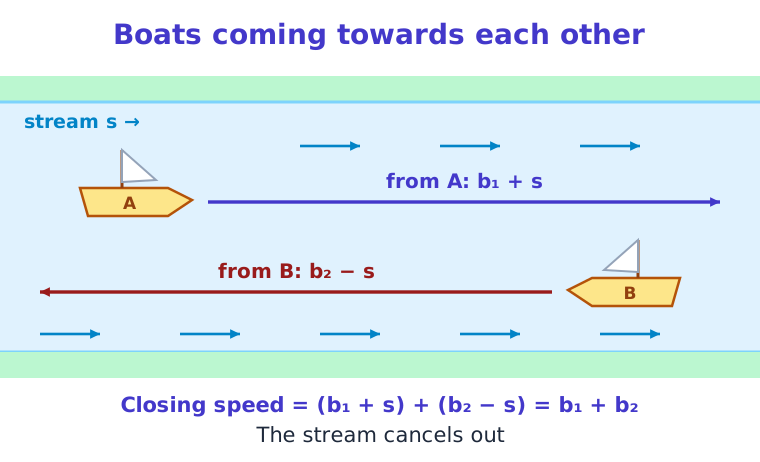
A river flowing right. Boat A moves right at b₁ + s, boat B moves left at b₂ − s. Closing speed b₁ + b₂; the stream cancels.

The floating hat

In the water frame the hat stays still and Anita rows away at $b$ for 15 minutes, then back at $b$. So she needs 15 minutes to return.

The hat floated for $15 + 15 = 30$ minutes. If the Narmada flows at 4 km/h, she picks it up $4 \times \frac{1}{2} = 2$ km downstream of where it fell.
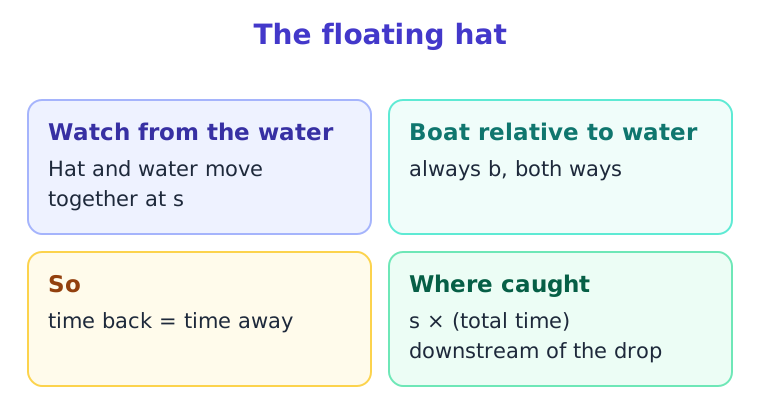
Four cards: hat and water move together at s; the boat moves at b relative to the water both ways; so time back equals time away; the hat is caught s times the total time downstream.

Raft and boat

A raft drifts from A to B in 12 hours. A boat goes from A to B in 3 hours. How long does the boat take from B to A?

Per hour: stream $= \frac{1}{12}$ of AB, downstream $= \frac{1}{3}$, so $b = \frac{1}{3} - \frac{1}{12} = \frac{1}{4}$ and upstream $= \frac{1}{4} - \frac{1}{12} = \frac{1}{6}$. The boat takes 6 hours back.

Round trip with an unknown stream

A boat with $b = 10$ km/h goes 21 km downstream and back in 5 hours. Find $s$.

$2bd = T(b^2 - s^2)$: $2 \times 10 \times 21 = 5(100 - s^2)$, so $100 - s^2 = 84$, $s^2 = 16$ and $s = 4$ km/h.

Check: $21 \div 14 + 21 \div 6 = 1.5 + 3.5 = 5$. Correct.

"It takes h hours more upstream"

A boat with $b = 12$ km/h takes 2 hours more to go 45 km upstream than downstream. Then

$$\frac{45}{12 - s} - \frac{45}{12 + s} = 2 \Rightarrow 90s = 2(144 - s^2)$$

so $s^2 + 45s - 144 = 0$, $(s + 48)(s - 3) = 0$ and $s = 3$ km/h. In the exam, try the options: $45 \div 9 - 45 \div 15 = 5 - 3 = 2$.

Journeys with a stop in the middle

A boat goes from A down to B, 48 km, and then back up to C, the midpoint of AB. Treat each leg separately.
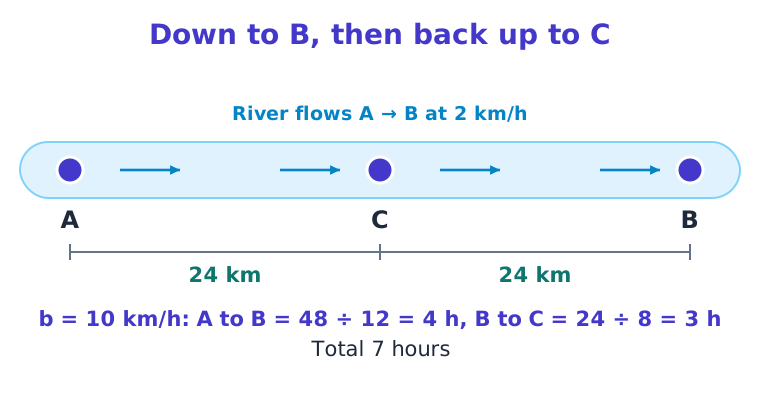
River map with A, C and B, 24 km between each; the river flows from A to B at 2 km/h. With b = 10: A to B takes 48 ÷ 12 = 4 h and B to C takes 24 ÷ 8 = 3 h, 7 h in all.

When the stream changes

A boat with $b = 12$ km/h goes 40 km upstream. Normally $s = 2$, so it takes $40 \div 10 = 4$ h. After rain $s = 4$, so it takes $40 \div 8 = 5$ h, 1 hour more. Find each time with its own stream speed, then compare.
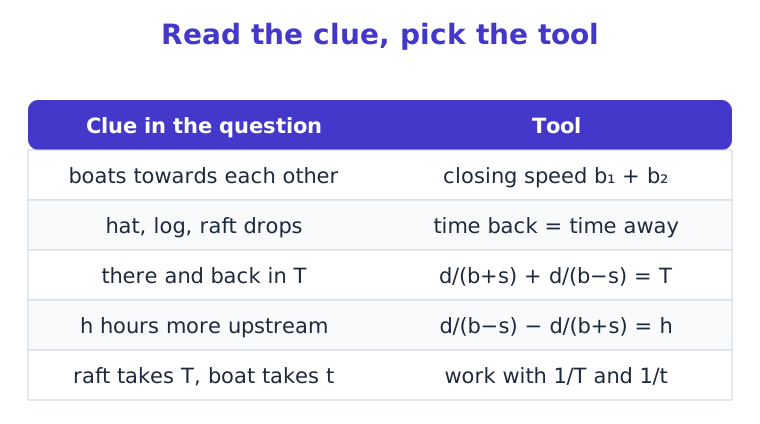
Table matching clues to tools: boats towards each other use b₁ + b₂; a dropped hat means time back equals time away; there and back in T uses d/(b+s) + d/(b−s) = T; h hours more upstream uses the difference; raft and boat use 1/T and 1/t.

Back to Anita

She rowed away from the hat for 15 minutes in the water frame, so she reaches it 15 minutes after turning. Her own speed and the river's speed never entered the answer. That is the power of choosing the right frame.
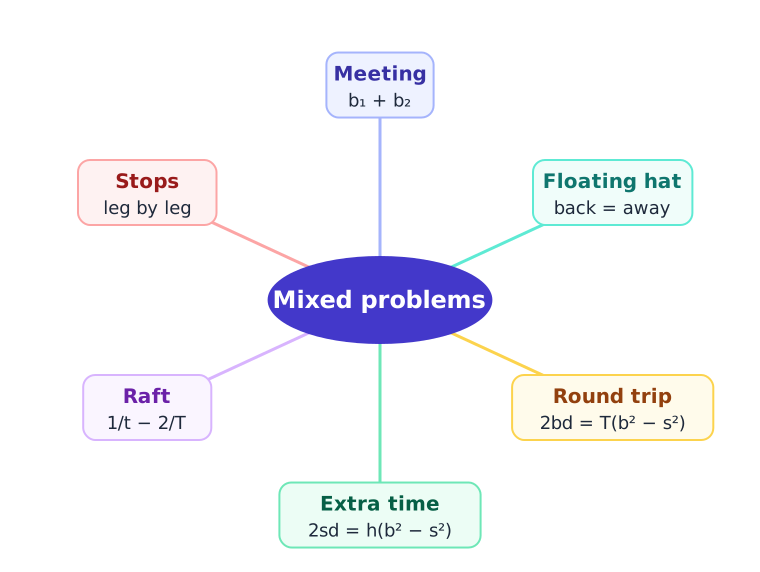
Mind map of mixed boat problems: meeting boats b₁ + b₂, floating hat, round trip 2bd = T(b² − s²), extra time 2sd = h(b² − s²), raft fractions and stops.

Concepts and terms

Stream cancels in meetings

One boat gains s and the other loses s, so the gap closes at b₁ + b₂ whatever the stream.

Frame of the water

Seen from a raft, the water is still and the boat moves at b both ways. Floating things never move in this frame.

Round-trip equation

d/(b + s) + d/(b − s) = T becomes 2bd = T(b² − s²). Given three of b, s, d, T you can find the fourth.

Fraction of the trip per hour

If a raft needs T hours for a stretch, the stream covers 1/T of it each hour. Boats then work like pipes in a tank.

Did you know

The hat puzzle is often credited to Einstein's way of thinking: choose the frame in which the problem is easiest.

Memory tricks

Meeting boats — Face to face, forget the flow — Towards each other the stream cancels; use b₁ + b₂.

Floating hat — Away ten, back ten — If you noticed after 10 minutes, you get the hat back 10 minutes after turning.

Practice MCQs with answers (59)

Q1 Two towns on a river are 60 km apart. A boat leaves the upper town going downstream and another leaves the lower town going upstream, at the same time. Their speeds in still water are 12 km/h and 8 km/h, and the stream flows at 3 km/h. After how long do they meet? intermediate
  • A 3 hours
  • B 15 hours
  • C 3 h 30 min
  • D 6 hours
Show answer
Answer: 3 hours
Why:

Closing speed = (12 + 3) + (8 − 3) = 20 km/h; time = 60 ÷ 20 = 3 hours.

Q2 Two towns on a river are 90 km apart. A boat leaves the upper town going downstream and another leaves the lower town going upstream, at the same time. Their speeds in still water are 20 km/h and 10 km/h, and the stream flows at 4 km/h. After how long do they meet? intermediate
  • A 9 hours
  • B 3 hours
  • C 3 h 30 min
  • D 6 hours
Show answer
Answer: 3 hours
Why:

Closing speed = (20 + 4) + (10 − 4) = 30 km/h; time = 90 ÷ 30 = 3 hours.

Q3 Two towns on a river are 45 km apart. A boat leaves the upper town going downstream and another leaves the lower town going upstream, at the same time. Their speeds in still water are 9 km/h and 6 km/h, and the stream flows at 2 km/h. After how long do they meet? advanced
  • A 15 hours
  • B 3 h 30 min
  • C 3 hours
  • D 6 hours
Show answer
Answer: 3 hours
Why:

Closing speed = (9 + 2) + (6 − 2) = 15 km/h; time = 45 ÷ 15 = 3 hours.

Q4 Two towns on a river are 72 km apart. A boat leaves the upper town going downstream and another leaves the lower town going upstream, at the same time. Their speeds in still water are 14 km/h and 10 km/h, and the stream flows at 5 km/h. After how long do they meet? advanced
  • A 3 h 30 min
  • B 6 hours
  • C 18 hours
  • D 3 hours
Show answer
Answer: 3 hours
Why:

Closing speed = (14 + 5) + (10 − 5) = 24 km/h; time = 72 ÷ 24 = 3 hours.

Q5 Boats start at the same time from two ghats 60 km apart and move towards each other. The one from the upper ghat has still-water speed 12 km/h, the other 8 km/h, and the river flows at 3 km/h. How far from the upper ghat do they meet? advanced
  • A 45 km
  • B 15 km
  • C 36 km
  • D 27 km
Show answer
Answer: 45 km
Why:

They meet after 60 ÷ 20 = 3 h. The upper boat goes at 15 km/h, so it covers 15 × 3 = 45 km.

Q6 Boats start at the same time from two ghats 90 km apart and move towards each other. The one from the upper ghat has still-water speed 20 km/h, the other 10 km/h, and the river flows at 4 km/h. How far from the upper ghat do they meet? advanced
  • A 18 km
  • B 72 km
  • C 60 km
  • D 48 km
Show answer
Answer: 72 km
Why:

They meet after 90 ÷ 30 = 3 h. The upper boat goes at 24 km/h, so it covers 24 × 3 = 72 km.

Q7 Boats start at the same time from two ghats 48 km apart and move towards each other. The one from the upper ghat has still-water speed 10 km/h, the other 6 km/h, and the river flows at 2 km/h. How far from the upper ghat do they meet? advanced
  • A 30 km
  • B 24 km
  • C 36 km
  • D 12 km
Show answer
Answer: 36 km
Why:

They meet after 48 ÷ 16 = 3 h. The upper boat goes at 12 km/h, so it covers 12 × 3 = 36 km.

Q8 Anita rows upstream. A ball falls from the boat into the river, and Anita notices only after 15 minutes, then turns back at once. How long after turning will the boat reach the ball? intermediate
  • A 30 min
  • B 7.5 min
  • C It depends on the speed of the boat
  • D 15 min
Show answer
Answer: 15 min
Why:

Relative to the water the ball is still and the boat moves at b both ways, so returning takes the same 15 minutes.

Q9 Kabir rows upstream. A ball falls from the boat into the river, and Kabir notices only after 20 minutes, then turns back at once. The river flows at 3 km/h. How far from the point where it fell is the ball picked up? advanced
  • A 2 km
  • B 4 km
  • C 3 km
  • D 1 km
Show answer
Answer: 2 km
Why:

The ball floats for 20 + 20 = 40 minutes at 3 km/h: 3 × 40/60 = 2 km.

Q10 Farida rows upstream. A ball falls from the boat into the river, and Farida notices only after 45 minutes, then turns back at once. The river flows at 2 km/h. How far from the point where it fell is the ball picked up? advanced
  • A 4 km
  • B 3 km
  • C 1.5 km
  • D 6 km
Show answer
Answer: 3 km
Why:

The ball floats for 45 + 45 = 90 minutes at 2 km/h: 2 × 90/60 = 3 km.

Q11 Joseph rows upstream. A ball falls from the boat into the river, and Joseph notices only after 10 minutes, then turns back at once. The river flows at 6 km/h. How far from the point where it fell is the ball picked up? advanced
  • A 3 km
  • B 1 km
  • C 2 km
  • D 4 km
Show answer
Answer: 2 km
Why:

The ball floats for 10 + 10 = 20 minutes at 6 km/h: 6 × 20/60 = 2 km.

Q12 A raft drifts from Patna to Bhagalpur, downstream, in 12 hours. A motorboat covers the same stretch downstream in 3 hours. How long will the motorboat take to go back from Bhagalpur to Patna? advanced
  • A 7 hours
  • B 4 hours
  • C 9 hours
  • D 6 hours
Show answer
Answer: 6 hours
Why:

Per hour: stream = 1/12, downstream = 1/3, so upstream = 1/3 − 2/12 = 1/6 of the stretch. Time = 6 hours.

Q13 A raft drifts from Haridwar to Kanpur, downstream, in 24 hours. A motorboat covers the same stretch downstream in 4 hours. How long will the motorboat take to go back from Kanpur to Haridwar? advanced
  • A 6 hours
  • B 8 hours
  • C 4 h 48 min
  • D 20 hours
Show answer
Answer: 6 hours
Why:

Per hour: stream = 1/24, downstream = 1/4, so upstream = 1/4 − 2/24 = 1/6 of the stretch. Time = 6 hours.

Q14 A raft drifts from Nashik to Nanded, downstream, in 10 hours. A motorboat covers the same stretch downstream in 2 hours. How long will the motorboat take to go back from Nanded to Nashik? advanced
  • A 8 hours
  • B 3 h 20 min
  • C 4 hours
  • D 2 h 30 min
Show answer
Answer: 3 h 20 min
Why:

Per hour: stream = 1/10, downstream = 1/2, so upstream = 1/2 − 2/10 = 0.3 of the stretch. Time = 3 h 20 min.

Q15 A raft drifts from Jabalpur to Narmadapuram, downstream, in 20 hours. A motorboat covers the same stretch downstream in 4 hours. How long will the motorboat take to go back from Narmadapuram to Jabalpur? advanced
  • A 16 hours
  • B 8 hours
  • C 6 h 40 min
  • D 5 hours
Show answer
Answer: 6 h 40 min
Why:

Per hour: stream = 1/20, downstream = 1/4, so upstream = 1/4 − 2/20 = 0.15 of the stretch. Time = 6 h 40 min.

Q16 A boat with a still-water speed of 10 km/h goes 21 km downstream and comes back in 5 hours. What is the speed of the stream? intermediate
  • A 5 km/h
  • B 3 km/h
  • C 6 km/h
  • D 4 km/h
Show answer
Answer: 4 km/h
Why:

2bd = T(b² − s²): 420 = 5(100 − s²), so s² = 16 and s = 4 km/h.

Q17 Ravi's boat with a still-water speed of 6 km/h goes 16 km downstream and comes back in 6 hours. What is the speed of the stream? intermediate
  • A 2 km/h
  • B 4 km/h
  • C 3 km/h
  • D 1 km/h
Show answer
Answer: 2 km/h
Why:

2bd = T(b² − s²): 192 = 6(36 − s²), so s² = 4 and s = 2 km/h.

Q18 A motorboat with a still-water speed of 12 km/h goes 32 km downstream and comes back in 6 hours. What is the speed of the stream? advanced
  • A 6 km/h
  • B 4 km/h
  • C 5 km/h
  • D 3 km/h
Show answer
Answer: 4 km/h
Why:

2bd = T(b² − s²): 768 = 6(144 − s²), so s² = 16 and s = 4 km/h.

Q19 Meena's boat with a still-water speed of 5 km/h goes 12 km downstream and comes back in 5 hours. What is the speed of the stream? advanced
  • A 2 km/h
  • B 3 km/h
  • C 1 km/h
  • D 0.5 km/h
Show answer
Answer: 1 km/h
Why:

2bd = T(b² − s²): 120 = 5(25 − s²), so s² = 1 and s = 1 km/h.

Q20 A man rows 48 km downstream and back again in 10 hours. The river flows at 2 km/h. How fast does he row in still water? advanced
  • A 12 km/h
  • B 11 km/h
  • C 9 km/h
  • D 10 km/h
Show answer
Answer: 10 km/h
Why:

Try b = 10: 48 ÷ 12 + 48 ÷ 8 = 4 + 6 = 10 hours. It fits.

Q21 A man rows 24 km downstream and back again in 6 hours. The river flows at 3 km/h. How fast does he row in still water? advanced
  • A 9 km/h
  • B 10 km/h
  • C 8 km/h
  • D 11 km/h
Show answer
Answer: 9 km/h
Why:

Try b = 9: 24 ÷ 12 + 24 ÷ 6 = 2 + 4 = 6 hours. It fits.

Q22 A man rows 15 km downstream and back again in 4 hours. The river flows at 2 km/h. How fast does he row in still water? advanced
  • A 9 km/h
  • B 8 km/h
  • C 7 km/h
  • D 10 km/h
Show answer
Answer: 8 km/h
Why:

Try b = 8: 15 ÷ 10 + 15 ÷ 6 = 1.5 + 2.5 = 4 hours. It fits.

Q23 A boat goes from A to B, 48 km downstream, and then comes back upstream to C, the midpoint of AB. Its speed in still water is 9 km/h and the stream flows at 3 km/h. How long does the whole journey take? intermediate
  • A 6 hours
  • B 9 hours
  • C 8 hours
  • D 12 hours
Show answer
Answer: 8 hours
Why:

A to B: 48 ÷ 12 = 4 h. B to C: 24 ÷ 6 = 4 h. Total 8 hours.

Q24 A boat goes from A to B, 40 km downstream, and then comes back upstream to C, the midpoint of AB. Its speed in still water is 15 km/h and the stream flows at 5 km/h. How long does the whole journey take? intermediate
  • A 3 hours
  • B 5 hours
  • C 6 hours
  • D 4 hours
Show answer
Answer: 4 hours
Why:

A to B: 40 ÷ 20 = 2 h. B to C: 20 ÷ 10 = 2 h. Total 4 hours.

Q25 A boat goes downstream from A to B and then upstream back to C, halfway between A and B, taking 3 h 48 min in all. Its speed in still water is 14 km/h and the stream flows at 4 km/h. Find the distance AB. advanced
  • A 36 km
  • B 54 km
  • C 18 km
  • D 53.2 km
Show answer
Answer: 36 km
Why:

d ÷ 18 + (d/2) ÷ 10 = 3.8 gives d = 36 km.

Q26 A boat goes downstream from A to B and then upstream back to C, halfway between A and B, taking 8 hours in all. Its speed in still water is 11 km/h and the stream flows at 1 km/h. Find the distance AB. advanced
  • A 30 km
  • B 60 km
  • C 88 km
  • D 72 km
Show answer
Answer: 60 km
Why:

d ÷ 12 + (d/2) ÷ 10 = 8 gives d = 60 km.

Q27 A launch with a still-water speed of 12 km/h goes 40 km upstream. On normal days the current is 2 km/h; after heavy rain it is 4 km/h. How much longer does the trip take after the rain? intermediate
  • A 2 hours
  • B 1 h 30 min
  • C 1 hour
  • D 30 min
Show answer
Answer: 1 hour
Why:

Before: 40 ÷ 10 = 4 h. After: 40 ÷ 8 = 5 h. Extra 1 hour.

Q28 A launch with a still-water speed of 20 km/h goes 96 km upstream. On normal days the current is 4 km/h; after heavy rain it is 8 km/h. How much longer does the trip take after the rain? intermediate
  • A 3 hours
  • B 4 hours
  • C 2 h 30 min
  • D 2 hours
Show answer
Answer: 2 hours
Why:

Before: 96 ÷ 16 = 6 h. After: 96 ÷ 12 = 8 h. Extra 2 hours.

Q29 A launch with a still-water speed of 15 km/h goes 60 km upstream. On normal days the current is 3 km/h; after heavy rain it is 5 km/h. How much longer does the trip take after the rain? intermediate
  • A 1 hour
  • B 32 min
  • C 2 hours
  • D 20 min
Show answer
Answer: 1 hour
Why:

Before: 60 ÷ 12 = 5 h. After: 60 ÷ 10 = 6 h. Extra 1 hour.

Q30 In 3 hours a boat covers 36 km downstream. The stream flows at 2 km/h. How far can it go upstream in the same time? beginner
  • A 18 km
  • B 24 km
  • C 30 km
  • D 32 km
Show answer
Answer: 24 km
Why:

D = 36 ÷ 3 = 12, so U = 12 − 2 × 2 = 8 km/h, and 8 × 3 = 24 km.

Q31 In 2 hours a boat covers 34 km downstream. The stream flows at 3 km/h. How far can it go upstream in the same time? intermediate
  • A 16 km
  • B 24 km
  • C 22 km
  • D 28 km
Show answer
Answer: 22 km
Why:

D = 34 ÷ 2 = 17, so U = 17 − 2 × 3 = 11 km/h, and 11 × 2 = 22 km.

Q32 In 4 hours a boat covers 42 km downstream. The stream flows at 1.5 km/h. How far can it go upstream in the same time? intermediate
  • A 39 km
  • B 24 km
  • C 36 km
  • D 30 km
Show answer
Answer: 30 km
Why:

D = 42 ÷ 4 = 10.5, so U = 10.5 − 2 × 1.5 = 7.5 km/h, and 7.5 × 4 = 30 km.

Q33 A swimmer whose speed in still water is 12 km/h swims a stretch downstream in 1 hour and the same stretch upstream in 2 hours. Find the speed of the current. intermediate
  • A 4 km/h
  • B 11 km/h
  • C 5 km/h
  • D 6 km/h
Show answer
Answer: 4 km/h
Why:

(b + s)1 = (b − s)2 gives s = b(2 − 1) ÷ (2 + 1) = 4 km/h.

Q34 A swimmer whose speed in still water is 16 km/h swims a stretch downstream in 3 hours and the same stretch upstream in 5 hours. Find the speed of the current. intermediate
  • A 5 km/h
  • B 4 km/h
  • C 6.4 km/h
  • D 8 km/h
Show answer
Answer: 4 km/h
Why:

(b + s)3 = (b − s)5 gives s = b(5 − 3) ÷ (5 + 3) = 4 km/h.

Q35 A swimmer whose speed in still water is 18 km/h swims a stretch downstream in 2 hours and the same stretch upstream in 4 hours. Find the speed of the current. intermediate
  • A 12 km/h
  • B 9 km/h
  • C 6 km/h
  • D 7 km/h
Show answer
Answer: 6 km/h
Why:

(b + s)2 = (b − s)4 gives s = b(4 − 2) ÷ (4 + 2) = 6 km/h.

Q36 A ferry runs between two ghats 16 km apart on a river flowing at 4 km/h. Its speed in still water is 12 km/h. How many complete round trips can it make in 12 hours? intermediate
  • A 8
  • B 5
  • C 3
  • D 4
Show answer
Answer: 4
Why:

One round trip = 16 ÷ 16 + 16 ÷ 8 = 3 h, so 12 ÷ 3 gives 4 complete trips.

Q37 A ferry runs between two ghats 36 km apart on a river flowing at 3 km/h. Its speed in still water is 15 km/h. How many complete round trips can it make in 26 hours? intermediate
  • A 5
  • B 4
  • C 10
  • D 6
Show answer
Answer: 5
Why:

One round trip = 36 ÷ 18 + 36 ÷ 12 = 5 h, so 26 ÷ 5 gives 5 complete trips.

Q38 A boat whose speed in still water is 10 km/h takes 1 hour more to go 24 km upstream than to go 24 km downstream. Find the speed of the stream. advanced
  • A 1 km/h
  • B 2 km/h
  • C 4 km/h
  • D 3 km/h
Show answer
Answer: 2 km/h
Why:

Check s = 2: 24 ÷ 8 − 24 ÷ 12 = 3 − 2 = 1 h. It fits 2sd = h(b² − s²).

Q39 A boat whose speed in still water is 8 km/h takes 1 hour more to go 15 km upstream than to go 15 km downstream. Find the speed of the stream. advanced
  • A 1 km/h
  • B 4 km/h
  • C 2 km/h
  • D 3 km/h
Show answer
Answer: 2 km/h
Why:

Check s = 2: 15 ÷ 6 − 15 ÷ 10 = 2.5 − 1.5 = 1 h. It fits 2sd = h(b² − s²).

Q40 A boat whose speed in still water is 12 km/h takes 2 hours more to go 45 km upstream than to go 45 km downstream. Find the speed of the stream. advanced
  • A 5 km/h
  • B 4 km/h
  • C 2 km/h
  • D 3 km/h
Show answer
Answer: 3 km/h
Why:

Check s = 3: 45 ÷ 9 − 45 ÷ 15 = 5 − 3 = 2 h. It fits 2sd = h(b² − s²).

Q41 A boat whose speed in still water is 15 km/h takes 2 hours more to go 40 km upstream than to go 40 km downstream. Find the speed of the stream. advanced
  • A 5 km/h
  • B 6 km/h
  • C 4 km/h
  • D 7 km/h
Show answer
Answer: 5 km/h
Why:

Check s = 5: 40 ÷ 10 − 40 ÷ 20 = 4 − 2 = 2 h. It fits 2sd = h(b² − s²).

Q42 The downstream and upstream speeds of a boat are in the ratio 5 : 3. Its speed in still water is 8 km/h. What is the speed of the stream? beginner
  • A 4 km/h
  • B 2 km/h
  • C 4.8 km/h
  • D 3 km/h
Show answer
Answer: 2 km/h
Why:

D = 5k, U = 3k, b = 4k = 8, so k = 2 and s = 1k = 2 km/h.

Q43 The downstream and upstream speeds of a boat are in the ratio 7 : 3. Its speed in still water is 10 km/h. What is the speed of the stream? intermediate
  • A 8 km/h
  • B 30/7 km/h
  • C 4 km/h
  • D 2.5 km/h
Show answer
Answer: 4 km/h
Why:

D = 7k, U = 3k, b = 5k = 10, so k = 2 and s = 2k = 4 km/h.

Q44 The downstream and upstream speeds of a boat are in the ratio 3 : 2. Its speed in still water is 15 km/h. What is the speed of the stream? intermediate
  • A 10 km/h
  • B 9 km/h
  • C 6 km/h
  • D 3 km/h
Show answer
Answer: 3 km/h
Why:

D = 3k, U = 2k, b = 2.5k = 15, so k = 6 and s = 0.5k = 3 km/h.

Q45 Two boats leave the same ghat together and go downstream. Their speeds in still water are 14 km/h and 10 km/h, and the river flows at 3 km/h. How far apart are they after 3 hours? beginner
  • A 12 km
  • B 21 km
  • C 72 km
  • D 30 km
Show answer
Answer: 12 km
Why:

Both get +3, so the gap grows at 14 − 10 = 4 km/h: 4 × 3 = 12 km.

Q46 Two boats leave the same ghat together and go downstream. Their speeds in still water are 18 km/h and 12 km/h, and the river flows at 4 km/h. How far apart are they after 2 hours? beginner
  • A 20 km
  • B 12 km
  • C 60 km
  • D 28 km
Show answer
Answer: 12 km
Why:

Both get +4, so the gap grows at 18 − 12 = 6 km/h: 6 × 2 = 12 km.

Q47 Two boats move towards each other on a river. Their closing speed depends on beginner
  • A only the stream speed
  • B the stream and the boats equally
  • C only their still-water speeds
  • D which boat is upstream
Show answer
Answer: only their still-water speeds
Why:

(b₁ + s) + (b₂ − s) = b₁ + b₂.

Q48 A man drops a bottle while rowing downstream and notices after 6 minutes. If he turns back, he reaches the bottle in intermediate
  • A it depends on the current
  • B 3 minutes
  • C 12 minutes
  • D 6 minutes
Show answer
Answer: 6 minutes
Why:

Direction does not matter: in the water frame the bottle is still and he moves at b both ways.

Q49 If the stream speed increases while b stays the same, the time for a fixed round trip intermediate
  • A increases
  • B stays the same
  • C becomes zero
  • D decreases
Show answer
Answer: increases
Why:

Round-trip time = 2bd ÷ (b² − s²); a larger s makes the bottom smaller and the time larger.

Q50 In a round-trip equation you get s² = 16. The speed of the stream is beginner
  • A 8 km/h
  • B 4 km/h
  • C −4 km/h
  • D 16 km/h
Show answer
Answer: 4 km/h
Why:

Speeds are positive, so take s = 4 and drop −4.

Q51 A boat goes from A to B downstream and back to the midpoint C. The return leg covers beginner
  • A all of AB, with the current
  • B all of AB, against the current
  • C half of AB, against the current
  • D half of AB, with the current
Show answer
Answer: half of AB, against the current
Why:

B to C is half the stretch and goes back up the river.

Q52 Assertion (A): Two boats moving towards each other on a river meet at the same time as they would on a still lake. Reason (R): The stream adds to one boat's speed exactly what it takes from the other's. intermediate
  • A Both A and R are true, and R is the correct explanation of A
  • B Both A and R are true, but R is not the correct explanation of A
  • C A is true but R is false
  • D A is false but R is true
Show answer
Answer: Both A and R are true, and R is the correct explanation of A
Why:

Closing speed is b₁ + b₂ either way, and R gives the reason.

Q53 Assertion (A): A boat reaches a dropped hat after the same time it spent moving away from it. Reason (R): The boat's upstream and downstream speeds are equal. advanced
  • A Both A and R are true, and R is the correct explanation of A
  • B Both A and R are true, but R is not the correct explanation of A
  • C A is true but R is false
  • D A is false but R is true
Show answer
Answer: A is true but R is false
Why:

A is true (water frame). R is false: b + s and b − s differ. Equality holds only relative to the water.

Q54 Two boats leave the same ghat together. Which are true? 1. If both go downstream, the gap grows at the difference of their still-water speeds. 2. If one goes up and one goes down, the gap grows at the sum of their still-water speeds. advanced
  • A 1 only
  • B 2 only
  • C Both 1 and 2
  • D Neither 1 nor 2
Show answer
Answer: Both 1 and 2
Why:

In both cases the stream cancels: b₁ − b₂ and b₁ + b₂.

Q55 A boat has b = 12 km/h. Which are true? 1. If s = 3, it goes 45 km upstream 2 hours slower than downstream. 2. If s = 12, it cannot move upstream at all. intermediate
  • A 1 only
  • B 2 only
  • C Both 1 and 2
  • D Neither 1 nor 2
Show answer
Answer: Both 1 and 2
Why:

45 ÷ 9 − 45 ÷ 15 = 5 − 3 = 2, true. With s = b, upstream speed is 0, true.

Q56 The map shows a boat trip from A down to B and back up to C, the midpoint. How long does the whole trip take? ![River map with A, C and B, 24 km between each; the river flows from A to B at 2 km/h; the boat's still-water speed is 10 km/h.](/syllabus/veda-skills-0-quantitative-aptitude-en/ch11/route-abc-q.svg) intermediate
  • A 10 hours
  • B 7 h 12 min
  • C 6 hours
  • D 7 hours
Show answer
Answer: 7 hours
Why:

A to B: 48 ÷ 12 = 4 h. B to C: 24 ÷ 8 = 3 h. Total 7 hours.

Q57 The two boats in the picture start at the same moment. After how long do they meet? ![A river flowing right at 2 km/h. Boat X goes right with still-water speed 11 km/h, boat Y goes left with still-water speed 7 km/h; they are 54 km apart.](/syllabus/veda-skills-0-quantitative-aptitude-en/ch11/q-meet.svg) intermediate
  • A 3 hours
  • B 13 h 30 min
  • C 2 h 15 min
  • D 2 h 42 min
Show answer
Answer: 3 hours
Why:

Closing speed = 11 + 7 = 18 km/h (the 2 km/h cancels), so 54 ÷ 18 = 3 h.

Q58 In the same picture, how far from X do the boats meet? ![A river flowing right at 2 km/h. Boat X goes right with still-water speed 11 km/h, boat Y goes left with still-water speed 7 km/h; they are 54 km apart.](/syllabus/veda-skills-0-quantitative-aptitude-en/ch11/q-meet.svg) advanced
  • A 15 km
  • B 39 km
  • C 33 km
  • D 27 km
Show answer
Answer: 39 km
Why:

They meet after 3 h. X moves at 11 + 2 = 13 km/h, so it covers 13 × 3 = 39 km.

Q59 The picture shows a boat rowing upstream for 25 minutes after a cap fell in, then turning back. How far downstream of the drop point is the cap picked up? ![A river flowing right at 3 km/h. A boat rows left for 25 minutes after a cap falls, then turns back; the return time is marked with a question.](/syllabus/veda-skills-0-quantitative-aptitude-en/ch11/q-hat.svg) advanced
  • A 3 km
  • B 1.25 km
  • C 2.5 km
  • D 5 km
Show answer
Answer: 2.5 km
Why:

Back also takes 25 min, so the cap floats 50 min at 3 km/h: 3 × 50/60 = 2.5 km.

Important short questions (4)

Two boats start towards each other from ghats 84 km apart, with still-water speeds 16 and 12 km/h on a river flowing at 4 km/h. When do they meet?

Closing speed 16 + 12 = 28 km/h, so 84 ÷ 28 = 3 hours.

A raft takes 15 h and a boat 3 h to go from P down to Q. How long does the boat take from Q to P?

Upstream rate = 1/3 − 2/15 = 3/15 = 1/5, so 5 hours.

Explain why the hat puzzle does not need the boat's speed.

Relative to the water the hat is at rest and the boat moves at b away and b back. Equal speeds over equal distances give equal times.

b = 6 km/h, s = 2 km/h. How far can the boat go and come back in 6 hours?

d = T(b² − s²) ÷ 2b = 6 × 32 ÷ 12 = 16 km.

Long answer questions (1)

A boat with b = 12 km/h takes 2 hours more to go 45 km upstream than 45 km downstream. (a) Form the equation. (b) Solve for s. (c) Find the time for the round trip.

(a) 45/(12 − s) − 45/(12 + s) = 2.

(b) 90s = 2(144 − s²), so s² + 45s − 144 = 0, (s + 48)(s − 3) = 0, s = 3 km/h.

(c) 45 ÷ 15 + 45 ÷ 9 = 3 + 5 = 8 hours.

Flashcards (13)

Closing speed of boats towards each other?
b₁ + b₂
Separating speed, same direction?
b₁ − b₂
Hat noticed after 12 min; time to get it back?
12 minutes
Speed of a raft?
s
Round trip equation simplified?
2bd = T(b² − s²)
Extra time equation simplified?
2sd = h(b² − s²)
Raft T hours, boat t hours down: upstream time?
1 ÷ (1/t − 2/T)
Raft 12 h, boat 3 h down: up?
6 hours
b = 10, s = 2, A to B 48 km down, back to midpoint: time?
7 hours
Stream rises: upstream time?
Increases
Down and up speeds 5 : 3, b = 8: s?
2 km/h
Meeting boats 60 km apart, 12 and 8 km/h: time?
3 hours
Same distance in t₁ down and t₂ up, b known: s?
b(t₂ − t₁) ÷ (t₂ + t₁)

Play this topic

  • Mixed problems check

Veda Skills Quantitative Aptitude Unit 11 — frequently asked questions

A boat goes 30 km downstream in 2 hours and 18 km upstream in 3 hours. Find b and s.

D = 15, U = 6, so b = 21 ÷ 2 = 10.5 km/h and s = 9 ÷ 2 = 4.5 km/h.

b = 9 km/h and s = 3 km/h. How long does a 36 km round trip (36 km each way) take?

36 ÷ 12 + 36 ÷ 6 = 3 + 6 = 9 hours.

Upstream takes 3 times as long as downstream. The stream is 2 km/h. Find b.

b : s = 4 : 2 = 2 : 1, so b = 4 km/h.

Two boats start towards each other from ghats 84 km apart, with still-water speeds 16 and 12 km/h on a river flowing at 4 km/h. When do they meet?

Closing speed 16 + 12 = 28 km/h, so 84 ÷ 28 = 3 hours.

A raft takes 15 h and a boat 3 h to go from P down to Q. How long does the boat take from Q to P?

Upstream rate = 1/3 − 2/15 = 3/15 = 1/5, so 5 hours.

Explain why the hat puzzle does not need the boat's speed.

Relative to the water the hat is at rest and the boat moves at b away and b back. Equal speeds over equal distances give equal times.

Part of the Veda Skills Quantitative Aptitude course
See every unit of the Veda Skills course Quantitative Aptitude.
See all units

All Veda Skills Quantitative Aptitude units

All Quantitative Aptitude units · All Skills & Exams courses

Study this chapter properly, free

Everything above is on this page to read. In the Veda app the same chapter becomes spaced-repetition flashcards, timed tests that mark themselves, Veda Bites you can swipe, and games — with your progress tracked topic by topic.

Get Veda free