Veda Skills Quantitative Aptitude Unit 6: Profit, Loss and Discount
- 3 topics
- 172 MCQs
- 10 short answers
- 3 long answers
- 40 flashcards
- 3 games
- ~150 min read
- English
Checked before publishing: 23 automated checks, including a plagiarism check against the textbook's own words. How we check our content
Cost Price, Selling Price and Profit
Work out profit and loss and their percentages on the cost price, find the selling price or cost price from a percentage, and solve the exam favourites: same selling price with gain and loss, cost of x equals selling price of y, rates per dozen and overheads.
What you will be able to do
- I can find profit, loss and their percentages from the cost price and selling price.
- I can find the selling price from the cost price and a profit or loss percent, using a multiplier.
- I can find the cost price when the selling price and the percent are given.
- I can solve "same SP", "CP of x = SP of y" and overhead questions.

Key points
Cost price (CP) is what the seller pays; selling price (SP) is what the buyer pays.
Profit = SP − CP when SP > CP; loss = CP − SP when SP < CP.
Profit % and loss % are always calculated on the cost price.
SP = CP × (100 + profit %) ÷ 100 and SP = CP × (100 − loss %) ÷ 100.
CP = SP × 100 ÷ (100 + profit %): divide by the multiplier, do not subtract the percent from SP.
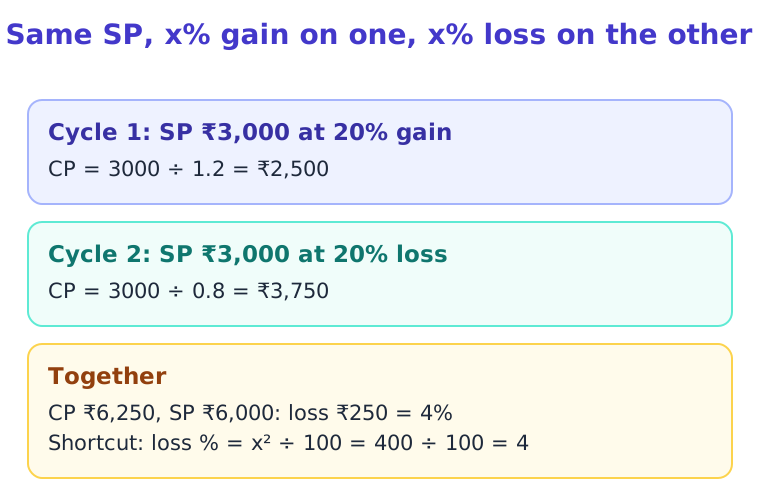
Two items sold at the same SP, one at x% gain and one at x% loss, always give an overall loss of x² ÷ 100 %.
If the CP of x articles = the SP of y articles, profit % = (x − y) ÷ y × 100.
Repair, transport and other overheads are added to the cost price.
Full explanation
Raju's phone-cover stall

Raju sells phone covers outside a metro station. He buys each cover from a wholesaler for ₹80 and sells it for ₹100. His friend asks, "Are you making 20% profit, or 25%?" Both numbers sound right. Only one is.
This topic gives you the rules that settle it, and the shortcuts exams expect.
CP, SP, profit and loss

- Cost price (CP): what the seller paid, ₹80.
- Selling price (SP): what the buyer pays, ₹100.
- Profit $= SP - CP = ₹20$ when SP is bigger.
- Loss $= CP - SP$ when SP is smaller.
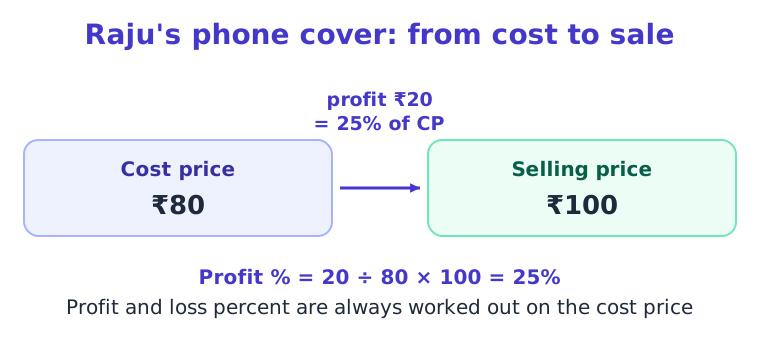
Profit percent is on CP
$$\text{Profit}% = \frac{\text{Profit}}{\text{CP}} \times 100 = \frac{20}{80} \times 100 = 25%$$
The 20% his friend had in mind is $20 \div 100$, profit on SP. Exams never mean that unless they say "profit on selling price".
Multipliers make it fast
Write every percent change as one multiplier. A 25% profit means $SP = CP \times \frac{5}{4}$; a 20% loss means $SP = CP \times \frac{4}{5}$.
Example: CP ₹840 at 15% profit: $840 \times 1.15 = ₹966$.
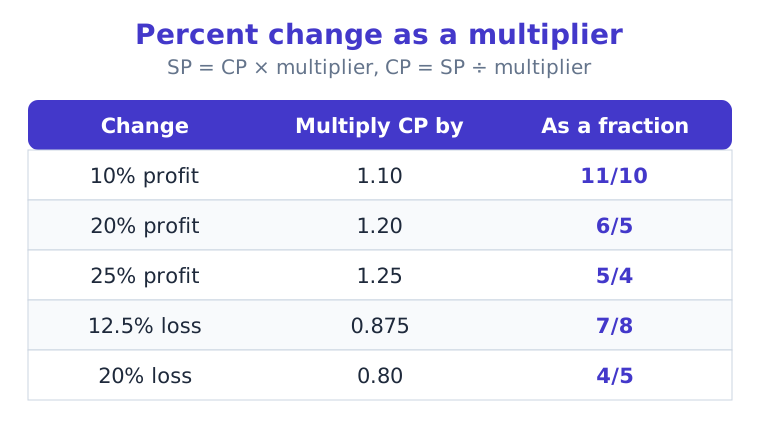
Going back: finding the CP
To go from SP back to CP, divide by the multiplier.
Example: a fan is sold for ₹1,080 at 20% profit. $CP = 1080 \div \frac{6}{5} = 1080 \times \frac{5}{6} = ₹900$.
Trap: $1080 - 20%$ of $1080 = ₹864$ is wrong, because the 20% was on CP, not on SP.
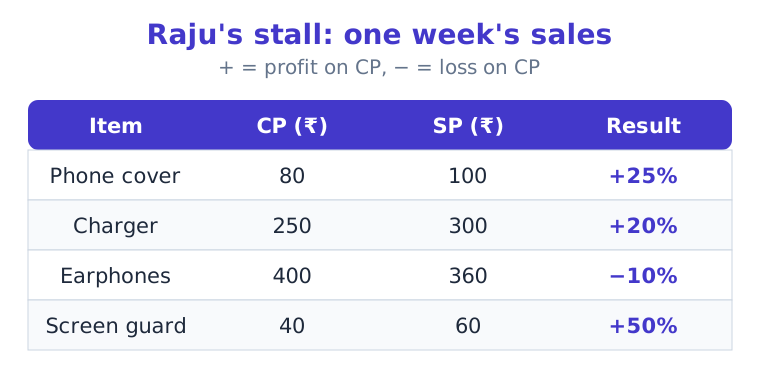
A whole week at Raju's stall
The same rule works for every item: find the profit or loss, then divide by that item's CP.
The same-SP trap
Two cycles are sold for ₹3,000 each, one at 20% gain and one at 20% loss. It feels like break-even. It is not: the loss is on a bigger CP.
CP of x equals SP of y
If the cost of 20 pens equals the selling price of 16 pens, the seller gains 4 pens on every 16 sold.
$$\text{Profit}% = \frac{x - y}{y} \times 100 = \frac{4}{16} \times 100 = 25%$$
If $y > x$, the same formula gives a loss.
Rates and overheads
Rates: bought 6 for ₹10, sold 4 for ₹10. Make the counts equal (LCM 12): CP of 12 $= ₹20$, SP of 12 $= ₹30$, profit 50%.
Overheads: a scooter bought for ₹18,000 with ₹2,000 repairs has CP ₹20,000. Sold at ₹23,000, profit $= 3000 \div 20000 = 15%$.
Back to Raju
Raju now tells his friend: 25% profit, because profit is measured on what he paid. He also knows that to make 40% on a ₹80 cover he must sell it for $80 \times 1.4 = ₹112$.
Exam summary: percent on CP, multiply to go forward, divide to go back, and add every expense to CP.
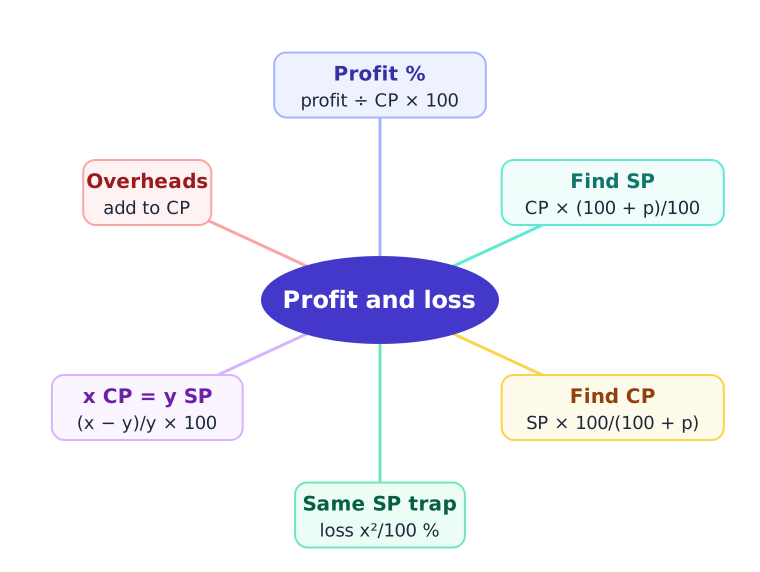
Concepts and terms
Profit as a part of the cost price, times 100. Bought at ₹80, sold at ₹100: 20 ÷ 80 × 100 = 25%.
A percent change written as one number: 25% profit is × 1.25 = × 5/4, 20% loss is × 0.8 = × 4/5.
Purchase price plus every expense before the sale, such as repair or transport.
Gaining and losing the same percent on equal selling prices is never break-even; it is a loss of x²/100 %.

Did you know
Kirana shops often work on a profit of only 8 to 12% per item; they earn by selling many items every day.
Accountants call the point where total sales equal total costs the break-even point: no profit, no loss.

Memory tricks
Base of the percent — Profit sits on Cost — Profit and loss percents are on CP. (Discount, in the next topic, sits on MP.)
Going forward or back — CP to SP multiply, SP to CP divide — With a 25% profit, SP = CP × 5/4 and CP = SP × 4/5.
Practice MCQs with answers (64)
- A 130%
- B 35%
- C 25%
- D 30%
Show answer
Why:
Profit = ₹120; on CP: 120 ÷ 400 × 100 = 30%.
- A 15%
- B 10%
- C 115%
- D 20%
Show answer
Why:
Profit = ₹360; on CP: 360 ÷ 2,400 × 100 = 15%.
- A 30%
- B 25%
- C 20%
- D 125%
Show answer
Why:
Profit = ₹400; on CP: 400 ÷ 1,600 × 100 = 25%.
- A 112%
- B 17%
- C 12%
- D 10 5/7%
Show answer
Why:
Profit = ₹90; on CP: 90 ÷ 750 × 100 = 12%.
- A 25%
- B 16 2/3%
- C 120%
- D 20%
Show answer
Why:
Profit = ₹2,500; on CP: 2,500 ÷ 12,500 × 100 = 20%.
- A 12%
- B 112%
- C 17%
- D 10 5/7%
Show answer
Why:
Profit = ₹540; on CP: 540 ÷ 4,500 × 100 = 12%.
- A 20%
- B 15%
- C 10%
- D 85%
Show answer
Why:
Loss = ₹135; on CP: 135 ÷ 900 × 100 = 15%.
- A 17%
- B 13 7/11%
- C 12%
- D 88%
Show answer
Why:
Loss = ₹300; on CP: 300 ÷ 2,500 × 100 = 12%.
- A 17.5%
- B 14 2/7%
- C 87.5%
- D 12.5%
Show answer
Why:
Loss = ₹80; on CP: 80 ÷ 640 × 100 = 12.5%.
- A 20%
- B 25%
- C 80%
- D 15%
Show answer
Why:
Loss = ₹300; on CP: 300 ÷ 1,500 × 100 = 20%.
- A 17.5%
- B 12.5%
- C 14 2/7%
- D 87.5%
Show answer
Why:
Loss = ₹600; on CP: 600 ÷ 4,800 × 100 = 12.5%.
- A ₹126
- B ₹714
- C ₹966
- D ₹855
Show answer
Why:
SP = 840 × 1.15 = ₹966.
- A ₹1,100
- B ₹1,262
- C ₹150
- D ₹1,400
Show answer
Why:
SP = 1,250 × 1.12 = ₹1,400.
- A ₹3,888
- B ₹288
- C ₹3,312
- D ₹3,608
Show answer
Why:
SP = 3,600 × 1.08 = ₹3,888.
- A ₹115
- B ₹575
- C ₹345
- D ₹485
Show answer
Why:
SP = 460 × 1.25 = ₹575.
- A ₹350
- B ₹1,650
- C ₹2,350
- D ₹2,017.5
Show answer
Why:
SP = 2,000 × 1.175 = ₹2,350.
- A ₹2,070
- B ₹1,815
- C ₹270
- D ₹1,530
Show answer
Why:
SP = 1,800 × 0.85 = ₹1,530.
- A ₹690
- B ₹810
- C ₹758
- D ₹60
Show answer
Why:
SP = 750 × 0.92 = ₹690.
- A ₹2,700
- B ₹2,100
- C ₹2,412.5
- D ₹300
Show answer
Why:
SP = 2,400 × 0.875 = ₹2,100.
- A ₹793.5
- B ₹675
- C ₹600
- D ₹586.5
Show answer
Why:
CP = SP ÷ 1.15 = 690 ÷ 1.15 = ₹600. Taking 15% of the SP is the trap.
- A ₹1,296
- B ₹1,060
- C ₹864
- D ₹900
Show answer
Why:
CP = SP ÷ 1.2 = 1,080 ÷ 1.2 = ₹900. Taking 20% of the SP is the trap.
- A ₹2,400
- B ₹3,174
- C ₹2,745
- D ₹2,346
Show answer
Why:
CP = SP ÷ 1.15 = 2,760 ÷ 1.15 = ₹2,400. Taking 15% of the SP is the trap.
- A ₹1,296.75
- B ₹1,300
- C ₹1,433.25
- D ₹1,360
Show answer
Why:
CP = SP ÷ 1.05 = 1,365 ÷ 1.05 = ₹1,300. Taking 5% of the SP is the trap.
- A ₹3,071.25
- B ₹6,378.75
- C ₹3,500
- D ₹4,690
Show answer
Why:
CP = SP ÷ 1.35 = 4,725 ÷ 1.35 = ₹3,500. Taking 35% of the SP is the trap.
- A ₹520.2
- B ₹597
- C ₹703.8
- D ₹720
Show answer
Why:
CP = SP ÷ 0.85 = 612 ÷ 0.85 = ₹720. Taking 15% of the SP is the trap.
- A ₹2,260
- B ₹2,237.4
- C ₹1,830.6
- D ₹2,024
Show answer
Why:
CP = SP ÷ 0.9 = 2,034 ÷ 0.9 = ₹2,260. Taking 10% of the SP is the trap.
- A ₹780.3
- B ₹1,080
- C ₹903
- D ₹1,055.7
Show answer
Why:
CP = SP ÷ 0.85 = 918 ÷ 0.85 = ₹1,080. Taking 15% of the SP is the trap.
- A ₹1,197
- B ₹1,254
- C ₹1,260
- D ₹1,150
Show answer
Why:
CP = 1,140 ÷ 0.95 = ₹1,200; new SP = 1,200 × 1.05 = ₹1,260.
- A ₹935
- B ₹1,062.5
- C ₹875
- D ₹1,100
Show answer
Why:
CP = 850 ÷ 0.85 = ₹1,000; new SP = 1,000 × 1.1 = ₹1,100.
- A ₹2,875
- B ₹2,827
- C ₹3,220
- D ₹2,884
Show answer
Why:
CP = 2,800 ÷ 1.12 = ₹2,500; new SP = 2,500 × 1.15 = ₹2,875.
- A ₹786.6
- B ₹874
- C ₹855
- D ₹709
Show answer
Why:
CP = 684 ÷ 0.9 = ₹760; new SP = 760 × 1.15 = ₹874.
- A 10%
- B 8%
- C 4%
- D 2%
Show answer
Why:
Same SP with ±20%: loss = 20² ÷ 100 = 4%. (CPs ₹2,500 and ₹3,750.)
- A 1.5%
- B 5%
- C 2%
- D 1%
Show answer
Why:
Same SP with ±10%: loss = 10² ÷ 100 = 1%. (CPs ₹9,000 and ₹11,000.)
- A Loss of ₹400
- B Loss of ₹800
- C No profit, no loss
- D Profit of ₹400
Show answer
Why:
CPs: 3,000 ÷ 1.25 = ₹2,400 and 3,000 ÷ 0.75 = ₹4,000. Total CP ₹6,400, SP ₹6,000: loss ₹400.
- A 4%
- B 25%
- C 11 1/9%
- D 20%
Show answer
Why:
Take each pen to cost ₹1: CP of 16 = ₹16, SP of 16 = ₹20. Profit = 4 ÷ 16 × 100 = 25%.
- A 2%
- B 9 1/11%
- C 20%
- D 16 2/3%
Show answer
Why:
Take each notebook to cost ₹1: CP of 10 = ₹10, SP of 10 = ₹12. Profit = 2 ÷ 10 × 100 = 20%.
- A 9 1/11%
- B 1%
- C 15%
- D 10%
Show answer
Why:
Take each mango to cost ₹1: CP of 10 = ₹10, SP of 10 = ₹11. Profit = 1 ÷ 10 × 100 = 10%.
- A 20%
- B 4%
- C 11 1/9%
- D 25%
Show answer
Why:
Take each toy to cost ₹1: CP of 20 = ₹20, SP of 20 = ₹16. Loss = 4 ÷ 20 × 100 = 20%.
- A 60%
- B 50%
- C 33 1/3%
- D 10%
Show answer
Why:
On 12 bananas: CP = ₹20, SP = ₹30. Profit % = 10 ÷ 20 × 100 = 50%.
- A 11 1/9%
- B 50%
- C 12.5%
- D 25%
Show answer
Why:
On 6 oranges: CP = ₹40, SP = ₹45. Profit % = 5 ÷ 40 × 100 = 12.5%.
- A 66.25%
- B 36%
- C 25%
- D 56.25%
Show answer
Why:
On 20 toffees: CP = ₹16, SP = ₹25. Profit % = 9 ÷ 16 × 100 = 56.25%.
- A 20%
- B 25%
- C 10%
- D 30%
Show answer
Why:
On 20 lemons: CP = ₹15, SP = ₹12. Loss % = 3 ÷ 15 × 100 = 20%.
- A ₹400
- B ₹1,200
- C ₹240
- D ₹200
Show answer
Why:
The two SPs differ by 5% of CP, and that is ₹60. CP = 60 × 100 ÷ 5 = ₹1,200.
- A ₹180
- B ₹144
- C ₹900
- D ₹300
Show answer
Why:
The two SPs differ by 4% of CP, and that is ₹36. CP = 36 × 100 ÷ 4 = ₹900.
- A ₹450
- B ₹700
- C ₹1,800
- D ₹600
Show answer
Why:
The two SPs differ by 15% of CP, and that is ₹90. CP = 90 × 100 ÷ 15 = ₹600.
- A 10%
- B 11 1/9%
- C 9 1/11%
- D 22 2/9%
Show answer
Why:
Effective CP = 4,500 + 500 = ₹5,000; profit = ₹500; 500 ÷ 5,000 × 100 = 10%.
- A 16 2/3%
- B 15%
- C 20%
- D 27 7/9%
Show answer
Why:
Effective CP = 18,000 + 2,000 = ₹20,000; profit = ₹3,000; 3,000 ÷ 20,000 × 100 = 15%.
- A 28 4/7%
- B 20%
- C 25%
- D 42 6/7%
Show answer
Why:
Effective CP = 700 + 100 = ₹800; profit = ₹200; 200 ÷ 800 × 100 = 25%.
- A 20%
- B 16 2/3%
- C 40%
- D 25%
Show answer
Why:
Let SP = 100: profit = 20, CP = 80. Profit on CP = 20 ÷ 80 × 100 = 25%.
- A 60%
- B 75%
- C 37.5%
- D 27 3/11%
Show answer
Why:
Let SP = 100: profit = 37.5, CP = 62.5. Profit on CP = 37.5 ÷ 62.5 × 100 = 60%.
- A Pen
- B Watch
- C Bag
- D Lamp
Show answer
Why:
Pen 10/40 = 25%, bag 120/600 = 20%, watch 360/1200 = 30%, lamp 160/800 = 20%. The watch is highest even though the pen looks cheap and easy.
- A ₹725
- B ₹625
- C ₹600
- D ₹562.50
Show answer
Why:
CP = 750 ÷ 5/4 = 750 × 4/5 = ₹600. (750 − 25% of 750 = ₹562.50 is the trap.)
- A ₹1,488
- B ₹1,339.29
- C ₹1,680
- D ₹1,320
Show answer
Why:
SP = 1500 × 0.88 = ₹1,320.
- A 16%
- B 15%
- C 13.79%
- D 17.5%
Show answer
Why:
Total CP = ₹1,000, total SP = ₹1,160, profit = 16%. (Averaging 25% and 10% gives 17.5%, the wrong way.)
- A the selling price
- B the cost price
- C the marked price
- D the profit itself
Show answer
Why:
Unless a question says otherwise, profit and loss percents are on CP.
- A 5/4
- B 1/5
- C 4/5
- D 6/5
Show answer
Why:
20% loss leaves 80% = 4/5 of CP.
- A 200%
- B 33 1/3%
- C 50%
- D 100%
Show answer
Why:
2S − C = 3(S − C) gives S = 2C, so profit = C, which is 100%.
- A SP equals CP
- B SP equals twice CP
- C SP is 100% of profit
- D CP is zero
Show answer
Why:
Profit = SP − CP = 0 only when the two prices are equal.
- A 5/8
- B 11/8
- C 3/8
- D 8/11
Show answer
Why:
100% + 37.5% = 137.5% = 11/8.
- A 10%
- B 1%
- C 0%
- D 11 1/9%
Show answer
Why:
Let CP = 100: SP = 90. New CP = 90 and SP = 90, so no profit.
- A Both A and R are true, and R is the correct explanation of A
- B Both A and R are true, but R is not the correct explanation of A
- C A is true but R is false
- D A is false but R is true
Show answer
Why:
Both true, and R explains A: 20 ÷ 80 = 25%.
- A Both A and R are true, and R is the correct explanation of A
- B Both A and R are true, but R is not the correct explanation of A
- C A is true but R is false
- D A is false but R is true
Show answer
Why:
A is false: there is a loss of 15² ÷ 100 = 2.25%. R is true and is the reason the loss is bigger.
- A 1 only
- B 2 only
- C Both 1 and 2
- D Neither 1 nor 2
Show answer
Why:
100 ÷ 500 = 20%, so 1 is true. 100 ÷ 500 = 20% loss, not 25%, so 2 is false.
- A 1 only
- B 2 only
- C Both 1 and 2
- D Neither 1 nor 2
Show answer
Why:
1: (10 − 8) ÷ 8 = 25%. 2: SP 100, profit 20, CP 80, so 20 ÷ 80 = 25%. Both true.
Important short questions (4)
Profit = ₹360; 360 ÷ 2400 × 100 = 15%.
CP = 1380 ÷ 1.15 = ₹1,200.
(15 − 12) ÷ 12 × 100 = 25%.
8% + 4% = 12% of CP = ₹120, so CP = ₹1,000.
Long answer questions (1)
Outlay = 50 × 40 + 100 = ₹2,100. Needed SP = 2100 × 1.2 = ₹2,520. Rice left = 45 kg, so the price = 2520 ÷ 45 = ₹56 per kg.
Flashcards (14)
Play this topic
- Profit or trap?
Marked Price and Discounts
Read a price tag: find the selling price after a discount, the discount percent, and the marked price. Then link cost, marked and selling prices: the profit after a mark-up and a discount, how much to mark to earn a target profit, and "buy x get y free" offers.
What you will be able to do
- I can find the selling price, discount percent or marked price when the other two are given.
- I can find the profit percent after a mark-up and a discount.
- I can find how much above cost a seller must mark to earn a profit after a discount.
- I can turn "buy x get y free" into a discount percent.
Key points
Marked price (MP) or list price is the price printed on the tag. MRP is the highest price allowed by law.
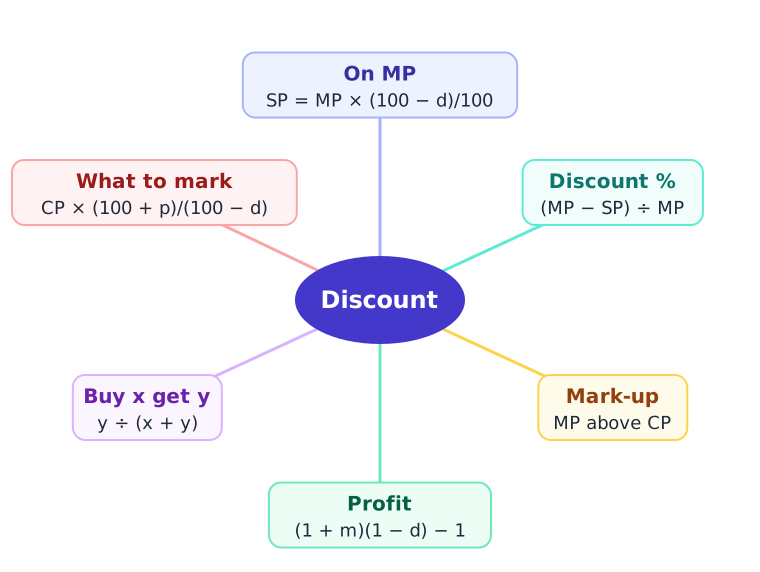
Discount is always calculated on the marked price: SP = MP − discount.
SP = MP × (100 − d) ÷ 100 and MP = SP × 100 ÷ (100 − d).
Discount % = (MP − SP) ÷ MP × 100. Profit % is still on CP.
If goods are marked m% above CP and sold at d% discount, SP = CP × (1 + m/100)(1 − d/100).
To earn p% profit after d% discount, mark MP = CP × (100 + p) ÷ (100 − d).
"Buy x get y free" is a discount of y ÷ (x + y) × 100 %.
Full explanation
Meera's Diwali sale

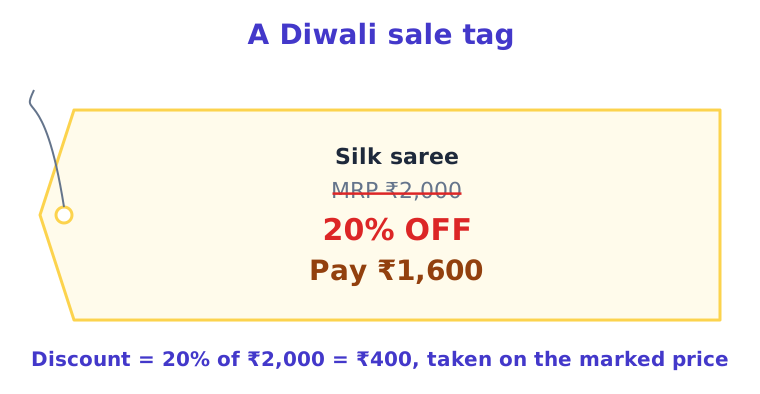
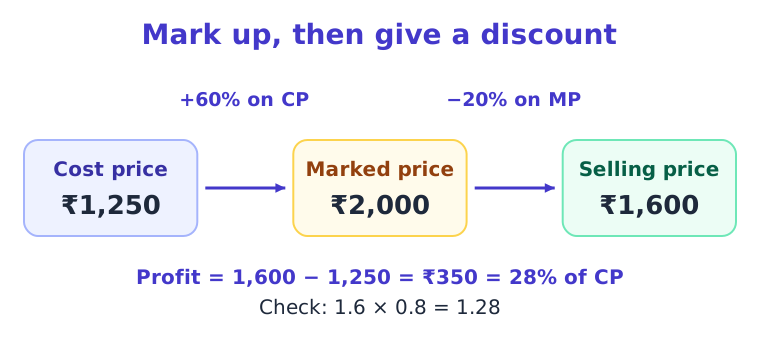
Meera owns a saree shop in Lucknow. A silk saree costs her ₹1,250. She prints ₹2,000 on its tag and, for Diwali, announces 20% off. A customer pays ₹1,600 and walks away happy. Meera is happy too.
How can both win? Because there are three prices here, not two.
Marked price and discount
The marked price (MP) is printed on the tag. The discount is a cut on that MP, and what the customer pays is the SP.
$$SP = MP \times \frac{100 - d}{100} = 2000 \times 0.8 = ₹1600$$
Discount percent and finding the MP
Discount % $= \frac{MP - SP}{MP} \times 100$. A ₹2,400 kurta sold for ₹1,920 has a discount of $480 \div 2400 = 20%$.
Finding MP: a bag sold for ₹1,360 after 15% off had $MP = 1360 \div 0.85 = ₹1600$. Divide, do not add 15%.
Three prices in a row
The seller marks up on CP, then gives a discount on MP. Multiply the two multipliers to get from CP to SP.
Profit after a mark-up and a discount
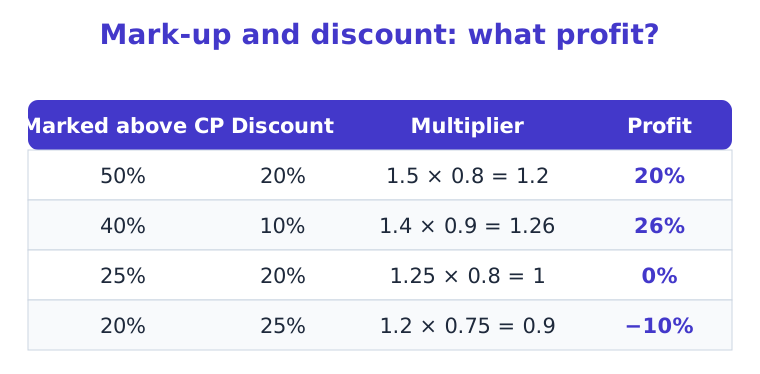
$$\text{Profit}% = \left[\left(1 + \frac{m}{100}\right)\left(1 - \frac{d}{100}\right) - 1\right] \times 100$$
Equal mark-up and discount always lose: 20% up and 20% off gives $1.2 \times 0.8 = 0.96$, a 4% loss.
How much should the seller mark?
To keep a profit of $p%$ after a discount of $d%$:
$$MP = CP \times \frac{100 + p}{100 - d}$$
Example: CP ₹800, wanted profit 20%, discount 20%: $MP = 800 \times \frac{120}{80} = ₹1200$. That is 50% above cost.
"Buy x, get y free"
You take $x + y$ items and pay for $x$. The discount is $\frac{y}{x + y} \times 100%$.

Back to Meera
Meera's saree: CP ₹1,250, MP ₹2,000, SP ₹1,600. The customer saved ₹400, which is 20% of MP. Meera earned ₹350, which is 28% of CP. Both percents are right, on different bases.
Exam summary: discount on MP, profit on CP, multiply the multipliers, and mark $CP \times \frac{100 + p}{100 - d}$.
Concepts and terms
A reduction on the marked price. A ₹2,000 saree at 20% off sells for ₹1,600.
How far the marked price is above the cost price, as a percent of CP.
CP (paid by the seller) → MP (on the tag) → SP (paid by the buyer). Mark-up is on CP, discount is on MP.
Paying for 3 and taking 4 means you pay 3/4 of the marked value: a 25% discount.
Did you know
In India, it is illegal to sell a packaged product above the MRP printed on it, but shops may sell below it.
Many festival sales raise the marked price first, so a "50% off" tag may be a much smaller real discount.
Memory tricks
Bases — Profit on Cost, Discount on Mark — Two different bases. Mixing them up is the most common error in this topic.
What to mark — Profit up, discount down — MP ÷ CP = (100 + profit) ÷ (100 − discount): profit goes on top, discount at the bottom.
Practice MCQs with answers (53)
- A ₹1,020
- B ₹1,185
- C ₹1,380
- D ₹180
Show answer
Why:
SP = 1,200 × 0.85 = ₹1,020. Discount = ₹180.
- A ₹300
- B ₹2,200
- C ₹2,488
- D ₹2,800
Show answer
Why:
SP = 2,500 × 0.88 = ₹2,200. Discount = ₹300.
- A ₹1,020
- B ₹170
- C ₹680
- D ₹830
Show answer
Why:
SP = 850 × 0.8 = ₹680. Discount = ₹170.
- A ₹4,860
- B ₹1,260
- C ₹3,565
- D ₹2,340
Show answer
Why:
SP = 3,600 × 0.65 = ₹2,340. Discount = ₹1,260.
- A ₹570
- B ₹190
- C ₹608
- D ₹735
Show answer
Why:
SP = 760 × 0.75 = ₹570. Discount = ₹190.
- A ₹16,875
- B ₹13,125
- C ₹1,875
- D ₹14,987.5
Show answer
Why:
SP = 15,000 × 0.875 = ₹13,125. Discount = ₹1,875.
- A 20%
- B 10%
- C 15%
- D 85%
Show answer
Why:
Discount = ₹225; on MP: 225 ÷ 1,500 × 100 = 15%.
- A 33 1/3%
- B 75%
- C 30%
- D 25%
Show answer
Why:
Discount = ₹600; on MP: 600 ÷ 2,400 × 100 = 25%.
- A 16%
- B 21%
- C 11%
- D 84%
Show answer
Why:
Discount = ₹104; on MP: 104 ÷ 650 × 100 = 16%.
- A 14 2/7%
- B 12.5%
- C 87.5%
- D 17.5%
Show answer
Why:
Discount = ₹1,000; on MP: 1,000 ÷ 8,000 × 100 = 12.5%.
- A 80%
- B 15%
- C 20%
- D 25%
Show answer
Why:
Discount = ₹64; on MP: 64 ÷ 320 × 100 = 20%.
- A ₹1,375
- B ₹1,700
- C ₹1,564
- D ₹1,600
Show answer
Why:
MP = SP ÷ 0.85 = 1,360 ÷ 0.85 = ₹1,600.
- A ₹2,500
- B ₹2,600
- C ₹2,475
- D ₹2,260
Show answer
Why:
MP = SP ÷ 0.9 = 2,250 ÷ 0.9 = ₹2,500.
- A ₹1,055.7
- B ₹1,080
- C ₹933
- D ₹1,180
Show answer
Why:
MP = SP ÷ 0.85 = 918 ÷ 0.85 = ₹1,080.
- A ₹4,230
- B ₹6,100
- C ₹6,000
- D ₹5,460
Show answer
Why:
MP = SP ÷ 0.7 = 4,200 ÷ 0.7 = ₹6,000.
- A ₹960
- B ₹1,152
- C ₹1,120
- D ₹1,200
Show answer
Why:
MP = 800 × 120 ÷ 80 = ₹1,200. Check: ₹1,200 × 0.8 = ₹960 = 800 + 20%.
- A ₹1,800
- B ₹1,710
- C ₹1,795.5
- D ₹1,785
Show answer
Why:
MP = 1,500 × 114 ÷ 95 = ₹1,800. Check: ₹1,800 × 0.95 = ₹1,710 = 1,500 + 14%.
- A ₹3,600
- B ₹3,750
- C ₹3,480
- D ₹3,000
Show answer
Why:
MP = 2,400 × 125 ÷ 80 = ₹3,750. Check: ₹3,750 × 0.8 = ₹3,000 = 2,400 + 25%.
- A ₹648
- B ₹712.8
- C ₹720
- D ₹708
Show answer
Why:
MP = 600 × 108 ÷ 90 = ₹720. Check: ₹720 × 0.9 = ₹648 = 600 + 8%.
- A ₹2,316.6
- B ₹2,286
- C ₹2,106
- D ₹2,340
Show answer
Why:
MP = 1,800 × 117 ÷ 90 = ₹2,340. Check: ₹2,340 × 0.9 = ₹2,106 = 1,800 + 17%.
- A 50%
- B 55%
- C 40%
- D 44%
Show answer
Why:
MP ÷ CP = 120 ÷ 80 = 1.5, so mark 50% above cost (not 20% + 20%).
- A 23.2%
- B 25%
- C 20%
- D 22%
Show answer
Why:
MP ÷ CP = 110 ÷ 88 = 1.25, so mark 25% above cost (not 10% + 12%).
- A 28.7%
- B 6 4/11%
- C 30%
- D 27%
Show answer
Why:
MP ÷ CP = 117 ÷ 90 = 1.3, so mark 30% above cost (not 17% + 10%).
- A 18.8%
- B 16%
- C 18%
- D 20%
Show answer
Why:
MP ÷ CP = 108 ÷ 90 = 1.2, so mark 20% above cost (not 8% + 10%).
- A 12%
- B 28%
- C 8%
- D 20%
Show answer
Why:
1.4 × 0.8 = 1.12, so profit = 12%.
- A 40%
- B 20%
- C 10%
- D 30%
Show answer
Why:
1.5 × 0.8 = 1.2, so profit = 20%.
- A 2.5%
- B 15%
- C 12.5%
- D 17.5%
Show answer
Why:
1.25 × 0.9 = 1.125, so profit = 12.5%.
- A 13%
- B 9.5%
- C 10%
- D 9%
Show answer
Why:
1.3 × 0.7 = 0.91, so loss = 9%.
- A 35%
- B 20%
- C 55%
- D 75%
Show answer
Why:
1.8 × 0.75 = 1.35, so profit = 35%.
- A 14%
- B 10%
- C 5%
- D 6%
Show answer
Why:
1.2 × 0.75 = 0.9, so loss = 10%.
- A 75%
- B 33 1/3%
- C 25%
- D 20%
Show answer
Why:
You take 4 and pay for 3: discount = 1 ÷ 4 × 100 = 25%.
- A 16 2/3%
- B 80%
- C 25%
- D 20%
Show answer
Why:
You take 5 and pay for 4: discount = 1 ÷ 5 × 100 = 20%.
- A 40%
- B 66 2/3%
- C 33 1/3%
- D 60%
Show answer
Why:
You take 5 and pay for 3: discount = 2 ÷ 5 × 100 = 40%.
- A 11 1/9%
- B 12.5%
- C 87.5%
- D 14 2/7%
Show answer
Why:
You take 8 and pay for 7: discount = 1 ÷ 8 × 100 = 12.5%.
- A 60%
- B 33 1/3%
- C 37.5%
- D 62.5%
Show answer
Why:
You take 8 and pay for 5: discount = 3 ÷ 8 × 100 = 37.5%.
- A ₹960
- B ₹1,250
- C ₹900
- D ₹1,000
Show answer
Why:
SP = 1,500 × 0.8 = ₹1,200; CP = SP ÷ 1.2 = ₹1,000.
- A ₹1,800
- B ₹1,680
- C ₹1,728
- D ₹2,000
Show answer
Why:
SP = 2,400 × 0.9 = ₹2,160; CP = SP ÷ 1.2 = ₹1,800.
- A ₹572
- B ₹600
- C ₹594
- D ₹800
Show answer
Why:
SP = 880 × 0.75 = ₹660; CP = SP ÷ 1.1 = ₹600.
- A 15 1/9%
- B 4.5%
- C 4%
- D 7%
Show answer
Why:
MP ÷ CP = 117 ÷ 90 = 1.3. New SP ÷ CP = 1.3 × 0.8 = 1.04, so profit = 4%.
- A 22.5%
- B 30%
- C 38%
- D 35%
Show answer
Why:
MP ÷ CP = 120 ÷ 80 = 1.5. New SP ÷ CP = 1.5 × 0.9 = 1.35, so profit = 35%.
- A 19%
- B 15%
- C 20%
- D 22%
Show answer
Why:
MP ÷ CP = 105 ÷ 75 = 1.4. New SP ÷ CP = 1.4 × 0.85 = 1.19, so profit = 19%.
- A ₹450
- B ₹1,350
- C ₹1,440
- D ₹1,775
Show answer
Why:
1800 × 0.75 = ₹1,350 (₹450 is the discount, not the price).
- A 80%
- B 25%
- C 20%
- D 48%
Show answer
Why:
Discount ₹480 on MP ₹2,400 = 20%. (480 ÷ 1920 = 25% uses the wrong base.)
- A ₹300
- B ₹450
- C ₹360
- D ₹337.50
Show answer
Why:
He pays 3 × 450 = ₹1,350 for 4 shirts, so ₹337.50 each, a 25% discount.
- A 26%
- B 30%
- C 36%
- D 24%
Show answer
Why:
MP = ₹2,100, SP = 2100 × 0.9 = ₹1,890; profit ₹390 on ₹1,500 = 26%.
- A the selling price
- B the marked price
- C the profit
- D the cost price
Show answer
Why:
Discount is a reduction on the tag price, the MP.
- A neither gains nor loses
- B gains 4%
- C loses 4%
- D loses 20%
Show answer
Why:
1.2 × 0.8 = 0.96, a 4% loss.
- A equal to the profit
- B 100%
- C 50%
- D 0%
Show answer
Why:
No reduction from the tag means no discount: 0%.
- A Buy 2 get 1 free
- B Buy 3 get 1 free
- C 30% off
- D Buy 4 get 1 free
Show answer
Why:
Buy 2 get 1 is 1 ÷ 3 = 33 1/3%, more than the flat 30%; buy 3 get 1 is 25%; buy 4 get 1 is 20%.
- A exactly double that percent above CP
- B more than double that percent above CP
- C exactly that percent above CP
- D equal to CP
Show answer
Why:
MP/CP = (1 + x)/(1 − x), which is above 1 + 2x. For x = 10%: 110/90 ≈ 1.222, so 22.2% above, more than 20%.
- A Both A and R are true, and R is the correct explanation of A
- B Both A and R are true, but R is not the correct explanation of A
- C A is true but R is false
- D A is false but R is true
Show answer
Why:
With CP ₹1,250: SP ₹1,600 is 20% below MP and 28% above CP. R explains A.
- A Both A and R are true, and R is the correct explanation of A
- B Both A and R are true, but R is not the correct explanation of A
- C A is true but R is false
- D A is false but R is true
Show answer
Why:
Both statements are true, but the discount is 1 out of 4 taken (25%), not 1 out of 3 paid. R does not explain A.
- A 1 only
- B 2 only
- C Both 1 and 2
- D Neither 1 nor 2
Show answer
Why:
150 ÷ 1000 = 15%. Profit = 170 ÷ 680 = 25%. Both true.
Important short questions (3)
15000 × 7/8 = ₹13,125.
1.4 × 0.75 = 1.05, so a 5% profit.
MP = 720 × 125 ÷ 90 = ₹1,000.
Long answer questions (1)
(a) MP = 2000 × 117 ÷ 90 = ₹2,600.
(b) SP = 2600 × 0.8 = ₹2,080; profit = 80 ÷ 2000 = 4%.
Flashcards (13)
Play this topic
- Tag check
Successive Discounts and Dishonest Dealers
Apply two or three discounts one after another, turn them into a single equivalent discount, compare shop offers, and catch dishonest dealers who use false weights, add water, or cheat while buying and selling.
What you will be able to do
- I can find the selling price after two or three successive discounts.
- I can find the single discount equal to successive discounts, and compare offers.
- I can find the net change when a price rises and then falls.
- I can find the gain of a dealer who uses false weights, mixes water or cheats both ways.
Key points
Successive discounts are applied one after another; the second is on the already reduced price.
Two discounts a% and b% equal a single discount of (a + b − ab/100)%.
For three or more, multiply the factors (1 − a)(1 − b)(1 − c) and subtract from 1.
The order of successive discounts does not change the final price.
A rise of a% followed by a fall of b% is a net change of (a − b − ab/100)%.
A dealer who sells at cost but gives w grams for 1 kg gains (1000 − w) ÷ w × 100 %.
With false weight and a price change together, multiply: SP ÷ CP = (price factor) × (1000 ÷ w).
Full explanation
Neha's two shops

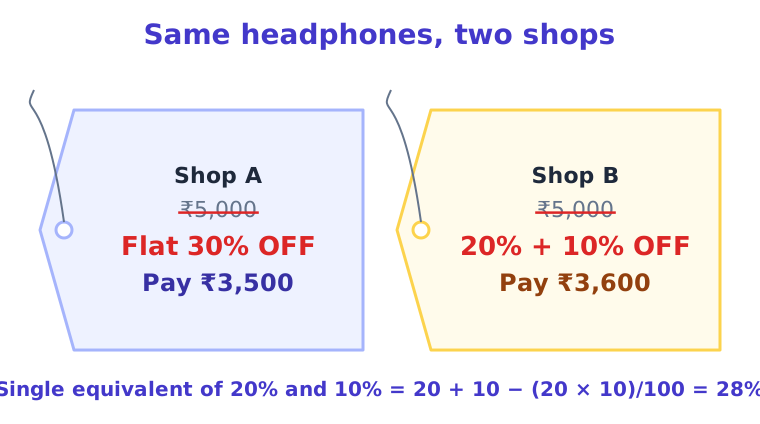
Neha wants headphones with a marked price of ₹5,000. Shop A offers a flat 30% off. Shop B offers 20% off and then another 10% off. "Same thing," says her brother, "20 plus 10 is 30." Neha is not so sure.
This topic settles it, and then looks at sellers who cheat with the scale itself.
Successive discounts
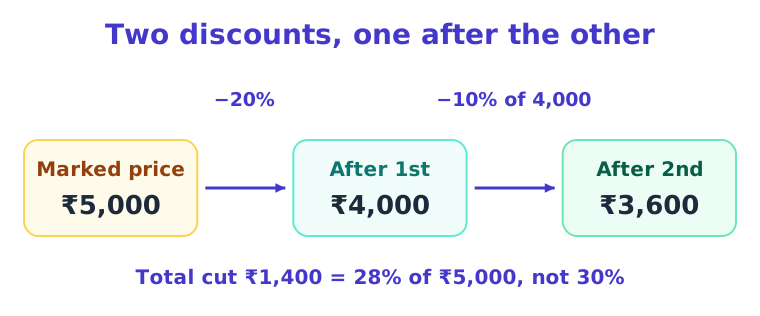
The second discount is taken on the price after the first. At shop B: $5000 \times 0.8 = 4000$, then $4000 \times 0.9 = 3600$.
The single equivalent discount
$$\text{Single discount} = a + b - \frac{ab}{100}$$
For 20% and 10%: $20 + 10 - 2 = 28%$. So shop A (30%) is cheaper by ₹100.
Three or more discounts
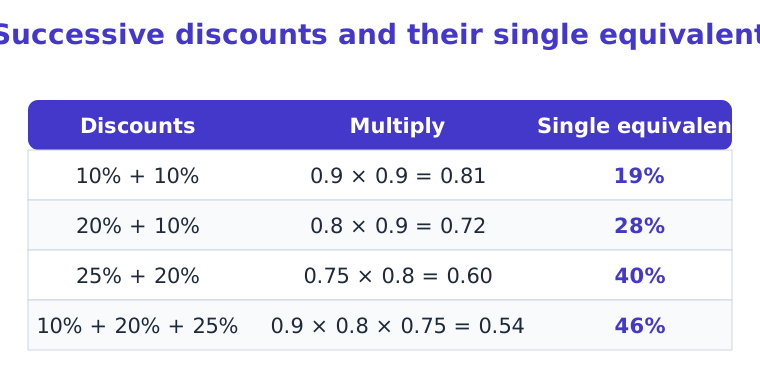
Multiply the factors. 10%, 20% and 25%: $0.9 \times 0.8 \times 0.75 = 0.54$, so the buyer pays 54% and the single discount is 46%. The order does not matter, because multiplication can be done in any order.
A rise, then a fall
The same idea works for any two percent changes. A rise of $a%$ then a fall of $b%$ gives a net change of $a - b - \frac{ab}{100}$.
Up 20% then down 20%: $20 - 20 - 4 = -4$, a 4% fall. Up 25% then down 20%: $25 - 20 - 5 = 0$, back where it started.
The dishonest dealer
A grocer sells at cost price but his scale gives 800 g when it shows 1 kg. He is paid for 1,000 g but his cost is only 800 g.
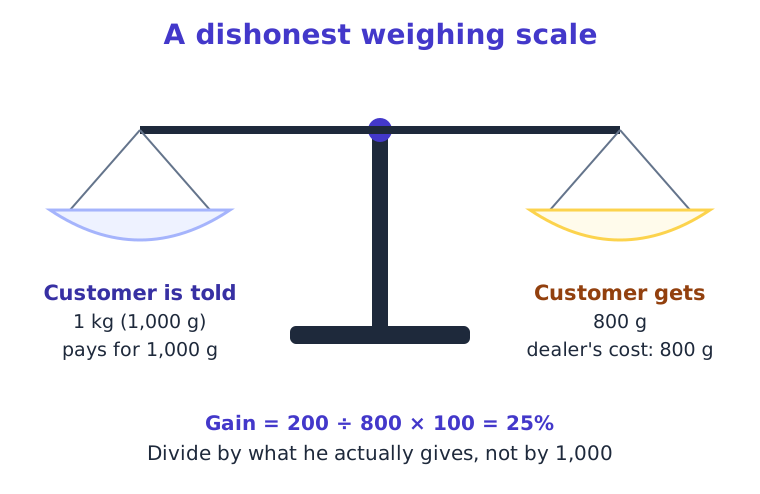
The false-weight formula
$$\text{Gain}% = \frac{\text{true weight} - \text{false weight}}{\text{false weight}} \times 100$$
With 900 g for a kilogram: $\frac{100}{900} \times 100 = 11\frac{1}{9}%$. The same rule works for a metre stick that is 90 cm long.
Cheating on price and weight together
Multiply the two effects. Selling 10% above cost and giving 880 g per kg:
$$\frac{SP}{CP} = 1.1 \times \frac{1000}{880} = 1.25$$
so the gain is 25%. Even a seller who "loses 4%" on price but gives 800 g gains: $0.96 \times 1.25 = 1.2$, a 20% gain.
Back to Neha
Neha buys from shop A and saves ₹100, because 20% + 10% is only a 28% discount. On the way home she notices the fruit seller's scale has no stamp, and now she knows how much a missing 100 g is worth to him.
Exam summary: multiply factors for successive changes; for false weights, divide by what is actually given.
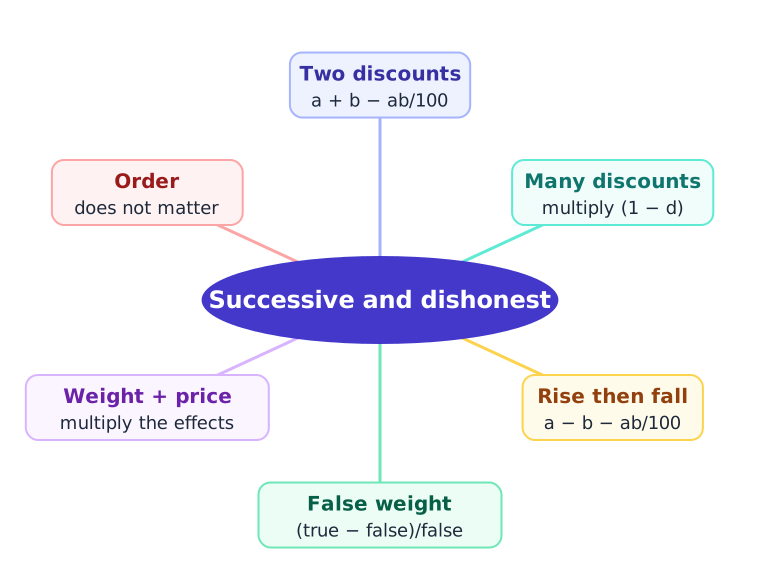
Concepts and terms
20% then 10% on ₹5,000: ₹4,000, then ₹3,600. The total cut is 28%, not 30%.
One discount that gives the same final price: a + b − ab/100.
Charging for 1,000 g but giving 800 g gains 200 on a cost of 800: 25%.
Price and weight effects multiply: 10% above cost and 880 g for a kg gives 1.1 × 1000/880 = 1.25, a 25% gain.
Did you know
Shop scales in India must carry a stamp from the Legal Metrology department, checked every year, to stop false weighing.
Online stores often stack offers: a sale discount, then a bank-card discount. These are successive, not added.
Memory tricks
Two discounts — Add, then take the product away — 20 and 10: 20 + 10 = 30, minus 20 × 10 ÷ 100 = 2, gives 28.
False weight — Error over what is given — Gain % = (shortfall ÷ actual weight given) × 100.
Practice MCQs with answers (55)
- A 28%
- B 15%
- C 30%
- D 32%
Show answer
Why:
20 + 10 − (20 × 10)/100 = 28%.
- A 22.5%
- B 40%
- C 45%
- D 50%
Show answer
Why:
25 + 20 − (25 × 20)/100 = 40%.
- A 26.5%
- B 12.5%
- C 23.5%
- D 25%
Show answer
Why:
15 + 10 − (15 × 10)/100 = 23.5%.
- A 56%
- B 25%
- C 50%
- D 44%
Show answer
Why:
30 + 20 − (30 × 20)/100 = 44%.
- A 16.4%
- B 17%
- C 17.6%
- D 8.5%
Show answer
Why:
12 + 5 − (12 × 5)/100 = 16.4%.
- A 65%
- B 55%
- C 75%
- D 32.5%
Show answer
Why:
40 + 25 − (40 × 25)/100 = 55%.
- A 20%
- B 21%
- C 19%
- D 10%
Show answer
Why:
10 + 10 − (10 × 10)/100 = 19%.
- A ₹3,700
- B ₹3,500
- C ₹1,400
- D ₹3,600
Show answer
Why:
5,000 × 0.8 × 0.9 = ₹3,600. (Adding the discounts would give ₹3,500.)
- A ₹810
- B ₹390
- C ₹834
- D ₹780
Show answer
Why:
1,200 × 0.75 × 0.9 = ₹810. (Adding the discounts would give ₹780.)
- A ₹1,880
- B ₹6,120
- C ₹6,280
- D ₹6,000
Show answer
Why:
8,000 × 0.85 × 0.9 = ₹6,120. (Adding the discounts would give ₹6,000.)
- A ₹900
- B ₹1,650
- C ₹1,600
- D ₹1,500
Show answer
Why:
2,500 × 0.8 × 0.8 = ₹1,600. (Adding the discounts would give ₹1,500.)
- A ₹432.8
- B ₹400
- C ₹220
- D ₹420
Show answer
Why:
640 × 0.75 × 0.875 = ₹420. (Adding the discounts would give ₹400.)
- A ₹10,260
- B ₹1,740
- C ₹10,500
- D ₹10,200
Show answer
Why:
12,000 × 0.9 × 0.95 = ₹10,260. (Adding the discounts would give ₹10,200.)
- A 54%
- B 46%
- C 49%
- D 55%
Show answer
Why:
Buyer pays 0.9 × 0.8 × 0.75 = 0.54 of MP, so the discount = 46%.
- A 30%
- B 72.9%
- C 27.1%
- D 30.1%
Show answer
Why:
Buyer pays 0.9 × 0.9 × 0.9 = 0.729 of MP, so the discount = 27.1%.
- A 68.4%
- B 34.6%
- C 35%
- D 31.6%
Show answer
Why:
Buyer pays 0.8 × 0.9 × 0.95 = 0.684 of MP, so the discount = 31.6%.
- A Shop A, by ₹100
- B Shop A, by ₹200
- C Shop A, by ₹50
- D Shop B, by ₹100
Show answer
Why:
A: 5,000 × 0.7 = ₹3,500. B: 5,000 × 0.8 × 0.9 = ₹3,600. Difference ₹100.
- A Shop B, by ₹360
- B Shop A, by ₹360
- C Shop A, by ₹720
- D Shop A, by ₹180
Show answer
Why:
A: 12,000 × 0.65 = ₹7,800. B: 12,000 × 0.8 × 0.85 = ₹8,160. Difference ₹360.
- A Shop A, by ₹15
- B Shop B, by ₹30
- C Shop A, by ₹30
- D Shop A, by ₹60
Show answer
Why:
A: 2,000 × 0.75 = ₹1,500. B: 2,000 × 0.85 × 0.9 = ₹1,530. Difference ₹30.
- A Shop B, by ₹256
- B Shop B, by ₹320
- C Shop A, by ₹128
- D Shop B, by ₹128
Show answer
Why:
A: 8,000 × 0.72 = ₹5,760. B: 8,000 × 0.8 × 0.88 = ₹5,632. Difference ₹128.
- A 10%
- B 8%
- C 28%
- D 11 1/9%
Show answer
Why:
After the first discount: ₹800. Second cut = 80 ÷ 800 × 100 = 10%.
- A 28%
- B 20%
- C 25%
- D 18%
Show answer
Why:
After the first discount: ₹2,250. Second cut = 450 ÷ 2,250 × 100 = 20%.
- A 11.25%
- B 36.25%
- C 15%
- D 20%
Show answer
Why:
After the first discount: ₹600. Second cut = 90 ÷ 600 × 100 = 15%.
- A 125%
- B 27%
- C 20%
- D 25%
Show answer
Why:
The buyer gets 800 g but pays for 1000 g: gain = 200 ÷ 800 × 100 = 25%.
- A 11 1/9%
- B 111 1/9%
- C 13 1/9%
- D 10%
Show answer
Why:
The buyer gets 900 g but pays for 1000 g: gain = 100 ÷ 900 × 100 = 11 1/9%.
- A 104 1/6%
- B 4 1/6%
- C 6 1/6%
- D 4%
Show answer
Why:
The buyer gets 960 g but pays for 1000 g: gain = 40 ÷ 960 × 100 = 4 1/6%.
- A 25%
- B 133 1/3%
- C 33 1/3%
- D 35 1/3%
Show answer
Why:
The buyer gets 750 g but pays for 1000 g: gain = 250 ÷ 750 × 100 = 33 1/3%.
- A 27%
- B 20%
- C 125%
- D 25%
Show answer
Why:
The buyer gets 80 cm but pays for 100 cm: gain = 20 ÷ 80 × 100 = 25%.
- A 11 1/9%
- B 10%
- C 111 1/9%
- D 13 1/9%
Show answer
Why:
The buyer gets 90 cm but pays for 100 cm: gain = 10 ÷ 90 × 100 = 11 1/9%.
- A 23 7/11%
- B 25%
- C 13 7/11%
- D 22%
Show answer
Why:
SP ÷ CP = 1.1 × 1000/880 = 1.25, so the gain is 25%. Multiply the effects; do not add them.
- A 45%
- B 25%
- C 50%
- D 40%
Show answer
Why:
SP ÷ CP = 1.2 × 1000/800 = 1.5, so the gain is 50%. Multiply the effects; do not add them.
- A 11 1/9%
- B 18%
- C 19 1/9%
- D 20%
Show answer
Why:
SP ÷ CP = 1.08 × 1000/900 = 1.2, so the gain is 20%. Multiply the effects; do not add them.
- A 20%
- B 21%
- C 25%
- D 16%
Show answer
Why:
SP ÷ CP = 0.96 × 1000/800 = 1.2, so the gain is 20%. Multiply the effects; do not add them.
- A 25%
- B 10%
- C 8%
- D 13%
Show answer
Why:
SP ÷ CP = 0.88 × 1000/800 = 1.1, so the gain is 10%. Multiply the effects; do not add them.
- A 20%
- B 21%
- C 22 2/9%
- D 25 2/9%
Show answer
Why:
For the price of 100 g he gets 110 g and gives 90 g: gain = (110 ÷ 90 − 1) × 100 = 22 2/9%.
- A 40%
- B 44%
- C 45%
- D 50%
Show answer
Why:
For the price of 100 g he gets 120 g and gives 80 g: gain = (120 ÷ 80 − 1) × 100 = 50%.
- A 25%
- B 30%
- C 20%
- D 80%
Show answer
Why:
He pays for 4 parts of milk and sells 5 parts: gain = 1 ÷ 4 × 100 = 25%.
- A 90%
- B 11 1/9%
- C 16 1/9%
- D 10%
Show answer
Why:
He pays for 9 parts of milk and sells 10 parts: gain = 1 ÷ 9 × 100 = 11 1/9%.
- A 22 11/17%
- B 15%
- C 17 11/17%
- D 85%
Show answer
Why:
He pays for 17 parts of milk and sells 20 parts: gain = 3 ÷ 17 × 100 = 17 11/17%.
- A 6% decrease
- B No change
- C 4% increase
- D 4% decrease
Show answer
Why:
Net = 20 − 20 − (20 × 20)/100 = −4%. Check with 100: 100 → 120 → 96.
- A No change
- B 5% increase
- C 1% increase
- D 2% decrease
Show answer
Why:
Net = 25 − 20 − (25 × 20)/100 = 0%. Check with 100: 100 → 125 → 100.
- A No change
- B 1% decrease
- C 1% increase
- D 3% decrease
Show answer
Why:
Net = 10 − 10 − (10 × 10)/100 = −1%. Check with 100: 100 → 110 → 99.
- A 2% increase
- B 10% increase
- C 4% increase
- D 4% decrease
Show answer
Why:
Net = 30 − 20 − (30 × 20)/100 = 4%. Check with 100: 100 → 130 → 104.
- A ₹4,380
- B ₹1,680
- C ₹4,200
- D ₹4,320
Show answer
Why:
6000 × 0.8 × 0.9 = ₹4,320. (Adding to 30% gives ₹4,200, the trap.)
- A Shop B is cheaper by ₹40
- B Shop A is cheaper by ₹40
- C Shop A is cheaper by ₹200
- D Both cost the same
Show answer
Why:
A: 4000 × 0.65 = ₹2,600. B: 4000 × 0.8 × 0.8 = ₹2,560, a 36% discount. B is cheaper by ₹40.
- A 14%
- B 14 2/7%
- C 12.5%
- D 125%
Show answer
Why:
Gain = 125 ÷ 875 × 100 = 1/7 × 100 = 14 2/7%. (125 ÷ 1000 = 12.5% uses the wrong base.)
- A 15%
- B 76.5%
- C 23.5%
- D 25%
Show answer
Why:
Discounts were 15% and 10%. 15,300 ÷ 20,000 = 0.765, so the single discount is 23.5%.
- A 56%
- B 50%
- C 46%
- D 44%
Show answer
Why:
20 + 30 − 6 = 44%.
- A Both are the same
- B It depends on the price
- C 30% then 10%
- D 10% then 30%
Show answer
Why:
0.7 × 0.9 = 0.9 × 0.7 = 0.63 either way.
- A 50%
- B a little more than 5%
- C exactly 5%
- D a little less than 5%
Show answer
Why:
50 ÷ 950 = 5 5/19%, because the base is 950, not 1,000.
- A lower only if x > 50
- B equal to the original
- C lower than the original
- D higher than the original
Show answer
Why:
(1 + x)(1 − x) = 1 − x², always below 1.
- A Both A and R are true, and R is the correct explanation of A
- B Both A and R are true, but R is not the correct explanation of A
- C A is true but R is false
- D A is false but R is true
Show answer
Why:
Both true, and R explains A: 10% of 80 is only 8, so 20 + 8 = 28.
- A Both A and R are true, and R is the correct explanation of A
- B Both A and R are true, but R is not the correct explanation of A
- C A is true but R is false
- D A is false but R is true
Show answer
Why:
A is false: 100 ÷ 900 = 11 1/9%. R is true, and it is why A is wrong.
- A 1 only
- B 2 only
- C Both 1 and 2
- D Neither 1 nor 2
Show answer
Why:
0.9³ = 0.729, so 27.1% is right. 1.25 × 0.8 = 1, so 2 is right too.
- A 1 only
- B 2 only
- C Both 1 and 2
- D Neither 1 nor 2
Show answer
Why:
1.1 × 1000/900 = 11/9, a gain of 22 2/9%. So 1 is false and 2 is true.
Important short questions (3)
0.75 × 0.8 × 0.9 = 0.54, so 46%.
1.05 × 1000/840 = 1.25, so 25%.
Both give 40%: 0.75 × 0.8 = 0.6. Both cost ₹6,000.
Long answer questions (1)
(a) 1.25 × 0.9 = 1.125, a 12.5% gain.
(b) 1.125 × 1000/900 = 1.25, a total gain of 25%.
Flashcards (13)
Play this topic
- Stacked or fair?
Veda Skills Quantitative Aptitude Unit 6 — frequently asked questions
Profit = ₹360; 360 ÷ 2400 × 100 = 15%.
CP = 1380 ÷ 1.15 = ₹1,200.
(15 − 12) ÷ 12 × 100 = 25%.
15000 × 7/8 = ₹13,125.
1.4 × 0.75 = 1.05, so a 5% profit.
MP = 720 × 125 ÷ 90 = ₹1,000.
0.75 × 0.8 × 0.9 = 0.54, so 46%.
1.05 × 1000/840 = 1.25, so 25%.
Both give 40%: 0.75 × 0.8 = 0.6. Both cost ₹6,000.

All Veda Skills Quantitative Aptitude units
All Quantitative Aptitude units · All Skills & Exams courses
Study this chapter properly, free
Everything above is on this page to read. In the Veda app the same chapter becomes spaced-repetition flashcards, timed tests that mark themselves, Veda Bites you can swipe, and games — with your progress tracked topic by topic.
Get Veda free