Veda Skills Quantitative Aptitude Unit 4: Ratio and Proportion
- 3 topics
- 196 MCQs
- 10 short answers
- 3 long answers
- 37 flashcards
- 3 games
- ~140 min read
- English
Checked before publishing: 23 automated checks, including a plagiarism check against the textbook's own words. How we check our content
Ratios and Proportions
Write and simplify ratios (with units), divide an amount in a given ratio, combine ratios such as A : B and B : C, use proportion (ad = bc) to find fourth, third and mean proportionals, and solve income, coin, mixture and variation problems.
What you will be able to do
- I can simplify a ratio, converting to the same unit first.
- I can divide an amount in a given ratio and find each share.
- I can combine A : B and B : C into A : B : C.
- I can use ad = bc to find a missing term of a proportion.
- I can solve income–expenditure, coin and mixture questions with ratios.

Key points
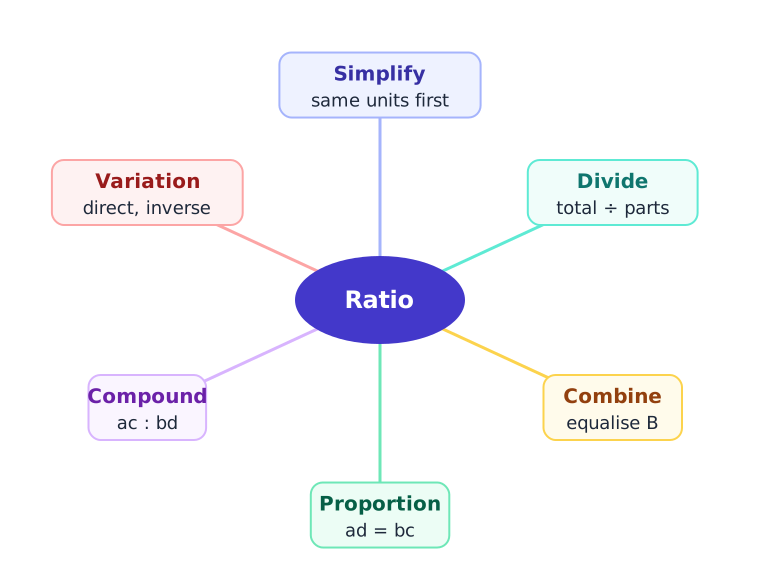
A ratio a : b compares two quantities of the same kind: a : b = a/b.
Convert both quantities to the same unit before writing the ratio.
Multiplying or dividing both terms by the same non-zero number keeps the ratio the same.
To divide N in the ratio a : b, one part = N ÷ (a + b); the shares are a and b parts.
To join A : B and B : C, make B the same in both, using the LCM.
a : b = c : d is a proportion; then ad = bc (extremes × = means ×).
Fourth proportional of a, b, c is bc/a; third proportional of a, b is b²/a; mean proportional is √(ab).
Compound ratio of a : b and c : d is ac : bd; duplicate ratio of a : b is a² : b².
Direct variation: x/y stays fixed. Inverse variation: x × y stays fixed.
Full explanation
The tiffin box

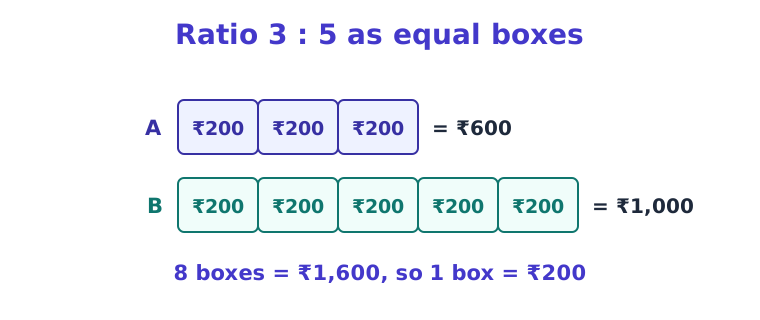
Asha and Ravi pool money for a tiffin service: Asha pays ₹600 and Ravi pays ₹1,000. At the end of the month ₹160 comes back as a refund. Splitting it half and half feels unfair. How should it be shared?
The fair answer uses a ratio.
What a ratio is

A ratio compares two quantities of the same kind by division: $a : b = \frac{a}{b}$. 600 : 1,000 = 3 : 5 (divide both by 200). Multiplying or dividing both terms by the same number does not change a ratio.
Same units first
45 minutes : 2 hours is not 45 : 2. Change hours to minutes: 45 : 120 = 3 : 8. Likewise 75 paise : ₹3 = 75 : 300 = 1 : 4.
Dividing in a ratio
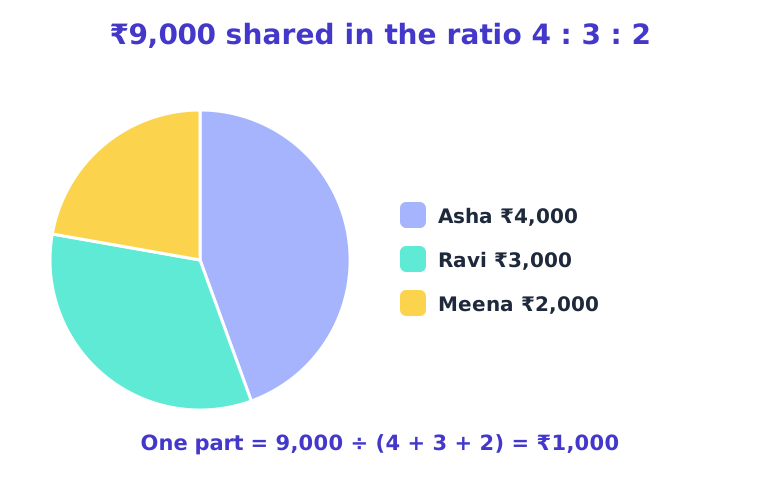
To divide $N$ in the ratio $a : b$, cut it into $a + b$ equal parts. One part $= \frac{N}{a + b}$.
Back to the tiffin refund
Asha and Ravi paid in the ratio 3 : 5. One part of ₹160 is $\frac{160}{8} = ₹20$. Asha gets $3 \times 20 = ₹60$ and Ravi gets $5 \times 20 = ₹100$.
Joining two ratios
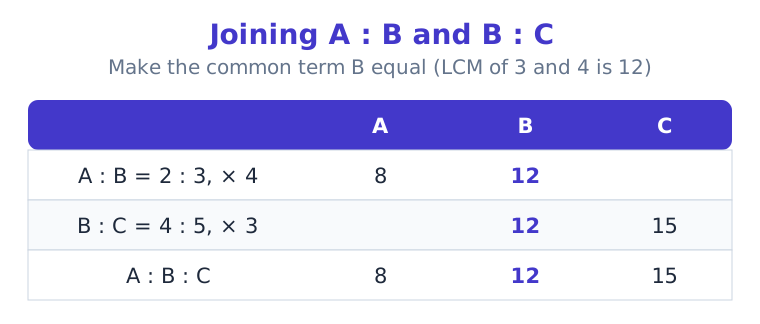
If A : B = 2 : 3 and B : C = 4 : 5, the two values of B (3 and 4) differ. Make them equal with the LCM 12: A : B = 8 : 12 and B : C = 12 : 15, so A : B : C = 8 : 12 : 15.
Proportion
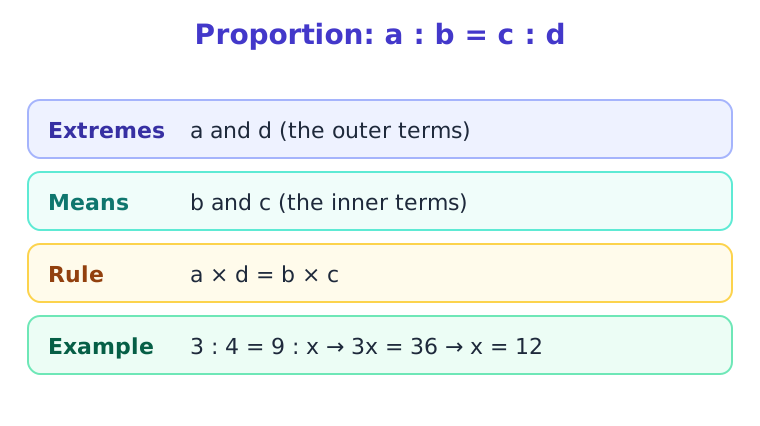
Four numbers are in proportion when $a : b = c : d$. Then $ad = bc$.
- Fourth proportional of $a, b, c$: $\frac{bc}{a}$
- Third proportional of $a, b$: $\frac{b^2}{a}$
- Mean proportional of $a, b$: $\sqrt{ab}$
Compound and duplicate ratios
Compound ratio of $a : b$ and $c : d$ is $ac : bd$. Duplicate ratio of $a : b$ is $a^2 : b^2$; sub-duplicate is $\sqrt{a} : \sqrt{b}$; triplicate is $a^3 : b^3$.
Income, expenditure and savings
If incomes are $3k$ and $2k$, and each saves the same amount $S$, then the expenditures are $3k - S$ and $2k - S$. Set their ratio equal to the given one and solve for $k$.
Direct and inverse variation
More kilograms cost more: direct, so $\frac{x}{y}$ stays fixed. More workers finish sooner: inverse, so $x \times y$ stays fixed. 12 workers take 15 days, so 20 workers take $\frac{12 \times 15}{20} = 9$ days.
Concepts and terms
A comparison by division of two quantities in the same unit. 3 : 5 means 3 parts to 5 parts.
An equality of two ratios, a : b = c : d, so that ad = bc.
The ratio of the products of the antecedents and of the consequents: a : b and c : d give ac : bd.
Direct: both grow together in the same ratio. Inverse: one grows as the other shrinks, product fixed.

Did you know
Many Indian recipes scale by ratio: idli batter is often rice and urad dal in about 3 : 1 or 4 : 1, whatever the batch size.

Memory tricks
Proportion rule — Outside times outside = inside times inside — In a : b = c : d, a and d are outside, b and c inside: ad = bc.
Joining ratios — Make the middle match — A : B and B : C share B; scale both so B is the same number.
Practice MCQs with answers (80)
- A 3 : 8
- B 8 : 3
- C 15 : 4
- D 45 : 2
Show answer
Why:
Same unit first: 2 hours = 120 minutes. Then 45 : 120 = 3 : 8.
- A 5 : 2
- B 1 : 4
- C 25 : 1
- D 4 : 1
Show answer
Why:
Same unit first: 3 rupees = 300 paise. Then 75 : 300 = 1 : 4.
- A 20 : 1
- B 5 : 1
- C 1 : 5
- D 2 : 1
Show answer
Why:
Same unit first: 2 metres = 200 cm. Then 40 : 200 = 1 : 5.
- A 250 : 3
- B 12 : 1
- C 5 : 6
- D 1 : 12
Show answer
Why:
Same unit first: 3 kg = 3,000 grams. Then 250 : 3,000 = 1 : 12.
- A 3 : 10
- B 3 : 1
- C 300 : 1
- D 10 : 3
Show answer
Why:
Same unit first: 2 litres = 2,000 mL. Then 600 : 2,000 = 3 : 10.
- A 25 : 9
- B 5 : 18
- C 50 : 3
- D 18 : 5
Show answer
Why:
Same unit first: 3 hours = 180 minutes. Then 50 : 180 = 5 : 18.
- A 3 : 4 : 6
- B 2 : 3 : 5
- C 8 : 9 : 10
- D 10 : 9 : 8
Show answer
Why:
Multiply every term by the LCM of the denominators, 12: 8 : 9 : 10.
- A 2 : 3 : 4
- B 1 : 1 : 1
- C 3 : 4 : 6
- D 6 : 4 : 3
Show answer
Why:
Multiply every term by the LCM of the denominators, 12: 6 : 4 : 3.
- A 18 : 20 : 21
- B 21 : 20 : 18
- C 5 : 3 : 10
- D 3 : 2 : 7
Show answer
Why:
Multiply every term by the LCM of the denominators, 30: 18 : 20 : 21.
- A ₹900
- B ₹1,000
- C ₹1,200
- D ₹800
Show answer
Why:
Ratio in whole numbers 4 : 5, total parts 9. One part = 1,800 ÷ 9 = 200. Ravi gets 5 parts = ₹1,000.
- A ₹600
- B ₹1,500
- C ₹900
- D ₹1,200
Show answer
Why:
Ratio in whole numbers 3 : 5, total parts 8. One part = 2,400 ÷ 8 = 300. Ravi gets 3 parts = ₹900.
- A ₹2,500
- B ₹1,500
- C ₹2,250
- D ₹3,750
Show answer
Why:
Ratio in whole numbers 2 : 3 : 5, total parts 10. One part = 7,500 ÷ 10 = 750. Sana gets 5 parts = ₹3,750.
- A ₹1,500
- B ₹1,800
- C ₹1,200
- D ₹2,700
Show answer
Why:
Ratio in whole numbers 4 : 5 : 9, total parts 18. One part = 5,400 ÷ 18 = 300. Sana gets 5 parts = ₹1,500.
- A ₹2,100
- B ₹4,200
- C ₹2,800
- D ₹4,900
Show answer
Why:
Ratio in whole numbers 3 : 4 : 6, total parts 13. One part = 9,100 ÷ 13 = 700. Neha gets 6 parts = ₹4,200.
- A ₹1,400
- B ₹2,450
- C ₹3,500
- D ₹4,200
Show answer
Why:
Ratio in whole numbers 2 : 5, total parts 7. One part = 4,900 ÷ 7 = 700. Neha gets 5 parts = ₹3,500.
- A ₹800
- B ₹600
- C ₹1,400
- D ₹1,200
Show answer
Why:
Ratio in whole numbers 6 : 4 : 3, total parts 13. One part = 2,600 ÷ 13 = 200. Neha gets 6 parts = ₹1,200.
- A ₹1,600
- B ₹600
- C ₹3,200
- D ₹1,000
Show answer
Why:
The gap is 5 − 3 = 2 parts = ₹400, so one part = ₹200. Total = 8 parts = ₹1,600.
- A ₹2,100
- B ₹3,300
- C ₹1,200
- D ₹9,900
Show answer
Why:
The gap is 7 − 4 = 3 parts = ₹900, so one part = ₹300. Total = 11 parts = ₹3,300.
- A ₹16,800
- B ₹2,700
- C ₹4,200
- D ₹1,500
Show answer
Why:
The gap is 9 − 5 = 4 parts = ₹1,200, so one part = ₹300. Total = 14 parts = ₹4,200.
- A 4 : 3
- B 1 : 1
- C 16 : 27
- D 3 : 4
Show answer
Why:
Multiply the first terms and the second terms: 2 × 9 : 3 × 8 = 18 : 24 = 3 : 4.
- A 2 : 3
- B 14 : 17
- C 24 : 25
- D 3 : 2
Show answer
Why:
Multiply the first terms and the second terms: 4 × 10 : 5 × 12 = 40 : 60 = 2 : 3.
- A 2 : 1
- B 1 : 2
- C 10 : 13
- D 18 : 49
Show answer
Why:
Multiply the first terms and the second terms: 3 × 7 : 7 × 6 = 21 : 42 = 1 : 2.
- A 27 : 125
- B 3 : 5
- C 9 : 25
- D 9 : 5
Show answer
Why:
Square both terms: 3² : 5² = 9 : 25.
- A 16 : 49
- B 256 : 2401
- C 7 : 4
- D 4 : 7
Show answer
Why:
Take square roots: √16 : √49 = 4 : 7.
- A 8 : 27
- B 27 : 8
- C 4 : 9
- D 2 : 3
Show answer
Why:
Cube both terms: 2³ : 3³ = 8 : 27.
- A 2 : 3 : 5
- B 8 : 12 : 15
- C 8 : 15 : 12
- D 10 : 12 : 15
Show answer
Why:
Make B equal: A : B = 8 : 12 and B : C = 12 : 15, so A : B : C = 8 : 12 : 15.
- A 9 : 14 : 12
- B 21 : 24 : 28
- C 9 : 12 : 14
- D 3 : 4 : 7
Show answer
Why:
Make B equal: A : B = 18 : 24 and B : C = 24 : 28, so A : B : C = 9 : 12 : 14.
- A 10 : 9 : 12
- B 5 : 8 : 6
- C 5 : 6 : 3
- D 10 : 12 : 9
Show answer
Why:
Make B equal: A : B = 20 : 24 and B : C = 24 : 18, so A : B : C = 10 : 12 : 9.
- A 3 : 8
- B 8 : 3
- C 1 : 4
- D 2 : 3
Show answer
Why:
Make B equal: A : B = 3 : 6 and B : C = 6 : 8, so A : B : C = 3 : 6 : 8. So A : C = 3 : 8.
- A 15 : 8
- B 8 : 15
- C 4 : 3
- D 6 : 5
Show answer
Why:
Make B equal: A : B = 8 : 10 and B : C = 10 : 15, so A : B : C = 8 : 10 : 15. So A : C = 8 : 15.
- A ₹1,600
- B ₹2,400
- C ₹3,000
- D ₹3,500
Show answer
Why:
Make B equal: A : B = 8 : 12 and B : C = 12 : 15, so A : B : C = 8 : 12 : 15. C gets 15/35 of ₹7,000 = ₹3,000.
- A 4 : 5
- B 2 : 7
- C 35 : 16
- D 16 : 35
Show answer
Why:
A/D = (A/B)(B/C)(C/D) = (2 × 4 × 6)/(3 × 5 × 7) = 48/105 = 16/35.
- A 15
- B 12
- C 2.4
- D $\frac{20}{3}$
Show answer
Why:
4 : 6 = 10 : x, so 4x = 6 × 10 = 60 and x = 15.
- A 16
- B 28
- C 1.75
- D $\frac{36}{7}$
Show answer
Why:
3 : 7 = 12 : x, so 3x = 7 × 12 = 84 and x = 28.
- A 18
- B $\frac{8}{3}$
- C 24
- D $\frac{75}{8}$
Show answer
Why:
5 : 8 = 15 : x, so 5x = 8 × 15 = 120 and x = 24.
- A 36
- B $\frac{8}{3}$
- C 8
- D 9
Show answer
Why:
4 : 6 = 6 : x, so x = 6² ÷ 4 = 9.
- A 16
- B 144
- C 6.75
- D 15
Show answer
Why:
9 : 12 = 12 : x, so x = 12² ÷ 9 = 16.
- A 1,296
- B 81
- C $\frac{64}{9}$
- D 56
Show answer
Why:
16 : 36 = 36 : x, so x = 36² ÷ 16 = 81.
- A 6.5
- B 36
- C 6
- D 20.25
Show answer
Why:
4 : x = x : 9, so x² = 4 × 9 = 36 and x = 6.
- A 40.5
- B 13
- C 144
- D 12
Show answer
Why:
8 : x = x : 18, so x² = 8 × 18 = 144 and x = 12.
- A 18
- B 19.5
- C 324
- D 60.75
Show answer
Why:
12 : x = x : 27, so x² = 12 × 27 = 324 and x = 18.
- A 2
- B 1
- C 3
- D 5
Show answer
Why:
Set up the proportion and cross-multiply, or test the options: (5 + 1) : (7 + 1) = 6 : 8 = 3 : 4.
- A 7
- B 2
- C 3
- D 9
Show answer
Why:
Set up the proportion and cross-multiply, or test the options: (7 + 3) : (11 + 3) = 10 : 14 = 5 : 7.
- A 7
- B 12
- C 9
- D 3
Show answer
Why:
Set up the proportion and cross-multiply, or test the options: (15 − 3) : (19 − 3) = 12 : 16 = 3 : 4.
- A 4
- B 12
- C 8
- D 37
Show answer
Why:
Set up the proportion and cross-multiply, or test the options: (40 − 4) : (52 − 4) = 36 : 48 = 3 : 4.
- A 4
- B 2
- C 3
- D 5
Show answer
Why:
With 2: 13 : 26 = 1 : 2 and 18 : 36 = 1 : 2. Extremes 468 = means 468.
- A 8
- B 10
- C 5
- D 6
Show answer
Why:
With 5: 12 : 21 = 4 : 7 and 48 : 84 = 4 : 7. Extremes 1,008 = means 1,008.
- A ₹1,800
- B ₹3,000
- C ₹3,600
- D ₹2,400
Show answer
Why:
Incomes 4k and 3k. (4k − 600) : (3k − 600) = 3 : 2 gives 2(4k − 600) = 3(3k − 600), so k = 600. Incomes ₹2,400 and ₹1,800; expenditures ₹1,800 and ₹1,200.
- A ₹3,200
- B ₹4,000
- C ₹2,400
- D ₹8,000
Show answer
Why:
Incomes 5k and 4k. (5k − 1,600) : (4k − 1,600) = 3 : 2 gives 2(5k − 1,600) = 3(4k − 1,600), so k = 800. Incomes ₹4,000 and ₹3,200; expenditures ₹2,400 and ₹1,600.
- A ₹14,000
- B ₹18,000
- C ₹16,000
- D ₹20,000
Show answer
Why:
Incomes 9k and 7k. (9k − 2,000) : (7k − 2,000) = 4 : 3 gives 3(9k − 2,000) = 4(7k − 2,000), so k = 2,000. Incomes ₹18,000 and ₹14,000; expenditures ₹16,000 and ₹12,000.
- A ₹3,000
- B ₹6,000
- C ₹5,000
- D ₹4,000
Show answer
Why:
Incomes 3k and 2k. (3k − 1,000) : (2k − 1,000) = 5 : 3 gives 3(3k − 1,000) = 5(2k − 1,000), so k = 2,000. Incomes ₹6,000 and ₹4,000; expenditures ₹5,000 and ₹3,000.
- A ₹10,500
- B ₹9,000
- C ₹6,000
- D ₹7,500
Show answer
Why:
Incomes 7k and 5k. (7k − 1,500) : (5k − 1,500) = 3 : 2 gives 2(7k − 1,500) = 3(5k − 1,500), so k = 1,500. Incomes ₹10,500 and ₹7,500; expenditures ₹9,000 and ₹6,000.
- A 126
- B 21
- C 105
- D 63
Show answer
Why:
Take 5n, 6n, 8n coins. Value = 5n + 6n/2 + 8n/4 = 10n = 210, so n = 21. 50 paise coins = 6 × 21 = 126.
- A 120
- B 160
- C 80
- D 40
Show answer
Why:
Take 2n, 3n, 4n coins. Value = 2n + 3n/2 + 4n/4 = 4.5n = 180, so n = 40. 25 paise coins = 4 × 40 = 160.
- A 350
- B 100
- C 50
- D 200
Show answer
Why:
Take n, 2n, 4n coins. Value = n + 2n/2 + 4n/4 = 3n = 150, so n = 50. ₹1 coins = 1 × 50 = 50.
- A 50
- B 25
- C 75
- D 100
Show answer
Why:
Take 3n, 4n, 8n coins. Value = 3n + 4n/2 + 8n/4 = 7n = 175, so n = 25. 50 paise coins = 4 × 25 = 100.
- A 9 days
- B 12 days
- C 25 days
- D 7 days
Show answer
Why:
More workers, fewer days: inverse. 12 × 15 = 180 worker-days; 180 ÷ 20 = 9.
- A ₹205.71
- B ₹630
- C ₹560
- D ₹420
Show answer
Why:
Direct variation: price per kg = 360 ÷ 8 = ₹45; 14 × 45 = ₹630.
- A 4.5 hours
- B 6.25 hours
- C 4 hours
- D 3.75 hours
Show answer
Why:
Speed and time vary inversely: 60 × 5 = 300 km; 300 ÷ 75 = 4 hours.
- A 2
- B 9
- C 10
- D 4
Show answer
Why:
x × y is fixed: 6 × 8 = 48, so x = 48 ÷ 12 = 4.
- A 2 : 3
- B 5 : 8
- C 7 : 12
- D 3 : 5
Show answer
Why:
As decimals: 3/5 ≈ 0.6, 5/8 ≈ 0.625, 7/12 ≈ 0.583, 2/3 ≈ 0.667. The greatest is 2 : 3.
- A 5 : 9
- B 7 : 13
- C 3 : 5
- D 4 : 7
Show answer
Why:
As decimals: 4/7 ≈ 0.571, 5/9 ≈ 0.556, 3/5 ≈ 0.6, 7/13 ≈ 0.538. The smallest is 7 : 13.
- A 5 : 7
- B 8 : 11
- C 11 : 15
- D 13 : 18
Show answer
Why:
As decimals: 11/15 ≈ 0.733, 8/11 ≈ 0.727, 13/18 ≈ 0.722, 5/7 ≈ 0.714. The greatest is 11 : 15.
- A 6 litres
- B 15 litres
- C 28 litres
- D 10 litres
Show answer
Why:
Milk = 42 L and water = 18 L. Milk does not change, so new water = 42 × 2/3 = 28 L. Add 28 − 18 = 10 L.
- A 5 litres
- B 15 litres
- C $\frac{10}{3}$ litres
- D 10 litres
Show answer
Why:
Milk = 30 L and water = 10 L. Milk does not change, so new water = 30 × 1/2 = 15 L. Add 15 − 10 = 5 L.
- A 40 litres
- B 10 litres
- C $\frac{50}{9}$ litres
- D 15 litres
Show answer
Why:
Milk = 50 L and water = 30 L. Milk does not change, so new water = 50 × 4/5 = 40 L. Add 40 − 30 = 10 L.
- A 24 litres
- B 9 litres
- C 15 litres
- D 20 litres
Show answer
Why:
Milk = 36 L and water = 9 L. Milk does not change, so new water = 36 × 2/3 = 24 L. Add 24 − 9 = 15 L.
- A increased by the same number
- B decreased by the same number
- C squared
- D multiplied by the same non-zero number
Show answer
Why:
Only multiplying or dividing both terms by the same number keeps the ratio. Adding changes it: 2 : 3 → 3 : 4.
- A 4 : 1
- B 8 : 3
- C 5 : 3
- D 1 : 4
Show answer
Why:
Take a = 5, b = 3: (5 + 3) : (5 − 3) = 8 : 2 = 4 : 1.
- A the sum of the means, b + c
- B the product of the means, bc
- C ab
- D the product cd
Show answer
Why:
a : b = c : d means a/b = c/d, so ad = bc.
- A 7 : 8
- B 3 : 4
- C 10 : 11
- D 11 : 10
Show answer
Why:
x = 3, y = 4: (6 + 4) : (3 + 8) = 10 : 11.
- A 3 : 4 : 6
- B 6 : 4 : 3
- C 2 : 3 : 4
- D 4 : 3 : 2
Show answer
Why:
Let each equal 12: A = 4, B = 3, C = 2.
- A Both A and R are true, and R is the correct explanation of A
- B Both A and R are true, but R is not the correct explanation of A
- C A is true but R is false
- D A is false but R is true
Show answer
Why:
(2/3) × (4/5) = 8/15. R is exactly the reason.
- A Both A and R are true, and R is the correct explanation of A
- B Both A and R are true, but R is not the correct explanation of A
- C A is true but R is false
- D A is false but R is true
Show answer
Why:
2 : 3 plus 1 each is 3 : 4, so A is false. R is true.
- A 1 only
- B 2 only
- C Both 1 and 2
- D Neither 1 nor 2
Show answer
Why:
18 : 12 = 3 : 2, true. Third proportional = 36/4 = 9, so 2 is false.
- A 1 only
- B 2 only
- C Both 1 and 2
- D Neither 1 nor 2
Show answer
Why:
a/b = 3/4 gives 4a = 3b, true. 5/8 = 0.625 > 0.6, true.
- A ₹1,000
- B ₹600
- C ₹800
- D ₹960
Show answer
Why:
8 boxes = ₹1,600, so 1 box = ₹200. B has 5 boxes = ₹1,000.
- A ₹320
- B ₹400
- C ₹200
- D ₹600
Show answer
Why:
B has 2 boxes more than A; 2 × ₹200 = ₹400.
- A ₹4,000
- B ₹5,000
- C ₹6,000
- D ₹3,600
Show answer
Why:
Parts 2 + 3 + 5 = 10; one part = ₹1,200; C = 5 × 1,200 = ₹6,000.
- A 8 : 3
- B 6 : 5
- C 2 : 3
- D 3 : 2
Show answer
Why:
Boys 30 + 35 + 40 = 105, girls 25 + 30 + 15 = 70. 105 : 70 = 3 : 2.
Important short questions (4)
120 : 80 = 3 : 2.
One part = 5,400 ÷ 18 = 300. Shares ₹1,200, ₹1,500, ₹2,700.
Make B = 12: 9 : 12 and 12 : 14, so 9 : 12 : 14.
√(8 × 18) = √144 = 12.
Long answer questions (1)
(a) (5k − 1,600) : (4k − 1,600) = 3 : 2, so 2(5k − 1,600) = 3(4k − 1,600).
(b) 10k − 3,200 = 12k − 4,800, so 2k = 1,600 and k = 800.
(c) Incomes ₹4,000 and ₹3,200; expenditures ₹2,400 and ₹1,600. 4,000 : 3,200 = 5 : 4 and 2,400 : 1,600 = 3 : 2.
Flashcards (13)
Play this topic
- Ratio: true or false?
Partnership
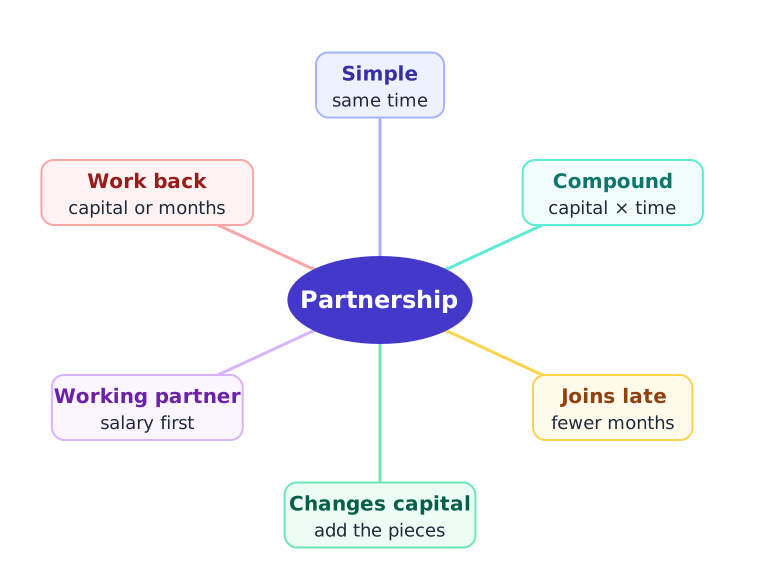
Share business profit in the ratio of capital × time: simple partnership, a partner who joins late or leaves early, capital changed midway, a working partner's salary, and working back to an unknown capital or period.
What you will be able to do
- I can share profit in the ratio of capitals when the time is the same.
- I can use capital × months when partners invest for different periods.
- I can handle a capital that is increased or withdrawn midway.
- I can take out a working partner's salary before sharing the rest.
- I can find an unknown capital or period from the profit ratio.
Key points
Profit is shared in the ratio of capital × time (in months).
If everyone invests for the same time, share in the ratio of capitals.
If the capitals are equal, share in the ratio of times.
A partner who joins after m months of a year invests for 12 − m months.
If a capital changes midway, add capital × months for each part of the year.
A working partner's salary or commission comes out of the profit first; the rest is shared.
Loss is shared in the same ratio as profit.
If 2A = 3B = 4C (capitals), then A : B : C = 1/2 : 1/3 : 1/4 = 6 : 4 : 3.
Full explanation
The food stall

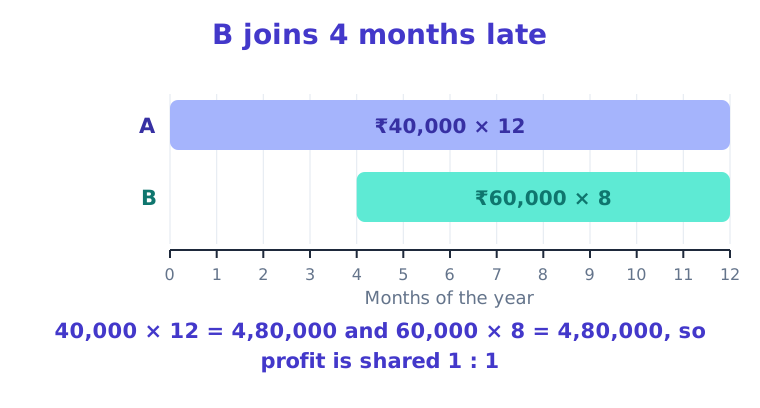
Meena starts a food stall in January with ₹40,000. In May her friend Kabir joins with ₹60,000. At the end of the year the stall has made ₹30,000 profit. Kabir put in more money; Meena put it in for longer. Who should get more?
Simple partnership
When everyone invests for the same time, profit is shared in the ratio of capitals. ₹40,000 and ₹60,000 for a full year give 2 : 3.
Capital × time
When the periods differ, each partner's weight is capital × months. Money that stays longer earns a bigger share.
Meena and Kabir
Kabir joined after 4 months, so he was in for 8 months. Meena: $40{,}000 \times 12 = 4{,}80{,}000$. Kabir: $60{,}000 \times 8 = 4{,}80{,}000$. The weights are equal, so each gets ₹15,000.
A table keeps it tidy
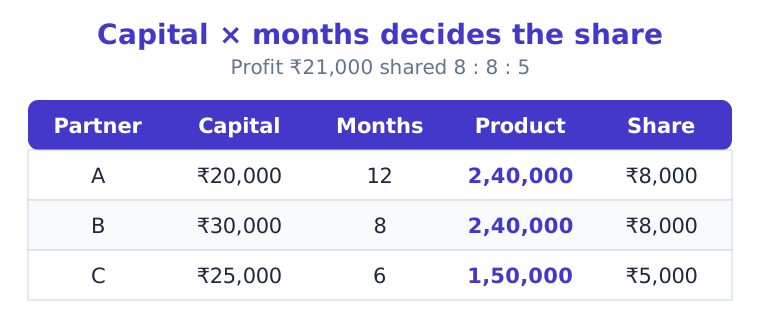
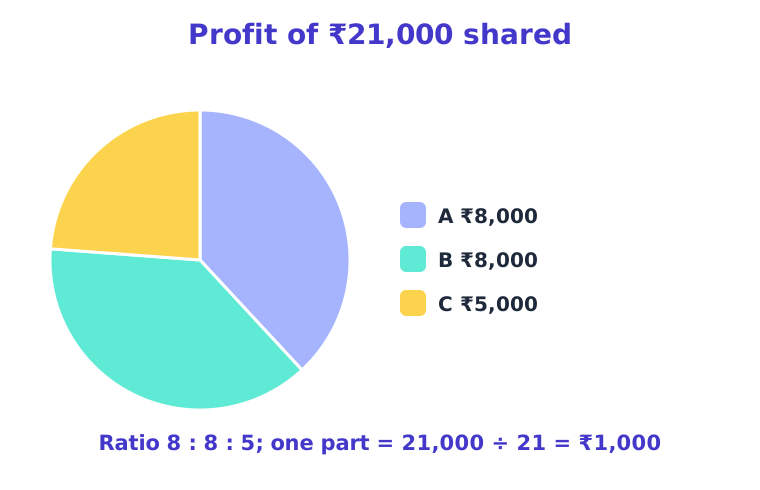
For three or more partners, make a table: capital, months, product, share. The products give the ratio.
Capital changed midway
If A starts with ₹40,000 and adds ₹20,000 after 4 months, A's weight is $40{,}000 \times 4 + 60{,}000 \times 8$. Break the year into pieces and add.
Working partner
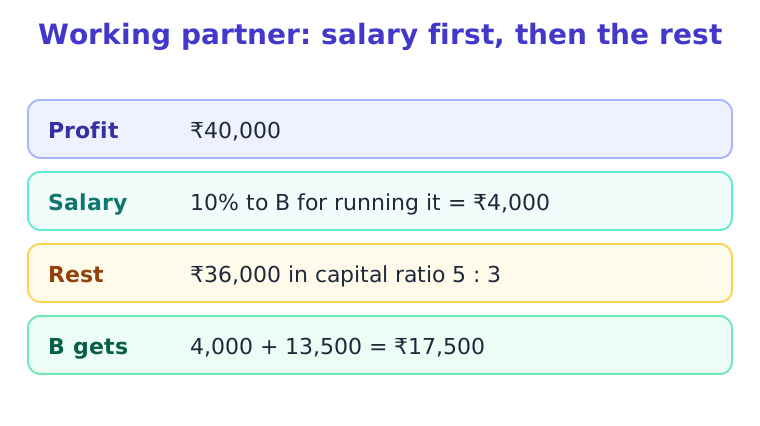
If one partner runs the business, take out the salary or commission first, then share the rest in the capital ratio.
Working backwards
If the profit ratio is known, set capital × months for each partner equal to that ratio and solve for the missing capital or period.
Concepts and terms
All partners invest for the same period, so profit follows the capital ratio.
Periods differ, so each partner's weight is capital × months.
A partner who runs the business and gets a salary or a percent of profit before sharing.
A partner who only invests money and does not run the business.
Did you know
Indian law has a separate act for partnership firms, passed in 1932, and it still sets the default rule: if partners agree nothing, profit is shared equally.
Memory tricks
The share rule — Money × months = muscle — A partner's weight is capital multiplied by the months it stayed in the business.
Practice MCQs with answers (58)
- A ₹15,000
- B ₹17,500
- C ₹12,500
- D ₹10,000
Show answer
Why:
Same time, so share in the capital ratio 2 : 3. B gets 3/5 of ₹25,000 = ₹15,000.
- A ₹6,300
- B ₹7,200
- C ₹6,000
- D ₹4,500
Show answer
Why:
Same time, so share in the capital ratio 5 : 7 : 8. C gets 8/20 of ₹18,000 = ₹7,200.
- A ₹2,250
- B ₹3,750
- C ₹3,000
- D ₹4,500
Show answer
Why:
Same time, so share in the capital ratio 2 : 3. A gets 2/5 of ₹7,500 = ₹3,000.
- A ₹15,000
- B ₹20,000
- C ₹14,500
- D ₹10,000
Show answer
Why:
Same time, so share in the capital ratio 2 : 3 : 4. A gets 2/9 of ₹45,000 = ₹10,000.
- A ₹3,600
- B ₹6,000
- C ₹4,000
- D ₹2,400
Show answer
Why:
Same time, so share in the capital ratio 2 : 3 : 5. B gets 3/10 of ₹12,000 = ₹3,600.
- A ₹6,000
- B ₹8,000
- C ₹9,400
- D ₹7,000
Show answer
Why:
Same time, so share in the capital ratio 3 : 4. B gets 4/7 of ₹14,000 = ₹8,000.
- A ₹10,000
- B ₹8,000
- C ₹12,000
- D ₹14,000
Show answer
Why:
Same time, so share in the capital ratio 3 : 2. A gets 3/5 of ₹20,000 = ₹12,000.
- A ₹15,400
- B ₹13,200
- C ₹8,800
- D ₹11,000
Show answer
Why:
Capital × months: A: 30,000 × 12 = 3,60,000, B: 40,000 × 9 = 3,60,000. Ratio 1 : 1. B gets 1/2 of ₹22,000 = ₹11,000.
- A ₹10,000
- B ₹14,000
- C ₹16,000
- D ₹14,200
Show answer
Why:
Capital × months: A: 20,000 × 12 = 2,40,000, B: 30,000 × 8 = 2,40,000, C: 25,000 × 6 = 1,50,000. Ratio 8 : 8 : 5. C gets 5/21 of ₹42,000 = ₹10,000.
- A ₹11,250
- B ₹10,000
- C ₹9,000
- D ₹8,000
Show answer
Why:
Capital × months: A: 15,000 × 10 = 1,50,000, B: 20,000 × 6 = 1,20,000. Ratio 5 : 4. A gets 5/9 of ₹18,000 = ₹10,000.
- A ₹16,500
- B ₹15,000
- C ₹18,000
- D ₹13,200
Show answer
Why:
Capital × months: A: 60,000 × 5 = 3,00,000, B: 40,000 × 9 = 3,60,000. Ratio 5 : 6. B gets 6/11 of ₹33,000 = ₹18,000.
- A ₹5,600
- B ₹2,400
- C ₹6,000
- D ₹4,000
Show answer
Why:
Capital × months: A: 8,000 × 9 = 72,000, B: 12,000 × 6 = 72,000, C: 16,000 × 3 = 48,000. Ratio 3 : 3 : 2. C gets 2/8 of ₹16,000 = ₹4,000.
- A ₹20,000
- B ₹25,500
- C ₹27,500
- D ₹35,000
Show answer
Why:
Capital × months: A: 50,000 × 4 = 2,00,000, B: 35,000 × 10 = 3,50,000. Ratio 4 : 7. A gets 4/11 of ₹55,000 = ₹20,000.
- A ₹6,000
- B ₹10,000
- C ₹11,600
- D ₹8,000
Show answer
Why:
Capital × months: A: 18,000 × 8 = 1,44,000, B: 24,000 × 10 = 2,40,000. Ratio 3 : 5. B gets 5/8 of ₹16,000 = ₹10,000.
- A ₹21,000
- B ₹18,000
- C ₹15,000
- D ₹12,000
Show answer
Why:
Capital × months: A: 40,000 × 12 = 4,80,000, B: 60,000 × 8 = 4,80,000. Ratio 1 : 1. B gets 1/2 of ₹30,000 = ₹15,000.
- A ₹16,200
- B ₹13,500
- C ₹18,000
- D ₹9,000
Show answer
Why:
Capital × months: A: 24,000 × 12 = 2,88,000, B: 36,000 × 4 = 1,44,000. Ratio 2 : 1. B gets 1/3 of ₹27,000 = ₹9,000.
- A ₹15,000
- B ₹19,000
- C ₹20,000
- D ₹25,000
Show answer
Why:
Capital × months: A: 50,000 × 12 = 6,00,000, B: 40,000 × 9 = 3,60,000. Ratio 5 : 3. B gets 3/8 of ₹40,000 = ₹15,000.
- A ₹16,000
- B ₹12,000
- C ₹15,600
- D ₹8,400
Show answer
Why:
Capital × months: A: 30,000 × 12 = 3,60,000, B: 45,000 × 8 = 3,60,000, C: 60,000 × 6 = 3,60,000. Ratio 1 : 1 : 1. C gets 1/3 of ₹36,000 = ₹12,000.
- A ₹26,400
- B ₹22,000
- C ₹24,000
- D ₹20,000
Show answer
Why:
Capital × months: A: 60,000 × 12 = 7,20,000, B: 75,000 × 8 = 6,00,000. Ratio 6 : 5. A gets 6/11 of ₹44,000 = ₹24,000.
- A ₹21,000
- B ₹18,000
- C ₹12,000
- D ₹15,000
Show answer
Why:
Capital × months: A: 35,000 × 12 = 4,20,000, B: 42,000 × 10 = 4,20,000. Ratio 1 : 1. A gets 1/2 of ₹30,000 = ₹15,000.
- A ₹20,000
- B ₹30,000
- C ₹15,000
- D ₹25,000
Show answer
Why:
Capital × months: A: 80,000 × 6 = 4,80,000, B: 60,000 × 12 = 7,20,000. Ratio 2 : 3. A gets 2/5 of ₹50,000 = ₹20,000.
- A ₹36,000
- B ₹18,000
- C ₹10,000
- D ₹19,200
Show answer
Why:
Capital × months: A: 45,000 × 12 = 5,40,000, B: 30,000 × 9 = 2,70,000, C: 25,000 × 6 = 1,50,000. Ratio 18 : 9 : 5. B gets 9/32 of ₹64,000 = ₹18,000.
- A ₹19,100
- B ₹15,500
- C ₹16,000
- D ₹15,000
Show answer
Why:
A: 40,000 × 4 + 60,000 × 8 = 6,40,000. B: 50,000 × 12 = 6,00,000. Ratio 16 : 15, so A gets 16/31 of ₹31,000 = ₹16,000.
- A ₹21,800
- B ₹19,000
- C ₹20,000
- D ₹18,000
Show answer
Why:
A: 60,000 × 6 + 40,000 × 6 = 6,00,000. B: 45,000 × 12 = 5,40,000. Ratio 10 : 9, so B gets 9/19 of ₹38,000 = ₹18,000.
- A ₹18,000
- B ₹16,000
- C ₹21,400
- D ₹17,000
Show answer
Why:
A: 30,000 × 3 + 50,000 × 9 = 5,40,000. B: 40,000 × 12 = 4,80,000. Ratio 9 : 8, so A gets 9/17 of ₹34,000 = ₹18,000.
- A ₹10,400
- B ₹13,000
- C ₹18,200
- D ₹15,600
Show answer
Why:
A: 50,000 × 8 + 20,000 × 4 = 4,80,000. B: 40,000 × 12 = 4,80,000. Ratio 1 : 1, so A gets 1/2 of ₹26,000 = ₹13,000.
- A ₹26,000
- B ₹37,800
- C ₹32,000
- D ₹29,000
Show answer
Why:
A: 24,000 × 4 + 36,000 × 8 = 3,84,000. B: 30,000 × 4 + 24,000 × 8 = 3,12,000. Ratio 16 : 13, so A gets 16/29 of ₹58,000 = ₹32,000.
- A ₹19,000
- B ₹15,000
- C ₹13,500
- D ₹17,500
Show answer
Why:
Salary first: 10% of 40,000 = 4,000. Rest = 36,000, shared 5 : 3: B's part = 13,500. Total = ₹17,500.
- A ₹36,000
- B ₹28,800
- C ₹18,000
- D ₹46,800
Show answer
Why:
Salary first: 1,500 × 12 = 18,000. Rest = 30,000, shared 3 : 2: A's part = 18,000. Total = ₹36,000.
- A ₹24,000
- B ₹34,000
- C ₹40,000
- D ₹30,000
Show answer
Why:
Salary first: 20% of 50,000 = 10,000. Rest = 40,000, shared 2 : 3: B's part = 24,000. Total = ₹34,000.
- A ₹10,800
- B ₹18,000
- C ₹16,800
- D ₹12,000
Show answer
Why:
Salary first: 10% of 60,000 = 6,000. Rest = 54,000, shared 2 : 2 : 1: C's part = 10,800. Total = ₹16,800.
- A ₹15,000
- B ₹10,000
- C ₹27,000
- D ₹22,000
Show answer
Why:
Salary first: 1,000 × 12 = 12,000. Rest = 24,000, shared 5 : 7: A's part = 10,000. Total = ₹22,000.
- A ₹36,000
- B ₹81,000
- C ₹24,000
- D ₹8,000
Show answer
Why:
B was in for 8 months. 36,000 × 12 : B × 8 = 3 : 2, so B = 36,000 × 12 × 2 ÷ (3 × 8) = ₹36,000.
- A ₹1,00,000
- B ₹36,000
- C ₹27,000
- D ₹6,750
Show answer
Why:
B was in for 9 months. 45,000 × 12 : B × 9 = 5 : 3, so B = 45,000 × 12 × 3 ÷ (5 × 9) = ₹36,000.
- A ₹48,000
- B ₹16,000
- C ₹72,000
- D ₹91,125
Show answer
Why:
B was in for 8 months. 54,000 × 12 : B × 8 = 9 : 8, so B = 54,000 × 12 × 8 ÷ (9 × 8) = ₹72,000.
- A 4 months
- B 10 months
- C 6 months
- D 8 months
Show answer
Why:
30,000 × 12 : 45,000 × t = 2 : 1 gives t = 4 months in the business, so B joined after 12 − 4 = 8 months.
- A 4 months
- B 6 months
- C 2 months
- D 8 months
Show answer
Why:
60,000 × 12 : 40,000 × t = 9 : 4 gives t = 8 months in the business, so B joined after 12 − 8 = 4 months.
- A 8 months
- B 6 months
- C 4 months
- D 7 months
Show answer
Why:
25,000 × 12 : 30,000 × t = 5 : 3 gives t = 6 months in the business, so B joined after 12 − 6 = 6 months.
- A 4 : 3 : 2
- B 1 : 1 : 1
- C 6 : 6 : 5
- D 3 : 4 : 5
Show answer
Why:
Multiply term by term: 3 × 4 : 4 × 3 : 5 × 2 = 6 : 6 : 5.
- A 5 : 4
- B 1 : 1
- C 2 : 3
- D 5 : 6
Show answer
Why:
Multiply term by term: 2 × 5 : 3 × 4 = 5 : 6.
- A 5 : 5 : 4
- B 1 : 1 : 1
- C 5 : 6 : 8
- D 6 : 5 : 3
Show answer
Why:
Multiply term by term: 5 × 6 : 6 × 5 : 8 × 3 = 5 : 5 : 4.
- A 10 : 9
- B 5 : 2
- C 5 : 3
- D 2 : 3
Show answer
Why:
Capital = profit ÷ time: 5/2 : 3/3 = 5 : 2.
- A ₹6,000
- B ₹10,000
- C ₹8,000
- D ₹12,000
Show answer
Why:
2A = 3B = 4C means the capitals are in the ratio 1/2 : 1/3 : 1/4 = 6 : 4 : 3. B gets 4/13 of ₹26,000 = ₹8,000.
- A ₹10,000
- B ₹6,000
- C ₹4,000
- D ₹8,000
Show answer
Why:
3A = 4B = 6C means the capitals are in the ratio 1/3 : 1/4 : 1/6 = 4 : 3 : 2. A gets 4/9 of ₹18,000 = ₹8,000.
- A ₹12,000
- B ₹9,000
- C ₹15,000
- D ₹13,500
Show answer
Why:
4A = 5B means the capitals are in the ratio 1/4 : 1/5 = 5 : 4. B gets 4/9 of ₹27,000 = ₹12,000.
- A capital only
- B capital × time
- C time only
- D capital + time
Show answer
Why:
Each rupee earns for every month it stays, so the weight is capital × time.
- A 5 months
- B 12 months
- C 7 months
- D 17 months
Show answer
Why:
12 − 5 = 7.
- A a creditor
- B a shareholder
- C a working partner
- D a sleeping partner
Show answer
Why:
A sleeping partner provides capital but no work.
- A 2 : 3
- B 8 : 20
- C 1 : 1
- D 3 : 2
Show answer
Why:
Equal capitals cancel: 8 : 12 = 2 : 3.
- A ₹3,000
- B ₹4,500
- C ₹7,500
- D ₹6,000
Show answer
Why:
Loss is shared like profit: 3/8 × 12,000 = ₹4,500.
- A Both A and R are true, and R is the correct explanation of A
- B Both A and R are true, but R is not the correct explanation of A
- C A is true but R is false
- D A is false but R is true
Show answer
Why:
4,80,000 = 4,80,000, so equal shares; R gives the reason.
- A Both A and R are true, and R is the correct explanation of A
- B Both A and R are true, but R is not the correct explanation of A
- C A is true but R is false
- D A is false but R is true
Show answer
Why:
The salary comes out of the profit first; only the rest is divided. So A is false; R is true.
- A 1 only
- B 2 only
- C Both 1 and 2
- D Neither 1 nor 2
Show answer
Why:
2A = 3B gives A/B = 3/2, so 1 is false. Equal capitals cancel, so 2 is true.
- A 1 only
- B 2 only
- C Both 1 and 2
- D Neither 1 nor 2
Show answer
Why:
6 : 12 = 1 : 2, true. Loss uses the same ratio, so 2 is false.
- A ₹4,687.50
- B ₹4,000
- C ₹4,500
- D ₹4,166.67
Show answer
Why:
A: 30,000 × 12 = 3,60,000; B: 45,000 × 9 = 4,05,000; C: 60,000 × 6 = 3,60,000. Ratio 8 : 9 : 8, so B = 9/25 × 12,500 = ₹4,500.
- A ₹11,500
- B ₹10,000
- C ₹12,000
- D ₹11,000
Show answer
Why:
A: 50,000 × 4 + 30,000 × 8 = 4,40,000; B: 40,000 × 12 = 4,80,000. Ratio 11 : 12, so A = 11/23 × 23,000 = ₹11,000.
- A ₹64,000
- B ₹16,000
- C ₹1,60,000
- D ₹56,000
Show answer
Why:
Same time, so capitals follow the shares 25 : 35 : 40. C = 40,000 × 40/25 = ₹64,000.
- A ₹10,800
- B ₹9,000
- C ₹8,000
- D ₹7,297.30
Show answer
Why:
P: 2,40,000; Q: 2,40,000; R: 2,40,000. All equal, so each gets 27,000 ÷ 3 = ₹9,000.
Important short questions (3)
Ratio 3 : 2. A ₹12,000, B ₹8,000.
50,000 × 12 : 40,000 × 9 = 600 : 360 = 5 : 3.
1/3 : 1/4 : 1/6 = 4 : 3 : 2.
Long answer questions (1)
(a) 1,500 × 12 = ₹18,000.
(b) Rest = 48,000 − 18,000 = ₹30,000, shared 3 : 2: A ₹18,000, B ₹12,000.
(c) A gets 18,000 + 18,000 = ₹36,000; B gets ₹12,000.
Flashcards (12)
Play this topic
- Partnership: true or false?
Problems on Ages
Turn age puzzles into ratio equations: present ratio and ratio after or before n years, sum and ratio, "k times as old", constant age gaps, family averages, and children born at equal intervals.
What you will be able to do
- I can write present ages as ax and bx from a ratio.
- I can add or subtract the same n years to both ages and form an equation.
- I can solve "k times as old" questions using the constant age gap.
- I can use totals and averages to find a missing age.
Key points
If present ages are in the ratio a : b, write them as ax and bx.
After n years both ages are ax + n and bx + n; n years ago they were ax − n and bx − n.
The difference between two people's ages never changes.
The ratio of ages moves towards 1 as time passes.
If A is k times as old as B now, then after n years A is not k times B (unless n = 0).
Total age of a group = number of people × average age; every person adds 1 year per year.
For n children born at an interval of g years, the ages form an arithmetic sequence: sum = n × youngest + g × n(n − 1)/2.
Always check that the answer gives sensible ages (positive, parent older than child).
Full explanation
The birthday riddle

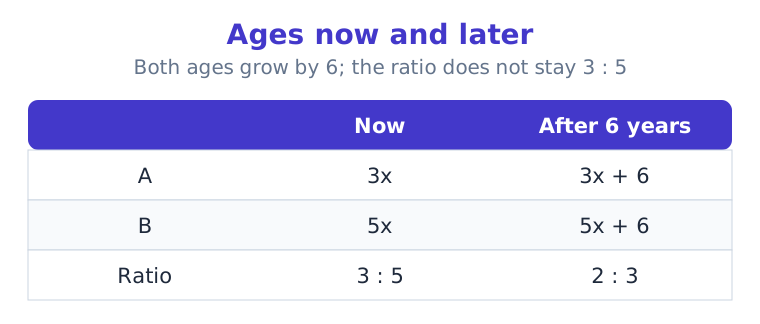
At Neha's birthday party her uncle says, "Your age and your brother's are in the ratio 3 : 5 now. In 6 years they will be in the ratio 2 : 3." Neha wants to know her brother's age. Two facts, two times: this is an age problem.
Write the ages with one letter
A ratio 3 : 5 becomes ages $3x$ and $5x$. One unknown is enough.
Move both ages together
After 6 years: $3x + 6$ and $5x + 6$. Everyone gets older by the same number of years.
Solve Neha's riddle
$\frac{3x + 6}{5x + 6} = \frac{2}{3}$ gives $9x + 18 = 10x + 12$, so $x = 6$. Neha is $3 \times 6 = 18$ and her brother is 30. Check: in 6 years, 24 : 36 = 2 : 3.
The gap never changes
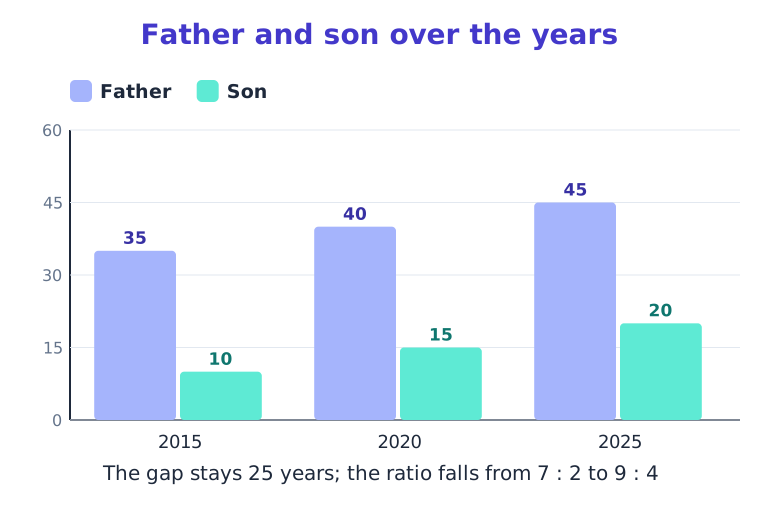
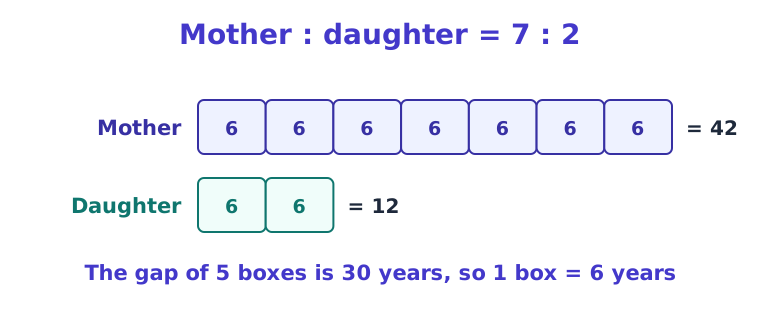
A father 25 years older than his son is 25 years older on every birthday. The ratio shrinks, the gap stays.
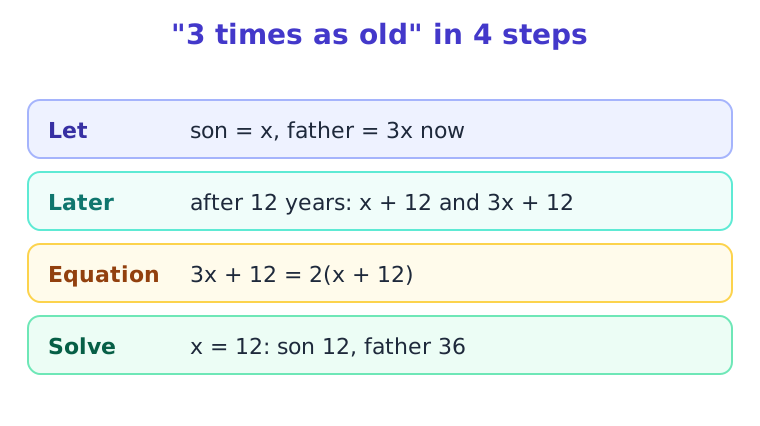
"k times as old"
If the father is 3 times as old as the son now, write son $= x$, father $= 3x$. A later condition gives one equation in $x$.
Averages and groups
Total age = number of people × average. In 3 years, a family of 4 adds $4 \times 3 = 12$ years to its total.
Children at equal intervals
Five children born 3 years apart have ages $y, y + 3, y + 6, y + 9, y + 12$. If the sum is 50, then $5y + 30 = 50$ and the youngest is 4.
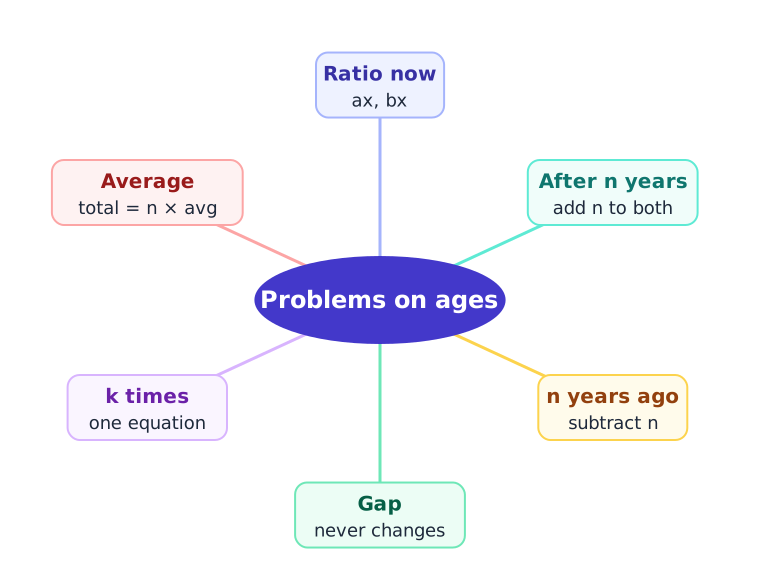
Concepts and terms
Ages in the ratio a : b are written ax and bx with one unknown x.
Both people age equally, so their difference is the same in every year.
Total age = count × average. After t years, the total grows by count × t.
Did you know
Age puzzles are very old: the Greek Anthology, about 1,500 years old, gives Diophantus's age as a riddle whose answer is 84.
Memory tricks
Ages move together — Same years to everyone — Add (or subtract) the same n to every age, never to just one.
Gap — The gap is glued — Father − son is the same on every birthday.
Practice MCQs with answers (58)
- A 6 years
- B 18 years
- C 36 years
- D 30 years
Show answer
Why:
Ages 3x and 5x. (3x + 6) : (5x + 6) = 2 : 3 gives 3(3x + 6) = 2(5x + 6), so x = 6. Ages 18 and 30. Check: 24 : 36 = 2 : 3.
- A 16 years
- B 20 years
- C 4 years
- D 28 years
Show answer
Why:
Ages 4x and 7x. (4x + 4) : (7x + 4) = 5 : 8 gives 8(4x + 4) = 5(7x + 4), so x = 4. Ages 16 and 28. Check: 20 : 32 = 5 : 8.
- A 30 years
- B 66 years
- C 78 years
- D 6 years
Show answer
Why:
Ages 5x and 6x. (5x + 6) : (6x + 6) = 6 : 7 gives 7(5x + 6) = 6(6x + 6), so x = 6. Ages 30 and 36. Check: 36 : 42 = 6 : 7.
- A 20 years
- B 8 years
- C 16 years
- D 24 years
Show answer
Why:
Ages 2x and 3x. (2x + 4) : (3x + 4) = 5 : 7 gives 7(2x + 4) = 5(3x + 4), so x = 8. Ages 16 and 24. Check: 20 : 28 = 5 : 7.
- A 35 years
- B 7 years
- C 21 years
- D 28 years
Show answer
Why:
Ages 3x and 4x. (3x + 7) : (4x + 7) = 4 : 5 gives 5(3x + 7) = 4(4x + 7), so x = 7. Ages 21 and 28. Check: 28 : 35 = 4 : 5.
- A 28 years
- B 4 years
- C 36 years
- D 32 years
Show answer
Why:
Ages 7x and 9x. (7x + 4) : (9x + 4) = 4 : 5 gives 5(7x + 4) = 4(9x + 4), so x = 4. Ages 28 and 36. Check: 32 : 40 = 4 : 5.
- A 20 years
- B 52 years
- C 68 years
- D 4 years
Show answer
Why:
Ages 5x and 8x. (5x + 8) : (8x + 8) = 7 : 10 gives 10(5x + 8) = 7(8x + 8), so x = 4. Ages 20 and 32. Check: 28 : 40 = 7 : 10.
- A 4 years
- B 28 years
- C 20 years
- D 16 years
Show answer
Why:
Ages 5x and 7x. (5x − 4) : (7x − 4) = 2 : 3 gives 3(5x − 4) = 2(7x − 4), so x = 4. Ages 20 and 28. Check: 16 : 24 = 2 : 3.
- A 36 years
- B 6 years
- C 48 years
- D 42 years
Show answer
Why:
Ages 6x and 7x. (6x − 6) : (7x − 6) = 5 : 6 gives 6(6x − 6) = 5(7x − 6), so x = 6. Ages 36 and 42. Check: 30 : 36 = 5 : 6.
- A 28 years
- B 20 years
- C 7 years
- D 35 years
Show answer
Why:
Ages 4x and 5x. (4x − 8) : (5x − 8) = 20 : 27 gives 27(4x − 8) = 20(5x − 8), so x = 7. Ages 28 and 35. Check: 20 : 27.
- A 40 years
- B 50 years
- C 5 years
- D 15 years
Show answer
Why:
Ages 3x and 7x. (3x − 5) : (7x − 5) = 1 : 3 gives 3(3x − 5) = 7x − 5, so x = 5. Ages 15 and 35. Check: 10 : 30 = 1 : 3.
- A 40 years
- B 5 years
- C 45 years
- D 25 years
Show answer
Why:
Ages 5x and 9x. (5x − 5) : (9x − 5) = 1 : 2 gives 2(5x − 5) = 9x − 5, so x = 5. Ages 25 and 45. Check: 20 : 40 = 1 : 2.
- A 18 years
- B 30 years
- C 6 years
- D 24 years
Show answer
Why:
6 years ago: 3x and 4x. 6 years from now each adds 12: (3x + 12) : (4x + 12) = 5 : 6, so x = 6. A was 18, so A is now 18 + 6 = 24.
- A 15 years
- B 25 years
- C 10 years
- D 20 years
Show answer
Why:
5 years ago: x and 2x. 5 years from now each adds 10: (x + 10) : (2x + 10) = 2 : 3, so x = 10. A was 10, so A is now 10 + 5 = 15.
- A 29 years
- B 24 years
- C 20 years
- D 30 years
Show answer
Why:
4 years ago: 4x and 5x. 6 years from now each adds 10: (4x + 10) : (5x + 10) = 6 : 7, so x = 5. A was 20, so A is now 20 + 4 = 24.
- A 40 years
- B 20 years
- C 30 years
- D 25 years
Show answer
Why:
One part = 60 ÷ 12 = 5. A = 35, B = 25. After 5 years B = 30.
- A 46 years
- B 26 years
- C 32 years
- D 38 years
Show answer
Why:
One part = 72 ÷ 9 = 8. A = 40, B = 32. After 6 years B = 38.
- A 33 years
- B 27 years
- C 35 years
- D 30 years
Show answer
Why:
One part = 54 ÷ 9 = 6. A = 24, B = 30. After 3 years B = 33.
- A 24 years
- B 19 years
- C 20 years
- D 31 years
Show answer
Why:
After 5 years the sum is 50 + 2 × 5 = 60. A then = 60 × 2/5 = 24, so A now = 19.
- A 30 years
- B 17 years
- C 15 years
- D 20 years
Show answer
Why:
After 5 years the sum is 45 + 2 × 5 = 55. A then = 55 × 4/11 = 20, so A now = 15.
- A 32 years
- B 36 years
- C 30 years
- D 28 years
Show answer
Why:
After 4 years the sum is 64 + 2 × 4 = 72. A then = 72 × 4/9 = 32, so A now = 28.
- A 12 years
- B 24 years
- C 14 years
- D 36 years
Show answer
Why:
Son x, father 3x. 3x + 12 = 2(x + 12) gives x = 12. Father 36. Check: 48 = 2 × 24.
- A 5 years
- B 10 years
- C 40 years
- D 15 years
Show answer
Why:
Son x, father 4x. 4x + 5 = 3(x + 5) gives x = 10. Father 40. Check: 45 = 3 × 15.
- A 16 years
- B 10 years
- C 8 years
- D 40 years
Show answer
Why:
Son x, father 5x. 5x + 8 = 3(x + 8) gives 2x = 16, so x = 8. Father 40. Check: 48 = 3 × 16.
- A 3 years
- B 54 years
- C 15 years
- D 9 years
Show answer
Why:
Son x, father 6x. 6x + 6 = 4(x + 6) gives 2x = 18, so x = 9. Father 54. Check: 60 = 4 × 15.
- A 8 years
- B 4 years
- C 24 years
- D 12 years
Show answer
Why:
Daughter x, mother 3x. 3x − 4 = 5(x − 4) gives 2x = 16, so x = 8. Mother 24. Check: 20 = 5 × 4.
- A 18 years
- B 9 years
- C 15 years
- D 3 years
Show answer
Why:
Daughter x, mother 2x. 2x − 6 = 4(x − 6) gives 2x = 18, so x = 9. Mother 18. Check: 12 = 4 × 3.
- A 40 years
- B 15 years
- C 10 years
- D 45 years
Show answer
Why:
The gap 30 never changes. Then father = 3 × son, so the gap = (3 − 1) × son's age then, giving son then = 30 ÷ 2 = 15. Son now = 15 − 5 = 10.
- A 12 years
- B 36 years
- C 32 years
- D 8 years
Show answer
Why:
The gap 24 never changes. Then father = 3 × son, so the gap = (3 − 1) × son's age then, giving son then = 24 ÷ 2 = 12. Son now = 12 − 4 = 8.
- A 5 years
- B 8 years
- C 40 years
- D 37 years
Show answer
Why:
The gap 32 never changes. Then father = 5 × son, so the gap = (5 − 1) × son's age then, giving son then = 32 ÷ 4 = 8. Son now = 8 − 3 = 5.
- A 17 years
- B 43 years
- C 13 years
- D 39 years
Show answer
Why:
Gap 26 = (3 − 1) × son's age then, so son then = 13 and son now = 17. Father now = 17 + 26 = 43.
- A 50 years
- B 16 years
- C 56 years
- D 10 years
Show answer
Why:
Gap 40 = (5 − 1) × son's age then, so son then = 10 and son now = 16. Father now = 16 + 40 = 56.
- A 35 years
- B 41 years
- C 43 years
- D 40 years
Show answer
Why:
Now the three total 3 × (27 + 3) = 90. Wife and child now total 2 × (20 + 5) = 50. Husband = 90 − 50 = 40.
- A 46 years
- B 32 years
- C 48 years
- D 42 years
Show answer
Why:
Now the three total 3 × (30 + 2) = 96. Wife and child now total 2 × (21 + 4) = 50. Husband = 96 − 50 = 46.
- A 20 years
- B 19 years
- C 23 years
- D 28 years
Show answer
Why:
Couple now: 2 × (23 + 5) = 56. With the child: 56 + 1 = 57. Average = 57 ÷ 3 = 19.
- A 22 years
- B 24 years
- C 23 years
- D 33 years
Show answer
Why:
Couple now: 2 × (26 + 7) = 66. With the child: 66 + 3 = 69. Average = 69 ÷ 3 = 23.
- A 15 years
- B 30 years
- C 75 years
- D 45 years
Show answer
Why:
New total = 31 × 15 = 465. Old total = 30 × 14 = 420. Teacher = 45.
- A 37 years
- B 13 years
- C 24 years
- D 61 years
Show answer
Why:
New total = 25 × 13 = 325. Old total = 24 × 12 = 288. Teacher = 37.
- A 7 years
- B 4 years
- C 16 years
- D 10 years
Show answer
Why:
Ages y, y + 3, …, y + 12. Sum = 5y + 30 = 50, so y = 4. Youngest = 4.
- A 9 years
- B 8 years
- C 12 years
- D 6 years
Show answer
Why:
Ages y, y + 2, …, y + 6. Sum = 4y + 12 = 36, so y = 6. Eldest = 12.
- A 12 years
- B 9 years
- C 17 years
- D 7 years
Show answer
Why:
Ages y, y + 2, …, y + 10. Sum = 6y + 30 = 72, so y = 7. Youngest = 7.
- A 16 years
- B 8 years
- C 12 years
- D 10 years
Show answer
Why:
Ages y, y + 2, …, y + 8. Sum = 5y + 20 = 60, so y = 8. Eldest = 16.
- A 16 years
- B 12 years
- C 13 years
- D 10 years
Show answer
Why:
x(x + 4) = 192. Try factors of 192 that differ by 4: 12 × 16 = 192. So B = 12.
- A 15 years
- B 12 years
- C 10 years
- D 8 years
Show answer
Why:
x(x + 5) = 150. Try factors of 150 that differ by 5: 10 × 15 = 150. So B = 10.
- A 20 years
- B 16 years
- C 12 years
- D 14 years
Show answer
Why:
x(x + 6) = 280. Try factors of 280 that differ by 6: 14 × 20 = 280. So B = 14.
- A stays the same every year
- B decreases every year
- C doubles in 10 years
- D increases every year
Show answer
Why:
Both get one year older each year, so the difference is fixed.
- A becomes 0
- B gets closer to 1
- C stays the same
- D keeps increasing
Show answer
Why:
The gap is fixed while both ages grow, so their ratio moves toward 1.
- A 7x and 9x
- B 3x + 4 and 5x
- C 3x + 4 and 5x + 4
- D 3(x + 4) and 5(x + 4)
Show answer
Why:
Add 4 years to each age.
- A 25 years
- B 29 years
- C 45 years
- D 30 years
Show answer
Why:
Every person adds 5 years, so the average also rises by 5.
- A 26 years
- B 14 years
- C 66 years
- D 40 years
Show answer
Why:
The gap never changes: still 26 years.
- A Both A and R are true, and R is the correct explanation of A
- B Both A and R are true, but R is not the correct explanation of A
- C A is true but R is false
- D A is false but R is true
Show answer
Why:
A = 20, B = 10: after 10 years 30 and 20, not double. A is false; R is true.
- A Both A and R are true, and R is the correct explanation of A
- B Both A and R are true, but R is not the correct explanation of A
- C A is true but R is false
- D A is false but R is true
Show answer
Why:
5 × 6 = 30. R explains A.
- A 1 only
- B 2 only
- C Both 1 and 2
- D Neither 1 nor 2
Show answer
Why:
The gap is fixed, so 1 is true. Equal ages stay equal, so 2 is true.
- A 1 only
- B 2 only
- C Both 1 and 2
- D Neither 1 nor 2
Show answer
Why:
After 6 years the ages are 3x + 6 and 5x + 6, so 1 is false. Two people add 1 year each, so 2 is true.
- A 45 years
- B 40 years
- C 50 years
- D 10 years
Show answer
Why:
(4x + 5) : (5x + 5) = 9 : 11 gives 44x + 55 = 45x + 45, so x = 10 and A = 40.
- A 42 years
- B 6 years
- C 12 years
- D 15 years
Show answer
Why:
The gap is 5 boxes = 30 years, so 1 box = 6. Son = 2 × 6 = 12.
- A 24 years
- B 12 years
- C 6 years
- D 8 years
Show answer
Why:
Now the sum is 36. Each year adds 3, so (60 − 36) ÷ 3 = 8 years.
- A 5 : 3
- B 4 : 3
- C 3 : 5
- D 2 : 1
Show answer
Why:
After 4 years: Tara 20, Riya 12. 20 : 12 = 5 : 3.
Important short questions (3)
(4x + 4)/(7x + 4) = 5/8 gives 32x + 32 = 35x + 20, x = 4. Ages 16 and 28.
Gap 30 = 2 × son then, so son then 15 and now 10.
31 × 15 − 30 × 14 = 465 − 420 = 45.
Long answer questions (1)
(a) 3x and 4x.
(b) Twelve years later: (3x + 12) : (4x + 12) = 5 : 6, so 18x + 72 = 20x + 60.
(c) x = 6. Six years ago 18 and 24, so now 24 and 30. Check: in six years 30 : 36 = 5 : 6.
Flashcards (12)
Play this topic
- Ages: true or false?
Veda Skills Quantitative Aptitude Unit 4 — frequently asked questions
120 : 80 = 3 : 2.
One part = 5,400 ÷ 18 = 300. Shares ₹1,200, ₹1,500, ₹2,700.
Make B = 12: 9 : 12 and 12 : 14, so 9 : 12 : 14.
Ratio 3 : 2. A ₹12,000, B ₹8,000.
50,000 × 12 : 40,000 × 9 = 600 : 360 = 5 : 3.
1/3 : 1/4 : 1/6 = 4 : 3 : 2.
(4x + 4)/(7x + 4) = 5/8 gives 32x + 32 = 35x + 20, x = 4. Ages 16 and 28.
Gap 30 = 2 × son then, so son then 15 and now 10.
31 × 15 − 30 × 14 = 465 − 420 = 45.

All Veda Skills Quantitative Aptitude units
All Quantitative Aptitude units · All Skills & Exams courses
Study this chapter properly, free
Everything above is on this page to read. In the Veda app the same chapter becomes spaced-repetition flashcards, timed tests that mark themselves, Veda Bites you can swipe, and games — with your progress tracked topic by topic.
Get Veda free