Veda Skills Quantitative Aptitude Unit 16: Trigonometry

Trigonometry is Unit 16 of Veda Skills Quantitative Aptitude. This page has the complete chapter notes across 2 topics, 125 practice MCQs with answers and explanations, 9 important short and long questions and 28 flashcards, written for SSC, Bank, Railway and placement exams and free to read.
  • 2 topics
  • 125 MCQs
  • 7 short answers
  • 2 long answers
  • 28 flashcards
  • 2 games
  • ~120 min read
  • English

Checked before publishing: 23 automated checks, including a plagiarism check against the textbook's own words. How we check our content

Trigonometric Ratios and Identities

The six trigonometric ratios in a right triangle, standard values at 0°, 30°, 45°, 60° and 90°, the three Pythagorean identities, complementary angles, and the maximum and minimum questions of harder exams.

What you will be able to do

  • I can write all six trigonometric ratios from the sides of a right triangle.
  • I can find all ratios when one ratio is given.
  • I can evaluate expressions using the values at 0°, 30°, 45°, 60° and 90°.
  • I can simplify using the three identities and complementary angles.
  • I can find the maximum and minimum of simple trigonometric expressions.

Key points

  • $\sin\theta$ = opposite/hypotenuse, $\cos\theta$ = adjacent/hypotenuse, $\tan\theta$ = opposite/adjacent.

  • $\operatorname{cosec}\theta$, $\sec\theta$, $\cot\theta$ are the reciprocals of $\sin\theta$, $\cos\theta$, $\tan\theta$.

  • $\tan\theta = \frac{\sin\theta}{\cos\theta}$.

  • $\sin 30^\circ = \frac{1}{2}$, $\sin 45^\circ = \frac{1}{\sqrt{2}}$, $\sin 60^\circ = \frac{\sqrt{3}}{2}$; cosines run in reverse.

  • $\tan 30^\circ = \frac{1}{\sqrt{3}}$, $\tan 45^\circ = 1$, $\tan 60^\circ = \sqrt{3}$.

  • $\sin^2\theta + \cos^2\theta = 1$, $\sec^2\theta - \tan^2\theta = 1$, $\operatorname{cosec}^2\theta - \cot^2\theta = 1$.

  • $\sin(90^\circ - \theta) = \cos\theta$, $\tan(90^\circ - \theta) = \cot\theta$, $\sec(90^\circ - \theta) = \operatorname{cosec}\theta$.

  • If $\sec\theta + \tan\theta = k$, then $\sec\theta - \tan\theta = \frac{1}{k}$.

  • The greatest value of $a\sin\theta + b\cos\theta$ is $\sqrt{a^2 + b^2}$ and the least is $-\sqrt{a^2 + b^2}$.

Full explanation

Meena's ramp

A student on a beach looking up at a lighthouse, a long evening shadow on the sand.

Meena is building a ramp 13 m long that rises 5 m. The carpenter asks: "What is the angle, and how far along the ground does it run?" Both answers come from the ratios of the sides of a right triangle. Those ratios are trigonometry.

Naming the sides
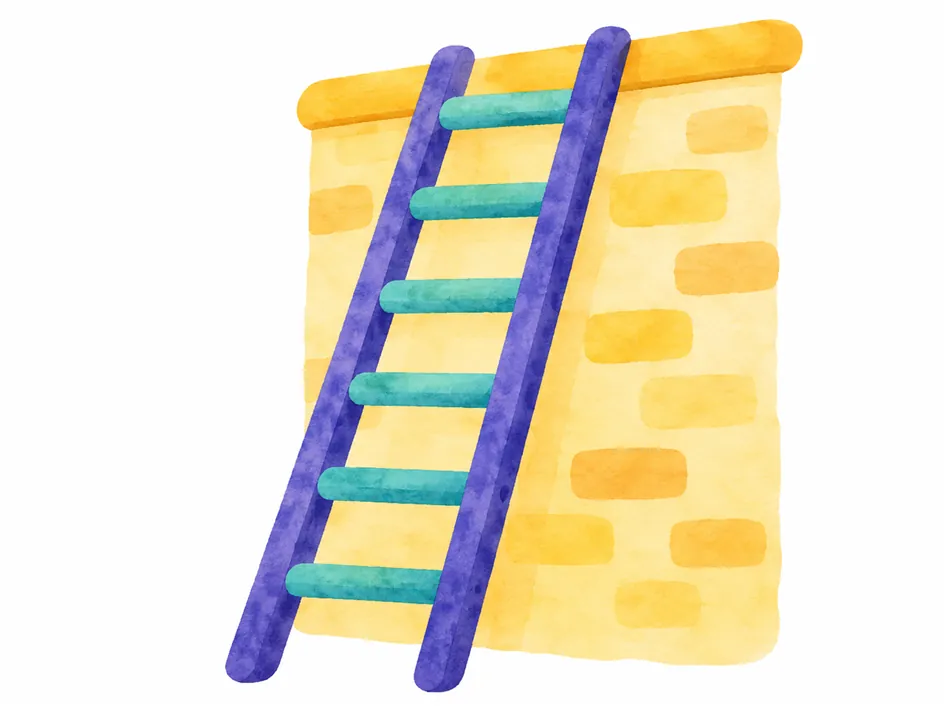
A ladder leaning against a wall.

Mark the angle $\theta$. The side across from it is the opposite, the side next to it (not the hypotenuse) is the adjacent, and the longest side, across from the right angle, is the hypotenuse.

$$\sin\theta = \frac{\text{opp}}{\text{hyp}}, \quad \cos\theta = \frac{\text{adj}}{\text{hyp}}, \quad \tan\theta = \frac{\text{opp}}{\text{adj}}$$
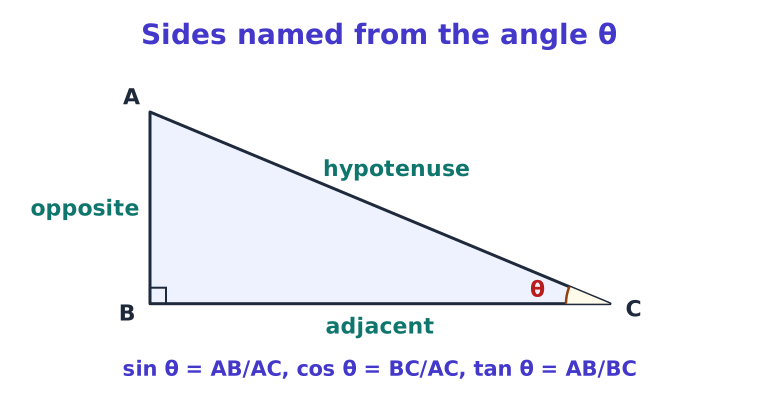
Right triangle ABC with the right angle at B and θ at C; AB is the opposite side, BC the adjacent side and AC the hypotenuse.

The other three ratios

$\displaystyle \operatorname{cosec}\theta = \frac{1}{\sin\theta}, \quad \sec\theta = \frac{1}{\cos\theta}, \quad \cot\theta = \frac{1}{\tan\theta} = \frac{\cos\theta}{\sin\theta}$

So you only ever need to find three; flip them for the rest.

One ratio gives all

If $\tan\theta = \frac{5}{12}$, draw a triangle with opposite 5 and adjacent 12. Pythagoras gives the hypotenuse 13, and now every ratio is read off: $\sin\theta = \frac{5}{13}$, $\cos\theta = \frac{12}{13}$. Learn the triples 3-4-5, 5-12-13, 8-15-17, 7-24-25.
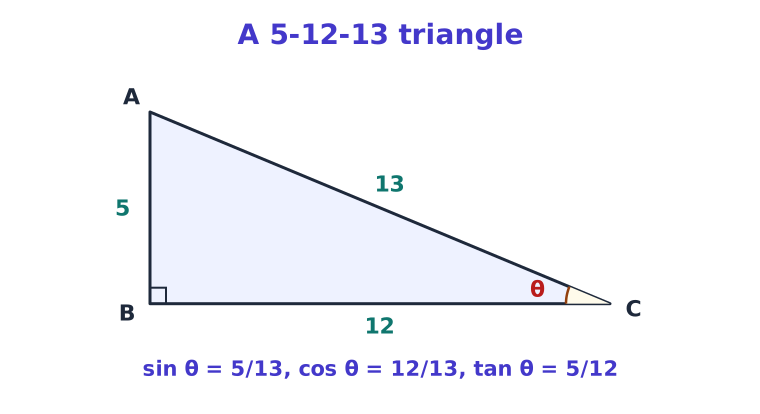
Right triangle with sides 5, 12 and 13 and angle θ at C; sin θ = 5/13, cos θ = 12/13, tan θ = 5/12.

Standard angles

Halve an equilateral triangle of side 2 to get a 30-60-90 triangle with sides $1, \sqrt{3}, 2$. Halve a unit square along its diagonal to get a 45-45-90 triangle with sides $1, 1, \sqrt{2}$. Every standard value is a ratio of these sides.
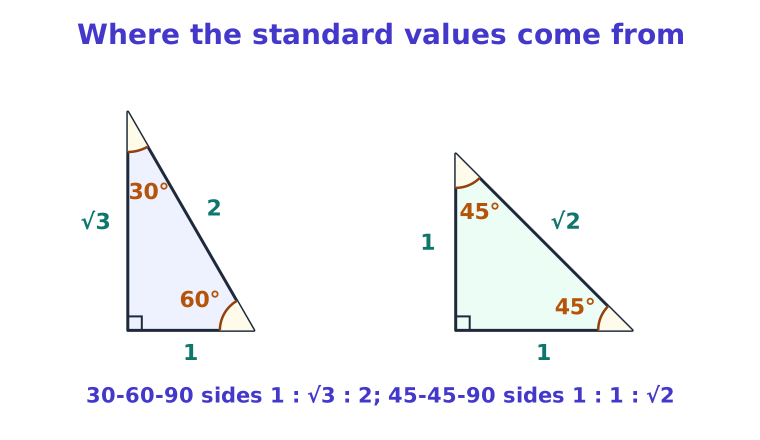
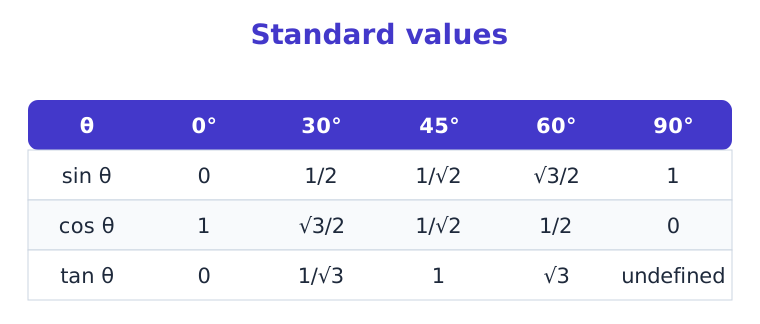
Two set squares: a 30-60-90 triangle with sides 1, √3 and 2, and a 45-45-90 triangle with sides 1, 1 and √2.

Table of sin, cos and tan at 0°, 30°, 45°, 60° and 90°.

The three identities

Divide $\text{opp}^2 + \text{adj}^2 = \text{hyp}^2$ by $\text{hyp}^2$, by $\text{adj}^2$ and by $\text{opp}^2$:

$\displaystyle \sin^2\theta + \cos^2\theta = 1, \quad 1 + \tan^2\theta = \sec^2\theta, \quad 1 + \cot^2\theta = \operatorname{cosec}^2\theta$

A useful consequence: $(\sec\theta + \tan\theta)(\sec\theta - \tan\theta) = 1$.

Complementary angles

In a right triangle the two acute angles add to 90°, and the opposite side of one is the adjacent side of the other. So

$\displaystyle \sin(90^\circ - \theta) = \cos\theta, \quad \tan(90^\circ - \theta) = \cot\theta, \quad \sec(90^\circ - \theta) = \operatorname{cosec}\theta$

That is why $\frac{\sin 37^\circ}{\cos 53^\circ} = 1$ and $\tan 10^\circ \tan 80^\circ = 1$.
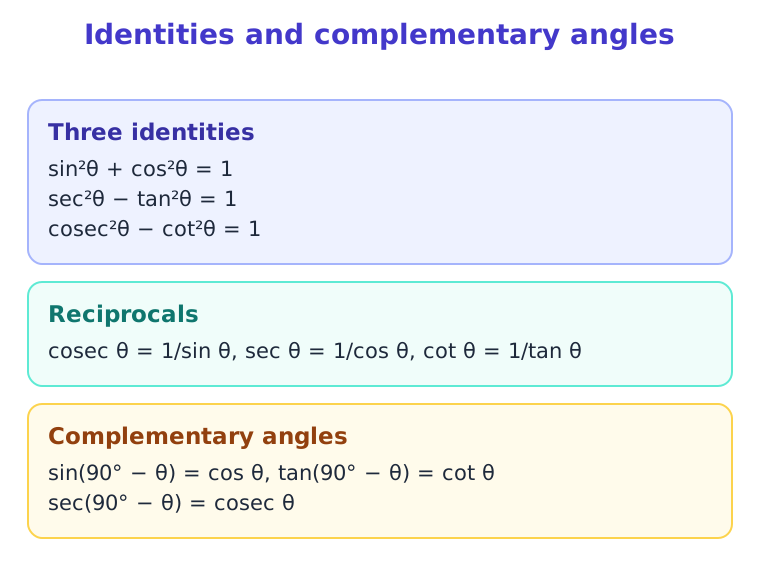
Cards listing the three identities, the reciprocal ratios and the complementary-angle rules.

Greatest and least values

$a\sin\theta + b\cos\theta$ swings between $-\sqrt{a^2 + b^2}$ and $\sqrt{a^2 + b^2}$. So $3\sin\theta + 4\cos\theta$ is at most 5. For a sum like $9\tan^2\theta + 4\cot^2\theta$, AM ≥ GM gives the least value $2\sqrt{9 \times 4} = 12$.

Meena's answers

Opposite 5, hypotenuse 13: $\sin\theta = \frac{5}{13}$. The ground run is the adjacent side, $\sqrt{169 - 25} = 12$ m, and $\tan\theta = \frac{5}{12}$. A whole topic built on one triangle and Pythagoras.
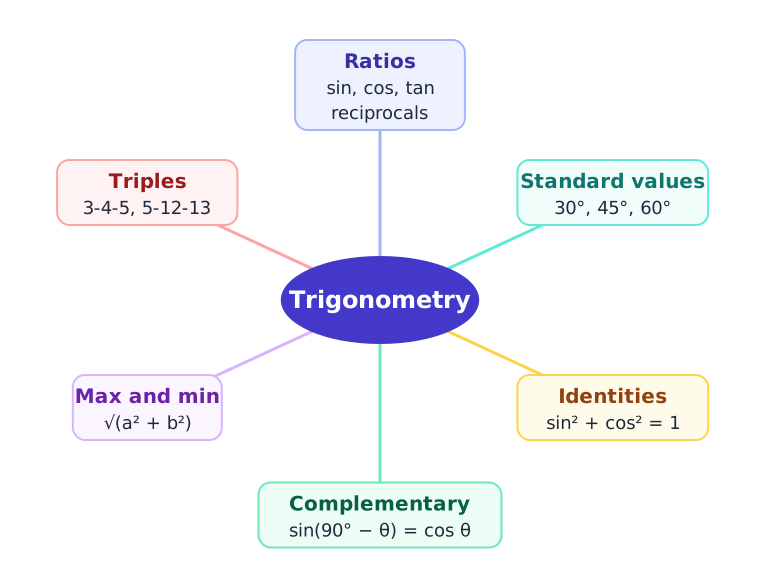
Mind map: ratios, standard values, identities, complementary angles, maximum and minimum, and triples around Trigonometry.

Concepts and terms

Trigonometric ratio

A ratio of two sides of a right triangle, fixed by the angle alone and not by the size of the triangle.

Identity

An equation true for every angle, such as sin²θ + cos²θ = 1, which is Pythagoras divided by the hypotenuse squared.

Complementary angles

Two angles adding to 90°. The two acute angles of a right triangle are complementary, so the sine of one is the cosine of the other.

Range of values

sin θ and cos θ lie between −1 and 1; sec θ and $\operatorname{cosec}$ θ are never between −1 and 1; tan θ can be any number.

Did you know

The word "sine" comes from Aryabhata's "jya" (bow-string), which travelled through Arabic "jiba" and was misread in Latin as "sinus".

Memory tricks

Three basic ratios — SOH-CAH-TOA — Sine = Opposite/Hypotenuse, Cosine = Adjacent/Hypotenuse, Tangent = Opposite/Adjacent.

Sine values — √0/2, √1/2, √2/2, √3/2, √4/2 — For 0°, 30°, 45°, 60°, 90°. Read the same list backwards for cosine.

Practice MCQs with answers (68)

Q1 In the right triangle ABC shown, find $\sin\theta$. ![Right triangle ABC, right angle at B, angle θ at C; AB = 5, BC = 12.](/syllabus/veda-skills-0-quantitative-aptitude-en/ch16/q-rt-1.svg) beginner
  • A 5/12
  • B 5/13
  • C 13/5
  • D 12/13
Show answer
Answer: 5/13
Why:

AC = √(5² + 12²) = 13. $\sin\theta$ = AB/AC = 5/13.

Q2 In the right triangle ABC shown, find $\cos\theta$. ![Right triangle ABC, right angle at B, angle θ at C; AB = 3, AC = 5.](/syllabus/veda-skills-0-quantitative-aptitude-en/ch16/q-rt-2.svg) beginner
  • A 3/4
  • B 5/3
  • C 4/5
  • D 3/5
Show answer
Answer: 4/5
Why:

BC = √(5² − 3²) = 4. $\cos\theta$ = BC/AC = 4/5.

Q3 In the right triangle ABC shown, find $\tan\theta$. ![Right triangle ABC, right angle at B, angle θ at C; BC = 15, AC = 17.](/syllabus/veda-skills-0-quantitative-aptitude-en/ch16/q-rt-3.svg) intermediate
  • A 8/17
  • B 15/17
  • C 17/8
  • D 8/15
Show answer
Answer: 8/15
Why:

AB = √(17² − 15²) = 8. $\tan\theta$ = AB/BC = 8/15.

Q4 In the right triangle ABC shown, find $\sec\theta$. ![Right triangle ABC, right angle at B, angle θ at C; AB = 24, BC = 7.](/syllabus/veda-skills-0-quantitative-aptitude-en/ch16/q-rt-4.svg) intermediate
  • A 25/7
  • B 24/7
  • C 24/25
  • D 7/25
Show answer
Answer: 25/7
Why:

AC = √(24² + 7²) = 25. $\sec\theta$ = AC/BC = 25/7.

Q5 In the right triangle ABC shown, find $\cot\theta$. ![Right triangle ABC, right angle at B, angle θ at C; AB = 20, AC = 29.](/syllabus/veda-skills-0-quantitative-aptitude-en/ch16/q-rt-5.svg) intermediate
  • A 20/21
  • B 21/20
  • C 20/29
  • D 21/29
Show answer
Answer: 21/20
Why:

BC = √(29² − 20²) = 21. $\cot\theta$ = BC/AB = 21/20.

Q6 In the right triangle ABC shown, find $\operatorname{cosec}\theta$. ![Right triangle ABC, right angle at B, angle θ at C; BC = 40, AC = 41.](/syllabus/veda-skills-0-quantitative-aptitude-en/ch16/q-rt-6.svg) advanced
  • A 9/40
  • B 9/41
  • C 41/9
  • D 40/41
Show answer
Answer: 41/9
Why:

AB = √(41² − 40²) = 9. $\operatorname{cosec}\theta$ = AC/AB = 41/9.

Q7 In the right triangle ABC shown, find $\cos\theta$. ![Right triangle ABC, right angle at B, angle θ at C; AB = 12, BC = 5.](/syllabus/veda-skills-0-quantitative-aptitude-en/ch16/q-rt-7.svg) beginner
  • A 13/12
  • B 12/13
  • C 12/5
  • D 5/13
Show answer
Answer: 5/13
Why:

AC = √(12² + 5²) = 13. $\cos\theta$ = BC/AC = 5/13.

Q8 In the right triangle ABC shown, find $\tan\theta$. ![Right triangle ABC, right angle at B, angle θ at C; AB = 15, AC = 17.](/syllabus/veda-skills-0-quantitative-aptitude-en/ch16/q-rt-8.svg) intermediate
  • A 15/8
  • B 15/17
  • C 8/17
  • D 17/15
Show answer
Answer: 15/8
Why:

BC = √(17² − 15²) = 8. $\tan\theta$ = AB/BC = 15/8.

Q9 In the right triangle ABC shown, find $\sin\theta$. ![Right triangle ABC, right angle at B, angle θ at C; BC = 24, AC = 25.](/syllabus/veda-skills-0-quantitative-aptitude-en/ch16/q-rt-9.svg) intermediate
  • A 25/7
  • B 7/25
  • C 24/25
  • D 7/24
Show answer
Answer: 7/25
Why:

AB = √(25² − 24²) = 7. $\sin\theta$ = AB/AC = 7/25.

Q10 In the right triangle ABC shown, find $\operatorname{cosec}\theta$. ![Right triangle ABC, right angle at B, angle θ at C; AB = 4, BC = 3.](/syllabus/veda-skills-0-quantitative-aptitude-en/ch16/q-rt-10.svg) beginner
  • A 4/3
  • B 4/5
  • C 5/4
  • D 3/5
Show answer
Answer: 5/4
Why:

AC = √(4² + 3²) = 5. $\operatorname{cosec}\theta$ = AC/AB = 5/4.

Q11 If $\tan\theta = \frac{5}{12}$ and θ is acute, find $\sin\theta$. intermediate
  • A 13/5
  • B 13/12
  • C 12/13
  • D 5/13
Show answer
Answer: 5/13
Why:

Sides 5, 12, 13 (opposite, adjacent, hypotenuse). $\sin\theta$ = 5/13.

Q12 If $\sin\theta = \frac{3}{5}$ and θ is acute, find $\tan\theta$. beginner
  • A 3/4
  • B 5/3
  • C 5/4
  • D 4/5
Show answer
Answer: 3/4
Why:

Sides 3, 4, 5 (opposite, adjacent, hypotenuse). $\tan\theta$ = 3/4.

Q13 If $\cos\theta = \frac{8}{17}$ and θ is acute, find $\operatorname{cosec}\theta$. intermediate
  • A 17/8
  • B 17/15
  • C 15/17
  • D 15/8
Show answer
Answer: 17/15
Why:

Sides 15, 8, 17 (opposite, adjacent, hypotenuse). $\operatorname{cosec}\theta$ = 17/15.

Q14 If $\sec\theta = \frac{25}{24}$ and θ is acute, find $\cot\theta$. advanced
  • A 7/24
  • B 7/25
  • C 24/7
  • D 24/25
Show answer
Answer: 24/7
Why:

Sides 7, 24, 25 (opposite, adjacent, hypotenuse). $\cot\theta$ = 24/7.

Q15 If $\cot\theta = \frac{21}{20}$ and θ is acute, find $\sin\theta$. intermediate
  • A 20/21
  • B 29/20
  • C 21/29
  • D 20/29
Show answer
Answer: 20/29
Why:

Sides 20, 21, 29 (opposite, adjacent, hypotenuse). $\sin\theta$ = 20/29.

Q16 If $\tan\theta = \frac{3}{4}$, find the value of $\frac{2\sin\theta + \cos\theta}{2\sin\theta - \cos\theta}$. intermediate
  • A 5
  • B 1/5
  • C 3
  • D -5
Show answer
Answer: 5
Why:

Divide top and bottom by $\cos\theta$: (2 × 3/4 + 1) ÷ (2 × 3/4 − 1) = 10/2 = 5.

Q17 If $\tan\theta = \frac{5}{12}$, find the value of $\frac{3\sin\theta + 2\cos\theta}{4\sin\theta - \cos\theta}$. advanced
  • A 8/39
  • B 39/8
  • C 5/3
  • D -9/32
Show answer
Answer: 39/8
Why:

Divide top and bottom by $\cos\theta$: (3 × 5/12 + 2) ÷ (4 × 5/12 − 1) = 39/8.

Q18 If $\tan\theta = \frac{4}{3}$, find the value of $\frac{\sin\theta + \cos\theta}{2\sin\theta - \cos\theta}$. intermediate
  • A 2
  • B 1/11
  • C 7/5
  • D 5/7
Show answer
Answer: 7/5
Why:

Divide top and bottom by $\cos\theta$: (1 × 4/3 + 1) ÷ (2 × 4/3 − 1) = 7/5.

Q19 Find the value of $\sin 30^\circ + \cos 60^\circ$. beginner
  • A 2
  • B 1/2
  • C 3/2
  • D 1
Show answer
Answer: 1
Why:

Put in the standard values: 1/2 + 1/2 = 1.

Q20 Find the value of $\sin^2 60^\circ + \cos^2 60^\circ$. beginner
  • A 1
  • B 3/2
  • C 2
  • D 1/2
Show answer
Answer: 1
Why:

Put in the standard values: 3/4 + 1/4 = 1.

Q21 Find the value of $\tan^2 60^\circ - 2\sin^2 45^\circ$. beginner
  • A 3
  • B 2
  • C 3/2
  • D 4
Show answer
Answer: 2
Why:

Put in the standard values: 3 − 2 × 1/2 = 2.

Q22 Find the value of $2\sin^2 30^\circ + 3\tan^2 30^\circ - \cos^2 45^\circ$. intermediate
  • A 2
  • B 1/2
  • C 1
  • D 3/2
Show answer
Answer: 1
Why:

Put in the standard values: 2 × 1/4 + 3 × 1/3 − 1/2 = 1.

Q23 Find the value of $4\cot^2 60^\circ + \sec^2 30^\circ - 2\sin^2 45^\circ$. intermediate
  • A 10/3
  • B 8/3
  • C 7/6
  • D 5/3
Show answer
Answer: 5/3
Why:

Put in the standard values: 4 × 1/3 + 4/3 − 2 × 1/2 = 5/3.

Q24 Find the value of $\operatorname{cosec}^2 30^\circ - \cot^2 30^\circ + \sec 60^\circ$. intermediate
  • A 3
  • B 4
  • C 5/2
  • D 6
Show answer
Answer: 3
Why:

Put in the standard values: 4 − 3 + 2 = 3.

Q25 Find the value of $3\tan^2 30^\circ + \sin^2 90^\circ - \cos^2 0^\circ$. beginner
  • A 2
  • B 1
  • C 1/2
  • D 3/2
Show answer
Answer: 1
Why:

Put in the standard values: 3 × 1/3 + 1 − 1 = 1.

Q26 Find the value of $2\cos^2 60^\circ + 3\sec^2 30^\circ - 2\tan^2 45^\circ$. advanced
  • A 7/2
  • B 2
  • C 5/2
  • D 5
Show answer
Answer: 5/2
Why:

Put in the standard values: 2 × 1/4 + 3 × 4/3 − 2 × 1 = 5/2.

Q27 Find the value of $\sin^2 45^\circ + \cos^2 45^\circ + \tan 45^\circ$. beginner
  • A 4
  • B 3
  • C 3/2
  • D 2
Show answer
Answer: 2
Why:

Put in the standard values: 1/2 + 1/2 + 1 = 2.

Q28 Find the value of $\sec^2 45^\circ - \tan^2 45^\circ + 2\cos 60^\circ$. intermediate
  • A 2
  • B 3/2
  • C 4
  • D 3
Show answer
Answer: 2
Why:

Put in the standard values: 2 − 1 + 2 × 1/2 = 2.

Q29 Find the value of $\frac{\tan 60^\circ - \tan 30^\circ}{1 + \tan 60^\circ \tan 30^\circ}$. advanced
  • A 1
  • B √3/3
  • C 0.5
  • D √3
Show answer
Answer: √3/3
Why:

(√3 − 1/√3) ÷ (1 + 1) = (2/√3) ÷ 2 = 1/√3 = √3/3. (It is tan 30°.)

Q30 Find the value of $\sin 60^\circ \cos 30^\circ + \cos 60^\circ \sin 30^\circ$. intermediate
  • A 0.75
  • B 0.5
  • C 1
  • D √3/2
Show answer
Answer: 1
Why:

(√3/2)(√3/2) + (1/2)(1/2) = 3/4 + 1/4 = 1. (It is sin 90°.)

Q31 If $2\sin\theta = \sqrt{3}$ and θ is acute, find θ. beginner
  • A 30°
  • B 45°
  • C 90°
  • D 60°
Show answer
Answer: 60°
Why:

sin θ = √3/2, so θ = 60°.

Q32 If $\sqrt{3}\tan\theta = 1$ and θ is acute, find θ. beginner
  • A 30°
  • B 90°
  • C 60°
  • D 45°
Show answer
Answer: 30°
Why:

tan θ = 1/√3, so θ = 30°.

Q33 If $2\cos^2\theta = 1$ and θ is acute, find θ. intermediate
  • A 90°
  • B 45°
  • C 30°
  • D 60°
Show answer
Answer: 45°
Why:

cos²θ = 1/2, cos θ = 1/√2, θ = 45°.

Q34 If $\sin\theta = \cos\theta$ and θ is acute, find θ. beginner
  • A 60°
  • B 0°
  • C 45°
  • D 30°
Show answer
Answer: 45°
Why:

tan θ = 1, so θ = 45°.

Q35 If $\tan 2\theta = \sqrt{3}$ and θ is acute, find θ. intermediate
  • A 15°
  • B 45°
  • C 60°
  • D 30°
Show answer
Answer: 30°
Why:

2θ = 60°, so θ = 30°.

Q36 If $\sin\theta + \cos\theta = \frac{7}{5}$, find $\sin\theta\cos\theta$. intermediate
  • A 12/25
  • B 37/25
  • C 24/25
  • D 49/25
Show answer
Answer: 12/25
Why:

Square: 1 + 2 $\sin\theta\cos\theta$ = 49/25, so $\sin\theta\cos\theta$ = (49/25 − 1)/2 = 12/25.

Q37 If $\sin\theta + \cos\theta = \frac{17}{13}$, find $\sin\theta\cos\theta$. advanced
  • A 229/169
  • B 60/169
  • C 120/169
  • D 289/169
Show answer
Answer: 60/169
Why:

Square: 1 + 2 $\sin\theta\cos\theta$ = 289/169, so $\sin\theta\cos\theta$ = (289/169 − 1)/2 = 60/169.

Q38 If $\sec\theta + \tan\theta = 2$, find $\sec\theta - \tan\theta$. beginner
  • A 3/4
  • B 3/5
  • C 1/2
  • D 5/4
Show answer
Answer: 1/2
Why:

$(\sec\theta + \tan\theta)(\sec\theta - \tan\theta) = 1$, so $\sec\theta - \tan\theta$ = 1/2.

Q39 If $\sec\theta + \tan\theta = 3$, find $\sin\theta$. advanced
  • A 5/3
  • B 4/3
  • C 1/3
  • D 4/5
Show answer
Answer: 4/5
Why:

$(\sec\theta + \tan\theta)(\sec\theta - \tan\theta) = 1$, so $\sec\theta - \tan\theta$ = 1/3. Adding and halving: $\sec\theta$ = 5/3, so $\tan\theta$ = 4/3 and $\sin\theta$ = $\tan\theta$ ÷ $\sec\theta$ = 4/5.

Q40 If $\sec\theta + \tan\theta = \frac{5}{2}$, find $\tan\theta$. intermediate
  • A 21/20
  • B 29/20
  • C 21/29
  • D 2/5
Show answer
Answer: 21/20
Why:

$(\sec\theta + \tan\theta)(\sec\theta - \tan\theta) = 1$, so $\sec\theta - \tan\theta$ = 2/5. Adding and halving: $\sec\theta$ = 29/20, so $\tan\theta$ = 21/20.

Q41 If $\sin(3A) = \cos(A - 26^\circ)$, where both angles are acute, find A. intermediate
  • A 26°
  • B 29°
  • C 32°
  • D 34°
Show answer
Answer: 29°
Why:

Complementary: (3A) + (A - 26°) = 90°, so 4A = 116°, A = 29°.

Q42 If $\tan(2A) = \cot(A - 18^\circ)$, where both angles are acute, find A. intermediate
  • A 33°
  • B 72°
  • C 36°
  • D 41°
Show answer
Answer: 36°
Why:

Complementary: (2A) + (A - 18°) = 90°, so 3A = 108°, A = 36°.

Q43 If $\sec(4A) = \operatorname{cosec}(A - 20^\circ)$, where both angles are acute, find A. advanced
  • A 19°
  • B 32°
  • C 27°
  • D 22°
Show answer
Answer: 22°
Why:

Complementary: (4A) + (A - 20°) = 90°, so 5A = 110°, A = 22°.

Q44 If $\cos(2A + 10^\circ) = \sin(3A - 20^\circ)$, where both angles are acute, find A. intermediate
  • A 20°
  • B 17°
  • C 30°
  • D 25°
Show answer
Answer: 20°
Why:

Complementary: (2A + 10°) + (3A - 20°) = 90°, so 5A = 100°, A = 20°.

Q45 Find the value of $\frac{\sin 37^\circ}{\cos 53^\circ}$. beginner
  • A 2
  • B 1
  • C 0
  • D 37/53
Show answer
Answer: 1
Why:

cos 53° = sin 37°, so the ratio is 1.

Q46 Find $\tan 15^\circ \tan 25^\circ \tan 65^\circ \tan 75^\circ$. intermediate
  • A 0
  • B √3
  • C 1
  • D 1/√3
Show answer
Answer: 1
Why:

tan 75° = cot 15°, tan 65° = cot 25°; each pair multiplies to 1.

Q47 Find $\sin^2 20^\circ + \sin^2 70^\circ$. intermediate
  • A 0
  • B 2
  • C 1/2
  • D 1
Show answer
Answer: 1
Why:

sin 70° = cos 20°, so the sum is sin²20° + cos²20° = 1.

Q48 Find $\operatorname{cosec} 31^\circ - \sec 59^\circ$. beginner
  • A 0
  • B 2
  • C −1
  • D 1
Show answer
Answer: 0
Why:

sec 59° = $\operatorname{cosec}$ 31°, so the difference is 0.

Q49 Find $\cos 1^\circ \cos 2^\circ \cos 3^\circ \cdots \cos 100^\circ$. advanced
  • A −1
  • B 0
  • C 1
  • D 1/2
Show answer
Answer: 0
Why:

The product includes cos 90° = 0.

Q50 Simplify $(1 - \cos^2\theta)\sec^2\theta$. beginner
  • A $\cot^2\theta$
  • B $\sin^2\theta$
  • C $\tan^2\theta$
  • D $1$
Show answer
Answer: $\tan^2\theta$
Why:

sin²θ × 1/cos²θ = tan²θ.

Q51 Simplify $(\sin\theta + \cos\theta)^2 + (\sin\theta - \cos\theta)^2$. intermediate
  • A $0$
  • B $1$
  • C $4\sin\theta\cos\theta$
  • D $2$
Show answer
Answer: $2$
Why:

The cross terms cancel: 2(sin²θ + cos²θ) = 2.

Q52 Simplify $\frac{\sin\theta}{1 + \cos\theta} + \frac{1 + \cos\theta}{\sin\theta}$. advanced
  • A $2\operatorname{cosec}\theta$
  • B $2\sin\theta$
  • C $\operatorname{cosec}\theta$
  • D $2\sec\theta$
Show answer
Answer: $2\operatorname{cosec}\theta$
Why:

Numerator sin²θ + 1 + 2cos θ + cos²θ = 2(1 + cos θ); dividing by sin θ(1 + cos θ) gives 2/sin θ.

Q53 Simplify $\sec^4\theta - \tan^4\theta$. advanced
  • A $\sec^2\theta - \tan^2\theta$
  • B $\sec^2\theta + \tan^2\theta$
  • C $2\tan^2\theta$
  • D $1$
Show answer
Answer: $\sec^2\theta + \tan^2\theta$
Why:

(sec²θ − tan²θ)(sec²θ + tan²θ) = 1 × (sec²θ + tan²θ).

Q54 Simplify $\sqrt{\frac{1 - \sin\theta}{1 + \sin\theta}}$ for acute θ. advanced
  • A $\operatorname{cosec}\theta - \cot\theta$
  • B $1 - \tan\theta$
  • C $\sec\theta - \tan\theta$
  • D $\sec\theta + \tan\theta$
Show answer
Answer: $\sec\theta - \tan\theta$
Why:

Multiply inside by (1 − sin θ)/(1 − sin θ): √((1 − sin θ)²/cos²θ) = (1 − sin θ)/cos θ = sec θ − tan θ.

Q55 Which of these can never be true? beginner
  • A $\tan\theta = 5$
  • B $\sec\theta = \frac{5}{4}$
  • C $\cos\theta = \frac{1}{5}$
  • D $\sin\theta = \frac{5}{4}$
Show answer
Answer: $\sin\theta = \frac{5}{4}$
Why:

sin θ cannot exceed 1. tan θ can be any number; sec θ ≥ 1 is fine.

Q56 If $\tan\theta + \cot\theta = 2$, find $\tan^2\theta + \cot^2\theta$. intermediate
  • A $2$
  • B $0$
  • C $1$
  • D $4$
Show answer
Answer: $2$
Why:

Square: tan²θ + cot²θ + 2 = 4, so the answer is 2.

Q57 What is the greatest value of $3\sin\theta + 4\cos\theta$? advanced
  • A 4
  • B 5
  • C 25
  • D 7
Show answer
Answer: 5
Why:

Greatest value = √(3² + 4²) = √25 = 5. (Not 7: sin and cos cannot both be 1 at once.)

Q58 What is the greatest value of $5\sin\theta + 12\cos\theta$? advanced
  • A 169
  • B 17
  • C 13
  • D 12
Show answer
Answer: 13
Why:

Greatest value = √(5² + 12²) = √169 = 13. (Not 17: sin and cos cannot both be 1 at once.)

Q59 What is the least value of $8\sin\theta - 15\cos\theta$? advanced
  • A −23
  • B −15
  • C 0
  • D −17
Show answer
Answer: −17
Why:

The range of a sin θ + b cos θ is from −√(a² + b²) to √(a² + b²); here √(64 + 225) = 17, so the least is −17.

Q60 What is the least value of $9\tan^2\theta + 4\cot^2\theta$? advanced
  • A 12
  • B 36
  • C 13
  • D 6
Show answer
Answer: 12
Why:

AM ≥ GM: 9tan²θ + 4cot²θ ≥ 2√(9 × 4) = 12, reached when 9tan²θ = 4cot²θ, that is tan²θ = 2/3.

Q61 What is the least value of $16\tan^2\theta + 25\cot^2\theta$? advanced
  • A 400
  • B 40
  • C 41
  • D 20
Show answer
Answer: 40
Why:

AM ≥ GM: 16tan²θ + 25cot²θ ≥ 2√(16 × 25) = 40, reached when 16tan²θ = 25cot²θ, that is tan²θ = 5/4.

Q62 What is the greatest value of $\sin\theta\cos\theta$? advanced
  • A 2
  • B 0.25
  • C 0.5
  • D 1
Show answer
Answer: 0.5
Why:

sin θ cos θ = ½ sin 2θ, and sin 2θ is at most 1, so the greatest value is ½ = 0.5, reached at θ = 45°.

Q63 Convert $\frac{5\pi}{6}$ radians to degrees. beginner
  • A 300°
  • B 120°
  • C 135°
  • D 150°
Show answer
Answer: 150°
Why:

π rad = 180°, so 5π/6 = 5 × 30° = 150°.

Q64 Convert 135° to radians. beginner
  • A $\frac{3\pi}{4}$
  • B $\frac{3\pi}{2}$
  • C $\frac{2\pi}{3}$
  • D $\frac{5\pi}{6}$
Show answer
Answer: $\frac{3\pi}{4}$
Why:

135 × π/180 = 3π/4.

Q65 Assertion (A): $\sin 60^\circ = \cos 30^\circ$. Reason (R): $\sin(90^\circ - \theta) = \cos\theta$ for every θ. beginner
  • A Both A and R are true, and R is the correct explanation of A
  • B Both A and R are true, but R is not the correct explanation of A
  • C A is true but R is false
  • D A is false but R is true
Show answer
Answer: Both A and R are true, and R is the correct explanation of A
Why:

Both equal √3/2, and 60° = 90° − 30°, so R explains A.

Q66 Assertion (A): The greatest value of $3\sin\theta + 4\cos\theta$ is 7. Reason (R): The greatest value of $\sin\theta$ and of $\cos\theta$ is 1. advanced
  • A Both A and R are true, and R is the correct explanation of A
  • B Both A and R are true, but R is not the correct explanation of A
  • C A is true but R is false
  • D A is false but R is true
Show answer
Answer: A is false but R is true
Why:

R is true, but sin and cos are not 1 at the same θ. The greatest value is √(9 + 16) = 5, so A is false.

Q67 Consider the statements: 1. $\tan 45^\circ + \cot 45^\circ = 2$. 2. $\sin 30^\circ + \sin 60^\circ = \sin 90^\circ$. intermediate
  • A 1 only
  • B 2 only
  • C Both 1 and 2
  • D Neither 1 nor 2
Show answer
Answer: 1 only
Why:

1 + 1 = 2, true. 1/2 + √3/2 ≈ 1.37 ≠ 1, false.

Q68 Which of these statements is/are true? 1. $\sec^2\theta + \tan^2\theta = 1$. 2. $\operatorname{cosec}^2\theta - \cot^2\theta = 1$. beginner
  • A 1 only
  • B 2 only
  • C Both 1 and 2
  • D Neither 1 nor 2
Show answer
Answer: 2 only
Why:

The identity is sec²θ − tan²θ = 1, so 1 is false; 2 is a true identity.

Important short questions (4)

If $\cos\theta = \frac{8}{17}$, find all the other trigonometric ratios.

Opposite = √(289 − 64) = 15. sin θ = 15/17, tan θ = 15/8, $\operatorname{cosec}$ θ = 17/15, sec θ = 17/8, cot θ = 8/15.

Evaluate $\frac{\sin 30^\circ + \tan 45^\circ - \operatorname{cosec} 60^\circ}{\sec 30^\circ + \cos 60^\circ + \cot 45^\circ}$.

Numerator 3/2 − 2/√3, denominator 3/2 + 2/√3; multiply by 2√3: (3√3 − 4)/(3√3 + 4) = (43 − 24√3)/11.

Prove that $\frac{\tan\theta}{1 - \cot\theta} + \frac{\cot\theta}{1 - \tan\theta} = 1 + \sec\theta\operatorname{cosec}\theta$.

Put t = tan θ: t²/(t − 1) − 1/(t(t − 1)) = (t³ − 1)/(t(t − 1)) = (t² + t + 1)/t = 1 + t + 1/t = 1 + (sin²θ + cos²θ)/(sin θ cos θ) = 1 + sec θ $\operatorname{cosec}$ θ.

If $\sin(A + B) = 1$ and $\cos(A - B) = \frac{\sqrt{3}}{2}$, with A > B acute, find A and B.

A + B = 90°, A − B = 30°, so A = 60°, B = 30°.

Long answer questions (1)

(a) If $\tan\theta = \frac{3}{4}$, find $\sin\theta$ and $\cos\theta$. (b) Verify $\sin^2\theta + \cos^2\theta = 1$ for these values. (c) Find $\frac{2\sin\theta - \cos\theta}{2\sin\theta + \cos\theta}$.

(a) Sides 3, 4, 5: sin θ = 3/5, cos θ = 4/5.

(b) 9/25 + 16/25 = 25/25 = 1.

(c) Divide by cos θ: (2 × 3/4 − 1)/(2 × 3/4 + 1) = (1/2)/(5/2) = 1/5.

Flashcards (15)

sin 30°?
1/2
cos 30°?
√3/2
tan 60°?
√3
tan 30°?
1/√3
sin 45°?
1/√2
sec 60°?
2
sin²θ + cos²θ?
1
sec²θ − tan²θ?
1
sin(90° − θ)?
cos θ
tan θ = 3/4: sin θ?
3/5
cos θ = 12/13: tan θ?
5/12
Maximum of 3 sin θ + 4 cos θ?
5
tan 1° tan 89°?
1
sec θ + tan θ = 3: sec θ − tan θ?
1/3
Largest value of sin θ?
1, at 90°

Play this topic

  • Ratio check

Heights and Distances

Angles of elevation and depression, towers, shadows, ladders, broken trees, two observation points, two buildings, flagstaffs and moving objects, all solved with tan 30°, 45° and 60° and drawn to scale.

What you will be able to do

  • I can draw the right triangle hidden in a heights-and-distances question.
  • I can find a height or a distance from one angle of elevation or depression.
  • I can solve two-angle problems: two points, two buildings, a flagstaff on a building.
  • I can solve ladder and broken-tree questions using sin and cos.
  • I can find speeds of moving objects from changing angles.

Key points

  • The angle of elevation is measured up from the horizontal; the angle of depression is measured down from the horizontal.

  • The angle of depression from A to B equals the angle of elevation from B to A (alternate angles).

  • Height = distance × tan θ; distance = height × cot θ.

  • At 45° the height equals the distance; at 60° the height is √3 times it; at 30° the distance is √3 times the height.

  • Two points on the same side at 60° and 30°, a apart: height = a√3/2.

  • A ladder of length L at angle θ to the ground reaches height L sin θ, with its foot L cos θ from the wall.

  • A tree broken so that its top meets the ground at 30°, at distance d from the foot, was d√3 tall.

  • Use √3 ≈ 1.732 only when the question asks for a decimal.

Full explanation

Arjun's water tank

A boy looking up at a kite flying high above a tree.

Arjun stands 20 m from the village water tower and looks up at its top. His protractor app shows 60°. Without climbing, he can find the height. A few minutes later he walks back and the angle drops to 30°. How far did he walk?

Elevation

The angle of elevation is the angle between the horizontal and the line of sight to an object above you. Tower, ground and line of sight make a right triangle, so

$$\tan\theta = \frac{\text{height}}{\text{distance}}$$
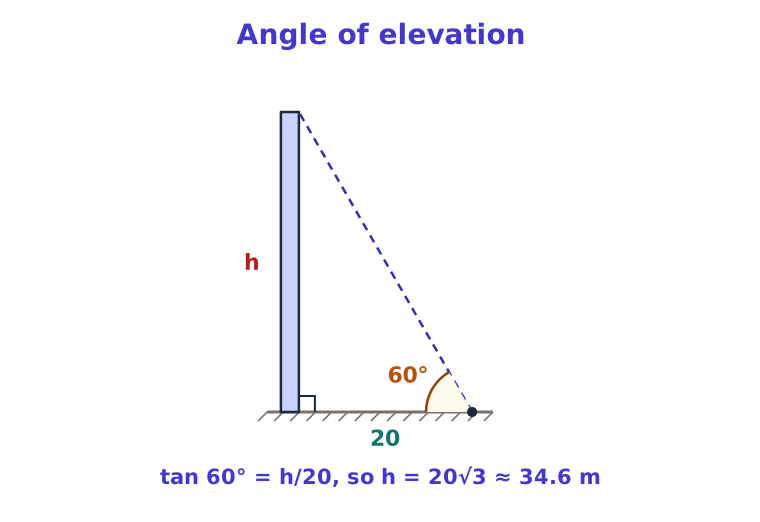
A tower of height h with an observer 20 m from its foot; the line of sight to the top makes 60° with the ground.

Depression

The angle of depression is measured down from the horizontal at the observer's eye to an object below. Because the horizontal at the top is parallel to the ground, the depression from the top equals the elevation from the bottom.
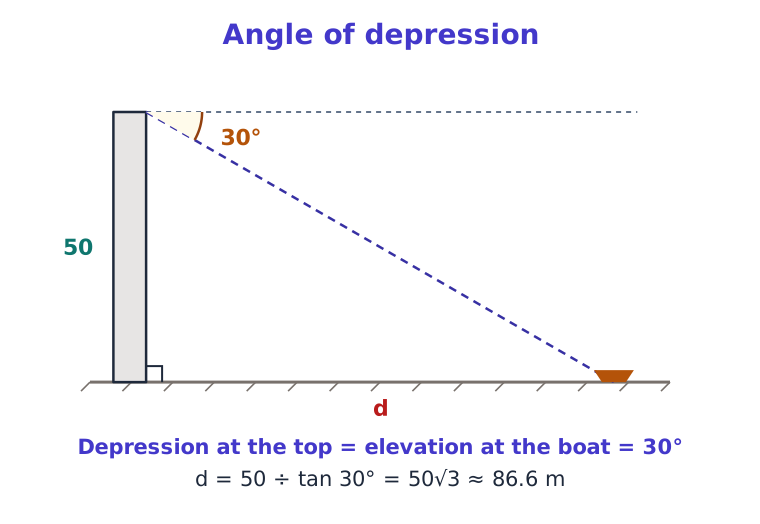
A 50 m cliff with a dashed horizontal at the top and a boat on the water; the angle of depression of 30° is marked at the top.

The three working values

θ 30° 45° 60°
$\tan\theta$ $\frac{1}{\sqrt{3}}$ 1 $\sqrt{3}$

At 45° height = distance. At 60° height = $\sqrt{3}$ × distance. At 30° distance = $\sqrt{3}$ × height.

Two points on one side

From C the angle is 60°, from D (farther, a metres behind) it is 30°. Then $BC = \frac{h}{\sqrt{3}}$ and $BD = h\sqrt{3}$, so

$$h\sqrt{3} - \frac{h}{\sqrt{3}} = a \Rightarrow h = \frac{a\sqrt{3}}{2}$$
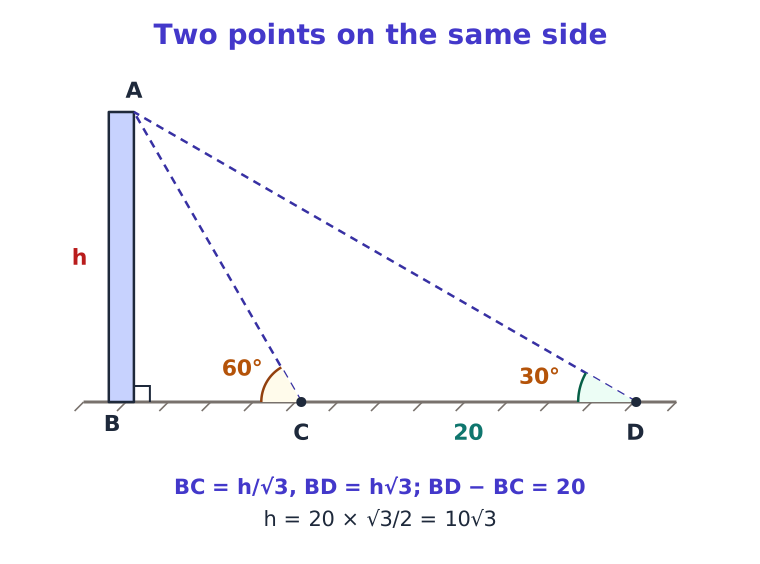
Tower AB with two observers C and D on the same side, 20 m apart; the angles of elevation are 60° from C and 30° from D.

Ladders and broken trees

When the slanted length is involved, use sin and cos. A ladder of length $L$ at $\theta$ reaches $L\sin\theta$ up the wall, with its foot $L\cos\theta$ out.

A tree broken at height $s$ whose top meets the ground $d$ from the foot at angle $\theta$: $s = d\tan\theta$, broken part $= \frac{d}{\cos\theta}$; the full height is their sum.
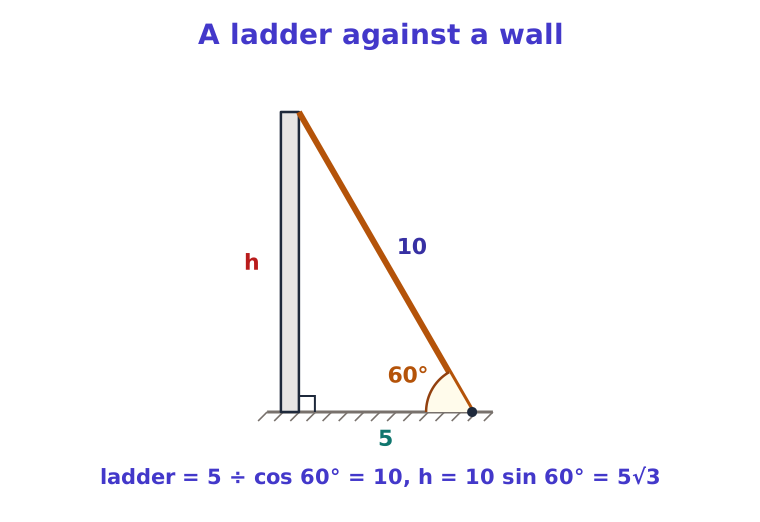
A ladder of length 10 leaning on a wall, its foot 5 from the wall, making 60° with the ground.

Two buildings

From the roof of a building of height $h$, the top of a taller tower is seen at elevation $\alpha$ and its foot at depression $\beta$. Draw the horizontal from the eye: it splits the tower into $h$ (below) and $d\tan\alpha$ (above), where $d = h\cot\beta$.
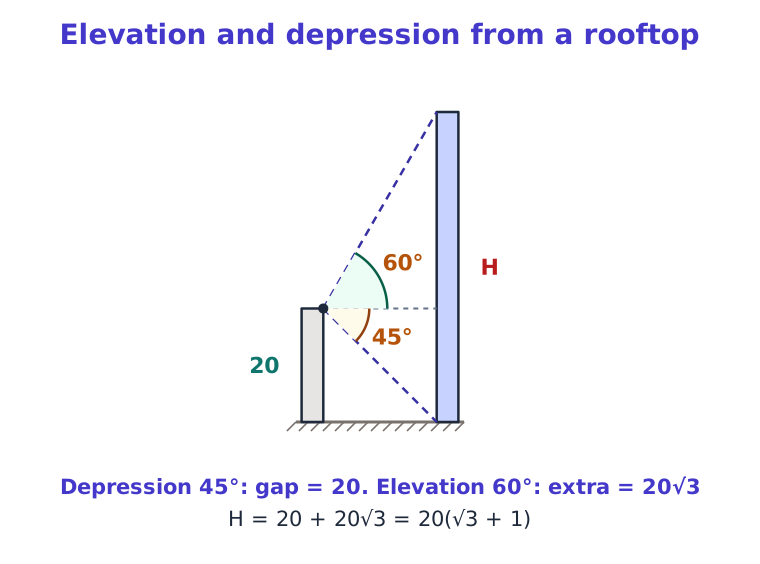
A 20 m building facing a taller tower; from the rooftop the tower top is at 60° elevation and its foot at 45° depression.

Moving objects

A plane flying level at height $h$ is seen at 60°, and $t$ seconds later at 30°. It covered $h\cot 30^\circ - h\cot 60^\circ = \frac{2h}{\sqrt{3}}$, so its speed is $\frac{2h}{\sqrt{3},t}$.

Arjun's answers

Height $= 20\tan 60^\circ = 20\sqrt{3} \approx 34.6$ m. At 30° he is $20\sqrt{3} \times \sqrt{3} = 60$ m from the foot, so he walked $60 - 20 = 40$ m. One triangle per angle, and tan does the rest.
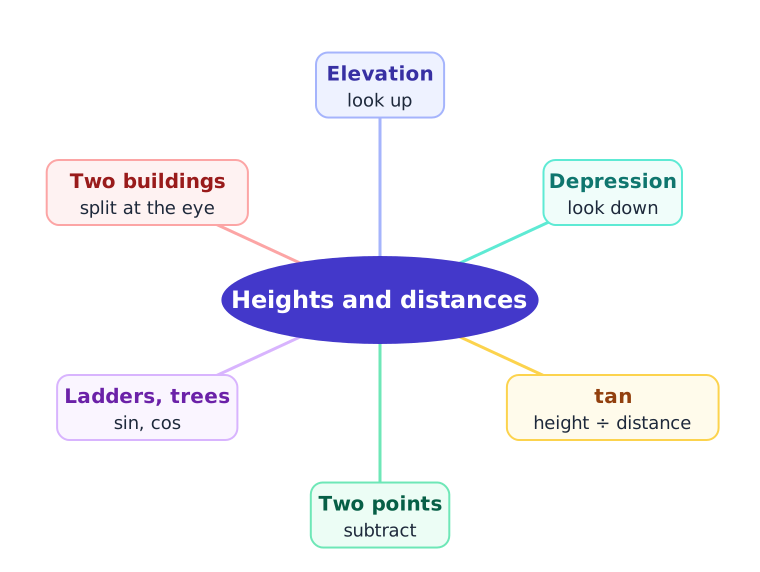
Mind map: elevation, depression, tan, two points, ladders and trees, and two buildings around Heights and distances.

Concepts and terms

Line of sight

The straight line from the observer's eye to the object. With the horizontal it makes the angle of elevation or depression.

Hidden right triangle

Tower, ground and line of sight form a right triangle with the right angle at the foot of the tower.

Alternate angles

The horizontal at the top is parallel to the ground, so the angle of depression at the top equals the angle of elevation at the bottom.

Two-triangle problems

When two angles are given, write tan for each triangle and eliminate the unknown distance.

Did you know

In 1856 the Great Trigonometrical Survey of India announced the height of Peak XV (Mount Everest) as 8840 m, worked out from angles of elevation taken about 170 km away. Today's value, 8849 m, is only 9 m more.

Memory tricks

Elevation vs depression — Elevation: eyes up. Depression: eyes down. Both from the horizontal. — Never measure from the vertical tower.

The 60-30 shortcut — Gap times √3 over 2 — Angles 60° and 30° from two points a apart give height a√3/2.

Practice MCQs with answers (57)

Q1 From a point 20 m from the foot of a tower, the angle of elevation of its top is 60°. Find the height of the tower (in m). ![A tower of unknown height h; the observer is 20 m from its foot and the angle of elevation is 60°.](/syllabus/veda-skills-0-quantitative-aptitude-en/ch16/q-elev-1.svg) beginner
  • A 20√3
  • B 20√3/3
  • C 10√3
  • D 40
Show answer
Answer: 20√3
Why:

h = 20 × tan 60° = 20√3 m.

Q2 From a point 30 m from the foot of a pole, the angle of elevation of its top is 45°. Find the height of the pole (in m). ![A pole of unknown height h; the observer is 30 m from its foot and the angle of elevation is 45°.](/syllabus/veda-skills-0-quantitative-aptitude-en/ch16/q-elev-2.svg) beginner
  • A 30√3
  • B 30
  • C 10√3
  • D 60
Show answer
Answer: 30
Why:

h = 30 × tan 45° = 30 m.

Q3 From a point 45 m from the foot of a tree, the angle of elevation of its top is 30°. Find the height of the tree (in m). ![A tree of unknown height h; the observer is 45 m from its foot and the angle of elevation is 30°.](/syllabus/veda-skills-0-quantitative-aptitude-en/ch16/q-elev-3.svg) intermediate
  • A 90
  • B 45√3
  • C 15√3
  • D 22.5
Show answer
Answer: 15√3
Why:

h = 45 × tan 30° = 15√3 m.

Q4 From a point 15√3 m from the foot of a tower, the angle of elevation of its top is 60°. Find the height of the tower (in m). ![A tower of unknown height h; the observer is 15√3 m from its foot and the angle of elevation is 60°.](/syllabus/veda-skills-0-quantitative-aptitude-en/ch16/q-elev-4.svg) intermediate
  • A 22.5
  • B 30√3
  • C 15
  • D 45
Show answer
Answer: 45
Why:

h = 15√3 × tan 60° = 45 m.

Q5 From a point 50 m from the foot of a tower, the angle of elevation of its top is 30°. Find the height of the tower (in m). ![A tower of unknown height h; the observer is 50 m from its foot and the angle of elevation is 30°.](/syllabus/veda-skills-0-quantitative-aptitude-en/ch16/q-elev-5.svg) beginner
  • A 50√3/3
  • B 100
  • C 50√3
  • D 25
Show answer
Answer: 50√3/3
Why:

h = 50 × tan 30° = 50√3/3 m.

Q6 The angle of elevation of the top of a 30 m tower from a point on the ground is 30°. How far is the point from the foot of the tower (in m)? ![A tower of height 30 with the angle 30° marked at the end of the ground distance, which is marked ?.](/syllabus/veda-skills-0-quantitative-aptitude-en/ch16/q-elev-6.svg) beginner
  • A 60
  • B 30√3
  • C 30
  • D 10√3
Show answer
Answer: 30√3
Why:

d = 30 ÷ tan 30° = 30 × cot 30° = 30√3 m.

Q7 The angle of elevation of the top of a 20√3 m tower from a point on the ground is 60°. How far is the point from the foot of the tower (in m)? ![A tower of height 20√3 with the angle 60° marked at the end of the ground distance, which is marked ?.](/syllabus/veda-skills-0-quantitative-aptitude-en/ch16/q-elev-7.svg) intermediate
  • A 40√3
  • B 20√3
  • C 20
  • D 60
Show answer
Answer: 20
Why:

d = 20√3 ÷ tan 60° = 20√3 × cot 60° = 20 m.

Q8 A vertical pole 12 m tall casts a shadow when the sun's altitude is 45°. Find the length of the shadow (in m). ![A pole of height 12 with the angle 45° marked at the end of the shadow, which is marked ?.](/syllabus/veda-skills-0-quantitative-aptitude-en/ch16/q-elev-8.svg) beginner
  • A 12√3
  • B 24
  • C 6√3
  • D 12
Show answer
Answer: 12
Why:

d = 12 ÷ tan 45° = 12 × cot 45° = 12 m.

Q9 A vertical pole 8√3 m tall casts a shadow when the sun's altitude is 60°. Find the length of the shadow (in m). ![A pole of height 8√3 with the angle 60° marked at the end of the shadow, which is marked ?.](/syllabus/veda-skills-0-quantitative-aptitude-en/ch16/q-elev-9.svg) intermediate
  • A 8
  • B 8√3
  • C 24
  • D 16√3
Show answer
Answer: 8
Why:

d = 8√3 ÷ tan 60° = 8√3 × cot 60° = 8 m.

Q10 A pole 10√3 m tall casts a shadow 10 m long. Find the angle of elevation of the sun. ![A pole of height 10√3 and its shadow 10; the angle at the end of the shadow is marked ?.](/syllabus/veda-skills-0-quantitative-aptitude-en/ch16/q-ang-1.svg) beginner
  • A 90°
  • B 60°
  • C 30°
  • D 45°
Show answer
Answer: 60°
Why:

tan θ = 10√3/10 = √3, so θ = 60°.

Q11 A pole 15 m tall casts a shadow 15 m long. Find the angle of elevation of the sun. ![A pole of height 15 and its shadow 15; the angle at the end of the shadow is marked ?.](/syllabus/veda-skills-0-quantitative-aptitude-en/ch16/q-ang-2.svg) beginner
  • A 30°
  • B 60°
  • C 45°
  • D 90°
Show answer
Answer: 45°
Why:

tan θ = 15/15 = 1, so θ = 45°.

Q12 A pole 6 m tall casts a shadow 6√3 m long. Find the angle of elevation of the sun. ![A pole of height 6 and its shadow 6√3; the angle at the end of the shadow is marked ?.](/syllabus/veda-skills-0-quantitative-aptitude-en/ch16/q-ang-3.svg) intermediate
  • A 90°
  • B 45°
  • C 60°
  • D 30°
Show answer
Answer: 30°
Why:

tan θ = 6/6√3 = √3/3, so θ = 30°.

Q13 A ladder 10 m long leans against a wall and makes an angle of 60° with the ground. How high up the wall does it reach (in m)? ![A ladder of length 10 against a wall making 60° with the ground.](/syllabus/veda-skills-0-quantitative-aptitude-en/ch16/q-lad-1.svg) beginner
  • A 5√3
  • B 5
  • C 10√3
  • D 10
Show answer
Answer: 5√3
Why:

h = 10 sin 60° = 5√3 m.

Q14 A ladder 12 m long leans against a wall and makes an angle of 60° with the ground. How far is its foot from the wall (in m)? ![A ladder of length 12 against a wall making 60° with the ground.](/syllabus/veda-skills-0-quantitative-aptitude-en/ch16/q-lad-2.svg) beginner
  • A 4√3
  • B 6
  • C 12
  • D 6√3
Show answer
Answer: 6
Why:

d = 12 cos 60° = 6 m.

Q15 A ladder 8 m long leans against a wall and makes an angle of 30° with the ground. How high up the wall does it reach (in m)? ![A ladder of length 8 against a wall making 30° with the ground.](/syllabus/veda-skills-0-quantitative-aptitude-en/ch16/q-lad-3.svg) intermediate
  • A 8
  • B 4√3
  • C 4
  • D 8√3/3
Show answer
Answer: 4
Why:

h = 8 sin 30° = 4 m.

Q16 A ladder 14 m long leans against a wall and makes an angle of 30° with the ground. How far is its foot from the wall (in m)? ![A ladder of length 14 against a wall making 30° with the ground.](/syllabus/veda-skills-0-quantitative-aptitude-en/ch16/q-lad-4.svg) intermediate
  • A 14√3
  • B 14
  • C 7
  • D 7√3
Show answer
Answer: 7√3
Why:

d = 14 cos 30° = 7√3 m.

Q17 From the top of a 60 m high cliff, the angle of depression of a boat is 30°. How far is it from the foot of the cliff (in m)? ![A cliff of height 60 with a dashed horizontal at its top; the angle of depression 30° is marked there, and the distance d along the ground is unknown.](/syllabus/veda-skills-0-quantitative-aptitude-en/ch16/q-dep-1.svg) intermediate
  • A 60√3
  • B 60
  • C 20√3
  • D 120
Show answer
Answer: 60√3
Why:

Depression at the top = elevation at the bottom = 30°. d = 60 × cot 30° = 60√3 m.

Q18 From the top of a 75 m high tower, the angle of depression of a car is 45°. How far is it from the foot of the tower (in m)? ![A tower of height 75 with a dashed horizontal at its top; the angle of depression 45° is marked there, and the distance d along the ground is unknown.](/syllabus/veda-skills-0-quantitative-aptitude-en/ch16/q-dep-2.svg) beginner
  • A 150
  • B 75
  • C 75√3
  • D 25√3
Show answer
Answer: 75
Why:

Depression at the top = elevation at the bottom = 45°. d = 75 × cot 45° = 75 m.

Q19 From the top of a 50√3 m high cliff, the angle of depression of a boat is 60°. How far is it from the foot of the cliff (in m)? ![A cliff of height 50√3 with a dashed horizontal at its top; the angle of depression 60° is marked there, and the distance d along the ground is unknown.](/syllabus/veda-skills-0-quantitative-aptitude-en/ch16/q-dep-3.svg) intermediate
  • A 50√3
  • B 150
  • C 50
  • D 100√3
Show answer
Answer: 50
Why:

Depression at the top = elevation at the bottom = 60°. d = 50√3 × cot 60° = 50 m.

Q20 From the top of a 40 m high tower, the angle of depression of a car is 30°. How far is it from the foot of the tower (in m)? ![A tower of height 40 with a dashed horizontal at its top; the angle of depression 30° is marked there, and the distance d along the ground is unknown.](/syllabus/veda-skills-0-quantitative-aptitude-en/ch16/q-dep-4.svg) intermediate
  • A 80
  • B 40
  • C 40√3/3
  • D 40√3
Show answer
Answer: 40√3
Why:

Depression at the top = elevation at the bottom = 30°. d = 40 × cot 30° = 40√3 m.

Q21 The angles of elevation of the top of a tower from two points C and D on the same side, 20 m apart, are 60° and 30°. Find the height of the tower (in m). ![Tower AB with points C and D on the ground 20 m apart; elevations 60° from C and 30° from D.](/syllabus/veda-skills-0-quantitative-aptitude-en/ch16/q-two-1.svg) intermediate
  • A 10√3
  • B 20√3
  • C 20√3/3
  • D 20
Show answer
Answer: 10√3
Why:

BC = h cot 60°, BD = h cot 30°; BD − BC = 20 gives h = 20 ÷ (cot 30° − cot 60°) = 10√3 m.

Q22 The angles of elevation of the top of a tower from two points C and D on the same side, 40 m apart, are 60° and 30°. How far is C, the nearer point, from the foot of the tower (in m)? ![Tower AB with points C and D on the ground 40 m apart; elevations 60° from C and 30° from D.](/syllabus/veda-skills-0-quantitative-aptitude-en/ch16/q-two-2.svg) intermediate
  • A 20√3
  • B 20
  • C 60
  • D 80
Show answer
Answer: 20
Why:

h = 20√3 (from the two triangles); BC = h cot 60° = 20 m.

Q23 The angles of elevation of the top of a tower from two points C and D on the same side, 40 m apart, are 45° and 30°. Find the height of the tower (in m). ![Tower AB with points C and D on the ground 40 m apart; elevations 45° from C and 30° from D.](/syllabus/veda-skills-0-quantitative-aptitude-en/ch16/q-two-3.svg) advanced
  • A 40√3/3
  • B 40(√3 + 1)
  • C 20(√3 + 1)
  • D 40
Show answer
Answer: 20(√3 + 1)
Why:

BC = h cot 45°, BD = h cot 30°; BD − BC = 40 gives h = 40 ÷ (cot 30° − cot 45°) = 20(√3 + 1) m.

Q24 The angles of elevation of the top of a tower from two points C and D on the same side, 30 m apart, are 60° and 45°. Find the height of the tower (in m). ![Tower AB with points C and D on the ground 30 m apart; elevations 60° from C and 45° from D.](/syllabus/veda-skills-0-quantitative-aptitude-en/ch16/q-two-4.svg) advanced
  • A 30(√3 + 3)
  • B 30√3
  • C 30
  • D 15(√3 + 3)
Show answer
Answer: 15(√3 + 3)
Why:

BC = h cot 60°, BD = h cot 45°; BD − BC = 30 gives h = 30 ÷ (cot 45° − cot 60°) = 15(√3 + 3) m.

Q25 The angles of elevation of the top of a tower from two points C and D on the same side, 50 m apart, are 60° and 30°. Find the height of the tower (in m). ![Tower AB with points C and D on the ground 50 m apart; elevations 60° from C and 30° from D.](/syllabus/veda-skills-0-quantitative-aptitude-en/ch16/q-two-5.svg) intermediate
  • A 25√3
  • B 50√3/3
  • C 50
  • D 50√3
Show answer
Answer: 25√3
Why:

BC = h cot 60°, BD = h cot 30°; BD − BC = 50 gives h = 50 ÷ (cot 30° − cot 60°) = 25√3 m.

Q26 A tree breaks due to a storm and the broken part bends so that its top touches the ground 10 m from the foot, making an angle of 30° with the ground. Find the original height of the tree (in m). ![A broken tree: the standing part is vertical, the broken part slants down to touch the ground 10 m from the foot at 30°.](/syllabus/veda-skills-0-quantitative-aptitude-en/ch16/q-brk-1.svg) intermediate
  • A 20
  • B 10√3
  • C 10√3/3
  • D 20√3/3
Show answer
Answer: 10√3
Why:

Standing part = 10 tan 30° = 10√3/3; broken part = 10 ÷ cos 30° = 20√3/3; total = 10√3 m.

Q27 A tree breaks due to a storm and the broken part bends so that its top touches the ground 6 m from the foot, making an angle of 60° with the ground. Find the original height of the tree (in m). ![A broken tree: the standing part is vertical, the broken part slants down to touch the ground 6 m from the foot at 60°.](/syllabus/veda-skills-0-quantitative-aptitude-en/ch16/q-brk-2.svg) advanced
  • A 12
  • B 12√3
  • C 6(√3 + 2)
  • D 6√3
Show answer
Answer: 6(√3 + 2)
Why:

Standing part = 6 tan 60° = 6√3; broken part = 6 ÷ cos 60° = 12; total = 6(√3 + 2) m.

Q28 A tree breaks due to a storm and the broken part bends so that its top touches the ground 9√3 m from the foot, making an angle of 30° with the ground. Find the original height of the tree (in m). ![A broken tree: the standing part is vertical, the broken part slants down to touch the ground 9√3 m from the foot at 30°.](/syllabus/veda-skills-0-quantitative-aptitude-en/ch16/q-brk-3.svg) advanced
  • A 18√3
  • B 9
  • C 18
  • D 27
Show answer
Answer: 27
Why:

Standing part = 9√3 tan 30° = 9; broken part = 9√3 ÷ cos 30° = 18; total = 27 m.

Q29 From the top of a building 20 m high, the angle of elevation of the top of a tower is 60° and the angle of depression of its foot is 45°. Find the height of the tower (in m). ![A building of height 20 and a taller tower; from the rooftop the elevation of the tower top is 60° and the depression of its foot is 45°.](/syllabus/veda-skills-0-quantitative-aptitude-en/ch16/q-bld-1.svg) advanced
  • A 20(√3 + 1)
  • B 20(√3 + 2)
  • C 20(√3 − 1)
  • D 20√3
Show answer
Answer: 20(√3 + 1)
Why:

Gap = 20 cot 45° = 20. Part above eye = 20 tan 60° = 20√3. Tower = 20 + 20√3 = 20(√3 + 1) m.

Q30 From the top of a building 15 m high, the angle of elevation of the top of a tower is 60° and the angle of depression of its foot is 30°. Find the height of the tower (in m). ![A building of height 15 and a taller tower; from the rooftop the elevation of the tower top is 60° and the depression of its foot is 30°.](/syllabus/veda-skills-0-quantitative-aptitude-en/ch16/q-bld-2.svg) advanced
  • A 45
  • B 60
  • C 75
  • D 30
Show answer
Answer: 60
Why:

Gap = 15 cot 30° = 15√3. Part above eye = 15√3 tan 60° = 45. Tower = 15 + 45 = 60 m.

Q31 From the top of a building 30 m high, the angle of elevation of the top of a tower is 30° and the angle of depression of its foot is 60°. Find the height of the tower (in m). ![A building of height 30 and a taller tower; from the rooftop the elevation of the tower top is 30° and the depression of its foot is 60°.](/syllabus/veda-skills-0-quantitative-aptitude-en/ch16/q-bld-3.svg) advanced
  • A 10
  • B 70
  • C 40
  • D 80
Show answer
Answer: 40
Why:

Gap = 30 cot 60° = 10√3. Part above eye = 10√3 tan 30° = 10. Tower = 30 + 10 = 40 m.

Q32 From the top of a building 24 m high, the angle of depression of the foot of a tower is 30°. How far apart are the building and the tower (in m)? ![A building of height 24 and a taller tower; from the rooftop the elevation of the tower top is 60° and the depression of its foot is 30°.](/syllabus/veda-skills-0-quantitative-aptitude-en/ch16/q-bld-4.svg) intermediate
  • A 8√3
  • B 48
  • C 48√3
  • D 24√3
Show answer
Answer: 24√3
Why:

d = 24 cot 30° = 24√3 m.

Q33 Two poles of equal height stand on either side of a road 80 m wide. From a point on the road between them, the angles of elevation of their tops are 30° and 60°. Find the height of the poles (in m). ![Two equal poles 80 m apart with an observer between them; elevations 30° and 60°.](/syllabus/veda-skills-0-quantitative-aptitude-en/ch16/q-btw-1.svg) advanced
  • A 20√3
  • B 40√3
  • C 40
  • D 60
Show answer
Answer: 20√3
Why:

h cot 30° + h cot 60° = 80, so h = 80 ÷ (√3 + √3/3) = 20√3 m.

Q34 Two poles of equal height stand on either side of a road 100 m wide. From a point on the road between them, the angles of elevation of their tops are both 45°. Find the height of the poles (in m). ![Two equal poles 100 m apart with an observer between them; elevations 45° and 45°.](/syllabus/veda-skills-0-quantitative-aptitude-en/ch16/q-btw-2.svg) intermediate
  • A 50√3
  • B 50
  • C 100
  • D 25
Show answer
Answer: 50
Why:

h cot 45° + h cot 45° = 100, so h = 100 ÷ (1 + 1) = 50 m.

Q35 Two poles of equal height stand on either side of a road 60 m wide. From a point on the road between them, the angles of elevation of their tops are 30° and 45°. Find the height of the poles (in m). ![Two equal poles 60 m apart with an observer between them; elevations 30° and 45°.](/syllabus/veda-skills-0-quantitative-aptitude-en/ch16/q-btw-3.svg) advanced
  • A 30
  • B 30(3 − √3)
  • C 30(√3 − 1)
  • D 60(√3 − 1)
Show answer
Answer: 30(√3 − 1)
Why:

h cot 30° + h cot 45° = 60, so h = 60 ÷ (√3 + 1) = 30(√3 − 1) m.

Q36 From a point 20 m from the foot of a building, the angles of elevation of the bottom and the top of a flagstaff on the building are 45° and 60°. Find the height of the flagstaff (in m). ![A building with a flagstaff on top; an observer 20 m away sees the bottom of the flagstaff at 45° and its top at 60°.](/syllabus/veda-skills-0-quantitative-aptitude-en/ch16/q-flag-1.svg) intermediate
  • A 40(√3 − 1)
  • B 20√3
  • C 20
  • D 20(√3 − 1)
Show answer
Answer: 20(√3 − 1)
Why:

Building = 20 tan 45° = 20; building + flag = 20 tan 60° = 20√3; flagstaff = 20(√3 − 1) m.

Q37 From a point 30 m from the foot of a building, the angles of elevation of the bottom and the top of a flagstaff on the building are 30° and 60°. Find the height of the flagstaff (in m). ![A building with a flagstaff on top; an observer 30 m away sees the bottom of the flagstaff at 30° and its top at 60°.](/syllabus/veda-skills-0-quantitative-aptitude-en/ch16/q-flag-2.svg) advanced
  • A 20√3
  • B 40√3
  • C 30√3
  • D 10√3
Show answer
Answer: 20√3
Why:

Building = 30 tan 30° = 10√3; building + flag = 30 tan 60° = 30√3; flagstaff = 20√3 m.

Q38 From a point 18 m from the foot of a building, the angles of elevation of the bottom and the top of a flagstaff on the building are 30° and 45°. Find the height of the building (in m). ![A building with a flagstaff on top; an observer 18 m away sees the bottom of the flagstaff at 30° and its top at 45°.](/syllabus/veda-skills-0-quantitative-aptitude-en/ch16/q-flag-3.svg) beginner
  • A 6(3 − √3)
  • B 6√3
  • C 36
  • D 18
Show answer
Answer: 6√3
Why:

Building = 18 tan 30° = 6√3 m.

Q39 An aeroplane flying horizontally at a height of 1500√3 m is seen at an angle of elevation of 60°. After 15 seconds the angle becomes 30°. Find its speed (in km/h). advanced
  • A 360
  • B 1440
  • C 720
  • D 200
Show answer
Answer: 720
Why:

Distance = h(cot 30° − cot 60°) = 1500√3 × 2/√3 = 3000 m in 15 s = 200 m/s = 720 km/h.

Q40 An aeroplane flying horizontally at a height of 600√3 m is seen at an angle of elevation of 60°. After 10 seconds the angle becomes 30°. Find its speed (in km/h). advanced
  • A 216
  • B 864
  • C 120
  • D 432
Show answer
Answer: 432
Why:

Distance = h(cot 30° − cot 60°) = 600√3 × 2/√3 = 1200 m in 10 s = 120 m/s = 432 km/h.

Q41 The shadow of a tower 20√3 m tall is longer when the sun's altitude is 30° than when it is 60°. By how much (in m)? intermediate
  • A 40
  • B 60
  • C 20
  • D 80
Show answer
Answer: 40
Why:

20√3 cot 30° − 20√3 cot 60° = 60 − 20 = 40 m.

Q42 The shadow of a tower 30 m tall is longer when the sun's altitude is 30° than when it is 45°. By how much (in m)? advanced
  • A 30√3
  • B 30(√3 − 1)
  • C 30
  • D 60(√3 − 1)
Show answer
Answer: 30(√3 − 1)
Why:

30 cot 30° − 30 cot 45° = 30√3 − 30 = 30(√3 − 1) m.

Q43 A man 1.5 m tall stands 30 m from a tower and sees its top at an angle of elevation of 45°. Find the height of the tower (in m). intermediate
  • A 30
  • B 33
  • C 31.5
  • D 28.5
Show answer
Answer: 31.5
Why:

Above eye level = 30 tan 45° = 30; add 1.5: 31.5 m.

Q44 A man 1.6 m tall stands 28√3 m from a tower and sees its top at an angle of elevation of 60°. Find the height of the tower (in m). advanced
  • A 87.2
  • B 82.4
  • C 84
  • D 85.6
Show answer
Answer: 85.6
Why:

Above eye level = 28√3 tan 60° = 84; add 1.6: 85.6 m.

Q45 From 50 m away, the top of a tower is seen at 60°. Find its height (in m). (Take √3 = 1.732) intermediate
  • A 86.6
  • B 28.87
  • C 173.2
  • D 43.3
Show answer
Answer: 86.6
Why:

h = 50 tan 60° = 50√3 = 86.6 m.

Q46 From 60 m away, the top of a tower is seen at 30°. Find its height (in m). (Take √3 = 1.732) intermediate
  • A 69.28
  • B 34.64
  • C 30
  • D 103.92
Show answer
Answer: 34.64
Why:

h = 60 tan 30° = 20√3 = 34.64 m.

Q47 Two boats are on opposite sides of a lighthouse 60 m tall. Their angles of depression from the top are 45° and 30°. How far apart are the boats (in m)? intermediate
  • A 60(√3 − 1)
  • B 60√3
  • C 60(√3 + 1)
  • D 60
Show answer
Answer: 60(√3 + 1)
Why:

60 cot 45° + 60 cot 30° = 60 + 60√3 = 60(√3 + 1) m.

Q48 From the top of a 100 m lighthouse, two ships on the same side are seen at depressions of 60° and 30°. Find the distance between the ships (in m). advanced
  • A 100√3/3
  • B 400√3/3
  • C 100√3
  • D 200√3/3
Show answer
Answer: 200√3/3
Why:

100 cot 30° − 100 cot 60° = 100√3 − 100/√3 = 200/√3 = 200√3/3 m.

Q49 As an observer walks towards a tower, the angle of elevation of its top beginner
  • A increases
  • B decreases
  • C stays the same
  • D first increases, then decreases
Show answer
Answer: increases
Why:

Closer means a steeper line of sight: the height is fixed and the distance shrinks, so tan θ grows.

Q50 If a pole and its shadow have the same length, the sun's altitude is beginner
  • A 90°
  • B 45°
  • C 30°
  • D 60°
Show answer
Answer: 45°
Why:

tan θ = 1, so θ = 45°.

Q51 The angle of depression of a boat from the top of a cliff equals intermediate
  • A the angle between the cliff and the line of sight
  • B twice the angle of elevation
  • C the angle of elevation of the top from the boat
  • D 90° minus the angle of elevation from the boat
Show answer
Answer: the angle of elevation of the top from the boat
Why:

The horizontal at the top is parallel to the ground; the two angles are alternate angles.

Q52 The ratio of the length of a rod to its shadow is 1 : √3. The angle of elevation of the sun is intermediate
  • A 90°
  • B 60°
  • C 45°
  • D 30°
Show answer
Answer: 30°
Why:

tan θ = 1/√3, so θ = 30°.

Q53 When the sun's altitude changes from 30° to 60°, the shadow of a tower becomes advanced
  • A one-third as long
  • B unchanged
  • C half as long
  • D √3 times as long
Show answer
Answer: one-third as long
Why:

Shadow = h cot θ: h√3 becomes h/√3, which is one-third.

Q54 Assertion (A): From a point 30 m from a tower, the top is seen at 45°; so the tower is 30 m tall. Reason (R): $\tan 45^\circ = 1$. beginner
  • A Both A and R are true, and R is the correct explanation of A
  • B Both A and R are true, but R is not the correct explanation of A
  • C A is true but R is false
  • D A is false but R is true
Show answer
Answer: Both A and R are true, and R is the correct explanation of A
Why:

h = 30 tan 45° = 30, and R is exactly the reason.

Q55 Assertion (A): The angle of depression of an object is measured from the vertical line through the observer. Reason (R): The angle of depression equals the angle of elevation from the object. intermediate
  • A Both A and R are true, and R is the correct explanation of A
  • B Both A and R are true, but R is not the correct explanation of A
  • C A is true but R is false
  • D A is false but R is true
Show answer
Answer: A is false but R is true
Why:

Depression is measured from the horizontal, so A is false. R is true (alternate angles).

Q56 Consider the statements: 1. A 10 m ladder making 60° with the ground reaches 5√3 m up the wall. 2. Its foot is 5√3 m from the wall. intermediate
  • A 1 only
  • B 2 only
  • C Both 1 and 2
  • D Neither 1 nor 2
Show answer
Answer: 1 only
Why:

10 sin 60° = 5√3, true. The foot is 10 cos 60° = 5 m, so 2 is false.

Q57 Which of these statements is/are true? 1. Points 20 m apart seeing a tower at 60° and 30° give a height of 20√3 m. 2. At an angle of elevation of 45°, the height equals the distance. intermediate
  • A 1 only
  • B 2 only
  • C Both 1 and 2
  • D Neither 1 nor 2
Show answer
Answer: 2 only
Why:

Height = 20√3/2 = 10√3, so 1 is false. tan 45° = 1, so 2 is true.

Important short questions (3)

A kite is flying at a height of 60 m. The string makes 60° with the ground and is tight. Find the length of the string.

L = 60 ÷ sin 60° = 120/√3 = 40√3 m.

From the top of a 75 m lighthouse the angle of depression of a ship is 30°. How far is the ship?

75 cot 30° = 75√3 ≈ 129.9 m.

The shadow of a tower is 40 m longer when the sun's altitude is 30° than when it is 60°. Find the height.

h√3 − h/√3 = 40, so h = 40√3/2 = 20√3 m.

Long answer questions (1)

From the top of a building 60 m high, the angles of depression of the top and the bottom of a lamp post are 30° and 60°. (a) Find the distance between the building and the lamp post. (b) Find the height of the lamp post. (c) Find the difference between their heights.

(a) Depression 60° of the bottom: d = 60 cot 60° = 20√3 m.

(b) Depression 30° of the top: drop = 20√3 × tan 30° = 20 m, so the post is 60 − 20 = 40 m.

(c) 60 − 40 = 20 m.

Flashcards (13)

Angle of elevation is measured from?
The horizontal, upwards
Angle of depression is measured from?
The horizontal, downwards
Elevation 45°, distance 25 m: height?
25 m
Elevation 60°, distance 10 m: height?
10√3 m
Elevation 30°, height 10 m: distance?
10√3 m
Height equals shadow: sun's altitude?
45°
Ladder 10 m at 60°: height reached?
5√3 m
Ladder 10 m at 60°: foot from wall?
5 m
60° and 30° from points 40 m apart: height?
20√3 m
Depression from the top = elevation from?
The bottom point
Broken tree, top 6 m from foot at 30°: full height?
6√3 m
√3 to three decimals?
1.732
Walking towards a tower: what happens to the angle of elevation?
increases

Play this topic

  • Angle check

Veda Skills Quantitative Aptitude Unit 16 — frequently asked questions

If $\cos\theta = \frac{8}{17}$, find all the other trigonometric ratios.

Opposite = √(289 − 64) = 15. sin θ = 15/17, tan θ = 15/8, $\operatorname{cosec}$ θ = 17/15, sec θ = 17/8, cot θ = 8/15.

Evaluate $\frac{\sin 30^\circ + \tan 45^\circ - \operatorname{cosec} 60^\circ}{\sec 30^\circ + \cos 60^\circ + \cot 45^\circ}$.

Numerator 3/2 − 2/√3, denominator 3/2 + 2/√3; multiply by 2√3: (3√3 − 4)/(3√3 + 4) = (43 − 24√3)/11.

Prove that $\frac{\tan\theta}{1 - \cot\theta} + \frac{\cot\theta}{1 - \tan\theta} = 1 + \sec\theta\operatorname{cosec}\theta$.

Put t = tan θ: t²/(t − 1) − 1/(t(t − 1)) = (t³ − 1)/(t(t − 1)) = (t² + t + 1)/t = 1 + t + 1/t = 1 + (sin²θ + cos²θ)/(sin θ cos θ) = 1 + sec θ $\operatorname{cosec}$ θ.

A kite is flying at a height of 60 m. The string makes 60° with the ground and is tight. Find the length of the string.

L = 60 ÷ sin 60° = 120/√3 = 40√3 m.

From the top of a 75 m lighthouse the angle of depression of a ship is 30°. How far is the ship?

75 cot 30° = 75√3 ≈ 129.9 m.

The shadow of a tower is 40 m longer when the sun's altitude is 30° than when it is 60°. Find the height.

h√3 − h/√3 = 40, so h = 40√3/2 = 20√3 m.

Part of the Veda Skills Quantitative Aptitude course
See every unit of the Veda Skills course Quantitative Aptitude.
See all units

All Veda Skills Quantitative Aptitude units

All Quantitative Aptitude units · All Skills & Exams courses

Study this chapter properly, free

Everything above is on this page to read. In the Veda app the same chapter becomes spaced-repetition flashcards, timed tests that mark themselves, Veda Bites you can swipe, and games — with your progress tracked topic by topic.

Get Veda free