Veda Skills Quantitative Aptitude Unit 3: Percentage
- 3 topics
- 180 MCQs
- 12 short answers
- 3 long answers
- 39 flashcards
- 3 games
- ~145 min read
- English
Checked before publishing: 23 automated checks, including a plagiarism check against the textbook's own words. How we check our content
Percentage Basics and Conversions
Understand percent as "out of 100", convert between fractions, decimals and percents, find x% of y and what percent one number is of another, handle "more than / less than" with the right base, and compute percentage change.
What you will be able to do
- I can convert any fraction or decimal to a percent and back.
- I can find x% of a number and the number when x% of it is known.
- I can say what percent one quantity is of another, using the correct base.
- I can compute percentage increase and decrease, and solve "A is r% more than B" questions.

Key points
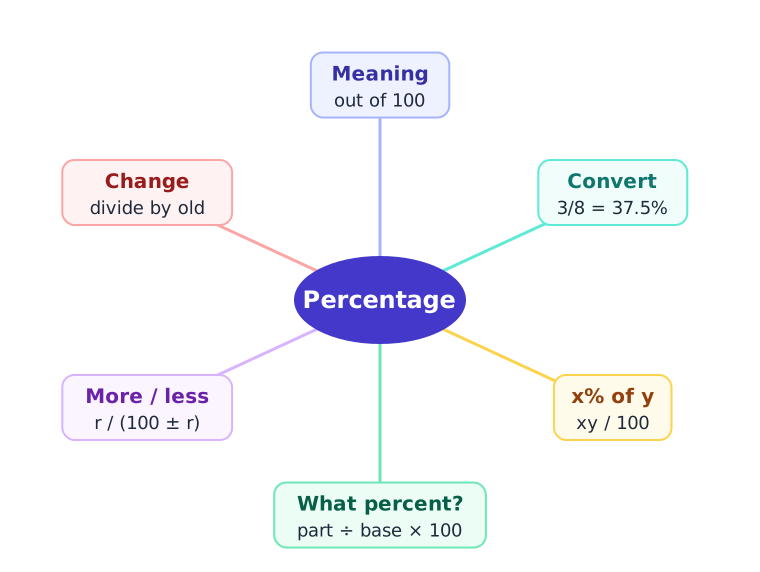
x% means x out of 100, that is x/100.
x% of y = xy/100, and x% of y = y% of x.
"a is what percent of b?" = (a ÷ b) × 100. The number after "of" is the base.
Percentage change = (new − old) ÷ old × 100. Always divide by the old value.
If A is r% more than B, then B is r/(100 + r) × 100 % less than A.
If A is r% less than B, then B is r/(100 − r) × 100 % more than A.
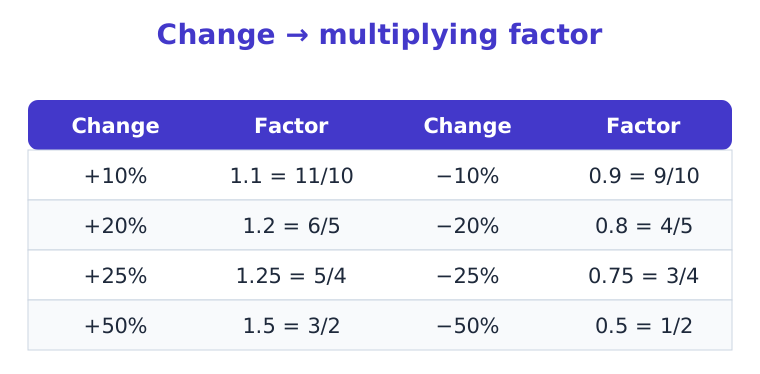
Increase by r%: multiply by (1 + r/100). Decrease by r%: multiply by (1 − r/100).
A change from 8% to 10% is a rise of 2 percentage points, but a 25% increase.
Full explanation
The sale board

Priya sees two boards in a market. One shop says "₹200 off on ₹1,000". The other says "15% off". Which is the better deal?
To compare, both offers need the same language, and that language is per cent: a number out of 100.
What per cent means

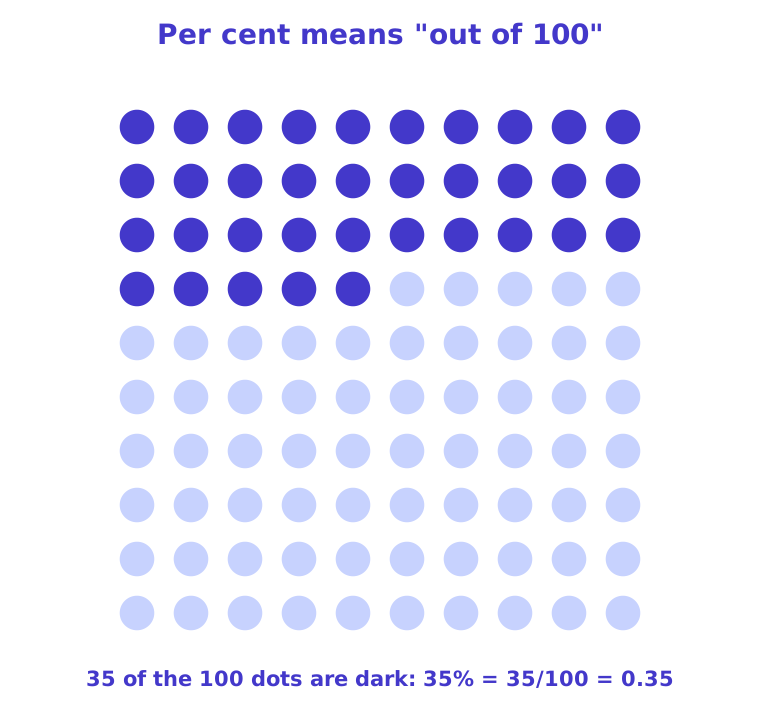
$x% = \frac{x}{100}$. So 35% is 35 parts out of 100, which is 0.35.
Fractions, decimals and percents
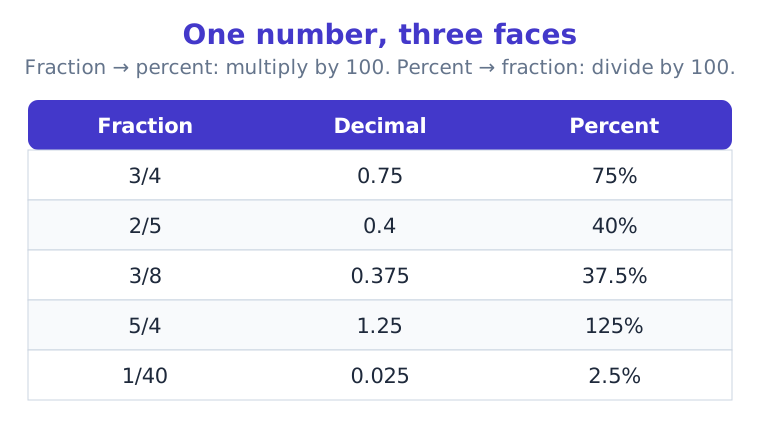
- Fraction → percent: multiply by 100. $\frac{3}{8} \times 100 = 37.5%$
- Percent → fraction: divide by 100 and reduce. $62.5% = \frac{62.5}{100} = \frac{5}{8}$
- Decimal → percent: move the point two places right. $0.045 = 4.5%$
Two basic questions
- x% of y $= \frac{x \times y}{100}$: 15% of 1,000 = 150.
- a is what percent of b? $= \frac{a}{b} \times 100$: 200 is what percent of 1,000? 20%.
Handy swap: $x%$ of $y$ = $y%$ of $x$. So 8% of 25 = 25% of 8 = 2.
Priya decides
"₹200 off on ₹1,000" is $\frac{200}{1000} \times 100 = 20%$ off. That beats 15%. Same language, easy choice.
Finding the whole
If 35% of a number is 140, then 1% is 4 and 100% is 400: number = $\frac{140 \times 100}{35}$.
Percentage change
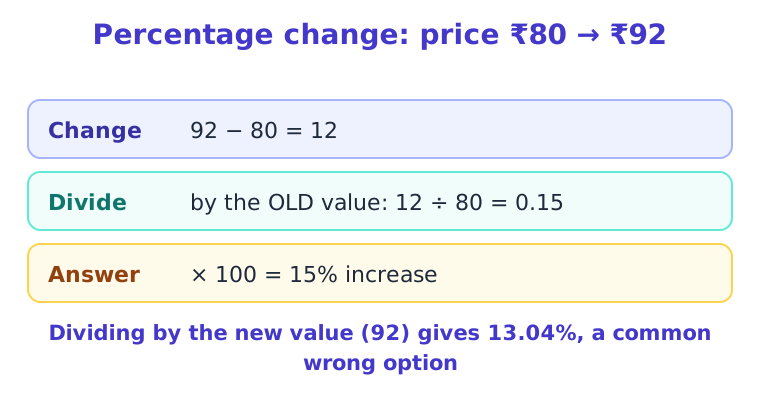
$\text{change %} = \frac{\text{new} - \text{old}}{\text{old}} \times 100$. Divide by the old value, always.
"More than" and "less than"
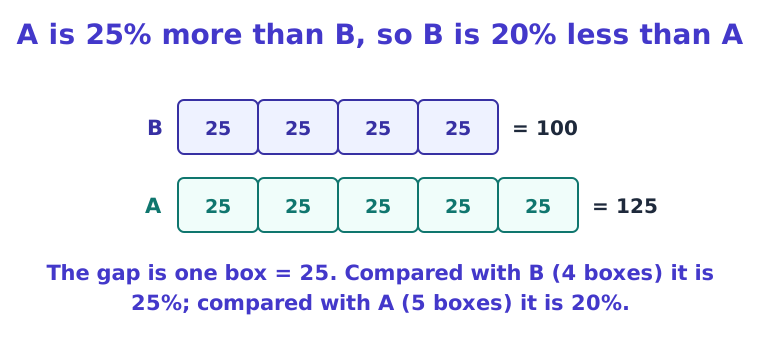
If A is 25% more than B, take B = 100, so A = 125. The gap 25 compared with A is $\frac{25}{125} = 20%$. So B is 20% less than A, not 25%.
Formula: more by $r%$ → the other is $\frac{r}{100 + r} \times 100%$ less.
Percentage points
If a bank's rate goes from 8% to 10%, it rose by 2 percentage points, but by $\frac{2}{8} = 25%$ of its old value. News reports mix these up; exams test the difference.
Priya's rule for every shop
Turn every offer into a percent of the same base before comparing. That one habit solves most of this topic.
Concepts and terms
A fraction with denominator 100: 35% = 35/100 = 0.35.
The quantity we compare with, the 100% value. In "20% of 50", the base is 50.
Change divided by the original value, times 100.
The number you multiply by to apply a change: +20% → × 1.2, −15% → × 0.85.

Did you know
The % sign grew out of the Italian "per cento"; old account books wrote it as "p cento", which slowly became %.

Memory tricks
Which base? — "Than" and "of" point to the base — In "A is 25% more than B" the base is B; in "what percent of B" the base is B.
More and less — Add for more, subtract for less, on the bottom — More by r%: the other is r/(100 + r) less. Less by r%: the other is r/(100 − r) more.
Practice MCQs with answers (69)
- A 54
- B 90
- C 306
- D 540
Show answer
Why:
15% of 360 = $15 \times 360 \div 100 = 54$.
- A 378
- B 294
- C 546
- D 2,940
Show answer
Why:
35% of 840 = $35 \times 840 \div 100 = 294$.
- A 1,400
- B 2,000
- C 200
- D 360
Show answer
Why:
12.5% of 1,600 = $12.5 \times 1600 \div 100 = 200$.
- A ₹320
- B ₹1,000
- C ₹2,000
- D ₹200
Show answer
Why:
$16\frac{2}{3}%$ of 1,200 = $\frac{50}{3} \times 1200 \div 100 = 200$.
- A 450
- B 4,500
- C 700
- D 2,050
Show answer
Why:
18% of 2,500 = $18 \times 2500 \div 100 = 450$.
- A 9,100
- B 910
- C 975
- D 1,820
Show answer
Why:
140% of 650 = $140 \times 650 \div 100 = 910$.
- A 840
- B 1,200
- C 120
- D 216
Show answer
Why:
12.5% of 960 = $12.5 \times 960 \div 100 = 120$.
- A ₹560
- B ₹2,960
- C ₹2,400
- D ₹240
Show answer
Why:
7.5% of 3,200 = $7.5 \times 3200 \div 100 = 240$.
- A 25%
- B 2.5%
- C 400%
- D 75%
Show answer
Why:
$\frac{45}{180} \times 100 = 25$, so 25%.
- A 28%
- B 72%
- C 7.2%
- D $138\frac{8}{9}\%$
Show answer
Why:
$\frac{432}{600} \times 100 = 72$, so 72%.
- A 0.75%
- B $1333\frac{1}{3}\%$
- C 7.5%
- D 92.5%
Show answer
Why:
$\frac{27}{360} \times 100 = \frac{15}{2}$, so 7.5%.
- A 65%
- B 3.5%
- C $285\frac{5}{7}\%$
- D 35%
Show answer
Why:
$\frac{84}{240} \times 100 = 35$, so 35%.
- A $41\frac{2}{3}\%$
- B 240%
- C $58\frac{1}{3}\%$
- D $4\frac{1}{6}\%$
Show answer
Why:
$\frac{550}{1320} \times 100 = \frac{125}{3}$, so $41\frac{2}{3}%$.
- A 7.5%
- B 75%
- C $133\frac{1}{3}\%$
- D 25%
Show answer
Why:
$\frac{39}{52} \times 100 = 75$, so 75%.
- A 50%
- B 3.75%
- C 37.5%
- D $33\frac{1}{3}\%$
Show answer
Why:
$\frac{3}{8} \times 100 = \frac{75}{2}$, so 37.5%.
- A 40%
- B 3.5%
- C $33\frac{1}{3}\%$
- D 35%
Show answer
Why:
$\frac{7}{20} \times 100 = 35$, so 35%.
- A $83\frac{1}{3}\%$
- B 100%
- C $8\frac{1}{3}\%$
- D $71\frac{3}{7}\%$
Show answer
Why:
$\frac{5}{6} \times 100 = \frac{250}{3}$, so $83\frac{1}{3}%$.
- A $26\frac{34}{41}\%$
- B 27.5%
- C 30%
- D 2.75%
Show answer
Why:
$\frac{11}{40} \times 100 = \frac{55}{2}$, so 27.5%.
- A 180%
- B 250%
- C 225%
- D 22.5%
Show answer
Why:
$\frac{9}{4} \times 100 = 225$, so 225%.
- A $71\frac{3}{7}\%$
- B $5\frac{5}{7}\%$
- C 50%
- D $57\frac{1}{7}\%$
Show answer
Why:
$\frac{4}{7} \times 100 = \frac{400}{7}$, so $57\frac{1}{7}%$.
- A $\frac{5}{8}$
- B $\frac{3}{8}$
- C $\frac{25}{4}$
- D $\frac{1}{16}$
Show answer
Why:
62.5% $= \frac{62.5}{100} = \frac{625}{1000} = \frac{5}{8}$.
- A $\frac{13}{16}$
- B $\frac{3}{16}$
- C $\frac{15}{8}$
- D $\frac{3}{160}$
Show answer
Why:
18.75% $= \frac{18.75}{100} = \frac{1875}{10000} = \frac{3}{16}$.
- A $\frac{1}{60}$
- B $\frac{5}{6}$
- C $\frac{1}{6}$
- D $\frac{5}{3}$
Show answer
Why:
$16\frac{2}{3}%$ $= \frac{50}{3} \div 100 = \frac{50}{300} = \frac{1}{6}$.
- A $\frac{7}{50}$
- B $\frac{2}{5}$
- C $14$
- D $\frac{7}{5}$
Show answer
Why:
140% $= \frac{140}{100} = \frac{7}{5}$.
- A $\frac{7}{16}$
- B $\frac{7}{160}$
- C $\frac{9}{16}$
- D $\frac{35}{8}$
Show answer
Why:
43.75% $= \frac{43.75}{100} = \frac{4375}{10000} = \frac{7}{16}$.
- A 49
- B 400
- C 189
- D 260
Show answer
Why:
35% = 140, so 100% $= \frac{140 \times 100}{35} = 400$.
- A ₹675
- B ₹5,175
- C ₹30,000
- D ₹25,500
Show answer
Why:
15% = 4,500, so 100% $= \frac{4500 \times 100}{15} = 30000$.
- A 5,700
- B 432
- C 2,232
- D 7,500
Show answer
Why:
24% = 1,800, so 100% $= \frac{1800 \times 100}{24} = 7500$.
- A 3,000
- B 2,625
- C 3,375
- D 6,000
Show answer
Why:
12.5% = 375, so 100% $= \frac{375 \times 100}{12.5} = 3000$.
- A ₹13,800
- B ₹15,000
- C ₹96
- D ₹1,296
Show answer
Why:
8% = 1,200, so 100% $= \frac{1200 \times 100}{8} = 15000$.
- A 15,000
- B 5,000
- C 7,500
- D 10,000
Show answer
Why:
$33\frac{1}{3}%$ = 2,500, so 100% $= \frac{2500 \times 100}{\frac{100}{3}} = 7500$.
- A $33\frac{1}{3}\%$
- B 75%
- C 25%
- D 20%
Show answer
Why:
Take B = 100, then A = 125. Gap 25 out of A: $\frac{25}{125} \times 100 = 20$, so 20%.
- A 25%
- B 20%
- C $16\frac{2}{3}\%$
- D 80%
Show answer
Why:
Take coffee = 100, then tea = 80. Gap 20 out of tea: $\frac{20}{80} \times 100 = 25$, so 25%.
- A 100%
- B $33\frac{1}{3}\%$
- C 25%
- D 50%
Show answer
Why:
Take B = 100, then A = 150. Gap 50 out of A: $\frac{50}{150} \times 100 = \frac{100}{3}$, so $33\frac{1}{3}%$.
- A $28\frac{4}{7}\%$
- B 60%
- C $66\frac{2}{3}\%$
- D 40%
Show answer
Why:
Take coffee = 100, then tea = 60. Gap 40 out of tea: $\frac{40}{60} \times 100 = \frac{200}{3}$, so $66\frac{2}{3}%$.
- A 150%
- B 40%
- C 60%
- D 37.5%
Show answer
Why:
Take B = 100, then A = 160. Gap 60 out of A: $\frac{60}{160} \times 100 = 37.5$, so 37.5%.
- A 50%
- B $33\frac{1}{3}\%$
- C 25%
- D $66\frac{2}{3}\%$
Show answer
Why:
Take coffee = 100, then tea = $\frac{200}{3}$. Gap $\frac{100}{3}$ out of tea: $\frac{100}{200} \times 100 = 50$, so 50%.
- A ₹3,960
- B ₹5,040
- C ₹4,512
- D ₹540
Show answer
Why:
Multiply by $1 + \frac{12}{100}$: ₹4,500 × 1.12 = ₹5,040.
- A ₹17,985
- B ₹2,700
- C ₹15,300
- D ₹20,700
Show answer
Why:
Multiply by $1 - \frac{15}{100}$: ₹18,000 × 0.85 = ₹15,300.
- A ₹7,235
- B ₹2,520
- C ₹4,680
- D ₹9,720
Show answer
Why:
Multiply by $1 + \frac{35}{100}$: ₹7,200 × 1.35 = ₹9,720.
- A ₹22,400
- B ₹28,800
- C ₹25,587.5
- D ₹3,200
Show answer
Why:
Multiply by $1 - \frac{12.5}{100}$: ₹25,600 × 0.875 = ₹22,400.
- A ₹990
- B ₹1,330
- C ₹380
- D ₹570
Show answer
Why:
Multiply by $1 + \frac{40}{100}$: ₹950 × 1.4 = ₹1,330.
- A 115% increase
- B $13\frac{1}{23}\%$ increase
- C 15% increase
- D 15% decrease
Show answer
Why:
Rise = 46 − 40 = 6. Divide by the old value: $\frac{6}{40} \times 100 = 15$, so it is an increase of 15%.
- A 25% increase
- B 75% decrease
- C $33\frac{1}{3}\%$ decrease
- D 25% decrease
Show answer
Why:
Fall = 2400 − 1800 = 600. Divide by the old value: $\frac{600}{2400} \times 100 = 25$, so it is a decrease of 25%.
- A 20% increase
- B 120% increase
- C $16\frac{2}{3}\%$ increase
- D 20% decrease
Show answer
Why:
Rise = 90 − 75 = 15. Divide by the old value: $\frac{15}{75} \times 100 = 20$, so it is an increase of 20%.
- A 92% decrease
- B 8% decrease
- C $8\frac{16}{23}\%$ decrease
- D 8% increase
Show answer
Why:
Fall = 1250 − 1150 = 100. Divide by the old value: $\frac{100}{1250} \times 100 = 8$, so it is a decrease of 8%.
- A 20% increase
- B 25% decrease
- C 25% increase
- D 125% increase
Show answer
Why:
Rise = 45 − 36 = 9. Divide by the old value: $\frac{9}{36} \times 100 = 25$, so it is an increase of 25%.
- A 64%
- B 110%
- C 102.5%
- D 100%
Show answer
Why:
Take C = 100. B = 125, A = 80% of 125 = 100. So 100%.
- A 90%
- B 105%
- C 40%
- D 100%
Show answer
Why:
Take C = 100. B = 150, A = 60% of 150 = 90. So 90%.
- A 160%
- B 90%
- C 100%
- D 97.5%
Show answer
Why:
Take C = 100. B = 75, A = 120% of 75 = 90. So 90%.
- A 0.45%
- B 45%
- C 4.5%
- D $\frac{9}{200}\%$
Show answer
Why:
Multiply by 100 (move the point two places right): 4.5%.
- A 23%
- B 2300%
- C 2.3%
- D 230%
Show answer
Why:
Multiply by 100 (move the point two places right): 230%.
- A 0.7%
- B $\frac{7}{1000}\%$
- C 0.07%
- D 7%
Show answer
Why:
Multiply by 100 (move the point two places right): 0.7%.
- A The rate rose by 2%, which is 2 percentage points
- B The rate rose by 2 percentage points, which is a 25% increase
- C The rate rose by 25 percentage points
- D The rate rose by 20%
Show answer
Why:
10 − 8 = 2 points; 2/8 × 100 = 25% of the old rate.
- A 150%
- B 6%
- C 50%
- D 33.33%
Show answer
Why:
Increase 6 points on a base of 12: 6/12 × 100 = 50%.
- A The number divided by 10
- B The number minus 1
- C The number times 100
- D The number divided by 100
Show answer
Why:
1% = 1/100 of the number.
- A 25% of 8
- B 80% of 25
- C 25% of 80
- D 8% of 2.5
Show answer
Why:
x% of y = y% of x: both equal 2.
- A 60%
- B 0.6%
- C 3/5
- D 0.6
Show answer
Why:
3/5 = 0.6 = 60%, but 0.6% = 0.006.
- A 100%
- B 10%
- C 110%
- D 90%
Show answer
Why:
Old = 100%, new = 100% + 10% = 110%.
- A 40
- B 100
- C x
- D y
Show answer
Why:
The quantity after "of" is the 100% value.
- A 15% decrease
- B 15% increase
- C 8.5% decrease
- D 85% decrease
Show answer
Why:
0.85 = 1 − 0.15, so it is a 15% fall.
- A Both A and R are true, and R is the correct explanation of A
- B Both A and R are true, but R is not the correct explanation of A
- C A is true but R is false
- D A is false but R is true
Show answer
Why:
B = 100, A = 125: 25/100 = 25% and 25/125 = 20%. The change of base is exactly why.
- A Both A and R are true, and R is the correct explanation of A
- B Both A and R are true, but R is not the correct explanation of A
- C A is true but R is false
- D A is false but R is true
Show answer
Why:
10/50 = 20%, so A is false. R is the correct rule.
- A 1 only
- B 2 only
- C Both 1 and 2
- D Neither 1 nor 2
Show answer
Why:
1.5 × 40 = 60, true. 0.005 × 600 = 3, so 2 is false.
- A 1 only
- B 2 only
- C Both 1 and 2
- D Neither 1 nor 2
Show answer
Why:
y = 5x, so 500%: true. 1.5 × 1.5 = 2.25, a 125% increase, so 2 is false.
- A 58%
- B 42%
- C 24%
- D 40%
Show answer
Why:
4 full rows of 10 plus 2 = 42 dark dots out of 100 = 42%.
- A 62.5%
- B 38%
- C 37.5%
- D 30%
Show answer
Why:
3 of 8 parts: 3/8 × 100 = 37.5%.
- A 90%
- B 20%
- C 25%
- D $33\frac{1}{3}\%$
Show answer
Why:
Rise = 360 − 270 = 90. On the old value: 90/270 × 100 = 33⅓%.
- A $66\frac{2}{3}\%$
- B $33\frac{1}{3}\%$
- C 75%
- D 150%
Show answer
Why:
240/360 × 100 = 66⅔%.
Important short questions (4)
7/16 × 100 = 43.75%.
60/160 × 100 = 37.5%.
Number = 288 × 100/32 = 900. 45% of 900 = 405.
6/54 × 100 = 11.11% (that is 11⅑%).
Long answer questions (1)
(a) Babu 100, Arun 125, Chetan 80.
(b) (125 − 80)/125 × 100 = 36%.
(c) 45/80 × 100 = 56.25%.
Flashcards (14)
Play this topic
- Percent: true or false?
Successive Change and Population
Combine two or more percentage changes with the net-change formula, see why equal rise and fall gives a loss, grow or shrink a population or a machine's value year by year, and keep spending fixed when prices change.
What you will be able to do
- I can find the net effect of two successive percentage changes.
- I can find a population or value after n years of growth or depreciation.
- I can work backwards to find an earlier population or price.
- I can find how much consumption must change to keep expenditure the same.
Key points
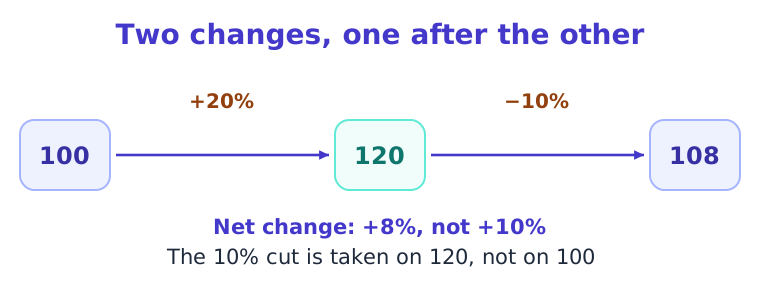
Successive changes multiply: +20% then −10% is 1.2 × 0.9 = 1.08, a net +8%.
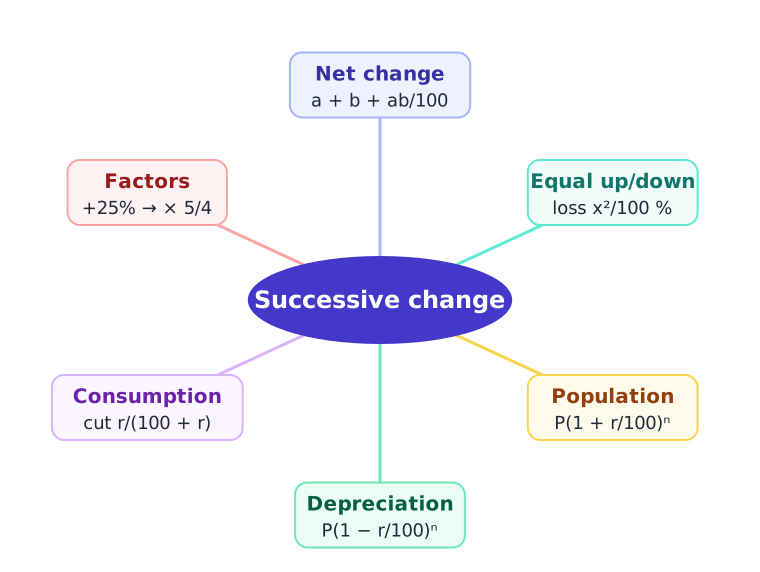
Net change of a% and b% = a + b + ab/100 (use minus signs for decreases).
A rise of x% followed by a fall of x% (or the reverse) always gives a net loss of x²/100 %.
Population after n years = P(1 + r/100)ⁿ; value after depreciation = P(1 − r/100)ⁿ.
n years ago, the population was P ÷ (1 + r/100)ⁿ.
If the price rises r%, cut consumption by r/(100 + r) × 100 % to keep spending the same.
If the price falls r%, consumption can rise by r/(100 − r) × 100 % for the same spending.
Two successive discounts d₁ and d₂ equal one discount of d₁ + d₂ − d₁d₂/100.
Full explanation
The shopkeeper's trick
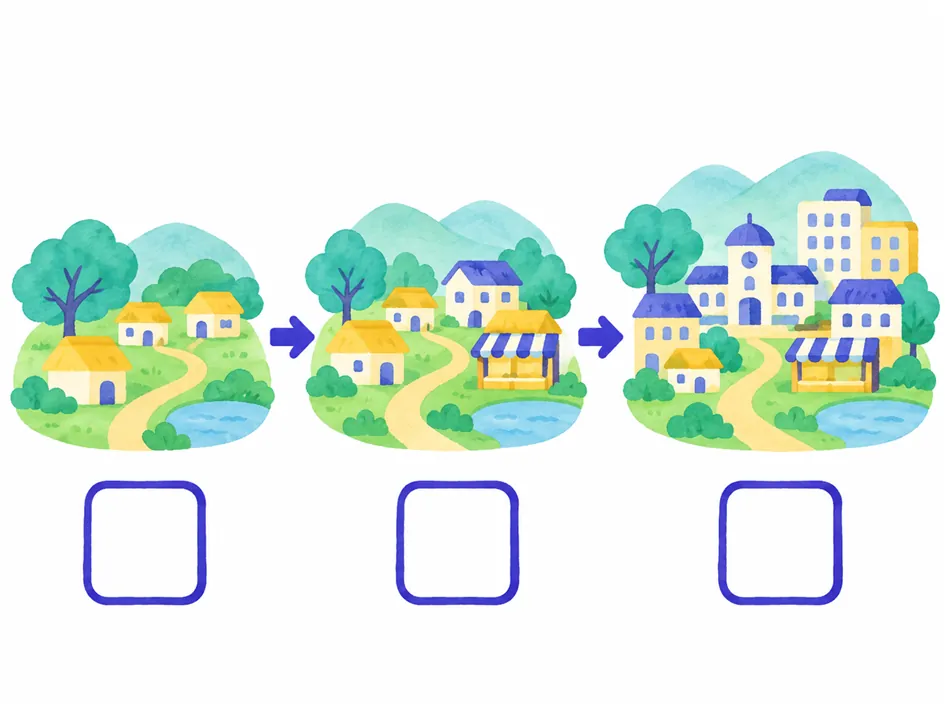
Before Diwali, a shopkeeper raises the price of a TV by 20%. During the sale he announces "10% off". Customers feel they still save. Do they?
The answer needs one idea: the second change is taken on the new price, not the old one.
Changes multiply
A change of $r%$ multiplies the value by $(1 + \frac{r}{100})$. Two changes multiply by both factors.
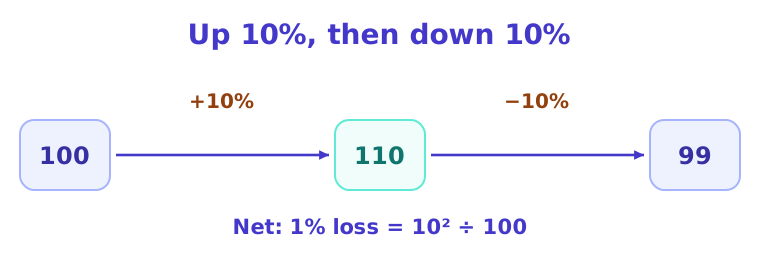
$100 \xrightarrow{+20%} 120 \xrightarrow{-10%} 108$: the net change is +8%.
The net-change formula
For changes $a%$ and $b%$ (minus for a fall): $\text{net} = a + b + \frac{ab}{100}$.
- +20, −10: $20 - 10 - 2 = +8%$
- +30, +10: $30 + 10 + 3 = +43%$
- −20, −25: $-20 - 25 + 5 = -40%$
Equal rise and fall
Up $x%$ then down $x%$ (in either order): net $= x - x - \frac{x^2}{100}$, a loss of $\frac{x^2}{100}%$.
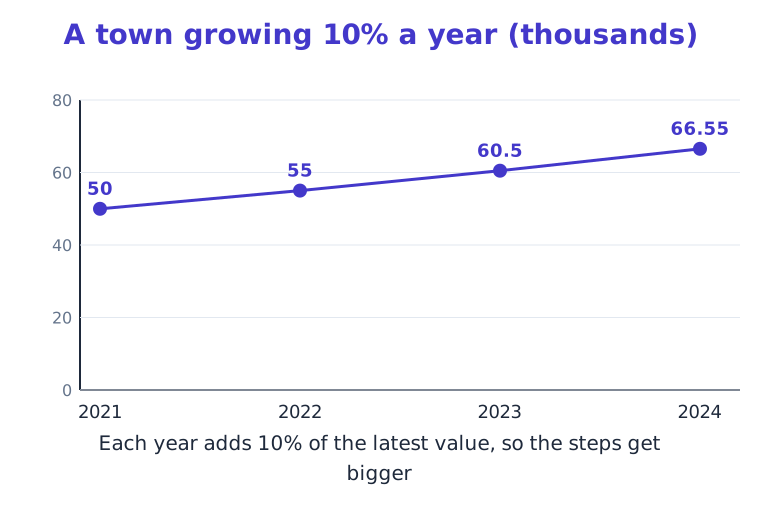
Population growth
If a town grows $r%$ every year, each year multiplies by $(1 + \frac{r}{100})$:
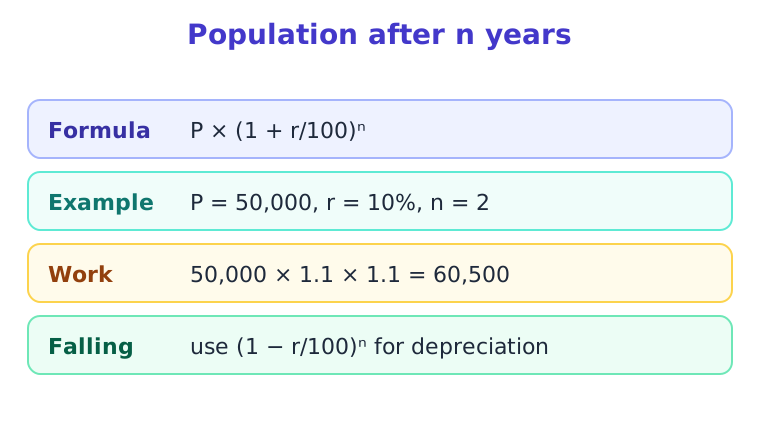
$$P_n = P\left(1 + \frac{r}{100}\right)^n$$
For a fall (a machine losing value), use $(1 - \frac{r}{100})^n$.
Going backwards
If the population now is 72,600 after 10% growth for 2 years, then 2 years ago it was $\frac{72600}{1.1 \times 1.1} = 60{,}000$. Divide by the factors; do not subtract 20%.
Price up, consumption down
Expenditure = price × consumption. If the price rises 25%, consumption must fall by $\frac{25}{125} = 20%$ to keep the bill the same. If the price falls 20%, you can buy $\frac{20}{80} = 25%$ more.
The TV, settled
Raise 20%, cut 10%: the customer pays $1.2 \times 0.9 = 1.08$ times the old price. The "sale" is an 8% rise. Whenever you see two percents in a row, multiply the factors.
Concepts and terms
A second percentage change applied to the result of the first, not to the original.
a + b + ab/100 combines two changes; the ab/100 term is the change on the change.
A fall in value by a fixed percent of the current value each year.
Price × consumption. Keeping it fixed means the two factors must balance.
Did you know
India's population grew from about 36 crore in 1951 to about 121 crore in 2011, roughly 2% a year compounded for 60 years.
Memory tricks
Net change — Add them, then add their product over 100 — +20 and −10: 20 − 10 + (20 × −10)/100 = 10 − 2 = 8.
Equal up and down — Same x up and down: always lose x²/100 — 20% up and 20% down loses 4%.
Practice MCQs with answers (57)
- A 8% increase
- B 2% decrease
- C 8% decrease
- D 10% increase
Show answer
Why:
Net $= a + b + \frac{ab}{100} = 20 - 10 - 2 = 8%$, an increase of 8%. Check: $\frac{6}{5} \times \frac{9}{10} = \frac{27}{25}$.
- A 40% increase
- B 43% increase
- C 3% increase
- D 43% decrease
Show answer
Why:
Net $= a + b + \frac{ab}{100} = 30 + 10 + 3 = 43%$, an increase of 43%. Check: $\frac{13}{10} \times \frac{11}{10} = \frac{143}{100}$.
- A 40% increase
- B 45% decrease
- C 40% decrease
- D 5% increase
Show answer
Why:
Net $= a + b + \frac{ab}{100} = -20 - 25 + 5 = -40%$, a decrease of 40%. Check: $\frac{4}{5} \times \frac{3}{4} = \frac{3}{5}$.
- A 5% increase
- B 5% decrease
- C 1% increase
- D No change
Show answer
Why:
Net $= a + b + \frac{ab}{100} = 25 - 20 - 5 = 0%$, no change. Check: $\frac{5}{4} \times \frac{4}{5} = 1$.
- A 2% decrease
- B 10% increase
- C 12% decrease
- D 2% increase
Show answer
Why:
Net $= a + b + \frac{ab}{100} = 40 - 30 - 12 = -2%$, a decrease of 2%. Check: $\frac{7}{5} \times \frac{7}{10} = \frac{49}{50}$.
- A 5% increase
- B 2% increase
- C 3% decrease
- D 2% decrease
Show answer
Why:
Net $= a + b + \frac{ab}{100} = -15 + 20 - 3 = 2%$, an increase of 2%. Check: $\frac{17}{20} \times \frac{6}{5} = \frac{51}{50}$.
- A 20% decrease
- B 9% decrease
- C 10% decrease
- D 10% increase
Show answer
Why:
Net $= a + b + \frac{ab}{100} = 50 - 40 - 20 = -10%$, a decrease of 10%. Check: $\frac{3}{2} \times \frac{3}{5} = \frac{9}{10}$.
- A 27% increase
- B 1.8% increase
- C 28.8% decrease
- D 28.8% increase
Show answer
Why:
Net $= a + b + \frac{ab}{100} = 12 + 15 + 1.8 = 28.8%$, an increase of 28.8%. Check: $\frac{28}{25} \times \frac{23}{20} = \frac{161}{125}$.
- A 12.5% increase
- B 15% increase
- C 2.5% decrease
- D 12.5% decrease
Show answer
Why:
Net $= a + b + \frac{ab}{100} = -10 + 25 - 2.5 = 12.5%$, an increase of 12.5%. Check: $\frac{9}{10} \times \frac{5}{4} = \frac{9}{8}$.
- A 20% decrease
- B 20% increase
- C 35% increase
- D 15% decrease
Show answer
Why:
Net $= a + b + \frac{ab}{100} = 60 - 25 - 15 = 20%$, an increase of 20%. Check: $\frac{8}{5} \times \frac{3}{4} = \frac{6}{5}$.
- A No change
- B 1% increase
- C 1% decrease
- D 2% decrease
Show answer
Why:
Equal rise and fall always lose $\frac{x^2}{100} = \frac{10^2}{100} = 1%$.
- A No change
- B 4% increase
- C 2% decrease
- D 4% decrease
Show answer
Why:
Equal rise and fall always lose $\frac{x^2}{100} = \frac{20^2}{100} = 4%$.
- A 2.25% decrease
- B No change
- C 2.25% increase
- D 1.5% decrease
Show answer
Why:
Equal rise and fall always lose $\frac{x^2}{100} = \frac{15^2}{100} = 2.25%$.
- A 55,000
- B 60,500
- C 66,550
- D 60,000
Show answer
Why:
50,000 × $\left(\frac{11}{10}\right)^{2}$ = 60,500. (Simple growth would give 60,000, which forgets growth on growth.)
- A 1,00,000
- B 1,56,250
- C 1,25,000
- D 1,12,000
Show answer
Why:
64,000 × $\left(\frac{5}{4}\right)^{3}$ = 1,25,000. (Simple growth would give 1,12,000, which forgets growth on growth.)
- A 84,000
- B 92,610
- C 88,000
- D 88,200
Show answer
Why:
80,000 × $\left(\frac{21}{20}\right)^{2}$ = 88,200. (Simple growth would give 88,000, which forgets growth on growth.)
- A 80,000
- B 75,000
- C 1,00,000
- D 64,000
Show answer
Why:
1,25,000 × $\left(\frac{4}{5}\right)^{2}$ = 80,000. (Taking 20% of the first value off every year would give 75,000, but each fall is on the current value.)
- A 64,000
- B 69,120
- C 57,600
- D 82,944
Show answer
Why:
40,000 × $\left(\frac{6}{5}\right)^{3}$ = 69,120. (Simple growth would give 64,000, which forgets growth on growth.)
- A ₹1,62,000
- B ₹1,31,220
- C ₹1,45,800
- D ₹1,40,000
Show answer
Why:
2,00,000 × $\left(\frac{9}{10}\right)^{3}$ = 1,45,800. (Taking 10% of the first value off every year would give 1,40,000, but each fall is on the current value.)
- A ₹3,07,200
- B ₹3,60,000
- C ₹4,80,000
- D ₹3,84,000
Show answer
Why:
6,00,000 × $\left(\frac{4}{5}\right)^{2}$ = 3,84,000. (Taking 20% of the first value off every year would give 3,60,000, but each fall is on the current value.)
- A 24,500
- B 28,000
- C 25,500
- D 24,000
Show answer
Why:
32,000 × $\left(\frac{7}{8}\right)^{2}$ = 24,500. (Taking 12.5% of the first value off every year would give 24,000, but each fall is on the current value.)
- A 61,452
- B 60,000
- C 58,080
- D 58,806
Show answer
Why:
Divide by the yearly factor once for each year: 72,600 ÷ $\left(\frac{11}{10}\right)^{2}$ = 60,000. Subtracting 20% is wrong.
- A 10,266
- B 9,317
- C 10,000
- D 10,500
Show answer
Why:
Divide by the yearly factor once for each year: 13,310 ÷ $\left(\frac{11}{10}\right)^{3}$ = 10,000. Subtracting 30% is wrong.
- A 6,900
- B 6,584
- C 5,900
- D 6,400
Show answer
Why:
Divide by the yearly factor once for each year: 9,216 ÷ $\left(\frac{6}{5}\right)^{2}$ = 6,400. Subtracting 40% is wrong.
- A 22,000
- B 23,000
- C 22,200
- D 21,600
Show answer
Why:
Multiply the factors: 20,000 × $\frac{11}{10}$ × $\frac{4}{5}$ × $\frac{5}{4}$ = 22,000.
- A 50,000
- B 49,500
- C 48,500
- D 52,500
Show answer
Why:
Multiply the factors: 50,000 × $\frac{6}{5}$ × $\frac{11}{10}$ × $\frac{3}{4}$ = 49,500.
- A 59,200
- B 64,000
- C 60,480
- D 61,120
Show answer
Why:
Multiply the factors: 64,000 × $\frac{3}{4}$ × $\frac{6}{5}$ × $\frac{21}{20}$ = 60,480.
- A $33\frac{1}{3}\%$
- B 12.5%
- C 25%
- D 20%
Show answer
Why:
Cut = $\frac{r}{100 + r} \times 100 = \frac{25}{125} \times 100$ = 20%.
- A $16\frac{2}{3}\%$
- B 25%
- C 10%
- D 20%
Show answer
Why:
Cut = $\frac{r}{100 + r} \times 100 = \frac{20}{120} \times 100$ = $16\frac{2}{3}%$.
- A 50%
- B $33\frac{1}{3}\%$
- C 100%
- D 25%
Show answer
Why:
Cut = $\frac{r}{100 + r} \times 100 = \frac{50}{150} \times 100$ = $33\frac{1}{3}%$.
- A $33\frac{1}{3}\%$
- B 50%
- C 25%
- D $16\frac{2}{3}\%$
Show answer
Why:
Cut = $\frac{r}{100 + r} \times 100 = \frac{100}{400} \times 100$ = 25%.
- A 20%
- B $16\frac{2}{3}\%$
- C 40%
- D 25%
Show answer
Why:
Rise = $\frac{r}{100 - r} \times 100 = \frac{20}{80} \times 100$ = 25%.
- A $66\frac{2}{3}\%$
- B $28\frac{4}{7}\%$
- C 80%
- D 40%
Show answer
Why:
Rise = $\frac{r}{100 - r} \times 100 = \frac{40}{60} \times 100$ = $66\frac{2}{3}%$.
- A No change
- B 4% decrease
- C 4% increase
- D 2% decrease
Show answer
Why:
Area = length × breadth, so use the net change: $a + b + \frac{ab}{100} = 20 - 20 - 4 = -4%$, a decrease of 4%.
- A 20% increase
- B 17% decrease
- C 17% increase
- D 3% decrease
Show answer
Why:
Area = length × breadth, so use the net change: $a + b + \frac{ab}{100} = 30 - 10 - 3 = 17%$, an increase of 17%.
- A 4% increase
- B 40% increase
- C 44% decrease
- D 44% increase
Show answer
Why:
Area = length × breadth, so use the net change: $a + b + \frac{ab}{100} = 20 + 20 + 4 = 44%$, an increase of 44%.
- A 12.5% increase
- B 2.5% increase
- C 15% increase
- D 12.5% decrease
Show answer
Why:
Expenditure = price × consumption: $(1 + \frac{1}{4})(1 - \frac{1}{10}) = \frac{9}{8}$, so +12.5%.
- A 10% increase
- B 10% decrease
- C 5% increase
- D 5% decrease
Show answer
Why:
Expenditure = price × consumption: $(1 + \frac{1}{5})(1 - \frac{1}{4}) = \frac{9}{10}$, so −10%.
- A 8% increase
- B 20% increase
- C 12% increase
- D 12% decrease
Show answer
Why:
Expenditure = price × consumption: $(1 + \frac{2}{5})(1 - \frac{1}{5}) = \frac{28}{25}$, so +12%.
- A 30%
- B 15%
- C 2%
- D 28%
Show answer
Why:
$20 + 10 - \frac{20 \times 10}{100} = 28%$. The second discount is on the reduced price.
- A 40%
- B 22.5%
- C 5%
- D 45%
Show answer
Why:
$25 + 20 - \frac{25 \times 20}{100} = 40%$. The second discount is on the reduced price.
- A 4.5%
- B 40.5%
- C 45%
- D 22.5%
Show answer
Why:
$30 + 15 - \frac{30 \times 15}{100} = 40.5%$. The second discount is on the reduced price.
- A $\frac{1}{4}$
- B $\frac{4}{5}$
- C $\frac{5}{4}$
- D $\frac{3}{4}$
Show answer
Why:
Factor $= 1 + \frac{1}{4} = \frac{5}{4}$.
- A $\frac{4}{3}$
- B $-\frac{1}{3}$
- C $\frac{3}{2}$
- D $\frac{2}{3}$
Show answer
Why:
Factor $= 1 - \frac{1}{3} = \frac{2}{3}$.
- A +25% then −20%
- B +20% then −25%
- C +20% then −20%
- D +10% then −10%
Show answer
Why:
5/4 × 4/5 = 1. The others: +20% then −20% gives 0.96, +10% then −10% gives 0.99, +20% then −25% gives 0.9.
- A 20%
- B 21%
- C 11%
- D 22%
Show answer
Why:
1.1 × 1.1 = 1.21.
- A Yes, the larger change must come first
- B Only when both are decreases
- C No, the factors are multiplied and can be swapped
- D Yes, the increase must come first
Show answer
Why:
a × b = b × a, so 1.2 × 0.9 = 0.9 × 1.2.
- A 73%
- B 27.1%
- C 70%
- D 72.9%
Show answer
Why:
Each 10% fall multiplies by 0.9, so 0.9³ = 0.729, which is 72.9% of the original.
- A 50%
- B 100%
- C 200%
- D 25%
Show answer
Why:
Price × 2 means consumption × 1/2: a 50% cut.
- A Both A and R are true, and R is the correct explanation of A
- B Both A and R are true, but R is not the correct explanation of A
- C A is true but R is false
- D A is false but R is true
Show answer
Why:
100 → 120 → 96. The 20% fall on 120 is 24, bigger than the rise of 20. R explains A.
- A Both A and R are true, and R is the correct explanation of A
- B Both A and R are true, but R is not the correct explanation of A
- C A is true but R is false
- D A is false but R is true
Show answer
Why:
1.1³ = 1.331, so 33.1%: A is false. R is true and is why compounding beats 30%.
- A 1 only
- B 2 only
- C Both 1 and 2
- D Neither 1 nor 2
Show answer
Why:
10 + 10 − 1 = 19, true. The cut needed is 25/125 = 20%, so 2 is false.
- A 1 only
- B 2 only
- C Both 1 and 2
- D Neither 1 nor 2
Show answer
Why:
1.5 × 0.5 = 0.75: a 25% loss. 0.5 × 2 = 1: back to start. Both true.
- A ₹10,000
- B ₹8,000
- C ₹8,400
- D ₹7,600
Show answer
Why:
8,000 × 5/4 = 10,000; 10,000 × 4/5 = 8,000. The changes cancel.
- A 5% decrease
- B 5% increase
- C 1% decrease
- D No change
Show answer
Why:
100 × 1.1 = 110, × 1.2 = 132, × 0.75 = 99. Net: 1% decrease.
- A 1,05,000
- B 1,02,500
- C 1,12,500
- D 1,08,000
Show answer
Why:
75,000/62,500 = 1.2, so 20% a year. 90,000 × 1.2 = 1,08,000. (Adding 15,000 again gives a wrong 1,05,000.)
- A 20%
- B 25%
- C 18%
- D 36%
Show answer
Why:
120/600 = 20% and 96/480 = 20%.
Important short questions (4)
10 + 20 + 200/100 = 32%.
1,60,000 × 1.05 × 1.05 = 1,76,400.
20/120 × 100 = 16⅔%.
72,900 ÷ 0.9³ = 72,900 ÷ 0.729 = ₹1,00,000.
Long answer questions (1)
(a) 10 + 10 − 1 = 19%.
(b) 40 − 19 − (40 × 19)/100 = 21 − 7.6 = 13.4% above cost.
(c) 2,500 × 1.4 × 0.9 × 0.9 = ₹2,835.
Flashcards (13)
Play this topic
- Successive change: true or false?
Percentage in Exams: Marks, Votes and Expenses
Solve the percentage problems exams love: maximum and pass marks, two-candidate elections with and without invalid votes, salaries spent "of the remaining", income and savings changes, and students passing in both subjects.
What you will be able to do
- I can find maximum marks and pass marks from a student's score and shortfall.
- I can find total votes from a winning margin, including invalid votes.
- I can trace a salary through several expenses taken "of the remaining".
- I can use a Venn diagram for "failed in one or both subjects" questions.
Key points
Pass marks = marks obtained + marks short. If that is p% of the maximum, maximum = pass marks × 100 ÷ p.
Two students: one gets a% and fails by x, another gets b% and passes by y. Then (b − a)% of the maximum = x + y.
In a two-candidate election, if the winner gets p%, the margin is (2p − 100)% of the votes.
With invalid votes, first find the valid votes; percentages for candidates are usually of the valid votes.
"x% of the remaining" means multiply the amount left by (1 − x/100); do not subtract from 100 directly.
Savings = income − expenditure. Track both separately when each changes by a different percent.
Passed in both = 100% − (failed in A + failed in B − failed in both).
Full explanation
Three questions from one paper

In an SSC CGL paper, Rohit meets three percentage questions in a row: a student who failed by 20 marks, an election won by 1,280 votes, and a salary spent in stages. All three look different, but each is solved by finding what the percent is of.
Pass marks and maximum marks
Asha scores 32% and fails by 20 marks; the pass mark is 36%. Her marks plus 20 equal the pass mark, so $36% - 32% = 4%$ of the maximum is 20 marks. Maximum = $\frac{20 \times 100}{4} = 500$.
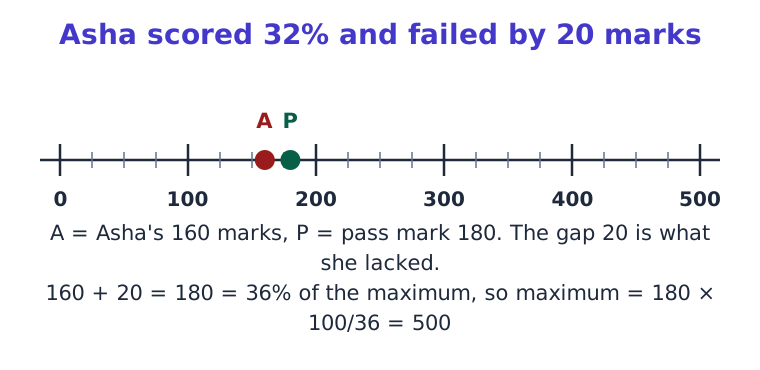
Two students, one paper
A gets 30% and fails by 25 marks; B gets 45% and gets 35 more than the pass mark. Between them lie $25 + 35 = 60$ marks and $45 - 30 = 15%$. So 15% = 60 and the maximum is 400; pass mark = 30% of 400 + 25 = 145.
Elections with two candidates
If the winner gets $p%$, the loser gets $(100 - p)%$, and the margin is $(2p - 100)%$ of the votes.
Winner 58%, margin 1,280: $16%$ of the votes = 1,280, so total = 8,000.
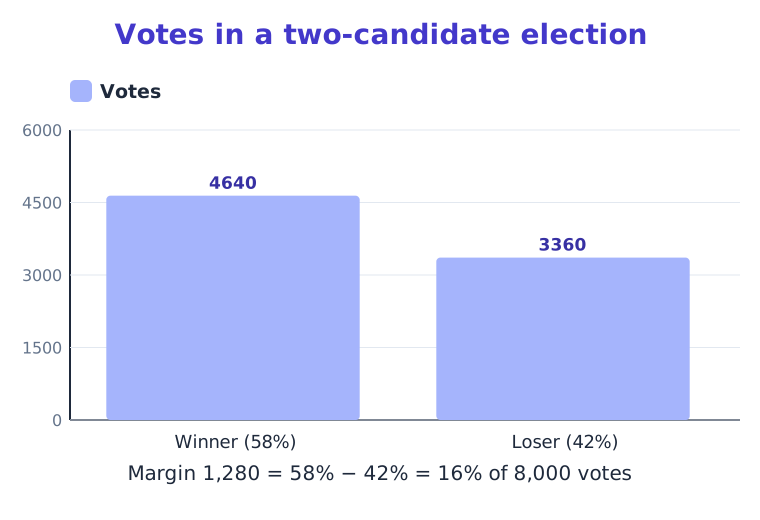
Invalid votes
If 20% of votes are invalid and the winner gets 60% of the valid votes, the loser gets 40% of 80% = 32% of all votes. If the loser got 2,560 votes, total votes = $\frac{2560}{0.32} = 8{,}000$.
Expenses: of the whole, or of the remaining?
Read each percent carefully. "Of his salary" is of the whole; "of the remaining" is of what is left.
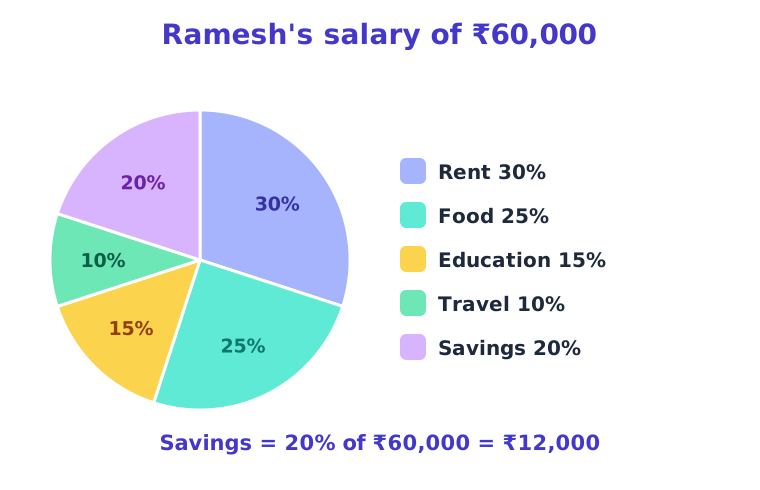
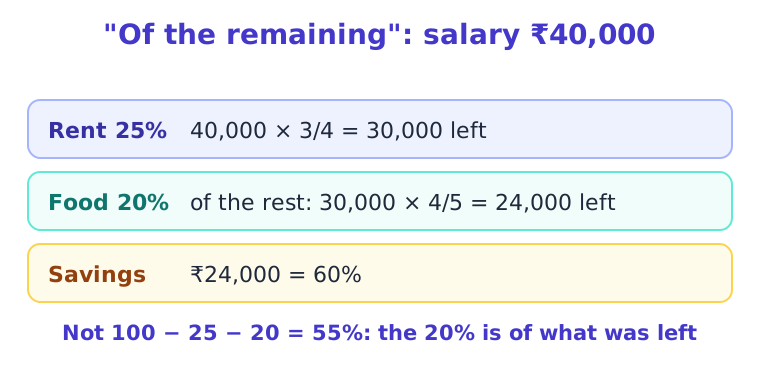
Passed in both subjects
If 30% failed in Hindi, 35% in English and 10% in both, then failed in at least one = $30 + 35 - 10 = 55%$, and passed in both = 45%.
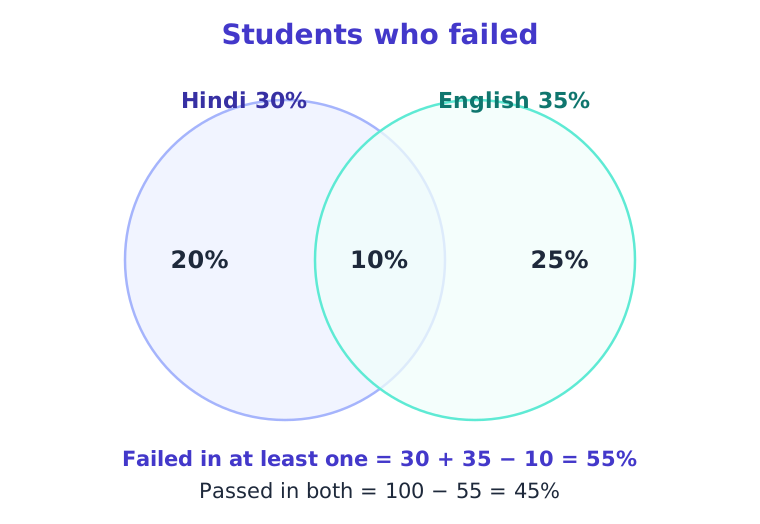
Rohit's three answers
Maximum marks 500, total votes 8,000, savings 60% of the salary. Each time he asked: percent of what? Make that your first question too.
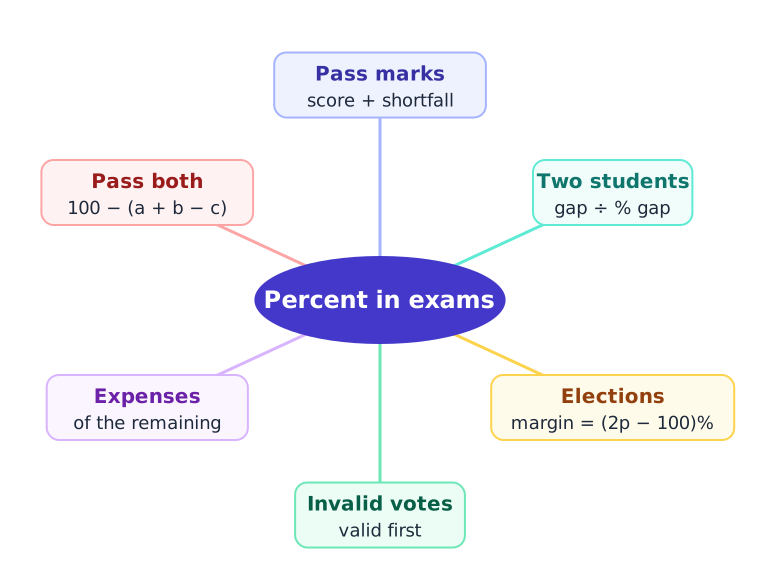
Concepts and terms
The least marks needed to pass, usually given as a percent of the maximum.
Winner's votes minus loser's votes. With p% and (100 − p)%, it is (2p − 100)%.
Votes polled minus invalid (rejected) votes.
A percentage taken on what is left after earlier expenses, not on the original amount.
Did you know
In the 2024 Lok Sabha election, about 65.8% of India's nearly 97 crore registered voters cast their votes, more than 64 crore people.
Memory tricks
Two-student marks — Marks gap over percent gap — Maximum = (x + y) × 100 ÷ (b − a): the marks between them divided by the percent between them.
Election margin — Twice the winner minus a hundred — Winner 62% → margin 2 × 62 − 100 = 24% of the votes.
Practice MCQs with answers (54)
- A 550
- B 600
- C 450
- D 500
Show answer
Why:
Pass mark = 160 + 20 = 180 = 36% of the maximum. Maximum = 180 × 100 ÷ 36 = 500.
- A 375
- B 225
- C 250
- D 300
Show answer
Why:
Pass mark = 120 + 30 = 150 = 40% of the maximum. Maximum = 150 × 100 ÷ 40 = 375.
- A 400
- B 600
- C 700
- D 500
Show answer
Why:
Pass mark = 210 + 42 = 252 = 42% of the maximum. Maximum = 252 × 100 ÷ 42 = 600.
- A 445
- B 390
- C 500
- D 258
Show answer
Why:
Pass mark = 178 + 22 = 200 = 40% of the maximum. Maximum = 200 × 100 ÷ 40 = 500.
- A 840
- B 400
- C 1020
- D 1200
Show answer
Why:
Pass mark = 255 + 45 = 300 = 25% of the maximum. Maximum = 300 × 100 ÷ 25 = 1200.
- A 400
- B 500
- C 300
- D 200
Show answer
Why:
Pass mark = 99 + 33 = 132 = 33% of the maximum. Maximum = 132 × 100 ÷ 33 = 400.
- A 450
- B 400
- C 500
- D 300
Show answer
Why:
Between them: 25 + 35 = 60 marks and 45 − 30 = 15%. Maximum = 60 × 100 ÷ 15 = 400.
- A 450
- B 500
- C 400
- D 300
Show answer
Why:
Between them: 40 + 20 = 60 marks and 40 − 25 = 15%. Maximum = 60 × 100 ÷ 15 = 400.
- A 550
- B 600
- C 400
- D 500
Show answer
Why:
Between them: 10 + 100 = 110 marks and 42 − 20 = 22%. Maximum = 110 × 100 ÷ 22 = 500.
- A 36.25%
- B 30%
- C 37.5%
- D 41.25%
Show answer
Why:
Maximum = 60 × 100 ÷ 15 = 400. Pass mark = 30% of 400 + 25 = 145, which is 36.25% of 400.
- A 36%
- B 40.8%
- C 42%
- D 45.8%
Show answer
Why:
Maximum = 60 × 100 ÷ 12 = 500. Pass mark = 36% of 500 + 24 = 204, which is 40.8% of 500.
- A 400
- B 300
- C 500
- D 600
Show answer
Why:
Between them: 15 + 60 = 75 marks and 50 − 35 = 15%. Maximum = 75 × 100 ÷ 15 = 500.
- A 9,000
- B 16,000
- C 9,280
- D 8,000
Show answer
Why:
Margin = (58 − 42)% = 16% of the votes = 1,280. Total = 1,280 × 100 ÷ 16 = 8,000.
- A 15,000
- B 16,000
- C 30,000
- D 18,600
Show answer
Why:
Margin = (62 − 38)% = 24% of the votes = 3,600. Total = 3,600 × 100 ÷ 24 = 15,000.
- A 16,250
- B 13,750
- C 11,250
- D 25,000
Show answer
Why:
Total = 2,500 × 100 ÷ 10 = 25,000; winner = 55% of 25,000 = 13,750.
- A 33,000
- B 9,000
- C 21,000
- D 30,000
Show answer
Why:
Total = 12,000 × 100 ÷ 40 = 30,000; winner = 70% of 30,000 = 21,000.
- A 23,500
- B 45,000
- C 23,400
- D 22,500
Show answer
Why:
Margin = (52 − 48)% = 4% of the votes = 900. Total = 900 × 100 ÷ 4 = 22,500.
- A 8,000
- B 6,400
- C 8,640
- D 12,800
Show answer
Why:
The loser got 40% of 80% = 32% of all votes. Total = 2,560 ÷ 0.32 = 8,000.
- A 7,200
- B 8,000
- C 8,540
- D 10,800
Show answer
Why:
The loser got 30% of 90% = 27% of all votes. Total = 2,160 ÷ 0.27 = 8,000.
- A 6,600
- B 1,600
- C 1,200
- D 1,740
Show answer
Why:
Total = 5,400 ÷ 0.3375 = 16,000; valid = 12,000; winner = 6,600; margin = 6,600 − 5,400 = 1,200.
- A 34,000
- B 42,975
- C 59,500
- D 40,000
Show answer
Why:
The loser got 35% of 85% = 29.75% of all votes. Total = 11,900 ÷ 0.2975 = 40,000.
- A 2,400
- B 2,500
- C 2,520
- D 3,600
Show answer
Why:
Total = 1,200 ÷ 0.24 = 5,000; valid = 4,800; winner = 3,600; margin = 3,600 − 1,200 = 2,400.
- A 30,000
- B 50,000
- C 74,000
- D 40,000
Show answer
Why:
Winner = 60% of 80% = 48% of all voters = 24,000. Total = 50,000.
- A 37,500
- B 24,000
- C 50,000
- D 68,000
Show answer
Why:
Winner = 48% of 75% = 36% of all voters = 18,000. Total = 50,000.
- A 39,900
- B 18,000
- C 16,500
- D 30,000
Show answer
Why:
Winner = 55% of 60% = 33% of all voters = 9,900. Total = 30,000.
- A ₹40,000
- B ₹45,000
- C ₹64,000
- D ₹28,000
Show answer
Why:
Part saved = $\frac{3}{5}$ of the salary (multiply what is left at each "remaining" step). Salary = ₹24,000 ÷ $\frac{3}{5}$ = ₹40,000.
- A ₹46,200
- B ₹30,000
- C ₹21,900
- D ₹36,000
Show answer
Why:
Part saved = $\frac{27}{50}$ of the salary (multiply what is left at each "remaining" step). Salary = ₹16,200 ÷ $\frac{27}{50}$ = ₹30,000.
- A ₹25,500
- B ₹90,000
- C ₹30,000
- D ₹39,000
Show answer
Why:
Part saved = $\frac{3}{10}$ of the salary (multiply what is left at each "remaining" step). Salary = ₹9,000 ÷ $\frac{3}{10}$ = ₹30,000.
- A ₹43,500
- B ₹23,250
- C ₹35,000
- D ₹30,000
Show answer
Why:
Part saved = $\frac{9}{20}$ of the salary (multiply what is left at each "remaining" step). Salary = ₹13,500 ÷ $\frac{9}{20}$ = ₹30,000.
- A ₹20,000
- B ₹27,200
- C ₹16,400
- D ₹36,000
Show answer
Why:
Part saved = $\frac{9}{25}$ of the salary (multiply what is left at each "remaining" step). Salary = ₹7,200 ÷ $\frac{9}{25}$ = ₹20,000.
- A 5% increase
- B 40% increase
- C 20% increase
- D 40% decrease
Show answer
Why:
Take income 100: expenditure 80, savings 20. New income 120, new expenditure 92, new savings 28. Savings rise by 8 on 20: $\frac{8}{20} \times 100$ = 40% increase.
- A 10% increase
- B 20% increase
- C 20% decrease
- D 10% decrease
Show answer
Why:
Take income 100: expenditure 75, savings 25. New income 110, new expenditure 90, new savings 20. Savings fall by 5 on 25: $\frac{5}{25} \times 100$ = 20% decrease.
- A 45% decrease
- B 10% increase
- C 30% increase
- D 45% increase
Show answer
Why:
Take income 100: expenditure 60, savings 40. New income 130, new expenditure 72, new savings 58. Savings rise by 18 on 40: $\frac{18}{40} \times 100$ = 45% increase.
- A 900
- B 1,000
- C 700
- D 1,100
Show answer
Why:
Failed in at least one = 30 + 35 − 10 = 55%. Passed both = 45% of 2,000 = 900.
- A 825
- B 945
- C 1,065
- D 555
Show answer
Why:
Failed in at least one = 20 + 25 − 8 = 37%. Passed both = 63% of 1,500 = 945.
- A 180
- B 360
- C 270
- D 330
Show answer
Why:
Failed in at least one = 42 + 28 − 15 = 55%. Passed both = 45% of 600 = 270.
- A 76.2%
- B 83.2%
- C 81%
- D 79.2%
Show answer
Why:
Total = 198 out of 250: 198/250 × 100 = 79.2%.
- A $80\frac{5}{14}\%$
- B 78%
- C $77\frac{5}{14}\%$
- D $84\frac{5}{14}\%$
Show answer
Why:
Total = 225 out of 280: 225/280 × 100 = $80\frac{5}{14}%$.
- A $69\frac{9}{13}\%$
- B $72\frac{9}{13}\%$
- C $76\frac{9}{13}\%$
- D $73\frac{1}{3}\%$
Show answer
Why:
Total = 189 out of 260: 189/260 × 100 = $72\frac{9}{13}%$.
- A 75
- B 84
- C 79
- D 74
Show answer
Why:
Needed in all = 75% of 400 = 300. Already 221, so 79 more.
- A 95
- B 85
- C 100
- D 90
Show answer
Why:
Needed in all = 60% of 450 = 270. Already 180, so 90 more.
- A 40% of maximum = 200
- B 40% of maximum = 160
- C 60% of maximum = 200
- D 40% of maximum = 180
Show answer
Why:
Pass mark = 180 + 20 = 200.
- A 50% of the votes
- B zero: it is a tie
- C 100 votes
- D 25% of the votes
Show answer
Why:
2 × 50 − 100 = 0.
- A 18%
- B 12%
- C 15%
- D 54%
Show answer
Why:
54/360 × 100 = 15%.
- A 40%
- B 30%
- C 9%
- D 21%
Show answer
Why:
30% of 70% = 21%.
- A Both A and R are true, and R is the correct explanation of A
- B Both A and R are true, but R is not the correct explanation of A
- C A is true but R is false
- D A is false but R is true
Show answer
Why:
60 − 40 = 20. R gives the 40% that produces the margin.
- A Both A and R are true, and R is the correct explanation of A
- B Both A and R are true, but R is not the correct explanation of A
- C A is true but R is false
- D A is false but R is true
Show answer
Why:
Food = 20% of 75% = 15%, so 100 − 25 − 15 = 60% is left. A is false; R is true.
- A 1 only
- B 2 only
- C Both 1 and 2
- D Neither 1 nor 2
Show answer
Why:
Failed in at least one = 30 + 20 − 10 = 40, so 60% passed both. Maths only = 30 − 10 = 20%. Both true.
- A 1 only
- B 2 only
- C Both 1 and 2
- D Neither 1 nor 2
Show answer
Why:
50% of 90% = 45% of all votes, so 1 is false. 0.45 × 600 = 270, true.
- A ₹7,200
- B ₹4,800
- C ₹15,000
- D ₹14,400
Show answer
Why:
Difference = 30% − 15% = 15% of ₹48,000 = ₹7,200.
- A ₹96,000
- B ₹1,15,200
- C ₹1,44,000
- D ₹9,600
Show answer
Why:
Monthly saving = 20% of 48,000 = ₹9,600; yearly = 9,600 × 12 = ₹1,15,200.
- A 360
- B 126
- C 420
- D 504
Show answer
Why:
126/360 = 35%; 35% of 1,200 = 420.
- A 14.29%
- B 42%
- C 16.67%
- D 6%
Show answer
Why:
Total = 10,000. Margin = 4,200 − 3,600 = 600 = 6%.
- A 78%
- B 80%
- C 85%
- D 77%
Show answer
Why:
78 + 85 + 64 + 92 + 71 = 390 out of 500 = 78%.
Important short questions (4)
Pass mark = 210 = 35%, so maximum = 210 × 100/35 = 600.
Margin = 26% = 6,500, so total = 25,000.
50,000 × 0.8 × 0.75 × 0.9 = ₹27,000.
100 − (25 + 15 − 5) = 65%.
Long answer questions (1)
Margin = 10% of valid votes = 1,672, so valid = 16,720.
Votes cast = 16,720 ÷ 0.95 = 17,600.
(a) Voters = 17,600 ÷ 0.88 = 20,000. (b) 17,600. (c) 55% of 16,720 = 9,196.
Flashcards (12)
Play this topic
- Exam percent: true or false?
Veda Skills Quantitative Aptitude Unit 3 — frequently asked questions
7/16 × 100 = 43.75%.
60/160 × 100 = 37.5%.
Number = 288 × 100/32 = 900. 45% of 900 = 405.
10 + 20 + 200/100 = 32%.
1,60,000 × 1.05 × 1.05 = 1,76,400.
20/120 × 100 = 16⅔%.
Pass mark = 210 = 35%, so maximum = 210 × 100/35 = 600.
Margin = 26% = 6,500, so total = 25,000.
50,000 × 0.8 × 0.75 × 0.9 = ₹27,000.

All Veda Skills Quantitative Aptitude units
All Quantitative Aptitude units · All Skills & Exams courses
Study this chapter properly, free
Everything above is on this page to read. In the Veda app the same chapter becomes spaced-repetition flashcards, timed tests that mark themselves, Veda Bites you can swipe, and games — with your progress tracked topic by topic.
Get Veda free