Veda Skills Quantitative Aptitude Unit 12: Mixtures and Alligation

Mixtures and Alligation is Unit 12 of Veda Skills Quantitative Aptitude. This page has the complete chapter notes across 2 topics, 128 practice MCQs with answers and explanations, 10 important short and long questions and 27 flashcards, written for SSC, Bank, Railway and placement exams and free to read.
  • 2 topics
  • 128 MCQs
  • 8 short answers
  • 2 long answers
  • 27 flashcards
  • 2 games
  • ~100 min read
  • English

Checked before publishing: 23 automated checks, including a plagiarism check against the textbook's own words. How we check our content

Rule of Alligation

Use the alligation cross to find the ratio in which two ingredients at different prices or strengths must be mixed, find the mean price from a ratio, treat water as a free ingredient, handle profit twists, and apply the same rule to averages of marks, interest rates and speeds.

What you will be able to do

  • I can find the mixing ratio from two prices and a mean price.
  • I can find the mean price when the mixing ratio is given.
  • I can mix solutions of different strengths and treat water as costing ₹0.
  • I can apply alligation to averages: marks, interest rates and speeds.

Key points

  • Alligation finds the ratio in which two things must be mixed to reach a given mean.

  • Cheaper : dearer = (d − m) : (m − c), where c < m < d.

  • The mean always lies between the two values; it sits nearer the one used in the larger quantity.

  • Given the ratio a : b, the mean is (a × c + b × d) ÷ (a + b).

  • Water is an ingredient with price ₹0 (or 0% milk).

  • With a profit, first turn the selling price into the cost price of the mixture, then use the cross.

  • The ratio is in the unit of the "per": price per kg gives kg, rate per rupee gives rupees, speed per hour gives hours.

  • Strengths in % mix the same way as prices: (q − r) : (r − p).

Full explanation

Gupta ji's tea blend
A roadside tea stall pouring two kettles into one steaming cup, steam curling up.

Gupta ji buys tea at ₹200 per kg and at ₹300 per kg. Customers like a blend that costs him ₹240 per kg. In what ratio should he mix the two teas?

Guessing 1 : 1 gives ₹250, too costly. He needs more of the cheap tea, but how much more? One small cross on paper answers it.

Mixing is a weighted average
Two jars of different coloured juice poured into one glass.

If $a$ kg at price $c$ is mixed with $b$ kg at price $d$, the mean price is

$$m = \frac{a c + b d}{a + b}$$

The mean always lies between $c$ and $d$, and it is pulled towards the price used in the larger quantity.
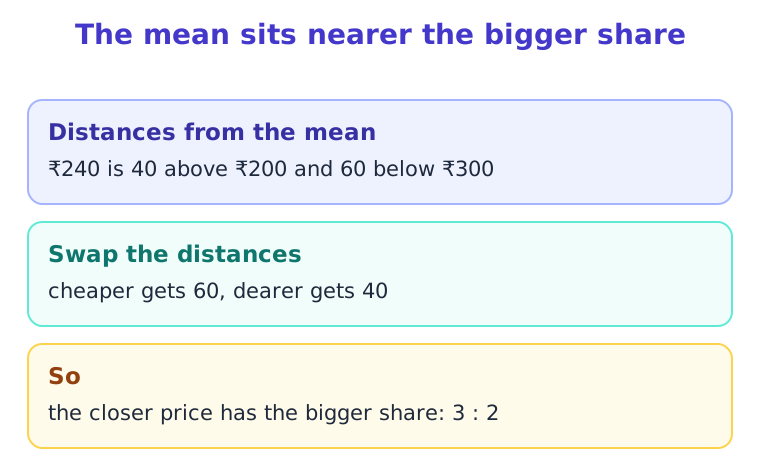
Three cards: ₹240 is 40 above ₹200 and 60 below ₹300; swap the distances so cheaper gets 60 and dearer 40; the closer price has the bigger share, 3 : 2.

The rule of alligation

For a cheaper price $c$, a dearer price $d$ and a mean $m$:

$$\text{cheaper} : \text{dearer} = (d - m) : (m - c)$$

Draw it as a cross. Each difference lands under the other price.
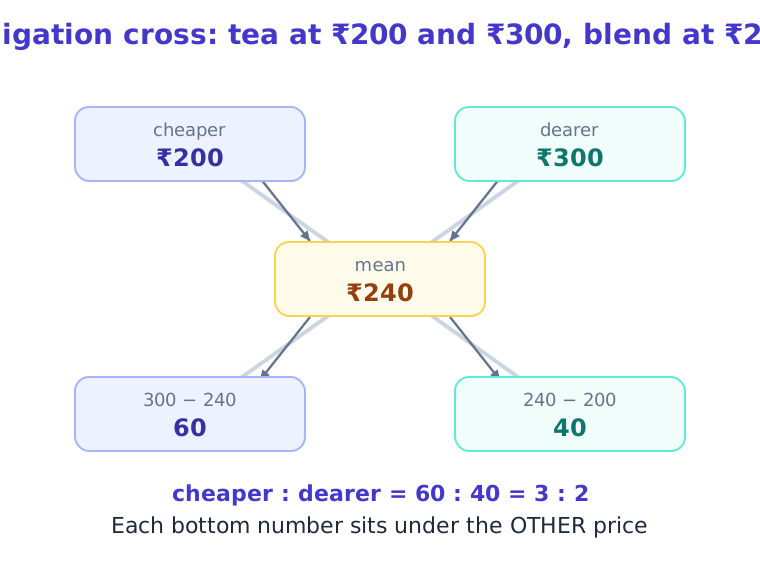
Alligation cross with ₹200 top left, ₹300 top right, ₹240 in the middle, 60 bottom left and 40 bottom right, giving cheaper : dearer = 3 : 2.

Worked example: from ratio back to price

Rice at ₹45 and ₹60 per kg is mixed in the ratio 2 : 3. Mean $= \frac{2 \times 45 + 3 \times 60}{5} = \frac{270}{5} = ₹54$.

Check with the cross: $(60 - 54) : (54 - 45) = 6 : 9 = 2 : 3$. The two methods agree.

Strengths mix the same way

Milk that is 30% pure and milk that is 60% pure are mixed to get 40% milk. Treat the percentages like prices:

$(60 - 40) : (40 - 30) = 20 : 10 = 2 : 1$.
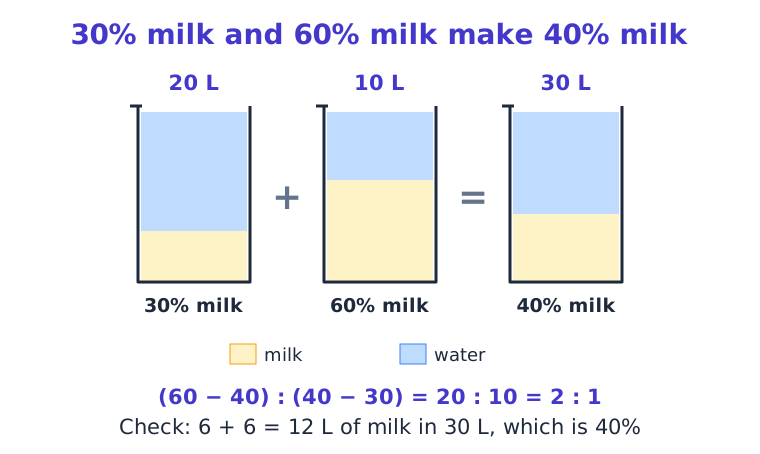
Three beakers: 20 L of 30% milk plus 10 L of 60% milk equals 30 L of 40% milk; ratio 2 : 1; check 6 + 6 = 12 L milk in 30 L.

Water is free

A milkman buys milk at ₹50 per litre and adds water so the mixture is worth ₹40 per litre. Water costs ₹0, so it goes on the cheaper side.
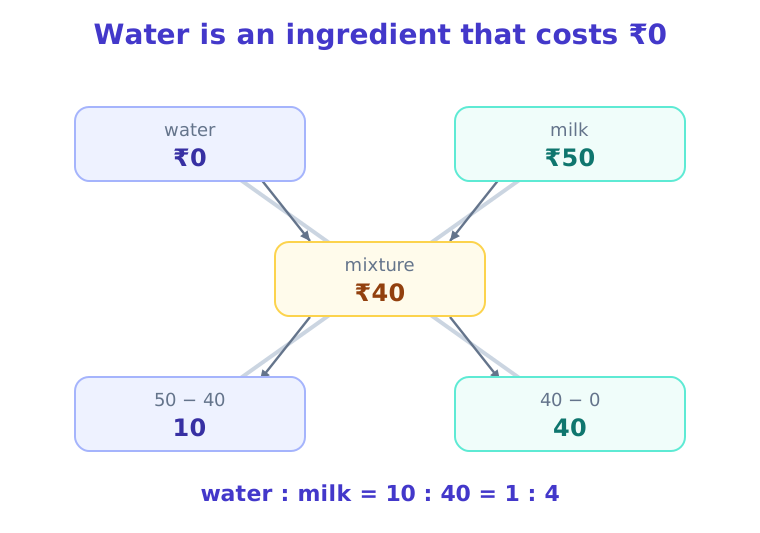
Alligation cross with water ₹0 and milk ₹50 on top, mixture ₹40 in the middle, 10 and 40 below: water : milk = 1 : 4.

The profit twist

A grocer mixes sugar at ₹40 and ₹55 per kg and sells the mixture at ₹60, gaining 20%. The cost of the mixture is $60 \div 1.2 = ₹50$.

Now the cross: $(55 - 50) : (50 - 40) = 5 : 10 = 1 : 2$. Using ₹60 as the mean would be wrong: it is not between 40 and 55 at all.

Averages of groups

The same cross works for any two groups with their own averages. Boys average 60 marks, girls 75, the whole class 66:

boys : girls $= (75 - 66) : (66 - 60) = 9 : 6 = 3 : 2$. In a class of 40, there are 24 boys.
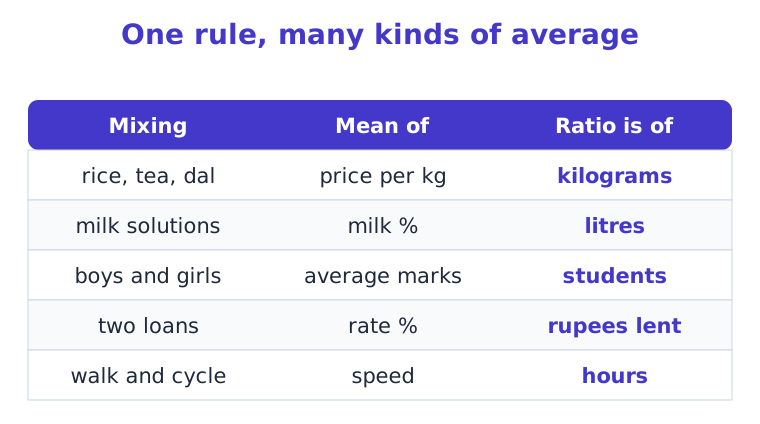
Table: rice prices per kg give a ratio of kilograms; milk % gives litres; average marks give students; interest rates give rupees lent; speeds give hours.

Speeds: a ratio of times

Ravi covers 61 km in 9 hours, partly walking at 4 km/h and partly cycling at 9 km/h. The average speed is $\frac{61}{9}$ km/h.

Time walking : time cycling $= (9 - \frac{61}{9}) : (\frac{61}{9} - 4) = 20 : 25 = 4 : 5$. So he walks for 4 hours, that is 16 km.

Back to Gupta ji

$(300 - 240) : (240 - 200) = 60 : 40 = 3 : 2$. For every 3 kg of the ₹200 tea he adds 2 kg of the ₹300 tea. Check: $(3 \times 200 + 2 \times 300) \div 5 = 1200 \div 5 = ₹240$.
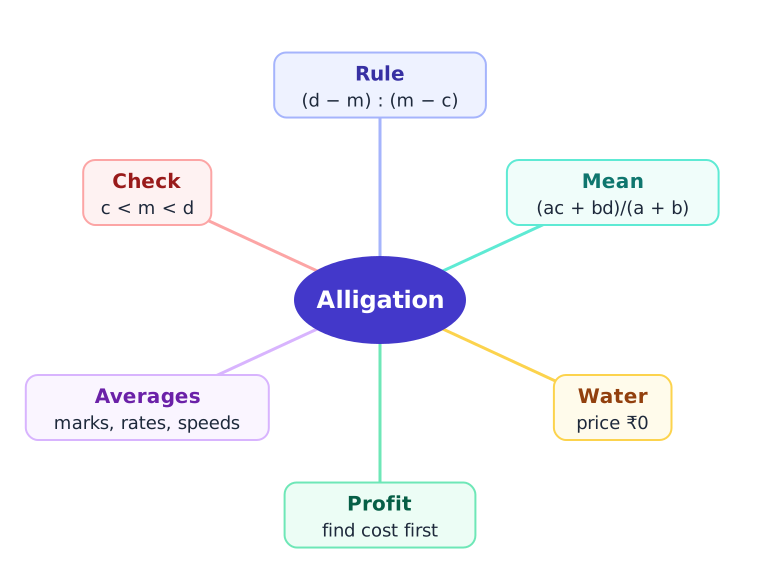
Mind map of alligation: the rule (d − m) : (m − c), the mean formula, water at ₹0, profit means find cost first, averages of marks, rates and speeds, and the check c < m < d.

Concepts and terms

Weighted average

When 3 kg at ₹200 is mixed with 2 kg at ₹300, the mean is (600 + 600) ÷ 5 = ₹240, not the plain average ₹250.

Rule of alligation

Write the two prices on top, the mean in the middle, and the differences crosswise below. The bottom numbers give the ratio.

Free ingredient

Water costs nothing and has 0% milk, so it goes on the cheaper side with value 0.

Alligation of averages

Any two groups with their own averages mixing into one overall average follow the same cross: boys and girls, two loans, two speeds.

Did you know

Tea companies blend leaves from several gardens to keep the taste and the cost per kg the same all year; that blending is alligation.

Gold purity mixes the same way: 18-carat and 22-carat gold in equal parts give 20-carat gold.

Memory tricks

The cross — Top, middle, cross, read — Prices on top, mean in the middle, subtract crosswise, read the ratio at the bottom.

Which share is bigger? — Near means more — The price closer to the mean is used in the larger quantity.

Practice MCQs with answers (68)

Q1 In what ratio must rice at ₹200 per kg be mixed with rice at ₹300 per kg so that the mixture costs ₹240 per kg? beginner
  • A 3 : 2
  • B 2 : 5
  • C 3 : 5
  • D 2 : 3
Show answer
Answer: 3 : 2
Why:

Cheaper : dearer = (300 − 240) : (240 − 200) = 60 : 40 = 3 : 2.

Q2 Sharma ji has two kinds of wheat, at ₹30 and ₹50 per kg. To make a blend worth ₹35 per kg, what should be the ratio of the cheaper kind to the dearer kind? beginner
  • A 1 : 3
  • B 3 : 1
  • C 1 : 4
  • D 3 : 4
Show answer
Answer: 3 : 1
Why:

Cheaper : dearer = (50 − 35) : (35 − 30) = 15 : 5 = 3 : 1.

Q3 In what ratio must tea at ₹40 per kg be mixed with tea at ₹60 per kg so that the mixture costs ₹52 per kg? beginner
  • A 2 : 5
  • B 3 : 2
  • C 2 : 3
  • D 3 : 5
Show answer
Answer: 2 : 3
Why:

Cheaper : dearer = (60 − 52) : (52 − 40) = 8 : 12 = 2 : 3.

Q4 Verma ji has two kinds of sugar, at ₹60 and ₹90 per kg. To make a blend worth ₹70 per kg, what should be the ratio of the cheaper kind to the dearer kind? intermediate
  • A 2 : 3
  • B 1 : 2
  • C 1 : 3
  • D 2 : 1
Show answer
Answer: 2 : 1
Why:

Cheaper : dearer = (90 − 70) : (70 − 60) = 20 : 10 = 2 : 1.

Q5 In what ratio must dal at ₹25 per kg be mixed with dal at ₹40 per kg so that the mixture costs ₹34 per kg? intermediate
  • A 2 : 3
  • B 3 : 2
  • C 3 : 5
  • D 2 : 5
Show answer
Answer: 2 : 3
Why:

Cheaper : dearer = (40 − 34) : (34 − 25) = 6 : 9 = 2 : 3.

Q6 Mr Reddy has two kinds of cashew, at ₹120 and ₹180 per kg. To make a blend worth ₹160 per kg, what should be the ratio of the cheaper kind to the dearer kind? intermediate
  • A 1 : 3
  • B 1 : 2
  • C 2 : 1
  • D 2 : 3
Show answer
Answer: 1 : 2
Why:

Cheaper : dearer = (180 − 160) : (160 − 120) = 20 : 40 = 1 : 2.

Q7 In what ratio must coffee at ₹18 per kg be mixed with coffee at ₹24 per kg so that the mixture costs ₹20 per kg? intermediate
  • A 1 : 3
  • B 2 : 3
  • C 2 : 1
  • D 1 : 2
Show answer
Answer: 2 : 1
Why:

Cheaper : dearer = (24 − 20) : (20 − 18) = 4 : 2 = 2 : 1.

Q8 Sharma ji has two kinds of basmati rice, at ₹72 and ₹96 per kg. To make a blend worth ₹90 per kg, what should be the ratio of the cheaper kind to the dearer kind? advanced
  • A 3 : 1
  • B 3 : 4
  • C 1 : 4
  • D 1 : 3
Show answer
Answer: 1 : 3
Why:

Cheaper : dearer = (96 − 90) : (90 − 72) = 6 : 18 = 1 : 3.

Q9 In what ratio must rice at ₹35 per kg be mixed with rice at ₹47 per kg so that the mixture costs ₹40 per kg? advanced
  • A 7 : 5
  • B 7 : 12
  • C 5 : 7
  • D 5 : 12
Show answer
Answer: 7 : 5
Why:

Cheaper : dearer = (47 − 40) : (40 − 35) = 7 : 5.

Q10 Wheat at ₹45 per kg and wheat at ₹60 per kg are mixed in the ratio 2 : 3. What is the price of the mixture per kg? beginner
  • A ₹55
  • B ₹54
  • C ₹52.5
  • D ₹51
Show answer
Answer: ₹54
Why:

Mean = (2 × 45 + 3 × 60) ÷ 5 = 270 ÷ 5 = ₹54.

Q11 Tea at ₹20 per kg and tea at ₹32 per kg are mixed in the ratio 3 : 1. What is the price of the mixture per kg? beginner
  • A ₹29
  • B ₹24
  • C ₹23
  • D ₹26
Show answer
Answer: ₹23
Why:

Mean = (3 × 20 + 1 × 32) ÷ 4 = 92 ÷ 4 = ₹23.

Q12 Sugar at ₹80 per kg and sugar at ₹100 per kg are mixed in the ratio 1 : 4. What is the price of the mixture per kg? intermediate
  • A ₹84
  • B ₹97
  • C ₹90
  • D ₹96
Show answer
Answer: ₹96
Why:

Mean = (1 × 80 + 4 × 100) ÷ 5 = 480 ÷ 5 = ₹96.

Q13 Dal at ₹36 per kg and dal at ₹48 per kg are mixed in the ratio 5 : 7. What is the price of the mixture per kg? intermediate
  • A ₹43
  • B ₹44
  • C ₹42
  • D ₹41
Show answer
Answer: ₹43
Why:

Mean = (5 × 36 + 7 × 48) ÷ 12 = 516 ÷ 12 = ₹43.

Q14 Cashew at ₹150 per kg and cashew at ₹210 per kg are mixed in the ratio 3 : 2. What is the price of the mixture per kg? intermediate
  • A ₹186
  • B ₹174
  • C ₹175
  • D ₹180
Show answer
Answer: ₹174
Why:

Mean = (3 × 150 + 2 × 210) ÷ 5 = 870 ÷ 5 = ₹174.

Q15 How many kg of tea at ₹45 per kg must be mixed with 30 kg of tea at ₹30 per kg so that the mixture is worth ₹36 per kg? intermediate
  • A 30 kg
  • B 50 kg
  • C 20 kg
  • D 45 kg
Show answer
Answer: 20 kg
Why:

Cheaper : dearer = 9 : 6, so dearer = 30 × 6 ÷ 9 = 20 kg.

Q16 How many kg of sugar at ₹70 per kg must be mixed with 24 kg of sugar at ₹50 per kg so that the mixture is worth ₹62 per kg? intermediate
  • A 24 kg
  • B 60 kg
  • C 16 kg
  • D 36 kg
Show answer
Answer: 36 kg
Why:

Cheaper : dearer = 8 : 12, so dearer = 24 × 12 ÷ 8 = 36 kg.

Q17 How many kg of dal at ₹120 per kg must be mixed with 40 kg of dal at ₹90 per kg so that the mixture is worth ₹100 per kg? intermediate
  • A 20 kg
  • B 40 kg
  • C 60 kg
  • D 80 kg
Show answer
Answer: 20 kg
Why:

Cheaper : dearer = 20 : 10, so dearer = 40 × 10 ÷ 20 = 20 kg.

Q18 How many kg of cashew at ₹360 per kg must be mixed with 15 kg of cashew at ₹240 per kg so that the mixture is worth ₹330 per kg? advanced
  • A 60 kg
  • B 45 kg
  • C 5 kg
  • D 15 kg
Show answer
Answer: 45 kg
Why:

Cheaper : dearer = 30 : 90, so dearer = 15 × 90 ÷ 30 = 45 kg.

Q19 How many kg of coffee at ₹75 per kg must be mixed with 60 kg of coffee at ₹55 per kg so that the mixture is worth ₹60 per kg? advanced
  • A 180 kg
  • B 60 kg
  • C 20 kg
  • D 80 kg
Show answer
Answer: 20 kg
Why:

Cheaper : dearer = 15 : 5, so dearer = 60 × 5 ÷ 15 = 20 kg.

Q20 In what ratio must a mixture with 30% milk be mixed with one with 60% milk to get a mixture with 40% milk? beginner
  • A 1 : 3
  • B 1 : 2
  • C 2 : 3
  • D 2 : 1
Show answer
Answer: 2 : 1
Why:

Treat the percentages like prices: (60 − 40) : (40 − 30) = 20 : 10 = 2 : 1.

Q21 In what ratio must a solution with 20% acid be mixed with one with 50% acid to get a solution with 30% acid? beginner
  • A 2 : 1
  • B 2 : 3
  • C 2 : 5
  • D 1 : 2
Show answer
Answer: 2 : 1
Why:

Treat the percentages like prices: (50 − 30) : (30 − 20) = 20 : 10 = 2 : 1.

Q22 In what ratio must a solution with 60% salt be mixed with one with 85% salt to get a solution with 75% salt? intermediate
  • A 3 : 2
  • B 2 : 3
  • C 2 : 5
  • D 12 : 17
Show answer
Answer: 2 : 3
Why:

Treat the percentages like prices: (85 − 75) : (75 − 60) = 10 : 15 = 2 : 3.

Q23 In what ratio must a syrup with 10% sugar be mixed with one with 40% sugar to get a syrup with 22% sugar? intermediate
  • A 3 : 5
  • B 1 : 4
  • C 3 : 2
  • D 2 : 3
Show answer
Answer: 3 : 2
Why:

Treat the percentages like prices: (40 − 22) : (22 − 10) = 18 : 12 = 3 : 2.

Q24 In what ratio must a solution with 45% alcohol be mixed with one with 70% alcohol to get a solution with 50% alcohol? intermediate
  • A 4 : 5
  • B 9 : 14
  • C 1 : 4
  • D 4 : 1
Show answer
Answer: 4 : 1
Why:

Treat the percentages like prices: (70 − 50) : (50 − 45) = 20 : 5 = 4 : 1.

Q25 How many litres of a 60% acid solution must be added to 30 litres of a 20% acid solution to make it 30% acid? intermediate
  • A 10 litres
  • B 90 litres
  • C 30 litres
  • D 15 litres
Show answer
Answer: 10 litres
Why:

Amount of 20% : amount of 60% = (60 − 30) : (30 − 20) = 30 : 10, so the 60% solution needed = 30 × 10 ÷ 30 = 10 litres.

Q26 How many litres of an 80% salt solution must be added to 18 litres of a 40% salt solution to make it 50% salt? intermediate
  • A 54 litres
  • B 6 litres
  • C 18 litres
  • D 11 litres
Show answer
Answer: 6 litres
Why:

Amount of 40% : amount of 80% = (80 − 50) : (50 − 40) = 30 : 10, so the 80% solution needed = 18 × 10 ÷ 30 = 6 litres.

Q27 Milk costs ₹50 per litre. In what ratio must water be mixed with milk so that the mixture is worth ₹40 per litre? beginner
  • A 4 : 1
  • B 1 : 5
  • C 1 : 4
  • D 4 : 5
Show answer
Answer: 1 : 4
Why:

Water is ₹0: water : milk = (50 − 40) : (40 − 0) = 10 : 40 = 1 : 4.

Q28 Milk costs ₹60 per litre. In what ratio must water be mixed with milk so that the mixture is worth ₹45 per litre? beginner
  • A 1 : 4
  • B 3 : 4
  • C 3 : 1
  • D 1 : 3
Show answer
Answer: 1 : 3
Why:

Water is ₹0: water : milk = (60 − 45) : (45 − 0) = 15 : 45 = 1 : 3.

Q29 Milk costs ₹36 per litre. In what ratio must water be mixed with milk so that the mixture is worth ₹32 per litre? intermediate
  • A 1 : 8
  • B 8 : 9
  • C 8 : 1
  • D 1 : 9
Show answer
Answer: 1 : 8
Why:

Water is ₹0: water : milk = (36 − 32) : (32 − 0) = 4 : 32 = 1 : 8.

Q30 Milk costs ₹48 per litre. In what ratio must water be mixed with milk so that the mixture is worth ₹40 per litre? intermediate
  • A 5 : 1
  • B 1 : 5
  • C 1 : 6
  • D 5 : 6
Show answer
Answer: 1 : 5
Why:

Water is ₹0: water : milk = (48 − 40) : (40 − 0) = 8 : 40 = 1 : 5.

Q31 A milkman buys milk at ₹40 per litre and adds water. He has 50 litres of mixture that costs him ₹32 per litre. How much water is in it? intermediate
  • A 12.5 litres
  • B 12 litres
  • C 10 litres
  • D 40 litres
Show answer
Answer: 10 litres
Why:

Water : milk = 8 : 32, so water = 50 × 8 ÷ 40 = 10 litres.

Q32 A milkman buys milk at ₹60 per litre and adds water. He has 36 litres of mixture that costs him ₹50 per litre. How much water is in it? intermediate
  • A 7.2 litres
  • B 8 litres
  • C 30 litres
  • D 6 litres
Show answer
Answer: 6 litres
Why:

Water : milk = 10 : 50, so water = 36 × 10 ÷ 60 = 6 litres.

Q33 Gupta ji mixes rice at ₹20 per kg with rice at ₹30 per kg and sells the mixture at ₹27.5 per kg, making a profit of 10%. In what ratio were the two kinds mixed? intermediate
  • A 1 : 1
  • B 3 : 2
  • C 1 : 2
  • D 2 : 1
Show answer
Answer: 1 : 1
Why:

Cost of the mixture = ₹27.5 × 100 ÷ 110 = ₹25. Then (30 − 25) : (25 − 20) = 1 : 1.

Q34 Sharma ji mixes wheat at ₹60 per kg with wheat at ₹75 per kg and sells the mixture at ₹78 per kg, making a profit of 20%. In what ratio were the two kinds mixed? advanced
  • A 1 : 2
  • B 2 : 1
  • C 3 : 1
  • D 5 : 4
Show answer
Answer: 2 : 1
Why:

Cost of the mixture = ₹78 × 100 ÷ 120 = ₹65. Then (75 − 65) : (65 − 60) = 2 : 1.

Q35 Khan sahab mixes tea at ₹40 per kg with tea at ₹55 per kg and sells the mixture at ₹60 per kg, making a profit of 20%. In what ratio were the two kinds mixed? advanced
  • A 11 : 8
  • B 2 : 1
  • C 1 : 2
  • D 3 : 2
Show answer
Answer: 1 : 2
Why:

Cost of the mixture = ₹60 × 100 ÷ 120 = ₹50. Then (55 − 50) : (50 − 40) = 1 : 2.

Q36 Verma ji mixes sugar at ₹126 per kg with sugar at ₹135 per kg and sells the mixture at ₹165 per kg, making a profit of 25%. In what ratio were the two kinds mixed? advanced
  • A 15 : 14
  • B 2 : 1
  • C 3 : 2
  • D 1 : 2
Show answer
Answer: 1 : 2
Why:

Cost of the mixture = ₹165 × 100 ÷ 125 = ₹132. Then (135 − 132) : (132 − 126) = 1 : 2.

Q37 A dishonest milkman sells his milk at the cost price but mixes water in it and gains 25%. What is the ratio of water to milk in the mixture? intermediate
  • A 1 : 4
  • B 3 : 4
  • C 4 : 1
  • D 1 : 5
Show answer
Answer: 1 : 4
Why:

Every 100 parts of milk are sold as 125 parts, so water : milk = 25 : 100 = 1 : 4.

Q38 A dishonest milkman sells his milk at the cost price but mixes water in it and gains 20%. What is the ratio of water to milk in the mixture? intermediate
  • A 5 : 1
  • B 1 : 5
  • C 1 : 6
  • D 4 : 5
Show answer
Answer: 1 : 5
Why:

Every 100 parts of milk are sold as 120 parts, so water : milk = 20 : 100 = 1 : 5.

Q39 A dishonest milkman sells his milk at the cost price but mixes water in it and gains 10%. What is the ratio of water to milk in the mixture? advanced
  • A 10 : 1
  • B 1 : 11
  • C 1 : 10
  • D 9 : 10
Show answer
Answer: 1 : 10
Why:

Every 100 parts of milk are sold as 110 parts, so water : milk = 10 : 100 = 1 : 10.

Q40 In a class of 40 students, the average mark of the boys is 60 and of the girls is 75. The class average is 66. How many boys are there? intermediate
  • A 26
  • B 16
  • C 20
  • D 24
Show answer
Answer: 24
Why:

Ratio = (75 − 66) : (66 − 60) = 9 : 6 = 3 : 2, so boys = 40 × 3 ÷ 5 = 24.

Q41 A factory has 50 workers. Unskilled workers earn ₹300 a day on average and skilled workers ₹450. The average for all workers is ₹360. How many unskilled workers are there? intermediate
  • A 30
  • B 20
  • C 25
  • D 32
Show answer
Answer: 30
Why:

Ratio = (450 − 360) : (360 − 300) = 90 : 60 = 3 : 2, so unskilled workers = 50 × 3 ÷ 5 = 30.

Q42 A cricket squad of 16 players has an average age of 27 years. The bowlers average 24 years and the batters 32 years. How many bowlers are there? intermediate
  • A 8
  • B 10
  • C 12
  • D 6
Show answer
Answer: 10
Why:

Ratio = (32 − 27) : (27 − 24) = 5 : 3, so bowlers = 16 × 5 ÷ 8 = 10.

Q43 In a class of 30 students, the average mark of the boys is 50 and of the girls is 70. The class average is 62. How many boys are there? advanced
  • A 15
  • B 14
  • C 12
  • D 18
Show answer
Answer: 12
Why:

Ratio = (70 − 62) : (62 − 50) = 8 : 12 = 2 : 3, so boys = 30 × 2 ÷ 5 = 12.

Q44 A factory has 45 workers. Unskilled workers earn ₹55 a day on average and skilled workers ₹80. The average for all workers is ₹65. How many unskilled workers are there? advanced
  • A 29
  • B 25
  • C 18
  • D 27
Show answer
Answer: 27
Why:

Ratio = (80 − 65) : (65 − 55) = 15 : 10 = 3 : 2, so unskilled workers = 45 × 3 ÷ 5 = 27.

Q45 Sunita lends ₹10,000 in two parts, one at 8% and the other at 12% simple interest a year. The total interest for one year is ₹1,000. How much was lent at 8%? intermediate
  • A ₹5,000
  • B ₹6,000
  • C ₹4,000
  • D ₹7,000
Show answer
Answer: ₹5,000
Why:

Average rate = 1000 × 100 ÷ 10000 = 10%. Ratio = (12 − 10) : (10 − 8) = 1 : 1, so ₹5,000 at 8%.

Q46 Mohan lends ₹12,000 in two parts, one at 5% and the other at 10% simple interest a year. The total interest for one year is ₹840. How much was lent at 5%? advanced
  • A ₹8,200
  • B ₹7,200
  • C ₹4,800
  • D ₹6,000
Show answer
Answer: ₹7,200
Why:

Average rate = 840 × 100 ÷ 12000 = 7%. Ratio = (10 − 7) : (7 − 5) = 3 : 2, so ₹7,200 at 5%.

Q47 Harpreet lends ₹20,000 in two parts, one at 6% and the other at 9% simple interest a year. The total interest for one year is ₹1,560. How much was lent at 6%? advanced
  • A ₹12,000
  • B ₹10,000
  • C ₹8,000
  • D ₹9,000
Show answer
Answer: ₹8,000
Why:

Average rate = 1560 × 100 ÷ 20000 = 7.8%. Ratio = (9 − 7.8) : (7.8 − 6) = 2 : 3, so ₹8,000 at 6%.

Q48 Ravi covers 61 km in 9 hours, partly on foot at 4 km/h and partly by cycle at 9 km/h. How far did Ravi walk? advanced
  • A 4 km
  • B 45 km
  • C 36 km
  • D 16 km
Show answer
Answer: 16 km
Why:

Average speed 61/9 km/h. Time on foot : by cycle = (9 − 61/9) : (61/9 − 4), so time on foot = 4 h and distance = 4 × 4 = 16 km.

Q49 Kiran covers 70 km in 6 hours, partly on foot at 5 km/h and partly by cycle at 15 km/h. How far did Kiran walk? advanced
  • A 10 km
  • B 30 km
  • C 2 km
  • D 60 km
Show answer
Answer: 10 km
Why:

Average speed 35/3 km/h. Time on foot : by cycle = (15 − 35/3) : (35/3 − 5), so time on foot = 2 h and distance = 5 × 2 = 10 km.

Q50 Salim covers 44 km in 5 hours, partly on foot at 4 km/h and partly by cycle at 12 km/h. How far did Salim walk? advanced
  • A 24 km
  • B 8 km
  • C 2 km
  • D 36 km
Show answer
Answer: 8 km
Why:

Average speed 8.8 km/h. Time on foot : by cycle = (12 − 8.8) : (8.8 − 4), so time on foot = 2 h and distance = 4 × 2 = 8 km.

Q51 Vessel P has milk and water in the ratio 3 : 1, and vessel Q in the ratio 1 : 1. If 8 litres from P are mixed with 4 litres from Q, what is the ratio of milk to water in the new mixture? intermediate
  • A 1 : 2
  • B 7 : 3
  • C 2 : 1
  • D 9 : 4
Show answer
Answer: 2 : 1
Why:

Milk = 8 × 3/4 + 4 × 1/2 = 8 L; water = 4 L; ratio 2 : 1.

Q52 Vessel P has milk and water in the ratio 2 : 3, and vessel Q in the ratio 4 : 1. If 10 litres from P are mixed with 10 litres from Q, what is the ratio of milk to water in the new mixture? intermediate
  • A 2 : 3
  • B 13 : 8
  • C 8 : 3
  • D 3 : 2
Show answer
Answer: 3 : 2
Why:

Milk = 10 × 2/5 + 10 × 4/5 = 12 L; water = 8 L; ratio 3 : 2.

Q53 Two vessels hold milk and water in the ratios 5 : 2 and 3 : 4. In what ratio must they be mixed to get milk and water in the ratio 1 : 1? advanced
  • A 1 : 3
  • B 1 : 1
  • C 3 : 1
  • D 4 : 3
Show answer
Answer: 1 : 3
Why:

Milk fractions: 5/7, 3/7, target 1/2. First : second = (difference of 3/7 and 1/2) : (difference of 1/2 and 5/7) = 1/14 : 3/14 = 1 : 3.

Q54 Two vessels hold milk and water in the ratios 2 : 1 and 3 : 2. In what ratio must they be mixed to get milk and water in the ratio 5 : 3? advanced
  • A 3 : 8
  • B 3 : 5
  • C 8 : 5
  • D 5 : 3
Show answer
Answer: 3 : 5
Why:

Milk fractions: 2/3, 3/5, target 5/8. First : second = (difference of 3/5 and 5/8) : (difference of 5/8 and 2/3) = 1/40 : 1/24 = 3 : 5.

Q55 Two kinds of rice cost ₹40 and ₹60 per kg. Which of these can be the price of a mixture of the two? beginner
  • A ₹100
  • B ₹38
  • C ₹52
  • D ₹64
Show answer
Answer: ₹52
Why:

The mean must lie between ₹40 and ₹60, and ₹52 is the only option in that range.

Q56 If ₹30 and ₹50 items are mixed and the mean is ₹33, which item is used more? beginner
  • A The ₹50 item
  • B Both equally
  • C It cannot be told
  • D The ₹30 item
Show answer
Answer: The ₹30 item
Why:

₹33 is much nearer ₹30, so the ₹30 item is the bigger share (17 : 3).

Q57 In alligation, water mixed with milk is taken at a price of beginner
  • A ₹0
  • B the mean price
  • C the price of milk
  • D half the price of milk
Show answer
Answer: ₹0
Why:

Water costs nothing, so its price is 0.

Q58 Average marks of two sections are combined using alligation. The ratio found is the ratio of intermediate
  • A the pass marks
  • B the number of students
  • C the total marks
  • D the highest marks
Show answer
Answer: the number of students
Why:

An average is marks per student, so the weights are students.

Q59 A man travels partly at 40 km/h and partly at 60 km/h. Alligation on the average speed gives the ratio of advanced
  • A the fuel used
  • B the distances at each speed
  • C the times spent at each speed
  • D the two speeds
Show answer
Answer: the times spent at each speed
Why:

Speed is distance per hour, so the weights are hours.

Q60 A grocer sells a mix at ₹60 per kg and gains 20%. Which value goes in the middle of the alligation cross? intermediate
  • A ₹72
  • B ₹48
  • C ₹60
  • D ₹50
Show answer
Answer: ₹50
Why:

Cost = 60 ÷ 1.2 = ₹50. The cross always uses cost prices.

Q61 Assertion (A): Rice at ₹40 and ₹70 per kg mixed in the ratio 2 : 1 costs ₹50 per kg. Reason (R): The price of a mixture is the weighted average (a × c + b × d) ÷ (a + b) of the two prices. intermediate
  • A Both A and R are true, and R is the correct explanation of A
  • B Both A and R are true, but R is not the correct explanation of A
  • C A is true but R is false
  • D A is false but R is true
Show answer
Answer: Both A and R are true, and R is the correct explanation of A
Why:

By R, the price = (2 × 40 + 1 × 70) ÷ 3 = 150 ÷ 3 = ₹50, so A is true and R is exactly why.

Q62 Assertion (A): Mixing milk at ₹50 with water to get ₹40 needs water : milk = 4 : 1. Reason (R): Water is taken at ₹0 in the alligation cross. intermediate
  • A Both A and R are true, and R is the correct explanation of A
  • B Both A and R are true, but R is not the correct explanation of A
  • C A is true but R is false
  • D A is false but R is true
Show answer
Answer: A is false but R is true
Why:

With water at ₹0: water : milk = (50 − 40) : (40 − 0) = 1 : 4, so A is false. R is true.

Q63 Tea at ₹200 and ₹300 per kg is blended. Which are true? 1. For a ₹240 blend, the ratio is 3 : 2. 2. For a ₹280 blend, more of the ₹200 tea is needed. intermediate
  • A 1 only
  • B 2 only
  • C Both 1 and 2
  • D Neither 1 nor 2
Show answer
Answer: 1 only
Why:

60 : 40 = 3 : 2, true. For ₹280: 20 : 80 = 1 : 4, so more of the ₹300 tea; 2 is false.

Q64 Consider the statements about alligation: 1. It can be used for average speeds of two parts of a journey. 2. The mean can be greater than both values. beginner
  • A 1 only
  • B 2 only
  • C Both 1 and 2
  • D Neither 1 nor 2
Show answer
Answer: 1 only
Why:

Speeds are averages per hour, so 1 is true. A mean always lies between the two values, so 2 is false.

Q65 Complete the alligation cross. In what ratio are the cheaper and dearer items mixed? ![Alligation cross: cheaper ₹32, dearer ₹50, mean ₹38; the two bottom cells are blank.](/syllabus/veda-skills-0-quantitative-aptitude-en/ch12/q-cross-ratio.svg) beginner
  • A 2 : 1
  • B 3 : 2
  • C 1 : 2
  • D 3 : 1
Show answer
Answer: 2 : 1
Why:

(50 − 38) : (38 − 32) = 12 : 6 = 2 : 1.

Q66 The cross shows that the cheaper and dearer items are mixed in the ratio 3 : 2. What is the mean price? ![Alligation cross: cheaper ₹25, dearer ₹45, mean unknown; cheaper share 3, dearer share 2.](/syllabus/veda-skills-0-quantitative-aptitude-en/ch12/q-cross-mean.svg) intermediate
  • A ₹35
  • B ₹33
  • C ₹37
  • D ₹30
Show answer
Answer: ₹33
Why:

(3 × 25 + 2 × 45) ÷ 5 = 165 ÷ 5 = ₹33. Check: (45 − 33) : (33 − 25) = 12 : 8 = 3 : 2.

Q67 The two beakers on the left are poured together. What percentage of the new mixture is milk? ![Beakers: 15 L with 20% milk plus 25 L with 60% milk make 40 L of unknown strength.](/syllabus/veda-skills-0-quantitative-aptitude-en/ch12/q-beakers-mix.svg) intermediate
  • A 40%
  • B 50%
  • C 45%
  • D 35%
Show answer
Answer: 45%
Why:

Milk = 3 + 15 = 18 L in 40 L, which is 45%.

Q68 How many litres of the 75% milk must be added to the 12 litres of 25% milk to get 40% milk, as shown? ![Beakers: 12 L of 25% milk plus an unknown amount of 75% milk make a 40% mixture.](/syllabus/veda-skills-0-quantitative-aptitude-en/ch12/q-beakers-need.svg) advanced
  • A 2.4 litres
  • B 28 litres
  • C 6 litres
  • D 36/7 litres
Show answer
Answer: 36/7 litres
Why:

Ratio 25% : 75% = (75 − 40) : (40 − 25) = 35 : 15 = 7 : 3, so 12 × 3 ÷ 7 = 36/7 litres (about 5.14 L).

Important short questions (4)

In what ratio should rice at ₹42 and ₹54 per kg be mixed to get rice worth ₹45 per kg?

(54 − 45) : (45 − 42) = 9 : 3 = 3 : 1.

Milk costs ₹45 per litre. How much water must be added to 40 litres of milk so that the mixture is worth ₹40 per litre?

Water : milk = 5 : 40 = 1 : 8, so water = 40 ÷ 8 = 5 litres.

A shopkeeper mixes dal at ₹80 and ₹100 per kg and sells at ₹99, gaining 10%. Find the ratio.

Cost = 99 ÷ 1.1 = ₹90; (100 − 90) : (90 − 80) = 1 : 1.

Why does alligation on speeds give a ratio of times and not distances?

Speed is distance per hour, an average over hours, so the weights in the average are hours.

Long answer questions (1)

A trader has 60 kg of sugar. He sells part at a 10% profit and the rest at a 25% profit, and gains 15% on the whole. (a) Use alligation to find the ratio of the two parts. (b) Find how much was sold at each rate. (c) Check with the total profit on a cost of ₹40 per kg.

(a) (25 − 15) : (15 − 10) = 10 : 5 = 2 : 1.

(b) 40 kg at 10% and 20 kg at 25%.

(c) Cost ₹2,400. Profit = 1,600 × 0.10 + 800 × 0.25 = 160 + 200 = ₹360, which is 15% of ₹2,400. Correct.

Flashcards (14)

Alligation rule?
cheaper : dearer = (d − m) : (m − c)
Mean from ratio a : b?
(ac + bd) ÷ (a + b)
₹20 and ₹30, mean ₹24: ratio?
3 : 2
Price of water in alligation?
₹0
Milk ₹60, mixture ₹45: water : milk?
1 : 3
Where must the mean lie?
Between the two values
Sold at ₹66 with 10% gain: cost?
₹60
Selling milk at cost price, gain 20%: water : milk?
1 : 5
20% and 50% acid to make 30%: ratio?
2 : 1
Alligation on speeds gives a ratio of?
Times
Alligation on interest rates gives a ratio of?
Money lent
18-carat and 22-carat gold make 20-carat in ratio?
1 : 1
Mean equal to the cheaper price means?
No dearer item is used
Boys 50, girls 70, class 62: boys : girls?
2 : 3

Play this topic

  • Cross check

Replacement in Mixtures

Track what is left when part of a mixture is taken out and replaced again and again, work backwards to the vessel size or the amount drawn, and solve adding, boiling-off and ratio-change questions by holding on to the part that does not change.

What you will be able to do

  • I can find the pure liquid left after n replacements using V(1 − x/V)ⁿ.
  • I can work backwards to find the vessel size or the amount drawn out.
  • I can find what fraction of a mixture to replace to reach a new strength.
  • I can solve adding-water, adding-milk and evaporation questions by keeping one part fixed.

Key points

  • Taking out x litres from V litres removes the fraction x/V of every ingredient.

  • After one replacement, the pure liquid left is V(1 − x/V).

  • After n replacements, it is V(1 − x/V)ⁿ, not V − nx.

  • The fraction of pure liquid left is (1 − x/V)ⁿ; multiply by 100 for the percentage.

  • If a fraction f of a mixture is replaced by water, every other ingredient is multiplied by (1 − f).

  • Adding water keeps the milk fixed: V × p = (V + w) × q.

  • Adding milk keeps the water fixed; boiling off water keeps the salt fixed.

  • For a ratio change after adding one ingredient, write both ratios with the unchanged part equal.

Full explanation

Lakshmi's milk can
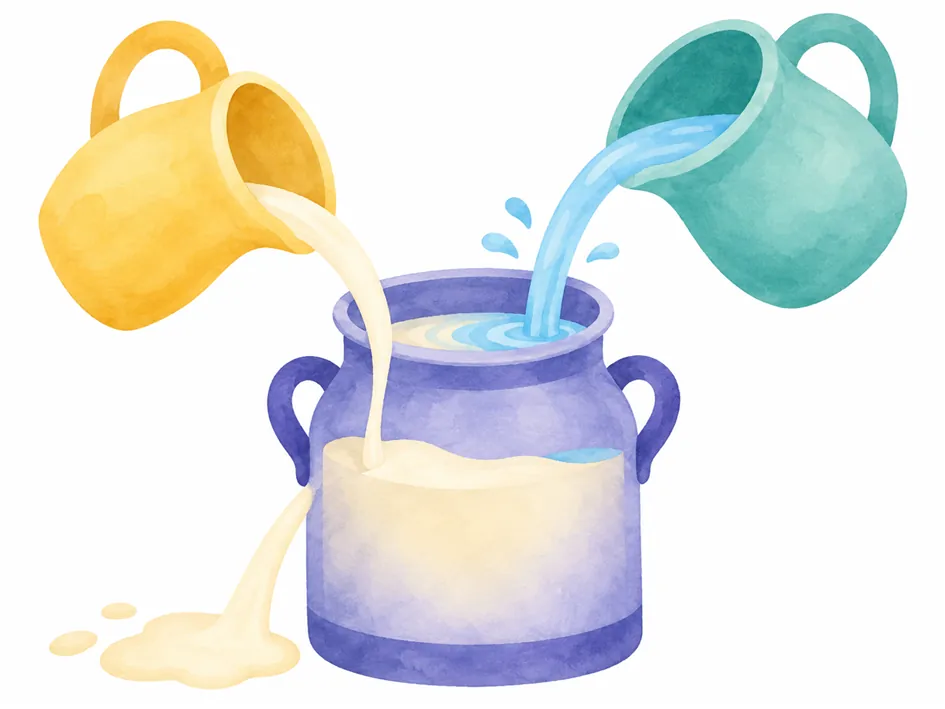
A milk can where some milk is poured out and water poured in.

Lakshmi runs a dairy. Her helper takes 10 litres out of a 100-litre can of pure milk and tops it up with water. Later he does the same thing again, and then a third time.

The helper thinks 30 litres of milk are gone. Lakshmi knows it is less. Who is right, and how much pure milk is left?

One replacement

Taking out 10 L from 100 L removes $\frac{10}{100} = \frac{1}{10}$ of everything in the can. So $\frac{9}{10}$ of the milk stays: 90 L. Water is added to fill the can again.

The second time is different

Now the can holds 90 L milk and 10 L water. The next 10 L taken out is a mixture: it removes 9 L of milk and 1 L of water. So the milk falls to 81 L, not 80 L. Each time, the milk is multiplied by $\frac{9}{10}$.
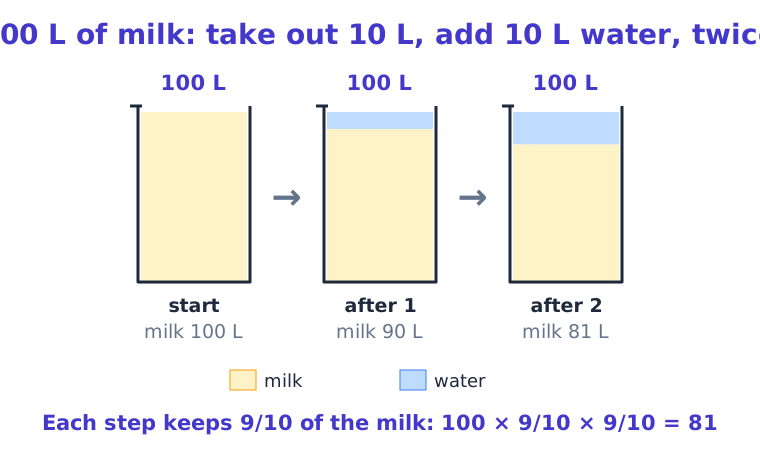
Three beakers of 100 L: pure milk at the start, 90 L milk after one replacement, 81 L milk after two; each step keeps 9/10 of the milk.

The formula

A vessel of $V$ litres of pure liquid; $x$ litres are replaced each time, $n$ times:

$$\text{pure left} = V\left(1 - \frac{x}{V}\right)^n$$

The water (or other liquid) is $V$ minus this.
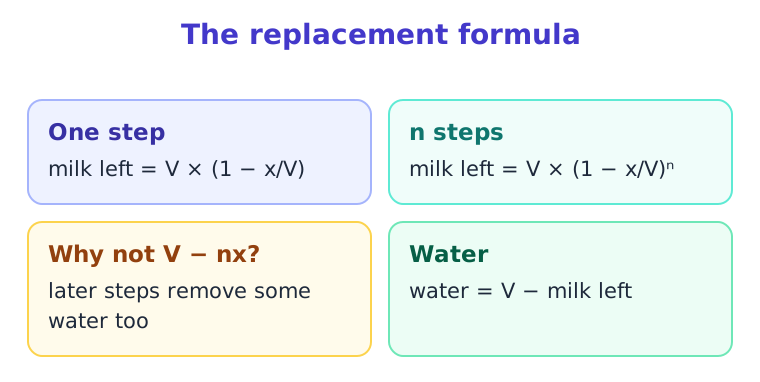
Cards: one step leaves V(1 − x/V); n steps leave V(1 − x/V)ⁿ; it is not V − nx because later steps remove water too; water = V − milk left.

Worked example: ratio after replacement

A 40-litre can of milk; 4 litres are replaced with water twice. Milk left $= 40 \times \left(\frac{9}{10}\right)^2 = 32.4$ L, water $= 7.6$ L.

Milk : water $= 32.4 : 7.6 = 81 : 19$.

Going backwards

After two replacements of 9 litres, milk : water is 16 : 9. Find the vessel size.

$\left(1 - \frac{9}{V}\right)^2 = \frac{16}{25}$, so $1 - \frac{9}{V} = \frac{4}{5}$, $\frac{9}{V} = \frac{1}{5}$ and $V = 45$ litres.

Replacing part of a mixture

A vessel is full of a mixture that is $\frac{5}{8}$ syrup. What fraction must be drawn off and replaced with water to make it half syrup?

$\frac{5}{8}(1 - f) = \frac{1}{2}$, so $1 - f = \frac{4}{5}$ and $f = \frac{1}{5}$.
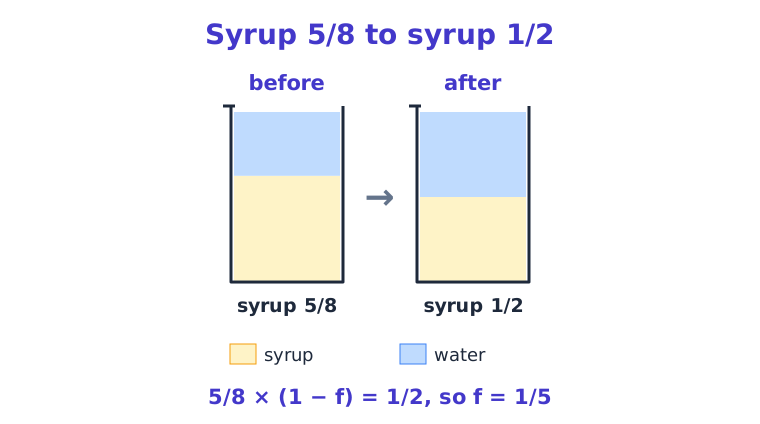
Two beakers: before, syrup fills 5/8; after replacing a fraction with water, syrup fills 1/2; 5/8 × (1 − f) = 1/2 gives f = 1/5.

Adding, not replacing: hold the fixed part

30 L of milk is 80% pure. How much water makes it 60% pure? The milk, 24 L, does not change:

$24 = 0.6 \times (30 + w)$, so $30 + w = 40$ and $w = 10$ L.

If instead you boil off water, the salt or sugar stays fixed in the same way.
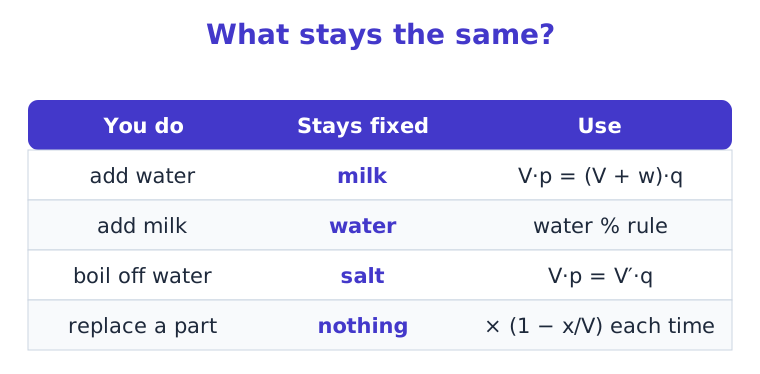
Table: adding water keeps milk fixed; adding milk keeps water fixed; boiling off water keeps salt fixed; replacing a part changes everything by the factor (1 − x/V).

Ratio changes

Milk and water are 4 : 1. Adding 6 L of water makes it 4 : 3. The milk is fixed, so write $4k$ for it: water goes from $k$ to $3k$, so $2k = 6$ and $k = 3$.

Milk = 12 L and the original mixture was 15 L.

Back to Lakshmi

$100 \times \left(\frac{9}{10}\right)^3 = 72.9$ litres of pure milk are left. Only 27.1 L of milk went, not 30 L, because the later rounds also took out some water. Lakshmi was right.
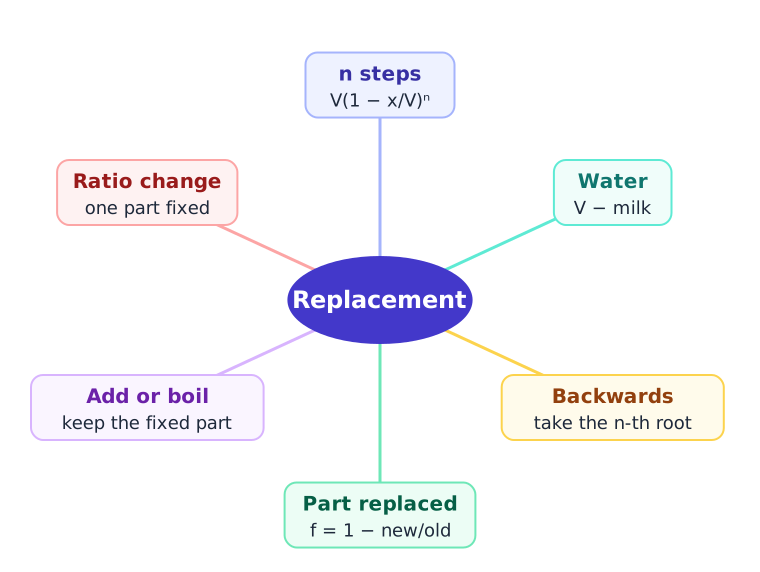
Mind map of replacement: V(1 − x/V)ⁿ after n steps, water = V − milk, working backwards with roots, part replaced f = 1 − new/old, adding or boiling keeps one part fixed, ratio changes.

Concepts and terms

Repeated replacement

Each round keeps the same fraction (1 − x/V) of the pure liquid, so n rounds multiply it n times.

Part replaced

Replacing a fraction f by water multiplies the old concentration by (1 − f): new = old × (1 − f).

The fixed part

When only one ingredient is added or removed, the other stays the same. Write the equation around it.

Did you know

Fish keepers change 20% of the aquarium water every week. After 3 changes only 0.8 × 0.8 × 0.8 = 51.2% of the original water is left: the same (1 − x/V)ⁿ rule.

Memory tricks

Replacement — Multiply, never subtract — Each round multiplies the milk by (1 − x/V); do not subtract x each time.

Adding or boiling — Hold the one that stays — Find the ingredient that does not change and equate its amounts before and after.

Practice MCQs with answers (60)

Q1 A can holds 100 litres of milk. 10 litres are taken out and replaced with water, and this is done twice in all. How much milk is left? beginner
  • A 81 litres
  • B 90 litres
  • C 72.9 litres
  • D 80 litres
Show answer
Answer: 81 litres
Why:

100 × (1 − 10/100)² = 100 × (0.9)² = 81 litres.

Q2 A jar holds 50 litres of pure juice. 10 litres are taken out and replaced with water, and this is done twice in all. How much pure juice is left? beginner
  • A 25.6 litres
  • B 32 litres
  • C 30 litres
  • D 40 litres
Show answer
Answer: 32 litres
Why:

50 × (1 − 10/50)² = 50 × (0.8)² = 32 litres.

Q3 A drum holds 64 litres of pure honey. 16 litres are taken out and replaced with water, and this is done three times in all. How much pure honey is left? intermediate
  • A 16 litres
  • B 36 litres
  • C 27 litres
  • D 20.25 litres
Show answer
Answer: 27 litres
Why:

64 × (1 − 16/64)³ = 64 × (0.75)³ = 27 litres.

Q4 A vessel holds 125 litres of milk. 25 litres are taken out and replaced with water, and this is done three times in all. How much milk is left? intermediate
  • A 50 litres
  • B 80 litres
  • C 51.2 litres
  • D 64 litres
Show answer
Answer: 64 litres
Why:

125 × (1 − 25/125)³ = 125 × (0.8)³ = 64 litres.

Q5 A tank holds 40 litres of pure oil. 4 litres are taken out and replaced with water, and this is done twice in all. How much pure oil is left? intermediate
  • A 32.4 litres
  • B 29.16 litres
  • C 32 litres
  • D 36 litres
Show answer
Answer: 32.4 litres
Why:

40 × (1 − 4/40)² = 40 × (0.9)² = 32.4 litres.

Q6 A can holds 80 litres of milk. 8 litres are taken out and replaced with water, and this is done three times in all. How much milk is left? advanced
  • A 64.8 litres
  • B 58.32 litres
  • C 52.488 litres
  • D 56 litres
Show answer
Answer: 58.32 litres
Why:

80 × (1 − 8/80)³ = 80 × (0.9)³ = 58.32 litres.

Q7 A jar holds 60 litres of pure juice. 6 litres are taken out and replaced with water, and this is done twice in all. How much pure juice is left? advanced
  • A 48 litres
  • B 54 litres
  • C 48.6 litres
  • D 43.74 litres
Show answer
Answer: 48.6 litres
Why:

60 × (1 − 6/60)² = 60 × (0.9)² = 48.6 litres.

Q8 A jar holds 100 litres of pure juice. 20 litres are taken out and replaced with water, and this is done twice in all. How much water is now in it? intermediate
  • A 64 litres
  • B 37 litres
  • C 40 litres
  • D 36 litres
Show answer
Answer: 36 litres
Why:

Pure juice left = 100 × (0.8)² = 64 L, so water = 100 − 64 = 36 litres.

Q9 A drum holds 40 litres of pure honey. 8 litres are taken out and replaced with water, and this is done twice in all. How much water is now in it? intermediate
  • A 14.4 litres
  • B 16 litres
  • C 25.6 litres
  • D 15.4 litres
Show answer
Answer: 14.4 litres
Why:

Pure honey left = 40 × (0.8)² = 25.6 L, so water = 40 − 25.6 = 14.4 litres.

Q10 A vessel holds 81 litres of milk. 27 litres are taken out and replaced with water, and this is done three times in all. How much water is now in it? advanced
  • A 58 litres
  • B 57 litres
  • C 81 litres
  • D 24 litres
Show answer
Answer: 57 litres
Why:

Milk left = 81 × (2/3)³ = 24 L, so water = 81 − 24 = 57 litres.

Q11 A tank holds 90 litres of pure oil. 9 litres are taken out and replaced with water, and this is done twice in all. How much water is now in it? advanced
  • A 18 litres
  • B 72.9 litres
  • C 17.1 litres
  • D 18.1 litres
Show answer
Answer: 17.1 litres
Why:

Pure oil left = 90 × (0.9)² = 72.9 L, so water = 90 − 72.9 = 17.1 litres.

Q12 A drum holds 40 litres of pure honey. 4 litres are taken out and replaced with water, and this is done twice in all. What is now the ratio of pure honey to water? intermediate
  • A 9 : 1
  • B 4 : 1
  • C 19 : 81
  • D 81 : 19
Show answer
Answer: 81 : 19
Why:

Pure honey = 32.4 L and water = 7.6 L, so the ratio is 81 : 19.

Q13 A vessel holds 20 litres of milk. 5 litres are taken out and replaced with water, and this is done twice in all. What is now the ratio of milk to water? intermediate
  • A 9 : 7
  • B 7 : 9
  • C 3 : 1
  • D 1 : 1
Show answer
Answer: 9 : 7
Why:

Milk = 11.25 L and water = 8.75 L, so the ratio is 9 : 7.

Q14 A tank holds 64 litres of pure oil. 16 litres are taken out and replaced with water, and this is done twice in all. What is now the ratio of pure oil to water? advanced
  • A 7 : 9
  • B 9 : 7
  • C 3 : 1
  • D 1 : 1
Show answer
Answer: 9 : 7
Why:

Pure oil = 36 L and water = 28 L, so the ratio is 9 : 7.

Q15 A can holds 100 litres of milk. 20 litres are taken out and replaced with water, and this is done three times in all. What is now the ratio of milk to water? advanced
  • A 61 : 64
  • B 16 : 9
  • C 64 : 61
  • D 2 : 3
Show answer
Answer: 64 : 61
Why:

Milk = 51.2 L and water = 48.8 L, so the ratio is 64 : 61.

Q16 From a vessel full of milk, 9 litres are taken out and replaced with water. This is done twice in all, and milk and water are now in the ratio 16 : 9. How much does the vessel hold? advanced
  • A 54 litres
  • B 90 litres
  • C 36 litres
  • D 45 litres
Show answer
Answer: 45 litres
Why:

Milk is now 16 parts out of 25, so (1 − 9/V)² = 16/25. Then 1 − 9/V = 4/5, 9/V = 1/5 and V = 45 litres.

Q17 From a vessel full of milk, 8 litres are taken out and replaced with water. This is done twice in all, and milk and water are now in the ratio 49 : 15. How much does the vessel hold? advanced
  • A 64 litres
  • B 32 litres
  • C 56 litres
  • D 72 litres
Show answer
Answer: 64 litres
Why:

Milk is now 49 parts out of 64, so (1 − 8/V)² = 49/64. Then 1 − 8/V = 7/8, 8/V = 1/8 and V = 64 litres.

Q18 From a vessel full of milk, 5 litres are taken out and replaced with water. This is done three times in all, and milk and water are now in the ratio 27 : 37. How much does the vessel hold? advanced
  • A 15 litres
  • B 20 litres
  • C 25 litres
  • D 30 litres
Show answer
Answer: 20 litres
Why:

Milk is now 27 parts out of 64, so (1 − 5/V)³ = 27/64. Then 1 − 5/V = 3/4, 5/V = 1/4 and V = 20 litres.

Q19 From a vessel full of milk, 4 litres are taken out and replaced with water. This is done twice in all, and milk and water are now in the ratio 81 : 19. How much does the vessel hold? advanced
  • A 36 litres
  • B 44 litres
  • C 40 litres
  • D 16 litres
Show answer
Answer: 40 litres
Why:

Milk is now 81 parts out of 100, so (1 − 4/V)² = 81/100. Then 1 − 4/V = 9/10, 4/V = 1/10 and V = 40 litres.

Q20 A tank holds 80 litres of pure oil. The same quantity is drawn out and replaced with another oil twice, after which 45 litres of the pure oil remain. How much was drawn each time? advanced
  • A 25 litres
  • B 18 litres
  • C 17.5 litres
  • D 20 litres
Show answer
Answer: 20 litres
Why:

(1 − x/80)² = 45/80 = 9/16, so 1 − x/80 = 3/4 and x = 80 × 1/4 = 20 litres.

Q21 A tank holds 50 litres of pure oil. The same quantity is drawn out and replaced with another oil twice, after which 32 litres of the pure oil remain. How much was drawn each time? advanced
  • A 10 litres
  • B 9 litres
  • C 15 litres
  • D 8 litres
Show answer
Answer: 10 litres
Why:

(1 − x/50)² = 32/50 = 16/25, so 1 − x/50 = 4/5 and x = 50 × 1/5 = 10 litres.

Q22 A tank holds 125 litres of pure oil. The same quantity is drawn out and replaced with another oil three times, after which 64 litres of the pure oil remain. How much was drawn each time? advanced
  • A 61/3 litres
  • B 25 litres
  • C 30 litres
  • D 23 litres
Show answer
Answer: 25 litres
Why:

(1 − x/125)³ = 64/125, so 1 − x/125 = 4/5 and x = 125 × 1/5 = 25 litres.

Q23 Each time, 25% of the liquid in a jar of pure juice is poured out and replaced with water. After 2 such operations, what percentage of the jar is pure juice? intermediate
  • A 43.75%
  • B 50%
  • C 56.25%
  • D 75%
Show answer
Answer: 56.25%
Why:

Each time 0.75 of the juice stays: (0.75)² × 100 = 56.25%.

Q24 Each time, 20% of the liquid in a jar of pure juice is poured out and replaced with water. After 3 such operations, what percentage of the jar is pure juice? intermediate
  • A 40%
  • B 64%
  • C 48.8%
  • D 51.2%
Show answer
Answer: 51.2%
Why:

Each time 0.8 of the juice stays: (0.8)³ × 100 = 51.2%.

Q25 Each time, 10% of the liquid in a jar of pure juice is poured out and replaced with water. After 2 such operations, what percentage of the jar is pure juice? intermediate
  • A 81%
  • B 90%
  • C 19%
  • D 80%
Show answer
Answer: 81%
Why:

Each time 0.9 of the juice stays: (0.9)² × 100 = 81%.

Q26 Each time, 50% of the liquid in a jar of pure juice is poured out and replaced with water. After 3 such operations, what percentage of the jar is pure juice? beginner
  • A 17.5%
  • B 12.5%
  • C 25%
  • D 87.5%
Show answer
Answer: 12.5%
Why:

Each time 0.5 of the juice stays: (0.5)³ × 100 = 12.5%.

Q27 A vessel is full of a mixture of syrup and water in the ratio 5 : 3. What fraction of the mixture must be drawn off and replaced with water so that syrup and water are in the ratio 1 : 1? advanced
  • A 1/2
  • B 1/8
  • C 1/5
  • D 3/8
Show answer
Answer: 1/5
Why:

Syrup goes from 5/8 to 1/2: 5/8 × (1 − f) = 1/2, so 1 − f = 0.8 and f = 1/5.

Q28 A vessel is full of a mixture of syrup and water in the ratio 3 : 1. What fraction of the mixture must be drawn off and replaced with water so that syrup and water are in the ratio 1 : 1? advanced
  • A 1/2
  • B 1/6
  • C 1/4
  • D 1/3
Show answer
Answer: 1/3
Why:

Syrup goes from 3/4 to 1/2: 3/4 × (1 − f) = 1/2, so 1 − f = 2/3 and f = 1/3.

Q29 A vessel is full of a mixture of syrup and water in the ratio 7 : 3. What fraction of the mixture must be drawn off and replaced with water so that syrup and water are in the ratio 1 : 1? intermediate
  • A 2/7
  • B 1/5
  • C 3/10
  • D 1/2
Show answer
Answer: 2/7
Why:

Syrup goes from 7/10 to 1/2: 7/10 × (1 − f) = 1/2, so 1 − f = 5/7 and f = 2/7.

Q30 A vessel is full of a mixture of syrup and water in the ratio 4 : 1. What fraction of the mixture must be drawn off and replaced with water so that syrup and water are in the ratio 3 : 2? intermediate
  • A 3/5
  • B 1/4
  • C 1/8
  • D 1/5
Show answer
Answer: 1/4
Why:

Syrup goes from 4/5 to 3/5: 4/5 × (1 − f) = 3/5, so 1 − f = 0.75 and f = 1/4.

Q31 A 60-litre mixture has milk and water in the ratio 2 : 1. 15 litres of the mixture are taken out and 15 litres of water are added. What is the new ratio of milk to water? intermediate
  • A 5 : 7
  • B 8 : 7
  • C 1 : 1
  • D 2 : 1
Show answer
Answer: 1 : 1
Why:

Milk = 40 × (1 − 15/60) = 30 L; water = 60 − 30 = 30 L; ratio 1 : 1.

Q32 A 50-litre mixture has milk and water in the ratio 3 : 2. 10 litres of the mixture are taken out and 10 litres of water are added. What is the new ratio of milk to water? intermediate
  • A 2 : 3
  • B 13 : 12
  • C 1 : 1
  • D 12 : 13
Show answer
Answer: 12 : 13
Why:

Milk = 30 × (1 − 10/50) = 24 L; water = 50 − 24 = 26 L; ratio 12 : 13.

Q33 An 80-litre mixture has milk and water in the ratio 5 : 3. 16 litres of the mixture are taken out and 16 litres of water are added. What is the new ratio of milk to water? intermediate
  • A 1 : 1
  • B 17 : 23
  • C 5 : 4
  • D 25 : 23
Show answer
Answer: 1 : 1
Why:

Milk = 50 × (1 − 16/80) = 40 L; water = 80 − 40 = 40 L; ratio 1 : 1.

Q34 30 litres of a mixture contain 80% milk. How much water must be added to make the milk 60% of the mixture? beginner
  • A 6 litres
  • B 10 litres
  • C 22.5 litres
  • D 40 litres
Show answer
Answer: 10 litres
Why:

Milk stays 24 L. New total = 24 ÷ 0.6 = 40 L, so add 10 litres.

Q35 40 litres of a mixture contain 90% milk. How much water must be added to make the milk 75% of the mixture? beginner
  • A 48 litres
  • B 6 litres
  • C 8 litres
  • D 100/3 litres
Show answer
Answer: 8 litres
Why:

Milk stays 36 L. New total = 36 ÷ 0.75 = 48 L, so add 8 litres.

Q36 60 litres of a mixture contain 50% milk. How much water must be added to make the milk 40% of the mixture? intermediate
  • A 75 litres
  • B 6 litres
  • C 48 litres
  • D 15 litres
Show answer
Answer: 15 litres
Why:

Milk stays 30 L. New total = 30 ÷ 0.4 = 75 L, so add 15 litres.

Q37 25 litres of a mixture contain 72% milk. How much water must be added to make the milk 60% of the mixture? intermediate
  • A 5 litres
  • B 125/6 litres
  • C 30 litres
  • D 3 litres
Show answer
Answer: 5 litres
Why:

Milk stays 18 L. New total = 18 ÷ 0.6 = 30 L, so add 5 litres.

Q38 A 60-litre solution has 20% acid. How many litres of pure acid must be added to make it 40% acid? intermediate
  • A 22 litres
  • B 20 litres
  • C 12 litres
  • D 30 litres
Show answer
Answer: 20 litres
Why:

Water stays 48 L and must be 60% of the new total: 48 ÷ 0.6 = 80 L, so add 20 litres.

Q39 A 40-litre solution has 25% acid. How many litres of pure acid must be added to make it 40% acid? intermediate
  • A 6 litres
  • B 15 litres
  • C 10 litres
  • D 12 litres
Show answer
Answer: 10 litres
Why:

Water stays 30 L and must be 60% of the new total: 30 ÷ 0.6 = 50 L, so add 10 litres.

Q40 A 30-litre solution has 10% acid. How many litres of pure acid must be added to make it 25% acid? intermediate
  • A 18 litres
  • B 8 litres
  • C 4.5 litres
  • D 6 litres
Show answer
Answer: 6 litres
Why:

Water stays 27 L and must be 75% of the new total: 27 ÷ 0.75 = 36 L, so add 6 litres.

Q41 40 litres of sea water contain 5% salt. How much water must evaporate so that the salt becomes 8%? beginner
  • A 15 litres
  • B 20 litres
  • C 25 litres
  • D 1.2 litres
Show answer
Answer: 15 litres
Why:

Salt stays 2 L. New total = 2 ÷ 0.08 = 25 L, so 40 − 25 = 15 litres evaporate.

Q42 60 litres of sea water contain 4% salt. How much water must evaporate so that the salt becomes 6%? intermediate
  • A 40 litres
  • B 20 litres
  • C 1.2 litres
  • D 25 litres
Show answer
Answer: 20 litres
Why:

Salt stays 2.4 L. New total = 2.4 ÷ 0.06 = 40 L, so 60 − 40 = 20 litres evaporate.

Q43 50 litres of sea water contain 3% salt. How much water must evaporate so that the salt becomes 5%? intermediate
  • A 1 litre
  • B 25 litres
  • C 20 litres
  • D 30 litres
Show answer
Answer: 20 litres
Why:

Salt stays 1.5 L. New total = 1.5 ÷ 0.05 = 30 L, so 50 − 30 = 20 litres evaporate.

Q44 A mixture has milk and water in the ratio 4 : 1. When 6 litres of water are added, the ratio becomes 4 : 3. How much milk is in the mixture? beginner
  • A 15 litres
  • B 8 litres
  • C 18 litres
  • D 12 litres
Show answer
Answer: 12 litres
Why:

Milk is fixed at 4k. Water goes from 1k to 3k, so 2k = 6, k = 3 and milk = 12 litres.

Q45 A mixture has milk and water in the ratio 5 : 2. When 9 litres of water are added, the ratio becomes 1 : 1. What was the quantity of the original mixture? beginner
  • A 21 litres
  • B 24 litres
  • C 15 litres
  • D 30 litres
Show answer
Answer: 21 litres
Why:

Write 1 : 1 as 5 : 5 so that milk keeps its 5 parts. Milk keeps 5k and water goes from 2k to 5k: 3k = 9 gives k = 3, so the original mixture was (5 + 2) × 3 = 21 litres.

Q46 A mixture has milk and water in the ratio 3 : 1. When 10 litres of water are added, the ratio becomes 1 : 1. What was the quantity of the original mixture? intermediate
  • A 15 litres
  • B 20 litres
  • C 30 litres
  • D 25 litres
Show answer
Answer: 20 litres
Why:

Write 1 : 1 as 3 : 3 so that milk keeps its 3 parts. Milk keeps 3k and water goes from 1k to 3k: 2k = 10 gives k = 5, so the original mixture was (3 + 1) × 5 = 20 litres.

Q47 A mixture has milk and water in the ratio 7 : 2. When 10 litres of water are added, the ratio becomes 7 : 4. How much milk is in the mixture? intermediate
  • A 45 litres
  • B 17.5 litres
  • C 35 litres
  • D 10 litres
Show answer
Answer: 35 litres
Why:

Milk is fixed at 7k. Water goes from 2k to 4k, so 2k = 10, k = 5 and milk = 35 litres.

Q48 A can of 100 L of milk has 10 L replaced with water three times. A student says 70 L of milk is left. The mistake is beginner
  • A the vessel becomes smaller
  • B water also contains milk
  • C there is no mistake
  • D later draws also remove some water
Show answer
Answer: later draws also remove some water
Why:

After the first round the can holds a mixture, so 10 L drawn contains less than 10 L of milk. The answer is 72.9 L.

Q49 When water is added to a milk-water mixture, which quantity stays the same? beginner
  • A The quantity of milk
  • B The quantity of water
  • C The ratio
  • D The total volume
Show answer
Answer: The quantity of milk
Why:

Only water is added, so the milk does not change.

Q50 Salt water is boiled so that some water evaporates. Which statement is true? beginner
  • A The amount of salt falls
  • B The salt percentage rises
  • C The salt percentage falls
  • D Nothing changes
Show answer
Answer: The salt percentage rises
Why:

Salt stays and the total shrinks, so its share grows.

Q51 After n replacements of x litres from V litres, the fraction of the original liquid left is intermediate
  • A 1 − (x/V)ⁿ
  • B 1 − nx/V
  • C (1 − x/V)ⁿ
  • D (x/V)ⁿ
Show answer
Answer: (1 − x/V)ⁿ
Why:

Each round keeps the fraction 1 − x/V of what was there.

Q52 Half of a jar of pure juice is replaced with water again and again. After how many operations does the juice first fall below 10%? advanced
  • A 3
  • B 5
  • C 10
  • D 4
Show answer
Answer: 4
Why:

(1/2)³ = 12.5% and (1/2)⁴ = 6.25%, so after 4 operations.

Q53 Assertion (A): Replacing 10 L of a 100 L can of milk with water twice leaves 81 L of milk. Reason (R): Each replacement keeps 9/10 of the milk present at that time. intermediate
  • A Both A and R are true, and R is the correct explanation of A
  • B Both A and R are true, but R is not the correct explanation of A
  • C A is true but R is false
  • D A is false but R is true
Show answer
Answer: Both A and R are true, and R is the correct explanation of A
Why:

100 × 9/10 × 9/10 = 81, and R is exactly the reason.

Q54 Assertion (A): Adding 10 L of water to 30 L of 80% milk makes it 60% milk. Reason (R): When water is added, the quantity of water stays fixed. intermediate
  • A Both A and R are true, and R is the correct explanation of A
  • B Both A and R are true, but R is not the correct explanation of A
  • C A is true but R is false
  • D A is false but R is true
Show answer
Answer: A is true but R is false
Why:

24 L milk in 40 L is 60%, so A is true. R is false: the milk stays fixed, not the water.

Q55 A 40 L can of milk has 4 L replaced with water twice. Which are true? 1. 32.4 L of milk is left. 2. Milk and water are in the ratio 81 : 19. advanced
  • A 1 only
  • B 2 only
  • C Both 1 and 2
  • D Neither 1 nor 2
Show answer
Answer: Both 1 and 2
Why:

40 × 0.81 = 32.4 and 32.4 : 7.6 = 81 : 19. Both true.

Q56 Consider the statements about adding and boiling: 1. Adding pure acid to a solution keeps the water fixed. 2. Boiling off water keeps the total volume fixed. beginner
  • A 1 only
  • B 2 only
  • C Both 1 and 2
  • D Neither 1 nor 2
Show answer
Answer: 1 only
Why:

Only acid is added, so water stays: 1 true. Boiling reduces the volume: 2 false.

Q57 The beakers show 10 L taken out of a 40 L can and replaced with water each round. How much milk is in the can after the second round? ![Three beakers of 40 L: pure milk, then three-quarters milk after one round, then unknown after two rounds; each round takes out 10 L and adds 10 L of water.](/syllabus/veda-skills-0-quantitative-aptitude-en/ch12/q-replace-40.svg) intermediate
  • A 22.5 litres
  • B 30 litres
  • C 17.5 litres
  • D 20 litres
Show answer
Answer: 22.5 litres
Why:

40 × (3/4)² = 40 × 9/16 = 22.5 litres. Subtracting 20 L would be the trap.

Q58 How much water must be poured in, as in the picture, to turn 30 L of 60% milk into 45% milk? ![Beakers: 30 L of 60% milk plus an unknown amount of water gives 45% milk.](/syllabus/veda-skills-0-quantitative-aptitude-en/ch12/q-add-water.svg) intermediate
  • A 15 litres
  • B 10 litres
  • C 4.5 litres
  • D 40 litres
Show answer
Answer: 10 litres
Why:

Milk 18 L stays. 18 ÷ 0.45 = 40 L in all, so 10 L of water.

Q59 In the picture, what fraction of the mixture was drawn off and replaced with water? ![Two full beakers: before, syrup fills three-quarters; after, syrup fills one half.](/syllabus/veda-skills-0-quantitative-aptitude-en/ch12/q-syrup.svg) advanced
  • A 2/3
  • B 1/4
  • C 1/3
  • D 1/2
Show answer
Answer: 1/3
Why:

3/4 × (1 − f) = 1/2, so 1 − f = 2/3 and f = 1/3.

Q60 The salt water on the left is boiled until it is 10% salt, as shown. How many litres of water boil away? ![Beakers: 50 L of 6% salt water becomes an unknown volume of 10% salt water after boiling.](/syllabus/veda-skills-0-quantitative-aptitude-en/ch12/q-evap.svg) intermediate
  • A 2 litres
  • B 25 litres
  • C 30 litres
  • D 20 litres
Show answer
Answer: 20 litres
Why:

Salt 3 L stays. 3 ÷ 0.10 = 30 L remain, so 20 L boil away.

Important short questions (4)

A 50 L can of milk has 5 L replaced with water three times. How much milk is left?

50 × (9/10)³ = 50 × 0.729 = 36.45 litres.

After two replacements of 8 L each, milk : water is 49 : 15. Find the size of the vessel.

(1 − 8/V)² = 49/64, so 1 − 8/V = 7/8 and V = 64 litres.

How much water must evaporate from 60 L of 4% salt water to make it 5%?

Salt 2.4 L; 2.4 ÷ 0.05 = 48 L must remain, so 12 L evaporate.

Explain why the milk after three replacements of 10 L from 100 L is 72.9 L and not 70 L.

From the second round on, the 10 L drawn is a mixture, so it takes out less than 10 L of milk. The milk shrinks by 9/10 each time: 100 → 90 → 81 → 72.9.

Long answer questions (1)

A vessel holds 80 L of milk. x litres are taken out and replaced with water, and the process is repeated once more. Now the vessel has 45 L of milk. (a) Find x. (b) Find the ratio of milk to water. (c) If it is done a third time, how much milk is left?

(a) (1 − x/80)² = 45/80 = 9/16, so 1 − x/80 = 3/4 and x = 20 L.

(b) Milk 45 L, water 35 L, ratio 9 : 7.

(c) 45 × 3/4 = 33.75 litres.

Flashcards (13)

Pure liquid after n replacements?
V(1 − x/V)ⁿ
100 L, 10 L replaced twice: milk?
81 L
100 L, 10 L replaced 3 times: milk?
72.9 L
Why not 100 − 30?
Later draws remove water too
1/4 replaced twice: fraction of milk left?
9/16
Part f replaced with water: new strength?
old × (1 − f)
5/8 syrup to 1/2: fraction replaced?
1/5
Adding water: what stays fixed?
The milk
Boiling off water: what stays fixed?
The dissolved salt or sugar
30 L at 80% milk, make it 60%: water to add?
10 L
After 2 rounds milk : water = 16 : 9, x = 9: V?
45 L
4 : 1 to 4 : 3 by adding 6 L water: milk?
12 L
Does the vessel size change in replacement?
No, it is refilled each time

Play this topic

  • Replacement check

Veda Skills Quantitative Aptitude Unit 12 — frequently asked questions

In what ratio should rice at ₹42 and ₹54 per kg be mixed to get rice worth ₹45 per kg?

(54 − 45) : (45 − 42) = 9 : 3 = 3 : 1.

Milk costs ₹45 per litre. How much water must be added to 40 litres of milk so that the mixture is worth ₹40 per litre?

Water : milk = 5 : 40 = 1 : 8, so water = 40 ÷ 8 = 5 litres.

A shopkeeper mixes dal at ₹80 and ₹100 per kg and sells at ₹99, gaining 10%. Find the ratio.

Cost = 99 ÷ 1.1 = ₹90; (100 − 90) : (90 − 80) = 1 : 1.

A 50 L can of milk has 5 L replaced with water three times. How much milk is left?

50 × (9/10)³ = 50 × 0.729 = 36.45 litres.

After two replacements of 8 L each, milk : water is 49 : 15. Find the size of the vessel.

(1 − 8/V)² = 49/64, so 1 − 8/V = 7/8 and V = 64 litres.

How much water must evaporate from 60 L of 4% salt water to make it 5%?

Salt 2.4 L; 2.4 ÷ 0.05 = 48 L must remain, so 12 L evaporate.

Part of the Veda Skills Quantitative Aptitude course
See every unit of the Veda Skills course Quantitative Aptitude.
See all units

All Veda Skills Quantitative Aptitude units

All Quantitative Aptitude units · All Skills & Exams courses

Study this chapter properly, free

Everything above is on this page to read. In the Veda app the same chapter becomes spaced-repetition flashcards, timed tests that mark themselves, Veda Bites you can swipe, and games — with your progress tracked topic by topic.

Get Veda free