Veda Skills Quantitative Aptitude Unit 5: Averages
- 2 topics
- 138 MCQs
- 8 short answers
- 2 long answers
- 27 flashcards
- 2 games
- ~95 min read
- English
Checked before publishing: 23 automated checks, including a plagiarism check against the textbook's own words. How we check our content
Average Basics
Find the average of any list, use the total method for missing, joining and leaving values, correct a wrongly copied entry, handle series and cricket averages, and find the average speed over equal distances.
What you will be able to do
- I can find the average of a list and the total from an average.
- I can find a missing value, or the value of a person who joins or leaves, with the total method.
- I can correct an average when one entry was copied wrongly.
- I can find the averages of consecutive numbers and standard series in one step.
- I can find the average speed for a journey with two equal distances.

Key points
Average = sum of the values ÷ number of values.
Total = average × number of values. Most average questions are solved by comparing totals.
The deviations of the values from their average always add up to zero.
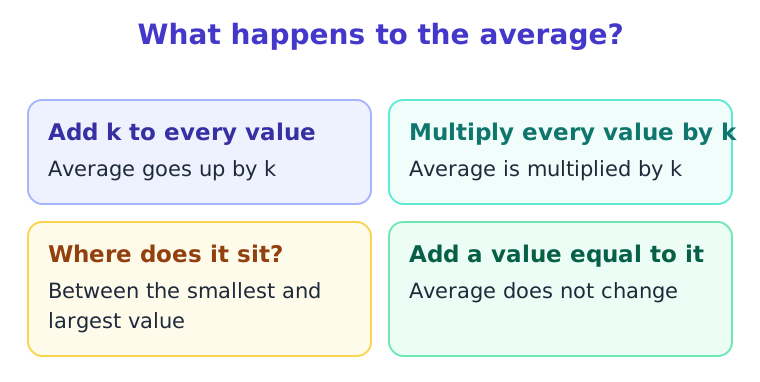
Adding k to every value raises the average by k; multiplying every value by k multiplies the average by k.
For equally spaced values, the average is (first + last) ÷ 2, which is also the middle value.
If one value x was copied as y, the average changes by (x − y) ÷ n.
When a member joins and the average rises by d, the newcomer = new average + (old count) × d.
Average speed over two equal distances is 2xy ÷ (x + y), not (x + y) ÷ 2.
Full explanation
Anjali's tea stall

Anjali runs a tea stall near a bus stand. From Monday to Friday she sold 42, 55, 38, 61 and 54 cups. The milkman asks: "How many cups do you sell in a day?" No single day is typical, so she needs one fair number for all five days.
That fair number is the average. By the end of this topic you will find it in seconds, and solve every exam twist on it.
What an average is

$$\text{Average} = \frac{\text{sum of the values}}{\text{number of values}}$$
Anjali's sum is $42 + 55 + 38 + 61 + 54 = 250$, over 5 days, so the average is $250 \div 5 = 50$ cups.
Turned around: Total = Average × Count. This one line solves most exam questions.
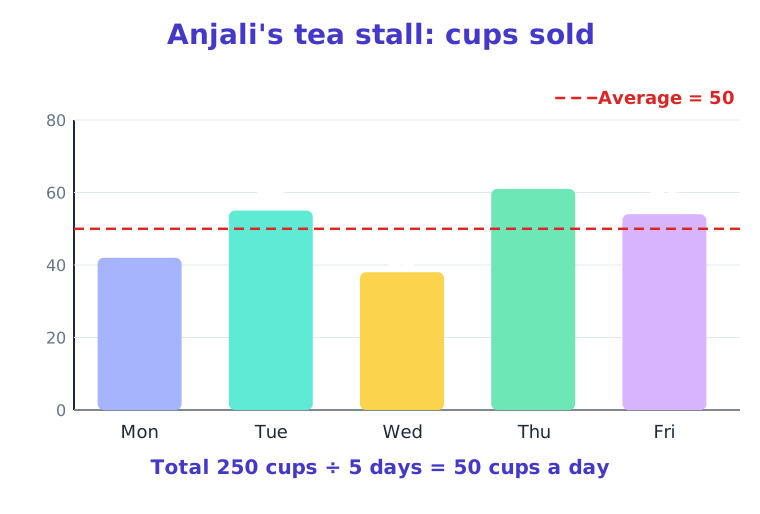
The levelling picture
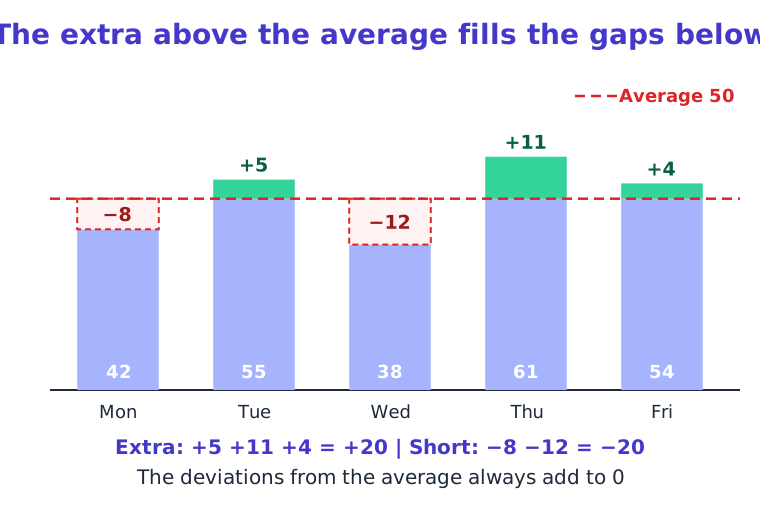
Imagine cutting the tops off the tall bars and pouring them into the short ones until every bar is level. The level you reach is the average.
The extra above 50 is $5 + 11 + 4 = 20$; the shortfall is $8 + 12 = 20$. They always match, so the deviations from the average add up to zero.
Shortcut: the assumed average
For big numbers, guess a round average and fix it.
Example: 487, 492, 503, 498, 510. Guess 500. Deviations: $-13, -8, +3, -2, +10$, sum $= -10$. Correction $= -10 \div 5 = -2$, so the average is $500 - 2 = 498$.
Four rules worth knowing
These let you answer many questions without any working.
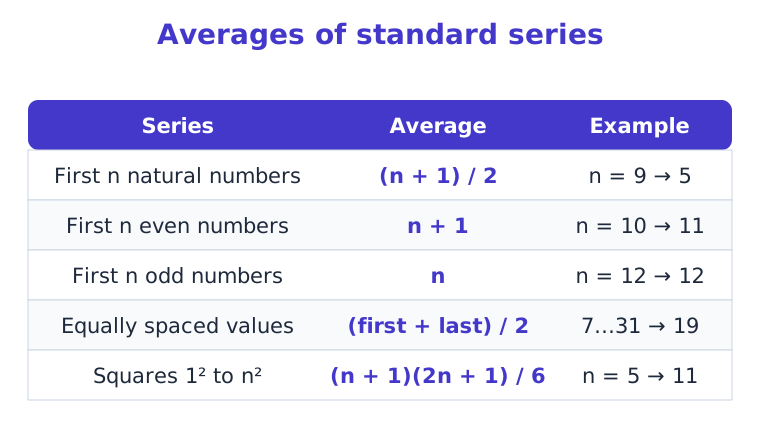
Series and consecutive numbers
When values go up by the same step, the average is the middle value, which equals $\frac{\text{first} + \text{last}}{2}$.
- Average of 5 consecutive even numbers is 36: they are 32, 34, 36, 38, 40.
- Average of the first 50 natural numbers: $\frac{50 + 1}{2} = 25.5$.
Joining, leaving and missing values
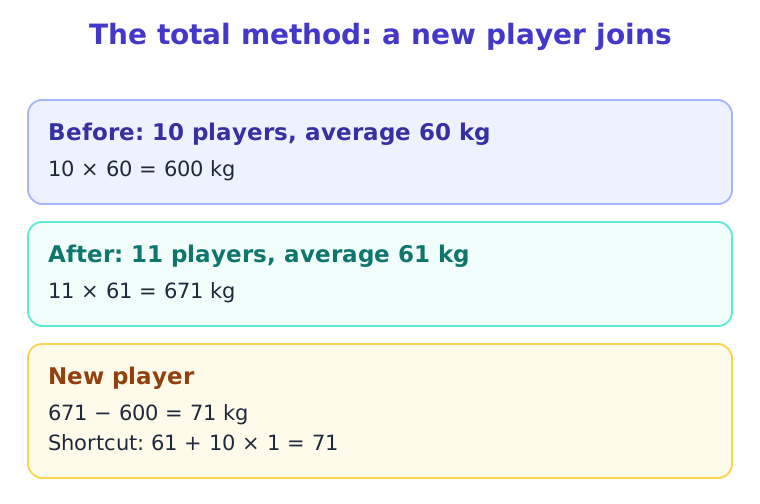
Make totals and compare them.
Missing value: the average of 5 subjects is 72 and four marks add to 287. Total needed $= 5 \times 72 = 360$, so the fifth mark is $360 - 287 = 73$.
Someone joins: the shortcut is newcomer = new average + (old count) × rise.
A wrongly copied entry
The average of 20 numbers was found to be 45, but one number 64 was read as 46. The total was short by $64 - 46 = 18$, so the average was short by $18 \div 20 = 0.9$.
Correct average $= 45 + 0.9 = 45.9$.
Cricket: one more innings
A batter scores 87 in the 17th innings and the average rises by 3. Let the old average be $a$.
$16a + 87 = 17(a + 3)$, so $a = 87 - 51 = 36$ and the new average is $39$.
Shortcut: new average $= \text{score} - (\text{old innings}) \times \text{rise} = 87 - 16 \times 3 = 39$.
Average speed over equal distances
A bus goes 120 km at 60 km/h and returns at 40 km/h. Time $= 2 + 3 = 5$ h for 240 km, so the average speed is 48 km/h.
Formula for equal distances: $\frac{2xy}{x + y} = \frac{2 \times 60 \times 40}{100} = 48$. The slower part takes more time, so it pulls the average down.
Back to Anjali
Anjali tells the milkman: about 50 cups a day. For the five weekdays he brings milk for 250 cups. On Saturday she sells 62 cups; her new six-day average is $\frac{250 + 62}{6} = 52$. She did not add all six again: she just added to the total.
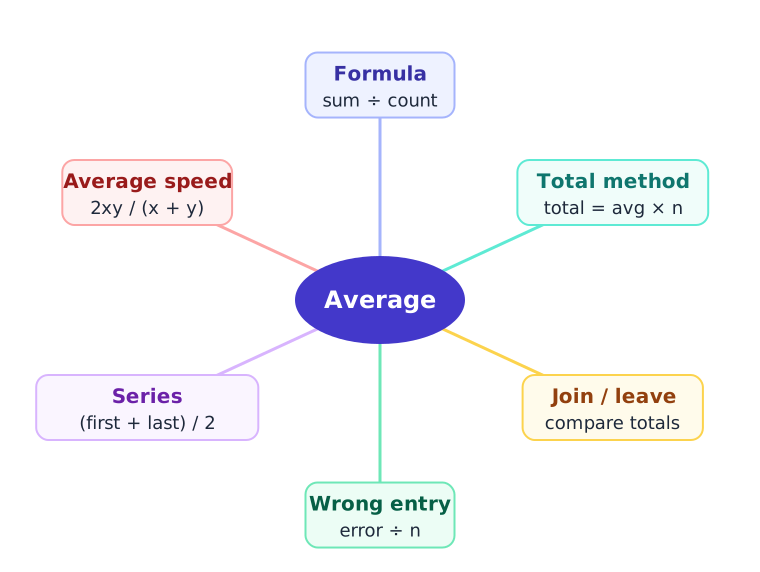
Exam summary: make totals, compare totals, divide once at the end.
Concepts and terms
One number that can stand for every value in a list: the sum shared equally. The average of 42, 55, 38, 61, 54 is 250 ÷ 5 = 50.
Turn every average into a total (average × count), add or subtract the totals, and divide at the end.
Guess an average, find how far each value is from it, and correct the guess by the average of those gaps.
Total distance ÷ total time. For two equal distances at x and y it is 2xy ÷ (x + y).

Did you know
A batting average in cricket divides runs by the number of times the batter got out, not by innings played.
The weather office reports a "normal" monsoon by comparing this year's rain with the long-period average of many years.

Memory tricks
Solving any average question — Make it a total — Average × count gives a total. Compare totals before and after; the difference is the answer.
Average speed — Two-x-y over x-plus-y — Equal distances: 2xy ÷ (x + y). The answer is always a little below the simple mean of the speeds.
Practice MCQs with answers (77)
- A 52.5
- B 71.5
- C 78.75
- D 63
Show answer
Why:
Sum = 315; average = 315 ÷ 5 = 63.
- A 53
- B 63.6
- C 55.5
- D 52
Show answer
Why:
Sum = 318; average = 318 ÷ 6 = 53.
- A 31.5
- B 36
- C 34.5
- D 42
Show answer
Why:
Sum = 252; average = 252 ÷ 7 = 36.
- A 40.5
- B 43
- C 41
- D 51.25
Show answer
Why:
Sum = 205; average = 205 ÷ 5 = 41.
- A 126.5
- B 178
- C 106.4
- D 133
Show answer
Why:
Sum = 532; average = 532 ÷ 4 = 133.
- A 1,331
- B 1,424
- C 1,597.2
- D 1,510.5
Show answer
Why:
Sum = 7,986; average = 7,986 ÷ 6 = 1,331.
- A 70
- B 73
- C 71
- D 75
Show answer
Why:
Sum = 584; average = 584 ÷ 8 = 73.
- A 24.5
- B 50
- C 25
- D 1,225
Show answer
Why:
Average = (n + 1) ÷ 2 = (49 + 1) ÷ 2 = 25.
- A 40
- B 81
- C 3,240
- D 40.5
Show answer
Why:
Average = (n + 1) ÷ 2 = (80 + 1) ÷ 2 = 40.5.
- A 41
- B 40
- C 42
- D 80
Show answer
Why:
2 + 4 + … + 80 has average n + 1 = 41.
- A 36
- B 35
- C 69
- D 17.5
Show answer
Why:
1 + 3 + … + 69 = 35², so the average is 35.
- A 91
- B 42
- C 45.5
- D 84
Show answer
Why:
7, 14, …, 84: average = (7 + 84) ÷ 2 = 45.5.
- A 32
- B 55.5
- C 43.5
- D 55
Show answer
Why:
Equally spaced, so average = (23 + 87) ÷ 2 = 55.
- A 46
- B 66
- C 57
- D 36
Show answer
Why:
Sum = n(n + 1)(2n + 1) ÷ 6 = 506; ÷ 11 gives 46.
- A 180
- B 94.5
- C 189
- D 90
Show answer
Why:
9, 18, …, 180: average = (9 + 180) ÷ 2 = 94.5.
- A 72
- B 78
- C 73
- D 68
Show answer
Why:
Total needed = 5 × 72 = 360; known total = 287; last = 360 − 287 = 73.
- A 76
- B 64
- C 65
- D 70
Show answer
Why:
Total needed = 6 × 65 = 390; known total = 320; last = 390 − 320 = 70.
- A 11
- B 5
- C 8
- D 17
Show answer
Why:
Total needed = 6 × 8 = 48; known total = 37; last = 48 − 37 = 11.
- A 34
- B 24
- C 31
- D 17
Show answer
Why:
Total needed = 7 × 24 = 168; known total = 144; last = 168 − 144 = 24.
- A 93
- B 99
- C 89
- D 85
Show answer
Why:
Total needed = 4 × 85 = 340; known total = 251; last = 340 − 251 = 89.
- A 39.5
- B 392
- C 343
- D 367.5
Show answer
Why:
Total = average × count = 24.5 × 15 = 367.5.
- A ₹15,600
- B ₹14,950
- C ₹674
- D ₹16,250
Show answer
Why:
Total = average × count = 650 × 24 = ₹15,600.
- A 49.3
- B 447.6
- C 484.9
- D 410.3
Show answer
Why:
Total = average × count = 37.3 × 12 = 447.6.
- A 46
- B 44
- C 45
- D 16
Show answer
Why:
New total − old total = 31 × 15 − 30 × 14 = 465 − 420 = 45.
- A 72
- B 70
- C 51
- D 71
Show answer
Why:
New total − old total = 11 × 61 − 10 × 60 = 671 − 600 = 71.
- A ₹49,500
- B ₹21,000
- C ₹51,000
- D ₹48,000
Show answer
Why:
New total − old total = 21 × 19,500 − 20 × 18,000 = 4,09,500 − 3,60,000 = ₹49,500.
- A 31
- B 30
- C 52
- D 29
Show answer
Why:
New total − old total = 12 × 41 − 11 × 42 = 492 − 462 = 30.
- A 56
- B 54
- C 55
- D 17
Show answer
Why:
New total − old total = 40 × 16 − 39 × 15 = 640 − 585 = 55.
- A 57
- B 7
- C 1
- D 56
Show answer
Why:
Old total 25 × 32 = 800; new total 24 × 31 = 744; difference = 56.
- A 44
- B 46
- C 14
- D 2
Show answer
Why:
Old total 8 × 30 = 240; new total 7 × 28 = 196; difference = 44.
- A ₹300
- B ₹760
- C ₹20
- D ₹780
Show answer
Why:
Old total 12 × 540 = 6,480; new total 11 × 520 = 5,720; difference = ₹760.
- A 19
- B 11
- C 12
- D 29
Show answer
Why:
Old total 9 × 20 = 180; new total 8 × 21 = 168; difference = 12.
- A 63
- B 46.8
- C 44.1
- D 45.9
Show answer
Why:
Error = 64 − 46 = 18; spread over 20: 0.9. Correct average = 45 + 0.9 = 45.9.
- A 61.1
- B 26
- C 60.2
- D 62.9
Show answer
Why:
Error = 48 − 84 = −36; spread over 40: 0.9. Correct average = 62 − 0.9 = 61.1.
- A 40
- B 38
- C 34
- D 86
Show answer
Why:
Error = 87 − 37 = 50; spread over 25: 2. Correct average = 36 + 2 = 38.
- A 69.46
- B 97
- C 70.54
- D 71.08
Show answer
Why:
Error = 96 − 69 = 27; spread over 50: 0.54. Correct average = 70 + 0.54 = 70.54.
- A 12.6
- B 20.7
- C 15
- D 15.3
Show answer
Why:
Error = 25 − 52 = −27; spread over 10: 2.7. Correct average = 18 − 2.7 = 15.3.
- A 56
- B 6
- C 50.5
- D 50
Show answer
Why:
First 6 + last 6 = 294 + 312 = 606, which counts the middle twice. All 11 = 550. Middle = 606 − 550 = 56.
- A 34
- B 42
- C 8
- D 35
Show answer
Why:
First 4 + last 4 = 120 + 160 = 280, which counts the middle twice. All 7 = 238. Middle = 280 − 238 = 42.
- A 68
- B 14
- C 82
- D 69
Show answer
Why:
First 7 + last 7 = 420 + 546 = 966, which counts the middle twice. All 13 = 884. Middle = 966 − 884 = 82.
- A 44
- B 10
- C 45
- D 54
Show answer
Why:
First 5 + last 5 = 210 + 240 = 450, which counts the middle twice. All 9 = 396. Middle = 450 − 396 = 54.
- A 39
- B 33
- C 42
- D 36
Show answer
Why:
Old average a: 16a + 87 = 17(a + 3), so a = 87 − 17 × 3 = 36; new average = 39.
- A 56
- B 52
- C 48
- D 44
Show answer
Why:
Old average a: 11a + 96 = 12(a + 4), so a = 96 − 12 × 4 = 48; new average = 52.
- A 50
- B 44
- C 47
- D 53
Show answer
Why:
Old average a: 20a + 110 = 21(a + 3), so a = 110 − 21 × 3 = 47; new average = 50.
- A 58
- B 56
- C 52
- D 54
Show answer
Why:
Old average a: 8a + 72 = 9(a + 2), so a = 72 − 9 × 2 = 54; new average = 56.
- A 48
- B 24
- C 46
- D 50
Show answer
Why:
Equal distances: 2xy ÷ (x + y) = 2 × 60 × 40 ÷ 100 = 48.
- A 14
- B 16
- C 18
- D 8
Show answer
Why:
Equal distances: 2xy ÷ (x + y) = 2 × 12 × 24 ÷ 36 = 16.
- A 30
- B 62
- C 60
- D 62.5
Show answer
Why:
Equal distances: 2xy ÷ (x + y) = 2 × 50 × 75 ÷ 125 = 60.
- A 42
- B 40.5
- C 20
- D 40
Show answer
Why:
Equal distances: 2xy ÷ (x + y) = 2 × 36 × 45 ÷ 81 = 40.
- A 2
- B 3
- C 1
- D 14
Show answer
Why:
Today the 5 members total 5 × (17 + 3) = 100. With the baby, 6 × 17 = 102. Baby = 102 − 100 = 2.
- A 5
- B 2
- C 3
- D 1
Show answer
Why:
Today the 4 members total 4 × (22 + 5) = 108. With the baby, 5 × 22 = 110. Baby = 110 − 108 = 2.
- A 31
- B 47
- C 27
- D 23
Show answer
Why:
Every member changes by 4 years, so the average changes by 4: 23 + 4 = 27.
- A 34
- B 32.8
- C 4
- D 28
Show answer
Why:
Every member changes by 6 years, so the average changes by 6: 34 − 6 = 28.
- A 40
- B 42
- C 41
- D 32
Show answer
Why:
The average is the middle value, so the numbers are 32, 34, 36, 38, 40. The largest is 40.
- A 33
- B 27
- C 26
- D 23
Show answer
Why:
The average is the middle value, so the numbers are 27, 28, 29, 30, 31, 32, 33. The smallest is 27.
- A 54
- B 43
- C 53
- D 55
Show answer
Why:
The average is the middle value, so the numbers are 43, 45, 47, 49, 51, 53. The largest is 53.
- A 32
- B 49
- C 31
- D 33
Show answer
Why:
The average is the middle value, so the numbers are 33, 35, 37, 39, 41, 43, 45, 47, 49. The smallest is 33.
- A 25
- B 20.5
- C 20
- D 70
Show answer
Why:
Each value rises by 5, so the average rises by 5: 20 + 5 = 25.
- A 12
- B 36
- C 15
- D 540
Show answer
Why:
The sum is multiplied by 3 and the count stays 15, so the average becomes 12 × 3 = 36.
- A 50
- B 36
- C 43
- D 18
Show answer
Why:
Apply the same steps to the average: 25 × 2 − 7 = 43.
- A 93
- B 75
- C 78
- D 90
Show answer
Why:
Needed total 6 × 75 = 450; she has 5 × 72 = 360; next test = 90. Shortcut: 75 + 5 × 3 = 90.
- A 84
- B 86
- C 66
- D 68
Show answer
Why:
Needed total 10 × 66 = 660; she has 9 × 64 = 576; next test = 84. Shortcut: 66 + 9 × 2 = 84.
- A 97.5
- B 78
- C 77
- D 79
Show answer
Why:
Sum = 72 + 85 + 64 + 90 + 79 = 390; average = 390 ÷ 5 = 78.
- A 4
- B 1
- C 3
- D 2
Show answer
Why:
Average = 312 ÷ 6 = 52. Scores above it: 72, 60, 84, so 3 matches.
- A 47
- B 54
- C 46.6
- D 49
Show answer
Why:
Total = 6 × 47 = 282; the other five add to 233; Thursday = 282 − 233 = 49.
- A 32
- B 31
- C 32.5
- D 33
Show answer
Why:
Sum = 224; 224 ÷ 7 = 32. Shortcut: assume 32; deviations −1, +2, −3, +1, +4, −2, −1 add to 0.
- A 27
- B 26
- C 25
- D 28
Show answer
Why:
D (35 kg) is replaced by 25 kg: the total falls by 10, so the average falls by 10 ÷ 5 = 2, giving 28 − 2 = 26.
- A 40
- B 41
- C 36
- D 75
Show answer
Why:
The largest value is at least the average, so it cannot be 36 (it could equal 40 if all are 40).
- A doubles
- B increases
- C decreases
- D stays the same
Show answer
Why:
The new value adds zero deviation, so the balance point does not move.
- A −3
- B −2
- C 3
- D 0
Show answer
Why:
Deviations add to 0: −4 + 2 − 1 + 6 + x = 0, so x = −3.
- A Take the middle value
- B Turn each average into a total
- C Divide the averages
- D Add the averages
Show answer
Why:
Totals can be added and subtracted; averages of different-sized groups cannot.
- A impossible to tell
- B exactly 40 km/h
- C less than 40 km/h
- D more than 40 km/h
Show answer
Why:
He spends more time at the slower speed, so the average (37.5) is below the simple mean 40.
- A Each number is 0
- B At least 5 are negative
- C Their product is 0
- D Their sum is 0
Show answer
Why:
Average 0 only says sum = 10 × 0 = 0; for example 5, −5, 0, … works.
- A Both A and R are true, and R is the correct explanation of A
- B Both A and R are true, but R is not the correct explanation of A
- C A is true but R is false
- D A is false but R is true
Show answer
Why:
Both true: 75 ÷ 5 = 15, and R is exactly why the middle value 15 is the answer.
- A Both A and R are true, and R is the correct explanation of A
- B Both A and R are true, but R is not the correct explanation of A
- C A is true but R is false
- D A is false but R is true
Show answer
Why:
A is false: 2 × 40 × 60 ÷ 100 = 48. R is true and is the very rule that gives 48.
- A 1 only
- B 2 only
- C Both 1 and 2
- D Neither 1 nor 2
Show answer
Why:
Adding 4 to each value adds 4 to the average (29). Doubling doubles it to 50, not 27.
- A 1 only
- B 2 only
- C Both 1 and 2
- D Neither 1 nor 2
Show answer
Why:
1 is false: the average of 1 and 2 is 1.5, not in the set. 2 is true (it can equal them only if all values are equal).
Important short questions (4)
Total = 7 × 26 = 182. First four = 96. Last three = 86, so their average = 86 ÷ 3 ≈ 28.67.
They are 6, 12, …, 96, equally spaced, so the average is (6 + 96) ÷ 2 = 51.
Time = 2 h + 3 h = 5 h for 60 km, so 60 ÷ 5 = 12 km/h. Check: 2 × 15 × 10 ÷ 25 = 12.
Error = 80 − 20 = 60; 60 ÷ 30 = 2; correct average = 52.
Long answer questions (1)
(a) Old total = 40 × 62 = 2,480. New total = 41 × 62.5 = 2,562.5. Her mark = 82.5.
(b) Total after he leaves = 2,562.5 − 30 = 2,532.5 for 40 students, so the average = 63.3125 ≈ 63.31.
Flashcards (14)
Play this topic
- Average or not?
Replacement and Weighted Averages
Combine groups of different sizes with the weighted average, find a missing group size or ratio by alligation, solve replacement questions in one line, and handle mixtures, credits and journeys made of unequal parts.
What you will be able to do
- I can find the combined average of two or three groups of different sizes.
- I can find the ratio or size of groups from their averages using alligation.
- I can solve replacement questions where one or two members are swapped.
- I can find the average price of a mixture and the average speed of a journey in unequal parts.
Key points
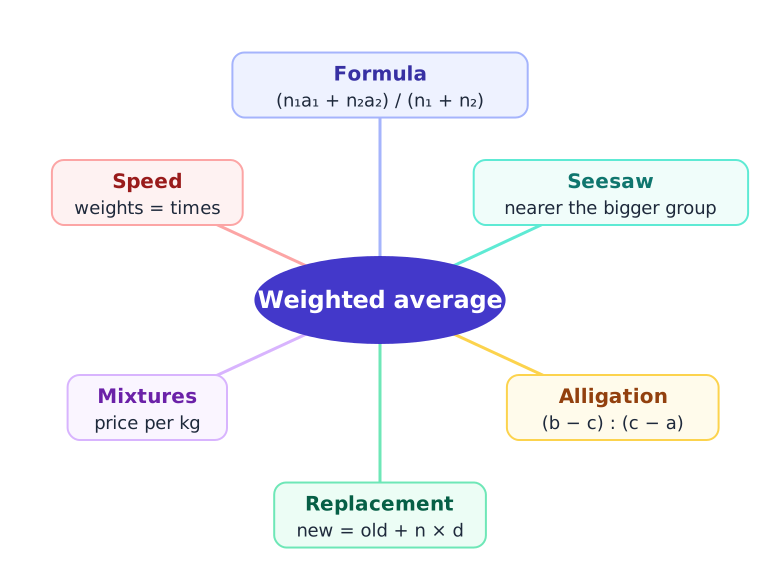
Weighted average = (n₁a₁ + n₂a₂ + …) ÷ (n₁ + n₂ + …). Each average is weighted by the size of its group.
The simple mean of two averages is correct only when the groups are the same size.
The combined average always lies between the group averages, nearer the bigger group.
Alligation: n₁ : n₂ = (a₂ − c) : (c − a₁), where c is the combined average.
Replacement: incoming − outgoing = (number of members) × (change in average).
Average price of a mixture = total cost ÷ total quantity.
Average speed = total distance ÷ total time; speeds are weighted by the time spent at each.
Full explanation
Mr Sharma's two batches

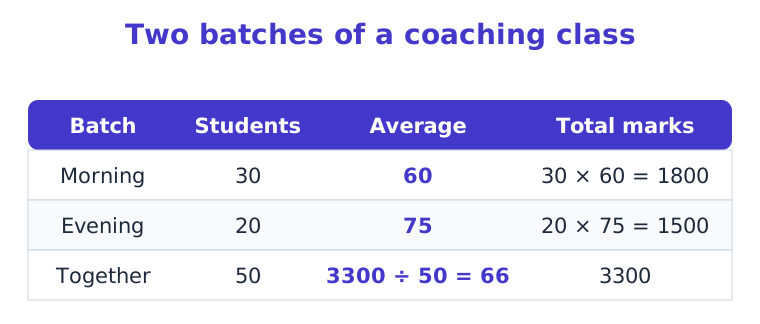
Mr Sharma teaches a morning batch of 30 students and an evening batch of 20. In a mock test the morning batch averaged 60 and the evening batch 75. A parent says: "So the class average is $(60 + 75) \div 2 = 67.5$." Mr Sharma smiles. The answer is not 67.5.
This topic shows why, and how to get it right in one line.
Weighted average
Turn each average into a total, add the totals, and divide by everyone:
$$\text{Combined average} = \frac{n_1 a_1 + n_2 a_2}{n_1 + n_2}$$
Here: $\frac{30 \times 60 + 20 \times 75}{50} = \frac{1800 + 1500}{50} = 66$.
Why the simple mean fails
The simple mean $67.5$ treats both batches as equally large. But the morning batch has more students, so it should count more. The true average 66 is nearer 60, the bigger group.
The simple mean is right only when the groups are the same size.
The seesaw picture
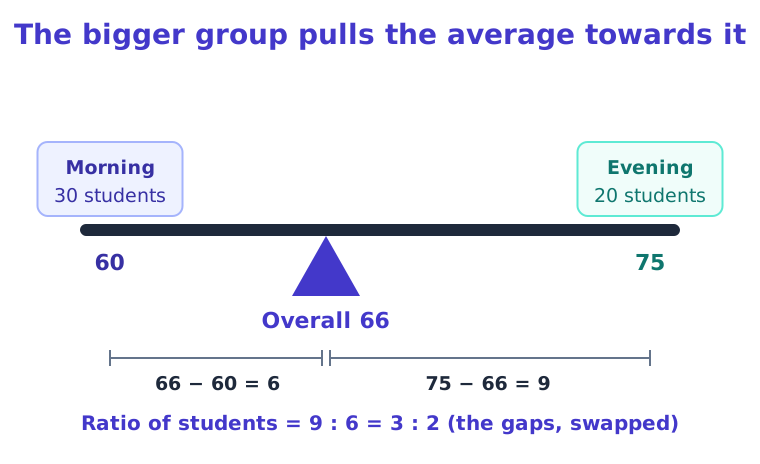
Put the two groups at the two ends of a beam. The balance point is the combined average. The heavier side pulls the fulcrum towards itself, and the distances are in the opposite ratio of the group sizes.
Alligation: finding the ratio
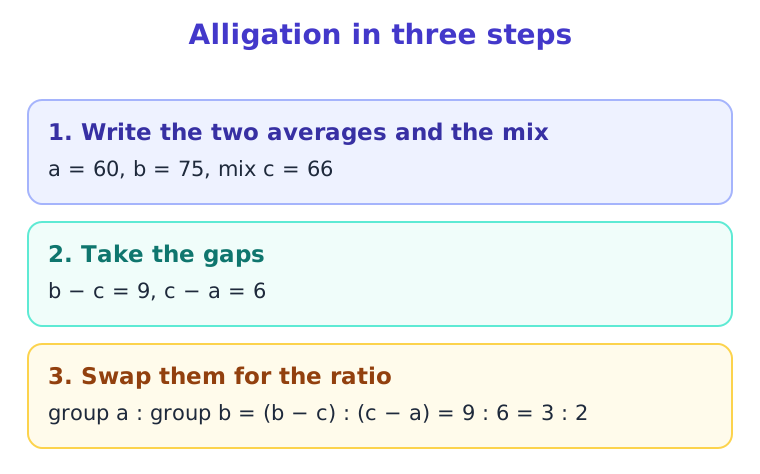
If you know both averages and the combined average, the seesaw gives the ratio at once:
$$n_1 : n_2 = (a_2 - c) : (c - a_1)$$
Worked example: technicians
A workshop has an average salary of ₹8,000. Its 7 technicians earn ₹12,000 on average and the rest earn ₹6,000. How many workers are there?
Gaps: $12000 - 8000 = 4000$ and $8000 - 6000 = 2000$. Technicians : others $= 2000 : 4000 = 1 : 2$. So there are 14 others and 21 workers in all.
Replacement in one line
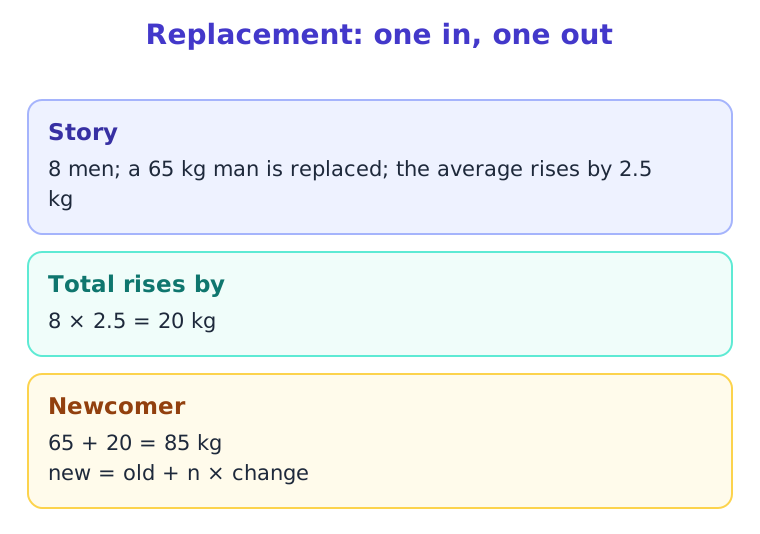
When one member is replaced, the count stays the same. So the total changes by $n \times d$, where $d$ is the change in average:
$$\text{newcomer} = \text{person replaced} + n \times d$$
If the average falls, $d$ is negative.
Two replaced at once
The average age of 10 men rises by 2 years when two men aged 20 and 24 are replaced by two women. The total rises by $10 \times 2 = 20$, so the women together are $44 + 20 = 64$ years, an average of 32 years.
Mixtures and journeys
Mixture: 30 kg of rice at ₹40 and 20 kg at ₹55 cost $1200 + 1100 = 2300$ for 50 kg, so ₹46 a kg.
Journey: 2 hours at 60 km/h and 3 hours at 40 km/h cover $120 + 120 = 240$ km in 5 hours, so the average speed is 48 km/h. Speeds are weighted by time, prices by quantity.
Back to Mr Sharma
Mr Sharma shows the parent the table: 3300 marks shared by 50 students is 66, not 67.5. The parent nods: the bigger morning batch pulls the average towards 60. From now on, before averaging two averages, he will ask how big each group is.
Exam summary: weight by size, use the seesaw for ratios, and remember in = out + n × d for replacement.
Concepts and terms
An average where each value counts as many times as its weight. 30 students at 60 and 20 at 75 give 3300 ÷ 50 = 66.
A quick way to find the ratio of two groups from their averages and the mix: the gaps, swapped.
One member leaves and another takes the place; the count stays the same, so the total changes by n × (change in average).
Driving 2 h at 60 and 1 h at 30 gives (120 + 30) ÷ 3 = 50 km/h: the speeds are weighted by the hours.
Did you know
A university CGPA is a weighted average: each grade point is weighted by the credits of that course.
The Sensex is a weighted average of 30 company share prices, weighted by the market value of each company.
Memory tricks
Alligation — Gaps, then swap — Find each average's gap from the mix, then swap them: the far group gets the small share.
Replacement — In = Out + n × d — The newcomer equals the one who left plus the count times the change in average.
Practice MCQs with answers (61)
- A 82.5
- B 67.5
- C 85
- D 87.5
Show answer
Why:
Count unchanged, so the total changes by 8 × 2.5 = 20. New = 65 + 20 = 85.
- A 75
- B 69
- C 45
- D 72
Show answer
Why:
Count unchanged, so the total changes by 10 × 3 = 30. New = 42 + 30 = 72.
- A 19
- B 18.75
- C 16.25
- D 19.25
Show answer
Why:
Count unchanged, so the total changes by 12 × 0.25 = 3. New = 16 + 3 = 19.
- A 58
- B 60
- C 62
- D 70
Show answer
Why:
Count unchanged, so the total changes by 6 × 2 = 12. New = 72 − 12 = 60.
- A ₹36,600
- B ₹35,400
- C ₹36,000
- D ₹24,600
Show answer
Why:
Count unchanged, so the total changes by 20 × 600 = 12,000. New = 24,000 + 12,000 = ₹36,000.
- A 10.8
- B 11.2
- C 13.8
- D 11
Show answer
Why:
Count unchanged, so the total changes by 15 × 0.2 = 3. New = 14 − 3 = 11.
- A 71.5
- B 73
- C 70
- D 59.5
Show answer
Why:
Count unchanged, so the total changes by 9 × 1.5 = 13.5. New = 58 + 13.5 = 71.5.
- A 95
- B 65
- C 77.5
- D 62.5
Show answer
Why:
Replaced = newcomer − n × d = 80 − 6 × 2.5 = 65.
- A 113
- B 93.2
- C 77
- D 75.2
Show answer
Why:
Replaced = newcomer − n × d = 95 − 10 × 1.8 = 77.
- A 62.5
- B 76
- C 68.5
- D 64
Show answer
Why:
Replaced = newcomer − n × d = 70 − 4 × 1.5 = 64.
- A 32
- B 30
- C 64
- D 24
Show answer
Why:
Total rises by 10 × 2 = 20. The two newcomers total 44 + 20 = 64, so their average is 32.
- A 46
- B 48
- C 96
- D 42
Show answer
Why:
Total rises by 8 × 2 = 16. The two newcomers total 80 + 16 = 96, so their average is 48.
- A 35
- B 47
- C 50
- D 100
Show answer
Why:
Total rises by 12 × 3 = 36. The two newcomers total 64 + 36 = 100, so their average is 50.
- A 69
- B 110
- C 67.5
- D 66
Show answer
Why:
(30 × 60 + 20 × 75) ÷ 50 = 3,300 ÷ 50 = 66. (The simple mean 67.5 ignores the group sizes.)
- A 59
- B 60
- C 58
- D 57
Show answer
Why:
(25 × 52 + 35 × 64) ÷ 60 = 3,540 ÷ 60 = 59. (The simple mean 58 ignores the group sizes.)
- A ₹570
- B ₹480
- C ₹600
- D ₹525
Show answer
Why:
(40 × 450 + 10 × 600) ÷ 50 = 24,000 ÷ 50 = ₹480. (The simple mean 525 ignores the group sizes.)
- A 65
- B 62.5
- C 64
- D 61
Show answer
Why:
(18 × 70 + 12 × 55) ÷ 30 = 1,920 ÷ 30 = 64. (The simple mean 62.5 ignores the group sizes.)
- A 74
- B 77
- C 72
- D 71
Show answer
Why:
(45 × 68 + 15 × 80) ÷ 60 = 4,260 ÷ 60 = 71. (The simple mean 74 ignores the group sizes.)
- A ₹470
- B ₹445
- C ₹471
- D ₹457.5
Show answer
Why:
(24 × 520 + 16 × 395) ÷ 40 = 18,800 ÷ 40 = ₹470. (The simple mean 457.5 ignores the group sizes.)
- A 57.8
- B 55.8
- C 53.8
- D 55
Show answer
Why:
Total = 1200 + 2100 + 2280 = 5580; players = 100; average = 55.8.
- A 42.4
- B 38.4
- C 40.4
- D 41.4
Show answer
Why:
Total = 400 + 720 + 900 = 2020; players = 50; average = 40.4.
- A 36
- B 20.4
- C 35
- D 34
Show answer
Why:
Class total = 40 × 39 = 1560; boys = 25 × 42 = 1050; girls = 510 ÷ 15 = 34.
- A 42.5
- B 44
- C 43.5
- D 41.5
Show answer
Why:
Class total = 30 × 47 = 1410; boys = 18 × 50 = 900; girls = 510 ÷ 12 = 42.5.
- A 8.25
- B 33
- C 34
- D 36
Show answer
Why:
Class total = 40 × 37 = 1480; boys = 32 × 38 = 1216; girls = 264 ÷ 8 = 33.
- A 60
- B 41
- C 40
- D 39
Show answer
Why:
Class total = 50 × 42 = 2100; boys = 20 × 45 = 900; girls = 1200 ÷ 30 = 40.
- A 4 : 5
- B 5 : 2
- C 2 : 3
- D 3 : 2
Show answer
Why:
Gaps: 75 − 66 = 9 and 66 − 60 = 6. Swap them: boys : girls = 9 : 6 = 3 : 2.
- A 2 : 1
- B 1 : 2
- C 8 : 11
- D 3 : 1
Show answer
Why:
Gaps: 55 − 45 = 10 and 45 − 40 = 5. Swap them: ₹40 rice : ₹55 rice = 10 : 5 = 2 : 1.
- A 3 : 2
- B 1 : 2
- C 2 : 1
- D 2 : 5
Show answer
Why:
Gaps: 45,000 − 36,000 = 9,000 and 36,000 − 18,000 = 18,000. Swap them: clerks : managers = 9,000 : 18,000 = 1 : 2.
- A 8 : 3
- B 31 : 50
- C 5 : 3
- D 3 : 5
Show answer
Why:
Gaps: 200 − 150 = 50 and 150 − 120 = 30. Swap them: cheaper : dearer = 50 : 30 = 5 : 3.
- A 4 : 5
- B 26 : 35
- C 9 : 4
- D 5 : 4
Show answer
Why:
Gaps: 70 − 60 = 10 and 60 − 52 = 8. Swap them: boys : girls = 10 : 8 = 5 : 4.
- A 21
- B 20
- C 14
- D 28
Show answer
Why:
Technicians : rest = (8,000 − 6,000) : (12,000 − 8,000) = 1 : 2, so the rest = 14 and total = 7 + 14 = 21.
- A 20
- B 35
- C 25
- D 45
Show answer
Why:
Technicians : rest = (10,000 − 8,000) : (15,000 − 10,000) = 2 : 5, so the rest = 25 and total = 10 + 25 = 35.
- A 28
- B 12
- C 22
- D 16
Show answer
Why:
Technicians : rest = (12,000 − 9,000) : (20,000 − 12,000) = 3 : 8, so the rest = 16 and total = 6 + 16 = 22.
- A 25
- B 10
- C 15
- D 20
Show answer
Why:
Technicians : rest = (600 − 500) : (900 − 600) = 1 : 3, so the rest = 15 and total = 5 + 15 = 20.
- A ₹46
- B ₹48
- C ₹47.5
- D ₹49
Show answer
Why:
Cost = 30 × 40 + 20 × 55 = ₹2,300 for 50 kg, so ₹46 per kg.
- A ₹39
- B ₹41
- C ₹43
- D ₹40
Show answer
Why:
Cost = 15 × 36 + 25 × 44 = ₹1,640 for 40 kg, so ₹41 per kg.
- A ₹106
- B ₹102.5
- C ₹104
- D ₹101
Show answer
Why:
Cost = 8 × 95 + 12 × 110 = ₹2,080 for 20 kg, so ₹104 per kg.
- A ₹375
- B ₹347
- C ₹360
- D ₹345
Show answer
Why:
Cost = 3 × 420 + 5 × 300 = ₹2,760 for 8 kg, so ₹345 per kg.
- A 48
- B 51
- C 50
- D 46
Show answer
Why:
Distance = 120 + 120 = 240 km in 5 h. Average = 240 ÷ 5 = 48 km/h, not the simple mean 50.
- A 47
- B 45
- C 43
- D 40
Show answer
Why:
Distance = 30 + 150 = 180 km in 4 h. Average = 180 ÷ 4 = 45 km/h, not the simple mean 40.
- A 52
- B 55
- C 54
- D 56
Show answer
Why:
Time = 3 + 2 = 5 h for 270 km. Average = 270 ÷ 5 = 54 km/h, not the simple mean 55.
- A 52
- B 48
- C 55
- D 50
Show answer
Why:
Time = 3 + 2 + 1 = 6 h for 300 km. Average = 300 ÷ 6 = 50 km/h, not the simple mean 55.
- A 50
- B 48
- C 45
- D 52
Show answer
Why:
Distance = 90 + 30 + 180 = 300 km in 6 h. Average = 300 ÷ 6 = 50 km/h, not the simple mean 45.
- A 8
- B 8.2
- C 8.7
- D 7.7
Show answer
Why:
(9 × 4 + 7 × 2 + 8 × 4) ÷ 10 = 82 ÷ 10 = 8.2.
- A 7.8
- B 8
- C 8.3
- D 8.8
Show answer
Why:
(8 × 3 + 7 × 2 + 9 × 5) ÷ 10 = 83 ÷ 10 = 8.3.
- A 8.2
- B 7.2
- C 8.7
- D 7.7
Show answer
Why:
(6 × 3 + 9 × 3 + 8 × 4) ÷ 10 = 77 ÷ 10 = 7.7.
- A 27
- B 24
- C 26
- D 30
Show answer
Why:
11 × 24 = 264; other 9 = 9 × 23 = 207; captain + keeper = 57 = 2c + 3, so c = 27.
- A 27
- B 28
- C 33
- D 26
Show answer
Why:
11 × 26 = 286; other 9 = 9 × 25 = 225; captain + keeper = 61 = 2c + 5, so c = 28.
- A 40
- B 36
- C 32
- D 50
Show answer
Why:
A : B = (80 − 70) : (70 − 62) = 10 : 8, so B = 40 × 8 ÷ 10 = 32. Check: (2480 + 2560) ÷ 72 = 70.
- A 68
- B 63
- C 62
- D 65
Show answer
Why:
(20 × 55 + 30 × 60 + 50 × 72) ÷ 100 = (1100 + 1800 + 3600) ÷ 100 = 65.
- A 45
- B 44
- C 46
- D 43
Show answer
Why:
(15 × 40 + 25 × 48) ÷ 40 = (600 + 1200) ÷ 40 = 45. It sits nearer 48 because group 2 is bigger.
- A 32
- B 30
- C 28
- D 31
Show answer
Why:
(10 × 30 + 15 × 40 + 25 × 24) ÷ 50 = (300 + 600 + 600) ÷ 50 = 30 thousand.
- A It cannot be decided
- B The group averaging 70 is twice as large
- C The group averaging 40 is twice as large
- D Both groups are equal
Show answer
Why:
Gaps 10 and 20, swapped: 20 : 10 = 2 : 1 for the 40-group.
- A Never
- B Always
- C When one group is larger
- D When the groups have the same size
Show answer
Why:
Equal sizes mean equal weights, so the weighted and simple means agree.
- A 68
- B 60
- C 63
- D 58
Show answer
Why:
A combined average must lie between 55 and 65, so it cannot be 68.
- A 1.5 less than the one replaced
- B 18 less than the one replaced
- C 19.5 less than the one replaced
- D 18 more than the one replaced
Show answer
Why:
12 × 1.5 = 18, and a fall means the newcomer is lighter.
- A 48 km/h
- B 52 km/h
- C 50 km/h
- D 45 km/h
Show answer
Why:
Equal times are equal weights: (40 + 60) ÷ 2 = 50. (Equal distances would give 48.)
- A Both A and R are true, and R is the correct explanation of A
- B Both A and R are true, but R is not the correct explanation of A
- C A is true but R is false
- D A is false but R is true
Show answer
Why:
Both true, and R explains A: 3300 ÷ 50 = 66 because the larger batch counts more.
- A Both A and R are true, and R is the correct explanation of A
- B Both A and R are true, but R is not the correct explanation of A
- C A is true but R is false
- D A is false but R is true
Show answer
Why:
A is true (10 × 2 = 20). R is false: one leaves and one joins, so the count stays 10.
- A 1 only
- B 2 only
- C Both 1 and 2
- D Neither 1 nor 2
Show answer
Why:
1 is true: the average leans towards the bigger group. 2 is false: it can never pass 50.
- A 1 only
- B 2 only
- C Both 1 and 2
- D Neither 1 nor 2
Show answer
Why:
Equal times give equal weights (1 is true). Equal distances give 2xy ÷ (x + y), which is smaller (2 is false).
Important short questions (4)
(40 × 52 + 60 × 47) ÷ 100 = (2080 + 2820) ÷ 100 = 49.
Gaps: 50 − 40 = 10 and 40 − 36 = 4. Ratio = 10 : 4 = 5 : 2.
5 × 1.2 = 6 kg more, so 58 + 6 = 64 kg.
(100 + 180) ÷ 5 = 56 km/h.
Long answer questions (1)
(a) A : B = (74 − 68) : (68 − 64) = 6 : 4 = 3 : 2, so B = 36 × 2 ÷ 3 = 24.
(b) A's new total = 36 × 64 + 6 × 74 = 2304 + 444 = 2748 for 42 students, so the average ≈ 65.43.
Flashcards (13)
Play this topic
- Weighted or not?
Veda Skills Quantitative Aptitude Unit 5 — frequently asked questions
Total = 7 × 26 = 182. First four = 96. Last three = 86, so their average = 86 ÷ 3 ≈ 28.67.
They are 6, 12, …, 96, equally spaced, so the average is (6 + 96) ÷ 2 = 51.
Time = 2 h + 3 h = 5 h for 60 km, so 60 ÷ 5 = 12 km/h. Check: 2 × 15 × 10 ÷ 25 = 12.
(40 × 52 + 60 × 47) ÷ 100 = (2080 + 2820) ÷ 100 = 49.
Gaps: 50 − 40 = 10 and 40 − 36 = 4. Ratio = 10 : 4 = 5 : 2.
5 × 1.2 = 6 kg more, so 58 + 6 = 64 kg.

All Veda Skills Quantitative Aptitude units
All Quantitative Aptitude units · All Skills & Exams courses
Study this chapter properly, free
Everything above is on this page to read. In the Veda app the same chapter becomes spaced-repetition flashcards, timed tests that mark themselves, Veda Bites you can swipe, and games — with your progress tracked topic by topic.
Get Veda free