Veda Skills Quantitative Aptitude Unit 19: Probability
- 2 topics
- 111 MCQs
- 9 short answers
- 4 long answers
- 27 flashcards
- 2 games
- ~105 min read
- English
Checked before publishing: 23 automated checks, including a plagiarism check against the textbook's own words. How we check our content
Coins, Dice and Cards
Probability as favourable outcomes over equally likely outcomes, the 0 to 1 scale, the complement rule, and the standard sample spaces: coins (2ⁿ outcomes), dice (6, 36 or 216 outcomes) and a pack of 52 cards, with odds in favour and against.
What you will be able to do
- I can find a probability as favourable outcomes divided by total equally likely outcomes.
- I can list the sample space for coins and use 2ⁿ for n coins.
- I can use the 36-cell grid for two dice.
- I can count cards in a pack of 52 by suit, colour and face.
- I can use P(not A) = 1 − P(A) and convert probability to odds.

Key points
P(E) = number of favourable outcomes ÷ number of equally likely outcomes.
0 ≤ P(E) ≤ 1. An impossible event has probability 0; a certain event has probability 1.
P(not E) = 1 − P(E). Use it for “at least one” questions.
n coins have 2ⁿ outcomes; exactly k heads happen in ⁿCₖ of them.
One die: 6 outcomes. Two dice: 36. Three dice: 216.
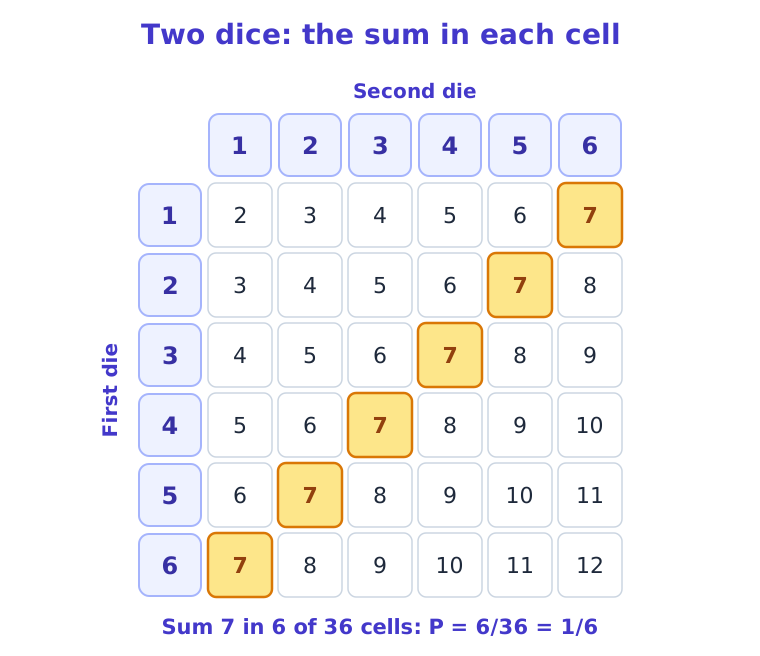
With two dice, sum 7 is the most likely sum (6 ways); sums 2 and 12 have 1 way each.
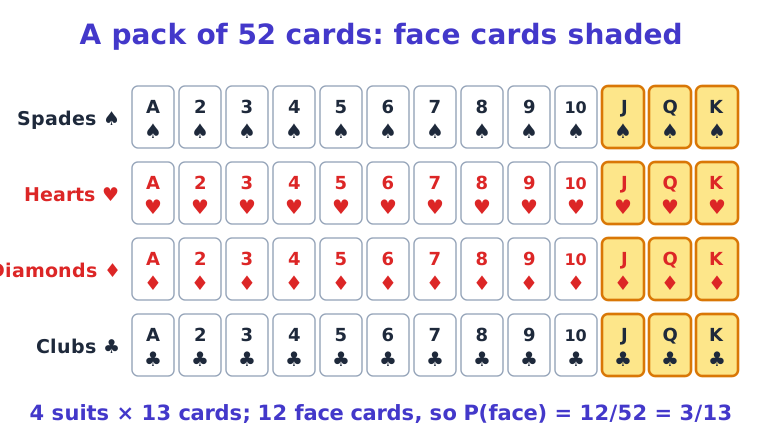
A pack has 4 suits of 13 cards: spades and clubs are black, hearts and diamonds are red.
There are 12 face cards (jack, queen, king) and 4 aces.
For “A or B” with overlap, count A + B − both, so nothing is counted twice.
Odds in favour = favourable : unfavourable; odds against is the reverse.
Full explanation
The ludo argument
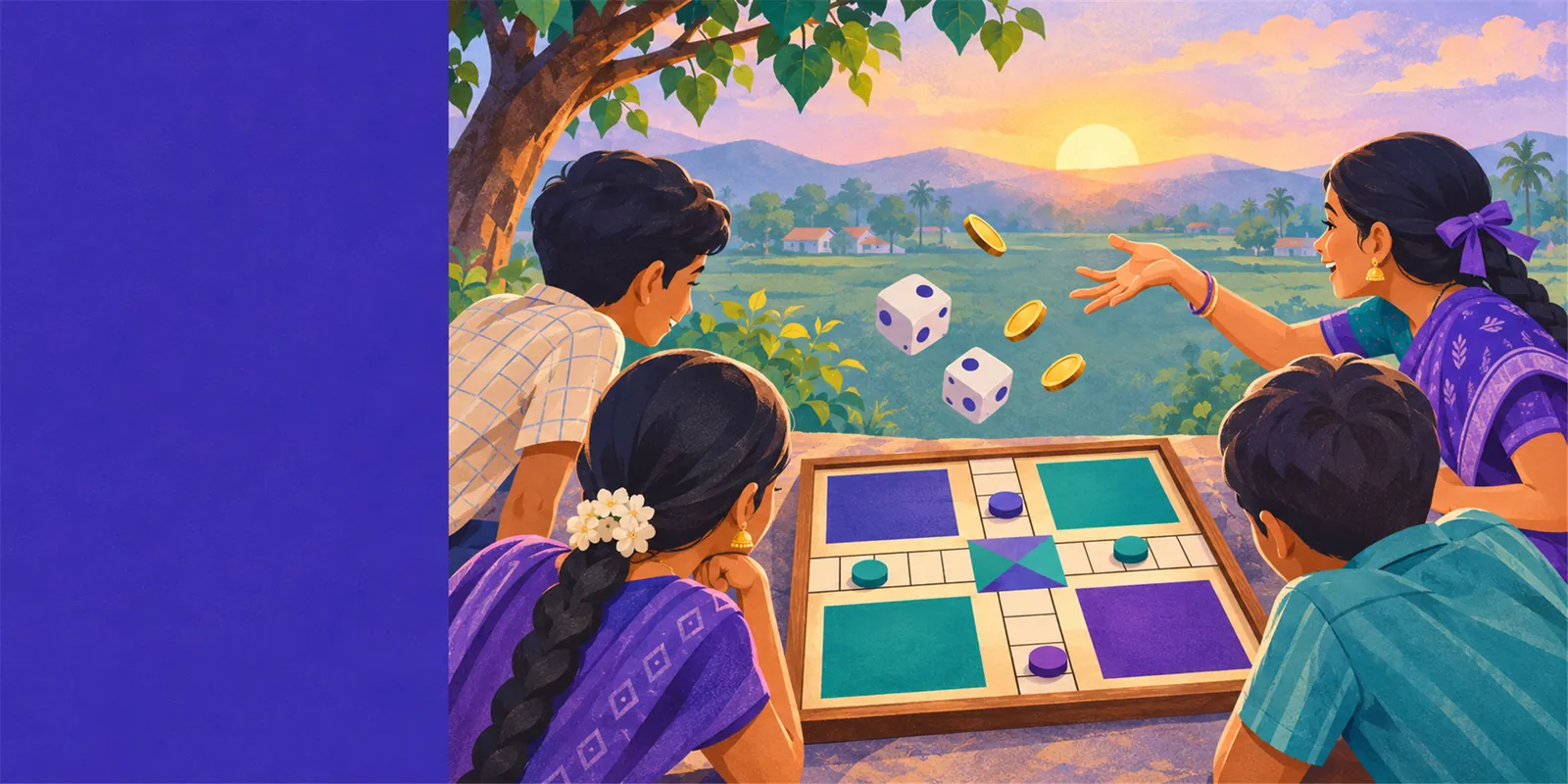
Riya and Kabir are playing ludo. Kabir needs a 6 to start and grumbles: “A 6 never comes!” Riya says: “It comes once in six throws on average. And sum 7 with two dice is more likely than sum 12.”
Who is right, and how can we put a number on “likely”? That number is probability.
Favourable over total
If every outcome is equally likely,
$P(E) = \frac{\text{favourable outcomes}}{\text{total outcomes}}$
A die has 6 equally likely faces and one of them is 6, so P(6) = 1/6. An even number has 3 faces: P = 3/6 = 1/2.
From 0 to 1
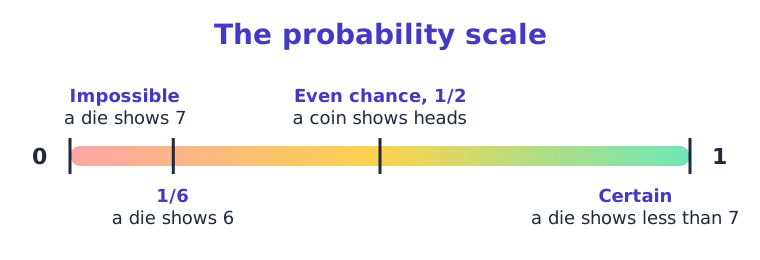
A probability is never negative and never more than 1. Impossible means 0; certain means 1; a fair coin landing heads sits in the middle at 1/2.
Coins
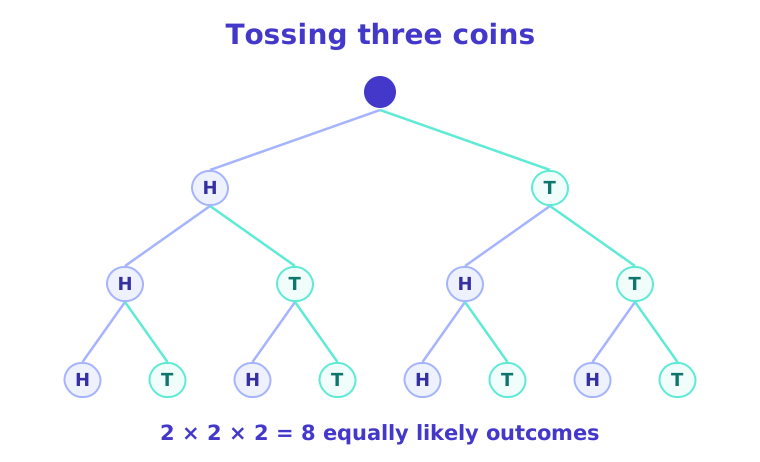
One coin: H or T. Two coins: HH, HT, TH, TT, which is 4 outcomes (HT and TH are different). Three coins: 2 × 2 × 2 = 8. In general n coins give $2^n$ outcomes.
P(exactly 2 heads with 3 coins) = 3/8, because HHT, HTH and THH work.
Two dice: the 36 grid
Write the first die down the side and the second across the top. The 36 cells are equally likely. Sum 7 appears in 6 cells, so P(sum 7) = 6/36 = 1/6; sum 12 appears once: 1/36.
So Riya is right: 7 is six times as likely as 12.
Not E: the complement
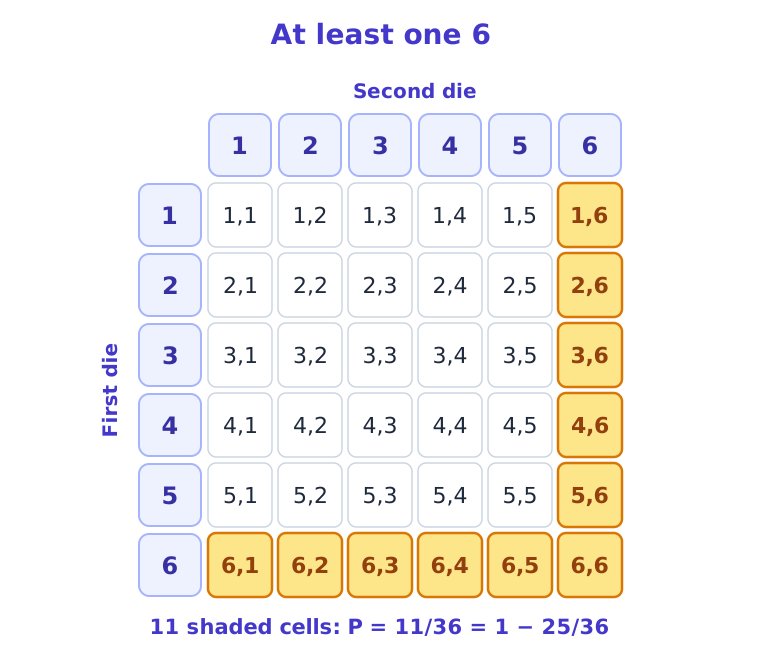
P(not E) = 1 − P(E). For “at least one 6 in two dice”, counting is slow, but no 6 at all is (5/6) × (5/6) = 25/36, so at least one 6 = 1 − 25/36 = 11/36.
A pack of cards
52 cards = 4 suits × 13 ranks (ace, 2 to 10, jack, queen, king). Spades ♠ and clubs ♣ are black; hearts ♥ and diamonds ♦ are red. There are 12 face cards and 4 aces.
P(king) = 4/52 = 1/13; P(red card) = 26/52 = 1/2; P(face card) = 12/52 = 3/13.
“Or” without double counting
P(ace or heart): 4 aces + 13 hearts counts the ace of hearts twice. So favourable = 4 + 13 − 1 = 16 and P = 16/52 = 4/13.
Odds
Odds in favour compare favourable with unfavourable. Sum 7 with two dice: 6 favourable, 30 unfavourable, so odds in favour are 6 : 30 = 1 : 5 and odds against are 5 : 1. To go back: odds a : b give P = a ÷ (a + b).
Back to the ludo board
Kabir’s chance of a 6 on one throw is 1/6, and of at least one 6 in two throws is 11/36, about one in three. Riya was right about 7 too.
List the equally likely outcomes, count what you want, divide, and reduce.
Concepts and terms
The list of all possible outcomes. For two coins: HH, HT, TH, TT.
When all outcomes are equally likely, P(E) = favourable ÷ total.
“Not E” contains every outcome that is not in E, so P(E) + P(not E) = 1.
Odds compare favourable with unfavourable outcomes; probability compares favourable with all outcomes.

Did you know
Probability theory began in 1654 with letters between Pascal and Fermat about a dice game that had to be stopped half-way.
Opposite faces of a standard die always add up to 7.

Memory tricks
Probability — Wanted over all — Top: the outcomes you want. Bottom: all equally likely outcomes.
Pack of cards — 4 × 13, 12 faces, 4 aces — Remember these three numbers and most card questions are counting.
Practice MCQs with answers (61)
- A 1/4
- B 1/2
- C 3/4
- D 1/3
Show answer
Why:
2 coins give 2^2 = 4 equally likely outcomes. Count those with exactly 1 head: 2. P = 2/4 = 1/2.
- A 1/4
- B 1
- C 3/4
- D 1/2
Show answer
Why:
2 coins give 2^2 = 4 equally likely outcomes. Count those with at least 1 head: 3. P = 3/4. Faster: 1 − P(no head) = 1 − 1/4 = 3/4.
- A 2/3
- B 1/2
- C 5/8
- D 3/8
Show answer
Why:
3 coins give 2^3 = 8 equally likely outcomes. Count those with exactly 2 heads: 3. P = 3/8.
- A 1/2
- B 2/3
- C 5/8
- D 3/8
Show answer
Why:
3 coins give 2^3 = 8 equally likely outcomes. Count those with at most 1 head: 4. P = 4/8 = 1/2.
- A 5/8
- B 3/8
- C 1/2
- D 3/4
Show answer
Why:
4 coins give 2^4 = 16 equally likely outcomes. Count those with exactly 2 heads: 6. P = 6/16 = 3/8.
- A 1/4
- B 1/16
- C 15/16
- D 1
Show answer
Why:
4 coins give 2^4 = 16 equally likely outcomes. Count those with at least 1 head: 15. P = 15/16. Faster: 1 − P(no head) = 1 − 1/16 = 15/16.
- A 1/6
- B 5/16
- C 17/32
- D 1/2
Show answer
Why:
5 coins give 2^5 = 32 equally likely outcomes. Count those with more heads than tails: 16. P = 16/32 = 1/2.
- A 1/8
- B 1/16
- C 1/4
- D 7/8
Show answer
Why:
4 coins give 2^4 = 16 equally likely outcomes. Count those with all heads or all tails: 2. P = 2/16 = 1/8.
- A 5/16
- B 13/16
- C 3/16
- D 27/32
Show answer
Why:
5 coins give 2^5 = 32 equally likely outcomes. Count those with at least 2 heads: 26. P = 26/32 = 13/16.
- A 2/3
- B 1/6
- C 1/2
- D 3/5
Show answer
Why:
Favourable faces: 2, 3, 5 (3 of 6). P = 3/6 = 1/2.
- A 2/3
- B 1/2
- C 1/6
- D 1/3
Show answer
Why:
Favourable faces: 5, 6 (2 of 6). P = 2/6 = 1/3.
- A 2/3
- B 1/3
- C 5/6
- D 1/6
Show answer
Why:
Favourable faces: 1, 2, 4, 6 (4 of 6). P = 4/6 = 2/3.
- A 1
- B 0
- C 1/6
- D 1/7
Show answer
Why:
A die has faces 1 to 6 only, so a 7 is impossible: P = 0.
- A 31/36
- B 1/6
- C 5/36
- D 1/9
Show answer
Why:
Two dice give 6 × 6 = 36 equally likely outcomes. 5 of them have this property: (2, 6), (3, 5), (4, 4), (5, 3), (6, 2). P = 5/36.
- A 1/10
- B 1/9
- C 1/18
- D 1/12
Show answer
Why:
Two dice give 6 × 6 = 36 equally likely outcomes. 3 of them have this property: (4, 6), (5, 5), (6, 4). P = 3/36 = 1/12.
- A 1/6
- B 5/36
- C 1/5
- D 7/36
Show answer
Why:
Two dice give 6 × 6 = 36 equally likely outcomes. 6 of them have this property: (4, 6), (5, 5), (5, 6), (6, 4), (6, 5), (6, 6). P = 6/36 = 1/6.
- A 5/36
- B 1/6
- C 1/5
- D 7/36
Show answer
Why:
Two dice give 6 × 6 = 36 equally likely outcomes. 6 of them have this property: (1, 1), (2, 2), (3, 3), (4, 4), (5, 5), (6, 6). P = 6/36 = 1/6.
- A 9/10
- B 7/9
- C 3/4
- D 13/18
Show answer
Why:
Two dice give 6 × 6 = 36 equally likely outcomes. 27 of them have this property. P = 27/36 = 3/4.
- A 4/9
- B 7/18
- C 1/2
- D 5/12
Show answer
Why:
Two dice give 6 × 6 = 36 equally likely outcomes. 15 of them have this property. P = 15/36 = 5/12.
- A 11/36
- B 5/18
- C 11/30
- D 1/3
Show answer
Why:
Two dice give 6 × 6 = 36 equally likely outcomes. 11 of them have this property. P = 11/36. Quick check: 1 − (5/6)² = 11/36.
- A 1/4
- B 2/9
- C 7/36
- D 4/15
Show answer
Why:
Two dice give 6 × 6 = 36 equally likely outcomes. 8 of them have this property: (1, 3), (2, 4), (3, 1), (3, 5), (4, 2), (4, 6), (5, 3), (6, 4). P = 8/36 = 2/9.
- A 2/9
- B 3/10
- C 1/4
- D 5/18
Show answer
Why:
Two dice give 6 × 6 = 36 equally likely outcomes. 9 of them have this property. P = 9/36 = 1/4.
- A 2/3
- B 5/6
- C 13/18
- D 25/36
Show answer
Why:
Two dice give 6 × 6 = 36 equally likely outcomes. 25 of them have this property. P = 25/36. Quick check: (5/6)² = 25/36.
- A 2/9
- B 1/4
- C 7/36
- D 4/15
Show answer
Why:
Two dice give 6 × 6 = 36 equally likely outcomes. 8 of them have this property: (1, 1), (1, 4), (2, 2), (3, 3), (4, 1), (4, 4), (5, 5), (6, 6). P = 8/36 = 2/9.
- A 5/36
- B 1/6
- C 1/5
- D 7/36
Show answer
Why:
Two dice give 6 × 6 = 36 equally likely outcomes. 6 of them have this property: (1, 1), (1, 2), (1, 3), (2, 1), (2, 2), (3, 1). P = 6/36 = 1/6.
- A 35/36
- B 1/6
- C 1/36
- D 7/216
Show answer
Why:
Three dice give 6³ = 216 outcomes; 6 of them work. P = 6/216 = 1/36.
- A 1/6
- B 7/216
- C 35/36
- D 1/36
Show answer
Why:
Three dice give 6³ = 216 outcomes; 6 of them work. P = 6/216 = 1/36.
- A 5/9
- B 1/2
- C 121/216
- D 4/9
Show answer
Why:
Three dice give 6³ = 216 outcomes; 120 of them work. P = 120/216 = 5/9.
- A 7/8
- B 1/8
- C 3/4
- D 7/54
Show answer
Why:
Three dice give 6³ = 216 outcomes; 27 of them work. P = 27/216 = 1/8.
- A 3/4
- B 1/2
- C 1/4
- D 1/3
Show answer
Why:
2 × 6 = 12 equally likely outcomes; 3 are favourable. P = 3/12 = 1/4.
- A 2/3
- B 5/12
- C 1/2
- D 7/12
Show answer
Why:
2 × 6 = 12 equally likely outcomes; 7 are favourable. P = 7/12.
- A 1/13
- B 2/13
- C 5/52
- D 3/52
Show answer
Why:
Favourable cards: 4 of 52. P = 4/52 = 1/13.
- A 1/52
- B 1/26
- C 1/13
- D 3/52
Show answer
Why:
Favourable cards: 2 of 52. P = 2/52 = 1/26.
- A 7/26
- B 3/13
- C 1/4
- D 1/2
Show answer
Why:
Favourable cards: 13 of 52. P = 13/52 = 1/4.
- A 5/52
- B 3/13
- C 7/52
- D 3/26
Show answer
Why:
Favourable cards: 6 of 52. P = 6/52 = 3/26.
- A 4/13
- B 15/52
- C 8/13
- D 17/52
Show answer
Why:
Favourable cards: 16 of 52. Add 13 hearts and 4 aces, then take away the ace of hearts counted twice: 13 + 4 − 1 = 16. P = 16/52 = 4/13.
- A 1/4
- B 3/4
- C 10/13
- D 19/26
Show answer
Why:
Favourable cards: 39 of 52. P = 39/52 = 3/4.
- A 1/52
- B 1/13
- C 1/26
- D 3/52
Show answer
Why:
Favourable cards: 2 of 52. P = 2/52 = 1/26.
- A 1/4
- B 37/52
- C 35/52
- D 9/13
Show answer
Why:
Favourable cards: 36 of 52. P = 36/52 = 9/13.
- A 7/13
- B 1/4
- C 29/52
- D 27/52
Show answer
Why:
Favourable cards: 28 of 52. 26 red cards + 4 kings − 2 red kings = 28. P = 28/52 = 7/13.
- A 1/4
- B 9/13
- C 37/52
- D 35/52
Show answer
Why:
Favourable cards: 36 of 52. Hearts or kings: 13 + 4 − 1 = 16, so neither: 52 − 16 = 36. P = 36/52 = 9/13.
- A 220/221
- B 2/221
- C 1/221
- D 3/1352
Show answer
Why:
Ways to choose 2 cards: ⁵²C₂ = 1326. Favourable: ⁴C₂ ÷ ⁵²C₂ = 6 ÷ 1326 = 1/221.
- A 77/102
- B 25/51
- C 25/208
- D 25/102
Show answer
Why:
Ways to choose 2 cards: ⁵²C₂ = 1326. Favourable: ²⁶C₂ ÷ ⁵²C₂ = 325 ÷ 1326 = 25/102.
- A 8/663
- B 1/169
- C 655/663
- D 16/663
Show answer
Why:
Ways to choose 2 cards: ⁵²C₂ = 1326. Favourable: (4 × 4) ÷ ⁵²C₂ = 16 ÷ 1326 = 8/663.
- A 13/17
- B 4/17
- C 8/17
- D 3/26
Show answer
Why:
Ways to choose 2 cards: ⁵²C₂ = 1326. Favourable: 4 × ¹³C₂ ÷ ⁵²C₂ = 312 ÷ 1326 = 4/17.
- A 1 : 10
- B 8 : 1
- C 1 : 8
- D 1 : 9
Show answer
Why:
4 favourable and 32 unfavourable outcomes. Odds in favour of = favourable : unfavourable = 4 : 32 = 1 : 8.
- A 1 : 7
- B 1 : 5
- C 5 : 6
- D 5 : 1
Show answer
Why:
6 favourable and 30 unfavourable outcomes. Odds against = unfavourable : favourable = 30 : 6 = 5 : 1.
- A 1/9
- B 5/36
- C 1/12
- D 2/15
Show answer
Why:
Two dice give 6 × 6 = 36 equally likely outcomes. 4 of them have this property: (3, 6), (4, 5), (5, 4), (6, 3). P = 4/36 = 1/9.
- A 4/9
- B 5/12
- C 7/18
- D 1/2
Show answer
Why:
Two dice give 6 × 6 = 36 equally likely outcomes. 15 of them have this property. P = 15/36 = 5/12.
- A 11/13
- B 23/52
- C 11/26
- D 21/52
Show answer
Why:
Favourable cards: 22 of 52. 12 face cards + 13 spades − 3 face spades = 22. P = 22/52 = 11/26.
- A 3/52
- B 2/13
- C 5/52
- D 1/13
Show answer
Why:
Favourable cards: 4 of 52. P = 4/52 = 1/13.
- A 1/2
- B 1/4
- C 3/8
- D 2/3
Show answer
Why:
At least two heads: HHH, HHT, HTH, THH, which is 4 of 8. P = 1/2.
- A 7/8
- B 3/4
- C 1/2
- D 3/8
Show answer
Why:
Even: 2, 4, 6, 8. Red: 1, 3, 6. Together without repeating 6: 1, 2, 3, 4, 6, 8, which is 6 of 8. P = 3/4.
- A 3/7
- B 0
- C 5/4
- D 1
Show answer
Why:
Probabilities lie from 0 to 1; 5/4 is more than 1.
- A 0.35
- B 0.75
- C 1.35
- D 0.65
Show answer
Why:
1 − 0.35 = 0.65.
- A The ordered pairs are equally likely, but the sums are not
- B Because sums 2 and 12 are impossible
- C Because 11 is a prime number
- D Because a die has 6 faces and 6 × 6 = 11
Show answer
Why:
Sum 7 can come 6 ways and sum 2 only 1 way, so the 11 sums are not equally likely; the 36 pairs are.
- A 2/7
- B 1/7
- C 1/53
- D 0
Show answer
Why:
365 days = 52 weeks + 1 day. That extra day is Sunday with probability 1/7.
- A Both A and R are true, and R is the correct explanation of A
- B Both A and R are true, but R is not the correct explanation of A
- C A is true but R is false
- D A is false but R is true
Show answer
Why:
2 of 4 outcomes: P = 1/2, and R is exactly why.
- A Both A and R are true, and R is the correct explanation of A
- B Both A and R are true, but R is not the correct explanation of A
- C A is true but R is false
- D A is false but R is true
Show answer
Why:
A is false: the king of hearts is counted twice, so it is 16/52 = 4/13. R is true.
- A 1 only
- B 2 only
- C Both 1 and 2
- D Neither 1 nor 2
Show answer
Why:
Sum 7: 6 of 36 = 1/6, true. Sum 12: only (6, 6), so 1/36, not 1/11.
- A 1 only
- B 2 only
- C Both 1 and 2
- D Neither 1 nor 2
Show answer
Why:
Red queens: 2 of 52 = 1/26. Clubs: 13 of 52 = 1/4. Both true.
Important short questions (5)
TTT, HTT, THT, TTH: 4 of 8. P = 1/2.
(3, 6), (4, 5), (5, 4), (6, 3): 4 of 36. P = 1/9.
Spades and clubs each have J, Q, K: 6 cards. P = 6/52 = 3/26.
Favourable 3, unfavourable 7: P = 3 ÷ 10 = 3/10.
Only TTTTT has no head: P(none) = 1/32, so at least one = 1 − 1/32 = 31/32.
Long answer questions (2)
(a) (2, 6), (3, 5), (4, 4), (5, 3), (6, 2): 5/36.
(b) Sums 10, 11, 12: 3 + 2 + 1 = 6 ways, so 6/36 = 1/6.
(c) 6 doublets: 6/36 = 1/6.
(d) 5 + 6 − 1 = 10, because (4, 4) is in both: 10/36 = 5/18.
(a) 26/52 = 1/2.
(b) 12/52 = 3/13.
(c) 6/52 = 3/26.
(d) 26 + 12 − 6 = 32, so 32/52 = 8/13.
Flashcards (14)
Play this topic
- Chance or not?
Bags, Balls and Events
Drawing balls from bags one at a time, together, with and without replacement; using combinations for selections; the addition rule for “A or B”, independent events and the multiplication rule, “at least one” by the complement, and choosing a bag before a ball.
What you will be able to do
- I can find the probability of drawing a ball of a given colour.
- I can tell draws with replacement from draws without replacement.
- I can use ⁿCᵣ to find probabilities when several balls are drawn together.
- I can use P(A or B) = P(A) + P(B) − P(A and B).
- I can multiply probabilities of independent events and use the complement for “at least one”.
Key points
One ball: P(colour) = balls of that colour ÷ all balls.
Two balls together: P = favourable selections ÷ ⁿC₂.
With replacement, the bag is the same for every draw, so multiply the same fractions.
Without replacement, the second fraction has one ball fewer on the bottom.
Drawing two together gives the same probabilities as drawing one after the other without replacement.
P(A or B) = P(A) + P(B) − P(A and B). For events that cannot happen together, the last term is 0.
Independent events: P(A and B) = P(A) × P(B).
At least one of several independent events = 1 − product of the failure probabilities.
Choosing a bag at random first: P = ½ × P(from bag I) + ½ × P(from bag II).
Full explanation
Meera’s lucky dip
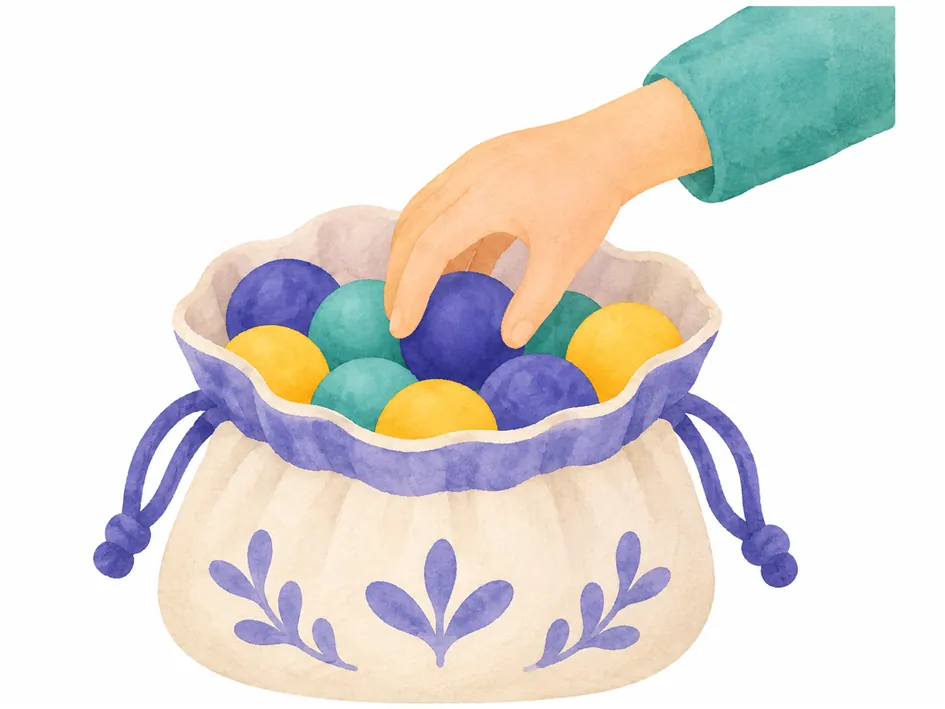
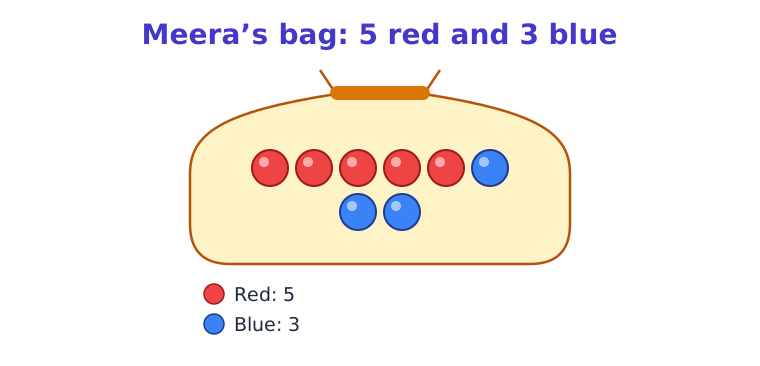
At the school fair, Meera runs a lucky dip: a cloth bag holds 5 red and 3 blue balls, and a red ball wins a toffee. Her friends ask: “What is my chance of red? And if I draw two, what is the chance both are red?”
One ball
There are 8 balls and 5 are red, so P(red) = 5/8 and P(blue) = 3/8. Red and blue cannot both happen for one ball, so P(red or blue) = 5/8 + 3/8 = 1.
Two balls: put back or not?
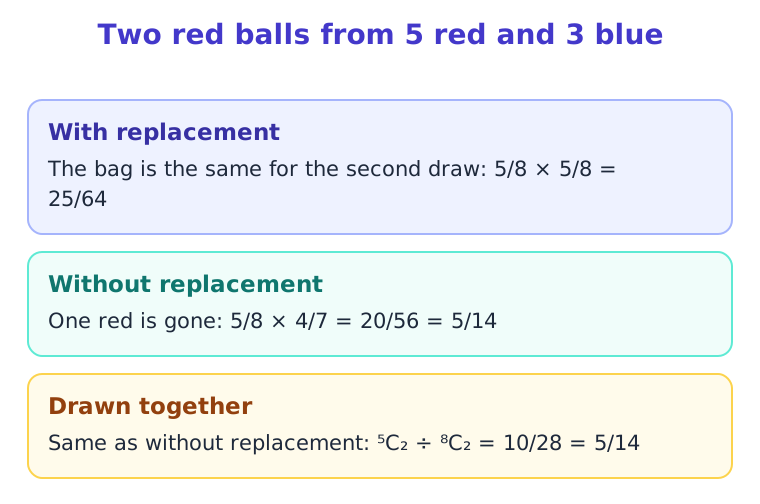
If the first ball goes back, the bag is the same: P(both red) = 5/8 × 5/8 = 25/64.
If it stays out, only 4 reds remain among 7: P(both red) = 5/8 × 4/7 = 5/14. Drawing two together is the same as not putting back: $\frac{^5C_2}{^8C_2} = \frac{10}{28} = \frac{5}{14}$.
One of each colour
Two balls together, one red and one blue: choose 1 red (5 ways) AND 1 blue (3 ways) = 15 of ⁸C₂ = 28, so P = 15/28.
In order without replacement, remember both orders: 5/8 × 3/7 + 3/8 × 5/7 = 30/56 = 15/28. Same answer.
At least one
P(at least one blue in two draws together) = 1 − P(no blue) = 1 − ⁵C₂/⁸C₂ = 1 − 10/28 = 9/14. The complement saves listing cases.
A or B: the addition rule
$P(A \cup B) = P(A) + P(B) - P(A \cap B)$
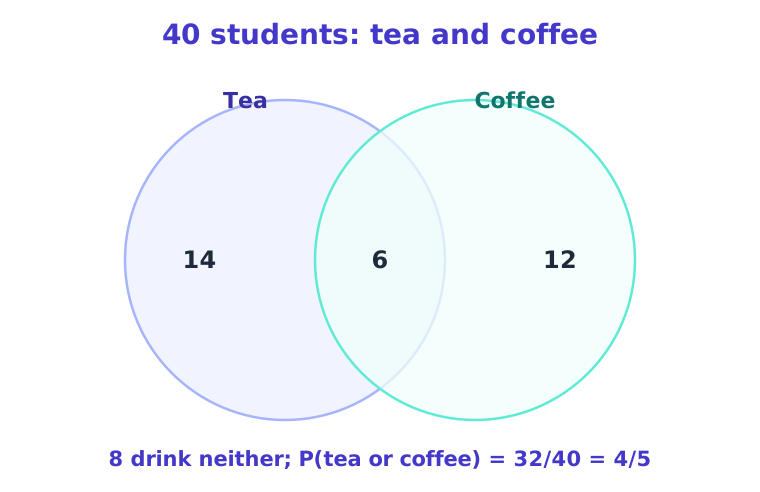
In a class of 40, 20 drink tea, 18 drink coffee and 6 drink both. P(tea or coffee) = 20/40 + 18/40 − 6/40 = 32/40 = 4/5.
Independent events
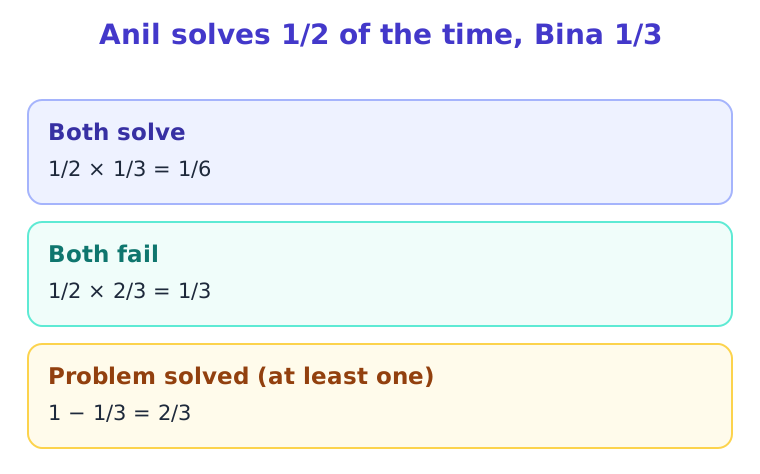
Anil solves a puzzle with probability 1/2 and Bina with 1/3, working separately. Both solve: 1/2 × 1/3 = 1/6. Both fail: 1/2 × 2/3 = 1/3. So the puzzle gets solved with probability 1 − 1/3 = 2/3. Adding 1/2 + 1/3 would count the “both” case twice.
First a bag, then a ball
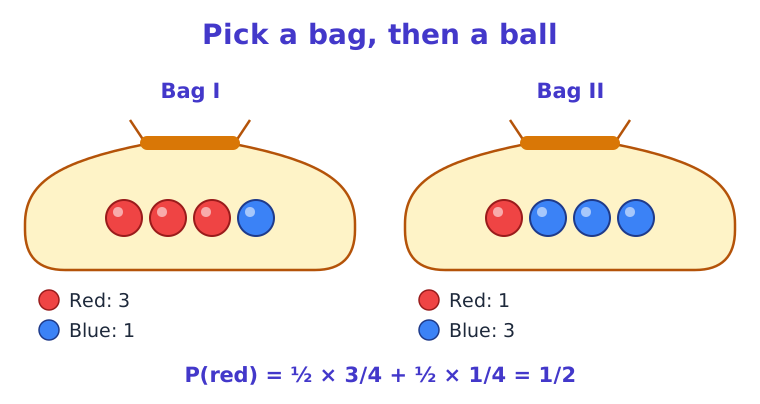
Bag I has 3 red and 1 blue; Bag II has 1 red and 3 blue. Toss a coin to choose a bag, then draw. P(red) = ½ × 3/4 + ½ × 1/4 = 1/2.
Turned around: if the ball is red, the chance it came from Bag I is (½ × 3/4) ÷ (1/2) = 3/4. This is Bayes’ rule.
Back to the lucky dip
One draw: red with 5/8. Two draws without putting back: both red 5/14, at least one blue 9/14. Meera decides to put each ball back, which makes both red 25/64.
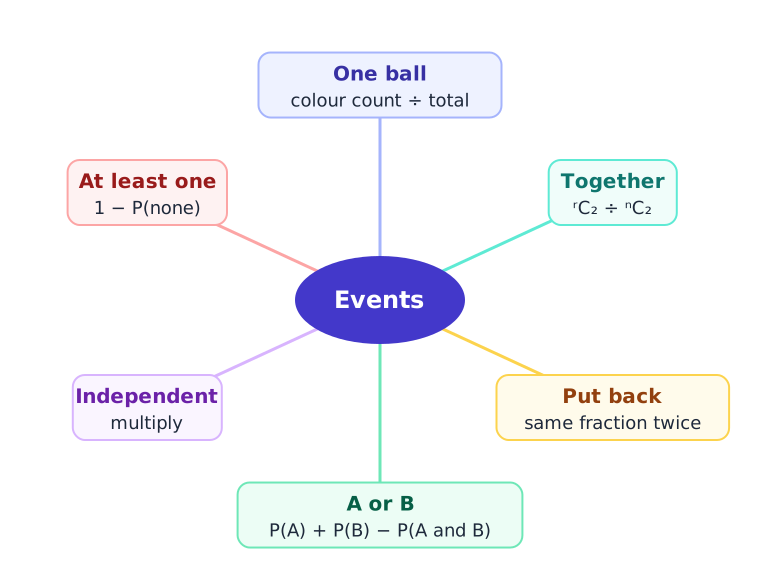
Count the bag, decide whether it changes, multiply for AND, add for OR, and use 1 − none for at least one.
Concepts and terms
Putting the ball back keeps the bag unchanged, so draws are independent. Keeping it out changes the second draw.
Events that cannot happen together, such as “red” and “blue” for one ball. Then P(A or B) = P(A) + P(B).
One event does not change the chance of the other, such as two separate coins. Then P(A and B) = P(A) × P(B).
If a bag is chosen first, add (chance of the bag) × (chance of the ball from that bag) over all bags.
Did you know
In a room of just 23 people, the probability that two share a birthday is more than 1/2.
Bayes’ rule, which turns “red given bag I” into “bag I given red”, is the basis of email spam filters.
Memory tricks
AND or OR — AND multiplies, OR adds — Red AND then blue: multiply. Red OR blue (one ball): add.
At least one — One minus none — P(at least one) = 1 − P(none).
Practice MCQs with answers (50)
- A 3/5
- B 2/3
- C 1/2
- D 2/5
Show answer
Why:
10 balls in all; 4 are red. P = 4/10 = 2/5.
- A 2/3
- B 1/12
- C 3/4
- D 1/3
Show answer
Why:
12 balls in all; 8 are not green. P = 8/12 = 2/3.
- A 2/3
- B 7/12
- C 5/12
- D 1/12
Show answer
Why:
12 balls in all; 7 are red or white. P = 7/12.
- A 8/15
- B 7/8
- C 7/15
- D 1/3
Show answer
Why:
15 balls in all; 7 are black. P = 7/15.
- A 5/6
- B 1/3
- C 2/27
- D 1/6
Show answer
Why:
$^{4}C_2 ÷ {}^{9}C_2$ = 6/36 = 1/6.
- A 8/15
- B 7/15
- C 4/15
- D 6/25
Show answer
Why:
One red (6 ways) AND one blue (4 ways): 24 of $^{10}C_2$ = 45. P = 8/15.
- A 5/9
- B 5/18
- C 10/81
- D 13/18
Show answer
Why:
Same colour: $^{3}C_2$ + $^{4}C_2$ + $^{2}C_2$ = 10 of 36. P = 5/18.
- A 13/36
- B 26/81
- C 13/18
- D 5/18
Show answer
Why:
Complement: neither is green in $^{5}C_2$ = 10 of 36 ways. P = 1 − 10/36 = 13/18.
- A 4/25
- B 3/20
- C 2/3
- D 1/3
Show answer
Why:
Ways to pick 2 of 10 balls: $^{10}C_2$ = 45. Favourable selections: 15. P = 15/45 = 1/3.
- A 13/18
- B 13/36
- C 26/81
- D 5/18
Show answer
Why:
Ways to pick 2 of 9 balls: $^{9}C_2$ = 36. Favourable selections: 26. P = 26/36 = 13/18.
- A 25/32
- B 25/64
- C 25/28
- D 39/64
Show answer
Why:
With replacement the draws are independent: 5/8 × 5/8 = 25/64.
- A 19/25
- B 12/25
- C 6/25
- D 8/15
Show answer
Why:
With replacement the draws are independent: 4/10 × 6/10 = 6/25.
- A 35/144
- B 97/132
- C 35/66
- D 35/132
Show answer
Why:
First red: 5/12. One ball is gone, so second blue: 7/11. Multiply: 5/12 × 7/11 = 35/132.
- A 2/15
- B 3/25
- C 13/15
- D 4/15
Show answer
Why:
First yellow: 4/10. One ball is gone, so second yellow: 3/9. Multiply: 4/10 × 3/9 = 2/15.
- A 17/28
- B 17/32
- C 15/32
- D 17/64
Show answer
Why:
The ball goes back, so each draw is out of 8. Ordered outcomes: 8 × 8 = 64; favourable 34. P = 34/64 = 17/32.
- A 5/12
- B 8/11
- C 3/11
- D 6/11
Show answer
Why:
Ways to pick 3 of 12: $^{12}C_3$ = 220. Favourable: 3 × 4 × 5 = 60. P = 60/220 = 3/11.
- A 5/32
- B 23/28
- C 5/14
- D 5/28
Show answer
Why:
Ways to pick 3 of 8: $^{8}C_3$ = 56. Favourable: $^{5}C_3$ = 10. P = 10/56 = 5/28.
- A 3/10
- B 7/10
- C 3/5
- D 12/13
Show answer
Why:
The bags are independent: 3/5 × 4/8 = 3/10.
- A 9/32
- B 9/16
- C 1/2
- D 7/16
Show answer
Why:
White from I and black from II, OR black from I and white from II: 5/8 × 6/8 + 3/8 × 2/8 = 9/16.
- A 1/9
- B 2/3
- C 5/12
- D 5/6
Show answer
Why:
P = ½ × 2/3 + ½ × 1/6 = 5/12. Each bag is equally likely, then the ball.
- A 3/10
- B 2/5
- C 1/2
- D 3/5
Show answer
Why:
P(I and red) = ½ × 3/5 = 3/10; P(red) = 1/2. Divide: 3/10 ÷ 1/2 = 3/5 (Bayes’ rule).
- A 7/15
- B 1/3
- C 1/15
- D 8/15
Show answer
Why:
Multiples of 3: 10; of 5: 6; of both: 2. Favourable = 10 + 6 − 2 = 14. P = 14/30 = 7/15.
- A 2/25
- B 8/25
- C 2/5
- D 6/25
Show answer
Why:
Multiples of 4: 12; of 6: 8; of both: 4. Favourable = 12 + 8 − 4 = 16. P = 16/50 = 8/25.
- A 1/2
- B 1/10
- C 3/5
- D 7/10
Show answer
Why:
Multiples of 2: 10; of 5: 4; of both: 2. Favourable = 10 + 4 − 2 = 12. P = 12/20 = 3/5.
- A 5/6
- B 1/6
- C 1/3
- D 2/3
Show answer
Why:
Use the complement: P(both fail) = 1/2 × 2/3 = 1/3, so P = 1 − 1/3 = 2/3.
- A 5/12
- B 1/12
- C 11/12
- D 1/2
Show answer
Why:
First only OR second only: 3/4 × 1/3 + 1/4 × 2/3 = 5/12.
- A 13/20
- B 1/10
- C 9/10
- D 9/20
Show answer
Why:
Independent, so multiply: 2/5 × 1/4 = 1/10.
- A 2/5
- B 7/20
- C 1/20
- D 3/5
Show answer
Why:
Both fail: 1/5 × 1/4 = 1/20.
- A 2/15
- B 2/5
- C 3/5
- D 13/15
Show answer
Why:
Use the complement: P(both fail) = 1/3 × 2/5 = 2/15, so P = 1 − 2/15 = 13/15.
- A 2/3
- B 1/2
- C 5/6
- D 1/6
Show answer
Why:
P(A or B) = P(A) + P(B) − P(A and B) = 1/2 + 1/3 − 1/6 = 2/3.
- A 4/5
- B 3/10
- C 7/10
- D 3/20
Show answer
Why:
P(A and B) = P(A) + P(B) − P(A or B) = 3/5 + 1/2 − 4/5 = 3/10.
- A 11/20
- B 13/20
- C 9/20
- D 1/10
Show answer
Why:
P(A or B) = 2/5 + 1/4 − 1/10 = 11/20; neither = 1 − 11/20 = 9/20.
- A 5/8
- B 1/2
- C 3/5
- D 3/8
Show answer
Why:
Odds in favour of 3 : 5 mean 3 favourable for 5 unfavourable, out of 8. P = 3/8.
- A 2/9
- B 2/7
- C 7/9
- D 1/4
Show answer
Why:
Odds against 7 : 2 mean 2 favourable for 7 unfavourable, out of 9. P = 2/9.
- A 6/7
- B 1/7
- C 3/7
- D 1/4
Show answer
Why:
All arrangements: 5040. With the vowels glued into one block: 720. P = 720/5040 = 1/7.
- A 7/10
- B 2/3
- C 3/10
- D 2/5
Show answer
Why:
Favourable: $^{4}C_{2} \times {}^{6}C_{1}$ = 36; total $^{10}C_{3}$ = 120. P = 3/10.
- A 1/210
- B 1/2
- C 41/42
- D 1/42
Show answer
Why:
Favourable: $^{5}C_{0} \times {}^{5}C_{4}$ = 5; total $^{10}C_{4}$ = 210. P = 1/42.
- A 3/4
- B 1/12
- C 5/6
- D 1/4
Show answer
Why:
12 balls in all; 9 are not blue. P = 9/12 = 3/4.
- A 4/7
- B 3/7
- C 6/7
- D 9/49
Show answer
Why:
Same colour: $^{4}C_2$ + $^{3}C_2$ = 9 of 21. P = 3/7.
- A 11/20
- B 9/10
- C 9/20
- D 1/2
Show answer
Why:
5 × 4 = 20 equally likely pairs; 9 favourable. P = 9/20.
- A 7/40
- B 4/5
- C 11/20
- D 1/5
Show answer
Why:
Read the diagram: 8 of the 40 students. P = 8/40 = 1/5.
- A 16/25
- B 6/25
- C 9/25
- D 3/5
Show answer
Why:
Read the diagram: 32 of the 50 students. P = 32/50 = 16/25.
- A P(A) = P(B)
- B P(A and B) = 0
- C P(A and B) = P(A) × P(B)
- D P(A or B) = 1
Show answer
Why:
Exclusive events cannot happen together, so their joint probability is 0.
- A Drawing two red balls one after another without replacement
- B A card being a king and the same card being a face card
- C A head on a coin and a 6 on a die
- D Getting a 2 and getting a 5 on one throw of a die
Show answer
Why:
Coin and die do not affect each other. The others are linked or exclusive.
- A 3/7
- B 1/53
- C 1/7
- D 2/7
Show answer
Why:
366 days = 52 weeks + 2 days. The 7 equally likely pairs (Sun-Mon, Mon-Tue, …, Sat-Sun) include Sunday in 2.
- A 0.3
- B 0.8
- C 1.1
- D 0.1
Show answer
Why:
Independent: 0.6 × 0.5 = 0.3.
- A Both A and R are true, and R is the correct explanation of A
- B Both A and R are true, but R is not the correct explanation of A
- C A is true but R is false
- D A is false but R is true
Show answer
Why:
Both are true and R is the reason: the sample spaces match up (each pair appears in 2 orders).
- A Both A and R are true, and R is the correct explanation of A
- B Both A and R are true, but R is not the correct explanation of A
- C A is true but R is false
- D A is false but R is true
Show answer
Why:
A is false: 7/6 > 1, so the events must overlap. R is true.
- A 1 only
- B 2 only
- C Both 1 and 2
- D Neither 1 nor 2
Show answer
Why:
3 of 5, true. With replacement it is (3/5)² = 9/25; 3/10 is the answer without replacement.
- A 1 only
- B 2 only
- C Both 1 and 2
- D Neither 1 nor 2
Show answer
Why:
1/4 × 1/5 = 1/20, true. Neither: 3/4 × 4/5 = 3/5, true.
Important short questions (4)
⁴C₂ ÷ ¹⁰C₂ = 6/45 = 2/15.
Without replacement the first ball is missing, so the second draw has one ball fewer and possibly one fewer of the wanted colour.
P(A or B) = 0.5 + 0.4 − 0.2 = 0.7. Since 0.5 × 0.4 = 0.2, they are independent.
All miss: 1/2 × 2/3 × 3/4 = 1/4. Hit: 1 − 1/4 = 3/4.
Long answer questions (2)
Total ⁹C₂ = 36.
(a) ⁴C₂ = 6: 6/36 = 1/6.
(b) 4 × 3 = 12: 12/36 = 1/3.
(c) 6 + 3 + 1 = 10: 10/36 = 5/18.
(d) No green: ⁷C₂ = 21, so 1 − 21/36 = 15/36 = 5/12.
(a) ½ × 5/8 + ½ × 2/8 = 7/16.
(b) (½ × 5/8) ÷ 7/16 = (5/16) ÷ (7/16) = 5/7.
Flashcards (13)
Play this topic
- Put back or not?
Veda Skills Quantitative Aptitude Unit 19 — frequently asked questions
TTT, HTT, THT, TTH: 4 of 8. P = 1/2.
(3, 6), (4, 5), (5, 4), (6, 3): 4 of 36. P = 1/9.
Spades and clubs each have J, Q, K: 6 cards. P = 6/52 = 3/26.
⁴C₂ ÷ ¹⁰C₂ = 6/45 = 2/15.
Without replacement the first ball is missing, so the second draw has one ball fewer and possibly one fewer of the wanted colour.
P(A or B) = 0.5 + 0.4 − 0.2 = 0.7. Since 0.5 × 0.4 = 0.2, they are independent.

All Veda Skills Quantitative Aptitude units
All Quantitative Aptitude units · All Skills & Exams courses
Study this chapter properly, free
Everything above is on this page to read. In the Veda app the same chapter becomes spaced-repetition flashcards, timed tests that mark themselves, Veda Bites you can swipe, and games — with your progress tracked topic by topic.
Get Veda free