Veda Skills Logical Reasoning Unit 8: Order and Ranking
- 3 topics
- 140 MCQs
- 11 short answers
- 3 long answers
- 36 flashcards
- 3 games
- ~125 min read
- English
Checked before publishing: 23 automated checks, including a plagiarism check against the textbook's own words. How we check our content
Rank from Both Ends
Find the total from a rank counted at both ends, the rank from the other end, the number of people between two persons, totals after an interchange, and the minimum size of a row, with one line of working each.
What you will be able to do
- I can find the total number in a row from one person's rank from both ends.
- I can convert a rank from one end to the other.
- I can count the people between two persons, including the overlap case.
- I can solve interchange and minimum-number questions.

Key points
Total = rank from left + rank from right − 1, because the person is counted twice.
Rank from the other end = total − rank + 1.
The same rules work for top and bottom, front and back, first and last.
People between two persons = difference of their positions (from the same end) − 1.
The quick formula total − L − R for "between" works only when the two counts do not overlap.
After an interchange, the moved person shares a seat with the other person's old rank: use that seat's two ranks.
A "minimum number" question has two cases: without overlap (L + k + R) and with overlap (L + R − k − 2).
People who joined at one end change the ranks counted from that end only.
Full explanation
The ticket queue

Meena is standing in a long queue for cricket tickets. Her friend calls: "Where are you?" She says, "I am 14th from the front and 9th from the back." Her friend wants to know how many people are in the queue, and how many stand between Meena and a cousin who is 5th from the front.
These are ranking questions, and they are among the fastest marks in any reasoning paper.
Counting from both ends

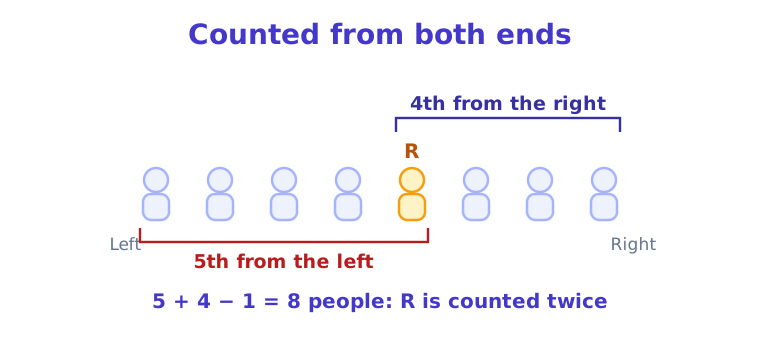
If you count Meena from the front you reach her at 14; from the back you reach her at 9. Adding gives 23, but Meena has been counted twice. So the queue has $14+9-1=22$ people.
$$N=L+R-1$$
From one end to the other
In a row of $N$, a person $L$-th from the left is $(N-L+1)$-th from the right. In a class of 40, 5th from the top is $40-5+1=36$th from the bottom.
Check with a tiny row: in a row of 3, the 1st from the left is 3rd from the right: $3-1+1=3$. Use this check whenever you doubt a $+1$.
People between two persons
Convert both ranks to the same end, then subtract and take away 1.
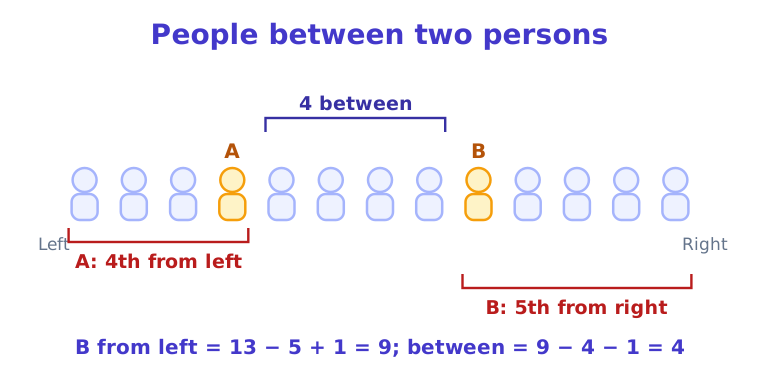
In a row of 13, A is 4th from the left and B is 5th from the right. B from the left is $13-5+1=9$. Between them: $9-4-1=4$ people.
When there is no overlap you can also use $N-L-R=13-4-5=4$.
The overlap trap
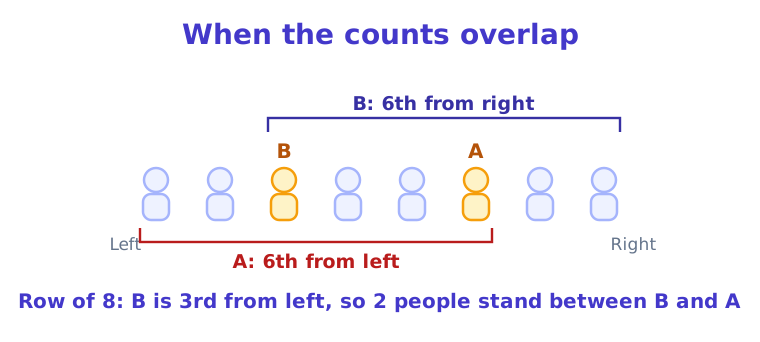
In a row of 8, A is 6th from the left and B is 6th from the right. $N-L-R=8-6-6=-4$, which is impossible, so the counts overlap. Place both from the left: A at 6, B at $8-6+1=3$. Between them: $6-3-1=2$.
Rule: if $L+R>N$, the two have crossed; always use same-end positions.
Interchange questions
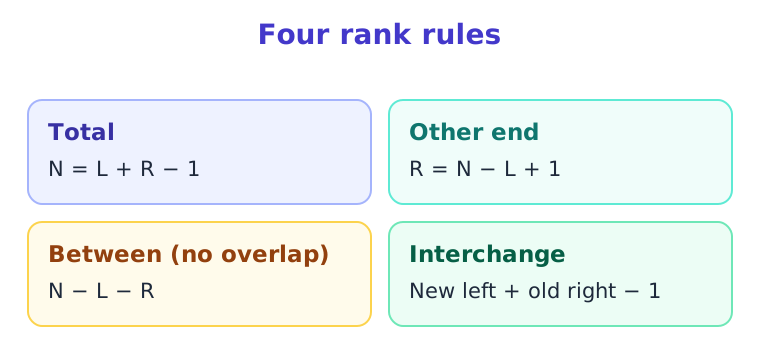
A is 10th from the left and B is 15th from the right. They swap, and A becomes 18th from the left. A now stands in B's old place, which is 18th from the left and 15th from the right. So $N=18+15-1=32$.
Toppers' tip: after a swap, find one seat whose rank you know from both ends, and apply $L+R-1$ to that seat.
Minimum number in a row
"A is 7th from the left, B is 12th from the right, and 4 people stand between them. What is the least number of people?"
- No overlap: $7+4+12=23$.
- Overlap (B to the left of A): $7+12-4-2=13$.
Both rows are possible, so the minimum is 13. Exams set this trap because most students stop at 23.
Pass, fail and absent
Ranks are often given among those who passed. If Ravi is 8th from the top and 27th from the bottom among the passed students, then $8+27-1=34$ passed. Add the failed and the absent to get the whole class.
Exam shortcuts
- Total: $L+R-1$.
- Other end: $N-L+1$.
- Between: same-end positions, difference minus 1.
- If $L+R>N$, they overlap.
- Interchange: use the seat known from both ends.
- Minimum: try the overlap case $L+R-k-2$.
- People joining at one end change only that end's ranks.
Back to Meena
The queue has $14+9-1=22$ people. Her cousin is 5th from the front, so between them stand $14-5-1=8$ people. Meena texted both answers before the counter even opened.
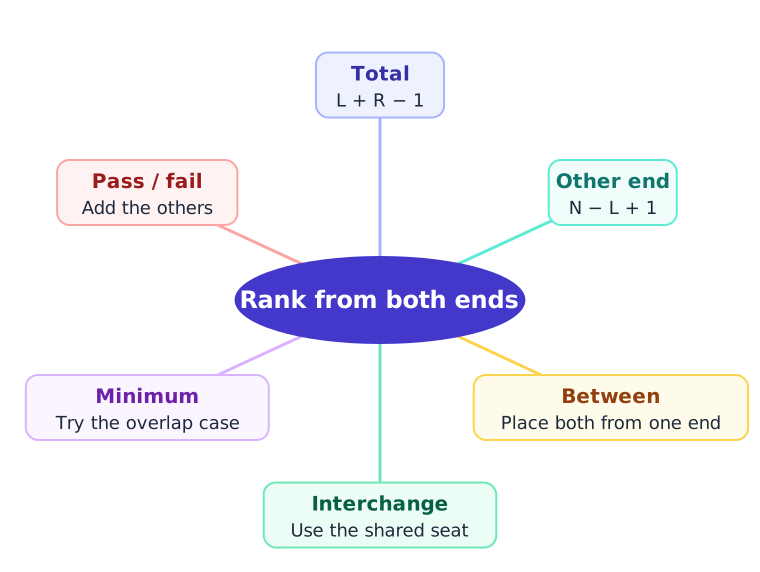
Concepts and terms
Counting from both ends counts the person twice, hence the −1.
Before comparing two people, convert both ranks to the same end.
If A's count from the left and B's count from the right cover each other, B is to the left of A.

Did you know
Railway reservation charts and exam merit lists use exactly these rank rules to publish "position from top" and "position from bottom".

Memory tricks
Total in a row — Add both, drop one — L + R − 1: the person is in both counts once too often.
Other end — Total minus rank plus one — N − L + 1. Check with a tiny row: in a row of 3, 1st from left is 3rd from right.
Practice MCQs with answers (45)
- A 23
- B 21
- C 24
- D 22
Show answer
Why:
Bhavna is counted from both ends, so subtract 1: 14 + 9 − 1 = 22.
- A 32
- B 31
- C 34
- D 33
Show answer
Why:
Naveen is counted from both ends, so subtract 1: 7 + 26 − 1 = 32.
- A 37
- B 35
- C 36
- D 34
Show answer
Why:
Komal is counted from both ends, so subtract 1: 18 + 18 − 1 = 35.
- A 34
- B 32
- C 33
- D 35
Show answer
Why:
Pankaj is counted from both ends, so subtract 1: 21 + 13 − 1 = 33.
- A 42
- B 41
- C 39
- D 40
Show answer
Why:
Payal is counted from both ends, so subtract 1: 9 + 32 − 1 = 40.
- A 45
- B 44
- C 47
- D 46
Show answer
Why:
Sameer is counted from both ends, so subtract 1: 31 + 15 − 1 = 45.
- A 52
- B 50
- C 51
- D 49
Show answer
Why:
Shalini is counted from both ends, so subtract 1: 4 + 47 − 1 = 50.
- A 61
- B 59
- C 60
- D 62
Show answer
Why:
Ravi is counted from both ends, so subtract 1: 23 + 38 − 1 = 60.
- A 29th
- B 13th
- C 27th
- D 28th
Show answer
Why:
From the other end: 40 − 13 + 1 = 28.
- A 25th
- B 31st
- C 24th
- D 26th
Show answer
Why:
From the other end: 55 − 31 + 1 = 25.
- A 3rd
- B 1st
- C 2nd
- D 29th
Show answer
Why:
From the other end: 29 − 29 + 1 = 1.
- A 8th
- B 64th
- C 65th
- D 66th
Show answer
Why:
From the other end: 72 − 8 + 1 = 65.
- A 19th
- B 27th
- C 29th
- D 28th
Show answer
Why:
From the other end: 46 − 19 + 1 = 28.
- A 20th
- B 21st
- C 44th
- D 19th
Show answer
Why:
From the other end: 63 − 44 + 1 = 20.
- A 27
- B 25
- C 24
- D 26
Show answer
Why:
13 + 13 − 1 = 25. A middle person in a row always means an odd total.
- A 42
- B 43
- C 41
- D 40
Show answer
Why:
21 + 21 − 1 = 41. A middle person in a row always means an odd total.
- A 31
- B 33
- C 24
- D 32
Show answer
Why:
Kavya now stands in Vikram's old place, which is 18th from the left and 15th from the right: 18 + 15 − 1 = 32.
- A 25
- B 24
- C 26
- D 17
Show answer
Why:
Sita now stands in Arjun's old place, which is 14th from the left and 12th from the right: 14 + 12 − 1 = 25.
- A 8th
- B 14th
- C 15th
- D 13th
Show answer
Why:
Total = 20 + 8 − 1 = 27. Manoj takes Anjali's old place, 14th from the left, which is 27 − 14 + 1 = 14 from the right.
- A 34
- B 27
- C 33
- D 32
Show answer
Why:
Pooja now stands in Imran's old place, which is 11th from the left and 23rd from the right: 11 + 23 − 1 = 33.
- A 9th
- B 18th
- C 16th
- D 17th
Show answer
Why:
Total = 25 + 9 − 1 = 33. Rahul takes Ritu's old place, 17th from the left, which is 33 − 17 + 1 = 17 from the right.
- A 13
- B 12
- C 14
- D 15
Show answer
Why:
Deepak from the left = 40 − 15 + 1 = 26. Between places 12 and 26: 26 − 12 − 1 = 13.
- A 8
- B 6
- C 5
- D 7
Show answer
Why:
Harish from the left = 35 − 20 + 1 = 16. Between places 9 and 16: 16 − 9 − 1 = 6.
- A 6
- B 3
- C 4
- D 5
Show answer
Why:
Mohan from the left = 30 − 14 + 1 = 17. Between places 17 and 22: 22 − 17 − 1 = 4. (They have crossed over, so the quick formula n − a − b fails here.)
- A 10
- B 11
- C 8
- D 9
Show answer
Why:
Sunil from the left = 52 − 25 + 1 = 28. Between places 18 and 28: 28 − 18 − 1 = 9.
- A 6
- B 8
- C 5
- D 7
Show answer
Why:
Nikhil from the left = 25 − 17 + 1 = 9. Between places 9 and 16: 16 − 9 − 1 = 6. (They have crossed over, so the quick formula n − a − b fails here.)
- A 4
- B 3
- C 5
- D 2
Show answer
Why:
Farhan from the left = 60 − 30 + 1 = 31. Between places 27 and 31: 31 − 27 − 1 = 3.
- A 23
- B 22
- C 13
- D 14
Show answer
Why:
Two cases. Rekha before Gopal: 7 + 4 + 12 = 23. Gopal before Rekha (they cross): the 4 people sit inside the overlap, so the total is 7 + 12 − 4 − 2 = 13. The minimum is 13.
- A 29
- B 19
- C 30
- D 18
Show answer
Why:
Two cases. Simran before Anil: 10 + 5 + 15 = 30. Anil before Simran (they cross): the 5 people sit inside the overlap, so the total is 10 + 15 − 5 − 2 = 18. The minimum is 18.
- A 18
- B 19
- C 26
- D 25
Show answer
Why:
Two cases. Tara before Karan: 14 + 3 + 9 = 26. Karan before Tara (they cross): the 3 people sit inside the overlap, so the total is 14 + 9 − 3 − 2 = 18. The minimum is 18.
- A 32
- B 19
- C 20
- D 33
Show answer
Why:
Two cases. Usha before Tarun: 11 + 6 + 16 = 33. Tarun before Usha (they cross): the 6 people sit inside the overlap, so the total is 11 + 16 − 6 − 2 = 19. The minimum is 19.
- A 40
- B 45
- C 44
- D 34
Show answer
Why:
Passed = 8 + 27 − 1 = 34. Add the failed and the absent: 34 + 6 + 4 = 44.
- A 39
- B 42
- C 36
- D 41
Show answer
Why:
Passed = 15 + 22 − 1 = 36. Add the failed and the absent: 36 + 3 + 2 = 41.
- A 64
- B 50
- C 59
- D 65
Show answer
Why:
Passed = 11 + 40 − 1 = 50. Add the failed and the absent: 50 + 9 + 5 = 64.
- A 30th
- B 26th
- C 31st
- D 20th
Show answer
Why:
Before: 40 − 15 + 1 = 26 from the right. People added on the left do not change the count from the right: still 26.
- A 23rd
- B 14th
- C 27th
- D 26th
Show answer
Why:
Before: 32 − 10 + 1 = 23 from the right. 4 people now stand to her right, so 23 + 4 = 27.
- A 37th
- B 28th
- C 36th
- D 30th
Show answer
Why:
Before: 50 − 21 + 1 = 30 from the right. People added on the left do not change the count from the right: still 30.
- A 32
- B 34
- C 33
- D 31
Show answer
Why:
14 + 19 − 1 = 32.
- A 17
- B 18
- C 20
- D 19
Show answer
Why:
Q from the left = 45 − 16 + 1 = 30. Between: 30 − 11 − 1 = 18.
- A 31
- B 29
- C 30
- D 32
Show answer
Why:
Up to and including M: 9; between: 12; K and everyone to its right: 9. Total = 9 + 12 + 9 = 30.
- A 3
- B 2
- C 0
- D 1
Show answer
Why:
1 + 1 − 1 = 1: the person stands alone.
- A Both A and R are true, and R is the correct explanation of A
- B Both A and R are true, but R is not the correct explanation of A
- C A is true but R is false
- D A is false but R is true
Show answer
Why:
10 + 10 − 1 = 19, and the −1 is there exactly because of R.
- A Both A and R are true, and R is the correct explanation of A
- B Both A and R are true, but R is not the correct explanation of A
- C A is true but R is false
- D A is false but R is true
Show answer
Why:
B is 20 − 15 + 1 = 6th from the left; between places 6 and 15 there are 15 − 6 − 1 = 8 people, not 10. A is false; R is true.
- A 1 only
- B 2 only
- C Both 1 and 2
- D Neither 1 nor 2
Show answer
Why:
45 − 12 + 1 = 34th from the bottom, and 34 − 1 = 33 students are below her. Both true.
- A 1 only
- B 2 only
- C Both 1 and 2
- D Neither 1 nor 2
Show answer
Why:
B is 10 − 8 + 1 = 3rd from the left, so B is left of A (5th) and one person (4th) stands between them. Only 1 is true.
Important short questions (4)
17 + 24 − 1 = 40.
B from the left = 30 − 25 + 1 = 6. Between places 6 and 8: 8 − 6 − 1 = 1 person.
30 − 8 − 25 = −3 is negative: the two counts overlap, so B is to the left of A.
Ravi is in Sunil's old seat: 21st from the left and 13th from the right. 21 + 13 − 1 = 33.
Long answer questions (1)
Case 1, A ahead of B: 9 + 5 + 14 = 28.
Case 2, B ahead of A (overlap): B is at place 9 − 5 − 1 = 3 from the front, and 14th from the back, so the queue has 3 + 14 − 1 = 16 people.
So the queue has 16 or 28 people; the minimum is 16.
Flashcards (12)
Play this topic
- Rank check
Position in a Row
Locate any element in a letter-digit-symbol arrangement, count patterns such as "a digit followed by a symbol", handle removed or reversed elements, and place people relative to each other in a row.
What you will be able to do
- I can find the element k places to the left or right of a given position.
- I can convert positions between the left and right ends.
- I can count patterns like "a letter immediately followed by a digit".
- I can answer questions after elements are removed or reversed.
- I can place people "k-th to the left/right" of each other in a row.
Key points
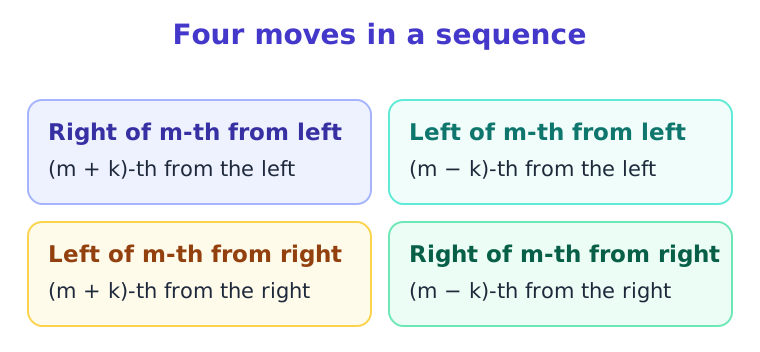
k-th to the right of the m-th from the left is the (m + k)-th from the left.
k-th to the left of the m-th from the right is the (m + k)-th from the right.
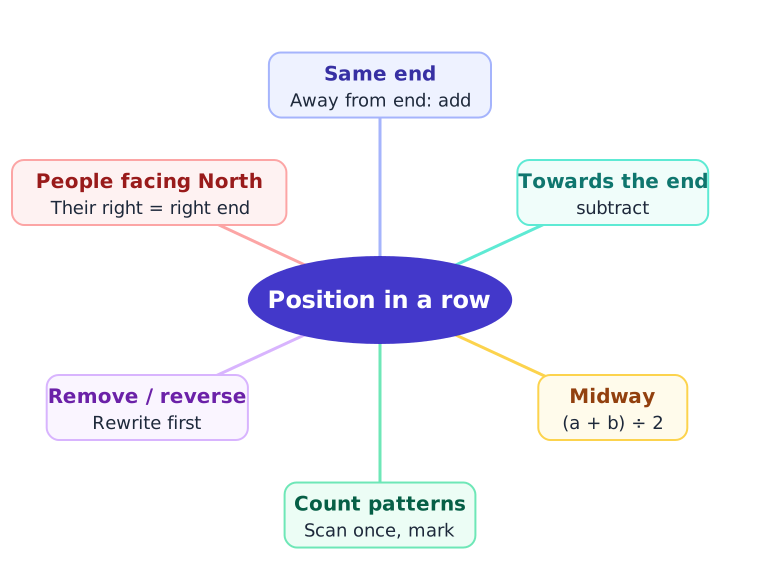
Moving away from the end you counted from: add. Moving towards it: subtract.
Position from the right = total − position from the left + 1.
The element midway between positions a and b (same end) is at (a + b) ÷ 2.
"Immediately preceded/followed" means the very next element, with nothing in between.
After removing or reversing elements, rewrite the new sequence before counting.
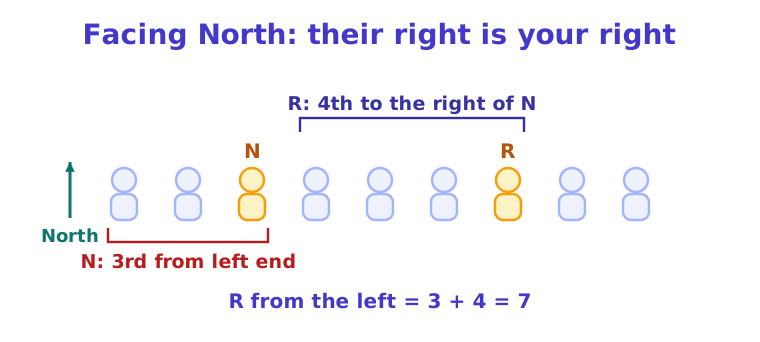
For people facing North, their right is the right end of the row; facing South, it is the left end.
Full explanation
The scoreboard puzzle

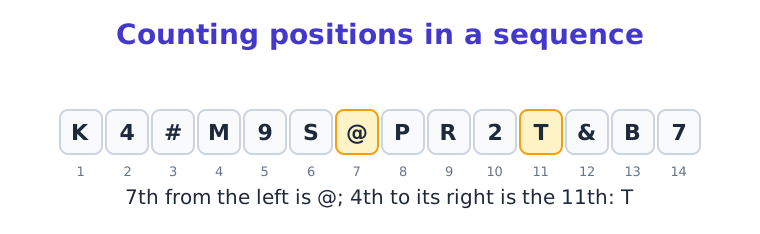
At the school sports day, Harish sees this code on the scoreboard: K 4 # M 9 S @ P R 2 T & B 7. His coach asks, "Which sign is 4th to the right of the 7th one from the left?" Harish starts counting on his fingers and loses track.
This topic shows how to answer such questions with one line of arithmetic instead of finger counting.
Add or subtract?
Count from one end and then move. If the move takes you away from that end, add; if it takes you towards it, subtract.
- 4th to the right of the 7th from the left: $7+4=11$th from the left.
- 3rd to the left of the 9th from the left: $9-3=6$th from the left.
Switching ends
Sometimes the two numbers come from different ends: "midway between the 6th from the left and the 10th from the right". Convert first: in 21 elements, 10th from the right is $21-10+1=12$th from the left. Midway: $(6+12)\div2=9$th from the left.
Counting patterns
"How many digits are immediately preceded by a letter and immediately followed by a symbol?" Do not read the question three times. Go through the arrangement once, stop at every digit only, and check its two neighbours. Write a tick for each digit that fits.
Trap: "preceded by" means the element just before (on the left), "followed by" means the one just after (on the right).
Removing and reversing
"If all the symbols are removed, which element is 5th from the right?" Rewrite the arrangement without the symbols, then count. "If the first 10 are reversed, which is 4th from the left?" The 4th of the reversed block is the old $(10-4+1)=7$th.
People in a row
When people stand facing North (towards you on a map with North up, their backs to the reader), their right is the right end. If N is 3rd from the left end and R is 4th to the right of N, R is $3+4=7$th from the left.
If a question has everyone facing South, their right is the left end of the page; draw an arrow before counting.
Exam shortcuts
- Away from the end: add; towards it: subtract.
- Convert to one end before finding a middle.
- Pattern questions: stop only at the asked type.
- Removed or reversed: rewrite, then count.
- Facing North: their right is your right.
Back to Harish
The 7th from the left is @. Four to its right is the $7+4=11$th from the left: T. Harish answered before the coach finished the question, without a single finger.
Concepts and terms
Moves away from your counting end add; moves towards it subtract.
Look at each element of the asked type and check its two neighbours only.
After a change (remove, reverse, swap) write the new arrangement, then count.
Did you know
Bank exams often use one arrangement for a set of five questions, so a careful first reading saves time on all five.
Memory tricks
Moving in a sequence — Same side subtract, opposite side add — "Left of m-th from left": same side, m − k. "Right of m-th from left": opposite side, m + k.
Practice MCQs with answers (49)
- A !
- B W
- C +
- D 4
Show answer
Why:
Moving right adds: 7 + 5 = 12, so take the 12th from the left: !.
- A 5
- B 6
- C @
- D 2
Show answer
Why:
Moving right adds: 10 + 6 = 16, so take the 16th from the left: 6.
- A T
- B 3
- C E
- D +
Show answer
Why:
Moving right adds: 4 + 9 = 13, so take the 13th from the left: E.
- A M
- B +
- C 2
- D T
Show answer
Why:
Moving right adds: 12 + 7 = 19, so take the 19th from the left: T.
- A 4
- B !
- C B
- D E
Show answer
Why:
4th to the left of 6th from the right is 6 + 4 = 10th from the right: 4.
- A 7
- B %
- C 4
- D Z
Show answer
Why:
7th to the left of 9th from the right is 9 + 7 = 16th from the right: %.
- A E
- B C
- C H
- D Y
Show answer
Why:
8th to the left of 5th from the right is 5 + 8 = 13th from the right: H.
- A 7
- B A
- C E
- D 3
Show answer
Why:
10th to the left of 3rd from the right is 3 + 10 = 13th from the right: 3.
- A +
- B G
- C 5
- D !
Show answer
Why:
4th from the right = 22 − 4 + 1 = 19 from the left. Midway: (3 + 19) ÷ 2 = 11: +.
- A ?
- B C
- C A
- D &
Show answer
Why:
6th from the right = 24 − 6 + 1 = 19 from the left. Midway: (5 + 19) ÷ 2 = 12: C.
- A W
- B 8
- C B
- D !
Show answer
Why:
4th from the right = 21 − 4 + 1 = 18 from the left. Midway: (4 + 18) ÷ 2 = 11: B.
- A 15
- B 2
- C 0
- D 1
Show answer
Why:
Scan left to right and mark each letter that fits: Y!. Count = 1.
- A 3
- B 6
- C 4
- D 2
Show answer
Why:
Scan left to right and mark each digit that fits: V7, P7, Y4. Count = 3.
- A 3
- B 2
- C 1
- D 6
Show answer
Why:
Scan left to right and mark each letter that fits: VM4, TE3. Count = 2.
- A 3
- B 1
- C 2
- D 12
Show answer
Why:
Scan left to right and mark each letter that fits: +N, ?N. Count = 2.
- A 5
- B 3
- C 1
- D 2
Show answer
Why:
Scan left to right and mark each letter that fits: RJS, TSV. Count = 2.
- A 2
- B 4
- C 3
- D 1
Show answer
Why:
Scan left to right and mark each symbol that fits: !P, &B. Count = 2.
- A 1
- B 2
- C 4
- D 3
Show answer
Why:
Scan left to right and mark each letter that fits: HP#, AC&. Count = 2.
- A 3
- B 1
- C 2
- D 4
Show answer
Why:
Scan left to right and mark each symbol that fits: X+N, M?N. Count = 2.
- A D
- B 5
- C E
- D B
Show answer
Why:
After removing them: K W G X Y P D B 5 4 E S J G C 8 B K. The 8th from the left is B.
- A @
- B U
- C V
- D &
Show answer
Why:
After removing them: H P # ? N V % Z A C & @ @ U & P Y K. The 6th from the right is @.
- A E
- B 3
- C 4
- D A
Show answer
Why:
After removing them: S W V M 4 5 Y H C T E 3 3 A 7 S. The 5th from the right is 3.
- A A
- B G
- C J
- D T
Show answer
Why:
After removing them: X + N B K A E A J G T M ? N. The 9th from the left is J.
- A 2
- B 9
- C 8
- D W
Show answer
Why:
After removing them: R J S T S V W B 8 W 9 2 Y 8 E 5. The 7th from the right is W.
- A H
- B C
- C Y
- D V
Show answer
Why:
After reversing, the 3rd from the left is the old 8th: H.
- A A
- B K
- C B
- D +
Show answer
Why:
After reversing, the 5th from the left is the old 8th: K.
- A J
- B &
- C V
- D S
Show answer
Why:
After reversing, the 2nd from the left is the old 7th: V.
- A 11th
- B 2nd
- C 6th
- D 10th
Show answer
Why:
Facing North, their right is the right end. Anjali from the left = 6 + 4 = 10.
- A 4th
- B 14th
- C 17th
- D 5th
Show answer
Why:
Facing North, their right is the right end. Pooja from the left = 9 − 5 = 4.
- A 22nd
- B 8th
- C 18th
- D 9th
Show answer
Why:
Facing North, their right is the right end. Ritu from the left = 11 + 7 = 18; from the right = 25 − 18 + 1 = 8.
- A 24th
- B 11th
- C 23rd
- D 8th
Show answer
Why:
Facing North, their right is the right end. Sneha from the left = 14 − 6 = 8; from the right = 30 − 8 + 1 = 23.
- A 16th
- B 4th
- C 2nd
- D 3rd
Show answer
Why:
Facing North, their right is the right end. Divya from the left = 4 + 12 = 16; from the right = 18 − 16 + 1 = 3.
- A 7th
- B 22nd
- C 8th
- D 6th
Show answer
Why:
Facing North, their right is the right end. Farah from the left = 20 − 13 = 7.
- A 4th
- B 5th
- C 17th
- D 6th
Show answer
Why:
Facing North, their right is the right end. Lata from the left = 8 + 9 = 17; from the right = 21 − 17 + 1 = 5.
- A 16th
- B 11th
- C 10th
- D 9th
Show answer
Why:
Geeta: 5 + 8 = 13. Nikhil: 13 − 3 = 10.
- A 23rd
- B 4th
- C 2nd
- D 3rd
Show answer
Why:
Farhan: 9 + 4 = 13. Rekha: 13 − 10 = 3.
- A 5
- B 4
- C 6
- D 7
Show answer
Why:
Places: Gopal 3, Simran 14, Anil 9. Between 3 and 9: 6 − 1 = 5.
- A 7
- B 8
- C 9
- D 10
Show answer
Why:
Places: Tara 12, Karan 18, Usha 3. Between 12 and 3: 9 − 1 = 8.
- A 11th
- B 16th
- C 12th
- D 13th
Show answer
Why:
Zoya: 7 + 7 = 14. Yash: 14 − 2 = 12.
- A 14th
- B 12th
- C 6th
- D 13th
Show answer
Why:
Midway = (7 + 19) ÷ 2 = 13.
- A 14th
- B 15th
- C 13th
- D 10th
Show answer
Why:
Midway = (4 + 24) ÷ 2 = 14.
- A 23rd
- B 22nd
- C 21st
- D 9th
Show answer
Why:
Midway = (13 + 31) ÷ 2 = 22.
- A 16
- B 9
- C 17
- D 18
Show answer
Why:
People to the right = 26 − 9 = 17.
- A 18
- B 17
- C 15
- D 16
Show answer
Why:
People to the left = 17 − 1 = 16.
- A 6
- B A
- C W
- D 4
Show answer
Why:
5 + 6 = 11th from the right, which is 18 − 11 + 1 = 8th from the left: 6.
- A 4
- B 3
- C 5
- D 2
Show answer
Why:
Check the element after each symbol; 3 of them are letters.
- A G
- B T
- C D
- D M
Show answer
Why:
2nd from the left is K; 3 places to the right is the 5th: D.
- A Both A and R are true, and R is the correct explanation of A
- B Both A and R are true, but R is not the correct explanation of A
- C A is true but R is false
- D A is false but R is true
Show answer
Why:
Left of a position counted from the right moves away from the right end, so 10 + 3 = 13. R explains A.
- A 1 only
- B 2 only
- C Both 1 and 2
- D Neither 1 nor 2
Show answer
Why:
comes right after 3, so 1 is true. P is followed by 3 and R by 7: two letters, so 2 is true.
Important short questions (3)
6 + 7 = 13th from the right = 25 − 13 + 1 = 13th from the left.
4 → K and 7 → M: two digits. 2 is followed by @.
Tara is at 10 − 4 = 6. Between 6 and 10: 3 people.
Long answer questions (1)
Counting from the right, moving left takes you further from the right end, so each step adds 1 to the position from the right.
Example: in A B C D E F G, the 2nd from the right is F. 3rd to its left is C, which is 2 + 3 = 5th from the right.
Flashcards (12)
Play this topic
- Position check
Comparison Order
Turn clues such as "A is taller than B but shorter than C" into one ladder, find the greatest, the least or the k-th person, and decide when an answer cannot be determined.
What you will be able to do
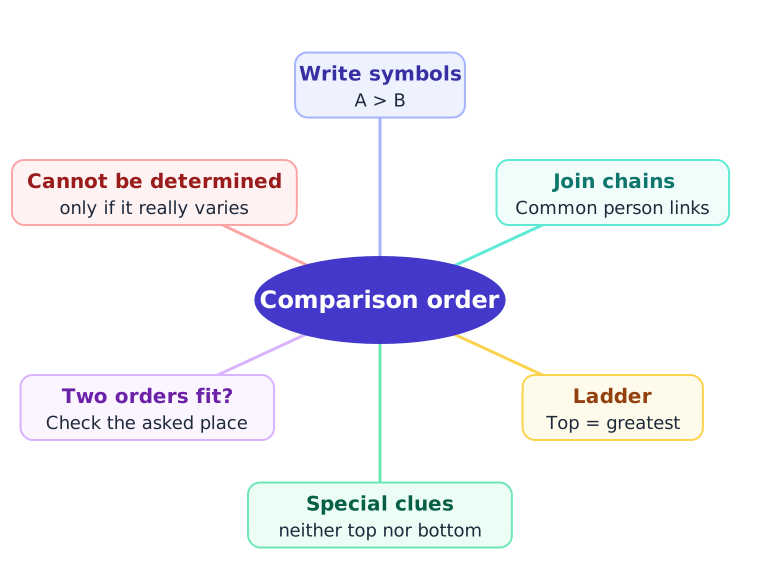
- I can write every comparison clue as a symbol such as A > B.
- I can join clues through a common person into one chain.
- I can use special clues such as "only one person is taller than X".
- I can tell when the asked place is fixed and when it cannot be determined.
Key points
Write each clue in symbols at once: "A is taller than B" is A > B; "A is shorter than B" is B > A.
"A is taller than B but shorter than C" gives the chain C > A > B.
Join chains through a common person; draw a ladder with the greatest at the top.
"Only one person is taller than X" means X is 2nd; "X is taller than only one person" means X is second from the bottom.
"Neither the tallest nor the shortest" removes the top and bottom places only.
If two orders fit the clues, answer only what is the same in both; otherwise the answer cannot be determined.
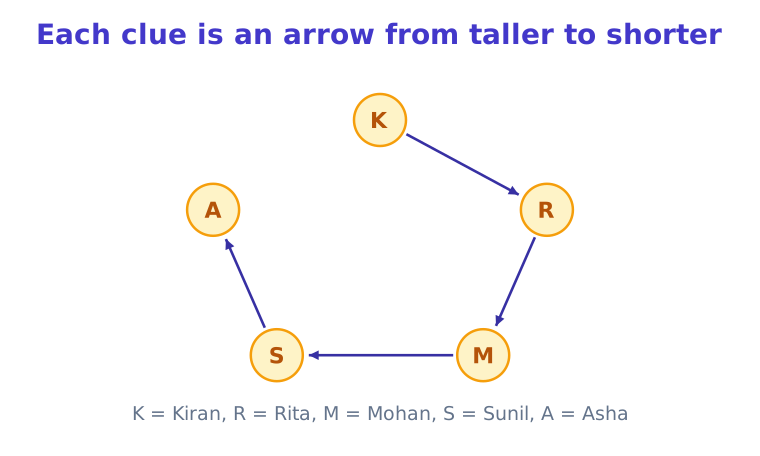
The person with nobody above them in the arrows is the greatest; the one with nobody below is the least.
Choose "Cannot be determined" only after checking that two valid orders really disagree.
Full explanation
Who is the tallest?

Five friends want to stand for a photo from tallest to shortest. Nobody has a measuring tape. Rita says, "I am taller than Mohan." Sunil says, "I am shorter than Mohan but taller than Asha." Kiran laughs: "I am taller than Rita." Can they line up without measuring?
Yes, and that is exactly what comparison questions test.
Step 1: symbols
Write each clue at once with ">" pointing from the greater to the smaller:
- Rita > Mohan
- Mohan > Sunil > Asha
- Kiran > Rita
"A is shorter than B" becomes B > A. Never write a clue in words twice.
Step 2: join through a common person
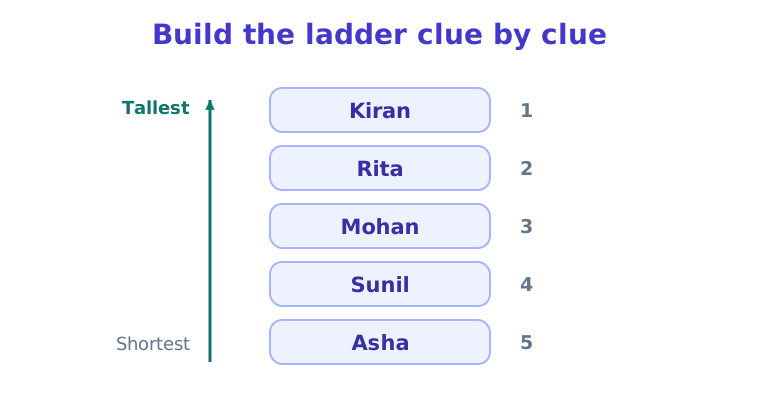
Mohan is in the first two chains, Rita in the first and third. Joining them gives one ladder:
$$\text{Kiran} > \text{Rita} > \text{Mohan} > \text{Sunil} > \text{Asha}$$
Arrows when clues are scattered
If the clues do not join easily, draw each person once and an arrow from the taller to the shorter. The person with no arrow coming in is the tallest; the one with no arrow going out is the shortest.
Special clues
- "Only one person is taller than X": X is 2nd.
- "X is taller than only one person": X is second from the bottom.
- "X is neither the tallest nor the shortest": X is somewhere in between, not necessarily the middle.
- "X is not the tallest": only the top place is ruled out.
When the order is not complete
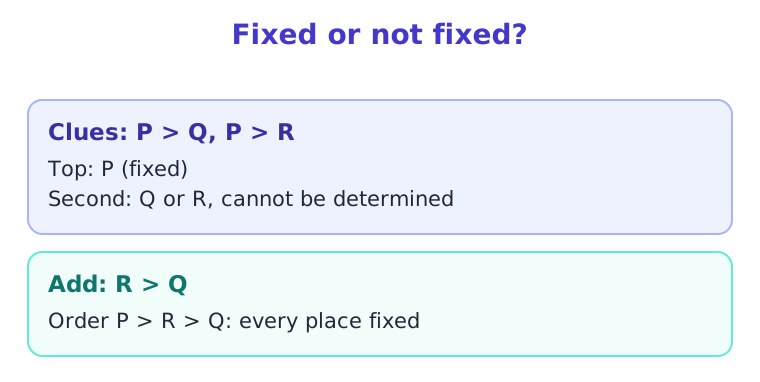
Sometimes two ladders fit the clues. Then a place is determined only if the same person stands there in both. With P > Q and P > R, the top is P, but the second place could be Q or R: it cannot be determined.
Before you pick that option, make sure you used every clue.
Exam method for a puzzle set
Bank papers give one set of clues and ask three to five questions. Spend the first minute on the ladder; then every question takes seconds. Mark the places that are fixed, and put a "?" where two people can swap.
Exam shortcuts
- Symbols first, words never twice.
- Join through the common person.
- No arrow in = top; no arrow out = bottom.
- "Only one above X" = 2nd; "above only one" = second last.
- Two ladders? Answer only what both agree on.
Back to the photo
The friends stood as Kiran, Rita, Mohan, Sunil and Asha, tallest to shortest, and the photo was taken in one go. Not a single tape was needed, only three clues and one ladder.
Concepts and terms
Every clue becomes A > B with the greater on the left, so all clues read the same way.
A vertical list with the greatest at the top; each new clue fits a person above or below someone already placed.
A place is determined when the same person stands there in every order that fits all the clues.
Did you know
Sorting programs in computers solve the same problem: they compare two items at a time and build the full order from the comparisons.
Memory tricks
Writing clues — Big mouth eats the bigger one — The open side of > faces the greater person, as in A > B.
Practice MCQs with answers (46)
- A Pooja
- B Cannot be determined
- C Arjun
- D Manoj
Show answer
Why:
Two orders fit the clues: Arjun > Manoj > Pooja > Anjali and Arjun > Pooja > Manoj > Anjali. In every order that fits, Arjun is 1st.
- A Pooja
- B Manoj
- C Cannot be determined
- D Anjali
Show answer
Why:
Two orders fit the clues: Arjun > Manoj > Pooja > Anjali and Arjun > Pooja > Manoj > Anjali. In every order that fits, Anjali is 4th.
- A Cannot be determined
- B Manoj
- C Pooja
- D Arjun
Show answer
Why:
Two orders fit the clues: Arjun > Manoj > Pooja > Anjali and Arjun > Pooja > Manoj > Anjali. The asked place differs between these orders, so it cannot be determined.
- A Harish
- B Deepak
- C Cannot be determined
- D Divya
Show answer
Why:
Combining the clues gives one order (greatest first): Deepak > Divya > Harish > Sneha. In every order that fits, Deepak is 1st.
- A Harish
- B Cannot be determined
- C Divya
- D Deepak
Show answer
Why:
Combining the clues gives one order (greatest first): Deepak > Divya > Harish > Sneha. In every order that fits, Divya is 2nd.
- A Cannot be determined
- B Nikhil
- C Nisha
- D Sunil
Show answer
Why:
Combining the clues gives one order (greatest first): Sunil > Nikhil > Nisha > Farhan > Geeta. In every order that fits, Sunil is 1st.
- A Nisha
- B Nikhil
- C Farhan
- D Cannot be determined
Show answer
Why:
Combining the clues gives one order (greatest first): Sunil > Nikhil > Nisha > Farhan > Geeta. In every order that fits, Nisha is 3rd.
- A Cannot be determined
- B 3
- C 4
- D 2
Show answer
Why:
Combining the clues gives one order (greatest first): Sunil > Nikhil > Nisha > Farhan > Geeta. Farhan is 4th in every order, so 3 people are above Farhan.
- A Cannot be determined
- B Tara
- C Anil
- D Simran
Show answer
Why:
Two orders fit the clues: Karan > Usha > Simran > Tara > Anil and Karan > Usha > Tara > Simran > Anil. In every order that fits, Anil is 5th.
- A Simran
- B Karan
- C Cannot be determined
- D Usha
Show answer
Why:
Two orders fit the clues: Karan > Usha > Simran > Tara > Anil and Karan > Usha > Tara > Simran > Anil. In every order that fits, Usha is 2nd.
- A Cannot be determined
- B Simran
- C Tara
- D Anil
Show answer
Why:
Two orders fit the clues: Karan > Usha > Simran > Tara > Anil and Karan > Usha > Tara > Simran > Anil. The asked place differs between these orders, so it cannot be determined.
- A Bhavna
- B Yash
- C Komal
- D Cannot be determined
Show answer
Why:
Combining the clues gives one order (greatest first): Yash > Bhavna > Komal > Naveen > Pankaj. In every order that fits, Yash is 1st.
- A Pankaj
- B Cannot be determined
- C Naveen
- D Komal
Show answer
Why:
Combining the clues gives one order (greatest first): Yash > Bhavna > Komal > Naveen > Pankaj. In every order that fits, Naveen is 4th.
- A Ravi
- B Amit
- C Cannot be determined
- D Priya
Show answer
Why:
Combining the clues gives one order (greatest first): Amit > Priya > Ravi > Shalini > Neha. In every order that fits, Priya is 2nd.
- A Neha
- B Shalini
- C Ravi
- D Cannot be determined
Show answer
Why:
Combining the clues gives one order (greatest first): Amit > Priya > Ravi > Shalini > Neha. In every order that fits, Neha is 5th.
- A 3
- B 2
- C 1
- D Cannot be determined
Show answer
Why:
Combining the clues gives one order (greatest first): Amit > Priya > Ravi > Shalini > Neha. Ravi is 3rd in every order, so 2 people are above Ravi.
- A Kavya
- B Cannot be determined
- C Vikram
- D Meena
Show answer
Why:
Two orders fit the clues: Vikram > Meena > Kavya > Rohan > Suresh > Sita and Vikram > Meena > Kavya > Suresh > Rohan > Sita. In every order that fits, Vikram is 1st.
- A Meena
- B Cannot be determined
- C Rohan
- D Kavya
Show answer
Why:
Two orders fit the clues: Vikram > Meena > Kavya > Rohan > Suresh > Sita and Vikram > Meena > Kavya > Suresh > Rohan > Sita. In every order that fits, Kavya is 3rd.
- A Sita
- B Suresh
- C Rohan
- D Cannot be determined
Show answer
Why:
Two orders fit the clues: Vikram > Meena > Kavya > Rohan > Suresh > Sita and Vikram > Meena > Kavya > Suresh > Rohan > Sita. In every order that fits, Sita is 6th.
- A Rohan
- B Cannot be determined
- C Suresh
- D Meena
Show answer
Why:
Two orders fit the clues: Vikram > Meena > Kavya > Rohan > Suresh > Sita and Vikram > Meena > Kavya > Suresh > Rohan > Sita. The asked place differs between these orders, so it cannot be determined.
- A Anjali
- B Rahul
- C Ritu
- D Cannot be determined
Show answer
Why:
Two orders fit the clues: Rahul > Ritu > Anjali > Imran > Pooja > Manoj and Rahul > Ritu > Imran > Anjali > Pooja > Manoj. In every order that fits, Ritu is 2nd.
- A Cannot be determined
- B Manoj
- C Imran
- D Pooja
Show answer
Why:
Two orders fit the clues: Rahul > Ritu > Anjali > Imran > Pooja > Manoj and Rahul > Ritu > Imran > Anjali > Pooja > Manoj. In every order that fits, Pooja is 5th.
- A Lata
- B Cannot be determined
- C Deepak
- D Divya
Show answer
Why:
Two orders fit the clues: Lata > Deepak > Divya > Harish > Farah > Mohan and Lata > Deepak > Divya > Harish > Mohan > Farah. In every order that fits, Lata is 1st.
- A Divya
- B Harish
- C Farah
- D Cannot be determined
Show answer
Why:
Two orders fit the clues: Lata > Deepak > Divya > Harish > Farah > Mohan and Lata > Deepak > Divya > Harish > Mohan > Farah. In every order that fits, Harish is 4th.
- A Farah
- B Mohan
- C Cannot be determined
- D Deepak
Show answer
Why:
Two orders fit the clues: Lata > Deepak > Divya > Harish > Farah > Mohan and Lata > Deepak > Divya > Harish > Mohan > Farah. The asked place differs between these orders, so it cannot be determined.
- A Cannot be determined
- B Geeta
- C Nisha
- D Nikhil
Show answer
Why:
Combining the clues gives one order (greatest first): Farhan > Nisha > Nikhil > Geeta. In every order that fits, Nikhil is 3rd.
- A Karan
- B Cannot be determined
- C Anil
- D Tara
Show answer
Why:
6 orders fit the clues, for example Karan > Anil > Tara > Tarun > Usha and Karan > Anil > Tarun > Tara > Usha. In every order that fits, Karan is 1st.
- A Tarun
- B Usha
- C Tara
- D Cannot be determined
Show answer
Why:
6 orders fit the clues, for example Karan > Anil > Tara > Tarun > Usha and Karan > Anil > Tarun > Tara > Usha. In every order that fits, Usha is 5th.
- A Payal
- B Cannot be determined
- C Pankaj
- D Komal
Show answer
Why:
Combining the clues gives one order (greatest first): Sameer > Naveen > Bhavna > Payal > Komal > Pankaj. In every order that fits, Pankaj is 6th.
- A Bhavna
- B Sameer
- C Cannot be determined
- D Naveen
Show answer
Why:
Combining the clues gives one order (greatest first): Sameer > Naveen > Bhavna > Payal > Komal > Pankaj. In every order that fits, Naveen is 2nd.
- A Ravi
- B Priya
- C Neha
- D Cannot be determined
Show answer
Why:
Combining the clues gives one order (greatest first): Priya > Ravi > Neha > Kabir > Amit. In every order that fits, Ravi is 2nd.
- A Neha
- B Kabir
- C Cannot be determined
- D Amit
Show answer
Why:
Combining the clues gives one order (greatest first): Priya > Ravi > Neha > Kabir > Amit. In every order that fits, Kabir is 4th.
- A Suresh
- B Kavya
- C Vikram
- D Cannot be determined
Show answer
Why:
Combining the clues gives one order (greatest first): Suresh > Vikram > Kavya > Meena. In every order that fits, Vikram is 2nd.
- A Rahul
- B Cannot be determined
- C Manoj
- D Imran
Show answer
Why:
Two orders fit the clues: Ritu > Rahul > Imran > Manoj > Pooja and Rahul > Ritu > Imran > Manoj > Pooja. In every order that fits, Imran is 3rd.
- A Pooja
- B Manoj
- C Imran
- D Cannot be determined
Show answer
Why:
Two orders fit the clues: Ritu > Rahul > Imran > Manoj > Pooja and Rahul > Ritu > Imran > Manoj > Pooja. In every order that fits, Pooja is 5th.
- A S
- B T
- C R
- D P
Show answer
Why:
T has no arrow coming in, so nothing is heavier than T. Full order: T > P > R > Q > S.
- A Q
- B P
- C R
- D S
Show answer
Why:
Follow the chain T → P → R → Q → S. The third is R.
- A B
- B C
- C E
- D D
Show answer
Why:
B and D fill rungs 2 and 4. D is not 2nd, so B is 2nd and D is 4th.
- A Kabir
- B Asha
- C Cannot be determined
- D Rohan
Show answer
Why:
Rohan > Asha and Kabir > Rohan, so Kabir > Rohan > Asha.
- A 2nd
- B 5th
- C 4th
- D 6th
Show answer
Why:
One person below her means she is second from the bottom: 6 − 1 = 5th from the top.
- A 4th
- B 2nd
- C 5th
- D 3rd
Show answer
Why:
He is 3rd from the heavy end, so 7 − 3 + 1 = 5th from the light end.
- A P is the oldest
- B Q is younger than P
- C R is younger than P
- D R is older than Q
Show answer
Why:
The first two clues leave Q and R unordered. Only "R > Q" orders them: P > R > Q. The other options repeat what is known.
- A Both A and R are true, and R is the correct explanation of A
- B Both A and R are true, but R is not the correct explanation of A
- C A is true but R is false
- D A is false but R is true
Show answer
Why:
Joining the chains gives O > M > N; transitivity in R is exactly why A holds.
- A Both A and R are true, and R is the correct explanation of A
- B Both A and R are true, but R is not the correct explanation of A
- C A is true but R is false
- D A is false but R is true
Show answer
Why:
B or C could be second, so A is false. R is a true statement about ranks.
- A 1 only
- B 2 only
- C Both 1 and 2
- D Neither 1 nor 2
Show answer
Why:
Order: Nisha > Lata > Gopal > Yash > Pankaj. Gopal is 3rd of 5, so 1 is true; Pankaj, not Yash, is the shortest, so 2 is false.
- A 1 only
- B 2 only
- C Both 1 and 2
- D Neither 1 nor 2
Show answer
Why:
Order: M > K > L > N. Both statements are true.
Important short questions (4)
Order: S > P > Q > R, so R is the shortest.
Three below her and 5 in all, so one is above her: she is 2nd from the heaviest.
No. Both A and C are above B, but no clue compares A with C, so either could be the greatest.
With only three places, K must be exactly in the middle: 2nd.
Long answer questions (1)
From the clues: V > W > X, X > Y and Z > V. Joining the chains: Z > V > W > X > Y.
The middle (3rd of 5) is W.
X is 4th, so 3 students (Z, V, W) scored more than X.
Flashcards (12)
Play this topic
- Order check
Veda Skills Logical Reasoning Unit 8 — frequently asked questions
17 + 24 − 1 = 40.
B from the left = 30 − 25 + 1 = 6. Between places 6 and 8: 8 − 6 − 1 = 1 person.
30 − 8 − 25 = −3 is negative: the two counts overlap, so B is to the left of A.
6 + 7 = 13th from the right = 25 − 13 + 1 = 13th from the left.
4 → K and 7 → M: two digits. 2 is followed by @.
Tara is at 10 − 4 = 6. Between 6 and 10: 3 people.
Order: S > P > Q > R, so R is the shortest.
Three below her and 5 in all, so one is above her: she is 2nd from the heaviest.
No. Both A and C are above B, but no clue compares A with C, so either could be the greatest.

All Veda Skills Logical Reasoning units
Study this chapter properly, free
Everything above is on this page to read. In the Veda app the same chapter becomes spaced-repetition flashcards, timed tests that mark themselves, Veda Bites you can swipe, and games — with your progress tracked topic by topic.
Get Veda free