Veda Skills Logical Reasoning Unit 4: Classification (Odd One Out)
- 2 topics
- 140 MCQs
- 7 short answers
- 2 long answers
- 28 flashcards
- 2 games
- ~95 min read
- English
Checked before publishing: 23 automated checks, including a plagiarism check against the textbook's own words. How we check our content
Numbers and Letters
Spot the one number, pair or letter group that breaks the rule the other three follow: primes, squares, cubes, multiples, digit sums, letter positions, jumps and opposite pairs.
What you will be able to do
- I can test a set of numbers for prime, square, cube, multiple and digit-sum rules in a fixed order.
- I can find the rule linking the two numbers of a pair and spot the pair that breaks it.
- I can turn letters into positions (forward and from Z) and find the jumps in a letter group.
- I can check that my answer is the only one by testing a second rule.

Key points
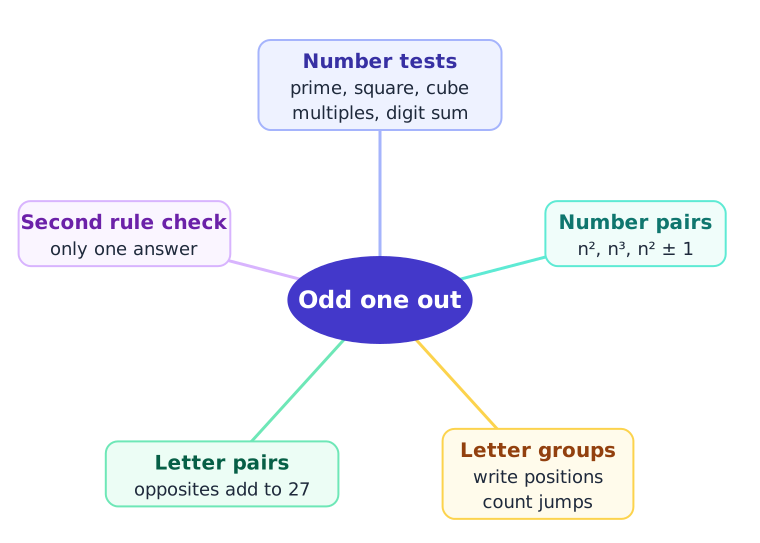
An odd-one-out set has one rule that fits exactly three items; the fourth item is the answer.
Test numbers in this order: even/odd, prime, square, cube, multiple of 7, 11 or 13, digit sum.
Numbers that look prime but are not: 91, 119, 133, 143, 161, 187, 203, 209, 221.
In a number pair, check second = first², first³, first² ± 1, first × (first + 1).
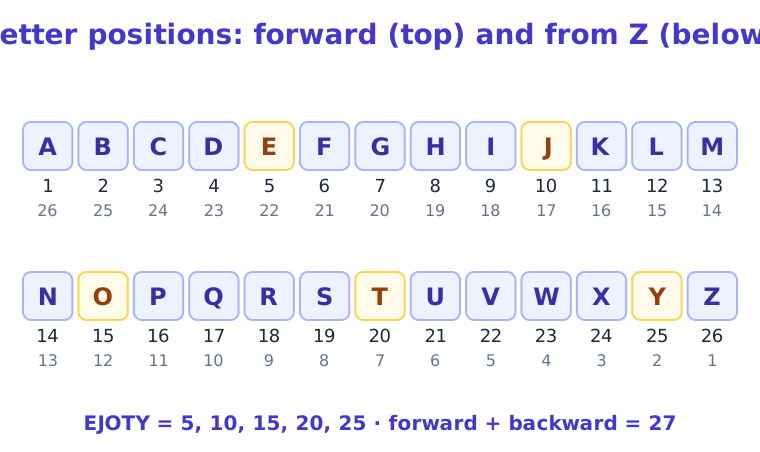
EJOTY gives the positions 5, 10, 15, 20, 25 at a glance.
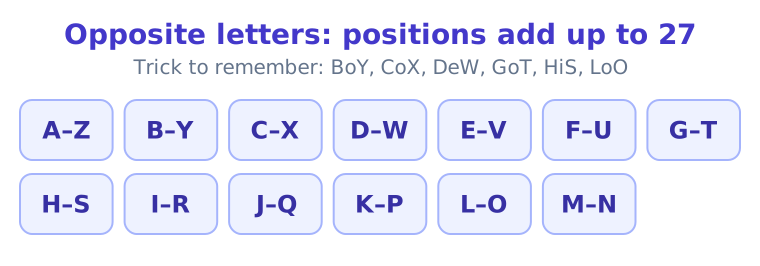
A letter and its opposite add up to 27: A–Z, B–Y, M–N. The reverse position of a letter is 27 minus its position.
For a letter group, write the positions and the jumps between them; three groups share the same jumps.
If two different items each break some rule, the question is not finished: find the rule that leaves only one.
Full explanation
Priya's first mock test

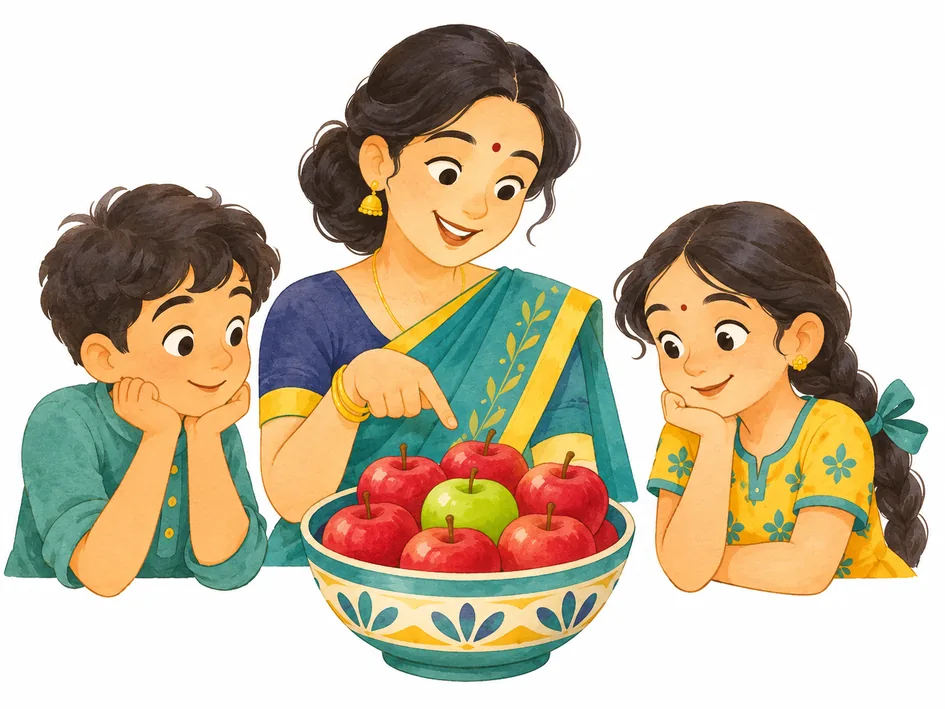
Priya is preparing for SSC CGL. In her first mock test she meets this question: Find the odd number out: 121, 169, 196, 150. She stares at it for a full minute. Her coach later solves it in five seconds: "Three are perfect squares; 150 is not."
Classification questions give you four items. Three share a rule, one breaks it. In this topic you will learn where to look first, so that you, like the coach, need only a few seconds.
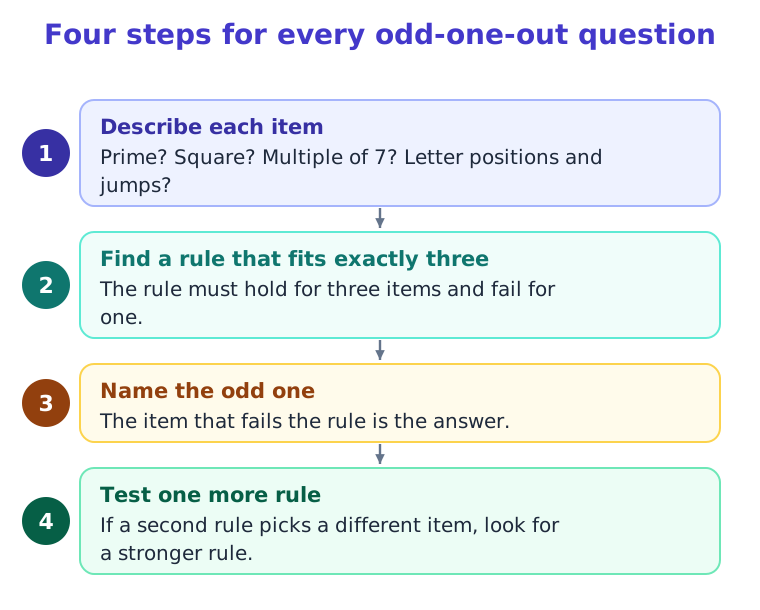
The method in four steps
- Describe each item in a few words (prime? square? letters with jumps of 2?).
- Find a rule that holds for exactly three items.
- Name the item that fails it.
- Test a second rule. If another rule picks a different item, your first rule was not the intended one.
Where to look first in numbers
Test in this order, because exams use these rules most:
- Even or odd
- Prime or composite (watch the traps 91, 119, 133, 143, 187, 221)
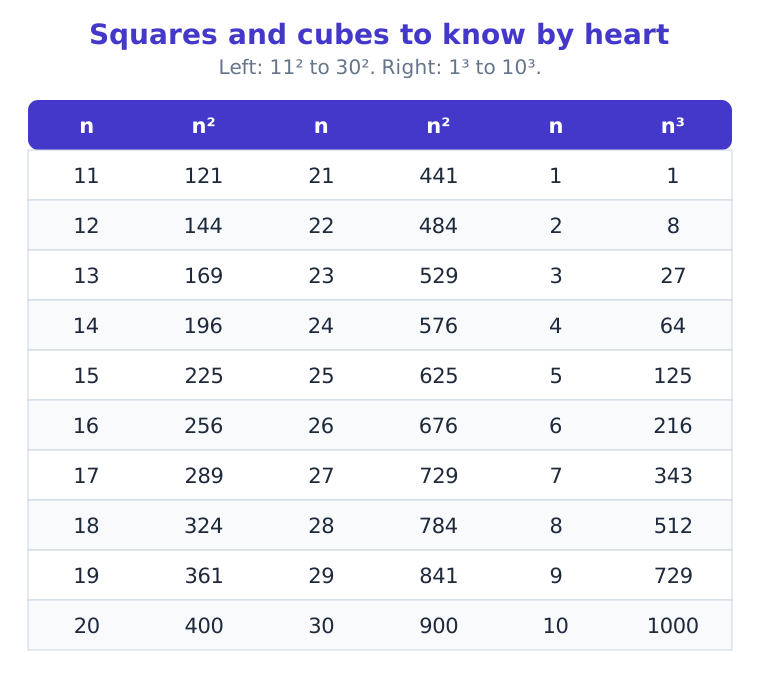
- Perfect square or cube
- Multiple of 7, 11, 13, 17
- Digit sum (three numbers whose digits add to the same total)
- Square ± 1 and n × (n + 1): 24, 35, 48 are $n^2-1$; 20, 30, 42 are $n(n+1)$
Worked example: the prime trap
Find the odd one out: 37, 43, 51, 59.
All four are odd and two-digit. Test primes: 37, 43 and 59 are prime, but $51 = 3 \times 17$. Second check: is any other rule singling out a different number? Digit sums are 10, 7, 6, 14, all different, and none is a square. So 51 is the only answer.
Number pairs
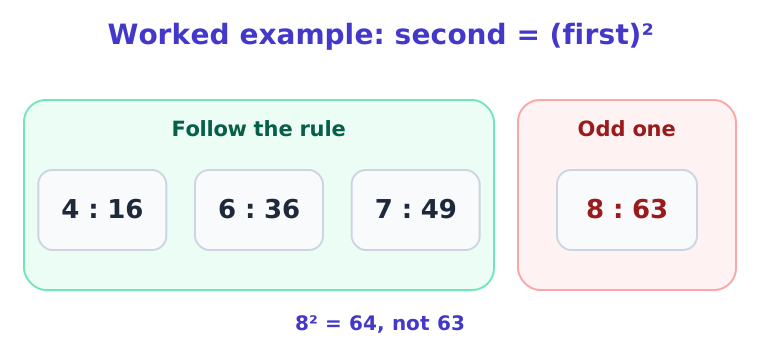
In a pair such as 6 : 36 the second number is made from the first. Try, in order: $n^2$, $n^3$, $n^2 \pm 1$, $n(n+1)$, $(n+1)^2$, $2n + 1$. Three pairs follow the rule; the fourth is usually off by one or two, which is exactly the trap.
Letters become numbers
Every letter question turns into a number question once you write positions. Remember EJOTY: E = 5, J = 10, O = 15, T = 20, Y = 25. To find R, go from T (20) back two: R = 18.
The reverse position (counting from Z) is $27 - \text{position}$, so R from the end is $27 - 18 = 9$.
Letter groups: count the jumps
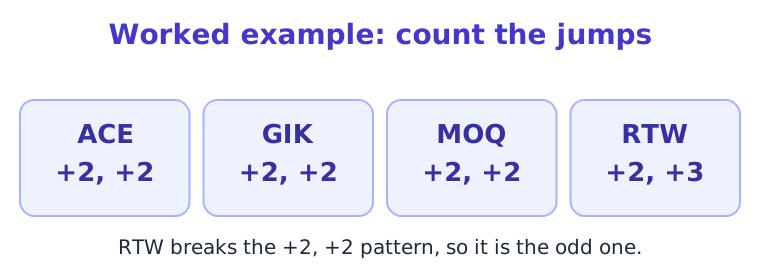
Write the jump from each letter to the next. In ACE, GIK, MOQ the jumps are +2, +2. In RTW they are +2, +3, so RTW is the odd one.
Count jumps, not letters in between: from C to F the jump is +3 (D, E are the two letters skipped).
Letter pairs and opposites
Two letters are opposites when their positions add to 27: A–Z, B–Y, C–X, … M–N. In BY, CX, DW, EU the first three are opposite pairs ($2 + 25$, $3 + 24$, $4 + 23$), but $5 + 21 = 26$, so EU is odd.
Other pair rules: the second letter a fixed number of places ahead (CF, GJ, LO: +3), or its position double the first (BD, CF, DH).
Letters with numbers
Terms such as C3, F6, H8, K11 join a letter and a number. Check: is the number the position (C = 3), the reverse position, double the position, or its square? Here K = 11, so all fit; change K11 to K12 and K12 becomes the odd one.
Exam shortcuts
- Numbers: parity → prime → square/cube → multiples → digit sum.
- Pairs: $n^2$, $n^3$, $n^2 \pm 1$, $n(n+1)$.
- Letters: write positions with EJOTY; count jumps.
- Opposites add to 27; reverse position = 27 − position.
- Always run a second rule before you mark the answer.
Back to Priya
A week later Priya meets 27, 64, 125, 150 in a new test. Cubes? 27, 64 and 125 are; 150 is not. Second check: parity gives two even and two odd, so nothing else stands out. Five seconds, one mark. The method works because it is the same every time.
Concepts and terms
A good classification set has one property shared by exactly three items. The item without it is the odd one.
A = 1, B = 2, … Z = 26. Counting from Z, the position is 27 minus the forward position.
The difference between the positions of neighbouring letters, such as A(1) C(3) E(5): +2, +2.
A fixed operation that turns the first number of a pair into the second, such as squaring.

Did you know
Sorting things into groups is one of the first thinking skills children learn, and computers use the same idea to sort e-mails into spam and inbox.
1729 is called the Ramanujan number: it is the smallest number that is a sum of two cubes in two ways (1³ + 12³ and 9³ + 10³).

Memory tricks
Positions 5, 10, 15, 20, 25 — EJOTY — E = 5, J = 10, O = 15, T = 20, Y = 25. Count a step or two from the nearest one.
Opposite letters — BoY, CoX, DeW, GoT, HiS, LoO — Each pair adds up to 27, so B–Y, C–X, D–W, G–T, H–S and L–O are opposites.
Practice MCQs with answers (71)
- A 53
- B 41
- C 49
- D 59
Show answer
Why:
All except 49 are prime numbers: 41 is prime, 59 is prime, 53 is prime. But 49 = 7 × 7 is not prime.
- A 113
- B 181
- C 227
- D 161
Show answer
Why:
All except 161 are prime numbers: 181 is prime, 227 is prime, 113 is prime. But 161 = 7 × 23 is not prime.
- A 67
- B 84
- C 70
- D 60
Show answer
Why:
All except 67 are composite numbers: 70 = 2 × 35, 60 = 2 × 30, 84 = 2 × 42. But 67 is prime.
- A 225
- B 224
- C 441
- D 100
Show answer
Why:
All except 224 are perfect squares: 100 = 10², 225 = 15², 441 = 21². But 224 lies between 14² = 196 and 15² = 225.
- A 324
- B 900
- C 623
- D 625
Show answer
Why:
All except 623 are perfect squares: 625 = 25², 324 = 18², 900 = 30². But 623 lies between 24² = 576 and 25² = 625.
- A 27
- B 729
- C 125
- D 25
Show answer
Why:
All except 25 are perfect cubes: 729 = 9³, 125 = 5³, 27 = 3³. But 25 is not a cube.
- A 72
- B 140
- C 126
- D 70
Show answer
Why:
All except 72 are multiples of 7: 126 = 7 × 18, 70 = 7 × 10, 140 = 7 × 20. But 72 = 7 × 10 + 2.
- A 231
- B 383
- C 385
- D 165
Show answer
Why:
All except 383 are multiples of 11: 231 = 11 × 21, 385 = 11 × 35, 165 = 11 × 15. But 383 = 11 × 34 + 9.
- A 299
- B 208
- C 105
- D 104
Show answer
Why:
All except 105 are multiples of 13: 299 = 13 × 23, 208 = 13 × 16, 104 = 13 × 8. But 105 = 13 × 8 + 1.
- A 238
- B 119
- C 255
- D 120
Show answer
Why:
All except 120 are multiples of 17: 255 = 17 × 15, 238 = 17 × 14, 119 = 17 × 7. But 120 = 17 × 7 + 1.
- A 83
- B 122
- C 197
- D 82
Show answer
Why:
All except 83 are one more than a perfect square: 122 = 11² + 1, 197 = 14² + 1, 82 = 9² + 1. But 83 − 1 = 82 is not a square.
- A 80
- B 122
- C 120
- D 48
Show answer
Why:
All except 122 are one less than a perfect square: 120 = 11² − 1, 48 = 7² − 1, 80 = 9² − 1. But 122 + 1 = 123 is not a square.
- A 132
- B 110
- C 130
- D 156
Show answer
Why:
All except 130 are products of two consecutive numbers: 110 = 10 × 11, 156 = 12 × 13, 132 = 11 × 12. But 130 lies between 10 × 11 = 110 and 11 × 12 = 132.
- A 900
- B 135
- C 324
- D 163
Show answer
Why:
All except 163 are numbers whose digits add up to 9: 1 + 3 + 5 = 9, 3 + 2 + 4 = 9, 9 + 0 + 0 = 9. But 1 + 6 + 3 = 10.
- A 217
- B 830
- C 218
- D 335
Show answer
Why:
All except 217 are numbers whose digits add up to 11: 8 + 3 + 0 = 11, 2 + 1 + 8 = 11, 3 + 3 + 5 = 11. But 2 + 1 + 7 = 10.
- A 229
- B 217
- C 173
- D 263
Show answer
Why:
All except 217 are prime numbers: 173 is prime, 263 is prime, 229 is prime. But 217 = 7 × 31 is not prime.
- A 144
- B 324
- C 145
- D 400
Show answer
Why:
All except 145 are perfect squares: 400 = 20², 144 = 12², 324 = 18². But 145 lies between 12² = 144 and 13² = 169.
- A 189
- B 175
- C 135
- D 131
Show answer
Why:
All except 131 are composite numbers: 175 = 5 × 35, 135 = 3 × 45, 189 = 3 × 63. But 131 is prime.
- A 3 : 11
- B 9 : 81
- C 12 : 144
- D 6 : 36
Show answer
Why:
In every pair except 3 : 11, the second number is the square of the first: 9² = 81, 12² = 144, 6² = 36. For 3 : 11, 3² = 9, not 11.
- A 18 : 324
- B 17 : 287
- C 20 : 400
- D 13 : 169
Show answer
Why:
In every pair except 17 : 287, the second number is the square of the first: 18² = 324, 20² = 400, 13² = 169. For 17 : 287, 17² = 289, not 287.
- A 8 : 512
- B 6 : 216
- C 7 : 341
- D 5 : 125
Show answer
Why:
In every pair except 7 : 341, the second number is the cube of the first: 5³ = 125, 8³ = 512, 6³ = 216. For 7 : 341, 7³ = 343, not 341.
- A 6 : 37
- B 12 : 145
- C 4 : 17
- D 9 : 80
Show answer
Why:
In every pair except 9 : 80, second = (first)² + 1: 6² + 1 = 37, 12² + 1 = 145, 4² + 1 = 17. For 9 : 80, 9² + 1 = 82, not 80.
- A 11 : 131
- B 12 : 143
- C 8 : 63
- D 4 : 15
Show answer
Why:
In every pair except 11 : 131, second = (first)² − 1: 8² − 1 = 63, 4² − 1 = 15, 12² − 1 = 143. For 11 : 131, 11² − 1 = 120, not 131.
- A 8 : 72
- B 11 : 143
- C 6 : 42
- D 13 : 182
Show answer
Why:
In every pair except 11 : 143, second = first × (first + 1): 13 × 14 = 182, 8 × 9 = 72, 6 × 7 = 42. For 11 : 143, 11 × 12 = 132, not 143.
- A 5 : 36
- B 12 : 169
- C 4 : 21
- D 3 : 16
Show answer
Why:
In every pair except 4 : 21, second = (first + 1)²: (12 + 1)² = 169, (3 + 1)² = 16, (5 + 1)² = 36. For 4 : 21, (4 + 1)² = 25, not 21.
- A 8 : 513
- B 6 : 217
- C 4 : 65
- D 3 : 25
Show answer
Why:
In every pair except 3 : 25, second = (first)³ + 1: 4³ + 1 = 65, 8³ + 1 = 513, 6³ + 1 = 217. For 3 : 25, 3³ + 1 = 28, not 25.
- A 28 : 55
- B 8 : 17
- C 30 : 61
- D 16 : 33
Show answer
Why:
In every pair except 28 : 55, second = 2 × first + 1: 2 × 16 + 1 = 33, 2 × 8 + 1 = 17, 2 × 30 + 1 = 61. For 28 : 55, 2 × 28 + 1 = 57, not 55.
- A 7 : 20
- B 22 : 63
- C 25 : 74
- D 11 : 32
Show answer
Why:
In every pair except 22 : 63, second = 3 × first − 1: 3 × 11 − 1 = 32, 3 × 7 − 1 = 20, 3 × 25 − 1 = 74. For 22 : 63, 3 × 22 − 1 = 65, not 63.
- A (8, 64, 512)
- B (9, 81, 729)
- C (3, 9, 30)
- D (5, 25, 125)
Show answer
Why:
Except (3, 9, 30), in each group the numbers are n, n² and n³: 5, 5² = 25, 5³ = 125; 8, 8² = 64, 8³ = 512; 9, 9² = 81, 9³ = 729. The group (3, 9, 30) breaks this rule.
- A (19, 18, 37)
- B (29, 3, 32)
- C (40, 29, 69)
- D (26, 17, 45)
Show answer
Why:
Except (26, 17, 45), in each group the third number is the sum of the first two: 40 + 29 = 69; 19 + 18 = 37; 29 + 3 = 32. The group (26, 17, 45) breaks this rule.
- A (8, 9, 71)
- B (3, 8, 24)
- C (12, 10, 120)
- D (4, 7, 28)
Show answer
Why:
Except (8, 9, 71), in each group the third number is the product of the first two: 4 × 7 = 28; 3 × 8 = 24; 12 × 10 = 120. The group (8, 9, 71) breaks this rule.
- A (10, 20, 40)
- B (11, 22, 46)
- C (22, 44, 88)
- D (18, 36, 72)
Show answer
Why:
Except (11, 22, 46), in each group each number is double the one before it: 18 × 2 = 36, 36 × 2 = 72; 10 × 2 = 20, 20 × 2 = 40; 22 × 2 = 44, 44 × 2 = 88. The group (11, 22, 46) breaks this rule.
- A (9, 81, 729)
- B (5, 25, 125)
- C (4, 16, 68)
- D (3, 9, 27)
Show answer
Why:
Except (4, 16, 68), in each group the numbers are n, n² and n³: 5, 5² = 25, 5³ = 125; 3, 3² = 9, 3³ = 27; 9, 9² = 81, 9³ = 729. The group (4, 16, 68) breaks this rule.
- A OQS
- B PRT
- C VXZ
- D UVX
Show answer
Why:
Write the positions and find the jumps. UVX: +1, +2; VXZ: +2, +2; OQS: +2, +2; PRT: +2, +2. Only UVX does not follow +2, +2.
- A CFJ
- B DGJ
- C LOR
- D RUX
Show answer
Why:
Write the positions and find the jumps. CFJ: +3, +4; LOR: +3, +3; RUX: +3, +3; DGJ: +3, +3. Only CFJ does not follow +3, +3.
- A MNP
- B IKM
- C JKM
- D TUW
Show answer
Why:
Write the positions and find the jumps. IKM: +2, +2; MNP: +1, +2; JKM: +1, +2; TUW: +1, +2. Only IKM does not follow +1, +2.
- A MQU
- B KOS
- C ILP
- D OSW
Show answer
Why:
Write the positions and find the jumps. OSW: +4, +4; ILP: +3, +4; MQU: +4, +4; KOS: +4, +4. Only ILP does not follow +4, +4.
- A HFD
- B TRP
- C PNL
- D NLK
Show answer
Why:
Write the positions and find the jumps. HFD: −2, −2; TRP: −2, −2; NLK: −2, −1; PNL: −2, −2. Only NLK does not follow −2, −2.
- A BDH
- B CEH
- C PRU
- D BDG
Show answer
Why:
Write the positions and find the jumps. BDH: +2, +4; BDG: +2, +3; CEH: +2, +3; PRU: +2, +3. Only BDH does not follow +2, +3.
- A FKP
- B EJN
- C MRW
- D KPU
Show answer
Why:
Write the positions and find the jumps. EJN: +5, +4; KPU: +5, +5; FKP: +5, +5; MRW: +5, +5. Only EJN does not follow +5, +5.
- A VSP
- B YVS
- C TRO
- D MJG
Show answer
Why:
Write the positions and find the jumps. VSP: −3, −3; TRO: −2, −3; YVS: −3, −3; MJG: −3, −3. Only TRO does not follow −3, −3.
- A PQSV
- B KLNQ
- C QRTW
- D LNPS
Show answer
Why:
Write the positions and find the jumps. PQSV: +1, +2, +3; LNPS: +2, +2, +3; KLNQ: +1, +2, +3; QRTW: +1, +2, +3. Only LNPS does not follow +1, +2, +3.
- A GIJL
- B LNPR
- C QSUW
- D FHJL
Show answer
Why:
Write the positions and find the jumps. QSUW: +2, +2, +2; FHJL: +2, +2, +2; LNPR: +2, +2, +2; GIJL: +2, +1, +2. Only GIJL does not follow +2, +2, +2.
- A GT
- B IQ
- C JQ
- D LO
Show answer
Why:
Positions: JQ: 10, 17; IQ: 9, 17; LO: 12, 15; GT: 7, 20. In all except IQ, the two letters are opposites (positions add to 27).
- A BY
- B FU
- C KQ
- D LO
Show answer
Why:
Positions: LO: 12, 15; KQ: 11, 17; BY: 2, 25; FU: 6, 21. In all except KQ, the two letters are opposites (positions add to 27).
- A IL
- B UX
- C GJ
- D VX
Show answer
Why:
Positions: VX: 22, 24; IL: 9, 12; UX: 21, 24; GJ: 7, 10. In all except VX, the second letter is 3 places after the first.
- A BF
- B OT
- C IN
- D RW
Show answer
Why:
Positions: OT: 15, 20; BF: 2, 6; IN: 9, 14; RW: 18, 23. In all except BF, the second letter is 5 places after the first.
- A EJ
- B IQ
- C LX
- D DH
Show answer
Why:
Positions: LX: 12, 24; DH: 4, 8; EJ: 5, 10; IQ: 9, 17. In all except IQ, the second letter's position is double the first.
- A IK
- B GM
- C HK
- D EO
Show answer
Why:
Positions: EO: 5, 15; IK: 9, 11; HK: 8, 11; GM: 7, 13. In all except HK, the positions add up to 20.
- A HL
- B NR
- C AE
- D EH
Show answer
Why:
Positions: HL: 8, 12; NR: 14, 18; EH: 5, 8; AE: 1, 5. In all except EH, the second letter is 4 places after the first.
- A FW
- B LR
- C MQ
- D HV
Show answer
Why:
Positions: HV: 8, 22; FW: 6, 23; LR: 12, 18; MQ: 13, 17. In all except FW, the positions add up to 30.
- A B2
- B M15
- C T20
- D P16
Show answer
Why:
The number is the position of the letter in T20 (T = 20), P16 (P = 16), B2 (B = 2). In M15 the number should be 13.
- A B25
- B K16
- C T8
- D F21
Show answer
Why:
The number is the position of the letter counted from Z in F21 (F = 21), B25 (B = 25), K16 (K = 16). In T8 the number should be 7.
- A H16
- B S38
- C R36
- D L25
Show answer
Why:
The number is double the position of the letter in S38 (S = 19), R36 (R = 18), H16 (H = 8). In L25 the number should be 24.
- A I82
- B E25
- C C9
- D H64
Show answer
Why:
The number is the square of the position of the letter in C9 (C = 3), H64 (H = 8), E25 (E = 5). In I82 the number should be 81.
- A J17
- B L14
- C T7
- D H19
Show answer
Why:
The number is the position of the letter counted from Z in H19 (H = 19), J17 (J = 17), T7 (T = 7). In L14 the number should be 15.
- A 64
- B 729
- C 728
- D 27
Show answer
Why:
All except 728 are perfect cubes: 729 = 9³, 27 = 3³, 64 = 4³. But 728 is not a cube.
- A 147
- B 175
- C 105
- D 148
Show answer
Why:
All except 148 are multiples of 7: 105 = 7 × 15, 147 = 7 × 21, 175 = 7 × 25. But 148 = 7 × 21 + 1.
- A 10 : 90
- B 14 : 196
- C 6 : 36
- D 4 : 16
Show answer
Why:
In every pair except 10 : 90, the second number is the square of the first: 14² = 196, 6² = 36, 4² = 16. For 10 : 90, 10² = 100, not 90.
- A EHK
- B CFJ
- C SVY
- D ILO
Show answer
Why:
Write the positions and find the jumps. ILO: +3, +3; CFJ: +3, +4; EHK: +3, +3; SVY: +3, +3. Only CFJ does not follow +3, +3.
- A CX
- B KP
- C EW
- D BY
Show answer
Why:
Positions: CX: 3, 24; KP: 11, 16; EW: 5, 23; BY: 2, 25. In all except EW, the two letters are opposites (positions add to 27).
- A S
- B J
- C Q
- D T
Show answer
Why:
12th from the right is position 27 − 12 = 15 (O). Five to the right: 15 + 5 = 20, which is T.
- A 64
- B 27
- C 81
- D 16
Show answer
Why:
64 = 8² = 4³. 16 and 81 are squares only; 27 is a cube only.
- A 14
- B 13
- C 26
- D 12
Show answer
Why:
A–Z, B–Y, … M–N: the 26 letters make 13 pairs.
- A Pick the largest number
- B Pick the smallest number
- C Look for a rule with no rival
- D Mark the first rule you saw
Show answer
Why:
Two rules picking two different items means one of them is not the intended rule. Look for the rule that leaves exactly one item out with no rival.
- A 18
- B 10
- C 16
- D 17
Show answer
Why:
O = 15, so Q = 15 + 2 = 17.
- A Both A and R are true, and R is the correct explanation of A
- B Both A and R are true, but R is not the correct explanation of A
- C A is true but R is false
- D A is false but R is true
Show answer
Why:
27 = 3³, 64 = 4³, 125 = 5³, while 196 = 14² is not a cube. R gives exactly the reason for A.
- A Both A and R are true, and R is the correct explanation of A
- B Both A and R are true, but R is not the correct explanation of A
- C A is true but R is false
- D A is false but R is true
Show answer
Why:
2 + 25, 3 + 24, 4 + 23 all make 27, but E + U = 5 + 21 = 26. R explains A.
- A Both A and R are true, and R is the correct explanation of A
- B Both A and R are true, but R is not the correct explanation of A
- C A is true but R is false
- D A is false but R is true
Show answer
Why:
121, 144, 169 are 11², 12², 13²; 180 is not a square, so the odd one is 180, not 121. A is false, R is true.
- A 1 only
- B 2 only
- C Both 1 and 2
- D Neither 1 nor 2
Show answer
Why:
O = 15 by EJOTY. 20th from the right is position 27 − 20 = 7, which is G. Both are true.
- A 1 only
- B 2 only
- C Both 1 and 2
- D Neither 1 nor 2
Show answer
Why:
11, 13, 17 are prime and 21 = 3 × 7. Both rules pick 21, so the answer to the odd-one-out is safe.
Important short questions (4)
143 = 11 × 13, 187 = 11 × 17, 209 = 11 × 19 are multiples of 11. 169 = 13² is not, so 169 is odd.
F = 6 and U = 21 add to 27, so they are opposites. T = 20, and 6 + 20 = 26.
Second = first³ + 1: 8 + 1, 27 + 1, 64 + 1. But 5³ + 1 = 126, not 124, so 5 : 124 is odd.
KNQ: 11, 14, 17, so +3, +3. BEI: 2, 5, 9, so +3, +4. KNQ follows +3, +3.
Long answer questions (1)
Example: 49, 64, 81, 90. Rule: perfect squares (7², 8², 9²); 90 is not.
Parity: 64 and 90 even, 49 and 81 odd, two and two, no single item.
Prime: none is prime. Multiple of 3: 81 and 90, two items, no single item. So 90 is the only answer.
Flashcards (14)
Play this topic
- Quick check
Words and Meanings
Classify words by what they mean: living things, plants and food, dances and instruments, metals, planets, units, word pairs with the same link, and words with the same meaning.
What you will be able to do
- I can name the class of a word at more than one level (animal, mammal, mammal living in water).
- I can find the narrowest class that holds three words and spot the fourth.
- I can find the odd word pair by naming the link and checking its order.
- I can pick the word that belongs to a given group.
Key points
Word classification depends on meaning: class, use, habitat, origin, not spelling.
Go from broad to narrow: animal → mammal → mammal that lives in water.
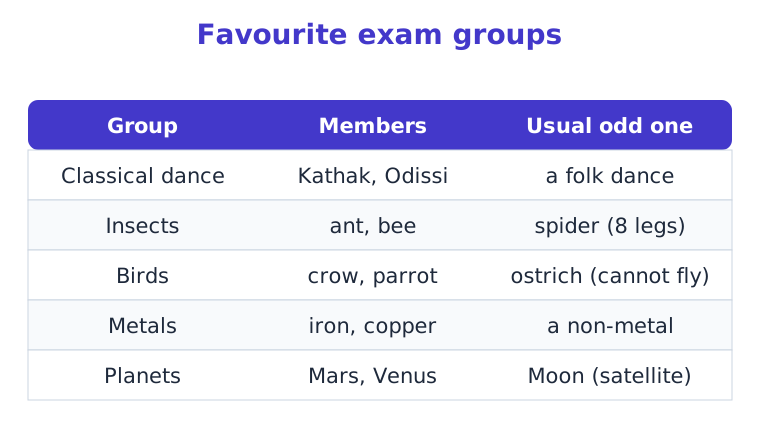
Classic traps: bat and whale are mammals; spider has 8 legs and is not an insect; ostrich and penguin cannot fly.
Potato is a stem tuber and onion a bulb, but carrot, radish and beetroot are roots; all grow underground.
Kathak, Bharatanatyam, Kuchipudi, Odissi, Kathakali, Manipuri are classical; Bhangra, Garba, Bihu, Lavani, Ghoomar are folk.
Months with 30 days: April, June, September, November. February has 28 or 29.
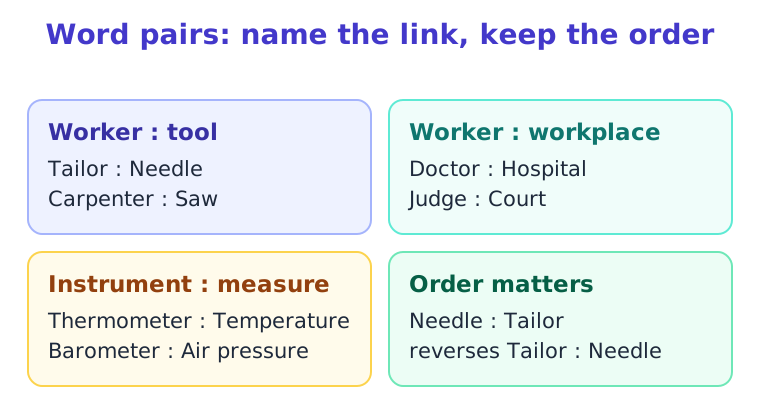
In word pairs, the link and its order must both match: Tailor : Needle is not the same as Needle : Tailor.
Moon is a satellite and Sun a star; neither is a planet.
Full explanation
Asha at the vegetable market
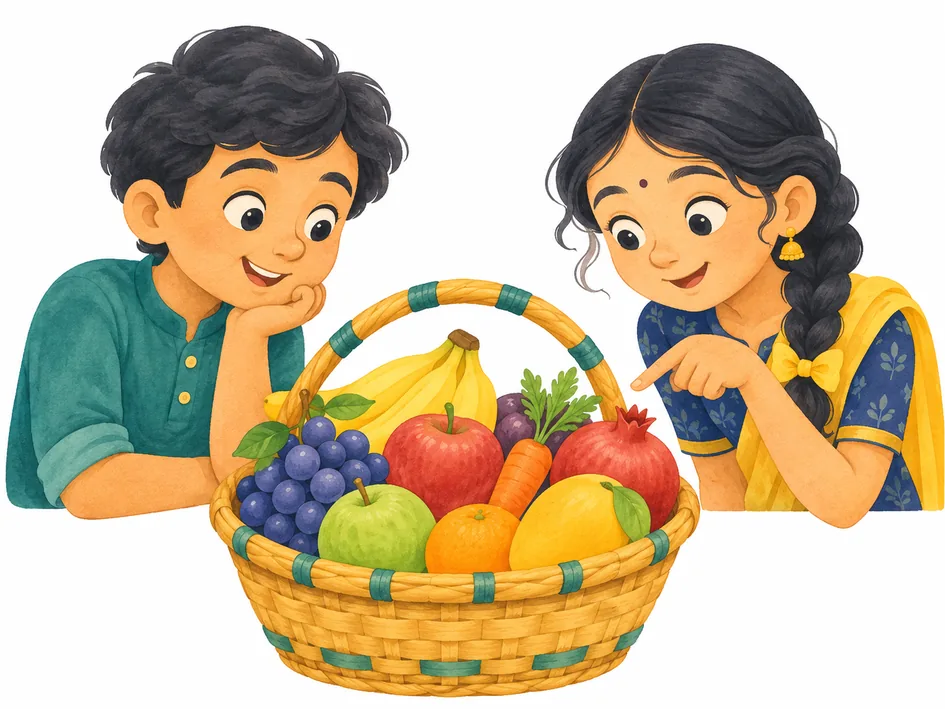
Asha helps her mother at the weekly market. Her mother says: "Put the carrots, radishes and beetroots in one basket." A brinjal has rolled in. Asha laughs: "This one grows on a plant above the ground, the others grow under it." Without knowing it, Asha has just solved a word classification question.
What the question tests
You get four words. Three belong to one class by meaning: what the thing is, what it does, where it lives, where it comes from. The fourth does not. Spelling never decides a word classification question.
Broad and narrow classes
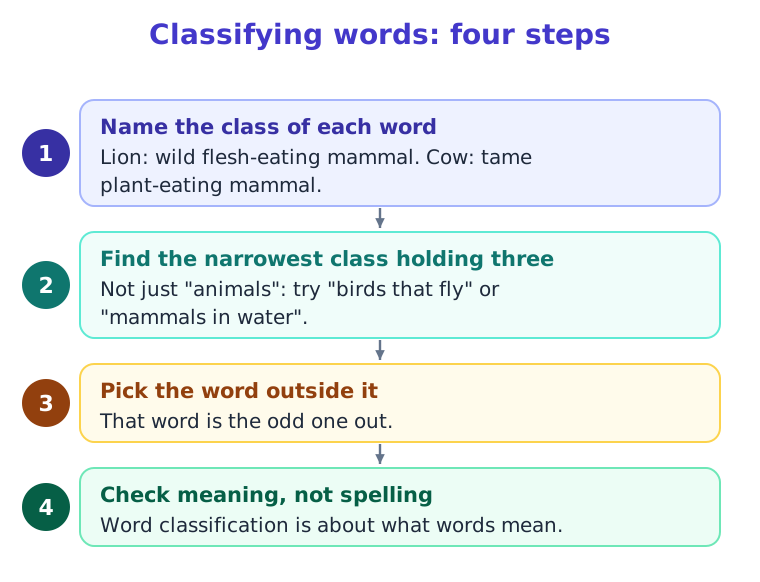
Every word sits in classes inside classes. A whale is an animal, a mammal, and a mammal that lives in water. If all four words are animals, that broad class tells you nothing. Go one level narrower until exactly three fit.
Worked example
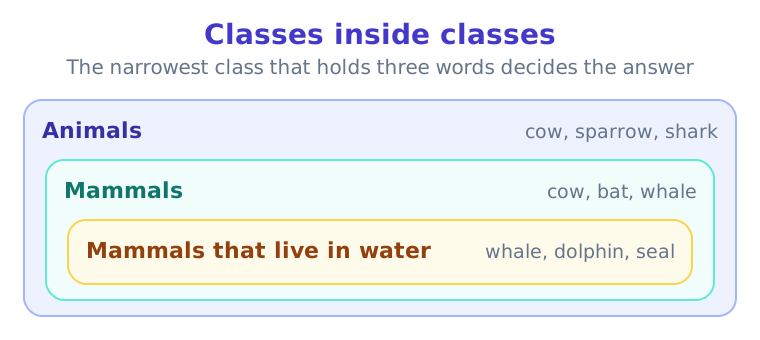
Find the odd one out: Whale, Dolphin, Seal, Shark.
All four live in the sea, so "water animals" fits all four and is useless. Narrower: whale, dolphin and seal breathe air and feed their young on milk; they are mammals. The shark is a fish. Answer: Shark.
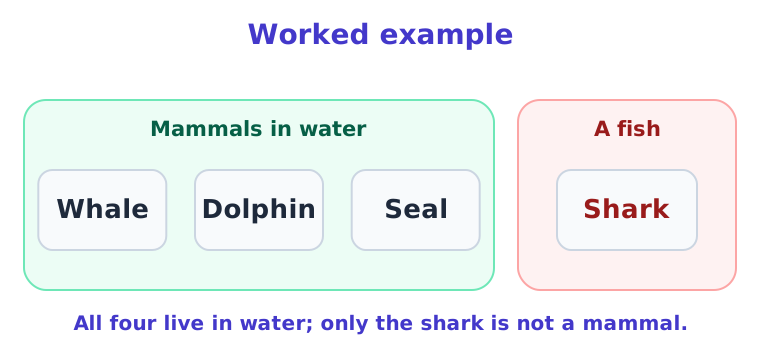
Groups exams love
A few groups come again and again. Learn the members and the usual trap in each.
Word pairs
Sometimes each option is a pair, such as Doctor : Hospital. Name the link in each pair in one phrase, then check the order. In Tailor : Needle, Carpenter : Saw, Farmer : Plough, Doctor : Hospital, the first three are worker : tool; the last is worker : workplace, so it is the odd pair.
Same meaning, one opposite
In meaning sets, three words are synonyms and one is the opposite or unrelated: Happy, Glad, Joyful, Sad. Read each word in a short sentence ("She felt …") to feel the meaning.
Choose the member
Another form gives three words and asks which option belongs with them. Find their narrowest class first, then test each option. Kathak, Odissi, Manipuri: classical dances, so pick the classical dance among the options, not Garba or Bihu.
Exam shortcuts
- Go from broad to narrow until exactly three fit.
- Know the traps: bat, whale, spider, ostrich, Moon, mercury (liquid metal).
- Pairs: same link and same order.
- Meaning sets: put each word in a sentence.
- Never decide by spelling.
Back to the market
At the end of the day Asha sorts one more basket: wheat, rice, maize and gram. "Gram is a pulse, the rest are cereals," she says. Her mother smiles. The same habit, naming the narrowest class, will win you marks in the exam hall.
Concepts and terms
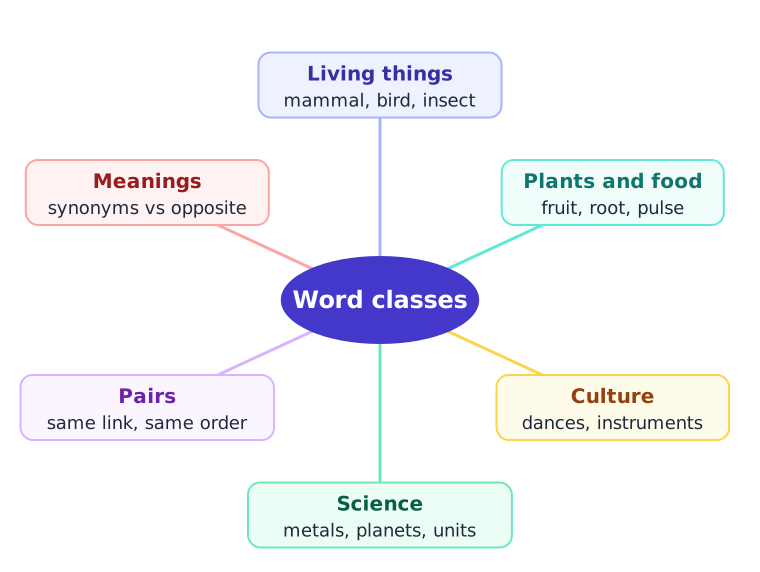
The group a word belongs to by meaning, such as fruit, bird or metal. A word can belong to several classes at different levels.
The smallest class that holds three of the four words. The fourth word lies outside it.
The relation between the two words: worker and tool, country and capital, instrument and what it measures.
Did you know
The bat is the only mammal that can truly fly.
India has eight dance forms recognised as classical by the Sangeet Natak Akademi.
Memory tricks
30-day months — Knuckle trick — Count months on your knuckles and the gaps between them: knuckles are 31-day months, gaps are the short months.
Insect or not? — Six legs, three parts — An insect has 6 legs and 3 body parts. Spider and scorpion have 8 legs.
Practice MCQs with answers (69)
- A Onion
- B Apple
- C Guava
- D Pomegranate
Show answer
Why:
Apple, Guava, Pomegranate are all fruits. Onion is not; it is a vegetable.
- A Beetroot
- B Banana
- C Turnip
- D Radish
Show answer
Why:
Beetroot, Turnip, Radish are all vegetables. Banana is not; it is a fruit.
- A Rose
- B Hibiscus
- C Banana
- D Marigold
Show answer
Why:
Hibiscus, Marigold, Rose are all flowers. Banana is not; it is a fruit.
- A Carrot
- B Turnip
- C Radish
- D Cauliflower
Show answer
Why:
Radish, Carrot, Turnip are all vegetables that grow under the ground. Cauliflower is not; it is a vegetable that grows above the ground.
- A Cauliflower
- B Radish
- C Beetroot
- D Turnip
Show answer
Why:
Radish, Beetroot, Turnip are all root vegetables. Cauliflower is not; it is a vegetable that grows above the ground.
- A Amaranth
- B Brinjal
- C Cabbage
- D Fenugreek
Show answer
Why:
Amaranth, Cabbage, Fenugreek are all leafy vegetables. Brinjal is not.
- A Barley
- B Wheat
- C Pigeon pea
- D Millet
Show answer
Why:
Barley, Wheat, Millet are all cereals (grains). Pigeon pea is not; it is a pulse.
- A Lentil
- B Moong
- C Pigeon pea
- D Barley
Show answer
Why:
Moong, Pigeon pea, Lentil are all pulses. Barley is not; it is a cereal.
- A Hawk
- B Horse
- C Buffalo
- D Goat
Show answer
Why:
Buffalo, Goat, Horse are all mammals. Hawk is not; it is a bird.
- A Pigeon
- B Tiger
- C Sparrow
- D Parrot
Show answer
Why:
Parrot, Pigeon, Sparrow are all birds. Tiger is not; it is a mammal.
- A Sparrow
- B Pigeon
- C Emu
- D Crow
Show answer
Why:
Sparrow, Pigeon, Crow are all creatures that can fly. Emu is not; it is a bird that cannot fly.
- A Goat
- B Elephant
- C Cow
- D Leopard
Show answer
Why:
Elephant, Cow, Goat are all plant-eating animals. Leopard is not; it is a flesh-eater.
- A Buffalo
- B Leopard
- C Wolf
- D Lion
Show answer
Why:
Wolf, Lion, Leopard are all flesh-eating animals. Buffalo is not; it is a plant-eater.
- A Housefly
- B Scorpion
- C Ant
- D Bee
Show answer
Why:
Bee, Housefly, Ant are all insects (six legs). Scorpion is not; it is an eight-legged creature.
- A Turtle
- B Lizard
- C Frog
- D Chameleon
Show answer
Why:
Turtle, Lizard, Chameleon are all reptiles. Frog is not; it is an amphibian.
- A Lion
- B Leopard
- C Seal
- D Rohu
Show answer
Why:
Lion, Leopard, Seal are all mammals. Rohu is not; it is a fish.
- A Mridangam
- B Violin
- C Veena
- D Guitar
Show answer
Why:
Veena, Guitar, Violin are all string instruments. Mridangam is not; it is a percussion instrument.
- A Dholak
- B Flute
- C Tabla
- D Mridangam
Show answer
Why:
Mridangam, Dholak, Tabla are all percussion instruments (struck). Flute is not; it is a wind instrument.
- A Flute
- B Nadaswaram
- C Guitar
- D Shehnai
Show answer
Why:
Nadaswaram, Shehnai, Flute are all wind instruments (blown). Guitar is not; it is a string instrument.
- A Manipuri
- B Odissi
- C Bharatanatyam
- D Lavani
Show answer
Why:
Bharatanatyam, Manipuri, Odissi are all classical dances of India. Lavani is not; it is a folk dance.
- A Odissi
- B Bhangra
- C Ghoomar
- D Lavani
Show answer
Why:
Lavani, Bhangra, Ghoomar are all folk dances of India. Odissi is not; it is a classical dance.
- A Uranus
- B Sun
- C Jupiter
- D Neptune
Show answer
Why:
Neptune, Uranus, Jupiter are all planets. Sun is not; it is a star.
- A Mars
- B Venus
- C Neptune
- D Mercury
Show answer
Why:
Mercury, Mars, Venus are all rocky planets near the Sun. Neptune is not; it is a giant planet far from the Sun.
- A Gold
- B Platinum
- C Aluminium
- D Phosphorus
Show answer
Why:
Platinum, Aluminium, Gold are all metals. Phosphorus are not; it is a non-metal.
- A Quicksilver
- B Platinum
- C Copper
- D Silver
Show answer
Why:
Silver, Platinum, Copper are all solids at room temperature. Quicksilver is not; it is liquid at room temperature.
- A Gold
- B Quicksilver
- C Platinum
- D Silver
Show answer
Why:
Gold, Platinum, Silver are all precious metals. Quicksilver is not; it is liquid at room temperature.
- A October
- B July
- C November
- D August
Show answer
Why:
October, July, August are all months with 31 days. November is not; it is a 30-day month.
- A September
- B April
- C November
- D January
Show answer
Why:
September, April, November are all months with 30 days. January is not; it is a 31-day month.
- A Nepal
- B Spain
- C France
- D Italy
Show answer
Why:
France, Italy, Spain are all countries in Europe. Nepal is not; it is a country in Asia.
- A India
- B Nigeria
- C Bhutan
- D Nepal
Show answer
Why:
Bhutan, Nepal, India are all countries in Asia. Nigeria is not; it is a country in Africa.
- A Kenya
- B Nigeria
- C Brazil
- D Ghana
Show answer
Why:
Nigeria, Ghana, Kenya are all countries in Africa. Brazil is not; it is a country in South America.
- A Scooter
- B Bus
- C Car
- D Ship
Show answer
Why:
Scooter, Bus, Car are all road vehicles. Ship is not; it is a water vehicle.
- A Bicycle
- B Car
- C Submarine
- D Ship
Show answer
Why:
Ship, Car, Submarine are all vehicles with an engine. Bicycle is not; it is a vehicle without an engine.
- A Triangle
- B Cone
- C Circle
- D Rectangle
Show answer
Why:
Rectangle, Triangle, Circle are all flat (two-dimensional) shapes. Cone is not; it is a solid (three-dimensional) shape.
- A Square
- B Cube
- C Cylinder
- D Pentagon
Show answer
Why:
Pentagon, Square, Cube are all shapes with only straight edges. Cylinder is not; it is a shape with a curved edge or surface.
- A Metre
- B Foot
- C Mile
- D Kilogram
Show answer
Why:
Mile, Metre, Foot are all units of length. Kilogram is not; it is a unit of mass.
- A Mile
- B Metre
- C Kilometre
- D Centimetre
Show answer
Why:
Kilometre, Centimetre, Metre are all metric units. Mile is not; it is a non-metric unit.
- A Skin
- B Lung
- C Tongue
- D Ear
Show answer
Why:
Tongue, Ear, Skin are all sense organs. Lung is not; it is an internal organ.
- A Yen
- B Dollar
- C Second
- D Rupee
Show answer
Why:
Yen, Dollar, Rupee are all currencies. Second is not; it is a unit of time.
- A Glad
- B Joyful
- C Happy
- D Sad
Show answer
Why:
Glad, Joyful, Happy all express joy; Sad means the opposite.
- A Timid
- B Brave
- C Fearless
- D Bold
Show answer
Why:
Brave, Fearless, Bold all express courage; Timid means the opposite.
- A Enormous
- B Tiny
- C Large
- D Huge
Show answer
Why:
Huge, Enormous, Large all describe great size; Tiny means the opposite.
- A Quick
- B Swift
- C Slow
- D Fast
Show answer
Why:
Quick, Swift, Fast all describe speed; Slow means the opposite.
- A Intelligent
- B Wise
- C Clever
- D Foolish
Show answer
Why:
Intelligent, Wise, Clever all describe a sharp mind; Foolish means the opposite.
- A Sailor : Ship
- B Blacksmith : Hammer
- C Barber : Razor
- D Painter : Brush
Show answer
Why:
Barber : Razor, Painter : Brush, Blacksmith : Hammer: each pair is a worker and the tool of the trade. Sailor : Ship shows a worker and the workplace.
- A Cook : Kitchen
- B Writer : Pen
- C Sailor : Ship
- D Teacher : School
Show answer
Why:
Teacher : School, Cook : Kitchen, Sailor : Ship: each pair is a worker and the workplace. Writer : Pen shows a worker and the tool of the trade.
- A Spider : Web
- B Bird : Nest
- C Shed : Cow
- D Horse : Stable
Show answer
Why:
Spider : Web, Bird : Nest, Horse : Stable: each pair is a creature and its home. Shed : Cow has the same link but in the reverse order.
- A Japan : Tokyo
- B India : New Delhi
- C Russia : Moscow
- D Gujarat : Gandhinagar
Show answer
Why:
Japan : Tokyo, India : New Delhi, Russia : Moscow: each pair is a country and its capital. Gujarat : Gandhinagar shows an Indian state and its capital.
- A Thermometer : Humidity
- B Speedometer : Speed
- C Odometer : Distance
- D Ammeter : Electric current
Show answer
Why:
Ammeter : Electric current, Speedometer : Speed, Odometer : Distance: each pair is an instrument and what it measures. In Thermometer : Humidity the two words do not match: Thermometer does not go with Humidity.
- A Russia : Rouble
- B Italy : Rome
- C Bangladesh : Taka
- D China : Yuan
Show answer
Why:
Bangladesh : Taka, China : Yuan, Russia : Rouble: each pair is a country and its currency. Italy : Rome shows a country and its capital.
- A Painter : Brush
- B Potter : Wheel
- C Pen : Writer
- D Barber : Razor
Show answer
Why:
Painter : Brush, Potter : Wheel, Barber : Razor: each pair is a worker and the tool of the trade. Pen : Writer has the same link but in the reverse order.
- A Rabbit : Burrow
- B Bee : Hive
- C Cow : Shed
- D Writer : Pen
Show answer
Why:
Cow : Shed, Rabbit : Burrow, Bee : Hive: each pair is a creature and its home. Writer : Pen shows a worker and the tool of the trade.
- A Nepal : Kathmandu
- B Kerala : Thiruvananthapuram
- C Gujarat : Gandhinagar
- D Bihar : Patna
Show answer
Why:
Bihar : Patna, Kerala : Thiruvananthapuram, Gujarat : Gandhinagar: each pair is an Indian state and its capital. Nepal : Kathmandu shows a country and its capital.
- A Bihu
- B Manipuri
- C Lavani
- D Garba
Show answer
Why:
Kathakali, Kuchipudi, Odissi are classical dances of India, and so is Manipuri. Garba, Bihu, Lavani are not.
- A Turtle
- B Whale
- C Cockroach
- D Penguin
Show answer
Why:
Ant, Bee, Housefly are insects (six legs), and so is Cockroach. Penguin, Turtle, Whale are not.
- A Rice
- B Millet
- C Barley
- D Moong
Show answer
Why:
Chickpea, Pigeon pea, Lentil are pulses, and so is Moong. Rice, Millet, Barley are not.
- A Catla
- B Frog
- C Dolphin
- D Turtle
Show answer
Why:
Hilsa, Shark, Rohu are fishes, and so is Catla. Turtle, Frog, Dolphin are not.
- A January
- B November
- C December
- D February
Show answer
Why:
September, April, June are months with 30 days, and so is November. January, December, February are not.
- A Shehnai
- B Sitar
- C Tabla
- D Guitar
Show answer
Why:
Mridangam, Dholak, Dhol are percussion instruments (struck), and so is Tabla. Shehnai, Sitar, Guitar are not.
- A Parrot
- B Pigeon
- C Sparrow
- D Chameleon
Show answer
Why:
Parrot, Pigeon, Sparrow are all birds. Chameleon is not; it is a reptile.
- A Jasmine
- B Pomegranate
- C Apple
- D Grapes
Show answer
Why:
Pomegranate, Apple, Grapes are all fruits. Jasmine is not; it is a flower.
- A Jupiter
- B Venus
- C Neptune
- D Uranus
Show answer
Why:
Neptune, Uranus, Jupiter are all giant planets far from the Sun. Venus are not; it is a rocky planet near the Sun.
- A Bihu
- B Garba
- C Kuchipudi
- D Lavani
Show answer
Why:
Lavani, Bihu, Garba are all folk dances of India. Kuchipudi is not; it is a classical dance.
- A Butterfly
- B Penguin
- C Sparrow
- D Bat
Show answer
Why:
The bat is a mammal (it feeds its young on milk) and flies. Sparrow is a bird, butterfly an insect, penguin a bird that cannot fly.
- A The first letter of the English word
- B What the thing is used for
- C Which class the thing belongs to
- D Where the thing lives
Show answer
Why:
Word classification depends on meaning. Spelling-based rules belong to letter questions, not word meaning questions.
- A Both A and R are true, and R is the correct explanation of A
- B Both A and R are true, but R is not the correct explanation of A
- C A is true but R is false
- D A is false but R is true
Show answer
Why:
A is true: the shark is a fish and the others are mammals. R is false: all four live in water.
- A Both A and R are true, and R is the correct explanation of A
- B Both A and R are true, but R is not the correct explanation of A
- C A is true but R is false
- D A is false but R is true
Show answer
Why:
Ant, bee and butterfly are insects with six legs; the spider has eight, so it is not an insect. R explains A.
- A 1 only
- B 2 only
- C Both 1 and 2
- D Neither 1 nor 2
Show answer
Why:
Kathakali (Kerala) and Kuchipudi (Andhra Pradesh) are classical. Bihu (Assam) and Garba (Gujarat) are folk dances.
- A 1 only
- B 2 only
- C Both 1 and 2
- D Neither 1 nor 2
Show answer
Why:
All four are metals, so "metal" cannot be the rule. Mercury is the only liquid, which makes it the odd one.
Important short questions (3)
Sitar, Veena and Sarod are string instruments. Tabla is a percussion instrument, so it is the odd one.
All four are animals, so the rule leaves nobody out. A narrower class, mammals, holds cow, bat and whale and leaves out the sparrow.
Each instrument should be paired with what it measures. An odometer measures distance, not speed, so Odometer : Speed is odd.
Long answer questions (1)
Example: Sparrow, Crow, Parrot, Ostrich. Broad class: all four are birds, which leaves nobody out.
Narrower class: sparrow, crow and parrot can fly; the ostrich cannot. So Ostrich is the odd one.
Flashcards (14)
Play this topic
- True or false?
Veda Skills Logical Reasoning Unit 4 — frequently asked questions
143 = 11 × 13, 187 = 11 × 17, 209 = 11 × 19 are multiples of 11. 169 = 13² is not, so 169 is odd.
F = 6 and U = 21 add to 27, so they are opposites. T = 20, and 6 + 20 = 26.
Second = first³ + 1: 8 + 1, 27 + 1, 64 + 1. But 5³ + 1 = 126, not 124, so 5 : 124 is odd.
Sitar, Veena and Sarod are string instruments. Tabla is a percussion instrument, so it is the odd one.
All four are animals, so the rule leaves nobody out. A narrower class, mammals, holds cow, bat and whale and leaves out the sparrow.
Each instrument should be paired with what it measures. An odometer measures distance, not speed, so Odometer : Speed is odd.

All Veda Skills Logical Reasoning units
Study this chapter properly, free
Everything above is on this page to read. In the Veda app the same chapter becomes spaced-repetition flashcards, timed tests that mark themselves, Veda Bites you can swipe, and games — with your progress tracked topic by topic.
Get Veda free