Veda Skills Logical Reasoning Unit 11: Syllogism
- 2 topics
- 170 MCQs
- 7 short answers
- 2 long answers
- 27 flashcards
- 2 games
- ~105 min read
- English
Checked before publishing: 23 automated checks, including a plagiarism check against the textbook's own words. How we check our content
All, Some and No Statements
Read the four statement forms (All, No, Some, Some not), draw them as Venn diagrams, link two or three statements through their middle group, and decide which conclusions definitely follow, including the either-or pair.
What you will be able to do
- I can draw All, No, Some and Some-not statements as Venn diagrams.
- I can reverse a statement correctly, and know which forms cannot be reversed.
- I can combine two statements through their middle group to get a definite conclusion.
- I can test a conclusion by trying to draw a case that breaks it.
- I can spot an either-or pair of conclusions.

Key points
Treat the statements as true, however strange they sound. "All pens are mangoes" is fine in a syllogism.
Every group named in the statements is taken to have at least one member.
A conclusion follows only if it is true in every case that fits the statements.
"Some" means at least one, possibly all.
"Some A are B" and "No A are B" can be reversed; "All A are B" gives only "Some B are A"; "Some A are not B" cannot be reversed.
Two statements combine only through a common (middle) group.
Two "Some" statements together give nothing definite.
Either I or II follows only for exact opposites about the same two groups (Some/No or All/Some-not) when neither follows alone.
Full explanation
The prize puzzle

The school notice board says: "All Class 10 students are in the science club. Some science club members will get prizes." Riya, who is in Class 10, says, "So some Class 10 students will get prizes!"
Is she right? Her conclusion sounds natural, yet it does not follow. This topic gives you a sure method to see why.
The ground rules
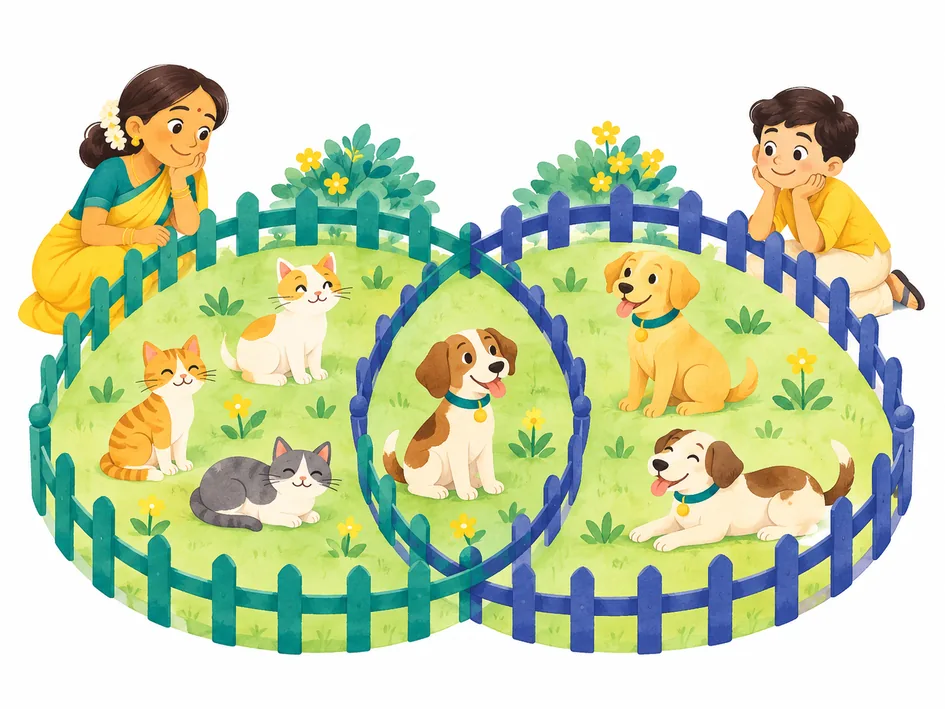
- Take every statement as true, however odd it sounds.
- Every group named has at least one member.
- "Some" means at least one, possibly all.
- A conclusion follows only if it is true in every case that fits the statements.
The four statements
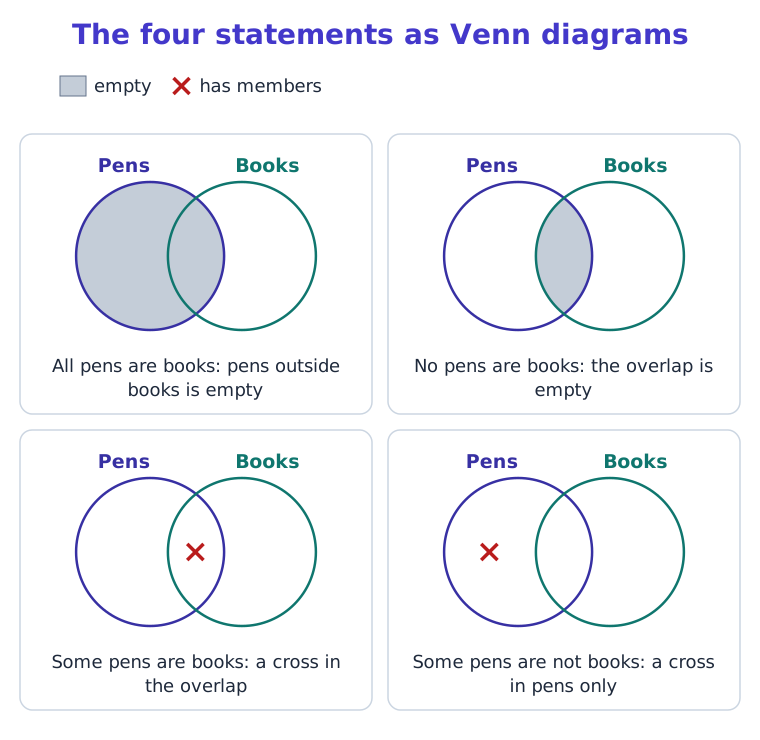
Every question uses four forms: All A are B, No A are B, Some A are B, Some A are not B. Draw each with two circles. Shade a region to say it is empty; put a cross to say it has members.
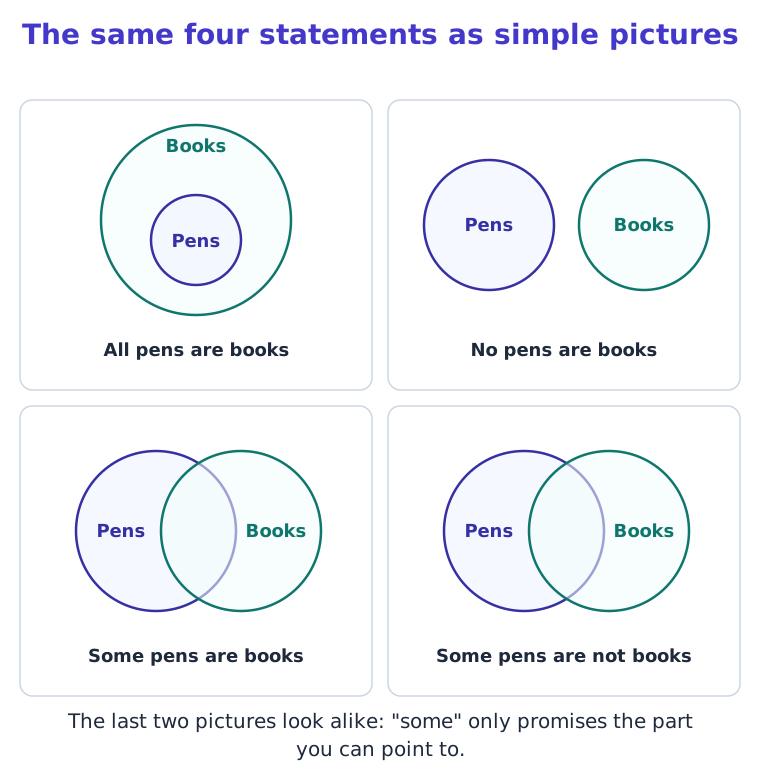
The same idea in simple pictures
Coaching classes often draw circles inside or apart. These pictures show one case each; that is fine for understanding, but a conclusion must hold in every case, not just the one you drew.
Reversing a statement
- "Some A are B" ⇒ "Some B are A".
- "No A are B" ⇒ "No B are A".
- "All A are B" ⇒ only "Some B are A" (not "All B are A").
- "Some A are not B" ⇒ cannot be reversed.
Also, because every group has members, "All A are B" ⇒ "Some A are B", and "No A are B" ⇒ "Some A are not B".
Two statements and a middle group
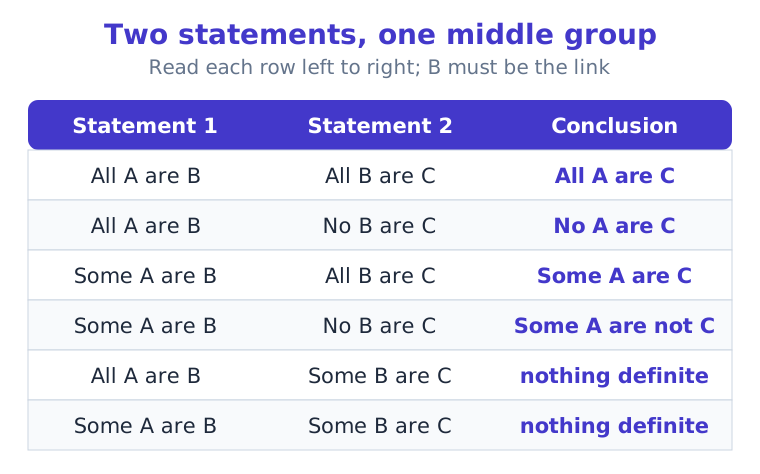
Two statements combine only through the group they share. Write them so that the middle group sits in the middle (reverse a statement if needed), then read the table.
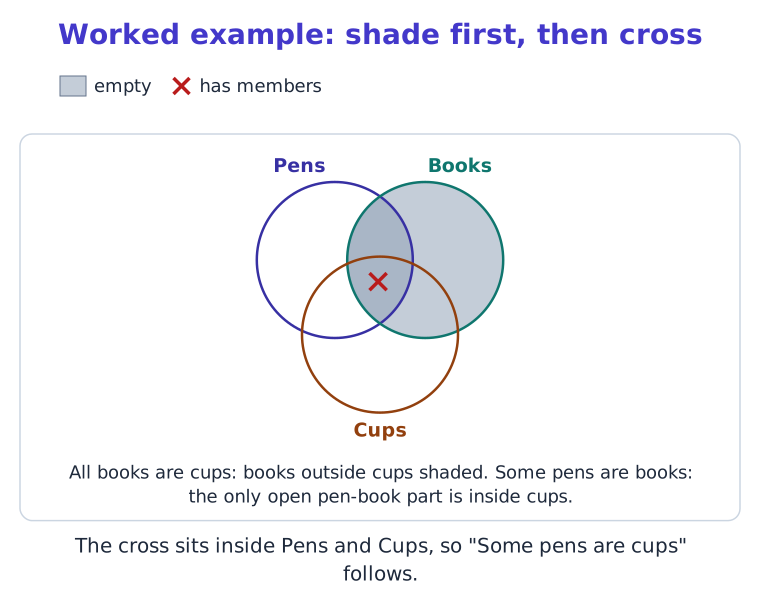
Worked example: shade, then cross
Statements: Some pens are books. All books are cups.
Shade first: "All books are cups" empties the part of books outside cups. Now the cross for "Some pens are books" can only go where pens, books and cups all meet. That cross lies inside pens and cups, so "Some pens are cups" follows.
Testing by breaking
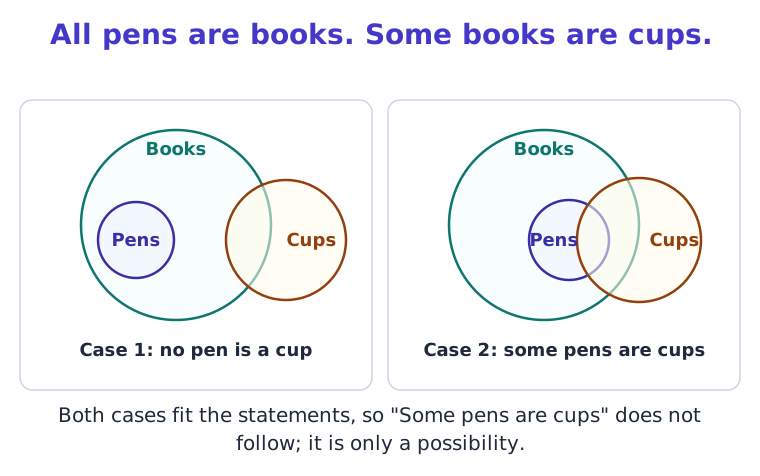
To show a conclusion does not follow, draw one case that fits the statements but breaks the conclusion.
Statements: All pens are books. Some books are cups. Is "Some pens are cups" definite? No: in Case 1 below the pens sit in a part of books that cups never touch.
The either-or pair
If neither conclusion follows, check whether they are exact opposites about the same two groups:
- "Some A are B" and "No A are B"
- "All A are B" and "Some A are not B"
One of a pair of opposites is always true, so the answer is either I or II. Two conclusions about different groups, or ones that are not exact opposites, are never either-or.
Exam shortcuts
- Find the middle group; reverse a statement so it sits in the middle.
- Some + Some, or All + Some (with the middle second), gives nothing definite.
- A "No" anywhere in the chain gives at most a "No" or "Some not" conclusion.
- Before ticking "neither", check for an either-or pair.
- When unsure, try to draw a breaking case.
Back to Riya
All Class 10 students are club members; some club members get prizes. The prize winners may all be from other classes, and that case fits both statements. So "some Class 10 students will get prizes" does not follow. It is only a possibility, which is the next topic.
Concepts and terms
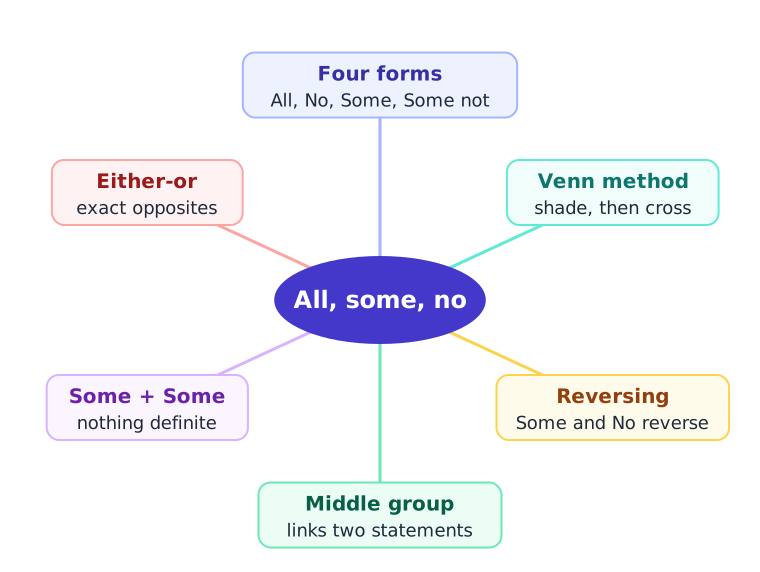
All A are B; No A are B; Some A are B; Some A are not B. Every syllogism question is built from these.
Shade the regions an All or No statement empties; put a cross where a Some statement says there are members. Shade first, then cross.
A conclusion follows when no case that fits the statements breaks it.
The group shared by two statements, such as "books" in "Some pens are books" and "All books are cups".

Did you know
Aristotle studied syllogisms about 2,300 years ago; John Venn drew his circle diagrams in 1880.
Indian logic (Nyaya) had its own five-step argument, studied for over two thousand years.

Memory tricks
Which forms reverse — Some and No swap; All shrinks; Some-not stays — Some A are B ⇒ Some B are A; No A are B ⇒ No B are A; All A are B ⇒ only Some B are A; Some A are not B cannot be reversed.
Combining two statements — Some + Some = nothing — Two Some statements never give a definite link between the outer groups.
Practice MCQs with answers (85)
- A Both I and II follow
- B Only II follows
- C Neither I nor II follows
- D Only I follows
Show answer
Why:
I follows: No mangoes are coins, which can be read the other way round: no coins are mangoes. II does not follow: As shown above, no coins are mangoes, the exact opposite of II. So only I follows.
- A Only II follows
- B Neither I nor II follows
- C Both I and II follow
- D Only I follows
Show answer
Why:
I does not follow: a case in which some lakes are bags fits all the statements. II follows: Statement 1 says this directly. So only II follows.
- A Only I follows
- B Both I and II follow
- C Only II follows
- D Neither I nor II follows
Show answer
Why:
I follows: Statement 1 says this directly. II follows: All stars are bricks and no bricks are coins, so no stars are coins. No stars are coins, which can be read the other way round: no coins are stars. So both follow.
- A Only I follows
- B Only II follows
- C Neither I nor II follows
- D Either I or II follows
Show answer
Why:
I does not follow: a case in which all cars are tables fits all the statements. II does not follow: All lakes are tables, and every group has at least one member, so some lakes are tables. That is the exact opposite of II. So neither follows.
- A Both I and II follow
- B Only II follows
- C Neither I nor II follows
- D Only I follows
Show answer
Why:
I follows: Some rivers are tables, which can be read the other way round: some tables are rivers. II does not follow: a case in which some tables are not rivers fits all the statements. So only I follows.
- A Neither I nor II follows
- B Only I follows
- C Only II follows
- D Either I or II follows
Show answer
Why:
I does not follow: a case in which some dogs are teachers fits all the statements. II does not follow: a case in which some coins are teachers fits all the statements. So neither follows.
- A Neither I nor II follows
- B Both I and II follow
- C Only I follows
- D Only II follows
Show answer
Why:
I follows: All buses are chairs and no chairs are lions, so no buses are lions. No buses are lions, so some buses are not lions. II follows: No chairs are lions, so some chairs are not lions. So both follow.
- A Both I and II follow
- B Only I follows
- C Only II follows
- D Neither I nor II follows
Show answer
Why:
I does not follow: No tables are pens, so some tables are not pens. That is the exact opposite of I. II follows: No tables are singers, which can be read the other way round: no singers are tables. No singers are tables, so some singers are not tables. So only II follows.
- A Only I follows
- B Neither I nor II follows
- C Both I and II follow
- D Either I or II follows
Show answer
Why:
I does not follow: a case in which all walls are rivers fits all the statements. II does not follow: a case in which some walls are not rivers fits all the statements. Neither follows alone, but they are about the same two groups and are exact opposites, so one of them must be true: either I or II follows.
- A Only I follows
- B Both I and II follow
- C Only II follows
- D Neither I nor II follows
Show answer
Why:
I follows: No doctors are clocks, so some doctors are not clocks. II does not follow: a case in which some doctors are not cups fits all the statements. So only I follows.
- A Both I and II follow
- B Only I follows
- C Only II follows
- D Neither I nor II follows
Show answer
Why:
I follows: Some mangoes are cars, which can be read the other way round: some cars are mangoes. II does not follow: a case in which some mangoes are not cars fits all the statements. So only I follows.
- A Only I follows
- B Neither I nor II follows
- C Only II follows
- D Both I and II follow
Show answer
Why:
I does not follow: a case in which some houses are not coins fits all the statements. II follows: No houses are walls, which can be read the other way round: no walls are houses. No walls are houses, so some walls are not houses. So only II follows.
- A Only II follows
- B Neither I nor II follows
- C Only I follows
- D Both I and II follow
Show answer
Why:
I follows: No roses are apples, which can be read the other way round: no apples are roses. No apples are roses, so some apples are not roses. II follows: Some mangoes are roses, which can be read the other way round: some roses are mangoes. So both follow.
- A Neither I nor II follows
- B Only I follows
- C Only II follows
- D Either I or II follows
Show answer
Why:
I does not follow: a case in which some chairs are cars fits all the statements. II does not follow: a case in which some bags are chairs fits all the statements. So neither follows.
- A Neither I nor II follows
- B Either I or II follows
- C Both I and II follow
- D Only I follows
Show answer
Why:
I does not follow: a case in which all lakes are plates fits all the statements. II does not follow: a case in which some lakes are not plates fits all the statements. Neither follows alone, but they are about the same two groups and are exact opposites, so one of them must be true: either I or II follows.
- A Only II follows
- B Either I or II follows
- C Neither I nor II follows
- D Only I follows
Show answer
Why:
I does not follow: No houses are buses, so some houses are not buses. That is the exact opposite of I. II does not follow: All buses are chairs, and every group has at least one member, so some buses are chairs. Some buses are chairs, which can be read the other way round: some chairs are buses. No houses are buses, which can be read the other way round: no buses are houses. Some chairs are buses and no buses are houses, so some chairs are not houses. That is the exact opposite of II. So neither follows.
- A Only II follows
- B Neither I nor II follows
- C Both I and II follow
- D Only I follows
Show answer
Why:
I follows: No houses are doctors, so some houses are not doctors. II does not follow: As shown above, some houses are not doctors, the exact opposite of II. So only I follows.
- A Only II follows
- B Both I and II follow
- C Only I follows
- D Neither I nor II follows
Show answer
Why:
I does not follow: All stones are teachers, and every group has at least one member, so some stones are teachers. That is the exact opposite of I. II follows: As shown above, some stones are teachers. So only II follows.
- A Both I and II follow
- B Either I or II follows
- C Only I follows
- D Neither I nor II follows
Show answer
Why:
I does not follow: a case in which some kites are fruits fits all the statements. II does not follow: a case in which no kites are fruits fits all the statements. Neither follows alone, but they are about the same two groups and are exact opposites, so one of them must be true: either I or II follows.
- A Neither I nor II follows
- B Only I follows
- C Both I and II follow
- D Only II follows
Show answer
Why:
I follows: Some rings are lions, which can be read the other way round: some lions are rings. II follows: Some lions are flowers, which can be read the other way round: some flowers are lions. So both follow.
- A Only II follows
- B Either I or II follows
- C Only I follows
- D Neither I nor II follows
Show answer
Why:
I does not follow: a case in which all balls are dogs fits all the statements. II does not follow: All dogs are balls and no balls are clocks, so no dogs are clocks. No dogs are clocks, which can be read the other way round: no clocks are dogs. No clocks are dogs, so some clocks are not dogs. That is the exact opposite of II. So neither follows.
- A Only I follows
- B Neither I nor II follows
- C Both I and II follow
- D Only II follows
Show answer
Why:
I follows: No tables are dancers, which can be read the other way round: no dancers are tables. II does not follow: All birds are tables and no tables are dancers, so no birds are dancers. That is the exact opposite of II. So only I follows.
- A Both I and II follow
- B Either I or II follows
- C Only I follows
- D Neither I nor II follows
Show answer
Why:
I does not follow: a case in which no coins are teachers fits all the statements. II does not follow: a case in which some coins are teachers fits all the statements. Neither follows alone, but they are about the same two groups and are exact opposites, so one of them must be true: either I or II follows.
- A Either I or II follows
- B Only I follows
- C Neither I nor II follows
- D Only II follows
Show answer
Why:
I does not follow: No dogs are cars, so some dogs are not cars. That is the exact opposite of I. II does not follow: a case in which some coins are not dogs fits all the statements. So neither follows.
- A Only I follows
- B Only II follows
- C Neither I nor II follows
- D Both I and II follow
Show answer
Why:
I follows: No singers are clouds, which can be read the other way round: no clouds are singers. Some flowers are clouds and no clouds are singers, so some flowers are not singers. II follows: Some flowers are clouds, which can be read the other way round: some clouds are flowers. So both follow.
- A Only II follows
- B Both I and II follow
- C Only I follows
- D Neither I nor II follows
Show answer
Why:
I does not follow: a case in which some birds are not tigers fits all the statements. II follows: Some birds are tigers, which can be read the other way round: some tigers are birds. So only II follows.
- A Only II follows
- B Neither I nor II follows
- C Either I or II follows
- D Only I follows
Show answer
Why:
I does not follow: No dogs are roads, which can be read the other way round: no roads are dogs. That is the exact opposite of I. II does not follow: All lions are dogs, and every group has at least one member, so some lions are dogs. Some lions are dogs, which can be read the other way round: some dogs are lions. That is the exact opposite of II. So neither follows.
- A Neither I nor II follows
- B Both I and II follow
- C Either I or II follows
- D Only I follows
Show answer
Why:
I does not follow: a case in which all pens are bricks fits all the statements. II does not follow: a case in which some pens are not bricks fits all the statements. Neither follows alone, but they are about the same two groups and are exact opposites, so one of them must be true: either I or II follows.
- A Only II follows
- B Neither I nor II follows
- C Both I and II follow
- D Only I follows
Show answer
Why:
I follows: All dogs are stones, and every group has at least one member, so some dogs are stones. Some dogs are stones, which can be read the other way round: some stones are dogs. II does not follow: a case in which no pens are boxes fits all the statements. So only I follows.
- A Neither I nor II follows
- B Only I follows
- C Only II follows
- D Either I or II follows
Show answer
Why:
I does not follow: a case in which all shirts are lions fits all the statements. II does not follow: All clouds are rings, and every group has at least one member, so some clouds are rings. Some clouds are rings, which can be read the other way round: some rings are clouds. That is the exact opposite of II. So neither follows.
- A Only II follows
- B Both I and II follow
- C Neither I nor II follows
- D Only I follows
Show answer
Why:
I follows: All mangoes are balls and all balls are caps, so all mangoes are caps. All mangoes are caps, and every group has at least one member, so some mangoes are caps. Some mangoes are caps, which can be read the other way round: some caps are mangoes. II follows: As shown above, some mangoes are caps. So both follow.
- A Both I and II follow
- B Only I follows
- C Either I or II follows
- D Neither I nor II follows
Show answer
Why:
I does not follow: a case in which some trees are not birds fits all the statements. II does not follow: a case in which all trees are birds fits all the statements. Neither follows alone, but they are about the same two groups and are exact opposites, so one of them must be true: either I or II follows.
- A Neither I nor II follows
- B Both I and II follow
- C Only I follows
- D Only II follows
Show answer
Why:
I does not follow: a case in which some books are not cats fits all the statements. II follows: Some mangoes are books, which can be read the other way round: some books are mangoes. So only II follows.
- A Neither I nor II follows
- B Either I or II follows
- C Only I follows
- D Only II follows
Show answer
Why:
I does not follow: a case in which no roads are stones fits all the statements. II does not follow: No roads are roses, which can be read the other way round: no roses are roads. That is the exact opposite of II. So neither follows.
- A Only II follows
- B Only I follows
- C Neither I nor II follows
- D Both I and II follow
Show answer
Why:
I follows: All stars are roads, and every group has at least one member, so some stars are roads. II does not follow: a case in which some dogs are roads fits all the statements. So only I follows.
- A Neither I nor II follows
- B Only I follows
- C Both I and II follow
- D Only II follows
Show answer
Why:
I follows: No cars are teachers, which can be read the other way round: no teachers are cars. II follows: No cars are teachers, so some cars are not teachers. So both follow.
- A Only II follows
- B Either I or II follows
- C Only I follows
- D Neither I nor II follows
Show answer
Why:
I does not follow: a case in which some birds are lakes fits all the statements. II does not follow: a case in which all rings are lakes fits all the statements. So neither follows.
- A Either I or II follows
- B Only I follows
- C Neither I nor II follows
- D Both I and II follow
Show answer
Why:
I does not follow: a case in which no apples are rivers fits all the statements. II does not follow: a case in which some apples are rivers fits all the statements. Neither follows alone, but they are about the same two groups and are exact opposites, so one of them must be true: either I or II follows.
- A Neither I nor II follows
- B Only I follows
- C Both I and II follow
- D Only II follows
Show answer
Why:
I follows: No cars are coins, which can be read the other way round: no coins are cars. II does not follow: a case in which no clouds are coins fits all the statements. So only I follows.
- A Neither I nor II follows
- B Both I and II follow
- C Only II follows
- D Only I follows
Show answer
Why:
I does not follow: Some dogs are mangoes, which can be read the other way round: some mangoes are dogs. That is the exact opposite of I. II follows: As shown above, some mangoes are dogs. So only II follows.
- A Neither I nor II follows
- B Only I follows
- C Only II follows
- D Both I and II follow
Show answer
Why:
I follows: All boxes are birds and some boxes are not roads, so some birds are not roads. II follows: All boxes are birds, and every group has at least one member, so some boxes are birds. Some boxes are birds, which can be read the other way round: some birds are boxes. So both follow.
- A Neither I nor II follows
- B Only II follows
- C Either I or II follows
- D Only I follows
Show answer
Why:
I does not follow: a case in which all teachers are buses fits all the statements. II does not follow: a case in which all cups are teachers fits all the statements. So neither follows.
- A Only I follows
- B Either I or II follows
- C Neither I nor II follows
- D Both I and II follow
Show answer
Why:
I does not follow: a case in which some walls are not chairs fits all the statements. II does not follow: a case in which all walls are chairs fits all the statements. Neither follows alone, but they are about the same two groups and are exact opposites, so one of them must be true: either I or II follows.
- A Neither I nor II follows
- B Both I and II follow
- C Only I follows
- D Only II follows
Show answer
Why:
I follows: No bags are dogs, so some bags are not dogs. II does not follow: As shown above, some bags are not dogs, the exact opposite of II. So only I follows.
- A Only I follows
- B Only II follows
- C Either I or II follows
- D Neither I nor II follows
Show answer
Why:
I does not follow: a case in which some teachers are not bottles fits all the statements. II does not follow: a case in which all teachers are houses fits all the statements. So neither follows.
- A Only II follows
- B Both I and II follow
- C Only I follows
- D Neither I nor II follows
Show answer
Why:
I does not follow: a case in which some fruits are not lions fits all the statements. II follows: Some cups are fruits, which can be read the other way round: some fruits are cups. So only II follows.
- A Some teachers are not walls
- B Some roses are teachers
- C Some teachers are not roses
- D All walls are teachers
Show answer
Why:
"Some roses are teachers" follows: Some teachers are roses, which can be read the other way round: some roses are teachers. Each of the other three is broken by some case that fits the statements.
- A No plates are rings
- B No dogs are rings
- C Some rings are plates
- D No dogs are plates
Show answer
Why:
"Some rings are plates" follows: All plates are rings, and every group has at least one member, so some plates are rings. Some plates are rings, which can be read the other way round: some rings are plates. Each of the other three is broken by some case that fits the statements.
- A All shirts are balls
- B Some shirts are not singers
- C Some shirts are singers
- D Some balls are singers
Show answer
Why:
"Some balls are singers" follows: Some singers are balls, which can be read the other way round: some balls are singers. Each of the other three is broken by some case that fits the statements.
- A Some walls are tables
- B No tables are walls
- C No coins are walls
- D Some tables are not walls
Show answer
Why:
"Some walls are tables" follows: Some tables are walls, which can be read the other way round: some walls are tables. Each of the other three is broken by some case that fits the statements.
- A All doctors are mangoes
- B Some doctors are not mangoes
- C All doctors are rivers
- D Some rivers are not bottles
Show answer
Why:
"Some doctors are not mangoes" follows: No mangoes are doctors, which can be read the other way round: no doctors are mangoes. No doctors are mangoes, so some doctors are not mangoes. Each of the other three is broken by some case that fits the statements.
- A Some caps are not bottles
- B All bottles are flowers
- C Some bottles are kites
- D Some bottles are not kites
Show answer
Why:
"Some bottles are kites" follows: Some kites are bottles, which can be read the other way round: some bottles are kites. Each of the other three is broken by some case that fits the statements.
- A Some fruits are dogs
- B Some dogs are fruits
- C Some bags are not dogs
- D All bags are dogs
Show answer
Why:
"All bags are dogs" does not follow: Some bags are not fruits and all dogs are fruits, so some bags are not dogs. That is the exact opposite of this option. The other three follow from the statements.
- A All houses are books
- B Some books are houses
- C Some houses are mangoes
- D Some houses are books
Show answer
Why:
"All houses are books" does not follow: a case in which some houses are not books fits all the statements. The other three follow from the statements.
- A No bottles are roses
- B Some cups are bottles
- C Some cups are not bottles
- D Some roses are not bottles
Show answer
Why:
"Some cups are bottles" does not follow: a case in which no cups are bottles fits all the statements. The other three follow from the statements.
- A Some boxes are books
- B No books are dogs
- C No boxes are books
- D No dogs are books
Show answer
Why:
"No boxes are books" does not follow: All books are boxes, and every group has at least one member, so some books are boxes. Some books are boxes, which can be read the other way round: some boxes are books. That is the exact opposite of this option. The other three follow from the statements.
- A All kites are coins; All coins are rings
- B No coins are kites; Some rings are not coins
- C Some kites are not coins; All coins are rings
- D Some kites are coins; No rings are coins
Show answer
Why:
No rings are coins, which can be read the other way round: no coins are rings. Some kites are coins and no coins are rings, so some kites are not rings. In each other pair, some case that fits both statements breaks the conclusion.
- A All roses are shirts; All shirts are dogs
- B All shirts are roses; No dogs are shirts
- C Some shirts are not roses; All shirts are dogs
- D All roses are shirts; No shirts are dogs
Show answer
Why:
All roses are shirts and all shirts are dogs, so all roses are dogs. All roses are dogs, and every group has at least one member, so some roses are dogs. In each other pair, some case that fits both statements breaks the conclusion.
- A Some cups are bricks; Some cups are not bottles
- B All bricks are cups; All cups are bottles
- C Some cups are bricks; Some bottles are not cups
- D All bricks are cups; No cups are bottles
Show answer
Why:
All bricks are cups and all cups are bottles, so all bricks are bottles. In each other pair, some case that fits both statements breaks the conclusion.
- A No clouds are tables; Some clouds are not boxes
- B No clouds are tables; No clouds are boxes
- C All tables are clouds; All clouds are boxes
- D All tables are clouds; No clouds are boxes
Show answer
Why:
All tables are clouds and all clouds are boxes, so all tables are boxes. All tables are boxes, and every group has at least one member, so some tables are boxes. In each other pair, some case that fits both statements breaks the conclusion.
- A All kites are bricks; Some bottles are bricks
- B No kites are bricks; Some bricks are bottles
- C No kites are bricks; Some bricks are not bottles
- D Some kites are not bricks; All bottles are bricks
Show answer
Why:
Some kites are not bricks and all bottles are bricks, so some kites are not bottles. In each other pair, some case that fits both statements breaks the conclusion.
- A Some houses are rings
- B Some houses are not rings
- C All rings are houses
- D No rings are houses
Show answer
Why:
All houses are rings, and every group has at least one member, so some houses are rings. The other three can each be false in a case that fits the statement.
- A All roses are shirts
- B Some roses are not shirts
- C Some shirts are roses
- D Some roses are shirts
Show answer
Why:
No roses are shirts, so some roses are not shirts. The other three can each be false in a case that fits the statement.
- A No clocks are plates
- B Some clocks are not plates
- C Some plates are clocks
- D Some plates are not clocks
Show answer
Why:
Some clocks are plates, which can be read the other way round: some plates are clocks. The other three can each be false in a case that fits the statement.
- A All kites are cars
- B Some kites are cars
- C Some cars are kites
- D No kites are cars
Show answer
Why:
No cars are kites, which can be read the other way round: no kites are cars. The other three can each be false in a case that fits the statement.
- A Some pens are fruits
- B No pens are fruits
- C Some pens are not fruits
- D No fruits are pens
Show answer
Why:
All pens are fruits, and every group has at least one member, so some pens are fruits. The other three can each be false in a case that fits the statement.
- A Some roses are pens
- B Some roses are not pens
- C All roses are pens
- D Some pens are roses
Show answer
Why:
No roses are pens, so some roses are not pens. The other three can each be false in a case that fits the statement.
- A Some stones are not mangoes
- B No stones are mangoes
- C Some stones are mangoes
- D Some mangoes are not stones
Show answer
Why:
Some mangoes are stones, which can be read the other way round: some stones are mangoes. The other three can each be false in a case that fits the statement.
- A All coins are dogs
- B No dogs are coins
- C Some dogs are not coins
- D Some dogs are coins
Show answer
Why:
All dogs are coins, and every group has at least one member, so some dogs are coins. The other three can each be false in a case that fits the statement.
- A Some bags are stars
- B No stars are apples
- C No apples are bags
- D No bags are stars
Show answer
Why:
"Some bags are stars" is true because there is a cross where bags and stars overlap. "No stars are apples" is false: there is a cross where stars and apples overlap. "No apples are bags" is false: there is a cross where apples and bags overlap. "No bags are stars" is false: there is a cross where bags and stars overlap.
- A No singers are roads
- B Some singers are roads
- C All singers are chairs
- D No roads are singers
Show answer
Why:
"Some singers are roads" is true because there is a cross where singers and roads overlap. "No roads are singers" is false: there is a cross where roads and singers overlap. "No singers are roads" is false: there is a cross where singers and roads overlap. "All singers are chairs" is false: there is a cross in singers outside chairs.
- A No chairs are trees
- B No stones are trees
- C All trees are chairs
- D Some stones are not chairs
Show answer
Why:
"All trees are chairs" is true because the part of trees outside chairs is all shaded. "Some stones are not chairs" is false: the part of stones outside chairs is all shaded. "No chairs are trees" is false: there is a cross where chairs and trees overlap. "No stones are trees" is false: there is a cross where stones and trees overlap.
- A 1
- B 2
- C 3
- D 4
Show answer
Why:
Diagram (1) satisfies both statements. (2) breaks "No apples are plates" because there is a cross where apples and plates overlap; (3) breaks "No apples are plates" because there is a cross where apples and plates overlap; (4) breaks "No apples are plates" because there is a cross where apples and plates overlap.
- A 1
- B 2
- C 3
- D 4
Show answer
Why:
Diagram (2) satisfies both statements. (1) breaks "Some lions are stones" because the overlap of lions and stones is all shaded; (3) breaks "Some flowers are not lions" because the part of flowers outside lions is all shaded; (4) breaks "Some flowers are not lions" because the part of flowers outside lions is all shaded.
- A 1
- B 2
- C 3
- D 4
Show answer
Why:
Diagram (3) satisfies both statements. (1) breaks "Some boxes are roads" because the overlap of boxes and roads is all shaded; (2) breaks "Some boxes are roads" because the overlap of boxes and roads is all shaded; (4) breaks "Some roads are clocks" because the overlap of roads and clocks is all shaded.
- A Some dancers are not chairs
- B Some doctors are chairs
- C All doctors are dancers
- D Some dancers are chairs
Show answer
Why:
"Some dancers are chairs" follows: Some chairs are dancers, which can be read the other way round: some dancers are chairs. Each of the other three is broken by some case that fits the statements.
- A at least one A is a B; possibly all are
- B some A are B and some are not
- C exactly one A is a B
- D fewer than half of the A are B
Show answer
Why:
In logic "some" promises only at least one. It does not rule out all, and it does not promise that some are not.
- A All A are B
- B Some A are not B
- C Some A are B
- D No A are B
Show answer
Why:
Some A are not B says nothing about the B outside A, so no reversed statement follows. All A are B at least gives Some B are A.
- A a cross in A outside B
- B shading A outside B
- C shading the overlap of A and B
- D a cross in the overlap
Show answer
Why:
No A are B says the shared part is empty, so shade it.
- A at least one of them is "Some"
- B both of them are negative
- C they use the same words in the same order
- D they share a middle group and are not both "Some"
Show answer
Why:
Without a shared group there is no bridge; two Some statements never fix the link; two negatives give nothing either.
- A Some cups are pens; No cups are pens
- B Some cups are pens; Some pens are not cups
- C Some cups are pens; Some cups are not pens
- D All cups are pens; No cups are pens
Show answer
Why:
Only exact opposites about the same groups qualify. Some/Some-not can both be true; All/No can both be false; "Some cups are pens" and "Some pens are not cups" have different subjects.
- A Both A and R are true, and R is the correct explanation of A
- B Both A and R are true, but R is not the correct explanation of A
- C A is true but R is false
- D A is false but R is true
Show answer
Why:
All + All gives All, and R is exactly the reason.
- A Both A and R are true, and R is the correct explanation of A
- B Both A and R are true, but R is not the correct explanation of A
- C A is true but R is false
- D A is false but R is true
Show answer
Why:
A is false: all dogs might be cats while some cats are not dogs. R is true, but it is about a different form.
- A 1 only
- B 2 only
- C Both 1 and 2
- D Neither 1 nor 2
Show answer
Why:
All kites are balls and no balls are stars, so no kites are stars, which reverses to no stars are kites. No balls are stars, and balls exist, so some balls are not stars.
- A 1 only
- B 2 only
- C Both 1 and 2
- D Neither 1 nor 2
Show answer
Why:
Two Some statements give nothing about clouds and roads. Some clouds are houses reverses to some houses are clouds.
Important short questions (4)
Two overlapping circles, pens and books. The part of pens outside books is shaded, because no pen lies outside books.
The B that are A and the B that are C may be different members, so A and C might not meet at all, or might meet. Both cases fit.
No roses are stones (All + No). Some flowers are roses (reversing All).
When neither conclusion follows on its own, and they are exact opposites about the same two groups in the same order: Some/No or All/Some-not.
Long answer questions (1)
I: Some + All gives Some pens are cups. Follows.
II: All books are cups + No cups are plates gives No books are plates. Follows.
III: Some pens are cups + No cups are plates gives Some pens are not plates. Follows.
Flashcards (14)
Play this topic
- Does it follow?
Possibility Cases
Decide whether a conclusion is certain, only possible, or impossible; judge "is a possibility" conclusions; use blank Venn regions and the stretch test; and avoid the traps that break a No or an All.
What you will be able to do
- I can sort any conclusion into certain, possible-only or impossible.
- I can decide whether a "is a possibility" conclusion follows.
- I can read a Venn diagram with blank regions.
- I can explain why a possibility is impossible by naming the definite fact it breaks.
Key points
A possibility follows when at least one case that fits the statements makes it true.
A possibility fails only when it is impossible, that is, when its opposite is certain.
"All A being B is a possibility" fails if "Some A are not B" (or "No A are B") is certain.
"Some A being B is a possibility" fails only if "No A are B" is certain.
Blank regions in a Venn diagram can be filled or left empty; that freedom is what makes a possibility.
A No statement can never be broken by a possibility, and neither can an All.
This kit asks about a possibility only when it is not already certain, so the key never depends on a convention.
Definite conclusions in a possibility question are judged exactly as in Topic 1.
Full explanation
Could it happen?

After the prize notice in Topic 1, Riya asks a better question: "Could some Class 10 students get prizes?" Now the answer is yes. Nothing in the notice stops it. Exams ask exactly this: not "must it be true?" but "can it be true?"
Three verdicts
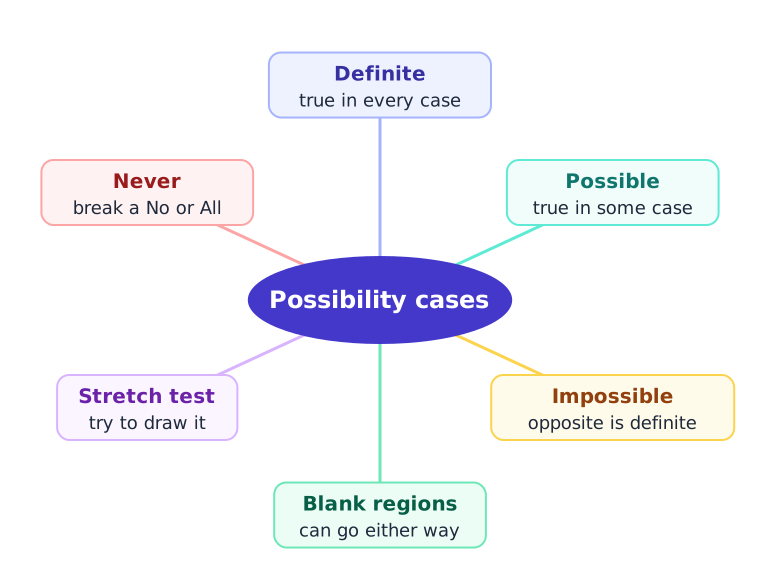
Every conclusion gets one of three verdicts:
- Certain: true in every case that fits the statements.
- Possible: true in at least one such case.
- Impossible: true in none of them; its opposite is certain.
A "is a possibility" conclusion follows when the verdict is possible. This kit asks about possibilities only when they are not already certain.
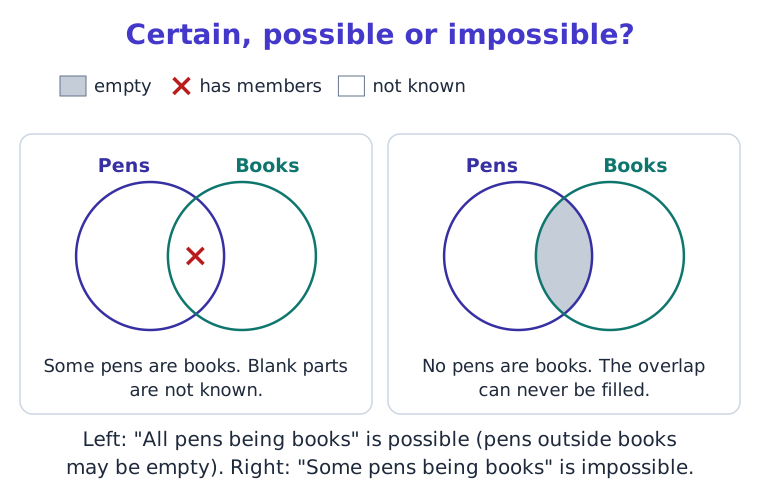
Blank regions
In the Venn method, a region with no shading and no cross is not known: it may have members or not. Those blank regions are where possibilities live.
The stretch test
To check "All pens being cups is a possibility", try to stretch the cups circle until it swallows every pen, without breaking any statement. If you manage it, the possibility follows. If some statement blocks you, it does not.
When is a possibility impossible?
A possibility fails only when its opposite is certain:
- "All A being B" fails if "Some A are not B" is certain.
- "Some A being B" fails if "No A are B" is certain.
- "Some A not being B" fails if "All A are B" is certain.
- "No A being B" fails if "Some A are B" is certain.
Worked example
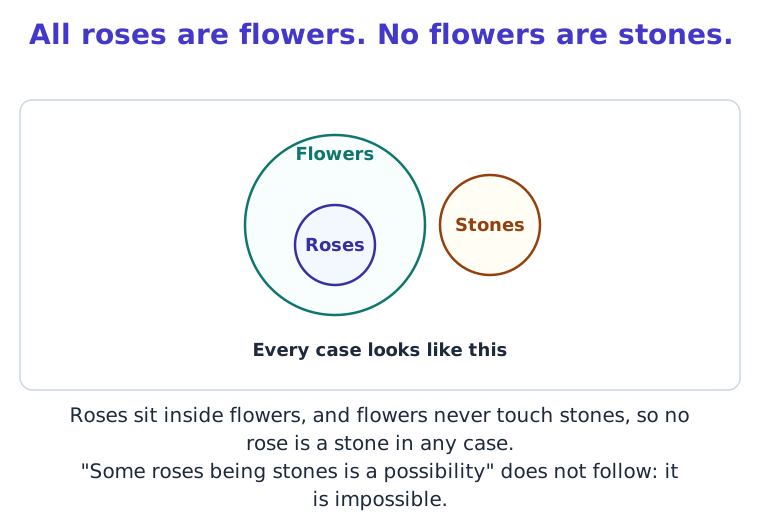
Statements: All roses are flowers. No flowers are stones.
- "Some roses being stones is a possibility": All + No makes "No roses are stones" certain. Impossible.
- "All stones being flowers is a possibility": No flowers are stones, so no stone can be a flower. Impossible.
- "All flowers being roses is a possibility": nothing stops the roses circle from filling flowers. Follows.
Mixed questions
Most papers mix one definite conclusion with one possibility. Judge each on its own rule: the definite one must hold in every case, the possibility in at least one. Then combine the two verdicts into the answer.
Exam shortcuts
- For a possibility, look only for a certain opposite. None found: it follows.
- Hidden certain facts (from All + No, Some + No) kill possibilities.
- A possibility can never break an All or a No that follows from the statements.
- Do not reject a possibility for being uncertain; that is what possible means.
Back to Riya
"Some Class 10 students getting prizes is a possibility": draw the prize winners inside Class 10; both statements still hold. It follows. Riya was wrong to call it certain, but right to call it possible.
Concepts and terms
Certain: true in every case. Possible: true in at least one case. Impossible: true in no case.
All/Some-not and Some/No are opposites. A possibility is impossible exactly when its opposite is certain.
Try to stretch a circle to make the possibility true without breaking any statement. If you can, it follows.
Did you know
Possibility questions entered bank exams around 2016 and now appear in almost every IBPS and SBI paper.
Logicians call "possible" and "certain" the two modalities; this is the same idea in exam form.
Memory tricks
Testing a possibility — Can I draw it? Then it follows. — One drawable case is enough for a possibility.
What a possibility can never do — Never break a No, never break an All — If a No or All statement forbids it, the possibility is impossible.
Practice MCQs with answers (85)
- A Both I and II follow
- B Only II follows
- C Neither I nor II follows
- D Only I follows
Show answer
Why:
I follows: no statement rules out that no lions are plates, though it is not certain, so it is a possibility. II does not follow: a case in which some lions are balls fits all the statements. So only I follows.
- A Only II follows
- B Neither I nor II follows
- C Both I and II follow
- D Only I follows
Show answer
Why:
I does not follow: a case in which all cars are mangoes fits all the statements. II follows: no statement rules out that no mangoes are cars, though it is not certain, so it is a possibility. So only II follows.
- A Neither I nor II follows
- B Both I and II follow
- C Only I follows
- D Only II follows
Show answer
Why:
I follows: All apples are chairs, and every group has at least one member, so some apples are chairs. II follows: no statement rules out that some chairs are not apples, though it is not certain, so it is a possibility. So both follow.
- A Either I or II follows
- B Only I follows
- C Neither I nor II follows
- D Only II follows
Show answer
Why:
I does not follow: No bricks are apples, which can be read the other way round: no apples are bricks. That is the exact opposite of I. II does not follow: No apples are bricks, so some apples are not bricks. That rules out II. So neither follows.
- A Only II follows
- B Neither I nor II follows
- C Both I and II follow
- D Only I follows
Show answer
Why:
I follows: no statement rules out that all bottles are roses, though it is not certain, so it is a possibility. II does not follow: a case in which some bottles are not cups fits all the statements. So only I follows.
- A Only II follows
- B Both I and II follow
- C Only I follows
- D Neither I nor II follows
Show answer
Why:
I does not follow: a case in which some rings are not roses fits all the statements. II follows: no statement rules out that some doctors are roses, though it is not certain, so it is a possibility. So only II follows.
- A Neither I nor II follows
- B Both I and II follow
- C Only I follows
- D Only II follows
Show answer
Why:
I follows: no statement rules out that some walls are birds, though it is not certain, so it is a possibility. II follows: No tigers are birds, so some tigers are not birds. So both follow.
- A Only II follows
- B Either I or II follows
- C Neither I nor II follows
- D Only I follows
Show answer
Why:
I does not follow: Some clouds are cups, which can be read the other way round: some cups are clouds. That rules out I. II does not follow: a case in which some cups are not balls fits all the statements. So neither follows.
- A Neither I nor II follows
- B Both I and II follow
- C Only II follows
- D Only I follows
Show answer
Why:
I follows: no statement rules out that no books are cars, though it is not certain, so it is a possibility. II does not follow: a case in which some cars are clocks fits all the statements. So only I follows.
- A Only II follows
- B Only I follows
- C Neither I nor II follows
- D Both I and II follow
Show answer
Why:
I does not follow: No flowers are chairs, which can be read the other way round: no chairs are flowers. No chairs are flowers, so some chairs are not flowers. That is the exact opposite of I. II follows: no statement rules out that no chairs are pens, though it is not certain, so it is a possibility. So only II follows.
- A Neither I nor II follows
- B Both I and II follow
- C Only I follows
- D Only II follows
Show answer
Why:
I follows: No apples are chairs, which can be read the other way round: no chairs are apples. No chairs are apples, so some chairs are not apples. II follows: no statement rules out that all chairs are coins, though it is not certain, so it is a possibility. So both follow.
- A Either I or II follows
- B Only I follows
- C Neither I nor II follows
- D Only II follows
Show answer
Why:
I does not follow: a case in which some clouds are not mangoes fits all the statements. II does not follow: No bricks are clouds, so some bricks are not clouds. All bricks are mangoes and some bricks are not clouds, so some mangoes are not clouds. That rules out II. So neither follows.
- A Neither I nor II follows
- B Both I and II follow
- C Only II follows
- D Only I follows
Show answer
Why:
I follows: no statement rules out that some trees are not dogs, though it is not certain, so it is a possibility. II does not follow: a case in which some teachers are not dogs fits all the statements. So only I follows.
- A Both I and II follow
- B Only I follows
- C Only II follows
- D Neither I nor II follows
Show answer
Why:
I follows: no statement rules out that some coins are trees, though it is not certain, so it is a possibility. II follows: No coins are shirts, which can be read the other way round: no shirts are coins. No shirts are coins, so some shirts are not coins. So both follow.
- A Both I and II follow
- B Only II follows
- C Only I follows
- D Neither I nor II follows
Show answer
Why:
I does not follow: a case in which all apples are stars fits all the statements. II follows: no statement rules out that all apples are teachers, though it is not certain, so it is a possibility. So only II follows.
- A Only II follows
- B Either I or II follows
- C Neither I nor II follows
- D Only I follows
Show answer
Why:
I does not follow: Some boxes are teachers, which can be read the other way round: some teachers are boxes. That rules out I. II does not follow: a case in which all boxes are apples fits all the statements. So neither follows.
- A Only I follows
- B Only II follows
- C Neither I nor II follows
- D Both I and II follow
Show answer
Why:
I follows: no statement rules out that some houses are teachers, though it is not certain, so it is a possibility. II follows: no statement rules out that all houses are teachers, though it is not certain, so it is a possibility. So both follow.
- A Only I follows
- B Neither I nor II follows
- C Both I and II follow
- D Only II follows
Show answer
Why:
I follows: no statement rules out that some houses are not lions, though it is not certain, so it is a possibility. II does not follow: All houses are lakes, and every group has at least one member, so some houses are lakes. Some houses are lakes, which can be read the other way round: some lakes are houses. That rules out II. So only I follows.
- A Only II follows
- B Neither I nor II follows
- C Either I or II follows
- D Only I follows
Show answer
Why:
I does not follow: All clocks are teachers, and every group has at least one member, so some clocks are teachers. That rules out I. II does not follow: Some clocks are teachers, which can be read the other way round: some teachers are clocks. That rules out II. So neither follows.
- A Both I and II follow
- B Only I follows
- C Only II follows
- D Neither I nor II follows
Show answer
Why:
I does not follow: No coins are roads, so some coins are not roads. That rules out I. II follows: no statement rules out that some roads are trees, though it is not certain, so it is a possibility. So only II follows.
- A Only I follows
- B Only II follows
- C Neither I nor II follows
- D Both I and II follow
Show answer
Why:
I follows: no statement rules out that all boxes are lakes, though it is not certain, so it is a possibility. II follows: no statement rules out that all lakes are boxes, though it is not certain, so it is a possibility. So both follow.
- A Neither I nor II follows
- B Only II follows
- C Either I or II follows
- D Only I follows
Show answer
Why:
I does not follow: All trees are cups and all cups are cars, so all trees are cars. That rules out I. II does not follow: All trees are cups, and every group has at least one member, so some trees are cups. Some trees are cups, which can be read the other way round: some cups are trees. That rules out II. So neither follows.
- A Only I follows
- B Neither I nor II follows
- C Only II follows
- D Either I or II follows
Show answer
Why:
I does not follow: No doctors are chairs, so some doctors are not chairs. That rules out I. II does not follow: No doctors are chairs, which can be read the other way round: no chairs are doctors. No chairs are doctors, so some chairs are not doctors. That rules out II. So neither follows.
- A Both I and II follow
- B Only I follows
- C Only II follows
- D Neither I nor II follows
Show answer
Why:
I does not follow: All rivers are cats, and every group has at least one member, so some rivers are cats. That rules out I. II follows: no statement rules out that some boxes are not cats, though it is not certain, so it is a possibility. So only II follows.
- A Neither I nor II follows
- B Only I follows
- C Only II follows
- D Both I and II follow
Show answer
Why:
I follows: no statement rules out that some fruits are tables, though it is not certain, so it is a possibility. II follows: no statement rules out that some fruits are not tables, though it is not certain, so it is a possibility. So both follow.
- A Only I follows
- B Only II follows
- C Neither I nor II follows
- D Both I and II follow
Show answer
Why:
I follows: no statement rules out that some bricks are not flowers, though it is not certain, so it is a possibility. II does not follow: Some flowers are bricks, which can be read the other way round: some bricks are flowers. That rules out II. So only I follows.
- A Only II follows
- B Neither I nor II follows
- C Either I or II follows
- D Only I follows
Show answer
Why:
I does not follow: All coins are bottles, and every group has at least one member, so some coins are bottles. Some coins are bottles, which can be read the other way round: some bottles are coins. That rules out I. II does not follow: No roses are bottles, which can be read the other way round: no bottles are roses. No bottles are roses, so some bottles are not roses. That rules out II. So neither follows.
- A Only II follows
- B Neither I nor II follows
- C Both I and II follow
- D Only I follows
Show answer
Why:
I follows: no statement rules out that some tables are not plates, though it is not certain, so it is a possibility. II follows: no statement rules out that some fruits are not plates, though it is not certain, so it is a possibility. So both follow.
- A Neither I nor II follows
- B Both I and II follow
- C Only II follows
- D Only I follows
Show answer
Why:
I follows: no statement rules out that some trees are not chairs, though it is not certain, so it is a possibility. II does not follow: All tigers are trees, and every group has at least one member, so some tigers are trees. Some tigers are trees, which can be read the other way round: some trees are tigers. That is the exact opposite of II. So only I follows.
- A Neither I nor II follows
- B Only II follows
- C Either I or II follows
- D Only I follows
Show answer
Why:
I does not follow: Some clocks are dancers, which can be read the other way round: some dancers are clocks. That rules out I. II does not follow: a case in which some dancers are not lions fits all the statements. So neither follows.
- A Only II follows
- B Both I and II follow
- C Neither I nor II follows
- D Only I follows
Show answer
Why:
I follows: no statement rules out that all pens are books, though it is not certain, so it is a possibility. II follows: Some houses are books, which can be read the other way round: some books are houses. So both follow.
- A Only I follows
- B Neither I nor II follows
- C Only II follows
- D Both I and II follow
Show answer
Why:
I does not follow: a case in which all rings are coins fits all the statements. II follows: no statement rules out that no rings are tigers, though it is not certain, so it is a possibility. So only II follows.
- A Only I follows
- B Neither I nor II follows
- C Both I and II follow
- D Either I or II follows
Show answer
Why:
I does not follow: a case in which no stars are balls fits all the statements. II does not follow: a case in which some stars are balls fits all the statements. Neither follows alone, but they are about the same two groups and are exact opposites, so one of them must be true: either I or II follows.
- A Neither I nor II follows
- B Only I follows
- C Only II follows
- D Either I or II follows
Show answer
Why:
I does not follow: a case in which no stones are boxes fits all the statements. II does not follow: All stones are houses, and every group has at least one member, so some stones are houses. Some stones are houses, which can be read the other way round: some houses are stones. That rules out II. So neither follows.
- A Only II follows
- B Both I and II follow
- C Neither I nor II follows
- D Only I follows
Show answer
Why:
I follows: no statement rules out that some bottles are fruits, though it is not certain, so it is a possibility. II follows: no statement rules out that some bottles are tigers, though it is not certain, so it is a possibility. So both follow.
- A Either I or II follows
- B Only I follows
- C Neither I nor II follows
- D Only II follows
Show answer
Why:
I does not follow: All cars are clouds, and every group has at least one member, so some cars are clouds. Some cars are clouds, which can be read the other way round: some clouds are cars. That rules out I. II does not follow: Some cars are balls and no balls are lions, so some cars are not lions. That is the exact opposite of II. So neither follows.
- A Both I and II follow
- B Only II follows
- C Neither I nor II follows
- D Only I follows
Show answer
Why:
I follows: no statement rules out that some doctors are fruits, though it is not certain, so it is a possibility. II does not follow: a case in which no fruits are lions fits all the statements. So only I follows.
- A Only II follows
- B Both I and II follow
- C Only I follows
- D Neither I nor II follows
Show answer
Why:
I does not follow: a case in which some cats are apples fits all the statements. II follows: no statement rules out that some apples are not stones, though it is not certain, so it is a possibility. So only II follows.
- A Only I follows
- B Neither I nor II follows
- C Only II follows
- D Either I or II follows
Show answer
Why:
I does not follow: a case in which no clouds are cats fits all the statements. II does not follow: a case in which no bricks are cats fits all the statements. So neither follows.
- A Only I follows
- B Only II follows
- C Both I and II follow
- D Neither I nor II follows
Show answer
Why:
I follows: No rivers are apples, which can be read the other way round: no apples are rivers. II follows: no statement rules out that no roads are balls, though it is not certain, so it is a possibility. So both follow.
- A Only II follows
- B Neither I nor II follows
- C Both I and II follow
- D Only I follows
Show answer
Why:
I follows: no statement rules out that all lions are books, though it is not certain, so it is a possibility. II does not follow: a case in which some apples are not books fits all the statements. So only I follows.
- A Only II follows
- B Only I follows
- C Neither I nor II follows
- D Both I and II follow
Show answer
Why:
I does not follow: a case in which some bottles are kites fits all the statements. II follows: no statement rules out that no bags are shirts, though it is not certain, so it is a possibility. So only II follows.
- A Only I follows
- B Either I or II follows
- C Neither I nor II follows
- D Both I and II follow
Show answer
Why:
I does not follow: a case in which some books are not doctors fits all the statements. II does not follow: a case in which all books are doctors fits all the statements. Neither follows alone, but they are about the same two groups and are exact opposites, so one of them must be true: either I or II follows.
- A Only II follows
- B Either I or II follows
- C Neither I nor II follows
- D Only I follows
Show answer
Why:
I does not follow: a case in which no buses are clouds fits all the statements. II does not follow: All bottles are buses, and every group has at least one member, so some bottles are buses. Some bottles are buses, which can be read the other way round: some buses are bottles. No clouds are bottles, which can be read the other way round: no bottles are clouds. Some buses are bottles and no bottles are clouds, so some buses are not clouds. That is the exact opposite of II. So neither follows.
- A No balls being fruits is a possibility
- B No fruits being balls is a possibility
- C All fruits being plates is a possibility
- D Some plates not being fruits is a possibility
Show answer
Why:
No statement rules out that some plates are not fruits, and it is not certain, so this possibility follows. Each other option is impossible. Statement 2 says some fruits are not plates, which rules out "all fruits are plates". Statement 1 says some balls are fruits, which rules out "no balls are fruits". Some balls are fruits, which can be read the other way round: some fruits are balls. That rules out "no fruits are balls".
- A Some buses not being walls is a possibility
- B No walls being buses is a possibility
- C No tables being buses is a possibility
- D No buses being tables is a possibility
Show answer
Why:
No statement rules out that some buses are not walls, and it is not certain, so this possibility follows. Each other option is impossible. Some buses are walls, which can be read the other way round: some walls are buses. That rules out "no walls are buses". Some buses are tables, which can be read the other way round: some tables are buses. That rules out "no tables are buses". Statement 2 says some buses are tables, which rules out "no buses are tables".
- A Some lakes being birds is a possibility
- B Some lakes not being cars is a possibility
- C All lakes being birds is a possibility
- D No birds being cars is a possibility
Show answer
Why:
No statement rules out that some lakes are not cars, and it is not certain, so this possibility follows. Each other option is impossible. No birds are lakes, which can be read the other way round: no lakes are birds. That rules out "some lakes are birds". No lakes are birds, so some lakes are not birds. That rules out "all lakes are birds". Statement 1 says some birds are cars, which rules out "no birds are cars".
- A Some teachers being houses is a possibility
- B Some teachers not being apples is a possibility
- C Some apples not being teachers is a possibility
- D Some houses being teachers is a possibility
Show answer
Why:
No statement rules out that some apples are not teachers, and it is not certain, so this possibility follows. Each other option is impossible. No houses are teachers, which can be read the other way round: no teachers are houses. That rules out "some teachers are houses". Statement 1 says all teachers are apples, which rules out "some teachers are not apples". Statement 2 says no houses are teachers, which rules out "some houses are teachers".
- A Some pens being apples is a possibility
- B Some apples being pens is a possibility
- C All apples being walls is a possibility
- D Some pens being walls is a possibility
Show answer
Why:
No statement rules out that some pens are walls, and it is not certain, so this possibility follows. Each other option is impossible. Statement 1 says some apples are not walls, which rules out "all apples are walls". Statement 2 says no pens are apples, which rules out "some pens are apples". No pens are apples, which can be read the other way round: no apples are pens. That rules out "some apples are pens".
- A Some balls being buses is a possibility
- B All balls being chairs is a possibility
- C All chairs being balls is a possibility
- D All tables being balls is a possibility
Show answer
Why:
No statement rules out that some balls are buses, and it is not certain, so this possibility follows. Each other option is impossible. No balls are chairs, so some balls are not chairs. That rules out "all balls are chairs". No balls are chairs, which can be read the other way round: no chairs are balls. No chairs are balls, so some chairs are not balls. That rules out "all chairs are balls". No tables are balls, so some tables are not balls. That rules out "all tables are balls".
- A No cats being bags is a possibility
- B All bags being stones is a possibility
- C Some bags not being cats is a possibility
- D Some stones being cats is a possibility
Show answer
Why:
No stones are bags, which can be read the other way round: no bags are stones. No bags are stones, so some bags are not stones. That rules out this option. The other three are possible but not certain.
- A Some dancers not being houses is a possibility
- B Some dancers not being tigers is a possibility
- C No tigers being houses is a possibility
- D Some houses being dancers is a possibility
Show answer
Why:
All tigers are houses, and every group has at least one member, so some tigers are houses. That rules out this option. The other three are possible but not certain.
- A No cars being bricks is a possibility
- B Some trees not being cars is a possibility
- C Some dogs not being cars is a possibility
- D Some bricks being trees is a possibility
Show answer
Why:
All trees are dogs and no dogs are bricks, so no trees are bricks. No trees are bricks, which can be read the other way round: no bricks are trees. That rules out this option. The other three are possible but not certain.
- A No teachers being cups is a possibility
- B Some teachers not being mangoes is a possibility
- C All cups being mangoes is a possibility
- D All teachers being mangoes is a possibility
Show answer
Why:
Statement 2 says some teachers are cups, which rules out this option. The other three are possible but not certain.
- A All books being lions is a possibility
- B All birds being lions is a possibility
- C Some lions being walls is a possibility
- D Some lions not being books is a possibility
Show answer
Why:
No lions are birds, which can be read the other way round: no birds are lions. No birds are lions, so some birds are not lions. That rules out this option. The other three are possible but not certain.
- A Some plates being lakes is a possibility
- B Some lakes being roads is a possibility
- C No plates being roads is a possibility
- D All roads being plates is a possibility
Show answer
Why:
All plates are roads, and every group has at least one member, so some plates are roads. That rules out this option. The other three are possible but not certain.
- A No cars are birds
- B Some birds are not cars
- C No birds are cars
- D All cars are birds
Show answer
Why:
Nothing in the statement rules out that all cars are birds, and it is not certain, so it is a possibility. Each of the other three contradicts the statement.
- A No bricks are doctors
- B All bricks are doctors
- C Some bricks are not doctors
- D Some doctors are not bricks
Show answer
Why:
Some doctors are bricks, which can be read the other way round: some bricks are doctors. That is the exact opposite of "no bricks are doctors". So it can never be true. Each of the other three is true in at least one case that fits the statement.
- A No fruits are chairs
- B All fruits are chairs
- C Some chairs are fruits
- D All chairs are fruits
Show answer
Why:
The statement says some fruits are not chairs, the exact opposite of "all fruits are chairs". So it can never be true. Each of the other three is true in at least one case that fits the statement.
- A Some pens are not birds
- B No birds are pens
- C All birds are pens
- D No pens are birds
Show answer
Why:
Nothing in the statement rules out that all birds are pens, and it is not certain, so it is a possibility. Each of the other three contradicts the statement.
- A No bottles are walls
- B Some bottles are not walls
- C Some walls are not bottles
- D Some bottles are walls
Show answer
Why:
No walls are bottles, which can be read the other way round: no bottles are walls. That is the exact opposite of "some bottles are walls". So it can never be true. Each of the other three is true in at least one case that fits the statement.
- A No pens are balls
- B Some balls are not pens
- C All pens are balls
- D Some pens are balls
Show answer
Why:
Some balls are pens, which can be read the other way round: some pens are balls. That is the exact opposite of "no pens are balls". So it can never be true. Each of the other three is true in at least one case that fits the statement.
- A All cars are bottles
- B Some bottles are not cars
- C Some bottles are cars
- D Some cars are bottles
Show answer
Why:
The statement says all bottles are cars, the exact opposite of "some bottles are not cars". So it can never be true. Each of the other three is true in at least one case that fits the statement.
- A It is impossible
- B It can only be judged from real-world facts
- C It definitely follows
- D It is possible but not certain
Show answer
Why:
All shirts are teachers, and every group has at least one member, so some shirts are teachers. Some shirts are teachers, which can be read the other way round: some teachers are shirts. No dogs are shirts, which can be read the other way round: no shirts are dogs. Some teachers are shirts and no shirts are dogs, so some teachers are not dogs.
- A It definitely follows
- B It is impossible
- C It can only be judged from real-world facts
- D It is possible but not certain
Show answer
Why:
In some cases that fit the statements, some tigers are not stones; in others, all tigers are stones. So it is possible but not certain.
- A It is impossible
- B It definitely follows
- C It is possible but not certain
- D It can only be judged from real-world facts
Show answer
Why:
Some kites are cups, which can be read the other way round: some cups are kites. That is the exact opposite of the conclusion. So the conclusion is impossible.
- A It is impossible
- B It is possible but not certain
- C It can only be judged from real-world facts
- D It definitely follows
Show answer
Why:
In some cases that fit the statements, all cups are tables; in others, some cups are not tables. So it is possible but not certain.
- A It can only be judged from real-world facts
- B It definitely follows
- C It is impossible
- D It is possible but not certain
Show answer
Why:
All cars are houses, and every group has at least one member, so some cars are houses. That is the exact opposite of the conclusion. So the conclusion is impossible.
- A It can only be judged from real-world facts
- B It is possible but not certain
- C It is impossible
- D It definitely follows
Show answer
Why:
No bags are boxes, which can be read the other way round: no boxes are bags. No boxes are bags, so some boxes are not bags.
- A It is possible but not certain
- B It can only be judged from real-world facts
- C It definitely follows
- D It is impossible
Show answer
Why:
In some cases that fit the statements, some lions are not bricks; in others, all lions are bricks. So it is possible but not certain.
- A It definitely follows
- B It is impossible
- C It is possible but not certain
- D It can only be judged from real-world facts
Show answer
Why:
All tigers are cups and all cups are bags, so all tigers are bags. All tigers are bags, and every group has at least one member, so some tigers are bags. That is the exact opposite of the conclusion. So the conclusion is impossible.
- A It can only be judged from real-world facts
- B It definitely follows
- C It is possible but not certain
- D It is impossible
Show answer
Why:
In some cases that fit the statements, some dogs are not balls; in others, all dogs are balls. So it is possible but not certain.
- A Some books being dancers is a possibility
- B All books being dancers is a possibility
- C Some dancers being books is a possibility
- D Some dancers not being dogs is a possibility
Show answer
Why:
No statement rules out that some dancers are not dogs, and it is not certain, so this possibility follows. Each other option is impossible. Statement 2 says no books are dancers, which rules out "some books are dancers". No books are dancers, so some books are not dancers. That rules out "all books are dancers". No books are dancers, which can be read the other way round: no dancers are books. That rules out "some dancers are books".
- A Some chairs are fruits
- B Some lakes are not chairs
- C No lakes are chairs
- D All fruits are chairs
Show answer
Why:
"Some chairs are fruits" depends on blank regions, so it may or may not hold. "Some lakes are not chairs" is impossible; "No lakes are chairs" is impossible; "All fruits are chairs" is impossible.
- A No tigers are tables
- B No tables are mangoes
- C No mangoes are tigers
- D Some tigers are not tables
Show answer
Why:
"No tables are mangoes" depends on blank regions, so it may or may not hold. "Some tigers are not tables" is certain; "No tigers are tables" is certain; "No mangoes are tigers" is impossible.
- A Some buses are not doctors
- B Some balls are not doctors
- C All doctors are buses
- D Some buses are not balls
Show answer
Why:
"All doctors are buses" depends on blank regions, so it may or may not hold. "Some buses are not doctors" is certain; "Some balls are not doctors" is certain; "Some buses are not balls" is certain.
- A Some roads are not birds
- B Some clouds are roads
- C Some roads are not clouds
- D No birds are clouds
Show answer
Why:
"No birds are clouds" depends on blank regions, so it may or may not hold. "Some roads are not birds" is certain; "Some clouds are roads" is certain; "Some roads are not clouds" is certain.
- A at least one case that fits the statements makes it true
- B it is mentioned in a statement
- C it does not contradict real-world facts
- D every case that fits the statements makes it true
Show answer
Why:
Possible means true in at least one fitting case. Every case is the test for a definite conclusion.
- A "Some A are not B" is certain
- B "No A are B" is certain
- C "Some A are B" is not certain
- D A and B are in different statements
Show answer
Why:
The opposite of Some is No. Only a certain No makes the possibility impossible.
- A Some C being B is a possibility
- B Some A not being B is a possibility
- C All B being A is a possibility
- D Some A being C is a possibility
Show answer
Why:
Nothing stops A from filling B. The other three break "No A are C" (certain from All + No), "No B are C", and "All A are B".
- A A region with a cross
- B The space outside all circles
- C A shaded region
- D A blank region, which may or may not have members
Show answer
Why:
Shaded is surely empty and a cross is surely filled; only blank regions can go either way.
- A Both A and R are true, and R is the correct explanation of A
- B Both A and R are true, but R is not the correct explanation of A
- C A is true but R is false
- D A is false but R is true
Show answer
Why:
Some means at least one, possibly all; that is exactly why the possibility follows.
- A Both A and R are true, and R is the correct explanation of A
- B Both A and R are true, but R is not the correct explanation of A
- C A is true but R is false
- D A is false but R is true
Show answer
Why:
All bags are boxes and no boxes are rings, so no bags are rings is certain. The possibility is impossible, so A is false; R is true.
- A 1 only
- B 2 only
- C Both 1 and 2
- D Neither 1 nor 2
Show answer
Why:
Some singers are teachers is certain, and nothing blocks the rest of the singers from being teachers. Dancers may fill the whole teacher group too. Both are possible, neither is certain.
- A 1 only
- B 2 only
- C Both 1 and 2
- D Neither 1 nor 2
Show answer
Why:
No lions are tigers, so no tiger can be a lion: 1 is impossible. Some cats are tigers, and those cats can never be lions, so 2 is impossible too.
Important short questions (3)
Yes. Nothing says any book lies outside pens, so the pens circle can be stretched to cover all books.
No. All + No makes "No cars are trees" certain, which is the exact opposite.
Some A are not B; No A are B; Some A are B; All A are B.
Long answer questions (1)
(a) Possible only: the trees inside flowers may or may not include roses.
(b) Certain: some flowers are trees and no trees are stones, so those flowers are not stones.
(c) Possible only: roses might all lie in the part of flowers that are stones, since nothing links roses to trees.
(d) Possible only: nothing places any tree outside flowers.
Flashcards (13)
Play this topic
- Possible or not?
Veda Skills Logical Reasoning Unit 11 — frequently asked questions
Two overlapping circles, pens and books. The part of pens outside books is shaded, because no pen lies outside books.
The B that are A and the B that are C may be different members, so A and C might not meet at all, or might meet. Both cases fit.
No roses are stones (All + No). Some flowers are roses (reversing All).
Yes. Nothing says any book lies outside pens, so the pens circle can be stretched to cover all books.
No. All + No makes "No cars are trees" certain, which is the exact opposite.
Some A are not B; No A are B; Some A are B; All A are B.

All Veda Skills Logical Reasoning units
Study this chapter properly, free
Everything above is on this page to read. In the Veda app the same chapter becomes spaced-repetition flashcards, timed tests that mark themselves, Veda Bites you can swipe, and games — with your progress tracked topic by topic.
Get Veda free