Veda Skills Logical Reasoning Unit 16: Clock and Calendar
- 2 topics
- 162 MCQs
- 8 short answers
- 3 long answers
- 28 flashcards
- 2 games
- ~100 min read
- English
Checked before publishing: 23 automated checks, including a plagiarism check against the textbook's own words. How we check our content
Angles between Hands
Find the angle between the hands at any time with |30H − 5.5M|, find when the hands meet, oppose or make any angle, count such events in a day, and handle clocks that run fast or slow.
What you will be able to do
- I can find the angle between the hands at any time in under 20 seconds.
- I can find the exact time when the hands are together, opposite or at right angles.
- I can count how many times a position occurs in a given interval or in a day.
- I can solve fast-clock and slow-clock questions with a ratio of times.

Key points
The dial is 360°: each hour space is 30° and each minute space is 6°.
The minute hand turns 6° per minute; the hour hand turns 0.5° per minute.
The minute hand gains 5.5° on the hour hand every minute.
Angle at H:M = |30H − 5.5M|; if it is more than 180°, the smaller angle is 360° minus it.
Between H and H + 1 the hands meet at 60H/11 minutes past H.
The hands are θ apart at M = 2(30H ± θ)/11 minutes past H; keep only values from 0 to 60.
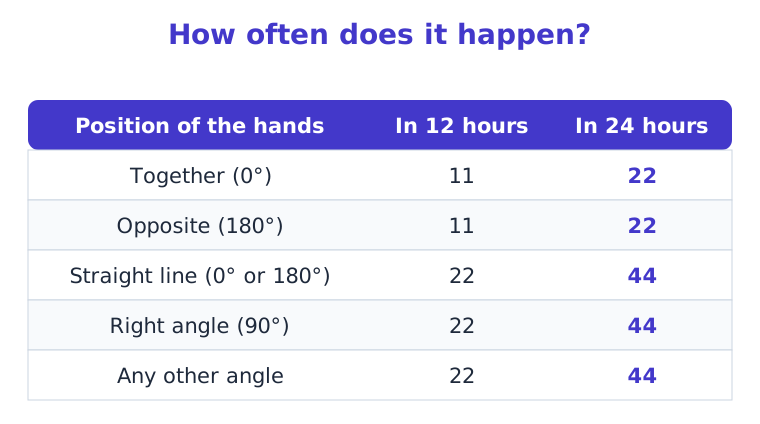
In 12 hours the hands meet 11 times, are opposite 11 times and make a right angle 22 times; double these for a day.
In a correct clock the hands meet every 720/11 = 65 5/11 minutes; meeting sooner means the clock gains, later means it loses.
Full explanation
Meera at the clock tower

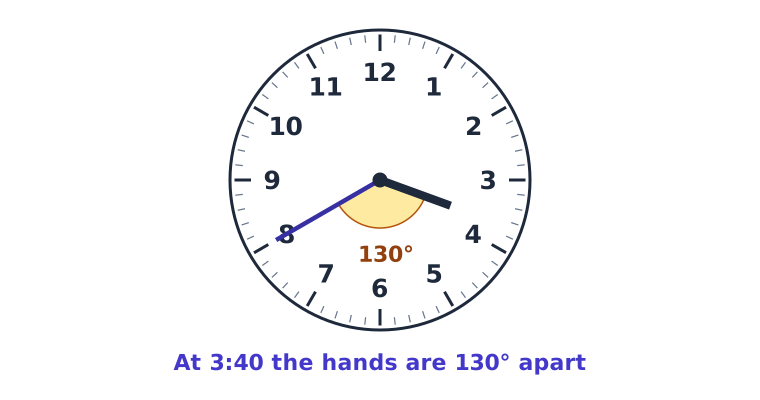
Meera waits for her train under the clock tower at Lucknow Charbagh. The tower clock shows 3:40. Her younger brother asks, "How wide is the angle between the two hands right now?"
Meera says the minute hand is on 8 and the hour hand near 4, so "four spaces, 120°". She is close, but wrong. This topic shows why, and gives you formulas that SSC, Bank and Railway papers test every year.
The dial in numbers
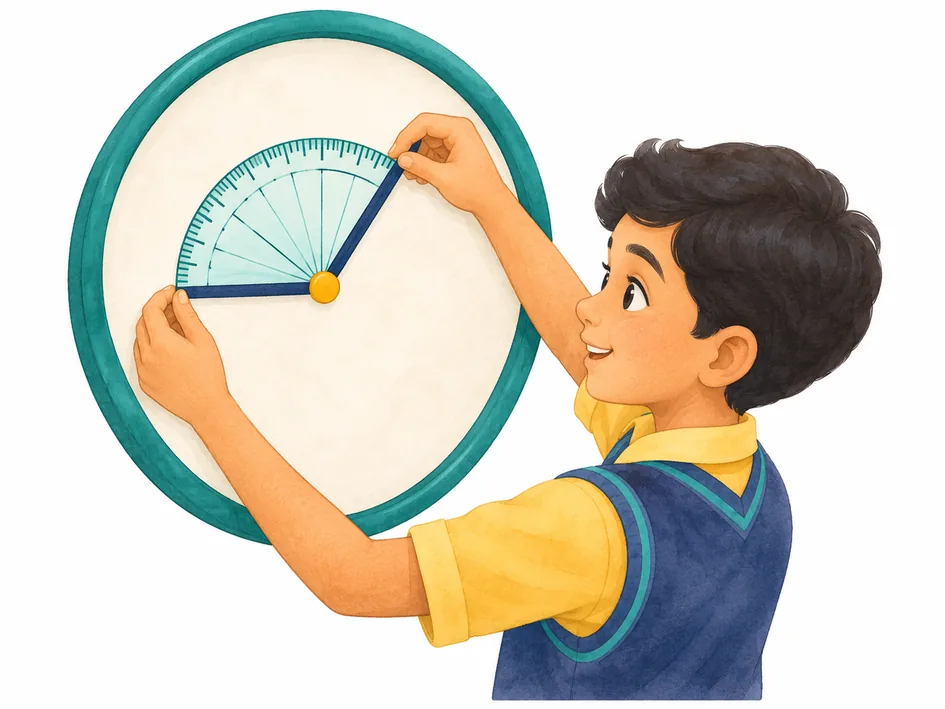
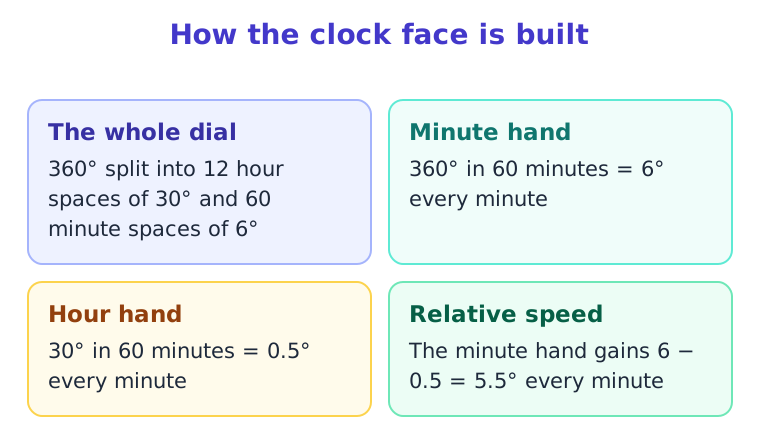
A full turn is 360°. The 12 hour marks split it into 12 spaces of 30°, and the 60 minute marks into 60 spaces of 6°.
- Minute hand: 360° in 60 minutes, so 6° per minute.
- Hour hand: 30° in 60 minutes, so 0.5° per minute.
- So the minute hand gains 5.5° per minute on the hour hand.
The angle formula
At H:M, measured clockwise from 12:
- the hour hand is at $30H + 0.5M$ degrees,
- the minute hand is at $6M$ degrees.
Subtract: $$\theta = |30H - 5.5M|$$
If $\theta$ is more than 180°, the smaller angle is $360 - \theta$.
Worked example: 3:40
$|30 \times 3 - 5.5 \times 40| = |90 - 220| = 130$ degrees.
Meera counted 4 spaces (120°) because she kept the hour hand on 4. In 40 minutes it moved on by $0.5 \times 40 = 20$ degrees past 3, so it is only $\frac{2}{3}$ of the way to 4, and the true angle is 130°.
Smaller angle or reflex angle?
Two hands always make two angles that add to 360°. Exams mean the smaller one unless they say "reflex".
Example: 7:20 gives $|210 - 110| = 100$°, so the reflex angle is $360 - 100 = 260$°.
Example: 11:10 gives $|330 - 55| = 275$°, which is more than 180°, so the angle is $360 - 275 = 85$°.
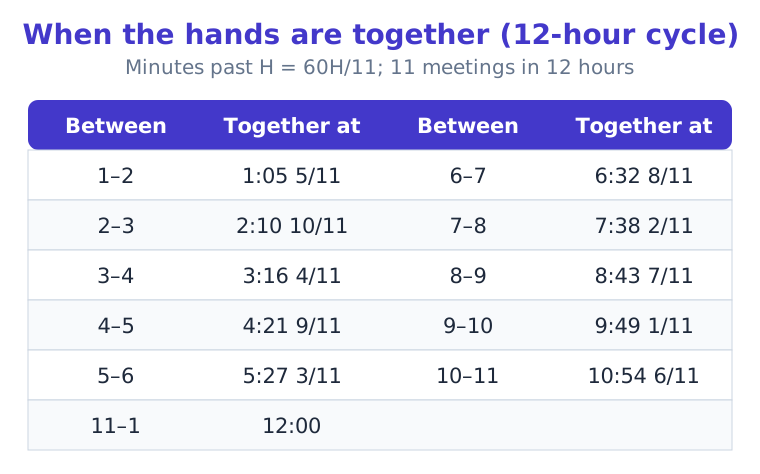
When are the hands together?
At H o'clock the minute hand is $30H$ degrees behind. It closes the gap at 5.5° a minute, so it needs
$$M = \frac{30H}{5.5} = \frac{60H}{11}$$ minutes.
Example: between 4 and 5, $M = \frac{240}{11} = 21\frac{9}{11}$, so the hands meet at $21\frac{9}{11}$ minutes past 4.
Any angle θ: opposite and right angles
The minute hand must be θ ahead of or behind the hour hand, so the gap to cover is $30H \pm \theta$:
$$M = \frac{2}{11}(30H \pm \theta)$$
Keep the values between 0 and 60.
Example: right angle between 2 and 3: $\frac{2}{11}(60 - 90)$ is negative, so drop it; $\frac{2}{11}(60 + 90) = 27\frac{3}{11}$. Also $\frac{2}{11}(60 - 90 + 360) = 60$ is 3:00, outside the hour. So the only right angle strictly between 2 and 3 is at $27\frac{3}{11}$ minutes past 2.
How many times in a day?
The minute hand laps the hour hand 11 times in 12 hours. Each lap brings one meeting, one opposite position and two right angles.
Fast and slow clocks
In a correct clock the hands meet every $\frac{720}{11} = 65\frac{5}{11}$ minutes. If they meet every 64 minutes of true time, the clock is fast.
Gain per day $= \left(\frac{720}{11} - 64\right) \times \frac{1440}{64} = \frac{16}{11} \times 22.5 = 32\frac{8}{11}$ minutes.
For a clock set right that gains or loses at a steady rate, use the ratio: shown time : true time stays fixed, both counted from the moment it was set.
Exam shortcuts
- Angle: $|30H - 5.5M|$, then 360 minus it if over 180.
- Together: $\frac{60H}{11}$ minutes past H.
- Angle θ: $\frac{2}{11}(30H \pm \theta)$ minutes past H.
- 12 hours: 11 meetings, 11 opposites, 22 right angles.
- Hour hand in t minutes: $\frac{t}{2}$ degrees; minute hand: $6t$ degrees.
Back to Meera
Meera works it out on the platform: $|90 - 220| = 130$°. Her brother then asks when the hands will next be together. Between 4 and 5: $\frac{60 \times 4}{11} = 21\frac{9}{11}$ minutes past 4. Her train leaves at 4:20, so she will see it from the window.
Mind map
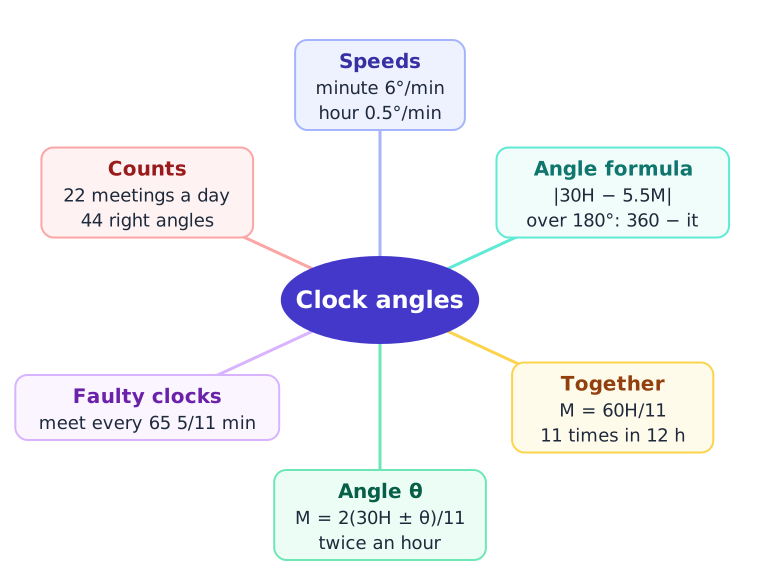
The whole topic on one page.
Concepts and terms
The minute hand covers 360° in 60 minutes (6° per minute); the hour hand covers 30° in 60 minutes (0.5° per minute).
At H:M the hour hand is at 30H + 0.5M and the minute hand at 6M degrees from 12, so the gap is |30H − 5.5M|.
To change the gap by d degrees the minute hand needs d/5.5 = 2d/11 minutes, because it gains 5.5° a minute.
A clock that gains runs at a fixed ratio to true time; shown time and true time grow in that ratio from the moment it was set right.

Did you know
Most watch advertisements show 10:10, because the hands then frame the brand name like a smile.
Between noon and midnight the hands overlap only 11 times, so no overlap happens between 11 and 12 except at 12 itself.

Memory tricks
Angle formula — Thirty H minus eleven-halves M — |30H − (11/2)M|, and flip to 360 minus it when the answer passes 180.
Meeting times — Five H times twelve-elevenths — The hands meet 5H × 12/11 = 60H/11 minutes past H: a little after the minute hand reaches the hour number.
Practice MCQs with answers (82)
- A 150°
- B 130°
- C 230°
- D 50°
Show answer
Why:
$|30 \times 3 - 5.5 \times 40| = |90 - 220| = 130$°.
- A 40°
- B 90°
- C 100°
- D 260°
Show answer
Why:
$|30 \times 7 - 5.5 \times 20| = |210 - 110| = 100$°.
- A 350°
- B 130°
- C 40°
- D 10°
Show answer
Why:
$|30 \times 4 - 5.5 \times 20| = |120 - 110| = 10$°.
- A 105°
- B 255°
- C 135°
- D 120°
Show answer
Why:
$|30 \times 2 - 5.5 \times 30| = |60 - 165| = 105$°.
- A 7.5°
- B 172.5°
- C 180°
- D 187.5°
Show answer
Why:
$|30 \times 9 - 5.5 \times 15| = |270 - 82.5| = 187.5$°; it is over 180°, so the angle is $360 - 187.5 = 172.5$°.
- A 72.5°
- B 42.5°
- C 12.5°
- D 347.5°
Show answer
Why:
$|30 \times 5 - 5.5 \times 25| = |150 - 137.5| = 12.5$°.
- A 275°
- B 25°
- C 90°
- D 85°
Show answer
Why:
$|30 \times 11 - 5.5 \times 10| = |330 - 55| = 275$°; it is over 180°, so the angle is $360 - 275 = 85$°.
- A 7.5°
- B 352.5°
- C 127.5°
- D 30°
Show answer
Why:
$|30 \times 8 - 5.5 \times 45| = |240 - 247.5| = 7.5$°.
- A 42.5°
- B 12.5°
- C 30°
- D 347.5°
Show answer
Why:
$|30 \times 6 - 5.5 \times 35| = |180 - 192.5| = 12.5$°.
- A 197.5°
- B 77.5°
- C 162.5°
- D 150°
Show answer
Why:
$|30 \times 10 - 5.5 \times 25| = |300 - 137.5| = 162.5$°.
- A 90°
- B 245°
- C 55°
- D 115°
Show answer
Why:
$|30 \times 1 - 5.5 \times 50| = |30 - 275| = 245$°; it is over 180°, so the angle is $360 - 245 = 115$°.
- A 162°
- B 144°
- C 198°
- D 192°
Show answer
Why:
$|30 \times 12 - 5.5 \times 36| = |360 - 198| = 162$°.
- A 183°
- B 177°
- C 57°
- D 156°
Show answer
Why:
$|30 \times 4 - 5.5 \times 54| = |120 - 297| = 177$°.
- A 219°
- B 21°
- C 141°
- D 132°
Show answer
Why:
$|30 \times 8 - 5.5 \times 18| = |240 - 99| = 141$°.
- A 156°
- B 182°
- C 58°
- D 178°
Show answer
Why:
$|30 \times 2 - 5.5 \times 44| = |60 - 242| = 182$°; it is over 180°, so the angle is $360 - 182 = 178$°.
- A 71.5°
- B 131.5°
- C 48°
- D 288.5°
Show answer
Why:
$|30 \times 11 - 5.5 \times 47| = |330 - 258.5| = 71.5$°.
- A 144°
- B 114°
- C 108°
- D 246°
Show answer
Why:
$|30 \times 6 - 5.5 \times 12| = |180 - 66| = 114$°.
- A 175°
- B 30°
- C 5°
- D 355°
Show answer
Why:
$|30 \times 9 - 5.5 \times 50| = |270 - 275| = 5$°.
- A 310°
- B 170°
- C 60°
- D 50°
Show answer
Why:
The clock shows 2:20. $|30 \times 2 - 5.5 \times 20| = |60 - 110| = 50$°.
- A 67.5°
- B 127.5°
- C 60°
- D 292.5°
Show answer
Why:
The clock shows 5:15. $|30 \times 5 - 5.5 \times 15| = |150 - 82.5| = 67.5$°.
- A 60°
- B 80°
- C 280°
- D 160°
Show answer
Why:
The clock shows 10:40. $|30 \times 10 - 5.5 \times 40| = |300 - 220| = 80$°.
- A 342.5°
- B 42.5°
- C 17.5°
- D 47.5°
Show answer
Why:
The clock shows 7:35. $|30 \times 7 - 5.5 \times 35| = |210 - 192.5| = 17.5$°.
- A 252.5°
- B 167.5°
- C 120°
- D 107.5°
Show answer
Why:
The clock shows 1:25. $|30 \times 1 - 5.5 \times 25| = |30 - 137.5| = 107.5$°.
- A 144°
- B 24°
- C 168°
- D 216°
Show answer
Why:
The clock shows 4:48. $|30 \times 4 - 5.5 \times 48| = |120 - 264| = 144$°.
- A 300°
- B 312.5°
- C 342.5°
- D 47.5°
Show answer
Why:
$|30 \times 3 - 5.5 \times 25| = |90 - 137.5| = 47.5$°. Reflex angle $= 360 - 47.5 = 312.5$°.
- A 175°
- B 180°
- C 185°
- D 215°
Show answer
Why:
$|30 \times 8 - 5.5 \times 10| = |240 - 55| = 185$°; it is over 180°, so the angle is $360 - 185 = 175$°. Reflex angle $= 360 - 175 = 185$°.
- A 280°
- B 110°
- C 240°
- D 250°
Show answer
Why:
$|30 \times 12 - 5.5 \times 20| = |360 - 110| = 250$°; it is over 180°, so the angle is $360 - 250 = 110$°. Reflex angle $= 360 - 110 = 250$°.
- A $16\frac{4}{11}$ min past 3
- B $21\frac{9}{11}$ min past 3
- C $10\frac{10}{11}$ min past 3
- D 15 min past 3
Show answer
Why:
At 3:00 the gap is 90°. Closing it at 5.5° a minute takes $\frac{60 \times 3}{11} = 16\frac{4}{11}$ minutes.
- A $21\frac{9}{11}$ min past 5
- B $27\frac{3}{11}$ min past 5
- C 25 min past 5
- D $32\frac{8}{11}$ min past 5
Show answer
Why:
At 5:00 the gap is 150°. Closing it at 5.5° a minute takes $\frac{60 \times 5}{11} = 27\frac{3}{11}$ minutes.
- A 35 min past 7
- B $43\frac{7}{11}$ min past 7
- C $38\frac{2}{11}$ min past 7
- D $32\frac{8}{11}$ min past 7
Show answer
Why:
At 7:00 the gap is 210°. Closing it at 5.5° a minute takes $\frac{60 \times 7}{11} = 38\frac{2}{11}$ minutes.
- A 10 min past 2
- B $16\frac{4}{11}$ min past 2
- C $5\frac{5}{11}$ min past 2
- D $10\frac{10}{11}$ min past 2
Show answer
Why:
At 2:00 the gap is 60°. Closing it at 5.5° a minute takes $\frac{60 \times 2}{11} = 10\frac{10}{11}$ minutes.
- A $43\frac{7}{11}$ min past 8
- B 40 min past 8
- C $49\frac{1}{11}$ min past 8
- D $38\frac{2}{11}$ min past 8
Show answer
Why:
At 8:00 the gap is 240°. Closing it at 5.5° a minute takes $\frac{60 \times 8}{11} = 43\frac{7}{11}$ minutes.
- A 50 min past 10
- B $54\frac{6}{11}$ min past 10
- C $49\frac{1}{11}$ min past 10
- D 55 min past 10
Show answer
Why:
At 10:00 the gap is 300°. Closing it at 5.5° a minute takes $\frac{60 \times 10}{11} = 54\frac{6}{11}$ minutes.
- A 35 min past 1
- B $43\frac{7}{11}$ min past 1
- C $38\frac{2}{11}$ min past 1
- D $21\frac{9}{11}$ min past 1
Show answer
Why:
Use $M = \frac{2}{11}(30H \pm \theta)$ with H = 1, θ = 180: the value in the hour is $38\frac{2}{11}$. Only this value lies inside the hour, so the answer is $38\frac{2}{11}$ minutes past 1.
- A $49\frac{1}{11}$ min past 4
- B $38\frac{2}{11}$ min past 4
- C 50 min past 4
- D $54\frac{6}{11}$ min past 4
Show answer
Why:
Use $M = \frac{2}{11}(30H \pm \theta)$ with H = 4, θ = 180: the value in the hour is $54\frac{6}{11}$. Only this value lies inside the hour, so the answer is $54\frac{6}{11}$ minutes past 4.
- A $10\frac{10}{11}$ min past 8
- B $16\frac{4}{11}$ min past 8
- C $5\frac{5}{11}$ min past 8
- D 10 min past 8
Show answer
Why:
Use $M = \frac{2}{11}(30H \pm \theta)$ with H = 8, θ = 180: the value in the hour is $10\frac{10}{11}$. Only this value lies inside the hour, so the answer is $10\frac{10}{11}$ minutes past 8.
- A 20 min past 10
- B $21\frac{9}{11}$ min past 10
- C $27\frac{3}{11}$ min past 10
- D $16\frac{4}{11}$ min past 10
Show answer
Why:
Use $M = \frac{2}{11}(30H \pm \theta)$ with H = 10, θ = 180: the value in the hour is $21\frac{9}{11}$. Only this value lies inside the hour, so the answer is $21\frac{9}{11}$ minutes past 10.
- A $54\frac{6}{11}$ min past 4
- B 35 min past 4
- C $5\frac{5}{11}$ min past 4
- D $38\frac{2}{11}$ min past 4
Show answer
Why:
Use $M = \frac{2}{11}(30H \pm \theta)$ with H = 4, θ = 90: the values in the hour are $5\frac{5}{11}$, $38\frac{2}{11}$. The first is $5\frac{5}{11}$ minutes past 4.
- A $5\frac{5}{11}$ min past 4
- B $54\frac{6}{11}$ min past 4
- C 35 min past 4
- D $38\frac{2}{11}$ min past 4
Show answer
Why:
Use $M = \frac{2}{11}(30H \pm \theta)$ with H = 4, θ = 90: the values in the hour are $5\frac{5}{11}$, $38\frac{2}{11}$. The second is $38\frac{2}{11}$ minutes past 4.
- A $16\frac{4}{11}$ min past 6
- B $49\frac{1}{11}$ min past 6
- C 45 min past 6
- D 15 min past 6
Show answer
Why:
Use $M = \frac{2}{11}(30H \pm \theta)$ with H = 6, θ = 90: the values in the hour are $16\frac{4}{11}$, $49\frac{1}{11}$. The first is $16\frac{4}{11}$ minutes past 6.
- A 20 min past 7
- B $54\frac{6}{11}$ min past 7
- C $21\frac{9}{11}$ min past 7
- D 50 min past 7
Show answer
Why:
Use $M = \frac{2}{11}(30H \pm \theta)$ with H = 7, θ = 90: the values in the hour are $21\frac{9}{11}$, $54\frac{6}{11}$. The second is $54\frac{6}{11}$ minutes past 7.
- A $43\frac{7}{11}$ min past 5
- B 35 min past 5
- C $16\frac{4}{11}$ min past 5
- D $38\frac{2}{11}$ min past 5
Show answer
Why:
Use $M = \frac{2}{11}(30H \pm \theta)$ with H = 5, θ = 60: the values in the hour are $16\frac{4}{11}$, $38\frac{2}{11}$. The first is $16\frac{4}{11}$ minutes past 5.
- A 20 min past 3
- B $10\frac{10}{11}$ min past 3
- C $32\frac{8}{11}$ min past 3
- D $21\frac{9}{11}$ min past 3
Show answer
Why:
Use $M = \frac{2}{11}(30H \pm \theta)$ with H = 3, θ = 30: the values in the hour are $10\frac{10}{11}$, $21\frac{9}{11}$. The second is $21\frac{9}{11}$ minutes past 3.
- A 14
- B 16
- C 17
- D 13
Show answer
Why:
The position comes twice per lap of 65 5/11 minutes, not per hour. Solving $5.5t = 90 + 360k$ or $360k - 90$ inside the interval gives 14 moments, the first at 2:27 3/11 and the last at 9:32 8/11.
- A 12
- B 10
- C 11
- D 9
Show answer
Why:
The position comes once per lap of 65 5/11 minutes, not per hour. Solving $5.5t = 0 + 360k$ inside the interval gives 10 moments, the first at 1:05 5/11 and the last at 10:54 6/11.
- A 7
- B 4
- C 5
- D 6
Show answer
Why:
The position comes once per lap of 65 5/11 minutes, not per hour. Solving $5.5t = 180 + 360k$ inside the interval gives 5 moments, the first at 6:00 and the last at 10:21 9/11.
- A 6
- B 7
- C 4
- D 5
Show answer
Why:
The position comes twice per lap of 65 5/11 minutes, not per hour. Solving $5.5t = 90 + 360k$ or $360k - 90$ inside the interval gives 5 moments, the first at 1:21 9/11 and the last at 3:32 8/11.
- A 4
- B 5
- C 3
- D 6
Show answer
Why:
The position comes once per lap of 65 5/11 minutes, not per hour. Solving $5.5t = 0 + 360k$ inside the interval gives 4 moments, the first at 2:10 10/11 and the last at 5:27 3/11.
- A 150°
- B 165°
- C 180°
- D 1980°
Show answer
Why:
330 minutes × 0.5° = 165°.
- A 2040°
- B 150°
- C 170°
- D 185°
Show answer
Why:
340 minutes × 0.5° = 170°.
- A 120°
- B 210°
- C 12.5°
- D 150°
Show answer
Why:
25 minutes × 6° = 150°.
- A 330°
- B 390°
- C 27.5°
- D 300°
Show answer
Why:
55 minutes × 6° = 330°.
- A 4320°
- B 360°
- C 375°
- D 345°
Show answer
Why:
720 minutes × 0.5° = 360°.
- A gains $22\frac{1}{2}$ min
- B gains $34\frac{10}{11}$ min
- C gains $32\frac{8}{11}$ min
- D loses $32\frac{8}{11}$ min
Show answer
Why:
A correct clock meets every 65 5/11 min. Each meeting here comes $1\frac{5}{11}$ min early, and there are $\frac{1440}{64}$ meetings a day: total $32\frac{8}{11}$ min, so the clock gains.
- A gains 120 min
- B gains $5\frac{5}{11}$ min
- C loses $130\frac{10}{11}$ min
- D gains $130\frac{10}{11}$ min
Show answer
Why:
A correct clock meets every 65 5/11 min. Each meeting here comes $5\frac{5}{11}$ min early, and there are $\frac{1440}{60}$ meetings a day: total $130\frac{10}{11}$ min, so the clock gains.
- A loses $130\frac{10}{11}$ min
- B loses 140 min
- C loses $157\frac{1}{11}$ min
- D gains $130\frac{10}{11}$ min
Show answer
Why:
A correct clock meets every 65 5/11 min. Each meeting here comes $6\frac{6}{11}$ min late, and there are $\frac{1440}{72}$ meetings a day: total $130\frac{10}{11}$ min, so the clock loses.
- A 2:15 pm
- B 2:18 pm
- C 2:21 pm
- D 1:42 pm
Show answer
Why:
6 hours pass, so it gains 3 × 6 = 18 minutes and shows 2:18 pm.
- A 4:50 pm
- B 3:15 pm
- C 4:45 pm
- D 4:40 pm
Show answer
Why:
9 hours pass, so it gains 5 × 9 = 45 minutes and shows 4:45 pm.
- A 10:56 am
- B 10:55 am
- C 11:20 am
- D 11:00 am
Show answer
Why:
In one true hour it shows 64 minutes. It has shown 320 minutes, so true time passed = 320 × 60/64 = 300 minutes: 11:00 am.
- A 1:00 pm
- B 12:55 pm
- C 1:24 pm
- D 12:54 pm
Show answer
Why:
In one true hour it shows 66 minutes. It has shown 264 minutes, so true time passed = 264 × 60/66 = 240 minutes: 1:00 pm.
- A 10:00 pm, Thursday
- B 11:00 pm, Thursday
- C 9:00 pm, Thursday
- D 12:00 am, Friday
Show answer
Why:
The clock shows 1424 minutes for every 1440 true minutes. It has shown 89 hours, so true time passed = 89 × 1440/1424 = 90 hours.
- A 3:00 pm, Friday
- B 6:00 pm, Friday
- C 5:00 pm, Friday
- D 4:00 pm, Friday
Show answer
Why:
The clock shows 1416 minutes for every 1440 true minutes. It has shown 59 hours, so true time passed = 59 × 1440/1416 = 60 hours.
- A 1
- B 2
- C 3
- D 4
Show answer
Why:
Clock (2) shows 9:00, where |30H − 5.5M| = 90°. The others give 12:15 → 82.5°, 6:15 → 97.5°, 3:30 → 75°.
- A 1
- B 2
- C 3
- D 4
Show answer
Why:
Clock (3) shows 6:00, where |30H − 5.5M| = 180°. The others give 12:30 → 165°, 5:30 → 15°, 6:30 → 15°.
- A 1
- B 2
- C 3
- D 4
Show answer
Why:
Clock (4) shows 3:00, where |30H − 5.5M| = 90°. The others give 9:30 → 105°, 2:30 → 105°, 3:15 → 7.5°.
- A $27\frac{3}{11}$ min
- B 24 min
- C 20 min
- D $21\frac{9}{11}$ min
Show answer
Why:
The clock shows 4:00, a gap of 120°. At 5.5° a minute: 120 ÷ 5.5 = $21\frac{9}{11}$ minutes.
- A $49\frac{1}{11}$ min
- B $54\frac{6}{11}$ min
- C 54 min
- D 45 min
Show answer
Why:
The clock shows 9:00, a gap of 270°. At 5.5° a minute: 270 ÷ 5.5 = $49\frac{1}{11}$ minutes.
- A 0.5°
- B 5.5°
- C 5°
- D 6°
Show answer
Why:
6° − 0.5° = 5.5° per minute.
- A 15°
- B 60°
- C 30°
- D 6°
Show answer
Why:
360° ÷ 12 = 30°.
- A 23
- B 24
- C 11
- D 22
Show answer
Why:
11 meetings every 12 hours, so 22 in a day; the meeting near 12 is shared.
- A 44
- B 22
- C 24
- D 48
Show answer
Why:
Two right angles per lap, 22 laps a day: 44.
- A 22
- B 44
- C 24
- D 48
Show answer
Why:
22 meetings + 22 opposite positions = 44.
- A Every 60 min
- B Every 65 min
- C Every $65\frac{5}{11}$ min
- D Every $66\frac{5}{11}$ min
Show answer
Why:
The minute hand gains 360° at 5.5° a minute: 360 ÷ 5.5 = 720/11 = 65 5/11 minutes.
- A 22
- B 10
- C 12
- D 11
Show answer
Why:
Once per lap and 11 laps in 12 hours; the opposite position between 5 and 7 is only at 6:00.
- A 30°
- B 0.5°
- C 360°
- D 6°
Show answer
Why:
One hour space = 30°.
- A 30 min past 6
- B $32\frac{8}{11}$ min past 6
- C $38\frac{2}{11}$ min past 6
- D $27\frac{3}{11}$ min past 6
Show answer
Why:
5 × 6 = 30 minutes, × 12/11 = 360/11 = 32 8/11 minutes past 6.
- A 30°
- B 0°
- C 15°
- D 7.5°
Show answer
Why:
0.5° × 30 minutes = 15°.
- A 65 min
- B $60\frac{1}{11}$ min
- C 60 min
- D $65\frac{5}{11}$ min
Show answer
Why:
Gap of 360° at 5.5° a minute: 720/11 = 65 5/11 minutes.
- A Both A and R are true, and R is the correct explanation of A
- B Both A and R are true, but R is not the correct explanation of A
- C A is true but R is false
- D A is false but R is true
Show answer
Why:
The minute hand is on 6 (180°), the hour hand at 90 + 15 = 105°, so the angle is 75°. R gives exactly why it is not 90°.
- A Both A and R are true, and R is the correct explanation of A
- B Both A and R are true, but R is not the correct explanation of A
- C A is true but R is false
- D A is false but R is true
Show answer
Why:
R is true, and it gives 1440 ÷ (720/11) = 22 meetings a day, so A is false.
- A 1 only
- B 2 only
- C Both 1 and 2
- D Neither 1 nor 2
Show answer
Why:
Strictly between 3 and 4 the right angle comes only at $32\frac{8}{11}$ min past 3 (the other is at 3:00 itself). Between 5 and 6 the hands are opposite only at 6:00, which is outside, so statement 2 is false (0 times).
- A 1 only
- B 2 only
- C Both 1 and 2
- D Neither 1 nor 2
Show answer
Why:
30° per 60 minutes is 0.5° per minute, and at 9:00 the gap is |270 − 0| = 270°, whose smaller angle is 90°. Both are true.
Important short questions (4)
|30 × 5 − 5.5 × 24| = |150 − 132| = 18°.
60 × 8 ÷ 11 = 480/11 = 43 7/11 minutes past 8.
The minute hand gains one full lap every 720/11 minutes, and 720 ÷ (720/11) = 11. The meetings before and after 12 are the same event.
12 hours × 2 = 24 minutes ahead, so 6:24 pm.
Long answer questions (2)
Right angle: M = 2(30H ± 90)/11 with H = 4. 2(120 − 90)/11 = 60/11 = 5 5/11 and 2(120 + 90)/11 = 420/11 = 38 2/11.
So at 4:05 5/11 and 4:38 2/11.
Together: 60 × 4/11 = 240/11 = 21 9/11 minutes past 4.
A correct clock meets every 720/11 = 65 5/11 minutes. This clock shows 65 5/11 minutes in 64 true minutes, a gain of 16/11 minutes each time.
In 1440 true minutes there are 1440/64 = 22.5 such intervals, so the gain is 16/11 × 22.5 = 360/11 = 32 8/11 minutes.
Flashcards (14)
Play this topic
- Clock facts
Odd Days and Day of the Week
Use odd days to find the weekday of any date, move forward or back from a known day, test leap years, count weekdays in a month or year, and find when a calendar repeats.
What you will be able to do
- I can count odd days in any span of days, months, years or centuries.
- I can find the weekday of any date from 1600 to 2400.
- I can move forward or backward from a known weekday without mistakes over February.
- I can decide which year has the same calendar as a given year.
Key points
Odd days are the days left over after complete weeks: N days give N mod 7 odd days.
An ordinary year has 1 odd day and a leap year has 2.
A year is a leap year if it is divisible by 4; a century year must be divisible by 400 (1900 is not, 2000 is).
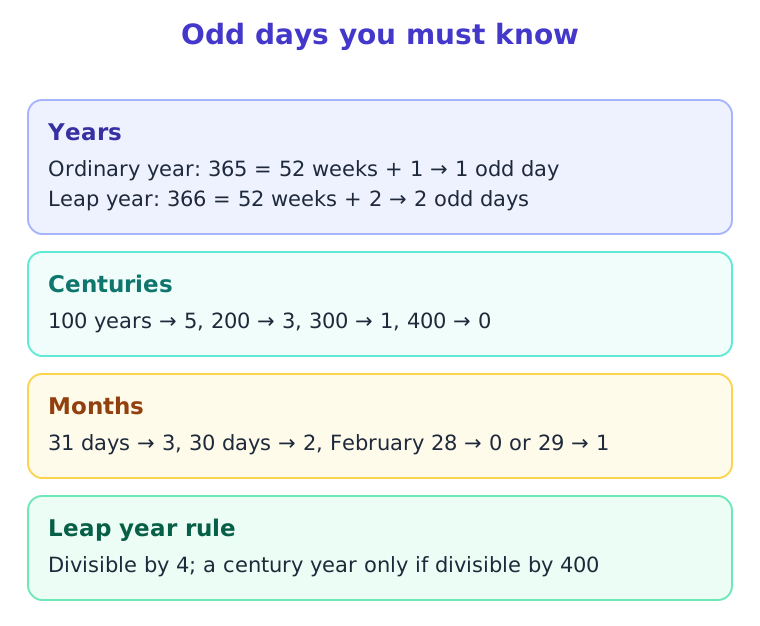
100 years have 5 odd days, 200 years 3, 300 years 1 and 400 years 0.
Months: 31 days give 3 odd days, 30 days give 2, February gives 0 (or 1 in a leap year).
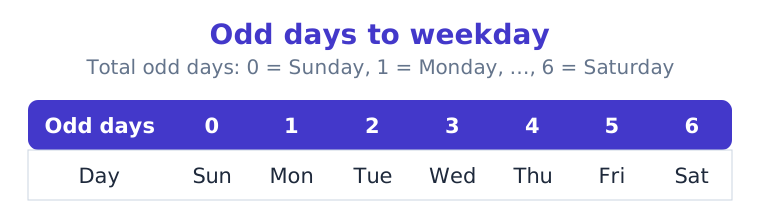
Weekday codes: 0 Sunday, 1 Monday, 2 Tuesday, 3 Wednesday, 4 Thursday, 5 Friday, 6 Saturday.
From a known date, count the days in between, take mod 7 and move forward (later date) or back (earlier date).
A century can never end on Tuesday, Thursday or Saturday, and never begin on Sunday, Wednesday or Friday.
Two years have the same calendar when they start on the same day and are both leap or both ordinary.
Full explanation
Arjun and his grandfather's diary

Arjun finds his grandfather's diary. The first page says: "Born in Meerut on the day India became free, 15 August 1947." Arjun wonders which day of the week that was. There is no 1947 calendar at home.
With the idea of odd days he can find it in two minutes, and so can you.
What are odd days?
A week has 7 days. After taking out complete weeks, the days left over are the odd days.
- 10 days = 1 week + 3 odd days
- 100 days = 14 weeks + 2 odd days
If today is Monday, 100 days later the weekday moves 2 places: Wednesday.
Years and leap years
- Ordinary year: 365 days = 52 weeks + 1 odd day.
- Leap year: 366 days = 52 weeks + 2 odd days.
Leap year test: divisible by 4. A century year (1800, 1900, 2000) is a leap year only if divisible by 400. So 2000 and 2400 are leap years; 1900 and 2100 are not.
Centuries and months
100 years have 24 leap years and 76 ordinary ones: $24 \times 2 + 76 = 124$, and $124 = 17 \times 7 + 5$, so 5 odd days.
Then 200 years: $10 \to 3$; 300 years: $15 \to 1$; 400 years: $20 + 1 = 21 \to 0$ (the 400th year is a leap year).
Odd days to weekday
Counting from the start of year 1, the total odd days up to a date give its weekday directly: 0 is Sunday, 1 Monday, and so on to 6 Saturday.
Worked example: 15 August 1947
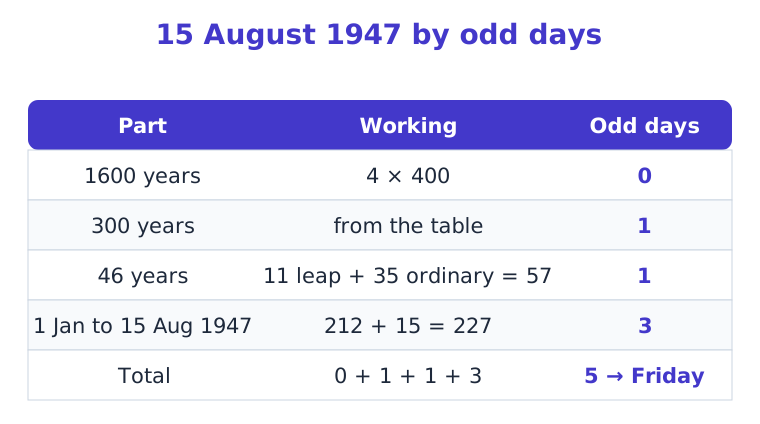
Split the completed years: $1946 = 1600 + 300 + 46$.
- 1600 years: 0 odd days
- 300 years: 1 odd day
- 46 years: 11 leap + 35 ordinary = $22 + 35 = 57 \to 1$
- 1947 up to 15 August: $31 + 28 + 31 + 30 + 31 + 30 + 31 + 15 = 227 \to 3$
Total $0 + 1 + 1 + 3 = 5$, so it was a Friday.
From a known day
Most exam questions give one date and its weekday. Count the days from the known date to the asked date (do not count the starting day), take mod 7, and move forward for a later date or back for an earlier one.
Example: 26 January 2024 was a Friday. 15 August 2024 is $5 + 29 + 31 + 30 + 31 + 30 + 31 + 15 = 202$ days later; $202 = 28 \times 7 + 6$, so Friday + 6 = Thursday.
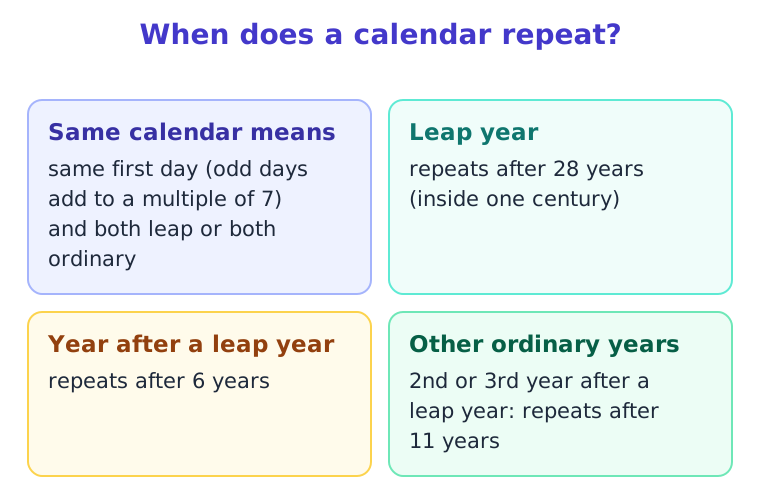
When does a calendar repeat?
Two years share a calendar when they start on the same weekday and are both leap or both ordinary. Add odd days year by year until the total is a multiple of 7.
Exam shortcuts
- Odd days of a period = days mod 7.
- Centuries: 5, 3, 1, 0.
- Last day of a century: only Monday, Wednesday, Friday or Sunday.
- First day of a century: only Monday, Tuesday, Thursday or Saturday.
- An ordinary year starts and ends on the same weekday; a leap year ends one day later.
Back to Arjun
Arjun writes the four lines of the worked example in the diary margin and gets 5 odd days. He runs to his grandfather: "You were born on a Friday!" His grandfather laughs: "Yes, and my mother said a Friday child is lucky."
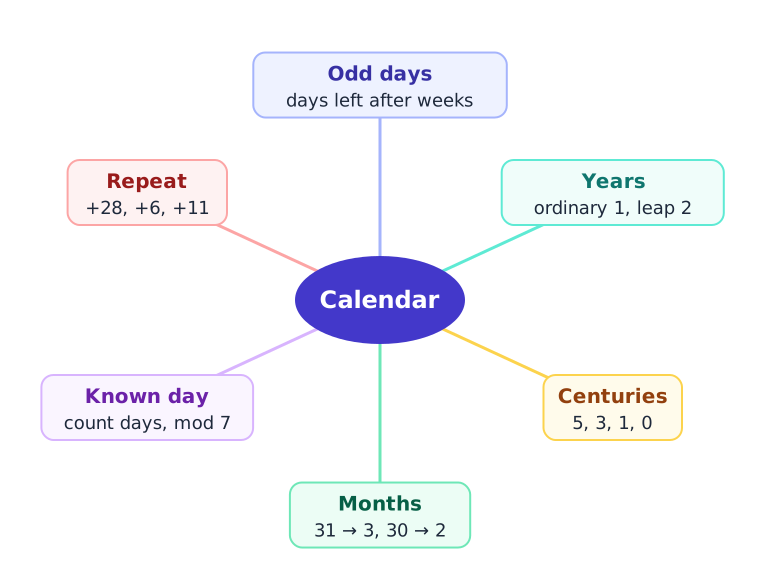
Mind map
The whole topic on one page.
Concepts and terms
The remainder when a number of days is divided by 7. It tells how far the weekday moves.
A year with 366 days. Every fourth year, except century years not divisible by 400.
100 years = 76 ordinary + 24 leap = 124 odd days = 5 odd days; doubling and tripling give 3 and 1, and 400 years give 0.
A later year repeats a calendar when the odd days in between add to a multiple of 7 and the leap status matches.
Did you know
15 August 1947, India's Independence Day, was a Friday.
The Gregorian calendar repeats exactly every 400 years, because 400 years contain 0 odd days.
Memory tricks
Century odd days — 5-3-1-0 — 100, 200, 300 and 400 years give 5, 3, 1 and 0 odd days.
Month odd days — Thirty-one is three, thirty is two — A 31-day month moves the weekday by 3, a 30-day month by 2.
Practice MCQs with answers (80)
- A 3
- B 1
- C 14
- D 2
Show answer
Why:
100 = 14 × 7 + 2, so 2 odd days.
- A 3
- B 2
- C 6
- D 4
Show answer
Why:
45 = 6 × 7 + 3, so 3 odd days.
- A 0
- B 1
- C 52
- D 2
Show answer
Why:
365 = 52 × 7 + 1, so 1 odd day.
- A 6
- B 4
- C 5
- D 35
Show answer
Why:
250 = 35 × 7 + 5, so 5 odd days.
- A 0
- B 5
- C 142
- D 6
Show answer
Why:
1000 = 142 × 7 + 6, so 6 odd days.
- A 1
- B 0
- C 2
- D 3
Show answer
Why:
From the 5-3-1-0 table, 300 years give 1 odd day.
- A 5
- B 3
- C 2
- D 1
Show answer
Why:
From the 5-3-1-0 table, 200 years give 3 odd days.
- A 3
- B 0
- C 5
- D 4
Show answer
Why:
500 = 400 + 100 years. Every 400 years give 0 odd days, and 100 years give 5.
- A 4
- B 0
- C 6
- D 1
Show answer
Why:
1100 = 800 + 300 years. Every 400 years give 0 odd days, and 300 years give 1.
- A 0
- B 2
- C 5
- D 1
Show answer
Why:
800 = 2 × 400 years, and every 400 years give 0 odd days, so the answer is 0.
- A 1900
- B 2000
- C 2100
- D 1800
Show answer
Why:
2000 passes the leap test (a century year divisible by 400). 1900: century not divisible by 400, 2100: century not divisible by 400, 1800: century not divisible by 400.
- A 1990
- B 1998
- C 1996
- D 2002
Show answer
Why:
1996 passes the leap test (divisible by 4, not a century year). 1998: not divisible by 4, 2002: not divisible by 4, 1990: not divisible by 4.
- A 2200
- B 2300
- C 2500
- D 2400
Show answer
Why:
2400 passes the leap test (a century year divisible by 400). 2200: century not divisible by 400, 2300: century not divisible by 400, 2500: century not divisible by 400.
- A 1600
- B 1900
- C 1700
- D 1500
Show answer
Why:
1600 passes the leap test (a century year divisible by 400). 1700: century not divisible by 400, 1500: century not divisible by 400, 1900: century not divisible by 400.
- A 2030
- B 2028
- C 2100
- D 2026
Show answer
Why:
2028 passes the leap test (divisible by 4, not a century year). 2026: not divisible by 4, 2030: not divisible by 4, 2100: century not divisible by 400.
- A Thursday
- B Sunday
- C Friday
- D Saturday
Show answer
Why:
Completed years 1946: 1600 years → 0; 300 years → 1; 46 years (11 leap) → 57 → 1; 1947 up to the date: 227 days → 3. Total 5 → 5, which is Friday.
- A Wednesday
- B Saturday
- C Friday
- D Thursday
Show answer
Why:
Completed years 1949: 1600 years → 0; 300 years → 1; 49 years (12 leap) → 61 → 5; 1950 up to the date: 26 days → 5. Total 11 → 4, which is Thursday.
- A Saturday
- B Friday
- C Monday
- D Sunday
Show answer
Why:
Completed years 1868: 1600 years → 0; 200 years → 3; 68 years (17 leap) → 85 → 1; 1869 up to the date: 275 days → 2. Total 6 → 6, which is Saturday.
- A Monday
- B Saturday
- C Sunday
- D Friday
Show answer
Why:
Completed years 1999: 1600 years → 0; 300 years → 1; 99 years (24 leap) → 123 → 4; 2000 up to the date: 1 day → 1. Total 6 → 6, which is Saturday.
- A Friday
- B Monday
- C Saturday
- D Sunday
Show answer
Why:
Completed years 1982: 1600 years → 0; 300 years → 1; 82 years (20 leap) → 102 → 4; 1983 up to the date: 176 days → 1. Total 6 → 6, which is Saturday.
- A Friday
- B Monday
- C Sunday
- D Saturday
Show answer
Why:
Completed years 2010: 2000 years → 0; 10 years (2 leap) → 12 → 5; 2011 up to the date: 92 days → 1. Total 6 → 6, which is Saturday.
- A Sunday
- B Saturday
- C Tuesday
- D Monday
Show answer
Why:
Completed years 1856: 1600 years → 0; 200 years → 3; 56 years (14 leap) → 70 → 0; 1857 up to the date: 130 days → 4. Total 7 → 0, which is Sunday.
- A Tuesday
- B Wednesday
- C Friday
- D Thursday
Show answer
Why:
Completed years 2022: 2000 years → 0; 22 years (5 leap) → 27 → 6; 2023 up to the date: 235 days → 4. Total 10 → 3, which is Wednesday.
- A Wednesday
- B Saturday
- C Thursday
- D Friday
Show answer
Why:
Completed years 1899: 1600 years → 0; 200 years → 3; 99 years (24 leap) → 123 → 4; 1900 up to the date: 60 days → 4. Total 11 → 4, which is Thursday.
- A Saturday
- B Tuesday
- C Monday
- D Sunday
Show answer
Why:
Completed years 2003: 2000 years → 0; 3 years (0 leap) → 3 → 3; 2004 up to the date: 60 days → 4. Total 7 → 0, which is Sunday.
- A Monday
- B Sunday
- C Tuesday
- D Saturday
Show answer
Why:
25 December 2023 is 288 days after 12 March 2023. 288 = 41 × 7 + 1, so move 1 day forward: Monday.
- A Thursday
- B Friday
- C Sunday
- D Saturday
Show answer
Why:
1 March 2024 is 60 days after 1 January 2024. 60 = 8 × 7 + 4, so move 4 days forward: Friday.
- A Wednesday
- B Friday
- C Thursday
- D Saturday
Show answer
Why:
2 October 2025 is 48 days after 15 August 2025. 48 = 6 × 7 + 6, so move 6 days forward: Thursday.
- A Tuesday
- B Monday
- C Saturday
- D Sunday
Show answer
Why:
5 June 2022 is 162 days before 14 November 2022. 162 = 23 × 7 + 1, so move 1 day back: Sunday.
- A Tuesday
- B Sunday
- C Monday
- D Wednesday
Show answer
Why:
10 May 2022 is 365 days after 10 May 2021. 365 = 52 × 7 + 1, so move 1 day forward: Tuesday.
- A Tuesday
- B Saturday
- C Friday
- D Sunday
Show answer
Why:
4 July 2020 is 366 days after 4 July 2019. 366 = 52 × 7 + 2, so move 2 days forward: Saturday.
- A Wednesday
- B Friday
- C Saturday
- D Sunday
Show answer
Why:
29 February 2020 is 1461 days after 29 February 2016. 1461 = 208 × 7 + 5, so move 5 days forward: Saturday.
- A Monday
- B Saturday
- C Thursday
- D Sunday
Show answer
Why:
8 February 2004 is 366 days before 8 February 2005. 366 = 52 × 7 + 2, so move 2 days back: Sunday.
- A Saturday
- B Friday
- C Sunday
- D Wednesday
Show answer
Why:
14 November 2026 is 292 days after 26 January 2026. 292 = 41 × 7 + 5, so move 5 days forward: Saturday.
- A Sunday
- B Saturday
- C Monday
- D Friday
Show answer
Why:
14 April 2018 is 171 days before 2 October 2018. 171 = 24 × 7 + 3, so move 3 days back: Saturday.
- A Sunday
- B Friday
- C Saturday
- D Wednesday
Show answer
Why:
61 = 8 × 7 + 5; move 5 forward from Monday: Saturday.
- A Monday
- B Saturday
- C Thursday
- D Friday
Show answer
Why:
100 = 14 × 7 + 2; move 2 forward from Wednesday: Friday.
- A Sunday
- B Saturday
- C Wednesday
- D Monday
Show answer
Why:
75 = 10 × 7 + 5; move 5 back from Friday: Sunday.
- A Wednesday
- B Thursday
- C Friday
- D Saturday
Show answer
Why:
200 = 28 × 7 + 4; move 4 forward from Sunday: Thursday.
- A Tuesday
- B Sunday
- C Monday
- D Wednesday
Show answer
Why:
50 = 7 × 7 + 1; move 1 back from Tuesday: Monday.
- A 2037
- B 2036
- C 2030
- D 2031
Show answer
Why:
2025 is an ordinary year. From 2025 to 2030 there are 5 ordinary and 1 leap years: 5 × 1 + 1 × 2 = 7 odd days, a multiple of 7, and 2031 is also ordinary. No earlier year gives a multiple of 7 with the same type.
- A 2052
- B 2035
- C 2029
- D 2030
Show answer
Why:
2024 is a leap year. From 2024 to 2051 there are 21 ordinary and 7 leap years: 21 × 1 + 7 × 2 = 35 odd days, a multiple of 7, and 2052 is also leap. No earlier year gives a multiple of 7 with the same type.
- A 2038
- B 2037
- C 2032
- D 2031
Show answer
Why:
2026 is an ordinary year. From 2026 to 2036 there are 8 ordinary and 3 leap years: 8 × 1 + 3 × 2 = 14 odd days, a multiple of 7, and 2037 is also ordinary. No earlier year gives a multiple of 7 with the same type.
- A 2039
- B 2033
- C 2038
- D 2032
Show answer
Why:
2027 is an ordinary year. From 2027 to 2037 there are 8 ordinary and 3 leap years: 8 × 1 + 3 × 2 = 14 odd days, a multiple of 7, and 2038 is also ordinary. No earlier year gives a multiple of 7 with the same type.
- A 2024
- B 2018
- C 2025
- D 2019
Show answer
Why:
2013 is an ordinary year. From 2013 to 2018 there are 5 ordinary and 1 leap years: 5 × 1 + 1 × 2 = 7 odd days, a multiple of 7, and 2019 is also ordinary. No earlier year gives a multiple of 7 with the same type.
- A 2108
- B 2124
- C 2102
- D 2107
Show answer
Why:
2096 is a leap year. From 2096 to 2107 there are 10 ordinary and 2 leap years: 10 × 1 + 2 × 2 = 14 odd days, a multiple of 7, and 2108 is also leap. No earlier year gives a multiple of 7 with the same type.
- A 51
- B 53
- C 52
- D 54
Show answer
Why:
2023 has 365 days = 52 weeks + 1. It starts on Sunday, so the extra day(s) are Sunday. Sunday occurs 53 times.
- A 53
- B 54
- C 52
- D 51
Show answer
Why:
2024 has 366 days = 52 weeks + 2. It starts on Monday, so the extra day(s) are Monday and Tuesday. Wednesday occurs 52 times.
- A 54
- B 51
- C 53
- D 52
Show answer
Why:
2025 has 365 days = 52 weeks + 1. It starts on Wednesday, so the extra day(s) are Wednesday. Friday occurs 52 times.
- A 53
- B 51
- C 52
- D 54
Show answer
Why:
2032 has 366 days = 52 weeks + 2. It starts on Thursday, so the extra day(s) are Thursday and Friday. Thursday occurs 53 times.
- A 4
- B 5
- C 6
- D 3
Show answer
Why:
31 days = 4 weeks + 3. The extra days are Friday, Saturday, Sunday, so Sunday comes 5 times.
- A 4
- B 6
- C 5
- D 3
Show answer
Why:
30 days = 4 weeks + 2. The extra days are Saturday, Sunday, so Saturday comes 5 times.
- A 5
- B 6
- C 3
- D 4
Show answer
Why:
31 days = 4 weeks + 3. The extra days are Tuesday, Wednesday, Thursday, so Friday comes 4 times.
- A 5
- B 3
- C 4
- D 6
Show answer
Why:
29 days = 4 weeks + 1. The extra days are Monday, so Monday comes 5 times.
- A 3
- B 4
- C 5
- D 6
Show answer
Why:
30 days = 4 weeks + 2. The extra days are Wednesday, Thursday, so Tuesday comes 4 times.
- A 26
- B 20
- C 19
- D 18
Show answer
Why:
The first Monday is the 5; add 7 for each later week: 5 + 7 × 2 = 19.
- A 20
- B 14
- C 12
- D 13
Show answer
Why:
The first Friday is the 6; add 7 for each later week: 6 + 7 × 1 = 13.
- A 26
- B 19
- C 27
- D 25
Show answer
Why:
The first Wednesday is the 5; add 7 for each later week: 5 + 7 × 3 = 26.
- A 20
- B 27
- C 28
- D 26
Show answer
Why:
The first Sunday is the 6; add 7 for each later week: 6 + 7 × 3 = 27, and 34 would pass 31.
- A Friday
- B Wednesday
- C Thursday
- D Saturday
Show answer
Why:
1 March is a Wednesday on the page. 1 June 2023 is 92 days later; 92 = 13 × 7 + 1, so move 1 forward: Thursday.
- A Saturday
- B Friday
- C Wednesday
- D Thursday
Show answer
Why:
1 July is a Tuesday on the page. 25 December 2025 is 177 days later; 177 = 25 × 7 + 2, so move 2 forward: Thursday.
- A Friday
- B Saturday
- C Thursday
- D Sunday
Show answer
Why:
1 February is a Thursday on the page. 15 March 2024 is 43 days later; 43 = 6 × 7 + 1, so move 1 forward: Friday.
- A 6
- B 5
- C 3
- D 4
Show answer
Why:
The page ends on Wednesday 30, so 1 May is a Thursday. 31 days = 4 weeks + 3, so Thursday occurs 5 times.
- A 4
- B 6
- C 5
- D 3
Show answer
Why:
The page ends on Tuesday 30, so 1 July is a Wednesday. 31 days = 4 weeks + 3, so Wednesday occurs 5 times.
- A Thursday
- B Tuesday
- C Monday
- D Wednesday
Show answer
Why:
The gap is 366 days (29 February falls in between), which is 2 odd days: Wednesday.
- A Monday
- B Sunday
- C Saturday
- D Tuesday
Show answer
Why:
The gap is 365 days (no 29 February in between), which is 1 odd day: Monday.
- A Sunday
- B Monday
- C Saturday
- D Tuesday
Show answer
Why:
The gap is 366 days (29 February falls in between), which is 2 odd days: Monday.
- A Sunday
- B Friday
- C Saturday
- D Thursday
Show answer
Why:
The gap is 365 days (no 29 February in between), which is 1 odd day: Saturday.
- A Monday
- B Friday
- C Sunday
- D Tuesday
Show answer
Why:
100, 200, 300, 400 years give 5, 3, 1, 0 odd days: Friday, Wednesday, Monday, Sunday. Tuesday never appears.
- A Thursday
- B Friday
- C Sunday
- D Wednesday
Show answer
Why:
The next day after Friday, Wednesday, Monday, Sunday: Saturday, Thursday, Tuesday, Monday. Of the options only Thursday fits.
- A Tuesday
- B Wednesday
- C Friday
- D Thursday
Show answer
Why:
365 days: 31 December is 364 days after 1 January, a whole number of weeks, so the same day: Wednesday.
- A Friday
- B Saturday
- C Sunday
- D Monday
Show answer
Why:
31 December is 365 days later: 1 odd day, so Saturday + 1 = Sunday.
- A 1
- B 0
- C 3
- D 2
Show answer
Why:
366 = 52 × 7 + 2.
- A Friday and Saturday
- B Friday and Sunday
- C Saturday and Sunday
- D Thursday and Friday
Show answer
Why:
366 = 52 weeks + 2: the two extra days are the first two days, Friday and Saturday.
- A 1
- B 0
- C 2
- D 6
Show answer
Why:
Each century adds 5 odd days: 5, 10 → 3, 15 → 1, and the 400th year is a leap year so 20 + 1 = 21 → 0.
- A 2054
- B 2048
- C 2053
- D 2049
Show answer
Why:
Check each year: the next year after 2042 with the same first day and the same leap status is 2053 (gaps 6, 11, 11).
- A Both A and R are true, and R is the correct explanation of A
- B Both A and R are true, but R is not the correct explanation of A
- C A is true but R is false
- D A is false but R is true
Show answer
Why:
1900 ÷ 400 is not whole, so it was ordinary; R is exactly the rule that decides it.
- A Both A and R are true, and R is the correct explanation of A
- B Both A and R are true, but R is not the correct explanation of A
- C A is true but R is false
- D A is false but R is true
Show answer
Why:
2024 is a leap year (R true), but 2030 is ordinary, so it cannot share 2024's calendar; the next match is 2052. A is false.
- A 1 only
- B 2 only
- C Both 1 and 2
- D Neither 1 nor 2
Show answer
Why:
400 years give 0; 300 years give 15 → 1 odd day, not 3 (3 is for 200 years).
- A 1 only
- B 2 only
- C Both 1 and 2
- D Neither 1 nor 2
Show answer
Why:
31 December is 364 days after 1 January, so statement 1 holds; 31 = 4 weeks + 3 days, so three weekdays occur 5 times. Both true.
Important short questions (4)
Completed years 1949: 1600 years → 0; 300 years → 1; 49 years (12 leap) → 61 → 5; 1950 up to the date: 26 days → 5. Total 11 → 4, which is Thursday.
100 years have 24 leap years (the 100th year is not one) and 76 ordinary years: 48 + 76 = 124 = 17 × 7 + 5.
123 = 17 × 7 + 4; Thursday + 4 = Monday.
No. It is a century year and 2100 is not divisible by 400.
Long answer questions (1)
Completed years 1868: 1600 years → 0; 200 years → 3; 68 years (17 leap) → 85 → 1; 1869 up to the date: 275 days → 2. Total 6 → 6, which is Saturday.
Flashcards (14)
Play this topic
- Calendar facts
Veda Skills Logical Reasoning Unit 16 — frequently asked questions
|30 × 5 − 5.5 × 24| = |150 − 132| = 18°.
60 × 8 ÷ 11 = 480/11 = 43 7/11 minutes past 8.
The minute hand gains one full lap every 720/11 minutes, and 720 ÷ (720/11) = 11. The meetings before and after 12 are the same event.
Completed years 1949: 1600 years → 0; 300 years → 1; 49 years (12 leap) → 61 → 5; 1950 up to the date: 26 days → 5. Total 11 → 4, which is Thursday.
100 years have 24 leap years (the 100th year is not one) and 76 ordinary years: 48 + 76 = 124 = 17 × 7 + 5.
123 = 17 × 7 + 4; Thursday + 4 = Monday.

All Veda Skills Logical Reasoning units
Study this chapter properly, free
Everything above is on this page to read. In the Veda app the same chapter becomes spaced-repetition flashcards, timed tests that mark themselves, Veda Bites you can swipe, and games — with your progress tracked topic by topic.
Get Veda free