Veda Skills Logical Reasoning Unit 15: Venn Diagrams and Data Sufficiency
- 2 topics
- 150 MCQs
- 6 short answers
- 2 long answers
- 24 flashcards
- 2 games
- ~95 min read
- English
Checked before publishing: 23 automated checks, including a plagiarism check against the textbook's own words. How we check our content
Venn Relations and Regions
Show how classes are related with circles (inside, overlapping or apart), pick the right diagram for three classes, read counts from the regions of a diagram, and use the counting rule for two and three sets.
What you will be able to do
- I can decide whether two classes are inside, overlapping or apart.
- I can choose the diagram that represents three classes.
- I can read "only", "exactly two" and "at least two" counts from a three-circle diagram.
- I can use n(A ∪ B) = n(A) + n(B) − n(A ∩ B) and its three-set form.

Key points
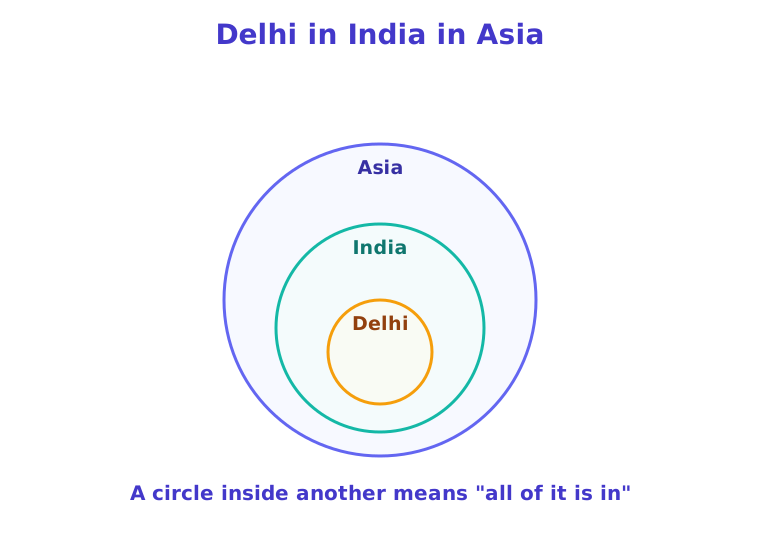
A circle inside another means every member of the inner class belongs to the outer class.
Overlapping circles mean some members are common, but not all.
Separate circles mean the classes have nothing in common.
For three classes, decide each of the three pairs first, then put the picture together.
A three-circle diagram has 7 regions inside the circles.
"Exactly two" leaves out the centre; "at least two" includes it.
Two sets: at least one = A + B − both; total = at least one + neither.
Least possible overlap of p% and q% is p + q − 100 (if positive); greatest is the smaller of p and q.
Full explanation
The sports survey

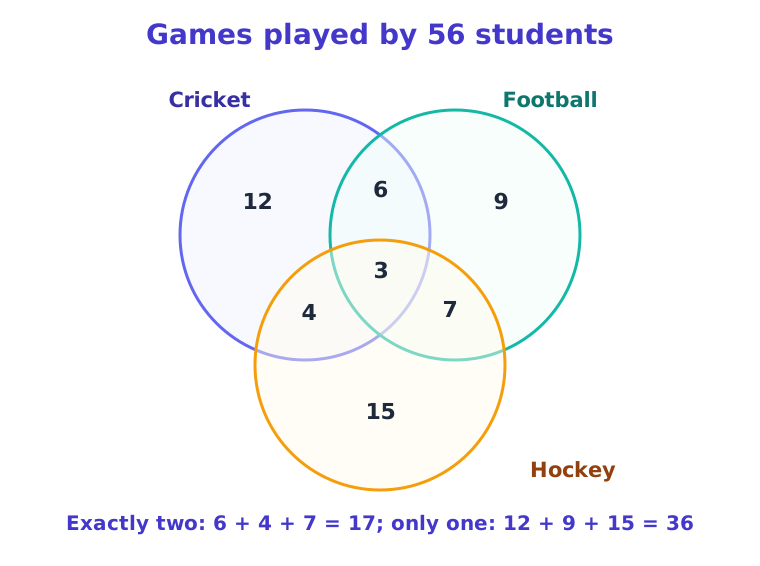
The sports teacher of a school in Indore asked 56 students which games they play: cricket, football or hockey. Many play more than one. How can she see, at a glance, who plays what? She draws three circles, one for each game. This topic is about such pictures.
Circles stand for classes
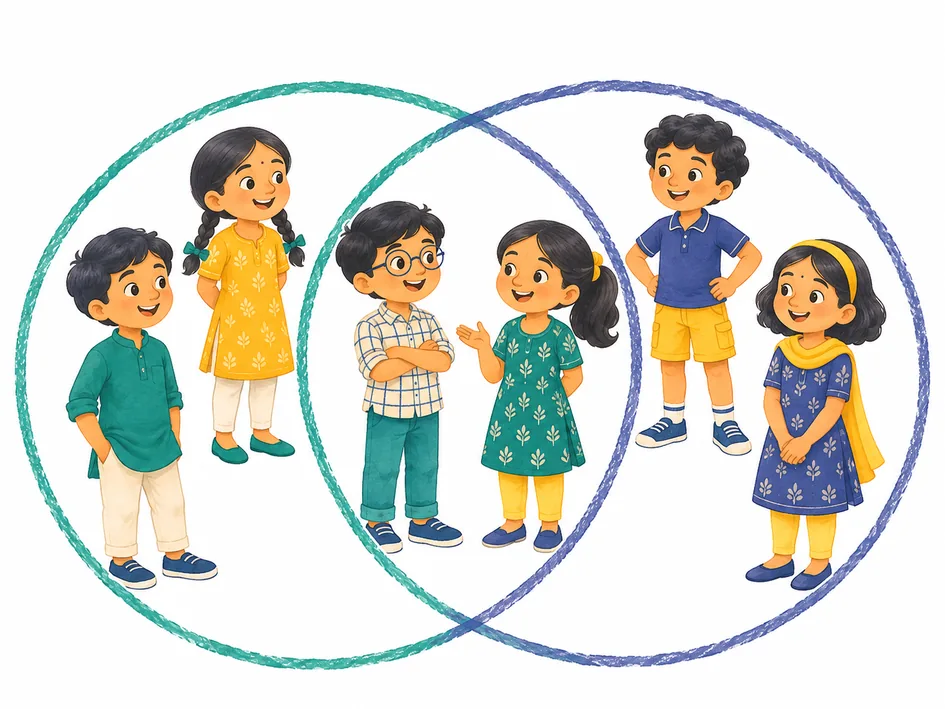
Each circle is a class (a group of things). How two circles sit tells how the classes are related:
- Inside: every member of one class is in the other (all dogs are animals).
- Overlapping: some members are common (some women are doctors).
- Apart: nothing in common (no pen is a river).
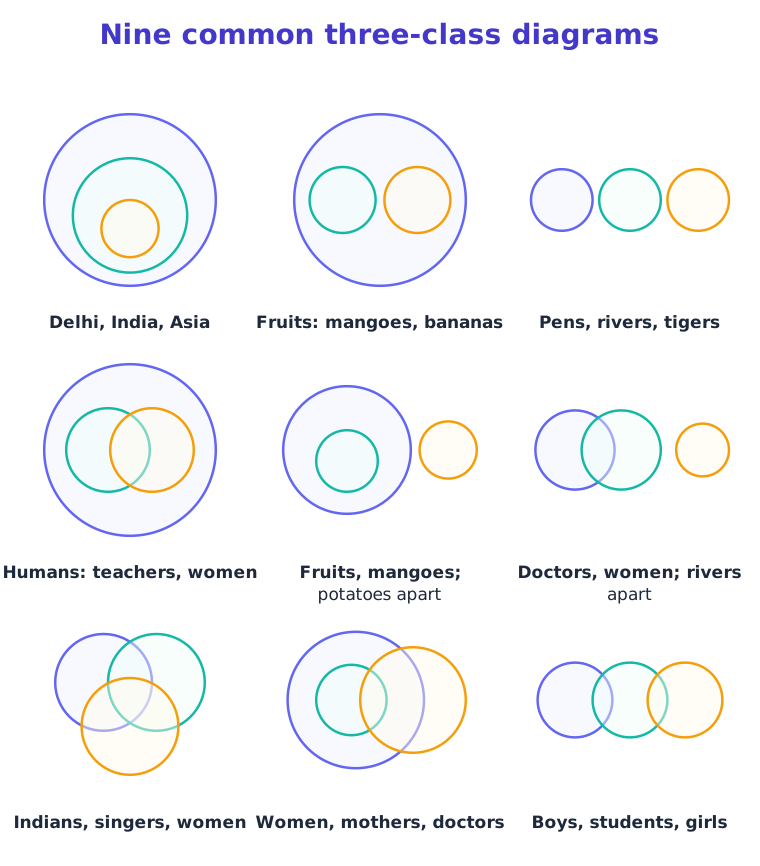
Three classes, nine pictures
With three classes there are only a few common pictures. Learn to recognise them; the exam will draw four and ask which one fits.
How to choose the diagram
- Take the classes two at a time: inside, overlapping or apart?
- Check the three pairs.
- Ask whether anything can belong to all three.
- Pick the picture that has exactly those parts, no more and no less.
A diagram with an extra region is as wrong as one with a missing region.
Worked example
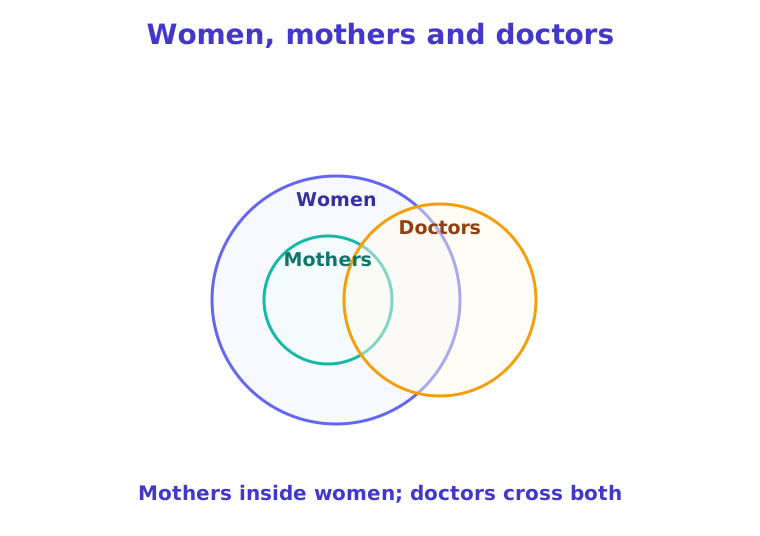
Women, Mothers, Doctors. Every mother is a woman: Mothers inside Women. Some doctors are women and some are not: Doctors cross Women. Some doctors are mothers, but not all mothers are doctors: Doctors cross Mothers too. So we need a circle inside another, with a third circle crossing both.
Reading numbers from a diagram
When each region has a number, every question is "which regions do I add?"
- Only cricket: the outer part of the cricket circle.
- Exactly two games: the three parts where two circles meet, without the centre.
- At least two: those three parts and the centre.
- Total: every region once.
Two sets: the counting rule
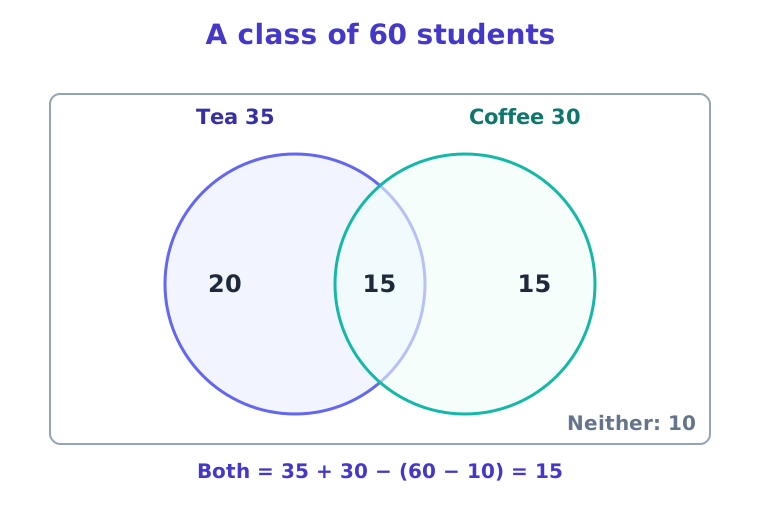
If 35 students drink tea and 30 drink coffee, the 65 counts the "both" group twice. So
$$n(T\cup C)=n(T)+n(C)-n(T\cap C)$$
With a "neither" group: total = at least one + neither. In a class of 60 with 10 who drink neither, at least one = 50, so both = 35 + 30 − 50 = 15.
Three sets
$$n(A\cup B\cup C)=A+B+C-(AB+BC+CA)+ABC$$
Subtracting the three pairs removes the "all three" group three times after adding it three times, so it must be added back once. "Only A" = A − AB − AC + ABC.
Least and greatest overlap
If 70% read Hindi and 60% read English, the two groups add to 130%, so at least 30% must read both. The overlap can be at most 60%, the smaller group, when all English readers also read Hindi.
Traps to avoid
- Dogs and cats are apart, not overlapping.
- "Exactly two" does not include the centre.
- Forgetting the "neither" group.
- Adding circle totals to get the number of people.
Back to the survey
The teacher read her diagram: 17 students play exactly two games, 36 play only one, and 3 play all three. Three circles answered every question she had.
Concepts and terms
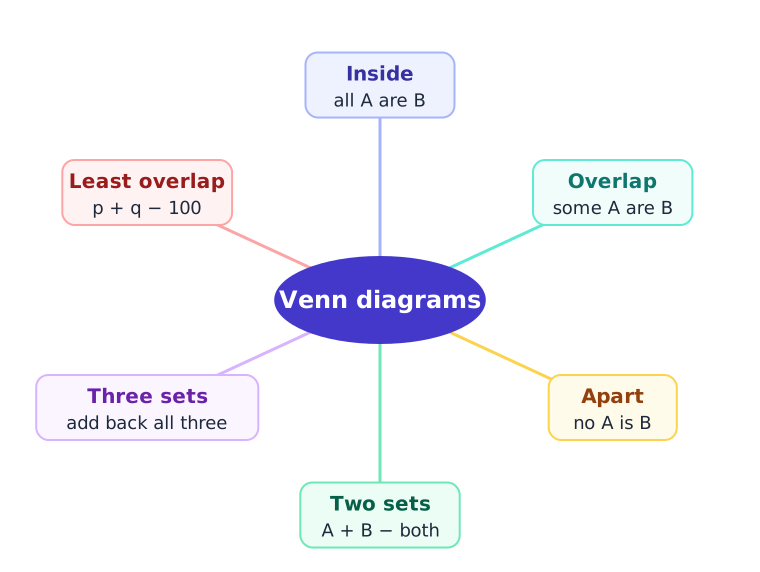
One inside the other (all A are B), overlapping (some A are B), or apart (no A is B).
Each region of a diagram is one combination of "in" and "out" of the circles; three circles make 7 regions inside.
Add the groups, subtract what was counted twice, and add back what was subtracted too often.

Did you know
John Venn, an English logician, introduced these diagrams in 1880 to show how classes in an argument are related.

Memory tricks
Two-set rule — Add both, take the overlap once — The overlap sits in both counts.
Exactly vs at least — Exactly: no centre. At least: with centre. — The centre is where all three meet.
Practice MCQs with answers (79)
- A 1
- B 2
- C 3
- D 4
Show answer
Why:
All multiples of 4 are even numbers and all even numbers are natural numbers: three circles one inside another. That is diagram (3).
- A 1
- B 2
- C 3
- D 4
Show answer
Why:
Crows and sparrows both lie inside birds, but none of the crows are sparrows: two separate circles inside a big one. That is diagram (2).
- A 1
- B 2
- C 3
- D 4
Show answer
Why:
No two of them have anything in common: three separate circles. That is diagram (4).
- A 1
- B 2
- C 3
- D 4
Show answer
Why:
Even numbers and multiples of 3 both lie inside natural numbers, and some even numbers are multiples of 3: two overlapping circles inside a big one. That is diagram (1).
- A 1
- B 2
- C 3
- D 4
Show answer
Why:
All multiples of 4 are even numbers, and odd numbers have nothing in common with either: one circle inside another, a third apart. That is diagram (1).
- A 1
- B 2
- C 3
- D 4
Show answer
Why:
Some doctors are women, and rivers are unrelated to both: two overlapping circles and one apart. That is diagram (3).
- A 1
- B 2
- C 3
- D 4
Show answer
Why:
Each pair overlaps and some belong to all three: three mutually overlapping circles. That is diagram (4).
- A 1
- B 2
- C 3
- D 4
Show answer
Why:
All multiples of 4 are even numbers, and some multiples of 3 are multiples of 4, some are other even numbers, some are neither: a circle inside another, crossed by a third. That is diagram (2).
- A 1
- B 2
- C 3
- D 4
Show answer
Why:
Some boys are students and some students are girls, but none of the boys are girls: a chain of three circles. That is diagram (4).
- A 1
- B 2
- C 3
- D 4
Show answer
Why:
Buses and trucks both lie inside vehicles, but none of the buses are trucks: two separate circles inside a big one. That is diagram (3).
- A 1
- B 2
- C 3
- D 4
Show answer
Why:
All cricketers are players, and some students are cricketers, some are other players, some are neither: a circle inside another, crossed by a third. That is diagram (1).
- A 1
- B 2
- C 3
- D 4
Show answer
Why:
Some men are doctors and some doctors are women, but none of the men are women: a chain of three circles. That is diagram (2).
- A 67
- B 44
- C 43
- D 35
Show answer
Why:
They are in exactly one region of the figure, the one marked 35. Adding the centre (8) would also count those who do all three.
- A 87
- B 95
- C 67
- D 111
Show answer
Why:
Exactly two means the three regions where two circles meet, without the centre: 18 + 35 + 34 = 87.
- A 115
- B 109
- C 32
- D 101
Show answer
Why:
Add all four parts of circle Hockey: 32 + 35 + 34 + 8 = 109.
- A 75
- B 95
- C 67
- D 87
Show answer
Why:
Only one means the three outer parts: 6 + 29 + 32 = 67.
- A 55
- B 3
- C 79
- D 30
Show answer
Why:
Take circle Tamil and leave out every part inside English: 3 + 27 = 30.
- A 89
- B 64
- C 25
- D 59
Show answer
Why:
At least two means exactly two or all three: 13 + 27 + 24 + 25 = 89.
- A 212
- B 148
- C 262
- D 123
Show answer
Why:
Add each of the seven regions once: 30 + 26 + 3 + 13 + 27 + 24 + 25 = 148. Adding the three circle totals counts the overlaps more than once.
- A 95
- B 39
- C 13
- D 38
Show answer
Why:
They are in exactly one region of the figure, the one marked 13. Adding the centre (25) would also count those who do all three.
- A 75
- B 101
- C 33
- D 62
Show answer
Why:
Exactly two means the three regions where two circles meet, without the centre: 29 + 28 + 5 = 62.
- A 29
- B 87
- C 43
- D 42
Show answer
Why:
They are in exactly one region of the figure, the one marked 29. Adding the centre (13) would also count those who do all three.
- A 87
- B 46
- C 59
- D 17
Show answer
Why:
Take circle Swim and leave out every part inside Dance: 17 + 29 = 46.
- A 92
- B 10
- C 57
- D 44
Show answer
Why:
Add all four parts of circle Sing: 10 + 29 + 5 + 13 = 57.
- A 64
- B 95
- C 94
- D 65
Show answer
Why:
Only one means the three outer parts: 27 + 17 + 21 = 65.
- A 94
- B 65
- C 64
- D 30
Show answer
Why:
At least two means exactly two or all three: 33 + 28 + 3 + 30 = 94.
- A 64
- B 33
- C 63
- D 118
Show answer
Why:
They are in exactly one region of the figure, the one marked 33. Adding the centre (30) would also count those who do all three.
- A 283
- B 129
- C 159
- D 223
Show answer
Why:
Add each of the seven regions once: 27 + 17 + 21 + 33 + 28 + 3 + 30 = 159. Adding the three circle totals counts the overlaps more than once.
- A 84
- B 29
- C 115
- D 50
Show answer
Why:
Take circle Football and leave out every part inside Cricket: 29 + 21 = 50.
- A 158
- B 286
- C 124
- D 218
Show answer
Why:
Add each of the seven regions once: 11 + 29 + 24 + 31 + 8 + 21 + 34 = 158. Adding the three circle totals counts the overlaps more than once.
- A 60
- B 94
- C 34
- D 64
Show answer
Why:
At least two means exactly two or all three: 31 + 8 + 21 + 34 = 94.
- A 115
- B 56
- C 21
- D 55
Show answer
Why:
They are in exactly one region of the figure, the one marked 21. Adding the centre (34) would also count those who do all three.
- A L
- B E
- C C
- D J
Show answer
Why:
They are inside Swim and Sing and Dance: region J.
- A E
- B A
- C M
- D J
Show answer
Why:
They are inside Swim and Sing and outside Dance: region E.
- A L
- B A
- C E
- D M
Show answer
Why:
They are inside Sing and outside Swim and Dance: region A.
- A G
- B N
- C F
- D M
Show answer
Why:
They are inside Hindi and English and outside Tamil: region F.
- A L
- B F
- C M
- D G
Show answer
Why:
They are inside Hindi and outside English and Tamil: region G.
- A L
- B A
- C G
- D N
Show answer
Why:
They are inside Hindi and Tamil and outside English: region L.
- A F
- B M
- C N
- D G
Show answer
Why:
They are inside Tea and outside Coffee and Milk: region M.
- A F
- B E
- C N
- D M
Show answer
Why:
They are inside Tea and Coffee and outside Milk: region N.
- A G
- B H
- C N
- D E
Show answer
Why:
They are inside Tea and Coffee and Milk: region E.
- A 11
- B 10
- C 33
- D 23
Show answer
Why:
At least one: 45 − 12 = 33. Both = 23 + 21 − 33 = 11. Forgetting the 12 who do neither gives -1.
- A 13
- B 10
- C 32
- D 23
Show answer
Why:
At least one: 22 + 35 − 13 = 44. Neither = 54 − 44 = 10.
- A 24
- B 39
- C 15
- D 23
Show answer
Why:
Only the first group = 23 − 8 = 15: the 8 who play both are inside the 23 as well.
- A 51
- B 37
- C 29
- D 40
Show answer
Why:
Total = 29 + 19 − 11 + 3 = 40. The 11 are counted in both 29 and 19, so subtract them once.
- A 21
- B 71
- C 35
- D 7
Show answer
Why:
At least one: 85 − 14 = 71. Both = 43 + 49 − 71 = 21. Forgetting the 14 who do neither gives 7.
- A 24
- B 13
- C 35
- D 37
Show answer
Why:
At least one: 41 + 46 − 24 = 63. Neither = 76 − 63 = 13.
- A 59
- B 52
- C 29
- D 30
Show answer
Why:
Only the first group = 52 − 23 = 29: the 23 who drink both are inside the 52 as well.
- A 60
- B 94
- C 63
- D 77
Show answer
Why:
Total = 35 + 45 − 17 + 14 = 77. The 17 are counted in both 35 and 45, so subtract them once.
- A 6
- B 18
- C 24
- D 48
Show answer
Why:
At least one: 60 − 12 = 48. Both = 24 + 30 − 48 = 6. Forgetting the 12 who do neither gives -6.
- A 22
- B 6
- C 16
- D 32
Show answer
Why:
At least one: 32 + 42 − 16 = 58. Neither = 64 − 58 = 6.
- A 42
- B 14
- C 21
- D 35
Show answer
Why:
Only the first group = 42 − 21 = 21: the 21 who drink both are inside the 42 as well.
- A 64
- B 61
- C 91
- D 76
Show answer
Why:
Total = 45 + 34 − 15 + 12 = 76. The 15 are counted in both 45 and 34, so subtract them once.
- A 24
- B 50
- C 29
- D 19
Show answer
Why:
At least one: 55 − 5 = 50. Both = 33 + 41 − 50 = 24. Forgetting the 5 who do neither gives 19.
- A 22
- B 8
- C 31
- D 30
Show answer
Why:
At least one: 42 + 45 − 22 = 65. Neither = 73 − 65 = 8.
- A 201
- B 126
- C 104
- D 82
Show answer
Why:
71 + 61 + 69 − 41 − 38 − 40 + 22 = 104. Subtracting the three pairs removes the "all three" group completely, so add 22 back.
- A 51
- B 17
- C 29
- D 23
Show answer
Why:
Only A = 84 − 33 − 34 + 6 = 23. The 6 who read all three are inside both 33 and 34, so they were taken away twice.
- A 52
- B 139
- C 110
- D 81
Show answer
Why:
Each pair count includes the 29 who read all three: 49 + 48 + 42 − 3 × 29 = 52.
- A 173
- B 115
- C 119
- D 111
Show answer
Why:
50 + 61 + 62 − 21 − 26 − 15 + 4 = 115. Subtracting the three pairs removes the "all three" group completely, so add 4 back.
- A 44
- B 8
- C 27
- D 46
Show answer
Why:
Only A = 81 − 37 − 36 + 19 = 27. The 19 who read all three are inside both 37 and 36, so they were taken away twice.
- A 87
- B 82
- C 77
- D 72
Show answer
Why:
Each pair count includes the 5 who read all three: 26 + 32 + 29 − 3 × 5 = 72.
- A 132
- B 104
- C 247
- D 160
Show answer
Why:
98 + 85 + 64 − 58 − 35 − 50 + 28 = 132. Subtracting the three pairs removes the "all three" group completely, so add 28 back.
- A 45
- B 18
- C 41
- D 23
Show answer
Why:
Only A = 73 − 50 − 28 + 23 = 18. The 23 who read all three are inside both 50 and 28, so they were taken away twice.
- A 35%
- B 15%
- C 20%
- D 50%
Show answer
Why:
The two groups must share at least 85% + 35% − 100% = 20%, because together they cannot pass 100%.
- A 10%
- B 40%
- C 25%
- D 65%
Show answer
Why:
The overlap cannot be bigger than the smaller group: at most 65% (when the smaller group lies inside the bigger one).
- A 30%
- B 45%
- C 15%
- D 40%
Show answer
Why:
The two groups must share at least 85% + 45% − 100% = 30%, because together they cannot pass 100%.
- A 20%
- B 35%
- C 45%
- D 15%
Show answer
Why:
The overlap cannot be bigger than the smaller group: at most 35% (when the smaller group lies inside the bigger one).
- A 15%
- B 40%
- C 30%
- D 45%
Show answer
Why:
The two groups must share at least 85% + 45% − 100% = 30%, because together they cannot pass 100%.
- A 10%
- B 20%
- C 50%
- D 30%
Show answer
Why:
The overlap cannot be bigger than the smaller group: at most 30% (when the smaller group lies inside the bigger one).
- A 7
- B 3
- C 6
- D 8
Show answer
Why:
3 "only" parts, 3 "exactly two" parts and 1 centre: 3 + 3 + 1 = 7.
- A Mangoes and fruits
- B Dogs and cats
- C Teachers and singers
- D Women and doctors
Show answer
Why:
No dog is a cat, so the circles do not touch. Women–doctors and teachers–singers overlap; mangoes lie inside fruits.
- A Pens and rivers
- B Boys and girls
- C Parrots and birds
- D Doctors and women
Show answer
Why:
Every parrot is a bird, so the parrot circle lies inside the bird circle.
- A 15
- B 3
- C 47
- D 7
Show answer
Why:
25 + 22 − 40 = 7.
- A 23
- B 18
- C 28
- D 33
Show answer
Why:
8 + 6 + 4 + 5 = 23. Without the centre it would be "exactly two" (18).
- A Some P are R
- B No P is an R
- C All P are R
- D All R are P
Show answer
Why:
P lies inside Q, and Q is apart from R, so P is apart from R too.
- A Both A and R are true, and R is the correct explanation of A
- B Both A and R are true, but R is not the correct explanation of A
- C A is true but R is false
- D A is false but R is true
Show answer
Why:
Both true, and R is exactly why the circles do not touch.
- A Both A and R are true, and R is the correct explanation of A
- B Both A and R are true, but R is not the correct explanation of A
- C A is true but R is false
- D A is false but R is true
Show answer
Why:
Both true, but the reason Mothers lie inside Women is that every mother is a woman, not that some doctors are mothers.
- A 1 only
- B 2 only
- C Both 1 and 2
- D Neither 1 nor 2
Show answer
Why:
Both = 30 + 28 − 50 = 8, and only tea = 30 − 8 = 22.
- A 1 only
- B 2 only
- C Both 1 and 2
- D Neither 1 nor 2
Show answer
Why:
3 + 3 + 1 = 7 regions; the centre belongs to all three, so it is not "exactly two".
Important short questions (3)
Both are animals, so both lie inside; no dog is a cat, so the two do not touch.
Exactly two is the three regions where two circles meet; at least two adds the centre, where all three meet.
At least one = 40 − 5 = 35. Both = 25 + 20 − 35 = 10.
Long answer questions (1)
(a) 52 + 45 + 40 − 18 − 15 − 12 + 7 = 99. (b) 52 − 18 − 12 + 7 = 29. (c) 100 − 99 = 1.
Flashcards (12)
Play this topic
- Circles quiz
Data Sufficiency
Decide whether the given statements are enough to answer a question, without solving it fully: test statement I alone, statement II alone, and only then both together; one sure answer, even a sure "no", means sufficient.
What you will be able to do
- I can state the five standard answers of a data sufficiency question.
- I can test each statement alone without borrowing facts from the other.
- I can list the possible answers a statement allows and decide if only one remains.
- I can handle yes/no questions, where a sure "no" is also sufficient.
Key points
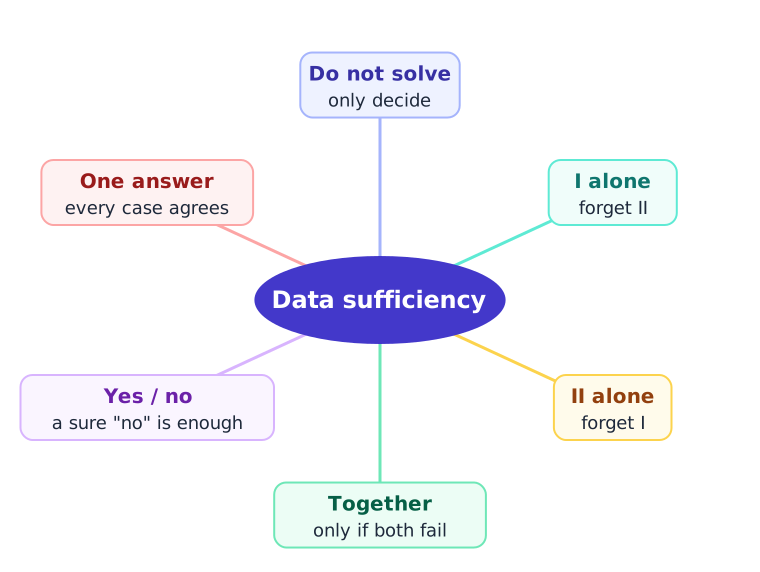
You do not need the final answer, only whether it can be found.
Test statement I alone first, then statement II alone, as if the other were not there.
Combine the statements only if neither alone is sufficient.
Sufficient means exactly one possible answer remains.
For a yes/no question, a definite "no" is as good as a definite "yes".
Never use outside facts that the question does not give.
The usual answer order: I alone, II alone, either alone, both together, not even both.
Full explanation
Enough to decide?
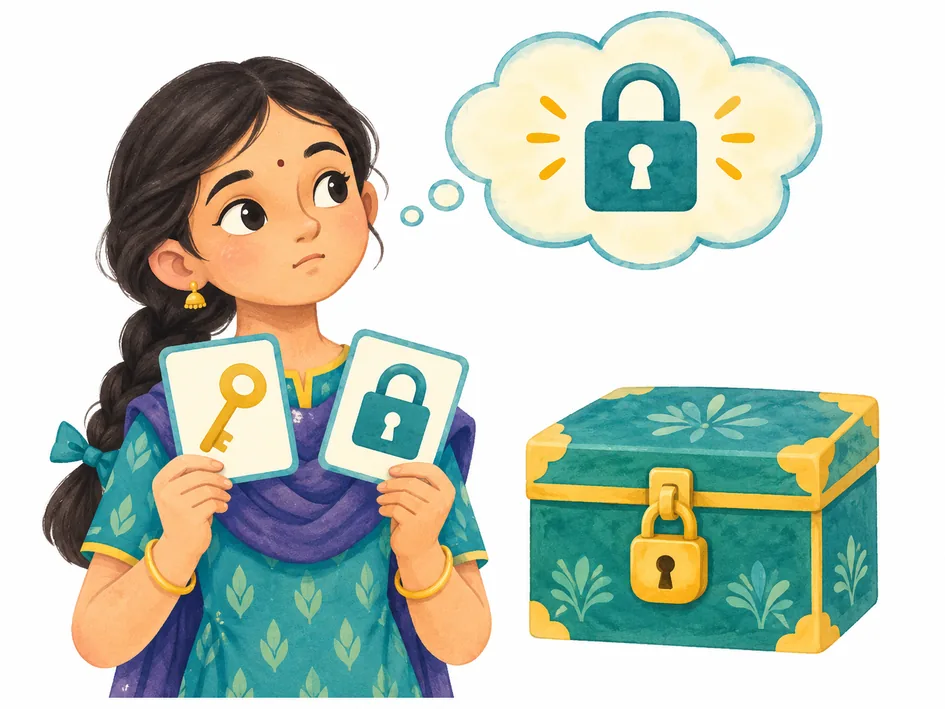
Inspector Meena has two clues about a theft at a Jaipur shop. Before she knocks on anyone's door, she asks one question: do these clues point to exactly one suspect? She does not need the full story yet, only whether her clues are enough. That is what a data sufficiency question asks you.
What the question asks
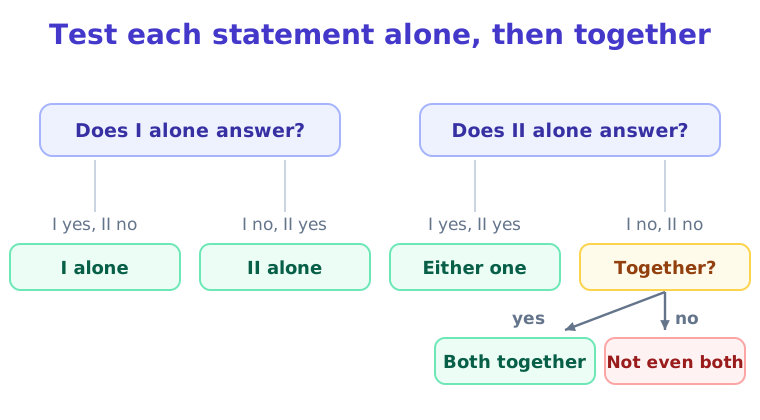
You get a question and two statements, I and II. Decide:
- I alone is sufficient, but II alone is not.
- II alone is sufficient, but I alone is not.
- Either statement alone is sufficient.
- Both together are sufficient, but neither alone is.
- Even both together are not sufficient.
The exam gives four or five of these in this order.
The method
- Read the question and note what kind of answer it needs (a day, a number, a name, yes or no).
- Take statement I alone. List the answers it allows. One answer means sufficient.
- Take statement II alone, forgetting I completely. Do the same.
- Only if both fail, combine them.
Worked example: a day
On which day of a Monday-to-Sunday week is Ravi's exam?
I. The exam is after Wednesday. II. The exam is on either Monday or Thursday.
I alone: Thursday, Friday, Saturday or Sunday. Not sufficient. II alone: Monday or Thursday. Not sufficient. Together: only Thursday. Both together are sufficient.
A sure "no" is enough
Question: $x$ is a whole number from 1 to 60. Is $x$ even?
I. $x$ is a multiple of 4. II. $x$ is a multiple of 3.
I alone: every multiple of 4 is even, so the answer is always "yes": sufficient. II alone: 6 is even but 9 is not: not sufficient. Answer: I alone.
If a statement said "$x$ is odd", the answer would always be "no", and that is sufficient too.
Numbers: list the values
For "What is $x$?", write the values each statement allows. "$x$ is a multiple of 12" allows 12, 24, 36 and 48: four values, not sufficient. "$x$ is a multiple of 12 and lies between 30 and 40" allows only 36.
Rankings, directions and codes
- Ranking: "A is taller than B" alone rarely fixes the tallest of five; look for a clue that places someone at the top.
- Direction: "R is north of Q" without a distance, and "P is 3 km from R" without a direction, each leave many places.
- Codes: a word is decoded only when it is the single common word of two sentences.
Seating with a picture
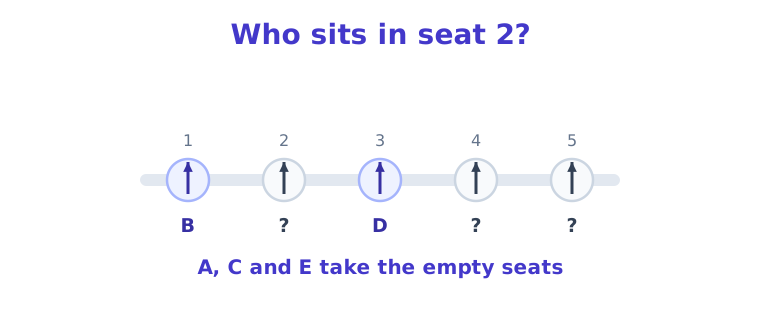
B sits in seat 1 and D in seat 3; A, C and E take seats 2, 4 and 5. Who sits in seat 2?
I. E sits at one of the ends. II. A sits somewhere to the right of C.
I alone: E is in seat 5, so seat 2 is A or C. Not sufficient. II alone: C is left of A, so seat 2 could be C or E. Not sufficient. Together: E in 5, so C and A take seats 2 and 4 with C on the left: C in seat 2. Both together.
Traps
- Do not let statement I "help" while you judge II alone.
- A definite "no" is sufficient.
- Check that no second answer fits before you say sufficient.
- Use only what the question gives.
Back to the inspector
Inspector Meena's first clue left three suspects and her second left two, but together they named one person. "Both together are sufficient," she said, and went to make her arrest.
Concepts and terms
Data are sufficient when every case they allow gives the same answer.
While judging II alone, forget everything statement I said.
A statement that always gives "no" answers the question; one that gives "yes" in some cases and "no" in others does not.
Did you know
Data sufficiency first became famous through the GMAT; Indian bank exams such as IBPS PO and SBI PO now ask 3 to 5 such questions.
Memory tricks
Order of testing — One, Two, Then Together — I alone, II alone, both only if needed.
Practice MCQs with answers (71)
- A Statement I alone is sufficient, but II alone is not
- B Either statement alone is sufficient
- C Both together are sufficient, but neither alone is
- D Even both together are not sufficient
Show answer
Why:
Statement I alone: the answer must be Friday, so it is sufficient. Statement II alone: the answer could be any of 5 possibilities, such as Wednesday and Thursday, so it is not sufficient.
- A Statement I alone is sufficient, but II alone is not
- B Statement II alone is sufficient, but I alone is not
- C Both together are sufficient, but neither alone is
- D Even both together are not sufficient
Show answer
Why:
Statement I alone: the answer could be Wednesday or Sunday, so it is not sufficient. Statement II alone: the answer must be Sunday, so it is sufficient.
- A Statement I alone is sufficient, but II alone is not
- B Statement II alone is sufficient, but I alone is not
- C Either statement alone is sufficient
- D Even both together are not sufficient
Show answer
Why:
Statement I alone: the answer must be Tuesday, so it is sufficient. Statement II alone: the answer must be Tuesday, so it is sufficient.
- A Statement I alone is sufficient, but II alone is not
- B Statement II alone is sufficient, but I alone is not
- C Either statement alone is sufficient
- D Both together are sufficient, but neither alone is
Show answer
Why:
Statement I alone: the answer could be Tuesday or Friday, so it is not sufficient. Statement II alone: the answer could be Wednesday or Friday, so it is not sufficient. Both together: the answer must be Friday, so they are sufficient.
- A Statement II alone is sufficient, but I alone is not
- B Either statement alone is sufficient
- C Both together are sufficient, but neither alone is
- D Even both together are not sufficient
Show answer
Why:
Statement I alone: the answer could be Monday or Tuesday, so it is not sufficient. Statement II alone: the answer could be Monday or Tuesday, so it is not sufficient. Both together: the answer could be Monday or Tuesday, so they are still not sufficient.
- A Statement I alone is sufficient, but II alone is not
- B Either statement alone is sufficient
- C Both together are sufficient, but neither alone is
- D Even both together are not sufficient
Show answer
Why:
Statement I alone: the answer must be Saturday, so it is sufficient. Statement II alone: the answer could be Saturday or Sunday, so it is not sufficient.
- A Statement I alone is sufficient, but II alone is not
- B Statement II alone is sufficient, but I alone is not
- C Both together are sufficient, but neither alone is
- D Even both together are not sufficient
Show answer
Why:
Statement I alone: the answer could be Monday or Wednesday, so it is not sufficient. Statement II alone: the answer must be Wednesday, so it is sufficient.
- A Statement I alone is sufficient, but II alone is not
- B Statement II alone is sufficient, but I alone is not
- C Either statement alone is sufficient
- D Even both together are not sufficient
Show answer
Why:
Statement I alone: the answer must be Monday, so it is sufficient. Statement II alone: the answer must be Monday, so it is sufficient.
- A Statement II alone is sufficient, but I alone is not
- B Either statement alone is sufficient
- C Both together are sufficient, but neither alone is
- D Even both together are not sufficient
Show answer
Why:
Statement I alone: the answer could be any of 5 possibilities, such as Wednesday and Thursday, so it is not sufficient. Statement II alone: the answer could be Monday, Tuesday or Wednesday, so it is not sufficient. Both together: the answer must be Wednesday, so they are sufficient.
- A Statement II alone is sufficient, but I alone is not
- B Either statement alone is sufficient
- C Both together are sufficient, but neither alone is
- D Even both together are not sufficient
Show answer
Why:
Statement I alone: the answer could be any of 6 possibilities, such as Monday and Tuesday, so it is not sufficient. Statement II alone: the answer could be any of 6 possibilities, such as Monday and Tuesday, so it is not sufficient. Both together: the answer could be any of 5 possibilities, such as Monday and Tuesday, so they are still not sufficient.
- A Statement I alone is sufficient, but II alone is not
- B Either statement alone is sufficient
- C Both together are sufficient, but neither alone is
- D Even both together are not sufficient
Show answer
Why:
Statement I alone: the answer must be Saturday, so it is sufficient. Statement II alone: the answer could be any of 6 possibilities, such as Monday and Tuesday, so it is not sufficient.
- A Statement I alone is sufficient, but II alone is not
- B Statement II alone is sufficient, but I alone is not
- C Both together are sufficient, but neither alone is
- D Even both together are not sufficient
Show answer
Why:
Statement I alone: the answer could be Tuesday or Saturday, so it is not sufficient. Statement II alone: the answer must be Tuesday, so it is sufficient.
- A Statement II alone is sufficient, but I alone is not
- B Either statement alone is sufficient
- C Both together are sufficient, but neither alone is
- D Even both together are not sufficient
Show answer
Why:
Statement I alone: the answer must be 59, so it is sufficient. Statement II alone: the answer must be 59, so it is sufficient.
- A Statement II alone is sufficient, but I alone is not
- B Either statement alone is sufficient
- C Both together are sufficient, but neither alone is
- D Even both together are not sufficient
Show answer
Why:
Statement I alone: the answer could be any of 8 possibilities, such as 6 and 13, so it is not sufficient. Statement II alone: the answer could be any of 6 possibilities, such as 5 and 14, so it is not sufficient. Both together: the answer must be 41, so they are sufficient.
- A Statement II alone is sufficient, but I alone is not
- B Either statement alone is sufficient
- C Both together are sufficient, but neither alone is
- D Even both together are not sufficient
Show answer
Why:
Statement I alone: the answer could be any of 12 possibilities, such as 5 and 10, so it is not sufficient. Statement II alone: the answer could be any of 52 possibilities, such as 1 and 2, so it is not sufficient. Both together: the answer could be any of 11 possibilities, such as 5 and 10, so they are still not sufficient.
- A Statement I alone is sufficient, but II alone is not
- B Either statement alone is sufficient
- C Both together are sufficient, but neither alone is
- D Even both together are not sufficient
Show answer
Why:
Statement I alone: the answer must be 34, so it is sufficient. Statement II alone: the answer could be any of 45 possibilities, such as 1 and 2, so it is not sufficient.
- A Statement I alone is sufficient, but II alone is not
- B Statement II alone is sufficient, but I alone is not
- C Both together are sufficient, but neither alone is
- D Even both together are not sufficient
Show answer
Why:
Statement I alone: the answer could be any of 5 possibilities, such as 12 and 24, so it is not sufficient. Statement II alone: the answer must be 12, so it is sufficient.
- A Statement I alone is sufficient, but II alone is not
- B Statement II alone is sufficient, but I alone is not
- C Either statement alone is sufficient
- D Even both together are not sufficient
Show answer
Why:
Statement I alone: the answer must be 58, so it is sufficient. Statement II alone: the answer must be 58, so it is sufficient.
- A Statement II alone is sufficient, but I alone is not
- B Either statement alone is sufficient
- C Both together are sufficient, but neither alone is
- D Even both together are not sufficient
Show answer
Why:
Statement I alone: the answer could be any of 6 possibilities, such as 8 and 17, so it is not sufficient. Statement II alone: the answer could be any of 8 possibilities, such as 5 and 12, so it is not sufficient. Both together: the answer must be 26, so they are sufficient.
- A Statement II alone is sufficient, but I alone is not
- B Either statement alone is sufficient
- C Both together are sufficient, but neither alone is
- D Even both together are not sufficient
Show answer
Why:
Statement I alone: the answer could be "no" or "yes", so it is not sufficient. Statement II alone: the answer could be "no" or "yes", so it is not sufficient. Both together: the answer could be "no" or "yes", so they are still not sufficient.
- A Statement I alone is sufficient, but II alone is not
- B Either statement alone is sufficient
- C Both together are sufficient, but neither alone is
- D Even both together are not sufficient
Show answer
Why:
Statement I alone: the answer must be "yes", so it is sufficient. Statement II alone: the answer could be "no" or "yes", so it is not sufficient.
- A Statement I alone is sufficient, but II alone is not
- B Statement II alone is sufficient, but I alone is not
- C Both together are sufficient, but neither alone is
- D Even both together are not sufficient
Show answer
Why:
Statement I alone: the answer could be "no" or "yes", so it is not sufficient. Statement II alone: the answer must be "no", so it is sufficient.
- A Statement I alone is sufficient, but II alone is not
- B Statement II alone is sufficient, but I alone is not
- C Either statement alone is sufficient
- D Even both together are not sufficient
Show answer
Why:
Statement I alone: the answer must be "yes", so it is sufficient. Statement II alone: the answer must be "yes", so it is sufficient.
- A Statement I alone is sufficient, but II alone is not
- B Statement II alone is sufficient, but I alone is not
- C Either statement alone is sufficient
- D Both together are sufficient, but neither alone is
Show answer
Why:
Statement I alone: the answer could be "no" or "yes", so it is not sufficient. Statement II alone: the answer could be "no" or "yes", so it is not sufficient. Both together: the answer must be "no", so they are sufficient.
- A Statement II alone is sufficient, but I alone is not
- B Either statement alone is sufficient
- C Both together are sufficient, but neither alone is
- D Even both together are not sufficient
Show answer
Why:
Statement I alone: the answer could be "no" or "yes", so it is not sufficient. Statement II alone: the answer could be "no" or "yes", so it is not sufficient. Both together: the answer could be "no" or "yes", so they are still not sufficient.
- A Statement I alone is sufficient, but II alone is not
- B Either statement alone is sufficient
- C Both together are sufficient, but neither alone is
- D Even both together are not sufficient
Show answer
Why:
Statement I alone: the answer must be P, so it is sufficient. Statement II alone: the answer could be A, M, P or Q, so it is not sufficient.
- A Statement II alone is sufficient, but I alone is not
- B Either statement alone is sufficient
- C Both together are sufficient, but neither alone is
- D Even both together are not sufficient
Show answer
Why:
Statement I alone: the answer could be "no" or "yes", so it is not sufficient. Statement II alone: the answer must be "yes", so it is sufficient.
- A Statement II alone is sufficient, but I alone is not
- B Either statement alone is sufficient
- C Both together are sufficient, but neither alone is
- D Even both together are not sufficient
Show answer
Why:
Statement I alone: the answer must be "yes", so it is sufficient. Statement II alone: the answer must be "yes", so it is sufficient.
- A Statement II alone is sufficient, but I alone is not
- B Either statement alone is sufficient
- C Both together are sufficient, but neither alone is
- D Even both together are not sufficient
Show answer
Why:
Statement I alone: the answer could be H, K or U, so it is not sufficient. Statement II alone: the answer could be C, U or V, so it is not sufficient. Both together: the answer must be U, so they are sufficient.
- A Statement II alone is sufficient, but I alone is not
- B Either statement alone is sufficient
- C Both together are sufficient, but neither alone is
- D Even both together are not sufficient
Show answer
Why:
Statement I alone: the answer could be "no" or "yes", so it is not sufficient. Statement II alone: the answer could be "no" or "yes", so it is not sufficient. Both together: the answer could be "no" or "yes", so they are still not sufficient.
- A Statement I alone is sufficient, but II alone is not
- B Either statement alone is sufficient
- C Both together are sufficient, but neither alone is
- D Even both together are not sufficient
Show answer
Why:
Statement I alone: the answer must be J, so it is sufficient. Statement II alone: the answer could be any of 5 possibilities, such as F and J, so it is not sufficient.
- A Statement I alone is sufficient, but II alone is not
- B Statement II alone is sufficient, but I alone is not
- C Both together are sufficient, but neither alone is
- D Even both together are not sufficient
Show answer
Why:
Statement I alone: the answer could be E, J, S or V, so it is not sufficient. Statement II alone: the answer must be E, so it is sufficient.
- A Statement I alone is sufficient, but II alone is not
- B Statement II alone is sufficient, but I alone is not
- C Either statement alone is sufficient
- D Even both together are not sufficient
Show answer
Why:
Statement I alone: the answer must be "yes", so it is sufficient. Statement II alone: the answer must be "yes", so it is sufficient.
- A Statement II alone is sufficient, but I alone is not
- B Either statement alone is sufficient
- C Both together are sufficient, but neither alone is
- D Even both together are not sufficient
Show answer
Why:
Statement I alone: the answer could be B, G, Q or T, so it is not sufficient. Statement II alone: the answer could be B, G or T, so it is not sufficient. Both together: the answer must be B, so they are sufficient.
- A Statement II alone is sufficient, but I alone is not
- B Either statement alone is sufficient
- C Both together are sufficient, but neither alone is
- D Even both together are not sufficient
Show answer
Why:
Statement I alone: the answer could be any of 5 possibilities, such as C and F, so it is not sufficient. Statement II alone: the answer could be any of 5 possibilities, such as C and F, so it is not sufficient. Both together: the answer could be G, K or W, so they are still not sufficient.
- A Statement I alone is sufficient, but II alone is not
- B Either statement alone is sufficient
- C Both together are sufficient, but neither alone is
- D Even both together are not sufficient
Show answer
Why:
Statement I alone: the answer must be south-west, so it is sufficient. Statement II alone: the answer could be any of 5 possibilities, such as east and north-west, so it is not sufficient.
- A Statement I alone is sufficient, but II alone is not
- B Statement II alone is sufficient, but I alone is not
- C Both together are sufficient, but neither alone is
- D Even both together are not sufficient
Show answer
Why:
Statement I alone: the answer could be any of 5 possibilities, such as east and north-east, so it is not sufficient. Statement II alone: the answer must be east, so it is sufficient.
- A Statement I alone is sufficient, but II alone is not
- B Statement II alone is sufficient, but I alone is not
- C Either statement alone is sufficient
- D Even both together are not sufficient
Show answer
Why:
Statement I alone: the answer must be east, so it is sufficient. Statement II alone: the answer must be east, so it is sufficient.
- A Statement II alone is sufficient, but I alone is not
- B Either statement alone is sufficient
- C Both together are sufficient, but neither alone is
- D Even both together are not sufficient
Show answer
Why:
Statement I alone: the answer could be east, north-east, south-east or the same point, so it is not sufficient. Statement II alone: the answer could be any of 5 possibilities, such as north and south, so it is not sufficient. Both together: the answer must be south-east, so they are sufficient.
- A Statement II alone is sufficient, but I alone is not
- B Either statement alone is sufficient
- C Both together are sufficient, but neither alone is
- D Even both together are not sufficient
Show answer
Why:
Statement I alone: the answer could be any of 5 possibilities, such as east and north-east, so it is not sufficient. Statement II alone: the answer could be any of 9 possibilities, such as east and north, so it is not sufficient. Both together: the answer could be east, north-east, south-east or west, so they are still not sufficient.
- A Statement I alone is sufficient, but II alone is not
- B Either statement alone is sufficient
- C Both together are sufficient, but neither alone is
- D Even both together are not sufficient
Show answer
Why:
Statement I alone: the answer must be south, so it is sufficient. Statement II alone: the answer could be any of 5 possibilities, such as north and south, so it is not sufficient.
- A Statement I alone is sufficient, but II alone is not
- B Statement II alone is sufficient, but I alone is not
- C Both together are sufficient, but neither alone is
- D Even both together are not sufficient
Show answer
Why:
Statement I alone: the answer could be any of 8 possibilities, such as east and north, so it is not sufficient. Statement II alone: the answer must be west, so it is sufficient.
- A Statement II alone is sufficient, but I alone is not
- B Either statement alone is sufficient
- C Both together are sufficient, but neither alone is
- D Even both together are not sufficient
Show answer
Why:
Statement I alone: the answer must be south-west, so it is sufficient. Statement II alone: the answer must be south-west, so it is sufficient.
- A Statement II alone is sufficient, but I alone is not
- B Either statement alone is sufficient
- C Both together are sufficient, but neither alone is
- D Even both together are not sufficient
Show answer
Why:
Statement I alone: the answer could be 'ti' or 'zu', so it is not sufficient. Statement II alone: the answer could be 'nu' or 'ti', so it is not sufficient. Both together: the answer must be 'ti', so they are sufficient.
- A Statement II alone is sufficient, but I alone is not
- B Either statement alone is sufficient
- C Both together are sufficient, but neither alone is
- D Even both together are not sufficient
Show answer
Why:
Statement I alone: the answer could be 'mo' or 'ti', so it is not sufficient. Statement II alone: the answer could be 'mo' or 'ti', so it is not sufficient. Both together: the answer could be 'mo' or 'ti', so they are still not sufficient.
- A Statement I alone is sufficient, but II alone is not
- B Either statement alone is sufficient
- C Both together are sufficient, but neither alone is
- D Even both together are not sufficient
Show answer
Why:
Statement I alone: the answer must be 'lo', so it is sufficient. Statement II alone: the answer could be 'ka' or 'lo', so it is not sufficient.
- A Statement I alone is sufficient, but II alone is not
- B Statement II alone is sufficient, but I alone is not
- C Both together are sufficient, but neither alone is
- D Even both together are not sufficient
Show answer
Why:
Statement I alone: the answer could be 'ra' or 'ti', so it is not sufficient. Statement II alone: the answer must be 'ti', so it is sufficient.
- A Statement II alone is sufficient, but I alone is not
- B Either statement alone is sufficient
- C Both together are sufficient, but neither alone is
- D Even both together are not sufficient
Show answer
Why:
Statement I alone: the answer must be 'pe', so it is sufficient. Statement II alone: the answer must be 'pe', so it is sufficient.
- A Statement I alone is sufficient, but II alone is not
- B Statement II alone is sufficient, but I alone is not
- C Either statement alone is sufficient
- D Both together are sufficient, but neither alone is
Show answer
Why:
Statement I alone: the answer could be 'nu' or 'si', so it is not sufficient. Statement II alone: the answer could be 'ka' or 'si', so it is not sufficient. Both together: the answer must be 'si', so they are sufficient.
- A Statement II alone is sufficient, but I alone is not
- B Either statement alone is sufficient
- C Both together are sufficient, but neither alone is
- D Even both together are not sufficient
Show answer
Why:
Statement I alone: the answer could be 'ka' or 'zu', so it is not sufficient. Statement II alone: the answer could be 'ka' or 'zu', so it is not sufficient. Both together: the answer could be 'ka' or 'zu', so they are still not sufficient.
- A Statement I alone is sufficient, but II alone is not
- B Either statement alone is sufficient
- C Both together are sufficient, but neither alone is
- D Even both together are not sufficient
Show answer
Why:
Statement I alone: the answer must be 'mo', so it is sufficient. Statement II alone: the answer could be 'mo' or 'ti', so it is not sufficient.
- A Statement II alone is sufficient, but I alone is not
- B Either statement alone is sufficient
- C Both together are sufficient, but neither alone is
- D Even both together are not sufficient
Show answer
Why:
Statement I alone: the answer could be any of 5 possibilities, such as 13 years and 26 years, so it is not sufficient. Statement II alone: the answer must be 39 years, so it is sufficient.
- A Statement II alone is sufficient, but I alone is not
- B Either statement alone is sufficient
- C Both together are sufficient, but neither alone is
- D Even both together are not sufficient
Show answer
Why:
Statement I alone: the answer must be 38 years, so it is sufficient. Statement II alone: the answer must be 38 years, so it is sufficient.
- A Statement II alone is sufficient, but I alone is not
- B Either statement alone is sufficient
- C Both together are sufficient, but neither alone is
- D Even both together are not sufficient
Show answer
Why:
Statement I alone: the answer could be any of 50 possibilities, such as 20 years and 21 years, so it is not sufficient. Statement II alone: the answer could be any of 58 possibilities, such as 1 year and 2 years, so it is not sufficient. Both together: the answer must be 39 years, so they are sufficient.
- A Statement II alone is sufficient, but I alone is not
- B Either statement alone is sufficient
- C Both together are sufficient, but neither alone is
- D Even both together are not sufficient
Show answer
Why:
Statement I alone: the answer could be any of 68 possibilities, such as 2 years and 3 years, so it is not sufficient. Statement II alone: the answer could be any of 61 possibilities, such as 1 year and 2 years, so it is not sufficient. Both together: the answer could be any of 30 possibilities, such as 32 years and 33 years, so they are still not sufficient.
- A Statement I alone is sufficient, but II alone is not
- B Either statement alone is sufficient
- C Both together are sufficient, but neither alone is
- D Even both together are not sufficient
Show answer
Why:
Statement I alone: the answer must be 20 years, so it is sufficient. Statement II alone: the answer could be any of 13 possibilities, such as 5 years and 10 years, so it is not sufficient.
- A Statement I alone is sufficient, but II alone is not
- B Statement II alone is sufficient, but I alone is not
- C Both together are sufficient, but neither alone is
- D Even both together are not sufficient
Show answer
Why:
Statement I alone: the answer could be any of 68 possibilities, such as 2 years and 3 years, so it is not sufficient. Statement II alone: the answer must be 41 years, so it is sufficient.
- A Statement II alone is sufficient, but I alone is not
- B Either statement alone is sufficient
- C Both together are sufficient, but neither alone is
- D Even both together are not sufficient
Show answer
Why:
Statement I alone: the answer must be U, so it is sufficient. Statement II alone: the answer must be U, so it is sufficient.
- A Statement II alone is sufficient, but I alone is not
- B Either statement alone is sufficient
- C Both together are sufficient, but neither alone is
- D Even both together are not sufficient
Show answer
Why:
Statement I alone: the answer could be C or M, so it is not sufficient. Statement II alone: the answer could be C or M, so it is not sufficient. Both together: the answer must be M, so they are sufficient.
- A Statement II alone is sufficient, but I alone is not
- B Either statement alone is sufficient
- C Both together are sufficient, but neither alone is
- D Even both together are not sufficient
Show answer
Why:
Statement I alone: the answer could be G, H or L, so it is not sufficient. Statement II alone: the answer could be G, H or L, so it is not sufficient. Both together: the answer could be H or L, so they are still not sufficient.
- A Statement I alone is sufficient, but II alone is not
- B Either statement alone is sufficient
- C Both together are sufficient, but neither alone is
- D Even both together are not sufficient
Show answer
Why:
Statement I alone: the answer must be E, so it is sufficient. Statement II alone: the answer could be C, E or J, so it is not sufficient.
- A The exact answer to the question
- B Whether the statements are true
- C Which statement is longer
- D Whether the statements are enough to answer it
Show answer
Why:
Data sufficiency only asks whether the answer can be fixed, not what it is.
- A Sufficient, because the answer is surely "no"
- B Not sufficient, because the answer is "no"
- C Sufficient only with statement II
- D Impossible to judge
Show answer
Why:
A definite "no" answers a yes/no question.
- A Statement I alone is sufficient, but II alone is not
- B Either statement alone is sufficient
- C Even both together are not sufficient
- D Both together are sufficient, but neither alone is
Show answer
Why:
Each works alone, so either is sufficient.
- A 3
- B 0
- C 2
- D 1
Show answer
Why:
Multiples of 7 up to 20 are 7 and 14: two values, so I alone is not sufficient. With II, only 7 remains.
- A Testing statement I first
- B Reading the question carefully
- C Writing down the possible values
- D Using statement I while judging statement II alone
Show answer
Why:
Each statement must be judged on its own; borrowing facts makes a weak statement look sufficient.
- A The distance of R and the direction of P are both unknown
- B Directions can never be found from two clues
- C 3 km is too short
- D Q is not named in the clues
Show answer
Why:
P could be east, west, north or south of R, and R could be 1 to 6 km away, so many directions remain.
- A Both A and R are true, and R is the correct explanation of A
- B Both A and R are true, but R is not the correct explanation of A
- C A is true but R is false
- D A is false but R is true
Show answer
Why:
Both true, and R is exactly why each statement is sufficient alone.
- A Both A and R are true, and R is the correct explanation of A
- B Both A and R are true, but R is not the correct explanation of A
- C A is true but R is false
- D A is false but R is true
Show answer
Why:
A is true: the answer is surely "no". R is false: a sure "no" is also sufficient.
- A 1 only
- B 2 only
- C Both 1 and 2
- D Neither 1 nor 2
Show answer
Why:
I alone allows 7 and 14; with II only 7 remains.
- A 1 only
- B 2 only
- C Both 1 and 2
- D Neither 1 nor 2
Show answer
Why:
You only decide whether the answer can be found; and each statement is judged alone.
Important short questions (3)
Because the question is answered: we know for sure that the answer is "no".
Only after checking that neither statement alone is sufficient.
I: Friday, Saturday or Sunday. II: Monday to Friday. Together: Friday. Both together are sufficient.
Long answer questions (1)
I alone: "mango" is the only word common to both sentences and "ka" the only common code, so mango = ka. Sufficient. II alone: it gives juice = mo, leaving mango as ka or ti. Not sufficient. Answer: statement I alone.
Flashcards (12)
Play this topic
- Enough or not?
Veda Skills Logical Reasoning Unit 15 — frequently asked questions
Both are animals, so both lie inside; no dog is a cat, so the two do not touch.
Exactly two is the three regions where two circles meet; at least two adds the centre, where all three meet.
At least one = 40 − 5 = 35. Both = 25 + 20 − 35 = 10.
Because the question is answered: we know for sure that the answer is "no".
Only after checking that neither statement alone is sufficient.
I: Friday, Saturday or Sunday. II: Monday to Friday. Together: Friday. Both together are sufficient.

All Veda Skills Logical Reasoning units
Study this chapter properly, free
Everything above is on this page to read. In the Veda app the same chapter becomes spaced-repetition flashcards, timed tests that mark themselves, Veda Bites you can swipe, and games — with your progress tracked topic by topic.
Get Veda free