Veda Skills Logical Reasoning Unit 10: Inequalities
- ★ Free chapter
- 2 topics
- 130 MCQs
- 7 short answers
- 2 long answers
- 27 flashcards
- 2 games
- ~100 min read
- English
Checked before publishing: 23 automated checks, including a plagiarism check against the textbook's own words. How we check our content
Direct Inequalities
Read a chain of signs such as P ≥ Q > R = S ≤ T, join statements through a common letter, decide which conclusions are definitely true, spot the either-or pair, and solve the reverse "which sign fits" questions.
What you will be able to do
- I can read the five signs >, ≥, =, ≤ and < and list the cases each one allows.
- I can join two letters through a chain and get their definite relation, or see that there is none.
- I can decide when two conclusions form an either-or pair.
- I can solve reverse questions: which sign fits a blank, or which expression makes a conclusion true.

Key points
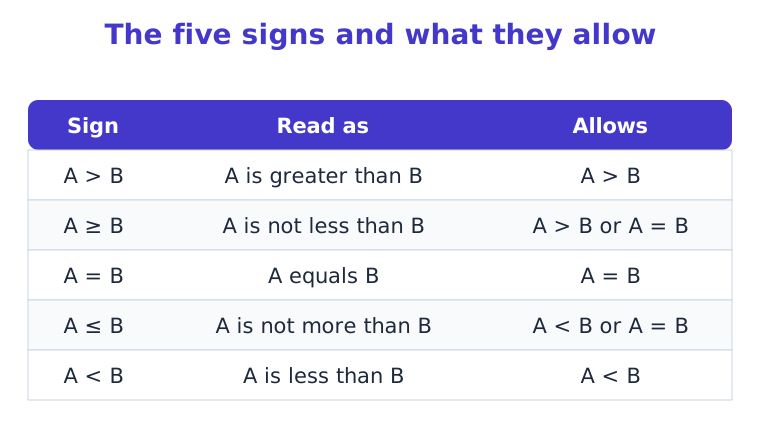
A ≥ B allows two cases, A > B or A = B. A ≤ B allows A < B or A = B.
Two letters can be compared only through the letters that link them in the statement.
If every sign on the path points the same way, the letters are related; one strict sign makes the result strict.
An = sign never changes the direction; it just passes the other sign along.
If two signs on the path face each other (> then <, or ≥ then ≤), no definite relation exists.
Either I or II is true only when both are about the same pair, neither is definite alone, and together they cover every case.
Typical either-or pairs: (>, =) when the path gives ≥, and (≥, <) or (≤, >) when there is no relation.
With separate statements, first join them into one chain through the common letters.
Full explanation
Who scored more?

After a class test, Meera hears three facts: Aarav scored more than Bhavna, Bhavna scored at least as much as Chirag, and Chirag scored the same as Deepa. Her friend asks: "So did Aarav beat Deepa? And did Bhavna beat Deepa?"
One answer is a sure yes and the other is "we cannot be sure". By the end of this topic you will see which is which in five seconds.
The five signs
Every inequality question uses only five signs. The two "or equal" signs are the ones that set traps, because each of them allows two cases.
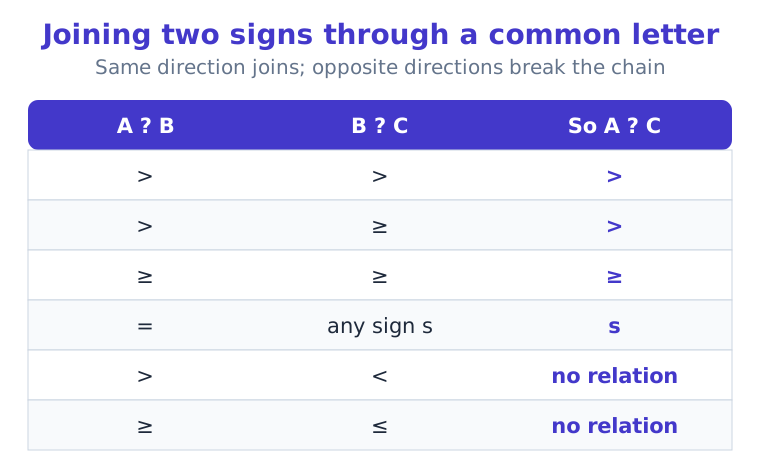
Joining signs through a common letter
Two letters can be compared only through the letters between them. Walk from one to the other and look at the signs:
- All signs point the same way: the letters are related.
- Any strict sign (> or <) on the path makes the result strict.
- All signs are ≥ (or =): the result is only ≥.
- = passes the other sign along.
- Two signs face each other: no definite relation.
Worked example: a definite relation
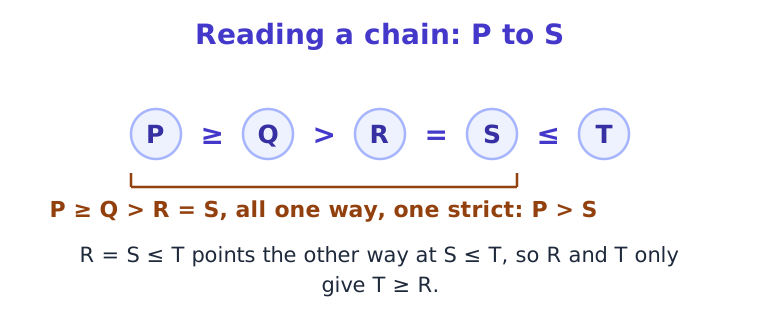
Statement: P ≥ Q > R = S ≤ T.
Is P > S true? The path P ≥ Q > R = S points one way and has a strict sign, so P > S is definitely true.
Is T > R true? The path from R is R = S ≤ T, which gives only T ≥ R. T may equal R, so T > R is not definite.
When the chain breaks
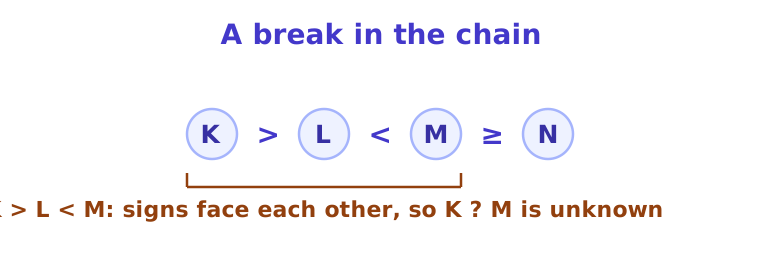
In K > L < M ≥ N, K and M are both greater than L, but nothing says which of them is bigger. Signs facing each other at L break the path. Any conclusion about K and M, such as K > M or K < M, is not definite.
The either-or pair
Sometimes neither conclusion is definite, yet one of them must hold. Tick either I or II only when all three are true:
- Both conclusions are about the same two letters.
- Neither is definite on its own.
- Together they cover every case for that pair.
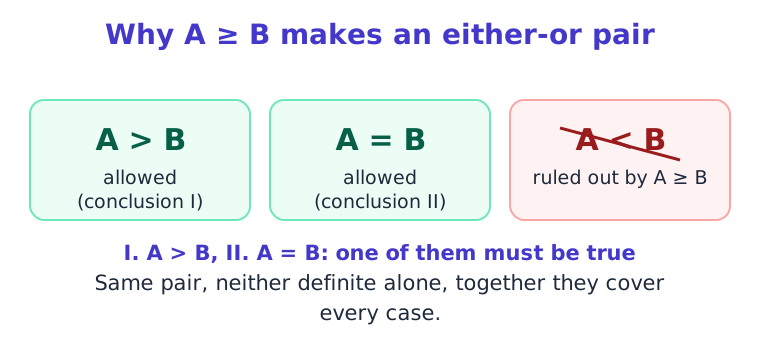
From A ≥ B, the pair I. A > B, II. A = B is either-or. With no relation at all, the pair I. A ≥ B, II. A < B is also either-or, because every pair of numbers is either ≥ or <.
A trap that looks like either-or
Statement: A > B < C. Conclusions: I. A > C, II. A = C.
Same pair, and neither is definite. But A < C is also possible, so the two do not cover every case. The answer is neither, not either-or.
Several statements
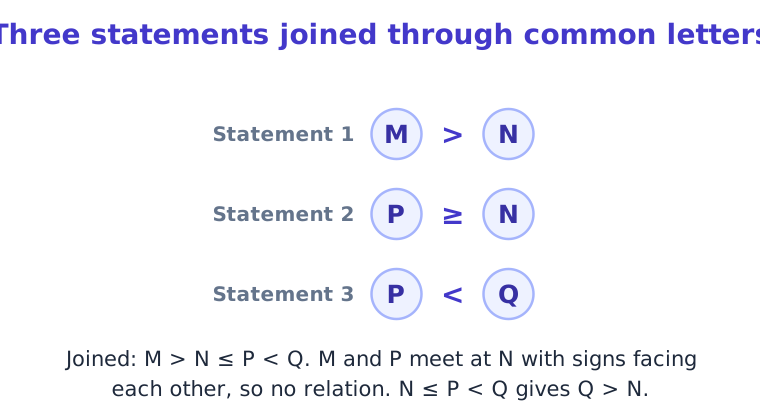
Bank papers often give separate statements such as M > N, P ≥ N, P < Q. Join them through the common letters into one chain: M > N ≤ P < Q. Then solve exactly as before.
Reverse questions: which sign fits?
"Which sign in A ≥ B ? C = D makes A > D definitely true?" Put each sign in the blank and test. With ≥ or = the path gives only A ≥ D; with < or ≤ it breaks. Only > works.
Topper's habit: test the options, never guess from the look of the expression.
Exam shortcuts
- Find the path between the two letters first; ignore the rest of the chain.
- Opposite signs anywhere on the path: stop, no relation.
- One strict sign on a one-way path: strict result.
- Before ticking "neither", check the either-or conditions.
- Read B < A as A > B before comparing.
Back to Meera
Write the facts with first letters: A > B ≥ C = D.
- Aarav and Deepa: A > B ≥ C = D, one way with a strict sign, so Aarav surely scored more.
- Bhavna and Deepa: B ≥ C = D gives only B ≥ D. Bhavna may have tied with Deepa, so we cannot be sure she scored more.
Concepts and terms
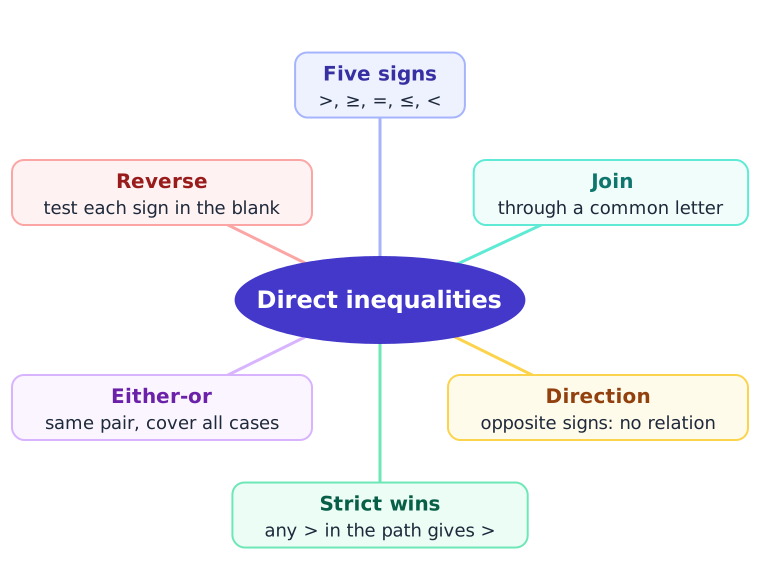
A relation that holds in every order of the letters allowed by the statement. Only these count as true.
To compare A and D in A > B ≥ C = D, follow A to B to C to D and combine the signs on the way.
Signs facing each other, as in A > B < C, mean A and C can stand in any order.
Two conclusions about the same pair, neither definite, that between them cover every possible case.

Did you know
Bank exams (IBPS, SBI) usually ask 5 inequality questions in the prelims reasoning section, and they are among the fastest marks.
Mathematicians call the ≥ relation a "weak order"; the same idea sorts cricket scores, exam ranks and prices.

Memory tricks
Combining signs — Same way, strict wins — If all signs point one way, the result follows them; one > (or <) on the path makes it strict.
Either-or test — Same pair, none sure, all covered — Check the three conditions in this order before you tick either-or.
Practice MCQs with answers (72)
- A Only I is true
- B Only II is true
- C Neither I nor II is true
- D Both I and II are true
Show answer
Why:
I (V ≤ H): V ≤ H is given directly, so I is true. II (T > V): T = H ≥ V gives only T ≥ V, which does not make T > V certain (T may also be equal to V); II is not true. So only I is true.
- A Only I is true
- B Only II is true
- C Neither I nor II is true
- D Both I and II are true
Show answer
Why:
I (V < X): V > N = X gives V > X, so V < X is false; I is not true. II (V > L): V > N = X ≥ L gives V > L, so II is true. So only II is true.
- A Neither I nor II is true
- B Only I is true
- C Both I and II are true
- D Only II is true
Show answer
Why:
I (H < P): H < S = G ≤ P gives H < P, so I is true. II (G = S): G = S is given directly, so II is true. So both are true.
- A Either I or II is true
- B Only I is true
- C Only II is true
- D Neither I nor II is true
Show answer
Why:
I (F > D): F ≤ C < W < D gives F < D, so F > D is false; I is not true. II (W ≥ D): W < D is given directly, so W ≥ D is false; II is not true. So neither is true.
- A Only I is true
- B Both I and II are true
- C Only II is true
- D Neither I nor II is true
Show answer
Why:
I (K > G): K > P ≥ G gives K > G, so I is true. II (G > H): only G ≥ H is given, which does not make G > H certain (G may also be equal to H); II is not true. So only I is true.
- A Neither I nor II is true
- B Only II is true
- C Both I and II are true
- D Only I is true
Show answer
Why:
I (X ≤ A): X > L > A gives X > A, so X ≤ A is false; I is not true. II (P < L): P ≤ A < L gives P < L, so II is true. So only II is true.
- A Either I or II is true
- B Only I is true
- C Neither I nor II is true
- D Only II is true
Show answer
Why:
I (E = C): in E ≥ W ≤ C the signs point both ways, so E and C have no definite relation; I is not definitely true. II (W ≥ X): in W ≤ E > X the signs point both ways, so W and X have no definite relation; II is not definitely true. So neither is true.
- A Neither I nor II is true
- B Only I is true
- C Only II is true
- D Both I and II are true
Show answer
Why:
I (U < C): U < C is given directly, so I is true. II (F > U): F > R > U gives F > U, so II is true. So both are true.
- A Only I is true
- B Only II is true
- C Neither I nor II is true
- D Both I and II are true
Show answer
Why:
I (P > G): P ≥ D > G gives P > G, so I is true. II (R < D): in R ≥ G < D the signs point both ways, so R and D have no definite relation; II is not definitely true. So only I is true.
- A Only II is true
- B Only I is true
- C Neither I nor II is true
- D Both I and II are true
Show answer
Why:
I (J > Q): J > Y = Q gives J > Q, so I is true. II (Q = D): in Q = Y < J ≥ T ≤ D the signs point both ways, so Q and D have no definite relation; II is not definitely true. So only I is true.
- A Only I is true
- B Neither I nor II is true
- C Only II is true
- D Both I and II are true
Show answer
Why:
I (A > V): in A ≥ X < T ≤ V the signs point both ways, so A and V have no definite relation; I is not definitely true. II (V > X): V ≥ T > X gives V > X, so II is true. So only II is true.
- A Only I is true
- B Only II is true
- C Neither I nor II is true
- D Both I and II are true
Show answer
Why:
I (F ≤ T): F ≤ V ≤ T gives F ≤ T, so I is true. II (Z ≥ F): Z = T ≥ V ≥ F gives Z ≥ F, so II is true. So both are true.
- A Neither I nor II is true
- B Only II is true
- C Either I or II is true
- D Only I is true
Show answer
Why:
I (P > T): in P ≤ D > V = T the signs point both ways, so P and T have no definite relation; I is not definitely true. II (X = V): X > T = V gives X > V, so X = V is false; II is not true. So neither is true.
- A Only I is true
- B Either I or II is true
- C Neither I nor II is true
- D Both I and II are true
Show answer
Why:
I (N ≤ E): in N ≤ S > E the signs point both ways, so N and E have no definite relation; I is not definitely true. II (N > E): in N ≤ S > E the signs point both ways, so N and E have no definite relation; II is not definitely true. Neither is definite alone, but both are about the same pair and between them they cover every case, so exactly one must hold: either I or II is true.
- A Neither I nor II is true
- B Both I and II are true
- C Only II is true
- D Only I is true
Show answer
Why:
I (V > D): in V ≤ E = Y ≥ D the signs point both ways, so V and D have no definite relation; I is not definitely true. II (V ≤ Y): V ≤ E = Y gives V ≤ Y, so II is true. So only II is true.
- A Both I and II are true
- B Only II is true
- C Neither I nor II is true
- D Only I is true
Show answer
Why:
I (L ≤ U): L ≤ R = U gives L ≤ U, so I is true. II (Y ≥ L): in Y > J ≤ U = R ≥ L the signs point both ways, so Y and L have no definite relation; II is not definitely true. So only I is true.
- A Either I or II is true
- B Both I and II are true
- C Only I is true
- D Neither I nor II is true
Show answer
Why:
I (M > E): in M < R > N ≥ E the signs point both ways, so M and E have no definite relation; I is not definitely true. II (M ≤ E): in M < R > N ≥ E the signs point both ways, so M and E have no definite relation; II is not definitely true. Neither is definite alone, but both are about the same pair and between them they cover every case, so exactly one must hold: either I or II is true.
- A Either I or II is true
- B Neither I nor II is true
- C Only I is true
- D Only II is true
Show answer
Why:
I (S ≥ Q): in S ≥ E ≥ P ≤ Q the signs point both ways, so S and Q have no definite relation; I is not definitely true. II (Q ≥ E): in Q ≥ P ≤ E the signs point both ways, so Q and E have no definite relation; II is not definitely true. So neither is true.
- A Only II is true
- B Neither I nor II is true
- C Both I and II are true
- D Only I is true
Show answer
Why:
I (V > E): V > Y > E gives V > E, so I is true. II (S > E): S = C > E gives S > E, so II is true. So both are true.
- A Only I is true
- B Neither I nor II is true
- C Both I and II are true
- D Either I or II is true
Show answer
Why:
I (V < D): in V ≥ G = Z ≤ D the signs point both ways, so V and D have no definite relation; I is not definitely true. II (V ≥ D): in V ≥ G = Z ≤ D the signs point both ways, so V and D have no definite relation; II is not definitely true. Neither is definite alone, but both are about the same pair and between them they cover every case, so exactly one must hold: either I or II is true.
- A Neither I nor II is true
- B Only I is true
- C Only II is true
- D Either I or II is true
Show answer
Why:
I (Z = H): Z < F ≤ H gives Z < H, so Z = H is false; I is not true. II (G ≤ H): in G ≥ A ≤ Z < F ≤ H the signs point both ways, so G and H have no definite relation; II is not definitely true. So neither is true.
- A Neither I nor II is true
- B Only I is true
- C Both I and II are true
- D Only II is true
Show answer
Why:
I (N > C): N > K ≥ E > C gives N > C, so I is true. II (U > C): in U < V > C the signs point both ways, so U and C have no definite relation; II is not definitely true. So only I is true.
- A Neither I nor II is true
- B Both I and II are true
- C Only II is true
- D Only I is true
Show answer
Why:
I (C > T): in C ≤ Z ≤ A ≥ T the signs point both ways, so C and T have no definite relation; I is not definitely true. II (T < E): T < S = E gives T < E, so II is true. So only II is true.
- A Both I and II are true
- B Only I is true
- C Neither I nor II is true
- D Either I or II is true
Show answer
Why:
I (N ≤ C): in N < U ≥ R < C the signs point both ways, so N and C have no definite relation; I is not definitely true. II (N > C): in N < U ≥ R < C the signs point both ways, so N and C have no definite relation; II is not definitely true. Neither is definite alone, but both are about the same pair and between them they cover every case, so exactly one must hold: either I or II is true.
- A Both I and II are true
- B Only II is true
- C Neither I nor II is true
- D Only I is true
Show answer
Why:
I (T < W): T ≤ A < W gives T < W, so I is true. II (M ≤ W): M = E ≤ W gives M ≤ W, so II is true. So both are true.
- A Either I or II is true
- B Neither I nor II is true
- C Only I is true
- D Only II is true
Show answer
Why:
I (M ≥ H): in M = B ≤ J > D ≥ H the signs point both ways, so M and H have no definite relation; I is not definitely true. II (U > H): in U ≤ M = B ≤ J > D ≥ H the signs point both ways, so U and H have no definite relation; II is not definitely true. So neither is true.
- A Both I and II are true
- B Only I is true
- C Either I or II is true
- D Neither I nor II is true
Show answer
Why:
I (R < N): in R < V < H > N the signs point both ways, so R and N have no definite relation; I is not definitely true. II (R ≥ N): in R < V < H > N the signs point both ways, so R and N have no definite relation; II is not definitely true. Neither is definite alone, but both are about the same pair and between them they cover every case, so exactly one must hold: either I or II is true.
- A Either I or II is true
- B Only I is true
- C Only II is true
- D Neither I nor II is true
Show answer
Why:
I (U > C): in U > D < X < C the signs point both ways, so U and C have no definite relation; I is not definitely true. II (U = C): in U > D < X < C the signs point both ways, so U and C have no definite relation; II is not definitely true. So neither is true.
- A Neither I nor II is true
- B Only I is true
- C Only II is true
- D Either I or II is true
Show answer
Why:
I (F < Z): in F = X ≤ B > J > Z the signs point both ways, so F and Z have no definite relation; I is not definitely true. II (F = Z): in F = X ≤ B > J > Z the signs point both ways, so F and Z have no definite relation; II is not definitely true. So neither is true.
- A Neither I nor II is true
- B Only I is true
- C Both I and II are true
- D Only II is true
Show answer
Why:
I (C < P): C < D < P gives C < P, so I is true. II (D > T): D < P < T gives D < T, so D > T is false; II is not true. So only I is true.
- A Only I is true
- B Only II is true
- C Both I and II are true
- D Neither I nor II is true
Show answer
Why:
I (P < K): P ≤ V < F ≤ L ≤ K gives P < K, so I is true. II (V < K): V < F ≤ L ≤ K gives V < K, so II is true. So both are true.
- A Neither I nor II is true
- B Both I and II are true
- C Only I is true
- D Either I or II is true
Show answer
Why:
I (E ≥ S): in E < L > S the signs point both ways, so E and S have no definite relation; I is not definitely true. II (E < S): in E < L > S the signs point both ways, so E and S have no definite relation; II is not definitely true. Neither is definite alone, but both are about the same pair and between them they cover every case, so exactly one must hold: either I or II is true.
- A Neither I nor II is true
- B Only I is true
- C Only II is true
- D Either I or II is true
Show answer
Why:
I (D < G): in D > V < F ≤ G the signs point both ways, so D and G have no definite relation; I is not definitely true. II (D > F): in D > V < F the signs point both ways, so D and F have no definite relation; II is not definitely true. So neither is true.
- A Only I is true
- B Only II is true
- C Neither I nor II is true
- D Both I and II are true
Show answer
Why:
I (D < L): D ≥ X ≥ L gives D ≥ L, so D < L is false; I is not true. II (X ≤ B): X ≤ D = B gives X ≤ B, so II is true. So only II is true.
- A Neither I nor II is true
- B Both I and II are true
- C Either I or II is true
- D Only I is true
Show answer
Why:
I (T > B): in T < E > M < B the signs point both ways, so T and B have no definite relation; I is not definitely true. II (T ≤ B): in T < E > M < B the signs point both ways, so T and B have no definite relation; II is not definitely true. Neither is definite alone, but both are about the same pair and between them they cover every case, so exactly one must hold: either I or II is true.
- A Only I is true
- B Only II is true
- C Either I or II is true
- D Neither I nor II is true
Show answer
Why:
I (K < C): in K = F < B > C the signs point both ways, so K and C have no definite relation; I is not definitely true. II (R < C): R > B > C gives R > C, so R < C is false; II is not true. So neither is true.
- A Only I is true
- B Both I and II are true
- C Only II is true
- D Neither I nor II is true
Show answer
Why:
I (Q ≤ H): Q ≤ P ≤ H gives Q ≤ H, so I is true. II (Q > U): in Q ≤ P ≥ M < U the signs point both ways, so Q and U have no definite relation; II is not definitely true. So only I is true.
- A L < H
- B X ≤ L
- C D > L
- D X < H
Show answer
Why:
X = D ≤ L gives X ≤ L, so X ≤ L is definitely true. X < H: the path gives X ≥ H, so it is not definite. L < H: the path gives L ≥ H, so it is not definite. D > L: the path gives D ≤ L, so it is not definite.
- A V < J
- B K > V
- C K < N
- D J > R
Show answer
Why:
K < J < N gives K < N, so K < N is definitely true. J > R: J > K ≤ R has facing signs, so it is not definite. V < J: V ≤ N > J has facing signs, so it is not definite. K > V: K < J < N ≥ V has facing signs, so it is not definite.
- A F > Q
- B U < J
- C H < G
- D H < U
Show answer
Why:
H ≤ F < U gives H < U, so H < U is definitely true. U < J: U > F ≥ H < Q > G < J has facing signs, so it is not definite. H < G: H < Q > G has facing signs, so it is not definite. F > Q: F ≥ H < Q has facing signs, so it is not definite.
- A C < G
- B J < A
- C A > C
- D V < M
Show answer
Why:
C < J ≤ G gives C < G, so C < G is definitely true. J < A: J ≤ G ≥ A has facing signs, so it is not definite. A > C: A ≤ G ≥ J > C has facing signs, so it is not definite. V < M: the path gives V = M, so it is not definite.
- A W < M
- B W > S
- C P > W
- D W < H
Show answer
Why:
W ≤ M = S gives W ≤ S, so W > S is impossible. Each of the other three is possible for some order of the letters.
- A C > F
- B R < F
- C P ≥ R
- D C > E
Show answer
Why:
P < B ≤ C ≤ R gives P < R, so P ≥ R is impossible. Each of the other three is possible for some order of the letters.
- A ≥
- B <
- C ≤
- D >
Show answer
Why:
With >: E > U ≥ A gives E > A. ≤ gives no definite relation; ≥ gives only E ≥ A; < gives no definite relation.
- A <
- B =
- C ≤
- D >
Show answer
Why:
With <: S ≤ N = Z < C gives S < C. = gives only S ≤ C; ≤ gives only S ≤ C; > gives no definite relation.
- A ≤
- B <
- C >
- D =
Show answer
Why:
With < the blank itself reads P > V. ≤ gives only P ≥ V; > gives only P < V; = gives only P = V.
- A ≤
- B <
- C >
- D =
Show answer
Why:
With > the blank itself reads Z < R. < gives only Z > R; = gives only Z = R; ≤ gives only Z ≥ R.
- A ≥
- B =
- C ≤
- D <
Show answer
Why:
With <: F > A ≥ R gives F > R. = gives only F ≥ R; ≤ gives only F ≥ R; ≥ gives no definite relation.
- A V ≥ J < N < A < M
- B V ≥ J ≥ N > A < M
- C V ≥ J > N < A < M
- D V ≥ J < N < A ≥ M
Show answer
Why:
In V ≥ J < N < A < M: A > N > J and J < N < A < M give both relations. V ≥ J > N < A < M fails A > J (no definite relation); V ≥ J < N < A ≥ M fails J < M (no definite relation); V ≥ J ≥ N > A < M fails A > J (it gives A < J).
- A M ≤ L = U ≥ E < K < W
- B M ≤ L = U ≥ E > K < W
- C M ≤ L = U ≥ E ≤ K > W
- D M ≤ L < U ≥ E > K < W
Show answer
Why:
In M ≤ L = U ≥ E > K < W: L = U ≥ E and K < E ≤ U give both relations. M ≤ L < U ≥ E > K < W fails L ≥ E (no definite relation); M ≤ L = U ≥ E < K < W fails K < U (no definite relation); M ≤ L = U ≥ E ≤ K > W fails K < U (no definite relation).
- A B ≤ P = G > Q ≥ S
- B B ≥ P > G > Q ≥ S
- C B ≤ P < G > Q ≥ S
- D B ≥ P < G > Q ≥ S
Show answer
Why:
In B ≤ P < G > Q ≥ S: S ≤ Q < G and B ≤ P < G give both relations. B ≤ P = G > Q ≥ S fails B < G (it gives B ≤ G); B ≥ P > G > Q ≥ S fails B < G (it gives B > G); B ≥ P < G > Q ≥ S fails B < G (no definite relation).
- A D and S
- B D and B
- C L and B
- D T and L
Show answer
Why:
Between T and L the path T < D ≥ L has signs facing both ways, so no relation is fixed. L and B: L ≥ S = B gives L ≥ B; D and S: D ≥ L ≥ S gives D ≥ S; D and B: D ≥ L ≥ S = B gives D ≥ B.
- A Q and B
- B A and B
- C W and B
- D A and G
Show answer
Why:
Between Q and B the path Q ≥ A < W < G = B has signs facing both ways, so no relation is fixed. W and B: W < G = B gives W < B; A and G: A < W < G gives A < G; A and B: A < W < G = B gives A < B.
- A R and K
- B V and H
- C N and K
- D V and N
Show answer
Why:
Between V and H the path V < R = N ≥ H has signs facing both ways, so no relation is fixed. N and K: N ≥ H > K gives N > K; V and N: V < R = N gives V < N; R and K: R = N ≥ H > K gives R > K.
- A Only II is true
- B Neither I nor II is true
- C Only I is true
- D Both I and II are true
Show answer
Why:
Write each sentence with the first letters: T ≤ E, T ≥ P, T > C, M > C. I (C < E): C < T ≤ E gives C < E, so I is true. II (E = P): E ≥ T ≥ P gives only E ≥ P, which does not make E = P certain (E may also be different from P); II is not true. So only I is true.
- A Only II is true
- B Either I or II is true
- C Only I is true
- D Neither I nor II is true
Show answer
Why:
Write each sentence with the first letters: R > H, H = G, H < O, W > G. I (G > O): G = H < O gives G < O, so G > O is false; I is not true. II (W ≤ R): in W > G = H < R the signs point both ways, so W and R have no definite relation; II is not definitely true. So neither is true.
- A Both I and II are true
- B Only I is true
- C Only II is true
- D Neither I nor II is true
Show answer
Why:
Write each sentence with the first letters: T > O, G ≤ T, K = G, G < L. I (K ≤ T): K = G ≤ T gives K ≤ T, so I is true. II (L > K): L > G = K gives L > K, so II is true. So both are true.
- A Only I is true
- B Either I or II is true
- C Neither I nor II is true
- D Both I and II are true
Show answer
Why:
Write each sentence with the first letters: W < H, W ≥ T, D < H, T = S. I (T ≥ D): in T ≤ W < H > D the signs point both ways, so T and D have no definite relation; I is not definitely true. II (T < D): in T ≤ W < H > D the signs point both ways, so T and D have no definite relation; II is not definitely true. Neither is definite alone, but both are about the same pair and between them they cover every case, so exactly one must hold: either I or II is true.
- A Only II is true
- B Neither I nor II is true
- C Only I is true
- D Both I and II are true
Show answer
Why:
I (Z > C): Z > N ≥ C gives Z > C, so I is true. II (J ≤ N): in J ≥ C ≤ N the signs point both ways, so J and N have no definite relation; II is not definitely true. So only I is true.
- A Only I is true
- B Neither I nor II is true
- C Both I and II are true
- D Either I or II is true
Show answer
Why:
I (Z < B): in Z ≥ W ≤ M < H = B the signs point both ways, so Z and B have no definite relation; I is not definitely true. II (Z ≥ B): in Z ≥ W ≤ M < H = B the signs point both ways, so Z and B have no definite relation; II is not definitely true. Neither is definite alone, but both are about the same pair and between them they cover every case, so exactly one must hold: either I or II is true.
- A Neither I nor II is true
- B Either I or II is true
- C Only I is true
- D Only II is true
Show answer
Why:
I (N > G): only N ≥ G is given, which does not make N > G certain (N may also be equal to G); I is not true. II (K > N): in K < M ≥ N the signs point both ways, so K and N have no definite relation; II is not definitely true. So neither is true.
- A Both I and II are true
- B Only II is true
- C Only I is true
- D Neither I nor II is true
Show answer
Why:
I (B < A): in B ≤ X > M < A the signs point both ways, so B and A have no definite relation; I is not definitely true. II (X > M): X > M is given directly, so II is true. So only II is true.
- A Neither I nor II is true
- B Both I and II are true
- C Only I is true
- D Only II is true
Show answer
Why:
Write R > S, M ≥ S, M < K, which join as R > S ≤ M < K. I: S ≤ M < K gives K > S, true. II: R > S ≤ M has facing signs, so R and M are unknown. Only I is true.
- A A < B
- B No relation
- C A > B
- D A = B
Show answer
Why:
A ≥ B rules out A < B, and B ≥ A rules out A > B. Only A = B is left.
- A >
- B ≥ and ≤ both
- C ≥
- D ≤
Show answer
Why:
allows only A > B. ≥ and ≤ each allow two cases.
- A > then ≥
- B ≥ then ≤
- C = then <
- D ≤ then <
Show answer
Why:
A ≥ B ≤ C: the signs face each other at B. The others point one way.
- A I. B > A, II. B = A
- B I. A > B, II. A = B
- C None of these pairs
- D I. B ≥ A, II. B < A
Show answer
Why:
A > B is definite. In the first pair I is true by itself, in the second II (B < A) is true by itself, and in the third both are false. Either-or needs neither to be definite.
- A A ≤ B
- B B > A
- C A < B
- D A > B
Show answer
Why:
Flip both the letters and the sign: B < A becomes A > B.
- A Both A and R are true, and R is the correct explanation of A
- B Both A and R are true, but R is not the correct explanation of A
- C A is true but R is false
- D A is false but R is true
Show answer
Why:
P ≥ Q > R points one way and contains >, so P > R. R is exactly the rule used.
- A Both A and R are true, and R is the correct explanation of A
- B Both A and R are true, but R is not the correct explanation of A
- C A is true but R is false
- D A is false but R is true
Show answer
Why:
At B the signs face each other, so A and C can be in any order. A is false; R is true.
- A 1 only
- B 2 only
- C Both 1 and 2
- D Neither 1 nor 2
Show answer
Why:
M > N = O ≥ P has a > on a one-way path, so M > P. N = O ≥ P gives N ≥ P. Both are true.
- A 1 only
- B 2 only
- C Both 1 and 2
- D Neither 1 nor 2
Show answer
Why:
W < X ≥ Y: signs face each other at X, so W and Y are unknown. X ≥ Y > Z gives X > Z. Only 2 is true.
Important short questions (4)
A > B ≥ C = D is one way with a strict sign, so A > D. B ≥ C = D has no strict sign, so only B ≥ D.
P and Q meet at R with signs facing each other, so P < Q is also possible. The two conclusions do not cover every case.
K ≤ L < M = N. (M > L is written as L < M so that L sits between K and M.)
, ≥ and = all work, because Y > Z is already strict. < and ≤ make the signs face each other at Y.
Long answer questions (1)
(P, S): P ≥ Q > R = S, one way with >, so P > S.
(Q, T): Q > R = S ≤ T, signs face each other at S, so no relation.
(R, T): R = S ≤ T gives T ≥ R.
For I and II: same pair, neither definite, and T ≥ R leaves exactly the cases T > R and T = R. So either I or II is true.
Flashcards (14)
Play this topic
- Definite or not?
Coded Inequalities
Turn symbols such as @, #, % and © back into the five signs, read verbal meanings like "neither greater than nor equal to", solve the decoded chain, and handle questions where the signs themselves are interchanged.
What you will be able to do
- I can turn a verbal meaning such as "not smaller than" into the right sign.
- I can decode a coded statement and its conclusions in one pass.
- I can solve questions where the five signs are interchanged.
- I can write a plain chain back in code.
Key points
Any two numbers stand in exactly one of three cases: greater, equal or smaller.
"Not X" removes one case and leaves two: not smaller means ≥, not greater means ≤.
"Neither X nor Y" removes two cases and leaves one: a strict sign or =.
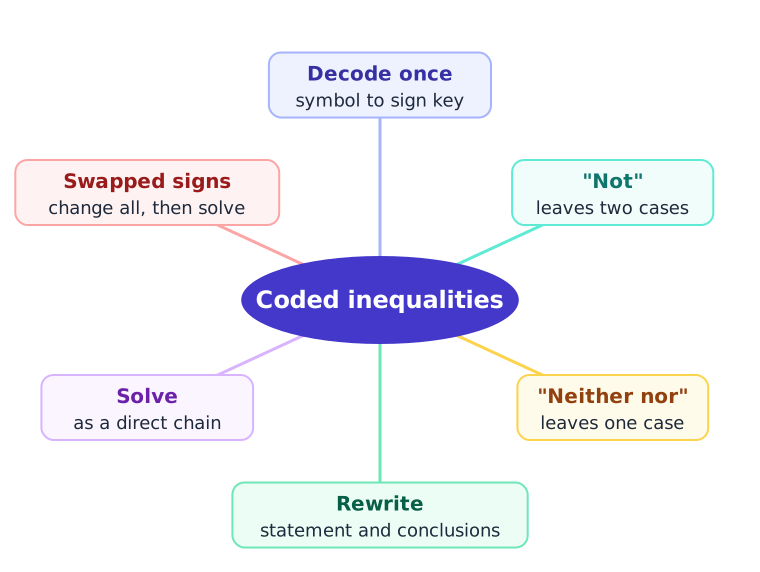
Decode the statement and both conclusions before you compare anything.
Write the key "symbol = sign" once in the margin and use it for all five questions of a set.
The order matters: P @ Q compares P with Q, so Q @ P is a different fact.
In interchanged-sign questions, change every sign in the statement and the conclusions, then solve.
After decoding, every rule of direct inequalities applies, including either-or.
Full explanation
A note in code
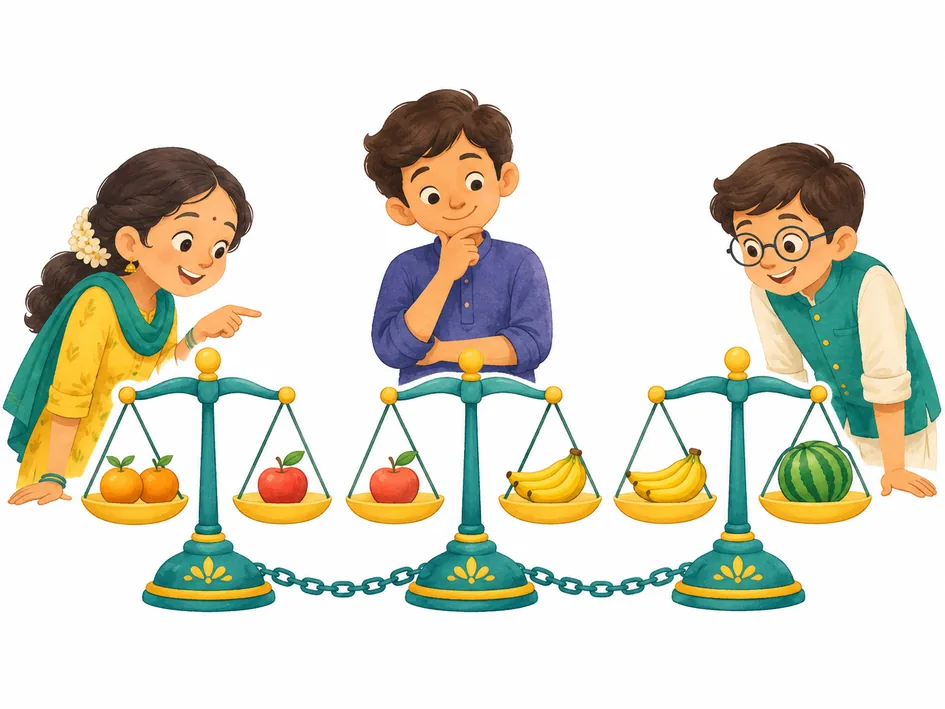
Kabir and Sana share notes before a test, written in their own code: "Raju @ Om # Pia". Kabir knows "@" means "is not smaller than" and "#" means "is neither smaller than nor equal to". Sana asks: "So is Raju ahead of Pia?"
Codes look scary, but each symbol is just one of the five signs in disguise.
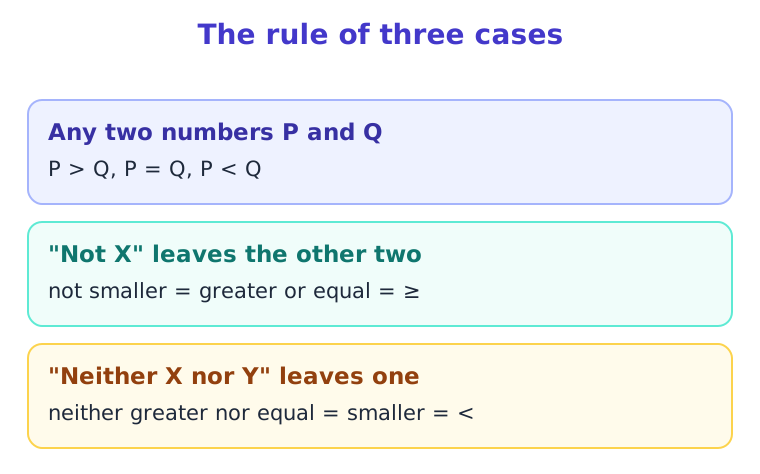
The rule of three cases
For any two numbers P and Q exactly one of three things is true: P > Q, P = Q, or P < Q. Every verbal code names some of these cases. Cross out what the words forbid; what is left is the sign.
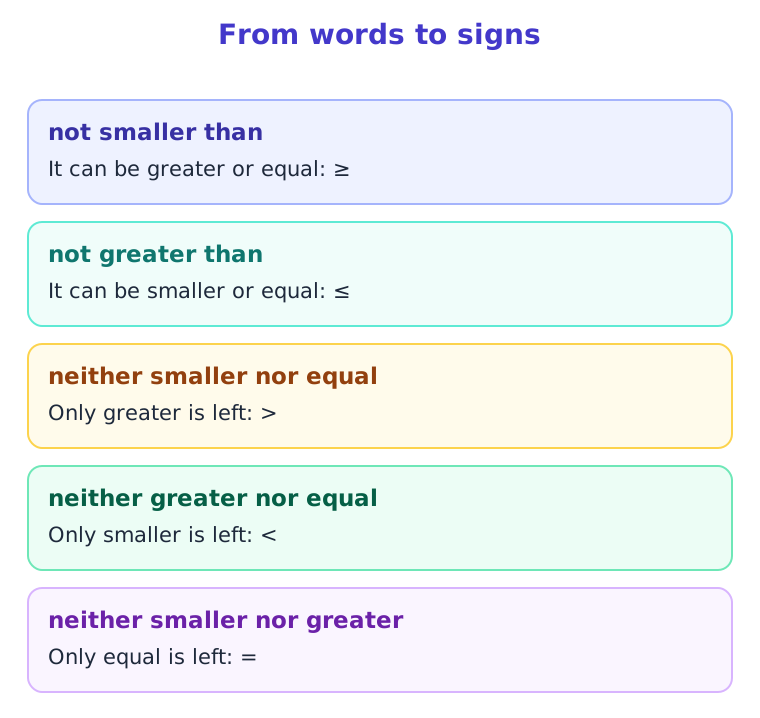
From words to signs
- "not smaller than" → ≥
- "not greater than" → ≤
- "neither smaller than nor equal to" → >
- "neither greater than nor equal to" → <
- "neither smaller than nor greater than" → =
Three steps for every coded question
- Key: write "symbol = sign" for all symbols once.
- Rewrite: the statement and both conclusions in plain signs.
- Solve: exactly as a direct inequality, including the either-or check.
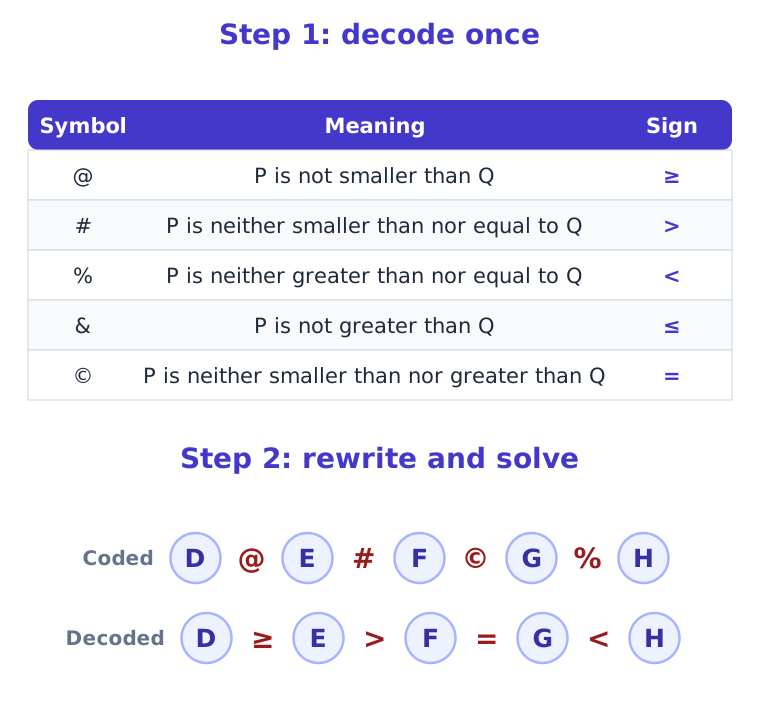
Worked example
Code: @ = not smaller than, # = neither smaller than nor equal to, % = neither greater than nor equal to, & = not greater than, © = neither smaller than nor greater than.
Statement: D @ E # F © G % H. Conclusions: I. D # G, II. E & H.
Key: @ is ≥, # is >, © is =, % is <, & is ≤. Rewrite: D ≥ E > F = G < H; I is D > G, II is E ≤ H.
I: D ≥ E > F = G, one way with >, so true. II: E > F = G < H, signs face each other at G, so not definite. Only I is true.
Plain codes
Easier papers define symbols directly, such as "P @ Q means P > Q". The method is the same: key, rewrite, solve. Speed comes from writing the key once for the whole set of five questions.
Interchanged signs
SSC papers sometimes say: "> means ≤, < means =, = means ≥ …". Make a two-column key (written → real), then rewrite every sign, in the statement and in the conclusions. A single sign left unchanged spoils the answer.
Writing in code
Some questions run the other way: "Which coded expression means A > B ≥ C?" Turn each sign into its symbol using the same key, and check the options one sign at a time. Usually three options differ from the key in exactly one symbol.
Exam shortcuts
- "Not" = two cases (≥ or ≤). "Neither … nor" = one case (>, < or =).
- Write the key in the margin before reading the statements.
- Decode the conclusions too.
- After decoding, use the path rule and the either-or check from Topic 1.
Back to Kabir and Sana
"Raju @ Om # Pia" decodes to R ≥ O > P. One way, with a strict sign, so Raju is surely ahead of Pia. The code changed nothing about the logic; it only hid the signs.
Concepts and terms
For any P and Q exactly one of P > Q, P = Q, P < Q holds. Every verbal meaning names some of these cases.
A symbol defined in words, such as "P # Q means P is neither smaller than nor equal to Q", which is P > Q.
The question says "> means ≤" and so on. Replace each written sign by its meaning before reading the chain.
Did you know
Coded inequalities were the standard bank pattern for years; the direct form took over around 2016, but SBI and IBPS mains still use codes.
Computer languages write ≥ as >= and ≤ as <=, which is the same idea as a code for a sign.
Memory tricks
Verbal meanings — Not leaves two, neither-nor leaves one — Cross out the cases the words forbid; what is left is the sign.
Solving order — Key, rewrite, solve — Make the key once, rewrite the statement and conclusions, then solve as a direct chain.
Practice MCQs with answers (58)
- A Neither I nor II is true
- B Both I and II are true
- C Only I is true
- D Only II is true
Show answer
Why:
Decode first (© → ≥, @ → >, & → =, % → <, # → ≤): W > J > N ≤ K; I is N < W, II is N > J. I (N < W): N < J < W gives N < W, so I is true. II (N > J): N < J is given directly, so N > J is false; II is not true. So only I is true.
- A Neither I nor II is true
- B Both I and II are true
- C Only I is true
- D Only II is true
Show answer
Why:
Decode first (& → =, % → ≤, © → ≥, # → <, δ → >): U = Q > F ≤ J; I is J < Q, II is Q > F. I (J < Q): in J ≥ F < Q the signs point both ways, so J and Q have no definite relation; I is not definitely true. II (Q > F): Q > F is given directly, so II is true. So only II is true.
- A Both I and II are true
- B Only I is true
- C Only II is true
- D Neither I nor II is true
Show answer
Why:
Decode first (# → ≥, ★ → >, & → <, δ → =, © → ≤): W ≤ J ≤ R > D; I is W ≤ J, II is R ≥ W. I (W ≤ J): W ≤ J is given directly, so I is true. II (R ≥ W): R ≥ J ≥ W gives R ≥ W, so II is true. So both are true.
- A Only I is true
- B Neither I nor II is true
- C Only II is true
- D Either I or II is true
Show answer
Why:
Decode first (# → =, % → ≤, © → ≥, ★ → <, @ → >): S > F ≥ Z < L; I is F < L, II is S ≤ Z. I (F < L): in F ≥ Z < L the signs point both ways, so F and L have no definite relation; I is not definitely true. II (S ≤ Z): S > F ≥ Z gives S > Z, so S ≤ Z is false; II is not true. So neither is true.
- A Neither I nor II is true
- B Both I and II are true
- C Only I is true
- D Only II is true
Show answer
Why:
Decode first (© → >, ★ → ≥, # → <, % → =, & → ≤): L < W ≤ D ≥ E; I is L < W, II is L > D. I (L < W): L < W is given directly, so I is true. II (L > D): L < W ≤ D gives L < D, so L > D is false; II is not true. So only I is true.
- A Neither I nor II is true
- B Both I and II are true
- C Only II is true
- D Only I is true
Show answer
Why:
Decode first (& → >, ★ → <, δ → =, % → ≤, # → ≥): L > J ≤ Y ≥ V > X; I is L > J, II is L > V. I (L > J): L > J is given directly, so I is true. II (L > V): in L > J ≤ Y ≥ V the signs point both ways, so L and V have no definite relation; II is not definitely true. So only I is true.
- A Only II is true
- B Neither I nor II is true
- C Both I and II are true
- D Only I is true
Show answer
Why:
Decode first (& → <, # → >, ★ → ≤, © → ≥, @ → =): J ≥ Y = G ≤ U < E; I is U < J, II is U < E. I (U < J): in U ≥ G = Y ≤ J the signs point both ways, so U and J have no definite relation; I is not definitely true. II (U < E): U < E is given directly, so II is true. So only II is true.
- A Only II is true
- B Both I and II are true
- C Neither I nor II is true
- D Only I is true
Show answer
Why:
Decode first (% → =, ★ → ≤, & → ≥, © → >, # → <): V < B ≤ M < K > A; I is K > M, II is M > V. I (K > M): K > M is given directly, so I is true. II (M > V): M ≥ B > V gives M > V, so II is true. So both are true.
- A Only II is true
- B Either I or II is true
- C Neither I nor II is true
- D Only I is true
Show answer
Why:
Decode first (δ → <, ★ → ≥, @ → =, © → >, % → ≤): G ≥ B = F > R ≤ S; I is G = F, II is R = S. I (G = F): G ≥ B = F gives only G ≥ F, which does not make G = F certain (G may also be different from F); I is not true. II (R = S): only R ≤ S is given, which does not make R = S certain (R may also be different from S); II is not true. So neither is true.
- A Neither I nor II is true
- B Both I and II are true
- C Only I is true
- D Either I or II is true
Show answer
Why:
Decode first (% → =, @ → ≥, & → <, δ → >, # → ≤): W ≥ F ≥ Z = Q < J; I is F = Q, II is F > Q. I (F = Q): F ≥ Z = Q gives only F ≥ Q, which does not make F = Q certain (F may also be different from Q); I is not true. II (F > Q): F ≥ Z = Q gives only F ≥ Q, which does not make F > Q certain (F may also be equal to Q); II is not true. Neither is definite alone, but both are about the same pair and between them they cover every case, so exactly one must hold: either I or II is true.
- A Only I is true
- B Only II is true
- C Neither I nor II is true
- D Both I and II are true
Show answer
Why:
Decode first (# → ≤, © → <, @ → ≥, % → =, & → >): N < S ≥ R ≥ T = W; I is S ≥ W, II is W < T. I (S ≥ W): S ≥ R ≥ T = W gives S ≥ W, so I is true. II (W < T): W = T is given directly, so W < T is false; II is not true. So only I is true.
- A Neither I nor II is true
- B Either I or II is true
- C Both I and II are true
- D Only I is true
Show answer
Why:
Decode first (& → >, ★ → <, @ → ≤, % → =, # → ≥): B ≥ Z > N > F < U; I is B < U, II is B ≥ U. I (B < U): in B ≥ Z > N > F < U the signs point both ways, so B and U have no definite relation; I is not definitely true. II (B ≥ U): in B ≥ Z > N > F < U the signs point both ways, so B and U have no definite relation; II is not definitely true. Neither is definite alone, but both are about the same pair and between them they cover every case, so exactly one must hold: either I or II is true.
- A Either I or II is true
- B Only I is true
- C Neither I nor II is true
- D Only II is true
Show answer
Why:
Decode first (★ → ≤, & → =, # → <, δ → ≥, @ → >): L < E ≤ C > P > J; I is J < L, II is E ≥ J. I (J < L): in J < P < C ≥ E > L the signs point both ways, so J and L have no definite relation; I is not definitely true. II (E ≥ J): in E ≤ C > P > J the signs point both ways, so E and J have no definite relation; II is not definitely true. So neither is true.
- A Neither I nor II is true
- B Both I and II are true
- C Only I is true
- D Only II is true
Show answer
Why:
Decode first (★ → <, % → ≥, # → >, δ → =, & → ≤): Y ≥ S ≥ D ≤ W < H; I is Y = H, II is H > W. I (Y = H): in Y ≥ S ≥ D ≤ W < H the signs point both ways, so Y and H have no definite relation; I is not definitely true. II (H > W): H > W is given directly, so II is true. So only II is true.
- A Either I or II is true
- B Only I is true
- C Neither I nor II is true
- D Both I and II are true
Show answer
Why:
Decode first (# → >, © → =, % → <, @ → ≤, & → ≥): T ≤ E < Y ≥ F > Q; I is Q ≥ E, II is Q < E. I (Q ≥ E): in Q < F ≤ Y > E the signs point both ways, so Q and E have no definite relation; I is not definitely true. II (Q < E): in Q < F ≤ Y > E the signs point both ways, so Q and E have no definite relation; II is not definitely true. Neither is definite alone, but both are about the same pair and between them they cover every case, so exactly one must hold: either I or II is true.
- A Only II is true
- B Both I and II are true
- C Neither I nor II is true
- D Only I is true
Show answer
Why:
Decode first (# → >, & → ≤, δ → <, % → =, @ → ≥): D ≥ W = R < V ≥ P; I is D ≥ W, II is V > W. I (D ≥ W): D ≥ W is given directly, so I is true. II (V > W): V > R = W gives V > W, so II is true. So both are true.
- A Neither I nor II is true
- B Both I and II are true
- C Either I or II is true
- D Only I is true
Show answer
Why:
Decode first (@ → =, ★ → ≥, & → <, % → >, # → ≤): F ≥ E ≤ N ≤ T ≥ X = W; I is E = T, II is E < T. I (E = T): E ≤ N ≤ T gives only E ≤ T, which does not make E = T certain (E may also be different from T); I is not true. II (E < T): E ≤ N ≤ T gives only E ≤ T, which does not make E < T certain (E may also be equal to T); II is not true. Neither is definite alone, but both are about the same pair and between them they cover every case, so exactly one must hold: either I or II is true.
- A Only I is true
- B Only II is true
- C Either I or II is true
- D Neither I nor II is true
Show answer
Why:
Decode first (% → ≥, δ → <, # → ≤, ★ → >, @ → =): N = X ≤ H < S > Q < A; I is X > A, II is Q < H. I (X > A): in X ≤ H < S > Q < A the signs point both ways, so X and A have no definite relation; I is not definitely true. II (Q < H): in Q < S > H the signs point both ways, so Q and H have no definite relation; II is not definitely true. So neither is true.
- A Only I is true
- B Only II is true
- C Neither I nor II is true
- D Both I and II are true
Show answer
Why:
Decode first (δ → >, ★ → ≤, # → =, © → ≥, @ → <): M = D ≤ P > B < Q < X; I is B < P, II is D > Q. I (B < P): B < P is given directly, so I is true. II (D > Q): in D ≤ P > B < Q the signs point both ways, so D and Q have no definite relation; II is not definitely true. So only I is true.
- A Only I is true
- B Only II is true
- C Neither I nor II is true
- D Both I and II are true
Show answer
Why:
Decode first (% → =, ★ → <, & → ≥, © → ≤, # → >): A ≥ S < D ≤ L > T ≥ N; I is D < A, II is N ≤ T. I (D < A): in D > S ≤ A the signs point both ways, so D and A have no definite relation; I is not definitely true. II (N ≤ T): N ≤ T is given directly, so II is true. So only II is true.
- A Only I is true
- B Only II is true
- C Both I and II are true
- D Neither I nor II is true
Show answer
Why:
Decode first (% → <, δ → ≥, # → ≤, @ → =, © → >): Y = E < M ≥ L ≤ H ≤ J; I is L ≤ J, II is H ≥ L. I (L ≤ J): L ≤ H ≤ J gives L ≤ J, so I is true. II (H ≥ L): H ≥ L is given directly, so II is true. So both are true.
- A Both I and II are true
- B Only I is true
- C Neither I nor II is true
- D Either I or II is true
Show answer
Why:
Decode first (★ → ≥, # → =, & → >, % → <, © → ≤): L ≤ Q = H < U ≥ D < M; I is D ≤ L, II is D > L. I (D ≤ L): in D ≤ U > H = Q ≥ L the signs point both ways, so D and L have no definite relation; I is not definitely true. II (D > L): in D ≤ U > H = Q ≥ L the signs point both ways, so D and L have no definite relation; II is not definitely true. Neither is definite alone, but both are about the same pair and between them they cover every case, so exactly one must hold: either I or II is true.
- A Only I is true
- B Both I and II are true
- C Only II is true
- D Neither I nor II is true
Show answer
Why:
Decode first (★ → ≥, © → >, @ → ≤, # → <, & → =): D < S, T > S, G < T, X ≥ G; I is D < T, II is X > D. I (D < T): D < S < T gives D < T, so I is true. II (X > D): in X ≥ G < T > S > D the signs point both ways, so X and D have no definite relation; II is not definitely true. So only I is true.
- A Only I is true
- B Neither I nor II is true
- C Only II is true
- D Either I or II is true
Show answer
Why:
Decode first (# → ≤, % → ≥, © → <, ★ → =, & → >): W > Z, Z < N, R = Z, H < R; I is Z < H, II is R > N. I (Z < H): Z = R > H gives Z > H, so Z < H is false; I is not true. II (R > N): R = Z < N gives R < N, so R > N is false; II is not true. So neither is true.
- A Neither I nor II is true
- B Both I and II are true
- C Either I or II is true
- D Only I is true
Show answer
Why:
Decode first (★ → =, % → <, © → >, δ → ≥, @ → ≤): Y < Z, Y = G, G ≥ X, C > G; I is Y > X, II is Y = X. I (Y > X): Y = G ≥ X gives only Y ≥ X, which does not make Y > X certain (Y may also be equal to X); I is not true. II (Y = X): Y = G ≥ X gives only Y ≥ X, which does not make Y = X certain (Y may also be different from X); II is not true. Neither is definite alone, but both are about the same pair and between them they cover every case, so exactly one must hold: either I or II is true.
- A Only I is true
- B Neither I nor II is true
- C Both I and II are true
- D Only II is true
Show answer
Why:
Decode first (© → <, @ → =, ★ → >, % → ≤, # → ≥): K ≤ Q, K ≥ X, F < Q, F = U, U ≤ W; I is W = Q, II is U < Q. I (W = Q): in W ≥ U = F < Q the signs point both ways, so W and Q have no definite relation; I is not definitely true. II (U < Q): U = F < Q gives U < Q, so II is true. So only II is true.
- A Either I or II is true
- B Both I and II are true
- C Only I is true
- D Neither I nor II is true
Show answer
Why:
Decode first (© → <, & → >, δ → ≥, % → ≤, # → =): L > R, R < X, L < Q, Q ≤ Z, Z < D; I is X > D, II is X ≤ D. I (X > D): in X > R < L < Q ≤ Z < D the signs point both ways, so X and D have no definite relation; I is not definitely true. II (X ≤ D): in X > R < L < Q ≤ Z < D the signs point both ways, so X and D have no definite relation; II is not definitely true. Neither is definite alone, but both are about the same pair and between them they cover every case, so exactly one must hold: either I or II is true.
- A Either I or II is true
- B Neither I nor II is true
- C Only I is true
- D Only II is true
Show answer
Why:
Decode first (& → >, ★ → ≥, @ → <, δ → =, % → ≤): F > K, L ≤ K, H < L, U ≤ H, A < H; I is H = F, II is K < A. I (H = F): H < L ≤ K < F gives H < F, so H = F is false; I is not true. II (K < A): K ≥ L > H > A gives K > A, so K < A is false; II is not true. So neither is true.
- A Only I is true
- B Only II is true
- C Both I and II are true
- D Neither I nor II is true
Show answer
Why:
Decode first (& → <, © → ≥, δ → ≤, # → =, % → >): T ≤ F, T > H, T < M, H ≥ G, V < G; I is H < F, II is T > V. I (H < F): H < T ≤ F gives H < F, so I is true. II (T > V): T > H ≥ G > V gives T > V, so II is true. So both are true.
- A Z > A < N > Y
- B Z < A ≥ N < Y
- C Z ≤ A > N < Y
- D Z < A > N < Y
Show answer
Why:
Replace each symbol by its sign (δ → >, © → ≥, ★ → <, @ → =, # → ≤): Z ★ A δ N ★ Y becomes Z < A > N < Y.
- A Z > A > R = K < W
- B Z ≥ A > R = K < W
- C Z < A < R = K > W
- D Z > A ≥ R = K < W
Show answer
Why:
Replace each symbol by its sign (© → <, @ → ≥, # → ≤, & → =, ★ → >): Z ★ A ★ R & K © W becomes Z > A > R = K < W.
- A P ≤ C ≤ J > K ≤ Z
- B P < C ≤ J > K ≤ Z
- C P > C ≥ J < K ≥ Z
- D P < C < J > K ≤ Z
Show answer
Why:
Replace each symbol by its sign (★ → >, δ → ≤, & → ≥, @ → =, © → <): P © C δ J ★ K δ Z becomes P < C ≤ J > K ≤ Z.
- A N = E ≤ R > S ≤ C ≤ A
- B N = E < R ≥ S ≤ C ≤ A
- C N = E ≤ R ≥ S ≤ C ≤ A
- D N = E ≥ R ≤ S ≥ C ≥ A
Show answer
Why:
Replace each symbol by its sign (# → >, % → <, @ → ≤, & → =, δ → ≥): N & E @ R δ S @ C @ A becomes N = E ≤ R ≥ S ≤ C ≤ A.
- A N ≤ P < F < V ≥ L = T
- B N ≥ P ≥ F > V ≤ L = T
- C N > P > F > V ≤ L = T
- D N ≥ P > F > V ≤ L = T
Show answer
Why:
Replace each symbol by its sign (& → =, % → >, @ → ≥, δ → <, © → ≤): N @ P % F % V © L & T becomes N ≥ P > F > V ≤ L = T.
- A R % Q & N # V
- B R % Q % N # V
- C R @ Q & N # V
- D R # Q & N # V
Show answer
Why:
Write each sign as its symbol (< → @, ≥ → &, > → ©, ≤ → %, = → #): R ≤ Q ≥ N = V becomes R % Q & N # V. Each other option has one wrong symbol.
- A U # P # T ★ Y @ C
- B U # P # T ★ Y δ C
- C U # P @ T ★ Y δ C
- D U # P # T ★ Y & C
Show answer
Why:
Write each sign as its symbol (= → @, > → ★, < → #, ≥ → &, ≤ → δ): U < P < T > Y ≤ C becomes U # P # T ★ Y δ C. Each other option has one wrong symbol.
- A D # M # H © N © K δ X
- B D % M # H © N # K δ X
- C D % M # H © N © K δ X
- D D © M # H © N © K δ X
Show answer
Why:
Write each sign as its symbol (> → &, ≥ → ©, = → %, ≤ → δ, < → #): D = M < H ≥ N ≥ K ≤ X becomes D % M # H © N © K δ X. Each other option has one wrong symbol.
- A B © M % P @ F # Z
- B B © M & P @ F # Z
- C B % M © P @ F # Z
- D B © M © P @ F # Z
Show answer
Why:
Write each sign as its symbol (≥ → &, ≤ → @, = → %, < → ©, > → #): B < M < P ≤ F > Z becomes B © M © P @ F # Z. Each other option has one wrong symbol.
- A Only I is true
- B Only II is true
- C Neither I nor II is true
- D Both I and II are true
Show answer
Why:
Change every sign to its real meaning: Y ≤ H > J > V; I is V < H, II is Y > V. I (V < H): V < J < H gives V < H, so I is true. II (Y > V): in Y ≤ H > J > V the signs point both ways, so Y and V have no definite relation; II is not definitely true. So only I is true.
- A Either I or II is true
- B Neither I nor II is true
- C Only I is true
- D Only II is true
Show answer
Why:
Change every sign to its real meaning: R ≤ S ≤ Q < M ≥ N; I is R = M, II is R < S. I (R = M): R ≤ S ≤ Q < M gives R < M, so R = M is false; I is not true. II (R < S): only R ≤ S is given, which does not make R < S certain (R may also be equal to S); II is not true. So neither is true.
- A Both I and II are true
- B Only I is true
- C Only II is true
- D Neither I nor II is true
Show answer
Why:
Change every sign to its real meaning: X ≥ L ≥ F ≤ E > J; I is L > E, II is E ≥ F. I (L > E): in L ≥ F ≤ E the signs point both ways, so L and E have no definite relation; I is not definitely true. II (E ≥ F): E ≥ F is given directly, so II is true. So only II is true.
- A Only I is true
- B Neither I nor II is true
- C Both I and II are true
- D Either I or II is true
Show answer
Why:
Change every sign to its real meaning: Y ≤ G ≥ W > V ≥ X; I is Y < W, II is Y ≥ W. I (Y < W): in Y ≤ G ≥ W the signs point both ways, so Y and W have no definite relation; I is not definitely true. II (Y ≥ W): in Y ≤ G ≥ W the signs point both ways, so Y and W have no definite relation; II is not definitely true. Neither is definite alone, but both are about the same pair and between them they cover every case, so exactly one must hold: either I or II is true.
- A Both I and II are true
- B Only I is true
- C Only II is true
- D Neither I nor II is true
Show answer
Why:
Change every sign to its real meaning: T = D > R > N ≤ J < Q; I is R > N, II is T > R. I (R > N): R > N is given directly, so I is true. II (T > R): T = D > R gives T > R, so II is true. So both are true.
- A Either I or II is true
- B Neither I nor II is true
- C Only I is true
- D Only II is true
Show answer
Why:
Change every sign to its real meaning: V < Q > X ≤ T ≥ W; I is Q ≥ T, II is T ≥ V. I (Q ≥ T): in Q > X ≤ T the signs point both ways, so Q and T have no definite relation; I is not definitely true. II (T ≥ V): in T ≥ X < Q > V the signs point both ways, so T and V have no definite relation; II is not definitely true. So neither is true.
- A Neither I nor II is true
- B Both I and II are true
- C Only I is true
- D Only II is true
Show answer
Why:
Decode first (# → ≤, % → =, @ → >, ★ → <, δ → ≥): D = L ≤ X > M; I is M < X, II is M ≤ D. I (M < X): M < X is given directly, so I is true. II (M ≤ D): in M < X ≥ L = D the signs point both ways, so M and D have no definite relation; II is not definitely true. So only I is true.
- A Only I is true
- B Neither I nor II is true
- C Both I and II are true
- D Either I or II is true
Show answer
Why:
Decode first (# → >, @ → =, © → ≥, ★ → ≤, δ → <): Q > F ≤ L < X > N; I is Q ≤ L, II is Q > L. I (Q ≤ L): in Q > F ≤ L the signs point both ways, so Q and L have no definite relation; I is not definitely true. II (Q > L): in Q > F ≤ L the signs point both ways, so Q and L have no definite relation; II is not definitely true. Neither is definite alone, but both are about the same pair and between them they cover every case, so exactly one must hold: either I or II is true.
- A Neither I nor II is true
- B Only II is true
- C Either I or II is true
- D Only I is true
Show answer
Why:
Decode first (% → >, ★ → ≤, & → ≥, @ → =, # → <): E ≤ L, Z < E, Z > P, G < Z; I is G = L, II is E ≤ P. I (G = L): G < Z < E ≤ L gives G < L, so G = L is false; I is not true. II (E ≤ P): E > Z > P gives E > P, so E ≤ P is false; II is not true. So neither is true.
- A Both I and II are true
- B Only II is true
- C Only I is true
- D Neither I nor II is true
Show answer
Why:
Decode first (@ → =, δ → >, # → ≥, % → ≤, ★ → <): N > H, D ≥ N, N = R, X > R; I is X ≤ D, II is H < X. I (X ≤ D): in X > R = N ≤ D the signs point both ways, so X and D have no definite relation; I is not definitely true. II (H < X): H < N = R < X gives H < X, so II is true. So only II is true.
- A P ≤ Q
- B P < Q
- C P ≥ Q
- D P > Q
Show answer
Why:
Not smaller leaves greater or equal: P ≥ Q.
- A P ≥ Q
- B P ≤ Q
- C P > Q
- D P < Q
Show answer
Why:
Greater and equal are both ruled out, so only smaller is left: P < Q.
- A P ≤ Q
- B P ≥ Q
- C P = Q
- D P < Q
Show answer
Why:
Not greater leaves smaller or equal: P ≤ Q.
- A P ≤ Q
- B P = Q
- C No relation
- D P ≥ Q
Show answer
Why:
Smaller and greater are ruled out; only equal is left.
- A not smaller than
- B not equal to
- C neither smaller than nor equal to
- D neither greater than nor equal to
Show answer
Why:
Removing smaller and equal leaves only greater. "Not smaller" still allows equal; "not equal" allows smaller too.
- A P < Q
- B P > Q
- C P ≥ Q
- D P ≤ Q
Show answer
Why:
Q # P means Q ≥ P, which is the same as P ≤ Q.
- A Both A and R are true, and R is the correct explanation of A
- B Both A and R are true, but R is not the correct explanation of A
- C A is true but R is false
- D A is false but R is true
Show answer
Why:
Removing "smaller" leaves greater and equal, which is ≥. R is exactly why.
- A Both A and R are true, and R is the correct explanation of A
- B Both A and R are true, but R is not the correct explanation of A
- C A is true but R is false
- D A is false but R is true
Show answer
Why:
Two cases are removed, so only P < Q is left; A is false. R is true.
- A 1 only
- B 2 only
- C Both 1 and 2
- D Neither 1 nor 2
Show answer
Why:
Decoded: A ≥ B > C = D. A > D is true (one way, with >). B > C = D gives B > D, so B = D is false. Only 1.
- A 1 only
- B 2 only
- C Both 1 and 2
- D Neither 1 nor 2
Show answer
Why:
Real statement: K ≤ L < M ≥ N. Written K = M is really K < M, and K ≤ L < M gives K < M, so 1 is true. Written L = N is really L < N, but L < M ≥ N has facing signs, so 2 is not definite.
Important short questions (3)
(a) ≥, (b) <, (c) =.
A > B ≤ C. The signs face each other at B, so A > C is not definite.
They are written in the same code. Comparing a decoded statement with coded conclusions mixes two languages and gives wrong answers.
Long answer questions (1)
Key: @ is ≥, # is >, © is =, % is <. Decoded: R ≥ S > T = U < V.
I. R > U: R ≥ S > T = U is one way with >, so true.
II. S > V: S > T = U < V has facing signs at U, so not definite.
III. T < V: T = U < V gives T < V, so true.
Flashcards (13)
Play this topic
- Read the code
Veda Skills Logical Reasoning Unit 10 — frequently asked questions
A > B ≥ C = D is one way with a strict sign, so A > D. B ≥ C = D has no strict sign, so only B ≥ D.
P and Q meet at R with signs facing each other, so P < Q is also possible. The two conclusions do not cover every case.
K ≤ L < M = N. (M > L is written as L < M so that L sits between K and M.)
(a) ≥, (b) <, (c) =.
A > B ≤ C. The signs face each other at B, so A > C is not definite.
They are written in the same code. Comparing a decoded statement with coded conclusions mixes two languages and gives wrong answers.

All Veda Skills Logical Reasoning units
Study this chapter properly, free
Everything above is on this page to read. In the Veda app the same chapter becomes spaced-repetition flashcards, timed tests that mark themselves, Veda Bites you can swipe, and games — with your progress tracked topic by topic.
Get Veda free