Veda Skills Logical Reasoning Unit 17: Mirror, Water Images and Paper Folding

Mirror, Water Images and Paper Folding is Unit 17 of Veda Skills Logical Reasoning. This page has the complete chapter notes across 3 topics, 150 practice MCQs with answers and explanations, 13 important short and long questions and 37 flashcards, written for SSC, Bank, Railway and placement exams and free to read.
  • 3 topics
  • 150 MCQs
  • 10 short answers
  • 3 long answers
  • 37 flashcards
  • 3 games
  • ~115 min read
  • English

Checked before publishing: 23 automated checks, including a plagiarism check against the textbook's own words. How we check our content

Mirror and Water Images

Find the mirror image and the water image of letters, numbers, words, clocks and figures, and spot the traps examiners set: the water image offered as a mirror image, letters reversed but not flipped, and half-flipped figures.

What you will be able to do

  • I can draw the mirror image of a word or number in the correct order with each letter flipped.
  • I can tell a mirror image from a water image at a glance.
  • I can find the time shown by the mirror image of a clock.
  • I can pick the true image of a figure by checking one asymmetric part.

Key points

  • A vertical mirror (placed to the left or right) swaps left and right; top and bottom stay as they are.

  • A water image (mirror below or above) swaps top and bottom; left and right stay as they are.

  • In the mirror image of a word, the letters come in reverse order and each letter is flipped sideways.

  • In the water image of a word, the order stays the same and each letter turns upside down.

  • A, H, I, M, O, T, U, V, W, X, Y look the same in a mirror; B, C, D, E, H, I, K, O, X look the same in water.

  • Mirror time of a clock = 11:60 − actual time (use 23:60 for a 24-hour clock); the rule also works backwards.

  • The water image of a clock flips each hand about the 3–9 line, so the minute hand at M moves to 30 − M.

  • To choose between figures, follow one small asymmetric part (a dot, a flag, a filled corner) rather than the whole figure.

Full explanation

Priya and the ambulance

A student standing on a lake shore with their reflection clear in the still water, folded paper boats and paper cranes floating nearby.

Priya is waiting at a red light in Pune. An ambulance stops behind her father's car. On its bonnet she sees strange letters: ƎƆИA⅃UᗺMA. Then she looks in the side mirror and reads AMBULANCE clearly!

The painters wrote the mirror image of the word on purpose. Today you will learn to make and read such images in seconds.

Two kinds of image
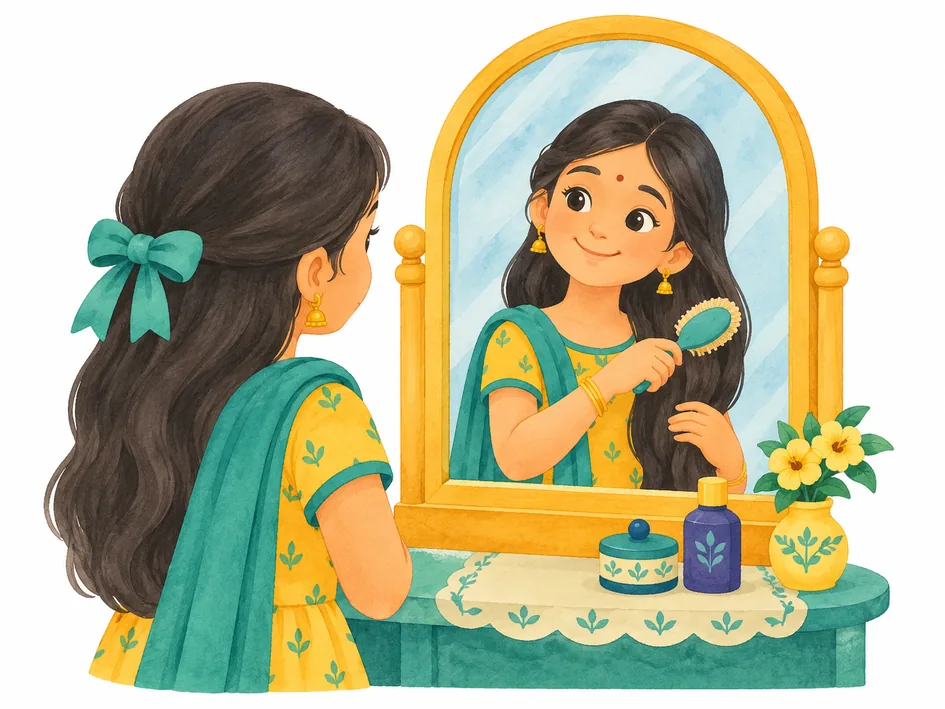
A girl brushing her hair in front of a mirror with her reflection showing.

  • Mirror image (mirror on the left or right, line MN standing up): left and right swap, top and bottom stay.
  • Water image (water or mirror below, line MN lying flat): top and bottom swap, left and right stay.

A word in a mirror is read backwards with every letter turned sideways; a word in water keeps its order but every letter stands on its head.
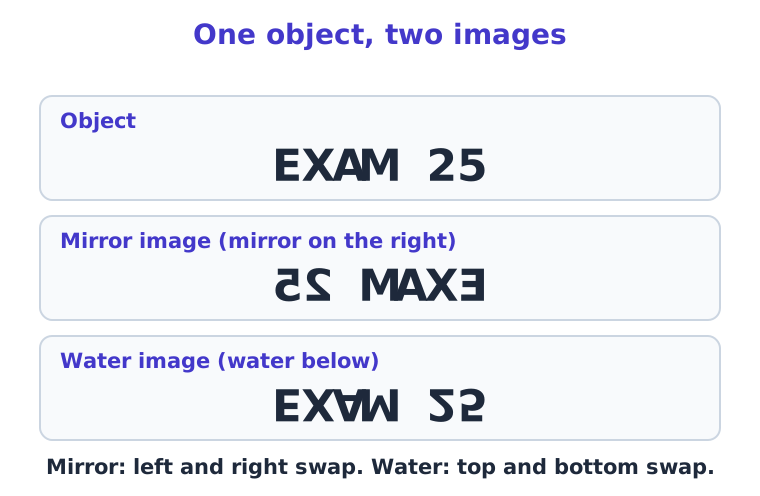
The text EXAM 25 shown three times: as written, as a mirror image with the order reversed and each character flipped sideways, and as a water image with each character upside down in the same order.

Letters that do not change

A letter with a vertical line of symmetry looks the same in a mirror: A, H, I, M, O, T, U, V, W, X, Y.

A letter with a horizontal line of symmetry looks the same in water: B, C, D, E, H, I, K, O, X.

Shortcut: a word looks the same in a mirror only if it is a palindrome made of mirror letters (MOM, TOOT, WOW). A word looks the same in water if every letter is a water letter (BOX, CODE, HIDE).
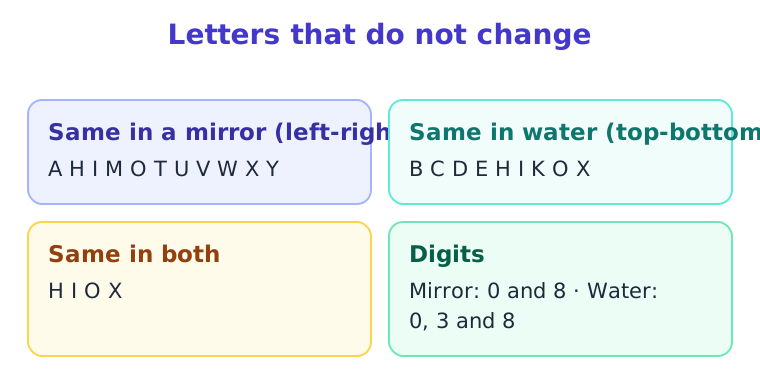
Cards: same in a mirror A H I M O T U V W X Y; same in water B C D E H I K O X; same in both H I O X; digits 0 and 8 in a mirror, 0, 3 and 8 in water.

Worked example: a word in a mirror

Find the mirror image of BANK with the mirror on the right.

  1. Reverse the order: K, N, A, B.
  2. Flip each letter sideways: K and N and B change, A does not.

The image reads ꓘИAᗺ. Trap options: KNAB (order reversed, letters not flipped), ᗺAИꓘ (letters flipped, order kept) and the upside-down water image.

Clocks in a mirror

The mirror image of a clock shows a different time. Real time and mirror time always add up to 12:00, so

$$\text{mirror time} = 11{:}60 - \text{real time}$$

Example: real time 3:40 gives $11{:}60 - 3{:}40 = 8{:}20$. The rule works both ways: if the mirror shows 8:20, the real time is 3:40.
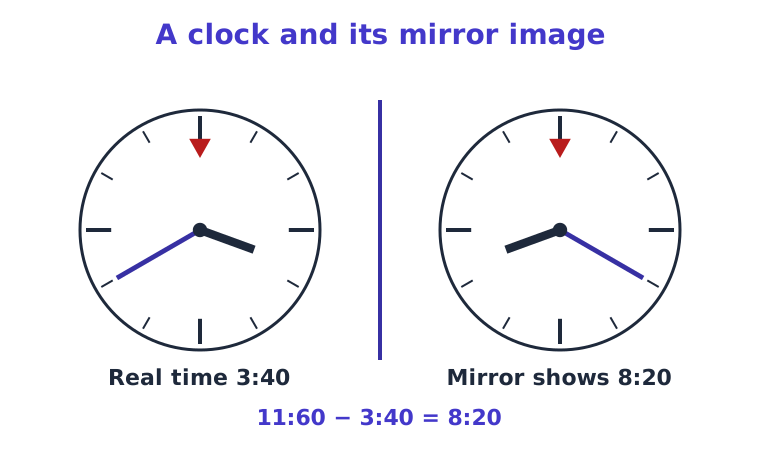
Two clocks either side of a vertical mirror line: the real clock at 3:40 and its mirror image, which reads 8:20.

Figures: follow one part

For a figure, do not try to flip everything in your head. Pick one asymmetric part, such as a filled triangle in a corner or a flag, and ask where it must go.

  • Mirror: a part on the top-left moves to the top-right.
  • Water: a part on the top-left moves to the bottom-left.
  • Rotation by 180°: top-left goes to bottom-right. This is neither image, and examiners love to offer it.
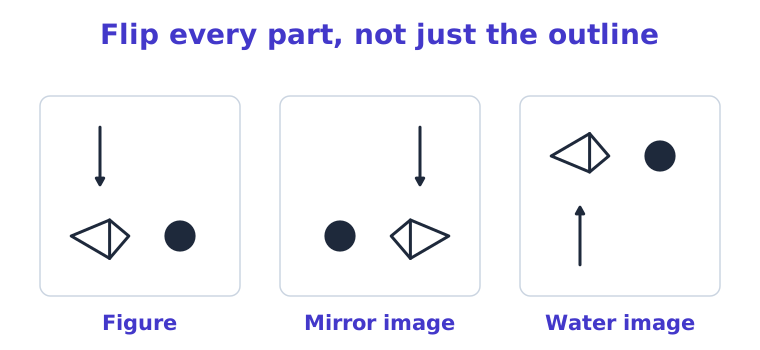
A figure made of three parts, shown beside its mirror image (each part moved to the opposite side and flipped) and its water image (each part moved top to bottom and flipped).

Exam shortcuts

  • Mirror image of a word: reverse the order, flip each letter sideways.
  • Water image: same order, each letter upside down.
  • Symmetric letters cannot help you; look for B, C, D, E, F, G, J, K, L, N, P, Q, R, S, Z.
  • Mirror clock: 11:60 − time.
  • A mirror image and a water image of the same object differ by a 180° turn.

Back to Priya

At home Priya writes her name PRIYA on a card in mirror writing: AYIЯꟼ. Her brother holds it up to the bathroom mirror and reads PRIYA. "Now I know why the ambulance looked odd," she says. "It was written for mirrors, not for people."

Mind map

The whole topic on one page.
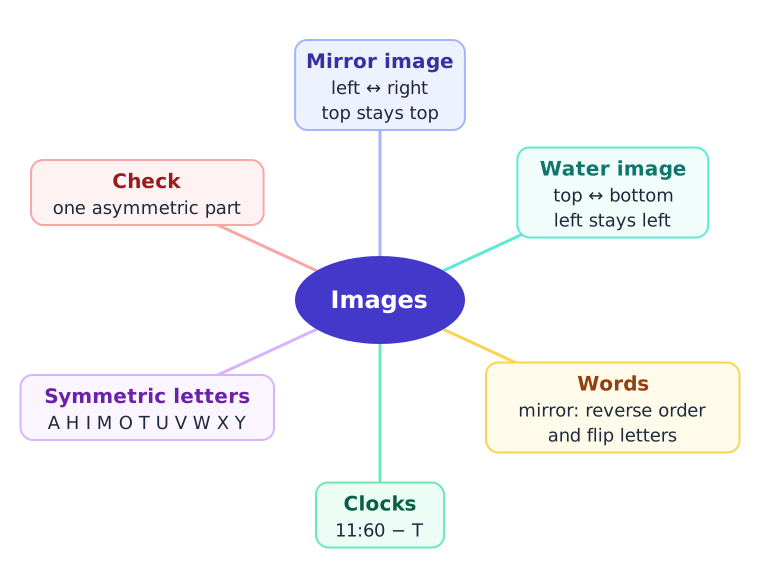
Mind map around Images: mirror image, water image, words, clocks with 11:60 minus T, symmetric letters, and checking one asymmetric part.

Concepts and terms

Lateral inversion

A plane mirror swaps left and right. Raise your right hand in front of a mirror and the image raises its left.

Water image

The image in still water below an object: the top goes to the bottom and the bottom to the top, with left and right unchanged.

Line of symmetry

A letter with a vertical line of symmetry (like A) is unchanged in a mirror; one with a horizontal line (like B) is unchanged in water.

Mirror time

Mirror and real times add up to 12:00, so mirror time = 11:60 − real time.

Did you know

AMBULANCE is painted in mirror writing on the front of ambulances so that drivers ahead can read it in their rear-view mirrors.

Leonardo da Vinci wrote many of his notebooks in mirror writing, from right to left.

Memory tricks

Mirror vs water — Mirror: sides swap. Water: heads swap. — In a mirror the left and right sides change places; in water the head goes to the feet.

Mirror time — Eleven-sixty minus — Subtract the time from 11:60 to read a mirror clock.

Practice MCQs with answers (61)

Q1 Which answer figure is the exact mirror image of the given text when the mirror MN is placed on its right? ![The text BANK with a vertical mirror line on its right. Answers: (1) KNAB, each character flipped sideways; (2) BANK, each character upside down; (3) KNAB, characters upright; (4) BANK, each character flipped sideways.](/syllabus/veda-skills-0-logical-reasoning-en/ch17/q17-word-1.svg) beginner
  • A 1
  • B 2
  • C 3
  • D 4
Show answer
Answer: 1
Why:

In a mirror image, the order of the characters reverses and each one flips sideways; top and bottom do not change. Only figure (1) does both. The other figures show a different image or only half of the change.

Q2 Which answer figure is the exact mirror image of the given text when the mirror MN is placed on its right? ![The text REASON with a vertical mirror line on its right. Answers: (1) REASON, each character upside down; (2) NOSAER, each character flipped sideways; (3) NOSAER, characters upright; (4) REASON, each character flipped sideways.](/syllabus/veda-skills-0-logical-reasoning-en/ch17/q17-word-2.svg) intermediate
  • A 1
  • B 2
  • C 3
  • D 4
Show answer
Answer: 2
Why:

In a mirror image, the order of the characters reverses and each one flips sideways; top and bottom do not change. Only figure (2) does both. The other figures show a different image or only half of the change.

Q3 Which answer figure is the exact mirror image of the given text when the mirror MN is placed on its right? ![The text PRIZE with a vertical mirror line on its right. Answers: (1) PRIZE, each character upside down; (2) EZIRP, characters upright; (3) EZIRP, each character flipped sideways; (4) PRIZE, each character flipped sideways.](/syllabus/veda-skills-0-logical-reasoning-en/ch17/q17-word-3.svg) intermediate
  • A 1
  • B 2
  • C 3
  • D 4
Show answer
Answer: 3
Why:

In a mirror image, the order of the characters reverses and each one flips sideways; top and bottom do not change. Only figure (3) does both. The other figures show a different image or only half of the change.

Q4 Which answer figure is the exact mirror image of the given text when the mirror MN is placed on its right? ![The text JUDGE with a vertical mirror line on its right. Answers: (1) JUDGE, each character upside down; (2) EGDUJ, characters upright; (3) JUDGE, each character flipped sideways; (4) EGDUJ, each character flipped sideways.](/syllabus/veda-skills-0-logical-reasoning-en/ch17/q17-word-4.svg) intermediate
  • A 1
  • B 2
  • C 3
  • D 4
Show answer
Answer: 4
Why:

In a mirror image, the order of the characters reverses and each one flips sideways; top and bottom do not change. Only figure (4) does both. The other figures show a different image or only half of the change.

Q5 Which answer figure is the exact mirror image of the given text when the mirror MN is placed on its right? ![The text SKETCH with a vertical mirror line on its right. Answers: (1) HCTEKS, each character flipped sideways; (2) SKETCH, each character upside down; (3) HCTEKS, characters upright; (4) SKETCH, each character flipped sideways.](/syllabus/veda-skills-0-logical-reasoning-en/ch17/q17-word-5.svg) advanced
  • A 1
  • B 2
  • C 3
  • D 4
Show answer
Answer: 1
Why:

In a mirror image, the order of the characters reverses and each one flips sideways; top and bottom do not change. Only figure (1) does both. The other figures show a different image or only half of the change.

Q6 Which answer figure is the exact mirror image of the given text when the mirror MN is placed on its right? ![The text NQT25 with a vertical mirror line on its right. Answers: (1) NQT25, each character upside down; (2) 52TQN, each character flipped sideways; (3) 52TQN, characters upright; (4) NQT25, each character flipped sideways.](/syllabus/veda-skills-0-logical-reasoning-en/ch17/q17-word-6.svg) advanced
  • A 1
  • B 2
  • C 3
  • D 4
Show answer
Answer: 2
Why:

In a mirror image, the order of the characters reverses and each one flips sideways; top and bottom do not change. Only figure (2) does both. The other figures show a different image or only half of the change.

Q7 Which answer figure is the exact mirror image of the given text when the mirror MN is placed on its right? ![The text GRAPE with a vertical mirror line on its right. Answers: (1) GRAPE, each character upside down; (2) EPARG, characters upright; (3) EPARG, each character flipped sideways; (4) GRAPE, each character flipped sideways.](/syllabus/veda-skills-0-logical-reasoning-en/ch17/q17-word-7.svg) beginner
  • A 1
  • B 2
  • C 3
  • D 4
Show answer
Answer: 3
Why:

In a mirror image, the order of the characters reverses and each one flips sideways; top and bottom do not change. Only figure (3) does both. The other figures show a different image or only half of the change.

Q8 Which answer figure is the exact mirror image of the given text when the mirror MN is placed on its right? ![The text FLASK with a vertical mirror line on its right. Answers: (1) FLASK, each character upside down; (2) KSALF, characters upright; (3) FLASK, each character flipped sideways; (4) KSALF, each character flipped sideways.](/syllabus/veda-skills-0-logical-reasoning-en/ch17/q17-word-8.svg) intermediate
  • A 1
  • B 2
  • C 3
  • D 4
Show answer
Answer: 4
Why:

In a mirror image, the order of the characters reverses and each one flips sideways; top and bottom do not change. Only figure (4) does both. The other figures show a different image or only half of the change.

Q9 Which answer figure is the exact mirror image of the given text when the mirror MN is placed on its right? ![The text ZEBRA42 with a vertical mirror line on its right. Answers: (1) 24ARBEZ, each character flipped sideways; (2) ZEBRA42, each character upside down; (3) 24ARBEZ, characters upright; (4) ZEBRA42, each character flipped sideways.](/syllabus/veda-skills-0-logical-reasoning-en/ch17/q17-word-9.svg) advanced
  • A 1
  • B 2
  • C 3
  • D 4
Show answer
Answer: 1
Why:

In a mirror image, the order of the characters reverses and each one flips sideways; top and bottom do not change. Only figure (1) does both. The other figures show a different image or only half of the change.

Q10 Which answer figure is the exact mirror image of the given text when the mirror MN is placed on its right? ![The text CLERK with a vertical mirror line on its right. Answers: (1) CLERK, each character upside down; (2) KRELC, each character flipped sideways; (3) KRELC, characters upright; (4) CLERK, each character flipped sideways.](/syllabus/veda-skills-0-logical-reasoning-en/ch17/q17-word-10.svg) intermediate
  • A 1
  • B 2
  • C 3
  • D 4
Show answer
Answer: 2
Why:

In a mirror image, the order of the characters reverses and each one flips sideways; top and bottom do not change. Only figure (2) does both. The other figures show a different image or only half of the change.

Q11 Which answer figure is the exact water image of the given text when the water surface MN is below it? ![The text PAGE with a horizontal water line below it. Answers: (1) EGAP, each character flipped sideways; (2) EGAP, each character turned upside down and flipped sideways; (3) PAGE, each character upside down; (4) EGAP, each character upside down.](/syllabus/veda-skills-0-logical-reasoning-en/ch17/q17-word-11.svg) beginner
  • A 1
  • B 2
  • C 3
  • D 4
Show answer
Answer: 3
Why:

In a water image, the order stays the same and each character turns upside down; left and right do not change. Only figure (3) does both. The other figures show a different image or only half of the change.

Q12 Which answer figure is the exact water image of the given text when the water surface MN is below it? ![The text TRAIN with a horizontal water line below it. Answers: (1) NIART, each character flipped sideways; (2) NIART, each character turned upside down and flipped sideways; (3) NIART, each character upside down; (4) TRAIN, each character upside down.](/syllabus/veda-skills-0-logical-reasoning-en/ch17/q17-word-12.svg) intermediate
  • A 1
  • B 2
  • C 3
  • D 4
Show answer
Answer: 4
Why:

In a water image, the order stays the same and each character turns upside down; left and right do not change. Only figure (4) does both. The other figures show a different image or only half of the change.

Q13 Which answer figure is the exact water image of the given text when the water surface MN is below it? ![The text KR7G with a horizontal water line below it. Answers: (1) KR7G, each character upside down; (2) G7RK, each character flipped sideways; (3) G7RK, each character turned upside down and flipped sideways; (4) G7RK, each character upside down.](/syllabus/veda-skills-0-logical-reasoning-en/ch17/q17-word-13.svg) advanced
  • A 1
  • B 2
  • C 3
  • D 4
Show answer
Answer: 1
Why:

In a water image, the order stays the same and each character turns upside down; left and right do not change. Only figure (1) does both. The other figures show a different image or only half of the change.

Q14 Which answer figure is the exact water image of the given text when the water surface MN is below it? ![The text MAPLE with a horizontal water line below it. Answers: (1) ELPAM, each character flipped sideways; (2) MAPLE, each character upside down; (3) ELPAM, each character turned upside down and flipped sideways; (4) ELPAM, each character upside down.](/syllabus/veda-skills-0-logical-reasoning-en/ch17/q17-word-14.svg) intermediate
  • A 1
  • B 2
  • C 3
  • D 4
Show answer
Answer: 2
Why:

In a water image, the order stays the same and each character turns upside down; left and right do not change. Only figure (2) does both. The other figures show a different image or only half of the change.

Q15 Which answer figure is the exact water image of the given text when the water surface MN is below it? ![The text SQUARE with a horizontal water line below it. Answers: (1) ERAUQS, each character flipped sideways; (2) ERAUQS, each character turned upside down and flipped sideways; (3) SQUARE, each character upside down; (4) ERAUQS, each character upside down.](/syllabus/veda-skills-0-logical-reasoning-en/ch17/q17-word-15.svg) advanced
  • A 1
  • B 2
  • C 3
  • D 4
Show answer
Answer: 3
Why:

In a water image, the order stays the same and each character turns upside down; left and right do not change. Only figure (3) does both. The other figures show a different image or only half of the change.

Q16 Which answer figure is the exact water image of the given text when the water surface MN is below it? ![The text FIGHT with a horizontal water line below it. Answers: (1) THGIF, each character flipped sideways; (2) THGIF, each character turned upside down and flipped sideways; (3) THGIF, each character upside down; (4) FIGHT, each character upside down.](/syllabus/veda-skills-0-logical-reasoning-en/ch17/q17-word-16.svg) intermediate
  • A 1
  • B 2
  • C 3
  • D 4
Show answer
Answer: 4
Why:

In a water image, the order stays the same and each character turns upside down; left and right do not change. Only figure (4) does both. The other figures show a different image or only half of the change.

Q17 Which answer figure is the exact water image of the given text when the water surface MN is below it? ![The text BLUE with a horizontal water line below it. Answers: (1) BLUE, each character upside down; (2) EULB, each character flipped sideways; (3) EULB, each character turned upside down and flipped sideways; (4) EULB, each character upside down.](/syllabus/veda-skills-0-logical-reasoning-en/ch17/q17-word-17.svg) beginner
  • A 1
  • B 2
  • C 3
  • D 4
Show answer
Answer: 1
Why:

In a water image, the order stays the same and each character turns upside down; left and right do not change. Only figure (1) does both. The other figures show a different image or only half of the change.

Q18 Which answer figure is the exact water image of the given text when the water surface MN is below it? ![The text RS2024 with a horizontal water line below it. Answers: (1) 4202SR, each character flipped sideways; (2) RS2024, each character upside down; (3) 4202SR, each character turned upside down and flipped sideways; (4) 4202SR, each character upside down.](/syllabus/veda-skills-0-logical-reasoning-en/ch17/q17-word-18.svg) advanced
  • A 1
  • B 2
  • C 3
  • D 4
Show answer
Answer: 2
Why:

In a water image, the order stays the same and each character turns upside down; left and right do not change. Only figure (2) does both. The other figures show a different image or only half of the change.

Q19 Which of these letter groups looks exactly the same in a mirror placed on its right: DAD, MAT, MOM, NUN? beginner
  • A DAD
  • B MAT
  • C NUN
  • D MOM
Show answer
Answer: MOM
Why:

MOM reads the same backwards and uses only mirror-safe letters. DAD: D flips. MAT: not the same backwards. NUN: N flips.

Q20 Which of these letter groups looks exactly the same in a mirror placed on its right: NOON, POOP, TOOT, TOTE? intermediate
  • A TOOT
  • B NOON
  • C TOTE
  • D POOP
Show answer
Answer: TOOT
Why:

TOOT reads the same backwards and uses only mirror-safe letters. NOON: N flips. TOTE: not the same backwards. POOP: P flips.

Q21 Which of these letter groups looks exactly the same in a mirror placed on its right: BOB, SOS, WOK, WOW? intermediate
  • A WOK
  • B WOW
  • C SOS
  • D BOB
Show answer
Answer: WOW
Why:

WOW reads the same backwards and uses only mirror-safe letters. BOB: B flips. WOK: not the same backwards. SOS: S flips.

Q22 Which of these letter groups looks exactly the same in a mirror placed on its right: ANNA, EYE, OTTER, OTTO? advanced
  • A ANNA
  • B OTTER
  • C OTTO
  • D EYE
Show answer
Answer: OTTO
Why:

OTTO reads the same backwards and uses only mirror-safe letters. ANNA: N flips. OTTER: not the same backwards. EYE: E flips.

Q23 Which of these letter groups looks exactly the same in its water image: BOX, BOY, BUS, FOX? beginner
  • A FOX
  • B BOY
  • C BUS
  • D BOX
Show answer
Answer: BOX
Why:

Every letter of BOX has a horizontal line of symmetry. BUS: U turns over. FOX: F turns over. BOY: Y turns over.

Q24 Which of these letter groups looks exactly the same in its water image: CODE, COKES, COPE, CORE? intermediate
  • A CODE
  • B COPE
  • C CORE
  • D COKES
Show answer
Answer: CODE
Why:

Every letter of CODE has a horizontal line of symmetry. COPE: P turns over. CORE: R turns over. COKES: S turns over.

Q25 Which of these letter groups looks exactly the same in its water image: HIDE, HIGH, HIRE, RIDE? intermediate
  • A HIGH
  • B HIDE
  • C RIDE
  • D HIRE
Show answer
Answer: HIDE
Why:

Every letter of HIDE has a horizontal line of symmetry. HIRE: R turns over. HIGH: G turns over. RIDE: R turns over.

Q26 Which of these letter groups looks exactly the same in its water image: DECK, DESK, DUCK, NECK? advanced
  • A DESK
  • B NECK
  • C DECK
  • D DUCK
Show answer
Answer: DECK
Why:

Every letter of DECK has a horizontal line of symmetry. DESK: S turns over. NECK: N turns over. DUCK: U turns over.

Q27 How many of the letters A B C D E F G H I J look exactly the same in a mirror placed beside them? intermediate
  • A 6
  • B 4
  • C 2
  • D 3
Show answer
Answer: 3
Why:

They are A, H, I: 3 letters with a vertical line of symmetry.

Q28 How many of the letters K L M N O P Q R S T look exactly the same in a mirror placed beside them? intermediate
  • A 3
  • B 2
  • C 4
  • D 5
Show answer
Answer: 3
Why:

They are M, O, T: 3 letters with a vertical line of symmetry.

Q29 How many of the letters A B C D E F G H I J look exactly the same in their water image? intermediate
  • A 3
  • B 6
  • C 7
  • D 5
Show answer
Answer: 6
Why:

They are B, C, D, E, H, I: 6 letters with a horizontal line of symmetry.

Q30 How many of the letters P Q R S T U V W X Y Z look exactly the same in their water image? advanced
  • A 2
  • B 0
  • C 1
  • D 6
Show answer
Answer: 1
Why:

They are X: 1 letters with a horizontal line of symmetry.

Q31 How many of the letters U V W X Y Z look exactly the same in a mirror placed beside them? beginner
  • A 1
  • B 6
  • C 4
  • D 5
Show answer
Answer: 5
Why:

They are U, V, W, X, Y: 5 letters with a vertical line of symmetry.

Q32 A clock shows 3:40. What time does its mirror image show? beginner
  • A 8:20
  • B 3:40
  • C 2:50
  • D 9:20
Show answer
Answer: 8:20
Why:

Real time and mirror time add up to 12:00: 11:60 − 3:40 = 8:20.

Q33 A clock shows 8:15. What time does its mirror image show? beginner
  • A 4:45
  • B 3:45
  • C 8:15
  • D 10:15
Show answer
Answer: 3:45
Why:

Real time and mirror time add up to 12:00: 11:60 − 8:15 = 3:45.

Q34 A clock shows 10:25. What time does its mirror image show? intermediate
  • A 10:25
  • B 8:05
  • C 1:35
  • D 2:35
Show answer
Answer: 1:35
Why:

Real time and mirror time add up to 12:00: 11:60 − 10:25 = 1:35.

Q35 A clock shows 1:50. What time does its mirror image show? intermediate
  • A 4:40
  • B 11:10
  • C 1:50
  • D 10:10
Show answer
Answer: 10:10
Why:

Real time and mirror time add up to 12:00: 11:60 − 1:50 = 10:10.

Q36 The mirror image of a wall clock shows 4:25. What is the actual time? intermediate
  • A 7:35
  • B 2:05
  • C 8:35
  • D 4:25
Show answer
Answer: 7:35
Why:

Real time and mirror time add up to 12:00: 11:60 − 4:25 = 7:35.

Q37 The mirror image of a wall clock shows 9:05. What is the actual time? advanced
  • A 9:25
  • B 2:55
  • C 3:55
  • D 9:05
Show answer
Answer: 2:55
Why:

Real time and mirror time add up to 12:00: 11:60 − 9:05 = 2:55.

Q38 The mirror image of a wall clock shows 12:35. What is the actual time? advanced
  • A 5:55
  • B 12:25
  • C 11:25
  • D 12:35
Show answer
Answer: 11:25
Why:

Real time and mirror time add up to 12:00: 11:60 − 12:35 = 11:25.

Q39 A clock shows 6:10. What time does its mirror image show? intermediate
  • A 6:50
  • B 6:10
  • C 12:20
  • D 5:50
Show answer
Answer: 5:50
Why:

Real time and mirror time add up to 12:00: 11:60 − 6:10 = 5:50.

Q40 The clock shows 2:10. Which answer figure is its mirror image when the mirror MN is placed on its right? (The red mark is 12.) ![A clock at 2:10 with a vertical mirror line beside it; four answer clocks (1) to (4) with the hands in different positions.](/syllabus/veda-skills-0-logical-reasoning-en/ch17/q17-clk-19.svg) beginner
  • A 1
  • B 2
  • C 3
  • D 4
Show answer
Answer: 3
Why:

In the mirror image each hand moves to the same angle on the other side of the 12–6 line. Figure (3) has both hands placed this way and reads 9:50 (11:60 − 2:10).

Q41 The clock shows 7:20. Which answer figure is its mirror image when the mirror MN is placed on its right? (The red mark is 12.) ![A clock at 7:20 with a vertical mirror line beside it; four answer clocks (1) to (4) with the hands in different positions.](/syllabus/veda-skills-0-logical-reasoning-en/ch17/q17-clk-20.svg) intermediate
  • A 1
  • B 2
  • C 3
  • D 4
Show answer
Answer: 4
Why:

In the mirror image each hand moves to the same angle on the other side of the 12–6 line. Figure (4) has both hands placed this way and reads 4:40 (11:60 − 7:20).

Q42 The clock shows 4:45. Which answer figure is its water image when the water surface MN is below it? (The red mark is 12.) ![A clock at 4:45 with a water line below it; four answer clocks (1) to (4) with the hands in different positions.](/syllabus/veda-skills-0-logical-reasoning-en/ch17/q17-clk-21.svg) advanced
  • A 1
  • B 2
  • C 3
  • D 4
Show answer
Answer: 1
Why:

In the water image each hand moves to the same angle on the other side of the 3–9 line. Figure (1) has both hands placed this way.

Q43 The clock shows 10:35. Which answer figure is its mirror image when the mirror MN is placed on its right? (The red mark is 12.) ![A clock at 10:35 with a vertical mirror line beside it; four answer clocks (1) to (4) with the hands in different positions.](/syllabus/veda-skills-0-logical-reasoning-en/ch17/q17-clk-22.svg) intermediate
  • A 1
  • B 2
  • C 3
  • D 4
Show answer
Answer: 2
Why:

In the mirror image each hand moves to the same angle on the other side of the 12–6 line. Figure (2) has both hands placed this way and reads 1:25 (11:60 − 10:35).

Q44 The clock shows 1:25. Which answer figure is its water image when the water surface MN is below it? (The red mark is 12.) ![A clock at 1:25 with a water line below it; four answer clocks (1) to (4) with the hands in different positions.](/syllabus/veda-skills-0-logical-reasoning-en/ch17/q17-clk-23.svg) advanced
  • A 1
  • B 2
  • C 3
  • D 4
Show answer
Answer: 3
Why:

In the water image each hand moves to the same angle on the other side of the 3–9 line. Figure (3) has both hands placed this way.

Q45 Which answer figure is the mirror image of the question figure when the mirror MN is placed on its right? ![A figure made of three parts with a vertical mirror line on its right. Answers: (1) flipped top to bottom; (2) turned through 180°; (3) turned a quarter clockwise; (4) flipped left to right.](/syllabus/veda-skills-0-logical-reasoning-en/ch17/q17-shape-24.svg) beginner
  • A 1
  • B 2
  • C 3
  • D 4
Show answer
Answer: 4
Why:

Follow one part: in a mirror image every part keeps its height but moves to the other side, and is itself flipped. Only figure (4) does this; the others are flipped top to bottom, turned through 180°, turned a quarter clockwise.

Q46 Which answer figure is the mirror image of the question figure when the mirror MN is placed on its right? ![A figure made of three parts with a vertical mirror line on its right. Answers: (1) flipped left to right; (2) flipped top to bottom; (3) turned through 180°; (4) turned a quarter clockwise.](/syllabus/veda-skills-0-logical-reasoning-en/ch17/q17-shape-25.svg) intermediate
  • A 1
  • B 2
  • C 3
  • D 4
Show answer
Answer: 1
Why:

Follow one part: in a mirror image every part keeps its height but moves to the other side, and is itself flipped. Only figure (1) does this; the others are flipped top to bottom, turned through 180°, turned a quarter clockwise.

Q47 Which answer figure is the water image of the question figure when the water surface MN is below it? ![A figure made of three parts with a water line below it. Answers: (1) flipped left to right; (2) flipped top to bottom; (3) turned through 180°; (4) turned a quarter clockwise.](/syllabus/veda-skills-0-logical-reasoning-en/ch17/q17-shape-26.svg) intermediate
  • A 1
  • B 2
  • C 3
  • D 4
Show answer
Answer: 2
Why:

Follow one part: in a water image every part keeps its side but moves from top to bottom, and is itself flipped. Only figure (2) does this; the others are flipped left to right, turned through 180°, turned a quarter clockwise.

Q48 Which answer figure is the mirror image of the question figure when the mirror MN is placed on its right? ![A figure made of three parts with a vertical mirror line on its right. Answers: (1) flipped top to bottom; (2) turned through 180°; (3) flipped left to right; (4) turned a quarter clockwise.](/syllabus/veda-skills-0-logical-reasoning-en/ch17/q17-shape-27.svg) advanced
  • A 1
  • B 2
  • C 3
  • D 4
Show answer
Answer: 3
Why:

Follow one part: in a mirror image every part keeps its height but moves to the other side, and is itself flipped. Only figure (3) does this; the others are flipped top to bottom, turned through 180°, turned a quarter clockwise.

Q49 Which answer figure is the water image of the question figure when the water surface MN is below it? ![A figure made of three parts with a water line below it. Answers: (1) flipped left to right; (2) turned through 180°; (3) turned a quarter clockwise; (4) flipped top to bottom.](/syllabus/veda-skills-0-logical-reasoning-en/ch17/q17-shape-28.svg) advanced
  • A 1
  • B 2
  • C 3
  • D 4
Show answer
Answer: 4
Why:

Follow one part: in a water image every part keeps its side but moves from top to bottom, and is itself flipped. Only figure (4) does this; the others are flipped left to right, turned through 180°, turned a quarter clockwise.

Q50 Which answer figure is the mirror image of the question figure when the mirror MN is placed on its right? ![A figure made of three parts with a vertical mirror line on its right. Answers: (1) flipped left to right; (2) flipped top to bottom; (3) turned through 180°; (4) turned a quarter clockwise.](/syllabus/veda-skills-0-logical-reasoning-en/ch17/q17-shape-29.svg) intermediate
  • A 1
  • B 2
  • C 3
  • D 4
Show answer
Answer: 1
Why:

Follow one part: in a mirror image every part keeps its height but moves to the other side, and is itself flipped. Only figure (1) does this; the others are flipped top to bottom, turned through 180°, turned a quarter clockwise.

Q51 Which answer figure is the water image of the question figure when the water surface MN is below it? ![A figure made of three parts with a water line below it. Answers: (1) flipped left to right; (2) flipped top to bottom; (3) turned through 180°; (4) turned a quarter clockwise.](/syllabus/veda-skills-0-logical-reasoning-en/ch17/q17-shape-30.svg) beginner
  • A 1
  • B 2
  • C 3
  • D 4
Show answer
Answer: 2
Why:

Follow one part: in a water image every part keeps its side but moves from top to bottom, and is itself flipped. Only figure (2) does this; the others are flipped left to right, turned through 180°, turned a quarter clockwise.

Q52 Which answer figure is the mirror image of the question figure when the mirror MN is placed on its right? ![A figure made of three parts with a vertical mirror line on its right. Answers: (1) flipped top to bottom; (2) turned through 180°; (3) flipped left to right; (4) turned a quarter clockwise.](/syllabus/veda-skills-0-logical-reasoning-en/ch17/q17-shape-31.svg) advanced
  • A 1
  • B 2
  • C 3
  • D 4
Show answer
Answer: 3
Why:

Follow one part: in a mirror image every part keeps its height but moves to the other side, and is itself flipped. Only figure (3) does this; the others are flipped top to bottom, turned through 180°, turned a quarter clockwise.

Q53 Ravi stands in front of a mirror and raises his right hand. Which hand does his image raise? beginner
  • A Its left hand
  • B Both hands
  • C Neither hand
  • D Its right hand
Show answer
Answer: Its left hand
Why:

A plane mirror swaps left and right (lateral inversion).

Q54 Which of these capital letters looks the same in a mirror and also in water? beginner
  • A E
  • B X
  • C A
  • D B
Show answer
Answer: X
Why:

X has both a vertical and a horizontal line of symmetry. A is mirror-safe only; B and E are water-safe only.

Q55 A word looks the same in a vertical mirror. What must be true? intermediate
  • A It starts and ends with a vowel
  • B It uses only letters like B, C, D, E
  • C It reads the same backwards and uses only letters like A, H, M, O, T
  • D It has an even number of letters
Show answer
Answer: It reads the same backwards and uses only letters like A, H, M, O, T
Why:

The mirror reverses the order and flips each letter, so both the order and every letter must survive the flip.

Q56 The mirror image and the water image of the same figure always differ by intermediate
  • A a shift to the right
  • B a rotation of 90°
  • C nothing; they are the same
  • D a rotation of 180°
Show answer
Answer: a rotation of 180°
Why:

Mirror flips x, water flips y; flipping both is the same as turning through 180°.

Q57 How many of the digits 0 to 9 look the same in a vertical mirror (in the usual printed form)? intermediate
  • A 2
  • B 1
  • C 3
  • D 4
Show answer
Answer: 2
Why:

Only 0 and 8 have a vertical line of symmetry, so the answer is 2.

Q58 Assertion (A): The mirror image of a clock showing 2:30 shows 9:30. Reason (R): Real time and mirror time always add up to 12:00. intermediate
  • A Both A and R are true, and R is the correct explanation of A
  • B Both A and R are true, but R is not the correct explanation of A
  • C A is true but R is false
  • D A is false but R is true
Show answer
Answer: Both A and R are true, and R is the correct explanation of A
Why:

11:60 − 2:30 = 9:30, and 2:30 + 9:30 = 12:00. R is the rule behind A.

Q59 Assertion (A): The word HIDE looks the same in a vertical mirror. Reason (R): H, I, D and E all have a horizontal line of symmetry. advanced
  • A Both A and R are true, and R is the correct explanation of A
  • B Both A and R are true, but R is not the correct explanation of A
  • C A is true but R is false
  • D A is false but R is true
Show answer
Answer: A is false but R is true
Why:

R is true, so HIDE looks the same in water, not in a mirror: a mirror would reverse it to EDIH and flip D and E. A is false.

Q60 Consider the statements: 1. In a water image, left and right are swapped. 2. In a mirror image of a word, the letters appear in reverse order. beginner
  • A 1 only
  • B 2 only
  • C Both 1 and 2
  • D Neither 1 nor 2
Show answer
Answer: 2 only
Why:

Water swaps top and bottom only, so 1 is false; a mirror reverses the order, so 2 is true.

Q61 Which of these is true? 1. The mirror time of 6:00 is 6:00. 2. The mirror time of 12:30 is 11:30. advanced
  • A 1 only
  • B 2 only
  • C Both 1 and 2
  • D Neither 1 nor 2
Show answer
Answer: Both 1 and 2
Why:

11:60 − 6:00 = 6:00, and 11:60 − 12:30 gives −0:30 + 12:00 = 11:30. Both are true.

Important short questions (4)

Write the mirror image rule for a word in two steps.

Write the letters in reverse order, then flip every letter left to right. Letters such as A, H, M, O, T stay the same.

A clock shows 5:35. What time will its mirror image show?

11:60 − 5:35 = 6:25.

Which capital letters look the same in both a mirror and water? Why?

H, I, O and X, because each has both a vertical and a horizontal line of symmetry.

How can you tell a mirror image from a water image in an answer figure?

Follow one part that is near the top. In the mirror image it stays near the top but moves to the other side; in the water image it moves to the bottom on the same side.

Long answer questions (1)

Explain, with the word CAB, how the mirror image and the water image are formed, and why the rotation by 180° is a different thing.

Mirror (line on the right): the order reverses to B, A, C and each letter flips sideways; A is unchanged, B and C face left.

Water (line below): the order stays C, A, B and each letter turns upside down; C and B look the same, A stands on its point.

Rotation by 180° does both flips at once: order B, A, C with every letter upside down and reversed. It is the mirror image of the water image, not an image of CAB itself.

Flashcards (13)

Mirror on the right: what swaps?
Left and right
Water image: what swaps?
Top and bottom
Letters unchanged in a mirror?
A H I M O T U V W X Y
Letters unchanged in water?
B C D E H I K O X
Letters unchanged in both?
H I O X
Mirror time of 2:15?
9:45
Mirror shows 7:10. Real time?
4:50
Mirror image of a word: two steps?
Reverse the order and flip each letter
Water image of a word: order?
Unchanged
Does MOM look the same in a mirror?
Yes
Does BOX look the same in water?
Yes
Mirror image and water image differ by?
A 180° rotation
Which digits look the same in a mirror?
0 and 8

Play this topic

  • Image or not?

Paper Folding and Cutting

Predict how a folded and punched or cut sheet looks when opened, count the holes from the number of folds, and fold a transparent sheet with a design in your head.

What you will be able to do

  • I can open a folded sheet step by step, last fold first.
  • I can count holes after opening from the number of folds and punches.
  • I can tell a reflected copy from a shifted copy of a hole or cut.
  • I can fold a transparent sheet with a design and predict the result.

Key points

  • Every fold doubles the number of layers: 1 fold gives 2 layers, 2 folds 4, 3 folds 8.

  • A hole punched through all layers appears once in every layer, so holes after opening = punches × 2^folds (when no hole is on a fold).

  • Open the folds in reverse order: undo the last fold first.

  • Each opening adds a mirror image of every hole across that fold line.

  • Holes are reflected, not shifted: a triangle pointing right becomes one pointing left on the other side of a vertical fold.

  • A cut touching a fold line joins its reflection, so a triangular notch on a fold opens into a diamond.

  • In transparent-sheet folding, the half that moves lands on the other half as its mirror image; the half that stays is unchanged.

Full explanation

Meena's rangoli stencil
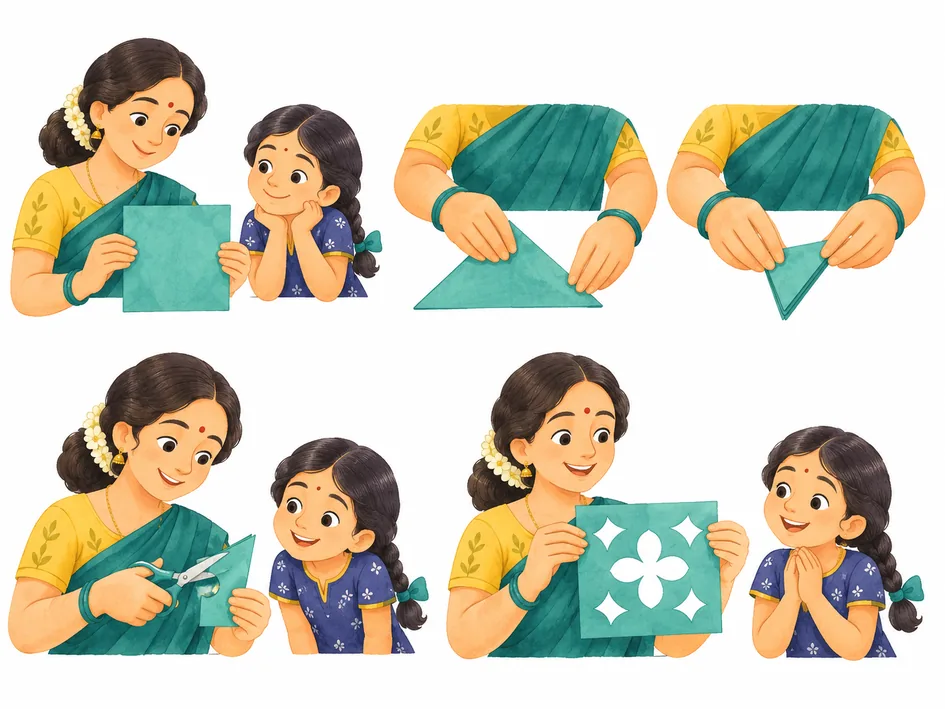
Hands folding a square of paper and cutting a small shape out with scissors.

Meena wants a stencil for the Diwali rangoli at her school in Jaipur. Her teacher shows a trick: fold a square sheet twice, punch two holes, and open it. Four copies of each hole appear, perfectly placed!

Meena's friend guesses where the holes will be before opening, and gets it wrong. This topic shows how to get it right every time.

Folds make layers

Each time you fold a sheet in half, the number of layers doubles. A punch goes through every layer, so it makes one hole in each.

$$\text{holes} = \text{punches} \times 2^{\text{folds}}$$

This holds when no hole sits on a fold line.
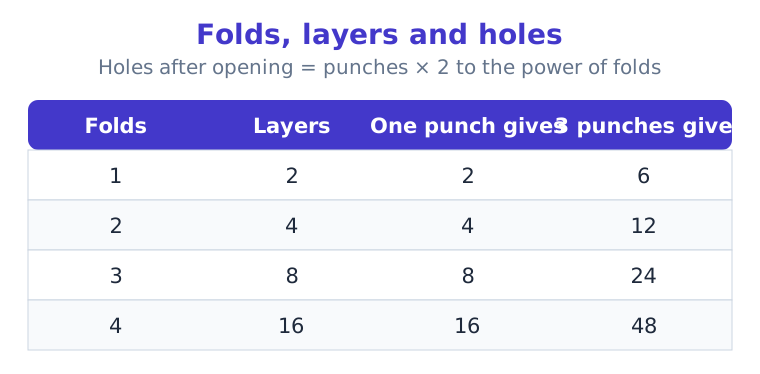
Table: 1 fold gives 2 layers, 2 folds 4, 3 folds 8, 4 folds 16; one punch gives the same number of holes and three punches give three times as many.

Opening: last fold first

The last fold is on top, so open it first. Each time you open a fold, imagine the fold line is a mirror: every hole gets a mirror copy on the other side, at the same distance from the line.
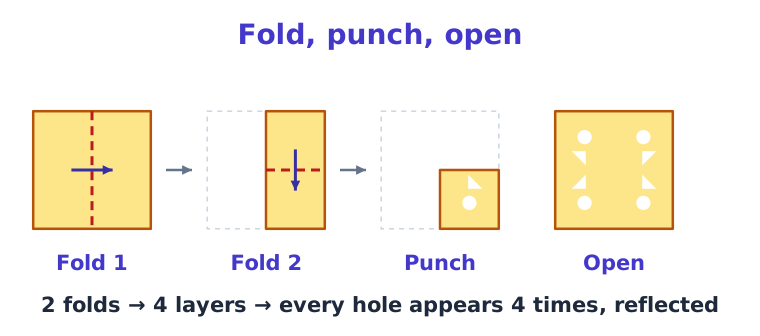
Four panels: the left half folded onto the right, the top folded down, a circle and a right triangle punched in the folded quarter, and the opened sheet with four circles and four triangles, each a mirror image across the fold lines.

Reflect, do not shift

The commonest wrong option shows the holes in the right places but not flipped. A round hole looks the same either way, so examiners use triangles, arrows and half-circles.

Check: a triangle whose right angle is near the fold must have its copy's right angle near the fold too.

Diagonal folds

A fold along a diagonal works the same way, with the diagonal as the mirror. A hole near the top edge of the folded triangle reappears near the side edge after opening.

Cuts on a fold

If a cut touches a fold line, it joins its own reflection. A small triangle cut at a folded edge opens into a diamond; a half-circle cut on a fold opens into a full circle.

Transparent sheets

Some questions give a transparent sheet with a design and ask how it looks after one fold. The moving half lands on the other half as its mirror image across the fold, and the other half stays as it is.
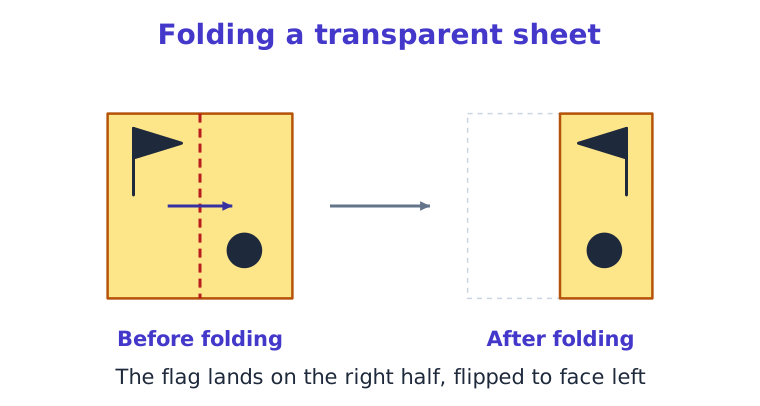
A transparent square with a flag on the top-left and a dot on the bottom-right is folded left over right; after folding the right half shows the dot and the flag, now facing left.

Exam shortcuts

  • Count first: punches × $2^{\text{folds}}$ removes wrong options fast.
  • Open the last fold first.
  • Every copy is a reflection: check one asymmetric hole.
  • A notch on a fold doubles into one bigger cut.
  • Transparent fold: moving half flips, staying half does not.

Back to Meena

Meena folds her sheet left over right, then top over bottom, and punches a circle and a triangle. Before opening she says: "Four layers, so four circles and four triangles, each flipped at the folds." She opens it, and she is right. The rangoli stencil is ready.

Mind map

The whole topic on one page.
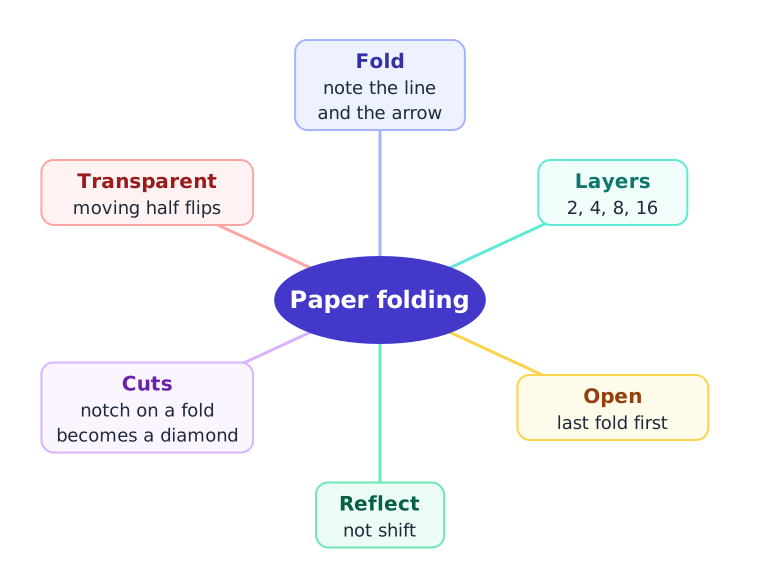
Mind map around Paper folding: fold line and arrow, layers 2 4 8 16, open the last fold first, reflect not shift, cuts on a fold, transparent sheets.

Concepts and terms

Layers

Folding in half puts one part on top of another, so the number of layers doubles with each fold.

Unfolding as reflection

Opening a fold places a mirror copy of everything across the fold line, as if the fold line were a mirror.

Reverse order

The last fold made is on top, so it is the first to be opened.

Transparent folding

On a transparent sheet both designs stay visible after folding: one as it was, the other as its mirror image.

Did you know

Sanjhi, the paper-cutting art of Mathura, makes symmetric designs by cutting a folded sheet.

A sheet of paper cannot usually be folded in half more than 7 or 8 times, because 8 folds already make 256 layers.

Memory tricks

Unfolding — Last in, first out — Open the last fold first, like taking plates off a pile.

Hole count — Double per fold — Punches × 2 × 2 × … once for each fold.

Practice MCQs with answers (44)

Q1 A square sheet of paper is folded as shown by the dashed lines and arrows, and then punched as shown in the last figure. How will it look when it is opened out? ![Folding steps: the left half is folded over onto the right half; then 2 holes are punched. Four opened sheets (1) to (4) with 2, 4, 4, 4 holes respectively.](/syllabus/veda-skills-0-logical-reasoning-en/ch17/q17-fold-38.svg) beginner
  • A 1
  • B 2
  • C 3
  • D 4
Show answer
Answer: 2
Why:

Unfold one step at a time, last fold first. Each unfolding adds a mirror copy of every hole across that fold line, so 2 becomes 4. Figure (2) has all of them, each reflected (not just shifted).

Q2 A square sheet of paper is folded as shown by the dashed lines and arrows, and then punched as shown in the last figure. How will it look when it is opened out? ![Folding steps: the top half is folded down onto the bottom half; then 2 holes are punched. Four opened sheets (1) to (4) with 2, 4, 4, 4 holes respectively.](/syllabus/veda-skills-0-logical-reasoning-en/ch17/q17-fold-39.svg) beginner
  • A 1
  • B 2
  • C 3
  • D 4
Show answer
Answer: 3
Why:

Unfold one step at a time, last fold first. Each unfolding adds a mirror copy of every hole across that fold line, so 2 becomes 4. Figure (3) has all of them, each reflected (not just shifted).

Q3 A square sheet of paper is folded as shown by the dashed lines and arrows, and then punched as shown in the last figure. How will it look when it is opened out? ![Folding steps: the right half is folded over onto the left half; then 2 holes are punched. Four opened sheets (1) to (4) with 2, 4, 4, 4 holes respectively.](/syllabus/veda-skills-0-logical-reasoning-en/ch17/q17-fold-40.svg) beginner
  • A 1
  • B 2
  • C 3
  • D 4
Show answer
Answer: 4
Why:

Unfold one step at a time, last fold first. Each unfolding adds a mirror copy of every hole across that fold line, so 2 becomes 4. Figure (4) has all of them, each reflected (not just shifted).

Q4 A square sheet of paper is folded as shown by the dashed lines and arrows, and then punched as shown in the last figure. How will it look when it is opened out? ![Folding steps: the bottom half is folded up onto the top half; then 2 holes are punched. Four opened sheets (1) to (4) with 4, 2, 4, 4 holes respectively.](/syllabus/veda-skills-0-logical-reasoning-en/ch17/q17-fold-41.svg) intermediate
  • A 1
  • B 2
  • C 3
  • D 4
Show answer
Answer: 1
Why:

Unfold one step at a time, last fold first. Each unfolding adds a mirror copy of every hole across that fold line, so 2 becomes 4. Figure (1) has all of them, each reflected (not just shifted).

Q5 A square sheet of paper is folded as shown by the dashed lines and arrows, and then punched as shown in the last figure. How will it look when it is opened out? ![Folding steps: it is folded along a diagonal; then 2 holes are punched. Four opened sheets (1) to (4) with 2, 4, 4, 4 holes respectively.](/syllabus/veda-skills-0-logical-reasoning-en/ch17/q17-fold-42.svg) intermediate
  • A 1
  • B 2
  • C 3
  • D 4
Show answer
Answer: 2
Why:

Unfold one step at a time, last fold first. Each unfolding adds a mirror copy of every hole across that fold line, so 2 becomes 4. Figure (2) has all of them, each reflected (not just shifted).

Q6 A square sheet of paper is folded as shown by the dashed lines and arrows, and then punched as shown in the last figure. How will it look when it is opened out? ![Folding steps: the left half is folded over onto the right half; then the top half is folded down onto the bottom half; then 1 hole is punched. Four opened sheets (1) to (4) with 2, 4, 4, 1 holes respectively.](/syllabus/veda-skills-0-logical-reasoning-en/ch17/q17-fold-43.svg) intermediate
  • A 1
  • B 2
  • C 3
  • D 4
Show answer
Answer: 3
Why:

Unfold one step at a time, last fold first. Each unfolding adds a mirror copy of every hole across that fold line, so 1 becomes 4. Figure (3) has all of them, each reflected (not just shifted).

Q7 A square sheet of paper is folded as shown by the dashed lines and arrows, and then punched as shown in the last figure. How will it look when it is opened out? ![Folding steps: the left half is folded over onto the right half; then the top half is folded down onto the bottom half; then 2 holes are punched. Four opened sheets (1) to (4) with 4, 8, 2, 8 holes respectively.](/syllabus/veda-skills-0-logical-reasoning-en/ch17/q17-fold-44.svg) intermediate
  • A 1
  • B 2
  • C 3
  • D 4
Show answer
Answer: 4
Why:

Unfold one step at a time, last fold first. Each unfolding adds a mirror copy of every hole across that fold line, so 2 becomes 8. Figure (4) has all of them, each reflected (not just shifted).

Q8 A square sheet of paper is folded as shown by the dashed lines and arrows, and then punched as shown in the last figure. How will it look when it is opened out? ![Folding steps: the top half is folded down onto the bottom half; then the left half is folded over onto the right half; then 2 holes are punched. Four opened sheets (1) to (4) with 8, 4, 8, 2 holes respectively.](/syllabus/veda-skills-0-logical-reasoning-en/ch17/q17-fold-45.svg) intermediate
  • A 1
  • B 2
  • C 3
  • D 4
Show answer
Answer: 1
Why:

Unfold one step at a time, last fold first. Each unfolding adds a mirror copy of every hole across that fold line, so 2 becomes 8. Figure (1) has all of them, each reflected (not just shifted).

Q9 A square sheet of paper is folded as shown by the dashed lines and arrows, and then punched as shown in the last figure. How will it look when it is opened out? ![Folding steps: the right half is folded over onto the left half; then the bottom half is folded up onto the top half; then 2 holes are punched. Four opened sheets (1) to (4) with 4, 8, 8, 2 holes respectively.](/syllabus/veda-skills-0-logical-reasoning-en/ch17/q17-fold-46.svg) advanced
  • A 1
  • B 2
  • C 3
  • D 4
Show answer
Answer: 2
Why:

Unfold one step at a time, last fold first. Each unfolding adds a mirror copy of every hole across that fold line, so 2 becomes 8. Figure (2) has all of them, each reflected (not just shifted).

Q10 A square sheet of paper is folded as shown by the dashed lines and arrows, and then punched as shown in the last figure. How will it look when it is opened out? ![Folding steps: the left half is folded over onto the right half; then it is folded along a diagonal; then 1 hole is punched. Four opened sheets (1) to (4) with 2, 4, 4, 4 holes respectively.](/syllabus/veda-skills-0-logical-reasoning-en/ch17/q17-fold-47.svg) advanced
  • A 1
  • B 2
  • C 3
  • D 4
Show answer
Answer: 3
Why:

Unfold one step at a time, last fold first. Each unfolding adds a mirror copy of every hole across that fold line, so 1 becomes 4. Figure (3) has all of them, each reflected (not just shifted).

Q11 A square sheet of paper is folded as shown by the dashed lines and arrows, and then punched as shown in the last figure. How will it look when it is opened out? ![Folding steps: the left half is folded over onto the right half; then it is folded in half again from left to right; then 2 holes are punched. Four opened sheets (1) to (4) with 4, 8, 2, 8 holes respectively.](/syllabus/veda-skills-0-logical-reasoning-en/ch17/q17-fold-48.svg) advanced
  • A 1
  • B 2
  • C 3
  • D 4
Show answer
Answer: 4
Why:

Unfold one step at a time, last fold first. Each unfolding adds a mirror copy of every hole across that fold line, so 2 becomes 8. Figure (4) has all of them, each reflected (not just shifted).

Q12 A square sheet of paper is folded as shown by the dashed lines and arrows, and then punched as shown in the last figure. How will it look when it is opened out? ![Folding steps: the top half is folded down onto the bottom half; then it is folded in half again from top to bottom; then 2 holes are punched. Four opened sheets (1) to (4) with 8, 4, 8, 2 holes respectively.](/syllabus/veda-skills-0-logical-reasoning-en/ch17/q17-fold-49.svg) advanced
  • A 1
  • B 2
  • C 3
  • D 4
Show answer
Answer: 1
Why:

Unfold one step at a time, last fold first. Each unfolding adds a mirror copy of every hole across that fold line, so 2 becomes 8. Figure (1) has all of them, each reflected (not just shifted).

Q13 A square sheet of paper is folded as shown by the dashed lines and arrows, and then punched as shown in the last figure. How will it look when it is opened out? ![Folding steps: the left half is folded over onto the right half; then the top half is folded down onto the bottom half; then it is folded in half again from left to right; then 1 hole is punched. Four opened sheets (1) to (4) with 4, 8, 8, 1 holes respectively.](/syllabus/veda-skills-0-logical-reasoning-en/ch17/q17-fold-50.svg) advanced
  • A 1
  • B 2
  • C 3
  • D 4
Show answer
Answer: 2
Why:

Unfold one step at a time, last fold first. Each unfolding adds a mirror copy of every hole across that fold line, so 1 becomes 8. Figure (2) has all of them, each reflected (not just shifted).

Q14 A square sheet of paper is folded as shown by the dashed lines and arrows, and then punched as shown in the last figure. How will it look when it is opened out? ![Folding steps: it is folded along a diagonal; then 2 holes are punched. Four opened sheets (1) to (4) with 2, 4, 4, 4 holes respectively.](/syllabus/veda-skills-0-logical-reasoning-en/ch17/q17-fold-51.svg) intermediate
  • A 1
  • B 2
  • C 3
  • D 4
Show answer
Answer: 3
Why:

Unfold one step at a time, last fold first. Each unfolding adds a mirror copy of every hole across that fold line, so 2 becomes 4. Figure (3) has all of them, each reflected (not just shifted).

Q15 A square sheet of paper is folded as shown by the dashed lines and arrows, and then punched as shown in the last figure. How will it look when it is opened out? ![Folding steps: the bottom half is folded up onto the top half; then the left half is folded over onto the right half; then 2 holes are punched. Four opened sheets (1) to (4) with 4, 8, 2, 8 holes respectively.](/syllabus/veda-skills-0-logical-reasoning-en/ch17/q17-fold-52.svg) intermediate
  • A 1
  • B 2
  • C 3
  • D 4
Show answer
Answer: 4
Why:

Unfold one step at a time, last fold first. Each unfolding adds a mirror copy of every hole across that fold line, so 2 becomes 8. Figure (4) has all of them, each reflected (not just shifted).

Q16 A square sheet of paper is folded as shown by the dashed lines and arrows, and then punched as shown in the last figure. How will it look when it is opened out? ![Folding steps: the right half is folded over onto the left half; then 2 holes are punched. Four opened sheets (1) to (4) with 4, 2, 4, 4 holes respectively.](/syllabus/veda-skills-0-logical-reasoning-en/ch17/q17-fold-53.svg) beginner
  • A 1
  • B 2
  • C 3
  • D 4
Show answer
Answer: 1
Why:

Unfold one step at a time, last fold first. Each unfolding adds a mirror copy of every hole across that fold line, so 2 becomes 4. Figure (1) has all of them, each reflected (not just shifted).

Q17 A square sheet of paper is folded as shown by the dashed lines and arrows, and then cut as shown in the last figure. How will it look when it is opened out? ![Folding steps: the left half is folded over onto the right half; then cuts are made. Four opened sheets (1) to (4) with 1, 2, 2, 2 cut-outs respectively.](/syllabus/veda-skills-0-logical-reasoning-en/ch17/q17-fold-54.svg) intermediate
  • A 1
  • B 2
  • C 3
  • D 4
Show answer
Answer: 2
Why:

Unfold one step at a time, last fold first. Each unfolding adds a mirror copy of every cut across that fold line, so 1 becomes 2. Figure (2) has all of them, each reflected (not just shifted).

Q18 A square sheet of paper is folded as shown by the dashed lines and arrows, and then cut as shown in the last figure. How will it look when it is opened out? ![Folding steps: the left half is folded over onto the right half; then the top half is folded down onto the bottom half; then cuts are made. Four opened sheets (1) to (4) with 2, 4, 4, 1 cut-outs respectively.](/syllabus/veda-skills-0-logical-reasoning-en/ch17/q17-fold-55.svg) intermediate
  • A 1
  • B 2
  • C 3
  • D 4
Show answer
Answer: 3
Why:

Unfold one step at a time, last fold first. Each unfolding adds a mirror copy of every cut across that fold line, so 1 becomes 4. Figure (3) has all of them, each reflected (not just shifted).

Q19 A square sheet of paper is folded as shown by the dashed lines and arrows, and then cut as shown in the last figure. How will it look when it is opened out? ![Folding steps: the top half is folded down onto the bottom half; then cuts are made. Four opened sheets (1) to (4) with 2, 4, 4, 4 cut-outs respectively.](/syllabus/veda-skills-0-logical-reasoning-en/ch17/q17-fold-56.svg) advanced
  • A 1
  • B 2
  • C 3
  • D 4
Show answer
Answer: 4
Why:

Unfold one step at a time, last fold first. Each unfolding adds a mirror copy of every cut across that fold line, so 2 becomes 4. Figure (4) has all of them, each reflected (not just shifted).

Q20 A square sheet of paper is folded as shown by the dashed lines and arrows, and then cut as shown in the last figure. How will it look when it is opened out? ![Folding steps: the left half is folded over onto the right half; then the top half is folded down onto the bottom half; then cuts are made. Four opened sheets (1) to (4) with 8, 4, 8, 2 cut-outs respectively.](/syllabus/veda-skills-0-logical-reasoning-en/ch17/q17-fold-57.svg) advanced
  • A 1
  • B 2
  • C 3
  • D 4
Show answer
Answer: 1
Why:

Unfold one step at a time, last fold first. Each unfolding adds a mirror copy of every cut across that fold line, so 2 becomes 8. Figure (1) has all of them, each reflected (not just shifted).

Q21 A transparent sheet with a design on it is folded along the dashed line in the direction of the arrow. Which answer figure shows the folded sheet? ![A transparent square with two designs and a dashed fold line with an arrow; four folded sheets: (1) the moving part shifted without flipping; (2) the design folded over correctly; (3) folded the other way; (4) the moving part flipped the wrong way.](/syllabus/veda-skills-0-logical-reasoning-en/ch17/q17-transp-58.svg) beginner
  • A 1
  • B 2
  • C 3
  • D 4
Show answer
Answer: 2
Why:

The half that moves lands on the other half as its mirror image across the fold line, and the half that stays does not change. Figure (2) shows this.

Q22 A transparent sheet with a design on it is folded along the dashed line in the direction of the arrow. Which answer figure shows the folded sheet? ![A transparent square with two designs and a dashed fold line with an arrow; four folded sheets: (1) the moving part shifted without flipping; (2) folded the other way; (3) the design folded over correctly; (4) the moving part flipped the wrong way.](/syllabus/veda-skills-0-logical-reasoning-en/ch17/q17-transp-59.svg) intermediate
  • A 1
  • B 2
  • C 3
  • D 4
Show answer
Answer: 3
Why:

The half that moves lands on the other half as its mirror image across the fold line, and the half that stays does not change. Figure (3) shows this.

Q23 A transparent sheet with a design on it is folded along the dashed line in the direction of the arrow. Which answer figure shows the folded sheet? ![A transparent square with two designs and a dashed fold line with an arrow; four folded sheets: (1) the moving part shifted without flipping; (2) folded the other way; (3) the moving part flipped the wrong way; (4) the design folded over correctly.](/syllabus/veda-skills-0-logical-reasoning-en/ch17/q17-transp-60.svg) intermediate
  • A 1
  • B 2
  • C 3
  • D 4
Show answer
Answer: 4
Why:

The half that moves lands on the other half as its mirror image across the fold line, and the half that stays does not change. Figure (4) shows this.

Q24 A transparent sheet with a design on it is folded along the dashed line in the direction of the arrow. Which answer figure shows the folded sheet? ![A transparent square with two designs and a dashed fold line with an arrow; four folded sheets: (1) the design folded over correctly; (2) the moving part shifted without flipping; (3) folded the other way; (4) the moving part flipped the wrong way.](/syllabus/veda-skills-0-logical-reasoning-en/ch17/q17-transp-61.svg) advanced
  • A 1
  • B 2
  • C 3
  • D 4
Show answer
Answer: 1
Why:

The half that moves lands on the other half as its mirror image across the fold line, and the half that stays does not change. Figure (1) shows this.

Q25 A transparent sheet with a design on it is folded along the dashed line in the direction of the arrow. Which answer figure shows the folded sheet? ![A transparent square with two designs and a dashed fold line with an arrow; four folded sheets: (1) the moving part shifted without flipping; (2) the design folded over correctly; (3) folded the other way; (4) the moving part flipped the wrong way.](/syllabus/veda-skills-0-logical-reasoning-en/ch17/q17-transp-62.svg) intermediate
  • A 1
  • B 2
  • C 3
  • D 4
Show answer
Answer: 2
Why:

The half that moves lands on the other half as its mirror image across the fold line, and the half that stays does not change. Figure (2) shows this.

Q26 A transparent sheet with a design on it is folded along the dashed line in the direction of the arrow. Which answer figure shows the folded sheet? ![A transparent square with two designs and a dashed fold line with an arrow; four folded sheets: (1) the moving part shifted without flipping; (2) folded the other way; (3) the design folded over correctly; (4) the moving part flipped the wrong way.](/syllabus/veda-skills-0-logical-reasoning-en/ch17/q17-transp-63.svg) advanced
  • A 1
  • B 2
  • C 3
  • D 4
Show answer
Answer: 3
Why:

The half that moves lands on the other half as its mirror image across the fold line, and the half that stays does not change. Figure (3) shows this.

Q27 A square sheet is folded: the left half is folded over onto the right half. Then 3 holes are punched through all the layers, away from the fold lines. How many holes will the opened sheet have? beginner
  • A 5
  • B 6
  • C 3
  • D 12
Show answer
Answer: 6
Why:

1 fold make 2 layers, and each hole goes through every layer: 3 × 2 = 6.

Q28 A square sheet is folded: the left half is folded over onto the right half; then the top half is folded down onto the bottom half. Then 2 holes are punched through all the layers, away from the fold lines. How many holes will the opened sheet have? beginner
  • A 16
  • B 6
  • C 8
  • D 4
Show answer
Answer: 8
Why:

2 folds make 4 layers, and each hole goes through every layer: 2 × 4 = 8.

Q29 A square sheet is folded: the top half is folded down onto the bottom half; then the left half is folded over onto the right half; then it is folded in half again from top to bottom. Then 1 hole is punched through all the layers, away from the fold lines. How many holes will the opened sheet have? intermediate
  • A 4
  • B 16
  • C 6
  • D 8
Show answer
Answer: 8
Why:

3 folds make 8 layers, and each hole goes through every layer: 1 × 8 = 8.

Q30 A square sheet is folded: the left half is folded over onto the right half; then the top half is folded down onto the bottom half; then it is folded in half again from left to right. Then 3 holes are punched through all the layers, away from the fold lines. How many holes will the opened sheet have? intermediate
  • A 24
  • B 18
  • C 12
  • D 48
Show answer
Answer: 24
Why:

3 folds make 8 layers, and each hole goes through every layer: 3 × 8 = 24.

Q31 A square sheet is folded: it is folded along a diagonal. Then 4 holes are punched through all the layers, away from the fold lines. How many holes will the opened sheet have? intermediate
  • A 4
  • B 8
  • C 16
  • D 6
Show answer
Answer: 8
Why:

1 fold make 2 layers, and each hole goes through every layer: 4 × 2 = 8.

Q32 A square sheet is folded: the left half is folded over onto the right half; then it is folded along a diagonal. Then 2 holes are punched through all the layers, away from the fold lines. How many holes will the opened sheet have? advanced
  • A 4
  • B 16
  • C 8
  • D 6
Show answer
Answer: 8
Why:

2 folds make 4 layers, and each hole goes through every layer: 2 × 4 = 8.

Q33 A square sheet is folded: the left half is folded over onto the right half; then the top half is folded down onto the bottom half; then it is folded in half again from left to right; then it is folded in half again from top to bottom. Then 1 hole is punched through all the layers, away from the fold lines. How many holes will the opened sheet have? advanced
  • A 17
  • B 8
  • C 32
  • D 16
Show answer
Answer: 16
Why:

4 folds make 16 layers, and each hole goes through every layer: 1 × 16 = 16.

Q34 A square sheet is folded: the right half is folded over onto the left half; then the bottom half is folded up onto the top half. Then 5 holes are punched through all the layers, away from the fold lines. How many holes will the opened sheet have? intermediate
  • A 20
  • B 10
  • C 40
  • D 9
Show answer
Answer: 20
Why:

2 folds make 4 layers, and each hole goes through every layer: 5 × 4 = 20.

Q35 A square sheet is folded: the top half is folded down onto the bottom half; then it is folded in half again from top to bottom. Then 3 holes are punched through all the layers, away from the fold lines. How many holes will the opened sheet have? advanced
  • A 6
  • B 12
  • C 24
  • D 7
Show answer
Answer: 12
Why:

2 folds make 4 layers, and each hole goes through every layer: 3 × 4 = 12.

Q36 A sheet is folded in half four times. How many layers of paper are there now? beginner
  • A 32
  • B 8
  • C 16
  • D 4
Show answer
Answer: 16
Why:

Each fold doubles the layers: 2 × 2 × 2 × 2 = 16.

Q37 When a folded sheet is opened, which fold should be undone first? beginner
  • A The longest fold line
  • B The first fold that was made
  • C Any fold; the order does not matter
  • D The last fold that was made
Show answer
Answer: The last fold that was made
Why:

The last fold is on top of the pile of layers, so it opens first.

Q38 A triangular hole near a vertical fold has its right angle at the bottom-right. After opening, where is the right angle of its copy on the other side? intermediate
  • A At the bottom-left
  • B At the top-left
  • C At the top-right
  • D At the bottom-right
Show answer
Answer: At the bottom-left
Why:

A vertical fold acts as a mirror: right becomes left, bottom stays bottom.

Q39 A square sheet is folded in half once and a half-circle is cut out with its straight edge on the fold. What appears when it is opened? intermediate
  • A One half-circle hole
  • B One full circular hole
  • C Two half-circle holes
  • D Two full circles
Show answer
Answer: One full circular hole
Why:

The cut touches the fold, so it joins its reflection into a full circle.

Q40 Holes after opening follow the pattern 1 fold → 2, 2 folds → 4, 3 folds → 8 for one punch. How many for 5 folds? intermediate
  • A 25
  • B 10
  • C 32
  • D 16
Show answer
Answer: 32
Why:

Doubling each time: 2⁵ = 32.

Q41 Assertion (A): A sheet folded twice and punched once shows 4 holes when opened. Reason (R): Two folds make four layers of paper. beginner
  • A Both A and R are true, and R is the correct explanation of A
  • B Both A and R are true, but R is not the correct explanation of A
  • C A is true but R is false
  • D A is false but R is true
Show answer
Answer: Both A and R are true, and R is the correct explanation of A
Why:

The punch passes through all 4 layers, one hole each, so R explains A (holes away from the folds).

Q42 Assertion (A): When a folded sheet is opened, a hole and its copy across a fold line look exactly alike in orientation. Reason (R): The copy is the mirror image of the hole in the fold line. intermediate
  • A Both A and R are true, and R is the correct explanation of A
  • B Both A and R are true, but R is not the correct explanation of A
  • C A is true but R is false
  • D A is false but R is true
Show answer
Answer: A is false but R is true
Why:

R is true, and that is why A is false: a mirror image of an asymmetric hole faces the other way.

Q43 A square sheet is folded left over right and then top over bottom. Consider: 1. The folded sheet has 4 layers. 2. Three punches through it give 12 holes when opened. beginner
  • A 1 only
  • B 2 only
  • C Both 1 and 2
  • D Neither 1 nor 2
Show answer
Answer: Both 1 and 2
Why:

2 folds → 4 layers, and 3 × 4 = 12 (holes away from the folds). Both are true.

Q44 About folding a transparent sheet left over right, which is true? 1. The design on the right half changes direction. 2. The design on the left half lands on the right half as its mirror image. intermediate
  • A 1 only
  • B 2 only
  • C Both 1 and 2
  • D Neither 1 nor 2
Show answer
Answer: 2 only
Why:

The right half does not move, so it does not change; only the left half is reflected onto it.

Important short questions (3)

A sheet is folded three times and punched twice. How many holes are there after opening? Explain.

Three folds make 2³ = 8 layers, and each punch goes through all 8, so 2 × 8 = 16 holes.

Why must folds be opened in reverse order?

The last fold lies on top of the others, so it is the only one that can be opened first; each opening reflects the holes across that fold line.

How does a triangular notch on a fold line look when opened?

It joins its mirror image across the fold, so it becomes one diamond (or a larger triangle) instead of two separate pieces.

Long answer questions (1)

A square sheet is folded left over right, then top over bottom. A small right-angled triangle is punched near the outer corner of the folded square. Describe the opened sheet step by step.

Open the top-over-bottom fold first: the triangle gets a copy in the top-right quarter, reflected top to bottom.

Then open the left-over-right fold: both triangles get copies in the left half, reflected left to right.

The sheet shows 4 triangles, one near each corner, each the mirror image of its neighbours, so all four right angles point to the corners (or all to the centre).

Flashcards (12)

Layers after 3 folds?
8
Holes: 2 punches, 2 folds?
8
Which fold do you open first?
The last one made
What does opening a fold do to a hole?
Adds its mirror copy across the fold line
Shifted copy or reflected copy?
Reflected
A notch cut on a fold opens into?
One shape twice as wide (like a diamond)
Holes formula?
punches × 2^folds
Transparent fold: what happens to the moving half?
It is reflected onto the other half
Transparent fold: the staying half?
Unchanged
Diagonal fold: what is the mirror?
The diagonal
Layers after 4 folds?
16
Common wrong option?
Holes shifted, not flipped

Play this topic

  • Fold facts

Embedded Figures and Pattern Completion

Find a simple figure hidden inside a complex one in the same size and direction, find which small figure a big one hides, complete a symmetric pattern, and count lines of symmetry.

What you will be able to do

  • I can trace a given figure inside a complex figure line by line.
  • I can reject options that hide a flipped or turned copy.
  • I can complete a pattern using its lines of symmetry.
  • I can state the number of lines of symmetry of common shapes.

Key points

  • An embedded figure must appear in the same size and the same direction; a flipped or turned copy does not count.

  • Start from the most unusual part of the simple figure, such as a slanting line or a sharp corner, and look for it first.

  • Extra lines around the hidden figure are allowed; missing lines are not.

  • A line of the simple figure may lie along a longer line of the complex figure.

  • In pattern completion, each quarter of a pattern symmetric about both centre lines is the mirror image of its neighbour.

  • The diagonally opposite quarter is the 180° turn of a quarter, not its mirror image.

  • Lines of symmetry: square 4, rectangle 2, equilateral triangle 3, regular hexagon 6, parallelogram 0, circle infinitely many.

Full explanation

Kabir at Fatehpur Sikri
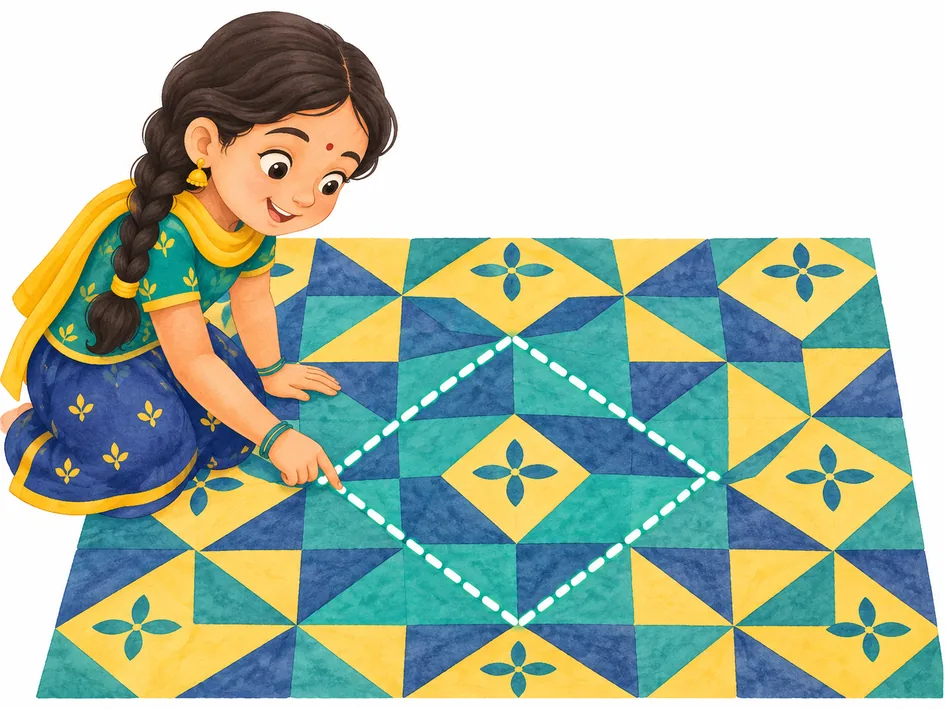
A hidden shape inside a busy tiled floor, a child tracing it with a finger.

Kabir's class visits Fatehpur Sikri near Agra. The guide points to a stone jali screen and says: "There is a six-pointed star hidden in this pattern. Who can find it?" Kabir stares at hundreds of crossing lines and sees nothing. His friend Sana finds it in ten seconds.

Her secret is a method, and you will learn it here.

What counts as embedded?

Figure X is embedded in a bigger figure if every line of X is present there:

  • in the same size,
  • in the same direction (not flipped, not turned),
  • with no line missing.

Extra lines around it do not matter.

Sana's method

  1. Pick the most unusual part of X: a slanting line, a sharp corner or a short step.
  2. Find every place in the big figure where that part appears in the same direction.
  3. From each such place, trace the remaining lines of X. One missing line means that place fails.
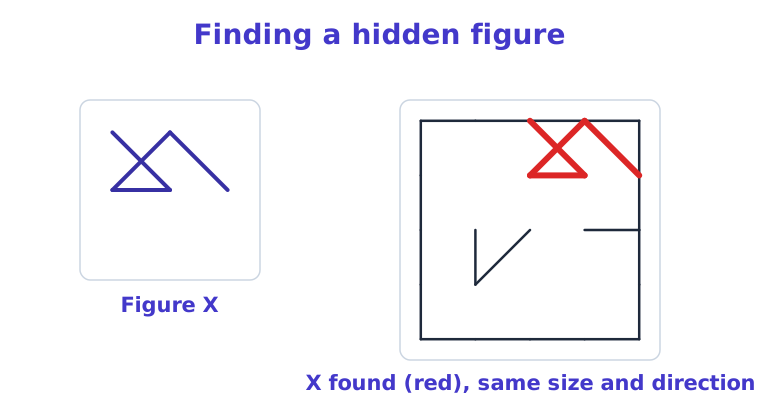
Figure X made of a few lines, and a larger square figure of crossing lines in which X is traced in red at one place, in the same size and direction.

The traps in the options

Examiners make three kinds of wrong options:

  • the big figure hides the mirror image of X;
  • it hides X turned through 90° or 180°;
  • it has X with one line missing.

So after you find a match, check its direction and count its lines.

The reverse question

Sometimes one big figure is given, and you must choose which small figure it hides. Use the same method on each option. The flipped and turned versions of the right answer are the usual distractors.

Completing a symmetric pattern

A pattern that is symmetric about both centre lines is made of four quarters:

  • left and right neighbours are mirror images,
  • top and bottom neighbours are water images,
  • diagonally opposite quarters are 180° turns.

To fill the missing quarter, reflect its neighbour across the line between them.
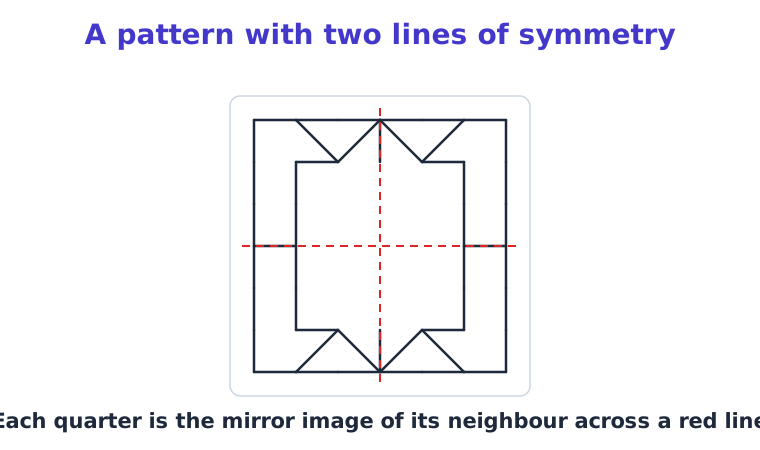
A square line pattern with a red dashed vertical and horizontal centre line; each quarter is the mirror image of the quarter beside it.

Lines of symmetry

A line of symmetry is a fold line that makes the two halves match. Knowing the common counts saves time.
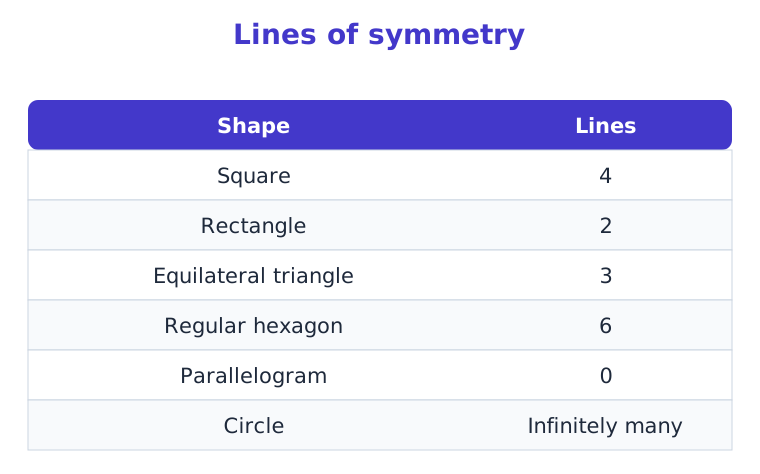
Table of lines of symmetry: square 4, rectangle 2, equilateral triangle 3, regular hexagon 6, parallelogram 0, circle infinitely many.

Exam shortcuts

  • Start with the odd part of X, not the obvious square.
  • Same size, same direction, every line.
  • Reject mirror and turned copies at once.
  • Completion: neighbours mirror, opposites turn.
  • Regular n-gon: n lines of symmetry.

Back to Kabir

Sana shows Kabir her trick: "Don't look for the whole star. Look for one sharp point, then follow its two sides." Kabir tries the next jali and finds a hexagon in it before Sana does.

Mind map

The whole topic on one page.
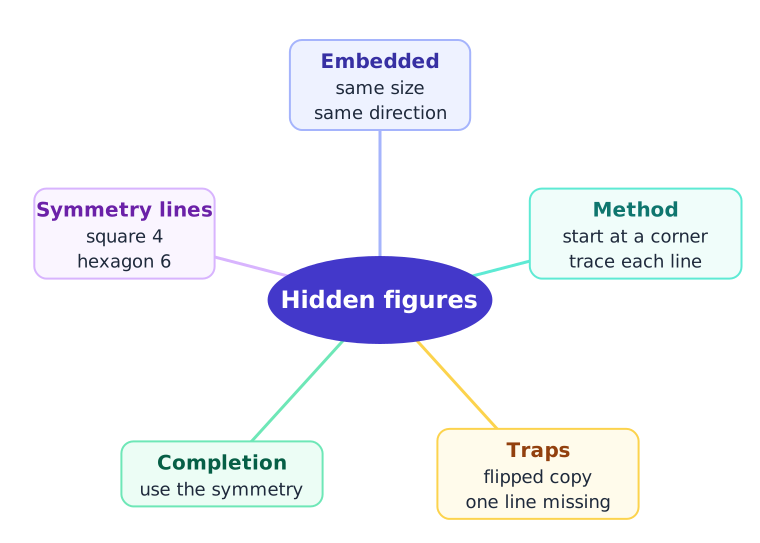
Mind map around Hidden figures: embedded means same size and direction, the method of tracing from a corner, the traps, pattern completion and lines of symmetry.

Concepts and terms

Embedded figure

A simple figure that forms part of a bigger figure, with every one of its lines present in the same size and direction.

Orientation

Which way a figure faces. A mirror image or a rotated copy has a different orientation, so it is a different figure here.

Pattern completion

A design with a missing part is completed by using its symmetry: the missing part is the reflection of a known part.

Line of symmetry

A line along which a figure can be folded so that the two halves match exactly.

Did you know

The stone jali screens of Fatehpur Sikri hide hundreds of small stars and hexagons inside one large symmetric pattern.

Psychologists use embedded-figure tests to measure how well people separate a shape from its background.

Memory tricks

Embedded figures — Same size, same side, every line — All three must hold for the figure to be really hidden there.

Completion — Neighbours mirror, opposites turn — Side-by-side quarters are mirror images; diagonal quarters are 180° turns.

Practice MCQs with answers (45)

Q1 In which answer figure is figure X hidden (embedded) exactly, with the same size and the same direction? ![A small figure X drawn with blue lines; four larger square figures (1) to (4) made of straight lines on a 4 by 4 grid.](/syllabus/veda-skills-0-logical-reasoning-en/ch17/q17-emb-71.svg) beginner
  • A 1
  • B 2
  • C 3
  • D 4
Show answer
Answer: 1
Why:

Trace X's lines inside each figure. Only figure (1) contains every line of X in the same position and direction; the others hold only a wrong copy: the mirror image of X; X turned a quarter; X upside down.

Q2 In which answer figure is figure X hidden (embedded) exactly, with the same size and the same direction? ![A small figure X drawn with blue lines; four larger square figures (1) to (4) made of straight lines on a 4 by 4 grid.](/syllabus/veda-skills-0-logical-reasoning-en/ch17/q17-emb-72.svg) intermediate
  • A 1
  • B 2
  • C 3
  • D 4
Show answer
Answer: 2
Why:

Trace X's lines inside each figure. Only figure (2) contains every line of X in the same position and direction; the others hold only a wrong copy: the mirror image of X; X turned a quarter; X upside down.

Q3 In which answer figure is figure X hidden (embedded) exactly, with the same size and the same direction? ![A small figure X drawn with blue lines; four larger square figures (1) to (4) made of straight lines on a 4 by 4 grid.](/syllabus/veda-skills-0-logical-reasoning-en/ch17/q17-emb-73.svg) intermediate
  • A 1
  • B 2
  • C 3
  • D 4
Show answer
Answer: 3
Why:

Trace X's lines inside each figure. Only figure (3) contains every line of X in the same position and direction; the others hold only a wrong copy: the mirror image of X; X turned a quarter; X upside down.

Q4 In which answer figure is figure X hidden (embedded) exactly, with the same size and the same direction? ![A small figure X drawn with blue lines; four larger square figures (1) to (4) made of straight lines on a 4 by 4 grid.](/syllabus/veda-skills-0-logical-reasoning-en/ch17/q17-emb-74.svg) advanced
  • A 1
  • B 2
  • C 3
  • D 4
Show answer
Answer: 4
Why:

Trace X's lines inside each figure. Only figure (4) contains every line of X in the same position and direction; the others hold only a wrong copy: the mirror image of X; X turned a quarter; X upside down.

Q5 In which answer figure is figure X hidden (embedded) exactly, with the same size and the same direction? ![A small figure X drawn with blue lines; four larger square figures (1) to (4) made of straight lines on a 4 by 4 grid.](/syllabus/veda-skills-0-logical-reasoning-en/ch17/q17-emb-75.svg) intermediate
  • A 1
  • B 2
  • C 3
  • D 4
Show answer
Answer: 1
Why:

Trace X's lines inside each figure. Only figure (1) contains every line of X in the same position and direction; the others hold only a wrong copy: the mirror image of X; X turned a quarter; X upside down.

Q6 In which answer figure is figure X hidden (embedded) exactly, with the same size and the same direction? ![A small figure X drawn with blue lines; four larger square figures (1) to (4) made of straight lines on a 4 by 4 grid.](/syllabus/veda-skills-0-logical-reasoning-en/ch17/q17-emb-76.svg) advanced
  • A 1
  • B 2
  • C 3
  • D 4
Show answer
Answer: 2
Why:

Trace X's lines inside each figure. Only figure (2) contains every line of X in the same position and direction; the others hold only a wrong copy: the mirror image of X; X turned a quarter; X upside down.

Q7 In which answer figure is figure X hidden (embedded) exactly, with the same size and the same direction? ![A small figure X drawn with blue lines; four larger square figures (1) to (4) made of straight lines on a 4 by 4 grid.](/syllabus/veda-skills-0-logical-reasoning-en/ch17/q17-emb-77.svg) beginner
  • A 1
  • B 2
  • C 3
  • D 4
Show answer
Answer: 3
Why:

Trace X's lines inside each figure. Only figure (3) contains every line of X in the same position and direction; the others hold only a wrong copy: the mirror image of X; X turned a quarter; X upside down.

Q8 In which answer figure is figure X hidden (embedded) exactly, with the same size and the same direction? ![A small figure X drawn with blue lines; four larger square figures (1) to (4) made of straight lines on a 4 by 4 grid.](/syllabus/veda-skills-0-logical-reasoning-en/ch17/q17-emb-78.svg) intermediate
  • A 1
  • B 2
  • C 3
  • D 4
Show answer
Answer: 4
Why:

Trace X's lines inside each figure. Only figure (4) contains every line of X in the same position and direction; the others hold only a wrong copy: the mirror image of X; X turned a quarter; X upside down.

Q9 In which answer figure is figure X hidden (embedded) exactly, with the same size and the same direction? ![A small figure X drawn with blue lines; four larger square figures (1) to (4) made of straight lines on a 4 by 4 grid.](/syllabus/veda-skills-0-logical-reasoning-en/ch17/q17-emb-79.svg) advanced
  • A 1
  • B 2
  • C 3
  • D 4
Show answer
Answer: 1
Why:

Trace X's lines inside each figure. Only figure (1) contains every line of X in the same position and direction; the others hold only a wrong copy: the mirror image of X; X turned a quarter; X upside down.

Q10 In which answer figure is figure X hidden (embedded) exactly, with the same size and the same direction? ![A small figure X drawn with blue lines; four larger square figures (1) to (4) made of straight lines on a 4 by 4 grid.](/syllabus/veda-skills-0-logical-reasoning-en/ch17/q17-emb-80.svg) intermediate
  • A 1
  • B 2
  • C 3
  • D 4
Show answer
Answer: 2
Why:

Trace X's lines inside each figure. Only figure (2) contains every line of X in the same position and direction; the others hold only a wrong copy: the mirror image of X; X turned a quarter; X upside down.

Q11 In which answer figure is figure X hidden (embedded) exactly, with the same size and the same direction? ![A small figure X drawn with blue lines; four larger square figures (1) to (4) made of straight lines on a 4 by 4 grid.](/syllabus/veda-skills-0-logical-reasoning-en/ch17/q17-emb-81.svg) advanced
  • A 1
  • B 2
  • C 3
  • D 4
Show answer
Answer: 3
Why:

Trace X's lines inside each figure. Only figure (3) contains every line of X in the same position and direction; the others hold only a wrong copy: the mirror image of X; X turned a quarter; X upside down.

Q12 In which answer figure is figure X hidden (embedded) exactly, with the same size and the same direction? ![A small figure X drawn with blue lines; four larger square figures (1) to (4) made of straight lines on a 4 by 4 grid.](/syllabus/veda-skills-0-logical-reasoning-en/ch17/q17-emb-82.svg) beginner
  • A 1
  • B 2
  • C 3
  • D 4
Show answer
Answer: 4
Why:

Trace X's lines inside each figure. Only figure (4) contains every line of X in the same position and direction; the others hold only a wrong copy: the mirror image of X; X turned a quarter; X upside down.

Q13 Which answer figure is hidden in the question figure, in the same size and direction? ![A square figure on a 4 by 4 grid made of straight lines, and four small line figures (1) to (4) in blue.](/syllabus/veda-skills-0-logical-reasoning-en/ch17/q17-remb-83.svg) beginner
  • A 1
  • B 2
  • C 3
  • D 4
Show answer
Answer: 1
Why:

Figure (1) can be traced inside the question figure line for line. The others are the same shape flipped or turned, and no flipped or turned copy is present.

Q14 Which answer figure is hidden in the question figure, in the same size and direction? ![A square figure on a 4 by 4 grid made of straight lines, and four small line figures (1) to (4) in blue.](/syllabus/veda-skills-0-logical-reasoning-en/ch17/q17-remb-84.svg) intermediate
  • A 1
  • B 2
  • C 3
  • D 4
Show answer
Answer: 2
Why:

Figure (2) can be traced inside the question figure line for line. The others are the same shape flipped or turned, and no flipped or turned copy is present.

Q15 Which answer figure is hidden in the question figure, in the same size and direction? ![A square figure on a 4 by 4 grid made of straight lines, and four small line figures (1) to (4) in blue.](/syllabus/veda-skills-0-logical-reasoning-en/ch17/q17-remb-85.svg) advanced
  • A 1
  • B 2
  • C 3
  • D 4
Show answer
Answer: 3
Why:

Figure (3) can be traced inside the question figure line for line. The others are the same shape flipped or turned, and no flipped or turned copy is present.

Q16 Which answer figure is hidden in the question figure, in the same size and direction? ![A square figure on a 4 by 4 grid made of straight lines, and four small line figures (1) to (4) in blue.](/syllabus/veda-skills-0-logical-reasoning-en/ch17/q17-remb-86.svg) intermediate
  • A 1
  • B 2
  • C 3
  • D 4
Show answer
Answer: 4
Why:

Figure (4) can be traced inside the question figure line for line. The others are the same shape flipped or turned, and no flipped or turned copy is present.

Q17 Which answer figure is hidden in the question figure, in the same size and direction? ![A square figure on a 4 by 4 grid made of straight lines, and four small line figures (1) to (4) in blue.](/syllabus/veda-skills-0-logical-reasoning-en/ch17/q17-remb-87.svg) advanced
  • A 1
  • B 2
  • C 3
  • D 4
Show answer
Answer: 1
Why:

Figure (1) can be traced inside the question figure line for line. The others are the same shape flipped or turned, and no flipped or turned copy is present.

Q18 Which answer figure is hidden in the question figure, in the same size and direction? ![A square figure on a 4 by 4 grid made of straight lines, and four small line figures (1) to (4) in blue.](/syllabus/veda-skills-0-logical-reasoning-en/ch17/q17-remb-88.svg) intermediate
  • A 1
  • B 2
  • C 3
  • D 4
Show answer
Answer: 2
Why:

Figure (2) can be traced inside the question figure line for line. The others are the same shape flipped or turned, and no flipped or turned copy is present.

Q19 Which answer figure is hidden in the question figure, in the same size and direction? ![A square figure on a 4 by 4 grid made of straight lines, and four small line figures (1) to (4) in blue.](/syllabus/veda-skills-0-logical-reasoning-en/ch17/q17-remb-89.svg) beginner
  • A 1
  • B 2
  • C 3
  • D 4
Show answer
Answer: 3
Why:

Figure (3) can be traced inside the question figure line for line. The others are the same shape flipped or turned, and no flipped or turned copy is present.

Q20 Which answer figure is hidden in the question figure, in the same size and direction? ![A square figure on a 4 by 4 grid made of straight lines, and four small line figures (1) to (4) in blue.](/syllabus/veda-skills-0-logical-reasoning-en/ch17/q17-remb-90.svg) advanced
  • A 1
  • B 2
  • C 3
  • D 4
Show answer
Answer: 4
Why:

Figure (4) can be traced inside the question figure line for line. The others are the same shape flipped or turned, and no flipped or turned copy is present.

Q21 The question figure is symmetric about its vertical and horizontal centre lines, but its top-right quarter is missing. Which answer figure completes it? ![A square line pattern with its top-right quarter shown blank with a question mark; four quarter-pieces: (1) the top-left part flipped left to right; (2) the top-left part copied unchanged; (3) the top-left part turned through 180°; (4) the top-left part flipped top to bottom.](/syllabus/veda-skills-0-logical-reasoning-en/ch17/q17-comp-91.svg) beginner
  • A 1
  • B 2
  • C 3
  • D 4
Show answer
Answer: 1
Why:

The top-right quarter must be the mirror image of the top-left quarter across the vertical centre line (and the water image of the bottom-right quarter). Figure (1) is exactly that.

Q22 The question figure is symmetric about its vertical and horizontal centre lines, but its top-right quarter is missing. Which answer figure completes it? ![A square line pattern with its top-right quarter shown blank with a question mark; four quarter-pieces: (1) the top-left part copied unchanged; (2) the top-left part flipped left to right; (3) the top-left part turned through 180°; (4) the top-left part flipped top to bottom.](/syllabus/veda-skills-0-logical-reasoning-en/ch17/q17-comp-92.svg) intermediate
  • A 1
  • B 2
  • C 3
  • D 4
Show answer
Answer: 2
Why:

The top-right quarter must be the mirror image of the top-left quarter across the vertical centre line (and the water image of the bottom-right quarter). Figure (2) is exactly that.

Q23 The question figure is symmetric about its vertical and horizontal centre lines, but its top-right quarter is missing. Which answer figure completes it? ![A square line pattern with its top-right quarter shown blank with a question mark; four quarter-pieces: (1) the top-left part copied unchanged; (2) the top-left part turned through 180°; (3) the top-left part flipped left to right; (4) the top-left part flipped top to bottom.](/syllabus/veda-skills-0-logical-reasoning-en/ch17/q17-comp-93.svg) intermediate
  • A 1
  • B 2
  • C 3
  • D 4
Show answer
Answer: 3
Why:

The top-right quarter must be the mirror image of the top-left quarter across the vertical centre line (and the water image of the bottom-right quarter). Figure (3) is exactly that.

Q24 The question figure is symmetric about its vertical and horizontal centre lines, but its top-right quarter is missing. Which answer figure completes it? ![A square line pattern with its top-right quarter shown blank with a question mark; four quarter-pieces: (1) the top-left part copied unchanged; (2) the top-left part turned through 180°; (3) the top-left part flipped top to bottom; (4) the top-left part flipped left to right.](/syllabus/veda-skills-0-logical-reasoning-en/ch17/q17-comp-94.svg) advanced
  • A 1
  • B 2
  • C 3
  • D 4
Show answer
Answer: 4
Why:

The top-right quarter must be the mirror image of the top-left quarter across the vertical centre line (and the water image of the bottom-right quarter). Figure (4) is exactly that.

Q25 The question figure is symmetric about its vertical and horizontal centre lines, but its top-right quarter is missing. Which answer figure completes it? ![A square line pattern with its top-right quarter shown blank with a question mark; four quarter-pieces: (1) the top-left part flipped left to right; (2) the top-left part copied unchanged; (3) the top-left part turned through 180°; (4) the top-left part flipped top to bottom.](/syllabus/veda-skills-0-logical-reasoning-en/ch17/q17-comp-95.svg) intermediate
  • A 1
  • B 2
  • C 3
  • D 4
Show answer
Answer: 1
Why:

The top-right quarter must be the mirror image of the top-left quarter across the vertical centre line (and the water image of the bottom-right quarter). Figure (1) is exactly that.

Q26 The question figure is symmetric about its vertical and horizontal centre lines, but its top-right quarter is missing. Which answer figure completes it? ![A square line pattern with its top-right quarter shown blank with a question mark; four quarter-pieces: (1) the top-left part copied unchanged; (2) the top-left part flipped left to right; (3) the top-left part turned through 180°; (4) the top-left part flipped top to bottom.](/syllabus/veda-skills-0-logical-reasoning-en/ch17/q17-comp-96.svg) advanced
  • A 1
  • B 2
  • C 3
  • D 4
Show answer
Answer: 2
Why:

The top-right quarter must be the mirror image of the top-left quarter across the vertical centre line (and the water image of the bottom-right quarter). Figure (2) is exactly that.

Q27 The question figure is symmetric about its vertical and horizontal centre lines, but its top-right quarter is missing. Which answer figure completes it? ![A square line pattern with its top-right quarter shown blank with a question mark; four quarter-pieces: (1) the top-left part copied unchanged; (2) the top-left part turned through 180°; (3) the top-left part flipped left to right; (4) the top-left part flipped top to bottom.](/syllabus/veda-skills-0-logical-reasoning-en/ch17/q17-comp-97.svg) beginner
  • A 1
  • B 2
  • C 3
  • D 4
Show answer
Answer: 3
Why:

The top-right quarter must be the mirror image of the top-left quarter across the vertical centre line (and the water image of the bottom-right quarter). Figure (3) is exactly that.

Q28 The question figure is symmetric about its vertical and horizontal centre lines, but its top-right quarter is missing. Which answer figure completes it? ![A square line pattern with its top-right quarter shown blank with a question mark; four quarter-pieces: (1) the top-left part copied unchanged; (2) the top-left part turned through 180°; (3) the top-left part flipped top to bottom; (4) the top-left part flipped left to right.](/syllabus/veda-skills-0-logical-reasoning-en/ch17/q17-comp-98.svg) intermediate
  • A 1
  • B 2
  • C 3
  • D 4
Show answer
Answer: 4
Why:

The top-right quarter must be the mirror image of the top-left quarter across the vertical centre line (and the water image of the bottom-right quarter). Figure (4) is exactly that.

Q29 The question figure is symmetric about its vertical and horizontal centre lines, but its top-right quarter is missing. Which answer figure completes it? ![A square line pattern with its top-right quarter shown blank with a question mark; four quarter-pieces: (1) the top-left part flipped left to right; (2) the top-left part copied unchanged; (3) the top-left part turned through 180°; (4) the top-left part flipped top to bottom.](/syllabus/veda-skills-0-logical-reasoning-en/ch17/q17-comp-99.svg) advanced
  • A 1
  • B 2
  • C 3
  • D 4
Show answer
Answer: 1
Why:

The top-right quarter must be the mirror image of the top-left quarter across the vertical centre line (and the water image of the bottom-right quarter). Figure (1) is exactly that.

Q30 The question figure is symmetric about its vertical and horizontal centre lines, but its top-right quarter is missing. Which answer figure completes it? ![A square line pattern with its top-right quarter shown blank with a question mark; four quarter-pieces: (1) the top-left part copied unchanged; (2) the top-left part flipped left to right; (3) the top-left part turned through 180°; (4) the top-left part flipped top to bottom.](/syllabus/veda-skills-0-logical-reasoning-en/ch17/q17-comp-100.svg) intermediate
  • A 1
  • B 2
  • C 3
  • D 4
Show answer
Answer: 2
Why:

The top-right quarter must be the mirror image of the top-left quarter across the vertical centre line (and the water image of the bottom-right quarter). Figure (2) is exactly that.

Q31 How many lines of symmetry does a square have? beginner
  • A 5
  • B 3
  • C 4
  • D 8
Show answer
Answer: 4
Why:

A square has 4 lines of symmetry, each of which acts like a mirror.

Q32 How many lines of symmetry does a rectangle (not a square) have? beginner
  • A 3
  • B 1
  • C 4
  • D 2
Show answer
Answer: 2
Why:

A rectangle (not a square) has 2 lines of symmetry, each of which acts like a mirror.

Q33 How many lines of symmetry does a equilateral triangle have? beginner
  • A 3
  • B 4
  • C 2
  • D 6
Show answer
Answer: 3
Why:

A equilateral triangle has 3 lines of symmetry, each of which acts like a mirror.

Q34 How many lines of symmetry does a isosceles triangle (not equilateral) have? intermediate
  • A 0
  • B 1
  • C 4
  • D 2
Show answer
Answer: 1
Why:

A isosceles triangle (not equilateral) has 1 line of symmetry, each of which acts like a mirror.

Q35 How many lines of symmetry does a regular hexagon have? intermediate
  • A 12
  • B 7
  • C 6
  • D 5
Show answer
Answer: 6
Why:

A regular hexagon has 6 lines of symmetry, each of which acts like a mirror.

Q36 How many lines of symmetry does a rhombus (not a square) have? intermediate
  • A 3
  • B 1
  • C 4
  • D 2
Show answer
Answer: 2
Why:

A rhombus (not a square) has 2 lines of symmetry, each of which acts like a mirror.

Q37 How many lines of symmetry does a parallelogram (not a rectangle or rhombus) have? advanced
  • A 0
  • B 1
  • C 2
  • D 4
Show answer
Answer: 0
Why:

A parallelogram (not a rectangle or rhombus) has 0 lines of symmetry; no fold makes its halves match.

Q38 How many lines of symmetry does a regular pentagon have? intermediate
  • A 6
  • B 5
  • C 4
  • D 10
Show answer
Answer: 5
Why:

A regular pentagon has 5 lines of symmetry, each of which acts like a mirror.

Q39 Figure X is a small right-angled triangle with its right angle at the bottom-left. Which of these does NOT count as X being embedded in a figure? intermediate
  • A The same triangle whose base lies on a longer line
  • B The same triangle in a corner of the figure
  • C A same-size triangle with its right angle at the bottom-right
  • D The same triangle with extra lines crossing it
Show answer
Answer: A same-size triangle with its right angle at the bottom-right
Why:

Moving the right angle to the bottom-right is a mirror image: the direction has changed.

Q40 In a pattern symmetric about both centre lines, the bottom-right quarter is what transformation of the top-left quarter? advanced
  • A A mirror image
  • B A water image
  • C A plain copy
  • D A 180° turn
Show answer
Answer: A 180° turn
Why:

Reflect across the vertical line, then across the horizontal line: two flips make a 180° turn.

Q41 The counts of lines of symmetry of regular polygons run: triangle 3, square 4, pentagon 5, hexagon ? Find the missing value. beginner
  • A 6
  • B 8
  • C 12
  • D 3
Show answer
Answer: 6
Why:

A regular n-gon has n lines of symmetry, so the hexagon has 6.

Q42 Assertion (A): A figure that contains the mirror image of X does not contain X as an embedded figure, unless X also appears in its own direction. Reason (R): An embedded figure must keep its size and direction. intermediate
  • A Both A and R are true, and R is the correct explanation of A
  • B Both A and R are true, but R is not the correct explanation of A
  • C A is true but R is false
  • D A is false but R is true
Show answer
Answer: Both A and R are true, and R is the correct explanation of A
Why:

Both true, and R is the rule that makes A true.

Q43 Assertion (A): A rectangle that is not a square has 4 lines of symmetry. Reason (R): A rectangle has two diagonals. beginner
  • A Both A and R are true, and R is the correct explanation of A
  • B Both A and R are true, but R is not the correct explanation of A
  • C A is true but R is false
  • D A is false but R is true
Show answer
Answer: A is false but R is true
Why:

R is true, but a rectangle's diagonals are not lines of symmetry; it has only 2 (the midlines). A is false.

Q44 Consider the statements: 1. A regular hexagon has 6 lines of symmetry. 2. A parallelogram that is not a rectangle or rhombus has 2 lines of symmetry. intermediate
  • A 1 only
  • B 2 only
  • C Both 1 and 2
  • D Neither 1 nor 2
Show answer
Answer: 1 only
Why:

The hexagon has 6; such a parallelogram has none.

Q45 About embedded figures, which is true? 1. Extra lines crossing the hidden figure do not matter. 2. The hidden figure may be larger than the given figure. beginner
  • A 1 only
  • B 2 only
  • C Both 1 and 2
  • D Neither 1 nor 2
Show answer
Answer: 1 only
Why:

Extra lines are allowed, but the size must be the same, so statement 2 is false.

Important short questions (3)

What three things must hold for figure X to be embedded in figure Y?

Every line of X must be in Y, in the same size and in the same direction.

How do you complete the missing top-right quarter of a pattern symmetric about both centre lines?

Reflect the top-left quarter across the vertical centre line (or the bottom-right quarter across the horizontal one).

Why does a rectangle have only 2 lines of symmetry?

Folding along a midline matches the halves, but folding along a diagonal does not, because the sides are unequal.
Long answer questions (1)

Describe a step-by-step method to decide which of four complex figures contains a given figure X, and the three kinds of wrong options to watch for.

Pick the most unusual part of X. In each figure, find where that part appears in the same direction. From there, trace every remaining line of X; all must be present.

Wrong options usually hide the mirror image of X, a turned copy of X, or X with one line missing. Reject them by checking direction and counting lines.

Flashcards (12)

Embedded figure: three conditions?
Same size, same direction, every line present
Does a mirror copy of X count?
No
Does a turned copy of X count?
No
Where should you start tracing?
At the most unusual part of X
Side-by-side quarters of a symmetric pattern?
Mirror images
Diagonally opposite quarters?
180° turns of each other
Lines of symmetry of a square?
4
Lines of symmetry of a rectangle?
2
Lines of symmetry of an equilateral triangle?
3
Lines of symmetry of a parallelogram?
0
Lines of symmetry of a regular hexagon?
6
Lines of symmetry of a circle?
Infinitely many

Play this topic

  • Hidden or not?

Veda Skills Logical Reasoning Unit 17 — frequently asked questions

Write the mirror image rule for a word in two steps.

Write the letters in reverse order, then flip every letter left to right. Letters such as A, H, M, O, T stay the same.

A clock shows 5:35. What time will its mirror image show?

11:60 − 5:35 = 6:25.

Which capital letters look the same in both a mirror and water? Why?

H, I, O and X, because each has both a vertical and a horizontal line of symmetry.

A sheet is folded three times and punched twice. How many holes are there after opening? Explain.

Three folds make 2³ = 8 layers, and each punch goes through all 8, so 2 × 8 = 16 holes.

Why must folds be opened in reverse order?

The last fold lies on top of the others, so it is the only one that can be opened first; each opening reflects the holes across that fold line.

How does a triangular notch on a fold line look when opened?

It joins its mirror image across the fold, so it becomes one diamond (or a larger triangle) instead of two separate pieces.

What three things must hold for figure X to be embedded in figure Y?

Every line of X must be in Y, in the same size and in the same direction.

How do you complete the missing top-right quarter of a pattern symmetric about both centre lines?

Reflect the top-left quarter across the vertical centre line (or the bottom-right quarter across the horizontal one).

Why does a rectangle have only 2 lines of symmetry?

Folding along a midline matches the halves, but folding along a diagonal does not, because the sides are unequal.

Part of the Veda Skills Logical Reasoning course
See every unit of the Veda Skills course Logical Reasoning.
See all units

All Veda Skills Logical Reasoning units

All Logical Reasoning units · All Skills & Exams courses

Study this chapter properly, free

Everything above is on this page to read. In the Veda app the same chapter becomes spaced-repetition flashcards, timed tests that mark themselves, Veda Bites you can swipe, and games — with your progress tracked topic by topic.

Get Veda free