Veda Skills Logical Reasoning Unit 7: Direction Sense
- 2 topics
- 171 MCQs
- 8 short answers
- 2 long answers
- 28 flashcards
- 2 games
- ~95 min read
- English
Checked before publishing: 23 automated checks, including a plagiarism check against the textbook's own words. How we check our content
Final Direction and Distance
Follow any walk of turns and distances, find how far and in which direction the person ends up, and solve relative-position and coded-direction questions with one rough sketch and Pythagoras.
What you will be able to do
- I can name all eight directions and the angle between any two of them.
- I can turn left or right correctly from any facing direction.
- I can find the net East-West and North-South movement of a walk.
- I can find the shortest distance and the direction of the end point from the start.
- I can solve "P is north of Q" chains and coded-direction questions.

Key points
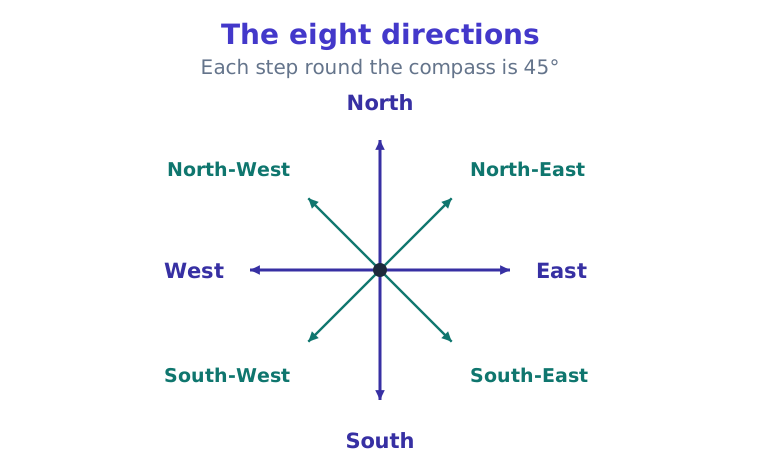
The four main directions are North, East, South and West; the four corners are North-East, South-East, South-West and North-West.
Neighbouring directions on the compass are 45° apart; main directions are 90° apart; opposite directions are 180° apart.
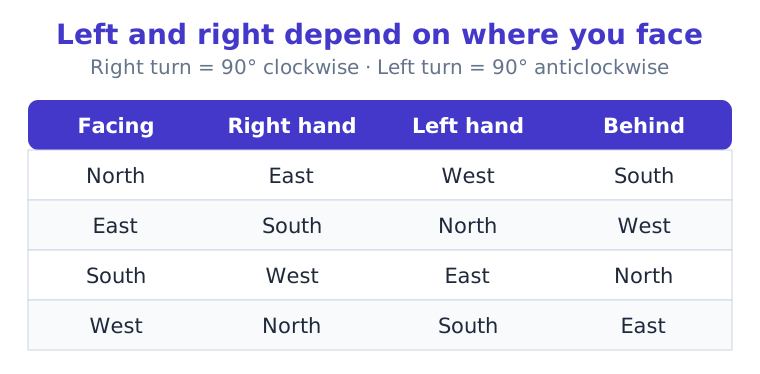
A right turn is 90° clockwise and a left turn is 90° anticlockwise, from wherever the person is facing.
Net East-West = (total East) − (total West); net North-South = (total North) − (total South).
Shortest distance = √(net East-West² + net North-South²), by Pythagoras.
If the end point is both east and north of the start, exams call its direction North-East, and so on for the other corners.
"Direction of the start from the end" is the opposite of "direction of the end from the start".
Total distance walked adds every leg; shortest distance uses only the net movement. They are equal only for a straight walk.
Full explanation
Asha's lost rider

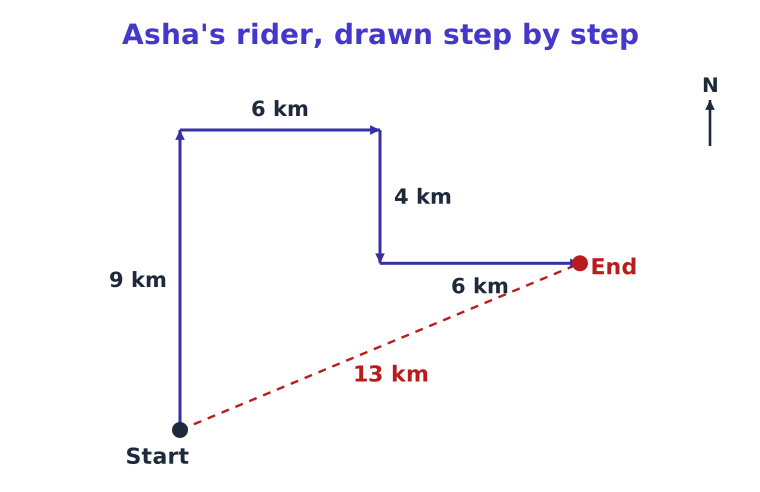
Asha runs a tiffin service. Her new rider phones: "I went 9 km north, turned right and went 6 km, turned right again for 4 km, then turned left and went 6 km. Where am I?" Asha has thirty seconds to tell him how far he is from the kitchen and in which direction.
That is a direction-sense question, and SSC, Bank and Railway papers ask two or three of them every time. By the end of this topic you will answer it in one quick sketch.
The eight directions
Draw North at the top of your rough sheet, always. Then East is on the right, South at the bottom and West on the left. The four corners sit halfway between: North-East (between N and E), South-East, South-West and North-West.
- Neighbours are 45° apart.
- Main directions are 90° apart.
- Opposites are 180° apart: N–S, E–W, NE–SW, NW–SE.
Left and right belong to the walker
A right turn is 90° clockwise and a left turn is 90° anticlockwise, measured from the way the person faces at that moment. Facing North, right is East. Facing South, right is West. This single fact decides half the questions, so learn the chart below until it is automatic.
Toppers' trick: turn your rough sheet so the walker's arrow points up the page; then right is simply right.
The net-movement method
You do not need a neat drawing. Keep two running totals:
- East–West: add East, subtract West.
- North–South: add North, subtract South.
The two totals tell you exactly where the person is. Everything else, the distance and the direction, comes from these two numbers.
Worked example: Asha's rider
Headings: North 9 → (right) East 6 → (right) South 4 → (left) East 6.
East–West: $6+6=12$ km East. North–South: $9-4=5$ km North.
Shortest distance $=\sqrt{12^2+5^2}=\sqrt{169}=13$ km. The rider is east and north of the kitchen, so he is 13 km North-East.
Pythagoras and the triples
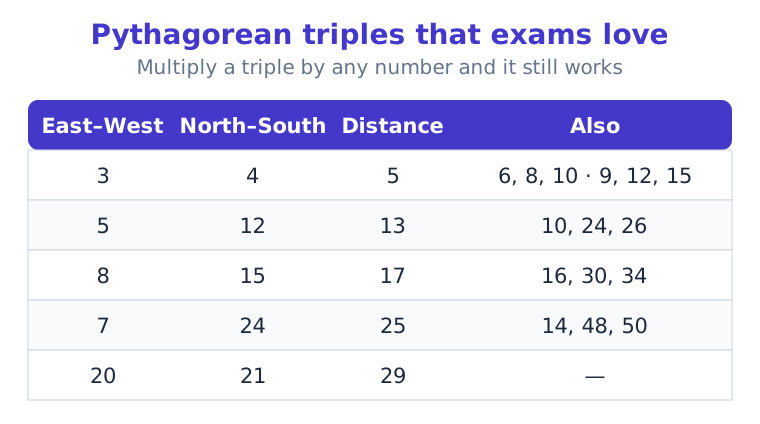
The two net movements are the legs of a right triangle, and the shortest distance is the hypotenuse. Exams almost always choose numbers from a few triples, so knowing them saves the square root.
Trap: never add the legs. 3 km East and 4 km North is 5 km away, not 7 km.
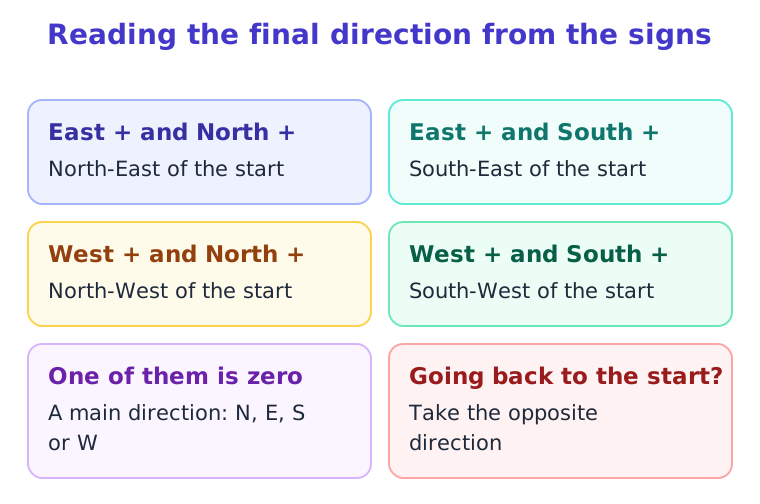
Reading the final direction
Look at the signs of the two totals. East and North both positive: the end is North-East of the start. If one total is zero, the answer is a main direction.
Read the question twice. "Where is he from the start?" and "In which direction is the start from him?" have opposite answers. To go back home he must walk in the opposite direction too.
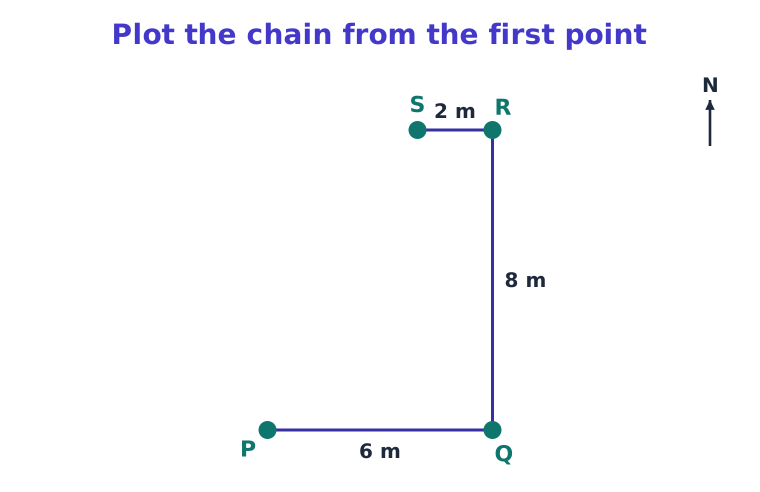
Chains: "P is 6 m east of Q"
Put the first reference point in the middle of your sheet and add one point per sentence. Example: Q is 6 m East of P, R is 8 m North of Q, S is 2 m West of R. Then S is $6-2=4$ m East and 8 m North of P, so S is North-East of P, at $\sqrt{4^2+8^2}=\sqrt{80}$ m.
Write each sentence as "new point = old point + move". Never start from the point asked about.
Coded directions (Bank pattern)
Bank papers hide the directions in symbols: 'P @ Q' means P is 3 m East of Q, 'P # Q' means P is 4 m North of Q. An expression such as A @ B # C is two facts: A @ B and B # C.
Method: start from the last letter (C), place B from it, then A from B. Then read the asked pair from the sketch.
Exam shortcuts
- North up, always; turn the sheet for left/right if you must.
- Two running totals: East–West and North–South.
- Distance: a triple if you can see one, else $\sqrt{x^2+y^2}$.
- Both totals non-zero: a corner direction (NE, SE, SW, NW).
- "From the end" or "to go back": flip the direction.
- Facing at the end is a separate question: follow the last turn only.
Back to Asha
Asha did the two totals in her head: 12 km East, 5 km North. "You are 13 km north-east of the kitchen," she said. "Turn round and head south-west." The rider was back in twenty minutes, and the tiffins were still warm.
Concepts and terms
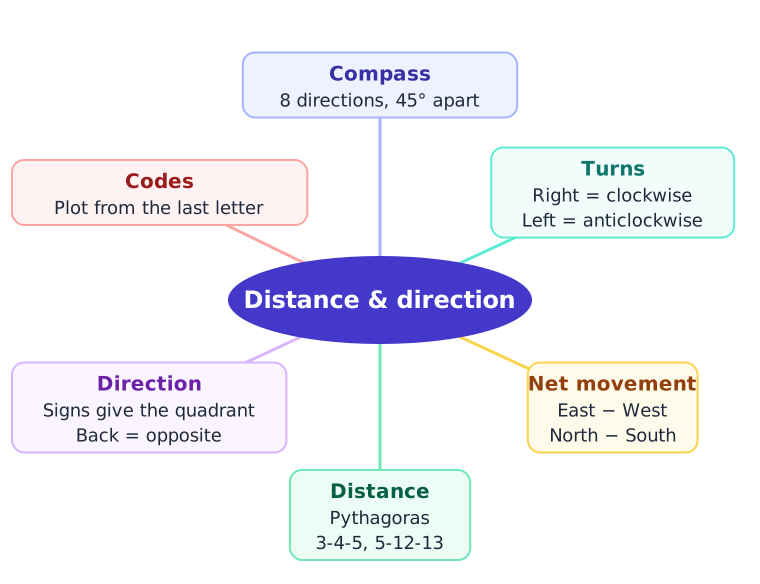
N, NE, E, SE, S, SW, W, NW in clockwise order, each 45° from the next.
Left and right are measured from the facing direction, not from the page. Facing South, your right is West.
Add all East moves and subtract West moves; add North moves and subtract South moves. The two results fix the end point.
The straight line from start to end, the hypotenuse of the right triangle made by the two net movements.

Did you know
Indian ships used the pole star (Dhruv Tara) to find North at night long before magnetic compasses reached the coast.
Google Maps and delivery apps store every place as two numbers, east-west and north-south, exactly the net movement you compute here.

Memory tricks
Order of the directions — Never Eat Soggy Wafers — N, E, S, W clockwise; the corners sit between the two they join (NE between N and E).
Turning — Right = clock, Left = anti — A right turn moves you the way clock hands move; a left turn moves you against them.
Practice MCQs with answers (97)
- A 5 km
- B $\sqrt{34}$ km
- C 1 km
- D 7 km
Show answer
Why:
Headings: East → North. Net movement: 4 km East and 3 km North. Straight-line distance = $\sqrt{4^2+3^2}=5$ km.
- A $\sqrt{34}$ km
- B 5 km
- C 1 km
- D 7 km
Show answer
Why:
Headings: South → East. Net movement: 4 km East and 3 km South. Straight-line distance = $\sqrt{4^2+3^2}=5$ km.
- A 2 km
- B 14 km
- C 10 km
- D $\sqrt{113}$ km
Show answer
Why:
Headings: West → South. Net movement: 6 km West and 8 km South. Straight-line distance = $\sqrt{6^2+8^2}=10$ km.
- A $\sqrt{194}$ km
- B 7 km
- C 17 km
- D 13 km
Show answer
Why:
Headings: North → West. Net movement: 12 km West and 5 km North. Straight-line distance = $\sqrt{12^2+5^2}=13$ km.
- A 5 km
- B 7 km
- C $\sqrt{241}$ km
- D 19 km
Show answer
Why:
Headings: West → South → East. Net movement: 3 km West and 4 km South. Straight-line distance = $\sqrt{3^2+4^2}=5$ km.
- A $8\sqrt{5}$ km
- B 17 km
- C 23 km
- D $\sqrt{89}$ km
Show answer
Why:
Headings: West → North → West. Net movement: 15 km West and 8 km North. Straight-line distance = $\sqrt{15^2+8^2}=17$ km.
- A $3\sqrt{13}$ km
- B $2\sqrt{61}$ km
- C 15 km
- D 21 km
Show answer
Why:
Headings: South → West → South. Net movement: 9 km West and 12 km South. Straight-line distance = $\sqrt{9^2+12^2}=15$ km.
- A $\sqrt{137}$ km
- B 15 km
- C 7 km
- D 5 km
Show answer
Why:
Headings: West → South → East. Net movement: 3 km East and 4 km South. Straight-line distance = $\sqrt{3^2+4^2}=5$ km.
- A 13 km
- B 17 km
- C $\sqrt{349}$ km
- D 23 km
Show answer
Why:
Headings: East → North → West. Net movement: 12 km East and 5 km North. Straight-line distance = $\sqrt{12^2+5^2}=13$ km.
- A $6\sqrt{5}$ m
- B 13 m
- C 17 m
- D $\sqrt{145}$ m
Show answer
Why:
Headings: South → West → South → West. Net movement: 5 m West and 12 m South. Straight-line distance = $\sqrt{5^2+12^2}=13$ m.
- A 7 m
- B $\sqrt{205}$ m
- C 5 m
- D 27 m
Show answer
Why:
Headings: North → East → South → West. Net movement: 4 m East and 3 m North. Straight-line distance = $\sqrt{4^2+3^2}=5$ m.
- A $\sqrt{97}$ m
- B 23 m
- C 7 m
- D 5 m
Show answer
Why:
Headings: West → South → East → North. Net movement: 4 m West and 3 m North. Straight-line distance = $\sqrt{4^2+3^2}=5$ m.
- A 13 m
- B 17 m
- C $\sqrt{349}$ m
- D 23 m
Show answer
Why:
Headings: North → West → North → East. Net movement: 12 m East and 5 m North. Straight-line distance = $\sqrt{12^2+5^2}=13$ m.
- A 34 km
- B 20 km
- C 28 km
- D $2\sqrt{157}$ km
Show answer
Why:
Headings: North → West → North → West → South. Net movement: 12 km West and 16 km North. Straight-line distance = $\sqrt{12^2+16^2}=20$ km.
- A 29 km
- B 17 km
- C 13 km
- D $\sqrt{265}$ km
Show answer
Why:
Headings: West → South → West → North → East. Net movement: 5 km West and 12 km South. Straight-line distance = $\sqrt{5^2+12^2}=13$ km.
- A 23 km
- B $\sqrt{89}$ km
- C 51 km
- D 17 km
Show answer
Why:
Headings: North → East → South → West → North. Net movement: 8 km West and 15 km North. Straight-line distance = $\sqrt{8^2+15^2}=17$ km.
- A 7 m
- B $\sqrt{373}$ m
- C 8 m
- D 25 m
Show answer
Why:
Headings: North → West → South. Net movement: 7 m West. Straight-line distance = 7 m.
- A $2\sqrt{65}$ m
- B 8 m
- C 9 m
- D 22 m
Show answer
Why:
Headings: North → East → South. Net movement: 8 m East. Straight-line distance = 8 m.
- A $\sqrt{65}$ m
- B 24 m
- C 8 m
- D $8\sqrt{5}$ m
Show answer
Why:
Headings: West → South → East. Net movement: 8 m South. Straight-line distance = 8 m.
- A $\sqrt{194}$ km
- B $\sqrt{269}$ km
- C 22 km
- D $5\sqrt{10}$ km
Show answer
Why:
Headings: North → West → North → West. Net movement: 9 km West and 13 km North. Straight-line distance = $\sqrt{9^2+13^2}=5\sqrt{10}$ km.
- A $2\sqrt{29}$ km
- B 14 km
- C $2\sqrt{74}$ km
- D 24 km
Show answer
Why:
Headings: South → East → South → West. Net movement: 4 km East and 10 km South. Straight-line distance = $\sqrt{4^2+10^2}=2\sqrt{29}$ km.
- A 26 km
- B $\sqrt{130}$ km
- C 16 km
- D $\sqrt{58}$ km
Show answer
Why:
Headings: South → East → North → East. Net movement: 9 km East and 7 km North. Straight-line distance = $\sqrt{9^2+7^2}=\sqrt{130}$ km.
- A South-West
- B North-West
- C South-East
- D South
Show answer
Why:
Headings: South → East → South. Net movement: 15 km East and 7 km South, so the final position is South-East of the start.
- A South
- B North-West
- C South-West
- D North-East
Show answer
Why:
Headings: North → East → South. Net movement: 10 km East and 5 km North, so the final position is North-East of the start.
- A North-West
- B North
- C North-East
- D South-East
Show answer
Why:
Headings: North → West → North. Net movement: 3 km West and 11 km North, so the final position is North-West of the start.
- A East
- B North-East
- C South-East
- D South-West
Show answer
Why:
Headings: West → North → East. Net movement: 10 km East and 5 km North, so the final position is North-East of the start.
- A East
- B South-East
- C North-East
- D South-West
Show answer
Why:
Headings: West → North → East. Net movement: 4 km East and 2 km North, so the final position is North-East of the start.
- A North
- B West
- C South
- D East
Show answer
Why:
Headings: East → North → East → South. Net movement: 9 m East, so the final position is East of the start.
- A South-East
- B South
- C North-East
- D North-West
Show answer
Why:
Headings: East → South → West → South. Net movement: 1 m East and 17 m South, so the final position is South-East of the start.
- A South
- B North
- C East
- D West
Show answer
Why:
Headings: West → North → East → South. Net movement: 6 m North, so the final position is North of the start.
- A North-West
- B West
- C South-East
- D South-West
Show answer
Why:
Headings: South → East → North → West. Net movement: 6 m East and 7 m South, so the final position is South-East of the start.
- A East
- B West
- C South
- D North
Show answer
Why:
Headings: North → West → North → East. Net movement: 15 m North, so the final position is North of the start.
- A North-West
- B South-East
- C West
- D South-West
Show answer
Why:
Headings: West → South → West → North → West. Net movement: 28 km West and 1 km North, so the final position is North-West of the start.
- A South
- B South-East
- C South-West
- D North-West
Show answer
Why:
Headings: North → East → South → East → South. Net movement: 12 km East and 7 km South, so the final position is South-East of the start.
- A North-West
- B South-West
- C North-East
- D North
Show answer
Why:
Headings: North → East → South → West → North. Net movement: 4 km East and 10 km North, so the final position is North-East of the start.
- A West
- B South-West
- C North-West
- D South-East
Show answer
Why:
Headings: North → West → North → West. The end point is 21 m West and 13 m North of the start (North-West of it). The start is the opposite way from the end: South-East.
- A North-East
- B South-West
- C West
- D North-West
Show answer
Why:
Headings: South → West → South → West. The end point is 7 km West and 22 km South of the start (South-West of it). The start is the opposite way from the end: North-East.
- A North-West
- B South-East
- C West
- D South-West
Show answer
Why:
Headings: South → East → North → West. The end point is 2 m West and 6 m North of the start (North-West of it). The start is the opposite way from the end: South-East.
- A South-West
- B East
- C North-East
- D North-West
Show answer
Why:
Headings: South → West → South → East. The end point is 11 km West and 24 km South of the start (South-West of it). The start is the opposite way from the end: North-East.
- A South
- B South-East
- C South-West
- D North-East
Show answer
Why:
Headings: West → South → East → South. The end point is 3 m West and 17 m South of the start (South-West of it). The start is the opposite way from the end: North-East.
- A North
- B South
- C East
- D West
Show answer
Why:
Headings: East → North → West → South. The end point is 5 km South of the start (South of it). The start is the opposite way from the end: North.
- A South-East
- B North-West
- C South
- D South-West
Show answer
Why:
Headings: West → South → East → South. The end point is 2 m East and 8 m South of the start (South-East of it). The start is the opposite way from the end: North-West.
- A East
- B North
- C South
- D West
Show answer
Why:
Track only the facing: West → South → West → South. The last heading is South.
- A West
- B East
- C North
- D South
Show answer
Why:
Track only the facing: East → North → East → South. The last heading is South.
- A South
- B North
- C West
- D East
Show answer
Why:
Track only the facing: West → North → East → South. The last heading is South.
- A South
- B East
- C North
- D West
Show answer
Why:
Track only the facing: North → East → South → East. The last heading is East.
- A North
- B West
- C South
- D East
Show answer
Why:
Track only the facing: East → South → East → South. The last heading is South.
- A 5 km, North-East
- B 23 km, South-West
- C 5 km, South-East
- D 5 km, South-West
Show answer
Why:
Headings: North → West → South → East. Net movement: 4 km West and 3 km South. Straight-line distance = $\sqrt{4^2+3^2}=5$ km. Direction: South-West.
- A 15 m, South-East
- B 15 m, South-West
- C 15 m, North-West
- D 21 m, South-East
Show answer
Why:
Headings: South → East → South → East. Net movement: 9 m East and 12 m South. Straight-line distance = $\sqrt{9^2+12^2}=15$ m. Direction: South-East.
- A 21 km, South-East
- B 15 km, South-East
- C 15 km, South-West
- D 15 km, North-West
Show answer
Why:
Headings: South → East → South → East. Net movement: 12 km East and 9 km South. Straight-line distance = $\sqrt{12^2+9^2}=15$ km. Direction: South-East.
- A 5 m, South-East
- B 33 m, North-West
- C 5 m, North-West
- D 5 m, North-East
Show answer
Why:
Headings: North → East → South → West. Net movement: 3 m West and 4 m North. Straight-line distance = $\sqrt{3^2+4^2}=5$ m. Direction: North-West.
- A 35 km, South-West
- B 25 km, North-West
- C 25 km, North-East
- D 25 km, South-West
Show answer
Why:
Headings: West → South → West → South. Net movement: 20 km West and 15 km South. Straight-line distance = $\sqrt{20^2+15^2}=25$ km. Direction: South-West.
- A 13 m, South-West
- B 13 m, North-East
- C 31 m, South-West
- D 13 m, South-East
Show answer
Why:
Headings: South → West → North → West. Net movement: 12 m West and 5 m South. Straight-line distance = $\sqrt{12^2+5^2}=13$ m. Direction: South-West.
- A South-East
- B North-East
- C North-West
- D South-West
Show answer
Why:
Place A at the centre and plot each point. C is 5 km East and 12 km North of A, so it is North-East of A; distance $\sqrt{5^2+12^2}$ = 13 km.
- A 11 m
- B 1 m
- C $\sqrt{61}$ m
- D $\sqrt{74}$ m
Show answer
Why:
Place P at the centre and plot each point. S is 6 m West and 5 m North of P, so it is North-West of P; distance $\sqrt{6^2+5^2}$ = $\sqrt{61}$ m.
- A 13 km, North-East
- B 17 km, South-West
- C 13 km, North-West
- D 13 km, South-West
Show answer
Why:
Place L at the centre and plot each point. O is 5 km West and 12 km South of L, so it is South-West of L; distance $\sqrt{5^2+12^2}$ = 13 km.
- A South-East
- B South-West
- C North-East
- D North-West
Show answer
Why:
Place X at the centre and plot each point. W is 7 m East and 4 m South of X, so it is South-East of X; distance $\sqrt{7^2+4^2}$ = $\sqrt{65}$ m.
- A 23 km
- B 17 km
- C 7 km
- D $8\sqrt{5}$ km
Show answer
Why:
Place C at the centre and plot each point. E is 15 km East and 8 km South of C, so it is South-East of C; distance $\sqrt{15^2+8^2}$ = 17 km.
- A $4\sqrt{5}$ m, North-West
- B 12 m, South-East
- C $4\sqrt{5}$ m, South-East
- D $4\sqrt{5}$ m, South-West
Show answer
Why:
Place J at the centre and plot each point. N is 4 m East and 8 m South of J, so it is South-East of J; distance $\sqrt{4^2+8^2}$ = $4\sqrt{5}$ m.
- A North-East
- B South-West
- C South-East
- D North-West
Show answer
Why:
Place S at the centre and plot each point. V is 6 km West and 5 km North of S, so it is North-West of S; distance $\sqrt{6^2+5^2}$ = $\sqrt{61}$ km.
- A 10 m
- B $3\sqrt{13}$ m
- C 14 m
- D 2 m
Show answer
Why:
Place G at the centre and plot each point. J is 8 m West and 6 m North of G, so it is North-West of G; distance $\sqrt{8^2+6^2}$ = 10 m.
- A 29 km, South-West
- B 29 km, North-East
- C 41 km, North-East
- D 29 km, South-East
Show answer
Why:
Place E at the centre and plot each point. G is 20 km East and 21 km North of E, so it is North-East of E; distance $\sqrt{20^2+21^2}$ = 29 km.
- A North-East
- B North-West
- C South-East
- D South-West
Show answer
Why:
Place Q at the centre and plot each point. U is 4 m East and 6 m South of Q, so it is South-East of Q; distance $\sqrt{4^2+6^2}$ = $2\sqrt{13}$ m.
- A 17 km
- B $\sqrt{674}$ km
- C 31 km
- D 25 km
Show answer
Why:
Place C at the centre and plot each point. A is 24 km East and 7 km South of C, so it is South-East of C; distance $\sqrt{24^2+7^2}$ = 25 km.
- A 15 m, North-East
- B 15 m, South-West
- C 21 m, North-East
- D 15 m, South-East
Show answer
Why:
Place O at the centre and plot each point. R is 9 m East and 12 m North of O, so it is North-East of O; distance $\sqrt{9^2+12^2}$ = 15 m.
- A 14 km
- B 10 km
- C 2 km
- D $8\sqrt{2}$ km
Show answer
Why:
Plot from Sonpur: Barli is 8 km East and 6 km South of Sonpur, so South-East, at 10 km.
- A North-West
- B South-West
- C South-East
- D North-East
Show answer
Why:
Plot from Sonpur: Barli is 8 km East and 6 km South of Sonpur, so South-East, at 10 km.
- A North-West
- B South-West
- C North-East
- D South-East
Show answer
Why:
Plot from Sonpur: Dhani is 5 km East and 12 km South of Rampur, so South-East, at 13 km.
- A 10 km
- B $8\sqrt{2}$ km
- C 14 km
- D 2 km
Show answer
Why:
Plot from Sonpur: Kheda is 8 km East and 6 km North of Sonpur, so North-East, at 10 km.
- A 5 m, North-West
- B 5 m, South-West
- C 5 m, North-East
- D 7 m, South-West
Show answer
Why:
Break the chain: A @ B, B # C. Plot from C backwards. C is then 3 m West and 4 m South of A: 5 m, South-West.
- A 10 m, South-East
- B 10 m, South-West
- C 10 m, North-East
- D 14 m, North-East
Show answer
Why:
Break the chain: L % M, M & N. Plot from N backwards. N is then 6 m East and 8 m North of L: 10 m, North-East.
- A $\sqrt{73}$ m, South-East
- B $\sqrt{73}$ m, South-West
- C 11 m, North-East
- D $\sqrt{73}$ m, North-East
Show answer
Why:
Break the chain: M # N, N @ O, O # K. Plot from K backwards. M is then 3 m East and 8 m North of K: $\sqrt{73}$ m, North-East.
- A 13 m, South-East
- B 13 m, North-West
- C 17 m, South-East
- D 13 m, South-West
Show answer
Why:
Break the chain: X # Y, Y @ Z. Plot from Z backwards. X is then 12 m East and 5 m South of Z: 13 m, South-East.
- A 7 m, North-East
- B $\sqrt{29}$ m, North-East
- C $\sqrt{29}$ m, South-East
- D $\sqrt{29}$ m, South-West
Show answer
Why:
Break the chain: D % E, E # F, F & G. Plot from G backwards. D is then 5 m East and 2 m North of G: $\sqrt{29}$ m, North-East.
- A $2\sqrt{61}$ m, South-West
- B $2\sqrt{61}$ m, North-West
- C $2\sqrt{61}$ m, South-East
- D 22 m, South-East
Show answer
Why:
Break the chain: S @ T, T @ U, U # V. Plot from V backwards. S is then 12 m East and 10 m South of V: $2\sqrt{61}$ m, South-East.
- A South-West
- B East
- C North-East
- D South-East
Show answer
Why:
Opposite means a 180° turn, four steps of 45° on the compass: North-West → South-East.
- A North-West
- B North-East
- C West
- D South-West
Show answer
Why:
Opposite means a 180° turn, four steps of 45° on the compass: South-East → North-West.
- A South
- B East
- C North-East
- D North
Show answer
Why:
Opposite means a 180° turn, four steps of 45° on the compass: West → East.
- A 225°
- B 90°
- C 135°
- D 180°
Show answer
Why:
Count the 45° steps the short way round: 3 × 45° = 135°.
- A 180°
- B 225°
- C 90°
- D 135°
Show answer
Why:
Count the 45° steps the short way round: 3 × 45° = 135°.
- A 180°
- B 90°
- C 135°
- D 225°
Show answer
Why:
Count the 45° steps the short way round: 4 × 45° = 180°.
- A 90°
- B 135°
- C 180°
- D 225°
Show answer
Why:
Count the 45° steps the short way round: 3 × 45° = 135°.
- A East
- B South
- C West
- D North
Show answer
Why:
Right is 90° clockwise from South: West.
- A West
- B East
- C North
- D South
Show answer
Why:
Left is 90° anticlockwise from West: South.
- A South
- B West
- C North
- D East
Show answer
Why:
Right is 90° clockwise from East: South.
- A South-West
- B North-East
- C South-East
- D North-West
Show answer
Why:
Behind is 180° away from South-West: North-East.
- A 25 km
- B 17 km
- C 13 km
- D $6\sqrt{5}$ km
Show answer
Why:
Headings: North → West → North → East. Net movement: 5 km East and 12 km North. Straight-line distance = $\sqrt{5^2+12^2}=13$ km.
- A 33 m
- B 7 m
- C $4\sqrt{2}$ m
- D 5 m
Show answer
Why:
Headings: North → West → South → East. Net movement: 3 m West and 4 m South. Straight-line distance = $\sqrt{3^2+4^2}=5$ m.
- A 26 km
- B $5\sqrt{29}$ km
- C 14 km
- D 34 km
Show answer
Why:
Headings: West → South → West → South. Net movement: 24 km West and 10 km South. Straight-line distance = $\sqrt{24^2+10^2}=26$ km.
- A 41 m
- B 12 m
- C 29 m
- D 14 m
Show answer
Why:
Walked: 12 + 8 + 9 + 12 = 41 m. Straight line: $\sqrt{21^2+20^2}=29$ m. Difference: 41 − 29 = 12 m.
- A 14 km
- B 10 km
- C 4 km
- D 6 km
Show answer
Why:
Walked: 3 + 4 + 5 + 2 = 14 km. Straight line: $\sqrt{8^2+6^2}=10$ km. Difference: 14 − 10 = 4 km.
- A 21 km
- B 25 km
- C 17 km
- D 15 km
Show answer
Why:
PQ = 12 km East and QR = 9 km North, so PR = $\sqrt{12^2+9^2}=15$ km.
- A $\sqrt{145}$ km, North-East
- B $\sqrt{145}$ km, South-West
- C 17 km, North-East
- D $\sqrt{145}$ km, North-West
Show answer
Why:
S is 12 − 4 = 8 km East and 9 km North of P: $\sqrt{8^2+9^2}=\sqrt{145}$ km, North-East.
- A Both A and R are true, and R is the correct explanation of A
- B Both A and R are true, but R is not the correct explanation of A
- C A is true but R is false
- D A is false but R is true
Show answer
Why:
Both true: 90° clockwise from East is South, which is exactly what R says.
- A Both A and R are true, and R is the correct explanation of A
- B Both A and R are true, but R is not the correct explanation of A
- C A is true but R is false
- D A is false but R is true
Show answer
Why:
By R the distance is $\sqrt{3^2+4^2}=5$ km, so A (7 km) is false while R is true.
- A 1 only
- B 2 only
- C Both 1 and 2
- D Neither 1 nor 2
Show answer
Why:
1 is true: a straight line is the shortest path. 2 is the exam convention for the corners.
- A 1 only
- B 2 only
- C Both 1 and 2
- D Neither 1 nor 2
Show answer
Why:
1 is true (180° apart). Clockwise from North, West comes after 270°, so 2 is false.
Important short questions (4)
Net: 5 km East and 12 km North. Distance $\sqrt{5^2+12^2}=13$ km, direction North-East.
7 km is the distance walked. The straight-line distance is $\sqrt{3^2+4^2}=5$ km.
Two lefts and one right leave one left: from South, a left turn faces East.
B is 2 m North of C and A is 2 m East of B. So C is 2 m West and 2 m South of A: $2\sqrt{2}$ m South-West.
Long answer questions (1)
Headings: South 10 → (left) East 6 → (left) North 18 → (right) East 2.
East–West: 6 + 2 = 8 m East. North–South: 18 − 10 = 8 m North.
Distance $=\sqrt{8^2+8^2}=8\sqrt{2}$ m. Both totals positive (East, North), so the end is North-East of the start.
Flashcards (14)
Play this topic
- Direction check
Shadows and Turns
Turn through any angle clockwise or anticlockwise, use the sun and shadows to find directions in the morning and evening, and crack renamed-compass and clock-compass questions.
What you will be able to do
- I can find the final facing after any sequence of degree turns.
- I can use the sun to fix East and West in the morning and evening.
- I can find which way a person faces from where the shadow falls.
- I can solve renamed-direction questions by finding one rotation.
- I can read directions from a clock placed as a compass.
Key points
Clockwise turns are the same as right turns; anticlockwise turns are left turns.
Add clockwise turns as + and anticlockwise as −, then take the total modulo 360°.
Each 45° moves one step round the eight-point compass.
The sun rises in the East and sets in the West, so morning shadows fall West and evening shadows fall East.
Shadow in front means the person faces away from the sun; shadow behind means the person faces the sun.
Two people facing each other face opposite directions, so their right hands point opposite ways.
In renamed-direction questions every direction turns by the same angle; find it from one given pair.
A clock used as a compass: fix where 12 points, then each hour mark is 30° clockwise from it.
Full explanation
Kabir and the morning shadow
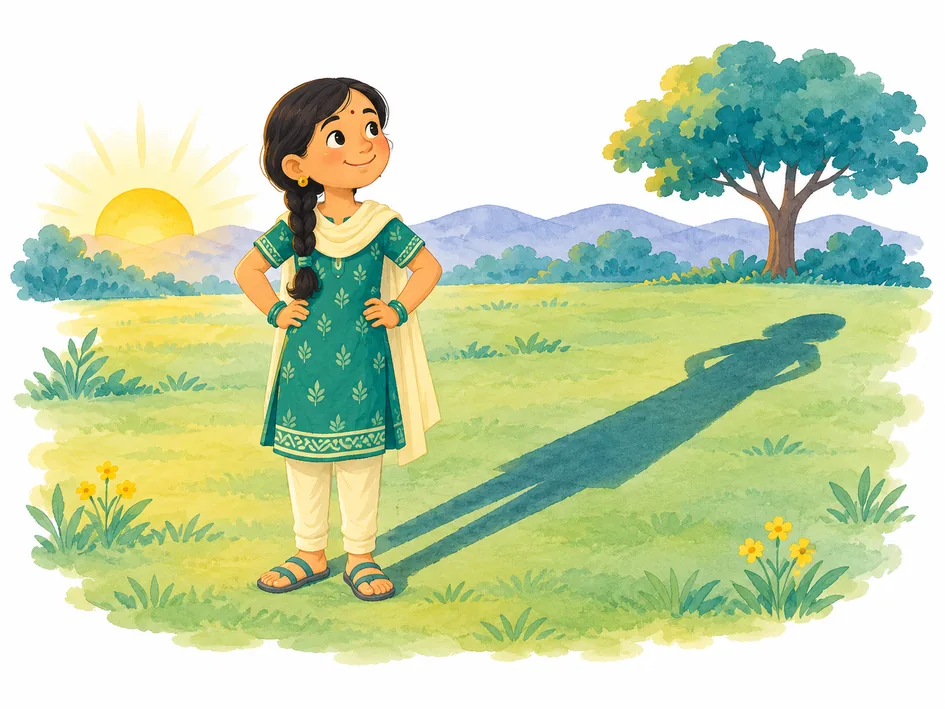
Kabir goes for a jog at 6:30 every morning. Today his coach says, "Run with your shadow straight in front of you, then turn 135° clockwise at the banyan tree." Kabir wants to know where he will be heading, and in which direction his shadow will fall after the turn.
Shadows, sunrise and turns by degrees make up the second type of direction question.
Turning by degrees
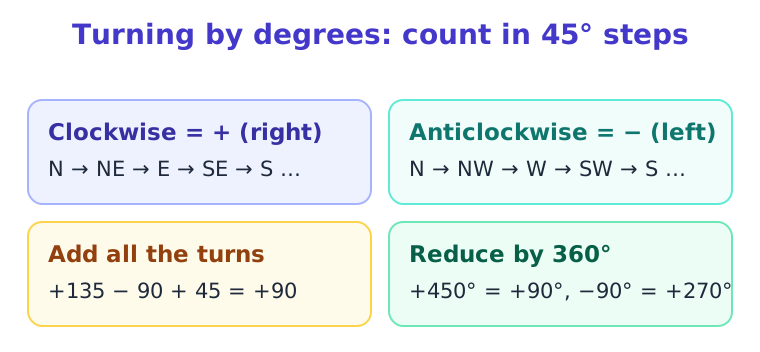
A turn of 90° clockwise is a right turn; 90° anticlockwise is a left turn; 180° is an about turn. Every 45° moves one step round the eight-point compass.
Shortcut: add all clockwise turns, subtract all anticlockwise turns, and reduce the total by 360°. Then move that many 45° steps from the starting direction.
Worked example: three turns
Priya faces North-West. She turns 135° clockwise, then 270° anticlockwise, then 45° clockwise.
Net turn $=135-270+45=-90$°, which is 90° anticlockwise (the same as 270° clockwise). From North-West, two steps anticlockwise: North-West → West → South-West.
The sun fixes East and West
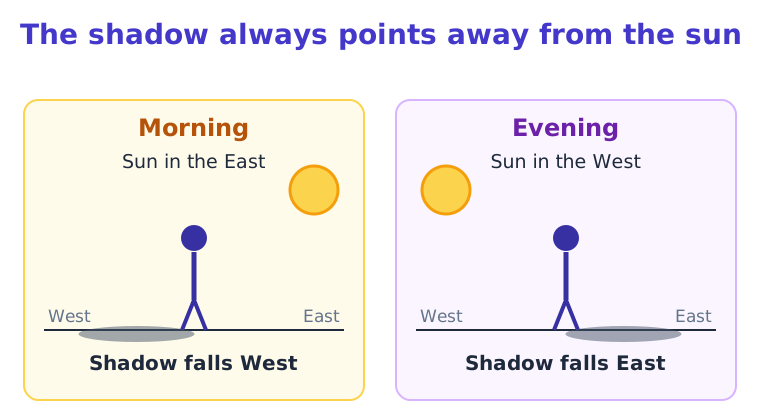
The sun rises in the East and sets in the West. A shadow always falls on the side away from the sun:
- Morning: sun East, shadow West.
- Evening: sun West, shadow East.
Exams do not ask about noon, because the sun is then almost overhead.
From the shadow to the facing
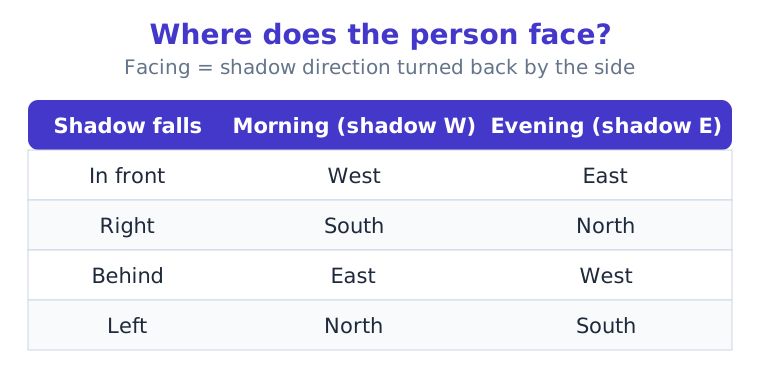
Two steps:
- Fix the shadow's direction from the time (morning West, evening East).
- Turn it back by the side the shadow is on. Shadow on the right means the person faces 90° anticlockwise from the shadow; on the left, 90° clockwise; in front, the shadow's own direction; behind, the opposite.
Example: In the morning Ravi's shadow is on his left. Shadow West; West is on his left, so he faces North.
Two people face to face
When A and B face each other, they face opposite directions. A favourite exam line: "In the morning, A's shadow falls to B's right." The shadow points West, and West is on B's right, so B faces South and A faces North.
Always ask: whose right? Work out that person first.
Renamed directions
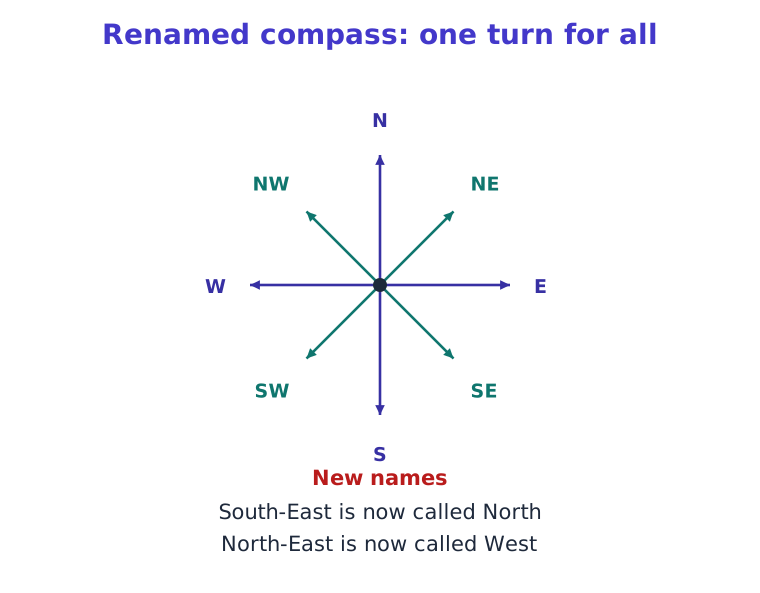
"If South-East becomes North, North-East becomes West and so on, what will West become?" The whole compass has turned by one angle. South-East → North is 135° anticlockwise (or 225° clockwise). Turn West by the same angle: South-East.
Check the question: "What will X become?" turns X forwards. "Which direction becomes X?" turns X backwards.
A clock as a compass
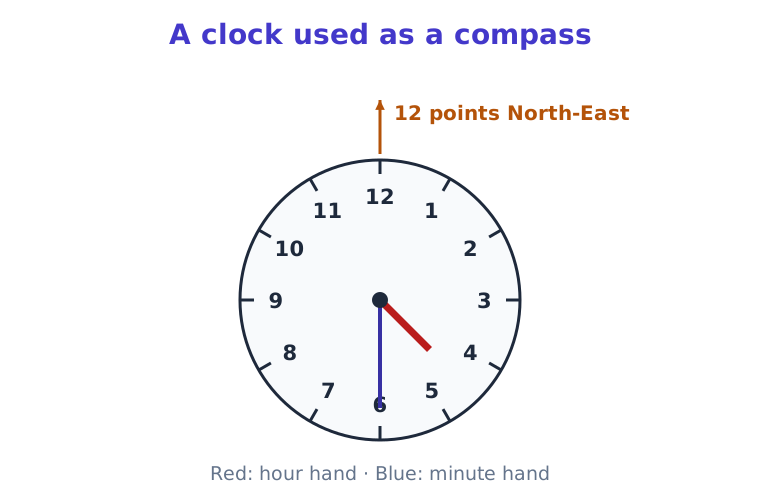
"A clock is placed so that at 12:00 the minute hand points North-East. Where does the hour hand point at 4:30?" First fix the direction of 12: North-East. At 4:30 the hour hand is at $4\times30+15=135$° from 12, which is three 45° steps clockwise: North-East → East → South-East → South.
Exam traps
- Read "clockwise" and "anticlockwise" carefully; one wrong sign flips the answer.
- A 270° clockwise turn is a 90° anticlockwise turn.
- Shadow side is relative to the person; shadow direction is absolute (morning West, evening East).
- In face-to-face questions, find the named person first.
- Renamed compass: find the turn from one pair and check it with the second.
Back to Kabir
In the morning the shadow points West, so with the shadow in front Kabir runs West. At the banyan tree he turns 135° clockwise: West → North-West → North → North-East. His shadow still points West, so now it falls behind him, a little to his left. Kabir smiled: the coach had given him a free compass lesson.
Concepts and terms
The sum of all turns with clockwise positive, reduced by 360°. Only the net turn decides the final facing.
A shadow always points away from the sun: West in the morning, East in the evening.
When directions are renamed in the same way, the whole compass has turned by one fixed angle.
A hand at angle θ from 12 points θ clockwise from the direction of 12.
Did you know
Ancient Indian sundials such as the Samrat Yantra at Jantar Mantar, Jaipur, read the time from the direction of a shadow.
At noon in most of India the sun is slightly to the south, so a noon shadow points a little towards North. Exams avoid noon for this reason.
Memory tricks
Shadow — Morning West, Evening East (MW-EE) — The shadow is opposite the sun: morning sun East, shadow West; evening sun West, shadow East.
Turns — Clock plus, anti minus — Add clockwise turns, subtract anticlockwise turns, then step round the compass.
Practice MCQs with answers (74)
- A East
- B North-West
- C South-West
- D South-East
Show answer
Why:
Count clockwise as + and anticlockwise as −: 90° + 45° = 135°, i.e. 135° clockwise. 135° is 3 steps of 45° from North: South-East.
- A North-West
- B South-West
- C North
- D South-East
Show answer
Why:
Count clockwise as + and anticlockwise as −: −90° − 45° = -135°, i.e. 225° clockwise. 225° is 5 steps of 45° from East: North-West.
- A South
- B North-West
- C South-East
- D North-East
Show answer
Why:
Count clockwise as + and anticlockwise as −: 135° = 135°, i.e. 135° clockwise. 135° is 3 steps of 45° from South: North-West.
- A North-West
- B North-East
- C South-East
- D East
Show answer
Why:
Count clockwise as + and anticlockwise as −: 180° + 45° = 225°, i.e. 225° clockwise. 225° is 5 steps of 45° from West: South-East.
- A South-West
- B East
- C North
- D North-East
Show answer
Why:
Count clockwise as + and anticlockwise as −: 90° − 135° + 45° = 0°, i.e. 0° clockwise. 0° is 0 steps of 45° from North-East: North-East.
- A South
- B East
- C North
- D South-West
Show answer
Why:
Count clockwise as + and anticlockwise as −: −45° − 90° + 180° = 45°, i.e. 45° clockwise. 45° is 1 steps of 45° from South-East: South.
- A West
- B South
- C South-East
- D North
Show answer
Why:
Count clockwise as + and anticlockwise as −: 270° + 45° = 315°, i.e. 315° clockwise. 315° is 7 steps of 45° from South-West: South.
- A North-East
- B South
- C South-West
- D West
Show answer
Why:
Count clockwise as + and anticlockwise as −: 135° − 270° + 45° = -90°, i.e. 270° clockwise. 270° is 6 steps of 45° from North-West: South-West.
- A West
- B South-East
- C North-East
- D East
Show answer
Why:
Count clockwise as + and anticlockwise as −: 225° − 90° + 315° = 450°, i.e. 90° clockwise. 90° is 2 steps of 45° from North: East.
- A North
- B North-East
- C South
- D West
Show answer
Why:
Count clockwise as + and anticlockwise as −: −135° + 360° − 45° + 90° = 270°, i.e. 270° clockwise. 270° is 6 steps of 45° from East: North.
- A North
- B South
- C South-West
- D South-East
Show answer
Why:
Count clockwise as + and anticlockwise as −: 315° + 315° = 630°, i.e. 270° clockwise. 270° is 6 steps of 45° from West: South.
- A North-West
- B North-East
- C North
- D South
Show answer
Why:
Count clockwise as + and anticlockwise as −: −225° + 90° − 45° = -180°, i.e. 180° clockwise. 180° is 4 steps of 45° from South: North.
- A South
- B North
- C West
- D East
Show answer
Why:
Right = +90°, left = −90°, about turn = 180°: 2 × 90 − 1 × 90 + 0 × 180 = 90°. From North that is East.
- A West
- B East
- C North
- D South
Show answer
Why:
Right = +90°, left = −90°, about turn = 180°: 1 × 90 − 3 × 90 + 0 × 180 = -180°. From East that is West.
- A South
- B East
- C North
- D West
Show answer
Why:
Right = +90°, left = −90°, about turn = 180°: 1 × 90 − 1 × 90 + 1 × 180 = 180°. From West that is East.
- A West
- B South
- C East
- D North
Show answer
Why:
Right = +90°, left = −90°, about turn = 180°: 2 × 90 − 1 × 90 + 1 × 180 = 270°. From South that is East.
- A West
- B South
- C East
- D North
Show answer
Why:
Right = +90°, left = −90°, about turn = 180°: 4 × 90 − 1 × 90 + 0 × 180 = 270°. From East that is North.
- A South
- B North
- C West
- D East
Show answer
Why:
Right = +90°, left = −90°, about turn = 180°: 1 × 90 − 2 × 90 + 2 × 180 = 270°. From West that is South.
- A East
- B South
- C North
- D West
Show answer
Why:
Morning: the sun is in the East, so the shadow points West. The shadow is on his right, so he faces 90° anticlockwise from the shadow: South.
- A South
- B West
- C North
- D East
Show answer
Why:
Morning: the sun is in the East, so the shadow points West. The shadow is on her left, so she faces 90° clockwise from the shadow: North.
- A East
- B West
- C South
- D North
Show answer
Why:
Evening: the sun is in the West, so the shadow points East. The shadow is on his right, so he faces 90° anticlockwise from the shadow: North.
- A South
- B North
- C East
- D West
Show answer
Why:
Evening: the sun is in the West, so the shadow points East. The shadow is on her left, so she faces 90° clockwise from the shadow: South.
- A East
- B West
- C North
- D South
Show answer
Why:
Morning: the sun is in the East, so the shadow points West. The shadow is in front of him, so he faces the shadow: West.
- A East
- B North
- C West
- D South
Show answer
Why:
Evening: the sun is in the West, so the shadow points East. The shadow is behind her, so she faces away from the shadow: West.
- A West
- B South
- C North
- D East
Show answer
Why:
Morning: the sun is in the East, so the shadow points West. The shadow is behind him, so he faces away from the shadow: East.
- A East
- B North
- C West
- D South
Show answer
Why:
Evening: the sun is in the West, so the shadow points East. The shadow is in front of her, so she faces the shadow: East.
- A East
- B North
- C South
- D West
Show answer
Why:
Morning: the sun is in the East, so the shadow points West. The shadow is on his left, so he faces 90° clockwise from the shadow: North.
- A West
- B South
- C North
- D East
Show answer
Why:
Evening: the sun is in the West, so the shadow points East. The shadow is on her right, so she faces 90° anticlockwise from the shadow: North.
- A Behind him
- B To his right
- C In front of him
- D To his left
Show answer
Why:
The shadow points West. Facing North, West is on his left.
- A To her right
- B To her left
- C Behind her
- D In front of her
Show answer
Why:
The shadow points East. Facing North, East is on her right.
- A To his left
- B To his right
- C Behind him
- D In front of him
Show answer
Why:
The shadow points West. Facing South, West is on his right.
- A To her left
- B To her right
- C Behind her
- D In front of her
Show answer
Why:
The shadow points East. Facing West, East is behind her.
- A To his right
- B In front of him
- C Behind him
- D To his left
Show answer
Why:
The shadow points East. Facing South, East is on his left.
- A East
- B West
- C North
- D South
Show answer
Why:
In the evening the sun is in the West, so every shadow points East, whichever way she faces.
- A East
- B West
- C North
- D South
Show answer
Why:
The sun rises in the East, so the shadow falls West.
- A South
- B East
- C North
- D West
Show answer
Why:
The shadow points West. West is on Suresh's right, so Suresh faces South; Meena faces the other way, North.
- A East
- B West
- C South
- D North
Show answer
Why:
The shadow points West. West is on Vikram's left, so Vikram faces North; Kavya faces the other way, South.
- A North
- B West
- C South
- D East
Show answer
Why:
The shadow points East. East is on Arjun's right, so Arjun faces North; Sita faces the other way, South.
- A South
- B North
- C East
- D West
Show answer
Why:
The shadow points East. East is on Manoj's left, so Manoj faces South; Anjali faces the other way, North.
- A South
- B East
- C North
- D West
Show answer
Why:
North → East is a turn of 90° clockwise. Turn West the same way: North.
- A North-West
- B South-West
- C North-East
- D South-East
Show answer
Why:
South-East → North is a turn of 135° anticlockwise. Turn West the same way: South-East.
- A North-West
- B South-East
- C South-West
- D North-East
Show answer
Why:
North → South-East is a turn of 135° clockwise. Turn South the same way: North-West.
- A South
- B North
- C East
- D West
Show answer
Why:
West → North is a turn of 90° clockwise. The direction renamed East is found by turning back: North.
- A North
- B West
- C South
- D East
Show answer
Why:
North-East → South-West is a turn of 180° clockwise. The direction renamed North is found by turning back: South.
- A North
- B West
- C East
- D South
Show answer
Why:
South → North-East is a turn of 135° anticlockwise. Turn North-West the same way: South.
- A South-West
- B North-West
- C South-East
- D North-East
Show answer
Why:
East → North is a turn of 90° anticlockwise. The direction renamed South-East is found by turning back: South-West.
- A North-East
- B North-West
- C South-East
- D South-West
Show answer
Why:
North-West → East is a turn of 135° clockwise. Turn South the same way: North-West.
- A West
- B South-West
- C South
- D North
Show answer
Why:
At 12:00 the minute hand is 0° clockwise from 12, so 12 points North-East. At 4:30 the hour hand is 135° clockwise from 12: North-East + 135° = South.
- A South
- B North
- C West
- D East
Show answer
Why:
At 3:00 the hour hand is 90° clockwise from 12, so 12 points West. At 6:00 the hour hand is 180° clockwise from 12: West + 180° = East.
- A North
- B East
- C South
- D North-East
Show answer
Why:
At 9:00 the minute hand is 0° clockwise from 12, so 12 points West. At 9:15 the minute hand is 90° clockwise from 12: West + 90° = North.
- A South-East
- B South-West
- C North
- D North-East
Show answer
Why:
At 9:00 the hour hand is 270° clockwise from 12, so 12 points South. At 1:30 the hour hand is 45° clockwise from 12: South + 45° = South-West.
- A North
- B South-West
- C North-East
- D North-West
Show answer
Why:
At 2:00 the minute hand is 0° clockwise from 12, so 12 points South. At 7:30 the hour hand is 225° clockwise from 12: South + 225° = North-East.
- A 7 km, North-West
- B 5 km, South-West
- C 5 km, South-East
- D 5 km, North-West
Show answer
Why:
The shadow points West, so she starts facing West. Headings: West → North. Net movement: 4 km West and 3 km North. Straight-line distance = $\sqrt{4^2+3^2}=5$ km. Direction: North-West.
- A 10 km, South-West
- B 10 km, North-East
- C 14 km, South-West
- D 10 km, North-West
Show answer
Why:
The shadow points East, so he starts facing West. Headings: West → South. Net movement: 6 km West and 8 km South. Straight-line distance = $\sqrt{6^2+8^2}=10$ km. Direction: South-West.
- A South-West
- B North-East
- C North-West
- D South-East
Show answer
Why:
The shadow points West, so she starts facing South. Headings: South → East → North. Net: 12 m East and 5 m North, so North-East.
- A 21 m, South-West
- B 15 m, South-East
- C 15 m, South-West
- D 15 m, North-East
Show answer
Why:
The shadow points East, so he starts facing South. Headings: South → West. Net movement: 12 m West and 9 m South. Straight-line distance = $\sqrt{12^2+9^2}=15$ m. Direction: South-West.
- A South-West
- B North-West
- C North-East
- D South-East
Show answer
Why:
The shadow points West, so she starts facing East. Headings: East → South → West. Net: 4 km East and 2 km South, so South-East.
- A South
- B South-West
- C North
- D East
Show answer
Why:
Count clockwise as + and anticlockwise as −: 90° = 90°, i.e. 90° clockwise. 90° is 2 steps of 45° from East: South.
- A West
- B South-East
- C North-West
- D North-East
Show answer
Why:
Count clockwise as + and anticlockwise as −: −135° = -135°, i.e. 225° clockwise. 225° is 5 steps of 45° from West: South-East.
- A North-West
- B South-West
- C North-East
- D South-East
Show answer
Why:
Count clockwise as + and anticlockwise as −: 45° + 90° = 135°, i.e. 135° clockwise. 135° is 3 steps of 45° from West: North-East.
- A West
- B East
- C North
- D South
Show answer
Why:
Morning: the sun is in the East, so the shadow points West. The shadow is on his right, so he faces 90° anticlockwise from the shadow: South.
- A South
- B North
- C East
- D West
Show answer
Why:
Evening: the sun is in the West, so the shadow points East. The shadow is on his left, so he faces 90° clockwise from the shadow: South.
- A East
- B West
- C North
- D South
Show answer
Why:
Evening: the sun is in the West, so the shadow points East. The shadow is behind him, so he faces away from the shadow: West.
- A South
- B East
- C West
- D North
Show answer
Why:
Morning: the sun is in the East, so the shadow points West. The shadow is in front of him, so he faces the shadow: West.
- A South-East
- B South-West
- C North-West
- D North-East
Show answer
Why:
North → South-East is a turn of 135° clockwise. Turn West the same way: North-East.
- A North-West
- B South-West
- C South-East
- D North-East
Show answer
Why:
West → South is a turn of 90° anticlockwise. Turn North-East the same way: North-West.
- A North-West
- B South-West
- C West
- D North-East
Show answer
Why:
12 points East. The hour hand at 4:30 is 135° clockwise from 12: South-West.
- A North-East
- B North
- C South
- D West
Show answer
Why:
12 points South-West. The hour hand at 10:30 is 315° clockwise from 12: South.
- A North
- B South-West
- C South-East
- D North-West
Show answer
Why:
Net turn: 135° − 90° + 180° = 225° = 225° clockwise. From East: North-West.
- A North-East
- B South
- C East
- D South-West
Show answer
Why:
Net turn: −45° + 270° − 135° = 90° = 90° clockwise. From North-West: North-East.
- A Both A and R are true, and R is the correct explanation of A
- B Both A and R are true, but R is not the correct explanation of A
- C A is true but R is false
- D A is false but R is true
Show answer
Why:
Both true. Facing North, East is on the right, and R gives exactly why the shadow points East.
- A Both A and R are true, and R is the correct explanation of A
- B Both A and R are true, but R is not the correct explanation of A
- C A is true but R is false
- D A is false but R is true
Show answer
Why:
Three quarter turns are 270°, not 360°, so A is false; R is true.
- A 1 only
- B 2 only
- C Both 1 and 2
- D Neither 1 nor 2
Show answer
Why:
1 is true. Facing South, West is on the right, so the morning shadow is on the right and 2 is false.
- A 1 only
- B 2 only
- C Both 1 and 2
- D Neither 1 nor 2
Show answer
Why:
225 + 135 = 360, so 1 is true; 90 + 90 = 180, so 2 is true.
Important short questions (4)
Morning shadow is West. West on his left means he faces North.
Net = −90 + 225 = +135°. Three steps clockwise from South-East: South, South-West, West. She faces West.
North → West is 90° anticlockwise. South-East turned 90° anticlockwise is North-East.
At 6:00 the hour hand is 180° from 12, so 12 points West. At 6:45 the minute hand is 270° from 12: West + 270° = South.
Long answer questions (1)
Evening: the sun is in the West, so the shadow points East.
East is on Sunil's left, so Sunil faces South (facing South, the left hand points East).
Rekha faces Sunil, so she faces the opposite way: North.
Flashcards (14)
Play this topic
- Shadow and turn check
Veda Skills Logical Reasoning Unit 7 — frequently asked questions
Net: 5 km East and 12 km North. Distance $\sqrt{5^2+12^2}=13$ km, direction North-East.
7 km is the distance walked. The straight-line distance is $\sqrt{3^2+4^2}=5$ km.
Two lefts and one right leave one left: from South, a left turn faces East.
Morning shadow is West. West on his left means he faces North.
Net = −90 + 225 = +135°. Three steps clockwise from South-East: South, South-West, West. She faces West.
North → West is 90° anticlockwise. South-East turned 90° anticlockwise is North-East.

All Veda Skills Logical Reasoning units
Study this chapter properly, free
Everything above is on this page to read. In the Veda app the same chapter becomes spaced-repetition flashcards, timed tests that mark themselves, Veda Bites you can swipe, and games — with your progress tracked topic by topic.
Get Veda free