Veda Skills Logical Reasoning Unit 1: Number Series
- ★ Free chapter
- 3 topics
- 209 MCQs
- 10 short answers
- 3 long answers
- 39 flashcards
- 3 games
- ~150 min read
- English
Checked before publishing: 23 automated checks, including a plagiarism check against the textbook's own words. How we check our content
Missing Term
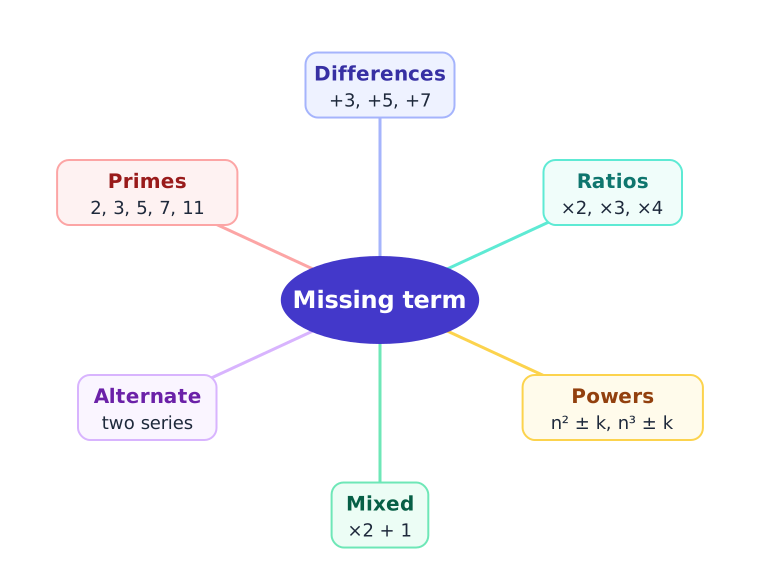
Find the missing or next number in a series by testing, in a fixed order, differences, ratios, squares and cubes, mixed ×/+ steps, alternate terms and primes.
What you will be able to do
- I can write the difference row of a series and spot when it is constant or growing.
- I can tell from the growth of a series whether to test differences or ratios first.
- I can recognise squares, cubes and primes hidden in a series.
- I can split an up-and-down series into two woven series.
- I can find a missing term in the middle of a series, not only at the end.

Key points
A number series is a list of numbers made by one rule; the question hides one term with ?.
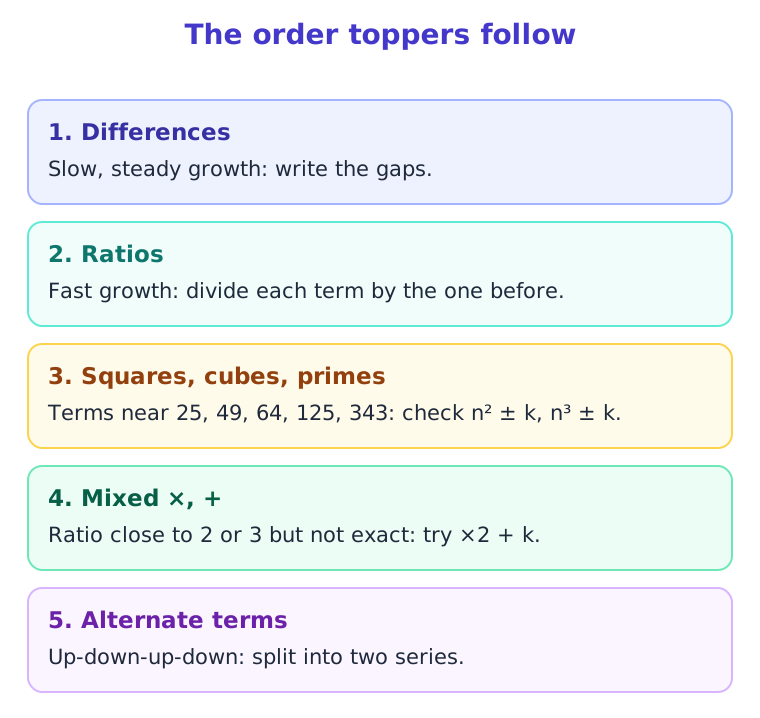
Slow growth (terms rise by small amounts) points to differences; fast growth points to ratios.
If the first differences are not constant, write the differences of the differences.
Constant second differences mean the terms follow n² or a similar square pattern.
A ratio close to 2 or 3 but not exact usually means ×2 + k or ×3 − k.
Terms that go up and down in turn usually hide two series in the odd and even places.
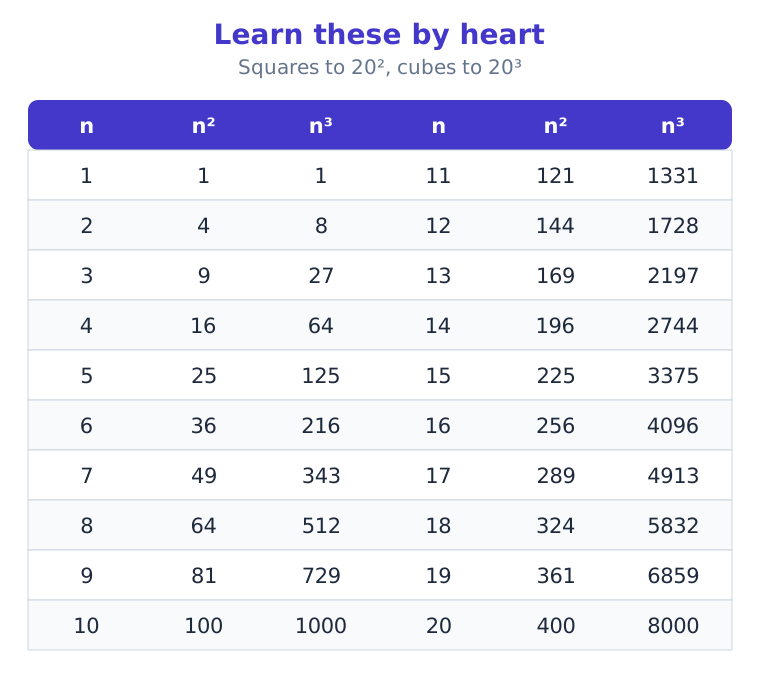
Know squares up to 30, cubes up to 20 and the 25 primes below 100 by heart.
Always check your rule on every given term before choosing an option.
Full explanation
Arjun's 40-second problem

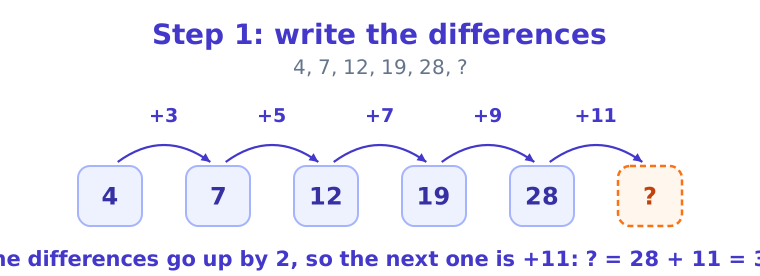
Arjun is preparing for SSC CGL. In his mock test he sees: 4, 7, 12, 19, 28, ? He tries adding 3, then 5, then guesses, and loses two minutes.
Number series questions are not about guessing. They are about checking a short list of rules in the right order. This topic gives you that order.
What a series question asks

A series is a list of numbers made by one rule. Each number is a term. One term is hidden by ?, usually the last one, sometimes one in the middle.
Your job: find the rule, check it on every term, then apply it to the blank.
Check 1: differences
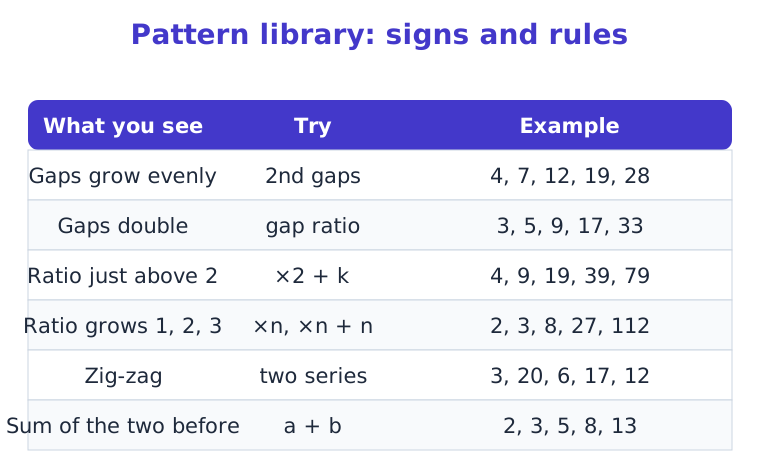
Subtract each term from the next. For Arjun's series the gaps are +3, +5, +7, +9. They grow by 2 every time, so the next gap is +11.
Check 2: ratios for fast growth
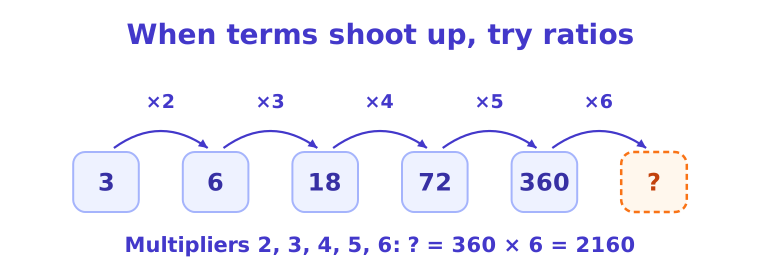
If the terms double or grow faster, divide each term by the one before it. In 3, 6, 18, 72, 360 the multipliers are ×2, ×3, ×4, ×5, so the next is ×6.
Quick test: if the last term is more than twice the one before it, think ratio first.
Check 3: squares, cubes and primes
Some terms sit next to famous numbers. 26, 50, 82, 122 are $5^2+1$, $7^2+1$, $9^2+1$, $11^2+1$. 7, 26, 63, 124 are $2^3-1$, $3^3-1$, $4^3-1$, $5^3-1$.
If you see 2, 3, 5, 7, 11, 13 or their squares 4, 9, 25, 49, 121, think primes.
Check 4: mixed steps
In 3, 7, 15, 31, 63 the ratio is a little more than 2 each time. That is the sign of ×2 + 1: $3 \times 2 + 1 = 7$, $7 \times 2 + 1 = 15$, and so on. Another favourite: ×1 + 1, ×2 + 2, ×3 + 3, …
Check 5: alternate terms
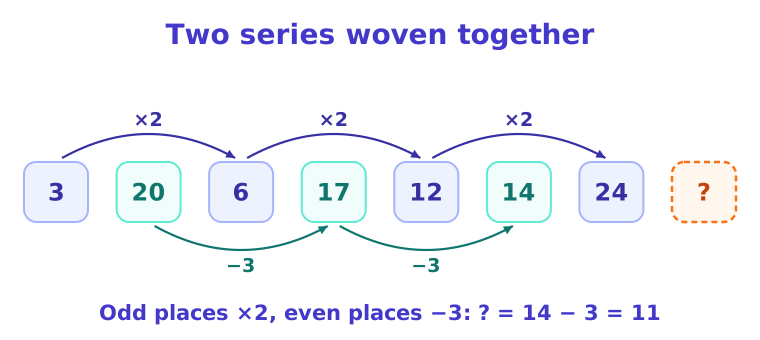
When a series goes up, down, up, down, it is usually two series in turn. In 3, 20, 6, 17, 12, 14, 24, ? the odd places 3, 6, 12, 24 go ×2 and the even places 20, 17, 14 go −3, so ? = 14 − 3 = 11.
A missing term in the middle
In 5, 11, ?, 29, 41 work from both sides. Differences 6, then ?, then 12. If the gaps are 6, 8, 10, 12, then ? = 11 + 8 = 19, and 19 + 10 = 29 confirms it.
Always confirm with the term after the blank.
Back to Arjun
With the order differences, ratios, powers, mixed, alternate, Arjun now writes +3, +5, +7, +9 under the series, sees the gaps grow by 2, and answers 39 in fifteen seconds. Two minutes saved on one question is two more questions attempted.
Concepts and terms
The row of gaps between neighbouring terms. 4, 7, 12, 19 has differences 3, 5, 7.
Each term divided by the one before. 3, 6, 18, 72 gives ratios 2, 3, 4.
A multiplication and an addition in one step, such as ×2 + 1: 3, 7, 15, 31.
Two series written in turn: 2, 20, 4, 17, 6, 14 is 2, 4, 6 and 20, 17, 14.

Did you know
The series 1, 1, 2, 3, 5, 8, 13 is the Fibonacci series, but it was described in India centuries earlier by the poet-mathematicians Pingala and Hemachandra while counting poetic metres.
Almost every SSC, bank and railway paper has 3 to 5 series questions, and each can be solved in under 40 seconds with the right order of checks.

Memory tricks
Order of checks — D-R-P-M-A — Differences, Ratios, Powers (squares, cubes), Mixed ×/+, Alternate terms.
Slow or fast — Slow: subtract. Fast: divide. — If terms grow slowly, look at differences; if they double or more, look at ratios.
Practice MCQs with answers (74)
- A 31
- B 37
- C 38
- D 43
Show answer
Why:
The same number is added each time: +6. So ? = 31 + 6 = 37.
- A 59
- B 67
- C 58
- D 49
Show answer
Why:
The same number is added each time: +9. So ? = 49 + 9 = 58.
- A 61
- B 67
- C 53
- D 60
Show answer
Why:
The same number is subtracted each time: −7. So ? = 67 − 7 = 60.
- A 70
- B 71
- C 81
- D 59
Show answer
Why:
The same number is added each time: +11. So ? = 59 + 11 = 70.
- A 13
- B 21
- C 22
- D 29
Show answer
Why:
The same number is subtracted each time: −8. So ? = 29 − 8 = 21.
- A 243
- B 405
- C 729
- D 1215
Show answer
Why:
Each term is the previous one ×3. So ? = 243 × 3 = 729.
- A 896
- B 128
- C 224
- D 512
Show answer
Why:
Each term is the previous one ×4. So ? = 128 × 4 = 512.
- A 224
- B 112
- C 168
- D 336
Show answer
Why:
Each term is the previous one ×2. So ? = 112 × 2 = 224.
- A 33
- B 32
- C 31
- D 0
Show answer
Why:
Each term is the previous one ÷2. So ? = 64 ÷ 2 = 32.
- A 80
- B 48
- C 64
- D 62
Show answer
Why:
Squares of 3, 4, 5, … So ? = 8² = 64.
- A 357
- B 329
- C 307
- D 343
Show answer
Why:
Cubes of 2, 3, 4, … So ? = 7³ = 343.
- A 82
- B 64
- C 80
- D 100
Show answer
Why:
Squares of 4, 5, 6, … then +1. So ? = 9² + 1 = 82.
- A 29
- B 31
- C 35
- D 33
Show answer
Why:
Consecutive prime numbers from 11. So ? = 31.
- A 43
- B 47
- C 45
- D 46
Show answer
Why:
The differences +2, +4, +6, … change by 2 each step. So ? = 33 + 12 = 45.
- A 64
- B 62
- C 58
- D 61
Show answer
Why:
The differences +4, +7, +10, … change by 3 each step. So ? = 45 + 16 = 61.
- A 50
- B 46
- C 54
- D 51
Show answer
Why:
The differences +1, +5, +9, … change by 4 each step. So ? = 33 + 17 = 50.
- A 57
- B 60
- C 61
- D 63
Show answer
Why:
The differences −2, −5, −8, … change by −3 each step. So ? = 74 − 14 = 60.
- A 78
- B 88
- C 83
- D 84
Show answer
Why:
The differences +5, +10, +15, … change by 5 each step. So ? = 58 + 25 = 83.
- A 97
- B 90
- C 102
- D 96
Show answer
Why:
The differences +3, +9, +15, … change by 6 each step. So ? = 69 + 27 = 96.
- A 95
- B 71
- C 96
- D 94
Show answer
Why:
Each term is the previous one ×2+1. So ? = 47 × 2 + 1 = 95.
- A 732
- B 730
- C 406
- D 728
Show answer
Why:
Each term is the previous one ×3−2. So ? = 244 × 3 − 2 = 730.
- A 64
- B 70
- C 67
- D 51
Show answer
Why:
Each term is the previous one ×2−3. So ? = 35 × 2 − 3 = 67.
- A 365
- B 363
- C 202
- D 364
Show answer
Why:
Each term is the previous one ×3+1. So ? = 121 × 3 + 1 = 364.
- A 317
- B 320
- C 314
- D 237
Show answer
Why:
Each term is the previous one ×2+3. So ? = 157 × 2 + 3 = 317.
- A 192
- B 240
- C 241
- D 84
Show answer
Why:
The multipliers ×1, ×2, ×3, … grow by 1. So ? = 48 × 5 = 240.
- A 3601
- B 1080
- C 3600
- D 3000
Show answer
Why:
The multipliers ×2, ×3, ×4, … grow by 1. So ? = 600 × 6 = 3600.
- A 585
- B 2205
- C 2837
- D 2835
Show answer
Why:
The multipliers ×1, ×3, ×5, … grow by 2. So ? = 315 × 9 = 2835.
- A 2
- B 3
- C 1
- D −12
Show answer
Why:
Divide by 7, 6, 5, … in turn. So ? = 6 ÷ 3 = 2.
- A 5
- B 4
- C 3
- D −80
Show answer
Why:
Divide by 8, 7, 6, … in turn. So ? = 20 ÷ 5 = 4.
- A 0
- B 37
- C 32
- D 27
Show answer
Why:
Two series are woven together: places 1, 3, 5, … go +5; places 2, 4, 6, … go −6. So ? = 38 − 6 = 32.
- A 25
- B 76
- C 31
- D 28
Show answer
Why:
Two series are woven together: places 1, 3, 5, … go ×3; places 2, 4, 6, … go −4. So ? = 32 − 4 = 28.
- A 17
- B 35
- C 21
- D 13
Show answer
Why:
Two series are woven together: places 1, 3, 5, … go +4; places 2, 4, 6, … go ×2. So ? = 13 + 4 = 17.
- A 29
- B 27
- C 45
- D 60
Show answer
Why:
Two steps take turns: ×2, then −3. So ? = 30 − 3 = 27.
- A 711
- B 245
- C 241
- D 395
Show answer
Why:
Two steps take turns: +4, then ×3. So ? = 237 + 4 = 241.
- A 29
- B 47
- C 21
- D 34
Show answer
Why:
Each term is the sum of the two terms before it. So ? = 13 + 21 = 34.
- A 80
- B 82
- C 98
- D 62
Show answer
Why:
Squares of 4, 5, 6, … with +1 and −1 in turn. So ? = 9² − 1 = 80.
- A 684
- B 685
- C 239
- D 686
Show answer
Why:
Multiply by 1, 2, 3, … and add the same number: ×1+1, ×2+2, ×3+3, … So ? = 136 × 5 + 5 = 685.
- A 62
- B 68
- C 66
- D 64
Show answer
Why:
The differences are consecutive primes 3, 5, 7, … So ? = 49 + 17 = 66.
- A 22
- B 19
- C 23
- D 21
Show answer
Why:
The differences +3, +5, +7, … change by 2 each step. So ? = 14 + 7 = 21.
- A 18
- B −2
- C 20
- D 13
Show answer
Why:
Each term is the previous one ×2+2. So ? = 8 × 2 + 2 = 18.
- A 945
- B 135
- C 75
- D −405
Show answer
Why:
Each term is the previous one ×3. So ? = 45 × 3 = 135.
- A 58
- B 78
- C 80
- D 102
Show answer
Why:
Squares of 5, 6, 7, … then −1. So ? = 9² − 1 = 80.
- A 19
- B 20
- C 14
- D 17
Show answer
Why:
Two series are woven together: places 1, 3, 5, … go +3; places 2, 4, 6, … go +4. So ? = 13 + 4 = 17.
- A 131
- B 133
- C 129
- D 99
Show answer
Why:
The differences +2, +4, +8, … are multiplied by 2 each time. So ? = 67 + 64 = 131.
- A 129
- B 128
- C 127
- D 74
Show answer
Why:
The differences +1, +3, +9, … are multiplied by 3 each time. So ? = 47 + 81 = 128.
- A 102
- B 86
- C 94
- D 83
Show answer
Why:
Add the squares of 1, 2, 3, … in turn. So ? = 58 + 6² = 94.
- A 228
- B 174
- C 242
- D 235
Show answer
Why:
Add the cubes of 1, 2, 3, … in turn. So ? = 110 + 5³ = 235.
- A 153
- B 154
- C 152
- D 113
Show answer
Why:
Multiply by 2 and add 1, 2, 3, … in turn. So ? = 74 × 2 + 5 = 153.
- A −29
- B −85
- C −84
- D −86
Show answer
Why:
Multiply by 1, 2, 3, … and subtract the same number: ×1−1, ×2−2, ×3−3, … So ? = −16 × 5 − 5 = −85.
- A 54
- B 99
- C 68
- D 37
Show answer
Why:
Each term is the sum of the three terms before it. So ? = 11 + 20 + 37 = 68.
- A 600
- B 721
- C 384
- D 720
Show answer
Why:
The multipliers ÷2, ×1, ×1.5, … grow by 0.5. So ? = 240 × 3 = 720.
- A 529
- B 433
- C 531
- D 527
Show answer
Why:
Squares of consecutive primes 5, 7, 11, … So ? = 23² = 529.
- A 3967
- B 3968
- C 3969
- D 118
Show answer
Why:
Square the previous term, then −1. So ? = 63² − 1 = 3968.
- A 349
- B 314
- C 350
- D 351
Show answer
Why:
Each term is n³ + n for n = 2, 3, 4, … So ? = 7³ + 7 = 350.
- A −1
- B 50
- C 35
- D 47
Show answer
Why:
The differences +3, +6, +12, … are multiplied by 2 each time. So ? = 23 + 24 = 47.
- A 49
- B 46
- C 52
- D 50
Show answer
Why:
The differences +2, +5, +8, … change by 3 each step. So ? = 35 + 14 = 49.
- A 288
- B 192
- C 96
- D 144
Show answer
Why:
Each term is the previous one ×2. So ? = 96 × 2 = 192.
- A −11
- B 61
- C 54
- D 47
Show answer
Why:
Two series are woven together: places 1, 3, 5, … go +7; places 2, 4, 6, … go −9. So ? = 63 − 9 = 54.
- A 68
- B 37
- C −203
- D 67
Show answer
Why:
Each term is the previous one ×3+1. So ? = 22 × 3 + 1 = 67.
- A 2
- B 4
- C 5
- D 1
Show answer
Why:
First differences: 5, 7, 9, 11, 13. Their differences are all 2.
- A A list of prime numbers
- B Ratios between terms
- C Digit sums of the terms
- D Differences between terms
Show answer
Why:
Growth that fast is multiplication, so divide each term by the one before it.
- A Find the second differences
- B Look for cubes
- C Split it into odd and even places
- D Find the ratio of neighbouring terms
Show answer
Why:
It jumps up and down. Odd places 40, 36, 32 fall by 4; even places 3, 6, 12 double.
- A 1, 3, 6, 11, 19
- B 5, 7, 10, 15, 21
- C 2, 4, 8, 16, 32
- D 3, 6, 11, 18, 27
Show answer
Why:
3, 6, 11, 18, 27: first differences 3, 5, 7, 9, second differences all 2. The others change.
- A 2, 7, 17, 37, 77
- B 2, 5, 11, 23, 47
- C 2, 9, 30, 93, 282
- D 2, 3, 6, 15, 42
Show answer
Why:
2 × 2 + 3 = 7, 7 × 2 + 3 = 17, 17 × 2 + 3 = 37, 37 × 2 + 3 = 77.
- A 3n − 1
- B n(n + 1)
- C n² + 1
- D 2n²
Show answer
Why:
1 × 2 = 2, 2 × 3 = 6, 3 × 4 = 12, 4 × 5 = 20, 5 × 6 = 30. The others fail at n = 2 or n = 3.
- A 36
- B 81
- C 64
- D 125
Show answer
Why:
64 = 8² = 4³. 36 and 81 are only squares; 125 is only a cube.
- A 99
- B 91
- C 93
- D 97
Show answer
Why:
91 = 7 × 13, 93 = 3 × 31, 95 = 5 × 19, so the next prime is 97.
- A 34
- B 37
- C 31
- D 90
Show answer
Why:
Add 3 each day: day 9 = 10 + 8 × 3 = 34. (Day 9 is 8 steps after day 1, not 9.)
- A 59
- B 61
- C 57
- D 65
Show answer
Why:
Differences 4, 8, 12, 16 grow by 4, so the next is 20: 41 + 20 = 61.
- A 480
- B 60
- C 30
- D 15
Show answer
Why:
960 → 480 → 240 → 120 → 60 → 30. Each hour is ÷2, five times.
- A Both A and R are true, and R is the correct explanation of A
- B Both A and R are true, but R is not the correct explanation of A
- C A is true but R is false
- D A is false but R is true
Show answer
Why:
6 × 7 = 42, so A is true, and R is exactly the rule that gives it.
- A Both A and R are true, and R is the correct explanation of A
- B Both A and R are true, but R is not the correct explanation of A
- C A is true but R is false
- D A is false but R is true
Show answer
Why:
The first differences are 5, 7, 9, 11, not constant, so A is false. R is true: the second differences are all 2.
- A 1 only
- B 2 only
- C Both 1 and 2
- D Neither 1 nor 2
Show answer
Why:
3 × 2 − 1 = 5, 5 × 2 − 1 = 9, … and the differences are 2, 4, 8, 16. Both hold.
- A 1 only
- B 2 only
- C Both 1 and 2
- D Neither 1 nor 2
Show answer
Why:
6³ = 216, so 1 is true. Second differences are 12, 18, 24, so 2 is false (for cubes the third differences are constant).
Important short questions (4)
Differences 5, 10, 15, 20 grow by 5, so the next is 25: 56 + 25 = 81.
Each term is ×2 + 1: 47 × 2 + 1 = 95.
The terms are n³ − 1 for n = 2 to 7, so ? = 6³ − 1 = 215.
Odd places 2, 4, 8 double; even places 15, 12, 9 fall by 3. ? is in an odd place: 8 × 2 = 16.
Long answer questions (1)
Order: differences, ratios, powers, mixed steps, alternate terms.
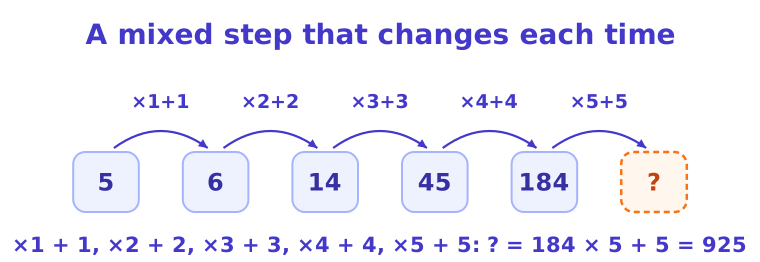
Differences 1, 8, 31, 139 show no simple pattern. Ratios 1.2, 2.3, 3.2, 4.1 are close to 1, 2, 3, 4, which suggests a mixed step: 5 × 1 + 1 = 6, 6 × 2 + 2 = 14, 14 × 3 + 3 = 45, 45 × 4 + 4 = 184.
So ? = 184 × 5 + 5 = 925.
Flashcards (14)
Play this topic
- Next term: true or false?
Wrong Term
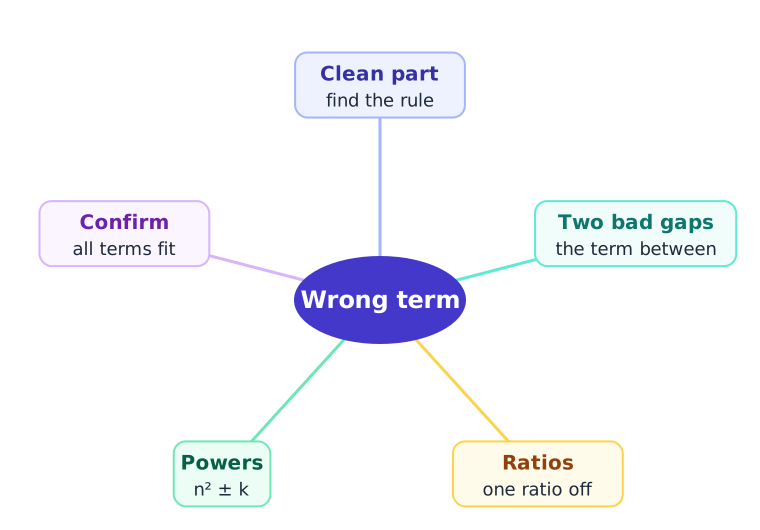
Find the one number that breaks the pattern of a series: get the rule from the clean part, see where two neighbouring differences or ratios go wrong, and confirm by correcting the term.
What you will be able to do
- I can find the rule of a series from the part that has no error.
- I can locate a wrong term from the two differences or ratios it spoils.
- I can state the correct value that should replace the wrong term.
- I can avoid marking a correct term that only looks odd.
Key points
Exactly one term is wrong; every other term follows the rule.
Find the rule from a clean stretch of three or four terms, at the start or at the end.
A wrong term spoils two neighbouring differences: one too big and one too small by the same amount.
In a ratio series, the wrong term spoils two neighbouring ratios.
If only the last gap looks wrong, the last term is the wrong one.
Confirm: after correcting, the whole series must follow one rule.
Wrong terms are usually close to the right value: off by 1, 2 or one step.
Full explanation
Meena checks the bill book

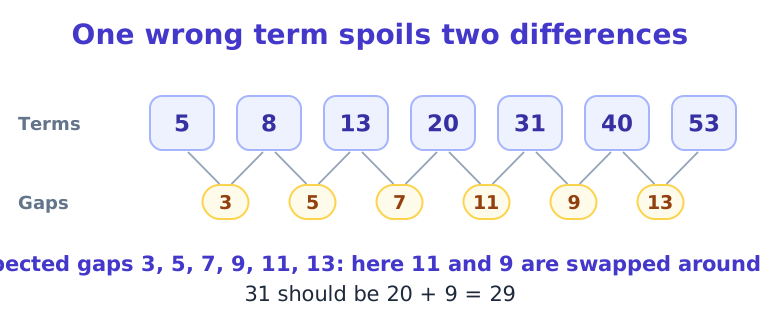
Meena helps at her father's shop. The bill numbers for a week should rise by a fixed rule, but one page shows 5, 8, 13, 20, 31, 40, 53. One number was copied wrongly. Which one?
Wrong-number questions in bank and SSC papers work exactly like Meena's bill book.
The promise of the question
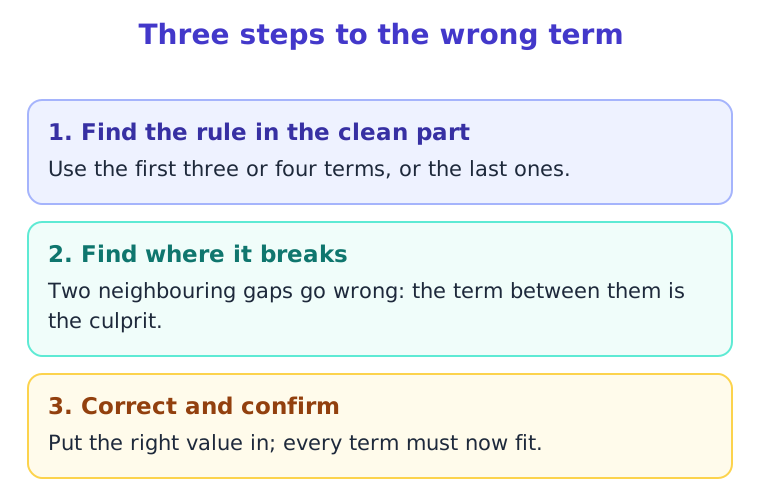
The question promises that exactly one term is wrong. Every other term follows the rule. So the plan is: find the rule from terms you trust, then find the single term that disobeys it.
Step 1: a clean stretch
In 5, 8, 13, 20 the gaps are 3, 5, 7: odd numbers growing by 2. That is the rule. The next gaps should be 9, 11, 13.
Step 2: the two-gap signal
The actual gaps are 3, 5, 7, 11, 9, 13. The gaps around 31 are wrong in opposite directions: 11 is 2 too big and 9 is 2 too small. One wrong term always spoils the two gaps on either side of it. So 31 is the culprit.
Step 3: correct and confirm
The gap after 20 should be 9, so the term should be $20 + 9 = 29$. Check: $29 + 11 = 40$ and $40 + 13 = 53$. Everything fits, so Meena knows the page should read 29, not 31.
Ratio series work the same way
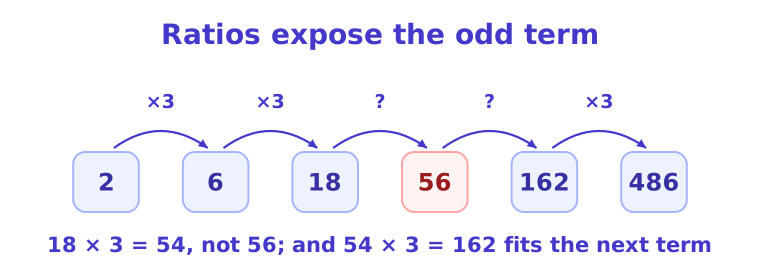
In 2, 6, 18, 56, 162, 486 the rule ×3 holds at the start and at the end. 18 × 3 = 54, not 56, and 54 × 3 = 162 matches the next term. So 56 is wrong.
The neighbour trap
When you see one odd gap, students often mark the term at either end of it. Look at both gaps: the wrong term is the one shared by two bad gaps. If only the very last gap is wrong, the last term is wrong.
Square and mixed patterns
For 10, 17, 26, 38, 50, 65 the terms should be $3^2+1$, $4^2+1$, … , $8^2+1$ = 10, 17, 26, 37, 50, 65. So 38 is wrong. For mixed steps like ×2 + 1, apply the step from each term and see which next term disagrees.
Back to Meena
Meena writes the gaps, sees the 11-and-9 pair around 31, and corrects it to 29 in under half a minute. Her father is impressed. You can do the same in the exam: rule, break, confirm.
Concepts and terms
A run of terms that clearly follows one rule, used to discover the rule before hunting the error.
One wrong term changes the gap before it and the gap after it, in opposite directions.
The number the rule gives at the wrong place. Some questions ask for it instead of the wrong number.
Did you know
Bank PO prelims often give five "wrong number" questions in a row, and they are among the fastest marks in the paper once you know the two-gap signal.
Memory tricks
Locating the error — Two bad gaps, one bad term — The wrong term sits between the two differences that do not fit.
Practice MCQs with answers (65)
- A 16
- B 26
- C 11
- D 22
Show answer
Why:
The same number is added each time: +5. The term 22 should be 21: 16 + 5 = 21.
- A 25
- B 28
- C 20
- D 32
Show answer
Why:
The same number is subtracted each time: −4. The term 25 should be 24: 28 − 4 = 24.
- A 24
- B 49
- C 96
- D 12
Show answer
Why:
Each term is the previous one ×2. The term 49 should be 48: 24 × 2 = 48.
- A 135
- B 5
- C 46
- D 15
Show answer
Why:
Each term is the previous one ×3. The term 46 should be 45: 15 × 3 = 45.
- A 25
- B 4
- C 9
- D 17
Show answer
Why:
Squares of 1, 2, 3, … The term 17 should be 16: 4² = 16.
- A 28
- B 64
- C 1
- D 8
Show answer
Why:
Cubes of 1, 2, 3, … The term 28 should be 27: 3³ = 27.
- A 17
- B 20
- C 23
- D 13
Show answer
Why:
Consecutive prime numbers from 7. The term 20 should be 19: 19.
- A 33
- B 40
- C 48
- D 54
Show answer
Why:
The same number is added each time: +7. The term 48 should be 47: 40 + 7 = 47.
- A 256
- B 4
- C 16
- D 65
Show answer
Why:
Each term is the previous one ×4. The term 65 should be 64: 16 × 4 = 64.
- A 24
- B 15
- C 33
- D 9
Show answer
Why:
The differences +2, +4, +6, … change by 2 each step. The term 24 should be 23: 15 + 8 = 23.
- A 11
- B 15
- C 19
- D 10
Show answer
Why:
The differences +1, +3, +5, … change by 2 each step. The term 15 should be 14: 11 + 3 = 14.
- A 22
- B 34
- C 50
- D 67
Show answer
Why:
The differences +3, +6, +9, … change by 3 each step. The term 50 should be 49: 34 + 15 = 49.
- A 82
- B 52
- C 58
- D 69
Show answer
Why:
The differences +2, +6, +10, … change by 4 each step. The term 69 should be 68: 58 + 10 = 68.
- A 53
- B 25
- C 42
- D 33
Show answer
Why:
The differences +5, +6, +7, … change by 1 each step. The term 53 should be 52: 42 + 10 = 52.
- A 185
- B 177
- C 165
- D 192
Show answer
Why:
The differences −3, −5, −7, … change by −2 each step. The term 177 should be 176: 185 − 9 = 176.
- A 7
- B 15
- C 32
- D 63
Show answer
Why:
Each term is the previous one ×2+1. The term 32 should be 31: 15 × 2 + 1 = 31.
- A 41
- B 365
- C 14
- D 123
Show answer
Why:
Each term is the previous one ×3−1. The term 123 should be 122: 41 × 3 − 1 = 122.
- A 131
- B 66
- C 258
- D 34
Show answer
Why:
Each term is the previous one ×2−2. The term 131 should be 130: 66 × 2 − 2 = 130.
- A 5
- B 18
- C 53
- D 1
Show answer
Why:
Each term is the previous one ×3+2. The term 18 should be 17: 5 × 3 + 2 = 17.
- A 2
- B 6
- C 25
- D 120
Show answer
Why:
The multipliers ×2, ×3, ×4, … grow by 1. The term 25 should be 24: 6 × 4 = 24.
- A 42
- B 840
- C 14
- D 169
Show answer
Why:
The multipliers ×1, ×2, ×3, … grow by 1. The term 169 should be 168: 42 × 4 = 168.
- A 7
- B 210
- C 2
- D 30
Show answer
Why:
The multipliers ×1, ×3, ×5, … grow by 2. The term 7 should be 6: 2 × 3 = 6.
- A 7
- B 12
- C 27
- D 24
Show answer
Why:
Two series are woven together: places 1, 3, 5, … go +4; places 2, 4, 6, … go −3. The term 12 should be 11: 7 + 4 = 11.
- A 8
- B 16
- C 26
- D 20
Show answer
Why:
Two series are woven together: places 1, 3, 5, … go ×2; places 2, 4, 6, … go +5. The term 26 should be 25: 20 + 5 = 25.
- A 8
- B 13
- C 31
- D 27
Show answer
Why:
Two steps take turns: ×2, then +5. The term 27 should be 26: 13 × 2 = 26.
- A 77
- B 82
- C 32
- D 38
Show answer
Why:
Two steps take turns: +6, then ×2. The term 77 should be 76: 38 × 2 = 76.
- A 18
- B 30
- C 47
- D 11
Show answer
Why:
Each term is the sum of the two terms before it. The term 30 should be 29: 11 + 18 = 29.
- A 63
- B 24
- C 49
- D 35
Show answer
Why:
Squares of 3, 4, 5, … then −1. The term 49 should be 48: 7² − 1 = 48.
- A 65
- B 217
- C 28
- D 127
Show answer
Why:
Cubes of 2, 3, 4, … then +1. The term 127 should be 126: 5³ + 1 = 126.
- A 52
- B 27
- C 34
- D 62
Show answer
Why:
Squares of 5, 6, 7, … with +2 and −2 in turn. The term 52 should be 51: 7² + 2 = 51.
- A 5040
- B 121
- C 720
- D 24
Show answer
Why:
Divide by 8, 7, 6, … in turn. The term 121 should be 120: 720 ÷ 6 = 120.
- A 184
- B 6
- C 46
- D 14
Show answer
Why:
Multiply by 1, 2, 3, … and add the same number: ×1+1, ×2+2, ×3+3, … The term 46 should be 45: 14 × 3 + 3 = 45.
- A 45
- B 14
- C 21
- D 33
Show answer
Why:
The differences are consecutive primes 2, 3, 5, … The term 33 should be 32: 21 + 11 = 32.
- A 36
- B 11
- C 19
- D 67
Show answer
Why:
The differences +1, +2, +4, … are multiplied by 2 each time. The term 36 should be 35: 19 + 16 = 35.
- A 18
- B 37
- C 90
- D 12
Show answer
Why:
The differences +2, +6, +18, … are multiplied by 3 each time. The term 37 should be 36: 18 + 18 = 36.
- A 16
- B 57
- C 33
- D 7
Show answer
Why:
Add the squares of 1, 2, 3, … in turn. The term 33 should be 32: 16 + 4² = 32.
- A 446
- B 41
- C 105
- D 231
Show answer
Why:
Add the cubes of 1, 2, 3, … in turn. The term 231 should be 230: 105 + 5³ = 230.
- A 59
- B 121
- C 12
- D 27
Show answer
Why:
Multiply by 2 and add 1, 2, 3, … in turn. The term 59 should be 58: 27 × 2 + 4 = 58.
- A 99
- B 55
- C 16
- D 29
Show answer
Why:
Each term is the sum of the three terms before it. The term 55 should be 54: 9 + 16 + 29 = 54.
- A 16
- B 24
- C 49
- D 120
Show answer
Why:
The multipliers ÷2, ×1, ×1.5, … grow by 0.5. The term 49 should be 48: 24 × 2 = 48.
- A 121
- B 169
- C 361
- D 290
Show answer
Why:
Squares of consecutive primes 7, 11, 13, … The term 290 should be 289: 17² = 289.
- A 276
- B 15
- C 56
- D 1644
Show answer
Why:
Multiply by 2, 3, 4, … and subtract the same number: ×2−2, ×3−3, ×4−4, … The term 276 should be 275: 56 × 5 − 5 = 275.
- A 252
- B 151
- C 36
- D 80
Show answer
Why:
Each term is n² × (n + 1). The term 151 should be 150: 5² × 6 = 150.
- A 20
- B 23
- C 21
- D 22
Show answer
Why:
The same number is added each time: +6. The wrong term is 22; it should be 15 + 6 = 21.
- A 485
- B 488
- C 487
- D 486
Show answer
Why:
Each term is the previous one ×3. The wrong term is 487; it should be 162 × 3 = 486.
- A 27
- B 29
- C 28
- D 26
Show answer
Why:
The differences +2, +5, +8, … change by 3 each step. The wrong term is 28; it should be 16 + 11 = 27.
- A 55
- B 53
- C 54
- D 52
Show answer
Why:
Each term is the previous one ×2+3. The wrong term is 54; it should be 25 × 2 + 3 = 53.
- A 82
- B 80
- C 81
- D 83
Show answer
Why:
Squares of 4, 5, 6, … The wrong term is 82; it should be 9² = 81.
- A 63
- B 66
- C 65
- D 64
Show answer
Why:
Two series are woven together: places 1, 3, 5, … go +2; places 2, 4, 6, … go ÷2. The wrong term is 65; it should be 128 ÷ 2 = 64.
- A 46
- B 47
- C 45
- D 48
Show answer
Why:
The differences +3, +6, +12, … are multiplied by 2 each time. The wrong term is 47; it should be 22 + 24 = 46.
- A 74
- B 72
- C 73
- D 71
Show answer
Why:
The multipliers ×1, ×2, ×3, … grow by 1. The wrong term is 73; it should be 18 × 4 = 72.
- A 30
- B 28
- C 29
- D 31
Show answer
Why:
Each term is the sum of the two terms before it. The wrong term is 30; it should be 11 + 18 = 29.
- A 32
- B 31
- C 29
- D 30
Show answer
Why:
Add the squares of 2, 3, 4, … in turn. The wrong term is 31; it should be 14 + 4² = 30.
- A 21
- B 12
- C 30
- D 6
Show answer
Why:
The differences +4, +6, +8, … change by 2 each step. The term 21 should be 20: 12 + 8 = 20.
- A 36
- B 325
- C 108
- D 972
Show answer
Why:
Each term is the previous one ×3. The term 325 should be 324: 108 × 3 = 324.
- A 12
- B 28
- C 20
- D 7
Show answer
Why:
Squares of 2, 3, 4, … then +3. The term 20 should be 19: 4² + 3 = 19.
- A 128
- B 131
- C 130
- D 129
Show answer
Why:
Each term is the previous one ×2−1. The wrong term is 130; it should be 65 × 2 − 1 = 129.
- A 28
- B 15
- C 20
- D 33
Show answer
Why:
Gaps should be 3, 4, 5, 6, 7. The bad pair 8, 5 surrounds 28; it should be 20 + 6 = 26.
- A Only the gap after it changes
- B The gap before grows by 3 and the gap after shrinks by 3
- C The gap before shrinks by 3 and the gap after grows by 3
- D Both gaps grow by 3
Show answer
Why:
Gap before = wrong − previous, so it is 3 too big. Gap after = next − wrong, so it is 3 too small.
- A The second-last term
- B It cannot be told
- C The last term
- D The first term
Show answer
Why:
The last term has only one gap touching it, so a single bad gap at the end points to the last term.
- A The sum of all terms
- B The middle term
- C The largest term
- D The rule, from a clean stretch of terms
Show answer
Why:
Without the rule you cannot tell which term disobeys it.
- A Both A and R are true, and R is the correct explanation of A
- B Both A and R are true, but R is not the correct explanation of A
- C A is true but R is false
- D A is false but R is true
Show answer
Why:
12 × 2 = 24 and 24 × 2 = 48, so 25 is wrong; R explains why both ratios around 25 fail.
- A Both A and R are true, and R is the correct explanation of A
- B Both A and R are true, but R is not the correct explanation of A
- C A is true but R is false
- D A is false but R is true
Show answer
Why:
By n² + 1 the terms are 2, 5, 10, 17, 26, 37, 50, so 26 is right and 38 is wrong. A is false, R is true.
- A 1 only
- B 2 only
- C Both 1 and 2
- D Neither 1 nor 2
Show answer
Why:
Gaps should be 2, 3, 4, 5, 6, 7: 4, 6, 9, 13, 18, 24, 31. So 25 is wrong and 24 is right.
- A 1 only
- B 2 only
- C Both 1 and 2
- D Neither 1 nor 2
Show answer
Why:
1, 3, 7, 15, 31, 63 follow ×2 + 1, so 32 is the wrong term, not 63.
Important short questions (3)
Rule ×2 + 1: 6, 13, 27, 55, 111, 223. So 112 is wrong; it should be 111.
It is the end of one gap and the start of the next. If it is k too big, the gap before grows by k and the gap after shrinks by k.
Squares 1² to 7²: the fifth should be 25, so 24 is wrong.
Long answer questions (1)
Gaps: 1, 4, 9, 16, 26, 35. The first four are the squares 1², 2², 3², 4², so the next two should be 25 and 36. The pair 26 (one too many) and 35 (one too few) sits around 58, so 58 is wrong.
Correct value: 32 + 25 = 57. Check: 57 + 36 = 93. The corrected series 2, 3, 7, 16, 32, 57, 93 adds 1², 2², …, 6².
Flashcards (12)
Play this topic
- Is this the wrong term?
Difference, Ratio and Mixed Patterns
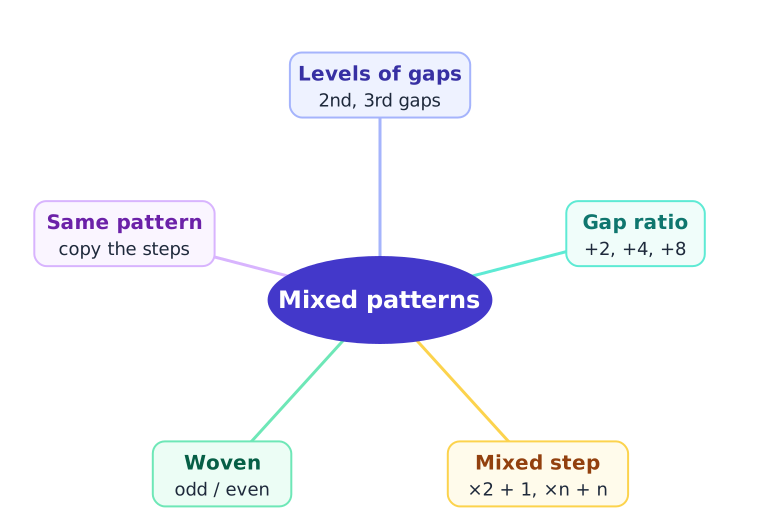
Crack the harder series of bank and SSC mains papers: second and third differences, differences that double, mixed steps such as ×2 + k and ×n + n, woven series, Fibonacci-type sums, and "same pattern" questions where a second series copies the steps of the first.
What you will be able to do
- I can build a difference ladder to the second or third level and read the next term from it.
- I can recognise differences that form a ratio series, squares, cubes or primes.
- I can identify mixed steps such as ×2 + 1, ×n + n and ×2 + 1, ×2 + 2, ….
- I can solve "same pattern" questions by copying the step chain to a new start.
- I can use the formulas for the nth term and the number of terms of a constant-difference series.
Key points
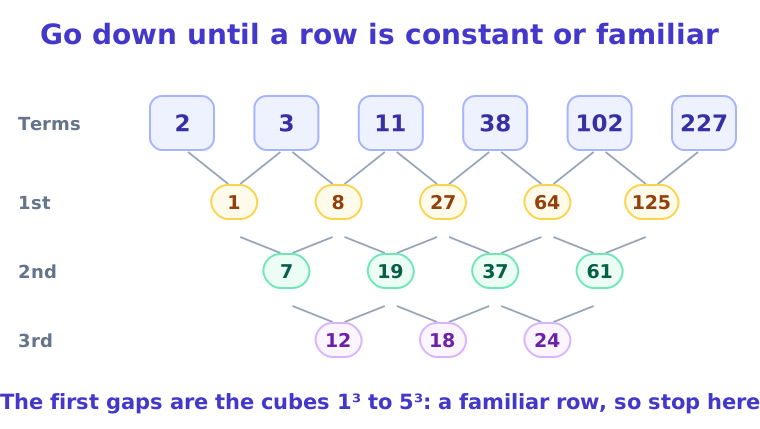
If the first differences are not constant, go one level down; stop at the first constant row.
Constant second differences mean a square-type rule; constant third differences mean a cube-type rule.
If the differences themselves double or triple, the series adds a ratio series: +2, +4, +8, ….
A ratio that grows 1, 2, 3, … with a small extra points to ×n + n or ×n − n.
×2 + 1, ×2 + 2, ×2 + 3 keeps the multiplier and grows the added number.
In a same-pattern question, find the step chain from series I and apply it to the new first term.
nth term of a constant-difference series: a + (n − 1)d. Number of terms: (last − first) ÷ d + 1.
Fibonacci-type series add the previous two (or three) terms.
Full explanation
Kavya meets a mains-level series
Kavya has cleared IBPS prelims. In the mains mock she sees 2, 3, 11, 38, 102, ? and 3, 4, 10, 33, 136, ?. Plain differences and plain ratios both fail. This topic gives her the deeper tools: ladders, gap ratios, mixed steps and copied patterns.
The difference ladder
Write the differences, then the differences of those, and keep going until one row is constant. For 2, 3, 11, 38, 102 the first gaps are 1, 8, 27, 64: the cubes. The next gap is $5^3 = 125$, so ? = 102 + 125 = 227.
When the gaps form a ratio series
In 3, 5, 9, 17, 33 the gaps are 2, 4, 8, 16: each gap doubles. So the next gap is 32 and the next term is 65. Always look at the gaps as a series of their own: they may be squares, cubes, primes or a ratio series.
Mixed steps that change
For 3, 4, 10, 33, 136 the ratios are about 1, 2, 3, 4. Try ×n + n: $3 \times 1 + 1 = 4$, $4 \times 2 + 2 = 10$, $10 \times 3 + 3 = 33$, $33 \times 4 + 4 = 136$. So ? = $136 \times 5 + 5 = 685$. Other common chains: ×2 + 1, ×2 + 2, ×2 + 3; ×1 − 1, ×2 − 2, ×3 − 3; ×0.5, ×1, ×1.5, ×2.
Woven series and alternate steps
If the terms go up and down, read places 1, 3, 5, … and 2, 4, 6, … separately. A related type uses two operations in turn: 5, 10, 8, 16, 14, 28 is ×2, −2, ×2, −2.
Same-pattern questions
Bank mains love this type. Series I: 2, 3, 8, 27, 112. Series II starts with 4 and follows the same pattern: 4, (a), (b), (c), …
Step chain of series I: ×1 + 1, ×2 + 2, ×3 + 3, ×4 + 4. So (a) = 4 × 1 + 1 = 5, (b) = 5 × 2 + 2 = 12, (c) = 12 × 3 + 3 = 39. Copy the steps, not the numbers.
Careful: a plain ×2 + 1 series has gaps that also double, and the two readings give different answers for series II. Exam setters intend the step chain (× and +); read it that way.
Two formulas worth knowing
For a constant-difference series with first term $a$ and difference $d$:
- $n$th term: $T_n = a + (n-1)d$. The 20th term of 7, 11, 15, … is $7 + 19 \times 4 = 83$.
- Number of terms from $a$ to $l$: $\frac{l-a}{d} + 1$. In 7, 11, …, 83 there are $\frac{76}{4} + 1 = 20$ terms.
Back to Kavya
Kavya now writes the ladder for 2, 3, 11, 38, 102 and sees cubes in the gaps: 227. For 3, 4, 10, 33, 136 she spots ratios 1, 2, 3, 4 and tests ×n + n: 685. Both in under a minute.
Concepts and terms
Rows of differences written under a series, each row one entry shorter, until a row is constant.
A step with two operations, such as ×3 − 1, or a changing pair such as ×1 + 1, ×2 + 2, ×3 + 3.
A second series that starts from a new number but uses exactly the same steps as the first.
Each term is the sum of the previous two (or three) terms: 2, 3, 5, 8, 13.
Did you know
The difference ladder was used by Charles Babbage to design his "Difference Engine" in the 1820s, a machine that printed tables of squares and cubes using only addition.
Memory tricks
How deep to go — Square: 2 steps down. Cube: 3 steps down. — n² gives constant second differences; n³ gives constant third differences.
Same pattern — Copy the steps, not the numbers — Write ×2 + 1, ×2 + 1, … above series I, then use those steps on series II.
Practice MCQs with answers (70)
- A 51
- B 68
- C 67
- D 66
Show answer
Why:
The differences +1, +2, +4, … are multiplied by 2 each time. So ? = 35 + 32 = 67.
- A 122
- B 69
- C 124
- D 123
Show answer
Why:
The differences +1, +3, +9, … are multiplied by 3 each time. So ? = 42 + 81 = 123.
- A 226
- B 194
- C 228
- D 224
Show answer
Why:
The differences +2, +4, +8, … are multiplied by 2 each time. So ? = 162 + 64 = 226.
- A 326
- B 321
- C 316
- D 241
Show answer
Why:
The differences +5, +10, +20, … are multiplied by 2 each time. So ? = 161 + 160 = 321.
- A 149
- B 131
- C 140
- D 127
Show answer
Why:
Add the squares of 2, 3, 4, … in turn. So ? = 91 + 7² = 140.
- A 88
- B 107
- C 91
- D 99
Show answer
Why:
Add the squares of 1, 2, 3, … in turn. So ? = 63 + 6² = 99.
- A 444
- B 436
- C 353
- D 452
Show answer
Why:
Add the cubes of 1, 2, 3, … in turn. So ? = 228 + 6³ = 444.
- A 117
- B 109
- C 101
- D 120
Show answer
Why:
Subtract the squares of 1, 2, 3, … in turn. So ? = 145 − 6² = 109.
- A 65
- B 63
- C 62
- D 59
Show answer
Why:
The differences +2, +5, +8, … change by 3 each step. So ? = 45 + 17 = 62.
- A 28
- B 30
- C 31
- D 29
Show answer
Why:
The differences +1, +2, +3, … change by 1 each step. So ? = 22 + 7 = 29.
- A 44
- B 42
- C 45
- D 46
Show answer
Why:
The differences −1, −3, −5, … change by −2 each step. So ? = 55 − 11 = 44.
- A 185
- B 184
- C 183
- D 136
Show answer
Why:
Multiply by 2 and add 1, 2, 3, … in turn. So ? = 89 × 2 + 6 = 184.
- A 664
- B 368
- C 665
- D 666
Show answer
Why:
Multiply by 3 and add 1, 2, 3, … in turn. So ? = 220 × 3 + 5 = 665.
- A 79
- B 102
- C 104
- D 103
Show answer
Why:
Multiply by 2 and add −1, −2, −3, … in turn. So ? = 54 × 2 − 5 = 103.
- A 2676
- B 802
- C 2677
- D 2675
Show answer
Why:
Multiply by 1, 2, 3, … and add the same number: ×1+1, ×2+2, ×3+3, … So ? = 445 × 6 + 6 = 2676.
- A 396
- B 395
- C 394
- D 139
Show answer
Why:
Multiply by 1, 2, 3, … and subtract the same number: ×1−1, ×2−2, ×3−3, … So ? = 80 × 5 − 5 = 395.
- A 1954
- B 586
- C 1956
- D 1958
Show answer
Why:
Multiply by 2, 3, 4, … and add the same number: ×2+2, ×3+3, ×4+4, … So ? = 325 × 6 + 6 = 1956.
- A 36
- B 56.25
- C 68
- D 67.5
Show answer
Why:
The multipliers ÷2, ×1, ×1.5, … grow by 0.5. So ? = 22.5 × 3 = 67.5.
- A 720
- B 721
- C 216
- D 600
Show answer
Why:
The multipliers ×1, ×2, ×3, … grow by 1. So ? = 120 × 6 = 720.
- A 4320
- B 5040
- C 5041
- D 1320
Show answer
Why:
The multipliers ×3, ×4, ×5, … grow by 1. So ? = 720 × 7 = 5040.
- A 487
- B 483
- C 485
- D 269
Show answer
Why:
Each term is the previous one ×3+2. So ? = 161 × 3 + 2 = 485.
- A 330
- B 245
- C 320
- D 325
Show answer
Why:
Each term is the previous one ×2−5. So ? = 165 × 2 − 5 = 325.
- A 70
- B 50
- C 40
- D 90
Show answer
Why:
Each term is the previous one ×0.5+20. So ? = 100 × 0.5 + 20 = 70.
- A 24
- B 44
- C 35
- D 64
Show answer
Why:
Each term is the sum of the three terms before it. So ? = 7 + 13 + 24 = 44.
- A 83
- B 134
- C 97
- D 60
Show answer
Why:
Each term is the sum of the two terms before it. So ? = 37 + 60 = 97.
- A 20
- B 28
- C 46
- D 33
Show answer
Why:
Add the two previous terms, then +1. So ? = 12 + 20 + 1 = 33.
- A 256
- B 56
- C 128
- D 288
Show answer
Why:
Each term is the product of the two terms before it. So ? = 8 × 32 = 256.
- A 678
- B 677
- C 676
- D 47
Show answer
Why:
Square the previous term, then +1. So ? = 26² + 1 = 677.
- A 36
- B 34
- C 38
- D 40
Show answer
Why:
consecutive primes 13, 17, 19, … then +1. So ? = 37 + 1 = 38.
- A 55
- B 54
- C 57
- D 56
Show answer
Why:
Each term is n² + n. So ? = 7² + 7 = 56.
- A 336
- B 300
- C 337
- D 335
Show answer
Why:
Each term is n³ − n. So ? = 7³ − 7 = 336.
- A 26
- B 162
- C 165
- D 159
Show answer
Why:
Two series are woven together: places 1, 3, 5, … go ×3; places 2, 4, 6, … go ×2. So ? = 54 × 3 = 162.
- A 79
- B −25
- C 72
- D 65
Show answer
Why:
Two series are woven together: places 1, 3, 5, … go −7; places 2, 4, 6, … go ×3. So ? = 79 − 7 = 72.
- A 120
- B 40
- C 126
- D 123
Show answer
Why:
Two steps take turns: ×3, then −1. So ? = 41 × 3 = 123.
- A 38
- B 40
- C 54
- D 72
Show answer
Why:
Two steps take turns: +2, then ×2. So ? = 36 + 2 = 38.
- A 12.25
- B 12.75
- C 35.5
- D 13.25
Show answer
Why:
Two steps take turns: ÷2, then +10. So ? = 25.5 ÷ 2 = 12.75.
- A 53
- B 38
- C 50
- D 2
Show answer
Why:
The differences +3, +6, +12, … are multiplied by 2 each time. So ? = 26 + 24 = 50.
- A −485
- B 40
- C 19
- D 39
Show answer
Why:
Multiply by 1, 2, 3, … and add the same number: ×1+1, ×2+2, ×3+3, … So ? = 12 × 3 + 3 = 39.
- A ×2 + 1
- B +2, +4, +8, …
- C ×3 − 1
- D ×2 − 1
Show answer
Why:
Apply ×2 + 1 from 5: 5 → 11, 11 → 23, 23 → 47, 47 → 95. Every step fits; each other rule fails by the second or third term.
- A ×2 + 3
- B ×3 − 1
- C ×3 + 1
- D ×2 + 2
Show answer
Why:
Apply ×3 − 1 from 2: 2 → 5, 5 → 14, 14 → 41, 41 → 122. Every step fits; each other rule fails by the second or third term.
- A ×2, ×3, ×4, …
- B ×1 − 1, ×2 − 2, ×3 − 3, …
- C ×1 + 1, ×2 + 2, ×3 + 3, …
- D ×2 + 1
Show answer
Why:
Apply ×1 + 1, ×2 + 2, ×3 + 3, … from 3: 3 → 4, 4 → 10, 10 → 33, 33 → 136, 136 → 685. Every step fits; each other rule fails by the second or third term.
- A +1³, +2³, +3³, …
- B +2, +4, +6, …
- C +3, +5, +7, …
- D +1², +2², +3², …
Show answer
Why:
Apply +1², +2², +3², … from 5: 5 → 6, 6 → 10, 10 → 19, 19 → 35, 35 → 60. Every step fits; each other rule fails by the second or third term.
- A ×2 + 1, ×2 + 2, ×2 + 3, …
- B ×2 + 1
- C ×2 + 2
- D ×3 + 1, ×3 + 2, ×3 + 3, …
Show answer
Why:
Apply ×2 + 1, ×2 + 2, ×2 + 3, … from 4: 4 → 9, 9 → 20, 20 → 43, 43 → 90, 90 → 185. Every step fits; each other rule fails by the second or third term.
- A ×2 + 1
- B +1³, +2³, +3³, …
- C +2, +4, +8, …
- D +1², +2², +3², …
Show answer
Why:
Apply +1³, +2³, +3³, … from 7: 7 → 8, 8 → 16, 16 → 43, 43 → 107, 107 → 232. Every step fits; each other rule fails by the second or third term.
- A ×2 + 2
- B ×3 − 2
- C ×2, ×3, ×4, …
- D ×1, ×2, ×3, …
Show answer
Why:
Apply ×2, ×3, ×4, … from 2: 2 → 4, 4 → 12, 12 → 48, 48 → 240. Every step fits; each other rule fails by the second or third term.
- A +2, +4, +6, …
- B ×2 − 1
- C +1², +2², +3², …
- D +2, +4, +8, …
Show answer
Why:
Apply +2, +4, +8, … from 9: 9 → 11, 11 → 15, 15 → 23, 23 → 39, 39 → 71. Every step fits; each other rule fails by the second or third term.
- A 39
- B 12
- C 40
- D 38
Show answer
Why:
Multiply by 1, 2, 3, … and add the same number: ×1+1, ×2+2, ×3+3, … Apply the same steps from 4: 4 × 1 + 1 = 5, 5 × 2 + 2 = 12, 12 × 3 + 3 = 39. So (c) = 39.
- A 14
- B 45
- C 46
- D 44
Show answer
Why:
Multiply by 1, 2, 3, … and add the same number: ×1+1, ×2+2, ×3+3, … Apply the same steps from 5: 5 × 1 + 1 = 6, 6 × 2 + 2 = 14, 14 × 3 + 3 = 45. So (c) = 45.
- A 71
- B 18
- C 72
- D 73
Show answer
Why:
The multipliers ×1, ×2, ×3, … grow by 1. Apply the same steps from 3: 3 × 1 = 3, 3 × 2 = 6, 6 × 3 = 18, 18 × 4 = 72. So (d) = 72.
- A 30
- B 26
- C 32
- D 31
Show answer
Why:
Two steps take turns: ×2, then +5. Apply the same steps from 4: 4 × 2 = 8, 8 + 5 = 13, 13 × 2 = 26, 26 + 5 = 31. So (d) = 31.
- A 120
- B 30
- C 121
- D 119
Show answer
Why:
The multipliers ×2, ×3, ×4, … grow by 1. Apply the same steps from 5: 5 × 2 = 10, 10 × 3 = 30, 30 × 4 = 120. So (c) = 120.
- A 153
- B 152
- C 151
- D 39
Show answer
Why:
Multiply by 1, 2, 3, … and subtract the same number: ×1−1, ×2−2, ×3−3, … Apply the same steps from 9: 9 × 1 − 1 = 8, 8 × 2 − 2 = 14, 14 × 3 − 3 = 39, 39 × 4 − 4 = 152. So (d) = 152.
- A 80
- B 140
- C 83
- D 87
Show answer
Why:
$T_n = a + (n-1)d = 7 + 19 \times 4 = 83$.
- A 325
- B 163
- C 152
- D 157
Show answer
Why:
$T_n = a + (n-1)d = 13 + 24 \times 6 = 157$.
- A 20
- B 21
- C 38
- D 19
Show answer
Why:
Number of terms = (last − first) ÷ difference + 1 = (83 − 7) ÷ 4 + 1 = 20.
- A 60
- B 31
- C 30
- D 32
Show answer
Why:
Number of terms = (last − first) ÷ difference + 1 = (222 − 12) ÷ 7 + 1 = 31.
- A 46
- B 44
- C 43
- D 40
Show answer
Why:
The differences +2, +5, +8, … change by 3 each step. Next second gap 3, next first gap 11 + 3 = 14, so ? = 29 + 14 = 43.
- A 84
- B 103
- C 96
- D 95
Show answer
Why:
Add the squares of 2, 3, 4, … in turn. Next second gap 11, next first gap 25 + 11 = 36, so ? = 59 + 36 = 95.
- A 55
- B 51
- C 59
- D 56
Show answer
Why:
The differences +1, +5, +9, … change by 4 each step. Next second gap 4, next first gap 13 + 4 = 17, so ? = 38 + 17 = 55.
- A 29
- B 30
- C 32
- D 28
Show answer
Why:
Two series are woven together: places 1, 3, 5, … go ×2; places 2, 4, 6, … go −5. So ? = 35 − 5 = 30.
- A 63
- B 54
- C 58
- D 36
Show answer
Why:
$T_n = a + (n-1)d = 3 + 11 \times 5 = 58$.
- A 36
- B 18
- C 20
- D 19
Show answer
Why:
Number of terms = (last − first) ÷ difference + 1 = (95 − 5) ÷ 5 + 1 = 19.
- A 44
- B 42
- C 46
- D 45
Show answer
Why:
The differences +2, +4, +6, … change by 2 each step. So ? = 32 + 12 = 44.
- A 48
- B 64
- C 65
- D 63
Show answer
Why:
The differences +1, +2, +4, … are multiplied by 2 each time. So ? = 32 + 32 = 64.
- A 2, 2, 2, 2, 2
- B 3, 4, 5, 6, 7
- C 3, 5, 7, 9, 11
- D 4, 9, 16, 25, 36
Show answer
Why:
4 − 1 = 3, 9 − 4 = 5, 16 − 9 = 7, 25 − 16 = 9, 36 − 25 = 11: the odd numbers.
- A The second differences, all 12
- B The third differences, all 8
- C The first differences, all 7
- D The third differences, all 6
Show answer
Why:
Gaps 7, 19, 37, 61, 91; then 12, 18, 24, 30; then 6, 6, 6.
- A Both A and R are true, and R is the correct explanation of A
- B Both A and R are true, but R is not the correct explanation of A
- C A is true but R is false
- D A is false but R is true
Show answer
Why:
112 × 5 + 5 = 565; R gives exactly this step.
- A Both A and R are true, and R is the correct explanation of A
- B Both A and R are true, but R is not the correct explanation of A
- C A is true but R is false
- D A is false but R is true
Show answer
Why:
7 + 19 × 4 = 83, not 87 (87 comes from using n instead of n − 1). A is false, R is true.
- A 1 only
- B 2 only
- C Both 1 and 2
- D Neither 1 nor 2
Show answer
Why:
Gaps 4, 9, 16, 25 are squares; next gap 36 gives 55 + 36 = 91. Both true.
- A 1 only
- B 2 only
- C Both 1 and 2
- D Neither 1 nor 2
Show answer
Why:
Steps ×1 + 1, ×2 + 2: 2 × 1 + 1 = 3, then 3 × 2 + 2 = 8, not 10. Only 1 is true.
Important short questions (3)
The terms are n³ + 1 for n = 0 to 4 (gaps 1, 7, 19, 37 with second gaps 6, 12, 18). Next: 5³ + 1 = 126.
(156 − 9) ÷ 7 + 1 = 21 + 1 = 22 terms.
×2 + 1 each time, or gaps 3, 6, 12, 24 doubling. Both give 47 + 48 = 95.
Long answer questions (1)
Steps of series I: ×1 + 1, ×2 + 2, ×3 + 3, ×4 + 4. Series II: 3 × 1 + 1 = 4, 4 × 2 + 2 = 10, 10 × 3 + 3 = 33, 33 × 4 + 4 = 136.
The gaps of series I (1, 8, 31, 139) follow no simple rule; they depend on the size of each term. So only the steps carry over.
Flashcards (13)
Play this topic
- Pattern check
Veda Skills Logical Reasoning Unit 1 — frequently asked questions
Differences 5, 10, 15, 20 grow by 5, so the next is 25: 56 + 25 = 81.
Each term is ×2 + 1: 47 × 2 + 1 = 95.
The terms are n³ − 1 for n = 2 to 7, so ? = 6³ − 1 = 215.
Rule ×2 + 1: 6, 13, 27, 55, 111, 223. So 112 is wrong; it should be 111.
It is the end of one gap and the start of the next. If it is k too big, the gap before grows by k and the gap after shrinks by k.
Squares 1² to 7²: the fifth should be 25, so 24 is wrong.
The terms are n³ + 1 for n = 0 to 4 (gaps 1, 7, 19, 37 with second gaps 6, 12, 18). Next: 5³ + 1 = 126.
(156 − 9) ÷ 7 + 1 = 21 + 1 = 22 terms.
×2 + 1 each time, or gaps 3, 6, 12, 24 doubling. Both give 47 + 48 = 95.

All Veda Skills Logical Reasoning units
Study this chapter properly, free
Everything above is on this page to read. In the Veda app the same chapter becomes spaced-repetition flashcards, timed tests that mark themselves, Veda Bites you can swipe, and games — with your progress tracked topic by topic.
Get Veda free