Veda Skills Logical Reasoning Unit 5: Coding-Decoding
- 3 topics
- 197 MCQs
- 9 short answers
- 3 long answers
- 37 flashcards
- 3 games
- ~160 min read
- English
Checked before publishing: 23 automated checks, including a plagiarism check against the textbook's own words. How we check our content
Letter Shift and Reverse Codes
Crack codes made by moving letters a fixed number of places, replacing them by opposite letters, writing words backwards, alternate or growing shifts, and swapping letters; then apply the rule forward or backward.
What you will be able to do
- I can find the jump between a letter and its code letter using positions.
- I can recognise fixed, alternate and growing shifts, opposite letters, reversal and swaps.
- I can apply a rule to a new word, wrapping round after Z.
- I can decode a code word by undoing the rule.

Key points
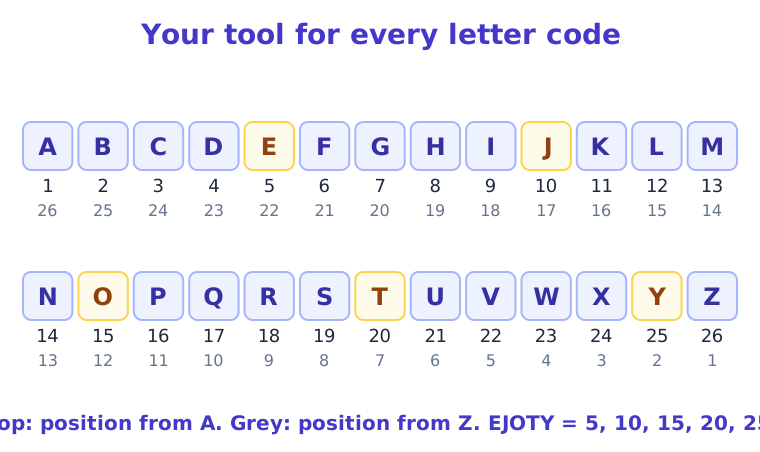
Write positions: A = 1 … Z = 26. EJOTY gives 5, 10, 15, 20, 25.
Jump = code letter position − word letter position. Check the first two letters, then all.
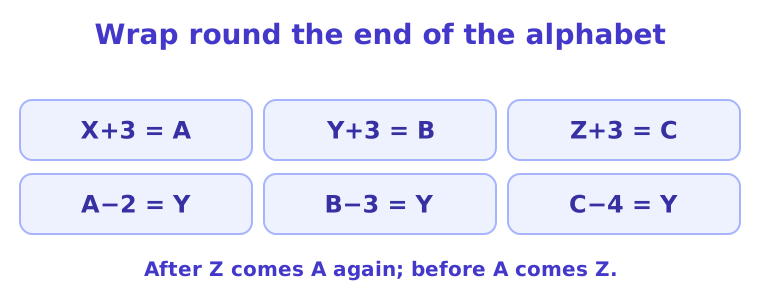
After Z comes A again: Y + 3 = B. Before A comes Z: B − 3 = Y.
Opposite letters add to 27: A–Z, B–Y, … M–N. The opposite code is its own undo.
If the code has the same letters as the word, look for reversal, pair swaps or reversed halves.
If the code letters look unrelated, reverse the word first and then look for a shift.
Growing shifts (+1, +2, +3) and alternate shifts (+1, −1) are common in Bank exams.
To decode, undo the rule: a forward shift becomes a backward shift.
Full explanation
Rohan's secret note
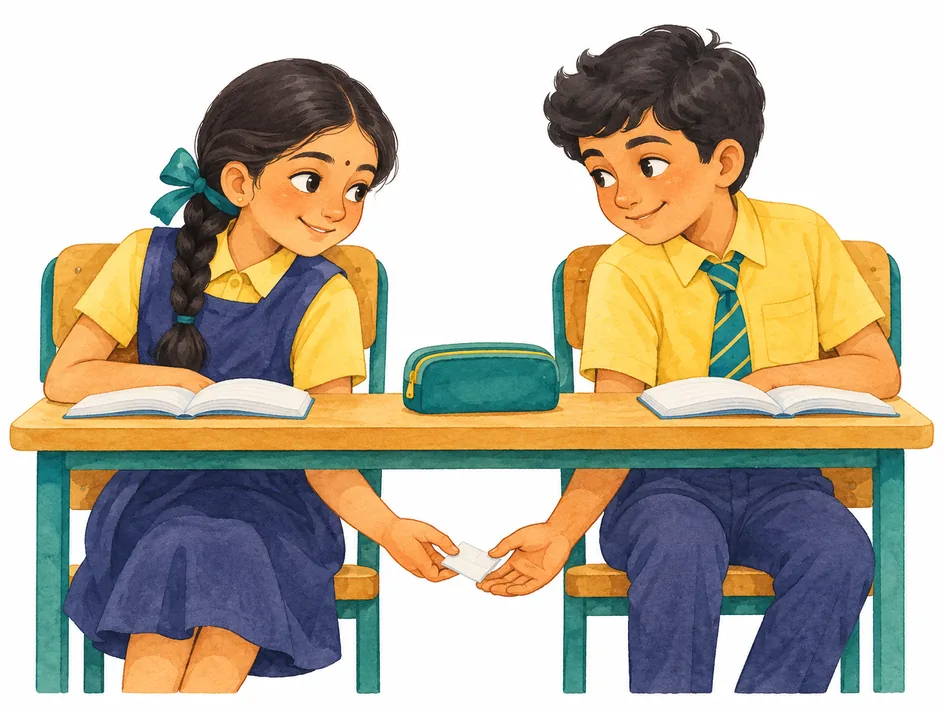
Rohan passes a note to his friend before the SSC mock test: "UFTU BU UFO". His friend frowns, then smiles: "Each letter is one step ahead. It says TEST AT TEN." Coding-decoding questions are exactly this game, played against the clock.
Positions are everything
Every letter code becomes arithmetic once you know positions. Learn EJOTY (5, 10, 15, 20, 25) and count from the nearest anchor. Also know positions from Z: the reverse position is $27 - \text{position}$.
The four-step method
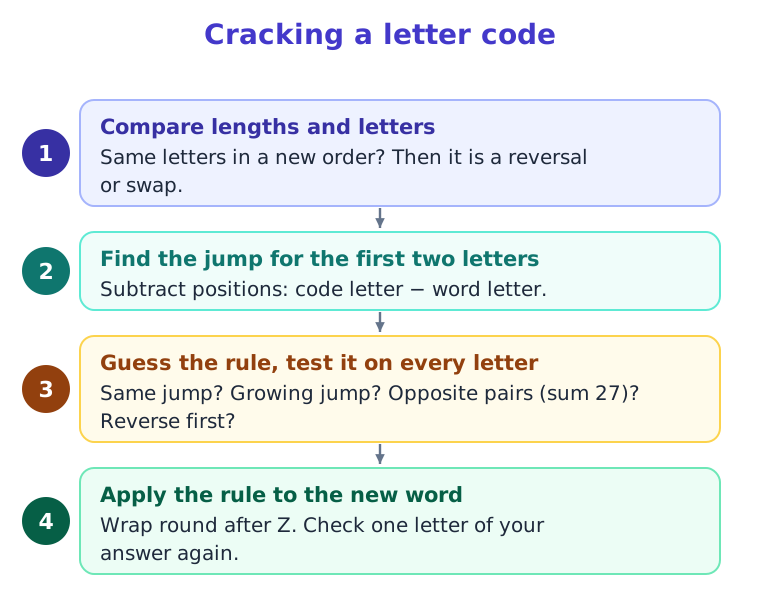
- Compare the word and the code: same letters in a new order, or new letters?
- Find the jump for the first two letters.
- Guess the rule and test it on every letter.
- Apply it to the new word, wrapping round after Z.
Fixed shift
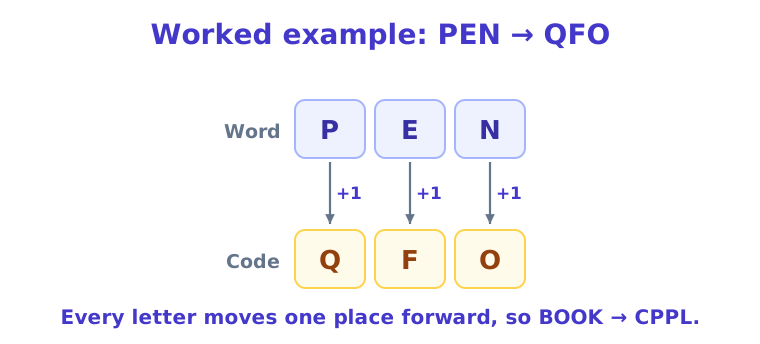
If PEN is coded QFO, the jumps are P→Q (+1), E→F (+1), N→O (+1). Every letter moves one place forward, so BOOK becomes CPPL. A backward shift works the same way with minus signs.
Wrap round
The alphabet is a circle. With a +3 code, X → A, Y → B, Z → C. With a −2 code, A → Y and B → Z. Forgetting the wrap is the most common slip in this chapter.
Opposite letters
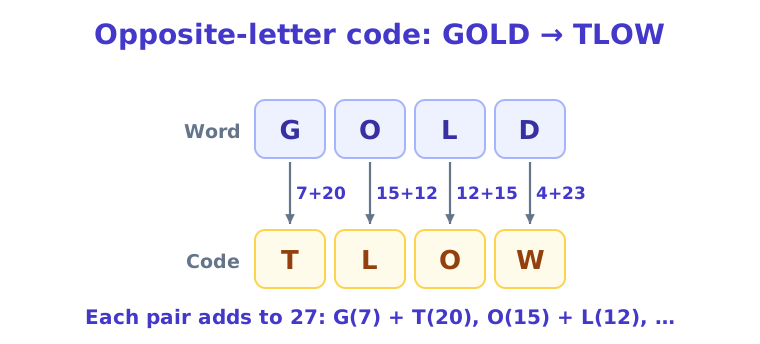
If GOLD is coded TLOW, check sums: G + T = 7 + 20 = 27, O + L = 15 + 12 = 27. Each letter is replaced by its opposite. Shortcut: the pairs BoY, CoX, DeW, GoT, HiS, LoO. Applying the code twice gives the word back, so decoding is the same as coding.
Reverse, then shift
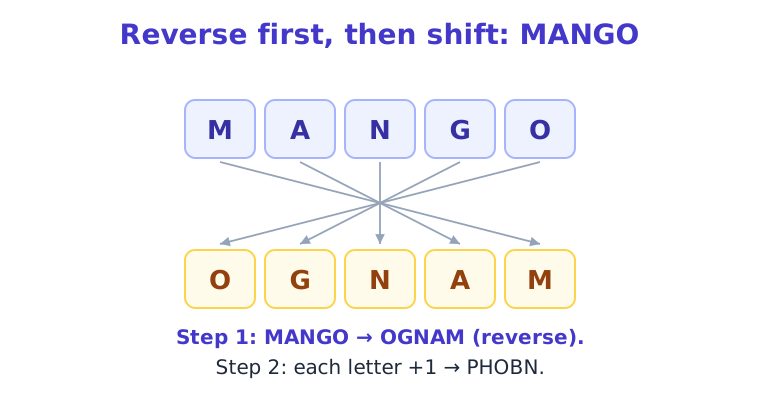
When the code letters look random, write the word backwards first. MANGO reversed is OGNAM; then +1 gives PHOBN. Always ask: was the word reversed before or after the shift? Here both orders give the same result, but with growing shifts they do not.
Changing shifts
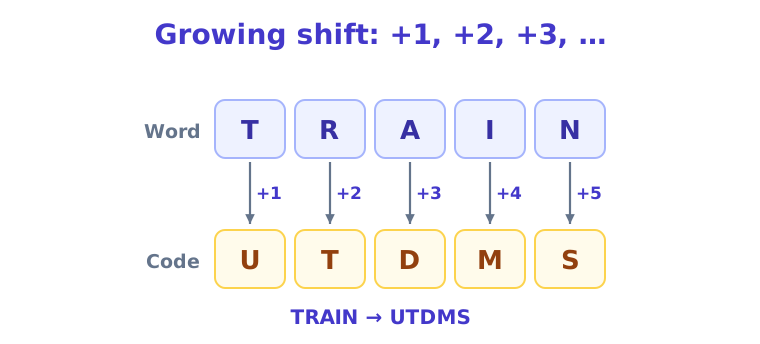
Some codes change the jump: +1, +2, +3, … (growing) or +1, −1, +1, … (alternate). TRAIN with a growing shift becomes UTDMS. Check at least three letters before you trust such a rule.
Swaps and halves
If the code uses exactly the letters of the word, nothing was shifted; letters only moved. TABLE → ATLBE swaps neighbours (TA→AT, BL→LB, E stays). GARDEN → RAGNED reverses each half (GAR→RAG, DEN→NED).
Decoding
To find the word behind a code, undo the rule. If the rule is +2, decode with −2: in a +2 code, FQI decodes to DOG. Opposite and reversal codes undo themselves.
Back to Rohan
Rohan's friend decoded UFTU BU UFO by moving each letter one step back: U→T, F→E, T→S. Next time Rohan uses opposite letters: GVHG ZG GVM. Can you read it? (Same message: TEST AT TEN.)
Concepts and terms
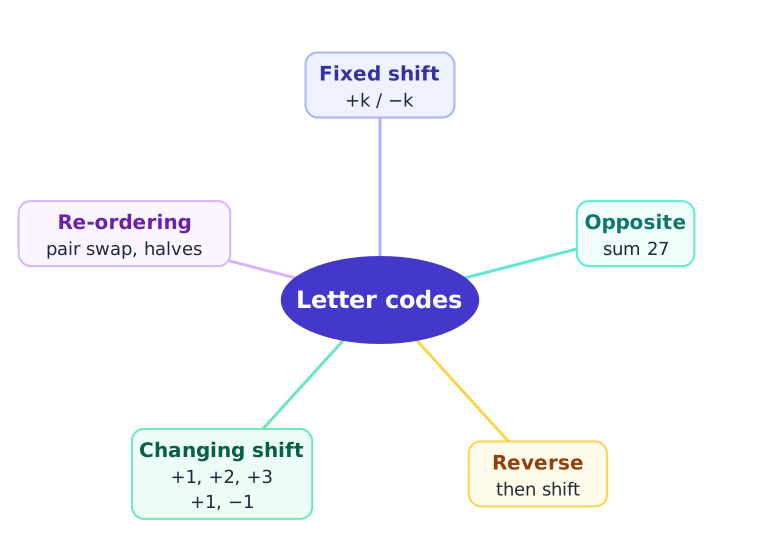
Every letter moves the same number of places, such as +2: CAT → ECV.
Every letter is replaced by the letter whose position makes 27 with it: CAT → XZG.
The word is written backwards, sometimes followed by a shift: CAT → TAC → UBD.
The jump changes from letter to letter: +1, +2, +3 or +1, −1, +1.

Did you know
Julius Caesar is said to have sent army messages with a shift of 3 letters, so the shift code is still called the Caesar cipher.
The opposite-letter code (A↔Z) is an old Hebrew cipher called Atbash.

Memory tricks
Positions — EJOTY — E 5, J 10, O 15, T 20, Y 25; count from the nearest one.
Opposites — Sum 27 — A letter and its code letter in an opposite code always add to 27.
Practice MCQs with answers (67)
- A QMBOG
- B QKBMF
- C QNBPF
- D QMBOF
Show answer
Why:
Rule: Each letter moves 1 place forward. Check: CHAIR → DIBJS. So PLANE: P→Q, L→M, A→B, N→O, E→F, giving QMBOF.
- A ETGCO
- B ESGBO
- C ETGCP
- D EPGYO
Show answer
Why:
Rule: Each letter moves 2 places forward. Check: JACKET → LCEMGV. So CREAM: C→E, R→T, E→G, A→C, M→O, giving ETGCO.
- A TOPNO
- B RONNM
- C RONNN
- D RQNPM
Show answer
Why:
Rule: Each letter moves 1 place back. Check: EAGLE → DZFKD. So SPOON: S→R, P→O, O→N, O→N, N→M, giving RONNM.
- A UKKS
- B PIHS
- C VKLS
- D VKLT
Show answer
Why:
Rule: Each letter moves 3 places forward. Check: JUICE → MXLFH. So SHIP: S→V, H→K, I→L, P→S, giving VKLS.
- A UYNR
- B QYJS
- C QCJV
- D QYJR
Show answer
Why:
Rule: Each letter moves 2 places back. Check: BREAD → ZPCYB. So SALT: S→Q, A→Y, L→J, T→R, giving QYJR.
- A WEPX
- B WODV
- C WEPY
- D TCOX
Show answer
Why:
Rule: Each letter moves 4 places forward. Check: FOREST → JSVIWX. So SALT: S→W, A→E, L→P, T→X, giving WEPX.
- A BJLYF
- B ZILZH
- C PXLOX
- D ZILZI
Show answer
Why:
Rule: Each letter moves 3 places back. Check: SNOW → PKLT. So CLOCK: C→Z, L→I, O→L, C→Z, K→H, giving ZILZH.
- A YLLP
- B AMLG
- C GTTP
- D GTTQ
Show answer
Why:
Rule: Each letter moves 5 places forward. Check: PENCIL → UJSHNQ. So BOOK: B→G, O→T, O→T, K→P, giving GTTP.
- A SJBLDU
- B UHDJFS
- C UJDLFV
- D UJDLFU
Show answer
Why:
Rule: Each letter moves 1 place forward. Check: CANDLE → DBOEMF. So TICKET: T→U, I→J, C→D, K→L, E→F, T→U, giving UJDLFU.
- A DQQM
- B CQPM
- C DMQI
- D DQQN
Show answer
Why:
Rule: Each letter moves 2 places forward. Check: POND → RQPF. So BOOK: B→D, O→Q, O→Q, K→M, giving DQQM.
- A OWHQ
- B OWHP
- C RYIP
- D ASTL
Show answer
Why:
Rule: Each letter moves 4 places back. Check: LAMP → HWIL. So SALT: S→O, A→W, L→H, T→P, giving OWHP.
- A HUE
- B ZQD
- C HUD
- D AMU
Show answer
Why:
Rule: Each letter moves 6 places forward. Check: STAR → YZGX. So BOX: B→H, O→U, X→D, giving HUD.
- A DNSM
- B XLIN
- C BNQM
- D XLIM
Show answer
Why:
Rule: Each letter is replaced by its opposite letter (A↔Z, B↔Y, …). Check: PLATE → KOZGV. So CORN: C→X, O→L, R→I, N→M, giving XLIM.
- A SLIHV
- B ELOPB
- C VHILS
- D SLIHW
Show answer
Why:
Rule: Each letter is replaced by its opposite letter (A↔Z, B↔Y, …). Check: ROAD → ILZW. So HORSE: H→S, O→L, R→I, S→H, E→V, giving SLIHV.
- A NLGSVJ
- B NLGSVI
- C QDGSNL
- D JLQEBO
Show answer
Why:
Rule: Each letter is replaced by its opposite letter (A↔Z, B↔Y, …). Check: DOCTOR → WLXGLI. So MOTHER: M→N, O→L, T→G, H→S, E→V, R→I, giving NLGSVI.
- A MDNNO
- B MFNPO
- C MLNVO
- D MLNVP
Show answer
Why:
Rule: Each letter is replaced by its opposite and the result is written backwards. Check: BREAD → WZVIY. So LEMON: opposites: OVNLM; backwards: MLNVO, giving MLNVO.
- A AGPQO
- B BHQRP
- C YENON
- D YENOM
Show answer
Why:
Rule: The word is written backwards. Check: RIVER → REVIR. So MONEY: MONEY backwards is YENOM.
- A SFWMJT
- B SFWMJU
- C PFISBO
- D QKJXCT
Show answer
Why:
Rule: The word is reversed and then each letter moves 1 place forward. Check: DOCTOR → SPUDPE. So SILVER: reverse: REVLIS; then R→S, E→F, V→W, L→M, I→J, S→T, giving SFWMJT.
- A BPOQDS
- B QDOONB
- C QDOONC
- D BNOODQ
Show answer
Why:
Rule: The word is reversed and then each letter moves 1 place back. Check: CROWN → MVNQB. So COPPER: reverse: REPPOC; then R→Q, E→D, P→O, P→O, O→N, C→B, giving QDOONB.
- A GTOSGR
- B NCOKPD
- C NCOKPC
- D CLKKCJ
Show answer
Why:
Rule: The word is reversed and then each letter moves 2 places forward. Check: LADDER → TGFFCN. So ANIMAL: reverse: LAMINA; then L→N, A→C, M→O, I→K, N→P, A→C, giving NCOKPC.
- A KPQL
- B QRUM
- C GPML
- D QRUL
Show answer
Why:
Rule: The word is reversed and then each letter moves 3 places forward. Check: WALLET → WHOODZ. So IRON: reverse: NORI; then N→Q, O→R, R→U, I→L, giving QRUL.
- A MELYK
- B IWJCK
- C KCLIM
- D MELYL
Show answer
Why:
Rule: The word is reversed and then each letter moves 2 places back. Check: BUTTER → PCRRSZ. So MANGO: reverse: OGNAM; then O→M, G→E, N→L, A→Y, M→K, giving MELYK.
- A NPOEBZ
- B NNOCBX
- C NNOCBY
- D LNMCZX
Show answer
Why:
Rule: Letters move +1 and −1 by turns (+1, −1, +1, …). Check: MORNING → NNSMJMH. So MONDAY: M+1=N, O−1=N, N+1=O, D−1=C, A+1=B, Y−1=X, giving NNOCBX.
- A SQNOR
- B RQNST
- C RQNSS
- D RONQS
Show answer
Why:
Rule: Letters move −1 and +1 by turns (−1, +1, −1, …). Check: FLOWER → EMNXDS. So SPORT: S−1=R, P+1=Q, O−1=N, R+1=S, T−1=S, giving RQNSS.
- A DMPCQR
- B HPTFUU
- C HMTCUS
- D HMTCUR
Show answer
Why:
Rule: Letters move +2 and −2 by turns (+2, −2, +2, …). Check: CREAM → EPGYO. So FOREST: F+2=H, O−2=M, R+2=T, E−2=C, S+2=U, T−2=R, giving HMTCUR.
- A QQDMFV
- B NQAMCV
- C QNDJFS
- D QQDMFW
Show answer
Why:
Rule: Letters move +1 and +2 by turns (+1, +2, +1, …). Check: BREAD → CTFCE. So POCKET: P+1=Q, O+2=Q, C+1=D, K+2=M, E+1=F, T+2=V, giving QQDMFV.
- A INCUU
- B IMCTU
- C IMCTV
- D IJCQU
Show answer
Why:
Rule: Letters move +2 and +1 by turns (+2, +1, +2, …). Check: BOTTLE → DPVUNF. So GLASS: G+2=I, L+1=M, A+2=C, S+1=T, S+2=U, giving IMCTU.
- A NWVMI
- B NWTKD
- C NWVMH
- D FLVXP
Show answer
Why:
Rule: The first letter moves 1 place forward, the second 2 places, the third 3 places, and so on. Check: HORSE → IQUWJ. So MUSIC: M+1=N, U+2=W, S+3=V, I+4=M, C+5=H, giving NWVMH.
- A QGZB
- B NEYA
- C OFZB
- D QGZA
Show answer
Why:
Rule: The first letter moves 1 place back, the second 2 places back, and so on. Check: WATER → VYQAM. So RICE: R−1=Q, I−2=G, C−3=Z, E−4=A, giving QGZA.
- A TRRVY
- B TROPS
- C TRPTU
- D TRRVZ
Show answer
Why:
Rule: The first letter moves 1 place forward, the second 2 places, the third 3 places, and so on. Check: NATION → OCWMTT. So SPORT: S+1=T, P+2=R, O+3=R, R+4=V, T+5=Y, giving TRRVY.
- A UHEPXQ
- B UNBMRE
- C UNBMRF
- D REBMUN
Show answer
Why:
Rule: Each pair of neighbouring letters is swapped (first with second, third with fourth, …). Check: SUNDAY → USDNYA. So NUMBER: NU MB ER → UN BM RE, giving UNBMRE.
- A JCRRCP
- B TELREU
- C TELRET
- D RETTEL
Show answer
Why:
Rule: The word is split into two halves and each half is written backwards. Check: BOTTLE → TOBELT. So LETTER: LET | TER → TEL | RET, giving TELRET.
- A SINNET
- B GVMMRH
- C ETNNSJ
- D ETNNSI
Show answer
Why:
Rule: Each pair of neighbouring letters is swapped (first with second, third with fourth, …). Check: QUEEN → UQEEN. So TENNIS: TE NN IS → ET NN SI, giving ETNNSI.
- A EAGLE
- B ECGNE
- C ELGAE
- D EAGLF
Show answer
Why:
Rule: Each letter moves 1 place forward. (RADIO → SBEJP). Undo it on FBHMF: the word is EAGLE. Check: E→F, A→B, G→H, L→M, E→F.
- A REVIR
- B RIVER
- C RHVDR
- D RIVES
Show answer
Why:
Rule: Each letter moves 2 places forward. (CAT → ECV). Undo it on TKXGT: the word is RIVER. Check: R→T, I→K, V→X, E→G, R→T.
- A DSCI
- B DUCL
- C DUCK
- D BUAK
Show answer
Why:
Rule: Each letter moves 1 place back. (LIGHT → KHFGS). Undo it on CTBJ: the word is DUCK. Check: D→C, U→T, C→B, K→J.
- A CNAES
- B CREAN
- C WJUAM
- D CREAM
Show answer
Why:
Rule: Each letter is replaced by its opposite letter (A↔Z, B↔Y, …). (SILK → HROP). Undo it on XIVZN: the word is CREAM. Check: C→X, R→I, E→V, A→Z, M→N.
- A HAMMER
- B HUMMYR
- C REMMAH
- D HAMMES
Show answer
Why:
Rule: The word is reversed and then each letter moves 1 place forward. (KING → HOJL). Undo it on SFNNBI: the word is HAMMER. Check: reverse: REMMAH; then R→S, E→F, M→N, M→N, A→B, H→I.
- A DHBIS
- B CHAIR
- C EIAHP
- D CHAIS
Show answer
Why:
Rule: Each letter moves 3 places forward. (RAIN → UDLQ). Undo it on FKDLU: the word is CHAIR. Check: C→F, H→K, A→D, I→L, R→U.
- A KETTLF
- B KBTQLB
- C KETTLE
- D KCTRLC
Show answer
Why:
Rule: Letters move +1 and −1 by turns (+1, −1, +1, …). (GOLD → HNMC). Undo it on LDUSMD: the word is KETTLE. Check: K+1=L, E−1=D, T+1=U, T−1=S, L+1=M, E−1=D.
- A CANDLF
- B CNBPYE
- C LENDCA
- D CANDLE
Show answer
Why:
Rule: The word is written backwards. (COPPER → REPPOC). Undo it on ELDNAC: the word is CANDLE. Check: CANDLE backwards is ELDNAC.
- A Each letter moves 2 places forward.
- B The word is reversed and then each letter moves 1 place forward.
- C Letters move −2 and +2 by turns (−2, +2, −2, …).
- D The first letter moves 1 place forward, the second 2 places, the third 3 places, and so on.
Show answer
Why:
Check each letter: P→R, O→Q, N→P, D→F. That is the rule: Each letter moves 2 places forward.
- A Each letter is replaced by its opposite and the result is written backwards.
- B Each letter is replaced by its opposite letter (A↔Z, B↔Y, …).
- C Each letter moves 1 place back.
- D Letters move +1 and −1 by turns (+1, −1, +1, …).
Show answer
Why:
Check each letter: W→D, A→Z, T→G, C→X, H→S. That is the rule: Each letter is replaced by its opposite letter (A↔Z, B↔Y, …).
- A Letters move +1 and +2 by turns (+1, +2, +1, …).
- B The word is reversed and then each letter moves 2 places forward.
- C The first letter moves 1 place forward, the second 2 places, the third 3 places, and so on.
- D The word is reversed and then each letter moves 3 places forward.
Show answer
Why:
Check each letter: P+1=Q, O+2=Q, N+3=Q, D+4=H. That is the rule: The first letter moves 1 place forward, the second 2 places, the third 3 places, and so on.
- A Each letter moves 1 place forward.
- B Each letter is replaced by its opposite letter (A↔Z, B↔Y, …).
- C The first letter moves 1 place forward, the second 2 places, the third 3 places, and so on.
- D Letters move +1 and −1 by turns (+1, −1, +1, …).
Show answer
Why:
Check each letter: S+1=T, U−1=T, G+1=H, A−1=Z, R+1=S. That is the rule: Letters move +1 and −1 by turns (+1, −1, +1, …).
- A The word is reversed and then each letter moves 1 place forward.
- B Letters move −2 and +2 by turns (−2, +2, −2, …).
- C Each letter moves 4 places back.
- D Letters move −1 and +1 by turns (−1, +1, −1, …).
Show answer
Why:
Check each letter: reverse: DNIW; then D→E, N→O, I→J, W→X. That is the rule: The word is reversed and then each letter moves 1 place forward.
- A EJQAM
- B ENQEM
- C EMQDM
- D ENQEN
Show answer
Why:
Rule: Each letter moves 2 places forward. Check: SCHOOL → UEJQQN. So CLOCK: C→E, L→N, O→Q, C→E, K→M, giving ENQEM.
- A KLXPVG
- B OMZGZN
- C MLZHBQ
- D MLZHBR
Show answer
Why:
Rule: Each letter moves 3 places back. Check: HOCKEY → ELZHBV. So POCKET: P→M, O→L, C→Z, K→H, E→B, T→Q, giving MLZHBQ.
- A FYUZ
- B HAWB
- C FAEM
- D FAEL
Show answer
Why:
Rule: The word is written backwards. Check: RICE → ECIR. So LEAF: LEAF backwards is FAEL.
- A DCPIWG
- B DCPIWH
- C DCNGSC
- D ACEMAR
Show answer
Why:
Rule: The first letter moves 1 place forward, the second 2 places, the third 3 places, and so on. Check: WHEAT → XJHEY. So CAMERA: C+1=D, A+2=C, M+3=P, E+4=I, R+5=W, A+6=G, giving DCPIWG.
- A WIII
- B WIIH
- C WVVH
- D TGHH
Show answer
Why:
Rule: Each letter moves 4 places forward. Check: GOLD → KSPH. So SEED: S→W, E→I, E→I, D→H, giving WIIH.
- A SEJA
- B EOJX
- C SEJZ
- D GQLZ
Show answer
Why:
Rule: Each letter moves 4 places back. Check: PLANET → LHWJAP. So WIND: W→S, I→E, N→J, D→Z, giving SEJZ.
- A HWNHPJZ
- B DTLGPKA
- C WHNFLUF
- D HWNHPJY
Show answer
Why:
Rule: Each letter moves 5 places forward. Check: COAL → HTFQ. So CRICKET: C→H, R→W, I→N, C→H, K→P, E→J, T→Y, giving HWNHPJY.
- A NJYLC
- B RJCLG
- C NJYLD
- D NNYPC
Show answer
Why:
Rule: Each letter moves 2 places back. Check: SPOON → QNMML. So PLANE: P→N, L→J, A→Y, N→L, E→C, giving NJYLC.
- A RPYGL
- B RTYKL
- C RTIAN
- D RTYKM
Show answer
Why:
Rule: Letters move −2 and +2 by turns (−2, +2, −2, …). Check: FISH → DKQJ. So TRAIN: T−2=R, R+2=T, A−2=Y, I+2=K, N−2=L, giving RTYKL.
- A UDNX
- B UBNU
- C UDNW
- D UCNV
Show answer
Why:
Rule: Letters move +2 and +3 by turns (+2, +3, +2, …). Check: CORN → ERTQ. So SALT: S+2=U, A+3=D, L+2=N, T+3=W, giving UDNW.
- A WONT
- B RONX
- C OJKS
- D WONS
Show answer
Why:
Rule: The word is written backwards. Check: MARKET → TEKRAM. So SNOW: SNOW backwards is WONS.
- A ROOT
- B RLMO
- C ROOU
- D RQMT
Show answer
Why:
Rule: The word is written backwards. (TREE → EERT). Undo it on TOOR: the word is ROOT. Check: ROOT backwards is TOOR.
- A WINE
- B WIND
- C SIJD
- D VIMD
Show answer
Why:
Rule: Each letter moves 2 places back. (BUTTER → ZSRRCP). Undo it on UGLB: the word is WIND. Check: W→U, I→G, N→L, D→B.
- A JUICF
- B EBITJ
- C JUICE
- D ECIUJ
Show answer
Why:
Rule: The word is reversed and then each letter moves 2 places forward. (DOCTOR → TQVEQF). Undo it on GEKWL: the word is JUICE. Check: reverse: ECIUJ; then E→G, C→E, I→K, U→W, J→L.
- A A
- B C
- C V
- D B
Show answer
Why:
Y(25) + 3 = 28; after 26 we wrap round, so 28 − 26 = 2, which is B.
- A G
- B F
- C H
- D Y
Show answer
Why:
Undo −4 by moving 4 forward: C(3) + 4 = 7, which is G. Check: G − 4 = C.
- A Both A and R are true, and R is the correct explanation of A
- B Both A and R are true, but R is not the correct explanation of A
- C A is true but R is false
- D A is false but R is true
Show answer
Why:
C(3)+X(24), A(1)+Z(26), T(20)+G(7) all make 27; so D→W, O→L, G→T gives WLT. R explains A.
- A Both A and R are true, and R is the correct explanation of A
- B Both A and R are true, but R is not the correct explanation of A
- C A is true but R is false
- D A is false but R is true
Show answer
Why:
A − 1 = Z, A − 2 = Y. The wrap round in R is exactly why A becomes Y.
- A Both A and R are true, and R is the correct explanation of A
- B Both A and R are true, but R is not the correct explanation of A
- C A is true but R is false
- D A is false but R is true
Show answer
Why:
PEN → QFO is +1 for each letter, so INK → JOL is true. R (+2) is false.
- A 1 only
- B 2 only
- C Both 1 and 2
- D Neither 1 nor 2
Show answer
Why:
T→U, E→F, A→B is +1. COFFEE +1 = DPGGFF. Both are true.
- A 1 only
- B 2 only
- C Both 1 and 2
- D Neither 1 nor 2
Show answer
Why:
L↔O, O↔L, V↔E, E↔V gives OLEV. Reversed, LOVE is EVOL, not EVLO.
Important short questions (3)
Every letter moves one place forward (M→N, O→P, …). FATHER → GBUIFS.
Move each letter 3 places back: J→G, R→O, R→O, G→D, so the word is GOOD.
Add the positions of each letter and its code letter. If every pair makes 27 (like G + T), it is an opposite code.
Long answer questions (1)
(a) Jumps: S→T +1, U→W +2, G→J +3, A→E +4, R→W +5: a growing shift.
(b) SALT → TCOX.
(c) Undo with −1, −2, −3, −4: DCOH → CALD.
Flashcards (13)
Play this topic
- Code check
Word and Sentence Codes
Decode sentences written in a code language by matching common words with common codes, use elimination, spot when a code cannot be determined, and solve substitution ("is called") questions.
What you will be able to do
- I can find the code of a word by comparing two statements that share it.
- I can use elimination to fix the remaining codes.
- I can say when a code cannot be determined.
- I can answer substitution questions by finding the real answer first.
Key points
In sentence codes the code words are usually jumbled: position tells you nothing.
A word common to two statements has its code common to both code lines.
Codes of statements without the word can be struck out for that word.
Once a code is fixed, remove it everywhere and look again.
If two words always appear together, their codes cannot be separated.
A word that appears only once gets the code left over after the others are fixed.
In substitution questions, answer the real question first, then replace it by what it is called.
Full explanation
Meera's Bank PO set
Meera opens the reasoning section of her Bank PO mock. The first set says: "In a certain code language, 'tea is hot' is written as …". Five questions depend on this one table. If she reads it the right way, she earns five marks in two minutes.
Jumbled codes
In sentence codes, the code words are not in the same order as the words. Never match the 1st word with the 1st code. Match by sharing: a word that appears in two statements has its code in both code lines.
Worked example
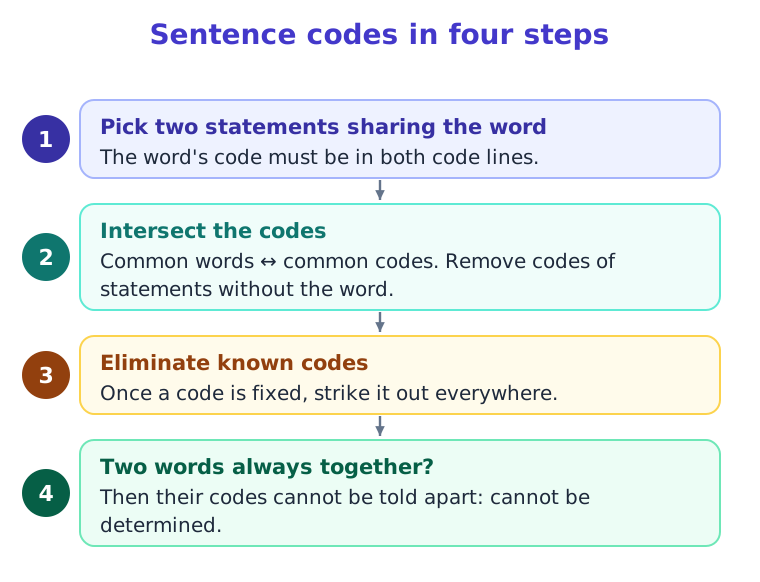
Look at the three statements in the table. "is" appears in all three, and only one code appears in all three code lines: that is the code for "is". Now "blue" is in statements 1 and 2; remove the code for "is" from their common codes and one code is left for "blue". Continue the same way for "sea", then "sky" and "deep".
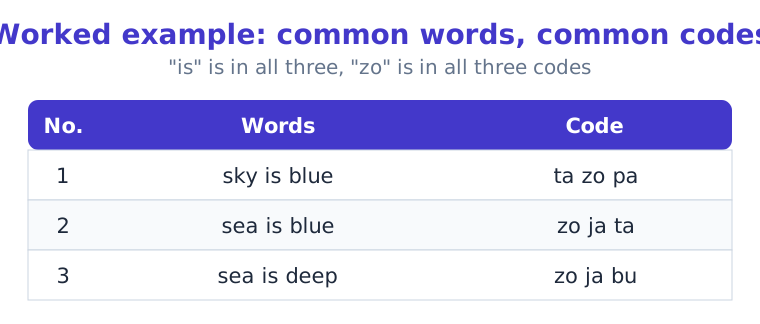
Elimination
A word that appears in only one statement has no partner to compare with. Fix the other words of that statement first; the code left over is its code. This is why the order in which you solve matters: always start with the most-shared word.
When the answer is "cannot be determined"
If "is" and "hot" both appear in statements 1 and 2 and nowhere else, two codes are shared by them and the data never tells which is which. The honest answer is cannot be determined. Exams use this option often; choose it only after checking every statement.
Two-word codes
Some questions ask for the code of a phrase made of known words. Find each word's code separately and write them together. The order of codes does not matter in jumbled codes, but in these questions the options are written in the order of the words.
Substitution: "is called"
If water is called air, air is called fire, fire is called sky, sky is called land and land is called water, what do we breathe? First answer the real question: we breathe air. Then rename it: air is called fire. The answer is fire.
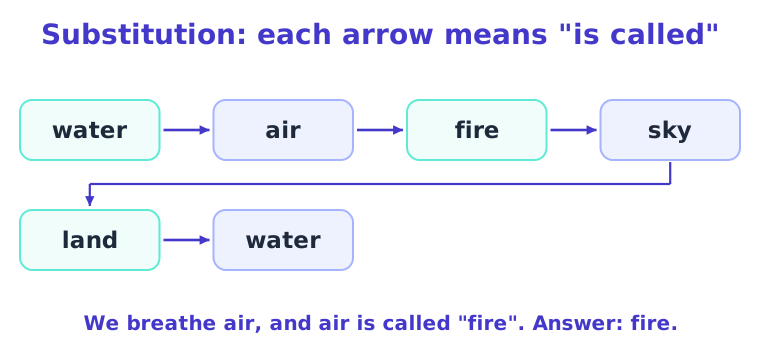
Traps in substitution
- Giving the real answer (air) instead of its new name.
- Renaming twice (air → fire → sky).
- Renaming the question word instead of the answer.
Exam shortcuts
- Start with the word that appears most often.
- Common words ↔ common codes; leftovers ↔ leftovers.
- Two words always together → cannot be determined.
- Substitution: real answer first, then rename once.
Back to Meera
Meera starts with "is", the word in every statement, then works outward. In four of the five questions she finds a code; in the fifth, two words always sit together, and she confidently marks "cannot be determined". Five marks, under two minutes.
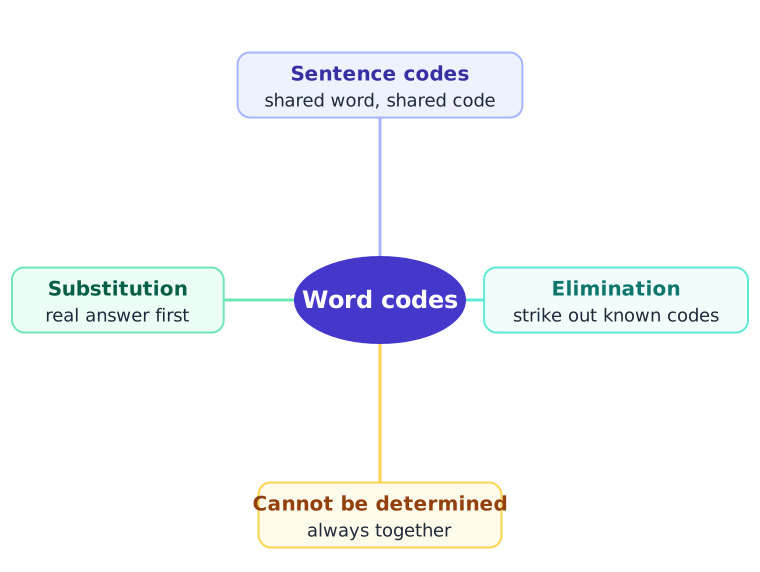
Concepts and terms
If "tea" is in statements 1 and 3, its code is in both code lines; the one code they share is its code.
After some codes are fixed, the codes left in a statement belong to its remaining words.
When two words are always together, the data never separates their codes.
Things are renamed in a chain; the answer is the new name of the real answer.
Did you know
Language learners use the same trick: comparing sentences that share a word to guess its meaning.
Bank PO exams often give four coded sentences and five questions on them as one set.
Memory tricks
Sentence codes — Common ↔ common — Common words match common codes; leftovers match leftovers.
Substitution — Real first, rename second — Never rename the question; rename only the answer.
Practice MCQs with answers (65)
- A xi
- B ta
- C ge
- D ti
Show answer
Why:
"sweet" appears only in statement 3; striking out the codes found in other statements and the codes already fixed leaves "ta".
- A hot
- B is
- C tea
- D sweet
Show answer
Why:
"tea" is in statements 1 and 3, whose only common code left is "xi".
- A ma
- B ti
- C xi
- D Cannot be determined
Show answer
Why:
"hot" and "is" always appear together, so their codes "ma", "ti" can be matched either way. The code for "hot" cannot be determined.
- A bu
- B zo
- C ja
- D pa
Show answer
Why:
"deep" appears only in statement 3; striking out the codes found in other statements and the codes already fixed leaves "bu".
- A is
- B sky
- C deep
- D blue
Show answer
Why:
"sky" appears only in statement 1; striking out the codes found in other statements and the codes already fixed leaves "pa".
- A ja zo
- B pa ja
- C ta zo
- D ta pa
Show answer
Why:
"is" is in statements 1, 2 and 3, whose only common code left is "zo"; "blue" is in statements 1 and 2, whose only common code left is "ta". So the code is "ta zo".
- A ye
- B xi
- C lu
- D qi
Show answer
Why:
"bread" appears only in statement 1; striking out the codes found in other statements and the codes already fixed leaves "qi".
- A milk
- B honey
- C and
- D butter
Show answer
Why:
"milk" is in statements 2 and 3, whose only common code left is "lu".
- A qi xi
- B na ye
- C na qi
- D xi ye
Show answer
Why:
"and" is in statements 1, 2 and 3, whose only common code left is "ye"; "honey" appears only in statement 3; striking out the codes found in other statements and the codes already fixed leaves "na". So the code is "na ye".
- A ho
- B ja
- C ve
- D ge
Show answer
Why:
"big" is in statements 1 and 3, whose only common code left is "ve".
- A kite
- B ball
- C big
- D blue
Show answer
Why:
"blue" appears only in statement 3; striking out the codes found in other statements and the codes already fixed leaves "ye".
- A ge ho
- B ge ve
- C ja ho
- D ve ja
Show answer
Why:
"ball" appears only in statement 1; striking out the codes found in other statements and the codes already fixed leaves "ge"; "kite" is in statements 2 and 3, whose only common code left is "ho". So the code is "ge ho".
- A xi
- B ja
- C ma
- D ye
Show answer
Why:
"sour" is in statements 2 and 3, whose only common code left is "ja".
- A is
- B sour
- C mango
- D sweet
Show answer
Why:
"mango" is in statements 1 and 3, whose only common code left is "xi".
- A xi ne
- B ye xi
- C ne ma
- D ye ma
Show answer
Why:
"is" is in statements 1 and 2, whose only common code left is "ma"; "lemon" appears only in statement 2; striking out the codes found in other statements and the codes already fixed leaves "ye". So the code is "ye ma".
- A xi
- B ve
- C bu
- D ja
Show answer
Why:
"big" is in statements 1 and 3, whose only common code left is "xi".
- A house
- B my
- C big
- D clean
Show answer
Why:
"my" is in statements 1 and 2, whose only common code left is "ve".
- A ve ja
- B bu ve
- C bu se
- D ja se
Show answer
Why:
"house" appears only in statement 1; striking out the codes found in other statements and the codes already fixed leaves "bu"; "clean" appears only in statement 2; striking out the codes found in other statements and the codes already fixed leaves "se". So the code is "bu se".
- A ge
- B pa
- C lu
- D zo
Show answer
Why:
"grass" appears only in statement 3; striking out the codes found in other statements and the codes already fixed leaves "zo".
- A leaves
- B fresh
- C brown
- D dry
Show answer
Why:
"leaves" is in statements 1 and 2, whose only common code left is "lu".
- A pa
- B Cannot be determined
- C lu
- D ge
Show answer
Why:
"fresh" and "green" always appear together, so their codes "ge", "pa" can be matched either way. The code for "fresh" cannot be determined.
- A se
- B pa
- C ye
- D ri
Show answer
Why:
"cat" appears only in statement 1; striking out the codes found in other statements and the codes already fixed leaves "ye".
- A horse
- B red
- C flower
- D beautiful
Show answer
Why:
"beautiful" is in statements 3 and 4, whose only common code left is "se".
- A Cannot be determined
- B pa
- C lu
- D ti
Show answer
Why:
"red" and "flower" always appear together, so their codes "lu", "ti" can be matched either way. The code for "red" cannot be determined.
- A ta
- B ho
- C qi
- D do
Show answer
Why:
"two" is in statements 1 and 2, whose only common code left is "ho".
- A six
- B four
- C nine
- D one
Show answer
Why:
"nine" appears only in statement 3; striking out the codes found in other statements and the codes already fixed leaves "pa".
- A ho do
- B ma ho
- C do qi
- D ma qi
Show answer
Why:
"one" is in statements 1 and 3, whose only common code left is "qi"; "six" is in statements 2 and 3, whose only common code left is "ma". So the code is "ma qi".
- A ve
- B ta
- C ri
- D ka
Show answer
Why:
"green" is in statements 1 and 3, whose only common code left is "ve".
- A saffron
- B white
- C blue
- D green
Show answer
Why:
"white" is in statements 1 and 2, whose only common code left is "ka".
- A ta ka
- B ve ri
- C ta ri
- D ka ve
Show answer
Why:
"saffron" appears only in statement 1; striking out the codes found in other statements and the codes already fixed leaves "ri"; "blue" is in statements 2 and 3, whose only common code left is "ta". So the code is "ta ri".
- A ja
- B ti
- C lu
- D ye
Show answer
Why:
"Tuesday" appears only in statement 1; striking out the codes found in other statements and the codes already fixed leaves "ye".
- A Friday
- B Thursday
- C Monday
- D Saturday
Show answer
Why:
"Friday" is in statements 2 and 3, whose only common code left is "ta".
- A xi
- B ri
- C ge
- D fi
Show answer
Why:
"guava" appears only in statement 3; striking out the codes found in other statements and the codes already fixed leaves "ri".
- A banana
- B mango
- C apple
- D grapes
Show answer
Why:
"apple" appears only in statement 1; striking out the codes found in other statements and the codes already fixed leaves "ge".
- A ka
- B ge
- C fi
- D Cannot be determined
Show answer
Why:
"banana" and "mango" always appear together, so their codes "fi", "ka" can be matched either way. The code for "banana" cannot be determined.
- A do
- B na
- C bu
- D ri
Show answer
Why:
"clean" is in statements 1, 2 and 4, whose only common code left is "do".
- A room
- B house
- C big
- D clean
Show answer
Why:
"house" appears only in statement 4; striking out the codes found in other statements and the codes already fixed leaves "zo".
- A water
- B air
- C fire
- D sky
Show answer
Why:
The real answer is "air", and "air" is called "fire". So the answer is "fire".
- A blue
- B yellow
- C red
- D green
Show answer
Why:
The real answer is "blue", and "blue" is called "green". So the answer is "green".
- A yellow
- B blue
- C green
- D white
Show answer
Why:
The real answer is "green", and "green" is called "yellow". So the answer is "yellow".
- A book
- B bag
- C eraser
- D pen
Show answer
Why:
The real answer is "book", and "book" is called "bag". So the answer is "bag".
- A moon
- B sky
- C sun
- D cloud
Show answer
Why:
The real answer is "cloud", and "cloud" is called "sun". So the answer is "sun".
- A sky
- B sun
- C moon
- D star
Show answer
Why:
The real answer is "moon", and "moon" is called "star". So the answer is "star".
- A ear
- B nose
- C hand
- D eye
Show answer
Why:
The real answer is "eye", and "eye" is called "ear". So the answer is "ear".
- A nose
- B mouth
- C hand
- D ear
Show answer
Why:
The real answer is "nose", and "nose" is called "mouth". So the answer is "mouth".
- A lion
- B cat
- C dog
- D horse
Show answer
Why:
The real answer is "lion", and "lion" is called "dog". So the answer is "dog".
- A ear
- B mouth
- C eye
- D nose
Show answer
Why:
The real answer is "ear", and "ear" is called "nose". So the answer is "nose".
- A land
- B fire
- C sky
- D water
Show answer
Why:
The real answer is "sky", and "sky" is called "land". So the answer is "land".
- A Both A and R are true, and R is the correct explanation of A
- B Both A and R are true, but R is not the correct explanation of A
- C A is true but R is false
- D A is false but R is true
Show answer
Why:
Both appear only in statements 1 and 2, so their two codes can be swapped without breaking any statement. R explains A.
- A Both A and R are true, and R is the correct explanation of A
- B Both A and R are true, but R is not the correct explanation of A
- C A is true but R is false
- D A is false but R is true
Show answer
Why:
A is false: the codes are jumbled, so position tells nothing. R is true: one word, one code.
- A 1 only
- B 2 only
- C Both 1 and 2
- D Neither 1 nor 2
Show answer
Why:
We drink water, which is called air: true. Birds fly in the sky, which is called land, so 2 is false.
- A 1 only
- B 2 only
- C Both 1 and 2
- D Neither 1 nor 2
Show answer
Why:
1 is the basic rule. 2 is false: a single word gets the leftover code once its partners are fixed.
- A Pick the last word of the chain
- B Find the real answer to the question
- C Pick the first word of the chain
- D Rename the question words
Show answer
Why:
Answer the real question first, then replace that answer by its new name.
- A At the same place in code line 1
- B Only in code line 1
- C In both code lines 1 and 3, and in neither of the others
- D In every code line
Show answer
Why:
One word has one code, so the code shows up exactly where the word does.
- A ge
- B lu
- C ve
- D ja
Show answer
Why:
"red" is in statements 1 and 2, whose only common code left is "ja".
- A qi
- B ma
- C ho
- D do
Show answer
Why:
"one" is in statements 1 and 3, whose only common code left is "qi".
- A ka
- B xi
- C ri
- D fi
Show answer
Why:
"grapes" is in statements 2 and 3, whose only common code left is "xi".
- A bu
- B ja
- C ri
- D ti
Show answer
Why:
"very" appears only in statement 3; striking out the codes found in other statements and the codes already fixed leaves "ri".
- A near
- B is
- C market
- D far
Show answer
Why:
"far" appears only in statement 2; striking out the codes found in other statements and the codes already fixed leaves "ne".
- A ja ti
- B ge bu
- C ja ge
- D bu ti
Show answer
Why:
"near" is in statements 1 and 3, whose only common code left is "ja"; "market" is in statements 2 and 3, whose only common code left is "ti". So the code is "ja ti".
- A xi
- B mo
- C zo
- D ve
Show answer
Why:
"lily" appears only in statement 1; striking out the codes found in other statements and the codes already fixed leaves "mo".
- A jasmine
- B rose
- C marigold
- D lily
Show answer
Why:
"marigold" appears only in statement 3; striking out the codes found in other statements and the codes already fixed leaves "ma".
- A xi ve
- B mo zo
- C ve mo
- D xi zo
Show answer
Why:
"lotus" is in statements 1 and 2, whose only common code left is "xi"; "jasmine" is in statements 2 and 3, whose only common code left is "zo". So the code is "xi zo".
- A ship
- B train
- C aeroplane
- D bus
Show answer
Why:
The real answer is "train", and "train" is called "ship". So the answer is "ship".
- A door
- B window
- C chair
- D bed
Show answer
Why:
The real answer is "door", and "door" is called "window". So the answer is "window".
Important short questions (3)
Once the codes of the other words in that statement are fixed, the one code left over must belong to it.
When two words always appear together, so no statement separates their codes.
We eat with the mouth, and mouth is called hand. Answer: hand.
Long answer questions (1)
two is in 1 and 2: common code b. six is in 2 and 3: common code e. one is in 1 and 3: common code a.
Then three = c (left in line 1), four = d (left in line 2), nine = f (left in line 3).
Flashcards (12)
Play this topic
- Code sense
Number and Symbol Codes
Turn words into numbers by letter positions, read jumbled letter-digit codes, apply Bank-style conditional codes for numbers, and evaluate expressions after swapping signs.
What you will be able to do
- I can code a word as a number using position sums or position strings.
- I can decode jumbled letter-digit codes by comparing words.
- I can apply conditional coding rules to a number.
- I can swap mathematical signs and evaluate with BODMAS.
Key points
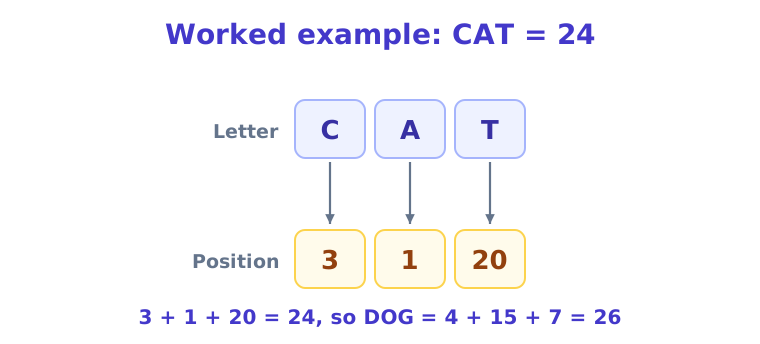
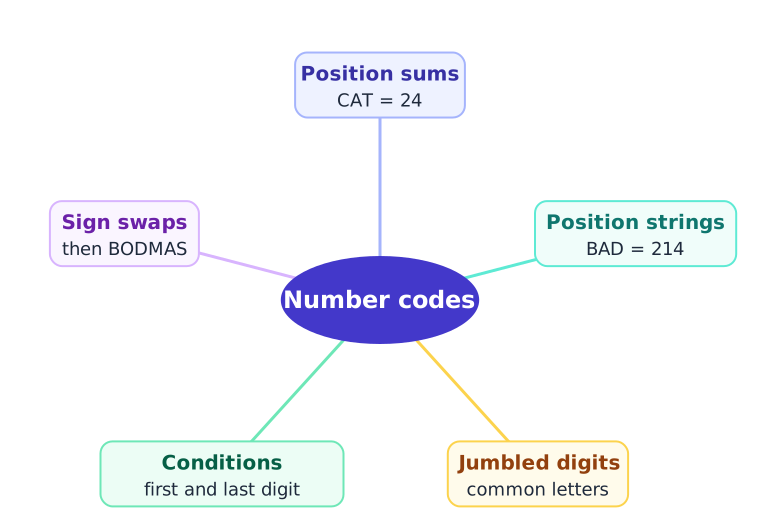
Position sum: CAT = 3 + 1 + 20 = 24. Always test the example with the sum first.
If the code is longer than the word, positions are written side by side: BAD = 2 1 4 = 214.
A code from Z (reverse positions) uses 27 − position.
Jumbled digit codes work like sentence codes: common letters ↔ common digits.
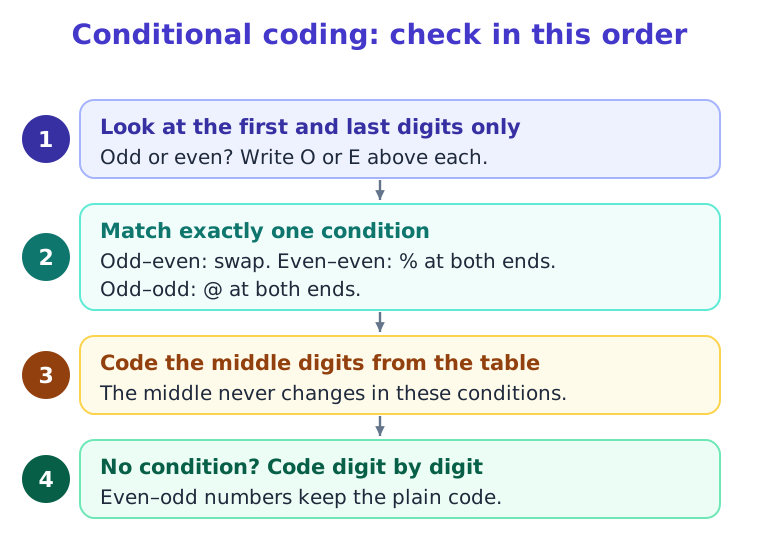
In conditional codes, check only the condition parts (usually first and last digits) and apply exactly one condition.
If no condition applies, code each digit straight from the table.
For sign swaps, rewrite the whole expression first, then use BODMAS.
Full explanation
Kavita's banking exam
Kavita has 20 minutes for 35 reasoning questions in IBPS Clerk prelims. A set of five questions begins with a table: "Digits are coded as letters as follows …" and three conditions. She knows that if she reads the conditions carefully once, all five answers will follow.
Words into numbers
The simplest number code adds the positions: $\text{CAT} = 3 + 1 + 20 = 24$. If the example fits the plain sum, the rule is usually that; if not, try sum + number of letters, sum of reverse positions, or double the sum.
Position strings
If the code has more digits than the word has letters, the positions are written side by side: $\text{BAD} \to 2,1,4$. Then $\text{FACE} \to 6,1,3,5 = 6135$. Watch for codes written from Z ($27 - p$) or written backwards.
Jumbled letter-digit codes
Sometimes each word is given with its digits in a mixed-up order. Treat it exactly like a sentence code: a letter in two words has its digit in both codes; letters that always appear together cannot be separated.
Conditional codes (Bank PO, Clerk)
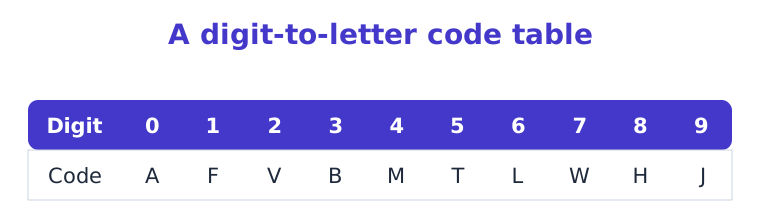
A table gives each digit a letter. Then conditions change the code for some numbers. Here we use three common conditions: (i) first digit odd, last even: swap their codes; (ii) both even: both become %; (iii) both odd: both become @. Exactly one or none applies.
Worked example
Using the table above, code 385246. First digit 3 is odd, last digit 6 is even, so condition (i) applies. Plain code: BHTVML. Swap the first and last letters: LHTVMB.
Sign swaps
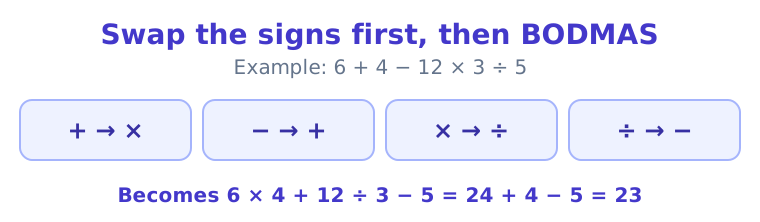
"If + means ×, − means +, × means ÷ and ÷ means −, find 6 + 4 − 12 × 3 ÷ 5." First rewrite every sign: $6 \times 4 + 12 \div 3 - 5$. Then BODMAS: $24 + 4 - 5 = 23$. Working left to right, or before swapping, gives a wrong option that the setter has placed on purpose.
Exam shortcuts
- Number = sum of positions? Test that first.
- Long code? Positions side by side.
- Jumbled digits: common letters ↔ common digits.
- Conditions: look at the ends only; apply one.
- Sign swaps: rewrite all signs, then BODMAS.
Back to Kavita
Kavita marks O or E over the first and last digit of each number, picks the one condition that fits, and copies the middle from the table. Five questions, under three minutes, no slips.
Concepts and terms
A word is coded as the sum of its letter positions, sometimes changed by a fixed step.
A table gives a code for each digit; extra conditions change some codes depending on the digits.
Symbols stand for other operations; replace them, then calculate in the usual order.
Did you know
Computers store every letter as a number: in the ASCII table, capital A is 65 and Z is 90.
Memory tricks
Order of work — Swap, then BODMAS — Never calculate before every sign has been replaced.
Conditions — Ends decide — Most Bank conditions look only at the first and last digits.
Practice MCQs with answers (65)
- A 43
- B 48
- C 87
- D 53
Show answer
Why:
Rule: add the positions of the letters. Check: CLOUD: 3 + 12 + 15 + 21 + 4 = 55. For JUICE: 10 + 21 + 9 + 3 + 5 = 48. So JUICE = 48.
- A 43
- B 37
- C 40
- D 41
Show answer
Why:
Rule: add the positions of the letters. Check: HEN: 8 + 5 + 14 = 27. For CUP: 3 + 21 + 16 = 40. So CUP = 40.
- A 112
- B 56
- C 52
- D 60
Show answer
Why:
Rule: add the positions, then add the number of letters. Check: COAL: 3 + 15 + 1 + 12 = 31; 31 + 4 = 35. For IRON: 9 + 18 + 15 + 14 = 56; 56 + 4 = 60. So IRON = 60.
- A 81
- B 54
- C 59
- D 49
Show answer
Why:
Rule: add the positions counted from Z. Check: BIRD: 25 + 18 + 9 + 23 = 75. For PLATE: 11 + 15 + 26 + 7 + 22 = 81. So PLATE = 81.
- A 28
- B 48
- C 24
- D 84
Show answer
Why:
Rule: double the sum of the positions. Check: PEN: 16 + 5 + 14 = 35; 2 × 35 = 70. For LEAF: 12 + 5 + 1 + 6 = 24; 2 × 24 = 48. So LEAF = 48.
- A 38
- B 35
- C 32
- D 46
Show answer
Why:
Rule: add the positions, then subtract the number of letters. Check: RICE: 18 + 9 + 3 + 5 = 35; 35 − 4 = 31. For ANT: 1 + 14 + 20 = 35; 35 − 3 = 32. So ANT = 32.
- A 33
- B 75
- C 37
- D 132
Show answer
Why:
Rule: multiply the sum of the positions by the number of letters. Check: TEA: 20 + 5 + 1 = 26; 26 × 3 = 78. For SEED: 19 + 5 + 5 + 4 = 33; 33 × 4 = 132. So SEED = 132.
- A 42
- B 46
- C 38
- D 66
Show answer
Why:
Rule: add the positions of the letters. Check: CAT: 3 + 1 + 20 = 24. For FISH: 6 + 9 + 19 + 8 = 42. So FISH = 42.
- A 73
- B 62
- C 78
- D 68
Show answer
Why:
Rule: add the positions counted from Z. Check: ROOT: 9 + 12 + 12 + 7 = 40. For SOUND: 8 + 12 + 6 + 13 + 23 = 62. So SOUND = 62.
- A 73
- B 39
- C 36
- D 35
Show answer
Why:
Rule: add the positions, then add 1. Check: SNOW: 19 + 14 + 15 + 23 = 71; 71 + 1 = 72. For RICE: 18 + 9 + 3 + 5 = 35; 35 + 1 = 36. So RICE = 36.
- A 775
- B 222020
- C 688
- D 577
Show answer
Why:
Rule: write the position of each letter in turn. Check: MUSIC → 13211993. For EGG: E = 5, G = 7, G = 7, giving 577.
- A 31523
- B 24124
- C 41624
- D 23153
Show answer
Why:
Rule: write the position of each letter in turn. Check: SOUND → 191521144. For COW: C = 3, O = 15, W = 23, giving 31523.
- A 1297820
- B 151820197
- C 13108921
- D 2087912
Show answer
Why:
Rule: write the position from Z of each letter in turn. Check: WIND → 4181323. For LIGHT (from Z): L = 15, I = 18, G = 20, H = 19, T = 7, giving 151820197.
- A 23151512
- B 4121215
- C 24161613
- D 12151523
Show answer
Why:
Rule: write each letter's position plus 1. Check: ANT → 21521. For WOOL (+1): W = 24, O = 16, O = 16, L = 13, giving 24161613.
- A 2123136
- B 2012125
- C 726251522
- D 5122120
Show answer
Why:
Rule: write the positions from the last letter to the first. Check: PLATE → 52011216. For TABLE: E = 5, L = 12, B = 2, A = 1, T = 20, giving 5122120.
- A 2191220
- B 719168
- C 715186
- D 618157
Show answer
Why:
Rule: write the position from Z of each letter in turn. Check: SAND → 8261323. For FROG (from Z): F = 21, R = 9, O = 12, G = 20, giving 2191220.
- A 14161615
- B 13151514
- C 14151513
- D 14121213
Show answer
Why:
Rule: write the position of each letter in turn. Check: TRAIN → 20181914. For MOON: M = 13, O = 15, O = 15, N = 14, giving 13151514.
- A 9
- B 0
- C 7
- D 6
Show answer
Why:
A is only in IOUA; striking out the digits found in other words and the digits already fixed leaves 7.
- A U
- B O
- C A
- D M
Show answer
Why:
M is only in IMUO; striking out the digits found in other words and the digits already fixed leaves 9.
- A Cannot be determined
- B 3
- C 8
- D 9
Show answer
Why:
N appears in exactly the same words as G (IGNO), so their digits 3, 8 can be matched either way. The code for N cannot be determined.
- A 8
- B 2
- C 3
- D 6
Show answer
Why:
U is only in UTMO; striking out the digits found in other words and the digits already fixed leaves 2.
- A T
- B I
- C O
- D M
Show answer
Why:
O is in ROMT, UTMO and IERO, whose only common digit left is 5.
- A 6
- B 8
- C 3
- D Cannot be determined
Show answer
Why:
M appears in exactly the same words as T (ROMT, UTMO), so their digits 6, 8 can be matched either way. The code for M cannot be determined.
- A 5
- B 3
- C 0
- D 4
Show answer
Why:
U is only in IUAE; striking out the digits found in other words and the digits already fixed leaves 5.
- A I
- B N
- C U
- D G
Show answer
Why:
N is only in ENBG; striking out the digits found in other words and the digits already fixed leaves 0.
- A 4
- B 5
- C Cannot be determined
- D 2
Show answer
Why:
G appears in exactly the same words as B (BIGA, ENBG), so their digits 2, 4 can be matched either way. The code for G cannot be determined.
- A DTMEWF
- B %TMEW%
- C @TMEW@
- D FTMEWD
Show answer
Why:
First digit 3 is odd and last digit 6 is even, so condition (i) applies. Plain code DTMEWF becomes FTMEWD.
- A %EWMH%
- B TEWMHF
- C @EWMH@
- D FEWMHT
Show answer
Why:
First digit 6 is even and last digit 8 is even, so condition (ii) applies. Plain code FEWMHT becomes %EWMH%.
- A MDLEHV
- B @DLEH@
- C %DLEH%
- D VDLEHM
Show answer
Why:
First digit 9 is odd and last digit 5 is odd, so condition (iii) applies. Plain code VDLEHM becomes @DLEH@.
- A %LETD%
- B @LETD@
- C WLETDV
- D VLETDW
Show answer
Why:
First digit 4 is even and last digit 9 is odd: no condition applies, so code digit by digit: WLETDV.
- A %BMAT%
- B @BMAT@
- C DBMATF
- D FBMATD
Show answer
Why:
First digit 7 is odd and last digit 4 is even, so condition (i) applies. Plain code DBMATF becomes FBMATD.
- A %HRDF%
- B MHRDFA
- C @HRDF@
- D AHRDFM
Show answer
Why:
First digit 2 is even and last digit 6 is even, so condition (ii) applies. Plain code AHRDFM becomes %HRDF%.
- A RBTFDE
- B @BTFD@
- C %BTFD%
- D EBTFDR
Show answer
Why:
First digit 5 is odd and last digit 3 is odd, so condition (iii) applies. Plain code EBTFDR becomes @BTFD@.
- A BEAHDM
- B %EAHD%
- C MEAHDB
- D @EAHD@
Show answer
Why:
First digit 6 is even and last digit 1 is odd: no condition applies, so code digit by digit: MEAHDB.
- A %AKBD%
- B EAKBDF
- C FAKBDE
- D @AKBD@
Show answer
Why:
First digit 9 is odd and last digit 1 is odd, so condition (iii) applies. Plain code EAKBDF becomes @AKBD@.
- A VPRDHF
- B %PRDH%
- C @PRDH@
- D FPRDHV
Show answer
Why:
First digit 1 is odd and last digit 8 is even, so condition (i) applies. Plain code FPRDHV becomes VPRDHF.
- A @KBRF@
- B %KBRF%
- C VKBRFA
- D AKBRFV
Show answer
Why:
First digit 8 is even and last digit 0 is even, so condition (ii) applies. Plain code VKBRFA becomes %KBRF%.
- A DHPEFD
- B %HPEF%
- C @HPEF@
- D DFEPHD
Show answer
Why:
First digit 3 is odd and last digit 3 is odd, so condition (iii) applies. Plain code DHPEFD becomes @HPEF@.
- A 129
- B 125
- C 137
- D 127
Show answer
Why:
Replace the signs: 9 − 21 + 6 × 24 − 5. By BODMAS, × and ÷ come first. First 6 × 24 = 144; then 9 − 21 + 144 − 5 = 127.
- A 61
- B 59
- C 1206
- D 63
Show answer
Why:
Replace the signs: 9 × 24 + 13 − 28 × 6. By BODMAS, × and ÷ come first. First 9 × 24 = 216, 28 × 6 = 168; then 216 + 13 − 168 = 61.
- A 160
- B 158
- C 156
- D 536
Show answer
Why:
Replace the signs: 3 × 9 + 10 × 15 − 19. By BODMAS, × and ÷ come first. First 3 × 9 = 27, 10 × 15 = 150; then 27 + 150 − 19 = 158.
- A 59
- B 55
- C 57
- D 177
Show answer
Why:
Replace the signs: 14 + 6 + 9 × 7 − 26. By BODMAS, × and ÷ come first. First 9 × 7 = 63; then 14 + 6 + 63 − 26 = 57.
- A 107
- B 103
- C 197
- D 105
Show answer
Why:
Replace the signs: 5 + 18 + 21 × 5 − 23. By BODMAS, × and ÷ come first. First 21 × 5 = 105; then 5 + 18 + 105 − 23 = 105.
- A 102
- B 214
- C 104
- D 100
Show answer
Why:
Replace the signs: 16 + 11 × 8 + 19 − 21. By BODMAS, × and ÷ come first. First 11 × 8 = 88; then 16 + 88 + 19 − 21 = 102.
- A 110
- B 112
- C 462
- D 114
Show answer
Why:
Replace the signs: 28 + 18 − 11 + 7 × 11. By BODMAS, × and ÷ come first. First 7 × 11 = 77; then 28 + 18 − 11 + 77 = 112.
- A 26
- B 38
- C 28
- D 30
Show answer
Why:
Replace the signs: 7 × 7 − 13 + 9 − 17. By BODMAS, × and ÷ come first. First 7 × 7 = 49; then 49 − 13 + 9 − 17 = 28.
- A 96
- B 92
- C 104
- D 94
Show answer
Why:
Replace the signs: 4 − 4 + 13 × 7 + 3. By BODMAS, × and ÷ come first. First 13 × 7 = 91; then 4 − 4 + 91 + 3 = 94.
- A 137
- B 135
- C 269
- D 139
Show answer
Why:
Replace the signs: 12 × 11 + 10 × 2 − 15. By BODMAS, × and ÷ come first. First 12 × 11 = 132, 10 × 2 = 20; then 132 + 20 − 15 = 137.
- A 21
- B 24
- C 57
- D 27
Show answer
Why:
Rule: add the positions of the letters. Check: SHIP: 19 + 8 + 9 + 16 = 52. For CAT: 3 + 1 + 20 = 24. So CAT = 24.
- A 70
- B 34
- C 42
- D 38
Show answer
Why:
Rule: add the positions, then add the number of letters. Check: RIVER: 18 + 9 + 22 + 5 + 18 = 72; 72 + 5 = 77. For GOLD: 7 + 15 + 12 + 4 = 38; 38 + 4 = 42. So GOLD = 42.
- A 93
- B 88
- C 47
- D 176
Show answer
Why:
Rule: double the sum of the positions. Check: SALT: 19 + 1 + 12 + 20 = 52; 2 × 52 = 104. For SPORT: 19 + 16 + 15 + 18 + 20 = 88; 2 × 88 = 176. So SPORT = 176.
- A 45
- B 85
- C 55
- D 50
Show answer
Why:
Rule: add the positions, then subtract the number of letters. Check: BREAD: 2 + 18 + 5 + 1 + 4 = 30; 30 − 5 = 25. For MANGO: 13 + 1 + 14 + 7 + 15 = 50; 50 − 5 = 45. So MANGO = 45.
- A 1115152
- B 3161612
- C 2151511
- D 25121216
Show answer
Why:
Rule: write each letter's position plus 1. Check: WATCH → 2422149. For BOOK (+1): B = 3, O = 16, O = 16, K = 12, giving 3161612.
- A 91411
- B 181316
- C 11149
- D 101512
Show answer
Why:
Rule: write the positions from the last letter to the first. Check: MILK → 1112913. For INK: K = 11, N = 14, I = 9, giving 11149.
- A 109
- B 101
- C 97
- D 99
Show answer
Why:
Replace the signs: 15 × 5 + 11 × 24 ÷ 11. By BODMAS, × and ÷ come first. First 15 × 5 = 75, 11 × 24 ÷ 11 = 24; then 75 + 24 = 99.
- A 157
- B 282
- C 159
- D 155
Show answer
Why:
Replace the signs: 25 + 27 × 6 − 15 − 15. By BODMAS, × and ÷ come first. First 27 × 6 = 162; then 25 + 162 − 15 − 15 = 157.
- A ERMVWB
- B BRMVWE
- C %RMVW%
- D @RMVW@
Show answer
Why:
First digit 7 is odd and last digit 4 is even, so condition (i) applies. Plain code ERMVWB becomes BRMVWE.
- A %MLRD%
- B @MLRD@
- C BMLRDE
- D EMLRDB
Show answer
Why:
First digit 4 is even and last digit 7 is odd: no condition applies, so code digit by digit: BMLRDE.
- A @EHJT@
- B REHJTK
- C %EHJT%
- D KEHJTR
Show answer
Why:
First digit 2 is even and last digit 5 is odd: no condition applies, so code digit by digit: KEHJTR.
- A %HBWJ%
- B KHBWJT
- C @HBWJ@
- D THBWJK
Show answer
Why:
First digit 8 is even and last digit 2 is even, so condition (ii) applies. Plain code THBWJK becomes %HBWJ%.
- A Both A and R are true, and R is the correct explanation of A
- B Both A and R are true, but R is not the correct explanation of A
- C A is true but R is false
- D A is false but R is true
Show answer
Why:
A = 27 − 1 = 26 and B = 27 − 2 = 25; 26 + 25 = 51. R gives the method.
- A Both A and R are true, and R is the correct explanation of A
- B Both A and R are true, but R is not the correct explanation of A
- C A is true but R is false
- D A is false but R is true
Show answer
Why:
8 + 2 × 3 = 8 + 6 = 14 by BODMAS, so A is true. R is false: left to right would give 30.
- A 1 only
- B 2 only
- C Both 1 and 2
- D Neither 1 nor 2
Show answer
Why:
482: both ends even, so % at both ends. 285: first even, last odd: no condition, so nothing is interchanged.
- A 1 only
- B 2 only
- C Both 1 and 2
- D Neither 1 nor 2
Show answer
Why:
A sum does not depend on order, so ACT = 24. A string does: DAB = 412.
- A Always exactly two
- B At most one
- C Always all three
- D All that seem close
Show answer
Why:
The conditions cover different first/last digit cases, so a number fits one condition or none.
Important short questions (3)
CAT = 3 + 1 + 20 = 24 is the position sum. BOOK = 2 + 15 + 15 + 11 = 43.
Rewrite: 5 × 4 − 12 ÷ 3 + 2 = 20 − 4 + 2 = 18.
Its first digit (2) is even and last digit (5) is odd. None of odd–even, even–even or odd–odd fits, so no condition applies.
Long answer questions (1)
385246: odd–even, condition (i): LHTVMB.
624518: even–even, condition (ii): %VMTF%.
472839: even–odd, no condition: MWVHBJ.
Flashcards (12)
Play this topic
- Number code check
Veda Skills Logical Reasoning Unit 5 — frequently asked questions
Every letter moves one place forward (M→N, O→P, …). FATHER → GBUIFS.
Move each letter 3 places back: J→G, R→O, R→O, G→D, so the word is GOOD.
Add the positions of each letter and its code letter. If every pair makes 27 (like G + T), it is an opposite code.
Once the codes of the other words in that statement are fixed, the one code left over must belong to it.
When two words always appear together, so no statement separates their codes.
We eat with the mouth, and mouth is called hand. Answer: hand.
CAT = 3 + 1 + 20 = 24 is the position sum. BOOK = 2 + 15 + 15 + 11 = 43.
Rewrite: 5 × 4 − 12 ÷ 3 + 2 = 20 − 4 + 2 = 18.
Its first digit (2) is even and last digit (5) is odd. None of odd–even, even–even or odd–odd fits, so no condition applies.

All Veda Skills Logical Reasoning units
Study this chapter properly, free
Everything above is on this page to read. In the Veda app the same chapter becomes spaced-repetition flashcards, timed tests that mark themselves, Veda Bites you can swipe, and games — with your progress tracked topic by topic.
Get Veda free