Veda Skills Logical Reasoning Unit 12: Statements and Conclusions
- 3 topics
- 140 MCQs
- 9 short answers
- 3 long answers
- 36 flashcards
- 4 games
- ~125 min read
- English
Checked before publishing: 23 automated checks, including a plagiarism check against the textbook's own words. How we check our content
Conclusions and Assumptions
Judge whether a conclusion must follow from a short statement, and whether an assumption is taken for granted by it, using the exam rules: treat the statement as true, add no outside facts, and distrust sweeping words.
What you will be able to do
- I can tell a conclusion (what follows) from an assumption (what is taken for granted).
- I can reject a line that goes beyond the statement or uses sweeping words.
- I can use the negation test to check an assumption.
- I can answer the two-line format: only I, only II, neither, or both.

Key points
Treat the statement as true, even if it sounds odd.
A conclusion must follow from the statement alone, with no outside facts.
An assumption is what the speaker must take for granted for the statement to make sense.
Words like only, all, always, never, best usually make a line too strong.
A line that adds a new fact (a reason, a number, a future event) does not follow.
Simple arithmetic from the given numbers does follow (60 − 42 = 18).
Negation test: if the opposite of an assumption makes the statement pointless, the assumption is implicit.
An advert or a notice always assumes people will read it and want what it offers.
Full explanation
The umbrella notice

The school notice says: "Students should bring an umbrella tomorrow, as rain is expected." Aman says, "So it will pour all day tomorrow!" Priya says, "The school thinks it may rain."
Who reads the notice correctly? Priya does. This topic shows you how to tell what a statement really gives you.
The ground rules
- Treat the statement as true.
- Use only the statement; bring in no outside facts.
- A line passes only if it is certain (for a conclusion) or needed (for an assumption).
- Simple arithmetic on the given numbers is allowed.
Before and after
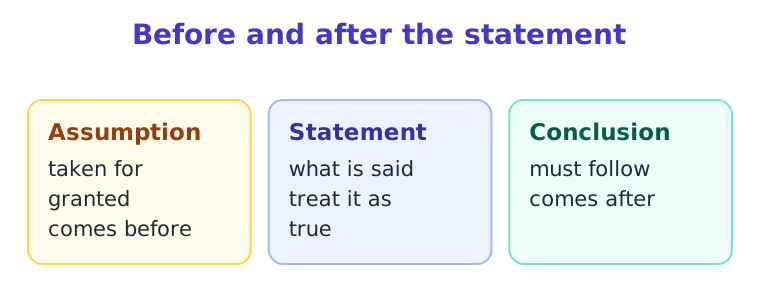
An assumption sits before the statement: the speaker already believes it. A conclusion sits after: it follows once the statement is true.
When does a conclusion follow?
Statement: "Of the 60 students in Class 9, 42 passed the science test."
- "18 did not pass" follows: 60 − 42 = 18.
- "The test was easy" does not follow: nothing is said about the test.
- "Class 9 is the best class" does not follow: no other class is compared.
Red-flag words
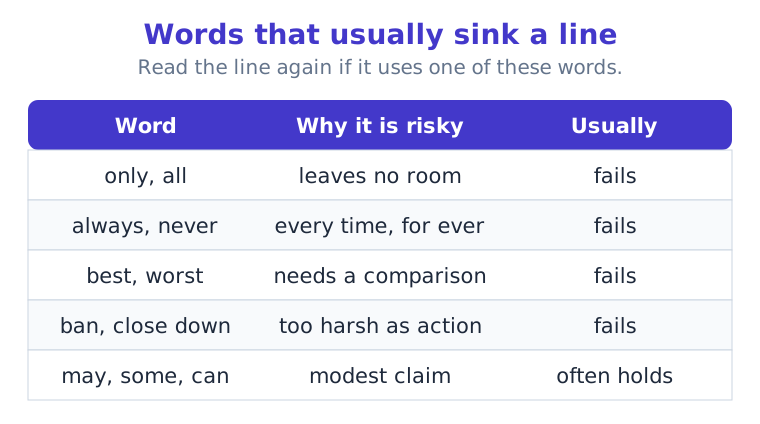
Words such as only, all, always, never, best make a line very strong. The statement rarely supports that much, so such lines usually fail. Modest words (some, may, can) are easier to support.
When is an assumption implicit?
Advert: "Use Kiran toothpaste for strong and healthy teeth."
- "People want strong teeth" is implicit: the advert speaks to that wish.
- "No other toothpaste works" is not implicit: the advert need not believe that.
The negation test
Turn the assumption around. "People do not want strong teeth": now the advert is pointless, so the original assumption was implicit. "Other toothpastes do work": the advert still makes sense, so that assumption was not needed.
The two-line format
Most questions give two lines, I and II. Judge each line on its own, then pick: only I, only II, neither, or both. Do not let one line change your view of the other.
Exam shortcuts
- Underline the key words of the statement first.
- Strike out any line with a new fact or a red-flag word.
- For numbers, do the arithmetic; a line that matches it follows.
- For adverts and notices, "people want this" and "people will read this" are almost always implicit.
Back to the umbrella
The notice assumes it may rain and that an umbrella helps. It does not assume a full day of heavy rain. Aman added a sweeping claim; Priya kept to what the notice needs.
Concepts and terms
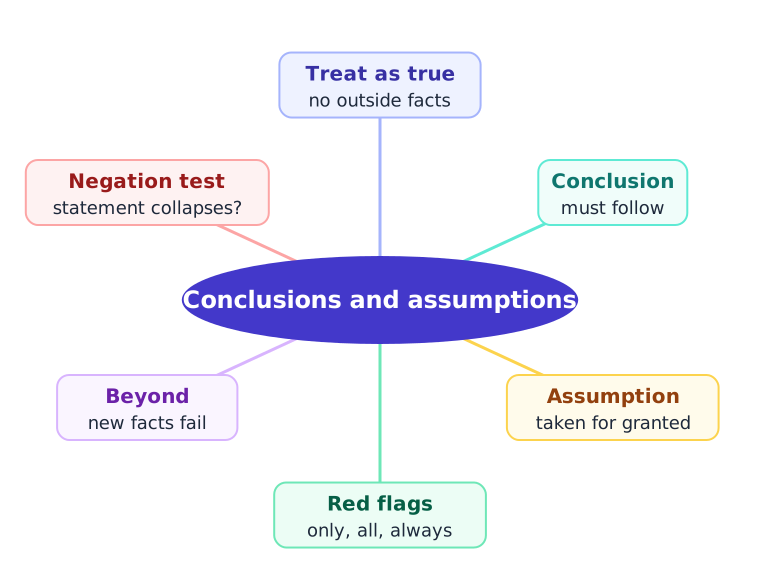
A fact that must be true once the statement is true. It comes after the statement.
A belief the speaker holds before speaking; without it, the statement would make no sense.
Adding a reason, a cause, a number or a forecast the statement never gives.
Turn the assumption into its opposite. If the statement now looks pointless, the assumption was implicit.

Did you know
Bank PO papers often give this section the name "Critical Reasoning".

Memory tricks
Where each one sits — Assumption before, conclusion after — The speaker assumes first, says the statement, and the conclusion follows from it.
Red-flag words — Only, all, always: alarm bells — Lines with these words are usually too strong.
Practice MCQs with answers (47)
- A Only I follows
- B Only II follows
- C Neither I nor II follows
- D Both I and II follow
Show answer
Why:
I follows: it is implied by the statement. Half of 60 is 30, and 42 is more than 30. II follows: it is implied by the statement. 60 − 42 = 18. So the answer is: Both I and II follow.
- A Only I follows
- B Only II follows
- C Neither I nor II follows
- D Both I and II follow
Show answer
Why:
I does not follow: it goes beyond the statement. No reason for failing is given. II does not follow: it is too sweeping. No other class is compared, so "best" cannot be judged. So the answer is: Neither I nor II follows.
- A Only I is implicit
- B Only II is implicit
- C Neither I nor II is implicit
- D Both I and II are implicit
Show answer
Why:
I is implicit: the statement depends on it. The advert appeals to this wish; without it, the advert makes no sense. II is not implicit: it goes against the statement. If this were so, the advert would be pointless. So the answer is: Only I is implicit.
- A Only I is implicit
- B Only II is implicit
- C Neither I nor II is implicit
- D Both I and II are implicit
Show answer
Why:
I is not implicit: it is too sweeping. The advert praises Kiran; it need not believe all others fail. II is implicit: the statement depends on it. Every advertisement is put out on this belief. So the answer is: Only II is implicit.
- A Only I follows
- B Only II follows
- C Neither I nor II follows
- D Both I and II follow
Show answer
Why:
I does not follow: it goes beyond the statement. Nothing is said about the number of visitors. II follows: it is implied by the statement. It closes at 5 p.m. on weekdays, so it is shut by 6 p.m. So the answer is: Only II follows.
- A Only I follows
- B Only II follows
- C Neither I nor II follows
- D Both I and II follow
Show answer
Why:
I does not follow: it goes against the statement. Friday is a weekday, so it opens at 9 a.m. II does not follow: it goes beyond the statement. The statement covers only weekdays; it says nothing about Sundays. So the answer is: Neither I nor II follows.
- A Only I is implicit
- B Only II is implicit
- C Neither I nor II is implicit
- D Both I and II are implicit
Show answer
Why:
I is implicit: the statement depends on it. The notice is based on this. II is not implicit: it is too sweeping. The notice only expects rain; it need not believe in a heavy, all-day downpour. So the answer is: Only I is implicit.
- A Only I is implicit
- B Only II is implicit
- C Neither I nor II is implicit
- D Both I and II are implicit
Show answer
Why:
I is not implicit: the statement does not depend on it. Nothing in the notice depends on the school's timings. II is not implicit: it goes against the statement. Then the notice would be pointless. So the answer is: Neither I nor II is implicit.
- A Only I follows
- B Only II follows
- C Neither I nor II follows
- D Both I and II follow
Show answer
Why:
I does not follow: it goes beyond the statement. Nothing is said about Ravi's class. II does not follow: it goes against the statement. Ravi is taller than Mohan. So the answer is: Neither I nor II follows.
- A Only I follows
- B Only II follows
- C Neither I nor II follows
- D Both I and II follow
Show answer
Why:
I follows: it is implied by the statement. Both the others are taller than Sunil. II follows: it is implied by the statement. Ravi > Mohan > Sunil. So the answer is: Both I and II follow.
- A Only I is implicit
- B Only II is implicit
- C Neither I nor II is implicit
- D Both I and II are implicit
Show answer
Why:
I is not implicit: it is too sweeping. The request does not depend on this. II is implicit: the statement depends on it. Otherwise there would be no need to update them. So the answer is: Only II is implicit.
- A Only I is implicit
- B Only II is implicit
- C Neither I nor II is implicit
- D Both I and II are implicit
Show answer
Why:
I is implicit: the statement depends on it. The alerts are offered because of this. II is not implicit: the statement does not depend on it. No such step is hinted at. So the answer is: Only I is implicit.
- A Only I follows
- B Only II follows
- C Neither I nor II follows
- D Both I and II follow
Show answer
Why:
I follows: it is implied by the statement. This is the same rule read from the other side. II follows: it is implied by the statement. "Only" shuts out everyone else. So the answer is: Both I and II follow.
- A Only I follows
- B Only II follows
- C Neither I nor II follows
- D Both I and II follow
Show answer
Why:
I does not follow: it goes beyond the statement. The rule is about entering the platform, not about seats. II does not follow: it goes against the statement. That is exactly what the rule forbids. So the answer is: Neither I nor II follows.
- A Only I is implicit
- B Only II is implicit
- C Neither I nor II is implicit
- D Both I and II are implicit
Show answer
Why:
I is implicit: the statement depends on it. The whole plan rests on this. II is not implicit: it goes against the statement. Then there would be nothing to reduce. So the answer is: Only I is implicit.
- A Only I is implicit
- B Only II is implicit
- C Neither I nor II is implicit
- D Both I and II are implicit
Show answer
Why:
I is not implicit: it is too sweeping. The plan aims to reduce pollution, not to end it. II is implicit: the statement depends on it. No one decides to plant trees where they cannot be planted. So the answer is: Only II is implicit.
- A Only I follows
- B Only II follows
- C Neither I nor II follows
- D Both I and II follow
Show answer
Why:
I does not follow: it is too sweeping. One month's rise says nothing certain about every future month. II follows: it is implied by the statement. 60 is twice 30. So the answer is: Only II follows.
- A Only I follows
- B Only II follows
- C Neither I nor II follows
- D Both I and II follow
Show answer
Why:
I does not follow: it goes beyond the statement. Farmers' earnings are not given; the shop price may not reach them. II does not follow: it goes beyond the statement. Only onions are talked about. So the answer is: Neither I nor II follows.
- A Only I is implicit
- B Only II is implicit
- C Neither I nor II is implicit
- D Both I and II are implicit
Show answer
Why:
I is implicit: the statement depends on it. The poster's promise rests on this. II is not implicit: it goes against the statement. It is the opposite of what the poster believes. So the answer is: Only I is implicit.
- A Only I is implicit
- B Only II is implicit
- C Neither I nor II is implicit
- D Both I and II are implicit
Show answer
Why:
I is not implicit: the statement does not depend on it. Timings are not part of the message. II is not implicit: it is too sweeping. The poster need not believe this; "no student" is too strong. So the answer is: Neither I nor II is implicit.
- A Only I follows
- B Only II follows
- C Neither I nor II follows
- D Both I and II follow
Show answer
Why:
I does not follow: it goes beyond the statement. Nothing is said about what happened to the demands. II does not follow: it goes beyond the statement. Only Tuesday is mentioned. So the answer is: Neither I nor II follows.
- A Only I follows
- B Only II follows
- C Neither I nor II follows
- D Both I and II follow
Show answer
Why:
I follows: it says what the statement says. The statement names a strike called by the traders. II follows: it is implied by the statement. All five shops were closed. So the answer is: Both I and II follow.
- A Only I is implicit
- B Only II is implicit
- C Neither I nor II is implicit
- D Both I and II are implicit
Show answer
Why:
I is not implicit: it goes against the statement. Then extra trains would not be needed. II is implicit: the statement depends on it. Extra trains are run only for extra travellers. So the answer is: Only II is implicit.
- A Only I is implicit
- B Only II is implicit
- C Neither I nor II is implicit
- D Both I and II are implicit
Show answer
Why:
I is implicit: the statement depends on it. A plan is made only if it can be carried out. II is not implicit: the statement does not depend on it. The plan does not depend on prices. So the answer is: Only I is implicit.
- A Only I follows
- B Only II follows
- C Neither I nor II follows
- D Both I and II follow
Show answer
Why:
I follows: it is implied by the statement. Three-fourths of 500 is 375, and 380 is more. II follows: it is implied by the statement. 500 − 380 = 120. So the answer is: Both I and II follow.
- A Only I follows
- B Only II follows
- C Neither I nor II follows
- D Both I and II follow
Show answer
Why:
I does not follow: it goes beyond the statement. Nothing is said about cars. II does not follow: it goes beyond the statement. Bus services are not talked about. So the answer is: Neither I nor II follows.
- A Only I is implicit
- B Only II is implicit
- C Neither I nor II is implicit
- D Both I and II are implicit
Show answer
Why:
I is implicit: the statement depends on it. The help is offered because of this. II is not implicit: it goes against the statement. The scheme is meant for girls who go to school. So the answer is: Only I is implicit.
- A Only I is implicit
- B Only II is implicit
- C Neither I nor II is implicit
- D Both I and II are implicit
Show answer
Why:
I is not implicit: it is too sweeping. "Every" is too strong; the scheme needs only that some girls find the trip hard. II is implicit: the statement depends on it. Otherwise bicycles would not be the help chosen. So the answer is: Only II is implicit.
- A The science test was very easy.
- B The 18 students who did not pass had not studied.
- C Class 9 is the best class of the school in science.
- D 18 students of Class 9 did not pass the science test.
Show answer
Why:
"18 students of Class 9 did not pass the science test." follows: it is implied by the statement. 60 − 42 = 18. "The science test was very easy." does not follow: it goes beyond the statement. The pass count says nothing about how easy the test was. "The 18 students who did not pass had not studied." does not follow: it goes beyond the statement. No reason for failing is given. "Class 9 is the best class of the school in science." does not follow: it is too sweeping. No other class is compared, so "best" cannot be judged.
- A On a Monday, the library is closed at 6 p.m.
- B Very few people visit the library after 4 p.m.
- C The library opens at 8 a.m. on Fridays.
- D The library is closed on Sundays.
Show answer
Why:
"On a Monday, the library is closed at 6 p.m." follows: it is implied by the statement. It closes at 5 p.m. on weekdays, so it is shut by 6 p.m. "The library is closed on Sundays." does not follow: it goes beyond the statement. The statement covers only weekdays; it says nothing about Sundays. "Very few people visit the library after 4 p.m." does not follow: it goes beyond the statement. Nothing is said about the number of visitors. "The library opens at 8 a.m. on Fridays." does not follow: it goes against the statement. Friday is a weekday, so it opens at 9 a.m.
- A It will rain heavily all day tomorrow.
- B An umbrella can protect students from the rain.
- C The school will close early tomorrow.
- D Rain does not affect students on their way to school.
Show answer
Why:
"An umbrella can protect students from the rain." is implicit: the statement depends on it. Otherwise there would be no point in asking for one. "It will rain heavily all day tomorrow." is not implicit: it is too sweeping. The notice only expects rain; it need not believe in a heavy, all-day downpour. "The school will close early tomorrow." is not implicit: the statement does not depend on it. Nothing in the notice depends on the school's timings. "Rain does not affect students on their way to school." is not implicit: it goes against the statement. Then the notice would be pointless.
- A Sunil is younger than Mohan.
- B Mohan is the tallest of the three.
- C Ravi is taller than Sunil.
- D Ravi is the tallest boy in his class.
Show answer
Why:
"Ravi is taller than Sunil." follows: it is implied by the statement. Ravi > Mohan > Sunil. "Mohan is the tallest of the three." does not follow: it goes against the statement. Ravi is taller than Mohan. "Ravi is the tallest boy in his class." does not follow: it goes beyond the statement. Nothing is said about Ravi's class. "Sunil is younger than Mohan." does not follow: it goes beyond the statement. Height tells us nothing about age.
- A Every customer has more than one mobile phone.
- B The bank will close accounts whose numbers are not updated.
- C Customers do not use mobile phones.
- D Some mobile numbers in the bank's records may be out of date.
Show answer
Why:
"Some mobile numbers in the bank's records may be out of date." is implicit: the statement depends on it. Otherwise there would be no need to update them. "Every customer has more than one mobile phone." is not implicit: it is too sweeping. The request does not depend on this. "The bank will close accounts whose numbers are not updated." is not implicit: the statement does not depend on it. No such step is hinted at. "Customers do not use mobile phones." is not implicit: it goes against the statement. Then asking for mobile numbers would make no sense.
- A A person without a valid ticket is not allowed on the platform.
- B Most passengers travel without tickets.
- C Everyone with a valid ticket will get a seat on the train.
- D People without tickets may stay on the platform.
Show answer
Why:
"A person without a valid ticket is not allowed on the platform." follows: it is implied by the statement. "Only" shuts out everyone else. "Everyone with a valid ticket will get a seat on the train." does not follow: it goes beyond the statement. The rule is about entering the platform, not about seats. "People without tickets may stay on the platform." does not follow: it goes against the statement. That is exactly what the rule forbids. "Most passengers travel without tickets." does not follow: it goes beyond the statement. Nothing is said about how many people break the rule.
- A The price of potatoes also rose in the city.
- B A kilogram of onions cost ₹30 more at the end of the month than at the start.
- C Onion prices will keep rising every month.
- D Onion farmers earned twice as much this month.
Show answer
Why:
"A kilogram of onions cost ₹30 more at the end of the month than at the start." follows: it is implied by the statement. 60 − 30 = 30. "Onion farmers earned twice as much this month." does not follow: it goes beyond the statement. Farmers' earnings are not given; the shop price may not reach them. "The price of potatoes also rose in the city." does not follow: it goes beyond the statement. Only onions are talked about. "Onion prices will keep rising every month." does not follow: it is too sweeping. One month's rise says nothing certain about every future month.
- A The classes are held only on Sundays.
- B Students who join the classes will score poorly.
- C Coaching can help students score better.
- D No student can score well without coaching.
Show answer
Why:
"Coaching can help students score better." is implicit: the statement depends on it. The poster's promise rests on this. "No student can score well without coaching." is not implicit: it is too sweeping. The poster need not believe this; "no student" is too strong. "The classes are held only on Sundays." is not implicit: the statement does not depend on it. Timings are not part of the message. "Students who join the classes will score poorly." is not implicit: it goes against the statement. It is the opposite of what the poster believes.
- A Traders in this market always go on strike on Tuesdays.
- B The strike lasted for a whole week.
- C The traders' demands were accepted.
- D The traders had called a strike.
Show answer
Why:
"The traders had called a strike." follows: it says what the statement says. The statement names a strike called by the traders. "The strike lasted for a whole week." does not follow: it goes beyond the statement. Only Tuesday is mentioned. "The traders' demands were accepted." does not follow: it goes beyond the statement. Nothing is said about what happened to the demands. "Traders in this market always go on strike on Tuesdays." does not follow: it is too sweeping. One strike does not make "always".
- A 120 of the surveyed families did not own a two-wheeler.
- B The other 120 families owned cars instead.
- C The town has a poor bus service.
- D Every family surveyed owned a two-wheeler.
Show answer
Why:
"120 of the surveyed families did not own a two-wheeler." follows: it is implied by the statement. 500 − 380 = 120. "The town has a poor bus service." does not follow: it goes beyond the statement. Bus services are not talked about. "Every family surveyed owned a two-wheeler." does not follow: it goes against the statement. 120 families did not own one. "The other 120 families owned cars instead." does not follow: it goes beyond the statement. Nothing is said about cars.
- A a line that uses the word "all"
- B true whenever the statement is true
- C likely to be true in real life
- D something the speaker believed before speaking
Show answer
Why:
A conclusion is forced by the statement. Real-life likelihood does not count, and a prior belief is an assumption.
- A any fact that is true in real life
- B a result that follows from the statement
- C something the statement takes for granted
- D something the statement says in words
Show answer
Why:
Assumptions are unsaid beliefs the statement depends on. A result that follows is a conclusion.
- A some
- B may
- C can
- D always
Show answer
Why:
"Always" claims every time; a single statement rarely supports that. The other three are modest words.
- A makes the statement pointless
- B uses the word "not"
- C is longer than the statement
- D is also true
Show answer
Why:
If flipping the assumption leaves the statement without a point, the speaker must have held it.
- A The survey covered 500 families
- B The town has a poor bus service
- C 120 surveyed families do not own one
- D Most surveyed families own one
Show answer
Why:
Bus service is a new idea. The other three come straight from the numbers.
- A Other shops sell rotten fruit
- B Mehta Stores is the only fruit shop in town
- C People want fresh fruit
- D Mehta Stores sells fruit
Show answer
Why:
The advert speaks to the wish for fresh fruit, so it takes that for granted. "Sells fruit" is read off the advert, so it is a conclusion. "Other shops sell rotten fruit" and "the only fruit shop" are too strong.
- A Both A and R are true, and R is the correct explanation of A
- B Both A and R are true, but R is not the correct explanation of A
- C A is true but R is false
- D A is false but R is true
Show answer
Why:
92 − 10 = 82, so A is true; R is the rule that makes it a valid conclusion.
- A Both A and R are true, and R is the correct explanation of A
- B Both A and R are true, but R is not the correct explanation of A
- C A is true but R is false
- D A is false but R is true
Show answer
Why:
The poster only needs coaching to help; it need not believe no one succeeds without it. A is false, R is true.
- A 1 only
- B 2 only
- C Both 1 and 2
- D Neither 1 nor 2
Show answer
Why:
1 follows: it is implied by the statement. If every conductor is a woman, none is a man. 2 does not follow: it goes beyond the statement. No comparison is made.
Important short questions (3)
For "Use Kiran toothpaste for strong teeth", an assumption is "people want strong teeth" (believed before). For "42 of 60 students passed", a conclusion is "18 did not pass" (follows after).
"Best" needs a comparison with other classes, which the statement does not give.
Opposite: fewer people travel during festivals. Then extra trains would be pointless, so the assumption is implicit.
Long answer questions (1)
I is implicit: the plan rests on it.
II is not: "completely" is too strong; the aim is only to reduce.
III is implicit: no one plans to plant where it cannot be done.
Flashcards (12)
Play this topic
- Follows or not?
- Implicit or not?
Course of Action
Decide which suggested steps should be taken on a stated problem: a good course of action tackles the problem or its cause, is practical, and is in proportion; bans, closures and punishing everyone are rejected.
What you will be able to do
- I can apply the three checks: tackles the problem, practical, in proportion.
- I can reject extreme, impractical and off-target actions.
- I can accept both a quick relief step and a long-term fix together.
- I can answer the two-line format for courses of action.
Key points
Take the problem in the statement as true and serious.
A good course of action reduces the problem or removes its cause.
It must be practical: possible with normal means and money.
It must be in proportion: no blanket bans, closures or punishing everyone.
A step that has nothing to do with the problem is rejected, however good it sounds.
A quick relief step and a long-term fix can both be followed.
Finding out the cause (an inquiry, a test, a survey) is a sound first step.
The step should be taken by someone who can act: the right office or person.
Full explanation
The flooded street

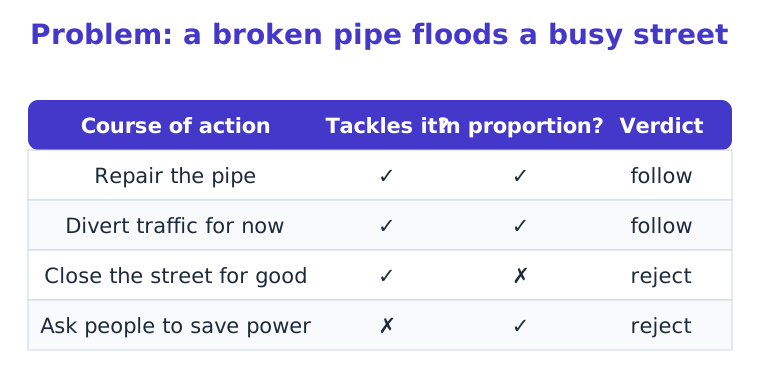
A broken pipe has flooded a busy street for two days. Four suggestions reach the mayor: repair the pipe; divert traffic for now; close the street for good; ask people to save electricity.
Which would you approve? By the end of this topic you will sort them in seconds.
What the question asks
You get a problem and two suggested courses of action. You decide which ones should be followed: only I, only II, neither, or both. Take the problem as true.
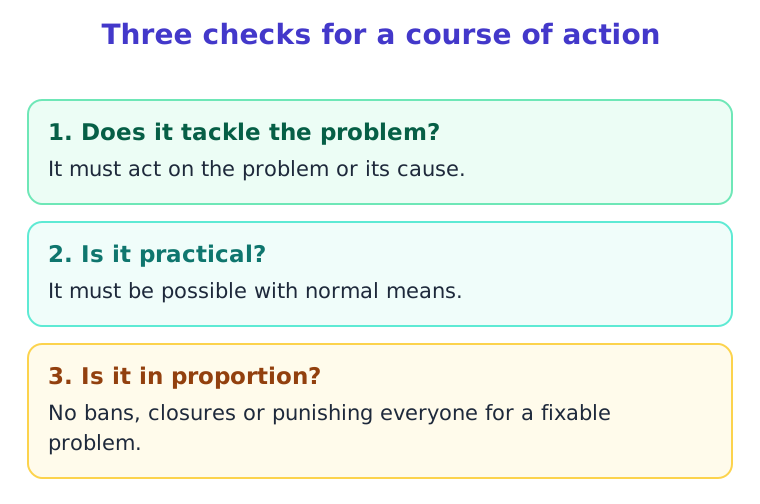
Three checks
- Tackles it: does the step reduce the problem or remove its cause?
- Practical: can it be done with normal means?
- In proportion: is it fair, with no blanket ban or punishment for all?
A step must pass all three.
Worked example
For the flooded street, check each suggestion against the three tests.
Extreme steps
Ban, close down, dismiss all, jail everyone: such steps are almost always out of proportion. They may stop the problem, but they cause bigger harm. Reject them.
Off-target and impractical steps
A new stadium does not teach reading; a new name does not fix a road. Off-target steps fail check 1. Free cars for every driver or moving a whole town fail check 2: they are impractical.
Relief now, fix later
Often one step gives quick relief (safe water, diverted traffic) and another removes the cause (repair, testing). They do not compete. When both pass the checks, the answer is both.
Exam shortcuts
- Cross out any step with ban, close, all, for ever, at once for everyone.
- Cross out a step that does not touch the problem.
- An inquiry, a test, a survey or awareness drive usually passes.
- Check that the right body is asked to act.
Back to the street
Repair the pipe and divert traffic: follow both. Closing the street for good is out of proportion, and saving electricity is off-target.
Concepts and terms
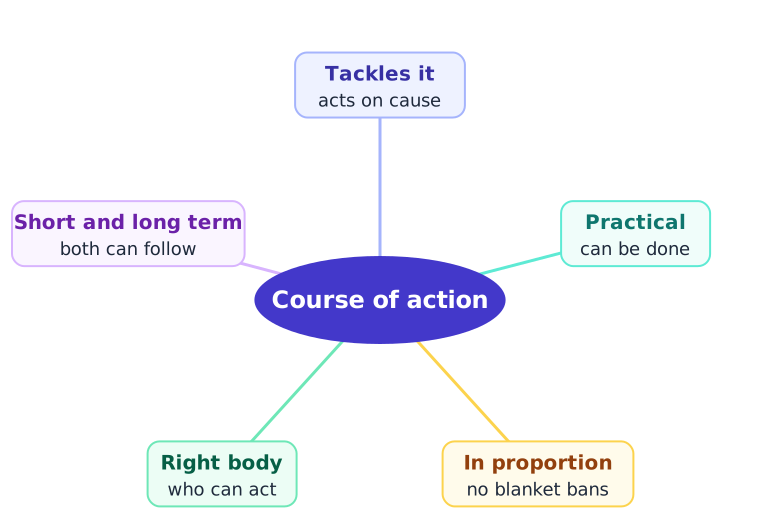
The step must reduce the problem or act on its cause.
It can be done with normal means: no free cars for all, no moving whole towns.
The step should fit the size of the problem. A fixable fault never calls for a permanent ban.
Did you know
Bank PO and SSC CGL papers ask course-of-action questions to test practical, balanced judgement, a skill officers use every day.
Memory tricks
Three checks — Solve, Do-able, Fair — Does it solve? Can it be done? Is it fair and in proportion?
Practice MCQs with answers (46)
- A Only I should be followed
- B Only II should be followed
- C Neither I nor II should be followed
- D Both I and II should be followed
Show answer
Why:
I should be followed: it tackles the problem in a practical way. It goes to the root of the problem through the right authority. II should not be followed: it is out of proportion to the problem. Stopping all eating is far too harsh and harms students. So the answer is: Only I should be followed.
- A Only I should be followed
- B Only II should be followed
- C Neither I nor II should be followed
- D Both I and II should be followed
Show answer
Why:
I should not be followed: it does not tackle the problem. Desks have nothing to do with unclean food. II should be followed: it tackles the problem in a practical way. Awareness cuts the illness at once and costs little. So the answer is: Only II should be followed.
- A Only I should be followed
- B Only II should be followed
- C Neither I nor II should be followed
- D Both I and II should be followed
Show answer
Why:
I should not be followed: it is not practical. Water keeps flowing from the pipe; buckets cannot keep up. II should be followed: it tackles the problem in a practical way. Fixing the pipe removes the cause. So the answer is: Only II should be followed.
- A Only I should be followed
- B Only II should be followed
- C Neither I nor II should be followed
- D Both I and II should be followed
Show answer
Why:
I should not be followed: it is out of proportion to the problem. A repairable pipe is no reason to shut a street for ever. II should not be followed: it does not tackle the problem. Electricity has nothing to do with the leak. So the answer is: Neither I nor II should be followed.
- A Only I should be followed
- B Only II should be followed
- C Neither I nor II should be followed
- D Both I and II should be followed
Show answer
Why:
I should be followed: it tackles the problem in a practical way. Knowing the numbers helps plan the right fix. II should not be followed: it does not tackle the problem. Cheaper fares would not reduce the crowd; they may add to it. So the answer is: Only I should be followed.
- A Only I should be followed
- B Only II should be followed
- C Neither I nor II should be followed
- D Both I and II should be followed
Show answer
Why:
I should not be followed: it is out of proportion to the problem. Stopping the route punishes the very passengers who need it. II should not be followed: it is not practical. People travel in the morning for work and school; this cannot be done. So the answer is: Neither I nor II should be followed.
- A Only I should be followed
- B Only II should be followed
- C Neither I nor II should be followed
- D Both I and II should be followed
Show answer
Why:
I should not be followed: it does not tackle the problem. Parks do nothing about dark roads. II should not be followed: it is not practical. Giving everyone a new car is not possible. So the answer is: Neither I nor II should be followed.
- A Only I should be followed
- B Only II should be followed
- C Neither I nor II should be followed
- D Both I and II should be followed
Show answer
Why:
I should be followed: it tackles the problem in a practical way. Closer watch can cut accidents meanwhile. II should be followed: it tackles the problem in a practical way. Better lighting tackles the cause directly. So the answer is: Both I and II should be followed.
- A Only I should be followed
- B Only II should be followed
- C Neither I nor II should be followed
- D Both I and II should be followed
Show answer
Why:
I should not be followed: it does not tackle the problem. A sports meet does nothing for the farmers. II should be followed: it tackles the problem in a practical way. Earlier warnings reduce losses next time. So the answer is: Only II should be followed.
- A Only I should be followed
- B Only II should be followed
- C Neither I nor II should be followed
- D Both I and II should be followed
Show answer
Why:
I should be followed: it tackles the problem in a practical way. Relief helps the affected farmers at once. II should not be followed: it is out of proportion to the problem. Banning farming would ruin the farmers it is meant to protect. So the answer is: Only I should be followed.
- A Only I should be followed
- B Only II should be followed
- C Neither I nor II should be followed
- D Both I and II should be followed
Show answer
Why:
I should be followed: it tackles the problem in a practical way. Finding the reason is the first step to fixing it. II should be followed: it tackles the problem in a practical way. Better teaching and facilities draw children back. So the answer is: Both I and II should be followed.
- A Only I should be followed
- B Only II should be followed
- C Neither I nor II should be followed
- D Both I and II should be followed
Show answer
Why:
I should not be followed: it is out of proportion to the problem. Punishing everyone without finding the cause is too harsh. II should not be followed: it does not tackle the problem. A new name does not fix whatever is driving children away. So the answer is: Neither I nor II should be followed.
- A Only I should be followed
- B Only II should be followed
- C Neither I nor II should be followed
- D Both I and II should be followed
Show answer
Why:
I should be followed: it tackles the problem in a practical way. Testing finds out what is wrong with the water. II should not be followed: it does not tackle the problem. A school does nothing about the water. So the answer is: Only I should be followed.
- A Only I should be followed
- B Only II should be followed
- C Neither I nor II should be followed
- D Both I and II should be followed
Show answer
Why:
I should not be followed: it is out of proportion to the problem. Moving a village over one well is far too drastic. II should be followed: it tackles the problem in a practical way. It stops more people from falling ill. So the answer is: Only II should be followed.
- A Only I should be followed
- B Only II should be followed
- C Neither I nor II should be followed
- D Both I and II should be followed
Show answer
Why:
I should not be followed: it is not practical. Free travel for all is not workable. II should be followed: it tackles the problem in a practical way. More counters serve the crowd faster. So the answer is: Only II should be followed.
- A Only I should be followed
- B Only II should be followed
- C Neither I nor II should be followed
- D Both I and II should be followed
Show answer
Why:
I should not be followed: it does not tackle the problem. Paint does nothing for the queues. II should not be followed: it is out of proportion to the problem. Stopping sales leaves passengers without tickets. So the answer is: Neither I nor II should be followed.
- A Only I should be followed
- B Only II should be followed
- C Neither I nor II should be followed
- D Both I and II should be followed
Show answer
Why:
I should be followed: it tackles the problem in a practical way. It protects the children right away. II should not be followed: it is out of proportion to the problem. Play is good for children; stopping it is too harsh. So the answer is: Only I should be followed.
- A Only I should be followed
- B Only II should be followed
- C Neither I nor II should be followed
- D Both I and II should be followed
Show answer
Why:
I should not be followed: it is out of proportion to the problem. Banning every vehicle in the city is far too drastic. II should not be followed: it does not tackle the problem. A new name does not make the road safe. So the answer is: Neither I nor II should be followed.
- A Only I should be followed
- B Only II should be followed
- C Neither I nor II should be followed
- D Both I and II should be followed
Show answer
Why:
I should not be followed: it is out of proportion to the problem. This punishes children for a gap the school should fill. II should not be followed: it is not practical. A home tutor for every child cannot be arranged. So the answer is: Neither I nor II should be followed.
- A Only I should be followed
- B Only II should be followed
- C Neither I nor II should be followed
- D Both I and II should be followed
Show answer
Why:
I should be followed: it tackles the problem in a practical way. Better teaching methods improve reading. II should be followed: it tackles the problem in a practical way. Extra practice works on the very skill that is weak. So the answer is: Both I and II should be followed.
- A Only I should be followed
- B Only II should be followed
- C Neither I nor II should be followed
- D Both I and II should be followed
Show answer
Why:
I should not be followed: it does not tackle the problem. A post office does nothing about garbage. II should be followed: it tackles the problem in a practical way. It removes the mess and stops it coming back. So the answer is: Only II should be followed.
- A Only I should be followed
- B Only II should be followed
- C Neither I nor II should be followed
- D Both I and II should be followed
Show answer
Why:
I should be followed: it tackles the problem in a practical way. People get a proper place to throw garbage. II should not be followed: it is out of proportion to the problem. Fining everyone, guilty or not, is unfair. So the answer is: Only I should be followed.
- A Only I should be followed
- B Only II should be followed
- C Neither I nor II should be followed
- D Both I and II should be followed
Show answer
Why:
I should be followed: it tackles the problem in a practical way. It targets exactly the guilty shops. II should be followed: it tackles the problem in a practical way. Aware buyers avoid such sweets. So the answer is: Both I and II should be followed.
- A Only I should be followed
- B Only II should be followed
- C Neither I nor II should be followed
- D Both I and II should be followed
Show answer
Why:
I should not be followed: it is out of proportion to the problem. A nationwide ban is far too drastic. II should not be followed: it does not tackle the problem. Opening hours have nothing to do with harmful dyes. So the answer is: Neither I nor II should be followed.
- A Only I should be followed
- B Only II should be followed
- C Neither I nor II should be followed
- D Both I and II should be followed
Show answer
Why:
I should be followed: it tackles the problem in a practical way. It fills the gap directly. II should not be followed: it is out of proportion to the problem. Closing it leaves children with no books at all. So the answer is: Only I should be followed.
- A Only I should be followed
- B Only II should be followed
- C Neither I nor II should be followed
- D Both I and II should be followed
Show answer
Why:
I should not be followed: it is not practical. Such books do not suit young readers. II should be followed: it tackles the problem in a practical way. A simple, low-cost way to add books. So the answer is: Only II should be followed.
- A Only I should be followed
- B Only II should be followed
- C Neither I nor II should be followed
- D Both I and II should be followed
Show answer
Why:
I should not be followed: it is not practical. Rebuilding classrooms underground is not workable. II should be followed: it tackles the problem in a practical way. A clear rule makes the expectation known to all. So the answer is: Only II should be followed.
- A Only I should be followed
- B Only II should be followed
- C Neither I nor II should be followed
- D Both I and II should be followed
Show answer
Why:
I should not be followed: it does not tackle the problem. New timings do not stop phones ringing. II should not be followed: it is out of proportion to the problem. Expelling students over a ringing phone is too harsh. So the answer is: Neither I nor II should be followed.
- A The school should ask the food safety office to check the stalls.
- B All the stall owners should be jailed at once.
- C The school should buy new desks for its classrooms.
- D Students should be stopped from eating anything during school hours.
Show answer
Why:
"The school should ask the food safety office to check the stalls." should be followed: it tackles the problem in a practical way. It goes to the root of the problem through the right authority. "Students should be stopped from eating anything during school hours." should not be followed: it is out of proportion to the problem. Stopping all eating is far too harsh and harms students. "All the stall owners should be jailed at once." should not be followed: it is out of proportion to the problem. Punishing everyone without any check is too harsh. "The school should buy new desks for its classrooms." should not be followed: it does not tackle the problem. Desks have nothing to do with unclean food.
- A Every resident should bring a bucket and remove the water.
- B The water department should repair the pipe at once.
- C The street should be closed for good.
- D People should be asked to save electricity.
Show answer
Why:
"The water department should repair the pipe at once." should be followed: it tackles the problem in a practical way. Fixing the pipe removes the cause. "The street should be closed for good." should not be followed: it is out of proportion to the problem. A repairable pipe is no reason to shut a street for ever. "People should be asked to save electricity." should not be followed: it does not tackle the problem. Electricity has nothing to do with the leak. "Every resident should bring a bucket and remove the water." should not be followed: it is not practical. Water keeps flowing from the pipe; buckets cannot keep up.
- A Passengers should be told to travel only at night.
- B Bus fares on all routes should be cut.
- C The transport office should study how many people use the route at that hour.
- D Route 12 should be stopped completely.
Show answer
Why:
"The transport office should study how many people use the route at that hour." should be followed: it tackles the problem in a practical way. Knowing the numbers helps plan the right fix. "Route 12 should be stopped completely." should not be followed: it is out of proportion to the problem. Stopping the route punishes the very passengers who need it. "Passengers should be told to travel only at night." should not be followed: it is not practical. People travel in the morning for work and school; this cannot be done. "Bus fares on all routes should be cut." should not be followed: it does not tackle the problem. Cheaper fares would not reduce the crowd; they may add to it.
- A Every driver should be given a new car with brighter lights.
- B All vehicles should be banned from city roads at night.
- C More parks should be built in the city.
- D Traffic police should keep a closer watch on these roads at night.
Show answer
Why:
"Traffic police should keep a closer watch on these roads at night." should be followed: it tackles the problem in a practical way. Closer watch can cut accidents meanwhile. "All vehicles should be banned from city roads at night." should not be followed: it is out of proportion to the problem. A total ban is far too drastic. "More parks should be built in the city." should not be followed: it does not tackle the problem. Parks do nothing about dark roads. "Every driver should be given a new car with brighter lights." should not be followed: it is not practical. Giving everyone a new car is not possible.
- A The government should give relief to the farmers who lost their crops.
- B All the rivers in the district should be filled with soil.
- C Farming should be banned in the district.
- D The district should hold a sports meet.
Show answer
Why:
"The government should give relief to the farmers who lost their crops." should be followed: it tackles the problem in a practical way. Relief helps the affected farmers at once. "Farming should be banned in the district." should not be followed: it is out of proportion to the problem. Banning farming would ruin the farmers it is meant to protect. "The district should hold a sports meet." should not be followed: it does not tackle the problem. A sports meet does nothing for the farmers. "All the rivers in the district should be filled with soil." should not be followed: it is not practical. This cannot be done, and rivers are needed.
- A All the wells in the state should be closed.
- B The villagers should be given safe drinking water until the well is cleaned.
- C The whole village should be moved to another place.
- D A new school should be opened in the village.
Show answer
Why:
"The villagers should be given safe drinking water until the well is cleaned." should be followed: it tackles the problem in a practical way. It stops more people from falling ill. "The whole village should be moved to another place." should not be followed: it is out of proportion to the problem. Moving a village over one well is far too drastic. "A new school should be opened in the village." should not be followed: it does not tackle the problem. A school does nothing about the water. "All the wells in the state should be closed." should not be followed: it is out of proportion to the problem. One bad well is no reason to close every well.
- A All vehicles should be banned from the city.
- B Children should not be allowed to play at all.
- C The colony should set aside an open space as a playground.
- D The road should be given a new name.
Show answer
Why:
"The colony should set aside an open space as a playground." should be followed: it tackles the problem in a practical way. A safe place to play removes the need to play on the road. "Children should not be allowed to play at all." should not be followed: it is out of proportion to the problem. Play is good for children; stopping it is too harsh. "The road should be given a new name." should not be followed: it does not tackle the problem. A new name does not make the road safe. "All vehicles should be banned from the city." should not be followed: it is out of proportion to the problem. Banning every vehicle in the city is far too drastic.
- A All the residents should move to another area.
- B Every resident of the area should be fined.
- C The area should get a new post office.
- D Dustbins should be placed nearby and emptied regularly.
Show answer
Why:
"Dustbins should be placed nearby and emptied regularly." should be followed: it tackles the problem in a practical way. People get a proper place to throw garbage. "Every resident of the area should be fined." should not be followed: it is out of proportion to the problem. Fining everyone, guilty or not, is unfair. "The area should get a new post office." should not be followed: it does not tackle the problem. A post office does nothing about garbage. "All the residents should move to another area." should not be followed: it is not practical. Moving a whole area over garbage is not workable.
- A Food inspectors should test sweets in the market and act against shops that break the law.
- B The market should stay open for longer hours.
- C Every shop in the market should be closed for ever.
- D The sale of all sweets in the country should be banned.
Show answer
Why:
"Food inspectors should test sweets in the market and act against shops that break the law." should be followed: it tackles the problem in a practical way. It targets exactly the guilty shops. "The sale of all sweets in the country should be banned." should not be followed: it is out of proportion to the problem. A nationwide ban is far too drastic. "The market should stay open for longer hours." should not be followed: it does not tackle the problem. Opening hours have nothing to do with harmful dyes. "Every shop in the market should be closed for ever." should not be followed: it is out of proportion to the problem. Honest shops would be punished too.
- A The library should be closed.
- B Students and parents could be asked to donate suitable books.
- C The school should buy a new bus.
- D Young children should be made to read books written for adults.
Show answer
Why:
"Students and parents could be asked to donate suitable books." should be followed: it tackles the problem in a practical way. A simple, low-cost way to add books. "The library should be closed." should not be followed: it is out of proportion to the problem. Closing it leaves children with no books at all. "The school should buy a new bus." should not be followed: it does not tackle the problem. A bus adds no books. "Young children should be made to read books written for adults." should not be followed: it is not practical. Such books do not suit young readers.
- A punish someone
- B be the strictest step possible
- C reduce the problem or remove its cause
- D be cheap, whatever it does
Show answer
Why:
The first check is whether it tackles the problem. Strictness, cheapness alone or punishment do not make a step right.
- A A repair
- B An inquiry into the cause
- C An awareness drive
- D A blanket ban
Show answer
Why:
Blanket bans stop far more than the problem. Repairs, inquiries and awareness are measured steps.
- A off-target
- B the best course of action
- C a relief step
- D an inquiry
Show answer
Why:
A stadium does nothing for reading, so it fails the first check.
- A Only when both are bans
- B When each passes all three checks
- C Only when they say the same thing
- D Never; only one step can be right
Show answer
Why:
Two different sound steps, such as relief now and a fix later, can both follow.
- A Let traffic police manage the flow
- B Build a second bridge
- C Lift vehicles across by cranes
- D Widen the bridge
Show answer
Why:
Cranes cannot carry daily traffic. The other three are normal, workable steps.
- A Both A and R are true, and R is the correct explanation of A
- B Both A and R are true, but R is not the correct explanation of A
- C A is true but R is false
- D A is false but R is true
Show answer
Why:
Repairing removes the cause and is practical and in proportion; R is exactly the reason.
- A Both A and R are true, and R is the correct explanation of A
- B Both A and R are true, but R is not the correct explanation of A
- C A is true but R is false
- D A is false but R is true
Show answer
Why:
Closing the school is out of proportion, so A is false. R is true.
- A 1 only
- B 2 only
- C Both 1 and 2
- D Neither 1 nor 2
Show answer
Why:
1 should be followed: it tackles the problem in a practical way. Better lighting tackles the cause directly. 2 should not be followed: it is out of proportion to the problem. A total ban is far too drastic.
Important short questions (3)
It is out of proportion: it stops all night travel to fix a problem that better lighting and policing can reduce.
Relief: supply safe drinking water. Lasting: test and clean the well.
Yes. Finding the cause is the sound first step; the fix depends on it.
Long answer questions (1)
I: follow; it targets the guilty through the right body.
II: reject; a nationwide ban is far out of proportion.
III: follow; awareness is practical and reduces harm.
Flashcards (12)
Play this topic
- Follow it or not?
Cause and Effect
Decide how two events are related: one causes the other, both come from a common cause, or they are independent; and pick the likely cause or effect of an event.
What you will be able to do
- I can tell which of two events is the cause and which is the effect.
- I can spot two events that share a hidden common cause.
- I can recognise two events that are independent.
- I can pick the likely cause or effect of an event and reject results posing as causes.
Key points
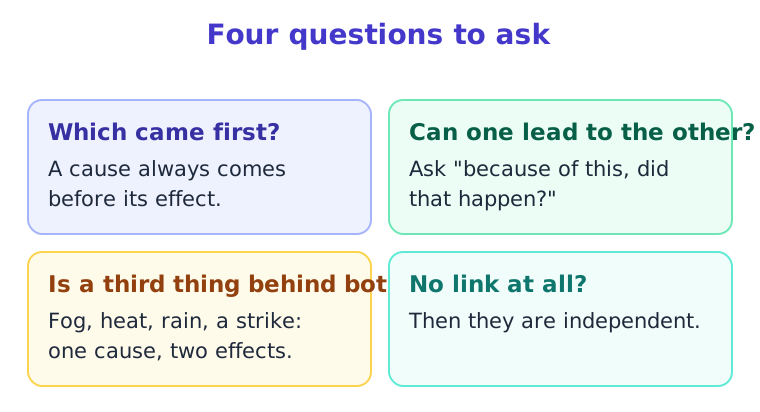
A cause always happens before its effect.
Ask: "Did this happen because of that?" If yes, that is the cause.
The cause may be written second; the order on the page does not decide it.
Two events with no link between them, but one hidden reason behind both, have a common cause (fog, heat, rain, a strike).
Events with no link at all are independent.
A result of an event is never its cause.
Use common sense about how the world works, but do not invent long chains.
Full explanation
The foggy morning

One morning the news says: "Many flights were delayed" and "Several trains ran late". Ravi says the late flights made the trains late. His sister says something else made both late.
Who is right? This topic gives you four boxes to sort every such pair.
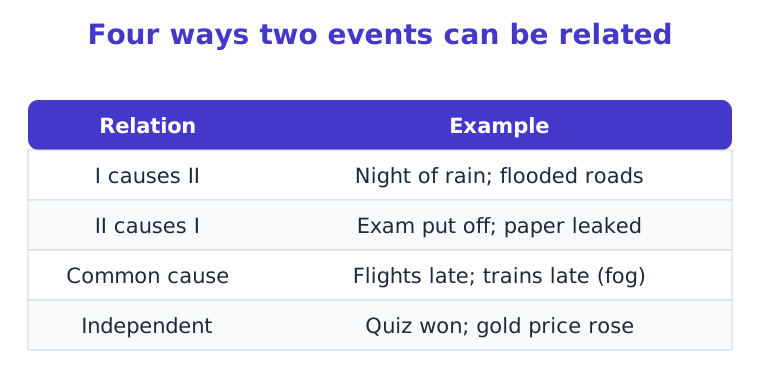
The four relations
- Statement I is the cause, II is its effect.
- Statement II is the cause, I is its effect.
- Both are effects of a common cause.
- They are independent.
Which came first?
A cause always comes before its effect. "The exam was postponed. The question paper had leaked." The leak happened first, so statement II is the cause even though it is written second.
The "because" test
Join the two with "because": "Roads were waterlogged because heavy rain fell all night." It reads naturally, so rain is the cause. Try the other way: "Heavy rain fell because roads were waterlogged." Nonsense.
Common cause
Ice cream sales rose; many people got heatstroke. Ice cream does not cause heatstroke, and heatstroke does not sell ice cream. A heat wave explains both. When the "because" test fails both ways but one hidden reason fits both, choose common cause.
Independent events
"A school in Pune won a science quiz. The price of gold rose in Mumbai." No reasonable link, no shared cause: independent. Do not invent a chain to connect them.
Picking a cause or an effect
For "Which could be a cause of this event?", reject anything that happened because of the event: it is a result. For "Which could be an effect?", reject anything that came before it.
Exam shortcuts
- Ignore the order on the page; find the time order.
- Weather, strikes and holidays are the usual common causes.
- If two events are in different places with no link, they are independent.
- A result is never a cause.
Back to the foggy morning
Late flights do not make trains late. Dense fog delays both, so they are effects of a common cause. Ravi's sister is right.
Concepts and terms
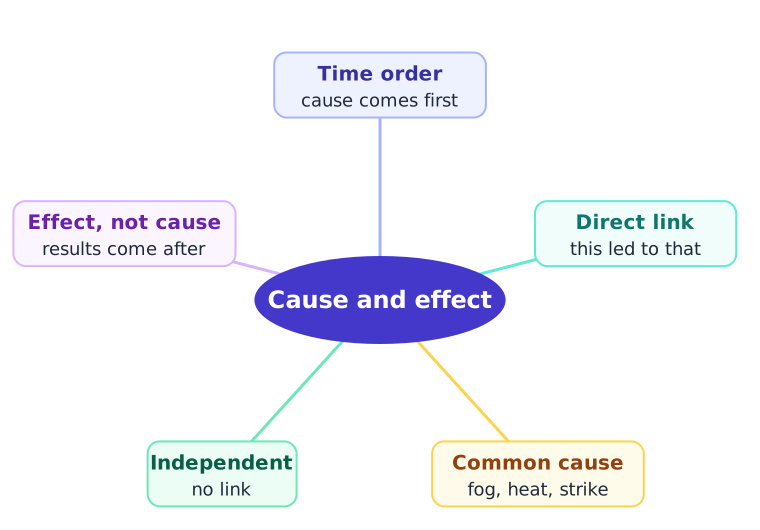
One event makes the other happen: heavy rain, then waterlogged roads.
Neither event causes the other, but one unstated reason causes both: late flights and late trains on a foggy morning.
No link at all: a quiz won in Pune and gold prices in Mumbai.
Did you know
Doctors and scientists face the same puzzle: two things rising together may share a cause rather than cause each other.
Memory tricks
Finding the cause — First, then because — Find which came first, then check that the second happened because of it.
Practice MCQs with answers (47)
- A Statement I is the cause and statement II is its effect
- B Statement II is the cause and statement I is its effect
- C Both statements are effects of a common cause
- D The two statements are independent of each other
Show answer
Why:
A night of heavy rain fills low roads with water. So: Statement I is the cause and statement II is its effect.
- A Statement I is the cause and statement II is its effect
- B Statement II is the cause and statement I is its effect
- C Both statements are effects of a common cause
- D The two statements are independent of each other
Show answer
Why:
A leaked paper cannot be used, so the exam was put off. So: Statement II is the cause and statement I is its effect.
- A Statement I is the cause and statement II is its effect
- B Statement II is the cause and statement I is its effect
- C Both statements are effects of a common cause
- D The two statements are independent of each other
Show answer
Why:
Neither delay caused the other; something like dense fog would cause both. So: Both statements are effects of a common cause.
- A Statement I is the cause and statement II is its effect
- B Statement II is the cause and statement I is its effect
- C Both statements are effects of a common cause
- D The two statements are independent of each other
Show answer
Why:
A quiz result and gold prices have nothing to do with each other. So: The two statements are independent of each other.
- A Statement I is the cause and statement II is its effect
- B Statement II is the cause and statement I is its effect
- C Both statements are effects of a common cause
- D The two statements are independent of each other
Show answer
Why:
Strong cyclone winds and waves damage boats. So: Statement I is the cause and statement II is its effect.
- A Statement I is the cause and statement II is its effect
- B Statement II is the cause and statement I is its effect
- C Both statements are effects of a common cause
- D The two statements are independent of each other
Show answer
Why:
Dirty water makes people ill. So: Statement II is the cause and statement I is its effect.
- A Statement I is the cause and statement II is its effect
- B Statement II is the cause and statement I is its effect
- C Both statements are effects of a common cause
- D The two statements are independent of each other
Show answer
Why:
A heat wave explains both; neither one causes the other. So: Both statements are effects of a common cause.
- A Statement I is the cause and statement II is its effect
- B Statement II is the cause and statement I is its effect
- C Both statements are effects of a common cause
- D The two statements are independent of each other
Show answer
Why:
A visit abroad does not bring rain, and rain does not cause a visit. So: The two statements are independent of each other.
- A Statement I is the cause and statement II is its effect
- B Statement II is the cause and statement I is its effect
- C Both statements are effects of a common cause
- D The two statements are independent of each other
Show answer
Why:
Waste poisons the water, and the fish die. So: Statement I is the cause and statement II is its effect.
- A Statement I is the cause and statement II is its effect
- B Statement II is the cause and statement I is its effect
- C Both statements are effects of a common cause
- D The two statements are independent of each other
Show answer
Why:
With the shopkeeper in hospital, no one opened the shop. So: Statement II is the cause and statement I is its effect.
- A Statement I is the cause and statement II is its effect
- B Statement II is the cause and statement I is its effect
- C Both statements are effects of a common cause
- D The two statements are independent of each other
Show answer
Why:
Poor rains or bad weather would hit both crops; one crop does not ruin the other. So: Both statements are effects of a common cause.
- A Statement I is the cause and statement II is its effect
- B Statement II is the cause and statement I is its effect
- C Both statements are effects of a common cause
- D The two statements are independent of each other
Show answer
Why:
The two events are unconnected. So: The two statements are independent of each other.
- A Statement I is the cause and statement II is its effect
- B Statement II is the cause and statement I is its effect
- C Both statements are effects of a common cause
- D The two statements are independent of each other
Show answer
Why:
A lower tax makes the cars cheaper, so more are bought. So: Statement I is the cause and statement II is its effect.
- A Statement I is the cause and statement II is its effect
- B Statement II is the cause and statement I is its effect
- C Both statements are effects of a common cause
- D The two statements are independent of each other
Show answer
Why:
Less supply from the villages pushed prices up. So: Statement II is the cause and statement I is its effect.
- A Statement I is the cause and statement II is its effect
- B Statement II is the cause and statement I is its effect
- C Both statements are effects of a common cause
- D The two statements are independent of each other
Show answer
Why:
A city-wide strike would explain both. So: Both statements are effects of a common cause.
- A Statement I is the cause and statement II is its effect
- B Statement II is the cause and statement I is its effect
- C Both statements are effects of a common cause
- D The two statements are independent of each other
Show answer
Why:
Buying a bicycle and the school's date have no link. So: The two statements are independent of each other.
- A Statement I is the cause and statement II is its effect
- B Statement II is the cause and statement I is its effect
- C Both statements are effects of a common cause
- D The two statements are independent of each other
Show answer
Why:
Electric light made evening study possible. So: Statement I is the cause and statement II is its effect.
- A Statement I is the cause and statement II is its effect
- B Statement II is the cause and statement I is its effect
- C Both statements are effects of a common cause
- D The two statements are independent of each other
Show answer
Why:
Waking late made her miss the bus. So: Statement II is the cause and statement I is its effect.
- A Statement I is the cause and statement II is its effect
- B Statement II is the cause and statement I is its effect
- C Both statements are effects of a common cause
- D The two statements are independent of each other
Show answer
Why:
A cold wave would cause both. So: Both statements are effects of a common cause.
- A Statement I is the cause and statement II is its effect
- B Statement II is the cause and statement I is its effect
- C Both statements are effects of a common cause
- D The two statements are independent of each other
Show answer
Why:
A cricket result does not move onion prices. So: The two statements are independent of each other.
- A Statement I is the cause and statement II is its effect
- B Statement II is the cause and statement I is its effect
- C Both statements are effects of a common cause
- D The two statements are independent of each other
Show answer
Why:
With the bridge gone, boats were the only way across. So: Statement I is the cause and statement II is its effect.
- A Statement I is the cause and statement II is its effect
- B Statement II is the cause and statement I is its effect
- C Both statements are effects of a common cause
- D The two statements are independent of each other
Show answer
Why:
Trains cannot run without the track. So: Statement II is the cause and statement I is its effect.
- A Statement I is the cause and statement II is its effect
- B Statement II is the cause and statement I is its effect
- C Both statements are effects of a common cause
- D The two statements are independent of each other
Show answer
Why:
An easy paper would explain both. So: Both statements are effects of a common cause.
- A Statement I is the cause and statement II is its effect
- B Statement II is the cause and statement I is its effect
- C Both statements are effects of a common cause
- D The two statements are independent of each other
Show answer
Why:
A new hospital has no bearing on a football result. So: The two statements are independent of each other.
- A Statement I is the cause and statement II is its effect
- B Statement II is the cause and statement I is its effect
- C Both statements are effects of a common cause
- D The two statements are independent of each other
Show answer
Why:
The adverts made people aware of the soap, and sales rose after them. So: Statement I is the cause and statement II is its effect.
- A Statement I is the cause and statement II is its effect
- B Statement II is the cause and statement I is its effect
- C Both statements are effects of a common cause
- D The two statements are independent of each other
Show answer
Why:
The released water raised the river and flooded the villages. So: Statement II is the cause and statement I is its effect.
- A Statement I is the cause and statement II is its effect
- B Statement II is the cause and statement I is its effect
- C Both statements are effects of a common cause
- D The two statements are independent of each other
Show answer
Why:
The arrival of the rains would cause both. So: Both statements are effects of a common cause.
- A A new post office opened near the colony.
- B Sewage got mixed with the colony's water supply.
- C The colony held a cricket match last month.
- D The nearby clinic was crowded with patients.
Show answer
Why:
"Sewage got mixed with the colony's water supply." is the answer: it explains why the event happened. "The nearby clinic was crowded with patients.": this is a result of the event, not its cause. "A new post office opened near the colony.": this has no link with the event. "The colony held a cricket match last month.": this has no link with the event.
- A Families began buying fewer tomatoes.
- B A new cricket stadium opened in the city.
- C Heavy rain damaged tomato crops in the main growing areas.
- D The price of gold rose.
Show answer
Why:
"Heavy rain damaged tomato crops in the main growing areas." is the answer: it explains why the event happened. "Families began buying fewer tomatoes.": this is a result of the event, not its cause. "A new cricket stadium opened in the city.": this has no link with the event. "The price of gold rose.": this has no link with the event.
- A The city's football team won a match.
- B Traffic was blocked on many roads.
- C A new mall opened in the city.
- D A strong storm hit the city last night.
Show answer
Why:
"A strong storm hit the city last night." is the answer: it explains why the event happened. "Traffic was blocked on many roads.": this is a result of the event, not its cause. "A new mall opened in the city.": this has no link with the event. "The city's football team won a match.": this has no link with the event.
- A The school started extra classes for weak students.
- B The school held a function to celebrate the results.
- C The school painted its main gate.
- D Parents praised the school for the results.
Show answer
Why:
"The school started extra classes for weak students." is the answer: it explains why the event happened. "The school held a function to celebrate the results.": this is a result of the event, not its cause. "The school painted its main gate.": this has no link with the event. "Parents praised the school for the results.": this is a result of the event, not its cause.
- A It snowed in the hills.
- B Truck owners raised their rates for carrying goods.
- C Oil companies were selling diesel at a loss.
- D A new film was released.
Show answer
Why:
"Truck owners raised their rates for carrying goods." is the answer: it follows naturally from the event. "Oil companies were selling diesel at a loss.": this would come before the event; it is a cause, not an effect. "A new film was released.": this has no link with the event. "It snowed in the hills.": this has no link with the event.
- A A cold, wet wind blew over the mountains for days.
- B A new road was planned in the plains.
- C Vehicles were stranded on both sides of the pass.
- D A school in the city held its sports day.
Show answer
Why:
"Vehicles were stranded on both sides of the pass." is the answer: it follows naturally from the event. "A cold, wet wind blew over the mountains for days.": this would come before the event; it is a cause, not an effect. "A new road was planned in the plains.": this has no link with the event. "A school in the city held its sports day.": this has no link with the event.
- A The nearest hospital was very far from the village.
- B The village team won a kabaddi match.
- C The rains were normal this year.
- D Villagers no longer have to travel far for treatment.
Show answer
Why:
"Villagers no longer have to travel far for treatment." is the answer: it follows naturally from the event. "The nearest hospital was very far from the village.": this would come before the event; it is a cause, not an effect. "The village team won a kabaddi match.": this has no link with the event. "The rains were normal this year.": this has no link with the event.
- A The test was on a chapter that had not yet been taught.
- B The teacher planned a revision class.
- C The school canteen started selling new snacks.
- D The students were upset after seeing their marks.
Show answer
Why:
"The test was on a chapter that had not yet been taught." is the answer: it explains why the event happened. "The teacher planned a revision class.": this is a result of the event, not its cause. "The school canteen started selling new snacks.": this has no link with the event. "The students were upset after seeing their marks.": this is a result of the event, not its cause.
- A The town got a new bus stand.
- B A factory began draining its waste into the river.
- C Boating on the river was stopped.
- D Fish in the river began to die.
Show answer
Why:
"A factory began draining its waste into the river." is the answer: it explains why the event happened. "Fish in the river began to die.": this is a result of the event, not its cause. "The town got a new bus stand.": this has no link with the event. "Boating on the river was stopped.": this is a result of the event, not its cause.
- A The team bought new bats last year.
- B The stadium painted its seats.
- C Heavy rain flooded the ground.
- D Fans asked for their ticket money back.
Show answer
Why:
"Heavy rain flooded the ground." is the answer: it explains why the event happened. "Fans asked for their ticket money back.": this is a result of the event, not its cause. "The team bought new bats last year.": this has no link with the event. "The stadium painted its seats.": this has no link with the event.
- A is the longer statement
- B happens after the effect
- C is written as statement I
- D happens before the effect
Show answer
Why:
Time order decides it; the page order and length do not.
- A effects of a common cause
- B effect and cause, in that order
- C completely unrelated
- D cause and effect, in that order
Show answer
Why:
A heat wave causes both; neither causes the other, and they are linked by that cause.
- A The length of the statements
- B The weather
- C The first word of statement I
- D The order of the statements
Show answer
Why:
Fog, heat, cold, rain and storms explain many pairs.
- A A flood hit the pillars hard
- B Overloaded trucks used the bridge daily
- C Villagers used boats to cross the river
- D The bridge was very old and weak
Show answer
Why:
Using boats came after the collapse. The other three could have caused it.
- A I causes II
- B II causes I
- C Common cause
- D Independent
Show answer
Why:
No link and no shared reason: independent.
- A The power cuts
- B The inverter sales
- C Both are effects of a common cause
- D Neither; they are independent
Show answer
Why:
People bought inverters because the power went off; the cuts came first.
- A Both A and R are true, and R is the correct explanation of A
- B Both A and R are true, but R is not the correct explanation of A
- C A is true but R is false
- D A is false but R is true
Show answer
Why:
Both A and R are true, and fog is exactly the common cause, so R explains A.
- A Both A and R are true, and R is the correct explanation of A
- B Both A and R are true, but R is not the correct explanation of A
- C A is true but R is false
- D A is false but R is true
Show answer
Why:
The cause can be written second ("Exam postponed. Paper leaked."), so A is false; R is true.
- A 1 only
- B 2 only
- C Both 1 and 2
- D Neither 1 nor 2
Show answer
Why:
1 is cause and effect: the cyclone damaged the boats. 2 is a common cause (the rains), not cause and effect.
- A 1 only
- B 2 only
- C Both 1 and 2
- D Neither 1 nor 2
Show answer
Why:
1 has no link: independent. 2 is cause and effect.
Important short questions (3)
Two events that do not cause each other but share one reason: on a foggy morning both flights and trains run late.
Statement II: waking late came first and led to missing the bus.
It happened after the flood and because of it; it is an effect.
Long answer questions (1)
(a) I causes II: rain came first and fills roads.
(b) Common cause: a cold wave drives both.
(c) Independent: no link at all.
Flashcards (12)
Play this topic
- Cause first?
Veda Skills Logical Reasoning Unit 12 — frequently asked questions
For "Use Kiran toothpaste for strong teeth", an assumption is "people want strong teeth" (believed before). For "42 of 60 students passed", a conclusion is "18 did not pass" (follows after).
"Best" needs a comparison with other classes, which the statement does not give.
Opposite: fewer people travel during festivals. Then extra trains would be pointless, so the assumption is implicit.
It is out of proportion: it stops all night travel to fix a problem that better lighting and policing can reduce.
Relief: supply safe drinking water. Lasting: test and clean the well.
Yes. Finding the cause is the sound first step; the fix depends on it.
Two events that do not cause each other but share one reason: on a foggy morning both flights and trains run late.
Statement II: waking late came first and led to missing the bus.
It happened after the flood and because of it; it is an effect.

All Veda Skills Logical Reasoning units
Study this chapter properly, free
Everything above is on this page to read. In the Veda app the same chapter becomes spaced-repetition flashcards, timed tests that mark themselves, Veda Bites you can swipe, and games — with your progress tracked topic by topic.
Get Veda free