Veda Skills Logical Reasoning Unit 3: Analogy
- 2 topics
- 150 MCQs
- 6 short answers
- 2 long answers
- 24 flashcards
- 2 games
- ~85 min read
- English
Checked before publishing: 23 automated checks, including a plagiarism check against the textbook's own words. How we check our content
Number and Letter Analogy
Find the rule that links the first pair of numbers or letters (powers, products, roots, digit rules, letter shifts, opposite letters, reversal, letter-position sums) and apply exactly the same rule to the second pair.
What you will be able to do
- I can read A : B :: C : D and find the rule that turns A into B.
- I can test the common number rules (x², x³, ±1, x(x + 1), ×k ± c, roots, digit sums) in a fixed order.
- I can choose between two rules that both fit the first pair by checking the options.
- I can solve letter-cluster analogies made by shifting, reversing or taking opposite letters.
- I can solve number triads and word-to-number analogies.

Key points
A : B :: C : D is read "A is to B as C is to D": the same rule links both pairs.
Try the rules in this order: x², x³, then ±1 or ±2, then x(x ± 1), then ×k ± c.
If the second number is smaller, try roots, division or digit sums.
Know squares to 30 and cubes to 15; most number analogies are built on them.
If two rules fit the first pair, work out both answers and see which one is in the options.
Letter clusters: write the positions and compare letter by letter (+k, −k, 27 − n, reversed).
Opposite letters add to 27 (A–Z, D–W, G–T).
In triads (a, b, c) the third number is usually made from the first two: a² + b², (a + b)², ab ± 1.
Full explanation
Arjun's practice sheet

Arjun has 20 analogy questions to finish before his coaching class. The first one says 6 : 37 :: 9 : ?. He stares at it. Then he remembers his teacher's list of rules, and the sheet starts to move fast.
What an analogy says

A : B :: C : D is read "A is to B as C is to D". Find the rule that turns A into B, then apply exactly the same rule to C.
Rules to try first
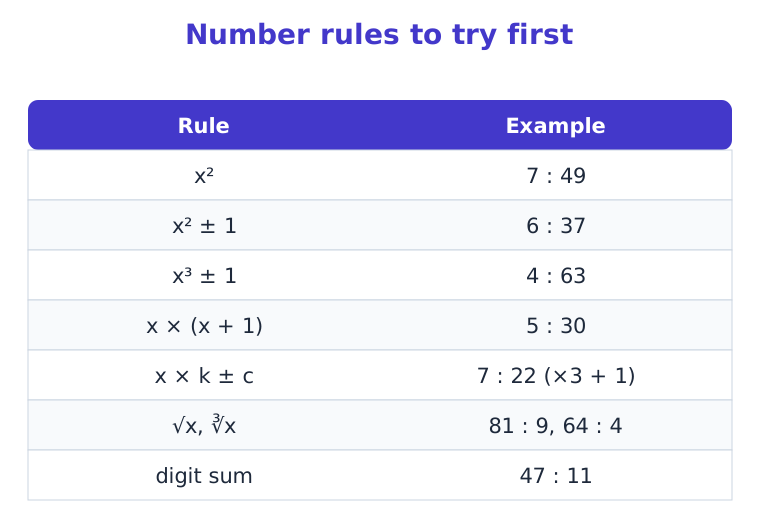
Most exam questions use one of a few rules. Try them in order: square, cube, square or cube ±1 or ±2, x(x + 1), ×k ± c. If B is smaller than A, try square root, cube root or the digit sum.
Arjun's first question
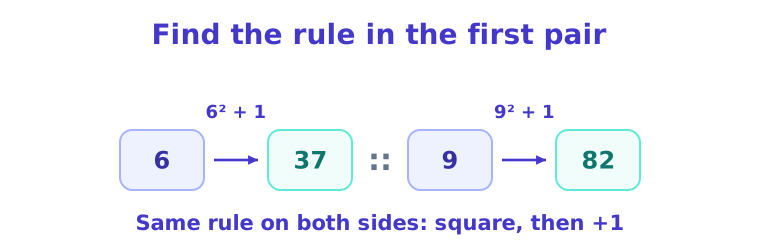
6 : 37. Is 37 near a square? $6^2=36$, and $36+1=37$. Rule: square, then +1. So 9 → $9^2+1=82$.
When two rules fit
2 : 5 fits "square + 1" ($2^2+1=5$) and also "×2 + 1" ($2\times2+1=5$). For 6 the first gives 37 and the second gives 13. Work out both and pick the one that appears in the options. Exam setters avoid putting both.
Number triads
In a set like (3, 4, 25) the third number comes from the first two: $3^2+4^2=25$. Check a² + b², (a + b)², ab ± 1 and a² − b² in turn.
Letter clusters
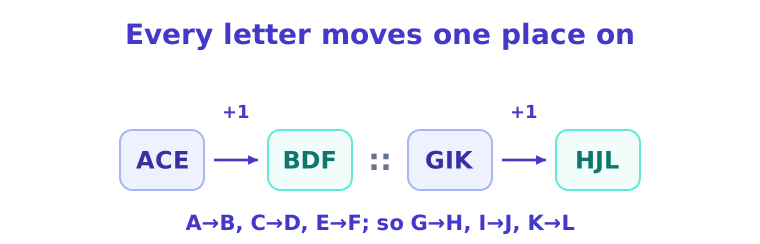
Write the positions and compare letter by letter. ACE : BDF: each letter moves +1. So GIK : HJL.
Opposite and reverse
D : W are opposite letters (4 + 23 = 27), so G : T. ABCD : DCBA is a reversal, so PQRS : SRQP. Sometimes a cluster is reversed and then shifted: CAT → TAC → UBD (+1).
Words as numbers
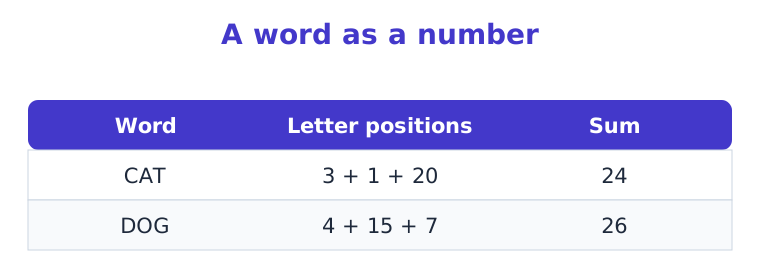
CAT : 24 :: DOG : ? Add the letter positions: C + A + T = 3 + 1 + 20 = 24. So DOG = 4 + 15 + 7 = 26.
Back to Arjun
With the rule list in his head, Arjun finishes all 20 questions in 12 minutes, checking the options every time two rules fit.
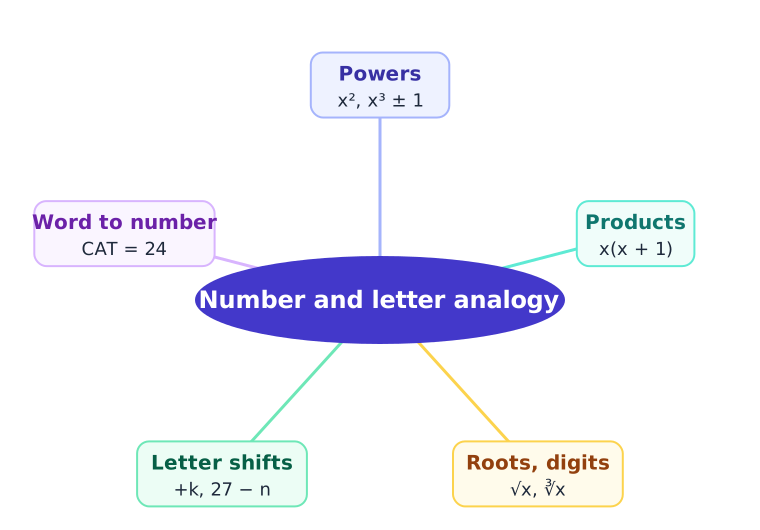
Concepts and terms
Two pairs linked by the same rule. The first pair shows the rule; the second pair uses it.
A short list of rules tried in a fixed order (powers, products, ×k ± c, roots, digits) so nothing is missed.
Each letter of the first cluster is changed by a rule (shift, opposite, reverse); the same change is made to the third cluster.

Did you know
SSC CGL and CHSL papers carry two or three analogy questions in almost every shift, and the number ones are nearly always built on squares and cubes.

Memory tricks
Order of rules — Square, Cube, Plus-minus, Product, Times — Try x², x³, then ±1 or ±2, then x(x ± 1), then ×k ± c.
Practice MCQs with answers (72)
- A 81
- B 83
- C 80
- D 82
Show answer
Why:
Rule: square plus 1. 6² + 1 = 37, so 9² + 1 = 82.
- A 170
- B 168
- C 169
- D 171
Show answer
Why:
Rule: square plus 1. 11² + 1 = 122, so 13² + 1 = 170.
- A 144
- B 143
- C 145
- D 146
Show answer
Why:
Rule: square minus 1. 8² − 1 = 63, so 12² − 1 = 143.
- A 289
- B 290
- C 288
- D 291
Show answer
Why:
Rule: square minus 1. 14² − 1 = 195, so 17² − 1 = 288.
- A 291
- B 288
- C 290
- D 289
Show answer
Why:
Rule: square of the number. 13² = 169, so 17² = 289.
- A 83
- B 81
- C 80
- D 82
Show answer
Why:
Rule: square plus 2. 5² + 2 = 27, so 9² + 2 = 83.
- A 344
- B 343
- C 336
- D 342
Show answer
Why:
Rule: cube of the number. 4³ = 64, so 7³ = 343.
- A 1727
- B 1729
- C 1728
- D 1716
Show answer
Why:
Rule: cube of the number. 9³ = 729, so 12³ = 1728.
- A 215
- B 210
- C 216
- D 217
Show answer
Why:
Rule: cube plus 1. 3³ + 1 = 28, so 6³ + 1 = 217.
- A 513
- B 504
- C 512
- D 511
Show answer
Why:
Rule: cube plus 1. 5³ + 1 = 126, so 8³ + 1 = 513.
- A 729
- B 728
- C 730
- D 720
Show answer
Why:
Rule: cube minus 1. 4³ − 1 = 63, so 9³ − 1 = 728.
- A 1000
- B 1001
- C 999
- D 990
Show answer
Why:
Rule: cube minus 1. 6³ − 1 = 215, so 10³ − 1 = 999.
- A 146
- B 145
- C 144
- D 156
Show answer
Why:
Rule: number × next number. 7 × 8 = 56, so 12 × 13 = 156.
- A 240
- B 227
- C 226
- D 225
Show answer
Why:
Rule: number × next number. 9 × 10 = 90, so 15 × 16 = 240.
- A 121
- B 110
- C 100
- D 120
Show answer
Why:
Rule: number × previous number. 8 × 7 = 56, so 11 × 10 = 110.
- A 82
- B 101
- C 100
- D 83
Show answer
Why:
Rule: square of the next number. (4 + 1)² = 25, so (9 + 1)² = 100.
- A 171
- B 170
- C 182
- D 196
Show answer
Why:
Rule: square of the next number. (7 + 1)² = 64, so (13 + 1)² = 196.
- A 196
- B 224
- C 225
- D 210
Show answer
Why:
Rule: square of the previous number. (6 − 1)² = 25, so (15 − 1)² = 196.
- A 217
- B 210
- C 215
- D 216
Show answer
Why:
Rule: cube minus the number. 4³ − 4 = 60, so 6³ − 6 = 210.
- A 124
- B 126
- C 150
- D 125
Show answer
Why:
Rule: square plus cube. 3² + 3³ = 36, so 5² + 5³ = 150.
- A 38
- B 36
- C 39
- D 37
Show answer
Why:
Rule: ×3, then +1. 7 × 3 + 1 = 22, so 12 × 3 + 1 = 37.
- A 37
- B 67
- C 38
- D 52
Show answer
Why:
Rule: ×2, then +3. 9 × 2 + 3 = 21, so 17 × 2 + 3 = 37.
- A 44
- B 43
- C 34
- D 25
Show answer
Why:
Rule: ×4, then −1. 6 × 4 − 1 = 23, so 11 × 4 − 1 = 43.
- A 15
- B 13
- C 14
- D 16
Show answer
Why:
Rule: square root. √144 = 12, so √196 = 14.
- A 10
- B 27
- C 18
- D 9
Show answer
Why:
Rule: cube root. ∛343 = 7, so ∛729 = 9.
- A 13
- B 40
- C 58
- D 14
Show answer
Why:
Rule: sum of the digits. 4 + 7 = 11, so 8 + 5 = 13.
- A 30
- B 28
- C 11
- D 27
Show answer
Why:
Rule: product of the digits. 3 × 6 = 18, so 4 × 7 = 28.
- A 49
- B 51
- C 50
- D 48
Show answer
Why:
Rule: square plus 1. 4² + 1 = 17, so 7² + 1 = 50.
- A 513
- B 504
- C 511
- D 512
Show answer
Why:
Rule: cube of the number. 5³ = 125, so 8³ = 512.
- A 132
- B 122
- C 121
- D 123
Show answer
Why:
Rule: number × next number. 5 × 6 = 30, so 11 × 12 = 132.
- A 8 : 66
- B 10 : 101
- C 12 : 143
- D 5 : 25
Show answer
Why:
7² + 1 = 50. Only 10 : 101 follows it: 10² + 1 = 101.
- A 6 : 217
- B 7 : 336
- C 5 : 124
- D 4 : 64
Show answer
Why:
3³ − 1 = 26. Only 5 : 124 follows it: 5³ − 1 = 124.
- A 11 : 121
- B 7 : 64
- C 8 : 65
- D 9 : 90
Show answer
Why:
6 × 7 = 42. Only 9 : 90 follows it: 9 × 10 = 90.
- A 11 : 120
- B 13 : 171
- C 6 : 36
- D 7 : 50
Show answer
Why:
9² − 1 = 80. Only 11 : 120 follows it: 11² − 1 = 120.
- A 3 : 26
- B 7 : 344
- C 4 : 63
- D 5 : 120
Show answer
Why:
2³ + 1 = 9. Only 7 : 344 follows it: 7³ + 1 = 344.
- A 10 : 101
- B 6 : 38
- C 8 : 81
- D 9 : 83
Show answer
Why:
(5 + 1)² = 36. Only 8 : 81 follows it: (8 + 1)² = 81.
- A 9 : 64
- B 11 : 25
- C 9 : 21
- D 13 : 40
Show answer
Why:
8 × 3 + 1 = 25. Only 13 : 40 follows it: 13 × 3 + 1 = 40.
- A 12 : 132
- B 10 : 81
- C 6 : 23
- D 9 : 80
Show answer
Why:
7 × 6 = 42. Only 12 : 132 follows it: 12 × 11 = 132.
- A (5, 2, 10)
- B (2, 5, 29)
- C (4, 5, 81)
- D (3, 6, 19)
Show answer
Why:
Third number = sum of the squares of the first two: 3² + 4² = 25. Similarly 2² + 5² = 29.
- A (3, 3, 18)
- B (4, 3, 13)
- C (4, 2, 36)
- D (3, 4, 25)
Show answer
Why:
Third number = square of the sum of the first two: (2 + 3)² = 25. Similarly (4 + 2)² = 36.
- A (5, 4, 41)
- B (2, 6, 16)
- C (3, 7, 21)
- D (6, 3, 19)
Show answer
Why:
Third number = product of the first two, plus 1: 4 × 5 + 1 = 21. Similarly 6 × 3 + 1 = 19.
- A (7, 2, 45)
- B (7, 3, 21)
- C (6, 2, 40)
- D (4, 3, 49)
Show answer
Why:
Third number = difference of the squares of the first two: 5² − 3² = 16. Similarly 7² − 2² = 45.
- A (4, 4, 32)
- B (6, 4, 20)
- C (3, 6, 81)
- D (2, 7, 14)
Show answer
Why:
Third number = twice the sum of the first two: 2 × (3 + 5) = 16. Similarly 2 × (6 + 4) = 20.
- A (2, 9, 20)
- B (3, 8, 24)
- C (5, 7, 30)
- D (6, 3, 24)
Show answer
Why:
Third number = product of the first two, minus the first: 4 × 6 − 4 = 20. Similarly 5 × 7 − 5 = 30.
- A HKL
- B IJL
- C GJL
- D HJL
Show answer
Why:
Every letter moves +1: A→B, C→D, E→F. So G→H, I→J, K→L.
- A NPR
- B OPR
- C MPR
- D NQR
Show answer
Why:
Every letter moves +3. K + 3 = N, M + 3 = P, O + 3 = R.
- A ABC
- B UVW
- C VVW
- D TVW
Show answer
Why:
Every letter moves −3. X − 3 = U, Y − 3 = V, Z − 3 = W.
- A IJ
- B GJ
- C HJ
- D HK
Show answer
Why:
First letter +2, second letter +3: F + 2 = H, G + 3 = J.
- A NO
- B LO
- C MP
- D MO
Show answer
Why:
First letter +1, second letter +2: L + 1 = M, M + 2 = O.
- A T
- B U
- C S
- D N
Show answer
Why:
D and W are opposite letters (4 + 23 = 27). The opposite of G (7) is 20 = T.
- A SRPQ
- B SRQP
- C TRQP
- D RRQP
Show answer
Why:
The letters are written in reverse order.
- A GOD
- B IPE
- C HPE
- D EPH
Show answer
Why:
Reverse the word (CAT → TAC), then move each letter +1 (UBD). DOG → GOD → HPE.
- A YZY
- B WZY
- C YZX
- D XZY
Show answer
Why:
Each letter is replaced by its opposite: B–Y, A–Z, D–W. So C–X, A–Z, B–Y.
- A TUBS
- B TVBS
- C UUBS
- D SUBS
Show answer
Why:
Every letter moves +1.
- A CW
- B DW
- C DX
- D EW
Show answer
Why:
First letter +1, second letter −1: C + 1 = D, X − 1 = W.
- A PNRD
- B SPTF
- C QNRD
- D RNRD
Show answer
Why:
Every letter moves −1.
- A PKQ
- B QJO
- C RKQ
- D QKQ
Show answer
Why:
The letters move +1, +2, +3: P + 1 = Q, I + 2 = K, N + 3 = Q.
- A YRT
- B CJH
- C ZRT
- D TRY
Show answer
Why:
Opposite letters: F–U, A–Z, N–M. So B–Y, I–R, G–T.
- A 55
- B 26
- C 27
- D 25
Show answer
Why:
Add the positions of the letters: CAT → 3 + 1 + 20 = 24. So DOG → 4 + 15 + 7 = 26.
- A 42
- B 40
- C 39
- D 38
Show answer
Why:
Add the positions of the letters: BAT → 2 + 1 + 20 = 23. So RAT → 18 + 1 + 20 = 39.
- A 12
- B 70
- C 68
- D 69
Show answer
Why:
Add the reverse positions (Z = 1) of the letters: ACE → 26 + 24 + 22 = 72. So BDF → 25 + 23 + 21 = 69.
- A 82
- B 41
- C 40
- D 83
Show answer
Why:
Add the positions of the letters and double the sum: AND → (1 + 14 + 4) × 2 = 38. So BOX → (2 + 15 + 24) × 2 = 82.
- A 51
- B 57
- C 58
- D 56
Show answer
Why:
Add the positions of the letters: SUN → 19 + 21 + 14 = 54. So MOON → 13 + 15 + 15 + 14 = 57.
- A 67
- B 65
- C 66
- D 15
Show answer
Why:
Add the reverse positions (Z = 1) of the letters: CAB → 24 + 26 + 25 = 75. So FED → 21 + 22 + 23 = 66.
- A Find a rule that changes A into C
- B Pick the largest option
- C Add A and B and apply the total to C
- D Find the rule that changes A into B
Show answer
Why:
The first pair shows the rule; the same rule is applied to C.
- A 37
- B 38
- C 35
- D 36
Show answer
Why:
Square + 1 gives 37 and ×2 + 1 gives 13. Only 37 is among the options, so the answer is 37.
- A Each letter is replaced by its opposite
- B The order of the letters is reversed
- C The letters move +1, +2, +3, +4
- D Each letter moves +3
Show answer
Why:
The same four letters appear, last first: a reversal.
- A The second letter is 19 places after the first
- B Both are vowels
- C Their positions add up to 27 (opposite letters)
- D Their positions differ by 13
Show answer
Why:
D (4) + W (23) = 27 and G (7) + T (20) = 27. A fixed shift would not work for both: 19 for D but 13 for G.
- A Both A and R are true, and R is the correct explanation of A
- B Both A and R are true, but R is not the correct explanation of A
- C A is true but R is false
- D A is false but R is true
Show answer
Why:
8³ = 512 and 11³ = 1331, so A is true and R is its reason.
- A Both A and R are true, and R is the correct explanation of A
- B Both A and R are true, but R is not the correct explanation of A
- C A is true but R is false
- D A is false but R is true
Show answer
Why:
5² − 1 = 24, so R is true. Then 7 → 7² − 1 = 48, not 49, so A is false.
- A 1 only
- B 2 only
- C Both 1 and 2
- D Neither 1 nor 2
Show answer
Why:
9² − 1 = 80 and 12² − 1 = 143. Both true.
- A 1 only
- B 2 only
- C Both 1 and 2
- D Neither 1 nor 2
Show answer
Why:
C + A + T = 3 + 1 + 20 = 24 uses forward positions; DOG = 4 + 15 + 7 = 26. Only 1.
Important short questions (3)
7³ = 343 and 343 + 1 = 344: cube + 1. So 9³ + 1 = 730.
Every letter +1, so TAKE → UBLF.
6² − 2² = 36 − 4 = 32, so a² − b².
Long answer questions (1)
Rule 1: square + 1 (3² + 1 = 10) gives 8² + 1 = 65.
Rule 2: ×3 + 1 (3 × 3 + 1 = 10) gives 8 × 3 + 1 = 25.
If only one of 65 and 25 is among the options, that one is the key. Options such as 64, 65, 66, 63 make 65 the only answer.
Flashcards (12)
Play this topic
- Rule check
Word Analogy
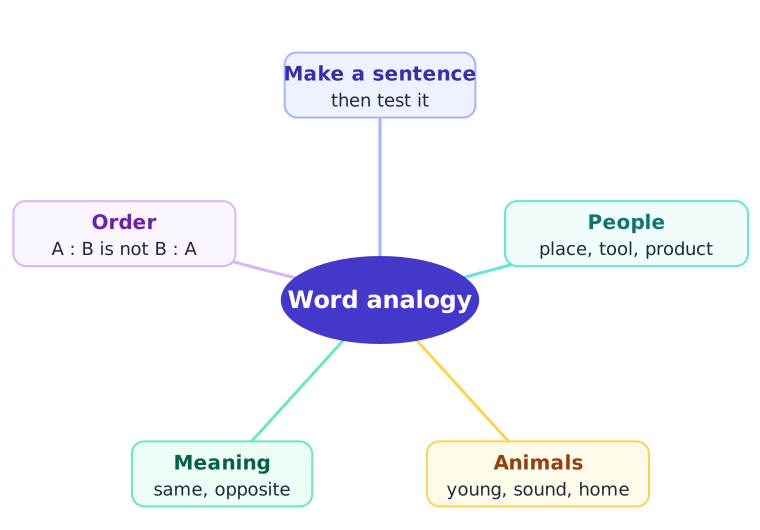
Find the relation between two words by turning it into a short sentence, then pick the word or pair that fits the same sentence: worker and workplace or tool, animal and young one, sound or home, country and capital, instrument and measure, synonyms and antonyms, part and whole, raw material and product, maker and product.
What you will be able to do
- I can state the relation in a word pair as one exact sentence.
- I can recognise the twelve common relation types used in exams.
- I can complete A : B :: C : ? and A : B :: ? : D.
- I can choose the pair with the same relation, keeping the order of the words.
- I can avoid traps such as a reversed pair, a synonym in an antonym question, or a famous city in place of a capital.
Key points
Turn the first pair into a sentence ("a doctor works in a hospital") and test each option in the same sentence.
If two options fit, make the sentence more exact.
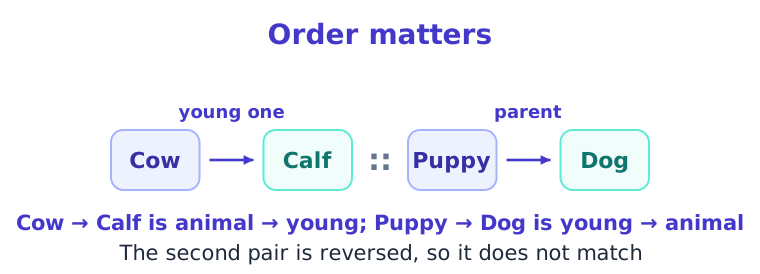
Order matters: Cow : Calf is animal → young, so Calf : Cow is a different relation.
One word can have many partners: a farmer works in a field and uses a plough. Use the relation of the first pair.
In antonym questions, a synonym of the word is the usual trap; in synonym questions, the antonym is.
Capitals are not always the biggest city: Australia → Canberra, not Sydney.
In "choose the pair" questions, the right pair has the same relation in the same direction.
Full explanation
Meera's word puzzle

Meera's mock test shows: Doctor : Hospital :: Farmer : ? The options are Plough, Field, Crop and Court. Plough feels right because farmers use ploughs. But is that the same relation?
Say it as a sentence
Turn the first pair into a short, exact sentence: "a doctor works in a hospital". Now put the third word in: "a farmer works in a ___". Only Field fits. Plough is the farmer's tool, a different relation.
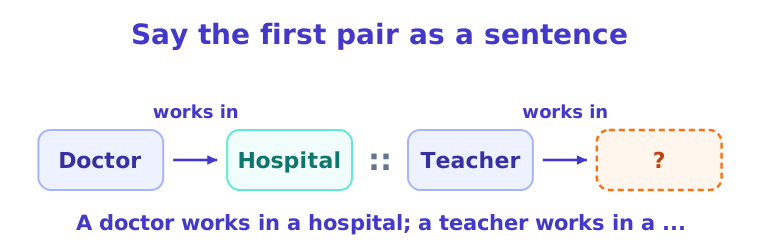
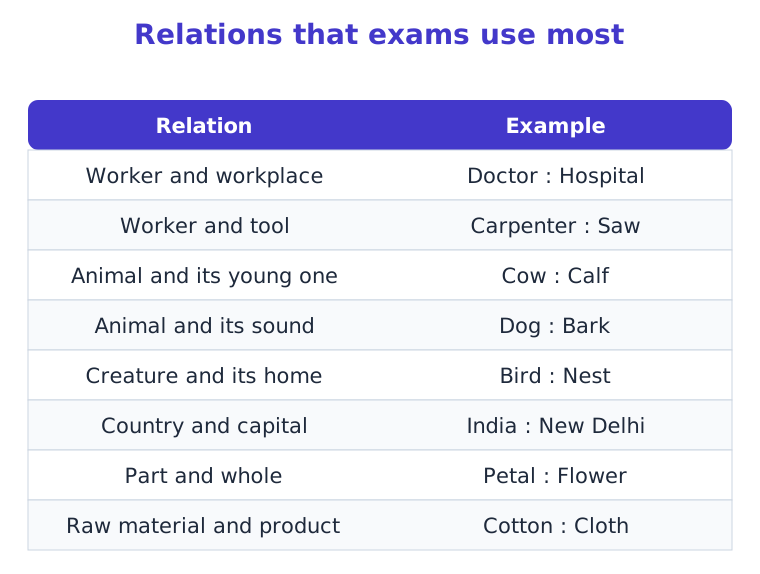
Relations exams love
Most word analogies use a short list of relations. Learn them as families: people (workplace, tool, product), animals (young one, sound, home), places (capital), science (instrument), meaning (synonym, antonym), things (part and whole, raw material and product).
Order matters
Cow : Calf means animal → young one. Puppy : Dog is young one → animal, the reverse. In "choose the pair" questions a reversed pair is the most common trap.
Many partners, one relation
A bee lives in a hive, makes honey and buzzes. In Bird : Nest :: Bee : ?, the relation is "lives in", so the answer is Hive, not Honey.
Same and opposite meanings
In Hot : Cold :: Rich : ?, the words are opposites, so the answer is Poor. Wealthy is the trap: it means the same as rich. In synonym questions the trap is the opposite word.
Capitals and other facts
India : New Delhi :: Australia : ? The answer is Canberra. Sydney is bigger and better known, which is exactly why it appears as an option.
Choosing the right pair
For "Select the pair related as Petal : Flower", test each option with "a ___ is part of a ___". Page : Book fits; Book : Page is reversed; Pen : Writer is a different relation.
Back to Meera
Meera says the sentence in her head, "a farmer works in a field", ticks Field, and moves on. Two seconds, no doubt.
Concepts and terms
A short sentence that links the two words, such as "a bee lives in a hive". The answer must fit the same sentence.
Most relations go one way: animal → young, part → whole. Swapping the words changes the relation.
People (workplace, tool, product), animals (young one, sound, home), places (capital), science (instrument), meaning (same, opposite), things (part, raw material).
Did you know
Bank and SSC papers in Hindi set word analogies with Hindi words, often synonyms and antonyms from the Hindi grammar syllabus, so the same skill is tested in both languages.
Memory tricks
Solving steps — Say it, Swap it, Check it — Say the pair as a sentence, swap in the third word, check every option in that sentence.
Practice MCQs with answers (78)
- A Temple
- B School
- C Field
- D Kitchen
Show answer
Why:
Relation: worker and workplace. Just as a doctor works in a hospital, a teacher works in a school.
- A Kitchen
- B Temple
- C Court
- D Stage
Show answer
Why:
Relation: worker and workplace. Just as a farmer works in a field, a judge works in a court.
- A Temple
- B Stage
- C Ship
- D Laboratory
Show answer
Why:
Relation: worker and workplace. Just as a chef works in a kitchen, a scientist works in a laboratory.
- A Needle
- B Clothes
- C Brush
- D Pen
Show answer
Why:
Relation: worker and tool. Just as a carpenter works with a saw, a tailor works with a needle.
- A Field
- B Plough
- C Pen
- D Hammer
Show answer
Why:
Relation: worker and tool. Just as a painter works with a brush, a farmer works with a plough.
- A Net
- B Gun
- C Razor
- D Hammer
Show answer
Why:
Relation: worker and tool. Just as a writer works with a pen, a barber works with a razor.
- A Foal
- B Tadpole
- C Bark
- D Puppy
Show answer
Why:
Relation: animal and its young one. Just as the young one of a cow is a calf, the young one of a dog is a puppy.
- A Chick
- B Tadpole
- C Lamb
- D Cub
Show answer
Why:
Relation: animal and its young one. Just as the young one of a horse is a foal, the young one of a hen is a chick.
- A Lamb
- B Cub
- C Roar
- D Den
Show answer
Why:
Relation: animal and its young one. Just as the young one of a frog is a tadpole, the young one of a lion is a cub.
- A Cub
- B Den
- C Roar
- D Neigh
Show answer
Why:
Relation: animal and its sound. Just as the sound of a dog is called a bark, the sound of a lion is called a roar.
- A Buzz
- B Croak
- C Hiss
- D Trumpet
Show answer
Why:
Relation: animal and its sound. Just as the sound of a horse is called a neigh, the sound of an elephant is called a trumpet.
- A Bray
- B Croak
- C Bark
- D Buzz
Show answer
Why:
Relation: animal and its sound. Just as the sound of a snake is called a hiss, the sound of a donkey is called a bray.
- A Cub
- B Den
- C Roar
- D Hive
Show answer
Why:
Relation: creature and its home. Just as a bird lives in a nest, a lion lives in a den.
- A Foal
- B Neigh
- C Stable
- D Web
Show answer
Why:
Relation: creature and its home. Just as a bee lives in a hive, a horse lives in a stable.
- A Moo
- B Burrow
- C Calf
- D Shed
Show answer
Why:
Relation: creature and its home. Just as a spider lives in a web, a cow lives in a shed.
- A Tokyo
- B Beijing
- C Osaka
- D Paris
Show answer
Why:
Relation: country and capital. Just as New Delhi is the capital of India, Tokyo is the capital of Japan.
- A Cairo
- B Kathmandu
- C Pokhara
- D Beijing
Show answer
Why:
Relation: country and capital. Just as Paris is the capital of France, Kathmandu is the capital of Nepal.
- A Saint Petersburg
- B Cairo
- C Moscow
- D Canberra
Show answer
Why:
Relation: country and capital. Just as Beijing is the capital of China, Moscow is the capital of Russia.
- A Voltage
- B Electric current
- C Earthquakes
- D Air pressure
Show answer
Why:
Relation: instrument and what it measures. Just as a thermometer measures temperature, a barometer measures air pressure.
- A Humidity
- B Purity of milk
- C Earthquakes
- D Voltage
Show answer
Why:
Relation: instrument and what it measures. Just as an ammeter measures electric current, a hygrometer measures humidity.
- A Purity of milk
- B Wind speed
- C Temperature
- D Voltage
Show answer
Why:
Relation: instrument and what it measures. Just as a seismograph measures earthquakes, an anemometer measures wind speed.
- A End
- B Bold
- C Start
- D Quiet
Show answer
Why:
Relation: words with the same meaning. Just as big and large mean the same, begin and start mean the same.
- A Glad
- B Accuracy
- C Quiet
- D Mistake
Show answer
Why:
Relation: words with the same meaning. Just as brave and bold mean the same, error and mistake mean the same.
- A Rich
- B Poor
- C Glad
- D Swift
Show answer
Why:
Relation: words with the same meaning. Just as silent and quiet mean the same, wealthy and rich mean the same.
- A Decrease
- B Poor
- C Wealthy
- D Defeat
Show answer
Why:
Relation: words with opposite meanings. Just as hot and cold are opposites, rich and poor are opposites.
- A Decrease
- B Dark
- C Modern
- D Old
Show answer
Why:
Relation: words with opposite meanings. Just as victory and defeat are opposites, ancient and modern are opposites.
- A Despair
- B Companion
- C Dark
- D Enemy
Show answer
Why:
Relation: words with opposite meanings. Just as increase and decrease are opposites, friend and enemy are opposites.
- A Book
- B Tree
- C House
- D Cart
Show answer
Why:
Relation: part and whole. Just as a petal is part of a flower, a page is part of a book.
- A Army
- B Hand
- C Tree
- D House
Show answer
Why:
Relation: part and whole. Just as a wheel is part of a cart, a finger is part of a hand.
- A Army
- B Flower
- C Wall
- D House
Show answer
Why:
Relation: part and whole. Just as a leaf is part of a tree, a brick is part of a wall.
- A Flour
- B Raisins
- C Paper
- D Curd
Show answer
Why:
Relation: raw material and product. Just as cloth is made from cotton, curd is made from milk.
- A Pot
- B Ornament
- C Paper
- D Flour
Show answer
Why:
Relation: raw material and product. Just as raisins is made from grapes, pot is made from clay.
- A Flour
- B Sugar
- C Ornament
- D Cloth
Show answer
Why:
Relation: raw material and product. Just as paper is made from wood, sugar is made from sugarcane.
- A Ornament
- B Pot
- C Poem
- D Statue
Show answer
Why:
Relation: maker and product. Just as an author makes book, a poet makes poem.
- A Hive
- B Statue
- C Buzz
- D Honey
Show answer
Why:
Relation: maker and product. Just as a potter makes pot, a bee makes honey.
- A Shoes
- B Book
- C Ornament
- D Furniture
Show answer
Why:
Relation: maker and product. Just as a sculptor makes statue, a cobbler makes shoes.
- A Teacher
- B Astronomer
- C Actor
- D Sailor
Show answer
Why:
Relation: worker and workplace. Just as a priest works in a temple, an astronomer works in an observatory.
- A Tailor
- B Fisherman
- C Woodcutter
- D Soldier
Show answer
Why:
Relation: worker and tool. Just as a blacksmith works with a hammer, a woodcutter works with an axe.
- A Horse
- B Tiger
- C Cow
- D Butterfly
Show answer
Why:
Relation: animal and its young one. Just as the young one of a sheep is a lamb, the young one of a butterfly is a caterpillar.
- A Pig
- B Bee
- C Eskimo
- D Bird
Show answer
Why:
Relation: creature and its home. Just as a rabbit lives in a burrow, a pig lives in a sty.
- A Australia
- B Bangladesh
- C India
- D France
Show answer
Why:
Relation: country and capital. Just as Cairo is the capital of Egypt, Dhaka is the capital of Bangladesh.
- A Thermometer
- B Ammeter
- C Odometer
- D Lactometer
Show answer
Why:
Relation: instrument and what it measures. Just as a voltmeter measures voltage, an odometer measures distance.
- A Gold
- B Cotton
- C Cobbler
- D Leather
Show answer
Why:
Relation: raw material and product. Just as flour is made from wheat, shoes is made from leather.
- A Weaver
- B Carpenter
- C Author
- D Cotton
Show answer
Why:
Relation: maker and product. Just as a goldsmith makes ornament, a weaver makes cloth.
- A Field : Farmer
- B Soldier : Barracks
- C Poet : Poem
- D Writer : Pen
Show answer
Why:
Relation: worker and workplace; an actor works in a stage, and a soldier works in a barracks. Check the order too: a reversed pair does not match.
- A Hammer : Blacksmith
- B Sculptor : Statue
- C Doctor : Stethoscope
- D Judge : Court
Show answer
Why:
Relation: worker and tool; a fisherman works with a net, and a doctor works with a stethoscope. Check the order too: a reversed pair does not match.
- A Horse : Neigh
- B Tadpole : Frog
- C Lion : Den
- D Deer : Fawn
Show answer
Why:
Relation: animal and its young one; the young one of a tiger is a cub, and the young one of a deer is a fawn. Check the order too: a reversed pair does not match.
- A Cow : Moo
- B Cow : Calf
- C Trumpet : Elephant
- D Bee : Hive
Show answer
Why:
Relation: animal and its sound; the sound of a frog is called a croak, and the sound of a cow is called a moo. Check the order too: a reversed pair does not match.
- A Bee : Honey
- B Monk : Monastery
- C Hen : Chick
- D Hive : Bee
Show answer
Why:
Relation: creature and its home; an eskimo lives in an igloo, and a monk lives in a monastery. Check the order too: a reversed pair does not match.
- A Scientist : Laboratory
- B Room : House
- C Bhutan : Thimphu
- D Beijing : China
Show answer
Why:
Relation: country and capital; Canberra is the capital of Australia, and Thimphu is the capital of Bhutan. Check the order too: a reversed pair does not match.
- A Humidity : Hygrometer
- B Painter : Brush
- C Astronomer : Observatory
- D Speedometer : Speed
Show answer
Why:
Relation: instrument and what it measures; a lactometer measures purity of milk, and a speedometer measures speed. Check the order too: a reversed pair does not match.
- A Little : Small
- B Page : Book
- C Ancient : Modern
- D Light : Dark
Show answer
Why:
Relation: words with the same meaning; rapid and swift mean the same, and little and small mean the same. Check the order too: a reversed pair does not match.
- A Silent : Quiet
- B Expand : Shrink
- C Lion : Cub
- D Brave : Bold
Show answer
Why:
Relation: words with opposite meanings; hope and despair are opposites, and expand and shrink are opposites. Check the order too: a reversed pair does not match.
- A Wood : Paper
- B Woodcutter : Axe
- C Chapter : Book
- D Hand : Finger
Show answer
Why:
Relation: part and whole; a soldier is part of an army, and a chapter is part of a book. Check the order too: a reversed pair does not match.
- A Leaf : Tree
- B Curd : Milk
- C Potter : Pot
- D Wool : Sweater
Show answer
Why:
Relation: raw material and product; ornament is made from gold, and sweater is made from wool. Check the order too: a reversed pair does not match.
- A Tailor : Clothes
- B Doctor : Stethoscope
- C Wheat : Flour
- D Shoes : Cobbler
Show answer
Why:
Relation: maker and product; a carpenter makes furniture, and a tailor makes clothes. Check the order too: a reversed pair does not match.
- A Rabbit : Burrow
- B France : Paris
- C Canberra : Australia
- D Barometer : Air pressure
Show answer
Why:
Relation: country and capital; Tokyo is the capital of Japan, and Paris is the capital of France. Check the order too: a reversed pair does not match.
- A Caterpillar : Butterfly
- B Pig : Sty
- C Sheep : Lamb
- D Donkey : Bray
Show answer
Why:
Relation: animal and its young one; the young one of a dog is a puppy, and the young one of a sheep is a lamb. Check the order too: a reversed pair does not match.
- A Country and capital
- B Part and whole
- C Animal and its young one
- D Instrument and what it measures
Show answer
Why:
A seismograph measures earthquakes.
- A Raw material and product
- B Worker and tool
- C Instrument and what it measures
- D Maker and product
Show answer
Why:
Sugar is made from sugarcane.
- A Country and capital
- B Maker and product
- C Part and whole
- D Raw material and product
Show answer
Why:
A poet makes poem.
- A Worker and tool
- B Words with opposite meanings
- C Animal and its sound
- D Maker and product
Show answer
Why:
The sound of a bee is called a buzz.
- A Worker and tool
- B Words with the same meaning
- C Words with opposite meanings
- D Part and whole
Show answer
Why:
A room is part of a house.
- A Country and capital
- B Instrument and what it measures
- C Worker and workplace
- D Words with the same meaning
Show answer
Why:
Thimphu is the capital of Bhutan.
- A Caterpillar
- B Lamb
- C Fawn
- D Puppy
Show answer
Why:
Relation: animal and its young one. Just as the young one of a hen is a chick, the young one of a sheep is a lamb.
- A Foal
- B Neigh
- C Stable
- D Web
Show answer
Why:
Relation: creature and its home. Just as a bird lives in a nest, a horse lives in a stable.
- A Bray
- B Coo
- C Moo
- D Hiss
Show answer
Why:
Relation: animal and its sound. Just as the sound of a lion is called a roar, the sound of a snake is called a hiss.
- A School, Court
- B School, Kitchen
- C Kitchen, Temple
- D Field, Court
Show answer
Why:
Both pairs must show the same relation (worker and workplace): Teacher : School and Judge : Court.
- A Stable, Shed
- B Stable, Web
- C Neigh, Sty
- D Foal, Web
Show answer
Why:
Both pairs must show the same relation (creature and its home): Horse : Stable and Spider : Web.
- A Saint Petersburg, Cairo
- B Moscow, Alexandria
- C Moscow, Cairo
- D Cairo, Dhaka
Show answer
Why:
Both pairs must show the same relation (country and capital): Russia : Moscow and Egypt : Cairo.
- A Razor, Gun
- B Plough, Axe
- C Brush, Net
- D Brush, Axe
Show answer
Why:
Both pairs must show the same relation (worker and tool): Painter : Brush and Woodcutter : Axe.
- A State the relation of the first pair as an exact sentence
- B Look for words with the same first letter
- C Count the letters in each word
- D Pick the option that sounds most familiar
Show answer
Why:
A bridge sentence ("a doctor works in a hospital") can be tested on every option; a vague feeling cannot.
- A Calf and Cow are not related
- B The order is reversed: young → animal instead of animal → young
- C Calf is a synonym of Cow
- D Both pairs are the same relation
Show answer
Why:
Relations have a direction. Swapping the two words turns animal → young into young → animal.
- A Melbourne
- B Perth
- C Canberra
- D Sydney
Show answer
Why:
New Delhi is the capital of India, and Canberra is the capital of Australia. Sydney and Melbourne are bigger, but they are not the capital.
- A Both A and R are true, and R is the correct explanation of A
- B Both A and R are true, but R is not the correct explanation of A
- C A is true but R is false
- D A is false but R is true
Show answer
Why:
A bird lives in a nest and a bee lives in a hive: same relation, and R states it.
- A Both A and R are true, and R is the correct explanation of A
- B Both A and R are true, but R is not the correct explanation of A
- C A is true but R is false
- D A is false but R is true
Show answer
Why:
R is true, but Rich and Wealthy mean the same, so the second pair is not opposite. A is false.
- A 1 only
- B 2 only
- C Both 1 and 2
- D Neither 1 nor 2
Show answer
Why:
The relation is "works in": Field. Plough is the farmer's tool, a different relation. Only 1.
- A 1 only
- B 2 only
- C Both 1 and 2
- D Neither 1 nor 2
Show answer
Why:
Instrument → what it measures fits the first two pairs. Speed : Speedometer is reversed. Only 1.
Important short questions (3)
Axe. "A tailor works with a needle; a woodcutter works with an axe."
The relation is "lives in"; a bee lives in a hive. Honey is what a bee makes, a different relation.
Foal, tadpole, fawn.
Long answer questions (1)
Reversed pair: for Petal : Flower, Book : Page is reversed; the sentence "a ___ is part of a ___" fails for it.
Wrong relation: in Doctor : Hospital :: Farmer : ?, Plough is the farmer's tool; the sentence "works in" picks Field.
Synonym trap: in Hot : Cold :: Rich : ?, Wealthy means the same as rich; the sentence "are opposites" picks Poor.
Flashcards (12)
Play this topic
- Pair check
Veda Skills Logical Reasoning Unit 3 — frequently asked questions
7³ = 343 and 343 + 1 = 344: cube + 1. So 9³ + 1 = 730.
Every letter +1, so TAKE → UBLF.
6² − 2² = 36 − 4 = 32, so a² − b².
Axe. "A tailor works with a needle; a woodcutter works with an axe."
The relation is "lives in"; a bee lives in a hive. Honey is what a bee makes, a different relation.
Foal, tadpole, fawn.

All Veda Skills Logical Reasoning units
Study this chapter properly, free
Everything above is on this page to read. In the Veda app the same chapter becomes spaced-repetition flashcards, timed tests that mark themselves, Veda Bites you can swipe, and games — with your progress tracked topic by topic.
Get Veda free