Veda Skills Logical Reasoning Unit 19: Practice Papers and Mock Tests
- 2 topics
- 144 MCQs
- 8 short answers
- 2 long answers
- 28 flashcards
- 2 games
- ~100 min read
- English
Checked before publishing: 23 automated checks, including a plagiarism check against the textbook's own words. How we check our content
Exam Strategy for the Reasoning Section
Plan a reasoning section like a topper: budget the seconds, attack in three rounds (one-liners, draw-and-solve, one puzzle set), choose the puzzle set that gives the most questions per minute, strike out options before solving, and avoid the seven common traps.
What you will be able to do
- I can work out the time budget per question for any section.
- I can sort reasoning questions into three rounds and attempt them in that order.
- I can choose the best puzzle set by questions per minute.
- I can strike out options by gender, size, first letter and contradiction.
- I can decide when a guess is worth it under negative marking.

Key points
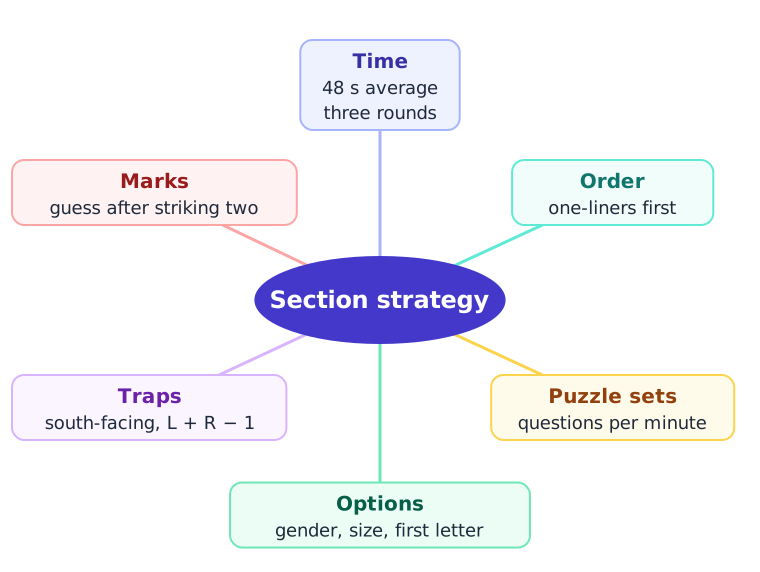
Time per question = total seconds ÷ number of questions; 25 questions in 20 minutes is 48 seconds each.
Bank prelims usually give about 35 reasoning questions in 20 minutes, close to 34 seconds each; always check your own exam notice.
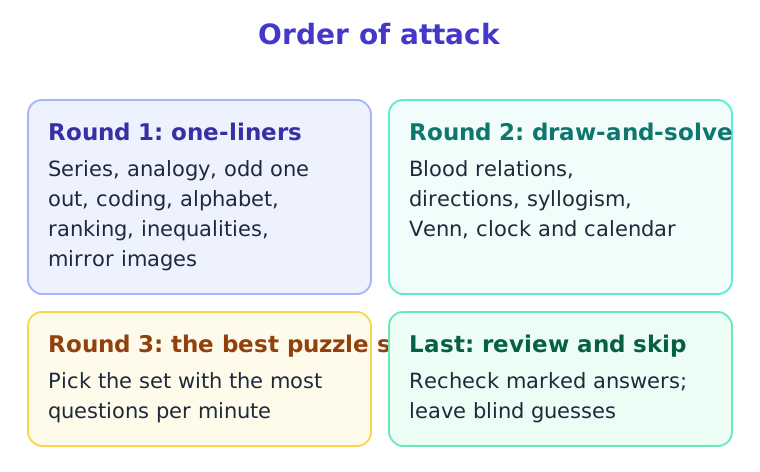
Round 1: one-liners (series, analogy, coding, alphabet, inequalities). Round 2: draw-and-solve (relations, directions, syllogism). Round 3: one puzzle set.
Choose the puzzle set with the most questions per minute: fewer people, one direction of facing, one variable, definite clues.
If you cannot fix two people of a puzzle in two minutes, leave the set and move on.
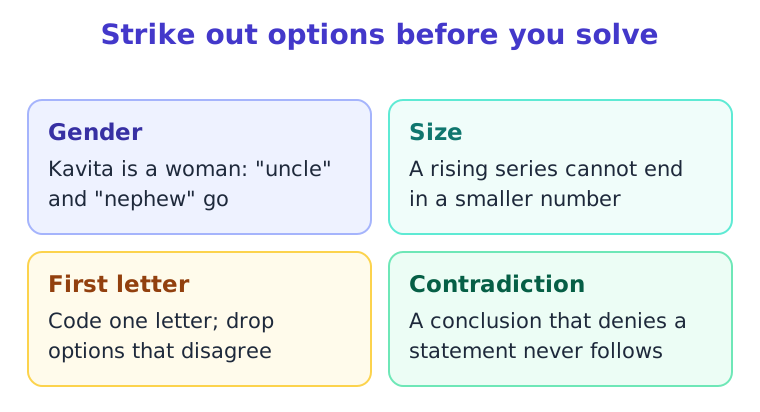
Strike out options first: the wrong gender, a smaller next term in a rising series, a code whose first letter disagrees.
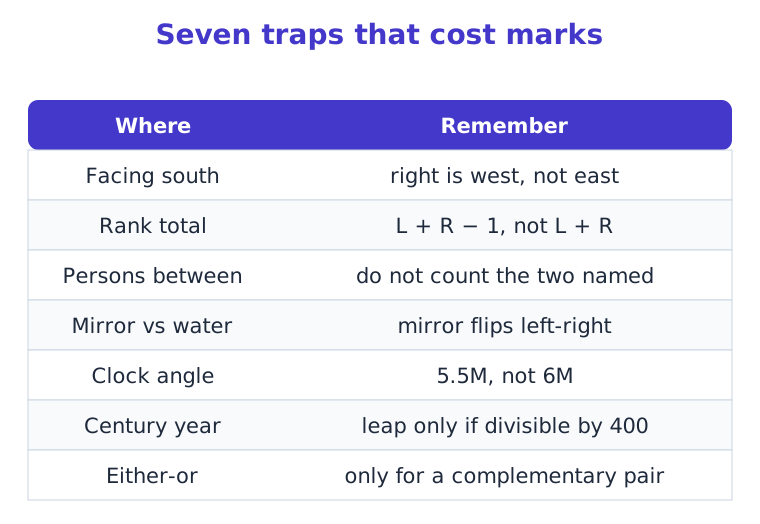
A conclusion that contradicts a statement never follows; "either-or" is right only for a complementary pair.
Under −0.25 marking a blind guess among four gains on average only 0.0625 marks; strike out two options before guessing.
Total in a row = L + R − 1; persons between two people exclude both of them.
Full explanation
Twenty minutes, twenty-five questions
Ritu knew every chapter of reasoning. In her first full mock she opened with a circular seating puzzle of eight people, spent seven minutes on it, and still had six one-liners untouched when the time ended. She scored 14 out of 25.
The questions were not too hard. The order was wrong. This topic is about the order.
Know your clock
Start every paper by finding your budget: total seconds ÷ number of questions.
- Mocks in this kit: 25 questions in 1200 seconds, so 48 seconds each.
- Bank prelims: about 35 reasoning questions in 20 minutes, so about 34 seconds each.
- SSC CGL Tier 1: 100 questions in 60 minutes for four parts, so 36 seconds each on average.
The budget is an average. A series question takes 20 seconds; a puzzle question takes 80. Patterns change, so check the notice of your own exam.
A plan for every mock
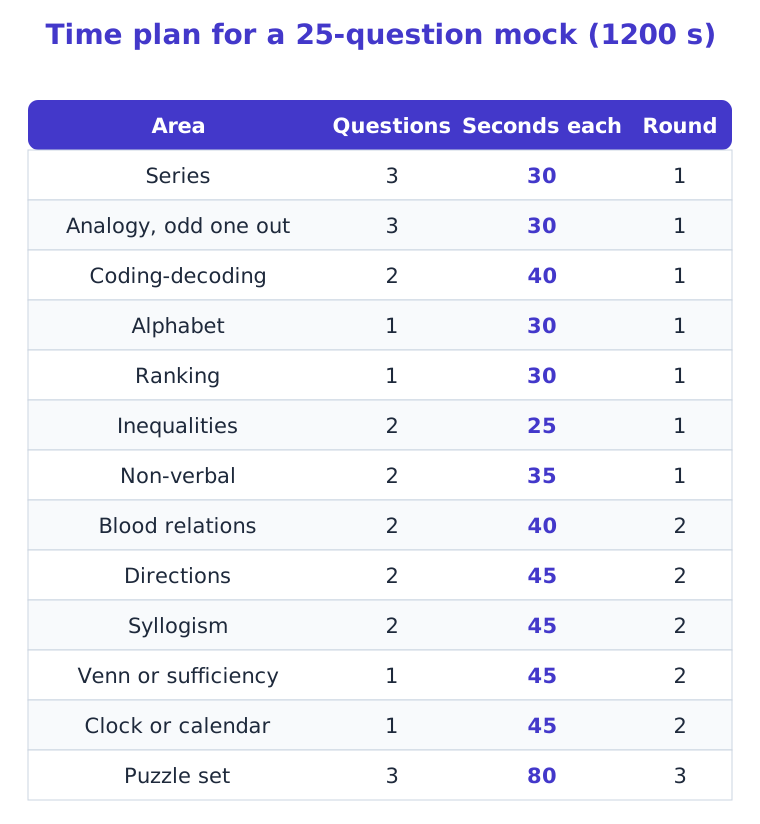
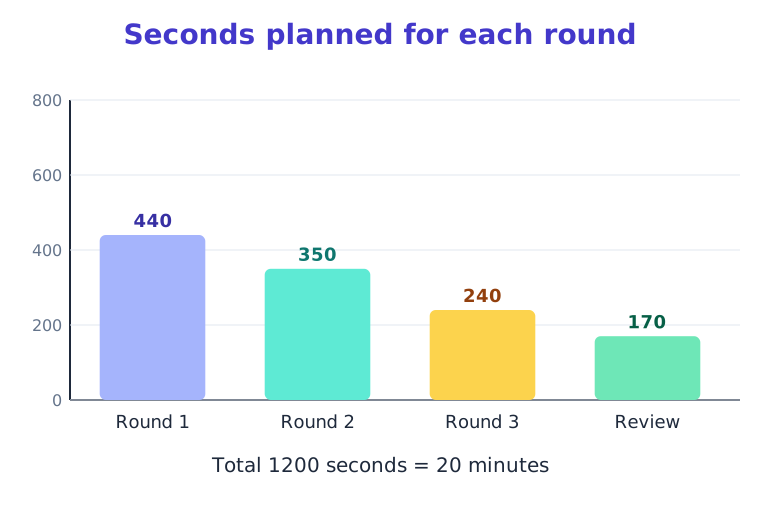
The table splits a 25-question mock by area. The planned times add up to 1030 seconds, which leaves 170 seconds to recheck marked answers.
Three rounds
Read the paper once from top to bottom and sort as you go.
- Round 1, one-liners (14 questions): answer at sight.
- Round 2, draw-and-solve (8 questions): a small tree, path or Venn diagram.
- Round 3, one puzzle set (3 questions): only after rounds 1 and 2.
If a one-liner takes more than a minute, mark it and move on.
Which puzzle set first?
A bank paper may offer three or four sets. You need one or two, so choose.
- Fewer people and one variable (only seats, or only floors) are faster.
- A row facing one way is faster than a circle with mixed facing.
- Definite clues ("Asha sits third to the right of Om") fix seats; negative clues ("Om does not sit at an end") only remove cases.
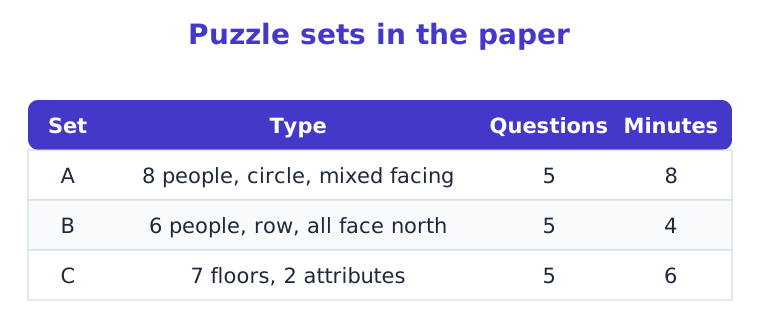
Then compare questions per minute = questions ÷ minutes needed.
Worked example: choosing the set
In the table, set A gives 5 questions in 8 minutes, $5 \div 8=0.625$ per minute. Set B gives $5 \div 4=1.25$ per minute. Set C gives $5 \div 6\approx 0.83$ per minute.
Take set B first. If time is left, take set C. Leave set A: eight people in a circle with mixed facing is the slowest kind.
Strike out before you solve
You need the right option, not always the full working. One quick check often removes two options.
Worked example: elimination
"Pointing to Kavita, Mohan said, she is my father's only son's daughter." Options: uncle, daughter, sister, nephew.
Kavita is a woman, so "uncle" and "nephew" go at once. My father's only son is Mohan himself, so Kavita is his daughter. Two options were gone in two seconds.
Seven traps
Most lost marks in reasoning are not hard questions. They are the same few slips, again and again.
Negative marking
With $+1$ for right and $-0.25$ for wrong, the expected gain of a guess among $n$ options is $\frac{1}{n}-0.25\times\frac{n-1}{n}$.
- No option struck out ($n=4$): $0.25-0.1875=0.0625$, almost nothing.
- Two struck out ($n=2$): $0.5-0.125=0.375$, worth it.
So never guess blind; strike out two options first, then guess.
Ritu's next mock
In her next mock Ritu finished the one-liners in seven minutes, the draw-and-solve questions in six, and then chose the six-person row puzzle over the circle. She left two questions she could not narrow down. Her score went from 14 to 21, with the same knowledge and a better order.
Concepts and terms
Total seconds divided by the number of questions. It is an average: one-liners take less, puzzle sets take more.
Collect the quick marks first, then the questions that need a small drawing, and only then one puzzle set.
For a puzzle set, divide the number of questions by the minutes it will take. Attempt the set with the highest value.
With n options left: right marks ÷ n minus wrong marks × (n − 1) ÷ n. Striking out options raises it quickly.

Did you know
In many bank prelims the cut-off for reasoning is crossed by solving the one-liners and one good puzzle set accurately; attempting every set is rarely needed.

Memory tricks
Order of attack — Line, Draw, Set — One-liners first, then draw-and-solve, then one puzzle set.
Choosing a set — Few, Straight, Sure — Few people, a straight row facing one way, sure (definite) clues.
Practice MCQs with answers (48)
- A 54
- B 48
- C 80
- D 75
Show answer
Why:
20 minutes = 1200 seconds; 1200 ÷ 25 = 48.
- A 40
- B 57
- C 34
- D 105
Show answer
Why:
20 minutes = 1200 seconds; 1200 ÷ 35 = 34.3, about 34 seconds.
- A 50
- B 120
- C 36
- D 30
Show answer
Why:
15 minutes = 900 seconds; 900 ÷ 30 = 30.
- A 45
- B 51
- C 75
- D 80
Show answer
Why:
30 minutes = 1800 seconds; 1800 ÷ 40 = 45.
- A 75
- B 48
- C 54
- D 80
Show answer
Why:
40 minutes = 2400 seconds; 2400 ÷ 50 = 48.
- A 39
- B 56
- C 33
- D 108
Show answer
Why:
25 minutes = 1500 seconds; 1500 ÷ 45 = 33.3, about 33 seconds.
- A 12
- B 16
- C 17
- D 16.25
Show answer
Why:
Wrong answers = 20 − 17 = 3. Score = 17 × 1 − 3 × 0.25 = 16.25.
- A 22.5
- B 22.25
- C 24
- D 16.5
Show answer
Why:
Wrong answers = 30 − 24 = 6. Score = 24 × 1 − 6 × 0.25 = 22.5.
- A 33.5
- B 34
- C 36
- D 25
Show answer
Why:
Wrong answers = 22 − 18 = 4. Score = 18 × 2 − 4 × 0.5 = 34.
- A 38
- B 42
- C 38.5
- D 28
Show answer
Why:
Wrong answers = 28 − 21 = 7. Score = 21 × 2 − 7 × 0.5 = 38.5.
- A 24.25
- B 26
- C 18
- D 24.5
Show answer
Why:
Wrong answers = 32 − 26 = 6. Score = 26 × 1 − 6 × 0.25 = 24.5.
- A 20
- B 19
- C 21
- D 18
Show answer
Why:
With c right: c × 1 − (25 − c) × 0.25 ≥ 18. c = 20 gives 18.75; c = 19 gives only 17.5.
- A 20
- B 22
- C 21
- D 23
Show answer
Why:
With c right: c × 1 − (30 − c) × 0.25 ≥ 20. c = 22 gives 20; c = 21 gives only 18.75.
- A 20
- B 22
- C 21
- D 23
Show answer
Why:
With c right: c × 2 − (25 − c) × 0.5 ≥ 40. c = 21 gives 40; c = 20 gives only 37.5.
- A 25
- B 26
- C 28
- D 27
Show answer
Why:
With c right: c × 1 − (35 − c) × 0.25 ≥ 25. c = 27 gives 25; c = 26 gives only 23.75.
- A 0.0625
- B −0.0625
- C 0.25
- D 0
Show answer
Why:
4 options remain: chance right = 1/4, chance wrong = 3/4. Gain = 1/4 − 0.25 × 3/4 = 0.0625.
- A 0.5
- B 0.375
- C 0.25
- D −0.375
Show answer
Why:
2 options remain: chance right = 1/2, chance wrong = 1/2. Gain = 1/2 − 0.25 × 1/2 = 0.375.
- A 2/3
- B 1/6
- C 1/3
- D −1/3
Show answer
Why:
3 options remain: chance right = 1/3, chance wrong = 2/3. Gain = 2/3 − 0.5 × 2/3 = 1/3.
- A 1
- B 0.5
- C −0.75
- D 0.75
Show answer
Why:
2 options remain: chance right = 1/2, chance wrong = 1/2. Gain = 2/2 − 0.5 × 1/2 = 0.75.
- A 1/6
- B −1/6
- C 1/3
- D 1/12
Show answer
Why:
3 options remain: chance right = 1/3, chance wrong = 2/3. Gain = 1/3 − 0.25 × 2/3 = 1/6.
- A 120
- B 48
- C 58
- D 19
Show answer
Why:
Time left = (20 − 12) × 60 = 480 s; questions left = 25 − 15 = 10; 480 ÷ 10 = 48 s.
- A 34
- B 17
- C 40
- D 80
Show answer
Why:
Time left = (20 − 10) × 60 = 600 s; questions left = 35 − 20 = 15; 600 ÷ 15 = 40 s.
- A 24
- B 21
- C 19
- D 22.5
Show answer
Why:
Right = 80% of 30 = 24; wrong = 6. Score = 24 × 1 − 6 × 0.25 = 22.5.
- A 65
- B 60.5
- C 68
- D 62
Show answer
Why:
Right = 85% of 40 = 34; wrong = 6. Score = 34 × 2 − 6 × 0.5 = 65.
- A Set C
- B Set B
- C Any set: they are equal
- D Set A
Show answer
Why:
Questions per minute: A: 5 ÷ 8 = 0.625, B: 5 ÷ 4 = 1.25, C: 5 ÷ 6 ≈ 0.83. Set B gives the most.
- A Set R
- B Any set: they are equal
- C Set P
- D Set Q
Show answer
Why:
Questions per minute: P: 3 ÷ 2 = 1.5, Q: 5 ÷ 5 = 1, R: 4 ÷ 6 ≈ 0.67. Set P gives the most.
- A 72
- B 48
- C 50
- D 60
Show answer
Why:
5 minutes = 300 s, and 300 ÷ 5 = 60 s.
- A 170
- B 140
- C 1030
- D 250
Show answer
Why:
Planned time = 3 × 30 + 3 × 30 + 2 × 40 + 1 × 30 + 1 × 30 + 2 × 25 + 2 × 35 + 2 × 40 + 2 × 45 + 2 × 45 + 1 × 45 + 1 × 45 + 3 × 80 = 1030 s. Left over = 1200 − 1030 = 170 s.
- A 25%
- B 20%
- C 2%
- D 24%
Show answer
Why:
240 ÷ 1200 × 100 = 20%.
- A A data sufficiency question on a puzzle
- B An 8-person circular puzzle with mixed facing
- C A direct inequality question
- D A floor puzzle with three attributes
Show answer
Why:
A direct inequality is a one-liner that takes about 20 seconds; the others need a full arrangement.
- A 8 people at a square table, some facing out
- B 7 floors with two attributes and many negative clues
- C 8 people in a circle with mixed facing
- D 6 people in a row, all facing north, with definite clues
Show answer
Why:
Few people, one facing direction, one variable and definite clues: Few, Straight, Sure.
- A Leave the set and move to another set or round
- B Guess all its questions at once
- C Start the paper again from question 1
- D Keep going until it is solved
Show answer
Why:
The two-minute rule: time sunk in a stuck set is time taken from questions you can solve.
- A Only "mother"
- B Any male relation, such as brother or uncle
- C None: every option must be checked fully
- D Any female relation
Show answer
Why:
"She" tells us Rekha is a woman, so male relations go. (The answer is wife: the only son is Arun.)
- A Neither conclusion I nor II is true
- B Either conclusion I or II is true
- C Only conclusion I is true
- D Both conclusions I and II are true
Show answer
Why:
I and II look like a complementary pair, which tempts "either-or". But P > Q ≥ R makes P > R certain, so only I is true. Either-or is right only when neither conclusion is certain.
- A Solving only the hardest puzzle sets
- B Taking more mocks without reviewing them
- C Attempting every question in every mock
- D Reviewing every mistake and writing its trap in a notebook
Show answer
Why:
The same traps repeat; naming them once stops most repeat errors.
- A 25
- B 41
- C 39
- D 37
Show answer
Why:
A rising series cannot drop below 28, so 25 goes. (The gaps 5, 7, 9 give 11 next: 39.)
- A 23
- B 22
- C 24
- D 21
Show answer
Why:
Usha is counted from both ends, so total = 12 + 11 − 1 = 22.
- A 3
- B 6
- C 4
- D 5
Show answer
Why:
From the left, Meera is at 32 − 11 + 1 = 22. Chirag is at 17. Between them: |22 − 17| − 1 = 4.
- A West
- B East
- C North
- D South
Show answer
Why:
In the morning the sun is in the east, so shadows point west. Nikhil's right is west, so Nikhil faces south.
- A 115°
- B 120°
- C 130°
- D 245°
Show answer
Why:
θ = |30H − 5.5M| = |30 × 10 − 5.5 × 10| = 245°; the smaller angle is 360° − 245° = 115°.
- A 10:26
- B 3:56
- C 4:56
- D 2:56
Show answer
Why:
Clock time + mirror time = 12:00. 11:60 − 8:04 = 3:56.
- A Yes, 0 odd days
- B Yes, 2 odd days
- C No, 1 odd day
- D No, 2 odd days
Show answer
Why:
A century year is a leap year only if it divides by 400. 2200 ÷ 400 leaves a remainder, so it is an ordinary year with 365 days: 1 odd day.
- A Only conclusion I is true
- B Only conclusion II is true
- C Both conclusions I and II are true
- D Neither conclusion I nor II is true
Show answer
Why:
I: Y ≤ K is not certain: the signs between Y and K point both ways (Y < E < H = D ≥ K). II: Y < M is not certain: the signs between Y and M point both ways (Y < E < H = D ≥ K ≤ M).
- A 1
- B 2
- C 3
- D 4
Show answer
Why:
In a water image, the order stays and each character turns upside down. Only figure (4) shows both changes; the others show the other image or half the change.
- A West
- B South
- C East
- D North
Show answer
Why:
Start facing north; turns right, left, left (each right is 90° clockwise, each left 90° anticlockwise) leave her facing west.
- A Both A and R are true, and R is the correct explanation of A
- B Both A and R are true, but R is not the correct explanation of A
- C A is true but R is false
- D A is false but R is true
Show answer
Why:
R is the reason the row is faster, so R explains A.
- A Both A and R are true, and R is the correct explanation of A
- B Both A and R are true, but R is not the correct explanation of A
- C A is true but R is false
- D A is false but R is true
Show answer
Why:
Both are true, but R is about a blind guess; A holds because 0.5 − 0.125 = 0.375 after striking two.
- A 1 only
- B 2 only
- C Both 1 and 2
- D Neither 1 nor 2
Show answer
Why:
1 collects quick marks; 2 picks the slowest kind of set.
Important short questions (4)
1200 ÷ 35 ≈ 34 seconds. Spend about 20 seconds on one-liners so that puzzle questions can get about 60 seconds each.
Few people, one facing direction (or one variable), and definite clues that fix positions.
Expected gain = 1/3 − 0.25 × 2/3 = 0.333 − 0.167 = 0.167 marks. Yes, if it takes only a few seconds.
Blood relations: the gender of the person asked about removes relations of the other gender. Series: a rising series cannot give a smaller next term.
Long answer questions (1)
Round 1, one-liners (14 questions, about 440 s). Round 2, draw-and-solve (8 questions, about 350 s). Round 3, one puzzle set (3 questions, about 240 s). Review 170 s.
For the set, compare questions ÷ minutes and prefer few people, one facing direction and definite clues. Leave a set if two people are not fixed in two minutes.
After the mock, list every error with its type and the trap behind it, and revise those traps before the next mock.
Flashcards (14)
Play this topic
- Strategy check
Mixed Practice Across All Chapters
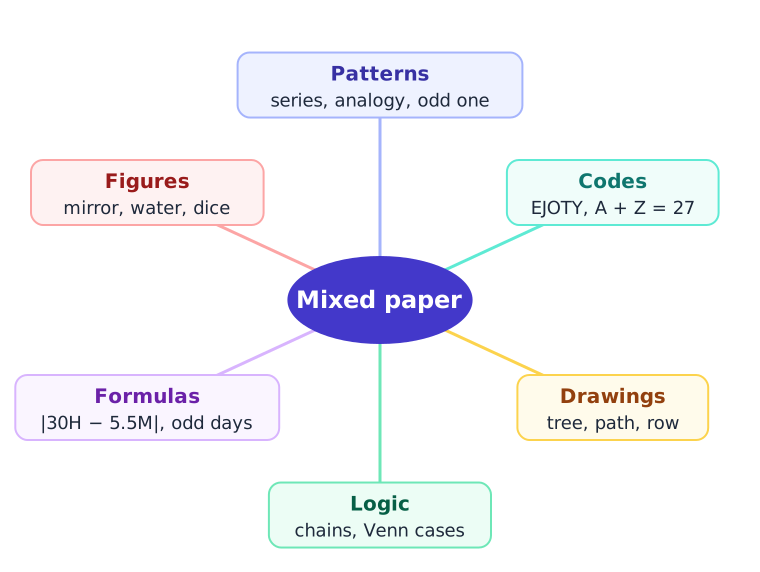
Practise every reasoning chapter in mixed order, as the real paper sets it: spot the type from its key words in a few seconds, recall the one method it needs (rule bank, EJOTY, family tree, path, Venn cases, clock formula), solve, and check the key against the data.
What you will be able to do
- I can name the chapter and method of a reasoning question from its key words.
- I can switch between chapters without losing speed.
- I can solve a three-question puzzle set from one set of clues.
- I can check an answer by putting it back into the data.
Key points
Series: try differences first, then ratios, then squares and cubes, then two series mixed at alternate places.
Letter positions: EJOTY marks 5, 10, 15, 20, 25; opposite letters add up to 27 (A–Z, M–N).
Odd one out: check that no second simple rule singles out a different option.
Blood relations: draw the tree with + for male and − for female; read the answer from the person asked about.
Directions: draw every leg; the final direction is from the start to the end point.
Inequalities: a conclusion is true only if every sign on the path points the same way.
Syllogism: a conclusion follows only if it is true in every Venn diagram that fits the statements.
Clock: θ = |30H − 5.5M|; take 360° − θ if θ is over 180°.
Calendar: an ordinary year moves the day by 1, a leap year by 2.
Mirror image: left and right swap; water image: top and bottom swap.
Full explanation
One paper, eighteen chapters
Imran had practised each chapter on its own and scored well in chapter tests. In a mixed mock, the switch from a syllogism to a dice question to a coding question slowed him down: he kept re-reading questions to work out what they were.
Mixed practice trains one more skill: naming the type and its method in a few seconds.
Spot the type
The first five seconds decide the next forty. Look for the key words, then use the method that goes with them.
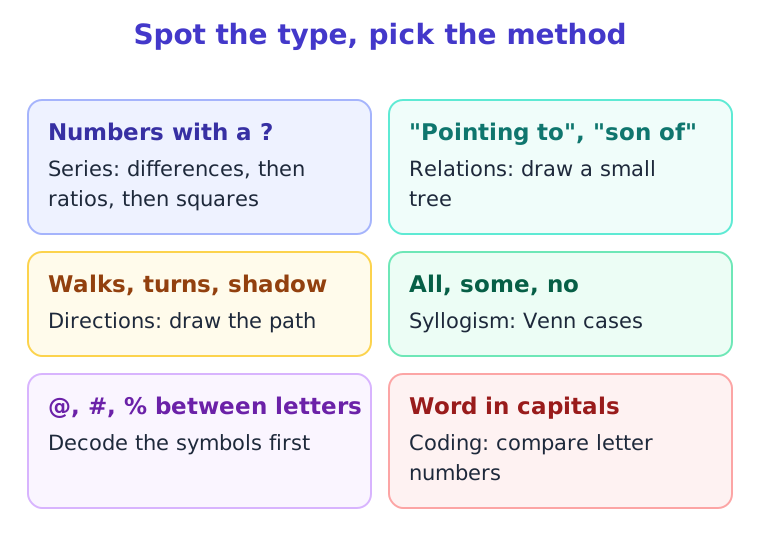
Series, analogy and odd one out
Write the differences under the terms. If they do not settle, try ratios, then squares and cubes, then split the series into odd and even places.
In 3, 7, 15, 31, 63, ? the differences 4, 8, 16, 32 double, so the next is 63 + 64 = 127. The rule ×2 + 1 gives the same 127, so the answer is safe.
For odd one out, find the rule shared by three options, then check that no other simple rule (prime, square, even, digit sum) picks a different option.
Coding and alphabet
Learn EJOTY: E = 5, J = 10, O = 15, T = 20, Y = 25. Opposite letters add up to 27: A–Z, B–Y, M–N.
If GOLD is written as HPME, each letter moves +1, so SALT becomes TBMU. Check the first letter of every option first: only options starting with T survive.
Relations and directions
For relations, draw a small tree: one row per generation, + for male, − for female, a double line for a couple. Then read the answer from the person asked about.
For directions, draw each leg and add them up. Walking 6 km north, 8 km east gives a straight-line distance of $\sqrt{6^2+8^2}=10$ km, to the north-east of the start.
Worked example: a puzzle set
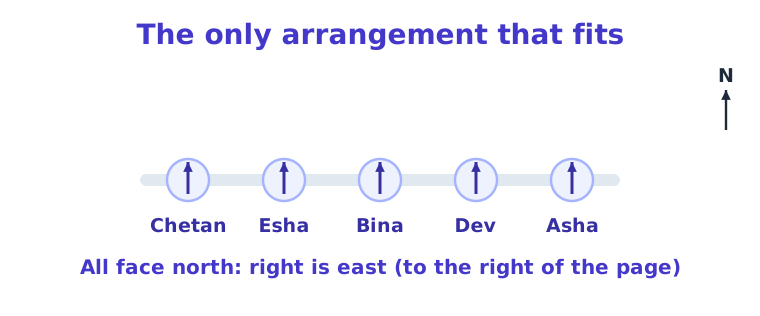
Five friends sit in a row, all facing north.
- Chetan sits at one end of the row.
- Bina sits second to the right of Chetan.
- Dev sits immediately to the right of Bina.
- Esha does not sit at an end.
Chetan must be at the left end, because Bina is two places to his right. Then Bina is 3rd and Dev 4th. Esha is not at an end, so she is 2nd, and Asha is 5th. One drawing now answers every question of the set.
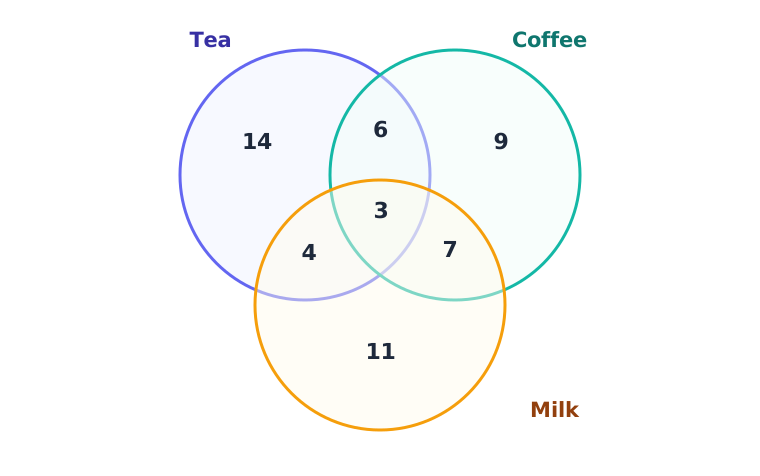
Venn regions
In region questions, read each number as one region only. In the figure, the people who take exactly two drinks are the three two-circle regions: 6 + 4 + 7 = 17. All tea drinkers are the four regions inside the Tea circle: 14 + 6 + 4 + 3 = 27.
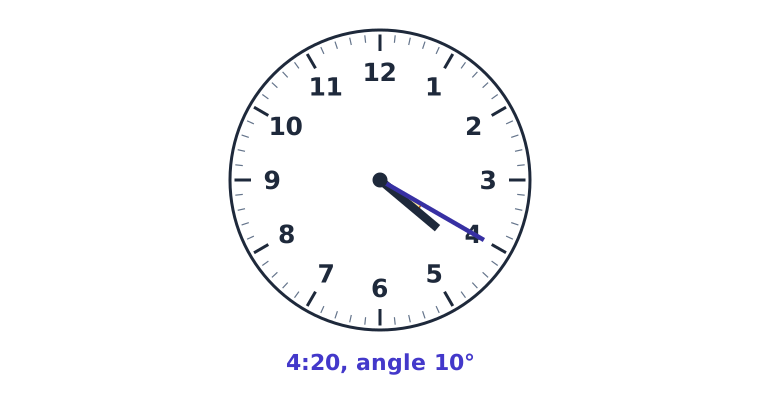
Clock and calendar
The angle between the hands is $\theta=|30H-5.5M|$. At 4:20 it is $|120-110|=10^\circ$: the hour hand has moved past 4 while the minute hand reached 4.
For days of the week count odd days: 1 for an ordinary year, 2 for a leap year, and a century year is a leap year only if it divides by 400.
Figures and dice
Mirror on the right: left and right swap, top stays on top. Water below: top and bottom swap, left stays left. A clock in a mirror shows 11:60 minus the real time.
For dice, a letter seen next to four others in two positions is opposite the sixth.
Imran's mixed mock
After three weeks of mixed sets, Imran named each question type before reading it fully and kept a one-line method for each. His time per question fell from 55 to 41 seconds, and his mixed-mock score rose from 16 to 21 out of 25.
Concepts and terms
Key words name the chapter: "pointing to" means relations, "walks and turns" means directions, "some and all" means syllogism.
In a puzzle set, fix the arrangement once and answer three questions from the same drawing.
Put the chosen option back into the clues or the rule; if one clue fails, the option is wrong.
Did you know
Every key in this chapter was checked by a program: series against a bank of rules, puzzles against every possible arrangement, syllogisms against every Venn case.
Memory tricks
Letter positions — EJOTY — E = 5, J = 10, O = 15, T = 20, Y = 25.
Series checks — Diff, Ratio, Power, Mix — Try differences, ratios, squares or cubes, then two mixed series.
Practice MCQs with answers (96)
- A 145
- B 414
- C 141
- D 421
Show answer
Why:
The steps alternate: ×3, +7, ×3, +7, ×3. The next step is +7: 138 + 7 = 145.
- A 60
- B 61
- C 59
- D 63
Show answer
Why:
The differences are 4, 6, 8, 10, 12: each is 2 more than the one before. The next difference is 14, so the term is 47 + 14 = 61.
- A 252
- B 255
- C 254
- D 318
Show answer
Why:
The differences 4, 8, 16, 32, 64 are multiplied by 2 each time. The next difference is 128: 126 + 128 = 254.
- A 30
- B 34
- C 19
- D 24
Show answer
Why:
Two series are mixed. Odd places: 18, 21, 24, 27 (step +3); even places: 39, 34, 29 (step −5). The missing term is at an even place: 29 − 5 = 24.
- A DUS
- B CUS
- C SUD
- D DVS
Show answer
Why:
Treat each position separately: letter 1 moves 2 letters back each time (D); letter 2 moves 3 letters forward each time (U); letter 3 moves forward by 1, 2, 3, 4 (one more each time) (S). Answer DUS.
- A P
- B O
- C N
- D Q
Show answer
Why:
Write the letter numbers: 5, 7, 9, 11, 13. The series moves 2 letters forward each time, so the next is 15 = O.
- A A
- B Y
- C Z
- D B
Show answer
Why:
Write the letter numbers: 11, 12, 14, 17, 21. The series moves forward by 1, 2, 3, 4, 5 (one more each time), so the next is 26 = Z.
- A JXY
- B YXK
- C LXY
- D KXY
Show answer
Why:
Treat each position separately: letter 1 moves forward by 1, 2, 3, 4 (one more each time) (K); letter 2 moves 5 letters forward each time (X); letter 3 moves forward by 1, 2, 3, 4 (one more each time) (Y). Answer KXY.
- A 36
- B 35
- C 29
- D 37
Show answer
Why:
The rule is (n − 1)² with n = the first number: 8 gives 49, so 7 gives 36. No other simple rule that turns 8 into 49 gives any other option.
- A 3 : 2
- B 5 : 16
- C 10 : 80
- D 8 : 50
Show answer
Why:
7 : 36 follows (n − 1)². Check the options: only 5 : 16 follows it; every other pair breaks it and fits no other simple rule that gives 7 : 36.
- A 72
- B 69
- C 68
- D 67
Show answer
Why:
The rule is n³ + n with n = the first number: 6 gives 222, so 4 gives 68. No other simple rule that turns 6 into 222 gives any other option.
- A BKNT
- B YRND
- C DMPV
- D DNRY
Show answer
Why:
From TIGE to UKJI, the letters move by +1, +2, +3, +4 and so on, from the left. The same change on CLOU gives DNRY.
- A ILH
- B JMI
- C HLI
- D CFB
Show answer
Why:
From LIG to OLJ, each letter moves 3 places forward (+3). The same change on FIE gives ILH.
- A QSA
- B ASQ
- C CVU
- D ATS
Show answer
Why:
From SPI to RNF, the letters move by −1, −2, −3, −4 and so on, from the left. The same change on BUT gives ASQ.
- A Wood
- B Sharp
- C Chop
- D Handle
Show answer
Why:
The pair shows a tool and its use: Needle → Sew. In the same way, Axe → Chop. The other options are linked to Axe in a different way.
- A Queen
- B Colony
- C Sugar
- D Anthill
Show answer
Why:
The pair shows a creature and its home: Rabbit → Burrow. In the same way, Ant → Anthill. The other options are linked to Ant in a different way.
- A Cub
- B Den
- C Roar
- D Tiger
Show answer
Why:
The pair shows an animal and its young one: Goat → Kid. In the same way, Lion → Cub. The other options are linked to Lion in a different way.
- A 61
- B 77
- C 19
- D 47
Show answer
Why:
19, 47, 61 are prime numbers; 77 is not. No other simple property (prime, square, even, digit sum, multiples) separates a different number.
- A 23
- B 43
- C 93
- D 59
Show answer
Why:
23, 43, 59 are prime numbers; 93 is not. No other simple property (prime, square, even, digit sum, multiples) separates a different number.
- A 47
- B 61
- C 79
- D 99
Show answer
Why:
47, 61, 79 are prime numbers; 99 is not. No other simple property (prime, square, even, digit sum, multiples) separates a different number.
- A PRQ
- B ABA
- C EFE
- D MNM
Show answer
Why:
Write the gaps between neighbouring letters. In ABA, EFE, MNM the gaps are +1, −1; in PRQ they are +2, −1.
- A GKMN
- B NRST
- C PTVW
- D DHJK
Show answer
Why:
Write the gaps between neighbouring letters. In DHJK, GKMN, PTVW the gaps are +4, +2, +1; in NRST they are +4, +1, +1.
- A UWRS
- B HJEF
- C MPKL
- D IKFG
Show answer
Why:
Write the gaps between neighbouring letters. In HJEF, IKFG, UWRS the gaps are +2, −5, +1; in MPKL they are +3, −5, +1.
- A Earth
- B Mars
- C Venus
- D Comet
Show answer
Why:
Comet: the others are planets; a comet is not a planet.
- A Mridangam
- B Sarod
- C Santoor
- D Ektara
Show answer
Why:
Mridangam: the others are string instruments; the mridangam is a drum.
- A Badminton
- B Hockey
- C Tennis
- D Squash
Show answer
Why:
Hockey: the others are played with a racket; hockey is played with a stick.
- A 9 : 43
- B 5 : 23
- C 6 : 30
- D 8 : 38
Show answer
Why:
The rule is second = n × 5 − 2, where n is the first number. 6 : 30 breaks it: 6 should give 28.
- A 3 : 6
- B 6 : 30
- C 9 : 72
- D 8 : 58
Show answer
Why:
The rule is second = n × (n − 1), where n is the first number. 8 : 58 breaks it: 8 should give 56.
- A SGFHM
- B RFEGL
- C MHFGS
- D THGIN
Show answer
Why:
Compare CRANE with DMZQB: the word is reversed and then each letter moves −1. Doing the same to NIGHT gives SGFHM.
- A JXOHBQ
- B KYPICR
- C RCIPYK
- D OCTMGV
Show answer
Why:
Compare HAMMER with FYKKCP: each letter moves 2 places back (−2). Doing the same to MARKET gives KYPICR.
- A LADDER
- B SFEEBM
- C REDDAL
- D QDCCZK
Show answer
Why:
Compare KETTLE with ELTTEK: the letters are written in reverse order. Doing the same to LADDER gives REDDAL.
- A 45
- B 41
- C 47
- D 46
Show answer
Why:
BLACK: 2 + 12 + 1 + 3 + 11 = 29, and the code is 34, so add the letter numbers and then add 5. CRANE: 3 + 18 + 1 + 14 + 5 = 41, giving 46.
- A 75
- B 73
- C 76
- D 74
Show answer
Why:
BREAD: 2 + 18 + 5 + 1 + 4 = 30, and the code is 32, so add the letter numbers and then add 2. STONE: 19 + 20 + 15 + 14 + 5 = 73, giving 75.
- A 1114916
- B 11181316
- C 1691411
- D 17101512
Show answer
Why:
In WOLF → 4121521, each letter is replaced by its number counted from Z (Z = 1, A = 26). So PINK → 11181316.
- A bi
- B ge
- C ho
- D si
Show answer
Why:
"flower" appears in lines 2 and 3; the only code common to both lines is ho.
- A paper
- B soil
- C tea
- D ink
Show answer
Why:
"ink" appears only in line 1. The other two words of that line also appear elsewhere, so their codes are lo (soil) and fa (tea). The code left is si.
- A grandson
- B son
- C grandfather
- D grandmother
Show answer
Why:
Work back from Pooja: Tarun is Pooja's son. So Chirag is Pooja's grandson (son's son).
- A niece
- B daughter-in-law
- C wife
- D daughter
Show answer
Why:
Work back from Pooja: Imran is Pooja's son. So Rekha is Pooja's daughter-in-law (son's wife).
- A grandmother
- B daughter
- C granddaughter
- D grandfather
Show answer
Why:
Work back from Chirag: Sohan is Chirag's son. So Bhavna is Chirag's granddaughter (son's daughter).
- A sister
- B cousin
- C wife
- D sister-in-law
Show answer
Why:
Decode: Pooja is the sister of Hema. Hema is the wife of Nikhil. Work back from Nikhil: Hema is Nikhil's wife. So Pooja is Nikhil's sister-in-law (wife's sister).
- A niece
- B wife
- C daughter
- D daughter-in-law
Show answer
Why:
Decode: Rekha is the daughter of Chirag. Chirag is the brother of Pankaj. Work back from Pankaj: Chirag is Pankaj's brother. So Rekha is Pankaj's niece (brother's daughter).
- A daughter
- B daughter-in-law
- C niece
- D wife
Show answer
Why:
Work back from Karan: Imran is Karan's son. So Vandana is Karan's daughter-in-law (son's wife).
- A father-in-law
- B husband
- C uncle
- D father
Show answer
Why:
Work back from Sapna: Deepak is Sapna's father. So Arjun is Sapna's uncle (father's brother).
- A daughter
- B grandfather
- C grandmother
- D granddaughter
Show answer
Why:
Work back from Bharat: Nikhil is Bharat's son. So Meera is Bharat's granddaughter (son's daughter).
- A East
- B South
- C North
- D West
Show answer
Why:
Start facing south; turns right, left, left (each right is 90° clockwise, each left 90° anticlockwise) leave her facing east.
- A South-east
- B South-west
- C North-west
- D North-east
Show answer
Why:
Legs: 60 m north, 70 m west, 120 m south. Net: 70 m west and 60 m south of Q, so Rakesh is to the south-west of Q.
- A 15 km
- B 1 km
- C 5 km
- D 7 km
Show answer
Why:
Net movement: 3 km east and 4 km north. Distance = √(3² + 4²) = √25 = 5 km.
- A West
- B South
- C East
- D North
Show answer
Why:
The sun is in the west, so shadows point east. The shadow is to his right, so Deepak faces north.
- A South
- B North
- C East
- D West
Show answer
Why:
The sun is in the west, so shadows point east. The shadow is to his left, so Gaurav faces south.
- A 52
- B 50
- C 51
- D 49
Show answer
Why:
Zoya is 11th from the top, so from the bottom it is 60 − 11 + 1 = 50.
- A 19
- B 21
- C 20
- D 14
Show answer
Why:
Position from the back = 33 − 14 + 1 = 20.
- A 43
- B 44
- C 41
- D 42
Show answer
Why:
Farah is counted from both ends, so total = 17 + 26 − 1 = 42.
- A Kavita
- B Vinod
- C Rekha
- D Nisha
Show answer
Why:
Combining the clues, the order from highest to lowest is Isha > Nisha > Kavita > Rekha > Vinod. Place 3: Kavita.
- A Rakesh
- B Sanjay
- C Mansi
- D Usha
Show answer
Why:
Combining the clues, the order from highest to lowest is Rakesh > Ritu > Usha > Sanjay > Mansi. Place 4: Sanjay.
- A MOULD
- B MOUSE
- C MOURN
- D MOUNT
Show answer
Why:
Compare letter by letter: MOULD < MOUNT < MOURN < MOUSE < MOUTH. Word 3 is MOURN.
- A Q
- B X
- C S
- D R
Show answer
Why:
21st from the left = position 21 = U. Moving 3 to the left: 21 − 3 = 18 = R.
- A 1
- B 2
- C 3
- D 0
Show answer
Why:
CABINET → ABCEINT. Letters in the same place: T, so 1.
- A TRACE
- B TRACK
- C TRAIL
- D TRADE
Show answer
Why:
Compare letter by letter: TRACE < TRACK < TRADE < TRAIL < TRAMP. Word 2 is TRACK.
- A Only conclusion II is true
- B Both conclusions I and II are true
- C Neither conclusion I nor II is true
- D Only conclusion I is true
Show answer
Why:
I: S ≥ Y is not certain: the signs between S and Y point both ways (S > M > T < Z > Y). II: T > Y is not certain: the signs between T and Y point both ways (T < Z > Y).
- A Only conclusion I is true
- B Only conclusion II is true
- C Both conclusions I and II are true
- D Neither conclusion I nor II is true
Show answer
Why:
I: L < V is not certain: the signs between L and V point both ways (L ≥ H ≤ T < A > V). II: H > V is not certain: the signs between H and V point both ways (H ≤ T < A > V).
- A Only conclusion I is true
- B Neither conclusion I nor II is true
- C Only conclusion II is true
- D Both conclusions I and II are true
Show answer
Why:
I: G > Q is true (G = V > Q). II: B > G is not certain: we only know B < G (B < Q < V = G).
- A Only conclusion II is true
- B Neither conclusion I nor II is true
- C Both conclusions I and II are true
- D Only conclusion I is true
Show answer
Why:
Decode first: L > Z < U ≤ A ≤ H = W; I is Z > A, II is W = L. I: Z > A is not certain: we only know Z < A (Z < U ≤ A). II: W = L is not certain: the signs between W and L point both ways (W = H ≥ A ≥ U > Z < L).
- A Both conclusions I and II are true
- B Only conclusion I is true
- C Neither conclusion I nor II is true
- D Only conclusion II is true
Show answer
Why:
Decode first: K < V < P < D > W; I is D < K, II is V < W. I: D < K is not certain: we only know D > K (D > P > V > K). II: V < W is not certain: the signs between V and W point both ways (V < P < D > W).
- A Only conclusion I follows
- B Both conclusions I and II follow
- C Neither conclusion I nor II follows
- D Only conclusion II follows
Show answer
Why:
I does not follow: a diagram where "some pots are not mirrors" also fits the statements. II follows: it is true in every Venn diagram that fits the statements.
- A Only conclusion I follows
- B Neither conclusion I nor II follows
- C Only conclusion II follows
- D Both conclusions I and II follow
Show answer
Why:
I follows: it is true in every Venn diagram that fits the statements. II does not follow: it is false in every diagram that fits the statements, because it contradicts them.
- A Either conclusion I or II follows
- B Neither conclusion I nor II follows
- C Only conclusion I follows
- D Only conclusion II follows
Show answer
Why:
I does not follow: it is false in every diagram that fits the statements, because it contradicts them. II does not follow: it is false in every diagram that fits the statements, because it contradicts them.
- A Only conclusion I follows
- B Only conclusion II follows
- C Neither conclusion I nor II follows
- D Either conclusion I or II follows
Show answer
Why:
I does not follow: it is false in every diagram that fits the statements, because it contradicts them. II does not follow: it is false in every diagram that fits the statements, because it contradicts them.
- A 1
- B 2
- C 3
- D 4
Show answer
Why:
No two of them have anything in common: three separate circles. That is diagram (4).
- A 1
- B 2
- C 3
- D 4
Show answer
Why:
Pencils and erasers both lie inside stationery, but none of the pencils are erasers: two separate circles inside a big one. That is diagram (1).
- A 14
- B 36
- C 17
- D 19
Show answer
Why:
This is a single region of the figure, so read its number directly: 19. Adding the overlapping regions too is the usual mistake.
- A 82
- B 57
- C 108
- D 26
Show answer
Why:
Add the right regions: 25 + 34 + 23 = 82.
- A Statement I alone is sufficient, but II alone is not
- B Either statement alone is sufficient
- C Both together are sufficient, but neither alone is
- D Even both together are not sufficient
Show answer
Why:
Statement I alone: the answer must be 56, so it is sufficient. Statement II alone: the answer could be any of 7 possibilities, such as 53 and 54, so it is not sufficient.
- A Statement II alone is sufficient, but I alone is not
- B Either statement alone is sufficient
- C Both together are sufficient, but neither alone is
- D Even both together are not sufficient
Show answer
Why:
Statement I alone: the answer could be any of 8 possibilities, such as 4 and 12, so it is not sufficient. Statement II alone: the answer could be any of 6 possibilities, such as 8 and 17, so it is not sufficient. Both together: the answer must be 44, so they are sufficient.
- A 177°
- B 162°
- C 198°
- D 174°
Show answer
Why:
θ = |30H − 5.5M| = |30 × 11 − 5.5 × 24| = 198°; the smaller angle is 360° − 198° = 162°.
- A $15\frac{10}{11}$ minutes past 2
- B 10 minutes past 2
- C $10\frac{10}{11}$ minutes past 2
- D 11 minutes past 2
Show answer
Why:
The minute hand gains 5.5° a minute and must make up 30 × 2 = 60°: 60 ÷ 5.5 = $10\frac{10}{11}$ minutes past 2.
- A 290°
- B 60°
- C 85°
- D 70°
Show answer
Why:
θ = |30H − 5.5M| = |30 × 6 − 5.5 × 20| = 70°.
- A Saturday
- B Sunday
- C Friday
- D Thursday
Show answer
Why:
The year between them has 365 days (no 29 February in between), giving 1 odd day: Friday + 1 = Saturday.
- A 2013
- B 2036
- C 2014
- D 2019
Show answer
Why:
A calendar repeats when 1 January falls on the same day and both years are leap years. Adding odd days year by year (1 for an ordinary year, 2 for a leap year) first reaches a multiple of 7 at 2036.
- A 2034
- B 2011
- C 2017
- D 2012
Show answer
Why:
A calendar repeats when 1 January falls on the same day and both years are ordinary years. Adding odd days year by year (1 for an ordinary year, 2 for a leap year) first reaches a multiple of 7 at 2017.
- A 167.5°
- B 150°
- C 222.5°
- D 137.5°
Show answer
Why:
The clock shows 12:25. θ = |30 × 0 − 5.5 × 25| = 137.5°.
- A 1
- B 2
- C 3
- D 4
Show answer
Why:
In a water image, the order stays and each character turns upside down. Only figure (2) shows both changes; the others show the other image or half the change.
- A 1:48
- B 2:48
- C 12:48
- D 8:18
Show answer
Why:
Clock time + mirror time = 12:00. 11:60 − 10:12 = 1:48.
- A 8:43
- B 9:43
- C 4:13
- D 10:43
Show answer
Why:
Clock time + mirror time = 12:00. 11:60 − 2:17 = 9:43.
- A 6
- B 4
- C 1
- D 2
Show answer
Why:
A face that touches 3 cannot be opposite it. 3 touches 2, 4, 5, 6: four faces. The only one left is 1. The "opposite faces add to 7" rule does not hold for this die.
- A 5
- B 4
- C 1
- D 2
Show answer
Why:
A face that touches 6 cannot be opposite it. 6 touches 1, 3, 4, 5: four faces. The only one left is 2. The "opposite faces add to 7" rule does not hold for this die.
- A 16
- B 14
- C 18
- D 8
Show answer
Why:
Count by size, smallest first, and include the triangles made of several pieces: 16 in all. Counting only the 8 smallest pieces is the usual mistake.
- A 1
- B 2
- C 3
- D 4
Show answer
Why:
In a water image, top and bottom swap; left and right stay. Figure (3) is the figure flipped top to bottom; the others are flipped left to right, turned through 180°, turned a quarter clockwise.
- A 3
- B 2
- C 1
- D 4
Show answer
Why:
Clockwise (all facing outward): Bina, Yash, Jaya, Chetan, Mohan, Isha, Dev.
Going to the right of Jaya, Isha is the third person, so 2 persons sit between them. (The other way round there are 3.)
- A Mohan
- B Dev
- C Jaya
- D Bina
Show answer
Why:
Clockwise (all facing outward): Bina, Yash, Jaya, Chetan, Mohan, Isha, Dev.
Isha moves to Yash's old seat. The seat immediately to the right of that seat now holds Jaya.
- A Fourth to the right
- B Second to the right
- C Third to the left
- D Third to the right
Show answer
Why:
Clockwise (all facing outward): Bina, Yash, Jaya, Chetan, Mohan, Isha, Dev.
Stand in Jaya's place and use Jaya's own left and right: Isha is third to the right of Jaya.
- A Box S – First from the bottom – pink
- B Box P – Fifth from the bottom – black
- C Box T – Sixth from the bottom – yellow
- D Box Q – Third from the bottom – yellow
Show answer
Why:
Sixth from the bottom: T (red); Fifth from the bottom: R (blue); Fourth from the bottom: P (black); Third from the bottom: U (green); Second from the bottom: Q (yellow); First from the bottom: S (pink).
Only this one matches the final table: Box S is at position 1 from the bottom with pink.
- A Blue
- B Yellow
- C Green
- D Pink
Show answer
Why:
Sixth from the bottom: T (red); Fifth from the bottom: R (blue); Fourth from the bottom: P (black); Third from the bottom: U (green); Second from the bottom: Q (yellow); First from the bottom: S (pink).
Box Q is at position 2 from the bottom, and the box there is yellow.
- A Box U
- B Box S
- C Box Q
- D Box P
Show answer
Why:
Sixth from the bottom: T (red); Fifth from the bottom: R (blue); Fourth from the bottom: P (black); Third from the bottom: U (green); Second from the bottom: Q (yellow); First from the bottom: S (pink).
Green is at position 3 from the bottom; one place down is position 2 from the bottom: Box Q.
- A Both A and R are true, and R is the correct explanation of A
- B Both A and R are true, but R is not the correct explanation of A
- C A is true but R is false
- D A is false but R is true
Show answer
Why:
63 × 2 + 1 = 127, and the rule fits every term, so R explains A.
- A Both A and R are true, and R is the correct explanation of A
- B Both A and R are true, but R is not the correct explanation of A
- C A is true but R is false
- D A is false but R is true
Show answer
Why:
A is true: looking back reverses the direction. R is false: opposite directions are 180° apart.
- A 1 only
- B 2 only
- C Both 1 and 2
- D Neither 1 nor 2
Show answer
Why:
K = 11 and 27 − 11 = 16 = P. From the right, 10th = 27 − 10 = 17 = Q. Both are true.
Important short questions (4)
Each term is ×2 + 1: 5 → 11 → 23 → 47 → 95. The differences 6, 12, 24 double too, giving 47 + 48 = 95.
Each letter moves one place forward: G→H, R→S, A→B, P→Q, E→F, so HSBQF.
The only daughter of Ajay's mother is Ajay's sister. The woman is his sister's daughter, his niece.
|30 × 7 − 5.5 × 20| = |210 − 110| = 100°.
Long answer questions (1)
Start with the clue that fixes a seat: Chetan at an end with Bina two places to his right puts Chetan at the left end. Chain the clues that hang on him: Bina 3rd, Dev 4th. Use the negative clue last: Esha not at an end gives 2nd, so Asha is 5th.
Once the row is drawn, questions on neighbours, ends and positions are read straight from it, so three questions cost little more than one.
Flashcards (14)
Play this topic
- Quick mixed check
Veda Skills Logical Reasoning Unit 19 — frequently asked questions
1200 ÷ 35 ≈ 34 seconds. Spend about 20 seconds on one-liners so that puzzle questions can get about 60 seconds each.
Few people, one facing direction (or one variable), and definite clues that fix positions.
Expected gain = 1/3 − 0.25 × 2/3 = 0.333 − 0.167 = 0.167 marks. Yes, if it takes only a few seconds.
Each term is ×2 + 1: 5 → 11 → 23 → 47 → 95. The differences 6, 12, 24 double too, giving 47 + 48 = 95.
Each letter moves one place forward: G→H, R→S, A→B, P→Q, E→F, so HSBQF.
The only daughter of Ajay's mother is Ajay's sister. The woman is his sister's daughter, his niece.

All Veda Skills Logical Reasoning units
Study this chapter properly, free
Everything above is on this page to read. In the Veda app the same chapter becomes spaced-repetition flashcards, timed tests that mark themselves, Veda Bites you can swipe, and games — with your progress tracked topic by topic.
Get Veda free