Veda Skills Logical Reasoning Unit 6: Blood Relations
- 3 topics
- 172 MCQs
- 9 short answers
- 3 long answers
- 38 flashcards
- 4 games
- ~155 min read
- English
Checked before publishing: 23 automated checks, including a plagiarism check against the textbook's own words. How we check our content
Direct Relations
Turn relation statements into a family tree, read "How is A related to B?" from B's side, keep track of gender, and decode spoken puzzles such as "the only son of my grandfather".
What you will be able to do
- I can draw a family tree from relation statements using the exam notation.
- I can name the relation of one person to another, in the right direction.
- I can tell when a relation cannot be determined because a gender is not given.
- I can solve pointing and photograph puzzles that use the word "only".

Key points
"How is A related to B?" means: A is B's what? Start from B.
Square = male, circle = female, double line = married couple, line down = children.
Brother, sister, son, daughter, father, mother, husband and wife tell the gender of the person named first.
"Child", "sibling" and "married to" do not tell a gender.
Count generations: parents one up, grandparents two up, children one down.
"Only son of my father" is the speaker himself (if male) or his brother (if female speaker).
Spouse's parents are in-laws; a sibling's spouse is a brother- or sister-in-law.
Hindi papers use exact words: father's brother and mother's brother have different names.
Full explanation
Neha's interview question
At her bank interview, Neha is asked: "Pointing to a man, a woman said, His mother is the only daughter of my mother. How is the woman related to the man?" She smiles, sketches three circles and a square on the notepad, and answers in ten seconds. This topic teaches that sketch.
Draw, do not imagine
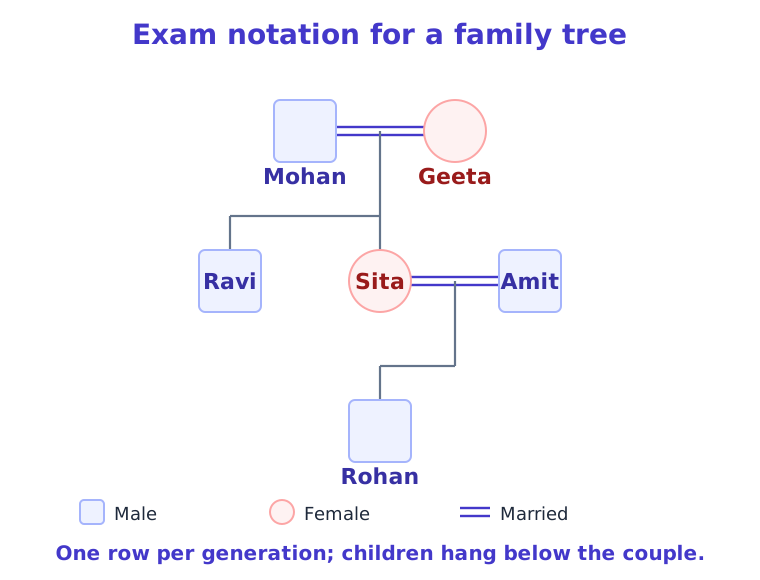
Write each person once and join them with the exam notation: a square for a male, a circle for a female, a double line for a married couple and a line down to their children. One row is one generation.
Which way are you looking?
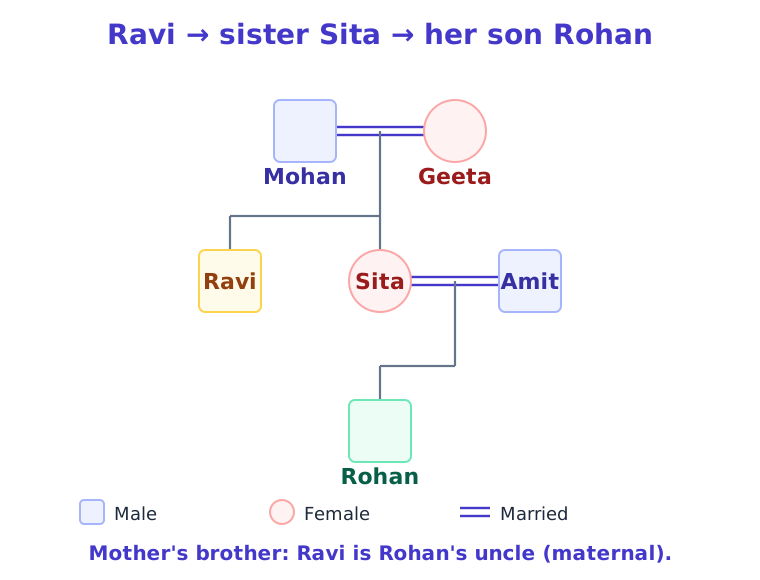
"How is A related to B?" asks: A is B's what? Stand at B and walk to A. Ravi is Rohan's uncle, but Rohan is Ravi's nephew. The most common wrong option in every paper is the right word read the wrong way.
Words by generation
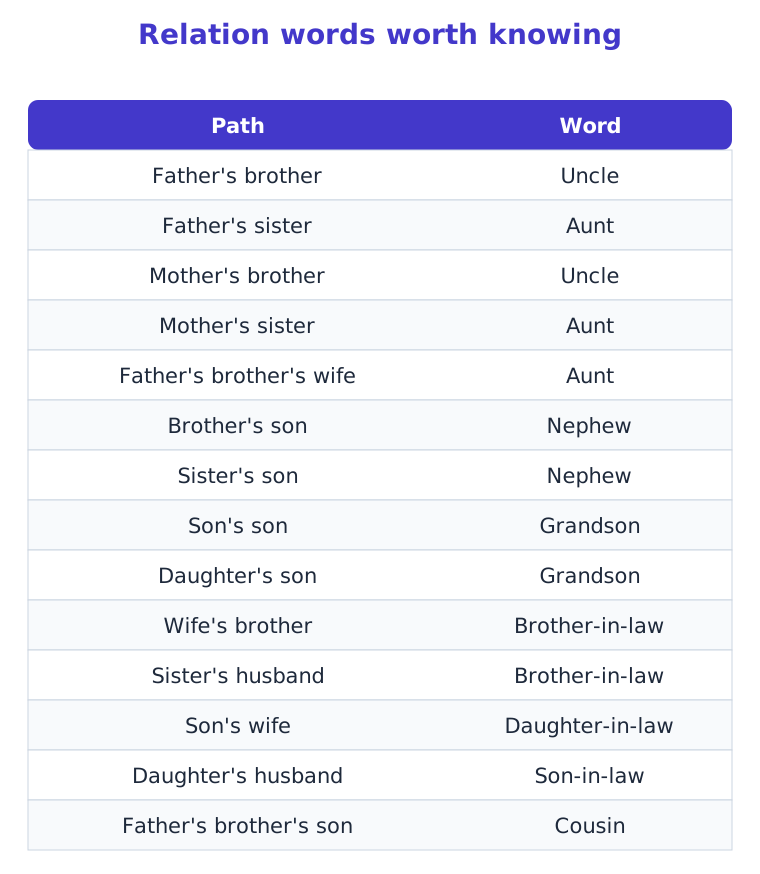
Two up: grandfather, grandmother. One up: father, mother, uncle, aunt, father-in-law. Level: brother, sister, cousin, husband, wife, brother-in-law. One down: son, daughter, nephew, niece, son-in-law. Two down: grandson, granddaughter.
Worked example
"Ravi is the brother of Sita. Sita is the mother of Rohan. How is Ravi related to Rohan?" Start at Rohan. His mother is Sita; Sita's brother is Ravi. A mother's brother is an uncle (in Hindi, specifically the maternal uncle). Answer: uncle.
Gender: told or not told?
"P is the brother of Q" tells you P is male; it says nothing about Q. "R is a child of S" and "T is married to U" tell nobody's gender. If the answer depends on a gender that was never given, the right option is cannot be determined.
The magic word "only"
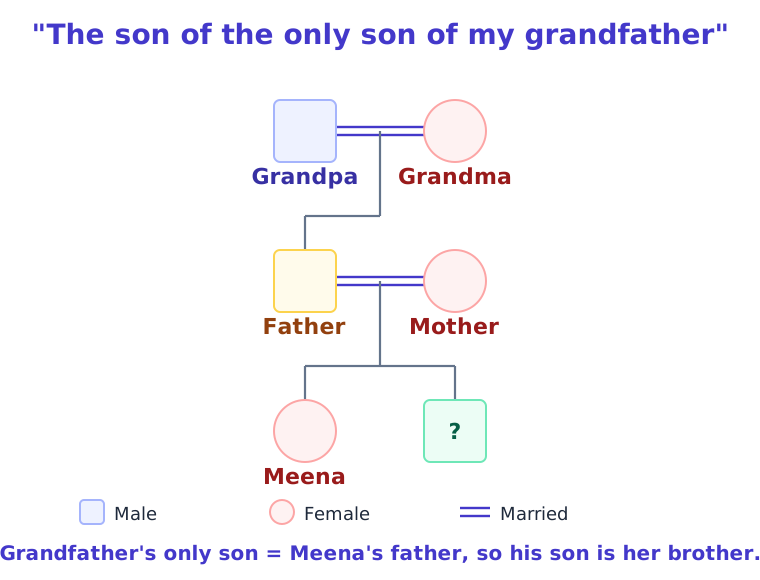
"He is the son of the only son of my grandfather," says Meena. Her grandfather's only son must be her own father, so the son of her father is her brother. Without "only", the grandfather's son could also be an uncle and the answer would be unclear.
Pointing and photograph puzzles
Break the sentence at every "of" and read it from the speaker's side: my grandfather → his only son (= my father) → his son (= my brother or me). In "His mother is (someone)", find that mother first; the pointed person is her child.
In-laws
Everything through a spouse is "in-law". Wife's father: father-in-law. Son's wife: daughter-in-law. Wife's brother and sister's husband: brother-in-law. Brother's wife and husband's sister: sister-in-law.
Exam shortcuts
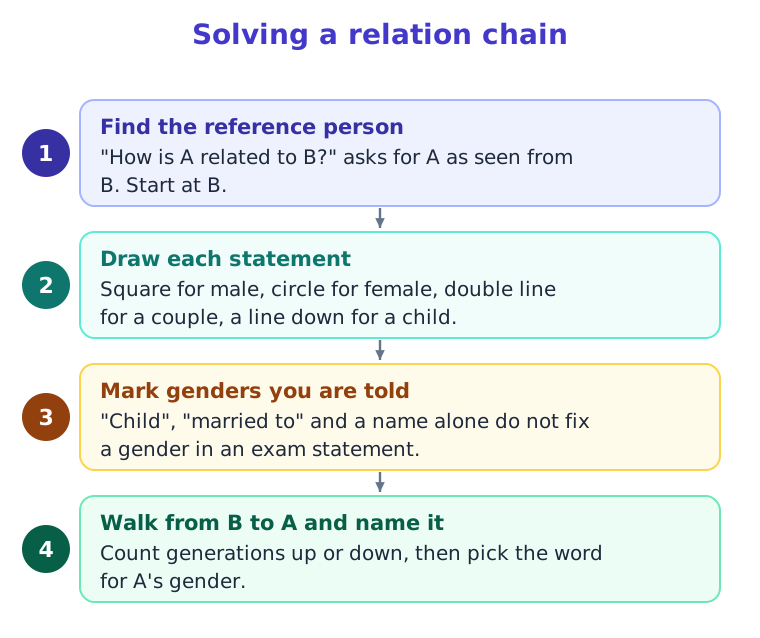
- Start at the person after "related to".
- Up, level, down: count generations first.
- Gendered word = gender of the person named first.
- "Only" closes a loop back to a known person.
- Check the option that reads the relation backwards; it is usually a trap.
Back to Neha
Neha drew the woman's mother, then that mother's only daughter: the woman herself. The man's mother is the woman, so the woman is his mother. Ten seconds, because the sketch did the thinking.
Concepts and terms
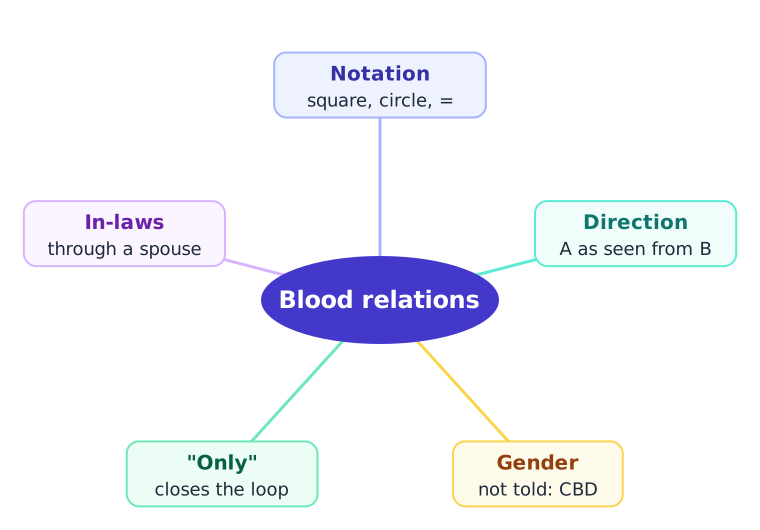
A is B's uncle means B is A's nephew or niece; the words change when you turn round.
Each parent step is one generation up and each child step one down; siblings and spouses stay level.
Only the gendered words tell gender. Names alone are not proof in a statement puzzle.
"Only son of my father" leaves no other son, so the phrase points back to a person already known.

Did you know
Hindi has separate everyday words for at least eight kinds of uncle and aunt; English uses just two.
Genealogists use the same square-and-circle notation as reasoning books.

Memory tricks
Direction — Stand on B, look at A — In "How is A related to B?", you stand at B.
Generations — Up, level, down — Parent up, sibling or spouse level, child down.
Practice MCQs with answers (65)
- A Father-in-law
- B Daughter-in-law
- C Grandfather
- D Mother-in-law
Show answer
Why:
Start from Mamta: Dinesh is Mamta's husband; Tarun is Dinesh's father. So Tarun is Mamta's father-in-law.
- A Aunt
- B Grandfather
- C Cannot be determined
- D Grandson
Show answer
Why:
Start from Deepak: Pooja is Deepak's mother; Karan is Pooja's father. So Karan is Deepak's grandfather.
- A Granddaughter
- B Cannot be determined
- C Daughter-in-law
- D Father-in-law
Show answer
Why:
Start from Arjun: Sanjay is Arjun's son; Kavita is Sanjay's wife. So Kavita is Arjun's daughter-in-law.
- A Sister
- B Son-in-law
- C Sister-in-law
- D Brother-in-law
Show answer
Why:
Start from Anita: Lata is Anita's sister; Tarun is Lata's husband. So Tarun is Anita's brother-in-law.
- A Daughter
- B Wife
- C Sister
- D Father
Show answer
Why:
Start from Rohan: Divya is Rohan's wife; Kavita is Divya's daughter. So Kavita is Rohan's daughter.
- A Mother
- B Sister
- C Brother
- D Niece
Show answer
Why:
Start from Rahul: Tanvi is Rahul's parent; Seema is Tanvi's daughter. So Seema is Rahul's sister.
- A Cannot be determined
- B Granddaughter
- C Grandfather
- D Grandmother
Show answer
Why:
Start from Meena: Gopal is Meena's father; Karan is Gopal's father. So Karan is Meena's grandfather.
- A Granddaughter
- B Father-in-law
- C Father
- D Grandfather
Show answer
Why:
Start from Kavita: Sunita is Kavita's mother; Ashok is Sunita's father. So Ashok is Kavita's grandfather.
- A Mother-in-law
- B Daughter-in-law
- C Husband
- D Mother
Show answer
Why:
Start from Shalini: Vivek is Shalini's husband; Usha is Vivek's mother. So Usha is Shalini's mother-in-law.
- A Granddaughter
- B Grandfather
- C Grandmother
- D Cannot be determined
Show answer
Why:
Start from Mamta: Karan is Mamta's father; Manoj is Karan's father. So Manoj is Mamta's grandfather.
- A Sister
- B Husband
- C Sister-in-law
- D Aunt
Show answer
Why:
Start from Nisha: Harish is Nisha's husband; Divya is Harish's parent; Lata is Divya's daughter. So Lata is Nisha's sister-in-law.
- A Grandmother
- B Niece
- C Grandson
- D Granddaughter
Show answer
Why:
Start from Radha: Tanvi is Radha's daughter; Ashok is Tanvi's husband; Meena is Ashok's daughter. So Meena is Radha's granddaughter.
- A Brother-in-law
- B Wife
- C Sister-in-law
- D Mother-in-law
Show answer
Why:
Start from Arjun: Pooja is Arjun's wife; Amit is Pooja's parent; Karan is Amit's son. So Karan is Arjun's brother-in-law.
- A Grandson
- B Nephew
- C Uncle
- D Niece
Show answer
Why:
Start from Harish: Mohan is Harish's father; Seema is Mohan's daughter; Vikas is Seema's son. So Vikas is Harish's nephew.
- A Daughter-in-law
- B Aunt
- C Sister-in-law
- D Wife
Show answer
Why:
Start from Sita: Vandana is Sita's mother; Kishore is Vandana's son; Nisha is Kishore's wife. So Nisha is Sita's sister-in-law.
- A Grandfather
- B Son-in-law
- C Cannot be determined
- D Granddaughter
Show answer
Why:
Start from Prakash: Usha is Prakash's daughter; Kishore is Usha's husband; Anita is Kishore's daughter. So Anita is Prakash's granddaughter.
- A Sister-in-law
- B Niece
- C Aunt
- D Nephew
Show answer
Why:
Start from Anita: Lata is Anita's mother; Gopal is Lata's son; Sunita is Gopal's wife. So Sunita is Anita's sister-in-law.
- A Cousin
- B Niece
- C Granddaughter
- D Uncle
Show answer
Why:
Start from Ravi: Lalit is Ravi's father; Harish is Lalit's son; Pooja is Harish's daughter. So Pooja is Ravi's niece.
- A Brother-in-law
- B Cousin
- C Niece
- D Uncle
Show answer
Why:
Start from Ravi: Asha is Ravi's sister; Sanjay is Asha's husband; Divya is Sanjay's daughter. So Divya is Ravi's niece.
- A Father-in-law
- B Granddaughter
- C Brother-in-law
- D Son-in-law
Show answer
Why:
Start from Arjun: Lata is Arjun's wife; Radha is Lata's daughter; Rahul is Radha's husband. So Rahul is Arjun's son-in-law.
- A Nephew
- B Uncle
- C Grandson
- D Cousin
Show answer
Why:
Start from Rohan: Arjun is Rohan's father; Mamta is Arjun's daughter; Ashok is Mamta's son. So Ashok is Rohan's nephew.
- A Grandmother
- B Grandson
- C Granddaughter
- D Son-in-law
Show answer
Why:
Start from Seema: Komal is Seema's daughter; Mohan is Komal's husband; Prakash is Mohan's son. So Prakash is Seema's grandson.
- A Uncle
- B Brother
- C Cousin
- D Nephew
Show answer
Why:
Start from Vandana: Seema is Vandana's mother; Amit is Seema's parent; Nitin is Amit's son; Karan is Nitin's son. So Karan is Vandana's cousin.
- A Brother-in-law
- B Cousin
- C Aunt
- D Uncle
Show answer
Why:
Start from Ashok: Sanjay is Ashok's father; Pooja is Sanjay's mother; Neha is Pooja's daughter; Vikas is Neha's husband. So Vikas is Ashok's uncle.
- A Cousin
- B Aunt
- C Uncle
- D Brother
Show answer
Why:
Start from Kishore: Dinesh is Kishore's father; Harish is Dinesh's father; Komal is Harish's daughter; Deepak is Komal's son. So Deepak is Kishore's cousin.
- A Uncle
- B Aunt
- C Sister-in-law
- D Cousin
Show answer
Why:
Start from Lalit: Tanvi is Lalit's mother; Usha is Tanvi's mother; Prakash is Usha's son; Jyoti is Prakash's wife. So Jyoti is Lalit's aunt.
- A Niece
- B Sister
- C Cousin
- D Aunt
Show answer
Why:
Start from Harish: Vivek is Harish's father; Radha is Vivek's mother; Asha is Radha's daughter; Ravi is Asha's husband; Usha is Ravi's daughter. So Usha is Harish's cousin.
- A Daughter-in-law
- B Son-in-law
- C Cousin
- D Cannot be determined
Show answer
Why:
Start from R: C is R's child; P is C's spouse. The statements do not tell whether P is male or female, so P could be daughter-in-law or son-in-law. The relation cannot be determined.
- A Cannot be determined
- B Daughter
- C Son
- D Cousin
Show answer
Why:
Start from S: H is S's wife; A is H's child. The statements do not tell whether A is male or female, so A could be daughter or son. The relation cannot be determined.
- A Nephew
- B Cannot be determined
- C Niece
- D Aunt
Show answer
Why:
Start from G: W is G's father; D is W's daughter; H is D's child. The statements do not tell whether H is male or female, so H could be nephew or niece. The relation cannot be determined.
- A Nephew
- B Niece
- C Cannot be determined
- D Son
Show answer
Why:
Start from T: X is T's father; K is X's daughter; V is K's child. The statements do not tell whether V is male or female, so V could be nephew or niece. The relation cannot be determined.
- A Brother-in-law
- B Aunt
- C Sister
- D Sister-in-law
Show answer
Why:
Start from E: L is E's wife; F is L's mother; W is F's daughter. So W is E's sister-in-law.
- A Cousin
- B Niece
- C Aunt
- D Uncle
Show answer
Why:
Start from D: G is D's father; Q is G's sister; F is Q's daughter. So F is D's cousin.
- A Aunt
- B Uncle
- C Cousin
- D Father
Show answer
Why:
Read the words from Neha's side, one step at a time: "mother" = Neha's mother; "sister" = Neha's aunt; "husband" = Neha's uncle. So the man is Neha's uncle.
- A Uncle
- B Niece
- C Brother
- D Sister
Show answer
Why:
Read the words from Geeta's side, one step at a time: "father" = Geeta's father; "only son" = Geeta's brother. So the man is Geeta's brother.
- A Cousin
- B Nephew
- C Uncle
- D Aunt
Show answer
Why:
Read the words from Naveen's side, one step at a time: "paternal grandfather" = Naveen's grandfather; "only daughter" = Naveen's aunt. So the woman is Naveen's aunt.
- A Grandson
- B Nephew
- C Granddaughter
- D Grandfather
Show answer
Why:
Read the words from Harish's side, one step at a time: "daughter" = Harish's daughter; "son" = Harish's grandson. So the man is Harish's grandson.
- A Son
- B Nephew
- C Cousin
- D Aunt
Show answer
Why:
Read the words from Lata's side, one step at a time: "mother" = Lata's mother; "only son" = Lata's brother; "son" = Lata's nephew. So the man is Lata's nephew.
- A Sister
- B Aunt
- C Sister-in-law
- D Husband
Show answer
Why:
Read the words from Usha's side, one step at a time: "husband" = Usha's husband; "mother" = Usha's mother-in-law; "only daughter" = Usha's sister-in-law. So the woman is Usha's sister-in-law.
- A Nephew
- B Mother
- C Aunt
- D Sister
Show answer
Why:
Read the words from Rekha's side, one step at a time: "maternal grandmother" = Rekha's grandmother; "only daughter" = Rekha's mother; "daughter" = Rekha's sister. So the woman is Rekha's sister.
- A Nephew
- B Grandson
- C Cousin
- D Uncle
Show answer
Why:
Read the words from Nitin's side, one step at a time: "father" = Nitin's father; "only daughter" = Nitin's sister; "son" = Nitin's nephew. So the man is Nitin's nephew.
- A Wife
- B Father-in-law
- C Son-in-law
- D Grandfather
Show answer
Why:
Read the words from Prakash's side, one step at a time: "wife" = Prakash's wife; "father" = Prakash's father-in-law. So the man is Prakash's father-in-law.
- A Uncle
- B Niece
- C Cousin
- D Aunt
Show answer
Why:
Read the words from Meena's side, one step at a time: "paternal grandmother" = Meena's grandmother; "only daughter" = Meena's aunt; "daughter" = Meena's cousin. So the woman is Meena's cousin.
- A Nephew
- B Brother
- C Daughter-in-law
- D Sister-in-law
Show answer
Why:
Read the words from Dinesh's side, one step at a time: "only brother" = Dinesh's brother; "wife" = Dinesh's sister-in-law. So the woman is Dinesh's sister-in-law.
- A Granddaughter
- B Niece
- C Daughter
- D Grandfather
Show answer
Why:
Read the words from Mohan's side, one step at a time: "mother" = Mohan's mother; "only son" = Mohan himself; "daughter" = Mohan's daughter. The woman is the child of that person. So the woman is Mohan's granddaughter.
- A Father-in-law
- B Sister-in-law
- C Brother-in-law
- D Aunt
Show answer
Why:
Read the words from Ashok's side, one step at a time: "wife" = Ashok's wife; "sister" = Ashok's sister-in-law. So the woman is Ashok's sister-in-law.
- A Uncle
- B Aunt
- C Cousin
- D Sister
Show answer
Why:
Read the words from Ashok's side, one step at a time: "paternal grandmother" = Ashok's grandmother; "only daughter" = Ashok's aunt; "daughter" = Ashok's cousin. So the woman is Ashok's cousin.
- A Niece
- B Aunt
- C Sister
- D Cousin
Show answer
Why:
Read the words from Amit's side, one step at a time: "father" = Amit's father; "only brother" = Amit's uncle; "daughter" = Amit's cousin. So the woman is Amit's cousin.
- A Nephew
- B Sister
- C Cousin
- D Aunt
Show answer
Why:
Read the words from Mamta's side, one step at a time: "only sister" = Mamta's sister; "husband" = Mamta's brother-in-law. The man is the child of that person. So the man is Mamta's nephew.
- A Granddaughter
- B Daughter-in-law
- C Father-in-law
- D Wife
Show answer
Why:
Turn the relation round. Vikas is Komal's father-in-law, and Komal is a woman, so Komal is Vikas's daughter-in-law. (Answering "father-in-law" again reads the relation the wrong way.)
- A Nephew
- B Niece
- C Brother-in-law
- D Sister-in-law
Show answer
Why:
Turn the relation round. Lata is Amit's sister-in-law, and Amit is a man, so Amit is Lata's brother-in-law. (Answering "sister-in-law" again reads the relation the wrong way.)
- A Father-in-law
- B Son-in-law
- C Grandmother
- D Mother-in-law
Show answer
Why:
Turn the relation round. Ashok is Priya's son-in-law, and Priya is a woman, so Priya is Ashok's mother-in-law. (Answering "son-in-law" again reads the relation the wrong way.)
- A Grandfather
- B Aunt
- C Grandson
- D Father
Show answer
Why:
Turn the relation round. Sanjay is Tarun's grandson, and Tarun is a man, so Tarun is Sanjay's grandfather. (Answering "grandson" again reads the relation the wrong way.)
- A Father
- B Uncle
- C Nephew
- D Cousin
Show answer
Why:
Turn the relation round. Vivek is Ashok's nephew, and Ashok is a man, so Ashok is Vivek's uncle. (Answering "nephew" again reads the relation the wrong way.)
- A Mother-in-law
- B Grandson
- C Son-in-law
- D Cannot be determined
Show answer
Why:
Start from Rani: Usha is Rani's daughter; Naveen is Usha's husband. So Naveen is Rani's son-in-law.
- A Brother
- B Nephew
- C Cannot be determined
- D Sister-in-law
Show answer
Why:
Start from Neha: Vivek is Neha's father; Lalit is Vivek's son; Rani is Lalit's wife. So Rani is Neha's sister-in-law.
- A Grandmother
- B Grandson
- C Grandfather
- D Mother-in-law
Show answer
Why:
Follow the lines from E: U is E's mother; C is U's mother. So C is E's grandmother.
- A Aunt
- B Sister-in-law
- C Sister
- D Husband
Show answer
Why:
Follow the lines from L: G is L's husband; H is G's sister. So H is L's sister-in-law.
- A It does not matter
- B From P's side: Q is P's what?
- C From Q's side: P is Q's what?
- D From the oldest person in the family
Show answer
Why:
The question asks what P is to Q, so stand at Q. Reading it from P gives the reversed word, a common trap.
- A R is the daughter of S.
- B R is the brother of S.
- C R is the wife of S.
- D R is a child of S.
Show answer
Why:
"Child" can be a son or a daughter; the other three words fix R's gender.
- A Uncle
- B Brother-in-law
- C Father
- D Cousin
Show answer
Why:
Mother's sister is an aunt; her husband is an uncle by marriage.
- A Both A and R are true, and R is the correct explanation of A
- B Both A and R are true, but R is not the correct explanation of A
- C A is true but R is false
- D A is false but R is true
Show answer
Why:
Both are true and R explains A: Q's gender is never told.
- A Both A and R are true, and R is the correct explanation of A
- B Both A and R are true, but R is not the correct explanation of A
- C A is true but R is false
- D A is false but R is true
Show answer
Why:
A is true (mother's brother's son is a cousin). R is false: the mother's brother is an uncle, not the father.
- A 1 only
- B 2 only
- C Both 1 and 2
- D Neither 1 nor 2
Show answer
Why:
C is B's sibling, so A is C's father: 1 is true. C's gender is never given, so 2 need not be true.
- A 1 only
- B 2 only
- C Both 1 and 2
- D Neither 1 nor 2
Show answer
Why:
Sita is the sister of Ravi's father, so she is his aunt (बुआ) and he is her nephew (भतीजा). Both are true.
Important short questions (3)
The question asks what A is to B. If A is B's uncle, B is A's nephew or niece; reading from A gives the reversed word.
Amit is male, so his father's only son is Amit himself. The girl is Amit's daughter.
P is Q's child, so P is R's nephew or niece, but P's gender is not given. The relation cannot be determined.
Long answer questions (1)
(a) Mohan (square) = Geeta (circle), with Tarun below them; Seema (circle) beside Mohan as his sister.
(b) Tarun's father is Mohan; Mohan's sister is Seema: she is Tarun's aunt (father's sister).
(c) Tarun's gender is not given, so Tarun is Seema's nephew or niece: cannot be determined.
Flashcards (14)
Play this topic
- Relation check
- Path to word
Coded Relations
Decode symbol-coded relations such as "A + B means A is the father of B", chain them into a family tree, and pick the expression that shows a given relation.
What you will be able to do
- I can rewrite a coded expression as relation sentences.
- I can find the relation between the first and last letters, in either direction.
- I can tell when a coded relation cannot be determined.
- I can choose the expression that means a given relation.
Key points
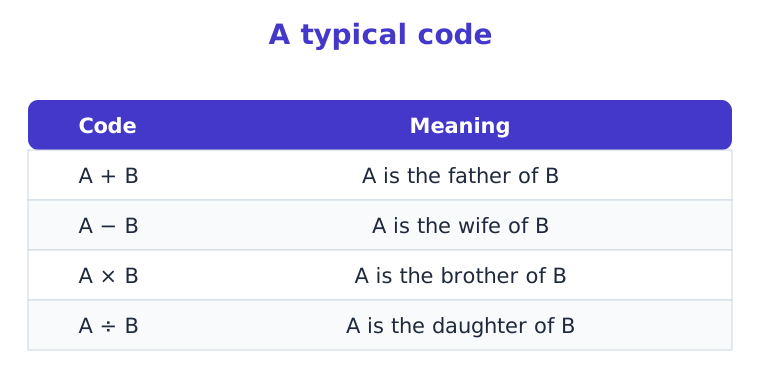
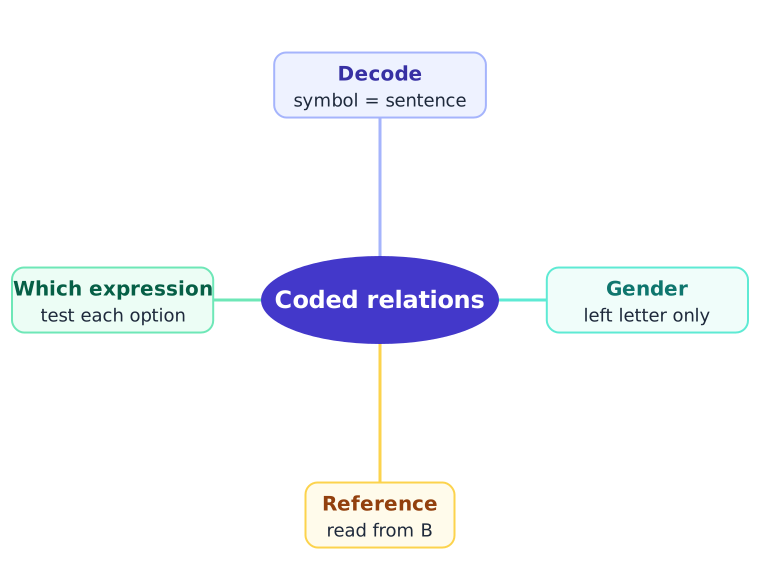
"A + B" always reads "A is the (relation) of B": the left letter is described.
In P × Q ÷ R + S, decode P × Q, then Q ÷ R, then R + S.
A symbol fixes the gender of its left letter only.
The last letter usually has no gender: questions about it often end in "cannot be determined".
"Wife of" or "husband of" fixes both people's genders.
A child's second parent of the other gender is the first parent's spouse.
For "which expression" questions, test the options instead of building from scratch.
Full explanation
Arjun meets the symbols
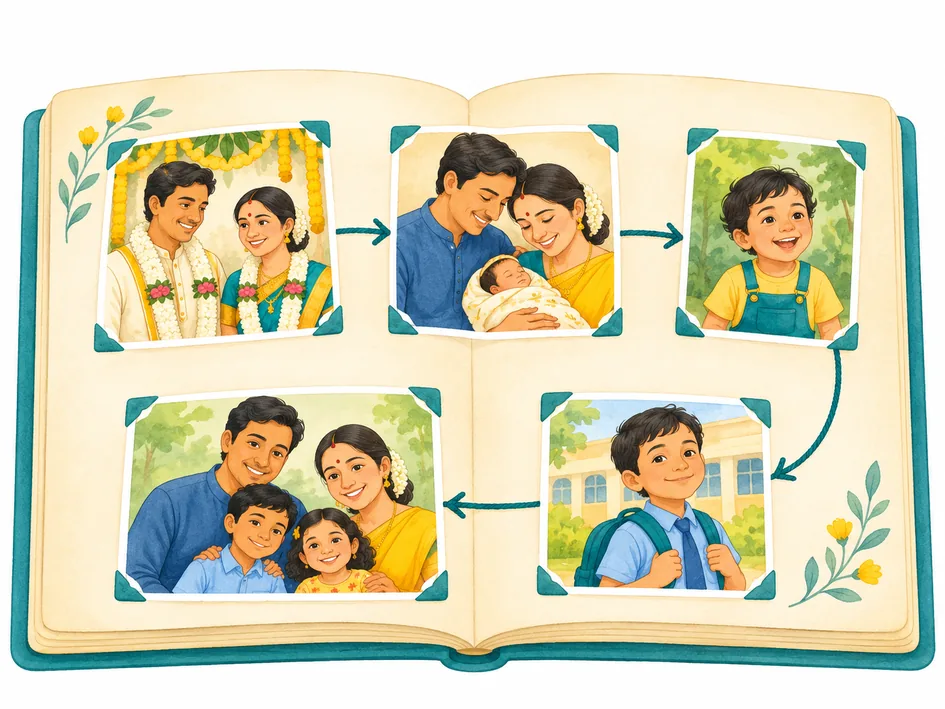
Arjun's SBI Clerk mock has a set: "A + B means A is the father of B; A − B means A is the wife of B" and more and then a line of letters and signs. It looks like algebra, but it is only a family tree written in shorthand.
A symbol is a sentence
"A + B" is read as "A is the father of B". The left letter is the person described; the right letter is the reference. Write the code table at the top of your rough sheet before you touch the expression.
Decode pair by pair
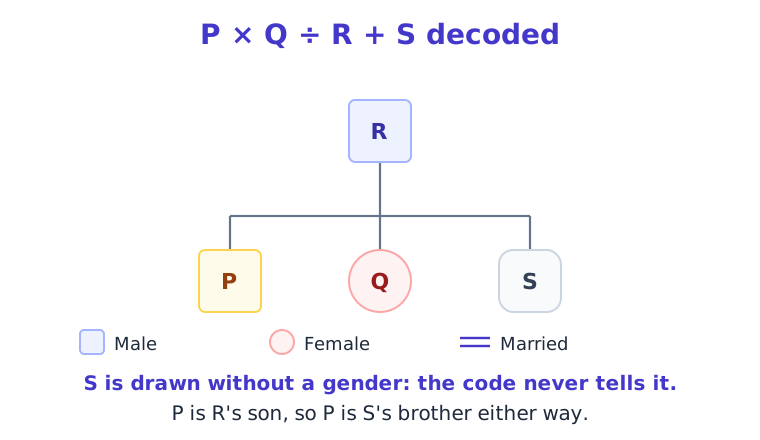
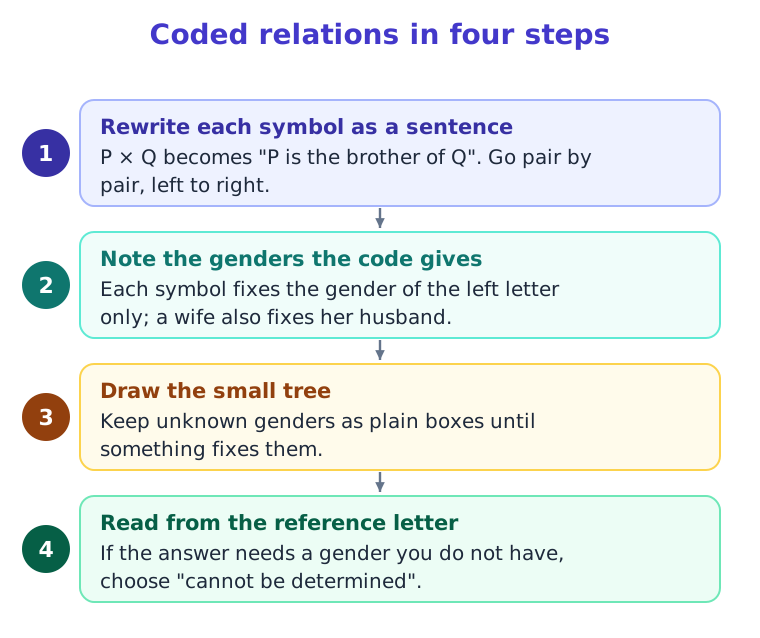
In P × Q ÷ R + S, take the pairs in order: P × Q (P is the brother of Q), Q ÷ R (Q is the daughter of R), R + S (R is the father of S). Three sentences, one family.
Draw as you decode
R is the father of Q and of S, and P is Q's brother, so P, Q and S are all R's children. How is P related to S? Start at S: P is S's brother. S itself never gets a gender, but this answer does not need it.
Turn the question round
Now ask "How is S related to P?" Start at P: S is P's brother or sister. The code never fixed S's gender, so the answer is cannot be determined. Same expression, different question, different answer.
Genders that come for free
"P − Q" (P is the wife of Q) tells you P is female and Q is male. A child with a known father whose other parent is a woman gives you a wife. Use every such clue before saying "cannot be determined".
"Which expression shows this relation?"
When the question gives the relation and asks for the expression, do not build one yourself. Decode each option quickly and stop at the first that gives exactly the asked relation; the others are built to give near misses (the reverse, the wrong side, the wrong gender).
Exam shortcuts
- Copy the code table first.
- Left letter = person described.
- Decode pairs left to right.
- Last letter: check whether its gender is ever given.
- "Which expression": test the options, do not invent.
Back to Arjun
Arjun copies the four meanings, decodes each pair into a sentence and sketches a three-line tree. Two questions take thirty seconds each; the third asks about the last letter, whose gender is never given, and he marks "cannot be determined" with confidence.
Concepts and terms
Each symbol between two letters is one relation statement about the left letter.
Neighbouring pairs share a letter, so the statements join into one tree.
A letter that only appears on the right of symbols never gets a gender from them.
Did you know
Coded blood relations appear almost every year in IBPS and SBI preliminary exams, usually as a set of three questions.
Memory tricks
Reading a symbol — Left is the subject — "A sym B": A is the (relation) of B.
Practice MCQs with answers (53)
- A Grandfather
- B Mother
- C Grandson
- D Father-in-law
Show answer
Why:
Decode: R is the father of J; J is the mother of F. Joining the steps from F, R is F's grandfather.
- A Grandfather
- B Grandson
- C Nephew
- D Daughter
Show answer
Why:
Decode: M is the son of B; B is the daughter of C. Joining the steps from C, M is C's grandson.
- A Son-in-law
- B Sister
- C Brother-in-law
- D Uncle
Show answer
Why:
Decode: S is the husband of L; L is the sister of U. Joining the steps from U, S is U's brother-in-law.
- A Wife
- B Sister
- C Brother-in-law
- D Sister-in-law
Show answer
Why:
Decode: T is the daughter of H; H is the father of K; K is the wife of U. Joining the steps from U, T is U's sister-in-law.
- A Sister
- B Brother
- C Mother
- D Father
Show answer
Why:
Decode: E is the daughter of S; S is the father of B. Joining the steps from B, E is B's sister.
- A Grandfather
- B Granddaughter
- C Grandson
- D Niece
Show answer
Why:
Decode: C is the daughter of R; R is the daughter of G. Joining the steps from G, C is G's granddaughter.
- A Sister
- B Niece
- C Cousin
- D Uncle
Show answer
Why:
Decode: C is the daughter of B; B is the daughter of L; L is the mother of T; T is the father of W. Joining the steps from W, C is W's cousin.
- A Uncle
- B Nephew
- C Father
- D Brother
Show answer
Why:
Decode: P is the brother of V; V is the brother of M. Joining the steps from M, P is M's brother.
- A Nephew
- B Uncle
- C Cousin
- D Niece
Show answer
Why:
Decode: U is the brother of T; T is the son of F; F is the brother of J. Joining the steps from J, U is J's nephew.
- A Sister
- B Brother
- C Uncle
- D Son
Show answer
Why:
Decode: P is the son of B; B is the father of L; L is the sister of F. Joining the steps from F, P is F's brother.
- A Nephew
- B Grandfather
- C Grandson
- D Son
Show answer
Why:
Decode: S is the son of M; M is the sister of P; P is the son of U. Joining the steps from U, S is U's grandson.
- A Niece
- B Cousin
- C Uncle
- D Nephew
Show answer
Why:
Decode: T is the brother of Q; Q is the son of L; L is the brother of C; C is the brother of D. Joining the steps from D, T is D's nephew.
- A Grandmother
- B Grandson
- C Aunt
- D Mother-in-law
Show answer
Why:
Decode: U is the mother of E; E is the mother of S. Joining the steps from S, U is S's grandmother.
- A Grandfather
- B Granddaughter
- C Son-in-law
- D Niece
Show answer
Why:
Decode: C is the daughter of J; J is the daughter of G. Joining the steps from G, C is G's granddaughter.
- A Son-in-law
- B Wife
- C Father-in-law
- D Mother-in-law
Show answer
Why:
Decode: E is the father of Q; Q is the sister of B; B is the wife of P. Joining the steps from P, E is P's father-in-law.
- A Wife
- B Brother-in-law
- C Mother
- D Grandson
Show answer
Why:
Decode: B is the son of A; A is the son of F; F is the husband of K. Joining the steps from K, B is K's grandson.
- A Nephew
- B Brother
- C Grandson
- D Uncle
Show answer
Why:
Decode: S is the son of P; P is the son of G; G is the mother of F. Joining the steps from F, S is F's nephew.
- A Aunt
- B Uncle
- C Brother
- D Nephew
Show answer
Why:
Decode: K is the son of H; H is the father of M; M is the father of F. Joining the steps from F, K is F's uncle.
- A Grandmother
- B Nephew
- C Uncle
- D Aunt
Show answer
Why:
Decode: J is the son of U; U is the mother of N; N is the husband of R; R is the mother of H. Joining the steps from H, J is H's uncle.
- A Brother-in-law
- B Cousin
- C Sister-in-law
- D Husband
Show answer
Why:
Decode: Q is the father of P; P is the daughter of J. Joining the steps from J, Q is J's husband.
- A Cannot be determined
- B Nephew
- C Niece
- D Aunt
Show answer
Why:
Decode: M is the daughter of W; W is the mother of E; E is the mother of T; T is the brother of R. The code never tells whether R is male or female, so R could be nephew or niece of M. The relation cannot be determined.
- A Grandmother
- B Father
- C Son
- D Aunt
Show answer
Why:
Decode: C is the son of Q; Q is the mother of F; F is the daughter of U. Joining the steps from C, U is C's father.
- A Niece
- B Sister-in-law
- C Brother-in-law
- D Uncle
Show answer
Why:
Decode: H is the daughter of G; G is the father of S; S is the brother of J; J is the wife of A. Joining the steps from H, A is H's brother-in-law.
- A Aunt
- B Daughter
- C Grandfather
- D Mother
Show answer
Why:
Decode: B is the daughter of P; P is the father of W; W is the daughter of J. Joining the steps from B, J is B's mother.
- A Cannot be determined
- B Nephew
- C Niece
- D Uncle
Show answer
Why:
Decode: M is the daughter of P; P is the father of V; V is the father of E. The code never tells whether E is male or female, so E could be nephew or niece of M. The relation cannot be determined.
- A Aunt
- B Uncle
- C Brother-in-law
- D Cousin
Show answer
Why:
Decode: E is the daughter of K; K is the brother of P; P is the wife of L. Joining the steps from E, L is E's uncle.
- A Mother-in-law
- B Wife
- C Husband
- D Father
Show answer
Why:
Decode: L is the mother of B; B is the daughter of Q. Joining the steps from L, Q is L's husband.
- A Brother-in-law
- B Father-in-law
- C Husband
- D Son-in-law
Show answer
Why:
Decode: G is the father of J; J is the wife of U. Joining the steps from G, U is G's son-in-law.
- A N % T ★ S
- B N @ T % S
- C N ★ T ★ S
- D N ★ T % S
Show answer
Why:
Decode N % T ★ S: N is the wife of T; T is the son of S. So N is S's daughter-in-law. N @ T % S makes N the father-in-law of S. N ★ T ★ S makes N the grandson of S. N ★ T % S makes N the son of S.
- A E − F ÷ P ÷ B
- B E × F + P × B
- C E − F ÷ P + B
- D E × F + P + B
Show answer
Why:
Decode E × F + P × B: E is the husband of F; F is the mother of P; P is the husband of B. So E is B's father-in-law. E × F + P + B makes E the grandfather of B. E − F ÷ P ÷ B makes E the grandson of B. E − F ÷ P + B makes E the brother of B.
- A S + E + V
- B S × E ÷ V
- C S ÷ E ÷ V
- D S × E × V
Show answer
Why:
Decode S ÷ E ÷ V: S is the daughter of E; E is the daughter of V. So S is V's granddaughter. S × E ÷ V makes S the son of V. S × E × V makes S the brother of V. S + E + V makes S the grandfather of V.
- A P × E × A
- B P − E + A
- C P × E + A
- D P + E × A
Show answer
Why:
Decode P + E × A: P is the father of E; E is the brother of A. So P is A's father. P − E + A makes P the mother of A. P × E + A makes P the uncle of A. P × E × A makes P the brother of A.
- A J − G + L
- B J ÷ G − L
- C J × G + L
- D J × G − L
Show answer
Why:
Decode J − G + L: J is the wife of G; G is the father of L. So J is L's mother. J × G − L makes J the brother-in-law of L. J ÷ G − L makes J the daughter of L. J × G + L makes J the uncle of L.
- A S × L − E
- B S × L ÷ E
- C S + L ÷ E
- D S − L + E
Show answer
Why:
Decode S × L ÷ E: S is the father of L; L is the mother of E. So S is E's grandfather. S − L + E makes S the granddaughter of E. S × L − E makes S the husband of E. S + L ÷ E makes S the brother of E.
- A E @ N # H % S
- B E @ N # H ★ S
- C E # N © H # S
- D E @ N # H © S
Show answer
Why:
Decode E # N © H # S: E is the brother of N; N is the daughter of H; H is the brother of S. So E is S's nephew. E @ N # H % S makes E the grandmother of S. E @ N # H ★ S makes E the mother-in-law of S. E @ N # H © S makes E the wife of S.
- A L ★ S @ H @ T
- B L ★ S # H ★ T
- C L @ S ★ H & T
- D L & S # H @ T
Show answer
Why:
Decode L & S # H @ T: L is the husband of S; S is the mother of H; H is the sister of T. So L is T's father. L ★ S # H ★ T makes L the son of T. L @ S ★ H & T makes L the daughter of T. L ★ S @ H @ T makes L the nephew of T.
- A A × G ÷ Q
- B A × G × Q
- C A ÷ G × Q
- D A − G × Q
Show answer
Why:
Decode A × G ÷ Q: A is the brother of G; G is the daughter of Q. So A is Q's son. A − G × Q makes A the sister-in-law of Q. A × G × Q makes A the brother of Q. A ÷ G × Q makes A the niece of Q.
- A P − H × E × B
- B P − H + E + B
- C P ÷ H × E ÷ B
- D P − H + E × B
Show answer
Why:
Decode P − H + E + B: P is the wife of H; H is the father of E; E is the father of B. So P is B's grandmother. P ÷ H × E ÷ B makes P the granddaughter of B. P − H + E × B makes P the mother of B. P − H × E × B makes P the sister-in-law of B.
- A M # N ★ K
- B M @ N @ K
- C M ★ N ★ K
- D M # N & K
Show answer
Why:
Decode M ★ N ★ K: M is the son of N; N is the son of K. So M is K's grandson. M # N & K makes M the mother-in-law of K. M # N ★ K makes M the wife of K. M @ N @ K makes M the sister of K.
- A M × G × Q
- B M ÷ G + Q
- C M + G − Q
- D M − G − Q
Show answer
Why:
Decode M − G − Q: M is the daughter of G; G is the daughter of Q. So M is Q's granddaughter. M ÷ G + Q makes M the wife of Q. M + G − Q makes M the grandson of Q. M × G × Q makes M the grandfather of Q.
- A Grandmother
- B Mother
- C Mother-in-law
- D Grandson
Show answer
Why:
Decode: K is the mother of L; L is the mother of C. Joining the steps from C, K is C's grandmother.
- A Grandfather
- B Grandmother
- C Grandson
- D Aunt
Show answer
Why:
Decode: Q is the wife of G; G is the father of V; V is the father of S. Joining the steps from S, Q is S's grandmother.
- A Brother
- B Uncle
- C Mother
- D Son
Show answer
Why:
Decode: L is the wife of K; K is the father of N. Joining the steps from N, L is N's mother.
- A Uncle
- B Father-in-law
- C Sister-in-law
- D Brother-in-law
Show answer
Why:
Decode: J is the brother of C; C is the wife of N. Joining the steps from N, J is N's brother-in-law.
- A Q is a parent of P, gender not known
- B Q is P's son
- C Q is male
- D Q is P's father
Show answer
Why:
"★" describes the left letter: P is male and Q's child. Q could be the father or the mother.
- A Only P's gender
- B P is female and Q is male
- C Only Q's gender
- D Neither gender
Show answer
Why:
A wife is female and her husband male, so both genders are fixed.
- A Both A and R are true, and R is the correct explanation of A
- B Both A and R are true, but R is not the correct explanation of A
- C A is true but R is false
- D A is false but R is true
Show answer
Why:
Q is P's son or daughter; only P's gender is fixed by "+". R explains A.
- A Both A and R are true, and R is the correct explanation of A
- B Both A and R are true, but R is not the correct explanation of A
- C A is true but R is false
- D A is false but R is true
Show answer
Why:
A is false: "B × A" makes B male, which "A × B" did not say. R is true.
- A 1 only
- B 2 only
- C Both 1 and 2
- D Neither 1 nor 2
Show answer
Why:
P is Q's husband and Q is R's mother, so P is R's father. R's gender is not given, so 2 need not be true.
- A Son
- B Uncle
- C Brother
- D Father
Show answer
Why:
Decode: L is the brother of G; G is the brother of B. Joining the steps from B, L is B's brother.
- A Grandfather
- B Son
- C Brother
- D Mother
Show answer
Why:
Decode: D is the mother of A; A is the brother of B. Joining the steps from B, D is B's mother.
- A Sister-in-law
- B Daughter-in-law
- C Niece
- D Nephew
Show answer
Why:
Decode: V is the mother of C; C is the son of J; J is the brother of M. Joining the steps from M, V is M's sister-in-law.
- A Grandmother
- B Mother-in-law
- C Mother
- D Son-in-law
Show answer
Why:
Decode: N is the wife of F; F is the father of G; G is the wife of U. Joining the steps from U, N is U's mother-in-law.
Important short questions (3)
A is the daughter of B: A is female, B is A's parent and B's gender is not given.
Symbols fix the gender of the left letter only, and the last letter is never on the left.
P is Q's wife and Q is R's father, so P is R's mother.
Long answer questions (1)
(a) M is N's brother; N is O's daughter; O is P's wife.
(b) O is the mother of N and M, and P is O's husband, so M is P's son.
(c) P is the husband of N's mother, so P is N's father.
Flashcards (12)
Play this topic
- Decode check
Family Puzzles
Solve family puzzles of six members in three generations: place the firm clues, fit the rest, check every clue, and answer relation, "who is" and counting questions.
What you will be able to do
- I can use the frame (members, generations, couples) to limit a family tree.
- I can build the whole tree from scattered clues.
- I can check that the tree satisfies every clue.
- I can answer relation, "who is", couple and counting questions from the tree.
Key points
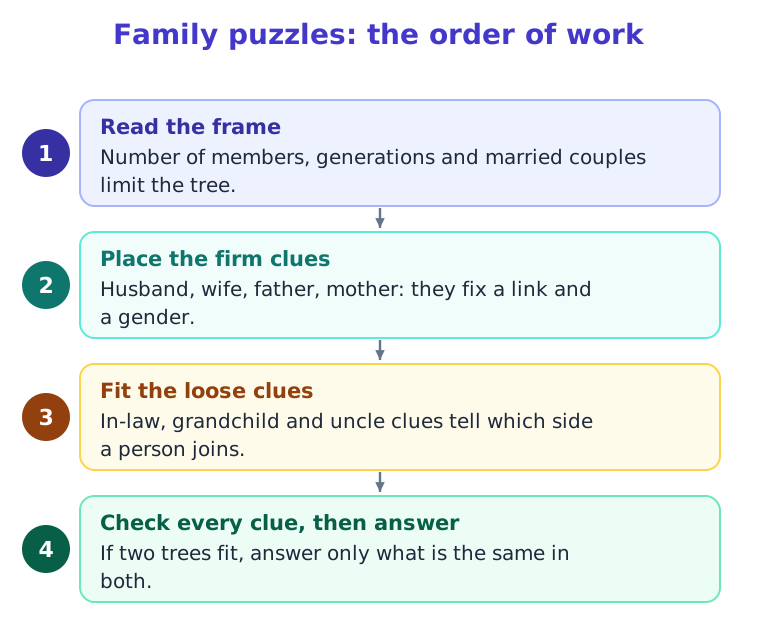
Read the frame first: how many members, generations and couples.
Place husband, wife, father and mother clues first: each fixes a link and a gender.
An in-law clue tells you who married into the family.
Keep a running list of males and females.
Three generations of six people: usually a top couple or person, their children with spouses, and grandchildren.
Check every clue against the finished tree before answering.
If more than one tree fits, only an answer that is the same in all of them is valid.
Full explanation
Kavya's puzzle set
Kavya's IBPS PO mains paper has a set: "There are six members P, Q, R, S, T and U in a family of three generations. There are two married couples." Five clues and three questions follow. She budgets four minutes for all three, and finishes in three.
Read the frame
Six members, three generations, two couples. That already tells you the shape: a top generation, a middle generation where most people sit, and one or two grandchildren. Nobody outside the six exists, and nobody else is married.
Firm clues first
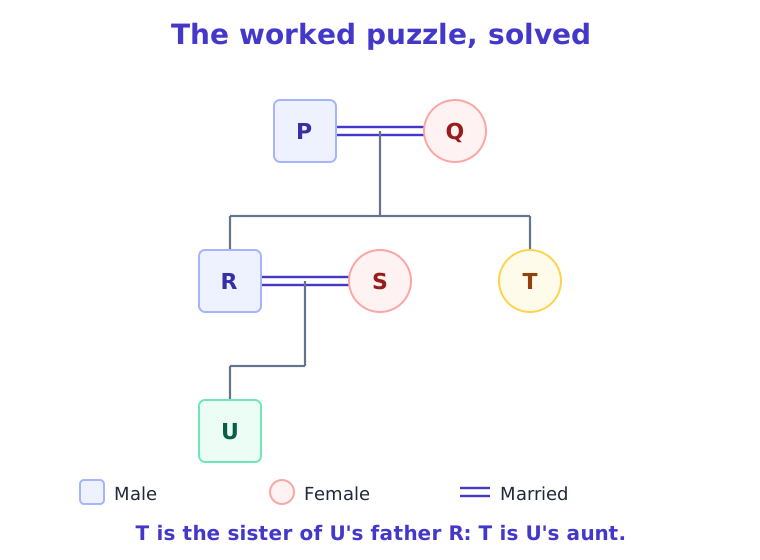
The worked set: T is the sister of R. S is the wife of R. U is the son of S. P is the husband of Q. Q is the mother of T. Start with the couples: R = S and P = Q. Two couples, so nobody else is married.
Fit the rest
Q is T's mother and T is R's sister, so R is also a child of P and Q: P and Q are the top generation. U is S's son; S is R's wife, so U is R's son too. Genders: P, R, U male; Q, S, T female.
Check, then answer
Read every clue against the tree: all five are true, and no other six-person tree with two couples satisfies them. Now "How is T related to U?": T is the sister of U's father, so T is U's aunt (father's sister). "Who is U's mother?" S.
Keep a gender list
Write two columns, male and female, and drop each name in as a clue fixes it. Counting questions ("How many female members?") are then free, and the list stops you from giving someone a gender that no clue gave.
Loose clues need care
"S is the daughter-in-law of P" says S married one of P's sons, but not which one. "T is the aunt of U" could be the father's or the mother's sister. Hold such clues until the firm ones have placed most people.
Question types
- Relation: How is X related to Y? Read from Y.
- Who is: Who is the mother of U? Find the one person.
- Count: How many male members? Use the gender list.
- Couple: Which pair is married? Read the double lines.
Exam shortcuts
- Frame first.
- Couples next: they also tell you who is not married.
- Parent clues build the vertical lines.
- Gender list beside the tree.
- Check all clues once before answering the set.
Back to Kavya
Kavya placed the two couples, hung R and T under P and Q, and U under R and S. One check of the five clues, and the three answers took a minute: aunt, S, and three female members.
Concepts and terms
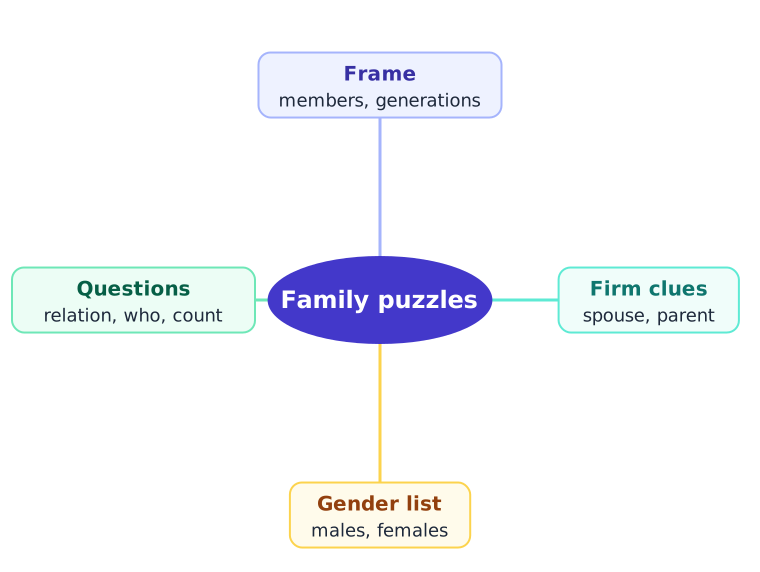
Firm clues (spouse, parent) fix one link; loose ones (in-law, uncle, grandchild) leave a choice of side.
Counts of members, generations and couples rule out most shapes before any clue is used.
A tree is the answer only when every clue is true in it.
Did you know
Puzzle sets in bank mains exams often hide the family inside a larger puzzle about floors or professions.
Memory tricks
Order of work — Frame, firm, loose, check — Four passes over the clues.
Practice MCQs with answers (54)
- A Mother
- B Grandmother
- C Grandson
- D Grandfather
Show answer
Why:
Build the tree from the clues. Q's child is S. R's child is U. S and U are husband and wife; their child is T. T and P are husband and wife. Males: S, T; females: P, Q, R, U. So Q is T's grandmother. This is the only family that fits all the clues.
- A Q
- B R
- C U
- D P
Show answer
Why:
Build the tree from the clues. Q's child is S. R's child is U. S and U are husband and wife; their child is T. T and P are husband and wife. Males: S, T; females: P, Q, R, U. U is S's wife. This is the only family that fits all the clues.
- A 2
- B 3
- C 5
- D 4
Show answer
Why:
Build the tree from the clues. Q's child is S. R's child is U. S and U are husband and wife; their child is T. T and P are husband and wife. Males: S, T; females: P, Q, R, U. The female members are P, Q, R, U: 4 in all. This is the only family that fits all the clues.
- A Son-in-law
- B Father-in-law
- C Grandson
- D Granddaughter
Show answer
Why:
Build the tree from the clues. B's children are F and A. D and A are husband and wife; their child is E. C and E are husband and wife. Males: C, D, F; females: A, B, E. So C is D's son-in-law. This is the only family that fits all the clues.
- A C
- B F
- C D
- D B
Show answer
Why:
Build the tree from the clues. B's children are F and A. D and A are husband and wife; their child is E. C and E are husband and wife. Males: C, D, F; females: A, B, E. F is E's uncle. This is the only family that fits all the clues.
- A 5
- B 2
- C 3
- D 4
Show answer
Why:
Build the tree from the clues. B's children are F and A. D and A are husband and wife; their child is E. C and E are husband and wife. Males: C, D, F; females: A, B, E. The female members are A, B, E: 3 in all. This is the only family that fits all the clues.
- A Brother-in-law
- B Wife
- C Sister
- D Sister-in-law
Show answer
Why:
Build the tree from the clues. K's child is N. L and N are husband and wife; their children are O and M. J and O are husband and wife. Males: J, L; females: K, M, N, O. So M is J's sister-in-law. This is the only family that fits all the clues.
- A L
- B J
- C N
- D K
Show answer
Why:
Build the tree from the clues. K's child is N. L and N are husband and wife; their children are O and M. J and O are husband and wife. Males: J, L; females: K, M, N, O. L is M's father. This is the only family that fits all the clues.
- A 1
- B 2
- C 3
- D 4
Show answer
Why:
Build the tree from the clues. K's child is N. L and N are husband and wife; their children are O and M. J and O are husband and wife. Males: J, L; females: K, M, N, O. The male members are J, L: 2 in all. This is the only family that fits all the clues.
- A Father-in-law
- B Daughter-in-law
- C Mother-in-law
- D Mother
Show answer
Why:
Build the tree from the clues. M's children are G and L. G and J are husband and wife. L and H are husband and wife; their child is K. Males: G, K, L; females: H, J, M. So M is J's mother-in-law. This is the only family that fits all the clues.
- A K
- B M
- C G
- D L
Show answer
Why:
Build the tree from the clues. M's children are G and L. G and J are husband and wife. L and H are husband and wife; their child is K. Males: G, K, L; females: H, J, M. L is H's husband. This is the only family that fits all the clues.
- A G and J
- B G and L
- C K and M
- D G and H
Show answer
Why:
Build the tree from the clues. M's children are G and L. G and J are husband and wife. L and H are husband and wife; their child is K. Males: G, K, L; females: H, J, M. The married couples are G–J and H–L. This is the only family that fits all the clues.
- A Nephew
- B Sister-in-law
- C Wife
- D Daughter-in-law
Show answer
Why:
Build the tree from the clues. R's children are S and Q. Q and T are husband and wife; their child is P. P and U are husband and wife. Males: P, Q, R, S; females: T, U. So T is S's sister-in-law. Every family that fits the clues gives this answer.
- A S
- B U
- C Q
- D R
Show answer
Why:
Build the tree from the clues. R's children are S and Q. Q and T are husband and wife; their child is P. P and U are husband and wife. Males: P, Q, R, S; females: T, U. Q is P's father. Every family that fits the clues gives this answer.
- A Q and S
- B R and S
- C S and U
- D Q and T
Show answer
Why:
Build the tree from the clues. R's children are S and Q. Q and T are husband and wife; their child is P. P and U are husband and wife. Males: P, Q, R, S; females: T, U. The married couples are P–U and Q–T. Every family that fits the clues gives this answer.
- A Niece
- B Aunt
- C Daughter
- D Nephew
Show answer
Why:
Build the tree from the clues. C's children are D and B. D and E are husband and wife; their child is F. A and B are husband and wife. Males: A, C, D; females: B, E, F. So F is B's niece. This is the only family that fits all the clues.
- A E
- B C
- C A
- D B
Show answer
Why:
Build the tree from the clues. C's children are D and B. D and E are husband and wife; their child is F. A and B are husband and wife. Males: A, C, D; females: B, E, F. C is D's father. This is the only family that fits all the clues.
- A 4
- B 5
- C 3
- D 2
Show answer
Why:
Build the tree from the clues. C's children are D and B. D and E are husband and wife; their child is F. A and B are husband and wife. Males: A, C, D; females: B, E, F. The male members are A, C, D: 3 in all. This is the only family that fits all the clues.
- A Son-in-law
- B Sister-in-law
- C Father
- D Father-in-law
Show answer
Why:
Build the tree from the clues. U's children are W and X. X and Y are husband and wife; their child is V. Z and V are husband and wife. Males: U, W, X, Z; females: V, Y. So X is Z's father-in-law. Every family that fits the clues gives this answer.
- A U
- B W
- C X
- D Z
Show answer
Why:
Build the tree from the clues. U's children are W and X. X and Y are husband and wife; their child is V. Z and V are husband and wife. Males: U, W, X, Z; females: V, Y. U is V's grandfather. Every family that fits the clues gives this answer.
- A X and Z
- B V and Z
- C W and X
- D U and W
Show answer
Why:
Build the tree from the clues. U's children are W and X. X and Y are husband and wife; their child is V. Z and V are husband and wife. Males: U, W, X, Z; females: V, Y. The married couples are V–Z and X–Y. Every family that fits the clues gives this answer.
- A Grandmother
- B Son-in-law
- C Mother-in-law
- D Father-in-law
Show answer
Why:
Build the tree from the clues. N's children are P and L. Q and P are husband and wife; their child is O. M and L are husband and wife. Males: M, O, Q; females: L, N, P. So N is Q's mother-in-law. Every family that fits the clues gives this answer.
- A L
- B M
- C N
- D P
Show answer
Why:
Build the tree from the clues. N's children are P and L. Q and P are husband and wife; their child is O. M and L are husband and wife. Males: M, O, Q; females: L, N, P. P is Q's wife. Every family that fits the clues gives this answer.
- A L and M
- B N and O
- C M and P
- D O and Q
Show answer
Why:
Build the tree from the clues. N's children are P and L. Q and P are husband and wife; their child is O. M and L are husband and wife. Males: M, O, Q; females: L, N, P. The married couples are L–M and P–Q. Every family that fits the clues gives this answer.
- A Aunt
- B Sister-in-law
- C Nephew
- D Wife
Show answer
Why:
Build the tree from the clues. S's children are Q and P. P and T are husband and wife; their child is U. R and U are husband and wife. Males: P, R; females: Q, S, T, U. So T is Q's sister-in-law. This is the only family that fits all the clues.
- A U
- B R
- C S
- D T
Show answer
Why:
Build the tree from the clues. S's children are Q and P. P and T are husband and wife; their child is U. R and U are husband and wife. Males: P, R; females: Q, S, T, U. S is Q's mother. This is the only family that fits all the clues.
- A 3
- B 5
- C 2
- D 4
Show answer
Why:
Build the tree from the clues. S's children are Q and P. P and T are husband and wife; their child is U. R and U are husband and wife. Males: P, R; females: Q, S, T, U. The female members are Q, S, T, U: 4 in all. This is the only family that fits all the clues.
- A Son-in-law
- B Brother-in-law
- C Mother-in-law
- D Granddaughter
Show answer
Why:
Build the tree from the clues. B and A are husband and wife; their child is E. F's child is C. C and E are husband and wife; their child is D. Males: B, C; females: A, D, E, F. So C is A's son-in-law. This is the only family that fits all the clues.
- A C
- B B
- C F
- D A
Show answer
Why:
Build the tree from the clues. B and A are husband and wife; their child is E. F's child is C. C and E are husband and wife; their child is D. Males: B, C; females: A, D, E, F. B is D's grandfather. This is the only family that fits all the clues.
- A B and C
- B B and D
- C A and B
- D B and F
Show answer
Why:
Build the tree from the clues. B and A are husband and wife; their child is E. F's child is C. C and E are husband and wife; their child is D. Males: B, C; females: A, D, E, F. The married couples are A–B and C–E. This is the only family that fits all the clues.
- A Daughter-in-law
- B Husband
- C Grandfather
- D Father-in-law
Show answer
Why:
Build the tree from the clues. N's child is M. J and M are husband and wife; their children are K and O. O and L are husband and wife. Males: J, K, N, O; females: L, M. So J is L's father-in-law. Every family that fits the clues gives this answer.
- A O
- B K
- C N
- D J
Show answer
Why:
Build the tree from the clues. N's child is M. J and M are husband and wife; their children are K and O. O and L are husband and wife. Males: J, K, N, O; females: L, M. O is L's husband. Every family that fits the clues gives this answer.
- A N and O
- B J and M
- C J and L
- D K and O
Show answer
Why:
Build the tree from the clues. N's child is M. J and M are husband and wife; their children are K and O. O and L are husband and wife. Males: J, K, N, O; females: L, M. The married couples are J–M and L–O. Every family that fits the clues gives this answer.
- A Grandmother
- B Father-in-law
- C Grandfather
- D Granddaughter
Show answer
Why:
Build the tree from the clues. H and G are husband and wife; their children are L and K. M and L are husband and wife; their child is J. Males: H, K, M; females: G, J, L. So H is J's grandfather. This is the only family that fits all the clues.
- A H
- B L
- C J
- D G
Show answer
Why:
Build the tree from the clues. H and G are husband and wife; their children are L and K. M and L are husband and wife; their child is J. Males: H, K, M; females: G, J, L. G is K's mother. This is the only family that fits all the clues.
- A G and H
- B J and L
- C H and L
- D J and K
Show answer
Why:
Build the tree from the clues. H and G are husband and wife; their children are L and K. M and L are husband and wife; their child is J. Males: H, K, M; females: G, J, L. The married couples are G–H and L–M. This is the only family that fits all the clues.
- A Granddaughter
- B Grandmother
- C Father
- D Uncle
Show answer
Why:
Build the tree from the clues. P's children are T and R. R and U are husband and wife; their child is S. Q and S are husband and wife. Males: Q, R; females: P, S, T, U. So P is S's grandmother. Every family that fits the clues gives this answer.
- A S
- B T
- C U
- D P
Show answer
Why:
Build the tree from the clues. P's children are T and R. R and U are husband and wife; their child is S. Q and S are husband and wife. Males: Q, R; females: P, S, T, U. U is R's wife. Every family that fits the clues gives this answer.
- A 3
- B 5
- C 2
- D 4
Show answer
Why:
Build the tree from the clues. P's children are T and R. R and U are husband and wife; their child is S. Q and S are husband and wife. Males: Q, R; females: P, S, T, U. The female members are P, S, T, U: 4 in all. Every family that fits the clues gives this answer.
- A Grandfather
- B Mother
- C Father-in-law
- D Grandson
Show answer
Why:
Build the tree from the clues. F and A are husband and wife; their child is B. D and B are husband and wife; their children are E and C. Males: C, D, E, F; females: A, B. So F is E's grandfather. This is the only family that fits all the clues.
- A E
- B B
- C F
- D A
Show answer
Why:
Build the tree from the clues. F and A are husband and wife; their child is B. D and B are husband and wife; their children are E and C. Males: C, D, E, F; females: A, B. B is D's wife. This is the only family that fits all the clues.
- A 1
- B 3
- C 2
- D 4
Show answer
Why:
Build the tree from the clues. F and A are husband and wife; their child is B. D and B are husband and wife; their children are E and C. Males: C, D, E, F; females: A, B. The female members are A, B: 2 in all. This is the only family that fits all the clues.
- A Sister-in-law
- B Mother-in-law
- C Wife
- D Brother-in-law
Show answer
Why:
Build the tree from the clues. W's children are Z and U. V and Z are husband and wife. U and Y are husband and wife; their child is X. Males: U, V; females: W, X, Y, Z. So U is V's brother-in-law. Every family that fits the clues gives this answer.
- A Z
- B Y
- C W
- D V
Show answer
Why:
Build the tree from the clues. W's children are Z and U. V and Z are husband and wife. U and Y are husband and wife; their child is X. Males: U, V; females: W, X, Y, Z. Z is X's aunt. Every family that fits the clues gives this answer.
- A U and Z
- B U and Y
- C Y and Z
- D V and Y
Show answer
Why:
Build the tree from the clues. W's children are Z and U. V and Z are husband and wife. U and Y are husband and wife; their child is X. Males: U, V; females: W, X, Y, Z. The married couples are U–Y and V–Z. Every family that fits the clues gives this answer.
- A H
- B A
- C P
- D N
Show answer
Why:
Follow the lines from K: A is K's husband; P is A's father. So P is K's father-in-law.
- A N
- B T
- C U
- D P
Show answer
Why:
Follow the lines from W: N is W's daughter; P is N's daughter. So P is W's granddaughter.
- A Grandson
- B Grandfather
- C Nephew
- D Granddaughter
Show answer
Why:
Follow the lines from K: A is K's son; C is A's son. So C is K's grandson.
- A Daughter
- B Niece
- C Uncle
- D Cousin
Show answer
Why:
Follow the lines from N: J is N's brother; S is J's daughter. So S is N's niece.
- A There is a third couple to find
- B The youngest member must be female
- C Every other member is unmarried
- D Every other member is a child of the first couple
Show answer
Why:
The frame allows exactly two couples, so nobody else is married. Nothing more follows without clues.
- A R is the sister-in-law of S
- B T is the grandson of P
- C U is the cousin of R
- D P is the husband of Q
Show answer
Why:
A spouse clue fixes a link and both genders; the others leave a choice of side or generation path.
- A Both A and R are true, and R is the correct explanation of A
- B Both A and R are true, but R is not the correct explanation of A
- C A is true but R is false
- D A is false but R is true
Show answer
Why:
Both true; R explains why the son is not fixed.
- A Both A and R are true, and R is the correct explanation of A
- B Both A and R are true, but R is not the correct explanation of A
- C A is true but R is false
- D A is false but R is true
Show answer
Why:
A is false: questions whose answer is the same in both trees can still be answered. R is true.
- A 1 only
- B 2 only
- C Both 1 and 2
- D Neither 1 nor 2
Show answer
Why:
Q is the mother of U's father: grandmother. S is the wife of T's brother: sister-in-law. Both true.
Important short questions (3)
Once two couples are placed, every other member is unmarried, which rules out many trees.
They fix one exact link and genders; in-law clues leave a choice of which son, daughter or side.
Three: P, R and U.
Long answer questions (1)
(a) A = B at the top; their children C and F; C = D; E below C and D.
(b) F is the sister of E's father C: E's aunt (father's sister).
(c) B, D, E and F: four.
Flashcards (12)
Play this topic
- Puzzle check
Veda Skills Logical Reasoning Unit 6 — frequently asked questions
The question asks what A is to B. If A is B's uncle, B is A's nephew or niece; reading from A gives the reversed word.
Amit is male, so his father's only son is Amit himself. The girl is Amit's daughter.
P is Q's child, so P is R's nephew or niece, but P's gender is not given. The relation cannot be determined.
A is the daughter of B: A is female, B is A's parent and B's gender is not given.
Symbols fix the gender of the left letter only, and the last letter is never on the left.
P is Q's wife and Q is R's father, so P is R's mother.
Once two couples are placed, every other member is unmarried, which rules out many trees.
They fix one exact link and genders; in-law clues leave a choice of which son, daughter or side.
Three: P, R and U.

All Veda Skills Logical Reasoning units
Study this chapter properly, free
Everything above is on this page to read. In the Veda app the same chapter becomes spaced-repetition flashcards, timed tests that mark themselves, Veda Bites you can swipe, and games — with your progress tracked topic by topic.
Get Veda free