Veda Skills Logical Reasoning Unit 2: Letter and Alphanumeric Series
- 3 topics
- 161 MCQs
- 9 short answers
- 3 long answers
- 36 flashcards
- 3 games
- ~130 min read
- English
Checked before publishing: 23 automated checks, including a plagiarism check against the textbook's own words. How we check our content
Letter Series
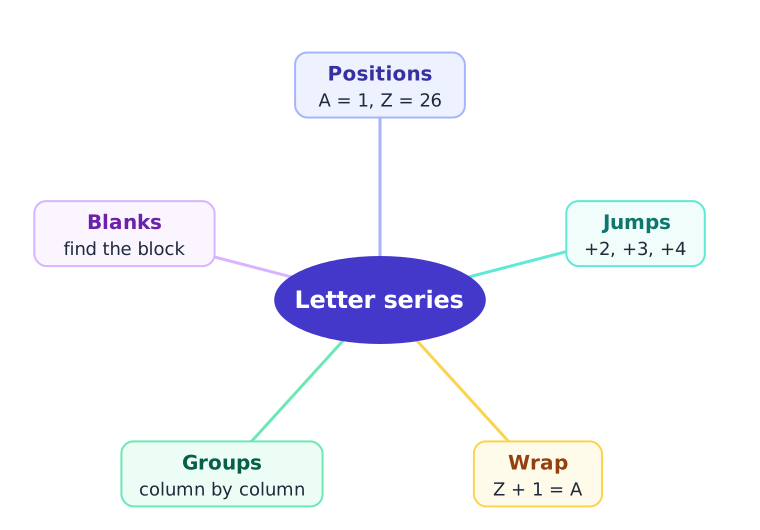
Turn letters into positions (A = 1 … Z = 26), find the jump rule, carry past Z back to A, read letter groups column by column, and fill repeating-letter blanks by finding the block.
What you will be able to do
- I can convert any letter to its position and back within seconds using EJOTY.
- I can find the jump rule of a single-letter series, including growing and alternating jumps.
- I can continue a series past Z by starting again at A.
- I can solve letter-group series by treating each place in the group as its own series.
- I can fill the blanks of a repeating letter pattern.

Key points
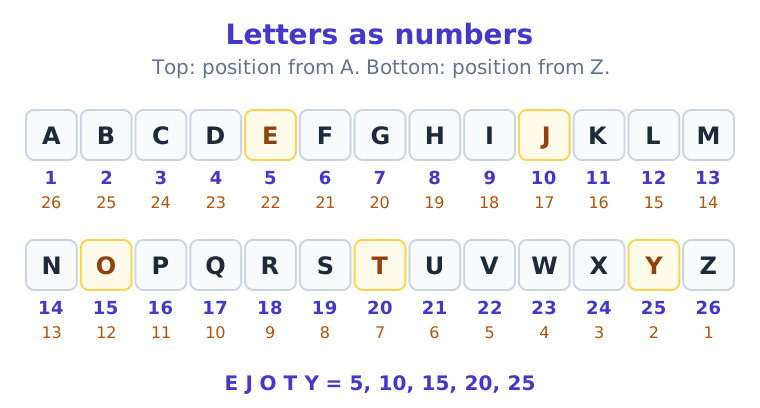
Every letter has a position: A = 1, B = 2, …, Z = 26.
EJOTY marks 5, 10, 15, 20, 25; count a step or two from these anchors.
A letter series is a number series in disguise: write the positions and find the gaps.
After Z the count starts again at A: position 27 is A, 28 is B (subtract 26).
Backward series subtract; before A comes Z.
In letter groups such as ACZ, BEX, CGV each place follows its own rule.
In blank-filling series, find the shortest block that repeats and copy it.
Full explanation
Ishaan's letter puzzle

Ishaan is preparing for RRB NTPC. His mock paper shows C, F, I, L, ? and then ACZ, BEX, CGV, ?. He knows numbers well, but letters slow him down. The trick is simple: turn letters into numbers.
Letters have positions

A = 1, B = 2, … Z = 26. You do not need to recite the alphabet each time. Learn EJOTY: E = 5, J = 10, O = 15, T = 20, Y = 25. R is T − 2 = 18; M is O − 2 = 13. Positions counted from Z (the reverse positions) are 27 minus the forward position.
Single-letter series
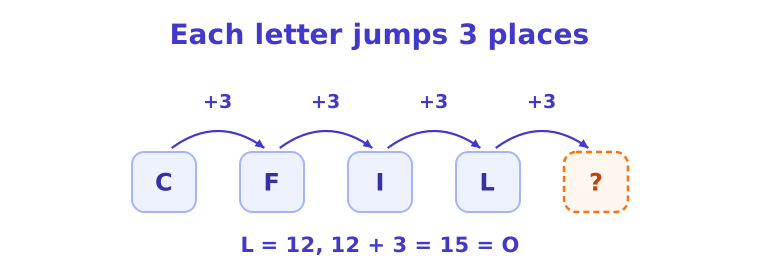
C, F, I, L are 3, 6, 9, 12: a jump of +3. So the next letter is 15 = O. Jumps can also grow (+1, +2, +3), take turns (+4, −1) or go backward (−2).
Going past Z
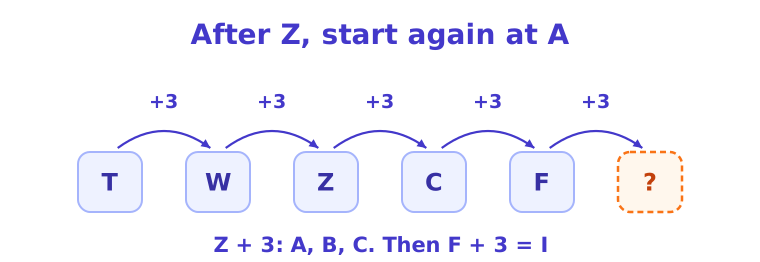
The alphabet is a circle in these questions. T, W, Z, C, F jumps +3 each time: Z + 3 = 29, and $29 - 26 = 3$, which is C. Going backward, B − 4 = −2, and $-2 + 26 = 24$, which is X.
Letter groups: read columns
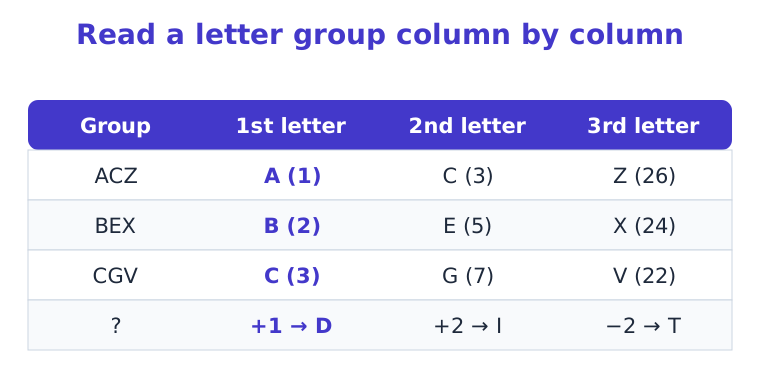
For ACZ, BEX, CGV, ? do not read words. Read the 1st letters A, B, C (+1), the 2nd letters C, E, G (+2) and the 3rd letters Z, X, V (−2). So the next group is DIT.
Filling blanks in a repeating pattern
SSC loves this type: A B _ A B B _ B B A _ B. Guess the block from the clear part (A B B), write it out (A B B | A B B | A B B | A B B) and read off the blanks: B A B. Always check the full string with your answer in it.
Exam shortcuts
- Write the position under each letter; letters become a number series.
- EJOTY for fast positions; 27 − n for the reverse position.
- Over 26 subtract 26; below 1 add 26.
- Groups: one column at a time.
- Blanks: find the block, then copy it.
Back to Ishaan
Ishaan writes 3, 6, 9, 12 under C, F, I, L and answers O. For the groups he splits the columns and answers DIT. Both take him under 20 seconds now.
Concepts and terms
The place of a letter in the alphabet counted from A: M = 13, R = 18.
Counting continues from Z back to A, so X + 4 = B (24 + 4 = 28, 28 − 26 = 2).
For groups, write the 1st letters, 2nd letters and so on as separate series.
A short string such as ABB that is written again and again: ABBABBABB.

Did you know
SSC CGL and CHSL papers almost always include at least one blank-filling letter series such as "ab_ba_ab_", and it is usually the quickest question in the reasoning section.

Memory tricks
Positions 5 to 25 — EJOTY — E = 5, J = 10, O = 15, T = 20, Y = 25. Every other letter is one or two steps from one of these.
Past Z — Over 26? Take away 26. — W + 6 = 29, and 29 − 26 = 3 = C.
Practice MCQs with answers (55)
- A R
- B Q
- C T
- D S
Show answer
Why:
Each letter moves 3 places forward (+3). So ? = O + 3 = R.
- A X
- B V
- C W
- D U
Show answer
Why:
Each letter moves 4 places forward (+4). So ? = R + 4 = V.
- A O
- B R
- C P
- D Q
Show answer
Why:
Each letter moves 2 places back (−2). So ? = R − 2 = P.
- A A
- B Y
- C B
- D Z
Show answer
Why:
Each letter moves 5 places forward (+5). So ? = U + 5 = Z.
- A I
- B H
- C K
- D J
Show answer
Why:
Each letter moves 3 places forward (+3). So ? = F + 3 = I.
- A R
- B P
- C Q
- D O
Show answer
Why:
Each letter moves 3 places back (−3). So ? = S − 3 = P.
- A S
- B R
- C Q
- D P
Show answer
Why:
Each letter moves 7 places forward (+7). So ? = J + 7 = Q.
- A V
- B Y
- C X
- D W
Show answer
Why:
Each letter moves 2 places forward (+2). So ? = U + 2 = W.
- A V
- B W
- C U
- D X
Show answer
Why:
The jumps +1, +2, +3, … change by +1 each time. So ? = P + 6 = V.
- A U
- B V
- C X
- D W
Show answer
Why:
The jumps +2, +3, +4, … change by +1 each time. So ? = P + 6 = V.
- A J
- B M
- C K
- D L
Show answer
Why:
The jumps −1, −2, −3, … change by −1 each time. So ? = P − 5 = K.
- A A
- B D
- C C
- D B
Show answer
Why:
The jumps +1, +3, +5, … change by +2 each time. So ? = S + 9 = B.
- A T
- B U
- C S
- D V
Show answer
Why:
The jumps +5, +4, +3, … change by −1 each time. So ? = S + 1 = T.
- A O
- B N
- C M
- D P
Show answer
Why:
Two jumps take turns: +4, then −1. So ? = J + 4 = N.
- A R
- B Q
- C P
- D O
Show answer
Why:
Two jumps take turns: +3, then −2. So ? = M + 3 = P.
- A R
- B P
- C S
- D Q
Show answer
Why:
Two jumps take turns: −3, then +1. So ? = T − 3 = Q.
- A T
- B S
- C V
- D U
Show answer
Why:
Two series are woven together: places 1, 3, 5, … go +2; places 2, 4, 6, … go −2. So ? = V − 2 = T.
- A G
- B H
- C J
- D I
Show answer
Why:
Two series are woven together: places 1, 3, 5, … go +3; places 2, 4, 6, … go +1. So ? = G + 1 = H.
- A L
- B K
- C J
- D I
Show answer
Why:
Positions are the squares 1, 4, 9, …. So ? = 6² = 36 → J.
- A S
- B R
- C P
- D Q
Show answer
Why:
Positions are consecutive primes 2, 3, 5, …. So ? = 17 → Q.
- A R
- B T
- C S
- D Q
Show answer
Why:
Each letter moves 4 places forward (+4). So ? = N + 4 = R.
- A H
- B I
- C K
- D J
Show answer
Why:
The jumps +1, +2, +3, … change by +1 each time. So ? = D + 5 = I.
- A R
- B U
- C S
- D T
Show answer
Why:
Each letter moves 5 places forward (+5). So ? = N + 5 = S.
- A N
- B M
- C K
- D L
Show answer
Why:
The jumps +1, +2, +3, … change by +1 each time. So ? = H + 4 = L.
- A EV
- B DV
- C GV
- D CV
Show answer
Why:
Read each place of the group separately. First: each letter moves 1 place forward (+1), so D + 1 = E. Second: each letter moves 1 place back (−1), so W − 1 = V. So ? = EV.
- A CKR
- B EKR
- C DKR
- D GKR
Show answer
Why:
Read each place of the group separately. First: each letter moves 1 place forward (+1), so D + 1 = E. Second: each letter moves 2 places forward (+2), so I + 2 = K. Third: each letter moves 2 places back (−2), so T − 2 = R. So ? = EKR.
- A IO
- B KO
- C JO
- D KN
Show answer
Why:
Read each place of the group separately. First: each letter moves 2 places forward (+2), so H + 2 = J. Second: each letter moves 3 places forward (+3), so L + 3 = O. So ? = JO.
- A JJJ
- B HJK
- C JJK
- D IJK
Show answer
Why:
Read each place of the group separately. First: each letter moves 2 places forward (+2), so G + 2 = I. Second: each letter moves 2 places forward (+2), so H + 2 = J. Third: each letter moves 2 places forward (+2), so I + 2 = K. So ? = IJK.
- A PU
- B OU
- C QU
- D QT
Show answer
Why:
Read each place of the group separately. First: the jumps +1, +2, +3, … change by +1 each time, so K + 5 = P. Second: each letter moves 1 place back (−1), so V − 1 = U. So ? = PU.
- A RHM
- B QHN
- C PHN
- D RHN
Show answer
Why:
Read each place of the group separately. First: each letter moves 3 places forward (+3), so N + 3 = Q. Second: each letter moves 3 places back (−3), so K − 3 = H. Third: each letter moves 1 place forward (+1), so M + 1 = N. So ? = QHN.
- A RJ
- B RI
- C QJ
- D PJ
Show answer
Why:
Read each place of the group separately. First: each letter moves 1 place forward (+1), so P + 1 = Q. Second: each letter moves 1 place back (−1), so K − 1 = J. So ? = QJ.
- A SH
- B QI
- C SI
- D RI
Show answer
Why:
Read each place of the group separately. First: each letter moves 4 places forward (+4), so N + 4 = R. Second: each letter moves 4 places back (−4), so M − 4 = I. So ? = RI.
- A MPS
- B NPS
- C NPR
- D LPS
Show answer
Why:
Read each place of the group separately. First: each letter moves 3 places forward (+3), so J + 3 = M. Second: each letter moves 3 places forward (+3), so M + 3 = P. Third: each letter moves 3 places forward (+3), so P + 3 = S. So ? = MPS.
- A MR
- B KR
- C IR
- D ER
Show answer
Why:
Read each place of the group separately. First: two jumps take turns: +2, then +3, so H + 3 = K. Second: each letter moves 1 place back (−1), so S − 1 = R. So ? = KR.
- A PQTW
- B LQTW
- C NQTW
- D MQTW
Show answer
Why:
Read each place of the group separately. First: each letter moves 2 places forward (+2), so L + 2 = N. Second: each letter moves 2 places forward (+2), so O + 2 = Q. Third: each letter moves 2 places forward (+2), so R + 2 = T. Fourth: each letter moves 2 places forward (+2), so U + 2 = W. So ? = NQTW.
- A A A A
- B A B B
- C A A B
- D B A B
Show answer
Why:
The block A B B repeats: A B B | A B B | A B B | A B B. The blanks read B A B.
- A B C A C
- B A A A C
- C A B A C
- D A C A C
Show answer
Why:
The block A B C repeats: A B C | A B C | A B C | A B C. The blanks read B C A C.
- A A A A A
- B A A B B
- C A B A B
- D A A A B
Show answer
Why:
The block A A B B repeats: A A B B | A A B B | A A B B. The blanks read A A B B.
- A A A A A
- B A A A C
- C C A A B
- D A A A B
Show answer
Why:
The block A B C A repeats: A B C A | A B C A | A B C A. The blanks read C A A B.
- A P P P Q
- B P P Q Q
- C P P R Q
- D P Q R Q
Show answer
Why:
The block P Q R Q repeats: P Q R Q | P Q R Q | P Q R Q. The blanks read P Q R Q.
- A N M N M N
- B M M N M M
- C M M N M N
- D M M M M N
Show answer
Why:
The block M N N M repeats: M N N M | M N N M | M N N M. The blanks read N M N M N.
- A A A A B A
- B B A A B C
- C A A A B C
- D A A A A C
Show answer
Why:
The block A B A C A repeats: A B A C A | A B A C A | A B A C A. The blanks read B A A B C.
- A X X Z Y
- B X X X Y
- C X Z Z Y
- D X X Y Y
Show answer
Why:
The block X Y Z Z repeats: X Y Z Z | X Y Z Z | X Y Z Z. The blanks read X Z Z Y.
- A B
- B Z
- C C
- D A
Show answer
Why:
Each letter moves 4 places forward (+4). So ? = W + 4 = A.
- A C
- B E
- C D
- D B
Show answer
Why:
The jumps +1, +3, +5, … change by +2 each time. So ? = T + 9 = C.
- A EQ
- B FQ
- C GQ
- D GP
Show answer
Why:
Read each place of the group separately. First: each letter moves 1 place forward (+1), so E + 1 = F. Second: each letter moves 2 places back (−2), so S − 2 = Q. So ? = FQ.
- A P
- B R
- C Q
- D J
Show answer
Why:
O is 15, so 17 is two steps on: Q.
- A C
- B E
- C P
- D D
Show answer
Why:
23 + 7 = 30, and 30 − 26 = 4, which is D.
- A 2
- B 4
- C 3
- D 1
Show answer
Why:
D and E are skipped, so 2 letters; the jump itself is +3.
- A 28
- B 27
- C 25
- D 26
Show answer
Why:
K + P = 11 + 16 = 27, L + O = 12 + 15 = 27: opposite letters.
- A Only the last letter matters
- B Every place moves +2
- C Column by column: every place moves +1
- D As words: look for meaning
Show answer
Why:
A, B, C, D; C, D, E, F; E, F, G, H: each column is +1, so next is EGI.
- A Both A and R are true, and R is the correct explanation of A
- B Both A and R are true, but R is not the correct explanation of A
- C A is true but R is false
- D A is false but R is true
Show answer
Why:
16 + 4 = 20 = T, and R gives that rule.
- A Both A and R are true, and R is the correct explanation of A
- B Both A and R are true, but R is not the correct explanation of A
- C A is true but R is false
- D A is false but R is true
Show answer
Why:
Y + 3 = 28, 28 − 26 = 2 = B, so A is false. R is true.
- A 1 only
- B 2 only
- C Both 1 and 2
- D Neither 1 nor 2
Show answer
Why:
Jump +3: N + 3 = Q, and +3 means two letters are skipped. Both true.
- A 1 only
- B 2 only
- C Both 1 and 2
- D Neither 1 nor 2
Show answer
Why:
First letters +2 (G → I), second letters −2 (T → R). So IR is right and statement 2 is false.
Important short questions (3)
Positions 7, 10, 14, 19: jumps +3, +4, +5. Next jump +6: 25 = Y.
21 + 9 = 30, 30 − 26 = 4, so D.
Block BDF repeats; blanks are B, D, F.
Long answer questions (1)
1st letters B, D, F, H: +2 → J. 2nd letters Z, X, V, T: −2 → R. 3rd letters A, C, E, G: +2 → I. So ? = JRI.
Two steps after that: L P K, then N N M. The 1st and 3rd columns stay inside the alphabet; if they passed Z we would subtract 26.
Flashcards (12)
Play this topic
- Letter quick check
Position Tricks
Answer alphabet-position questions in seconds: forward and reverse positions, opposite letters, "k-th to the left of the m-th from the right", letters between or midway, a reversed or edited alphabet, and letter pairs in a word.
What you will be able to do
- I can give the forward and reverse position of any letter.
- I can name the opposite of any letter using the sum 27.
- I can solve two-step "left of / right of" questions on a normal or changed alphabet.
- I can count letters between two letters and find the letter midway.
- I can count letter pairs in a word that have as many letters between them as in the alphabet.
Key points
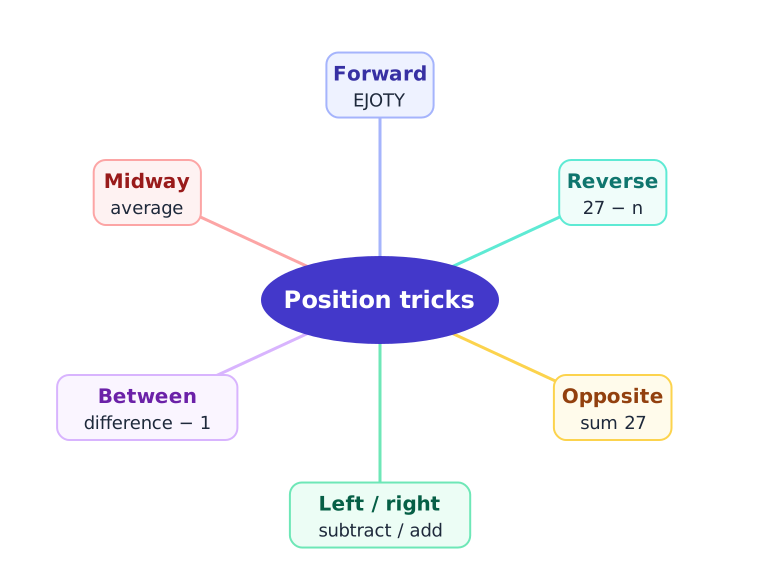
Reverse position (from Z) = 27 − forward position.
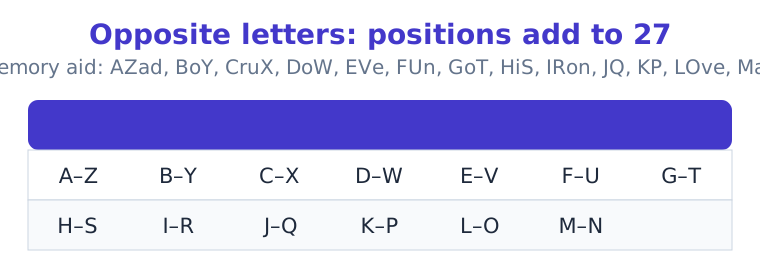
Opposite letters add to 27: A–Z, B–Y, …, M–N.
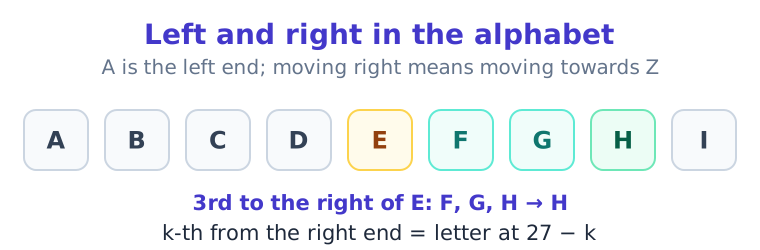
k-th from the right end is the letter at position 27 − k.
"To the right of" adds; "to the left of" subtracts.
Letters strictly between positions p and q: |p − q| − 1.
The letter midway between p and q is at (p + q) ÷ 2.
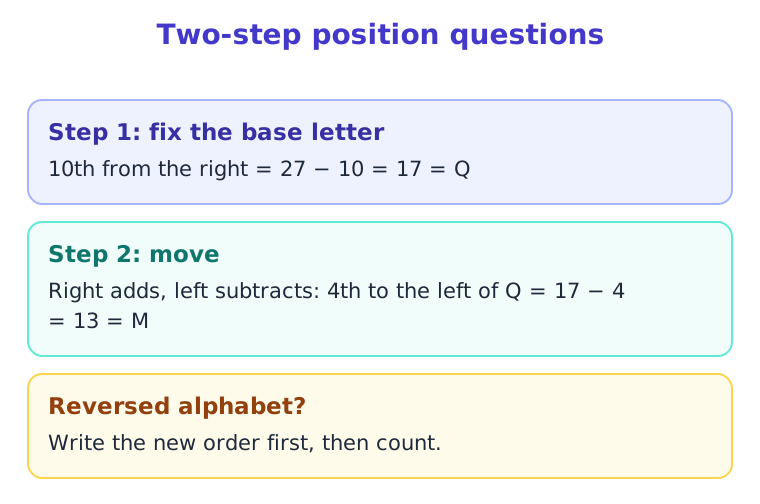
If the alphabet is changed (reversed, halves swapped, letters dropped), write the new order first and then count.
Full explanation
Pooja and the seat chart

Pooja's exam hall has seats labelled A to Z in one long row. Her admit card says: "your seat is the 4th to the left of the 10th seat from the right end". She has 30 seconds before the doors close. Position tricks solve this in two lines.
Two numbers for every letter
Every letter has a forward position (from A) and a reverse position (from Z). They always add to 27: R is 18th from A and $27 - 18 = 9$th from Z.
Opposite letters
The opposite of a letter sits at the same place from the other end. Opposites add to 27: A–Z, B–Y, C–X, … M–N. Opposite of G (7) is $27 - 7 = 20$ = T.
Left and right
Picture the alphabet written left to right. Right means towards Z, so you add; left means towards A, so you subtract. The k-th letter from the right end is at position $27 - k$.
Two-step questions
Pooja's seat: the 10th from the right is $27 - 10 = 17$ = Q. Four to the left: $17 - 4 = 13$ = M. Always fix the base letter first, then move.
Between and midway
Letters between D (4) and K (11): $11 - 4 - 1 = 6$ (E, F, G, H, I, J). The letter midway between D and P: $(4 + 16) \div 2 = 10$ = J.
Changed alphabets
If the first half A to M is written in reverse (M L K … A) and the rest left as it is, the 5th letter from the left is I. If every second letter is dropped (A, C, E, …), the 7th letter is M. Write the new order before counting.
Letter pairs in a word
A common SSC question: in DEPTH, how many pairs of letters have as many letters between them in the word as in the alphabet? Check pair by pair. DE: neighbours in both. DH: E, F, G between in the alphabet; E, P, T between in the word, so 3 = 3. EH: F, G in the alphabet; P, T in the word, 2 = 2. No other pair works, so the answer is 3. Pairs read backward (like H before D) count too.
Back to Pooja
Pooja whispers "27 − 10 = 17, Q; 17 − 4 = 13, M", walks to seat M and sits down with time to spare.
Concepts and terms
The place of a letter counted from Z: Z = 1, Y = 2, …, A = 26. It equals 27 − n.
The letter at the same place from the other end: the opposite of n is 27 − n, so G (7) ↔ T (20).
First find the base letter (k-th from an end), then move left (subtract) or right (add).
Did you know
Letter-pair questions on words ("how many pairs have as many letters between them as in the alphabet") appear in SSC CGL almost every year, and both directions (forward and backward) are counted.
Memory tricks
Opposite pairs — AZad BoY CruX DoW EVe FUn GoT HiS — Each capital pair is an opposite pair; the rest (IR, JQ, KP, LO, MN) follow by adding to 27.
Practice MCQs with answers (54)
- A 17
- B 9
- C 18
- D 19
Show answer
Why:
Count from the nearest EJOTY anchor: R = 18.
- A 22
- B 4
- C 24
- D 23
Show answer
Why:
Count from the nearest EJOTY anchor: W = 23.
- A 8
- B 7
- C 19
- D 9
Show answer
Why:
Count from the nearest EJOTY anchor: H = 8.
- A 20
- B 21
- C 6
- D 22
Show answer
Why:
Count from the nearest EJOTY anchor: U = 21.
- A 20
- B 6
- C 21
- D 22
Show answer
Why:
Reverse position = 27 − 6 = 21.
- A 15
- B 12
- C 13
- D 14
Show answer
Why:
Reverse position = 27 − 13 = 14.
- A 5
- B 22
- C 6
- D 4
Show answer
Why:
Reverse position = 27 − 22 = 5.
- A 15
- B 16
- C 11
- D 17
Show answer
Why:
Reverse position = 27 − 11 = 16.
- A U
- B W
- C V
- D R
Show answer
Why:
27 − 5 = 22, which is V.
- A R
- B W
- C P
- D Q
Show answer
Why:
27 − 10 = 17, which is Q.
- A J
- B K
- C D
- D I
Show answer
Why:
27 − 17 = 10, which is J.
- A A
- B M
- C L
- D N
Show answer
Why:
27 − 14 = 13, which is M.
- A O
- B M
- C N
- D D
Show answer
Why:
The 9th from the left is I (place 9 from the left). Moving 5 to the right gives place 14: N.
- A L
- B U
- C N
- D M
Show answer
Why:
The 10th from the right is Q (place 17 from the left). Moving 4 to the left gives place 13: M.
- A V
- B W
- C U
- D H
Show answer
Why:
The 12th from the right is O (place 15 from the left). Moving 7 to the right gives place 22: V.
- A R
- B L
- C M
- D K
Show answer
Why:
The 15th from the left is O (place 15 from the left). Moving 3 to the left gives place 12: L.
- A P
- B O
- C N
- D M
Show answer
Why:
The 6th from the left is F (place 6 from the left). Moving 8 to the right gives place 14: N.
- A T
- B S
- C Q
- D R
Show answer
Why:
The 3rd from the right is X (place 24 from the left). Moving 6 to the left gives place 18: R.
- A V
- B W
- C U
- D D
Show answer
Why:
The 14th from the right is M (place 13 from the left). Moving 9 to the right gives place 22: V.
- A H
- B I
- C K
- D J
Show answer
Why:
The 20th from the left is T (place 20 from the left). Moving 11 to the left gives place 9: I.
- A X
- B O
- C N
- D M
Show answer
Why:
The 8th from the right is S (place 19 from the left). Moving 5 to the left gives place 14: N.
- A Z
- B X
- C A
- D Y
Show answer
Why:
The 13th from the left is M (place 13 from the left). Moving 12 to the right gives place 25: Y.
- A P
- B O
- C Q
- D X
Show answer
Why:
The 7th from the left is T (place 7 from the left). Moving 4 to the right gives place 11: P.
- A C
- B O
- C N
- D P
Show answer
Why:
The 9th from the right is I (place 18 from the left). Moving 6 to the left gives place 12: O.
- A I
- B N
- C H
- D G
Show answer
Why:
The 11th from the right is K (place 16 from the left). Moving 3 to the right gives place 19: H.
- A Q
- B F
- C O
- D P
Show answer
Why:
The 16th from the left is K (place 16 from the left). Moving 5 to the left gives place 11: P.
- A G
- B H
- C K
- D F
Show answer
Why:
The 5th from the left is I (place 5 from the left). Moving 2 to the right gives place 7: G.
- A X
- B W
- C O
- D V
Show answer
Why:
The 6th from the right is S (place 21 from the left). Moving 4 to the left gives place 17: W.
- A J
- B D
- C L
- D N
Show answer
Why:
The 4th from the left is H (place 4 from the left). Moving 2 to the right gives place 6: L.
- A K
- B I
- C L
- D J
Show answer
Why:
(4 + 16) ÷ 2 = 10, which is J.
- A M
- B O
- C N
- D L
Show answer
Why:
(6 + 20) ÷ 2 = 13, which is M.
- A P
- B Q
- C S
- D R
Show answer
Why:
(8 + 26) ÷ 2 = 17, which is Q.
- A I
- B P
- C J
- D K
Show answer
Why:
(2 + 18) ÷ 2 = 10, which is J.
- A 6
- B 8
- C 9
- D 7
Show answer
Why:
13 − 5 − 1 = 7; the end letters are not counted.
- A 19
- B 20
- C 21
- D 18
Show answer
Why:
23 − 3 − 1 = 19; the end letters are not counted.
- A 14
- B 12
- C 11
- D 13
Show answer
Why:
20 − 7 − 1 = 12; the end letters are not counted.
- A 15
- B 12
- C 13
- D 14
Show answer
Why:
25 − 11 − 1 = 13; the end letters are not counted.
- A 2
- B 0
- C 3
- D 1
Show answer
Why:
Checking every pair, only MR fit: 1 pair.
- A 1
- B 0
- C 3
- D 2
Show answer
Why:
Checking every pair, only LN fit: 1 pair.
- A 4
- B 3
- C 2
- D 5
Show answer
Why:
Checking every pair, only HE, ON, ST fit: 3 pairs.
- A 3
- B 2
- C 1
- D 0
Show answer
Why:
Checking every pair, only ST fit: 1 pair.
- A RG
- B HT
- C BR
- D GH
Show answer
Why:
GH: positions 7 and 8, and in the word they are just as far apart. No other pair works.
- A HI
- B CH
- C HL
- D LD
Show answer
Why:
HI: positions 8 and 9, and in the word they are just as far apart. No other pair works.
- A DW
- B KQ
- C IR
- D GT
Show answer
Why:
G + T = 7 + 20 = 27, D + W = 27, I + R = 27, but K + Q = 11 + 17 = 28. K pairs with P.
- A n − 26
- B 26 + n
- C 27 − n
- D 26 − n
Show answer
Why:
A is 1st from A and 26th from Z: 1 + 26 = 27, so reverse = 27 − n.
- A O
- B D
- C Q
- D P
Show answer
Why:
10th = J; right adds: 10 + 6 = 16 = P.
- A Both A and R are true, and R is the correct explanation of A
- B Both A and R are true, but R is not the correct explanation of A
- C A is true but R is false
- D A is false but R is true
Show answer
Why:
(5 + 19) ÷ 2 = 12 = L; R is the method used.
- A Both A and R are true, and R is the correct explanation of A
- B Both A and R are true, but R is not the correct explanation of A
- C A is true but R is false
- D A is false but R is true
Show answer
Why:
27 − 8 = 19 = S, not R, so A is false. R is true.
- A 1 only
- B 2 only
- C Both 1 and 2
- D Neither 1 nor 2
Show answer
Why:
16 − 8 − 1 = 7, and 27 − 8 = 19 = S. Both true.
- A 1 only
- B 2 only
- C Both 1 and 2
- D Neither 1 nor 2
Show answer
Why:
Reversed: Z Y X W V …, so the 5th from the left is V; the right end is A, so the 5th from the right is E. Only 2.
- A L
- B Z
- C A
- D D
Show answer
Why:
The 6th from the left is X (place 6). 4 to the right: place 10 = L.
- A Y
- B O
- C C
- D G
Show answer
Why:
The 3rd from the right is U (place 13). 5 to the left: place 8 = O.
- A O
- B W
- C S
- D P
Show answer
Why:
The 8th from the right is R (place 8). 7 to the right: place 15 = S.
- A 28
- B 13
- C 26
- D 27
Show answer
Why:
G = 7 and T = 20: 7 + 20 = 27, as for every opposite pair.
Important short questions (3)
5th from the right = 27 − 5 = 22 (V). 22 − 7 = 15 = O.
B → Y, A → Z, G → T, so YZT.
F (6) and U (21): 21 − 6 − 1 = 14.
Long answer questions (1)
New order: M L K J I H G F E D C B A N O P …
(a) 4th from the left is J.
(b) 12th from the left is B; 3 to the right is place 15 = O.
(c) Positions change in the changed part, so normal positions (D for 4th) would be wrong.
Flashcards (12)
Play this topic
- Position check
Mixed Series
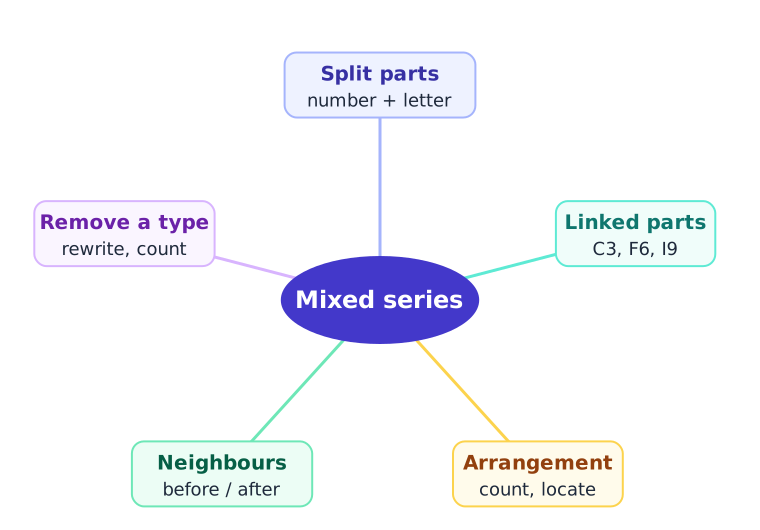
Solve series whose terms mix numbers and letters by splitting each term into parts, and answer alphanumeric arrangement questions: counting elements with neighbour conditions, finding positions, removing a type of element, and continuing groups taken from the arrangement.
What you will be able to do
- I can split a mixed term such as 16H into a number series and a letter series.
- I can spot when the number and the letter of a term are linked (C3, F6, I9).
- I can count elements of an arrangement that meet "immediately preceded by" and "immediately followed by" conditions.
- I can locate an element by its position from either end, before and after removing a type of element.
- I can continue a series of groups picked from an arrangement.
Key points
A mixed term like 16H is two series written together: solve the number part and the letter part separately.
Sometimes the parts are linked: in C3, F6, I9 the number is the position of the letter.
In an arrangement of n elements, the k-th from the right is the (n + 1 − k)-th from the left.
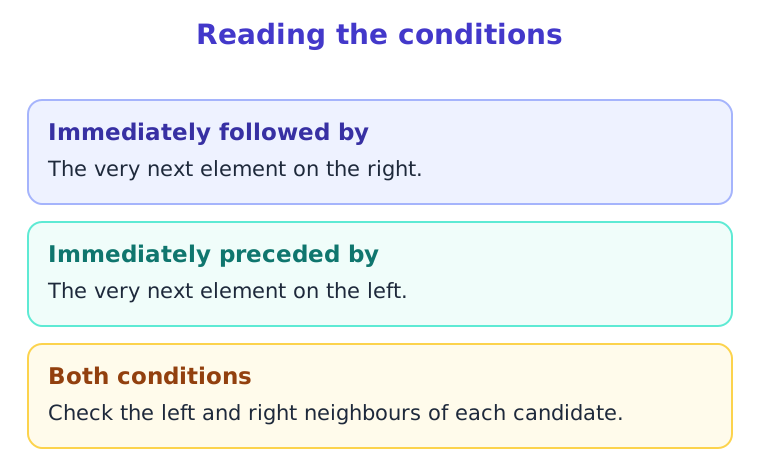
"Immediately preceded by" looks at the neighbour on the left; "immediately followed by" looks at the neighbour on the right.
With two conditions, an element counts only if both neighbours match.
If a type of element is removed, write the shortened arrangement first and then count.
For groups taken from an arrangement, find how far apart the elements of a group are and how far each new group moves.
Vowels are A, E, I, O, U; every other letter is a consonant.
Full explanation
Neha's mock test
Neha's bank mock test has a block of five questions on one long row of letters, digits and symbols, and two mixed series like 2B, 4D, 8F, 16H. Both look messy, but each breaks into simple steps.
Split the term
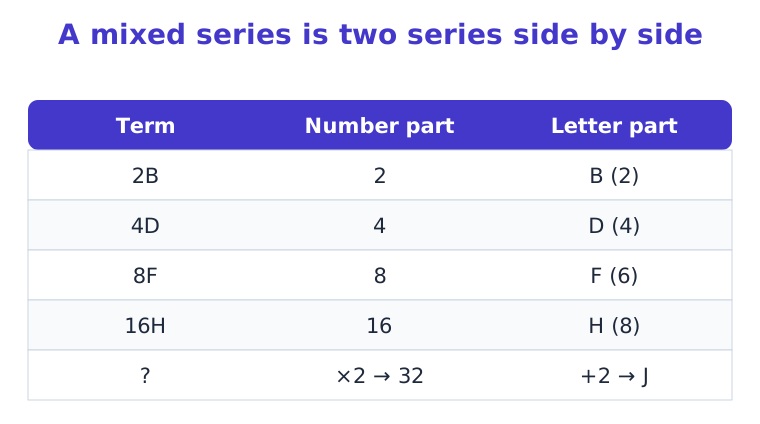
In 2B, 4D, 8F, 16H each term has a number part and a letter part. Numbers: 2, 4, 8, 16 (×2) → 32. Letters: B, D, F, H (+2) → J. So the next term is 32J.
Linked parts
In C3, F6, I9, L12 the number is the position of its letter (C = 3, F = 6). The letters jump +3, so the next letter is O and the number is 15: O15. Always check whether the two parts are linked before solving them separately.
Three-part terms
In C2X, D4V, E8T, F16R read three columns: C, D, E, F (+1); 2, 4, 8, 16 (×2); X, V, T, R (−2). The next term is G32P.
Reading an arrangement
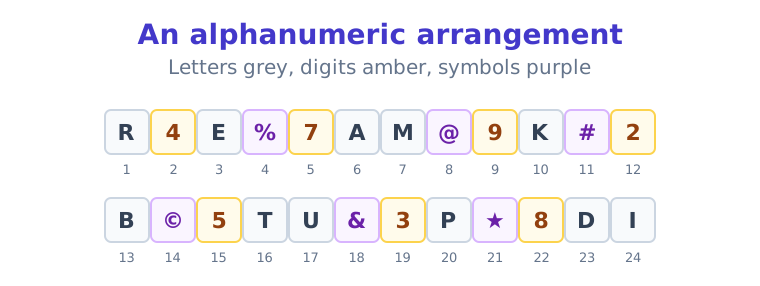
An arrangement is a row of letters, digits and symbols. Number the places from the left. With 24 elements, the k-th from the right is the (25 − k)-th from the left.
Counting with conditions
"How many letters are each immediately followed by a symbol?" Look at each letter and then at its right neighbour. In this arrangement: E%, M@, K#, B©, U&, P★. So the answer is 6.
Position questions
"Which element is 5th to the left of the 8th from the right end?" The 8th from the right is $25-8=17$th from the left: U. Five to the left: place 12 = 2.
Removing a type
"If all the symbols are removed, which element is 10th from the left?" First rewrite: R 4 E 7 A M 9 K 2 B 5 T U 3 P 8 D I. Now count: the 10th is B. Counting on the original row would give K, a common wrong option.
Groups from the arrangement
"R4E, %7A, M@9, ?" Each group is three neighbours, and each new group starts 3 places later. So the next group is K#2. Check the gap inside a group and the jump between groups.
Back to Neha
Neha numbers the 24 places once, splits each mixed term into parts, and clears all seven questions in under five minutes.
Concepts and terms
Each term is cut into its number part and letter part, and each part is solved as its own series: 2B, 4D, 8F gives 2, 4, 8 (×2) and B, D, F (+2).
A row of letters, digits and symbols. Questions ask you to count, locate or pick elements using their neighbours and positions.
A rule about the element just before or just after: "a digit immediately followed by a symbol" means the next element on the right is a symbol.
Did you know
Bank PO and SSC papers often give one alphanumeric arrangement and ask 4 or 5 questions on it, so a careful first reading saves time on all of them.
Memory tricks
Preceded vs followed — Preceded = Previous (left); Followed = Forward (right). — The P-words point back to the left, the F-words point on to the right.
From the right — n + 1 − k — In 24 elements, the 5th from the right is the 20th from the left.
Practice MCQs with answers (52)
- A J14
- B H15
- C I15
- D J15
Show answer
Why:
Read each place of the group separately. First: each letter moves 2 places forward (+2), so G + 2 = I. Second: numbers +3, so 12 + 3 = 15. So ? = I15.
- A 12T
- B 10U
- C 12U
- D 11U
Show answer
Why:
Read each place of the group separately. First: numbers +2, so 9 + 2 = 11. Second: each letter moves 1 place back (−1), so V − 1 = U. So ? = 11U.
- A O15
- B P14
- C N15
- D P15
Show answer
Why:
Read each place of the group separately. First: each letter moves 3 places forward (+3), so L + 3 = O. Second: numbers +3, so 12 + 3 = 15. So ? = O15.
- A 35F
- B 36F
- C 37F
- D 37E
Show answer
Why:
Read each place of the group separately. First: numbers are squares, so 6² = 36. Second: each letter moves 1 place forward (+1), so E + 1 = F. So ? = 36F.
- A H96N
- B F96O
- C G96O
- D H96O
Show answer
Why:
Read each place of the group separately. First: each letter moves 1 place forward (+1), so F + 1 = G. Second: numbers ×2, so 48 × 2 = 96. Third: each letter moves 2 places back (−2), so Q − 2 = O. So ? = G96O.
- A 17O
- B 17N
- C 15O
- D 16O
Show answer
Why:
Read each place of the group separately. First: numbers +1, +2, +3, …, so 11 + 5 = 16. Second: each letter moves 2 places forward (+2), so M + 2 = O. So ? = 16O.
- A R25
- B S24
- C Q25
- D S25
Show answer
Why:
Read each place of the group separately. First: each letter moves 2 places back (−2), so T − 2 = R. Second: numbers +5, so 20 + 5 = 25. So ? = R25.
- A 0P
- B 1P
- C 2P
- D 2O
Show answer
Why:
Read each place of the group separately. First: numbers −2, so 3 − 2 = 1. Second: each letter moves 3 places forward (+3), so M + 3 = P. So ? = 1P.
- A 80T
- B 82T
- C 81T
- D 82S
Show answer
Why:
Read each place of the group separately. First: numbers ×3, so 27 × 3 = 81. Second: each letter moves 4 places forward (+4), so P + 4 = T. So ? = 81T.
- A T49K
- B V49K
- C V49J
- D U49K
Show answer
Why:
Read each place of the group separately. First: each letter moves 4 places forward (+4), so Q + 4 = U. Second: numbers are squares, so 7² = 49. Third: each letter moves 3 places back (−3), so N − 3 = K. So ? = U49K.
- A 17R
- B 18R
- C 18Q
- D 16R
Show answer
Why:
Read each place of the group separately. First: numbers +3, so 14 + 3 = 17. Second: each letter moves 1 place forward (+1), so Q + 1 = R. So ? = 17R.
- A G10
- B H10
- C I10
- D I9
Show answer
Why:
Read each place of the group separately. First: each letter moves 2 places forward (+2), so F + 2 = H. Second: numbers +4, so 6 + 4 = 10. So ? = H10.
- A 34I
- B 36I
- C 35I
- D 36H
Show answer
Why:
Read each place of the group separately. First: numbers +7, so 28 + 7 = 35. Second: each letter moves 7 places forward (+7), so B + 7 = I. So ? = 35I.
- A Q64
- B Q63
- C O64
- D P64
Show answer
Why:
Read each place of the group separately. First: the jumps +1, +2, +3, … change by +1 each time, so K + 5 = P. Second: numbers ×2, so 32 × 2 = 64. So ? = P64.
- A 25Q
- B 24Q
- C 26Q
- D 26P
Show answer
Why:
Read each place of the group separately. First: numbers +5, so 20 + 5 = 25. Second: each letter moves 2 places back (−2), so S − 2 = Q. So ? = 25Q.
- A D32
- B F32
- C G32
- D E32
Show answer
Why:
Read each place of the group separately. First: each letter moves 1 place forward (+1), so E + 1 = F. Second: numbers ×2, so 16 × 2 = 32. So ? = F32.
- A 5
- B 3
- C 4
- D 0
Show answer
Why:
Scan left to right and check each consonant: M@, K#, B©, P★. That makes 4.
- A 7
- B 5
- C 0
- D 6
Show answer
Why:
Scan left to right and check each digit: %7A, @9K, #2B, ©5T, &3P, ★8D. That makes 6. Both neighbours must match, so do not stop after checking one side.
- A 6
- B 7
- C 5
- D 0
Show answer
Why:
Scan left to right and check each symbol: E%7, M@9, K#2, B©5, U&3, P★8. That makes 6. Both neighbours must match, so do not stop after checking one side.
- A 5
- B ©
- C B
- D I
Show answer
Why:
The 6th from the right is 3 (place 19 from the left); 5 to the left is place 14: ©.
- A 4
- B U
- C T
- D 5
Show answer
Why:
The 9th from the left is 9 (place 9 from the left); 7 to the right is place 16: T.
- A 9
- B B
- C K
- D 2
Show answer
Why:
Without symbols: R 4 E 7 A M 9 K 2 B 5 T U 3 P 8 D I. The 9th from the left is 2.
- A ©T&
- B #B5
- C 5U3
- D U3★
Show answer
Why:
Each group takes elements 2 places apart (1 skipped inside), and each new group starts 4 places later. The next group starts at place 14: ©T&.
- A 5
- B 4
- C 6
- D 3
Show answer
Why:
Scan left to right and check each letter: Q8, A1, Y1, P2. That makes 4.
- A 5
- B 6
- C 4
- D 3
Show answer
Why:
Scan left to right and check each digit: Q8, A1, Y1, P2. That makes 4.
- A 3
- B 1
- C 4
- D 2
Show answer
Why:
Scan left to right and check each symbol: 1%, 1@. That makes 2.
- A D
- B Y
- C V
- D 1
Show answer
Why:
The 10th from the right is # (place 15 from the left); 4 to the right is place 19: D.
- A 1
- B 7
- C A
- D &
Show answer
Why:
The 15th from the left is # (place 15 from the left); 6 to the left is place 9: 7.
- A V
- B D
- C #
- D Q
Show answer
Why:
Without digits: D F # Q U V & A % = Q # V D Y @ P. The 6th from the right is #.
- A =Q#
- B V&7
- C 1%=
- D A1%
Show answer
Why:
Each group is three neighbouring elements, and each new group starts 3 places later. The next group starts at place 10: A1%.
- A 1
- B 3
- C 2
- D 0
Show answer
Why:
Scan left to right and check each symbol: 3#. That makes 1.
- A 2
- B 3
- C 5
- D 4
Show answer
Why:
Scan left to right and check each vowel: E, I, U. That makes 3.
- A 5
- B 4
- C 3
- D 2
Show answer
Why:
Scan left to right and check each digit: 28, 93, 77. That makes 3.
- A S
- B 7
- C Y
- D I
Show answer
Why:
The 3rd from the right is U (place 22 from the left); 8 to the left is place 14: I.
- A 7
- B E
- C I
- D Z
Show answer
Why:
The 12th from the left is S (place 12 from the left); 3 to the right is place 15: 7.
- A R
- B Y
- C I
- D S
Show answer
Why:
Without symbols: R T 2 8 H W 9 3 E 2 S Y I 7 7 Z 3 P V U 7. The 12th from the left is Y.
- A +Y7
- B S73
- C ES7
- D WES
Show answer
Why:
Each group takes elements 3 places apart (2 skipped inside), and each new group starts 2 places later. The next group starts at place 9: ES7.
- A 1
- B 4
- C 3
- D 2
Show answer
Why:
Scan left to right and check each digit: 58, 83. That makes 2.
- A 2
- B 3
- C 1
- D 0
Show answer
Why:
Scan left to right and check each symbol: &G, &F. That makes 2.
- A 0
- B 1
- C 2
- D 4
Show answer
Why:
Scan left to right and check each consonant: &G8. That makes 1. Both neighbours must match, so do not stop after checking one side.
- A &
- B A
- C F
- D W
Show answer
Why:
The 14th from the right is R (place 11 from the left); 5 to the right is place 16: F.
- A B
- B K
- C S
- D R
Show answer
Why:
The 20th from the left is 6 (place 20 from the left); 9 to the left is place 11: R.
- A 8
- B &
- C 3
- D 5
Show answer
Why:
Without letters: 5 8 3 & 8 5 & 6 + #. The 5th from the left is 8.
- A JJ+
- B FW6
- C B&A
- D AJJ
Show answer
Why:
Each group takes elements 2 places apart (1 skipped inside), and each new group starts 5 places later. The next group starts at place 16: FW6.
- A 2
- B 4
- C 3
- D 5
Show answer
Why:
Scan left to right and check each letter: P+, F+, G%. That makes 3.
- A Treat 3K as the number 3 × 11 = 33
- B Add each number to the position of its letter
- C Use only the letters and ignore the numbers
- D Solve 3, 6, 12, 24 and K, M, O, Q as two separate series
Show answer
Why:
Numbers ×2 → 48; letters +2 → S. Next term 48S.
- A Y is the element just to the left of X
- B Y is the first element of the row
- C Y is the element just to the right of X
- D Y is somewhere to the left of X
Show answer
Why:
"Preceded" is the previous element, the neighbour on the left.
- A 18
- B 16
- C 14
- D 20
Show answer
Why:
Only the symbols on its left move it: 20 − 4 = 16. The two symbols on its right do not matter.
- A Both A and R are true, and R is the correct explanation of A
- B Both A and R are true, but R is not the correct explanation of A
- C A is true but R is false
- D A is false but R is true
Show answer
Why:
L + 3 = O = 15, and O15 has number = position. R explains A.
- A Both A and R are true, and R is the correct explanation of A
- B Both A and R are true, but R is not the correct explanation of A
- C A is true but R is false
- D A is false but R is true
Show answer
Why:
Numbers 5² = 25, but letters go +1: D → E. The next term is 25E, so A is false. R is true.
- A 1 only
- B 2 only
- C Both 1 and 2
- D Neither 1 nor 2
Show answer
Why:
Digits after a letter: P4, E7. Symbols after a digit: 4#, 7%. Both true.
- A 1 only
- B 2 only
- C Both 1 and 2
- D Neither 1 nor 2
Show answer
Why:
From the right: T, 5, #, so 1 is true. Without digits: M @ Q R # T, so the 3rd is Q, not R. Only 1.
Important short questions (3)
Numbers ×3: 54 × 3 = 162. Letters −2: T → R. Next term 162R.
31 − 12 = 19th from the left.
7K, 3B, 9E: 3 digits.
Long answer questions (1)
(a) Check each digit's two neighbours: none, so 0.
(b) 8th from the right = 25 − 8 = 17th from the left (U); 5 to the left is place 12: 2.
(c) Without symbols: R 4 E 7 A M 9 K 2 B 5 T U 3 P 8 D I; the 10th is B.
Flashcards (12)
Play this topic
- Mixed series check
Veda Skills Logical Reasoning Unit 2 — frequently asked questions
Positions 7, 10, 14, 19: jumps +3, +4, +5. Next jump +6: 25 = Y.
21 + 9 = 30, 30 − 26 = 4, so D.
Block BDF repeats; blanks are B, D, F.
5th from the right = 27 − 5 = 22 (V). 22 − 7 = 15 = O.
B → Y, A → Z, G → T, so YZT.
F (6) and U (21): 21 − 6 − 1 = 14.
Numbers ×3: 54 × 3 = 162. Letters −2: T → R. Next term 162R.
31 − 12 = 19th from the left.
7K, 3B, 9E: 3 digits.

All Veda Skills Logical Reasoning units
Study this chapter properly, free
Everything above is on this page to read. In the Veda app the same chapter becomes spaced-repetition flashcards, timed tests that mark themselves, Veda Bites you can swipe, and games — with your progress tracked topic by topic.
Get Veda free