
Level-Wise Practice: Why Beginner to Advanced Beats Random Questions
Practising a topic in three levels, with a short explanation after every answer, teaches more than a random mix of questions. How the levels work in Veda and when to move up.
By Prof. Rahul R. Keshwala, Founder
Practising level by level means answering easy questions on a topic until you get them right reliably, then moving to medium ones, then hard ones, instead of facing a random mix from the start. In Veda the Practice tab of every topic splits its MCQs into Beginner, Intermediate and Advanced. After every answer you see whether you were right and a short "Why", and when you have cleared a level Veda offers the next. It is the step between reading a topic and testing yourself on it, and it is where most of the learning happens.
I have taught for many years, and the pattern I see most often is a student who opens a question bank, gets four of the first five wrong, and decides the topic is "too hard". Usually the topic was fine. The questions were simply in the wrong order for someone who had read it once.
Why random question sets work against you
- Hard questions arrive before you are ready
- Guessing starts to feel normal
- 6 out of 10 tells you nothing specific
- Each level rests on the one below
- A wrong answer points at one gap
- Confidence builds with the topic
A random score of 6 out of 10 could mean you know the basics and miss the applications, or that you have half-understood everything. You cannot fix either until you can tell them apart.
What the three levels are for
- BeginnerDo you know the pieces? Terms, definitions, units
- IntermediateCan you use them? One idea applied to a case
- AdvancedCan you join them up? Several ideas, traps, why
Miss Beginner questions and the fix is the Learn tab, not more questions.
Most exam questions sit around Intermediate. Advanced is what separates a good score from a top one, and by the time you reach it, a wrong answer tells you something specific: your basics are sound and the gap is in combining them.
How Practice works in Veda
- Open a topic and go to the Practice tab. MCQ is the first choice; short and long written-answer questions sit beside it if the topic has them.
- Start at Beginner. Each level shows how many you have right against the number needed to clear it.
- Answer, then read the Why. After each answer the right option is marked and a short explanation appears underneath. Read it even when you were right. A correct guess and a correct answer look the same on the score.
- Tap Learn more when the Why is not enough. The AI writes a longer explanation of that one question, so you are not stuck rereading the whole topic for one idea.
- Clear the level. When you reach the number of correct answers the level needs, it is marked cleared and Veda offers the next level.
- Go back to your mistakes. Review my mistakes collects every question you got wrong in the topic, with the right answer and the explanation.
- Answerpick an option
- Whythe right option and a short explanation
- Learn morea longer explanation, if you need it
- Nextthe next question at your level
When you practise a level again, questions you have not answered come first, then the ones you got wrong, then the ones you got right. If you run out at a level, More questions asks the AI to write another batch at that level.
When to move up a level
- Move upwhen the level is cleared, not when you are bored
- Move downif the Why keeps pointing at the same basic idea
- Stopafter a level, not in the middle of one
- Ignore streaksthe level you cleared matters more
Clearing means you got enough right, not that you saw every question once. And a few minutes back at Intermediate is quicker than many wrong answers at the top.
Where Practice fits
Practice is the second of four steps on every topic: Learn, Practice, Revise, Test. Read the topic first, practise it level by level, revise it with flashcards on a later day, and then take a timed test from the Test tab. We explained the whole method in learn, practise, revise, test.
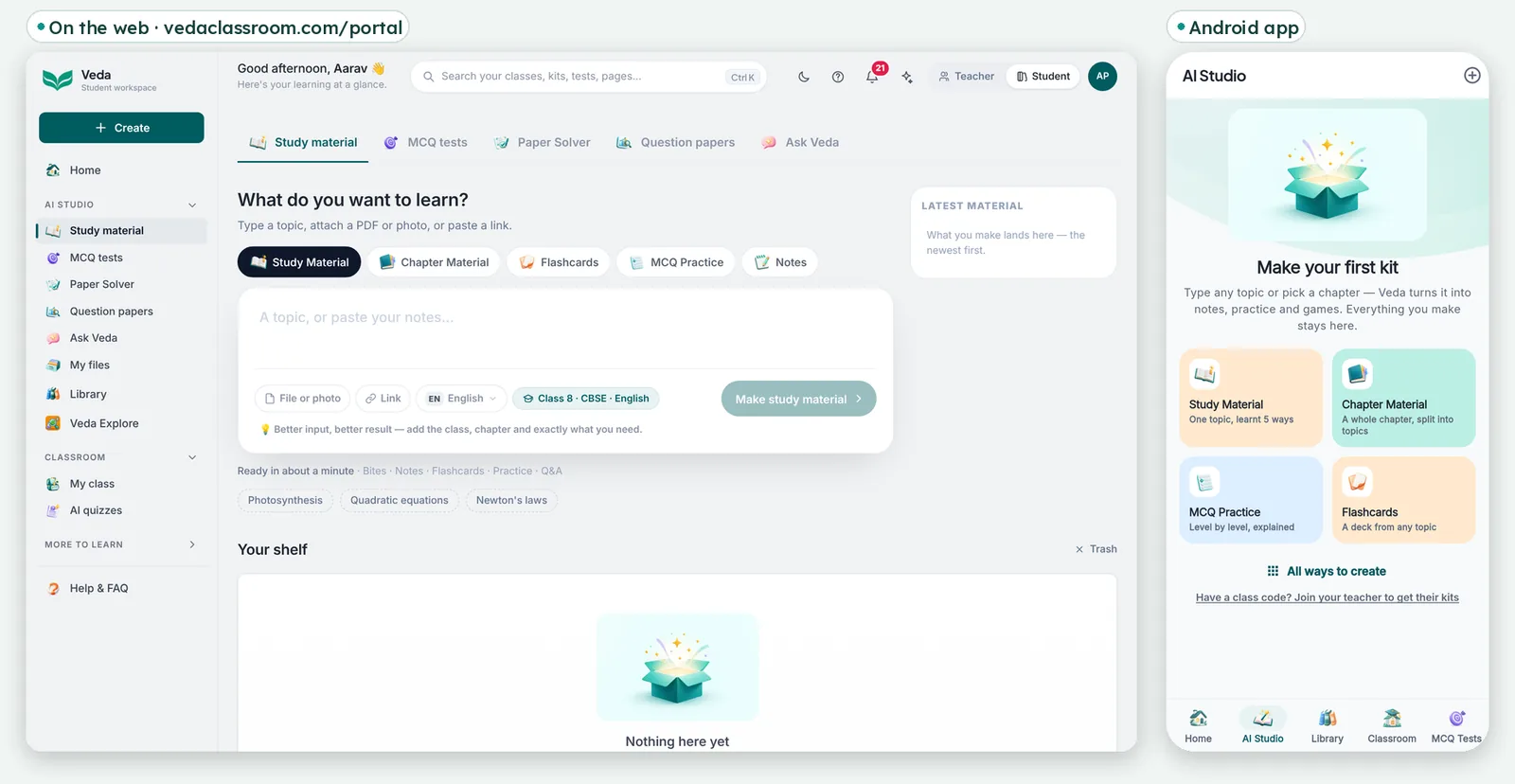
The same account works in the Android app and on the web at vedaclassroom.com/portal, and cleared levels carry across. On a computer you can answer with the keyboard, using 1 to 4 or A to D, and Enter for the next question.
What it can't do, and what to check
- Explanations are written by AI and can be wrong. Usually they are clear and correct. If a Why disagrees with your textbook or your teacher, go with the textbook and the teacher, and report the question from the topic page.
- Levels are relative to the topic. Advanced in a beginner topic is not the same as a hard exam question in a final-year course. Use the levels to order your practice, not as a grade.
- MCQs are not written answers. If your exam asks for explanations in your own words, use the short and long answer questions too.
- Some parts use credits. Learn more and More questions ask the AI to write something new, which uses AI credits. The free plan includes a monthly allowance.
Questions students ask
Can I jump straight to Advanced?
If you already know the topic well, try it. If the first few go wrong, drop back. That costs a few minutes and saves an hour of frustration.
Do the levels work in my language?
Yes. The questions and explanations follow the language of the topic, in any of more than 40 languages.
What if a level has no questions?
It shows None yet. You can practise the other levels, or use More questions to add some.