
CBSE Board Exam 2027: A Revision Plan From Now to February
CBSE theory exams for 2027 begin on 16 February. Here is a week-by-week plan for Class 10 and 12 students from late November, and how to use NCERT, past papers and short daily practice.
By Prof. Rahul R. Keshwala, Founder
CBSE released the 2027 date sheet in early November 2026, and the theory exams begin on 16 February 2027. From the end of November that leaves about eleven weeks. A plan that works for most Class 10 and 12 students is: finish the syllabus by mid-December, go through the NCERT text and examples, then write previous year papers under time, fix weak chapters, do sample papers, and keep the last week light. Check the date of each of your own subjects in the official date sheet PDF at cbse.gov.in, because your plan should be built around those dates, not ours.
We are not going to promise marks. Nobody honestly can. What a plan does is stop the two things that hurt most students in January.
- A chapter turns out never finished
- The exam pattern is new on the day
- Syllabus closed by mid-December
- Past papers written under time first
Everything below is meant to be adjusted. If your school's pre-boards fall in a different week, move the blocks around them. And if you are not a CBSE student, the same shape works for any board, a college semester exam or a coaching batch's final test: put in your own dates and your own textbook.
Before you start: three things to write down
- 📅 Your exam datesFrom the official date sheet on cbse.gov.in; count each gap
- 🏫 Your school's datesPre-boards, practicals and internal assessment; ask your teachers
- 📋 A chapter listEach marked: done well, done but shaky, not done
The chapter list is your plan. You will keep updating it.
The plan, week by week
- Weeks 1 to 3Late Nov to mid-Dec: finish the syllabus, no holes
- Weeks 4 and 5Second half of December: NCERT text, examples, exercises
- Weeks 6 to 8January: previous year papers under time
- Weeks 9 and 10Late Jan to early Feb: one shaky chapter per day
- Week 11Early February: CBSE sample papers with marking schemes
- Last weekKeep it light: no new chapters, sleep properly
Weeks 1 to 5: syllabus, then NCERT
If any chapter is still "not done", finish it first. Follow your teacher's order; for anything you missed, read the NCERT chapter, then do its exercise questions. Keep a single notebook per subject for formulas, definitions and the questions you got wrong.
CBSE papers lean heavily on NCERT. In the second half of December, read each chapter again carefully, including the boxes, diagrams and solved examples, and redo the exercise questions without looking at the answers. In Science and Social Science, small lines in the text often turn into one-mark questions.
Weeks 6 to 11: papers, weak chapters, sample papers
Write full previous year papers at a table, with a timer, in the time the real exam allows, then check them honestly. They show how questions are worded, how marks are split and how long a long answer should be. Two or three papers per subject, more for the hardest ones.
Then every chapter still marked "shaky" gets its own day: NCERT text again, the exercises, then questions only from that chapter. This is where marks actually move, because it is the first time you spend time where you are weakest instead of where you are comfortable. Finish with the sample question papers CBSE publishes for each subject on its academic website, written under time, and use the marking scheme to see what an examiner looks for.
The last week before your first paper
Read your one notebook per subject, look over formulas and diagrams, and sleep. Between papers, revise only the next subject. Check your admit card, the centre and the reporting time well before the day.
How to use Veda for this plan
Your Veda account works in the Android app and on the web at vedaclassroom.com/portal, so you can read on a computer at home and practise on your phone. Here is what helps at each stage, and what is free.
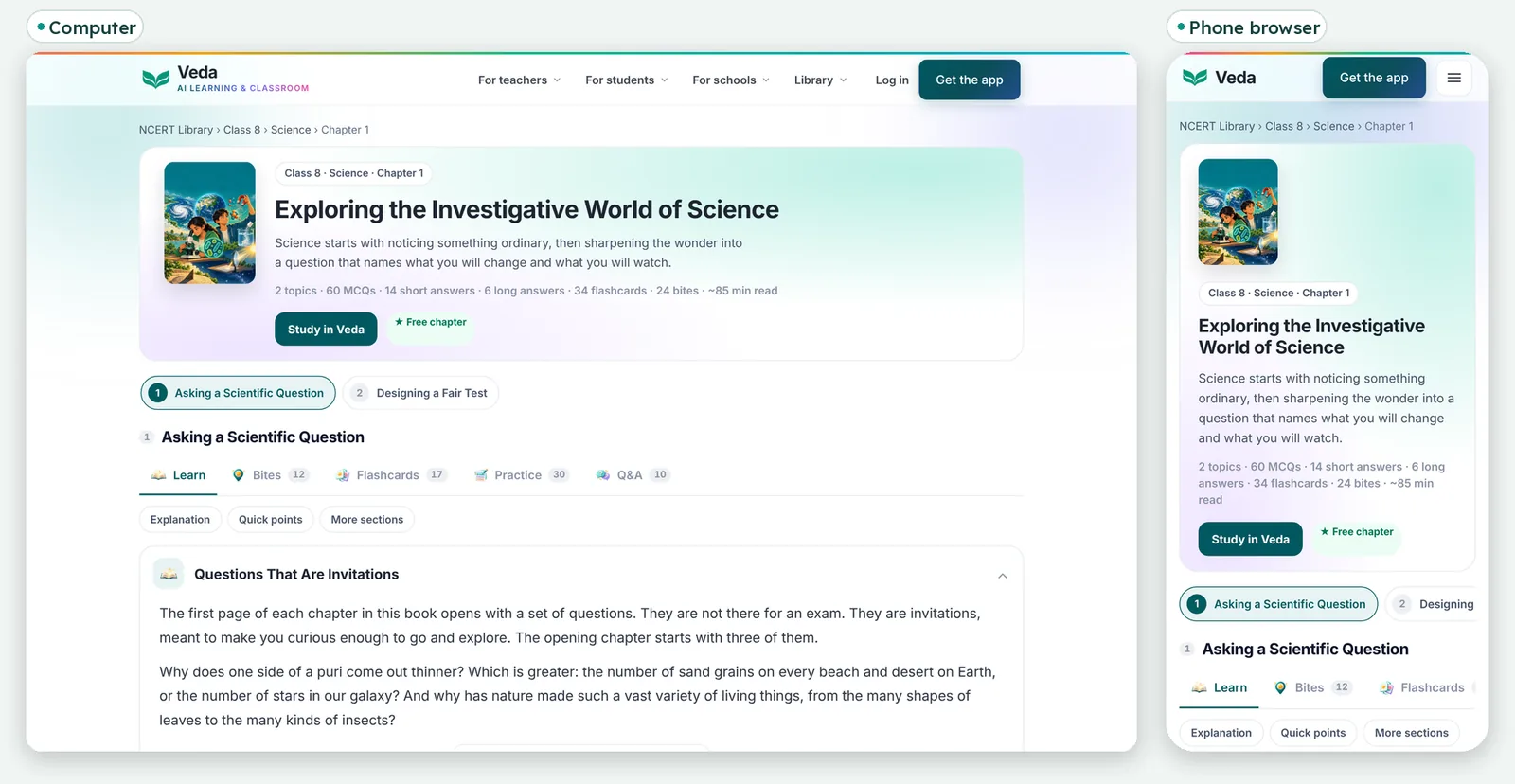
- NCERT libraryWeeks 1 to 5: chapter notes, MCQs, answers, flashcards
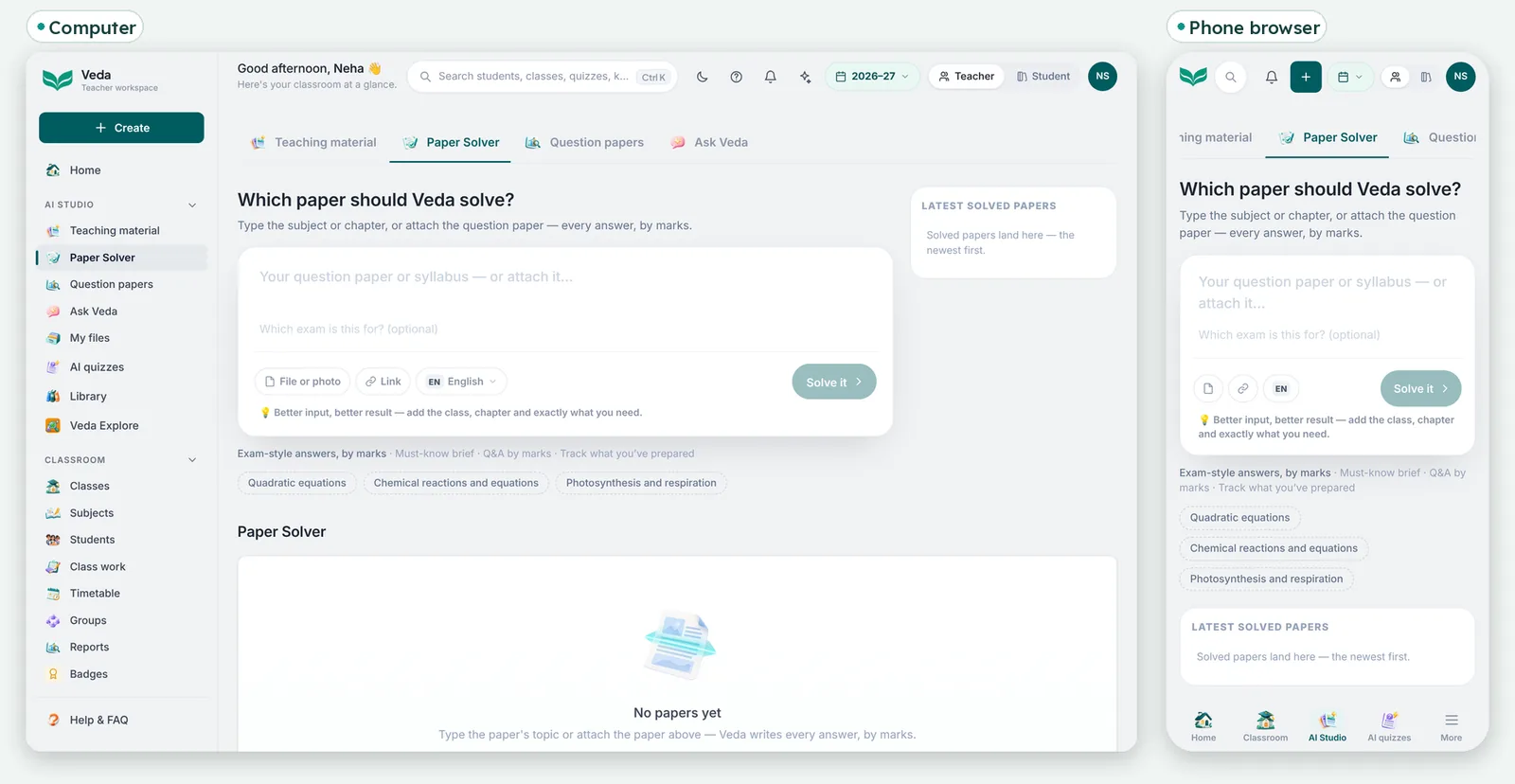
- Paper SolverWeeks 6 to 8: check the papers you wrote
- MCQ PracticeWeeks 9 and 10: one weak chapter, level by level
- Veda ArenaEvery week: a free 10-minute daily quiz
Arena and the free NCERT chapters cost nothing; the AI tools use credits.
- NCERT chapters. Our NCERT library has chapter-wise notes, MCQs, short and long answers and flashcards for Classes 5 to 10. The first and middle chapters of every subject are free to read; a Subject Pack opens the rest of that subject. Class 12 students can make Chapter Material for their own chapter in AI Studio, which uses AI credits. More in NCERT chapter-wise notes, MCQs and important questions.
- Paper Solver. After you have written a past paper yourself, attach a photo or file of it, or type the subject and chapter, and Paper Solver writes exam-style answers by marks, in the language you choose. Use it to check your answers and see how a full-mark answer is laid out, not to skip writing. It uses AI credits; the free plan includes some every month. See our solve question paper page.
- MCQ Practice. In AI Studio, make MCQ Practice for one weak chapter. It goes level by level with explanations, and uses AI credits.
- Veda Arena. A daily quiz in the Android app, free, with challenges and a duel-a-friend link. A small habit for the bus or the break, not a replacement for writing papers.
Sleep, food and the phone
- 😴 Sleep 7 to 8 hoursMemory settles in sleep; late nights cost more than they gain
- ⏰ Keep exam timePapers usually start in the morning; study then in the last two weeks
- 🍲 Eat normallyDrink water; no new diets or too much tea
- 🚶 Move a littleA 20-minute walk beats another hour of scrolling
- 📵 Phone awayTimed practice only works if it is really timed
- 💬 Talk to someoneA parent, teacher or friend; don't carry it alone
Feeling anxious before boards is common. Saying so out loud usually makes it lighter.
What to check, and what no app can do
- Dates come from CBSE, not from a blog. Use the official date sheet at cbse.gov.in for every subject, and check it again if CBSE issues any change.
- AI answers need checking. Paper Solver and AI Studio can make mistakes. Compare with your NCERT text and your teacher's notes, especially for numericals and dates.
- No app writes the exam for you. The practice that counts is writing full answers by hand, in time.
- Your teacher knows your paper pattern. If your school or teacher gives you a different order, follow them.
Questions students ask
When do the CBSE 2027 board exams start?
The theory exams begin on 16 February 2027. Check the date of each of your subjects in the official date sheet on cbse.gov.in.
How many previous year papers should I write?
Two or three full papers per subject under time is a good target, more for the subjects you find hardest. Checking them properly matters more than the number.
Is Veda free for board exam revision?
Partly. The first and middle chapters of every NCERT subject and Veda Arena are free. Paper Solver, MCQ Practice and other AI features use credits, and the free plan includes some every month. You can download Veda here.