
A 7-Day Exam-Week Study Plan, With AI Doing the Busywork
Seven days before an exam: map the topics, practise level by level, let spaced flashcards handle revision, and finish with timed tests. A day-by-day plan using Veda.
By Miss Shanti Divaraniya, Co-founder
With seven days left before an exam, the best plan is not to read everything once more. Spend day one making a map of every topic, days two to four practising and testing yourself topic by topic, days five and six mixing topics and fixing weak spots, and day seven doing a light timed test and sleeping well. Veda does the slow parts for you: its AI turns your chapters into notes, practice questions and flashcards, the flashcard schedule tells you what to revise each day, and timed tests show where you stand.
I have watched many students in the last week before exams, in schools, colleges and tuition classes. The ones who panic are usually re-reading. The ones who stay calm are usually answering questions. This plan is built on that difference.
Why re-reading is the wrong last-week habit
- Everything feels familiar
- Gaps stay hidden
- Fades soon after
- Late nights, tired exam
- Shows what you cannot recall
- Time goes to weak topics
- Lasts past the exam
- Sleep stays in the plan
A widely cited 2013 review of study techniques by John Dunlosky and colleagues rated practice testing and spreading study over time as the most useful methods they looked at, and rated re-reading and highlighting low. Research on interleaving, mixing different kinds of problems in one session, has also found it helps you pick the right method in an exam, where questions do not come sorted by chapter.
The seven days
- Day 1 · MapOne kit per chapter; list topics; skim Learn
- Day 2 · First thirdPractice Beginner to Advanced; start flashcards
- Day 3 · Second thirdSame again; Due today cards first
- Day 4 · Last thirdSame again; a short test on Day 2 topics
- Day 5 · Weak spotsRetake low tests; Learn more on misses
- Day 6 · MixTests across topics; write two long answers
- Day 7 · LightOne timed test, due cards, early night
Day 1: make the map
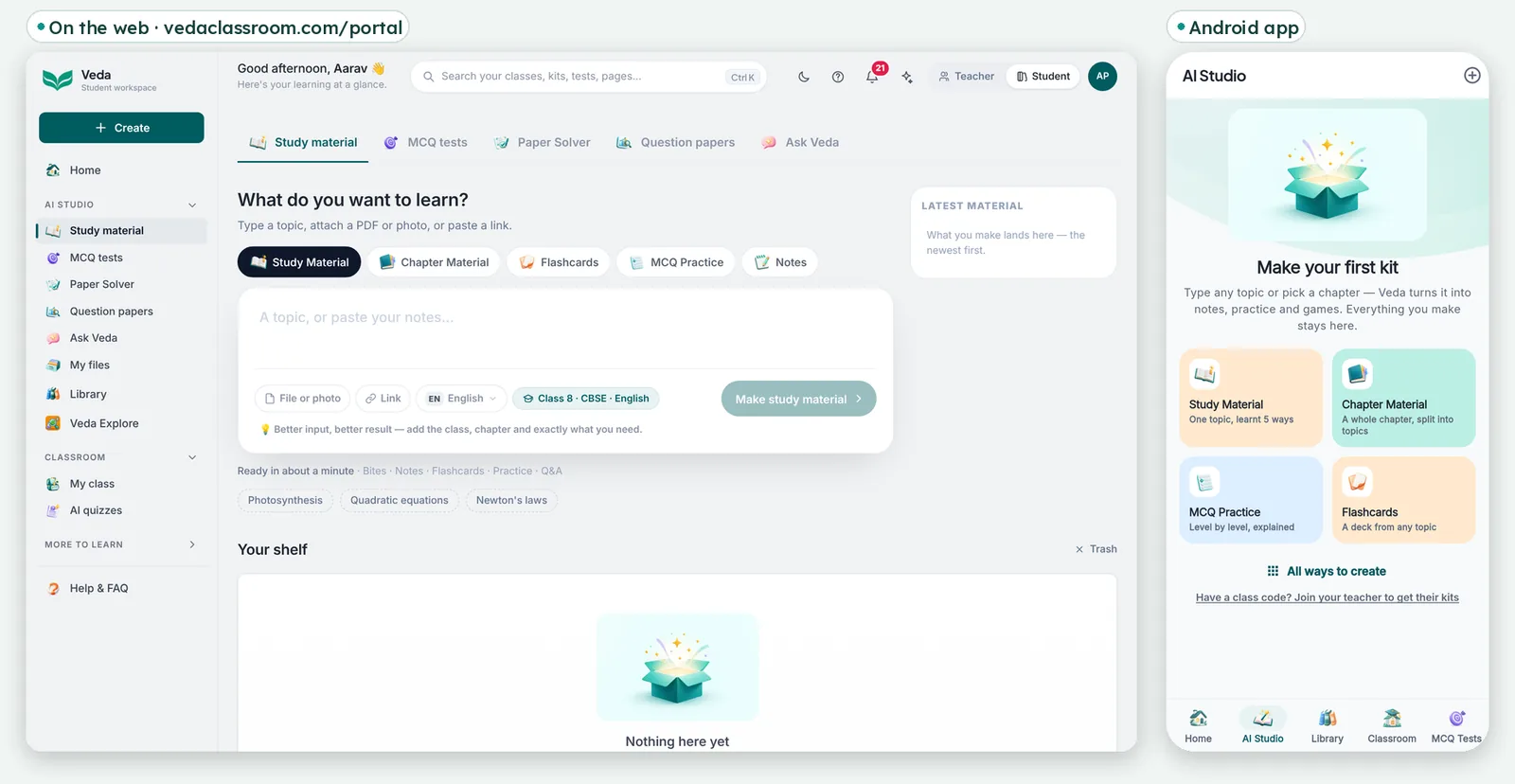
Open AI Studio and choose Chapter Material for each chapter: type the chapter name or attach the PDF, and the AI splits it into topics, each with its own kit. For a single topic, Study Material also starts from your teacher's notes, a photo of the page, or a lecture link. Write the list of topics on one sheet of paper and tick them off through the week. Skim the Learn tab of each, but do not try to master anything today.
Days 2 to 4: one third of the topics each day
Each topic gets the same treatment:
- RecallWrite what you remember before opening it
- LearnRead the notes; fill the gaps
- PracticeBeginner, Intermediate, Advanced, with the Why
- ReviseFlashcards; rate forgot, unsure, knew it
Start each day with Due today in Flashcards for the topics you have already done. The schedule brings back the cards you forgot sooner and leaves the ones you knew for later, so you do not have to decide what to revise. On day four, take a short Test on day two's topics.
Day 5: weak spots only
Your kit's progress page lists quiz performance weakest first. Work down that list. Open Review my answers on each low test, read the Why for every miss, and press Learn more where it still does not click. Then Retake. If one idea keeps confusing you, ask Ask Veda in your own words.
Day 6: mix it up
Take tests on different topics back to back, without notes, so your brain has to work out which idea each question needs. If your exam has written answers, use Paper Solver on a past paper or your syllabus to see exam-style answers by marks, then write two long answers yourself and compare.
Day 7: light and early
One timed test, set from the Test tab with a time limit close to your exam's pace. Clear the Due today cards. Then stop. Research on sleep and memory is fairly consistent that a night's sleep helps you keep what you studied; a last all-nighter works against you.
A few rules for the week
- Questions before notes. Try to answer first; read after.
- Short sessions. Forty minutes of practice, a break, then the next topic.
- Phone for cards, computer for reading. The same account works in the Android app and on the web at vedaclassroom.com/portal; what you do on one shows on the other.
- Your language. Kits can be made in more than 40 languages, so study in the medium you will write the exam in.
What it can't do, and what to check
- Check the notes against your syllabus. The AI writes from your material and sometimes gets a detail wrong. Your teacher and textbook win any disagreement.
- It does not know your exam pattern. Tell it the chapters; it cannot know which topics your examiner favours.
- Seven days cannot replace a term. If you are starting from nothing, cover fewer topics properly rather than every topic badly.
- AI features use credits. Making kits, Paper Solver, Learn more and fresh AI test questions use credits; the free plan includes a monthly allowance. Tests that reuse a topic's own practice questions do not.
If you study the NCERT syllabus, ready-made chapters are in the NCERT library, which is one example; any other course works from your own material. More in MCQ tests with a timer, or get the app.
Questions students ask
What if I have less than a week?
Squeeze it: day one is still the map, then practise and test the most important topics, and keep the last day light.
Can I set a timer on tests?
Yes. In a topic's Test tab you choose the number of questions, the difficulty and a time limit, or no limit.
Does this work for university exams?
Yes. Upload your lecture notes, slides as a PDF or a lecture link, and follow the same seven days.